Monthly Archives: May 2013

Albrecht Dürer 5.21.13 Thought of the Day

“What beauty is, I know not, though it adheres to many things.” — Albrecht Dürer.

Self-portrait, 1498. Museo del Prado, Madrid. ...

Self-portrait, 1498. Museo del Prado, Madrid. Oil on wood panel, 52 cm x 41 cm. (Photo credit: Wikipedia)

Albrecht Dürer was born on this day in Nuremberg, Germany in 1471. Today is the 542nd anniversary of his birth.

Dürer  was the third child born to Albrecht and Barbara Dürer. Although the family name “Dürer” means door maker, his father was actually a successful goldsmith. It was from his father that young Albrecht learned to work with gold and to draw. His talent for art led him to an apprenticeship with Michael Wolgemut at 15 and then to travel throughout Europe to study with various artist.

Durer self-portrait at the age of thirteen. , ...

Durer self-portrait at the age of thirteen. , Albertina. (Photo credit: Wikipedia)

Dürer’s skill set grew to include woodcuts, water colors, print making, drafting, and oil painting.

 Dürer revolutionized printmaking, elevating it to the level of an independent art form. He expanded its tonal and dramatic range, and provided the imagery with a new conceptual foundation. [The Metropolitan Museum of Art]

He came back to Nuremberg in 1495 and opened his own workshop. He did three woodcut series, Passion, Apocalypse and Life of the Virgin  in the next few years. His work included both sacred and secular subjects.

…Such as the so-called Master Engravings featuring Knight, Death, and the Devil (1513; 43.106.2), Saint Jerome in His Study (1514), and Melancholia I (1514; 43.106.1), which were intended more for connoisseurs and collectors than for popular devotion. Their technical virtuosity, intellectual scope, and psychological depth were unmatched by earlier printed work. [Ibid]

Dürer’s time abroad, especially in Italy, influenced his ascetic chiefly in the areas of persepective, proportion and human anatomy. He wrote the Four Books on Human Proportion.

c. 1490-1493

c. 1490-1493 (Photo credit: Wikipedia)

In 1512  the Holy Roman Emperor Maximilian 1 became Dürer’s patron.

What Dürer was angling for was a lifetime imperial pension, and he got one, though at the price of taking on hackwork. Along with other court artists, he was ordered to design an array of ceremonial stage props to enhance the emperor’s status visually. Most of this stuff — chariots, arches, froufrou armor — was just shiny, expensive junk, and a waste of creative energy. [NYTimes.com]

That didn’t stop him from pursuing Maximilian’s successor, Charles V., as his next patron. About this time he also became interested in the teachings of Martin Luther.

Late in his life he painted his final masterpiece,  two large panels for the Nuremberg town hall, The Four Apostles. In one panel St. John is in the foreground with St. Peter in the background, in the second panel St. Paul takes the foreground with St. Mark in the background.

The Four Apostles

The Four Apostles (Photo credit: Wikipedia)

The Four Apostles

The Four Apostles (Photo credit: Wikipedia)

He died in 1528 at the age of 56.

Dürer's Rhinoceros, a fanciful 'armoured' depi...

Dürer’s Rhinoceros, a fanciful ‘armoured’ depiction. (Photo credit: Wikipedia)


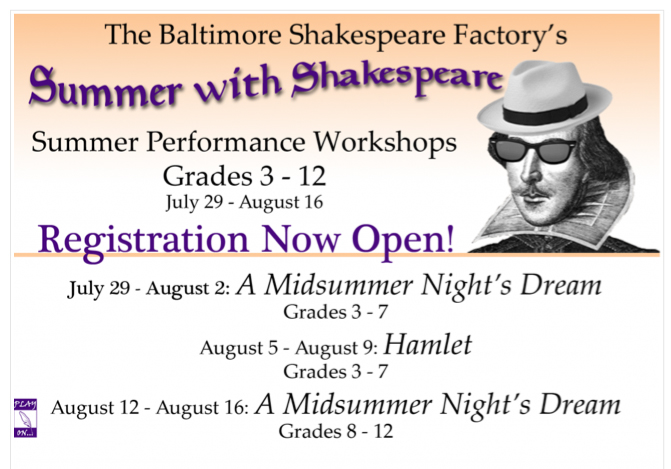
Summer fun with Baltimore Shakespeare Factory

The BSF's Summer with Shakespeare: Performance Workshops take place  July 29 - Aug 16.

The BSF’s Summer with Shakespeare: Performance Workshops take place July 29 – Aug 16.

If you:

  • live near Baltimore, Maryland,
  • are kid about to start 3rd to 12th grade,
  • and you like Shakespeare

… boy do I have a deal for you!

The Baltimore Shakespeare Factory is offering three, one week long workshops that will allow kids to experience what it might be like to travel back in time to the 1600s and be a part of the fun and excitement of Shakespeare’s acting company–The King’s Men. The BSF’s  “Summer with Shakespeare:Performance Workshops” will help students develop acting skills, make friends, build confidence, and develop an appreciation and understanding of Shakespeare’s work.

The campers will:

  • Work one-on-one with professional actors and educators
  • Learn and practice the same acting techniques Baltimore Shakespeare Factory uses in its productions
  • Study Shakespeare’s poetic language in ways that make it easy to understand, and learn how to use to enrich performance
  • Bring some of Shakespeare’s most famous characters to life!

“Shakespeare is a wonderful platform to get the kids active and engaged in group activity that stretches their imaginations as well as their ability to interpret complex language.  And it is a ton of fun!” says Wendy Meetze, Director of Education for the BSF.

This is the second year for the camp in Baltimore City (the camp is held in the Meadow at Evergreen House on Charles). The group, which began in Carroll County, hosted a similar camp starting in 2006 and have taught over 500 students. That Carroll County camp is still going strong on the campus of Century High School.

Students come in all shapes, sizes and from various backgrounds and skill levels. “Kids who are interested in theatre are especially attracted to the workshops” says Meetze, but “we truly believe there is no “typical” Shakespearean student or audience member. Shakespeare wrote for EVERYONE in his time, from peasants to princes.”

The camp will offer a small group setting with lots of one on one coaching. As a non-musical theatre performance camp the focus is squarely on the script, something that sets this camp apart from other performing arts camps in the area. “While the outcome is a production, the curriculum is a healthy mix of various skills needed to make that production a reality,” said Meetze. The campers perform their production prior to the professional company’s Friday performance. “We find the kids learn so much more by comparing and contrasting their version to a full production. There have certainly been occasions where our professional actors have discovered something new during the student’s performance!”

For more information on the camp, including a link to register  CLICK HERE.

Summer clipping

The Baltimore Shakespeare Factory  is dedicated to bringing the works of William Shakespeare to life for audiences of all ages and backgrounds. In Shakespeare’s time (1564-1616), the theater was accessible to everyone, and The Factory prides itself on continuing that tradition by presenting professional quality work at affordable prices.

This year, the group, which is a 501(c)3 non-profit organization, will present Hamlet and Mid Summer Night’s Dream this summer in the Meadow at Evergreen House on Charles Street and at other locals around town.  Click HERE for Hamlet’s schedule. Click HERE for Mid Summer’s Schedule.

Factory productions bring Shakespeare’s works to life in a way that is accessible to modern audiences without compromising the cornerstone of their artistic and literary merit—Shakespeare’s original language. The Baltimore Shakespeare Factory is built on a love of language, and productions are designed to not only help audiences understand Shakespeare’s words, but to love them, too.

This year the BSF launched it’s “4 free, 4 ever!” campaign which hopes to raise $750,000 by April , 2016–the 400th anniversary of Shakespeare’s Death> This will allow the group to present its shows at no cost to the public the following season.

Play on 4 free


Muffin Monday: Rhubarb Delight Muffins

Rhubarb Delight Muffins

IMG_4969

Ingredients:

  • 1/2 C. Brown Sugar

IMG_4936

  • 3/4 C. Demerara Sugar  (You could just use 1 1/4 Brown Sugar if you don’t have the Demerara Sugar)

IMG_4937

  • 1/2 C. Vegetable oil

IMG_4907

  • 1 Egg

IMG_4939

  • 2 1/2 C. Flour

IMG_4908

  • 2 tsp. Baking Soda
  • 1/2 tsp. Salt

IMG_4946

  • 1 C. Milk

IMG_4906

  • 2 tsp. Vanilla

IMG_4540

  • 1 1/2 C. Rhubarb (finely diced)

IMG_4941

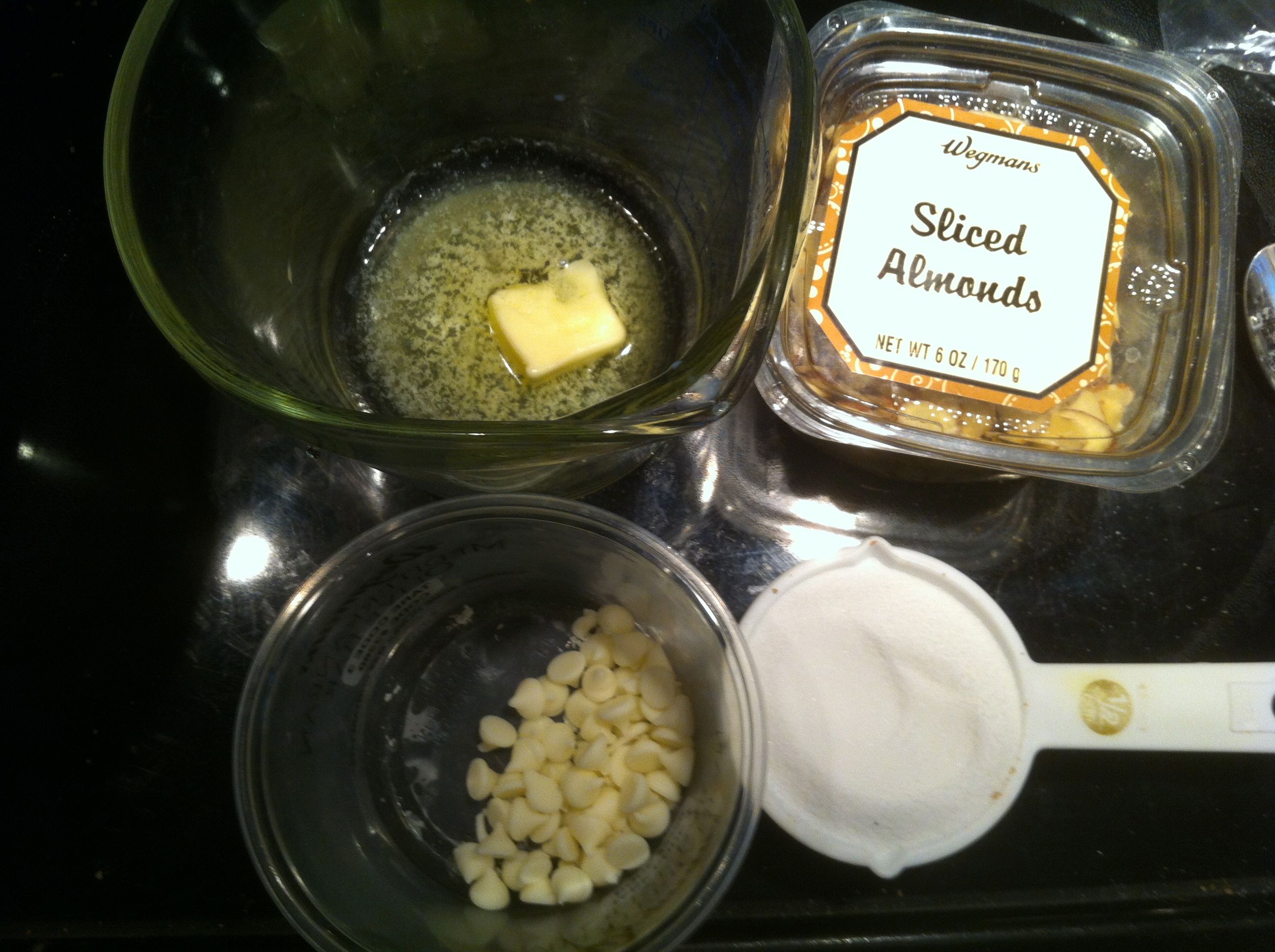
Topping Mixture:

  • 1/4 c White Chocolate Chips
  • 1/2 Almonds
  • 1/2 C. Sugar
  • 2 T. Butter

IMG_4954

Procedure:

1. Pre-heat oven to 350 degrees. Put muffin pants into the muffin tin and spray lightly.

2. Mix the first four ingredients together (the Sugars, Oil and Egg)

IMG_4940

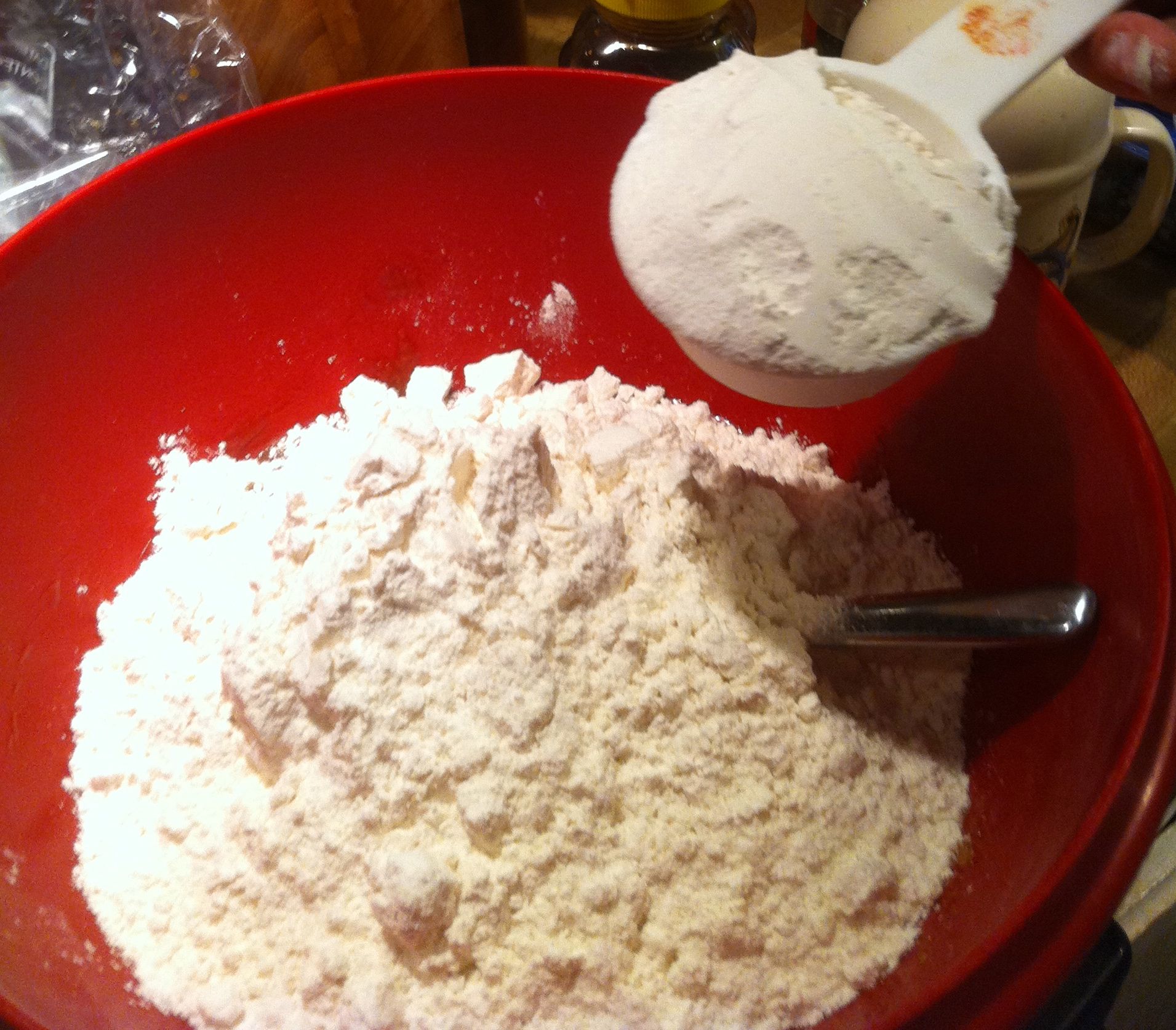
3. Add Flour,Baking Soda and Salt  all at once.

IMG_4947

4. Combine Milk and Vanilla in a measuring cup.

5. Add Milk to the batter and stir until completely mixed.

6. Fold in the diced Rhubarb.

IMG_4952

7. Divide the batter evenly amongst the muffin cups. (This recipe made 12 large muffins.) Set aside and make the Topping.

8. In the measuring cup you used for the milk and vanilla melt the butter.

9. Grind the Almonds in a blender or nut mill.

10. Combine the Nuts, Sugar and ground Almonds together in the measuring cup. Add the White Chocolate Chips.

IMG_4958

11. Spoon the topping onto the muffins, dividing evenly.

IMG_4960

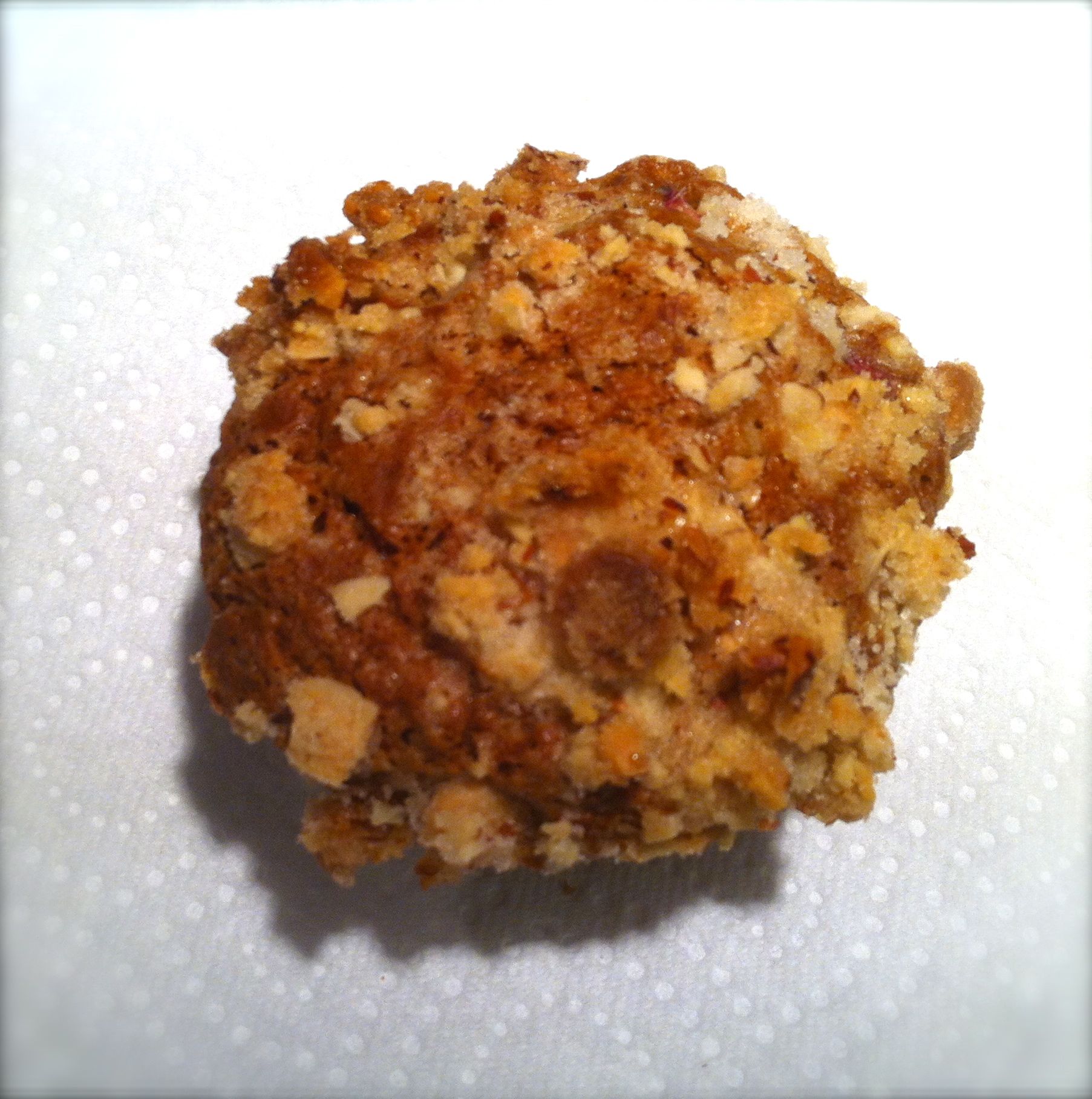
This is what one of the muffins looks like pre-baked

12. Bake for 25-30 minutes. Using the toothpick test to determine if they are done.

IMG_4965

13. Remove from oven and let cool for 5 minutes before transferring muffins to a cool surface. Let cool for an additional 5 to 10 minutes before you enjoy.

IMG_4971

Sorry these muffins aren’t very healthy. I’m going to try to make them again with out so much sugar. But every spring the god’s give us rhubarb and you’ve got to do something with it, right?  Your house will smell amazing while these little darlings are baking. And the will power you show by not munching on them the second they come out of the oven will off set the will power you don’t show by  indulging in their sweet wonderfulness (maybe twice.)

These are simply fantastic muffins and would make a great dessert.

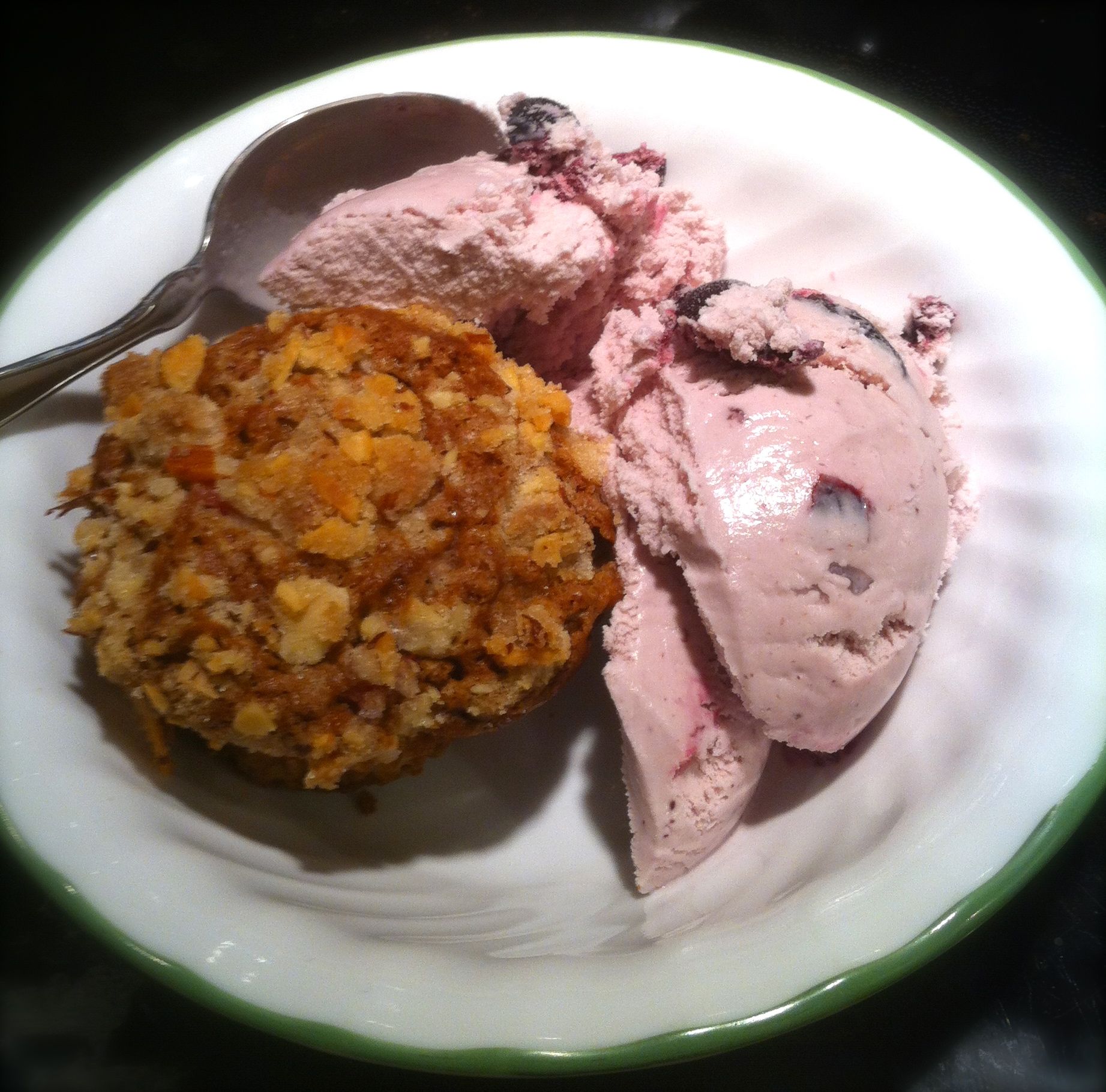
They are awesome on their own, but if you want the ultimate treat you could add one to a bowl of black cherry ice cream and just go straight to heaven.

IMG_4973

Serving suggestion.


Just saying … this is post 401.

400

Yea, so… 400 posts, 34,854views, 594 comments and 234 followers on Word Press (plus a bunch more on Facebook).

I’m coming up on my 1st anniversary (May 25th) as a blogger and I’m really pleased that I haven’t skipped a single day!

I’m considering some changes — my initial goal of “just write something every day” has been achieved, and I’d like to focus more on my creative writing. So I’ll probably only do a Thought of the Day bioBLOG when I find some one really interesting who is having a birthday. But, I am enjoying the recipe blog posts (you seem to like them too, I get my best responses on Muffin Mondays) and Secondary Character Saturdays…  so I’ll keep those up.

What do you think?

Has the experiment been a success?

What was your favorite bioBLOG? (I think mine was Queen Min of Korea, but I really enjoyed all the bios where I learned about some one new.)

Your feed back is really important to me and I can’t thank my readers, followers and  commenters enough. Thank you  x  infinity guys!


Cheers,

Rita (who loves to write)


Secondary Character Saturday: Sean Bean: Odysseus

Today is week three of Sean Bean month on Secondary Character Saturday! . Click HERE  to see the blog on Boromir or HERE for the bog on Ian Howe (from National Treasure). Today’s blog owes a special thanks to my rather amusing and sarcastic family. They had a lot of fun “helping” me write all about Odysseus. Enjoy!

——————————————————-

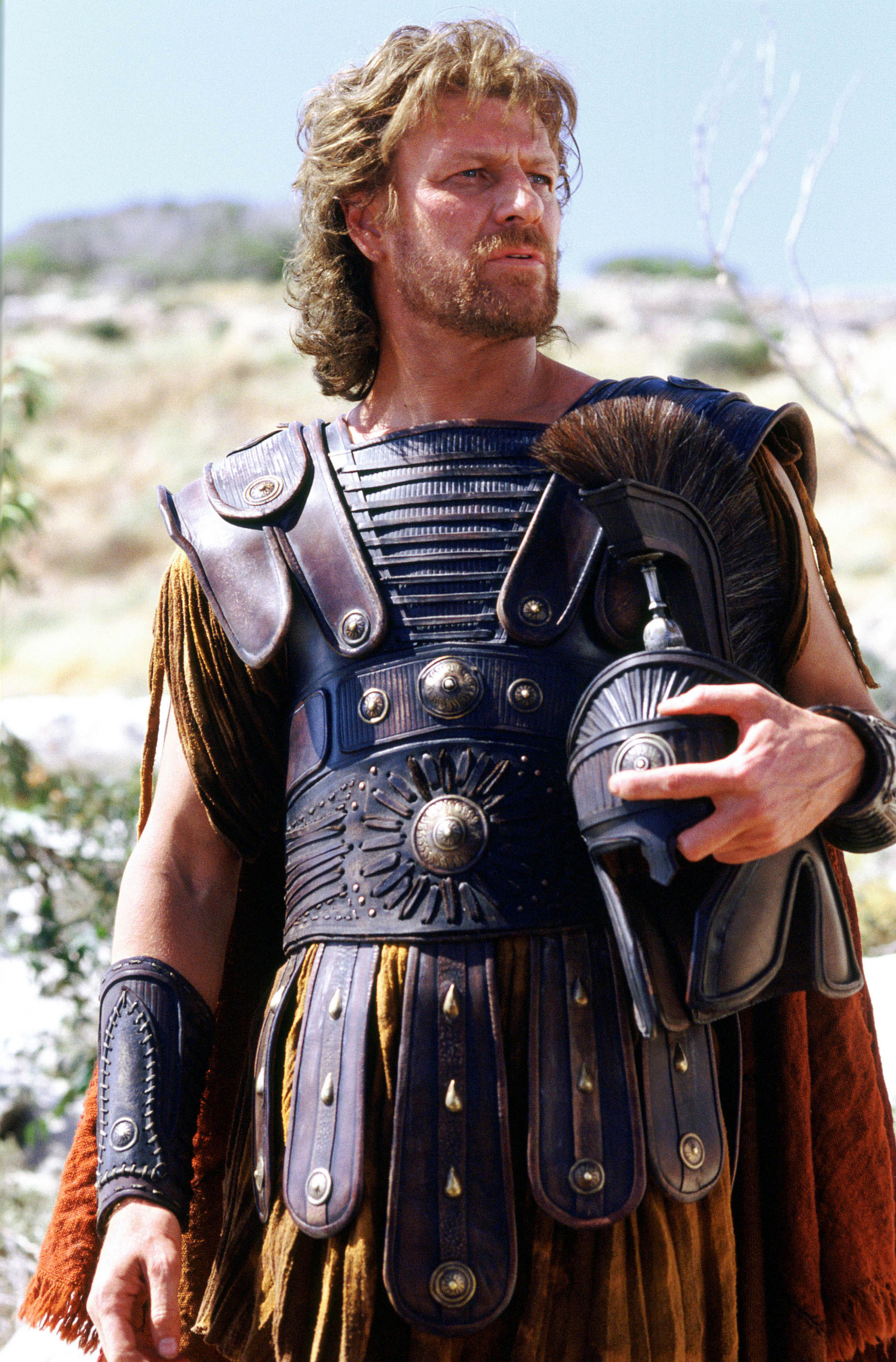
Speak to me oh sages, oh great Athena, Keeper of Wisdom, that my words may bring to life the tale of  (Sean Bean as) Odysseus, that hero of old.

WHO:  Odysseus

[Image courtesy Fanpop.com]
[Image courtesy Fanpop.com]

FROM: The Iliad and The Odyssey and the movie TROY

BY The Iliad and The Odyssey were written by Homer,  The Iliad was roughly adapted  for the screen and renamed “Troy” by  David Benioff

WRITTEN / RELEASED:  The epic poems were “written 800 B.C.E” [The Internet Classics ]; The movie came out in 2004.

PROS: Odysseus is …brave, smart, creative, loyal, realistic, cunning, and an eloquent speaker. He’s good with a weapon and never gave up. He (at least as played by Sean Bean) looks fine in a leather skirt. And he had a large book written about him that we got to read in high school.

The Resourceful Odysseus,… was the trusted advisor and chief lieutenant of Kings Menelaus and Agamemnon throughout the course of the war.  He would fight at the forefront of battle, restore order to the camp when necessary, and his speeches strengthened the resolve of the Greek soldiers to continue their struggle against the Trojans.  When Achilles fell in battle, it was Odysseus who fought his way through the hordes of enemy soldiers and retrieved his body.  At the funeral games following Achilles’ burial, Odysseus defeated Ajax the Greater in a wrestling match to win the title “Bravest of the Greeks”. [Bad Ass of the Week]

CONS: He’s stubborn and a bit quick tempered (just ask the suitors). He went over budget on the Trojan “Horse”  and it doesn’t even LOOK real. He gets along a little too well with the “ladies.” He doesn’t eat bacon — when any chef can tell you EVERYTHING is more epic with bacon. He had a large book written about him that we  HAD to read in high school.

Dispute between Ajax and Odysseus for Achilles...
Dispute between Ajax and Odysseus for Achilles’ armour. Attic black-figure oinochoe, ca. 520 BC. Kalos inscription. (Photo credit: Wikipedia)

MOST SHINING MOMENT: By inventing the Trojan Horse and bravely leading the men inside it he was the game changer in the Trojan War. One does not simple walk into the gates of Troy, you need a plan, and, Odysseus’ plan was both bold and brilliant.

LEAST SHINING MOMENT: Getting drunk with Calypso. Doh!

WHY SEAN BEAN IS SO GOOD IN THE ROLE: In the movie TROY the focus and camera stay sharply on a buffed and bulging muscles of Brad Pitt and the dark eyes of Eric Bana. Our boy Sean Bean just barely makes secondary character status. But when he IS on screen he steals the scene. He’s the one person on the shores of Turkey who seems in touch with reality. And in a movie that strives for epic status he gives a very human performance. He’s open with his emotions. You can see every bit of angst on his face. With Pitt there  is a blankness akin to blandness (that led me, at least,  to boredom.) Maybe that was an acting choice on Pitt’s part — play the demi god with an air of detachment — but for me? I’d rather watch more of Odysseus’s story.

To read the Iliad on line click HERE.

To read the Odyssey on line click HERE.


Emergency Exit Strategy

This post is in response to a writing prompt from Viewfromtheside’s Blog  This weekend’s theme is “Amusing Consequences”.
Click here to go to ViewfromthesideS blog and read other entries.

Although based on a real story names have been changed and circumstances slightly altered.

—————————————————-

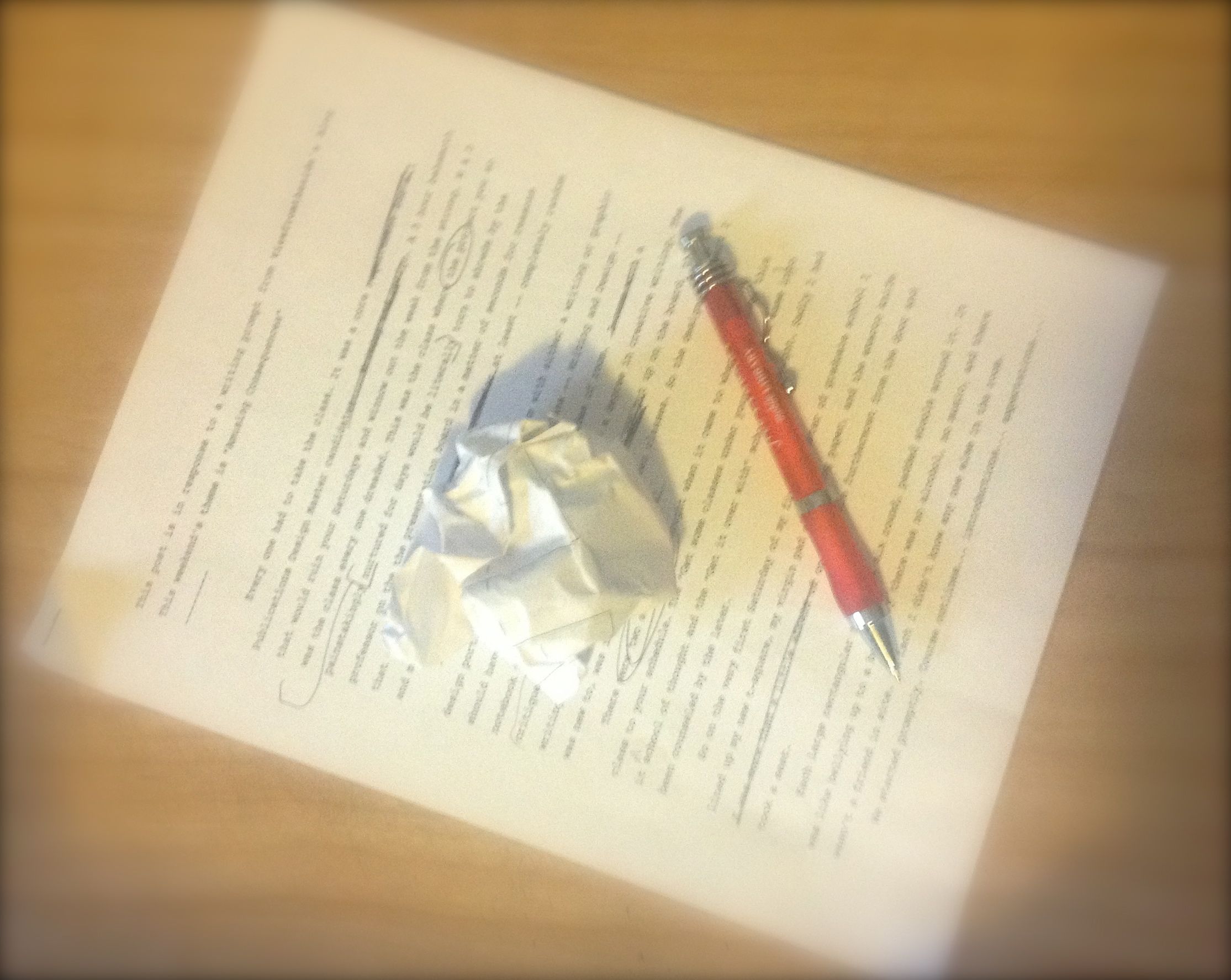
IMG_01542

Emergency Exit Strategy

Every one had to take the class. It was a core requirement for all Publications Design Master candidates… Writing and Design. A 5 hour behemoth that would ruin your Saturdays and winnow out the weak from the strong, W & D  was the class every one dreaded. This was the class where the project you so painstakingly nurtured for days would be literally torn to shreds by the professor on the the presentation board in a matter of seconds for reasons that seemed — at the beginning of the semester at least — completely random and mysterious.

You could enter the Pub Design program with either a writing or graphic design portfolio under your belt. So this class — Writing and Design — should have provoked equal fear from both sides of room.  I came with a notebook full of short stories and poems and a degree in creative writing. The  in-class critiques were based on what design you put up on the board, the writing portion was reviewed later, between classes. So the design, the part I was new to, was immediate — and brutal.

There were two schools of thought when it came to when you added this class to your schedule. The “Get some classes under your belt, and ease in to it” school of thought and the “Get it over with” school of thought. I fell under the second category.

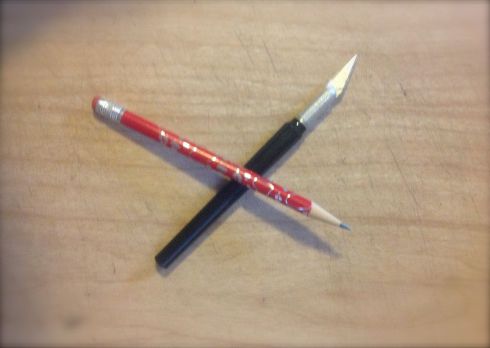
So on the very first Saturday of my first semester of graduate school I lined up my new t-square, my virgin pad of tracing paper, my pencils and my X-Acto knife on the table furthermost from the door and took a seat.

Each large rectangular table had six round, padded stools around it. It was like bellying up to a bar, only there was no alcohol, no music, and there wasn’t a friend in site. In fact I didn’t know any one else in the room.

We started promptly. Course outlines… introductions… expectations… at about the on hour point they asked if we had any questions?

QUESTIONS? My quick look around the room confirmed that everyone was as overwhelmed as I was. No one would be stupid enough to raise their hand and ask a question.

But then the person next to me moved. She didn’t put her hand up, but she definitely changed her body posture to draw attention to herself. “I have a question.” She said in a loud clear voice. Then she went on to ask a long and complicated question that I didn’t understand and have totally forgotten.

It was at this point that I thought I’m sunk. I’m totally out of my league. The excitement of starting graduate school had been slowly eroding in the last hour, but with this bossy girl and her incompressible question I seriously started to wonder if I could quit now and get some of my money back.

The design professor (this class was team taught, so there was one design prof. and one writing prof.) seemed pleased by the inquiry. “Yes, Alissa.” The use of her name with out consulting the class list confirmed that she’d taken classes from him before. The use of his smile meant she’d actually done well in those classes. “I was just about to get to that.”

The look of confusion, dismay and the fact that I was about to be the first person in the room to give up and walk out must have been pretty clear on my face. I tried to take a deep breath and stop the flight impulse. As I s-l-o-w-l-y released the breath I looked up and saw that the man across from me, an ex-Marine in fatigues, had caught my eye. He gave me a stoic nod and the tiniest roll of his hooded eyes.
IMG_0151

Next up we were given a design exercise. A breeze for the experienced designers, a black cloud of confusion for the writers. We were each to come up with a concept sketch for the assignment, share it with our table mates and then present the best one on the board for critique by the rest of the class.

When design time was up Allissa took total control of the table with a fake friendly smile and a “Lets see what everybody’s got.” I pushed my sketch in the pile with a shrug. I knew it was crap. I didn’t know what I was doing.  Starting with the girl sitting on the other side of her, Allissa explained why each sketch wouldn’t work. She allowed for some discussion, and a few people had the confidence and knowledge to speak up, but she was a juggernaut. Time was running out as she approached the end of the pile (mine). She looked at it gave a little sad shake of her head then turned it upside down  with out discussion. Then she held up her sketch. “Here’s my idea, and this is why I think it embraces the concept.” She said it with so much confidence that no one bothered to argue with her. And really it was  a good sketch.

She sashayed up to the cork board and pinned her sketch up to those representing the other 5 tables and a half hour of discussion ensued.

I tuned out. I was tired and hungry and defeated. The chosen few at the front of the room sounded like they were talking in the “Blah, blah, blah” language spoken by the adults in a Charlie Brown Peanuts special. I wasn’t ready to be an adult. I wasn’t ready for this. I concentrated on how fast it would take me to pack my gear and bolt at the break.

Then, mercifully, it was time for lunch. I threw the supplies I had so carefully arranged on the table back into my bag, grabbed my t-square and headed to the door.

But there was a bottleneck at the exit. I wasn’t the only one as anxious for their half hour of freedom.

I felt someone move next to me. Someone big It was my Marine table mate.

He gave me another nod.

“Hey.” I said in greeting.

“First class?” He asked, guessing correctly.

First and only I thought. “Yep.” We moved a forward, closer to the door. Personal space zeroed out as the bodies in the queue compressed.  “You?”

“No, this is my third semester.”

We moved another step to the exit. I was almost free.

“It’s pretty intense.”

Before he could answer we were through the press at the door and into the wider expanse of the hallway.

“Hum.” He agreed. We got to the front door and out into the street.

It felt good to breathe again.

“You’ll feel better after you eat.” He told me knowledgeably.

But I wasn’t going to eat. I was going to flee.

He headed to Main Street at a brisk march. I watched as a gaggle of students parted to make way for him. A Red Sea to his  cammo Moses.

My car was in the green lot, the other way. I took a few steps toward my escape vehicle, away from conflict, away from struggle, away from growth.

Then my stomach growled.

I would feel better after I ate. I turned around an headed to the eateries on Main Street.

When I got back to the class room I went to the table closest to the door — as far away from the other table as possible, and close enough to the door that I could bolt if I changed my mind again. I asked a friendly looking girl if any one was sitting on the stool next to her. No one was.

I  put my bag down and introduced myself. When the Marine came in I nodded to another empty chair at this new, friendlier table. But he shook his head. He would soldier on at the old one… a braver man than I.

“Were you here for the first half of class?” She inquired. Her smile was wide and friendly and full of kindness.

“I was sitting over there.”

At that moment Allissa gave a chortle of laughter that reverberated in the room.

“Ohhh.” My new table mate said knowingly. “Yeah. Good move.”

It was a good move. That nice girl and I became best friends. I stuck with the class and with the master program.

And although I may not have learned a lot in the way of design concepts that day (those would come) I did learn several important lessons that day:

  •  You are in charge of your own talents, don’t let any one dismiss you, least of all that voice in the back of your head.
  • You never know who might be on the other side of the room. It might wind up being a life long bestie.
  •  Just because some one has a big voice and a smidgen of experience that does not mean they are the best leader.
  • You WILL feel better after you’ve had something eat.
IMG_0153


Studs Terkel 5.16.13 Thought of the Day

“Most of us have jobs that are too small for our spirits.”–Studs Terkel

[Image courtesy: NPR.org]

[Image courtesy: NPR.org]

Louis “Studs” Terkel was born on this day in New York City, New York, USA in 1912. Today is the 101st anniversary of his birth.

Studs was the youngest of three boys born to Samuel and Anna Terkel. Both his parents worked in the clothing industry. His father was a tailor and his mother was a seamstress. The family moved to Chicago in 1922 and the Terkels opened a boarding house. There Studs met people from all over the world and listened to their stories.

Terkel later credited his curiosity and comfort with the world’s people to the many tenants he met there. “The thing I’m able to do, I guess, is break down walls,” he once told an interviewer. “If they think you’re listening, they’ll talk. It’s more of a conversation than an interview.” [Biography.com]

He went to the University of Chicago  and in 1934 he earned his law degree. But Studs’ talents lie else where and he didn’t take the Bar exam.

It was the middle of the Great Depression and he joined the WPA working in the radio division of the Writers Project. He found himself both writing and performing on air. He did both scripted work and read the news. Terkel did a stint in the Air Force then came back to radio. He covered the news, sports and eventually got his own interview and music show (he could play what ever he liked, so the show was an eclectic mix of folk, opera, jazz and blues.) In 1945 he made the leap to TV and hosted Stud’s Place.

His first book was Giants of Jazz published in 1956.

In 1966 he published …

his first book of oral history interviews, Division Street: America, … It was followed by a succession of oral history books on the 1930s Depression, World War Two, race relations, working, the American dream, and aging. His last oral history book, Will the Circle Be Unbroken: Reflections on Death, Rebirth, and Hunger for a Faith, was published in 2001.  [Studs Terkel.org]

He says in the preface of Division Street:

I realized quite early in this adventure that interviews, conventionally conducted, were meaningless. Conditioned clichés were certain to come. The question-and-answer technique may be of some value in determining favored detergents, toothpaste and deodorants, but not in the discovery of men and women. [Division Street]

It was better to just turn on the tape recorder and talk — as if your were sitting down to have a drink  at the bar in Stud’s Place.

His 1974 book Working became a Broadway play a few years later and we got to know The Housewife, The Cleaning Women, The Long Distance Trucker, Joe, and a dozen or so other every day characters that had never made it to the stage before.

In 1988 Terkel appeared as Hugh Fullerton in the John Sayles movie 8 Men Out about the Chicago Black Sox scandal.

He was still writing into the 21st Century, his last book, P.S.: Further Thoughts from a Lifetime of Listening, was released in 2008, but open heart surgery in 2005 (at 93) slowed him down — and forced him to stop his habit of smoking two cigars a day.

Studs died on Halloween Day of 2008. He was 96 years old.


Recommended Links:


L. Frank Baum 5.15.13 Thought of the Day

“Imagination has brought mankind through the dark ages to its present state of civilization. Imagination led Columbus to discover America. Imagination led Franklin to discover electricity.”– L. Frank Baum

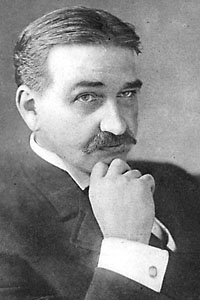
[Image courtesy: xyz
[Image courtesy: QOTD.org]

Lyman Frank Baum was born on this day in Chittenango, New York, USA in 1856. today is the 157th anniversary of his birth.

Frank was the seventh of nine children born to Benjamin and Cynthia Baum. The Baums were wealthy. Benjamin made his fortune in the oil fields of Pennsylvania. And Frank grew up happy at the family estate of Rose Lawn. He was a shy child, and, because of a “weak heart,”  he was home schooled for most of his life. He loved to read and spent hours in his father’s library. He didn’t like classical fairy tales — their goblins and villains were too scary — so he made up his own stories and shared them with his brothers and sisters.

When he was twelve his father… hoping to toughen Frank up and cure him of his ‘daydreaming,’ sent him to the Peekskill Military Academy. Baum was miserable there for over a year, and the only results of the experiment were a physical (and possibly also psychological) breakdown, and a lifelong aversion to both formal education and the military. [The Oddness of Oz]

Once home he turned to creative writing. His father bought him a small printing press and, along with his little brother Harry, “he started his own newspaper, the Rose Lawn Home Journal” [the Literary Network]. Frank filled the pages, honing his craft by cranking out articles, fiction and poetry. Other publications included Baum’s Complete Stamp Dealers’ Directory an 11 page  booklet for amateur philatelist and The Poultry Record in which Baum wrote about Hamburg chickens. “He would also write about the raising and breeding of chickens in The Book of Hamburgs. (1896)” [Ibid]

He became fascinated with acting and the theater.

He developed an intense and enduring fascination with the theater. In 1878, he began to work as a professional actor. Four years later his father bought him a small dramatic company, and Baum was soon adapting and starring in a romantic melodrama, The Maid of Arran [The Oddness of Oz]

Baum as Hugh Holcomb in Maid from Arran. [Image courtesy: Hungry Tiger Press.com]

But Baum had bad luck in almost every business endeavor he put his hand to. The Maid of Arran was a moderate success, but while he was touring with the play his theater back home (the one his father bought him) burned down. The company lost the building, all the sets and costumes, and all of the scripts (except those they were traveling with). Ironically the Baum play that was running at the time was called “Matches.”

Other short-lived opportunities soon soured. And he struggled for long-term success. In 1882 he married Maud Gage. Now he had a family to provide for. The time of being a daydreamer were over.

The family moved Aberdeen, South Dakota where he opened a department store, Baum’s Bazaar. The store failed — Frank let people have too much store credit. He became an editor of The Aberdeen Saturday Pioneer, where, after the Massacre at Wounded Knee, he wrote (what one hopes was) a Swiftian inspired modest proposal that all Native Americans be exterminated…

“Having wronged them for centuries, we had better, in order to protect our civilization, follow it up by one more wrong and wipe these untamed and untamable creatures from the face of the earth.”

He tried his hand at managing a baseball club and worked as a buyer for a department store. Nothing seemed to stick.

Baum moved the family to the Humboldt Park neighborhood of  Chicago in 1891. He worked as a reported for the Evening Post, edited a magazine on window displays and worked as traveling salesman.

In 1897, he finally started to have some success with his writing.   Mother Goose in Prose, stories based on traditional Mother Goose poems paired with lovely Maxfield Parrish illustrations, sold well enough that he could quit his door-to-door salesman job. Two years later Baum published Father Goose, His Book this time with W.W. Denslow as his illustrator and had even greater success.

Cover of the first edition of the Wonderful Wizard of Oz [Image courtesy: Loc.gov]

Cover of the first edition of the Wonderful Wizard of Oz [Image courtesy: Loc.gov]

In 1989 he wrote the Wizard of Oz. It was published in 1900, again with Denslow as illustrator, and cost $1.50 a copy.

Unlike other books for children, The Wizard of Oz was pleasingly informal; characters were defined by their actions rather than authorial discourse; and morality was a subtext rather than a juggernaut rolling through the text. [SmithsonianMag.org]

Baum wrote 13 more Oz books (some coming as frequently as one a year.) He had done more than write a best seller, he had created a new genre of fiction… The American Fairy Tale.

He wrote dozens of other books, from Dot and Tot of Merryland to The Life and Adventures of Santa Claus to his last book Phoebe Daring: A Story for Young Folk, but the Oz books were his bread a butter best sellers.

The family moved to Hollywood, California and Baum tried his hand at making silent films with the creation of the Oz Film Manufacturing Company. He wrote, directed and acted with the company which used experimental film effects to capture some of Baum’s fantastic themes. He also  worked with the Uplifters theatre troupe.

L. Frank Baum died of a stroke on May  6th, 1919.

“To please a child is a sweet and lovely thing

that warms one’s heart and brings its own reward.”

–L. Frank Baum

An illustration by W. W. Denslow from The Wond...
An illustration by W. W. Denslow from The Wonderful Wizard of Oz, also known as The Wizard of Oz, a 1900 children’s novel by L. Frank Baum. (Photo credit: Wikipedia)

Cate Blanchett 5.14.13 Thought of the Day

“If you know you are going to fail, then fail gloriously.”– Cate Blanchett

English: Actress Cate Blanchett at the 2011 Sy...

English: Actress Cate Blanchett at the 2011 Sydney Film Festival. (Photo credit: Wikipedia)

Catherine Élise Blanchett was born on this day in Melbourne, Victoria, Australia  in 1969. She is 44 years old.

She is the middle child born to Bob and June Blanchett. Her parents met by chance when her father — a Petty Officer in the US Navy —  was on leave in Melbourne (his ship, The USS Arneb was docked in the harbor for repairs.)

She grew up in the  Ivanhoe neighborhood where she went to Ivanhoe Girl’s Grammar School and Methodist Ladies College (secondary school). She attended the University of Melbourne where she studied economics and fine arts. She continued her education at the National Institute of Dramatic Art.

Her professional acting career started on the Sydney stage  and she landed her first big role in Oleanna by David Mamet in 1992.

For her … performance, Blanchett won the Sydney Theatre Critics Circle Newcomer Award in 1993. She also received critical acclaim for roles in the theater productions of Hamlet, The Tempest and The Seagull. [Biography.com]

She made her film debut in 1997’s fabulous Paradise Road with Glenn Close and Frances McDormand. She plays a nurse, Susan, in an internment camp on Sumatra during World War II. The women of the camp form a vocal orchestra to keep their spirits up in the face of harsh conditions and cruel punishments.

Blanchett and McDormat in Paradise Road [Image courtesy: FanPop.com]

Blanchett and McDormand in Paradise Road [Image courtesy: FanPop.com]

Also in 1997 she made the period drama Oscar and Lucinda with Ralph Fiennes. The following year she starred as Queen Elizabeth I  in Elizabeth. She won a BAFTA and Golden Globe for the role (and was nabbed her first Academy Award nomination). She mixed additional movie roles  (An Ideal Husband,  The Talented Mr. Ripley, The Gift) with a starring role in Plenty on London’s West End.

Middle Earth came calling in 2001 when Peter Jackson cast her as Galadriel in the film adaptation of  J.R.R. Tolkien‘s The Lord of the Rings, The Fellowship of the Ring. Her performance as the beautiful, powerful Elf Queen was reprised in The Two Towers, The Return of the King and The Hobbit.

Cate Blanchett portrays Galadriel in The Lord ...

Cate Blanchett portrays Galadriel in The Lord of the Rings film trilogy. (Photo credit: Wikipedia)

In the Aviator Blanchett took on the role of film icon Katharine Hepburn. She won an Oscar for her performance opposite Leonardo DiCapro in the 2005 film. The following year she continued her run of roles in which she starred opposite A list actors, incluidng Brad Pitt in Babel, George Clooney in The Good German and Dame Judi Dench in Notes on a Scandal.

She rounded out the decade by:

  • getting rave reviews as one of six actor embodying the persona of Bob Dylan in I’m Not Here
  • repeating her performance as Elizabeth Rex in Elizabeth: The Golden Age (The first one was much better than this sequel.)
  • playing a KGB agent, Irna Spalko, in Indian Jones and the Kingdom of the Crystal Skull
  • starring opposite Pitt again, this time in The Curious Case of Benjamin Button

In 2010 Blanchett donned another long gown, this time for her role as Marion Loxley in Ridley Scott’s action packed version of Robin Hood. The following year she showed her very nasty side in Hanna.

Coming up for Blanchett is a Woody Allen film, Blue Jasmine, due out this July,  and a duo of Terrance Malick  films that are currently in post-production, Lawless and Knight of Cups.

The Curious Case of Benjamin Button (film)

The Curious Case of Benjamin Button (film) (Photo credit: Wikipedia)