Category Archives: postaday

Leonard Bernstein 8.25.13 Thought of the Day

English: Leonard Bernstein

English: Leonard Bernstein (Photo credit: Wikipedia)

Louis Bernstein was born on this day in Lawrence, Massachusetts in 1918. Today is the 95th anniversary of his birth.

His parents, Jennie and Samuel Bernstein, were hard working Ukrainian  immigrants.  Although his birth cirtificate said ‘Louis’ everyone called him Leonard or Lenny. He officially changed his name when he was about 16.

His love affair with the piano began almost by accident when he was 10.

His Aunt Clara was going through a divorce and needed a place to store her massive upright piano. Lenny loved everything about the instrument, but his father refused to pay for lessons. Determined, the boy raised his own small pot of money to pay for a few sessions. He was a natural from the start, and by the time his bar mitzvah rolled around, his father was impressed enough to buy him a baby grand piano. The young Bernstein found inspiration everywhere and played with a voracity and spontaneity that impressed anyone who listened.  [Biography.com]

He attended Garrison Grammar School and Boston Latin School before going to Harvard University. In college he studies Music theory. 

In 1937, he attended a Boston Symphony concert conducted by Dmitri Mitropoulos. Bernstein’s heart sang when he saw the bald Greek man gesture with his bare hands, exuding a rare kind of enthusiasm for every score. At a reception the next day, Mitropoulos heard Bernstein play a sonata, and he was so moved by the young man’s abilities that he invited him to attend his rehearsals. Leonard spent a week with him. After the experience, Bernstein was determined to make music the center of his life. [Ibid]

After Harvard he went on to  the Curtis Institute of Music in Philadelphia to study conducting with Fritz Reiner and  Berkshire Music Center at Tanglewood.

Leonard Bernstein, 1944

Leonard Bernstein, 1944 (Photo credit: Wikipedia)

He landed a job with the New York Philharmonic and conducted his first concert on November 14, 1943. He went on to conduct internationally.

Bernstein wrote his first operetta, Candide in 1956. His second work for the stage was a collaboration with Jerome Robbins, Arthur Laurents andStephen Sondheim, the beloved musical West Side Story. When it opened, the show garnered unanimous rave reviews, matched only by its movie version released in 1961. [Ibid]

Here’s a two hour plus concert presentation of Candide…

And here’s a cool 10 minute mash up of modern day and original Broadway casts of West Side Story rehearsing for a Broadway Cares event…

[ANITA! 3:46  she still rocks!]  [Click here to see my BioBlog on Secondary Character Saturday: Anita]

Rehearsal photo for West Side Story

Rehearsal photo for West Side Story (Photo credit: Wikipedia)
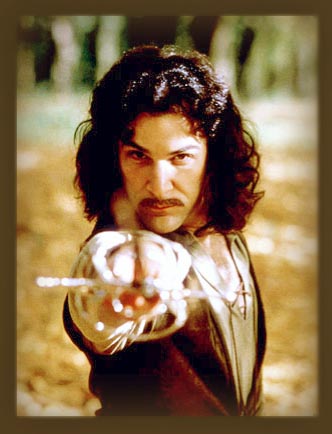

Secondary Character Saturday: Inigo Montoya

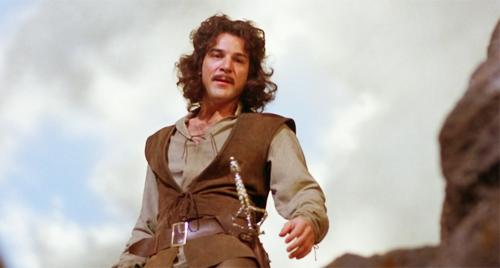
"Hello..." Mandy Patinkin brilliantly plays Inigo Montoya in the 1987 film version of The Princess Bride

“Hello…” Mandy Patinkin brilliantly plays Inigo Montoya in the 1987 film version of The Princess Bride [Image courtesy: 20th Century Fox]

WHO: Inigo Montoya (The Spaniard)

FROM: The Princess Bride

The Princess Bride

The Princess Bride (Photo credit: Rev Dan Catt)

BY: William Goldman (Movie directed by: Rob Reiner)

WRITTEN: 1973 (Movie produced: 1987)

PROS: Inigo is mysterious, dedicated to his friends, has a high sense of honor, is an excellent — ambidextrous — swordsman, and (despite two disfiguring scars on his cheeks) is handsome as all get out.

He has a nice sense of ironic humor — as evidenced in this passage from the book as Inigo, Fezzik, Vizzini and Buttercup are escaping from Florin to Guilder.

“No one could be following us yet?” the Spaniard asked.

“No one,” the Sicilian assured him. “It would be inconceivable.”

“Absolutely inconceivable?”

“Absolutely, totally, and in all other ways, inconceivable,” the Sicilian reassured him. “Why do you ask?”

“No reason,” the Spaniard replied. “It’s only that I just happened to look back and something’s there.”

They all whirled.

Something was indeed there. Less than a mile behind them across the moonlight was another sailing boat, small, painted what looked like black, with a giant sail that billowed black i the night, and a sing man at the tiller. A man in black.

The Spaniard looked at the Sicilian. “It must just be some local fisherman out for a pleasure cruise alone at night through shark infested waters.”

[in the movie Vizzini gets the punch line, but this is the way Goldman wrote it.]

Map of Florin and Guilder.

Map of Florin and Guilder. (Photo credit: Wikipedia)

CONS: His single-minded need for revenge against the six-fingered man (the man who killed his father) has consumed his life. Clearly Inigo is man of great passion and talent, if that passion and talent had been used for something other than revenge just think how much he would have been able to accomplish in life. He’s headstrong and doesn’t think things through.

Inigo awaits the Man in Black at the top of the Cliff

Inigo awaits the Man in Black at the top of the Cliff [Image courtesy: 20th Century Fox]

MOST SHINING MOMENT: It’s hard not to pick the scene where Inigo gets his revenge on the six-fingered man, but I’m going to go with something that happens earlier in the book.

As INCONCEIVABLE as it seems the Man in Black (Wesley) has almost caught up with the Inigo and rest in his boat. Buttercup, Inigo and Vizzini have hitched a ride on the giant, Fizzik, as he climbs a rope up the Cliffs of Insanity, and Wesley follows them up the rope. Once the group of outlaws gets to the top Vizzini orders the rope cut. But Wesley manages to grab onto the cliff before he falls. While Vizzini and Fizzik take Buttercup inland Inigo is left to deal with the Man in Black. He waits (somewhat impatiently) for Wesley to finish the climb and even throws down some rope to assist him. When, at last, Wesley has gained the top of the cliff Inigo could have easily slain the exhausted rescuer. Instead the Spaniard waits for him to recover… before engaging in the MOST AWESOME SWORD FIGHT EVER FILMED.

QUOTE:

WHY I CHOSE INIGO: I love that Inigo is flawed but determined. With out his (and Fizzik’s) comic relief the book would have sappy.  His history gives the novel some tender depth. And he is brilliantly played by Mandy Patinkin in the 1987 movie.

 "I see you have studied your Agrippa."

“I see you have studied your Agrippa.” [Image courtesy: 20th Century Fox]

If you’ve never read the Princess Bride I strongly suggest you add it to your “must read” pile. It is just too fun not to read, and like most books, it gives you more for your buck than does the movie. That says a lot considering the movie is fabulous. Click here to get to the Amazon Princess Bride page. (Try and get the book in hard copy it is something you’ll want to have around for your children and grandchildren.)


Gene Kelly 8.23.13 Thought of the Day

Promotional photograph of actor Gene Kelly.

“I got started dancing because I knew it was one way to meet girls” — Gene Kelly

Eugene Curran Kelly was born on this day in Pittsburg, Pennsylvania in 1912. Today is the 101st anniversary of his birth.

He was the third of five children  born to James and Harriet Kelly. His mother enrolled Gene and one of his brothers in dance classes but the boys bulked. Gene would rather play baseball than dance. He dreamed of playing shortstop for the Pittsburg Pirates. He returned to the dance studio by the time he was 15.

Kelly put his lessons to good use in college, teaching at a local studio to help him pay for his education. He also performed with his brother, Fred. [Biography.com]

Kelly went to the University of Pittsburg as an Economics  major. He also participated in the Cap and Gown Club which put on musicals. He recieved his BA in Economics in 1933 then went on to Law School at Pitt.

Gene Kelly's senior picture in the 1933 yearbo...

Gene Kelly’s senior picture in the 1933 yearbook of the University of Pittsburgh (The Owl). (Photo credit: Wikipedia)

His family opened two dance studios (one in 1932, the second in 1933) and Gene taught dance when he wasn’t studying. He eventually managed the studios. But in 1937 he moved to New York to make his way as a full time entertainer.

After “small roles in Leave It to Me! starring Mary Martin, and One For the Money” [Ibid] Kelly hit it big with the lead in Pal Joey. By 1942 he’d landed a movie contract with MGM and had made his film debut in For Me and My Gal with Judy Garland.

Other highlights in Kelly’s amazing career include:

  • Anchors Aweigh
  • On the Town
  • An American In Paris
  • Singing in the Rain
  • Inherit the Wind
  • Brigadoon
  • Summer Stock

Here are few clips to get your toes tapping…

And…

Kelly had a temperature of 103 when they filmed that btw.


Ray Bradbury 8.22.12 ritaLOVEStoWRITE

Photo of Ray Bradbury.

Photo of Ray Bradbury. (Photo credit: Wikipedia)

“I believe in libraries because most students don’t have any money. When I graduated from high school, it was during the Depression, and we had no money. I couldn’t go to college, so I went to the library three days a week for 10 years.”

“There are worse crimes than burning books. One of them is not reading them.”

“I don’t try to describe the future. I try to prevent it.”

“We are cups, constantly and quietly being filled. The trick is, knowing how to tip ourselves over and let the beautiful stuff out.”

“First you jump off the cliff and you build wings on the way down.”

— Ray Bradbury

Ray Douglas Bradbury was born on this day in Waukegan, Illinois in 1922. Today is the is the 91st anniversary of his birth.

He was born to Leonard and Moberg Bradbury. He “enjoyed a relatively idyllic childhood in Waukegan” [Biography.com] where he enjoyed reading (he was a big fan of “Frank Baum, Jules Verne and Edgar Rice Burroughs”  [Ibid] His family moved between Tucson Arizona and Waukegan when he was a boy, and Ray began to write when he was about 11. This was during the Depression and he sometimes had to write on butcher’s paper.  The family moved to LA in 1934 and Bradbury continued to hone his craft. “His first official pay as a writer came for contributing a joke to George Burns‘s Burns & Allen Show.” [Ibid] He thrived in Los Angeles. He would roller skate from the gates of the film studios to dinner clubs like the Brown Derby to star gaze and collect autographs.

When he graduated from Los Angeles  High School in 1938 and wanted to go to college, but he couldn’t afford it. He went to the library instead. He sold newspapers at South North Ave and Olympic Boulevard to support himself as he wrote. In 1939 he started his own magazine, Futuria Fantasia

 Nearly every piece in the magazine was written by Bradbury himself; he used a variety of pseudonyms to try to hide the fact that the magazine was a virtual one-man show. “I was still years away from writing my first good short story,” he later said, “but I could see my future. I knew where I wanted to go.” [Ibid]

[Annual collections of Futuria Fantasia are available for free for Kindle at Amazon.com.]

Bradbury sold his first professional story, “Pendulum” to Super Science Stories in November of 1941 for a whopping $15.00. By then he was writing every day, a habit he continued for the rest of his life.

His works include

  • short stories
  • novels
  • plays
  • screenplays
  • television scripts
  • verse
Ray Bradbury

Ray Bradbury (Photo credit: Wikipedia)

perhaps most famous among his over 500 published manuscripts were four books…

  • The Martian Chronicles (1950)
  • The Illustrated Man (1951)
  • Something Wicked This Way Comes [1962]
  • Fahrenheit 451 (1953)
Ray Bradbury

Ray Bradbury (Photo credit: Wikipedia)

It is the latter that is perhaps my favorite. In it Bradbury predicts a dystopian future where firemen set fires to burn books.  (Paper burns at 451 degrees Fahrenheit)

The people in this society do not read books, enjoy nature, spend time by themselves, think independently, or have meaningful conversations. Instead, they drive very fast, watch excessive amounts of television on wall-size sets, and listen to the radio on “Seashell Radio” sets attached to their ears. [Sparknotes.com]

[You can read Farenheit 451 HERE — or go for the ultimate ode to Bradbury …and roller skate to the LIBRARY  to read it there!]

He wrote into his 90’s. He died at the age of 91 on June 5th, 2012.

Ray Bradbury's Legacy

Ray Bradbury’s Legacy (Photo credit: Sam Howzit)


Farm Fresh Challenge: Tomato & Turkey Sauce with Ziti

This week's CSA box from Calverts Gift included: Green beans, tomatoes, french  fingerling potatoes, sweet peppers, escarole, head lettuce, cherry tomatoes, rapini. I also picked up some purple sage from the extras box

This week’s CSA box from Calverts Gift included: Green beans, tomatoes, french fingerling potatoes, escarole, head lettuce, cherry tomatoes, rapini. I traded out the sweet peppers for extra potatoes.  I also picked up some purple basil from the extras box

Goin’ old school with the Farm Fresh Challenge today and keeping it simple with my recipe for Tomato Sauce.

INGREDIENTS from the  BOX:

  • 4 Tomatoes
  • 12 Cherry Tomatoes
  • 1 bunch Purple Basil
  • Rapini

INGREDIENTS from previous BOX:

  • 1 head of Garlic

INGREDIENTS from the PANTRY:

  • 1 Tbls butter
  • Salt and Pepper
  • 1 teaspoon Olive Oil
  • 1 pound lean Ground Turkey
  • 1/2 cup Italian Bread Crumbs
  • 1 pound Ziti
  • shredded Italian Cheese

DIRECTIONS:

1. Peel the Garlic. Mince the cloves.

2. Heat the butter in a large pot on the stove. When the butter is melted add the Garlic and brown.

3. Add the Purple Sage and cook for 1 minute.

4.  Peel the large Tomatoes, chop into 1/2″ chunks and add to the Garlic. Cut the Cherry Tomatoes in half and add to the pot.

5. Stirring occasionally so the Tomato Sauce doesn’t stick to the pot cook until the Tomatoes are very soft. About 15 minutes.

6. Add Salt and Pepper to taste.

7. Remove to a bowl.

8. Add the Olive Oil to the pot then add the Ground Turkey. Brown completely.

9. Add the Italian Bread Crumbs and cook a few minutes longer.

10. Put the Ground Turkey in with the Tomato Sauce and wipe out the pot.

11. Fill the pot with 4 to 6 quarts of water and bring to a boil. Add the Ziti and a dash of Olive Oil and cook for 14 minutes (or follow directions on package.) When Ziti is tender drain in a collider.

12. Combine the Ziti with the Tomato/Ground Turkey Sauce in the pot, cover and set aside.

RAPINI

Rapini is similar to Brocoli Rabe. Both the stems and leaves are edible. Today well eat the stems.

1. Trim the bottom 1/4″ from the Rapini stems and discard. Cut stems in 1/2″ pieces up to the leaves (which you can save for another meal.)

2. In a second, smaller pot heat 1/2″ of water to boiling. Add the Rapini stems when the water is ready and boil for 5 minutes.

3. Drain and plate with the Ziti.

Garnish with Shredded Italian Cheese.

Tomato Sauce

The great thing about Tomato Sauce is you can add a little of this or a little of that to suit your needs. Next week I’ll be in the kitchen with my nephew who started his own garden this year.  He’s got some Ground Venison in the freezer and I think we’ll try that instead of (or maybe in addition to) the Turkey. Or you could leave out the meat all together.  I also like Onion (but didn’t have any in the pantry. So I’d add that. Pepper is always a nice add in (if everybody can tolerate it. Mushrooms too.

What else to do you add to your Sauce?


Benjamin Harrison 8.20.13 Thought of the Day

“I pity the man who wants a coat so cheap that the man or woman who produces the cloth will starve in the process.” — Benjamin Harrison

Portrait of the 23rd U.S. president Benjamin H...

Portrait of the 23rd U.S. president Benjamin Harrison. (Photo credit: Wikipedia)

Benjamin Harrison was born on this day in North Bend, Ohio in 1833. Today is the 180th anniversary of his birth.

Benjamin was the second of eight children born to John and Elizabeth Harrison at their farm near Cincinnati, Ohio. He went to school in a one-room schoolhouse as a child. For college he attended Farmer’s College in Cincinnati. He went on to study law at Miami University in Oxford, Ohio.

He married Caroline Lavinia Scott on October 20, 1853. The moved to Indianapolis, Indiana the following year and he began to practice law. When the Civil War broke out he was commissioned as a second lieutenant in the 70th Indiana Infantry. Eventually he earned the rank of brigadier general.

Colonel Benjamin Harrison

Colonel Benjamin Harrison (Photo credit: Wikipedia)

With  his strong political pedigree — which includes

  • a signer of the Declaration of Independence, Benjamin Harrison V  and
  • his grandfather, the ninth President of the United States, William Henry Harrison

he seemed destined to enter the political arena. He ran for Governor of Indiana in 1872 & 1876.

The Democrats defeated him for Governor of Indiana in 1876 by unfairly stigmatizing him as “Kid Gloves” Harrison. In the 1880’s he served in the United States Senate, where he championed Indians. homesteaders, and Civil War veterans. [Whitehouse.gov]

He was in the Senate from 1881 to 1887. In 1888 he ran against Grover Cleveland for US President. Harrison won all the Northern states except Connecticut, New Jersey, Delaware, Maryland, West Virginia, Kentucky and Missouri.

English: This image is based off this image fr...

English: This image is based off this image from Wikipedia, which in turn is based off this image from the Commons. (Photo credit: Wikipedia)

Cleveland took all the Southern states.  Cleveland actually had 100,000 more popular votes, but Harrison won the Electoral College 233 to 168.

U.S. President Benjamin Harrison.

U.S. President Benjamin Harrison. (Photo credit: Wikipedia)

Highlights of the Harrison Administration include:

  • The first Pan American Congress (1899)
  • The Dependent and Disability Pension Act
  • Naval expansion
  • The McKinley Tariff
  • The Sherman Antitrust Act

He was the first President to have his voice captured on a recording when Giuseppe Bettini used a wax phonograph cylinder to record this 36 second clip…

When Harrison entered office there was a significant treasury surplus. He chose to spend it on  internal improvements and on pensions to Civil War veterans, their wives and children.  Harrison, his Republican House and Senate were dubbed “the Billion-Dollar Congress”

English: Harrison portrayed as wasting the sur...

English: Harrison portrayed as wasting the surplus gained under Cleveland (Photo credit: Wikipedia)

Long before the end of the Harrison Administration, the Treasury surplus had evaporated, and prosperity seemed about to disappear as well. Congressional elections in 1890 went stingingly against the Republicans, and party leaders decided to abandon President Harrison although he had cooperated with Congress on party legislation. Nevertheless, his party renominated him in 1892, but he was defeated by Cleveland. [Whitehouse.gov]

Republicans in the West peeled off to join the Populist Party (whose candidate, James Weaver, ran on a platform that included an 8-hour work day, better pensions for veterans and free silver.)

To make matters worse for Harrison his beloved Caroline was loosing her long fought battle against tuberculosis. Harrison’s decision to stay at the ailing Caroline’s side — and not go on the campaign trail — probably didn’t help his campaign bid. Caroline died a mere two weeks before election day.  Cleveland won the election soundly.

Benjamin Harrison, former President of the Uni...

Benjamin Harrison, former President of the United States. (Photo credit: Wikipedia)

Harrison travelled the country after his defeat, enjoying his role as “dignified elder statesman” [Ibid]. In 1896  at age 62 he married Caroline’s former secretary (and niece) the 37-year-old widow Mrs. Mary Scott Lord Dimmick. It was a bit of a family scandal since his adult children, Russel and Mamie were both older than his new wife. Mary bore Harrison another child, Elizabeth in 1897.

He caught influenza in February of 1901. It worsened to pneumonia and he passed away in March, 1901.

English: US Postage stamp: Benjamin Harrison, ...


Muffin Monday: Apple Butter Chocolate Chip Muffins

Apple Butter Chocolate Chip Muffin

Apple Butter Chocolate Chip Muffin

INGREDIENTS:

Apple butter

DIRECTIONS:

1. Preheat the oven to 400 degrees and prepare muffin cups by spraying with baking spray.

2. In a large bowl combine Flour, Sugar, Baking Powder, Cinnamon, Salt, Nutmeg, Ginger, and Just Whites.

3. In a measuring cup combine the Milk, Oil and water. Stir into dry ingredients.

4. Add Apple Butter to batter. Mix well.

5. Add grated Beets or Zucchini and Mini Chocolate Chips. Fold in until incorperated.

6. Divide batter evenly into 12 muffin cups. Sprinkle a half dozen or so additional mini chocolate chips on top.

Apple Butter Choc Chip in pan

7. Bake for 15-18 minutes until the tops of the muffin are slightly brown and they pass the tooth pick test.

8. Remove from oven and cool for 5 minutes before enjoying.

single baked

I brought a couple of these to my knit group and had those ladies act as tasters. Virginia K. liked the chocolate chips, but thought they were too salty. Sheila S. liked the texture and the moisture level. She also liked they way the chocolate chips and beets were evenly distributed through out the muffin. But she found that the flavors were a bit too distinct and didn’t blend well. Maggie S. thought these were too moist. They were not her favorite muffins.

Personally I liked the stronger flavors of the ginger, cinimmon and nutmeg. I also liked the way the chocolate and spices worked with each other.

Let me know what you think!


Ahhh the Regency Life for me.

Austenland

Hold on to your bonnets ladies, Austenland is almost here. The film, which stars Keri  Russell as an uber  Jane Austen fan who travels to England for the vacation of a lifetime — a chance to live the Regency experience — won high marks at the Sundance Festival  and enjoyed a strong limited release this weekend. While the rest of us wait with bated breath for the film to come to our local movie house I thought I’d take a closer look at what life was really like in Jane’s day.  I was inspired by the August 15 HuffingtonPost.com article by Roy and Lesley Adkins which list 13 Reason You Wouldn’t Want to Live In Jane Austen’s England.

  1. Forced Marriage
  2. Infant Mortality
  3. Fetching Water
  4. Dangers of Fire
  5. Child Labor
  6. Chimney Sweeps
  7. Dubious Medicines
  8. Dodgy Dentistry
  9. Shocking Surgery
  10. Press Gangs
  11. The Bloody Code (Criminal Courts)
  12. Punishment After Death
  13. Injustice After Death

I’d like to humbly add my own warnings to coveting a life in an Empire dress.

An 1833 engraving of a scene from Chapter 59 o...

An 1833 engraving of a scene from Chapter 59 of Jane Austen’s Pride and Prejudice. Mr. Bennet is on the left, Elizabeth on the right. This, along with File:Pickering – Greatbatch – Jane Austen – Pride_and_Prejudice – This is not to be borne, Miss Bennet.jpg, are the first published illustrations of Pride and Prejudice. Janet M. Todd (2005), Jane Austen in Context, Cambridge University Press p. 127 (Photo credit: Wikipedia)

First… forget about Darcy. If you are like me  (solidly in the middle class)  you’ve got about as much chance as marrying the Master of Pemberley (or  Donwell or Delaford or Mansfield) as you do of winning PowerBall. As Austen makes perfectly clear MONEY likes MONEY, and if you don’t have it you’re not likely to attract it. Maybe, if you are very, very pretty you might temp an unwary man (assuming there’s not an eagle-eyed sister, mother or aunt looking out for just your sort). However, with out the aid of modern dentistry and plastic surgery I hope that your beauty is God-given.

Be prepared to get sick. The food is going to totally suck. With out the benefit of an Amana French Door stainless steel refrigerator — the Regency cook’s best method  for preserving food is salt. Yum. The water is unfiltered and filled with lovely microbes and the milk is unpasteurized.

Ladies hush your mouth. If children were meant to be seen and not heard, members of the fairer sex weren’t expected to say much more. Certainly they weren’t expected to say anything that contradicted with the men around them. That may make Elizabeth Bennet all the more extraordinary, but don’t you go trying it.

Lady Catherine confronts Elizabeth about Darcy...

Lady Catherine confronts Elizabeth about Darcy, on the title page of the first illustrated edition. This is the other of the first two illustrations of the novel. (Photo credit: Wikipedia)

Granted, it’s fun to don a Regency dress, long gloves and hat every once in a while, but I can’t imagine doing it every day. Summers must have been brutal (and aromatic) with all that fabric and no air conditioning.

Then again…I guess fantasy is part of the appeal of Austen’s novels. And every time I pick up one of Jane’s six novels (or one of the many Austen inspired books on my shelf) I’m a very willing participant in that fantasy…. As I will be when I go to see Austenland… if it ever makes it to a screen near me.

Jane Austen

Jane Austen (Photo credit: Wikipedia)


Secondary Character Saturday: Hermia

Washington Allston's 1818 painting Hermia and ...

Washington Allston’s 1818 painting Hermia and Helena. (Photo credit: Wikipedia)

Who: Hermia

From: A Mid Summer Nights Dream

By: William Shakespeare

Written: between 1594 and 1595

Pros: Though she be but little she is fierce.  She stands up for herself and refuses to give up on love. She’s played by my friend, the amazing Lisa Davidson,  in Baltimore Shakespeare Factory‘s current offering.

Most Shining Moment: Standing up to her father (and facing the death penalty) for love.

Hermia approaches love as though it were something easily threatened, but not easily lost. At all points, Hermia’s relentless – you have to hustle if you’re going to hold on to your lover, and it’s worth the hustle if the love is true. Hermia thus provides a contrast to the self-doubting and flippant love around her. She may seem fierce and shrewd, but sometimes that’s just the way love goes, unless you’re willing to let it go all together. [Shmoop. com]

ritaLOVEStoWRITE blog review of Mid Summer Night’s Dream [http://wp.me/2sm4g]

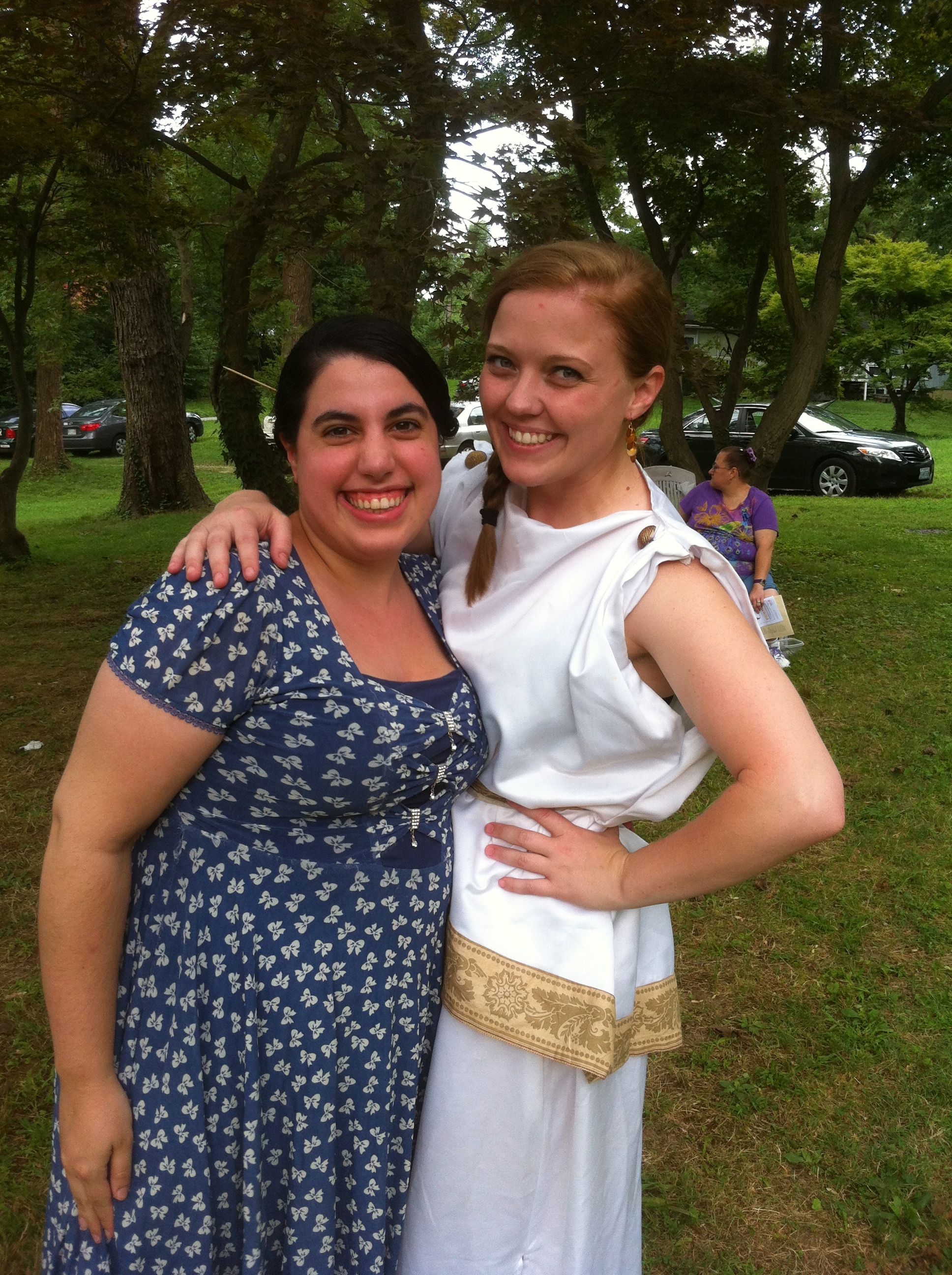
Hermia (Lisa Davidson) and fan (Maggie) off stage during intermission at the Factory's Mid Summer.

Hermia (Lisa Davidson) and fan (Maggie) off stage during intermission at the Factory’s Mid Summer.