Category Archives: World War One

Thought of the Day 11.7.12 Marie Curie

Well, I think my blog got hit with some residual radiation or something today. For some reason the text/formatting has just gone off the hook wacko. And I’ve run out of time and patience trying to trouble shoot it. I KNOW Madame Curie wouldn’t give up… but I am. Sorry, dear readers. I hope you can read past the odd formatting and enjoy this profile of this amazing woman…

————————————————————————————————————-


N o t h i n g   i n   l i f e   i s   t o   b e   f e a r e d .   I t   i s   o n l y   t o   b e   u n d e r s t o o d .
– –   M a r i e   C u r i e

Polish/French physicists Marie Curie

Polish/French physicists Marie Curie (Photo credit: Wikipedia)


M a r j a   S a l o m e a   S k l o d o w s k a     w a s   b o r n   i n   W a r s a w ,   P o l a n d   i n   1 8 6 7 .   T o d a y   i s   t h e   1 4 5 t h   a n n i v e r s a r y   o f
h e r   b i r t h .
P o l a n d   a t   t h e   t i m e   w a s   u n d e r   C z a r i s t   R u s s i a n   r u l e ,   a n d   M a r j a ‘ s   p a r e n t s   w e r e   n a t i o n a l i s t s .   H e r
p a r e n t s   w e r e   t e a c h e r s .   H e r   f a t h e r ,   L a d i s l a s ,   t a u g h t   M a t h   a n d   p h y s i c s ;   h e r   m o t h e r   r a n   a   b o a r d i n g
s c h o o l   f o r   g i r l s .   W h e n   R u s s i a n   t i g h t e n e d   t h e   r u l e s   o n   e d u c a t i o n   a n d   n o   l o n g e r   a l l o w e d   l a b o r a t o r y
i n s t r u c t i o n   i n   P o l i s h   s c h o o l s ,   L a d i s l a s   b r o u g h t   h o m e   t h e   l a b   e q u i p m e n t   a n d   h o m e   s c h o o l e d   h i s   c h i l d r e n .   H e   w a s   a l s o   v o c a l   i n   h i s   p r o – P o l i s h   s e n t i m e n t s   a n d   “ w a s   r e p e a t e d l y   f i r e d   a n d   d e m o t e d   f r o m
t e a c h i n g   p o s i t i o n s   o v e r   h i s   l o y a l t i e s . “   [ T h e   W r i t e r ‘ s   A l m a n a c ]     T h i n g s   g o t   w o r s e   w h e n   h e r   o l d e r
s i s t e r ,   Z o f i a ,   d i e d   o f   T y p h u s   w h e n   s h e   w a s   8 ,     a n d   t w o   y e a r s   l a t e r   h e r   m o t h e r ,   B r o n s i t w a ,   d i e d   o f
t u b e r c u l o s i s .
L a d i s l a s   r a i s e d   M a r j a   a n d   h e r   r e m a i n i n g   s i b l i n g s ,   J Û z e f ,   B r o n i s B a w a     a n d   H e l e n a .   M a r j a   w a s
b r i g h t   a n d   d i d   w e l l   w i t h   h e r   l e s s o n s .   S h e   w a s   s e n t   t o   b o a r d i n g   s c h o o l ,   b u t   w a s   u n a b l e   t o   g o   t o
u n i v e r s i t y   b e c a u s e   s h e   w a s   a   g i r l .   I n s t e a d   s h e   a t t e n d e d   “ T h e   F l o a t i n g   U n i v e r s i t y , “   a   s e c r e t
i n s t i t u t i o n   t h a t   t a u g h t   d e f i e d   t h e   R u s s i a n   a u t h o r i t i e s   a n d   t a u g h t   a   p r o – P o l i s h   c u r r i c u l u m .

D e t e r m i n e d   t o   g e t   a   p r o p e r   e d u c a t i o n ,   t h e   t w o   s i s t e r s   m a d e   a   p a c t   t o   t a k e   t u r n s   f u n d i n g   e a c h
o t h e r ‘ s   s c h o o l i n g .   M a r i e   t o o k   w o r k   f o r   t h r e e   y e a r s   a s   a   g o v e r n e s s   o n   a   s u g a r   b e e t   p l a n t a t i o n ,   w h i l e   s h e   f u n d e d   B r o n y a   t o   s t u d y   m e d i c i n e   i n   P a r i s .   . . . .   W h e n   s h e   f i n a l l y   g o t   h e r   o w n   c h a n c e   t o   s t u d y   a t
t h e   S o r b o n n e   i n   F r a n c e ,   M a r i e   t r a v e l e d   f o u r t h   c l a s s   w i t h   h e r   o w n   c h a i r   o n   t h e   t r a i n . . .   S h e   k e p t
w a r m   b y   w e a r i n g   e v e r y   p i e c e   o f   c l o t h i n g   s h e   o w n e d   a n d   w o u l d   g e t   s o   e n g r o s s e d   i n   s t u d y   t h a t   s h e
o f t e n   f a i n t e d   f o r   l a c k   o f   f o o d . . .   W i t h i n   a   f e w   y e a r s ,   s h e   g r a d u a t e d   t o p   o f   h e r   c l a s s   i n   p h y s i c s   a n d
m a t h .   [ I b i d ]

U p o n   g r a d u a t i o n   s h e   b e g a n   t o   i n v e s t i g a t e   t h e   m a g n e t i c   p r o p e r t i e s   o f   d i f f e r e n t   k i n d s   o f   s t e e l s .
S h e   m e e t   P i e r r e   C u r i e   w h e n   l o o k i n g   f o r   l a b   s p a c e .   “ T h e i r   p r o f e s s i o n a l   r e l a t i o n s h i p   s o o n   t u r n e d
r o m a n t i c ,   a n d   t h e   t w o   w e r e   m a r r i e d   i n   J u l y   1 8 9 5 . “   [ I b i d ]   M a r i e   r e c e i v e d   h e r   D o c t o r   o f   S c i e n c e
f r o m   t h e   S o r b o n n e .

M a r i e   C u r i e   w a s   n o t   a f r a i d   t o   t a k e   r i s k s .   H e r   f o r c e f u l   c h a r a c t e r   l e d   h e r   t o   a   l e v e l   o f   i n d e p e n d e n c e   u n u s u a l   f o r   h e r   t i m e .   I n   F r a n c e   d u r i n g   t h i s   p e r i o d ,   g i f t e d   w o m e n   w e r e   s c o r n e d   a n d   l o o k e d   d o w n
u p o n .   [ W i r e d . c o m ]

U n d a u n t e d   s h e   c o n t i n u e d   t o   p u r s u e   h e r   w o r k .   S h e   b e c a m e   f a s c i n a t e d   w i t h   F r e n c h   p h y s i c i s t   H e n r i   B e c q u e r e l ‘ s   w o r k   o n   u r a n i u m   c a s t   o f f   r a y s .

C u r i e   t o o k   B e c q u e r e l ‘ s   w o r k   a   f e w   s t e p s   f u r t h e r ,   c o n d u c t i n g   h e r   o w n   e x p e r i m e n t s   o n   u r a n i u m
r a y s .   S h e   d i s c o v e r e d   t h a t   t h e   r a y s   r e m a i n e d   c o n s t a n t ,   n o   m a t t e r   t h e   c o n d i t i o n   o r   f o r m   o f   t h e
u r a n i u m .   T h e   r a y s ,   s h e   t h e o r i z e d ,   c a m e   f r o m   t h e   e l e m e n t ‘ s   a t o m i c   s t r u c t u r e .   T h i s   r e v o l u t i o n a r y
i d e a   c r e a t e d   t h e   f i e l d   o f   a t o m i c   p h y s i c s   a n d   C u r i e   h e r s e l f   c o i n e d   t h e   w o r d   r a d i o a c t i v i t y   t o   d e s c r i b e   t h e   p h e n o m e n a .   [ B i o g r a p h y . c o m ]

M a r i e   a n d   P i e r r e   d i s c o v e r e d   a   t h e   r a d i o a c t i v e   e l e m e n t   p o l o n i u m   i n   1 9 8 9 ,   a n d   R a d i u m   i n   1 9 0 2 .
T h e   f o l l o w i n g   y e a r   M a r i e   C u r i e   b e c a m e   t h e   f i r s t   w o m a n   t o   r e c e i v e   t h e   N o b e l   P r i z e   i n   P h y s i c s .   “ S h e   w o n   t h e   p r e s t i g i o u s   h o n o r   a l o n g   w i t h   h e r   h u s b a n d   a n d   H e n r i   B e c q u e r e l ,   f o r   t h e i r   w o r k   o n
r a d i o a c t i v i t y . “   [ I b i d ]
I n   A p r i l   o f   1 9 0 6   P i e r r e   d i e d   t r a g i c a l l y   ( h e   w a s   h i t   b y   a   h o r s e – d r a w n   w a g o n ) ,   s h e   t o o k   o v e r   h i s
p o s i t i o n   a t   t h e   p h y s i c s   d e p a r t m e n t   a t   t h e   S o r b o n n e .   ( S h e   w a s   t h e   f i r s t   w o m a n   p r o f e s s o r   a t   t h e
S o r b o n n e .
I n   1 9 1 1   s h e   w o n   h e r   s e c o n d   N o b e l   P r i z e   – –   t h e   f i r s t   s c i e n t i s t   t o   d o   s o   – –   t h i s   t i m e   f o r   c h e m i s t r y .
I n   1 9 1 4   s h e   w a s   a p p o i n t e d   D i r e c t o r   o f   t h e   C u r i e   L a b o r a t o r y   a t   t h e   U n i v e r s i t y   o f   P a r i s .   D u r i n g
W a r   W o r l d   I   s h e   “ c h a m p i o n e d   t h e   u s e   o f   p o r t a b l e   X – r a y   m a c h i n e s   i n   t h e   f i e l d “ [ B i o g r a p h y . c o m ]     t h e   d e v i c e s   w e r e   n i c k n a m e d   “ L i t t l e   C u r i e s . “     A   d e c a d e   l a t e r   s h e   e s t a b l i s h e d   t h e   R a d i u m   I n s t i t u t e   i n   W a r s a w   w i t h   f u n d s   d o n a t e d   b y   P r e s i d e n t   H e r b e r t   H o o v e r   o f   t h e   U n i t e d   S t a t e s .   H e r   s i s t e r   B r o n i s l a w a
w a s   t h e   i n s t i t u t e ‘ s   f i r s t   d i r e c t o r .
I n   J u l y   o f   1 9 3 4   M a r i e   C u r i e   d i e d     f r o m   a p l a s t i c   a n e m i a .


Thought of the Day 11.6.12 John Philip Sousa

“Jazz will endure just as long people hear it through their feet instead of their brains.” –John Philip Sousa

John Philip Sousa, the composer of the song.

John Philip Sousa, the composer of the song. (Photo credit: Wikipedia)

I can’t think of any one who would make a better Thought of the Day Bio subject on Election Day 2012 than John Philip Sousa. He practically wrote the soundtrack for American patriotism AND he’s got a great mustache. What’s not to like?

He was born on this day in Washington, DC, USA in 1854. Today is the 158th anniversary of his birth.

He started his music career playing the violin, and soon added voice, piano, flute, cornet, baritone, trombone and alto horn to the mix.  After John Phillip tried to run away to join a circus band, his father, John Antonio Sousa,  “enlisted him in the Marines at age 13 as an apprentice…”[John Philip Sousa] in 1867.

He wrote and published his first composition “Moonlight on the Potomac Waltzes” in 1875 and was honorably discharged from the Marines two years later. Sousa “began performing (on violin), touring and eventually conducting theater orchestras. Conducted Gilbert & Sullivan’s H.M.S. Pinafore on Broadway.” [Ibid] While rehearsing Pinafore he met his wife Jane van Middlesworth Bellis.

In 1880 he returned to the US Marine Band as the Band’s leader, a post he kept for next 12 years.  Sousa conducted

“The President’s Own”, serving under presidents Hayes, Garfield, Cleveland, Arthur and Harrison. After two successful but limited tours with the Marine Band in 1891 and 1892, promoter David Blakely convinced Sousa to resign and organize a civilian concert band. [Ibid]

Sousa and his newly-formed civilian band, 1893

Sousa and his newly-formed civilian band, 1893 (Photo credit: Wikipedia)

Sousa wrote his own operetta, El Capitan in 1895.

He wrote 136 marches including Semper Fidelis March, King Cotton, Fairest of the Fair, Hands Across the Sea, And Stars and Stripes Forever — which he wrote in 1896. (In 1987 Congress proclaimed it the National March of the United States)

He designed a new type of bass tuba called the sousaphone. The Sousa Band toured throughout the world.

During World War I, Sousa joins the US Naval Reserve at age 62. He is assigned the rank of lieutenant and paid a salary of $1 per month…. After the war, Sousa continued to tour with his band. He championed the cause of music education, received several honorary degrees and fought for composers’ rights, testifying before Congress in 1927 and 1928.[Ibid]

Sousa died at the age of 77 in Reading, Pennsylvania after conducting a rehearsal. Fittingly, the last piece he conducted was Stars and Stripes Forever.

"Stars and Stripes Forever" (sheet m...

“Stars and Stripes Forever” (sheet music) Page 4 of 5 (Photo credit: Wikipedia)

Click HERE for a page with lots of audio clips of Sousa marches.

————————————-


Thought of the Day 10.29.12 Marie of Romania

Love, Faith, Courage with these three we can win the world..”

–Marie of Romania

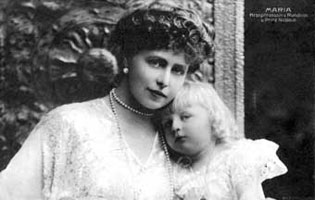
Marie Alexandra Victoria, Princess Marie of Edinburgh, was born on this day at Eastwell Park in Kent, England in 1875. Today is the 137th anniversary of her birth.

She was the eldest daughter of Prince Alfred of England and Grand Duchess Maria Alexandrovna of Russia and the granddaughter of Queen Victoria  on her father’s side and of Tsar Alexander II on her mother’s side. Because of  her double royal lineage she was considered highly suitable for a Royal match of her own.

When Marie was 17 she was married to Prince Ferdinand of Romania, a German raised nephew of King Carol I of Romania in Sigmaringen German in 1893. Ferdinand was 27 at the time. They had 6 children. Three boys and three girls. However, the marriage was not a happy one and The Princess took a lover, Barbu Stirbey. It is likely that Mircea (and possibly Mignon and Ileana) were Stirbey’s.

In 1914 King Carol I died and Ferdinand took the throne. Marie became Her Majesty the Queen of Romania but the couple were delayed in becoming the King and Queen until after World War 1.

During the War Princess Marie influenced the country to side with the Allies (and away from the Germans), she volunteered with the Red Cross  and nursed the sick and wounded. Her book My Country raised money for the Red Cross.

When WWI was over and the Allies were trying to figure out how to partition Europe and scold Germany, Marie herself went to Versailles and represented Romania. She wooed the ministers so much that they gave back territory that Romania had lost and promised not to partition her. [GEH — Queen Marie of Romania Study Notes]

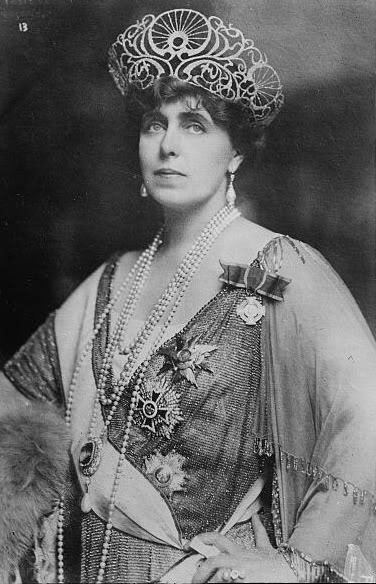
Queen Marie [Image courtesy Alexanderpalace.org]

Ferdinand and Marie were finally crowned in 1922. She was determined to be a modern queen.

A Queen who was not stuck in the Victorian time warp like Queen Mary of England, and a Queen who listened to her people and made herself available to her people. [Ibid]

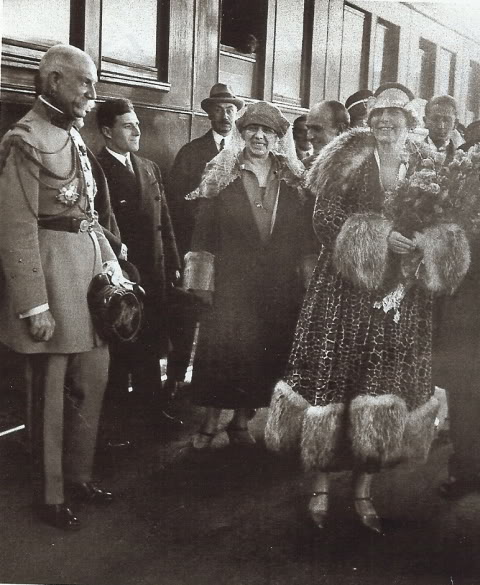
Queen Marie was very popular and travelled through out Europe and the US.

The Queen, on the right, traveling in Europe. [Image courtesy Alexanderpalace.org]

Although she was close with her younger children she was never on good terms with Crown Prince Carol (who became King Carol II after Ferdinand’s death in 1927). After Carol’s coronation he excluded his mother. She remained the Romania and wrote her two-part memoir, The Story of My Life. 

She died after a sudden illness in 1938. Following the Queen’s instructions her heart was removed from her body and kept at a cloister at Balchik Palace. The rest of her remains were interred with her husband.


Thought of the Day 10.21.12 Richard the Third

Blog Note: Today is NOT Richard the Third’s Birthday, that’s Oct 3 1452.

——————————————————————————–

Richard III Royal Collection

Richard III Royal Collection (Photo credit: Wikipedia)

Today I’m thinking about Richard the Third of England.

We just saw the terrific Moveable Shakespeare production of Richard III at Chesapeake Shakespeare Company in the ruins of the Patapsco Female Institute in Ellicott City Maryland.

Director Ian Gallanar chose to pick the characters up from the 15th century and time warp them  to something resembling War War One. Clever, especially considering the Patapsco Female Institute was used as a war hospital during the Great War. In his director’s notes he says:

“The production really uses the visual palate and the historic technology of the World War One era as a way to clarify the relationships of the characters….[The audience] might also recognize the futility and wastefulness of a war that, much like the English “Wars of the Roses,” seemed more about resolving who would inherit power rather than who ought to inherit power.” [Chesapeake Shakespeare Company, Richard III: Program Notes]

So on a cold October night we got to see one of Shakespeare’s bloodiest plays in and around the shell of a burned out 19th Century building that some people claim is haunted. The occasional gas-masked actors quietly playing cards in a dimly lit corner or typing away orders on an antique typewriter upped the creep factor. As did the lighting effects, the period music and wonderful costumes.

Vince Eisenson as Richard III. Photo by Teresa Castracane. [Image courtesy: Chesapeake Shakespeare Company]

This version of Richard really worked. I really liked the “Moveable” aspect too. It added to the length of the play (instead of quick scene changes the audience literally did a scene change by moving to a new part of the building or grounds, and that took a while.) My only problem was that there was a scene or two where I couldn’t see the action because I had the bad luck of standing behind some one tall.)  Still, I liked that we kept moving through the building, and “discovering” new rooms. It really put the audience DEAD center into the action of the play (and moving about  kept us warm.)

Richard III runs for one more weekend at Chesapeake Shakespeare. So if you are local to Maryland jump on their website and grab some tickets before they sell out. http://chesapeakeshakespeare.com/

————————————

Scrap for a Shakespeare character card: Richar...

Scrap for a Shakespeare character card: Richard III., c. 1890; Printer: Siegmund Hildesheimer & Co. Victoria and Albert Museum, London, Museum number: S.63-2008, Link (Photo credit: Wikipedia)

Of course they didn’t have instant fact checkers in Shakespeare’s day, and history, as they say is written by the winners. So it comes as no surprise that the Richard the Third we met last night was a real piece of work. Shakespeare was writing for an Elizabethan audience. Elizabeth, a Tudor, was the granddaughter of the man who finally brought about Richard’s undoing on Bosworth Field in Leicestershire, Henry VII. It was in his interest to make Richard as loathsome as possible.

Henry VII’s claim to the thrown was weak at best. So he took…

“every opportunity of enhancing his own reputation at the expense of his predecessor. Richard’s actions and behaviour were the subject of attention and scrutiny and were presented, in the weeks and years after his death, as those of a wicked and unscrupulous tyrant.” [The Richard III Society]

While he was alive Richard was well thought of.

  • He was loyal to his brother Edward.
  • He was effective in his administration of the North.
  • He defended the country against the Scots.
  • He handled the premature death of Edward with out plunging the country into crisis.

Shakespeare wasn’t the first writer to take up the thread of anti- Richard-ism. (Yes, I just made that up.)

By the time the Elizabethan playwright William Shakespeare penned what was to become one of his most popular and frequently performed plays, The Tragedy of King Richard III, the works of the anonymous Croyland Chronicler, John Rous, Bernard André, Polydore Vergil, Sir Thomas More, Edward Hall, Richard Grafton and Raphael Holinshed had been written. [Ibid]

So, as Chesapeake Shakespeare Managing  Director and Richard III Dramaturge says in her note… The Bard’s “fictitious villainous Richard has triumphed over the historic Richard for centuries now.” [CSC Program]

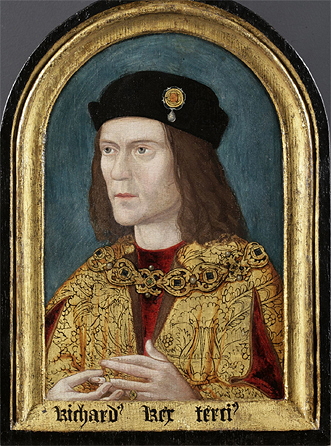
Richard III earliest surviving portrait. [Image courtesy: Wikipedia]

In a timely twist of history archeologists digging up a parking lot in Leicester have found the remains of  the Greyfriars Church that might be those of Richard, the last King of England to die on the battlefield. They have found a skeleton in the choir area (Richard was buried in the choir of Friars Minor at Leicester), that had a skull injury caused by a bladed implement, an arrowhead was found between its vertebrae and upper back, and it had spinal abnormalities.

“the individual would have had severe scoliosis – which is a form of spinal curvature. This would have made his right shoulder appear visibly higher than the left shoulder.” [University of Leicester Press Release : The Leicester Greyfriars Dig]


——————————————————————————-

Bonus Material:

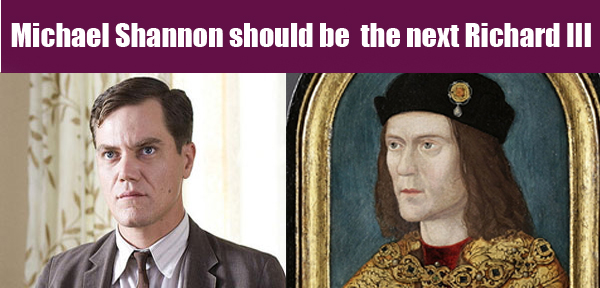
Not sure how many of you watch HBO’s Boardwalk Empire… but I couldn’t stop thinking how much Michael Shannon  (who plays messed up Treasury agent turned iron salesman Nelson Van Alden) looks like our boy Richard.  I think they ought to do a new film version of Richard cubed with Shannon in the lead. He certainly has the intensity to play the role.


Thought of the Day 10.17.12 Elinor Glyn

“All the legislation in the world will not abolish kissing”
Elinor Glyn

Portrait of Elinor Glyn, 1927

Portrait of Elinor Glyn, 1927 (Photo credit: Wikipedia)

Elinor Southerland was born on this day in Jersey, Channel Islands, England in 1864. Today is the 148th anniversary of her birth.

Elinor’s father died when she was a toddler and the family moved for a while to Canada. They returned to Jersey when she was eight and her mother remarried.  Elinor…

was a voracious reader interested in French history and mythology, though she had no formal education … She would later be drawn to mysticism and romance. [The Literature Network]

She liked to write and she kept a diary.

At 28 she married Clayton Glyn. The couple had two daughters, Margot and Juliet. The marriage was not a happy one.  and, although Elinor and Clayton officially remained together both had affairs.

Elinor had affairs with a succession of British aristocrats and some of her books are supposedly based on her various affairs… [Good Reads]

English: Elinor Glyn portrait

English: Elinor Glyn portrait (Photo credit: Wikipedia)

She contributed articles to Scottish Life and Cosmopolitan but her real break through in the literary world came with the serialization of her first book The Visits of Elizabeth in 1900. The book, was written as a series of letters by an innocent young woman. Elizabeth.

The naive and charming narrator gets herself into social scrapes due to her innocence, … they are actually funny over a hundred years later because you know what Elizabeth doesn’t know–and perhaps that was the appeal for the more knowing Edwardian readers. Glyn’s book is a bit of a satire, but a romantic one, and Elizabeth gets her happily-ever-after, but not before making every handsome gentleman fall deeply in love with her.  [Amazon.com review]

Elinor was prolific in turning out her novels (she had to be, finances at home had taken a turn for the worse and the once wealthy Clayton Glyn was in debt by 1908. He died in 1915.)  Her reputation as a writer of romance grew with the publications  of The Seventh Commandment (1902), The Reflections of Ambrosine (1903), The Damsel and the Sage (1903), The Vicissitudes of Evangeline (1905) and Beyond the Rocks (1906).

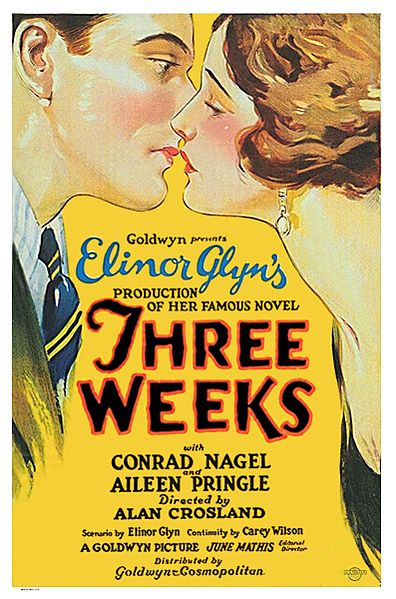
Movie poster for Three Weeks

Her risqué Three Weeks, about an exotic Balkan queen who seduces a young British aristocrat, was allegedly inspired by her affair with Lord Alistair Innes Ker. On the one hand it scandalized Edwardian aristocrats and jeopardized Glyn’s status. [The Literature Network]

Deemed immoral and banned at elite schools like Eton and panned by some critics who considered it disjointed and dull, the book non the less sold out within weeks of its publication and  it  “ensured her meteoric rise to fame.” [ibid]. It also brought about the anonymous  ditty:

Would you like to sin
With Elinor Glyn
On a tiger skin?
Or would you prefer
To err
With her
On some other fur

Her private life seemed to either echo or prelude the romantic interludes of the heroines in her novels as she continued to crank out “romances” until the start of World War One. During the Great War she worked in France as a war correspondent and Glyn was one of two women to witness the signing of the Treaty of Versailles.

Elinor Glyn looks up at Rudolph Valentino, fro...

Elinor Glyn looks up at Rudolph Valentino, from the frontispiece of Beyond The Rocks (Photo credit: Wikipedia)

She made the move to Hollywood in 1920 where she worked as a scriptwriter  for MGM and Paramount. The Great Moment was filmed in 1920.  In 1922 Beyond the Rocks was made into a major motion picture with red-hot Rudolph Valentino and Gloria Swanson. Three Weeks was given the big screen treatment not once, but twice, first in 1914 and then in 1924. And Glyn wrote the screenplay and was closely involved in the production of the 1926 Love’s Blindness.

In 1927 she wrote a novella that gave us the expression “the IT girl.”  She coined the phrase and quickly  crowned Clara Bow, who was staring in Red Hair (a movie based on Glyn’s The Vicissitudes of Evangeline), as the first IT girl. Here autobiography Romantic Adventure was published in 1936. She continued writing until 1940 when she published her last — and 42nd — book, The Third Eye.

English novelist and scriptwriter Elinor Glyn ...

English novelist and scriptwriter Elinor Glyn (1864-1943) (Photo credit: Wikipedia)

Elinor Glyn died in September of 1943 in Chelsea, London.

————————————————————————–

Bookshelf:

Interested in reading some of Elinor Glyn’s books? You can find them through the links below.

Red Hair (Classic Reprint)<img src=”http://www.assoc-amazon.com/e/ir?t=rico095-20&l=as2&o=1&a=B0094JHIEE&#8221; width=”1″ height=”1″ border=”0″ alt=”” style=”border:none !important; margin:0px !important;” />

Man and maid<img src=”http://www.assoc-amazon.com/e/ir?t=rico095-20&l=am2&o=1&a=117680328X&#8221; width=”1″ height=”1″ border=”0″ alt=”” style=”border:none !important; margin:0px !important;” />

Three Weeks<img src=”http://www.assoc-amazon.com/e/ir?t=rico095-20&l=am2&o=1&a=0715603612&#8243; width=”1″ height=”1″ border=”0″ alt=”” style=”border:none !important; margin:0px !important;” />

The Visits Of Elizabeth<img src=”http://www.assoc-amazon.com/e/ir?t=rico095-20&l=am2&o=1&a=1162711698&#8243; width=”1″ height=”1″ border=”0″ alt=”” style=”border:none !important; margin:0px !important;” />

The man and the moment<img src=”http://www.assoc-amazon.com/e/ir?t=rico095-20&l=am2&o=1&a=1178145077&#8243; width=”1″ height=”1″ border=”0″ alt=”” style=”border:none !important; margin:0px !important;” />

The man and the moment<img src=”http://www.assoc-amazon.com/e/ir?t=rico095-20&l=am2&o=1&a=1178145077&#8243; width=”1″ height=”1″ border=”0″ alt=”” style=”border:none !important; margin:0px !important;” />

The Point of View<img src=”http://www.assoc-amazon.com/e/ir?t=rico095-20&l=am2&o=1&a=1444425269&#8243; width=”1″ height=”1″ border=”0″ alt=”” style=”border:none !important; margin:0px !important;” />


Thought of the Day 10.14.12 e.e.cummings

“It takes courage to grow up and become who you really are.”
–e.e. cummings

E. E. Cummings, 1958 by Edward Estlin Cummings...

E. E. Cummings, 1958 by Edward Estlin Cummings, Oil on canvas (Photo credit: cliff1066™)

Edward Estlin Cummings was born on this day in Cambridge, Massachusetts, USA in 1894. Today is the 118th anniversary of his birth.

As a child Cummings  enjoyed art and writing, as well as the outdoors. His mother encouraged him to write. And Cummings worked at his craft by writing daily. He went to Harvard where he became interested in non conventional poetry.

First edition dustjacket of The Enormous Room

First edition dustjacket of The Enormous Room (Photo credit: Wikipedia)

During World War I he was an ambulance driver in France and fell in love with Paris. But he sent letters home that “holding views critical of French war effort” [e.e. cummings Biography] He was arrested and thrown in prison for three months. His book The Enormous Room is based on his experiences in the French prison.  He was later drafted into the US Army.

1st edition cover

1st edition cover (Photo credit: Wikipedia)

His first collection of poems, Tulips and Chimneys came out in 1923. Although his poems received critical praise — he won the Dial Award for poetry in 1925 — Cummings found it hard to find a publisher. His poetry was considered too avant guard.

His my father moved through dooms of love is a tribute to his recently deceased father…

my father moved through dooms of love

by E. E. Cummings

              34

my father moved through dooms of love 
through sames of am through haves of give, 
singing each morning out of each night 
my father moved through depths of height

this motionless forgetful where 
turned at his glance to shining here; 
that if(so timid air is firm) 
under his eyes would stir and squirm

newly as from unburied which 
floats the first who,his april touch 
drove sleeping selves to swarm their fates 
woke dreamers to their ghostly roots

and should some why completely weep 
my father's fingers brought her sleep:
vainly no smallest voice might cry 
for he could feel the mountains grow.

Lifting the valleys of the sea 
my father moved through griefs of joy; 
praising a forehead called the moon 
singing desire into begin

joy was his song and joy so pure 
a heart of star by him could steer 
and pure so now and now so yes 
the wrists of twilight would rejoice

keen as midsummer's keen beyond
conceiving mind of sun will stand,
so strictly(over utmost him
so hugely) stood my father's dream

his flesh was flesh his blood was blood:
no hungry man but wished him food;
no cripple wouldn't creep one mile
uphill to only see him smile.

Scorning the Pomp of must and shall
my father moved through dooms of feel;
his anger was as right as rain
his pity was as green as grain

septembering arms of year extend 
yes humbly wealth to foe and friend 
than he to foolish and to wise  
offered immeasurable is

proudly and(by octobering flame 
beckoned)as earth will downward climb, 
so naked for immortal work 
his shoulders marched against the darkhis sorrow was as true as bread:
no liar looked him in the head; 
if every friend became his foe 
he'd laugh and build a world with snow.My father moved through theys of we, 
singing each new leaf out of each tree 
(and every child was sure that spring 
danced when she heard my father sing)then let men kill which cannot share, 
let blood and flesh be mud and mire, 
scheming imagine,passion willed, 
freedom a drug that's bought and soldgiving to steal and cruel kind, 
a heart to fear,to doubt a mind, 
to differ a disease of same,
conform the pinnacle of amthough dull were all we taste as bright, 
bitter all utterly things sweet,
maggoty minus and dumb death 
all we inherit,all bequeathand nothing quite so least as truth
--i say though hate were why men breathe--
because my Father lived his soul 
love is the whole and more than all

Cummings died in 1962 from a stroke.

E.E. Cummings, full-length portrait, facing le...

E.E. Cummings, full-length portrait, facing left, wearing hat and coat / World-Telegram photo by Walter Albertin. (Photo credit: Wikipedia)


Thought of the Day 9.20.12 Elizabeth Kenny

“He who angers you conquers you.”

–Elizabeth Kenny

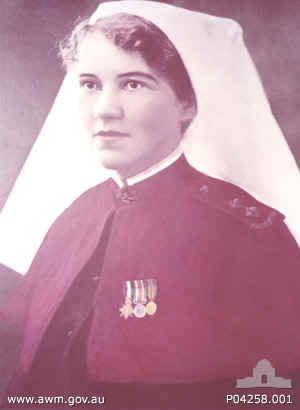
“Sister” Kenny [Image courtesy: Australian War Memorial; AWM.Gov.au]

Elizabeth Kenny was born on this day in Warialda, New South Wales, Australia in 1880. Today is the 132nd anniversary of her birth.

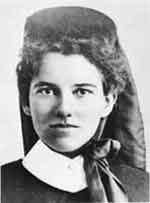
Because her father was an itinerant farmer the family moved often when Elizabeth was growing up. Her education was limited to home-schooling and a variety of small town primary schools. When she was 17 she fell off her horse and broke her wrist. Her father, Michael, took her to the town of  Toowoomba to see Dr. Aeneas McDonnell. Kenny remained in Toowoomba to recover from the injury and grew fascinated with Dr. McDonnell’s medical books, especially those on anatomy, and his model skeleton. It started Kenny on her life long journey in medicine. She made her own model skeleton to study how muscles and bone worked together in the human body.

Elizabeth Kenny as a young woman. [Image courtesy: Minnesota Public Radio.org]

At 18 she became an unaccredited,  unpaid bush nurse. She later (probably) volunteered at the maternity hospital at Guyra in New South Wales.

There is no official record of formal training or registration as a nurse. She probably learned by voluntary assistance at a small maternity hospital at Guyra, New South Wales. About 1910 Kenny was a self-appointed nurse, working from the family home at Nobby on the Darling Downs, riding on horseback to give her services, without pay, to any who called her. [Elizabeth Kenny, by Ross Patrick, Australian Dictionary of Biography]

Kenny opened St. Canice’s Cottage Hospital in Clifton. She kept in contact with Dr. McDonnell and would often telegraph him when a case stymied her.

In 1911 one such case presented itself. She contacted McDonnell about a new case that stymied her.. a young girl who was crippled, but not from a fall or external trauma. McDonnell replied that it was probably “It sounds like Infantile Paralysis.  There’s no known treatment, so do the best you can.” [Sister Elizabeth Kenny. Australians Documentary Series. 1998. from Teachspace.org] Kenny used a common sense approach. She applied hot compresses to the little girl’s spasming muscles. Hot, heavy woolen blankets were applied that help loosen the muscles and relieve the pain. Then she stretched the little girls legs and strengthened the muscles. It worked. The pain abated, the girl (allegedly) asked “Please, I want them rags that well my leg.”

Of the twenty children in the district, the six that Kenny treated survived without complications. [Sister Elizabeth Kenny. Australians Documentary Series. 1998. from Teachspace.org]

With the outbreak of World War I Kenny, with a letter of recommendation from Dr. McDonnell, joined the Australian Medical Corps. She worked on hospital ships bringing the wounded home from Europe. She was received a shrapnel wound to the leg while at the front.

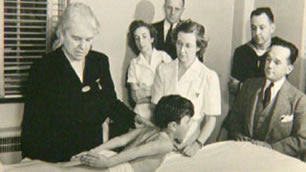
She patented her invention of a stretcher that immobilized shock patients during transport, the Sylvia Stretcher, and used the royalties  open a clinic for polio patients in Townsville, Queensland. Here she treated long-term polio and cerebral palsy patients, tossing aside the braces and concentrating on hot baths, passive movements and foments.

Sister Kenny works with a young patient as other doctors, nurses and physiotherapist observe. [Image courtesy: Sister Elizabeth Kenny: Medical Pioneer]

Her “homespun” methods for polio treatment, though effective, were controversial as the  accepted practice was to splint the affected limbs to keep them rigid. That way the stronger muscles wouldn’t pull on the weaker/paralyzed muscles and create deformities. Kenny thought that splinting the limbs would actually produce deformities and increase paralysis. She alternately dismissed, ridiculed or vilified by the medical establishment. Kenny soldiered on, buoyed by the support of parents who witnessed first hand the results her methods were having on their children. Kenny opened clinics in Brisbane and through out Queensland.

The controversy over her methods followed her to England  and the US. Kenny worked in the Minneapolis General Hospital where…

Her methods became widely accepted. She began courses for doctors and physiotherapists from many parts of the world. The Sister Kenny Institute was built in Minneapolis in 1942 and other Kenny clinics were established. [Elizabeth Kenny, by Ross Patrick, Australian Dictionary of Biography]

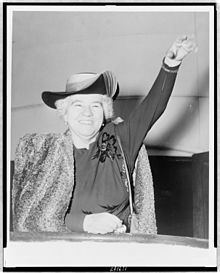
Kenny in 1950. {Image courtesy: Wikipedia]

She developed Parkinson’s disease and retired to Toowoomba in 1951. Kenny died there of cerebrovascular disease on 30 November 1952.

Sister Kenny’s pioneering principles of muscle rehabilitation became the foundation of physical therapy. Today, Sister Kenny Rehabilitation Services is one of the premier rehabilitation centers in the country, known for its progressive and innovative vision. [Nurses for nurse everywhere.info]


Thought of the Day 9.12.12 H.L.Mencken

“Love is the triumph of imagination over intelligence.”

— H. L. Mencken

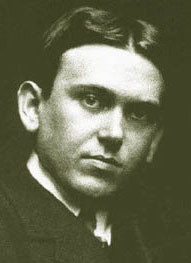
The Sage of Baltimore. [Image courtesy: The American Mercury]

Henry Louis Mencken was born on this day  in Baltimore, Maryland in 1880. Today is the 132nd anniversary of his birth.

Mencken lived in the same house in the Union Square neighborhood of the city for all but 5 years of his life. At 9 he read Huckleberry Finn by Mark Twain and knew he wanted to become a writer. His family had other ideas.

His grandfather had prospered in the tobacco business and his father, August, continued the family tradition. Mencken studied at the Baltimore Polytechnic Institute (1892-96) and then worked at his father’s cigar factory. [Books and Writers]

[Image Courtesy: Wikimedia Commons]

He worked for 3 years at the family owned business and would have stayed indefinitely, but upon his father’s death in 1899  Mencken was “free to choose his own trade in the world.”

Within a week, Mencken “invaded” the city room of the old Baltimore Morning Herald to face down the city editor and ask for a job…There were no jobs that day, but Mencken, persistent, returned daily for two weeks. “Finally I was sent out on a small assignment — it was a stable robbery at Govans — and a few days later I was on the staff,” [H.L. Mencken, Pioneer Journalist, By Jacques Kelly The Baltimore Sun]

His skill as a writer and his reputation for being able to turn a phrase grew. So 6 years later when the Herald closed its doors Mencken applied for a position at the larger Baltimore Sun.  He started at “The Sun as its Sunday editor, became an editorial writer, and in 1911 started writing his own column, the Free Lance Mencken.”  He worked at The Sun until 1948, bring his unflinching wit and critical eye to everything he saw.

“I believe that a young newspaper reporter in a big city… led a live that has never been matched… for romance and interest.” [Mencken from his only known audio interview. Courtesy of: The American Mercury.com]/

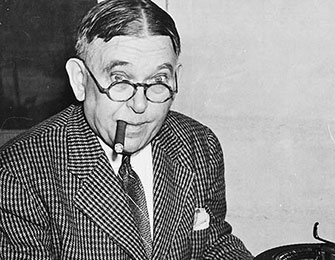
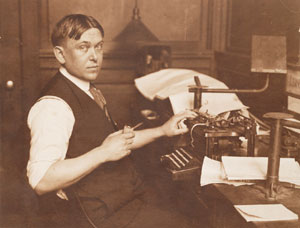
Mencken at work. [Image Courtesy: Enoch Pratt free Library Digital Collections.]

He was a war correspondent in Germany and Russia from 1916 to 1918. During WWI Mencken was pro-German (a very unpopular thing to be in patriotic Baltimore of 1917).

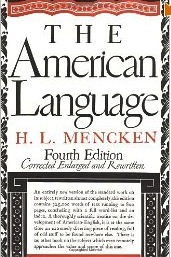
In 1919 he published The American Language, a guide to American expressions and idioms.

From 1914 to 1923 Mencken co-edited with drama critic George Jean Nathan (1882-1958) the Smart Set, which mocked everything from politics to art, universities to the Bible…[Books and Writers]

He preferred realism to modernism and he helped the careers of Sinclair Lewis, Dorothy Parker and Eugene O’Neill.

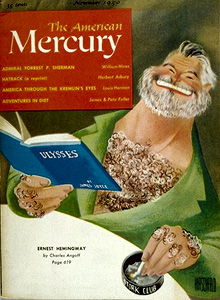
Cover of the American Mercury [Image Courtesy: Wikipedia]

He started The American Mercury monthly magazine, working on the magazine from 1924 t0 1933.

A stroke in 1948 left him nearly unable to read or write. Speaking took a lot of effort, and he grew easily frustrated. He spent his remaining days organizing his papers and letters (which can now be found in H.L. Mencken Room and Collection at the Central Branch of the Enoch Pratt Free Library on Cathedral Street in Baltimore.

[Image courtesy: MPT]

Here are a few more quips from the Sage of Baltimore:

  • “A cynic is a man who, when he smells flowers, looks around for a coffin.”
  • “Nature abhors a moron”
  • “Do not overestimate the decency of the human race”
  • “A man loses his sense of direction after four drinks; a woman loses hers after four kisses”
  • “Love is like war; easy to begin but very hard to stop”
  • “It is a sin to believe evil of others, but it is seldom a mistake.”
  • “Conscience is the inner voice that warns us somebody may be looking.”
  • “You come into the world with nothing, and the purpose of your life is to make something out of nothing”
  • “Most people are unable to write because they are unable to think, and they are unable to think because they congenitally lack the equipment to do so, just as they congenitally lack the equipment to fly over the moon.”
  • “I believe that it is better to tell the truth than a lie. I believe it is better to be free than to be a slave. And I believe it is better to know than to be ignorant.”

Thought of the Day 8.15.12 T.E. Lawrence

“Rebellions can be made by 2 percent actively in the striking force and 98 percent passively sympathetic.”

-T.E. Lawrence

T. E. Lawrence, Lawrence of Arabia

T. E. Lawrence, Lawrence of Arabia (Photo credit: Wikipedia)

Thomas Edward Lawrence  was born on this day in Tremadoc, Caernarvonshire, Wales in 1888.  Today is the 124th anniversary of his birth.

He was the son of Thomas Robert Tighe Chapman, the Baronet of Westmeath, and Sarah Junner a governess for the Chapman children.  A few years earlier T.E.’s  father, having fallen in love with the young governess,  had asked his wife, Edith, for a divorce, when she refused,  he left her and set up house with Junner. They were known as Mr. and Mrs. Lawrence and  had five sons together (T.E. was the second eldest). The family moved several times while T.E. (or Ned as he was known  then) was growing up. Ned and his brothers loved to cycle and sail and explore the countryside. He was very smart, and could read books and newspapers at 4. He studied history at Jesus College, Oxford.

When he was 21 he went to Ottoman Syria and visited 36 crusader castles. He covered 1,100 miles on foot and wrote his thesis ‘The Influence of the Crusades on European Military Architecture – to the End of the XIIth Century.”

He graduated from Jesus College and went on to post-graduate work in mediaeval pottery under a research fellowship for travel by Magdalen College. Lawrence went back to Syria, travelled to Egypt, Palestine and other spots in the Middle East working as a field archaeologist with his friend Leonard Wooley. Lawrence learned the customs and language of the people while he explored the history of the land.

At the outbreak of WWI Lawrence was co-opted into British military intelligence. He and Wooley surveyed the Negev Desert.

English: British Army File photo of T.E. Lawrence

English: British Army File photo of T.E. Lawrence (Photo credit: Wikipedia)

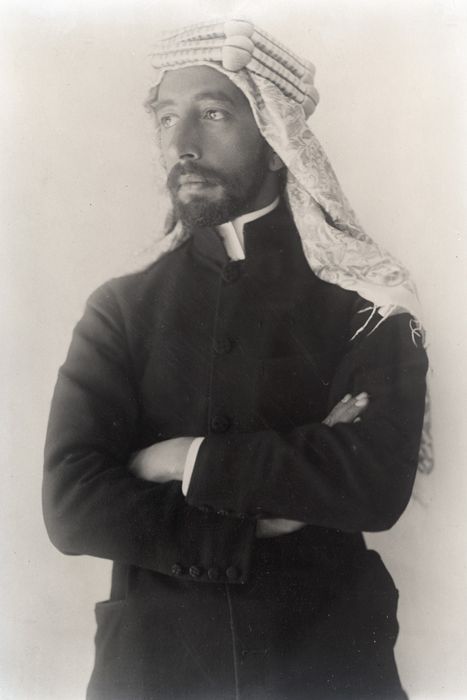
As the War progressed Lawrence began to dress in the long flowing robes of an Arab and  fought along side Emir Feisal to launch a Arab revolt against Germany’s ally, the Ottoman Empire. Feisal and Lawrence lead a guerrilla war in the desert. It took the Turkish government  far more  resources to squash a rebellion of breakaway Arab tribes than it took the British to incite one. Instead of attacking the heavily fortified city of Medina Feisal and Lawrence organized raids on the Hejaz railway.

Lawrence at Aqaba, 1917

Lawrence at Aqaba, 1917 (Photo credit: Wikipedia)

He was wounded several times by both bullets and shrapnel. He was captured in 1916 in Deraa where he was beaten and sexually assaulted. He escaped but the experience left him shattered.

In 1917 he and Feisal led an overland attack on the port city of Akuba. (The town was heavily fortified against a naval attack, but was surprised by an attack from the desert.) In 1918 he led Arab forces in the Battle of Tafileh  (for which he won the Distinguished Service Order  and was promoted.)

Prince Feisal

Prince Feisal

As the War wound down Lawrence returned to England and advocated for Arab independence. He travelled with Feisal to the Paris Peace Conference in 1919. But the Western powers, having used their Arab pawns in a successful game of chess against Germany and Turkey, divided the Middle East between France and England in the Sykes-Picot Agreement.

American journalist Lowell Thomas and cameraman Harry Chase had spent several weeks in the desert shooting dramatic footage of of Lawrence and (at Lawrence’s insistence) Arab leaders like Feisal. Thomas began to show his “Slide and Lantern” lecture to audiences in the US and England.

“The romantic and adventurous tales of this “mysterious blue eyed Arab in the garb of a prince wandering the streets” were an instant hit. Lowell Thomas’ screen show showed to packed audiences in New York and then London. ” [MPT Laurence of Arabia / Lowell Thomas]

Thomas’ London lecture/film tour ran for 6 months and included a Royal Command Performance. He went on to tour most of the English speaking countries in the world and made millions of dollars.

The legend of Lawrence of Arabia was born.

Cover of "Lawrence of Arabia (Single Disc...

DVD cover for the David Lean movie based on Lawrence’s life.  via Amazon

Lawrence, however was angry over the Paris Peace talks and, although he went to see Thomas’ show, he eschewed the added celebrity. He withdrew from public life to write his memoir, The Seven Pillars of Wisdom

He served, at Winston Churchill’s request, as a political adviser to the Colonial Office to help construct a pro-Arab settlement for the Middle East. He returned, under a pseudonym, to the armed forces, first in the Royal Air Force as John Hume Ross, then in the Army as Thomas Edward Shaw. But the press always found him out.

In May of 1935 Lawrence was riding his motorbike at 100 mph along a country road when he lost control and crashed. He died a few days later.

Lawrence of Arabia on his Brough Superior

Lawrence of Arabia on his Brough Superior (Photo credit: Wikipedia)