Secondary Character Saturday: Piglet!


[It’s Second Character Saturday! Today’s character is Piglet. I’ll be going straight to the source and discussing the AA Milne Piglet with illustrations by Ernest Shepard— not the Disney-fied Piglet.]

“But Piglet is so small that he slips into a pocket, where it is very comfortable to feel him when you are not quite sure whether twice seven is twelve or twenty-two.”― A.A. Milne, Winnie-the-Pooh

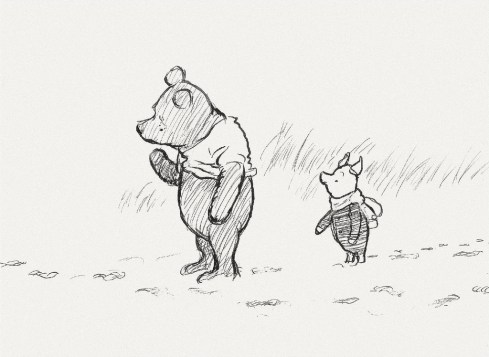
Piglet and Pooh think about fall.

Piglet and Pooh think about fall.


Who: Piglet


From: Winnie-the-Pooh


By: A.A. Milne


Date: 1926


Why: Piglet is shy, but brave. He reminds us that no matter how small and un-impowered we are… we are still big enough to stand up for what is right and face our fears.He is a role model for friendship.


In the stories he grounds the more popular (and more flighty) Pooh. He has a very strong relationship with Pooh, Eeyore and Christopher Robin. As readers (especial children) we relate to him because of his size and soft voice and WE want to be his friend too.


Piglet plants a haycorn plant.

Piglet plants a haycorn plant.


Pros: Loyal, brave, innocent, earnest, creative, humble, good listener, hard worker.


Cons: Excitable, follower, gullible.


Pooh and Piglet on an adventure

Pooh and Piglet on an adventure


Shining Moment: I love all the moments with Piglet in the books. I especially the quiet moments between Pooh and Piglet that just say “friendship” to me…


Piglet sidled up to Pooh from behind. “Pooh?” he whispered.
“Yes, Piglet?”
“Nothing,” said Piglet, taking Pooh’s hand. “I just wanted to be sure of you.”


“I don’t feel very much like Pooh today,” said Pooh.
“There there,” said Piglet. “I’ll bring you tea and honey until you do.”


“How do you spell ‘love’?” – Piglet
“You don’t spell it…you feel it.” – Pooh”


When you wake up in the morning, Pooh,” said Piglet at last, “what’s the first thing you say to yourself?”
“What’s for breakfast?” said Pooh. “What do you say, Piglet?”
“I say, I wonder what’s going to happen exciting today?” said Piglet.
Pooh nodded thoughtfully. “It’s the same thing,” he said.”


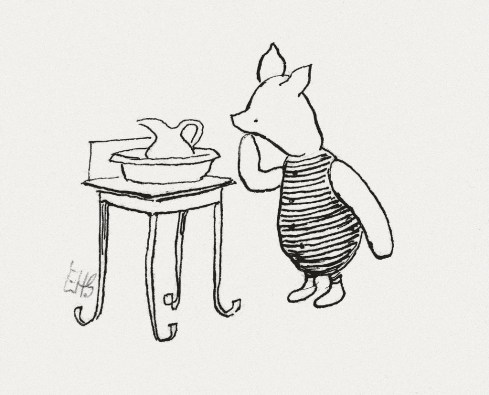
Piglet gets ready for the party


I love when he listens to Eeyore and does something to help him out of his funk.


He’s there for his friends and always willing to help. Despite his diminutive size he is brave enough to face great odds. He may be afraid of everything, but that doesn’t get in the way of his standing up for what is right, or standing next to a friend to face a challenge.


The Disney-fied version of my beloved porcine friend. [Image courtesy: render-graphiques.fr]

The Disney-fied version of my beloved porcine friend. [Image courtesy: render-graphiques.fr]


Least Shining Moment: I do not like what Disney did with Piglet. They turned his innocence into a cartoon. I was OK with that as a kid, but as I get older, and Disney keeps chugging out more and more Pooh related crap, I resent that they are forcing the Milne characters into cookie-cutter cartoons of themselves to sell more DVDs and plastic  stuff. Piglet just gets squeekier and squeekier and the tender, brave, humble pig gets more and more diluted. SHAME.


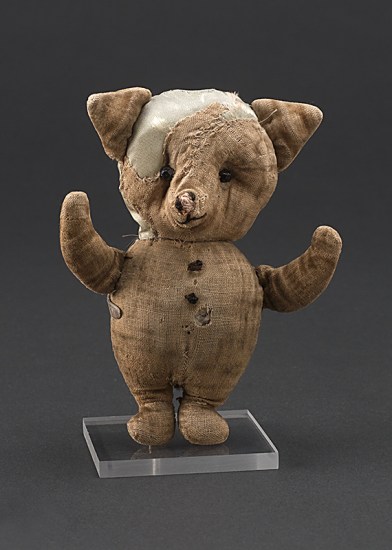
Well loved and well used, this is the original Piglet. One of Christopher Robin Milne's surviving stuffed animals, Piglet resides at the New York Public Library.

Well loved and well used, this is the original Piglet. One of Christopher Robin Milne‘s surviving stuffed animals, Piglet resides at the New York Public Library.

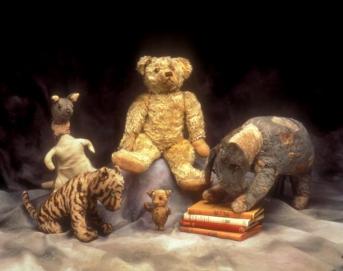
In 1921, as a first-birthday present, Christopher Robin Milne received a small stuffed bear, which had been purchased at Harrods in London. Eeyore, Piglet, Kanga, and Tigger soon joined Winnie-the-Pooh as Christopher’s playmates and the inspiration for the children’s classics When We Were Very Young (1924), Winnie-the-Pooh (1926), Now We Are Six (1927), and The House at Pooh Corner (1928), written by his father, A.A. Milne, and illustrated by Ernest H. Shepard.

You can see just how small Piglet is compared to the other stuffed animals in this photo. [Image courtesy: The New York Public Library

You can see just how small Piglet is compared to the other stuffed animals in this photo. [Image courtesy: The New York Public Library

Brought to the United States in 1947, the toys remained with the American publisher E.P. Dutton until 1987, when they were donated to The New York Public Library. [Treasures of The New York Public Library.]


Cover of Winnie-the-Pooh

Cover of Winnie-the-Pooh (Photo credit: Wikipedia)


One more image... Piglet dancing with delight. Keep that image in your heart today, OK?

One more image… Piglet dancing with delight. Keep that image in your heart today, OK?


Tycho Brahe 12.14.12 Thought of the Day

“I conclude, therefore, that this star is not some kind of comet or a fiery meteor… but that it is a star shining in the firmament itself one that has never previously been seen before our time, in any age since the beginning of the world.”
–Tycho Brahe

The astronomer Tycho Brahe

The astronomer Tycho Brahe (Photo credit: Wikipedia)

Tycho Ottesen Brahe was born on this day in Knutstrop Castle, Scania, Denmark-Norway in 1546. Today is the 466th anniversary of his birth.

Noble by birth Brahe’s twin brother died before he could be baptized. Tycho’s ode to his dead brother was his first published work. At two his  uncle,  Jorgen Thygesen Brahe,  took him (perhaps kidnapped him) to live at Tosterup Castle, and Tycho became Jorgen’s heir.  At 12 he entered the University of Copenhagen to study philosophy and rhetorics. There was a solar eclipse in 1560 and young Tycho was fascinated by it. He began studying astronomy. When he started at Leipzig he  began to study astronomy without permission…

but was soon forgiven after demonstrating successes. He found that old observations were very inaccurate, and started to design methods and instruments for high-precision measurement of positions of celestial bodies. [TychoBrahe]

From Leipzig he continued his academic pursuits  in  Germany, studying at Wittenberg, Rostock and Basel. In Rostock he had a famous duel with another student to determine who was the best mathematician.

Tycho Brahe

Tycho Brahe (Photo credit: lilspikey)

His nose was cut so badly that  for the rest of his life “he covered the scar with a plate probably made of a silver-copper alloy to imitate the colour of the skin.” [Ibid]

During this period his interest in alchemy and astronomy was aroused, and he bought several astronomical instruments.[The Galileo Project]

He returned to Scania and built a laboratory to study chemistry. In November of 1572 he turned his sights to the heavens again and observed …

a new brilliant star in the constellation of Cassiopeia. Tycho’s measurements showed that it really was a distant star and not any local phenomena. This was very intriguing at that time, since the sphere of the stars was considered to be divine and perfect, hence no changes ought to take place there. Tycho observed its brightness evolve until it faded away the next year. He reported the event in his book “De stella nova”, which made him famous all over Europe. [TychoBrahe]

With his new found fame he could have studied anywhere in Europe, but he chose to return to his beloved Denmark. King Frederick II  granted him the Island of Hven.

Map of Hven from the Blaeu Atlas 1663, based o...

“…There he built his observatory, Uraniburg, which became the finest observatory in Europe.” [The Galileo Project] He designed new instruments and developed a nightly program of observations.

Tycho Brahe's Stjerneborg observatory on the i...

Tycho Brahe’s Stjerneborg observatory on the island of Hven, restored. 2005 (Photo credit: Wikipedia)

The observatory was visited by many scholars, and Tycho trained a generation of young astronomers there in the art of observing. [Ibid]

He left Hven after he had an argument with King Christian IV and, after traveling for several years, wound up in Prague.

Tycho Brahe died 24th October 1601 of a urinary bladder infection. It has long been thought that the cure (a self-induced potion that may have contained lead) was the real culprit. But that has recently been disproved.

English: Signature of Tycho Brahe.

English: Signature of Tycho Brahe. (Photo credit: Wikipedia)

Tycho Brahe ved Knutstorp, Knudstrup

Tycho Brahe ved Knutstorp, Knudstrup (Photo credit: Wikipedia)


Pride and Prejudice Essay Contests

Today’s blog features two essay contests: the official JASNA Student Essay Contest,
and the ritaLOVEStoWRITE Essay Contest for the rest of us.


JASNA essay contest


JASNA STUDENT ESSAY CONTEST:


Attention: Students at the high school, college and post-graduate levels:


In celebration of the 200th anniversary of the publication of Pride and Prejudice, JASNA (The Jane Austen Society of North America) is looking for short essays on the following topic:


“Though Pride and Prejudice may be regarded as timeless, nevertheless within the novel Austen plots her time very carefully. Timing is everything for important relationships and events. And the characters are deeply connected to the time in which they live, which is both like and unlike our times. What do we discover about time, times, or timeliness from reading Pride and Prejudice?”


Title page from the first edition of the first...

Title page from the first edition of the first volume of Pride and Prejudice (Photo credit: Wikipedia)

Judges will be awarding scholarships ranging from $250 to $1000, plus a years membership to JASNA, plus tickets and lodging to the 2013 JASNA Annual General Meeting in Minneapolis. The winning essays will also appear on the JASNA website.


Deadline is May 15, 2013. 


Click HERE to go to the JASNA Essay Contest Page for more details.


[Please note that the contest is open to students outside the United States too, but the essay must be written in English.]


———————————————————————————————-


English: Mr. and Mrs. Bennet. Austen, Jane. Pr...

English: Mr. and Mrs. Bennet. Austen, Jane. Pride and Prejudice. London: George Allen, 1894, page 5. (Photo credit: Wikipedia)

ritaLOVEStoWRITE  Contest for the rest of us:


So what about the rest of us Pride and Prejudice lovers? Can’t WE write an essay*? Well, sure you can. I’m calling for entries right here and right now.


We too will be celebrating the 200th anniversary of P&P! But guess what? Any one can participate!  Couple of RULES here:


  1. TRY and keep it under 1200 words please.
  2. The “essay” should be Pride and Prejudice centric.
  3. Please submit your essay in English.
  4. Have fun with it!
  5. Oh, and no pornography == THIS is Austen after all!


English: Français : Une gravure de 1833 illust...

English: Français : Une gravure de 1833 illustrant une scène du chapitre 59 du roman Orgueil et Préjugés de Jane Austen. À gauche M. Bennet, à droite Elizabeth. Avec File:Pickering – Greatbatch – Jane Austen – Pride_and_Prejudice – This is not to be borne, Miss Bennet.jpg, il s’agit des toutes premières illustrations de l’œuvre. (Photo credit: Wikipedia)


Prizes include… All entries will be published in an upcoming special edition of the award-winning ritaLOVEStoWRITE blog. All entries will receive a participation banner for your blog. The top three entries will receive a special “Finalist” banner for their Blog Page, and the top entry will win a Darcy mug! (Please make sure to include an email contact — which I will remove before posting so the whole world doesn’t see it.)


Deadline: 28 January 2013 (That’s the anniversary date of the novel’s publication)


*I seriously encourage you to think outside the box. For you illustrators out there… how about some character studies? Are you a play wright? Why not treat us to a re-imagined scene or two?


AND … Although I’m not going to snark on your intellectual property I strongly suggest you throw a copyright on all your original material in case any one else takes a liking to it.


English: This diagram, or map, illustrates the...

English: This diagram, or map, illustrates the relationships between each of the main characters in the novel Pride and Prejudice by Jane Austen. (Photo credit: Wikipedia)


Steve Buscemi 12.13.12 Thought of the Day

“My favorite review described me as the cinematic equivalent of junk mail.”
Steve Buscemi


(Image courtesy: fan pop)

(Image courtesy: fanpop.com)


Steven Vincent Buscemi was born on this day in Brooklyn, New York, USA in 1957. He is 55 years old.


Buscemi is part Irish and part Italian, he’s one of four boys born to John Buscemi, a sanitation worker, and Dorthy Buscemi a hostess. He went to Valley Stream Central High School where he wrestled and acted. After graduating in 1975 he attended Nassau Community College then moved Manhattan to attend the Lee Strasberg Institute. He worked on FDNY Engine #55 as a fire fighter. He has worked as a bartender, a stand-up comedian, an ice-cream truck driver before breaking into acting. One of his brothers, Michael, is also an actor.


He made his film debut with a short called Tommy’s (in which he played Tommy), in 1985. He took on the odd ball, character actor roles — often the mafia types and worked in dozens of TV shows and movies. When he hooked up with the Coen Brother’s his off beat sensibilities found a home.


As of 2010, has appeared in six Coen Brothers films (Miller’s Crossing (1990), The Hudsucker Proxy (1994), Barton Fink (1991), Fargo (1996), The Big Lebowski (1998), and Paris, je t’aime (2006)), more than any other actor. [IMDB.com]


He played Mr. Pink in Quentin Tarntino’s Reservoir Dogs. Then paired up with the director again for a bit part in Pulp Fiction.


English: Photo of a young Steve Buscemi (Ameri...

English: Photo of a young Steve Buscemi (American actor). Taken in Silverlake / Los Angeles. (Photo credit: Wikipedia)


Buscemi was brilliant as Carl Showalter, the can’t-catch-a-break smal-time crook in Fargo.


His movie and tv CV is impressive, and he’s the kind of actor where you see a movie title  and you think “Oh, yeah, he WAS in that.”  From Templeton the Rat (in 2006’s Charlotte’s Web) to Donny (in 1998’s The Big Lebowski) to Lenny Wosniak (his recurring guest spot on 30 Rock) Buscemi is wonderful to watch — even when you want to turn away.


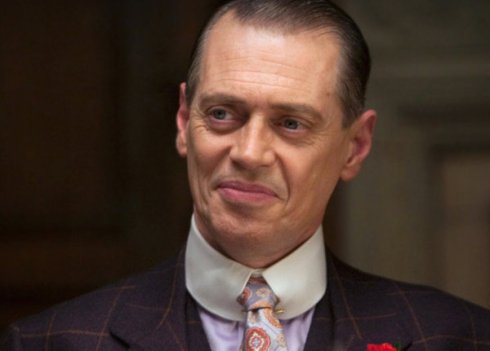
Most recently he’s been the star of HBO’s Boardwalk Empire. As amoral Nucky Thompson he manages to hang on to a thread of inner humanity to keep his character viable. And , oh, yeah, he’s a hoot. (When he’s not killing people.)

Buscemi as Nucky Thompson. (Image courtesy HBO)

Buscemi as Nucky Thompson. (Image courtesy HBO)


Frank Sinatra 12.12.12 Thought of the Day

“May you live to be 100 and may the last voice you hear be mine.”
— Frank Sinatra

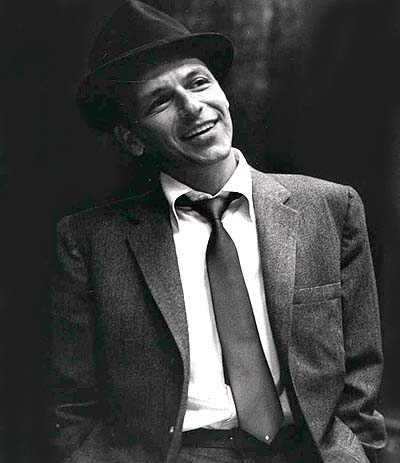
Image courtesy last.fm

Image courtesy last.fm

Francis Albert Sinatra was born on this day in Hoboken, New Jersey, USA in 1915. Today is the 97th anniversary of his birth.

Frank was the only child of Marty and Dolly Sinatra. As a kid he stood on top of the bar at a local nightclub and sang for tips. He dropped (or was kicked) out of high school, and help make ends meet at home by delivering the local paper, the Jersey Observer. He also worked as a riveter at a local shipyard. Although he couldn’t read music he began singing professionally by the mid 1930s when he joined the Three Flashes (they changed their name to the Hoboken Four.)

He worked as a singing waiter in Englewood Cliffs for $15 a week for almost 4 years. Then Henry James signed him for a one year contract at $75 a week. On July 13th, 1939, as the US was emerging from a decade of Depression and the world was on the advent of another great War, 23-year-old  Frank Sinatra recorded his first record, From the Bottom of my Heart, with the Harry James Orchestra.

He released 10 songs with James (none of which charted particularly high in their original pressing.) Sinatra switched to the more popular Tommy Dorsey’s band (with James’ blessing) in November. He recorded over 40 songs on Dorsey. One of his biggest hits with Dorsey was I’ll Never Smile Again.

By 1941 he was at the top of  both the Billboard and Down Beat magazine polls. Not only did he sell records, he opened up an entirely new audience — the bobby soxers (aka teenagers.) [It seems odd today — when so much of a company’s advertising budget goes toward capturing the 12-20 year old’s pocketbook — but prior to 1940 most consumers were adults.  Sinatra appealed to both adult women and bobby sox wearing girls.]

Image courtesy last.fm

Image courtesy last.fm

He went solo in 1943 and in the next three years he charted 17 times.  Sinatra was classified 4-F for military service because of a perforated eardrum, so he did not serve in the military.

He started making films as part of the Dorsey Band  with Las Vegas Nights and  Ship Ahoy, he had a walk on / singing part in the wonderfully named Reveille with Beverly but then had his first real role in Higher and Higher. He teamed with Gene Kelly for the hugely successful Anchors Aweigh in 1945.  It was the first of three Sinatra/Kelly films with Take Me Out to the Ball Game and On the Town coming out in 1949.  He won a special academy award for his work on the (dated) short film The House I Live In. (1945)

At the beginning of the 1950’s Sinatra saw his popularity wane somewhat. The bobby soxers who had screamed out deafening choruses of “FRANKIE” for the thin, blue-eyed singer had found new idols to adore.

He came back with a bang with his next movie, 1953’s From Here to Eternity. He won an Oscar as bad boy Angelo Maggio.

Cover of "From Here to Eternity"

Cover of From Here to Eternity

The same year he signed with Capitol Records. In 1954 his album Swing Easy! was named Album of the Year by Billboard and the single Young At Heart was picked for Song of the year. Swing Easy was arranged by Nelson Riddle. Sinatra and Riddle worked together again for Songs for Swingin’ Lovers! which included I’ve Got You Under My Skin.

He poked fun at his mobster image in the movie version of Guys and Dolls. in 1955 as Nathan Detroit.  In 1956 he played Mike Connor to Grace Kelly’s Tracy Lord in High Society.  The next year he was Joey in Pal Joey.

He started his own record label in 1960, Reprise Records. 

In 1962 he starred in his most dramatic movie the classic political thriller, The Manchurian Candidate. [For my money The Manchurian Candidate is the best movie of the bunch.]

He was a founding member of the Rat Pack and worked alongside Dean Martin, Peter Lawford, Sammy Davis Jr., and Joey Bishop in several movies and countless nightclub acts.

Here he is  having a ton of fun singing Lady Is a Tramp with the incomparable Ella Fitzgerald

Sinatra was a sucker for charities.  He raised over a billion dollars in the course of his life for charities all over the world.

His generosity touched the worlds of education, medicine, science, and children’s needs, his favorite cause. … Sometimes it was a late-night phone call that moved him; sometimes he just caught wind of a hard-luck story on the news or in the paper and did what he could to fix it. [Sinatra.com]

In 1962 he led a 12 country World Tour for Children that raised over a million dollars for children’s charities worldwide. He paid for the entire cost of the tour himself, and recruited other musical luminaries to join him.

He also worked against segregation , taking a major role in the desegregation of Nevada entertainment and hospitality industry in the 1960s. He boycotted venues and hotels where black performers and guest were banned. And he played benefits for Martin Luther King, Jr. and the Equal Right Movement.

Sinatra received the Presidential medal of Freedom from Ronal Reagan in 1985.

Ole’ Blue Eyes faced his final curtain on May 14, 1998. He was 82 years old.

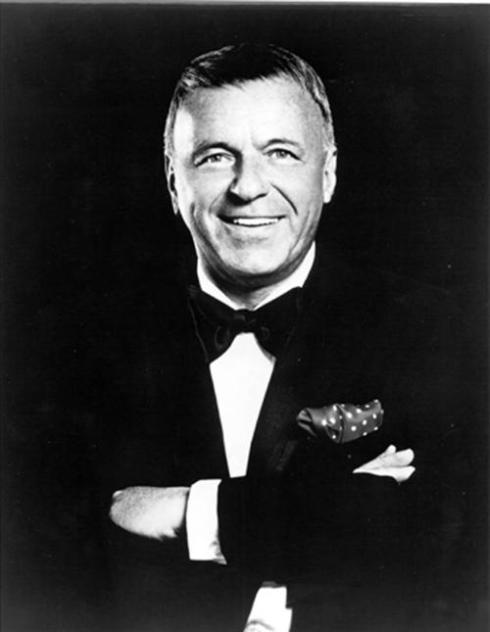
Frank older

Image courtesy last.fm


Rita Moreno 12.11.12 Thought of the Day

“Then there’s the story of ill-fated love. It’s universal.”
Rita Moreno

Caption for Rita Moreno

[Image courtesy: Berkeleyside]

Rosita Dolores Alverio was born on this day in Humacao, Puerto Rico in 1931. She is 81.

She moved to New York with her mother when she was six. Her first entertainment gig was doing Spanish voice overs to American films when she was 11. She made her Broadway debut in November of 1945 in Skydrift at the Belasco Theatre. Her name appeared in the program as Rita Moreno.

She appeared as Zelda Zanders in Singin’ in the Rain in 1952 and as Tuptim in The King and I in 1956. She also played a lot of  Latino “sexpot” roles, something she found degrading, but that she put up with.

Then came West Side Story…

Moreno (co-stars) as “Anita”, the Puerto Rican girlfriend of Sharks’ leader Bernardo, whose sister Maria is the piece’s Juliet. A seasoned singer and dancer, Moreno delivered a superb performance that completely overshadowed the Maria of the movie, the non-singer (and non-Hispanic) Natalie Wood, the only movie star in the ensemble cast. [IMDB Rita Moreno]

Watch her sing and dance up a storm with Geroge Chakiris and the Sharks (et al) in West Side Story…

But her performance went well beyond wise cracking, dancing and singing. She was…

…unforgettable in a harrowing scene where she had to deliver a message from Maria to the Romeo of the piece, the Jets’ member Tony, and is assaulted by his fellow gang-members. This is the real climax of the film.[Ibid]

She won an Oscar for her Anita.

Moreno is, in fact, the first person to win an Oscar, Emmy, Tony and Grammy — something only 12 other people have managed to achieve.. (She won Emmys for The Muppet Show and The Rockford Files; The Tony was for the musical The Ritz (’76), and the Grammy was for the soundtrack to the “Electric Company.”) In 2010 President Obama awarded Moreno a National Medal of  Arts.

Here she mets her match with the Muppet Show‘s Animal (or was it the other way around?)

From PBS kids shows like Where In the World is Carmen Sandiego to the hard-hitting HBO prison drama OZ (she won 3 American Latino Media Arts awards for her role as Sister Peter Marie Reimondo) Moreno always gives herself 100% to a project.

Here she is singing It’s An Art from the musical Working...

Moreno has over 130 credits listed in her TV and Movie database and has been working for over 6 decades. At 81 she still looks and sounds great, and shows little sign of slowing down.

Moreno in 2009. [Image courtesy NOVA Southeastern University.]

Moreno in 2009. [Image courtesy NOVA Southeastern University.]


Emily Dickinson 12.10.12 Thought of the Day

“Saying nothing…sometimes says the most.”
Emily Dickinson

English: Daguerreotype of the poet Emily Dicki...

If I can stop one heart from breaking,
I shall not live in vain;
If I can ease one life the aching,
Or cool one pain,
Or help one fainting robin
Unto his nest again,
I shall not live in vain.

Emily Elizabeth Dickinson was born on this day in Amherst, Massachusetts in 1830. Today is the 182 anniversary of her birth.

Emily was the second of three of three children born to Edward and Emily Norcross Dickinson. Her brother William Austin Dickinson was born a year before her, her litter sister Lavinia (“Vinnie”) three years after. Her father was a lawyer who served in the Massachusetts State legislature and Senate and the US House of Representatives.

The Dickinson children (Emily on the left), ca...

The Dickinson children (Emily on the left), ca. 1840. From the Dickinson Room at Houghton Library, Harvard University. (Photo credit: Wikipedia)

Emily was a proper Victorian girl and was well-educated in English, History, Science (especially Botany), the Classics, Literature, and Math at Amherst Academy.

“By Emily Dickinson’s account, she delighted in all aspects of the school—the curriculum, the teachers, the students … At the academy she developed a group of close friends within and against whom she defined her self and its written expression. …the time at school was a time of intellectual challenge and relative freedom for girls, especially in an academy such as Amherst, which prided itself on its progressive understanding of education.” [Poetry Foundation. org]

At 16 she entered Mount Holyoke Female Seminary. She found her time at the Seminary less agreeable and less challenging and she only stayed a year.

In February, 1852 the Springfield Daily Republican published Sic transit gloria mundi,” Dickinson’s first published work.

The speakers in Dickinson’s poetry, like those in Brontë’s and Browning’s works, are sharp-sighted observers who see the inescapable limitations of their societies as well as their imagined and imaginable escapes. [Poetry Foundation. org]

Only 20 of her 1700 poems were published  in her lifetime. She collected her writing in notebooks and shared her poems with her family and close friends, especially her sister-in-law Susan Gilbert Dickinson.

In 1864 and 1865 she went to stay with her Norcross cousins in Boston to see an eye doctor whereupon she was forbidden to read or write. It would be the last time she ventured from Amherst. [Online-Literature.com]

By 1870 she and Lavinia were staying at home to care for their bed ridden mother. In 1872 “Dickinson enjoyed a romance with Judge Otis Phillips Lord, a friend of her fathers.” [Emily Dickinson Museum.org] 

Austin Dickinson house, Amherst, Massachusetts...

Austin Dickinson house, Amherst, Massachusetts. View of facade from left. (Photo credit: Wikipedia)

In 1874 her father died unexpectedly. At that point Emily stopped going out in public. She lost her nephew Gib in 1883. Judge Lord died in 1884. And her dear friend Helen Hunt Jackson passed in 1885. Death seemed to surround her. Emily herself was very ill with an sickness “affecting the kidneys, Bright’s Disease, symptoms of which include chronic pain and edema, which may have contributed to her seclusion from the outside world.” [Online-Literature.com]

To make the abstract tangible, to define meaning without confining it, to inhabit a house that never became a prison, Dickinson created in her writing a distinctively elliptical language for expressing what was possible but not yet realized.[Poetry Foundation. org]

“She remained in poor health until she died at age 55 on May 15, 1886. She was buried four days later in the town cemetery, now known as West Cemetery.” [Ibid]

English: Grave of Emily Dickinson in Amherst, ...

English: Grave of Emily Dickinson in Amherst, Massachusetts. (Photo credit: Wikipedia)

Because I could not stop for Death,
He kindly stopped for me;
The carriage held but just ourselves
And Immortality.We slowly drove, he knew no haste,
And I had put away
My labor, and my leisure too,
For his civility.

We passed the school, where children strove
At recess, in the ring;
We passed the fields of gazing grain,
We passed the setting sun.

Or rather, he passed us;
The dews grew quivering and chill,
For only gossamer my gown,
My tippet only tulle.

We paused before a house that seemed
A swelling of the ground;
The roof was scarcely visible,
The cornice but a mound.

Since then ’tis centuries, and yet each
Feels shorter than the day
I first surmised the horses’ heads
Were toward eternity.


Jakob Dylan 12.9.12 Thought of the Day

“Tolerance can lead to learning something.”
— Jakob Dylan

Cover of "Red Letter Days"

Jakob Luke Dylan was born on this day in New York City, New York, USA in 1969. He is 43 years old.

Dylan is the youngest son of  Bob Dylan and his wife Sara, and he is the only one of his siblings to become a musician. He has long been under the shadow of his more famous father, something he takes in stride. He is determined not to sell tickets based on his last name, but he’s also had to bear the burden of 45 years worth of fans expecting him to be the next Bob Dylan.

On one hand, he acknowledges that no one forced him into a recording studio at knifepoint. On the other hand, the result has been, at times, preposterous; he was somehow elected chairman of the Child Musicians Who Could Never Live Up to Their Fathers Assn. [The Essential Jakob Dylan; Los Angeles Times  June 08, 2008]

The younger Dylan played in bands in high school and, after taking some time off to attend the Parsons School for Design in New York, formed The Wallflowers in the late 1980s. They put out a The Wallflowers in 1992 to lukewarm response, but fared better with their sophomore release, Bringing Down the Horse.  Horse was one of 1997s best-selling albums and it featured hits like 6th Avenue Heartache, One Headlight, Three Marlenas, and The Difference.  (Breach) and Red Letter Days came out in 2000 and 2002 respectively.

Here’s 6th Avenue Heartache…

I prefer my Jakob Dylan unplugged… like in this Austin City Limits Festival version of Evil is Alive & Well from 2008.

The song is off his first solo album, Seeing Things which was released in June of 2008.

Here’s an “unplugged” studio version of One Headlight with The Wallflowers.

His second “solo” album is really a collaborative effort with 15 other artists. Here’s Everybody’s Hurting from that album.

The Wallflowers reunited earlier this year. They put out a new album, Glad All Over in October. The group picks up touring again at the end of the month. So if you are in the little town of Bethlehem (PA) you can see them on the 27th at the Sands Casino. (Austin fans; they’ll be at the Erwin Center on St. Patty’s Day). A complete list of tour dates are on the Wallflower web site HERE.

ACL - Jakob Dylan

ACL – Jakob Dylan (Photo credit: kfjmiller)


Secondary Character Saturday — Mary Musgrove (Persuasion)

[Most of you know that I’m a Jane Austen fan. And you are probably surprised that it has taken me three whole weeks of Second Character Saturdays to get to an Austen character. Frankly, so am I!  I suppose I was warming up a bit with Horatio and Ron. But today, dear reader, I present you with my absolute favorite Austen creation… a confection of comedy, social commentary and self absorption (and even pathos)… Mary Musgrove from Persuasion.

If you’ve never read Jane Austen’s wonderful Persuasion you can go HERE to read it online via Project Guttenberg; or get it from Amazon Kindle HERE.  Or if you prefer to listen to Austen’s lovely prose HERE is a link to the Librabox recording. All three of these sources are free. You can also go to a book store or library and get something I like to call a B-O-O-K that you hold in your hand and turn the paper pages with your fingers.]

———————————————————-

Name: Mary Musgrove, Nee: Elliot

From: Persuasion

By: Jane Austen

Written In: 1816

Illustration from an early edition of Persuasion.

Illustration from an early edition of Persuasion.

Why: Through Mary Austen holds a mirror up to the Elliot’s (and through them the upper class in general)  over inflated sense of self-importance. Society is changing in the novel, there are the established gentry and the up and coming gentry, and each group admires different things. The Elliots are clearly old money and Mary feels, as a Baronet’s daughter, she deserves the best of everything. Unfortunately for her the Musgroves don’t give her the respect she thinks her rank deserves.

The more she demands attention, the more the Musgroves roll their eyes and ignore her.  The more she pushes herself to (her rightful place at) the front of the line, the more ridiculous she looks (and the more resented she is). By the time we meet her in the novel the only way she can get attention is when she is sick.

Poor Mary:

…is the least attractive daughter in a family where personal vanity is rated a virtue. While Elizabeth is a beauty whose looks have lasted into her late twenties, and Anne was “an extremely pretty girl”, though her bloom faded early, Mary “was inferior to both sisters, and had, even in her bloom, only reached the dignity of being ‘a fine girl’.”  [Literary Characters: Mary Musgrove in Persuasion]

Since Elizabeth never married, Mary would never have been able to enter a wider society. At about 19, she married a man who preferred her sister, and into a family where the members were blindly partial to one another and would always view her as an outsider and a second choice.” [Jane Austen-Her Life and Works] 

Not even her little boys listen to her.

Masterpiece Theatre - The Complete Jane Austen: "Persuasion" - Julia Davis as Elizabeth Elliot, Sally Hawkins as Anne Elliot, Amanda Hale as Mary Musgrove [Photo credit: Nick Briggs/Masterpiece Theatre]

Masterpiece Theatre – The Complete Jane Austen: “Persuasion” – Julia Davis as Elizabeth Elliot, Sally Hawkins as Anne Elliot, Amanda Hale as Mary Musgrove [Photo credit: Nick Briggs/Masterpiece Theatre]

Anne (the heroine of the story) inherited her mother’s soothing ways. It’s no wonder Mary calls on her when ever she feels “ill.”

…she is not a first object to anyone. It is understandable that a young woman brought up with so little affection might think herself ill-used when surrounded by evidence of it in a family where she can never fully share it, and where another would have been clearly preferred. [Ibid]

Here’s how Austen describes Mary:

“While well, and happy, and properly attended to, she had great good humour and excellent spirits, but any indisposition sunk her completely; she had no resources for solitude; and inheriting a good deal of the Elliot self-importance, was very prone to … fancying herself neglected and ill-used.” [from Persuasion, by Jane Austen]

Pros: She loves her boys, her husband and her sister. She’s funny. She brings much-needed comic relief to the novel (at her expense).

Cons: hypochondriac, elitist, selfish

Best Moment: ummmm… well…. I think Mary really does love Anne. And she appreciates her much more than any one else in the family. Although on the surface that may seem to be for purely selfish reasons I think Mary is genuinely happy to see Anne and spend time with her.

The fabulous Sophie Thompson played Mary in the 1995 version of Persusion. (Amanda Root is Anne). [Image courtesy: Collar City Brownstone]

The fabulous Sophie Thompson played Mary in the 1995 version of Persusion. (Amanda Root is Anne). [Image courtesy: Collar City Brownstone]

Worst Moment: When Mary gets hysterical at Lyme. Her sister-in-law, Louisa Musgrove, has just taken a serious spill from the top of a stone wall and lies critically injured, and Mary freaks out — causing some of the others to pay attention to her, and not to the unfortunate Louisa. Fortunately Anne keeps her head, calls for a doctor and gets Louisa to their friend’s the Harvilles’ house. “Captain Wentworth asks the capable Anne to stay and assist. Mary is offended, insisting she should stay.” [Literary Characters: Mary Musgrove in Persuasion] Every one gives in, of course, and Anne removes with Wentworth and Henrietta Musgrove to break the news to Mr. and Mrs. Musgrove back at Uppercross. When Mary finally returns to Uppercross we learn …

how useless Mary is as a ‘nurse’, compared with what Anne would have been. While her sister-in-law lies seriously ill, supposedly nursed by her, Mary goes out enjoying herself. Jane Austen writes, that, during her stay in Lyme, Mary ‘found more to enjoy than to suffer’. [Jane Austen-Her Life and Works] 

Why I love her: In my bucket list of fantasy things I’d like to do in this life… one of them is to play Mary Musgrove on stage. She is such an interesting character, and it would be a challenge to bring out the humanity to this character who can so easily be portrayed as a cartoon. She makes me laugh, but I feel for her too. I also get pretty frustrated with her. That’s a pretty interesting Secondary Character …. hmmm now that I think about it she’s a lot like Ron.
austen_6526

More Jane Austen Blogs from ritaLOVEStoWRITE: