Farm Fresh Challenge — Fennel meet Orange

I’m inspired by a recipe on Fox and Fawn Farm’s blog for the muffin half of today’s post. Fox & Farm is a CSA near Minneapolis, MN that’s run by Red and Nina Kirkman. I found the recipe (which I adapted here) through a Google search on ‘what the heck am I going to do with Fennel?’ (really I search for ‘Fennel Muffins’).  If you are looking for some additional farm fresh recipes give their site a look. It is well organized and equally well stocked with recipes and ideas.

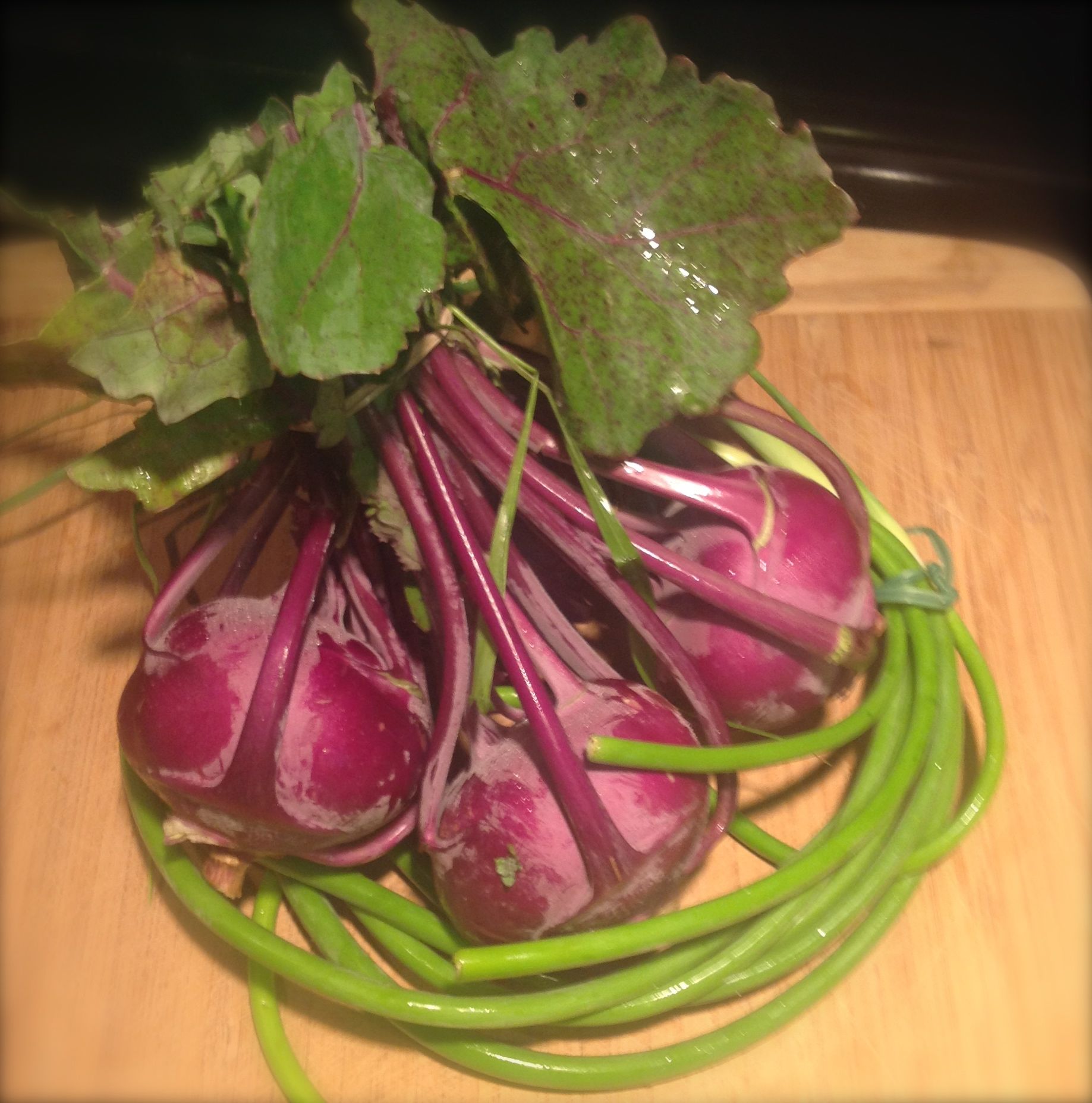
Here’s what I took home from my fabulous CSA — Calvert’s Gift — today:

The box was bountiful this week. Carrots, turnips, beets, fennel, zucchini, garlic scrapes. romaine lettuce, mixed greens, eggs

The box was bountiful again this week. My haul included:  Carrots, turnips, beets, fennel, zucchini, garlic scrapes. romaine lettuce, mixed greens, spring onions, green and purple basil and eggs. (Items in bold face are used in today’s Farm Fresh recipe.)

I knew right away that I wanted to make a twist on a Caesar Salad and I wanted to find a muffin recipe for those lovely fennel bulbs. So here we go…

[Not associated with the real Chopped, the Food Network or Tim Allen.]

Week Four [Not associated with the real Chopped, the Food Network or Tim Allen.]

Round One: Fennel Orange Cherry Muffins

INGREDIENTS:

  • 1/2 cup Orange Juice
  • 2 Eggs
  • 1/2 cup Vegetable Oil (I used Peanut Oil)
  • 3/4 cup Brow Sugar
  • 1 tsp Vanilla
  • 1 cup grated Fennel Bulb (save the Fennel Tops for the salad)
  • 1/2 cup grated Zucchini
  • 1/2 cup grated Carrots
  • 1/2 cup diced Cherries
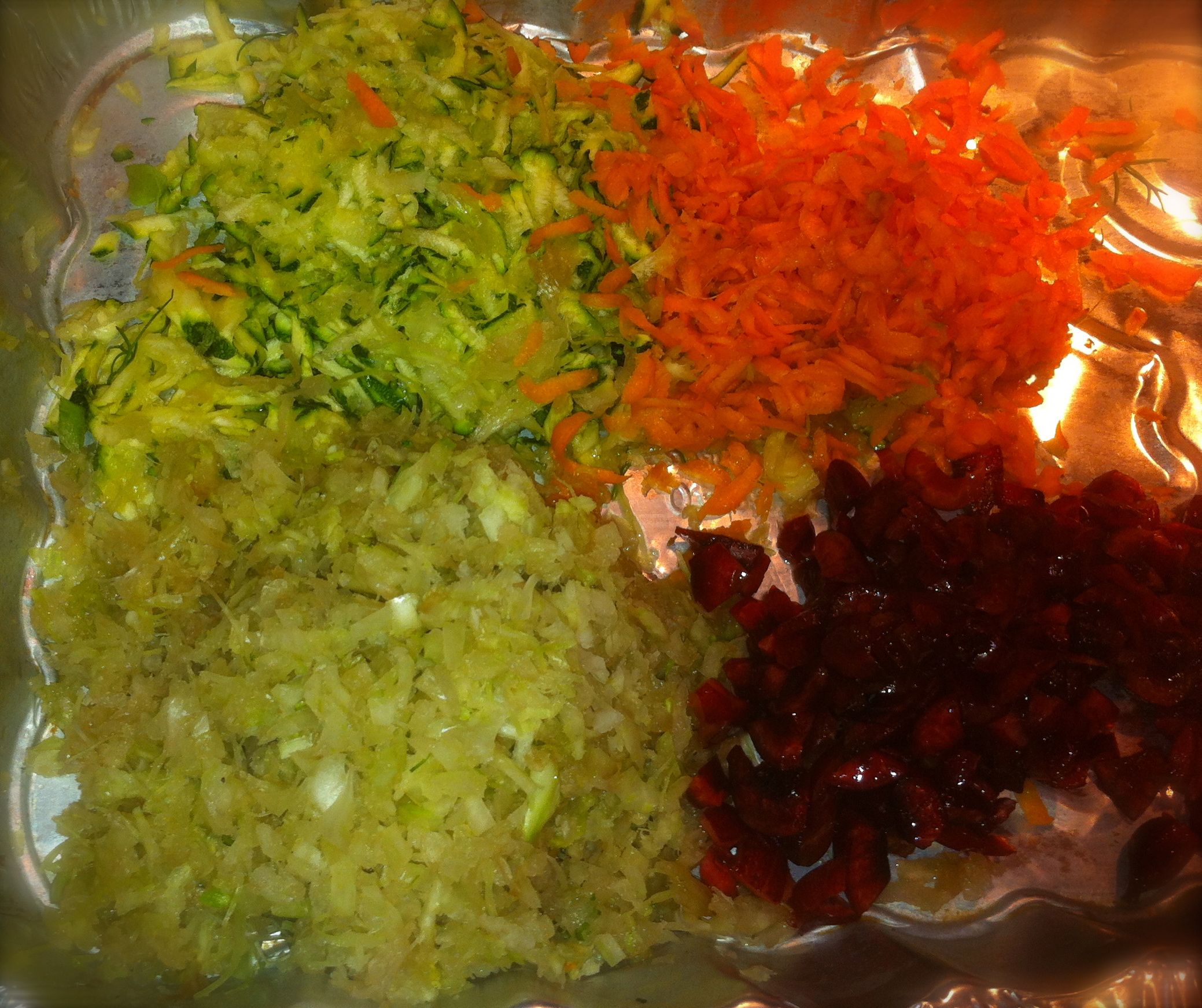
Zucchini, Carrots, Cherries and Fennel.

Zucchini, Carrots, Cherries and Fennel prepped and ready to go.

  • 2 1/4 cup Whole Wheat Flour
  • 1 1/2 teaspoon Baking Powder
  • 1 teaspoon salt
  • Sliced Almonds

DIRECTIONS:

1. Preheat oven to 350 degrees. Prep muffin cups with spray.

2. Grate the Zucchini, Carrots, Fennel. Dice the Cherries.

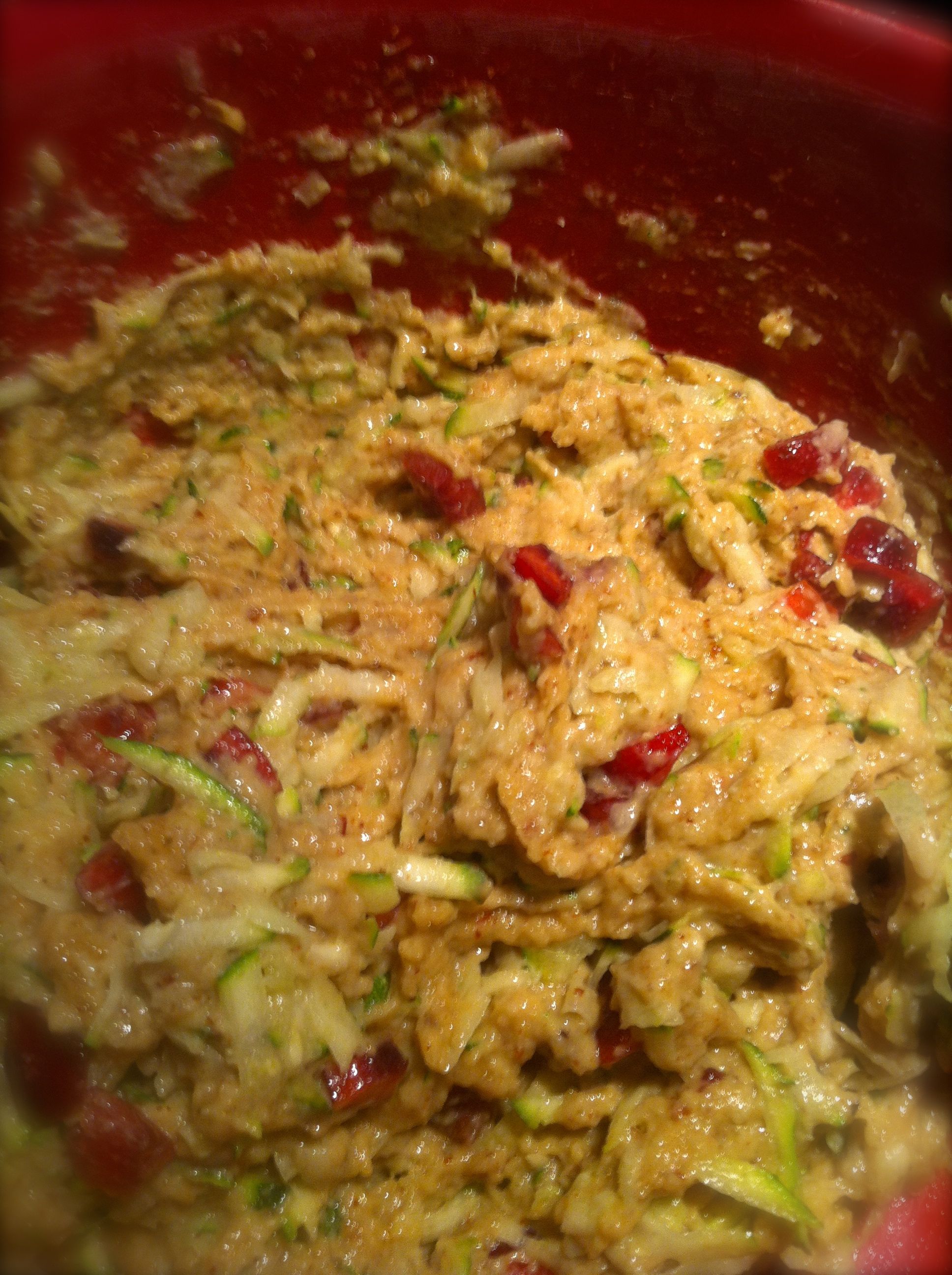
3. Put the Orange Juice, Eggs, Oil, Brown Sugar, and Vanilla in a large bowl and combine. Add the Zucchini, Carrots, Cherries an Fennel.

Isn't that a festive bowl of liquid ingredients?

Isn’t that a festive bowl of liquid ingredients?

4 Add the Flour, Baking Powder and Salt all at once to the liquid and fold in.

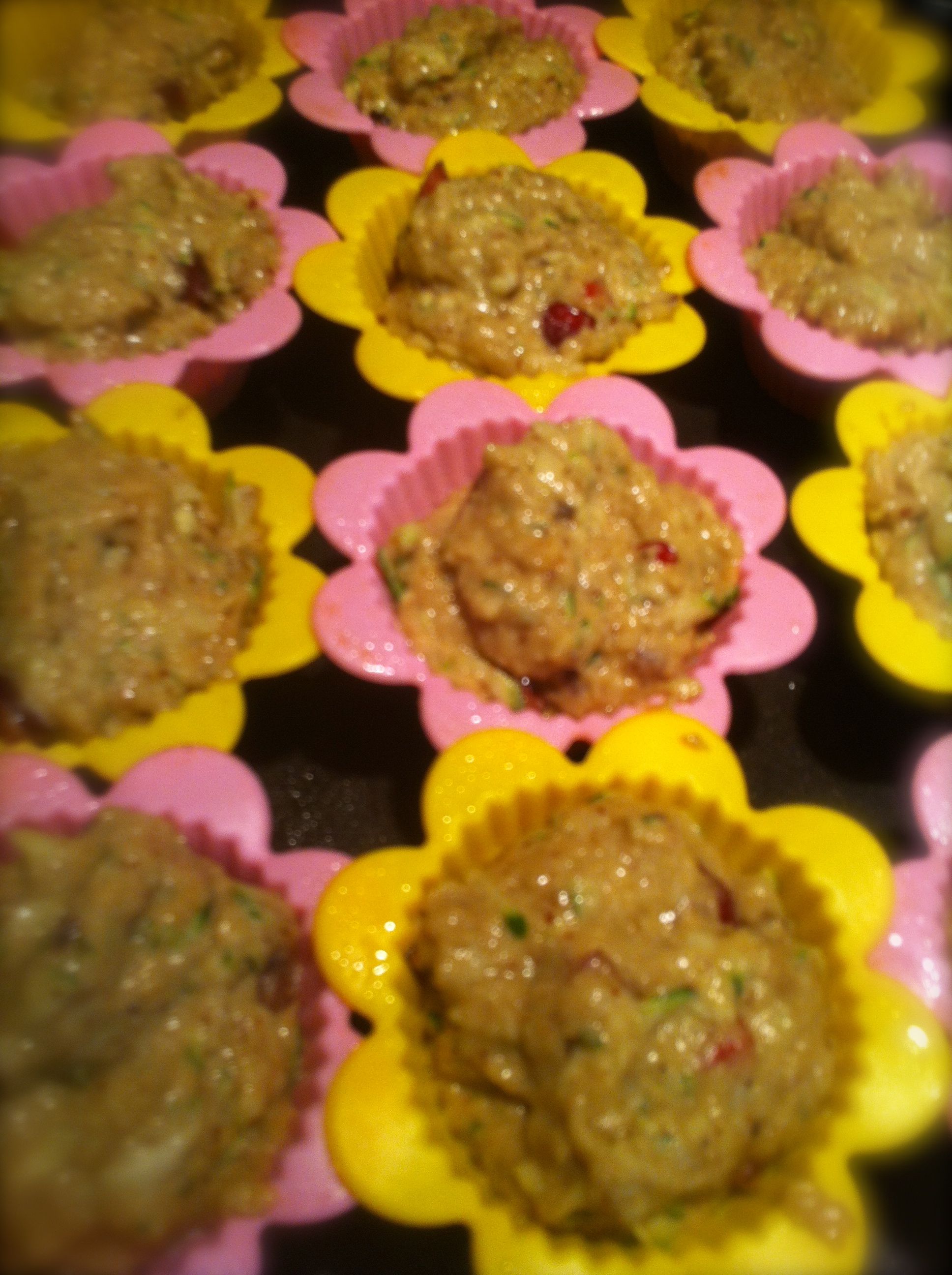
5. Divide evenly into 12 muffin cups (I had some left over… so BONUS MUFFIN !) Top with Almonds.

6. Bake for 25 – 35 minutes. (It took the full 35 minutes for me) until a toothpick inserted into the center of a muffin comes out clean and muffins look golden brown.

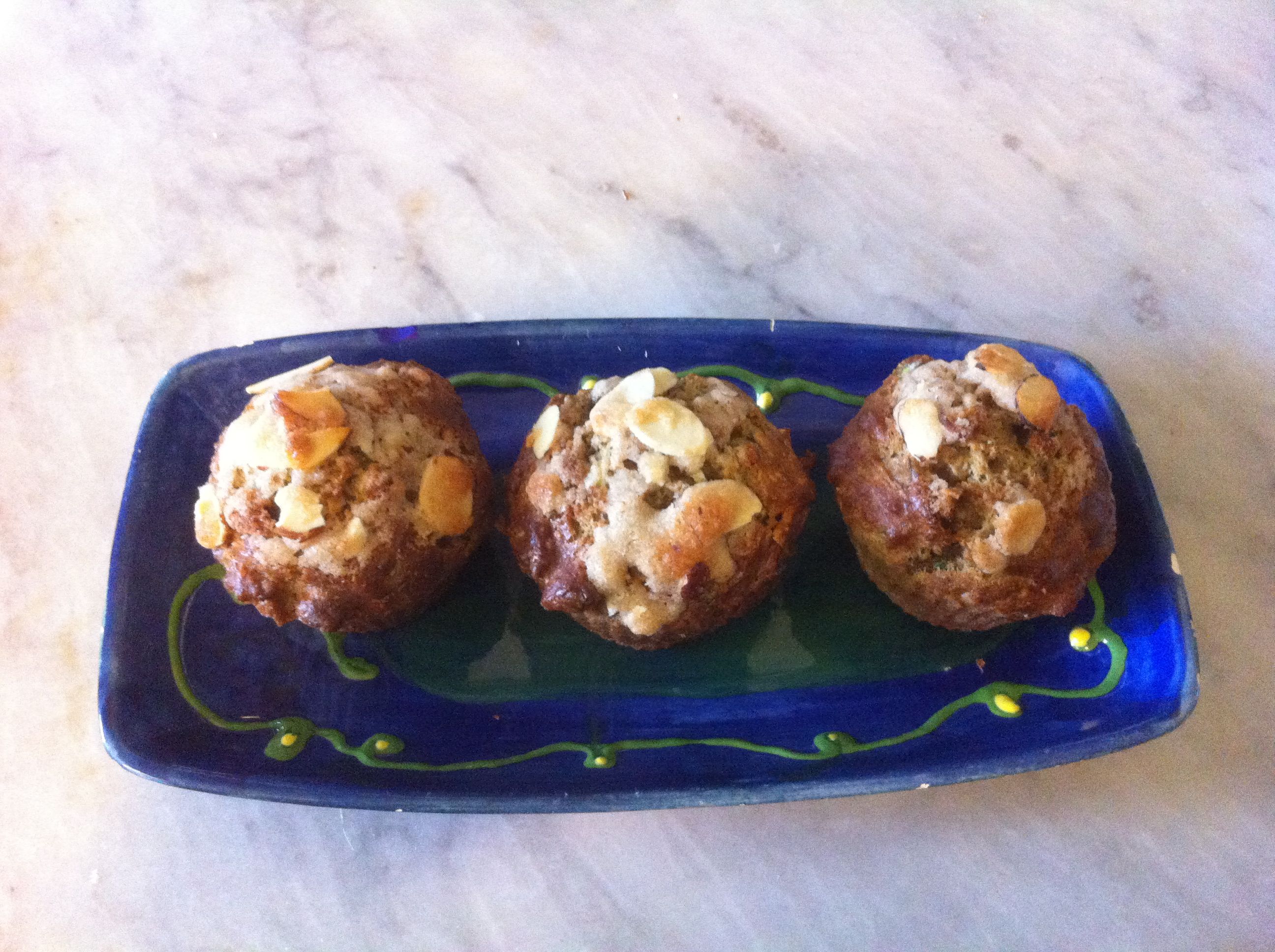
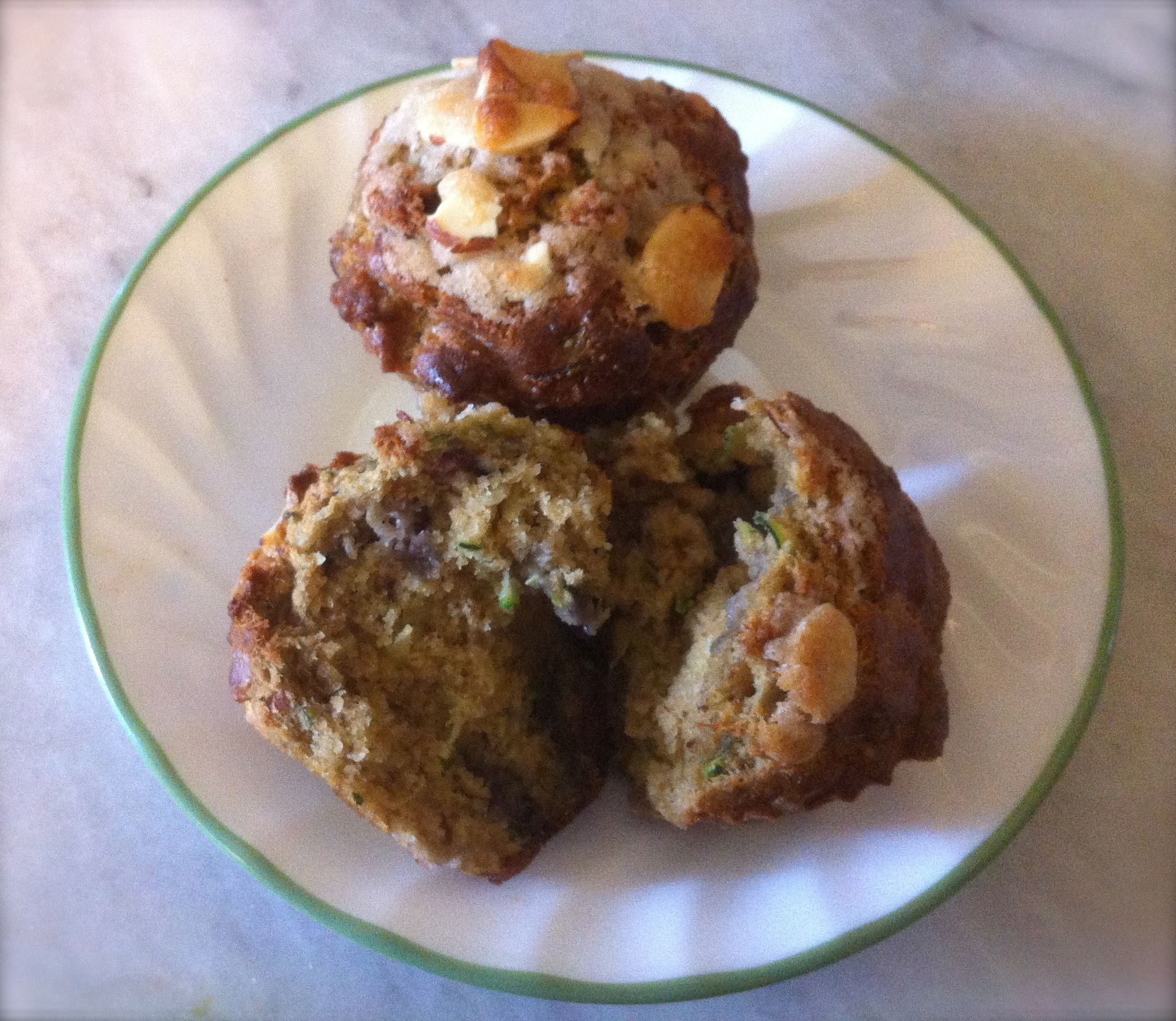
Finished muffin

Finished muffin

Round Two: Orange Caesar Salad w/Veal Sausage

Ingredients:

  • 1 head Romaine Lettuce
  • 2 cups assorted Spring Mix
  • 2 Spring Onions
  • 1/4 cup Garlic Scrapes, finely chopped
  • 1/4 cup Fennel Tops, finely chopped
  • 1/4 cup Extra Virgin Olive Oil
  • 1 teaspoon Garlic, finely minced
  • 5 leaves of Purple Basil, chopped
  • 2 slices of Bread, cut into 1/2″ chunks
  • 1/2 cup Orange Juice
  • 1 teaspoon Worcestershire Sauce
  • 2 Eggs, coddled
  • 2 ounces grated Parmesan Cheese
  • Salt
  • Pepper
  • 1 pound Weisswurst (Veal Sausage)

DIRECTIONS:

1. Whisk together the Olive Oil and Garlic in a large bowl and set aside.

2. Bring a pot of water to boil. Add the EGGS and let cook for 1 to 2 minutes to coddle. Remove eggs from water and set aside. Refresh water and bring to a boil.
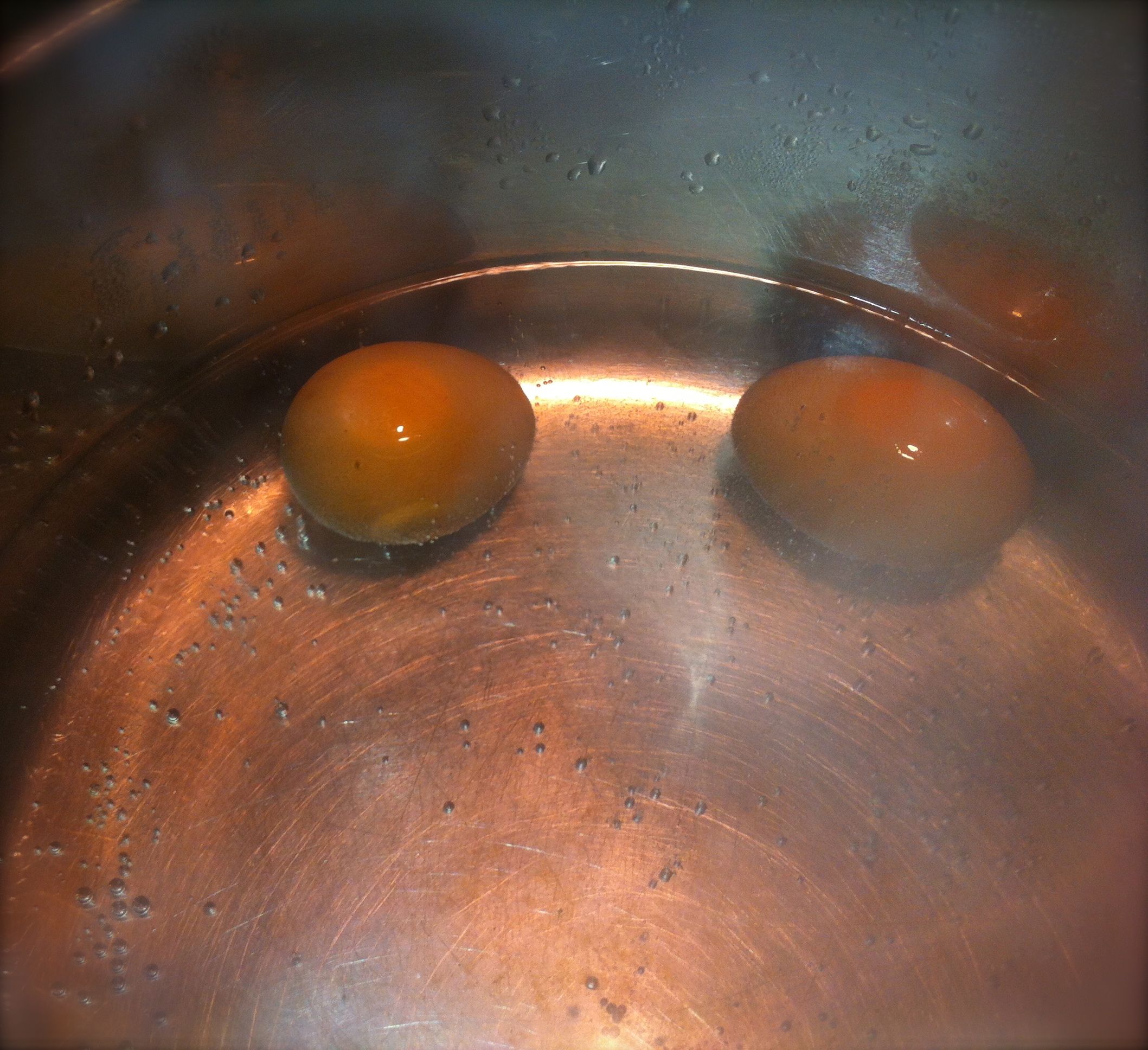
Eggs Coddled

I’m not big on adding raw eggs to a salad, which is traditional for a Caesar. I found a recipe that recommended Coddling the eggs so they are par cooked. You still get the lovely velvety-runny yolk, but it isn’t 100% raw. **

3. Clean the Lettuce/Spring Mix and pat dry with a paper towel. Break up the Romaine into  1″ to 2″ pieces. Chop the Spring Onion, Fennel tops, Purple Basil and Garlic Scrapes. Cut up the Bread.

4. Toss all the veggies and bread*  into the Olive Oil.

All the veggies in the salad before mixing or dressing

All the veggies  and bread in the salad before mixing or dressing

5. Put the Weisswurst in the boiling water to cook. When the skin breaks on the sausage it is ready.

6. In a medium bowl whisk the Orange Juice, Worcestershire Sauce, Coddled Eggs, Parmesan Cheese and a dash of Salt and Pepper together.  Pour the dressing over the greens and toss gently but well.

7. Plate the salad topped with sliced Weisswurst with a muffin on the side. Garnish with an additional sprig of Fennel top. Enjoy.
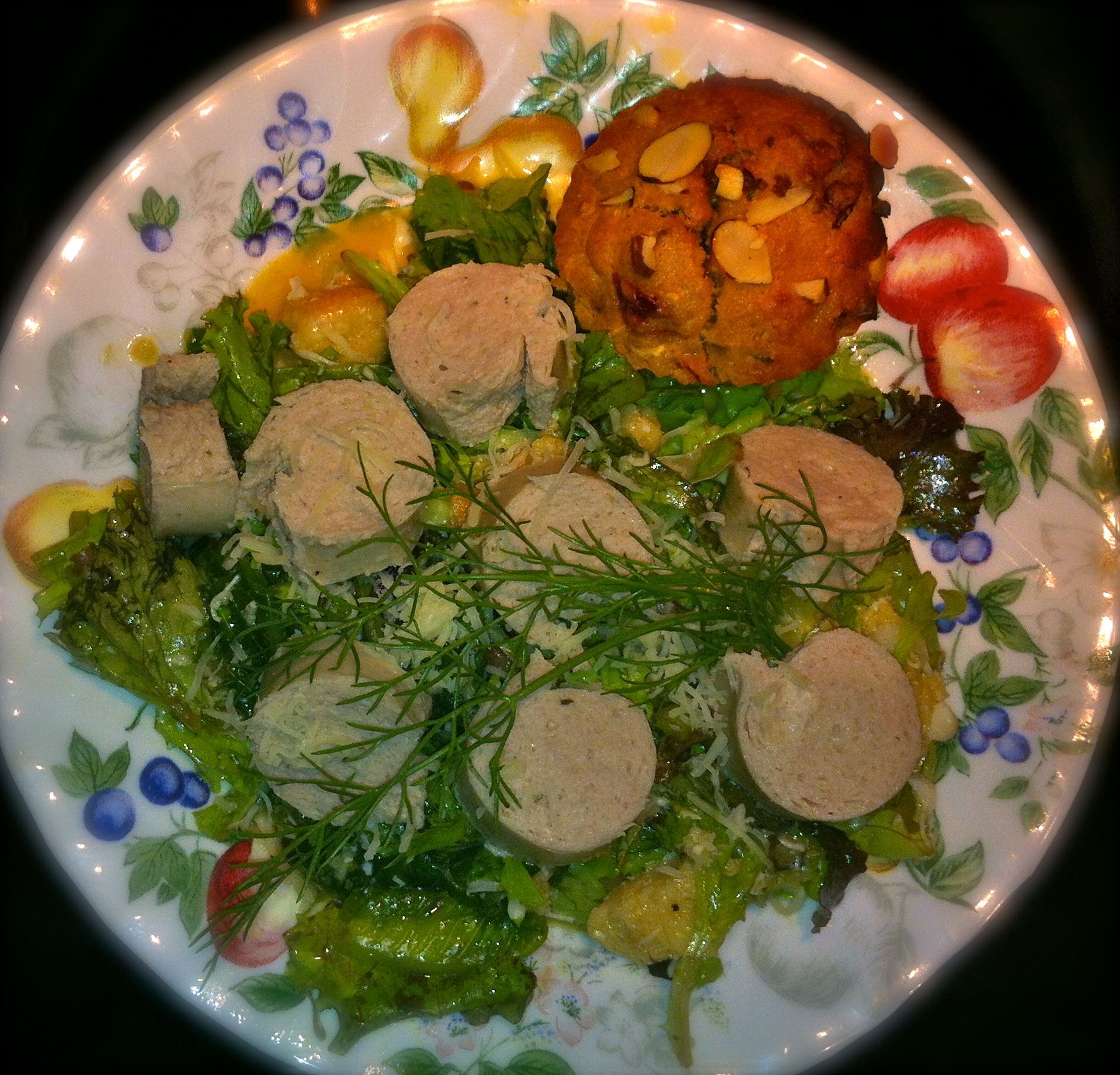
Plated meal.

Plated meal.

I liked the brightness that the orange juice brought to the Caesar Salad, and I’m digging the Orange / Fennel combo. The muffins were just sweet enough. The Cherry / Orange / Fennel combo worked well there too. They are moist and you’ll probably want to keep them in the fridge on these summery days.


Previously on Farm Fresh Challenge / Parkton Chopped:

• Farm Fresh Challenge: Kohlrabi Stir Up

Roasted Turnip Salad

Turnip and Ham Salad

*Maggie suggest adding the bread later.

**(If a par cooked, runny egg still leaves you running for the hills, then hard cook the eggs. Chop up hard boiled eggs and use a garnish. — But add a tablespoon of mayonnaise to the dressing to act as a binder.)


James Montgomery Flagg 6.18.13 Thought of the Day

English: American artist James Montgomery Flag...

English: American artist James Montgomery Flagg (1877-1960) (Photo credit: Wikipedia)

“I Want You for U.S. Army.”

James Montgomery Flagg was born in Pelham Manor, New York, USA in 1877. Today is the 136th anniversary of his birth.

He knew he wanted to be an artist at a young age. By 12 he sold his first illustration to St. Nicholas Magazine for $10. “By 14 he was a contributing artist for Life magazine, and the following year was on the staff of another magazine, Judge.”  [RoGallery.com] Although he attended art school in New York, London and Paris he was dubious as to their benefit. He once said “Art cannot be taught. Artists are born that way…I wasted six years of my young life in art schools… You can’t breed an artist. You can only breed mediocrity.”  [spartacus.schoolnet.com.uk] When he returned to the States he married Nellie McCormick, a St. Louis socialite 11 years his senior. The couple moved about the country eventually landing in New York City where Flagg established himself as a magazine illustrator.

English: Caricature of Rupert Hughes (1872-195...

English: Caricature of Rupert Hughes (1872-1956) by James Montgomery Flagg (1877-1960) (Photo credit: Wikipedia)

He worked with a dozen or so of the top publications in the country and produced an illustration a day (on average).

Flagg was not only a productive illustrator, he was also enormously versatile.. Flagg displayed his powers in opaque and transparent watercolor and oils. He worked in monochrome for halftone reproduction; with a full palette for color reproduction. He was equally skilled in charcoal and pencil. He was even a consummate sculptor. No medium was too difficult for him and except for pastel (which he disliked) he used them all with ease.” [spartacus.schoolnet.com.uk]

Flagg started to draw for Photoplay Magazine in 1903, producing illustrated portraits of movie stars.

When the US entered World War I he joined a group of fellow artist called the Division of Pictorial Publicity which designed patriotic posters. Among the 46 posters Flag created is his famous “I Want You for the US Army”. He posed as Uncle Sam himself (to save the trouble and expense of finding a model.)

English: Uncle Sam recruiting poster.

English: Uncle Sam recruiting poster. (Photo credit: Wikipedia)

He was a fan of Franklin D. Roosevelt and created political posters promoting the New Deal and Roosevelt’s presidential campaigns.  When the US entered WWII he revived Uncle Sam and made a series of Red Cross posters.

After the War he mounted an exhibition of his fine art at the Ferargil Gallery in New York City. But by the 1950’s magazines had moved to photography over illustration and he found his skills less in demand.

He was outspoken and he didn’t suffer fools. He had a high opinion of himself and once said “The difference between an artist and an illustrator is that the latter knows how to draw, eats three square meals a day and can pay for them.”

Along with his artwork he also wrote screenplays and acted on both the stage and set.

Flagg died on May 27th , 1960. He was 83 years old.

Click HERE to see a nice selection of his artwork.

Jas. Montgomery Flagg  (LOC)

Jas. Montgomery Flagg (LOC) (Photo credit: The Library of Congress)


Muffin Monday Banana Cherry Muffins DF

Happy Muffin Monday everyone! Here’s a recipe for all you Dairy Free folks out there. Hope you like it! IMG_5343

Banana Cherry Muffins

INGREDIENTS: 1 1/2 c Whole Wheat Flour IMG_5324 1 1/2 c Almond Meal IMG_5323 1/4 teaspoon Sea Salt IMG_5325 1 teaspoon Baking Soda IMG_5326 2 Tablespoons Olive Oil IMG_5329 2 Large Eggs IMG_5280 2 tablespoons Demerara Sugar

IMG_4937

2 teaspoons Almond Extract IMG_5332 2 Bananas

IMG_5327

1 cup Cherries (diced)

The Bing cherry owes its development to the Ch...

1 Zucchini (grated) IMG_5294 Topping: 2 tablespoons Almonds (silvered) 2 tablespoons Whole Wheat Flour 2 tablespoons White Sugar 2 tablespoons melted Butter DIRECTIONS: 1. Preheat the oven to 350 degrees. Prepare muffin cups. 2. In a large bowl place Flour, Almond Meal, Salt and Baking Soda. Mix. 3. In a medium bowl, mash the Bananas add Eggs one at a time, mixing  well with each addition. Add Olive Oil, Demerara Sugar and Almond Extract. 4. Mix the dry and wet ingredients together. IMG_5333 5. Add the Cherries and Zucchini  and mix gently. 6. Divide the batter evenly into 12 muffin cups. IMG_5335 7. In a small bowl combine all the topping ingredient. Divide evenly onto the muffins. 8. Bake for 20 minutes, or until a toothpick inserted into the center of one of the muffins comes out clean. IMG_5346 Both Maggie and I thought these muffins could have used a little more sugar… so you might want to add a bit more, or serve with marmalade. They are moist — especially considering there’s no milk or butter in the recipe — and moderately fluffy. You can really taste the Banana, not so much the Cherry. Give ’em a try and let me know what you think.


Random thought — HOW to be a REAL WOMAN

Little things prompt me to action sometimes. Today, for example, an article entitled “How To Be A Woman” came across my feed and it sparked in me a need to respond. I found it limited, insulting and misogynistic.

Clearly a bee got in my bonnet and I felt the need to write my own list of What Makes a Real Woman. Here goes…

Daisy

What Makes a Real Woman

  1. Be true to yourself
  2. Love
  3. Think
  4. Give
  5. Respect
  6. Conserve
  7. Rejoice
  8. Share
  9. Create
  10. Educate

Luckily you don’t have to be a Woman to follow these guidelines. They also hold true for What Makes a Real Human Being.

—————–

In  “How To Be A Woman” author Clarrisa Taylor advises to, among other things…

  • play dodgeball,
  • enter a male-dominated work field (and not leave to have a child),
  • learn to fall asleep without a man,

OK. Not my definition of Womanhood, but, if that’s how she chooses to define her life…

I had more of a problem with her advice to  “Show everyone how big your heart is” by falling in love with a broken man and not trying to fix him. Advice that, to me seemed more appropriate to a romance novel or a list entitled “How to Tell if You are a Woman in an Abusive Relationship”, maybe.)

But, the one that really got me was #4 …

 4. If you get raped, share your story. Make sure your voice is heard. But don’t prosecute him. You’re above that. This is how you win.

YES. Share your story. YES. make sure your voice is heard. Absolutely. But “don’t prosecute him”?  “You’re above that.” ? WHAT? If  you have been the victim of rape or sexual assault I hope you will prosecute the perpetrator, because the likelihood is that they’ll do it some one else. Seeking help (at qualified centers like  MCASA in Maryland or NSVRC nation wide ) “is how you win.”


Mary Katherine Goddard 6.16.13 Thought of the Day

“He carries every point, who blends the useful with the agreeable, amusing the reader while he instructs him.”
the English translation of the Goddard family motto.

[Image courtesy: The Baltimore Sun]

[Image courtesy: The Baltimore Sun]

Mary Katherine Goddard was born on this day n Groton, Connecticut, USA, in 1738. Today is the 275th anniversary of her birth.

She was elder of two children born to Sarah Updike Goddard and Dr. Giles Goddard. Mary Katherine and her brother William learned to read and write at their New London, Connecticut home. Their mother also taught them “Latin, French, and the literary classics.” [WHMN.org] Shakespeare, Pope and Swift  were favorite reading assignments.

When Mary Katherine was 19 her father passed away. The family stayed in Connecticut for a few years while William was apprenticed to a local printer, but in 1762 they moved to Providence, Rhode Island, and  Sarah Goddard lent William the money to start his own printing business. All three members of the family pitched in to help establish the business.

William was ostensibly in charge, (but) he traveled a great deal, and it was Sarah Updike Goddard who was the true publisher of the Providence Gazette and Country Journal.  Mary Katherine took a great interest in the business and forewent many of the usual activities for young ladies to work as a typesetter, printer, and journalist.  The mother/daughter team made their print shop a hub of activity at a time when newspapers exerted great political influence.  They added a bookbindery, and in addition to the Gazette, printed almanacs, pamphlets, and occasionally books.[WHMN.org]

In 1765 William left Rhode Island for the more metropolitan Philadelphia.  Mary Katherine took over the printing operation in Providence.

…Left with a burden upon her shoulders, Mary Katherine acquired the skills she needed to print a successful publication. “It was probably during the years of [William’s] absence… that his sister… learned the practical side of typography and journalism… ” Lawrence C. Wroth wrote.[University of Rhode Island web site URI.edu]

Three years later William asked the two women to sell the Providence business (They sold the Gazette,  press and building for $550) and move to Pennsylvania to help him with the Philadelphia Chronicle.

Upon their arrival they ran the newspaper and press and William headed to Baltimore, Maryland  on a new venture.  Mary Katherine followed him again in 1774 when she took over her brother’s weekly publications the Maryland Journal and Baltimore Advertiser as he continued to travel.

With her mother dead and her brother prioritizing his political inclinations, Mary Katherine Goddard finally assumed the title of publisher of the Maryland Journal and the Baltimore Advertiser.  She put “Published by M.K. Goddard” on the masthead on May 10, 1775 — and it remained there even when William returned from his New Hampshire-to-Georgia travels in 1776.  [WHMN.org]

She also became a postmaster in 1775 — the first woman in the colonies to do so. As postmaster she was at the  “center of the information exchange.”  [Ibid] and was privy to the news before her competitors. The Journal broke important news stories  (like the skirmishes at Lexington and Concord).

[Image courtesy the Library of Congress]

[Image courtesy the Library of Congress]

Mary Katherine kept the tone of the Journal professional. Other newspapers — and William — editorialized and included op eds that advanced political agendas. “Mary Katherine Goddard used a more objective, impersonal, and professional tone.” [Ibid]

She was a shrewd business woman who accepted alternate forms of payment when the taxes or the War made cash subscription payments difficult.

These included beef, pork, animal food, butter, hog’s lard, tallow, beeswax, flour, wheat, rye, Indian corn, beans and other goods she could sell in her shop. [University of Rhode Island web site URI.edu]

She ran a stationary and printing press where fine printing was produced. She also had a local paper mill.

Mary Katherine biggest scoop as a newspaper woman came in January of 1777 when her press printed the first official copy of the Declaration of  Independence to include the names of the signers.

Goddard's published copy of the Declaration of Independence with all the signers identified. [Image courtesy McHenry Country Turning Point.org]

Goddard’s published copy of the Declaration of Independence with all the signers identified. [Image courtesy McHenry Country Turning Point.org]

She successfully ran both the publication and the related printing and paper companies AND served as postmaster through out the long Revolutionary War. But things changed in 1784. She had a falling out with William and he forced her off the paper’s staff. Then in 1789 Mary Katherine was forced to give up her postmaster position. As a woman — it was as argued — she could not handle the traveling the job would demand. Her appeals — backed by a petition of endorsement signed by over 200 Baltimore businessmen — went to President Washington and Congress but got nowhere. She resigned her self to running her bookstore.

Mary Katherine Goddard died att he age of 78 on April 12, 1816. “A copy of the Declaration of Independence printed by her is at the Maryland Hall of Records.”[WHMN.org]


Secondary Character Saturday: James Montgomery “Scotty” Scott

James Doohan as Scotty.  [Image courtesy: Paramount Pictures]

James Doohan as Scotty.
[Image courtesy: Paramount Pictures]

WHO: James Montgomery Scott

FROM: Star Trek

BY: Created by Gene Roddenberry

PUBLISHED: The series premiered in 1966.

PROS: Loveable, brave, funny,  and  super smart, Mr. Scott knows every thing there is to know about the Enterprise. He’s the ultimate engineer, so he’s got that going for him too.

Scotty's position on the far left of this cast picture puts him firmly in the Secondary Character rhelm... But what would the crew of the USS Enterprise have gotten with out him? Pulled over to a service station and had the dilithium oil checked? I don't think so.

Scotty’s position on the far left of this cast picture puts him firmly in the Secondary Character category… But what would the crew of the USS Enterprise have gotten without him? Pulled over to a service station and had the dilithium oil checked? I don’t think so.

CONS:  Mr. Scott was very proud of his ship… blindingly proud… and it often got him in trouble, like when he…

started a bar fight aboard Deep Space Station K-7 when the Klingon named Korax suggested that the ship should be hauled away as garbage. As a result, he was confined to his quarters by Kirk. Scott smiled and told Kirk the punishment would give him a chance to catch up on technical journals he had not had time to read. [Memory Alpha.org]

MOST SHINING MOMENT:  Every other episode when he fixed the transporter, cajoled the engines to perform at warp 9 (plus) for an extended period of time, or otherwise earned his  nickname of “the miracle worker.”

LEAST SHINING MOMENT:  Being accused of murder on Argelius (3 times!) Fortunately it was just the alien reincarnation of Jack the Ripper.

MEMORABLE QUOTE: “I’m giving it all she’s got Captain..”

In the Star Trek prime universe Mr. Scott was played by Canadian character actor James Doohan. In the 2009 / 2013 reboot movies he’s played by Simon Pegg.

[Images courtesy: Universal Pictures]

[Images courtesy: Paramount Pictures]

For an in-depth tribute to Mr. Scott see this You tube clip:

Pez Mr. Scott is ready to beam aboard from my bookshelf.

Pez Mr. Scott is ready to beam aboard from my bookshelf.


Margaret Bourke-White 6.14.13 Thought of the Day

[Image courtesy: http://lichnosti.net]

[Image courtesy: http://lichnosti.net%5D

Margaret White was born on this day in the Bronx, New York City, New York, USA in 1904. Today is the 109th anniversary of her birth.

She was one of three children born to Joseph and Minnie. The family lived in Bound Brook, New Jersey.  Margaret, her brother, Roger, and sister, Ruth, went to school locally. Margaret was the editor of the high school year book. After attending several universities (Columbia, Michigan, Western Reserve University, Cornell, Purdue) she received her degree from  Cornell in 1927.

She took up photography as a hobby  but after graduating and moving to New York City she began to work in the field as a professional freelance photographer.

 She combined her own last name with her mother’s maiden name (Bourke) to create her hyphenated professional name. Beginning her career in 1927 as an industrial and architectural photographer, she soon gained a reputation for originality, and in 1929 the publisher Henry Luce hired her for his new Fortune magazine. [Britannica.com]

She went  to German on assignment for Fortune to shoot the Krupp Iron Works in 1930. That done she continued her journey (on her own) to the Soviet Union where she was “the first photographer to seriously document its rapid industrial development. She published her work in the book Eyes on Russia (1931).” [Notablebiographies.com] In 1936 she became a staff photographer for a new magazine called LIFE.

1936 LIFE First Cover

1936 LIFE First Cover (Photo credit: Chuck_893) Featuring Bourke-White’s photograph.

As America sank into the economic Depression of the 1930 Bourke-White turned her camera toward those suffering in the Dust Bowl or waiting in bread lines.

These projects also introduced people and social issues as subject matter into her oeuvre, and she developed a compassionate, humanitarian approach to such photos. In 1935 Bourke-White met the Southern novelist Erskine Caldwell, to whom she was married from 1939 to 1942. The couple collaborated on three illustrated books: You Have Seen Their Faces (1937), about Southern sharecroppers; North of the Danube (1939), about life inCzechoslovakia before the Nazi takeover; and Say, Is This the U.S.A. (1941), about the industrialization of the United States. [Britannica.com]


[Image courtesy: http://jewpics.blogspot.com/] Check this blog out for some more of Bourke-White's intense photography.

[Image courtesy: http://jewpics.blogspot.com/%5D Check this blog out for some more of Bourke-White’s intense photography.

During World War II she became the first female war correspondent to work in a combat zone. The transport she was taking across to North Africa was struck by a U-boat’s torpedo and sunk, but she survived. She covered the Allies in Italy, the Siege of Moscow, Patton’s march across the Rhine into Germany, and the liberation of Buchenwald Concentration Camp.

An iconic photograph of Gandhi at a spinning w...

An iconic photograph of Gandhi at a spinning wheel, taken by Margaret Bourke-White in 1946 (Photo credit: Wikipedia)

After the War she covered  the independence and partition of India and Pakistan. In 1949 and 1950 she covered apartheid in South Africa. In 1952 she went to Korea, again  working as a war correspondent.

Shortly after her return from Korea she noticed signs of Parkinson’s disease, the nerve disorder which she battled for the remainder of her life. …White died at her home in Darien, Connecticut. She left behind a legacy as a determined woman, an innovative visual artist, and a compassionate human observer. [Notablebiographies.com]


Here’s a mini documentary on her life….

http://youtu.be/iAkBu63H8H0


Anne Frank 6.13.13 Thought of the Day

Somehow I missed Anne Frank’s birthday yesterday. So I’m posting her bioBLOG today instead.

—————————————————————————————————————-

“How wonderful it is that nobody need wait a single moment before starting to improve the world.”— Anne Frank

Anne Frank

Anne Frank (Photo credit: Wikipedia)

Annelies Marie Frank was born on June 12, 1929 in Frankfurt am Main, Germany. Yesterday was the 84th anniversary of her birth.

Anne was the younger daughter of Otto and Edith Frank.  Otto Frank was a “lieutenant in the German Army during World War I who later became a businessman in Germany and the Netherlands..”[Biography.com] Anne’s older sister Margot was three years her senior.

The Franks were upper middle-class German Jews. They lived in a diverse neighborhood. Anne went to school and played with children of various religions. But when the Nazis came to power  in Germany Otto Frank moved his family to Amsterdam.

Anne Frank started at the Montessori School in 1934, and throughout the rest of the 1930s she lived a relatively happy and normal childhood. Frank had many friends, Dutch and German, Jewish and Christian, and she was a bright and inquisitive student. [Ibid]

She particularly liked reading and writing, while Margot liked arithmetic. It was one of the many ways in which the sisters were dissimilar. Anne was outgoing, rambunctious and loud; Margot was reserved, well behaved and quiet.

Germany invased the Netherlands on May 10, 1940. Anne later wrote about the invasion:

“After May 1940, the good times were few and far between; first there was the war, then the capitulation and then the arrival of the Germans, which is when the trouble started for the Jews.”

By October of 1940 Anti-Jewish laws were put into place. Anne and Margot had to leave their schools and attend the Jewish Lyceum.  The family had to sew the yellow Star of David on their clothing and had to follow a curfew. Otto Frank took measures to transfer his businesses to Gentile partners so the companies would not be liquidated.

For her birthday in 1942 Anne’s parents gave her a red and white checkered diary which she dubbed  “Kitty”. Less than a month later Margot was called up for service in a German work camp and the family went into hiding.

English: Reconstruction of the bookcase at the...

English: Reconstruction of the bookcase at the Anne Frank house. (Photo credit: Wikipedia)

For the next two years her family, along with Herman, Auguste and Peter Van Pels and Fritz Pfeffer, lived in the secret annex of one of Otto Frank’s former businesses. Anne…

wrote extensive daily entries in her diary. Some betrayed the depth of despair into which she occasionally sunk during day after day of confinement. “I’ve reached the point where I hardly care whether I live or die,” she wrote on February 3, 1944. “The world will keep on turning without me, and I can’t do anything to change events anyway.” However, the act of writing allowed Frank to maintain her sanity and her spirits. “When I write, I can shake off all my cares,” [Biography.com]

The Secret Annex was raided on August 4, 1944 and Anne, her family and the others hiding there were taken to  Camp WesterBork in Northeast Netherlands. On September 3rd, 1944 They were transferred to Auschwitz in Poland. That winter Anne and Margot were transferred to Bergen-Belsen. Both girls contracted typhus and died in March of 1945.

Otto Frank, the only one from the Annex to survive the Camps, returned to Amsterdam after the War. He found Anne’s diary and had selections from it published. It has since been published as a novel, a play and filmed for both television and the big screen.

And so it is that Anne Frank’s words live on 71 years after she began to scribble them down in a little red and white diary.

“Despite everything, I believe that people are really good at heart.”

English: The Diary of a Young Girl by Anne Fra...

English: The Diary of a Young Girl by Anne Frank on display at the Anne Frank Zentrum in Berlin, Germany. (Photo credit: Wikipedia)

For a terrific look inside Anne’s journey and life inside the Annex go HERE to The Secret Annex On Line


Farm Fresh Challenge: Kohlrabi Stir Up

It’s week three of the Community Service Agriculture Farm Fresh Challenge on ritaLOVEStoWRITE… aka…

[Not associated with the real Chopped, the Food Network or Tim Allen.]

[Not associated with the real Chopped, the Food Network or Tim Allen.]

As you can probably guess from the title of the blog, the box this week featured kohlrabi. Kohlrabi is one of my favorite vegetables. It’s the weirdest looking veggie out there, it’s kind of the space probe of the vegetable crisper. And the taste? Well, if Brocoli had a love child and  you were waiting for the paternity test to come back to tell you if Cabbage or Walnut was the father… THEN you’d (kind of) have an idea of what to expect with kohlrabi. It’s a bit brighter and tastier than momma brocoli and it is delightfully crispy.

Purple kohlrabl nestled in a wreath of garlic scrapes

Purple kohlrabl nestled in a wreath of garlic scrapes

From the CSA box:

1 bunch of Kohlrabi

1 bunch of Scallions

1 bunch of Garlic Scrapes

1 head of lettuce

1 egg

Kohlrabi, garlic tails, lettuce 1

From the ritaLOVEStoWRITE pantry/fridge:

1 tablespoon of Butter

4 Chicken Breast

1/4 cup Sour Cream

1/4 cup Milk

1/2 cup Whole Wheat Flour

Salt and Pepper

Cooking spray

Salad Dressing

DIRECTIONS:

The Chicken:

1. Heat a Foreman Grill to 350 degrees.

1. Clean the chicken breast under cold water and pat dry with a paper towel.

2. Set up two low bowls. In the first bowl beat the Egg and mix in the Sour Cream and the Milk. In the second bowl place the Flour, Salt and Pepper and mix it through with a fork.

3. Dredge each Chicken Breast through the Egg batter and then into the Flour until it is well coated.

4. When the Foreman Grill is ready spray with the Cooking spray. Place the Chicken onto the hot surface and close the lid. Check every 5 minutes. Turning and reposition until the Chicken is complete done.

The Vegetables:

1. Wash all the vegetables and pat dry with a paper towel

2. Trim the leaves off the Kohlrabi. Carefully peel the skin and outer fibrous layer off the bulb. Cut into slices.

3. Cut the Scallions into 1/4 ” pieces. You’ll need 1/2 cup of scallions.

4. Cut the Garlic Scrapes into 1/4″ pieces. You’ll need 1/4 cup of the Garlic Scrapes

5. Melt the butter in a large frying pan and stir fry the vegetables until the Kohlrabi is semi translucent.

Kholbrabi in pan

PLATING:

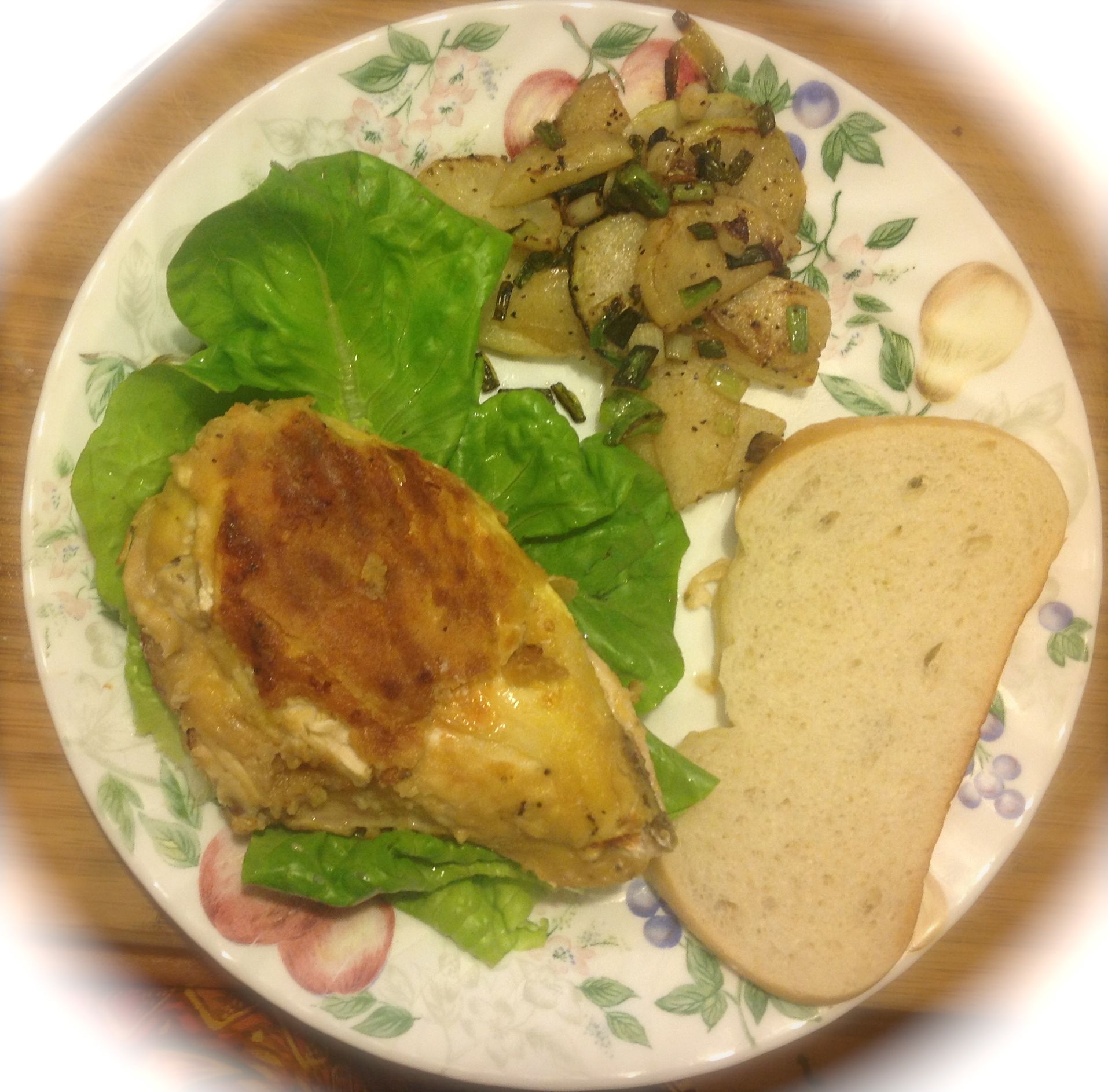
Divide the Lettuce evenly among four plates. Top with the Chicken. Place the Kohlrabi stir-fry on the side and add a piece of fresh bread. Serve with your favorite salad dressing.

Kholrabi plate

ritaLOVEStoWRITE Related Posts:

Roasted Turnip Salad

Turnip and Ham Salad