Category Archives: Writing

Thought of the Day 9.13.12 Roald Dahl

“We are the music makers, and we are the dreamers of dreams.”

–Roald Dahl

My Roald Dahl collage featuring some of his most popular characters (as drawn by the amazing Quentin Blake). Surrounding Mr. Dahl and his pups are: at the top left The BFG & Sophie, The Enormous Crocodile, Mr. Fox, James (inside the Peach,) the Grand High Witch, Willy Wonka, Danny (Champion of the World) and Matilda.

[I gave a little inward squeak of delight when I saw that it was Roald Dahl’s birthday today. I can’t think of a better way to spend a few hours than to reminisce with my old friends Charlie, Matilda, Sophie, James and the rest. What joy!]

Roald Dahl was born on this day in Llandaff, Cardiff, Wales, in 1916. Today is the 96th anniversary of this birth.

Although Dahl grew up in Wales his parents were from Norway and the family spoke Norwegian at home. His older sister, Astrid, and his father,Harald, died within weeks of each other when Roald was a toddler. Sophie, his mother, was pressured to bring the family home and live with relatives, but she knew Harald had wanted the children to have a proper English education. So she split the difference.  Summers were spent visiting relatives across the North Sea. Roald and his sisters enjoyed long, sun drenched days on the water and beaches of the Norwegian coast and the family visited with their grandparents in Oslo.
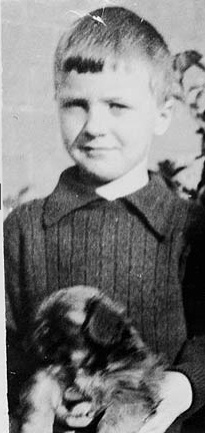
Roald Dahl aged 8. [Image courtesy: The Telegraph]

It was a lovely break for the dreary days at English public school that Dahl described as  being filled with “rules, rules and still more rules to be obeyed.”  His biography Boy: Tales Childhooddetails his exploits, dramas, and adventures growing up… like the time he mixed goat droppings into his older sister’s fiance’s pipe tobacco or the when he and his friend were given Cadbury chocolate samples to taste test at school.

After school Roald wanted adventure…

Though not a good student, his mother nevertheless offered him the option of attending Oxford or Cambridge University …. His reply, …was, “No, thank you. I want to go straight from school to work for a company that will send me to wonderful faraway places like Africa or China.”…Dahl took a position with the Shell Oil Company in Tanganyika (now Tanzania)

He worked for Shell in Mombasa, Kenya and Dar-es-Salaam, Tanganyika and had a famous encounter with a black mamba and some lions. At the outbreak of WWII Dahl joined the British Royal Air Force as a pilot — not an easy thing for him to do as he was 6’6″ and the open cockpit of his De Havilland Tiger Moth was built for men who were considerably smaller.  His head stuck up above the windshield.
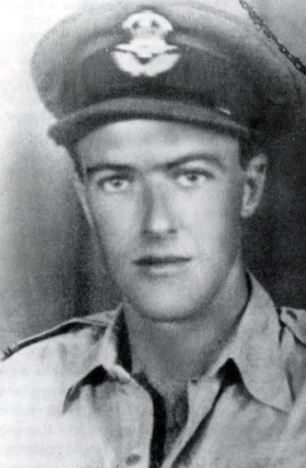
Dahl in his RAF uniform. [Image Courtesy: Mail Online]

In September 1940 while flying the last leg of a trip across the top of Africa he found himself  running out fuel and was lost. He couldn’t find the target airstrip near Mersa Matruh, Egypt, and had to make a desert landing. He cracked his skull, broke his nose, and was temporarily blinded in the crash. When he woke up he found out that the coordinates he’d been given for the airstrip had been all wrong. HQ had sent him by mistake into a no man’s land between Allied and Axis forces.

He flew other missions — bravely flying with the 80th Squadron  in the Greek Campaign. He described the “Battle of Athens” as “an endless blur of enemy fighters whizzing towards me from every side.” [Going Solo, Scholastic] After that he was sent back to Egypt and flew sorties over the Mediterranean against Vichy France, but he’d begun to have severe headaches — a result of the earlier crash. When the headaches got so bad that he began to black out he was grounded.  He writes about his adventures in Africa and in the War in his second, equally wonderful biography, Going Solo.

Dahl was sent to Washington DC as an assistant air attaché. While in Washington he stepped briefly into the role of a spy. He passed information to MI6 and worked on propoganda to promote the British agenda within the US. It was in DC that he began to write. The Saturday Evening Post published his first piece, “A Piece of Cake” (which it retitled to the more sensational, if less accurate “Shot Down Over Libya,”) in 1942. He also wrote his first book, a novel for adults about  the mythical creatures gremlins. Walt Disney optioned the story for a potential animated film.

The Gremlins is the story of Gus, a British World War II fighter pilot, who during the Battle of Britain turned to look out on the wing of his plane only to see an amazing sight: a little man, no more than six inches tall with horns growing from his head, drilling a hole in the plane’s wing. [Amazon.com]

Although the film was never made a companion book was released on a limited run. The book was re-released in 2006. (The classic Twilight Zone episode “Nightmare at 20,000 Feet” is an homage to the story.)
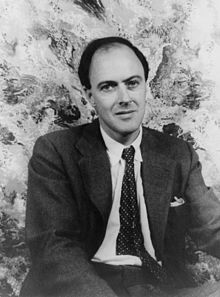
Dahl in 1954 [Image Courtesy Wikipedia]

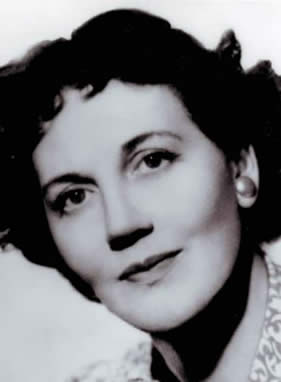
He began to write for children when his own family came along. ( He was married to actress Patricia Neal and had five children with her.)

…Dahl began making up stories for them each night before they went to bed. These stories became the basis for his career as a children’s writer, which began seriously with the publication of James and the Giant Peach in 1961. …Dahl insisted that having to invent stories night after night was perfect practice for his trade… [Roald Dahl Biography]

His other childrens’ books include: Charlie and the Chocolate Factory 1964; The Fantastic Mr. Fox 1970, Danny, the Champion of the World 1975;  The BFG 1982; The Witches 1983;  Matilda 1988 and others. He also wrote books of verse for children including the hilarious Revolting Rhymes and Dirty Beasts.  Most of his books have nasty adults who mistreat children, those adults do not fare well in the end. The justification that “Beastly people must be punished,” made Dahl very popular with children of all ages.
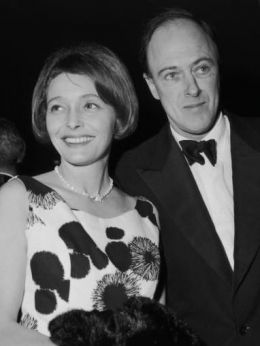
Neal and Dahl prior to their marriage. [HubPages.com]

He wrote fiction for adults as well, though it is much more difficult to find. Roald Dahl: Collected Stories is a good place to start and it contains dozens of the writer’s short stories. As does The Best of Roald Dahl.

“Dahl has the mastery of plot and characters possessed by great writers of the past, along with the wildness and wryness of his own. One of his trademarks is writing beautifully about the ugly, even the horrible.” [– The Los Angeles Times on the back of The Best of Roald Dahl]

He also wrote screen plays. He wrote a full script for The Gremlins for Disney, as well as the screenplay for Chitty Chitty Bang Bang (1968)– that creepy child catcher  who trolls the streets of Vulgaria with his candy festooned wagon is 100% Dahl– and the 1971 version of Willy Wonka & the Chocolate Factory.  For the small screen he penned  6 episodes of Alfred Hitchcock Presents  and several other suspense shows.

Dahl died at the age of 74 from Leukemia.

[Image courtesy: Wikipedia]

Thought of the Day 9.12.12 H.L.Mencken

“Love is the triumph of imagination over intelligence.”

— H. L. Mencken

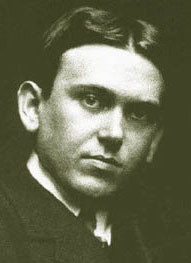
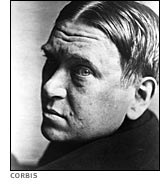
The Sage of Baltimore. [Image courtesy: The American Mercury]

Henry Louis Mencken was born on this day  in Baltimore, Maryland in 1880. Today is the 132nd anniversary of his birth.

Mencken lived in the same house in the Union Square neighborhood of the city for all but 5 years of his life. At 9 he read Huckleberry Finn by Mark Twain and knew he wanted to become a writer. His family had other ideas.

His grandfather had prospered in the tobacco business and his father, August, continued the family tradition. Mencken studied at the Baltimore Polytechnic Institute (1892-96) and then worked at his father’s cigar factory. [Books and Writers]

[Image Courtesy: Wikimedia Commons]

He worked for 3 years at the family owned business and would have stayed indefinitely, but upon his father’s death in 1899  Mencken was “free to choose his own trade in the world.”

Within a week, Mencken “invaded” the city room of the old Baltimore Morning Herald to face down the city editor and ask for a job…There were no jobs that day, but Mencken, persistent, returned daily for two weeks. “Finally I was sent out on a small assignment — it was a stable robbery at Govans — and a few days later I was on the staff,” [H.L. Mencken, Pioneer Journalist, By Jacques Kelly The Baltimore Sun]

His skill as a writer and his reputation for being able to turn a phrase grew. So 6 years later when the Herald closed its doors Mencken applied for a position at the larger Baltimore Sun.  He started at “The Sun as its Sunday editor, became an editorial writer, and in 1911 started writing his own column, the Free Lance Mencken.”  He worked at The Sun until 1948, bring his unflinching wit and critical eye to everything he saw.

“I believe that a young newspaper reporter in a big city… led a live that has never been matched… for romance and interest.” [Mencken from his only known audio interview. Courtesy of: The American Mercury.com]/

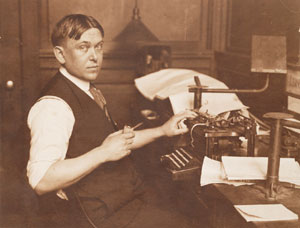
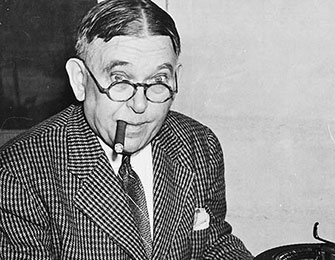
Mencken at work. [Image Courtesy: Enoch Pratt free Library Digital Collections.]

He was a war correspondent in Germany and Russia from 1916 to 1918. During WWI Mencken was pro-German (a very unpopular thing to be in patriotic Baltimore of 1917).

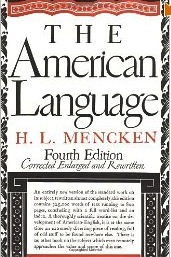
In 1919 he published The American Language, a guide to American expressions and idioms.

From 1914 to 1923 Mencken co-edited with drama critic George Jean Nathan (1882-1958) the Smart Set, which mocked everything from politics to art, universities to the Bible…[Books and Writers]

He preferred realism to modernism and he helped the careers of Sinclair Lewis, Dorothy Parker and Eugene O’Neill.

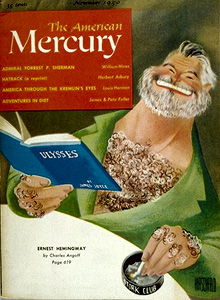
Cover of the American Mercury [Image Courtesy: Wikipedia]

He started The American Mercury monthly magazine, working on the magazine from 1924 t0 1933.

A stroke in 1948 left him nearly unable to read or write. Speaking took a lot of effort, and he grew easily frustrated. He spent his remaining days organizing his papers and letters (which can now be found in H.L. Mencken Room and Collection at the Central Branch of the Enoch Pratt Free Library on Cathedral Street in Baltimore.

[Image courtesy: MPT]

Here are a few more quips from the Sage of Baltimore:

  • “A cynic is a man who, when he smells flowers, looks around for a coffin.”
  • “Nature abhors a moron”
  • “Do not overestimate the decency of the human race”
  • “A man loses his sense of direction after four drinks; a woman loses hers after four kisses”
  • “Love is like war; easy to begin but very hard to stop”
  • “It is a sin to believe evil of others, but it is seldom a mistake.”
  • “Conscience is the inner voice that warns us somebody may be looking.”
  • “You come into the world with nothing, and the purpose of your life is to make something out of nothing”
  • “Most people are unable to write because they are unable to think, and they are unable to think because they congenitally lack the equipment to do so, just as they congenitally lack the equipment to fly over the moon.”
  • “I believe that it is better to tell the truth than a lie. I believe it is better to be free than to be a slave. And I believe it is better to know than to be ignorant.”

Thought of the Day 9.4.12 Paul Harvey

“In times like these, it helps to recall that there have always been times like these.”

–Paul Harvey

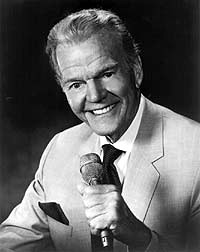
Broadcaster Paul Harvey (Image courtesy of: Arcane Radio Trivia.)

Paul Harvey Aurandt was born on this day in Tulsa, Oklahoma in 1918. Today is the 94th anniversary of his birth.

He was the son of a police officer and was interested in radio early on. He made radio receivers as a child and when he was in high school his smooth voice and distinctive reading style attracted the attention of a teacher who suggested to audition for the local radio station, KVOO.

He was hired at KVOO, but, the road to on air personality began humbly with Harvey starting out by sweeping the floor. Eventually he began to read the news and do commercials. He continued to work as KVOO, both as an announcer and a program director, while he attended the University of Tulsa. He had stints as Salina Kansas’ KFBI, Oklahoma City’s KOMA and St. Louis’ KXOK before he moved to Hawaii. He enlisted in the US Army Air Corps  in December of 1943, but he only served for 14 weeks at which time he was given a medical discharge for a cut on his heel. (Some sources say it was a Section 8 discharge and that Harvey changed his orders to make himself a ranking officer,  stole a plane and inflicted the wound himself during a psychotic dream. Harvey denied all those charges saying:

“It was an honorable medical discharge… There was a little training accident…a minor cut on the obstacle course…I don’t recall seeing anyone I knew who was a psychaitrist…I cannot tell you the exact wording of my discharge.” [The Washington Examiner])

Harvey moved to Chicago and he worked for the ABC affiliate WENR-AM.

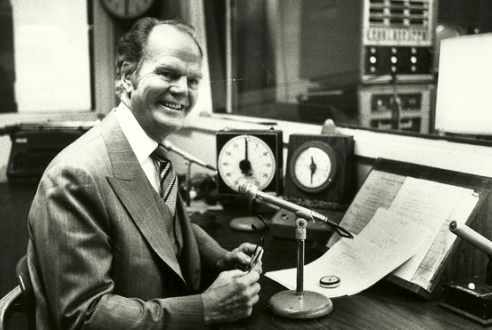
Paul Harvey at the broadcasting counsel in Chicago (image courtesy Time Out Chicago)

He had a run-in with national security when he attempted to infiltrate the Argonne National Laboratory outside of Chicago. The Lab was a favorite target of Harvey’s for it’s “lack of security” and the radio host wanted to prove it.

Shortly past 1 a.m. on February 6, 1951, Argonne guards discovered reporter Paul Harvey near the 10-foot (3.0 m) perimeter fence, his coat tangled in the barbed wire. Searching his car, guards found a previously prepared four-page broadcast detailing the saga of his unauthorized entrance into a classified “hot zone”. He was brought before a federal grand jury on charges of conspiracy to obtain information on national security and transmit it to the public, but was not indicted. [Argonne National Laboratory; History]

Harvey had friends in high places, most notably Senator Joseph McCarthy and FBI Director J. Edgar Hoover, and the charges against him were dropped. Of the incident Harvey later went on air to say  “Though my methods may be questioned, my accuracy and my loyalty never will be.”

In 1951, while the grand jury was still out in the Argonne case, Harvey debuted a new program on ABC,  Paul Harvey News and Comment. The show came on weekdays at noon and ran  for 58 years — the longest running radio show in history — until Harvey’s death in 2009. It was:

an idiosyncratic mix of headlines, comments, quips and advertisements, all voiced by Harvey — …syndicated at its peak to more than 1200 radio stations around the country each day. Harvey … wrote and recorded his shows six days a week from studios in Chicago. His brisk, quirky delivery and signature greeting “Hello, Americans!” were widely (if fondly) parodied. In 1976 Harvey began a companion radio feature, The Rest of the Story, telling little-known tales from the lives of famous people.  [Who 2 Biographies]

The Rest of the Story, while broadcast by Harvey, were written and produced by his son, Paul Harvey, Jr.. According to the production team the stories were completely true, but, in reality were either poorly researched or simply skewed to represent Harvey’s (Sr. and Jr) point of view.

He is the author of 7 books including: Autumn of Liberty; Our Lives, Our Fortunes, Our Sacred Honor; Paul Harvey’s For What It’s Worth; and several collections of The Rest of the Story. His biography Good Day! The Paul Harvey Story was published in 2009.

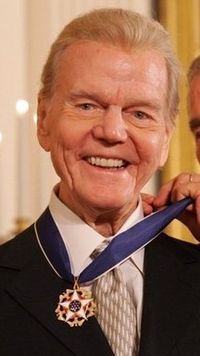
Harvey was inducted into the Radio Hall of Fame in 1990. In 2005 he received the Presidential Medal of Freedom.

Other Paul Harvey quotes include:

“Golf is a game in which you yell ‘fore!’ shoot six, and write down five.”

“If there is a 50-50 chance that something can go wrong, then 9 times out of ten it will.”

“Like what you do, if you don’t like it, do something else.”

Radios at the Vintage Radio and Communications Museum of Connecticut (Image courtesy Arcane Radio Trivia)

[This is one of those Thought of the Day birthday nods that I have a sentimental link to. I’m not a big fan of Paul Harvey and his conservative, folksy style, but there is a touchstone here.

I clearly remember listening to his gravely voice and pregnant pauses while in the car with my dad. He’d sign off with ‘good day’ and we’d echo back a ‘good day’ to each other.

The A&E Biography page links Harvey with Joseph McCarthy, J. Edgar Hoover and Billy Graham as “friends”, not three people I’d hope to see as the top three friends in my bio. And it is pretty clear that Harvey was less than diligent in his research. But I guess when you have to put out 5 days worth of “Story” to 23 MILLION fans facts can take a back seat.

…Still anytime I can spend a few hours remember my dad is worth the effort. And THAT’s the REST of the story. ‘Good day!’]


Heck yes! I’m a Stats Junkie

I’m a total Stats Junkie.

I turn on my computer. I check my email. I check my Facebook page. And in one last attempt to check the validity of my existence as a human being, I check the stats on my WordPress page.

The funny thing is I’m not generally a narcissistic creature. But in this electronic, faux culture of cyber space I have become addicted to the monkey on my back that is FEEDBACK. So even while I’m writing and researching the Thought of the Day I find myself glancing up to that mini stat indicator eyelash above the Edit Post. [Yes, I just did it.]

Honestly, I’m happy when I get 30 or so hits in a day. That’s decent, right? 30 people stopping by is worth the effort I’ve put into any given post. Maybe I’ve touched some one, made them laugh, given them a nugget of new information that they can share at the water cooler. That’s cool.

A fifty day? Boy-ya! I’m feeling good about myself. Seriously. “Give that fan a contract.” (That’s an Oriole’s thing, if you’re wondering.)

Up until this week my best day was 95! It was a Shakespeare inspire day and it was pretty awesome.

My stats as of about 48 minutes ago.

Then a couple of days ago I wrote a little tribute to my cousin Pat “Scunny” McCusker (who, sadly, had just passed away) and things went  through the roof. My stats topped out at 105. That’s an awesome day. Except, well,  it wasn’t. The only thing awesome about getting those stats was that it served as a continuing reminder that Pat touched a lot of hearts. Believe me, I’d much rather have a month of single digit days than have the reason for the spike you see over Aug 29.

So what about today? Well… it’s a rainy day, and a holiday, and people are home with nothing to do. No doubt that explains that second spike. And I’ve got to give another nod to Pat because 10 of these hits were from web searches on his name. But that’s still a pretty awesome day. This is how it looked  when I checked in at 7:00 Eastern Time…

At 8:00, when the stats click over for another day, the views had ticked up to 110 hits from 13 countries for 12 blog posts and the current home page.  Not bad at all. That plus… the Orioles won today.

So thanks everybody! Keep on stopping by virtual desk to see what I’m working on.

Cheers,

Rita


Thought of the Day 9.3.12 Ludovico Ariosto

“When the devil grows old he turns hermit”

Ludovico Ariosto 

c. 1510

c. 1510 (Photo credit: Wikipedia)

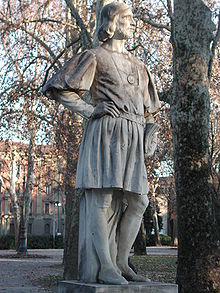
Ludovico Ariosto was born on this day in Reggio Emilia, Italy, in 1474. Today is the 538th anniversary of his birth.

Ariosto was the eldest of 10 children born to an affluent family. His father, Count Niccolo Ariosto, was the commander of the citadel, and Ludovico was supposed to follow in the his footsteps. He studied law, languages and literature.  He had a great love of poetry and wanted to become a writer, but he was obliged to support his family. When his father died, in 1500, he took over the family estate. In 1503 he began to work for Cardinal Ippolito D’Este who acted as Ariosto’s patron for a few years. Later he worked for the Cardinal’s brother, Alfonso I, Duke of Ferrara. In 1522 he was sent to wilderness of Garfagnana, Ferrara as governor. He did not take to the remote location of the bandits.

Statue of Ludovico Ariosto in Reggio Emilia

Ariosto snuck time to write some comedies, prose and poetry when his duties permitted. His play Cassaria was staged in 1508 and I Suppositi followed in 1509. (It was translated into English and was the inspiration for parts of  Shakespeare’s The Taming of the Shrew.) He wrote 5 comedies and 7 satires.

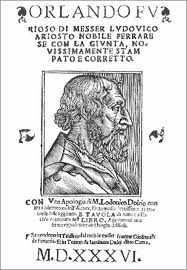
His greatest work, indeed ” the most celebrated narrative poem of the Italian high Renaissance” [Books and Writers] was Orlando Furioso. It was first published in 1516 at a length of  40 cantos.  The epic poem was revised and added to several times with the final version, at 46 cantos, appearing in 1532.  An additional 5 cantos , the Cinque canti were published by his son Virgino after the poet’s death.

 The plot revolves around the conflict of the Christian versus the Moor, the war between Charles, the Holy Roman Emperor, and Agramante, King of North Africa, and Marsilio, King of Spain. With the defeat and death of Agramante, the conflict ends, and Marsilio returns to Spain. [Books and Writers]

Two editions of Orlando Furioso.

The piece was so popular that, rumor has it, when the last revision came out Queen Elizabeth banned the English translator of the work from Court until he completed his task so he wouldn’t be distracted. Artist, composers and other writers have used characters from Orlando Furioso as their muse. Portrait of a Gentleman by Titian is one such work. His A Man with a Quilted Sleeve is believed to be Ludovico.


Thought of the Day 9.1.12 Edgar Rice Burroughs

“I write to escape…to escape poverty.”

Edgar Rice Burroughs

Русский: Эдгар Райс Берроуз

Edgar Rice Burroughs (Photo credit: Wikipedia)

Edgar Rice Burroughs was born on this day in Chicago, Illinois in 1875. Today is the 137th anniversary of his birth.

He was the middle child Major George Burroughs and his wife Mary Evaline. His younger siblings died of childhood diseases, leaving him the baby of the family. He bounced around several different local schools. Whenever there was an outbreak of a disease his parents took him out of one school and put him in another.  Since schools taught Latin and Greek as well as English he later …

“his erratic schooling… resulted in his … learning little English while taking the same Greek and Latin courses over and over again. Despite his claims to the contrary, this early exposure to Classical literature and mythology would serve Burroughs well in his future writing career.” [The Official Edgar Rice Burroughs Mini-Bio]

When a flu epidemic swept through Chicago his parents sent a teenaged Edgar to his brothers’ cattle ranch in Idaho. He love the rough and tumble “wild west”  with its range wars and saloon shoot outs and he lived there for six months before his parents realized the danger of  frontier life was on par with the danger of getting influenza. They called him home and enrolled him in Phillips Academy in Andover, Massachusetts. He didn’t last long there and was soon transferred to the more structured  Michigan Military Academy. He failed the West Point entrance exam  and signed up for the Army  as a private where he served with the 7th US Cavalry at Fort Grant, Arizona Territory. He was discharged from the Army for a heart condition in 1897.

In 1899 he was back in Chicago working for his father ‘s company, and the next year he married his childhood sweetheart, Emma Hulbert. After a few years he and Emma travelled west to Idaho so he could try his luck with his brothers again, this time at gold mining. But that venture soon went bust and Burroughs went through a number of jobs from railway policeman to peddler for quack medicine.

One of his jobs was as a pencil sharpener wholesaler. He placed ads for the pencil sharpeners in pulp fiction magazines and he would read through the magazines to check the placement of the ads.

“After reading several thousand words of breathless pulp fiction Burroughs determined … that ‘if people were paid for writing rot such as I read in some of those magazines that I could write stories just as rotten. As a matter of fact, although I had never written a story, I knew absolutely that I could write stories just as entertaining and probably a whole lot more so than any I chanced to read in those magazines.'” [The Official Edgar Rice Burroughs Mini-Bio]

Cover of "Under the Moons of Mars: A Prin...

Cover via Amazon

In fact he had already written stories, but his introduction into the pulp fiction market with Under the Moons of Mars,  for which he received a whopping $400 from All-Story magazine, was a turning point in his career. The story was serialized  in the magazine and produced as a novel under its original name of A Princess of Mars. By the time the last installment was published in July of 1912 Burroughs had completed two more novels. The Outlaw of Torn and Tarzan of the Apes. Outlaw was not picked up by the publisher, but Tarzan was an immediate hit. Burroughs got $700 for the book. He wrote a number of sequels for both Mars (11, including John Carter of Mars) and Tarzan (26).

Dustjacket by Armstrong Sperry for the first e...

Dustjacket by Armstrong Sperry for the first edition of Tarzan and the Lost Empire by Edgar Rice Burroughs (Photo credit: Wikipedia)

Other book series by Burroughs includes:

  • The Pellucidar series, which takes place in the hollow shell of the Earth (7 books, including one featuring a cross over appearance from Tarzan).
  • The Venus series, where Carson Napier, who is attempting a solo flight to Mars, crash lands instead on the watery planet of Venus. — look for a film made from the series coming out next year. (5 books)
  • The Caspak series, a prehistoric series, including The Land That Time Forgot (3 books)

He crossed writing genres at will penning social realism, horror stories, and westerns (and more).

Burroughs was living in Honolulu,  Hawaii when the Japanese bombed Pearl Harbor on December 7, 1941. He volunteered  to serve the war effort as a war correspondent  (the oldest in the Pacific theatre).

He died on March 19, 1950.

English: Bookplate of American writer Edgar Ri...

English: Bookplate of American writer Edgar Rice Burroughs (1875-1950) showing Tarzan holding the planet Mars, surrounded by other characters from Burroughs’ stories and symbols relating to the author’s personal interests and career. Associated media: File:Letter from Edgar Rice Burroughs to Ruthven Deane 1922.jpg explaining the design of his bookplate. (Photo credit: Wikipedia)


Thought of the Day 8.31.12 William Saroyan

“I can’t hate for long. It isn’t worth it.”

“The role of art is to make a world which can be tolerated.”

“Try as much as possible to be wholly alive, with all your might, and when you laugh, laugh like hell and when you get angry, get good and angry. Try to be alive. You will be dead soon enough.”

–William Saroyan

William Saroyan, American writer.

William Saroyan, American writer. (Photo credit: Wikipedia)

William Saroyan was born on this day in Fresno, California in 1908. Today is the 104th anniversary of his birth.

William was the youngest son of Armenian immigrant parents. His father died when he was 3 years old. William and his siblings went to the Fred Finch Orphanage in Oakland while their mother, Tahooki, found what work she could in San Francisco.  Six years later the family reunited as Tahooki got permanent work at a cannery in Fresno. He didn’t like school. The work was boring and he was picked on because he was the son of an immigrant. But he liked to learn, he liked to read and he like to write. He took advantage of the Fresno public library’s book collection and he took a course on typing at the Technical School. He sold newspapers to help with family finances, and worked his way up to messenger boy with a telegram company.

He travelled around the country hoping to become the next big American writer, but luck wasn’t with him (one time his suitcase, with most of his money and clothes inside, wound up in New Orleans instead of with him in New York.) So Saroyan returned to California and took a string of uninspiring jobs from working in a funeral parlor to selling vegetables at a farmers market. All the time he was writing on the side.

In 1933 he started to get published. His earned $15 when his short story The Daring Young Man on the Flying Trapeze appeared in the national magazine Story. Encouraged by the publication he decided to send the magazine one story a day for the entire month of January.

This he proceeded systematically to do, still full of the usual doubts that harass the unestablished writer, but determined to carry through the ambitious work program in as positive frame of mind as possible. He began with no firm ideas as to what the stories would be about… Midway through the month a telegram… arrived from the editors with the message he needed: yes, the stories were being received with great interest — keep them coming! This was the decisive moment of acceptance, marking the end of his long apprenticeship…. [Brian Darwent, William Saroyan Society, Biographical Sketch]

Other, higher paying, magazines began to take an interest. His stories appeared in The American Mercury, Harper’s, Scribner’s and others. A collection of his short stories was published by Random House in 1934 and became a best seller.

He traveled overseas, making a pilgrimage to his father’s homeland of Armenia. (He couldn’t make it as far his father home town, which was now a part of Turkey, but he did get to Erivan, Soviet Armenia.) Along the way he met Charlie Chaplin, George Bernard Shaw and Finnish composer Jean Sibelius.

He added playwriting to his skill list  in 1939 with My Heart’s in the Highlands. The play centers around a struggling Arminian American poet and his son Johnny.  His second play The Time of Your Life won a Pulitzer Prize (which Saroyan refused) and The New York Drama Critic’s Circle Best Play award (which he accepted.)  It takes place in Nick’s Pacific Street Saloon and centers around a wealthy young man named Joe and a bar full of colorful characters. The play has been revived several times on Broadway and in LA, and has been made into a big screen movie, with James Cagney and a Playhouse 90 television movie with Jackie Gleason.

First edition cover

First edition cover (Photo credit: Wikipedia)

The Human Comedy was produced by MGM Studios. Saroyan was under contract with Louis B. Mayer and he wrote and directed a short film called The Good Job as well as the 4.5 hour screen play for The Human Comedy (which Mayer turned over to another writer to edit down.) Saroyan also wrote a novel  on the same material that came out the same week as the film. The sentimental story was based on his life growing up as an immigrant in Fresno and it won an Oscar for the writer.

After WWII his writing career cooled. He was considered to sentimental and sugary for the harder edged, post-war critics.

 Saroyan praised freedom; brotherly love and universal benevolence were for him basic values, but with his idealism Saroyan was considered more or less out of date. [Books and Writers]

But he continued to write prolifically. In 1952 he published his memoir The Bicycle Rider in Beverly Hills.

Just before he died of cancer in 1981 he called the Associated Press quipping “Everybody has got to die, but I have always believed an exception would be made in my case. Now what?”

Stanford University has a large collection of his works and the author is celebrated by the William Saroyan Society. 

William Saroyan statue, Yerevan

William Saroyan statue, Yerevan (Photo credit: tm-tm)


Thought of the Day 8.30.12 Mary Woolstonecraft Shelley

“We are tomorrow’s past.”

–Mary Wollstonecraft Shelley

English: Cropped portrait of Mary Shelley

English: Cropped portrait of Mary Shelley (Photo credit: Wikipedia)

Mary Wollstonecraft Godwin was born on  this day in London, England in 1797. This is the 215th anniversary of her birth.

She was born into a family of  “intellectual rebels.” Her mother, Mary Wollstonecraft…

“the celebrated author of A Vindication of the Rights of Woman (1792), died of puerperal fever, leaving Godwin, [her father, William Godwin] the author of An Enquiry Concerning Political Justice (1793), to care for Mary and her three-year-old half-sister, Fanny Imlay.”[Eleanor Ty, Wilfrid Laurier University]

English: William Godwin, oil on canvas, 1802, ...

English: William Godwin, oil on canvas, 1802, 29 1/2 in. x 24 1/2 in. (749 mm x 622 mm), “Godwin liked Northcote’s portrait, describing it as ‘The principal memorandum of my corporal existence that will remain after my death.’ With the light hitting the philosopher’s temples, Northcote symbolised Godwin’s belief in progress based on reason.” (Photo credit: Wikipedia)

For four years Godwin raised “Pretty Little Mary” and her half-sister Fanny with the help of a governess. Mary thrived under her father’s affectionate care and grew into a “precocious, sensitive and spirited” little girl. But in 1801 he  married  Mary Jane Clairmont.  Little Mary did not get on well with her new “mother.” She grew up…

with a cruel step mother and emotionally distant father; she consoled herself at her mother’s graveside and spent periods of time in Scotland with friends of the family. [the Literary Network]

She was close to her half-sister Fanny and especially her step-sister Claire. But, while Claire was sent away to a boarding school to learn, Mary was left a home to learn what she could from the family library. Fortunately the library was well stocked, and her Father hosted a stream of literary visitors who sparked the girls’ imaginations. (Claire and Mary snuck into one such meeting and hid under a sofa so they could listen to Coleridge recite “The Rime of the Ancient Mariner.” [the Literary Network has a more detailed account of Mary’s early life and the strife between the girl and Mrs. Godwin.]

Percy Bysshe Shelley imbibed his radical philo...

Percy Bysshe Shelley imbibed his radical philosophy from William Godwin’s Political Justice. (Amelia Curran, 1819) (Photo credit: Wikipedia)

At  16, after a return from a very happy holiday with her friends the Baxters in Scotland,  she met Percy Bysshe Shelly. Percy was 5 years her senior and established writer and rich. He came to the Godwin’s to talk to her father about politics and his philosophy.  Mary and Percy fell in love with each other. Unfortunately Percy was already married (unhappily) to Harriet  Westbrook. Regardless of his marital status Mary and Percy ran off to Europe with Claire in tow. Her father, who believed in free love for other people, was against it for his daughter, he refused to talk to Mary until she and Percy married several years later.

Godwin-Shelley family tree

Godwin-Shelley family tree (Photo credit: Wikipedia)

The eight years Mary and Percy Shelley spent together were indeed characterized by romance and melodrama. During this period Mary and Percy, both extremely idealistic, lived on love–because of extended negotiations over the disposition of the estate of Percy’s grandfather–without money, constantly moving from one placed to another. Mary gave birth to four children, only one of whom survived to adulthood… [Eleanor Ty, Wilfrid Laurier University]

While at Lake Geneva they met Lord Byron. Byron and Claire became lovers and had a child of their own, Allegra.  Mary started work on Frankenstein while they were in Switzerland. It was inspired after a night of telling ghost stories.

Steel engraving (993 x 71mm) for frontispiece ...

Steel engraving (993 x 71mm) for frontispiece to the revised edition of Frankenstein by Mary Shelley, published by Colburn and Bentley, London 1831. The novel was first published in 1818. (Photo credit: Wikipedia)

As December 1816 loomed Harriet Westbrook Shelly committed suicide by walking into the Serpentine River near her home in Hyde Park. Unlike his relationship with Harriet, Percy found Mary an intellectual and romantic partner. With in the month Mary and Percy were married in London. They continued to travel, often with Byron, Claire and Allegra.

In 1822 Mary had a serious miscarriage and almost died. Later that year Percy was out sailing on the schooner “Don Juan’ when the boat sank in a sudden storm. Mary, devastated, returned to England with her only surviving son, Percy Florence.

The Cremation of Percy Bysshe Shelley, by Loui...

The Cremation of Percy Bysshe Shelley, by Louis Édouard Fournier. (Photo credit: Wikipedia)

She died in 1851 at the age of 54.  Romantic legend has it that when her son and daughter-in-law opened her box desk they found locks of hair from her long dead children and a silk envelope containing the ashes of Percy’s “heart”.

Books by Mary Wollstonecraft Shelly include:

History of Six Weeks’ Tour though a Part of France, Switzerland, Germany and Holland

Frankenstein; or The Modern Prometheus

Mathilda

Valperga; or, The Life and Adventures of Castruccio, Prince of Lucca

The Last Man

the Fortunes of Perkin Warbeck

Ladore

Falkner

Rambles in Germany and Italy

and collections of poems of Percy Bysshe Shelly


Thought of the Day 8.28.12 Mary Norton

“I’m no lady; I’m a member of Congress, and I’ll proceed on that basis.”

–Mary Norton

Kathleen Mary Pearson was born on this day  in London, England in 1903. It is the 99th anniversary of her birth.

The Cedars, Church Square at the end of the Hi...

The Cedars, Church Square at the end of the High Street in Leighton Buzzard, Bedfordshire, England. Built in 1855 for Mr. John Dollin Bassett. Designed by W. C. Read. Current location of Leighton Middle School, and occupied by Cedars Upper School until 1973. Location: OSGB36: SP 919 249, WGS84: 51:54.9192N 0:39.8815W (Photo credit: Wikipedia)

She grew up in a large Georgian style house, called The Cedars, in Bedfordshire. She used the house as inspiration for her setting of The Borrowers.

During World War II she worked for the War Office and in 1941 she moved to New York as part of the British Purchasing Commission. It was while she was in New York that she started to write.

Cover of "Bonfires and Broomsticks"

Cover of Bonfires and Broomsticks

In 1943 she published The Magic Bed Knob; or, How to Become a Witch in Ten Easy Lessons. The book sold well and Norton followed it up with Bonfires and Broomsticks. The books were turned into a 1971 Disney film called Bedknobs and Broomsticks that combined live action with animation (something the studio first did in Mary Poppins.) The movie starred  Angela Lansbury as a novice witch determined to use her powers to help England in the war effort. It featured the charming music number “Portobello Road,” a memorable soccer game between wild (animated) animals, and concluded with an army (live action) of suits of army fighting the invading Germans.

In 1946 she married Robert Charles Norton with whom she had 4 children.

The Borrowers (TV miniseries)

The Borrowers (TV miniseries) (Photo credit: Wikipedia)

In 1952 the first installment of her wildly popular The Borrowers series was published. It was followed by five more Borrowers novels. The books have been made into numerous stage shows,  movies and TV series.

Cover of "Are All the Giants Dead?"

Cover of Are All the Giants Dead?


In 1975 she wrote Are All the Giants Dead?