Category Archives: Writing

Mangahoota [a special fiction post]

[Since I will be AFK (Away From Keyboard) I thought I’d share the following short children’s story called “Mangahoota.” My daughter was kind enough to do the wonderful images. (I especially love the author/illustrator image at the end.) Needless to say this is copyrighted material and may not be duplicated in any form. Same goes for the illustrations. ]

———————————————————————————————————

Mangahoota

by Rita Baker-Schmidt, illustrations by Maggie Schmidt
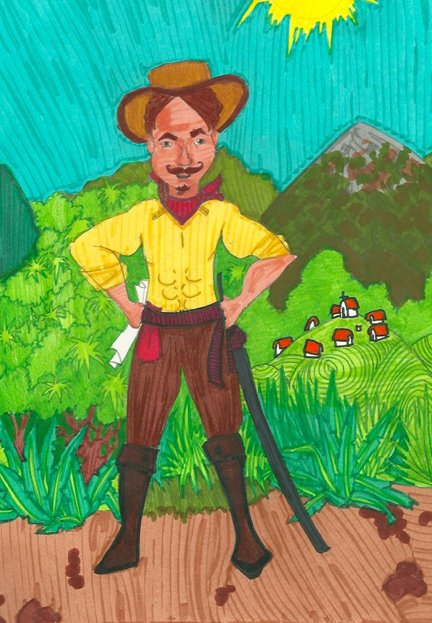


There once was an explorer named Juan Diego Benetiz Jorges Alanzo Perez. He loved to explore the wild and wonderful jungles of the Mexican country side. One day he was walking through a field, eating a mango, when something fell– plop– right on his head. It hit Juan with such a force that the poor man was knocked out cold.

When he woke up there was a bandage across his eyes. He couldn’t see and he had a terrible headache. “Please, Please, where am I?” Juan asked in Spanish.

“Senior, you are in my hospital.” Brother Christos put a gentle hand on the man’s arm. “You had a terrible blow, but you will be all right.”

“All right? I can’t see!”

“That is because your eyes have been bandaged.” Brother Cristos told him, “In a few days we will take off the bandages and you will be all better.”

Brother Christos stayed with Juan for a little while and then he left to go to Mass. But, before he left he promised Juan he would visit him again just before evening prayers.

Juan fell back asleep. He had odd dreams of gigantic flying creatures. He woke with a start. There was a thunderous sound outside. “Bam, Bam! Bam, Bam!” The whole hut shook! But, then a second later a softer “Bam, Bam,” came, and a tiny “Ouch.”

“What is that?” Juan called out, but he was the only one in the hospital that day so there was no one to answer he question.

When the good brother came back that evening he asked Juan if he had gotten any rest.
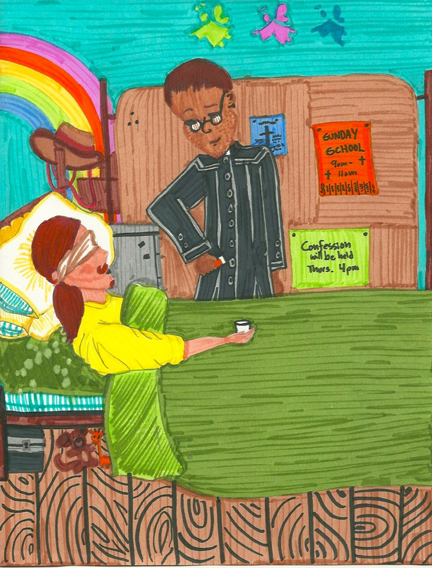
“I did rest” Juan told him, agitated, “but then I was awaken by a terrible noise.” He described it to Brother Christos.

Because the bandages, Juan could not see Brother Christos smile.

“Did we have an earth quake, Brother?”

“Oh, no.” Brother Christos said calmly, “That was only Mangahoota.”

“What on Earth is Mangahoota?” Juan demanded.

“It is a creature that lives in this area.” Brother explained. “It is usually very sweet and gently, but I’m afraid he lost his control yesterday and he fell from the sky.” There was a note of apology in the holy man’s voice. “That is how you got hurt, you see. Mangahoota fell on you.”

“A bird that is big enough to knock a man cold?”

“Oh, not a bird exactly, but yes, it is quite big.” Brother Christos told him.  “It is a difficult thing to explain.”

The next day, when Juan was sitting in the garden of the hospital, enjoying the warm sun on his bandaged face, it happened again. There was an enormous swooshing sound and then “Bam, Bam!” The Earth shook and the water spilled from his glass, “Bam, Bam!” Then softer “Bam, Bam, ouch”

“Help!” Juan cried in horror. “Help! Help! That Mangahoota is trying to get me! Help!”

The Mangahoota must have been frightened by the tone in Juan’s voice because it flew away again immediately.

Brother Christos came running. “What it is Senior? Are you all right?”

“That beast, that Mangahoota swooped down on me again!” Juan cried. “Take me inside, Brother, please.”

“But, senior, I assure you the Mangahoota is a loving animal. It will not hurt you.”

Juan pointed to his bandages, “It has already hurt me!” He said angrily, “Now, Please, I beg you, take me inside.”

“That was an accident.” Brother Cristos said soothingly, but he obliged Juan and walked him into the hut. “Forgive me Senior,” He said gently,  as he helped the explorer sit down “I am a bit confused.”

“Why is that Brother?” Juan asked. He was much calmer now that they were inside.

“I thought you were an explorer.”

“I am an explorer.”

Brother Cristos fluffed his pillow. “I see.” He said patiently.

“Why?”

The Holy man poured Juan a drink of cool water and put it in his hand. “Humm?”

“Why did you ask me if I was an explorer?”

“It is only that I thought that explorers liked to learn new things.” He said quietly.

“We do.” Juan told him. “We love to learn new things. That is what we live for!”

“Ahhh.” Brother Christos nodded. He sat down in the chair opposite Juan.

“‘Ahhh’ what?” Juan asked. He wished Brother Christos would just come out and say what was on his mind.

“Well… here you are a man who loves to explore new things, and out there is the Mangahoota, a new thing to you, and yet….”

Juan was quiet.

“I understand your hesitation, Senior. It must have been frightening.”

Juan grabbed at the brothers sleeve. “It was! It is a terribly frightening thing to have a Mangahoota land on your head.”

“I’m sure.” Brother Christos patted his arm. “And you just frightened the Mangahoota by shouting so fiercely. So perhaps it would be best if you didn’t meet.” He pushed himself off his chair and went to leave the room. “You are right, Senior. A meeting would be a bad thing.”

Juan thought for a long time about what Brother Christos had said. He was an explorer and this was a new and strange thing. He’s instincts as a man of knowledge kicked in and curiosity replaced his fear. By the time Brother Christos returned after evening prayers Juan had made up his mind to meet the beast.

The next day Brother Christos walked Juan into the bean field by the mission. When they stopped he handed Juan a bunch of mangos. “What is this?” Juan asked.
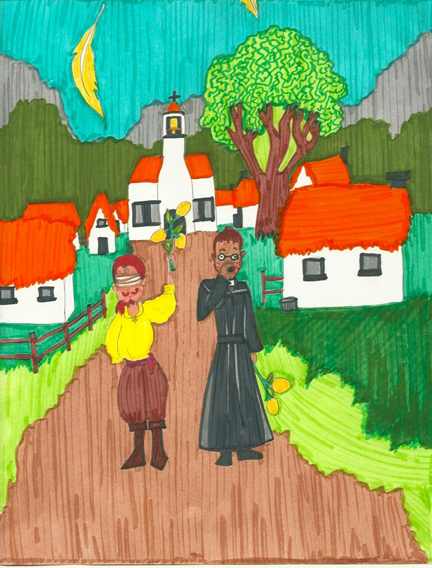
“Those are mangoes. Mangahoota loves mangoes.” He held Juan’s hand so it was straight out then he brought it in a slow arch above his head and back down again. “You must wave the mangoes like this, Senior.”

Juan did as he was instructed. “Like this Brother?”

“Yes, but a little faster.” Brother Christos told him. “And you must call him to  you, Senior.”

Juan stopped waving. “How?”

“You must wave your mangoes and call in a loud voice ‘Mangahoota, Mangahoota, come and get them, Mangahoota.”

Juan thought he must be joking.

“Please, go on Senior, or he may not come.”

Feeling silly, Juan waved the bouquet of mangoes over his head and called out “Mangahoota, Mangahoota, come and get them, Mangahoota.”

And from high above the mountains came the swoosh, swooshing sound of enormous wings. Then, “Bam, Bam…Bam, Bam…” and more quietly “Bam, Bam,” and just a whisper of a sound “Ouch.”

The Mangahoota clip-clopped over to them and took a nibble of the mangoes. Sweet smelling, sticky, mango juice pored over Juan’s hands as the creature ate. “Does he like them, Brother?”

Brother Christos laughed as the Mangahoota bent over and gave Juan a sticky lick of a kiss. “Oh, yes, Senior, as I say, they are his favorites.”

They spent some time in the field with the Mangahoota. Both Juan and Brother Christos kept their voices calm and soothing. And the Mangahoota let Juan pet his long fur covered body.

Juan could tell that the creature had long legs with big knobby knees. He had enormous wings, of course, which he kept tucked in against his body. And he had a long muscular neck. His neck was so long that Juan couldn’t reach the top unless the Mangahoota bent down.  But Juan couldn’t form a picture of the Mangahoota in his mind’s eye.

As the Mangahoota flew away and the men walked back into the compound of the mission Juan turned to Brother Christos. “I must know what a Mangahoota looks like.”

“Tomorrow,” Brother Christos told him, “We will take the bandages off, and if you are strong enough we will take our walk outside and you can call him again.”

Juan tried to sleep that night, but he couldn’t keep his mind off the Mangahoota. In the morning Brother Christos came to him and, as promised cut away the bandages.

It took a minute for Juan’s eyes to register his surroundings. The simple thatched hut with the crucifix on the wall, the four camp beds made up with white linens, and the kind young man who had been his doctor smiling at him. Juan smiled back. “Lets go.”

Brother Christos nodded to the bedside table. There were two bouquets of mangoes.

“I must warn you Senior,” Brother Christos told him, “the Mangahootas are very unusual creatures.”

“I should say so!” Instead of the monk helping support Juan, he was being pulled by him. They walked to the middle of the field.

“So unusual that you must employ all of your powers of imagination to see him as he is.”

“I understand. Don’t worry Brother, I have a very good imagination.”

Brother Christos smiled at him and gave him some mangoes.

With out hesitation Juan waved them frantically over her head. “Mangahoota, Mangahoota, come and get them Mangahoota!”

No creatures emerged.

“Mangahoota, Mangahoota, come and get them Mangahoota!” Juan looked at the monk. “Perhaps he doesn’t recognize me with out my bandages.

“We will both try, Senior.” And, holding his robes so he wouldn’t trip, he waved his too mangoes in the air.

“Mangahoota, Mangahoota, come and get them Mangahoota!” They both called. “Mangahoota, Mangahoota, come and get them Mangahoota!”

Then they saw him. Flying high over the mountains, so big that for a second he blocked out the Sun.

“Mangahoota, Mangahoota, come and get them Mangahoota!”

It flew lower over the field. Then with a ground shaking “Bam, Bam” its front hooves hit the ground. “Bam, Bam” the back hooves touched down. Then  a slow unforgiving arch of unstoppable motion bent his long neck and with a  softer, “Bam, Bam” the knobs on the tops of the Mangahoota’s short antlers tapped the ground, and the creature gave a soft, childlike “Ouch.”
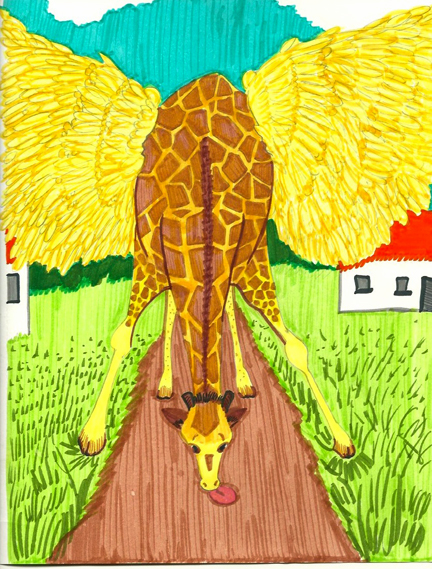
It shook away the small pain and  brought its face up to the mangoes. It began to eat, showering Juan and Brother Christos with mango juice. They laughed out loud. When he had devoured the mangoes he eyed them with his big giraffe eyes and lowered his sweet face first to Juan and then to Brother Christos and administered a lick of appreciation.

Later, as the giant animal took flight, Juan turned to Brother Christos. “Why didn’t you tell me a Mangahoota is a flying giraffe?”

“Some times it is better to believe without seeing, Senior, but some things are better believed when seen. The trick,” the young man smiled at Juan, “Is to know which is which.”

The End.
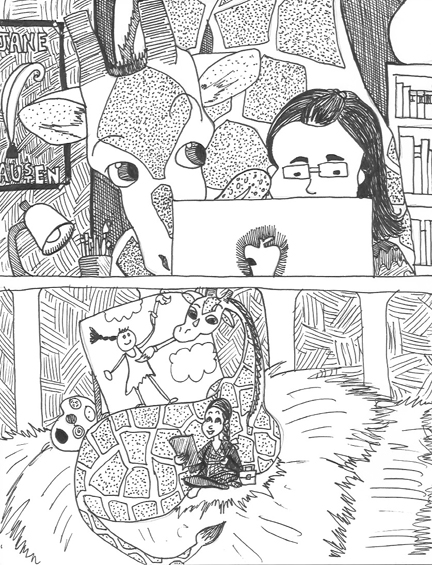
Rita is a writer, designer, musician, animal lover and Austen enthusiast. She thinks her daughter is extra awesome for doing these illustrations. 
 
Maggie is an aspiring educator, perpetual doodler and actress. 

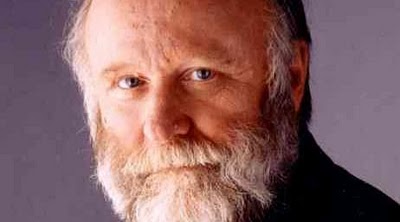
Thought of the Day 10.8.12 Frank Herbert

“There is no real ending. It’s just the place where you stop the story.”
–Frank Herbert

[Image courtesy: Otras musicas]


Frank Herbert was born on this day in Tacoma, Washington, USA in 1920. Today is the 92nd anniversary of his birth.

Frank’s mother came from a large Irish Catholic family (10 girls; 3 boys) (his invention of the Ben Gesserit for the Dune universe was likely an off shoot of the deep influence this gaggle of Aunts had on young Herbert’s life.) Frank’s father was a bus driver,  security guard, salesman, motorcycle patrolman and farmer. The family did a lot of traveling around before they settled on the farm.

Young Frank knew what he wanted be early in life.

On the morning of his eighth birthday Frank Junior famously announced to his family: “I wanna be a author.” (sic.) That day he wrote his first short story, which he called “Adventures in Darkest Africa.”  [Frank Herbert: The Works]

He was an explorer who thought nothing of paddling solo around Puget Sound to the San Juan Islands and back (200 miles) when he was ten or swimming across the Tacoma Narrows. He was also a great reader. “By the age of 12 he had, incredibly, already read the complete works of Shakespeare and discovered Ezra Pound.” [Frank Herbert: The Works]

Both Herbert’s parents were alcoholics and their drinking worsened as Frank entered his teen years. His sister, Patricia, was born when Frank was 13  and he took on parenting duties. By 1935 his parents were on the verge of a divorce. During high school he worked at his writing. He wrote short stories — he even wrote  novel, a boilerplate western, that he published under a pen name. He got a part-time job at the Tacoma Ledger. But by November of 1938 the situation at home had become too much. He left home with his baby sister and went to live with an aunt and uncle in Salem, Oregon. He graduated from North Salem High School and became a newspaper journalist. After a stint as a Photographer in the US Navy during WWII (he received a medical discharge because of a cranial blood clot he  developed after a fall)  he returned to Oregon and worked as a copy editor for the Oregon Journal in Portland. He worked for a number of west coast newspapers in a variety of cities for next two decades.
Besides his work in journalism: he lectured at University of Washington; he was a social and ecological consultant in Vietnam and Pakistan; and he wrote, directed and produced the documentary “The Tillers” based on the work of Roy Posterman.

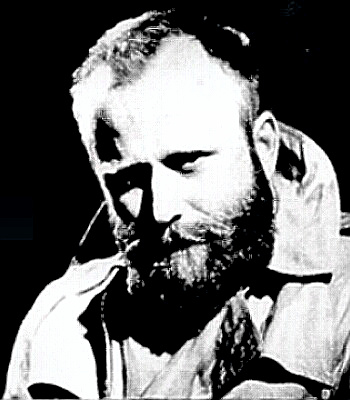
[Image courtesy: Poor William’s Almanack]


Success on the fiction front was more difficult to come by. He had short stories published — his first was “The Survival of the Cunning,” a war story published in Esquire magazine.  In 1952 Herbert published his first science fiction story, “Looking For Something,” in Startling Stories. It is about a stage hypnotist who discovers that the entire world is under alien hypnosis. Other short stories followed, but no publishers seemed interested when Herbert showed them Dune.

The Dragon in the Sea
The Dragon in the Sea (Photo credit: Wikipedia)


In 1956  Herbert’s first novel, The Dragon in the Sea was published. It had been serialized in Astounding Magazine as”Under Pressure“.

 “he used the environment of a 21st-century submarine as a way to explore sanity and madness. The book predicted worldwide conflicts over oil consumption and production. It was a critical success, but it was not a major commercial one.”  [Biblio.com]

While working on an article about sand dunes for the US Department of Agriculture in Florence, Oregon he got the idea of a sand dune so big that it could swallow up whole cities. In 1965, Dune was finished, a labor of love more than six years in the making. It was serialized in the magazine Analog then largely revised and expanded into book form. It was rejected 20 times before little Chilton Books — an auto repair manual publisher —  took a chance on it.

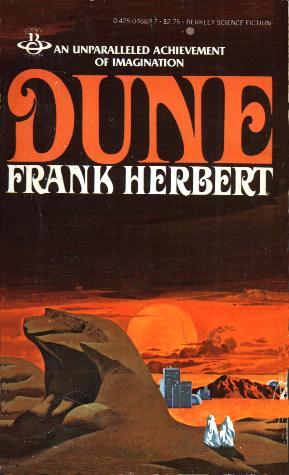
Dune cover art [Image courtesy: Book Wit]


Dune won the very first Nebula Award and was the co-winner of the Hugo Award. Published in 1965 it sets the scene for the Dune Series that follows — a series that is often considered the Lord of the Rings of Science Fiction. “Set on the desert planet Arrakis, Dune is the story of the boy Paul Atreides, who would become the mysterious man known as Muad’Dib. He would avenge the traitorous plot against his noble family–and would bring to fruition humankind’s most ancient and unattainable dream.” [Amazon.com review]

Dune was the first ecological science fiction novel, containing a multitude of big, inter-relating themes and multiple character viewpoints, a method which ran through all Herbert’s mature work. ” [Biblio.com]

Dune Messiah hit stores in 1969.   Children of Dune (1976)  was the first hardcover science fiction book to reach best-seller status. It was nominated for a Hugo Award.   And the spice kept flowing… God Emperor of Dune,  came out in 1981, followed by Heretics of Dune in 1984 and Chapterhouse: Dune in 1985.

Frank Herbert died of pancreatic cancer in 1986. But the Dune series lives on…Using Frank Herbert’s notes his son  Brian Herbert has co-authored additional Dune sequels with Kevin J. Anderson.

Frank Herbert Books
Frank Herbert Books (Photo credit: cobalt123)


Thought of the day 10.6.12 David Brin

“When it comes to privacy and accountability, people always demand the former for themselves and the latter for everyone else.”
David Brin

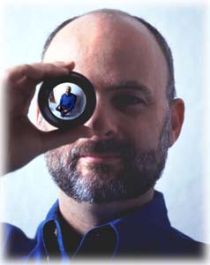
[Image courtesy: Scientific American.com]

David Brin was born on this day in Glendale, California, USA in 1950. He is 61 years old.

Brin is a graduate of the California Institute of Technology where he majored in astrophysics. He earned a Masters in applied physics and Doctor of Philosophy in space science from the University of  California, San Diego.

He is a consultant for NASA and the writer of  hard science fiction.

Brin serves on advisory committees dealing with subjects as diverse as national defense and homeland security, astronomy and space exploration, SETI and nanotechnology, future/prediction and philanthropy. His non-fiction book — The Transparent Society: Will Technology Force Us to Choose Between Freedom and Privacy? — deals with secrecy in the modern world. It won the Freedom of Speech Prize from the American Library Association. [The Worlds of David Brin]

Some of Brin’s book covers. [Image courtesy: The worlds of David Brin]

Brin won two Hugo Awards for his Uplift series. The “Uplift Universe explores a future when humans genetically engineer higher animals like dolphins to become equal members of our civilization.” [The Worlds of David Brin] The books in the series are: Sundiver, Startide Rising (which won the Hugo, Locus and Nebula awards,) The Uplift War (which won the Hugo  and Locus awards) and The Uplift Trilogy: Brightness Reef, Infinity’s Shore and Heaven’s Reach.

Other books he’s written include:

  • The Postman (which won  a Campbell and Locus Award and — after some major reworking– was made into a movie starring Kevin Costner.)
  • Earth (which ” foreshadowed global warming, cyberwarfare and near-future trends such as the World Wide Web” [The Worlds of David Brin])
  • Kiln People (“a fast-moving and fun noir detective story, set in a future when new technology enables people to physically be in more than two places at once.”[The Worlds of David Brin])
  • Foundation’s Triumph (a book that “brings a grand finale to (Isaac) Asimov’s famed Foundation Universe.”  [The Worlds of David Brin]
  • Sky Horizon (Winner of the Hal Clement Award for Best Sci Fi for young readers.)
  • Existence (“Existence – is set forty years ahead, in a near future when human survival seems to teeter along not just on one tightrope, but dozens, with as many hopeful trends and breakthroughs as dangers… a world we already see ahead.” [Amazon.com]

He has a trio of Graphic Novels on the shelf: Forgiveness (A Star Trek the Next Generation graphic novel), The Life Eaters (a graphic novel that loooks at what the world would be like if WWII had ended differently) and Tinkerers.

On the nonfiction front Brin has written : The Transparent Society: Will Technology Force Us to Choose Between Privacy and Freecom?  (Won the Freedom of Speech Award) and Star Wars on Trail: Science Fiction and Fantasy Writers Debat the Most Popular Science Fiction Films of All Time.

[Image courtesy: The Worlds of David Brin]

He’s also written novels for young adults, short stories, and a plethora of articles (both fiction and non fiction) like the excellent guest blog in Scientific American  “Too Hard For Science?”
http://blogs.scientificamerican.com/guest-blog/2011/04/29/too-hard-for-science-david-brin-raising-animals-to-human-levels-of-intelligence/


Thought of the Day 9.30.12 Jalal ad-Din Rumi

“The minute I heard my first love story I started looking for you, not knowing how blind that was. Lovers don’t finally meet somewhere. They’re in each other all along.”

Jalal ad-Din Rumi 

Rumi's attributed photo

Rumi’s attributed photo (Photo credit: Eliza_Tasbihi)

Jalal ad-DinRumi was born on this day in Persia (in what is now Balkh Province, Afghanistan) in 1207. Today is the 805th anniversary of his birth.

When he was 12 the Mongols invaded his homeland and Jalal ad-Din Rumi’s family escaped to Turkey. His father Baha’Walad became

an important position as a religious teacher, and his son succeeded him in that role. Rumi married and had a son, who later wrote Rumi’s biography. [The Messenger, A Guide to Life’s Adventure]

He met the dervish Shams al-Din of Tabriz in 1244 and became his devoted friend.

Rumi started the mystical practice of the sema, an act of worship that takes the form of an ecstatic, whirling dance accompanied by music. The sema is performed to this day in Konya, Turkey, by the Mevlevi order created by Rumi’s disciples.[The Messenger, A Guide to Life’s Adventure]

Wirujący derwisze

Wirujący derwisze (Photo credit: mammal)

Rumi’s disciples were jealous of his friendship with Shams, and in December 1248 the dervish was either driven away of killed by one of them (maybe Rumi’s son). Rumi traveled far and wide looking for his friend, but eventually he accepted that Shams would not be found.

Eventually, Rumi made peace with his loss, returning to his home believing Shams to be a part of him: “His essence speaks through me.” [Poetry.org]

He honored his friend with “more than 40,000 lyric verses… odes, eulogies, quatrains and other styles of Eastern-Islamic poetry called Divan-e-Shams-e Tabrizi.” [Poetry.org]

Shams of Tabriz as portrayed in a 1500 paintin...

Shams of Tabriz as portrayed in a 1500 painting in a page of a copy of Rumi’s poem dedicated to Shams. BNF Paris. (Photo credit: Wikipedia)

He used music, poetry and dance as a path for reaching God.

His six-volume the Masnavi remains an important text to Sufis around the world.

He died on December 17, 1273.  His shrine in Konya, Turkey is a  pilgrimage destination.

Rumi's tomb and minaret

Rumi’s tomb and minaret (Photo credit: Queen Esoterica)

“Rumi is both a poet and a mystic, but he is a teacher first, trying to communicate what he knows to his audience. Like all good teachers, he trusts that ultimately, when the means to go any further fail him and his voice falls silent, his students will have learnt to understand on their own.” [Alan Williams, Spiritual Verses, Introduction]

———————————————-

Your task is not to seek for love, but merely to seek and find all the barriers within yourself that you have built against it. [Jalal ad-Din Rumi , The Messenger, A Guide to Life’s Adventure]


Thought of the Day 9.29.12 Elizabeth Gaskell

“Sometimes one likes foolish people for their folly, better than wise people for their wisdom.”
Elizabeth Gaskell

Elizabeth Gaskell, in portrait of 1851 by Geor...

Elizabeth Gaskell, in portrait of 1851 by George Richmond (Photo credit: Wikipedia)

Elizabeth Cleghorn Stevenson was born on this day in London, England in 1810. Today is the 202nd anniversary of her birth.

The youngest of eight children, she was just a little over a year old when her mother died. Her father, William Stevenson, a Scottish Unitarian minister, was not up to taking care of the baby  and Elizabeth (Lily) went to live with her maternal aunt Hannah Lumb, whom she affectionately referred to as her “more than mother,” at Heathwaite House  in  the small town of Knutsford, Cheshire. There she enjoyed the affections of several aunts and other single ladies (either widows or spinsters) in the town. Her aunt taught her read. She went to Miss Byerlys school at Barford House and later to Avonbank in Stratford-on-Avon. Her education was traditional for a well-bred Victorian girl. She learned the classics, art, music and social graces at finishing school, while her father encouraged her writing and her brother John (John and Elizabeth were the only siblings to survive past infancy), who was in the Merchant Navy, sent her books and wrote her letters from his posts around the world .

When Elizabeth was nine she visited her father in London. He had remarried, and, unfortunately, Elizabeth did not get along with her new stepmother, Catherine Thomson. To complicate matters William and Catherine preferred their own children, and Elizabeth often felt like the odd man out. Eventually she was sent to live with a distant relative, another William, William Turner. Turner was a

A staunch proponent of reform and the abolition of oppressive and inhumane practices such as slavery, his outspoken criticisms profoundly affected Elizabeth’s values and her perspective on life. [The Literature Network]

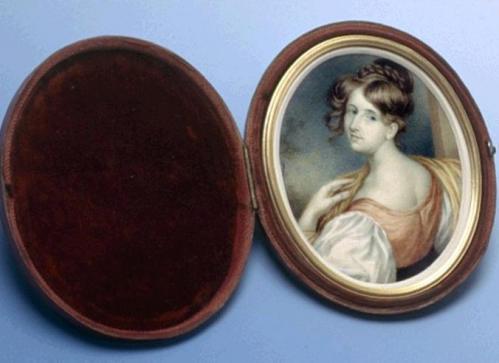
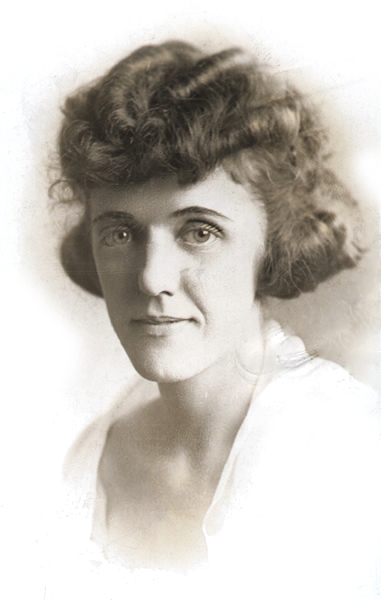
Elizabeth Gaskell around the time of her marriage, 1832 (Image courtesy: Jane Austen’s World)

She married William Gaskell, a minister in Knutsford in 1832. The Gaskells lived in Manchester. They had six children; a stillborn daughter, a son, who died in infancy from scarlet fever, and four girls.  “As the wife of a minister and mother to four growing girls, Gaskell’s life was hectic: they both taught Sunday school and volunteered for much-needed charitable causes in Manchester.” [The Literature Network] — Manchester, a mill town, had a lot of poor and working poor and Gaskell witnessed it first hand as she worked among them lending charity where she could.

Still, Elizabeth found time to write, keeping a diary about her growing daughters and the job she and her husband were doing as parents. William and Elizabeth collaborated  on some poems, Sketches among the Poor which were published in 1837.

In 1840 Clopton Hall, Elizabeth’s first solo work to be published, appeared in William Howitt’s  Visits to Remarkable Places. It was attributed to “a lady.” Later that year Howitt included her Notes on Cheshire Customs in his The Rural Life of England.

She used the pseudonym Cotton Mather Mills to write short story fiction until she published her first novel, Mary Barton in 1948.

In Mary Barton Gaskell drew on the devastation she felt after loosing her son. She also wrote about the hardships of the poor she saw all around her. The novel was published anonymously but it garnered praise from admirers like Charles Dickens, Thomas Carlyle, Charles Kingsley and John Ruskin. Other critics, however, were not so kind. They didn’t appreciate her scathing portrait of conditions in the mills or her calls for social reforms.

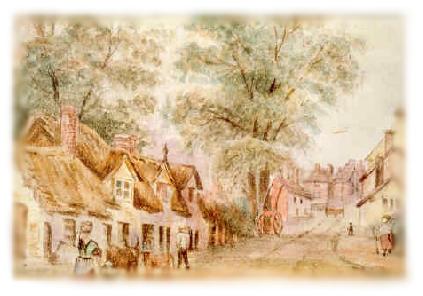
Real life Knutsford circa 1860, was the model for fictional Cranford. [Image courtesy Jane Austen World]

Dickens was so enamored with her writing that he published her next work Cranford in serial installments in his journal Household Words. Gaskell drew on her life with her Aunt Lumb and the kind (if opinionated) women of Knutsford for the characters and setting of her fictionalized Cranford.

In this witty and poignant comedy of early Victorian life in a country town, Elizabeth Gaskell describes the uneventful lives of the lady-like inhabitants so as to offer an ironic commentary on the diverse experiences of men and women. [The Literature Network]

Cranford was published in book form in 1853. As was Gaskell’s novel Ruth.

Like Mary Barton, Ruth raised a lot of eyebrows in Victorian England as its title character is a “fallen woman.” But Gaskell’s point is not the seduction or Ruth’s “loose morals” but the circumstances that led to the affair, and the web of lies and deception that cover up her “fall”. The novel is a little uneven with some of the characters merely looking down their Victorian noses disapprovingly  in a 2 demensional cartoon manner — Mrs. Benson–  or accepting their fate with angelic grace — Ruth– while, fortunately others are more fleshed out and interesting — the kind Thurstons totally won my heart. [Can some one please make this novel into a movie so Peter Dinklage can play Rev. Thurston?]

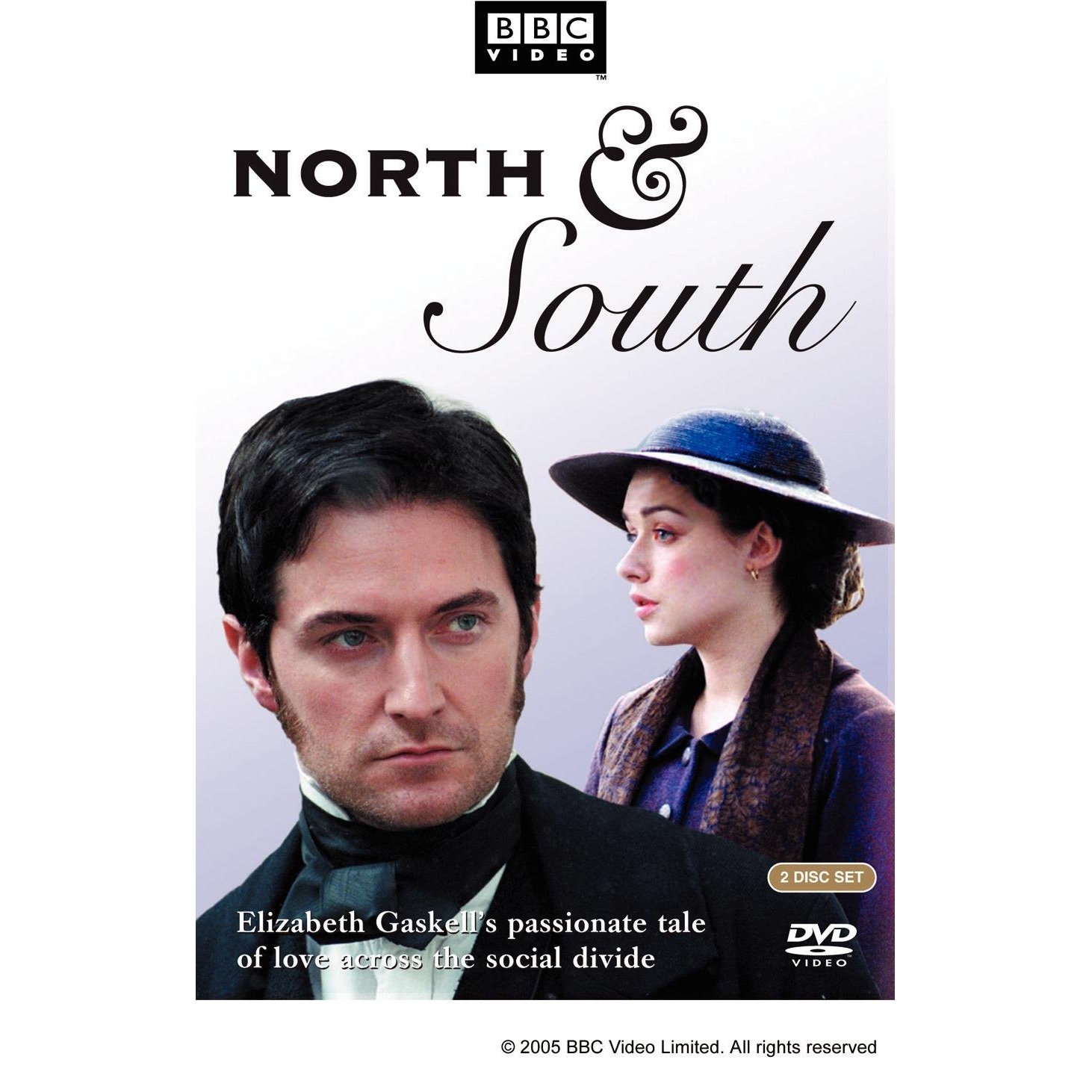
North and South is the second of Gaskell’s “industrial novels.” It was better received than Mary Barton because it gave  a more even-handed description of life in a mill town. In North and South Gaskell has the working poor (and — when a strike devastates the town — the sometimes NOT working poor) but she also gets into the head of the Mill Owner, Mr. Thornton. Between both camps is Margaret Hale who happens to be the daughter of a minister. North and South was serialized in Household Words before it was published as book.

DVD box art from the mini series of North and South. [Image courtesy: Amazon]

Her next book was far more personal. Elizabeth Gaskell met Charlotte Bronte in 1850 while in the Lake District.  The two became close friends, writing frequently. They visited each other several times. After Charlotte’s death in 1855.

the Reverend Patrick Bronte, for himself and on behalf of Brontes’s husband Arthur Bell Nicholls, asked Gaskell to write her biography in response to gossip and speculation. The Life of Charlotte Bronte was published in 1857. Gaskell spent much time researching, gathering material, and reading the letters of the eldest Bronte sister, and while she had set out to write a biography, the first edition was seen as an artful weaving of fact and fiction.  [The Literarure Network]

It was  “a pioneering biography of one great Victorian woman novelist by another.” [Google Books]

In 1863 she was paid 1,000 pounds for her novel Sylvia’s Lovers. (Mary Barton had brought her only 100 pounds.) A tragic love story set against the Napoleonic Wars Sylvia’s Lovers is one of her least well known novels.

England is at war with France, and press-gangs wreak havoc by seizing young men for service. One of their victims is a whaling harpooner named Charley Kinraid, whose charm and vivacity have captured the heart of Sylvia Robson. But Sylvia’s devoted cousin, Philip Hepburn, hopes to marry her himself and, in order to win her, deliberately withholds crucial information—with devastating consequences. [Good Reads]

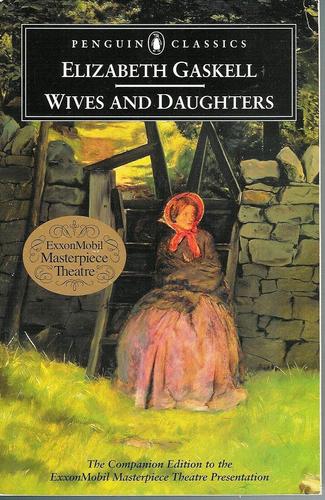
Cover of Wives and Daughters. [ Image courtesy: Amazon.com]

Wives and Daughters was also serialized (this time in Cornhill Magazine) before it came out as a novel.  It was the last book Gaskell wrote before she died (She didn’t quite finish it, and it was left to Frederick Greenwood to finish it off.)  Molly Gibson’s mother died when she was very young

Wives and Daughters centers on the story of youthful Molly Gibson, brought up from childhood by her father. When he remarries, a new step-sister enters Molly’s quiet life – loveable, but worldly and troubling, Cynthia. The narrative traces the development of the two girls into womanhood within the gossiping and watchful society of Hollingford. [Good Reads]

Gaskell also wrote dozens of short stories, especially ghost stories that she published both in magazines and in collections.

English: Elizabeth Gaskell (1810-1865)

English: Elizabeth Gaskell (1810-1865) (Photo credit: Wikipedia)

Elizabeth Gaskell died unexpectantly of a heart attack on November 12, 1865.

————————-

Published works by Elizabeth Gaskell  [Courtesy: The Titi Tudorancea Learning Center]

Novels

Mary Barton (1848)
Cranford (1851–3)
Ruth (1853)
North and South (1854–5)
Sylvia’s Lovers (1863)
Wives and Daughters: An Everyday Story (1865)

Novellas and collections

”The Moorland Cottage” (1850)
”Mr. Harrison’s Confessions (1851)
”The Old Nurse’s Story” (1852)
”Lizzie Leigh” (1855)
”My Lady Ludlow” (1859)
”Round the Sofa” (1859)
”Lois the Witch” (1861)
”A Dark Night’s Work” (1863)
”Cousin Phillis” (1864)

Short stories (partial)

Libbie Marsh’s Three Eras (1847)
Christmas Storms and Sunshine (1848)
The Squire’s Story (1853)
Half a Life-time Ago (1855)
An Accursed Race (1855)
The Poor Clare (1856)
“The Manchester Marriage” (1858), a chapter of A House to Let, co-written with Charles Dickens, Wilkie Collins, and Adelaide Anne Procter
The Haunted House (1859), co-written with Charles Dickens, Wilkie Collins, Adelaide Proctor, George Sala and Hesba Stretton.
The Half-brothers (1859)
The Grey Woman (1861)

Non-fiction

The Life of Charlotte Brontë (1857)


Thought of the Day 9.27.12 Clementine Paddleford

“Beer is the Danish national drink, and the Danish national weakness is another beer. ”

“Never grow a wishbone, daughter, where you backbone ought to be.”
Clementine Paddleford

Clementine Paddleford was born on this day in Stockdale (near Manhattan), Kansas in 1898. She grew up with a strong connection to the land and people who tilled it.

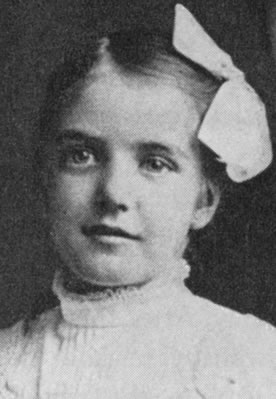
Clementine Paddleford as a girl. [Image courtesy: K-State Libraries]

She rode a horse to school, where she learned to love writing at an early age. She loved food too. She learned to cook by her mother’s side in their Kansas kitchen.

In a memoir called “A Flower for My Mother,” she wrote of fresh-picked corn and strawberries, ice cream made from new-fallen snow. [A Life in the Culinary Front Lines, by R.W. Apple, Jr, 11/30/05 The New York Times]

At 15 she worked for the Manhattan (Kansas) Daily Chronicle writing “personals” — She would borrow the family car and go down to the meet the 4 A.M. train for Kansas City and report  on which locals got on the train. It wasn’t journalism at its finest, but it was her first paid gig. She went to Kansas State Agriculture College and graduated in 1921 with a degree in Industrial Journalism. Industrial Journalism was a “boys club,” most women took home economics, and Paddleford was a trailblazer.

She moved from Manhattan, Kansas to Manhattan, New York and attended the Columbia School of Journalism at night while she worked reviewing books for Administration (a business magazine) and the New York Sun during the day. She specifically requested lengthy, more difficult, scientific books because, although she only earned $3 or $4 for a review, she could usually sell the book for $5 to a dealer. She also wrote women’s features for the New York Sun and the New  York Telegram

Later Paddleford became the woman’s editor for Fame and Fireside working there until 1929. When a change of management led to her leaving the publication she began to write on a freelance basis, mostly about food.

At home writing. [Image courtesy: The New School]

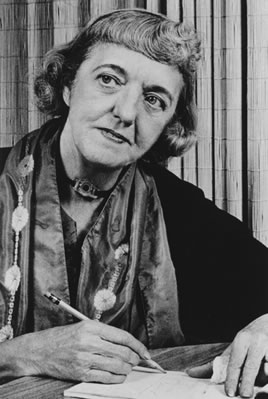
At 34 she was hospitalized for a malignant tumor on her larynx. She had the growth removed, along with her vocal chords. The operation left her with a breathing tube, and she had to re-learn how to talk. Her voice was never the same and she declined to speak in public after the operation. As for the breathing tube? She took it in stride.

She disguised the tube with a velvet choker that became part of her trademarked look and continued with her work. [the Found Recipe Box]

She worked as a food editor at the New York Herald-Tribune for 30 years from 1935-1966 bringing her signature editorial point of view to reviews and recipes. She made…

forty dollars a week to write six half-columns of advice to New York housewives on buying and eating. The job sounded like a cinch to Paddleford. Half a column a day shouldn’t take more than a couple of hours. And forty dollars was bread and butter. But what with her conscientiousness and her growing interest in the job, it wasn’t long before she was putting in as much as twelve hours a day combing food markets and writing the column. [Clementine Paddleford: her Passion is Food, by Josef Israels II, K-State Libraries; ]

She also did a weekly column at This Week Magazine and a monthly column for Gourmet Magazine. At her peak in the 1950’s and 1960’s she had 12 million readers.

Prior to Paddleford, food was treated in a dry academic manner. A recipe was just a list of numbers… x amount of flour… z amount of time in the oven… Paddleford brought the  food life. She told a story around the recipe.

Before Paddleford, newspaper food sections were dull primers on home economy. But she changed all of that, composing her own brand of sassy, unerringly authoritative prose designed to celebrate regional home cooking…[from the book description of Hometown Appetites: The Story of Clementine Paddleford]

She did the same when reviewing a restaurant or exploring the local cuisine …

We opened the mail one morning to learn a barrel of frogs’ legs… was coming our way. They came. We gave half of them away and cooked the rest for an important little dinner for three. The very thought of frogs’ legs sent memories reaching back to our first interest in the “greenies”—as we used to call frogs. Then we children were the hunters along the banks of a creek out Kansas way. We were small savages with clubs who caught froggies with a wallop over their noggins, took them home, and ate the shanks, a choice morsel. We’d wind up with only a few mouthfuls after a couple of hours’ work, but it seemed worth the effort. [Food Flashes, Clementine Paddleford, March 1951, Gourmet Magazine]

Paddleford was a food explorer too. She loved to go to remote places and discover the local cuisine. She learned to fly so she could get to places more quickly. She even had dinner on a nuclear submarine to see what the sailors had in the mess hall. (She came away from the encounter with a recipe for hamburger pie for 100 and one for brownies for 80.)

Well, I couldn’t write about Clementine Paddleford without sharing one of her recipes. Here is Hurry-Up Marble Cake

Hurry-Up Marble Cake

Here’s an old-time marble cake with a new-time trick, one double quick–no splitting the batter. Use your spatula as a wand–marbleize by magic. Pour the batter into layer-cake pans, drizzle over syrup made without cooking, using a ready-prepared cocoa. Swirl the spatula through the layers and dark chocolate spirals will show when the cake’s cut. The same method can be used to marbleize the frosting. Another day bake the marble loaf.

Double Marble Cake

1/2 cup instant sweet milk cocoa
2 tablespoons boiling water
2 1/2 cups sifted cake flour
2 teaspoons baking powder
1 teaspoon salt
1/2 cup shortening
1 1/2 teaspoons vanilla
1 cup sugar
2 egg yolks
1 egg
1 cup milk

Combine cocoa and water; stir until smooth. Set aside. Sift together flour, baking powder and salt. Combine shortening and vanilla. Gradually add sugar and cream well. Add egg yolks and egg, one at a time, and beat well. Add flour mixture alternately with milk. Pour into 2 9-inch round cake pans lined with wax paper. Drizzle cocoa mixture back and forth over both layers. With a spatula or knife, “swirl” through batter to marbleize. Bake at 325°F. 25 to 30 minutes. Cool in pans 10 minutes. Remove from pans, peel off paper. Cool thoroughly. Frost with marble frosting. Yield: 1 9-inch layer cake.

Marble Frosting

Combine 1/2 cup instant sweet milk cocoa with 2 tablespoons boiling water and stir until smooth; set aside. Combine 2 egg whites, 1/3 cup water, 1 1/2 cups sugar and 2 teaspoons white corn syrup (or substitute 1/8 teaspoon cream of tartar) and beat constantly over boiling water with rotary beater for 7 minutes, or until frosting holds its shape. Remove from water and beat for 2 minutes. Pour cocoa mixture over top of frosting in double boiler; do not stir. Spread between layers and on top and sides of cake. Frosting will become marbleized when spread.

Quick Marble Loaf Cake

Combine 1/2 cup instant sweet milk cocoa with 1 1/2 tablespoons milk; stir until smooth, set aside. Sift together 2 cups sifted cake flour, 1 tablespoon baking powder and 1/2 teaspoon salt. Combine 1/2 cup shortening and 1 1/2 teaspoons vanilla. Gradually add 3/4 cup sugar and cream well. Add 2 eggs, one at a time, and beat well. Add dry ingredients alternately with 3/4 cup milk. Fold in chocolate mixture gently several times to marbleize batter. Pour into a 10x5x3-inch pan lined with wax paper. Bake at 350°F. for 1 hour. Cool in pan 10 minutes. Remove from pan, peel off paper and cool cake thoroughly. Yield: 1 loaf cake. [recipecurio.com]


Thought of the Day 9.25.12 Shel Silverstein

“Listen to the mustn’ts, child. Listen to the don’ts. Listen to the shouldn’ts, the impossibles, the won’ts. Listen to the never haves, then listen close to me… Anything can happen, child. Anything can be.”

–Shel Silverstein

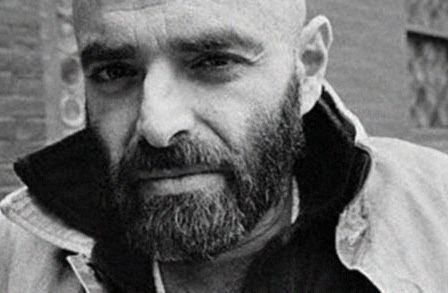
[Image courtesy: Poetry Foundation]

Sheldon Allan Silverstein was born on this day in Chicago, Illinois in 1930. Today is the  82nd anniversary of his birth.

Shel grew up in the Logan Square area of Chicago. He was notoriously private and seldom gave interviews so there is not much know about his early life. In one of the rare interviews he gave he said:

“When I was a kid—12 to 14, around there—I would much rather have been a good baseball player or a hit with the girls, but I couldn’t play ball. I couldn’t dance. Luckily, the girls didn’t want me. Not much I could do about that. So I started to draw and to write. I was also lucky that I didn’t have anybody to copy, be impressed by. I had developed my own style…” [Publishers Weekly, February 24, 1975.]

At 12 he became interested in cartooning and would practice his drawing by tracing comics, including Al Capp, from the “funny papers.” He attended the University of Illinois (for “One useless semester”), and the Art Institute of Chicago (for a summer session) before landing at Roosevelt University. It was a Roosevelt that he was first published, his cartoons appeared in the Roosevelt Torch.

In 1953 he was drafted into the US Army. He served from 1953-1955 and worked as a cartoonist for Stars and Stripes Newspaper. He said in a later Stars and Stripes interview that the Army  helped his art work because he didn’t have to worry about selling the cartoons anywhere. He was guaranteed 3 square meals a day. The Army also gave him the structure of a daily deadline. [To read the entire Stars and Stripes interview go to Off On a Tangent: Shel Silverstein Stars & Stripes Interview] His book Take Ten is a compilation of the cartoons he drew for Stars and Stripes.

Take Ten cover art. (Image courtesy: Amazon.com]

When he got out of the Army he found it difficult to sell his work on a regular basis. He freelanced for Sports Illustrated and Playboy and in 1956 he became a staff cartoonist for Playboy. He contributed poems and published several collections of his cartoons through the magazine.

Then in 1963 things took a turn.

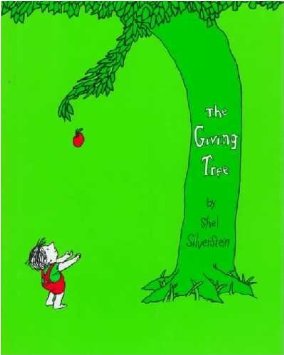
“…at the suggestion of fellow illustrator Tomi Ungerer, he was introduced to Ursula Nordstrom who convinced him to begin writing for children. One of Silverstein’s most popular books, The Giving Tree, was published in 1964.” [Shel Silverstein, Introduction by Meghan Ung. Humanities on the Internet]

Cover art for The Giving Tree [Image courtesy: Amazon.com]

No on had wanted to publish the book. They thought it was too sad for a children’s book. They thought it was too short. They couldn’t pigeonhole it as either for adults or children. But they all agreed it was wonderful. Then Harper and Row gave it a chance and it became a classic in children’s literature.

Here’s the 1973 animated movie of The Giving Tree narrated by Silverstein:

1974’s Where the Sidewalk Ends, a collection of poetry for children, won the New York Times Outstanding Book Award. The collection has been republished several times with Silverstein added poems at the 25th and 30th anniversary.  Here’s one of my favorite poems from the book, Hug o’ War:

Hug o’ War

I will not play at tug o’ war.

I’d rather play at hug o’war.

Where everyone hugs

instead of tugs,

Where everyone giggles

and rolls on the rug,

Where everyone kisses,

And everyone grins,

And everyone cuddles,

And everyone wins.

Next up was The Missing Piece is a beautifully written story about a circle who is looking for its soul mate. The nontraditional ending is both truthful and bittersweet.

A Light In the Attic brought more wonderful poems and illustrations. [Backward Bill always cracked us up at our house…]

…Backward Bill’s got a backward pup.

They eat their supper when the sun comes up…

Silverstein’s illustration of Backward Bill. [Image courtesy: Amazon.com]

Silverstein wrote a sequel to The Missing Piece called The Missing Piece Meets the Big O (see below) which won the 1982 International Reading Association’s Children’s Choice Award.

The Shel Silverstein collection  — “borrowed” from the shelves of an obliging independent brick and mortar bookstore, Greetings and Readings, Hunt Valley, Maryland.

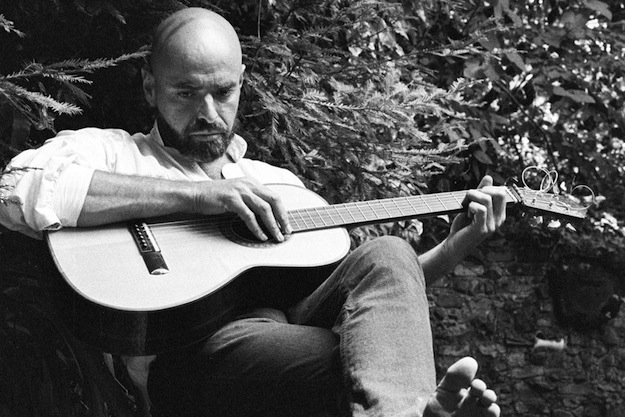
Silverstein also had a musical side. He played guitar and wrote songs, including the Johnny Cash hit A Boy Named Sue, the Irish Rovers “Unicorn Song” and the Dr. Hook song “The Cover of the Rolling Stone.” He performed on several albums (both his own and others.)

He was also a playwright. He had a hit with The Lady or the Tiger Show a play where contestants in a game show have to choose between two doors. Behind one door is a beautiful woman, behind the other door is a man-eating tiger. He co-wrote Oh, Hell! with David Mamet for Lincoln Center. The two worked together again on the film Things Change.

Silverstein died of a heart attack on May 10th, 1999 in Key West.

Shel playing his guitar. [Image courtesy: 105.7 Hawk]

Here’s the YouTube video for The Missing Piece Meets the Big O, I’d never read this book, or seen this video, but I just loved the message and had to share it…


Thought of the Day 9.18.20 Peace, Love, and Understanding

“My world, your world, one world” collage. [copyright: ritaLOVEStoWRITE]

“Love one another as I have loved you.”

— Jesus

Jesus of Nazareth was born in Bethlehem on December 25th in the year O*. We’ll celebrate his 2012th birthday soon.

[So, you may be wondering why am I bumping up Jesus in the usual chronological birthday list of Thought of the Day and featuring Him today?  I did it because I was looking for a good quote that reflected how I felt about current events, and this quote says it all. Let me explain…]

I’m dumb.

I must be.

Certainly I’m naive.

Absolutely I’m a fool.

Because… no matter how often I am presented with it…I just don’t understand hate.

This week has been a good one for hate and the haters. The bullies and the manipulators have been out in force. Frankly, people, I just don’t get it and I’m telling you to stop.

Please stop making (or rather manipulating**) movies so they are purposefully incendiary to an entire religion. While you are at it, stop sanctioning that movie in some misguided blessing from my God (as one Florida preacher did). Don’t speak for  Jesus unless it is a direct quote. Jesus, as I recall, said “Love one another as I have loved you.”  ONE ANOTHER — meaning everybody, not just the people who look, think, love, vote, or pray the way you do.

I’m a writer. (The word “write” is in the NAME of my BLOG). Obviously I believe in FREE SPEECH, but I also believe that Freedom of Speech comes with responsibility. You can’t yell “fire” in a crowded theatre and then, after people stampede out, shrug and say “Free Speech.” You can’t liable someone and evoke the right. And you shouldn’t knowingly spew hatred. Is it your free speech right to make any movie you want? Yes, but it is wrong, and you know it.

Hatred hurts. In this case it killed.

That brings me to the other side of this crisis, and the other side of the world. To those of you in Muslim countries and of the Muslim faith, PLEASE know that most of us in the U.S. are just as revolted by that movie as you are. In fact most of us didn’t know anything about it until the protest started in Egypt.

That movie in no way represents America.

But, it is also wrong that this stupid little movie is being used to insight violence through out the Middle East and in other Muslim countries. What happened in Libya was horribly wrong and senseless, and the only agenda it promoted is one of hate.

To my Muslim brothers and sisters I ask you to consider a more peaceful response.

I hope we can all dial back the rhetoric, the name calling, the stone throwing and resentment and redirect our efforts towards building peaceful relationships… large and small.

I know I’m not a genius,  but I do know that hate begets nothing but hate, whereas a hand held out in peace can build a better world.

Peace be with you, my friends.

Holding a virtual candle, and saying a prayer for peace, love and understanding.

—————————————-

(*Jesus’ birth is either on year O 0r the year 6 or 4 BC depending on which scholar you read)

(**The actors and crew for that movie didn’t know that their work would be over dubbed to become an anti-Muslim film btw. They thought it was just a low budget sci-fi movie about a astroid falling to the desert.)


Thought of the Day 9.15.12 Marco Polo

“I have not told half of what I saw.”

–Marco Polo

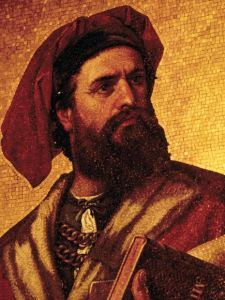
Marco Polo was born on this day in Venice, Italy in 1254. It is the 758th anniversary of his birth.

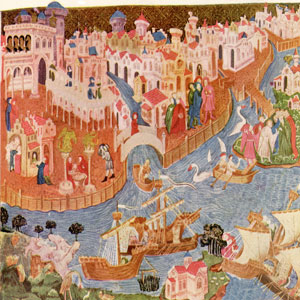
Marco Polo followed in the footsteps of his explorer father, Niccolo, and uncle, Matteo and traveled with them from Europe to the East. Niccolo and Matteo were on their first trip East when Marco was born. The elder Polos made it as far east as Kkublai Khan’s capital Kaifeng in the Mongol Empire. When they returned to Italy they found out that Marco’s mother, Niccolo’s wife, had died. Marco, then 15,  joined the explorers and in 1271 they set off again.

14th-century print showing the Polos leaving Venice at the beginning of their journey [Image Courtesy Hutton Archive/Getty Image / How Stuff Works]

This time they met the Great Khan himself in his summer capital of Xanadu. Khan liked the Polos, and took a special interest in the lively,  20 year-old Marco who he

conscripted him into service for the Empire. Marco served in several high-level government positions, including as ambassador and as the governor of the city of Yangzhou. [Biography of Marco Polo by Matt Rosenberg, About.Com Guide]

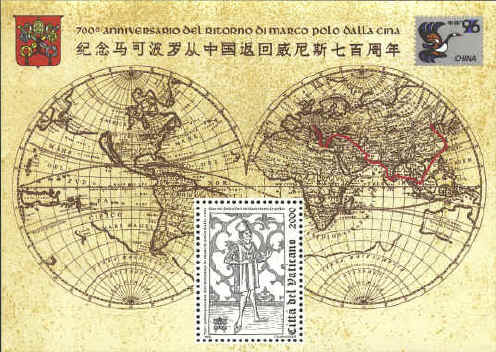
The Polos stayed in the diplomatic service of the Khan,  exploring the Empire for 17 years. In 1292, charged by Khan to escort a 17-year-old princess to Persia to wed a King, the Polos led an armada of 14 ships and 600 passengers that departed Sumatra and travelled to Indonesia, Sri Lanka, India through the Strait of Hormuz to Persia. The trip took 2 years.

Supposedly, only eighteen people survived from the original 600, including the Princess who could not wed her intended fiancée because he had died, so she married his son instead. [Biography of Marco Polo by Matt Rosenberg, About.Com Guide]

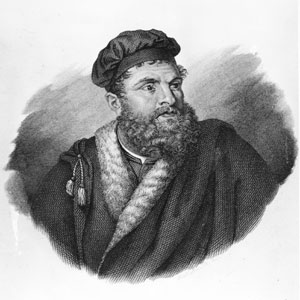
Polo would have been about 40 when he returned home from the East. [Image Courtesy: Hutton Archive/Getty Images; How Stuff Works]

The Polos went back to Venice. Marco became involved in the Italian wars between the city-states of Venice and Genoa, and was captured. While in prison he met Rustichello da Pisa . To pass the time he shared the stories of his far East travels with Rustichello who wrote them down. When they were released they worked together to publish The Travels of Marco Polo.

Polo told tales of fabulous Asian courts, black stones that would catch on fire (coal), and Chinese money made out of paper. [Biography of Marco Polo by Kallie Szczepanski, About.com Guide]

The book was an exaggerated telling of Polo’s actual adventures. Perhaps Marco hyped up the adventure to make for a more interesting tale in the dark days of prison, or maybe Rustichel loaded  it with danger and cannibals to increase sales. Regardless of how it happened, the book was an enormous hit. It was translated into most of the European languages and sold thousands of copies during Polo’s life time.

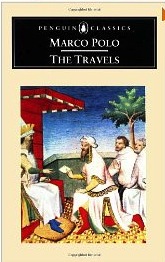
Cover of The Travels of Marco Polo, the paperback edition. The book has been in continuous publication (in one for or another) for 712 years. [ Image courtesy: Amazon.com]

The accounts of his travels provide a fascinating glimpse of the different societies he encountered: their religions, customs, ceremonies and way of life; on the spices and silks of the East; on precious gems, exotic vegetation and wild beasts. He tells the story of the holy shoemaker, the wicked caliph and the three kings, among a great many others, evoking a remote and long-vanished world with colour and immediacy. [Amazon.com]

The book heightened Europe’s desire to explore the world. Christopher Columbus owned a copy of it.

Marco lived out his days in Venice as a merchant. He married the daughter of another successful merchant and they had three daughters. He prefered to stay in Italy, letting others travel for the supplies that he sold.

As Polo neared death in 1324, he was asked to recant what he had written and simply said that he had not even told half of what he had witnessed. [Biography of Marco Polo by Matt Rosenberg, About.Com Guide]

The Polo’s route outlined in red [Image Courtesy: Tropical Stamps]