Category Archives: Thought of the Day

Elizabeth Bishop 2.8.13 Thought of the Day

“The whole shadow of Man is only as big as his hat.”–Elizabeth Bishop

[Image courtesy: Poetry Foundation.org]

[Image courtesy: Poetry Foundation.org]

Elizabeth Bishop was born on this day in Worcester, Massachusetts, USA in 1911 .  Today is the 102nd anniversary of her birth.

She was an only child whose father died when she was 8 moths old. Her mother suffered a series of mental breakdowns and was “permanently committed to an institution when Elizabeth was only five years old.” [Poetry Foundation]

[Image courtesy: The Elizabeth Bishop Legacy]

[Image courtesy: The Elizabeth Bishop Legacy]

Bishop, who went to live with her maternal grandparents in Nova Scotia, never saw her mother again. After several years her paternal grandparents took her to live with them in Massachusetts. The Bishops were well to do  and could afford a first class education for the little girl. They sent her to “Walnut Hills School for Girls and to Vassar College.” [Ibid]

[Image courtesy Elizabeth Bishop Society]

[Image courtesy Elizabeth Bishop Society]

After graduating Vassar Bishop, who was independently wealthy traveled extensively in Europe and North Africa. She lived for four years in Key West Florida where she wrote of her travels.  In 1946 those poems were compiled into her first book, North and South.  (The book won a Pulitzer Prize.) In 1951 she received a traveling fellowship and decided to circumnavigate South America. She made it as far as Santo, Brazil. Her intended stay of 2 weeks lasted over fifteen years. Upon returning to the United States she lived in New York, San Francisco, and New England.

Her style “focuses … with great subtlety on her impressions of the physical world… Her images are precise and true to life, and they reflect her own sharp wit and moral sense.” [Poets.org] The New York Times Called Bishop “One of the most important American poets” of the 20th Century. Bishop wrote slowly and precisely. She didn’t write a huge volume of poems, but each was measured perfection.

Here is my favorite Bishop poem, The Map:

map

The Map

Land lies in water; it is shadowed green.
Shadows, or are they shallows, at its edges
showing the line of long sea-weeded ledges
where weeds hang to the simple blue from green.
Or does the land lean down to lift the sea from under,
drawing it unperturbed around itself?
Along the fine tan sandy shelf
is the land tugging at the sea from under?

The shadow of Newfoundland lies flat and still.
Labrador’s yellow, where the moony Eskimo
has oiled it. We can stroke these lovely bays,
under a glass as if they were expected to blossom,
or as if to provide a clean cage for invisible fish.
The names of seashore towns run out to sea,
the names of cities cross the neighboring mountains
-the printer here experiencing the same excitement
as when emotion too far exceeds its cause.
These peninsulas take the water between thumb and finger
like women feeling for the smoothness of yard-goods.

Mapped waters are more quiet than the land is,
lending the land their waves’ own conformation:
and Norway’s hare runs south in agitation,
profiles investigate the sea, where land is.
Are they assigned, or can the countries pick their colors?
-What suits the character or the native waters best.
Topography displays no favorites; North’s as near as West.
More delicate than the historians’ are the map-makers’ colors.

Elizabeth Bishop

compass

Bishop died  at age 68 in October of 1979 in Boston. Besides her Pulitzer she won a National Book Award for Poetry in 1970, the Neustadt Internaional Prize in 1976 and two Guggenheim Fellowships (1947 & 1978).

[Image courtesy: Poets.org]

[Image courtesy: Poets.org]

Other Bishop poems I highly recommend:

A Visit to St. Elizabeths

Conversation

Five Flights Up

In The Waiting Room


Charles Dickens 2.7.13 Thought of the Day

“A loving heart is the truest wisdom.”–Charles Dickons

English: Detail from photographic portrait of ...

English: Detail from photographic portrait of Charles Dickens (Photo credit: Wikipedia)

Charles John Huffam Dickens was born on this day in Landport, Portsmouth, Hampshire, England in 1812. Today is 201st anniversary of his birth.

He was the second eldest child in a family of eight. His parents were of modest means but dreamed of a bigger, better life. His father, John, was a clerk, Elizabeth wanted to be a teacher — but with 8 children afoot never made it to the head of the classroom. The family was always poor, sometimes destitute.

When Dickens was four the family moved to Chatham, Kent. Dickens and his brothers and sisters roamed “he countryside and explore(d) the old castle at Rochester.” [Biography.com] They were happy years, and Dickens attended school and read ferociously. But the good times did not last. John outspent his income and was sent to debtor’s prison at the Marshalsea debtors’ prison in London in 1824. Elizabeth and the younger children moved in with  the father, but Frances, the eldest and Charles were sent to live with family friends.

Dickens at the Blacking Warehouse. Charles Dic...

Dickens at the Blacking Warehouse. Charles Dickens is here shown as a boy of twelve years of age, working in a factory. (Photo credit: Wikipedia)

So at 12 years old Charles Dickens was…

forced to leave school to work at a boot-blacking factory alongside the River Thames. At the rundown, rodent-ridden factory, Dickens earned six shillings a week labeling pots of “blacking,” a substance used to clean fireplaces. [Ibid]

John Dickens came into some money when his paternal grandmother died and he was released from the Marshalsea, but  Charles’ mother didn’t let him quit the boot-black factory right away. The family had grown accustomed to his six shillings a week. He never forgave her for making him go back to dirt and rats of the factory. Eventually he was able to go back to school, this time to The Wellington House Academy. Unfortunately the experience was anything but pleasant. The headmaster was sadistic, the teaching haphazard and fellow students undisciplined.

Charles Dickens described the second Marshalse...

Charles Dickens described the second Marshalsea in Little Dorrit. (Photo credit: Wikipedia)

At 15 he got a job as an office boy at a law office.

As it turned out, the job became an early launching point for his writing career. Within a year of being hired, Dickens began freelance reporting at the law courts of London. Just a few years later, he was reporting for two major London newspapers. [Ibid]

Dickens, who had a near photographic memory, stored all the experiences, the injustices, the cruelties, and the people he met in his head. They came out later on the pages of his novels. (Amy and her family live in the Marshalsea in Little Dorrit. David, Pip and Oliver relive some of his worst experiences in David Copperfield, Great Expectations, and Oliver Twist.)

Copy of Sketch of Charles Dickens

Copy of Sketch of Charles Dickens (Photo credit: Wikipedia)

By 1833 he was being published under a pseudonym, “Boz,” in magazines and three years later his first book, a collection of articles, Sketches by Boz, was published.

He wrote often wrote serialization for magazines (sometimes magazines in which he had a financial interest) and then published the finished story in the form of a book.

Charles Dickens (1812-1870)

Charles Dickens (1812-1870) (Photo credit: Wikipedia)

Here’s a list of his books:

  • The Posthumous Papers of the Pickwick Club
  • The Adventures of Oliver Twist
  • The Life and Adventures of Nicholas Nickleby
  • The Old Curiosity Shop
  • Barnaby Rudge: A Tale of the Riots of ‘Eighty
  • The Life and Adventures of Martin Chuzzlewit
  • Dombey and Son
  • David Copperfield
  • Bleak House
  • Hard Times: For These Times    
  • Little Dorrit     
  • A Tale of Two Cities
  • Great Expectations     
  • Our Mutual Friend
  • The Mystery of Edwin Drood

The Christmas books:

  •         A Christmas Carol (1843)
  •         The Chimes (1844)
  •         The Cricket on the Hearth (1845)
  •         The Battle of Life (1846)
  •         The Haunted Man and the Ghost’s Bargain (1848)

————————————————————————————————-

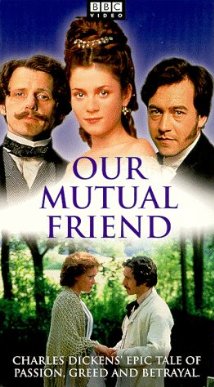
If you are looking for a good Dicken’s dvd to watch during the snow storm we are promised this weekend I can recommend both Little Dorrit with Clair Foy and Matthew MacFayden or Our Mutual Friend with Keely Hawes and Steven Mackintosh.

Our Mutual Friend DVD (Image courtesy IMDB)

Our Mutual Friend DVD (Image courtesy IMDB)

Little Dorrit dvd  (Image courtesy Amazon.com)

Little Dorrit dvd (Image courtesy Amazon.com)


MoNOTpoly

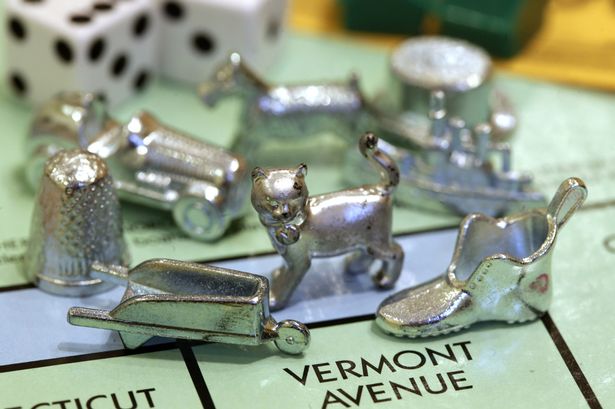
monopoly-cat-iron2-060113-jpg_143448I’m not against cats.

REALLY.

I like cats.

Not as much as I like dogs, maybe, but I do like cats.

I have nothing against them….

Scratch that. I have nothing against the breathing, furry kind of cats that curl up in your lap and let you scratch them behind their ears…the kind who eat catnip.

I’m not so sure about the little metallic guy who just entered the world of board games.

He’s cute enough, I guess. But he doesn’t look like a very stable kind of creature.

Currently the least stable game piece on the Monopoly board is the Scotty Dog.

Monpoly dogFun loving, adorable, excitable…you can’t go two moves with out this little fella falling on his side to roll over and play dead.

But at least you can upend him and sit him on his hind legs for a little more stability. I don’t think that’s an option for Felix.


And when you think of what the Cat is replacing! Well, the instability issue seems even worse.

The IRON, the steady dependable iron, is now cast aside for ms. kitty.

IronMonopolyThe humble Monopoly Iron was always the easiest game piece to manipulate. It never fell over. It came with its own handle for heaven’s sake.

Oh, it may not have been the cutest or most glamorous of game pieces, but it got the job done. It quietly went about the board biding its time, paying its rent, collecting its $200 for passing go.

I don’t know about this CAT. I suspect it will slink about from spot to spot at its leasure…looking for the sunniest  location in which to lounge away the afternoon. It’ll curl up into a nice fuzzy ball and …you know what? That kitty’s not movin’ til it hears the can opener in the kitchen.

Yeah… have fun playing with THAT.

Meoooooow.

The+newest+Monopoly+token,+a+cat


Babe Ruth 2.6.13 Thought of the Day

“Never let the fear of striking out get in your way.” — Babe Ruth

Babe Ruth

Babe Ruth (Photo credit: carloscappaticci)

George Herman Ruth was born on this day in Baltimore, Maryland, USA in 1895. Today is the 118th anniversary of his birth.

He was one of eight children born to George and Kate Ruth. Only he and his sister Mamie survived.  His parents ran a saloon  at 426 West Camden Street, a job that took much of their time. So George, Jr and Mamie were left to their own devices. As an adult Ruth reflected that he ran the streets as a kid, skipped school, chewed tobacco and drank beer while his father wasn’t looking. He was “incorrigible,” and that’s what his parents recorded on his entry documentation to St. Mary’s Industrial School for Boys when he was sent he was just 7 years old.

St. Mary’s was part reformatory, part orphanage, part school and part work house. It was run by the Xavier Brothers and it served boys from ages 5 to 21. Ruth learned to make shirts as well as carpentry skills at the school. He lived there for 12 years. His parents seldom had the time to visit the school.

Ruth (top row, far left) at St Mary's Industri...
Ruth (top row, far left) at St Mary’s Industrial School for Boys, Baltimore, Maryland, c. 1912 (Photo credit: Wikipedia)

Fortunately for Ruth, the prefect of discipline at St. Mary’s, Brother Matthias Boutlier, took him under his wing.

Ruth particularly looked up to a monk named Brother Mathias, who became a father figure to the young boy… Matthias, along with several other monks of the order, introduced Ruth to baseball, a game at which the boy excelled. [Biography.com]

Brother Matthias worked with Ruth to hone his hitting, pitching and fielding abilities. Ruth showed such promise that …

the Brothers invited Jack Dunn, owner of the Baltimore Orioles, to come watch (him)  play. Dunn was obviously impressed, as he offered a contract to (Ruth) in February 1914 after watching him for less than an hour…. Upon seeing (Ruth) for the first time, the Orioles players referred to him as “Jack’s newest babe”…[baberuth.com]

The nickname stuck and he was known as Babe Ruth from then on.

Babe Ruth pitching with Boston Red Sox, Comins...
Babe Ruth pitching with Boston Red Sox, Cominsky Park, 1914 (Photo credit: Wikipedia)

He started as a pitcher. First for Baltimore and then for the Boston Red Sox. By 1915 he was a “permanent fixture in the Red Sox rotation, …accumulating an 18-8 record with an ERA of 2.44.” [Ibid] Both his pitching and hitting game improved over the next few years and “In 1918, Babe Ruth pitched his 29th scoreless inning in a World Series. That record stood for 43 years!” [about.com]

English: American baseball player Babe Ruth in...
English: American baseball player Babe Ruth in 1921 (Photo credit: Wikipedia)

The following year he shifted his focus to his hitting game and earned a new record. This time for a whopping 29 home runs in a single season. Ruth was traded to the Yankees in 1920 and topped his home run tally (coming in at 54 for the year.) In 1921 he broke the record again with 59 home runs.  In 1927 Ruth, as part of the Yankees famous “Murderer’s Row” hit an amazing 60 home runs for the season — a record that stood for 34 years.


Over the course of his career, Ruth went on to break baseball’s most important slugging records, including:

  • most years leading a league in home runs (12);
  • most total bases in a season (457)
  • and highest slugging percentage for a season (.847).

In all he hit 714 home runs, a mark that stood until 1974, when Hank Aaron of the Atlanta Braves surpassed him. [Biography.com]


Baseball player Babe Ruth
Baseball player Babe Ruth (Photo credit: Wikipedia)

Ruth helped the Yankees win seven pennants and four World Series. He wore pinstripes until 1934. He was ready to retire from the active roster and wanted to manage, but his off-field hijinks — he was almost as famous for his love of alcohol, women and food as he was for his ability to swing a bat — made owners think twice about placing him in a supervisory position. He was traded to the Boston Braves for his final season where he hoped to have both playing and assistant-management duties, but he soon realized the “management” part of his job was mostly P.R., public appearances and giving autographs.

Ruth with the Boston Braves in 1935, his last ...
Ruth with the Boston Braves in 1935, his last year as a player (Photo credit: Wikipedia)


On May 25, 1935, an overweight and greatly diminished Babe Ruth reminded fans of his greatness one last time when hit three home runs in a single game at Forbes Field in Pittsburgh, Pennsylvania. The following week, Ruth officially retired. [Biography.com]

The Sultan of Swat, The Bambino, Number “3” (Babe’s number in the Yankee batting line up and eventually the number on the back of his pinstripes) was inaugurated into the Baseball Hall of Fame in 1936.

Babe Ruth
Babe Ruth (Photo credit: Wikipedia)

A decade later doctors discovered a tumor on his neck. Ruth had cancer. He died on August 16, 1948.

Babe still remains the greatest figure in major league baseball, and one of the true icons in American history. The Babe helped save baseball from the ugly Black Sox scandal, and gave hope to millions during The Great Depression. …He continues to be the benchmark by which all other players are measured. Despite last playing nearly 75 years ago, Babe is still widely considered the greatest player in Major League Baseball history. [baberuth.com]


Gehrig_&_Ruth[1]
#4 Gehrig and #3 Ruth were the heart of Murderer’s Row and the Yankees.

—————————————————————————–

Sigh, it kills this Baltimore Orioles girl to write “Y – A – N – K – E – E -S”  so often in a post. Please know I could only do it for the Babe (and for Lou Gehrig when it is his turn). When is Brooks Robinson’s birthday?


Laura Linney 2.5.13 Thought of the Day

Just because you’re not famous, doesn’t mean you’re not good. — Laura Linney

[Image courtesy: theplace2.com]

[Image courtesy: theplace2.com]

Laura Leggett Linney was born on this day in New York City, New York, USA in 1964. She is 49 years old.

Linney is the daughter of Romulus Linney, a playwright, and Miriam Perse, a nurse. Her parents divorced when she was an infant and she grew up in a modest 1 bedroom apartment with her mother. “Linney grew up working in the theater, both behind the scenes and, in her late teens, on the stage.” [Starpulse.com] After graduating from  Northfield Mount Hermon School, a New England prep school, she went to Northwestern University and Brown University for undergraduate work. (She received her BA in Fine Arts from Brown in 1986). She did post-graduate work with Group 19 at the Juillard School.

She took the stage in such Broadway productions as The Seagull, Six Degrees of Separation and Hedda Gabler before making the leap to film.

Linney’s screen debut was a minor role in Lorenzo’s Oil. She played Kevin Kline’s mistress in Dave, and landed the role of Mary Ann Singleton in Armistead Maupin’s Tales of the City (a role she would reprise two more times.) She played in a trio of thrillers, Congo, Primal Fear and Absolute Power, before getting her big break as Meryl Burbank in The Truman Show.

Linney played the "perfect wife" in Truman.

Linney played the “perfect wife” in Truman.

2000’s You Can Count On Me earned Linney her first Academy Award nomination for Best Actress. (Her second nomination was for her work in 2004’s Kinsey opposite Liam Neeson.) Also in 2000 she did the lush, delightful The House of Mirth (based on the Edith Wharton novel, with Gillian Anderson, Eric Stoltz and Elizabeth McGovern).

Linney won an Emmy Award for her work on Wild Iris opposite Gena Rowlands. She won another Emmy, this time for Outstanding Guest Actress in a Comedy Series for her story arc as Charlotte on the TV show Frasier.

She played Zelda Fitzgerald in American Master’s F.Scott Fitzgerald: Winter Dreams. She worked on ensemble films  including Love Actually and The Laramie Project. She’s equally stunning as the intellectual mom struggling as her family crumbles around her in the Squid and the Whale as she is in the supernatural thriller The Mothman Prophecies  as small town police officer.

On screen, Linney has mastered quite a line in striving. Her most memorable characters have had a combination of astute wit, career focus and either a leavening daffiness or a chilly sort of overbrightness. This tends to hinge on whether they’re good apples (as in You Can Count On Me or The Savages) or bad (The Truman Show, The House of Mirth). [The Telegraph 2.1.13]

She brought Abigail Adams to life with her beautiful, strong portrayal of our second First Lady in HBO’s mini-series John Adams. Linney won  her most recent  Emmy Award for her efforts.

She can currently be seen on Showtime’s The Big C — for which she won a Golden Globe — and as the host of Masterpiece Theatre on PBS. Her latest film role is as Margaret “Daisy” Suckley  in Hyde Park on Hudson opposite Bill Murray’s FDR.


Rosa Parks 2.4.13 Thought of the Day

“I have learned over the years that when one’s mind is made up, this diminishes fear; knowing what must be done does away with fear.” –Rosa Parks

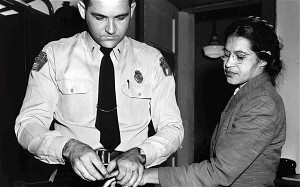
Rosa Parks getting fingerprinted after her arrest.

Rosa Parks getting fingerprinted after her arrest. [Image courtesy  abcnews.go.com]

Rosa Louise McCauley was born on this day in Tuskegee, Alabama in 1913. Today is the 100th anniversary of her birth.

Rosa’s father James was a carpenter and her mother Leona was a teacher. Her parents separated when Rosa was 2, and she moved with her mother a little brother Sylvester to Pine Level, Alabama (just outside the capital, Montgomery) to live with her maternal grandparents. He mother taught her to read. The segregated one room school-house she attended seldom had enough desks  or other supplies. At 11 she went to the Montgomery Industrial School for Girls, an institution a laboratory school set up by the Alabama State Teachers College for Negroes and founded “liberal-minded women from the northern United States. The school’s philosophy of self-worth was …to ‘take advantage of the opportunities, no matter how few they were.'” [Achievement.org] She dropped out of the school to care first for her grandmother then her mother.

At 19 she married Raymond Parks and moved to Montgomery. Raymond encouraged Rosa to finish high school, and she earned her degree in 1933.  The two were active in the National Association for the Advancement of Colored People (Raymond had been an active member when they met.) They worked to raise money to help defend the Scottsboro Boys and were members of the Voter’s League. Mrs. Parks managed to get her voter’s card (it took her three tries because of the Jim Crow laws in Montgomery.)

English: Photograph of Rosa Parks with Dr. Mar...

English: Photograph of Rosa Parks with Dr. Martin Luther King jr. (ca. 1955) Mrs. Rosa Parks altered the negro progress in Montgomery, Alabama, 1955, by the bus boycott she unwillingly began. National Archives record ID: 306-PSD-65-1882 (Box 93). Source: Ebony Magazine Ελληνικά: Φωτογραφία της Rosa Parks με τον Dr. Martin Luther King jr. (περ. 1955.) Español: Fotografía de Rosa Parks con Martin Luther King jr. (aprox. 1955). Français : Photographie Rosa Parks (ca. 1955) (Photo credit: Wikipedia)

Rosa served as the chapter’s youth leader. And in 1944 she became the secretary to NAACP President E.D. Nixon—a post she held until 1957. (She recalls that they needed a secretary, she was the only woman there, and she was too timid to decline.)

“I worked on numerous cases with the NAACP,” Mrs. Parks recalled, “but we did not get the publicity. There were cases of flogging, peonage, murder, and rape. We didn’t seem to have too many successes. It was more a matter of trying to challenge the powers that be, and to let it be known that we did not wish to continue being second-class citizens.” [Rosa Parks quoted on Achievement.org]

On Thursday, December 1, 1955

Rosa Parks boarded the Cleveland Avenue bus for home. She took a seat in the first of several rows designated for “colored” passengers. …As the bus Rosa was riding continued on its route, it began to fill with white passengers. Eventually, the bus was full and the driver noticed that several white passengers were standing in the aisle. He stopped the bus and moved the sign separating the two sections back one row and asked four black passengers to give up their seats. Three complied, but Rosa refused and remained seated. The driver demanded, “Why don’t you stand up?” to which Rosa replied, “I don’t think I should have to stand up.” The driver called the police and had her arrested. …The police arrested Rosa at the scene and charged her with violation of Chapter 6, Section 11, of the Montgomery City Code. She was taken to police headquarters, where, later that night, she was released on bail. [biography.com]

Booking photo of Parks

Booking photo of Parks (Photo credit: Wikipedia)

On the day of her trial the NAACP and the Montgomery Improvement Association (with its new leader Dr. Martin Luther King, Jr.) organized a Bus Boycott.  The

13-month mass protest that ended with the U.S. Supreme Court ruling that segregation on public buses is unconstitutional. …The bus boycott demonstrated the potential for nonviolent mass protest to successfully challenge racial segregation and served as an example for other southern campaigns that followed. In Stride Toward Freedom, King’s 1958 memoir of the boycott, he declared the real meaning of the Montgomery bus boycott to be the power of a growing self-respect to animate the struggle for civil rights. [Stanford.edu]

“At the time I was arrested I had no idea it would turn into this, … It was just a day like any other day. The only thing that made it significant was that the masses of the people joined in.” –Rosa Parks

After her arrest Parks lost her job  as a seamstress in a department store. “her husband was fired after his boss forbade him to talk about his wife or their legal case.” [biography.com] The couple was unable to find work and eventually they moved to Detroit, Michigan with Rosa’s Mother.

In Michigan Rosa Parks worked U.S. House of Representative John Conyer as a secretary and receptionist. In 1987 she helped found the Rosa and Raymond Parks Institute for Self-Development which runs bust tours  to civil rights and Underground Railroad sites for young people.

Rosa Parks receives an award from Bill Clinton.

Rosa Parks receives an award from Bill Clinton. (Photo credit: Wikipedia)

She published a biography, Rosa Parks: My Story and a memoir, Quiet Strength in the 1990s. In 1996 she received the Presidential Medal of Freedom from President Clinton.

Rosa Parks died on October 24, 2005 at the age of 93. She was honored by lying in state at the Capitol Rotunda in Washington, DC.

Today, on the centennial of her birth the US Postal Service is releasing a Forever Stamp with her likeness.

[Image courtesy USPS]

[Image courtesy USPS]

“I would like to be remembered as a person who wanted to be free… and other people would be also free.” –Rosa Parks


Elizabeth Blackwell 2.3.13 Thought of the Day


“If society will not admit of woman’s free development, then society must be remodeled.”
Elizabeth Blackwell

[Image courtesy History.com]

[Image courtesy History.com]

Elizabeth Blackwell was born on this day in Bristol, England in 1821. Today is the 192nd anniversary of her birth.


Elizabeth was the third of nine children born to Samuel and Hannah Blackwell. She had a happy childhood growing up with her large family (four aunts also lived with them.) Her father encouraged all his children in their education. Elizabeth had both a governess and private tutors.


In 1832, when Elizabeth was 11, the Blackwells moved to America. Her father wanted to get the family away from Bristol’s chaotic atmosphere. He also wanted to move to America to help the abolitionist movement. He started a new sugar refinery but this business in New York, but it did not do as well as his Bristol refinery. They moved to Ohio in 1838 to begin again. But soon after the move west Samuel Blackwell died. He left a large family and a good deal of debt.

T909228_08

[Image courtesy Biography.com]


Elizabeth and two of her sisters started a school, The Cincinnati English and French Academy for Young Ladies.


Blackwell later decided to pursue a career in medicine. But the road to becoming a doctor was not an easy one for her. She studied independently with a doctor before getting accepted to the Geneva Medical College in upstate New York in 1847. [Biography.com]

Notwithstanding the opposition of fellow students and the townspeople of Geneva, New York, and despite being keep from attending medical demonstrations that were considered inappropriate for women Elizabeth Blackwell graduated in 1849…


becoming thereby the first woman to graduate from medical school, the first woman doctor of medicine in the modern era. [about.com]

She went to Europe and trained in midwifery at La Maternite in Paris. In England she “worked at St. Bartholomew’s Hospital with Dr. James Paget…and became friends with Florence Nightingale.”[Ibid]


English: u.s. postage stamp of 1974, depicting...

English: u.s. postage stamp of 1974, depicting Elizabeth Blackwell Français : Timbre des Etats-unis de 1974, portrait de Elizabeth Blackwell (Photo credit: Wikipedia)

But on returning to the States she was unable to find a hospital willing to allow her to practice under their roof. She couldn’t get office space, “and she had to purchase a house in which to begin her practice.” [Ibid]


Her sister, Dr. Emily Blackwell, joined her in 1856 and, together with Dr. Marie Zakrzewska, they opened the New York Infirmary for Women and Children at 64 Bleecker Street in 1857. This institution and its medical college for women (opened 1867) provided training and experience for women doctors and medical care for the poor. [NIH.gov]

Health Education and maintaining Sanitary Conditions were core to the school. She helped establish the U.S. Sanitary Commission.


Blackwell returned to England “and served as a lecturer at the London School of Medicine for Women.” [Biography.com]


Cover of "Pioneer Work In Opening The Med...

Cover via Amazon

In 1877 she retired to Hastings, England. She published her biography, Pioneer Work in Opening the Medical Profession to Women in 1895.  On May 31, 1910 she died from complications of a stroke.

Portrait of Elizabeth Blackwell by Joseph Stan...

Portrait of Elizabeth Blackwell by Joseph Stanley Kozlowski, 1905. Syracuse University Medical School collection. (Photo credit: Wikipedia)


Second Character Saturday: Jim Halpert 2.2.13

Who: Jim Halpert/ Tim Canterbury

jimhalpertVStimcanterbury

From: The OFFICE (US/UK)

Played by:  John Krasinski / Martin Freeman

Created by: The US version of the Office was adapted from the UK series for an American audience by Greg Daniels  / The British version of the Office was  created by Ricky Gervais and Stephen Merchant

Date first appeared: 2005 / 2001

Jim attends an office Halloween party as s"Three whole Jim"

Jim attends an office Halloween party as “Three Whole Punch Jim” [Image courtesy: NBC]

Why: Is there a more “everyman” currently on television than Jim Halpert? His dogged humility, humor, kindness, and all around good guy-ness has appealed to audiences since the Office appeared on NBC’s schedule in 2005. Actually the character originated on the BBC as part of the Gervais/Merchant original Office in 2001.

Martin Freeman in the BBC's The Office (Image courtesy the BBC)

Martin Freeman in the BBC’s The Office (Image courtesy the BBC)

Martin Freeman (yes, today’s Bilbo and Dr. Watson) played put upon Tim Canterbury to Gervais’ David Brent.  Jim/Tim play the straight man to Michael/David and annoying co-worker Dwight / Gareth. There is also a certain Cinderella thread running in Jim/Tim’s story with Pam/Dawn the receptionist.

Pros: Friendly, creative, funny, inclusive.

Cons: Unmotivated, somewhat insecure, indecisive, competitive with Dwight/Gareth

Shining moment: My favorite Jim moment is when Michael and Dwight are away and he and Pam cook up the Office Olympics.

It helps that both John Krasinski and Martin Freeman are such good comic actors. Both men can evoke a lot of emotions without saying a word (something Krasinki had to do when he lost a jinx to Pam and couldn’t talk for most of an episode.)

Here’s a sampling of Freeman’s emotional facial expressions:

tim Canterbury faces

In general the BBC version of the show runs a little more on the blue  than it’s American off shoot. Garreth is more insufferable, the boss, David, is more slimy. That makes Tim’s road even more pathetic than Jim’s.

But Jim Halpert has had several more seasons to develop. The American version of the Office is still on the air and Jim is continuing to grow as a character. Here’s a youtube video featuring Krasinski’s Jim faces:

I think Jim or Tim would be an asset to any office.

So have you seen the BBC version? Who is your favorite? AND do you think Jim Harper (from HBO’s Newsroom) is the next generation Jim Halpert?   Discuss.

John Gallagher Jr. plays good guy Jim Harper on HBO's Newsroom. [Image courtesy HBO]

John Gallagher Jr. plays good guy Jim Harper on HBO’s Newsroom. [Image courtesy HBO]


Franz Schubert 1.31.13 Thought of the Day

“When I wished to sing of love, it turned to sorrow. And when I wished to sing of sorrow, it was transformed for me into love.”–Franz Schubert

English: Oil painting of Franz Schubert Deutsc...

English: Oil painting of Franz Schubert Deutsch: Gemälde von Franz Schubert (Photo credit: Wikipedia)

Franz Peter Schubert was born on this day in  Himmelpfortgrund, Austria in 1797. It is the 216th anniversary of his birth.

Schubert demonstrated his love of music early. He could sing, play piano, violin and organ at a young age. His father and older brother were his first musical instructors. “Eventually, Schubert enrolled at the Stadtkonvikt” [Biography.com] The school was a training ground for young singers who aspired to the chapel choir of the Imperial Court. In…

1808 he earned a scholarship that awarded him a spot in the court’s chapel choir. His educators at the Stadtkonvikt included Wenzel Ruzicka, the imperial court organist, and, later, the esteemed composer Antonio Salieri, who lauded Schubert as a musical genius.[Ibid]

He was the leader of the violin section of the student’s orchestra. He also conducted.

English: Oil painting of Franz Schubert, after...

English: Oil painting of Franz Schubert, after an 1825 watercolor (Photo credit: Wikipedia)

When his voice broke in 1812 he left the college, though he still took lessons from Salieri. In 1814 he enrolled at a teacher’s college and began composing.

By 1814, the young composer had written a number of piano pieces, and had produced string quartets, a symphony, and a three-act opera. Over the next year, his output included two additional symphonies and two of his first Lieds, “Gretchen am Spinnrade” and “Erlkönig.” Schubert is, in fact, largely credited with creating the German Lied.

He left the teaching college to pursue a music career full-time in 1818.

That summer he completed a string of material, including piano duets “Variations on a French Song in E minor” and the “Sonata in B Flat Major,” as well as several dances and songs. [Ibid]

At about that time wrote his first operetta “Die Zwillingsbrüder” (The Twin Brothers) followed by the score for “Die Zauberharfe” (The Magic Harp).

His composition “Quartettsatz [Quartz-Movement] in C minor,” helped spark a wave of string quartets that would dominate the music scene later in the decade.[Ibid]

He continued to produce symphonies, string quartets, fantasies, piano sonatas and songs. He wrote over 500 songs, and is perhaps best known today for his setting of Ave Maria.

Schubert suffered from syphilis for years leading up to his death. The official diagnosis was typhoid fever, but it is likely that he also suffered from mercury poisoning as well. He died on November 19, 1828 at the age of 31.

Deutsch: Ehemaliges Grab von Franz Schubert

Deutsch: Ehemaliges Grab von Franz Schubert (Photo credit: Wikipedia)