Category Archives: Shakespeare

Richard the 3rd UPDATE

R3 UPDATE!

Those bones found at the Leicester car park are those of King Richard! DNA testing matched the bones to one of Richard’s descendants.

[The play Richard III  at Chesapeake Shakespeare has run its course, But you can catch Vince Eisensen (who played Richard) and James Jager (who played Henry) as Proteus and Valentine in the company’s current production of The Two Gentlemen of Verona weekends from Feb 22nd to March 17th. Click HERE for details

————————————————————————————————————


Blog Note:  Richard the Third’s Birthday was Oct 3 1452.

——————————————————————————–

Richard III Royal Collection
Richard III Royal Collection (Photo credit: Wikipedia)

Today I’m thinking about Richard the Third of England.

We just saw the terrific Moveable Shakespeare production of Richard III at Chesapeake Shakespeare Company in the ruins of the Patapsco Female Institute in Ellicott City Maryland.

Director Ian Gallanar chose to pick the characters up from the 15th century and time warp them  to something resembling War War One. Clever, especially considering the Patapsco Female Institute was used as a war hospital during the Great War. In his director’s notes he says:

“The production really uses the visual palate and the historic technology of the World War One era as a way to clarify the relationships of the characters….[The audience] might also recognize the futility and wastefulness of a war that, much like the English “Wars of the Roses,” seemed more about resolving who would inherit power rather than who ought to inherit power.” [Chesapeake Shakespeare Company, Richard III: Program Notes]

So on a cold October night we got to see one of Shakespeare’s bloodiest plays in and around the shell of a burned out 19th Century building that some people claim is haunted. The occasional gas-masked actors quietly playing cards in a dimly lit corner or typing away orders on an antique typewriter upped the creep factor. As did the lighting effects, the period music and wonderful costumes.

Vince Eisenson as Richard III. Photo by Teresa Castracane. [Image courtesy: Chesapeake Shakespeare Company]
 

This version of Richard really worked. I really liked the “Moveable” aspect too. It added to the length of the play (instead of quick scene changes the audience literally did a scene change by moving to a new part of the building or grounds, and that took a while.) My only problem was that there was a scene or two where I couldn’t see the action because I had the bad luck of standing behind some one tall.)  Still, I liked that we kept moving through the building, and “discovering” new rooms. It really put the audience DEAD center into the action of the play (and moving about  kept us warm.)

Richard III runs for one more weekend at Chesapeake Shakespeare. So if you are local to Maryland jump on their website and grab some tickets before they sell out. http://chesapeakeshakespeare.com/

————————————

Scrap for a Shakespeare character card: Richar...

Scrap for a Shakespeare character card: Richard III., c. 1890; Printer: Siegmund Hildesheimer & Co. Victoria and Albert Museum, London, Museum number: S.63-2008, Link (Photo credit: Wikipedia)

Of course they didn’t have instant fact checkers in Shakespeare’s day, and history, as they say is written by the winners. So it comes as no surprise that the Richard the Third we met last night was a real piece of work. Shakespeare was writing for an Elizabethan audience. Elizabeth, a Tudor, was the granddaughter of the man who finally brought about Richard’s undoing on Bosworth Field in Leicestershire, Henry VII. It was in his interest to make Richard as loathsome as possible.

Henry VII’s claim to the thrown was weak at best. So he took…

“every opportunity of enhancing his own reputation at the expense of his predecessor. Richard’s actions and behaviour were the subject of attention and scrutiny and were presented, in the weeks and years after his death, as those of a wicked and unscrupulous tyrant.” [The Richard III Society]

While he was alive Richard was well thought of.

  • He was loyal to his brother Edward.
  • He was effective in his administration of the North.
  • He defended the country against the Scots.
  • He handled the premature death of Edward with out plunging the country into crisis.

Shakespeare wasn’t the first writer to take up the thread of anti- Richard-ism. (Yes, I just made that up.)

By the time the Elizabethan playwright William Shakespeare penned what was to become one of his most popular and frequently performed plays, The Tragedy of King Richard III, the works of the anonymous Croyland Chronicler, John Rous, Bernard André, Polydore Vergil, Sir Thomas More, Edward Hall, Richard Grafton and Raphael Holinshed had been written. [Ibid]

So, as Chesapeake Shakespeare Managing  Director and Richard III Dramaturge says in her note… The Bard’s “fictitious villainous Richard has triumphed over the historic Richard for centuries now.” [CSC Program]
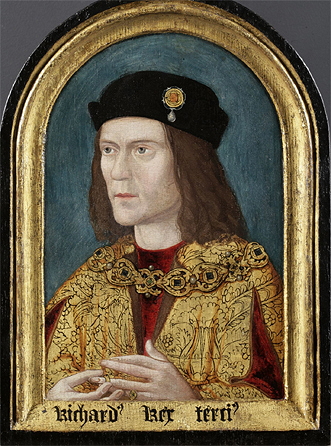
Richard III earliest surviving portrait. [Image courtesy: Wikipedia]
 

In a timely twist of history archeologists digging up a parking lot in Leicester have found the remains of  the Greyfriars Church that might be those of Richard, the last King of England to die on the battlefield. They have found a skeleton in the choir area (Richard was buried in the choir of Friars Minor at Leicester), that had a skull injury caused by a bladed implement, an arrowhead was found between its vertebrae and upper back, and it had spinal abnormalities.

“the individual would have had severe scoliosis – which is a form of spinal curvature. This would have made his right shoulder appear visibly higher than the left shoulder.” [University of Leicester Press Release : The Leicester Greyfriars Dig]

——————————————————————————-

Bonus Material:

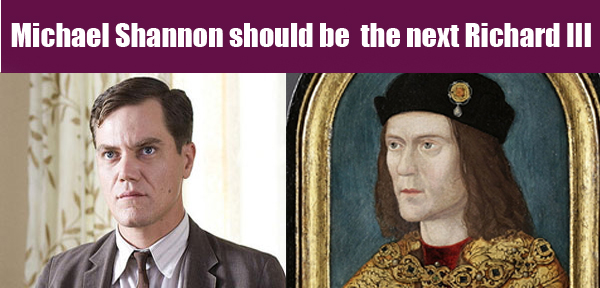
Not sure how many of you watch HBO’s Boardwalk Empire… but I couldn’t stop thinking how much Michael Shannon  (who plays messed up Treasury agent turned iron salesman Nelson Van Alden) looks like our boy Richard.  I think they ought to do a new film version of Richard cubed with Shannon in the lead. He certainly has the intensity to play the role.

Maggie Smith 12.28.12 Thought of the Day

“I like the ephemeral thing about theatre, every performance is like a ghost – it’s there and then it’s gone.”
Maggie Smith
Maggie Smith was author J. K. Rowling's person...

Maggie Smith was author J. K. Rowling’s personal choice for the role of McGonagall in the film series. (Photo credit: Wikipedia)

Margaret Natalie Smith was born on this day in Ilford, London, England in 1934. She is 78 years old.
The daughter of a secretary and a public health pathologist, she has twin older brothers. When Smith was 4 the family moved to Oxford where her father took a position at Oxford University.
Upon graduating from high school,
Smith attended the Oxford Playhouse School in 1951-53. She made her professional stage début in 1952, playing Viola in an Oxford University Dramatics Society production of Shakespeare’s Twelfth Night. [Biography]
She worked on Broadway in a comedy review, New Faces of 1956. 1956 also saw her first film role, an uncredited part in Child in the House.  She did a number of guest spots on television shows  before she landed a larger role in 1959’s Nowhere to Go. (For which she won  the British Academy of Film and Television Arts “Most Promising Newcomer” award.)
Back home she worked with the National Theatre of Great Britain, and had her break out role as Desdemona opposite Laurence Olivier’s Othello in 1964. The duo “reprised their roles in a film version of Othello the following year.” [Ibid] The film earned Smith her first Oscar nomination
While at the National Theatre, she acted in classic dramas by major authors such as Henrik Ibsen and Anton Chekhov. [Ibid]
She played Beatrice to Robert Stephens’ Benedict in the 1967 television version of Much Ado About Nothing.
In June of 1967 Smith and Stephens married (’67 – ’74)  and had two sons, Chris Larken and Toby Stephens. Both of boys grew up to become actors.
The Prime of Miss Jean Brodie, the story of a headstrong Scottish school teacher, won her both an Oscar and a BAFTA award in 1969.  In 1978 she won her second Oscar, this time for Best Supporting Actress in California Suite.
By the mid ’80s  she was winning accolades (and awards) for more mature roles, like her turn as Charlotte Bartlett in A Room with a View, Mrs. Medlock in The Secret Garden, Lady Random inTea With Mussolini, and as the elitist Constance, Countess of Trentham in the wonderful Gosford Park.
In 1975 she married playwright and librettist Beverly Cross, who died 1998.
In 1990 she won a Tony Award for Best Lead Actress in Lettice and Lovage on Broadway.
While she donned a pointy hat and tartan accented witch robes for the role of Professor Minerva McGonagall in the Harry Potter series, she continued to perform in an eclectic mix of movies, television and stage shows in both England and the US.
She won an Emmy for My House in Umbria in 2003,   and two more as the Dowager Countess of Grantham, Cousin Violet Crawley in Downton Abbey.
On the big screen she recently won a Screen Actors Guild Award for her performance in The Best Exotic Marigold Hotel (2012).  You can also see her  Quartet with Michael Gabon and Billy Connolly.

In 1990 Smith was made a Dame commander of the Order of the British Empire.


Thought of the Day 10.22.12 Sarah Bernhardt

Your words are my food, your breath my wine. You are everything to me.
–Sarah Bernhardt

English: Sarah Bernhardt, portrait by Nadar (d...

English: Sarah Bernhardt, portrait by Nadar (d. 1910) Português: Sarah Bernhardt, fotografia de Nadar (d. 1910) (Photo credit: Wikipedia)

Henriette-Rosine Bernard was born on this day in Paris, France in 1844. Today is the 168th anniversary of her birth.

The illegitimate daughter of a Julie Bernardt, a Dutch courtesan working in Paris. She was sent to Grandchamp, a Augustine convent school. She was greatly influenced by her time at the religious school and showed a desire to become a nun herself. Her first role was as the Angel Raphael in Tobais Regains His Sight, a show performed for the Archbishop of Paris when he visited the convent.

When one of her mother’s lovers, the Duke of Monry (Napoleon III’s half-brother) took an interest in young Sarah’s acting abilities, he arranged for her to go to the Paris Conservatoire at age 16 in 1862. She was forced to forget her dreams of becoming a Bride of Christ and took up a life on stage instead.

With the Duke as her patron she moved from the Conservatoire to France’s national theatre company, Comedie-Francaise where she starred in Iphigene. She left Comedie-Francaise after she slapped another actress and had a two year run at Theatre du gymnase-Dramatique.

English: Sarah Bernhardt as Joan of Arc holdin...

English: Sarah Bernhardt as Joan of Arc holding banner (Photo credit: Wikipedia)

At about that time she had an affair with  Charles-Joseph Eugène Henri Georges Lamoral de Ligne (Belgium) and gave birth to her son Maurice in 1864. Although the prince proposed the royal family rejected the idea of his marrying an illegitimate actress. They forbade the union and Bernhardt was left to raise Maurine on her own. [See side bar below]

In 1866 she got a contract with Theatre de L’Odeon. During her six year run at the L’Odeon she had her first big success in the French version of King Lear as Cordelia and as the Queen in Ruy Blas by Victor Hugo. Perhaps her most memorable star making role was Zanetto in Le Passant (The Passerby), a role she played in a command performance for Napoleon III.

In 1870, in the midst of the Franco-German War, Bernhardt organized a military hospital in the Odéon, and by the late 1870s, when the war was over, she resumed acting and had reached the heights of her acting career, propelled in part by her quirky behavior both on and off the stage.” [biography.com]

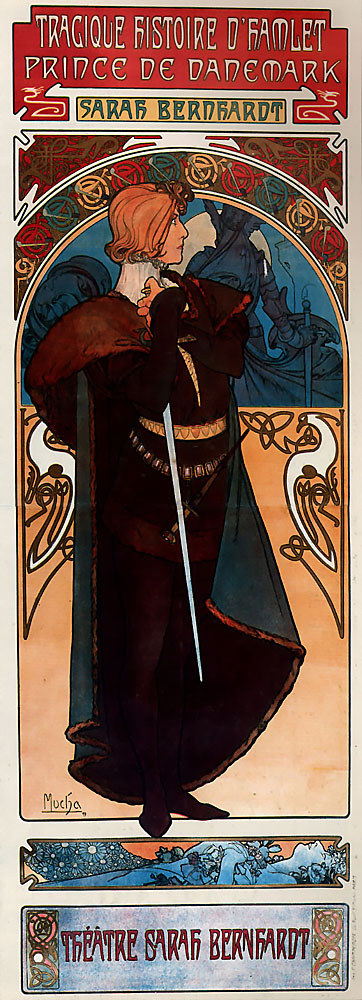
In 1899 she took over the Theatre de Nations and renamed it the Theatre Sarah-Bernhardt. In May she premiered a prose adaptation of Hamlet in which she played the great Dane.

At 61 the actress was in Rio de Janeiro starring in La Tosca.

She… injured herself in a leap off the parapet at the end of … the stage play that later became a Puccini opera, and she was in constant pain.  [Sarah Bernhardt’s leg, 02.02.09 NYTimes.com]

a decade later she take the pain no longer and she ordered doctors at Bordeaux University to amputate it above the knee. She was wheelchair bound for a while, but eventually she retuned to acting (with or with out the wooden leg which she found cumbersome.) Her last three movies were filmed after the leg was amputated.

English: Portrait of Sarah Bernhardt as Hamlet.

English: Portrait of Sarah Bernhardt as Hamlet. (Photo credit: Wikipedia)

With the advent of film Bernhardt became the first classical actress to lend her talents to the new medium. She filmed her version of Hamlet (Le Duel d’Hamlet — which she thought was abysmal); La Tosca; La Dame aux Camelias; Adrienne Lecouvreur; Elisabeth Reine d’Angleterre; Meres Francaise; Jeanne Dore and La Voyante.

She’s alleged to have had over 1,000 lovers. When she was 15 she bought a rosewood coffin. She some times slept in it — allegedly it helped her prepare for her dramatic roles. The coffin was lined with letters from her lovers.

Bernhardt died of kidney failure in 1923.

Side Bar — The Importance of Being Sarah:
[Prince Henri was not completely out of the picture. When Maurice was about to be married Henri offered to “officially recognize him and offered him his name and a substantial fortune.” [IMDB.com] Maruice refused saying his mother had sacrificed so much to raise him that he would remain a Bernhardt. Later when the two were traveling by train Henri was frustrated at having to wait in a long line. He went to the man in charge and demanded to be let in front saying “I am the Prince de Ligne” The man had never heard of him and told him to take his place in the back. So Maurice came forward and said he was the son of Sarah Bernhardt. They were immediately brought through. [ibid]

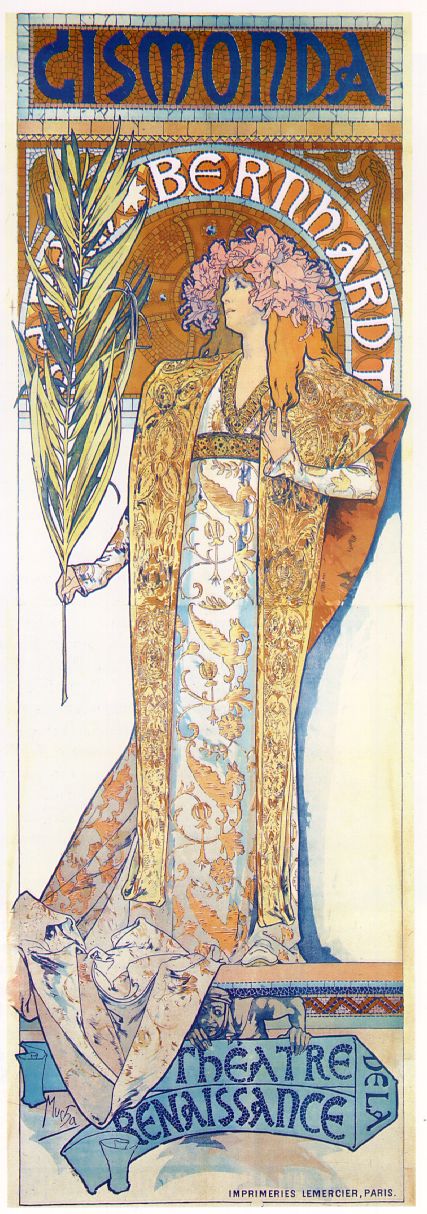
Alphonse Mucha’s poster for Bernhardt in as Gismonda [Image courtesy: Art Dish]
Mucha’s poster for Bernhardt’s Hamlet [Image Courtesy: Art Renewal]

Thought of the Day 10.21.12 Richard the Third

Blog Note: Today is NOT Richard the Third’s Birthday, that’s Oct 3 1452.

——————————————————————————–

Richard III Royal Collection

Richard III Royal Collection (Photo credit: Wikipedia)

Today I’m thinking about Richard the Third of England.

We just saw the terrific Moveable Shakespeare production of Richard III at Chesapeake Shakespeare Company in the ruins of the Patapsco Female Institute in Ellicott City Maryland.

Director Ian Gallanar chose to pick the characters up from the 15th century and time warp them  to something resembling War War One. Clever, especially considering the Patapsco Female Institute was used as a war hospital during the Great War. In his director’s notes he says:

“The production really uses the visual palate and the historic technology of the World War One era as a way to clarify the relationships of the characters….[The audience] might also recognize the futility and wastefulness of a war that, much like the English “Wars of the Roses,” seemed more about resolving who would inherit power rather than who ought to inherit power.” [Chesapeake Shakespeare Company, Richard III: Program Notes]

So on a cold October night we got to see one of Shakespeare’s bloodiest plays in and around the shell of a burned out 19th Century building that some people claim is haunted. The occasional gas-masked actors quietly playing cards in a dimly lit corner or typing away orders on an antique typewriter upped the creep factor. As did the lighting effects, the period music and wonderful costumes.

Vince Eisenson as Richard III. Photo by Teresa Castracane. [Image courtesy: Chesapeake Shakespeare Company]

This version of Richard really worked. I really liked the “Moveable” aspect too. It added to the length of the play (instead of quick scene changes the audience literally did a scene change by moving to a new part of the building or grounds, and that took a while.) My only problem was that there was a scene or two where I couldn’t see the action because I had the bad luck of standing behind some one tall.)  Still, I liked that we kept moving through the building, and “discovering” new rooms. It really put the audience DEAD center into the action of the play (and moving about  kept us warm.)

Richard III runs for one more weekend at Chesapeake Shakespeare. So if you are local to Maryland jump on their website and grab some tickets before they sell out. http://chesapeakeshakespeare.com/

————————————

Scrap for a Shakespeare character card: Richar...

Scrap for a Shakespeare character card: Richard III., c. 1890; Printer: Siegmund Hildesheimer & Co. Victoria and Albert Museum, London, Museum number: S.63-2008, Link (Photo credit: Wikipedia)

Of course they didn’t have instant fact checkers in Shakespeare’s day, and history, as they say is written by the winners. So it comes as no surprise that the Richard the Third we met last night was a real piece of work. Shakespeare was writing for an Elizabethan audience. Elizabeth, a Tudor, was the granddaughter of the man who finally brought about Richard’s undoing on Bosworth Field in Leicestershire, Henry VII. It was in his interest to make Richard as loathsome as possible.

Henry VII’s claim to the thrown was weak at best. So he took…

“every opportunity of enhancing his own reputation at the expense of his predecessor. Richard’s actions and behaviour were the subject of attention and scrutiny and were presented, in the weeks and years after his death, as those of a wicked and unscrupulous tyrant.” [The Richard III Society]

While he was alive Richard was well thought of.

  • He was loyal to his brother Edward.
  • He was effective in his administration of the North.
  • He defended the country against the Scots.
  • He handled the premature death of Edward with out plunging the country into crisis.

Shakespeare wasn’t the first writer to take up the thread of anti- Richard-ism. (Yes, I just made that up.)

By the time the Elizabethan playwright William Shakespeare penned what was to become one of his most popular and frequently performed plays, The Tragedy of King Richard III, the works of the anonymous Croyland Chronicler, John Rous, Bernard André, Polydore Vergil, Sir Thomas More, Edward Hall, Richard Grafton and Raphael Holinshed had been written. [Ibid]

So, as Chesapeake Shakespeare Managing  Director and Richard III Dramaturge says in her note… The Bard’s “fictitious villainous Richard has triumphed over the historic Richard for centuries now.” [CSC Program]

Richard III earliest surviving portrait. [Image courtesy: Wikipedia]

In a timely twist of history archeologists digging up a parking lot in Leicester have found the remains of  the Greyfriars Church that might be those of Richard, the last King of England to die on the battlefield. They have found a skeleton in the choir area (Richard was buried in the choir of Friars Minor at Leicester), that had a skull injury caused by a bladed implement, an arrowhead was found between its vertebrae and upper back, and it had spinal abnormalities.

“the individual would have had severe scoliosis – which is a form of spinal curvature. This would have made his right shoulder appear visibly higher than the left shoulder.” [University of Leicester Press Release : The Leicester Greyfriars Dig]


——————————————————————————-

Bonus Material:

Not sure how many of you watch HBO’s Boardwalk Empire… but I couldn’t stop thinking how much Michael Shannon  (who plays messed up Treasury agent turned iron salesman Nelson Van Alden) looks like our boy Richard.  I think they ought to do a new film version of Richard cubed with Shannon in the lead. He certainly has the intensity to play the role.


Thought of the Day 9.28.12 Gwyneth Paltrow

“Beauty, to me, is about being comfortable in your own skin. That, or a kick-ass red lipstick.”
–Gwyneth Paltrow

03092011-DSC_0697_Gwyneth Paltrow

03092011-DSC_0697_Gwyneth Paltrow (Photo credit: brixton21)

Gwyneth Kate Paltrow was born on this day in Los Angeles, California in 1972. She is 40 years old.

Paltrow has show business in her DNA. Her father, the late Bruce Paltrow, was a film producer and director, and her mother, Blythe Danner, is an Emmy and Tony Award winning actress. Brother, Jake, is following in his father’s footsteps as a director.

Gwyneth grew up in Santa Monica. The family moved to Massachusetts when she was 11 and she split her time there between summer stock at the Williamstown Theatre Festival in the Berkshires and the all girls Spence School in Manhattan during the winter.

“My playground was the theatre. I’d sit and watch my mother pretend for a living. As a young girl, that’s pretty seductive.” [Paltrow]

She flirted with Anthropology at the UC Santa Barbara, but Acting called and she dropped out.

At 19 she made her film debut in the movie Shout in which John Travolta plays a  teacher at a West Texas home for boys who helps the kids learn to love music through the magic of Rock and Roll. She was Young Wendy in Steven Spielberg’s Hook. After a slew of made for television movies she returned to the big screen in 1995 in Se7en opposite then love interest Brad Pitt.

In 1996 she sparkled in the title role of Emma. It’s always a good career move to play a Jane Austen heroine in my opinion, and  Paltrow did a delightful job with the role of Emma Woodhouse. [Emma is my first pick of Paltrow movies that  you should put on your Netflix queue — if you don’t already own it.]

Paltrow as Emma [Image courtesy: Austenitis]

Now a Hollywood a-lister, Paltrow had an impressive run of  films in 1998; a modern version of Great Expectations with Ethan Hawke, Sliding Doors, A Perfect Murder (a remake of Dial M for Murder), Hush, and the magnificent Shakespeare in Love.

Paltrow plays Viola de Lesseps opposite Joseph Finnes’ Shakespeare in a story of mistaken identity, love, comedy and drama worthy the bard. With Geoffrey Rush, Judi Dench and Collin Firth in supporting roles, Shakespeare in Love is fantastic. Paltrow and Dench won Oscars and the movie took home Best Picture.  [Shakespeare in Love is my second Paltrow pick for your Netflix queue.]

She was in Anthony Minghella’s The Talented Mr. Ripley opposite Matt Damon and Jude Law in 1999.

In 2000 she showed the world that she could sing in Duets with Huey Lewis. Then played opposite her long time friend Ben Affleck in Bounce.

She had roles in the ensemble movies Anniversary Party & The Royal Tenenbaums in 2001. And co-starred with Jack Black in the comedy Shallow Hal.

Paltrow and Arron Eckhart played the sexiest literary researchers EVER in an adaptation of A.S. Byatt’s Possession. The pair uncover letters linking two Victorian writers (played by Jeremy Northam and Jennifer Ehle.)

Paltrow and Eckhart in Possession [Image courtesy:buzzsugar.com]

Paltrow rather famously said:

“I don’t really understand the concept of having a career, or what agents mean when they say they’re building one for you. I just do things I think will be interesting and that have integrity.”

which explains the swings from serious/dramatic roles to the campy fun fest that dot her filmography. She took on poet Sylvia Path in Sylvia  (Blythe Danner played her mother) then the next year she played reporter Polly Perkins in the highly stylized retro/sci fi Sky Captain and the World of Tommorow. Then it was back to serious Gwyneth for Proof.

She had small roles in Infamous, Love and Other Disasters, and Running With Scissors and a supporting role in The Good Night before landing the role of Pepper Potts in the big budget film Iron Man opposite Robert Downey, Jr.. She reprised the role in Iron Man 2 and in the Avengers. (And because you can never flog a dead horse too much… you can look for Pepper Potts AGAIN inIron Man 3 in 2013)

She brought out the pipes again for Country Strong where she played struggling country singer Kelly Canter. Here’s “Shake That Thing” from the movie:

Paltrow has had three guest spots on the popular television show Glee as substitute teacher Holly Holliday.

She had a small but pivital role in Contagion. The film also stars  her Talented Mr. Ripley co stars Matt Damon and Jude Law, and her Possession co-star Jennifer Ehle. [Contagion is another movie you should put in your queue.]

This  year you can see her in the romanic comedy Thanks for Sharing with Mark Ruffalo and Tim Robbins.


Thought of the Day 9.19.12 Jeremy Irons

“It’s always great to play a man who sets himself up to be punctured.”

–Jeremy Irons

Jeremy John Irons was born on this day in Cowes on the Isle of Wight, England in 1948. He is 64 years old.

He grew up on the island, and didn’t have much connection with the professional performing arts. The family only ventured to the mainland once a year. But when he was an adolescent the family moved to Hertfordshire and, at 13, Jeremy was sent to the Sherborne School in Dorset. There he took part in a four-man school band called the Four Pillars of Wisdom. The group played for their mates on Sunday afternoons, with Jeremy on drums and harmonica (including stand out harmonica solos in “Moon River” and “Stairway to Heaven.” — because when you think of Stairway to Heaven you think ‘harmonica solo!’) He also performed comedy skits and was in the school’s production of My Fair Lady (he played Professor Higgins.)

Irons trained at the Bristol Old Vic Theatre School. There he “gained much experience working in everything from Shakespeare to contemporary dramas.” [IMDB biography] He supported himself with a number of odd jobs and by busking on the streets of Bristol.

In 1971 he moved to London and landed the role dual role of John the Baptist/Judas in Godspell at the Round House.

He did a lot of television work in the 1970’s including: The Pallisers;  Love of Lydia; Churchill’s People; Langrishe, Go Down; The Voysey Inheritance; and as Franz Liszt in Notorious Woman,

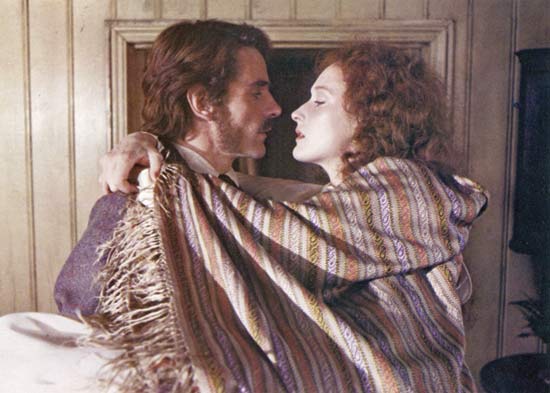
His film debut was in the 1980 film Nijinsky, but his break out role was opposite Meryl Streep in the French Lieutenant’s Woman. The film, based on the John Fowles novel, follows two parallel love stories — one between Victorian palaeontologist Charles and “the French Lieutenant’s Whore” Sarah; the other between Mike and Anna, the actors who play the Victorian couple in a movie they are making on the novel. Irons was nominated for a BAFTA Award for best Actor (Streep won one for Best Actress.)

Still from The French Lieutenant’s Woman [Image Courtesy: Encyclopedia Britannica]

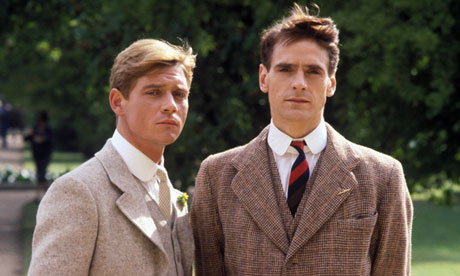
Back on television he played another Charles, Charles Ryder, opposite Anthony Andrew’s Sebastian Flyte in the hugely successful Brideshead Revisited  based on the Evelyn Waugh novel.  Irons got another BAFTA Nomination (Andrews won), both men were nominated for Emmy Awards.

Anthony Andrews and Jeremy Irons in Brideshead Revisited (Image Courtesy The Guardian.)

He followed those two high profile projects with an independent film about Polish guest workers in London, Moonlighting.

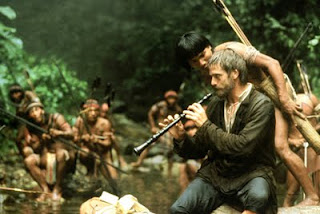
Irons played Father Gabriel in Roland Joffe’s The Mission. Father Gabriel is a Spanish Missionary who is sent into the jungles of South America. He builds a sanctuary for the Guarani Indians. Robert DeNiro, a reformed slave hunter joins him at the mission. Together they must defend both the mission and the people who live there from the encroaching Portuguese It is all set to Ennio Morricone’s beautiful music.

Father Gabriel’s (Irons) first encounter with the Guarani Indians. [Image courtesy: Mostly Movies]

David Cronenberg’s psychological thriller Dead Ringers saw Iron’s playing identical twin gynecologist. The movie brought the word “co-dependant” to a whole new level. Iron’s is cool (maybe even icy) and creepy in the movie. (It is a total departure from his Father Gabriel. So if you are planning a Jeremy fest, don’t book these two back to back.)

Reversal of Fortune finally brought Irons the Gold. He won both an Academy Award  and a Golden Globe Award for his portrayal of Claus von Bulow.

Irons took on the role of Rene Gallimard when Cronenberg brought M. Butterfly from stage to screen.

You might recognize his growling voice from Disney’s the Lion King. He played Simba’s uncle Scar.

When Bruce Willis brought his Die Hard franchise to New York for Die Hard with a Vengeance, Irons played his foil, psychopath Simon Gruber.

He pulled on some tights when he took on Aramis in The Man in the Iron Mask; Antonio, to Al Pacino’s Shylock, in Michael Radford’s 2004 movie of Shakepeare’s The Merchant of Venice;  suited up as Tiberias, a Knight Templar, in Kingdom of Heaven; and starred in the tv mini-series Elizabeth I, the Virgin Queen, as the Earl of Leicester/Lord Dudley, opposite Helen Mirren’s Bess.

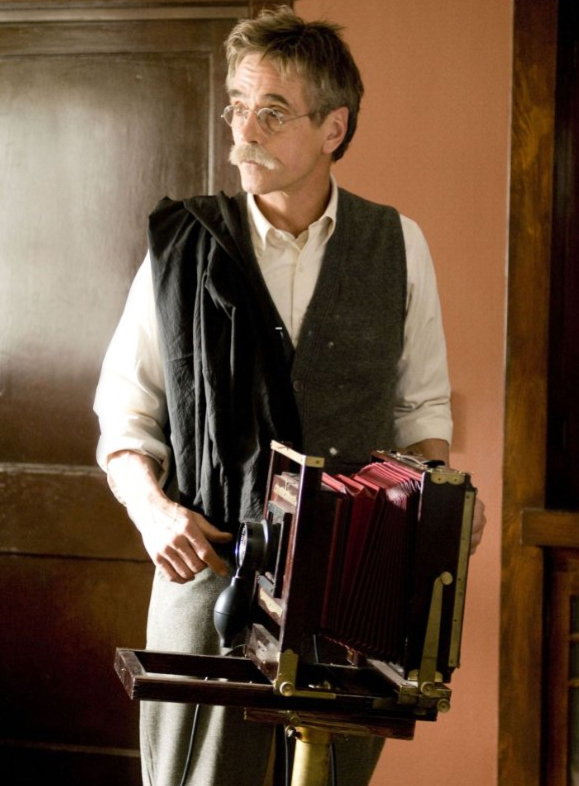
He played photographer Alfred Stieglitz in the made for TV biopic Georgia O’Keefe in 2009.

Still from Georgia O’Keefe. (Image Courtesy: IMDB)

Heck, he’s even voiced the part of Moe’s Bar Rag in the Simpsons!

Irons currently can be seen in Showtime’s sweeping TV mini series The Borgias, a crime drama set in 1492 Italy.

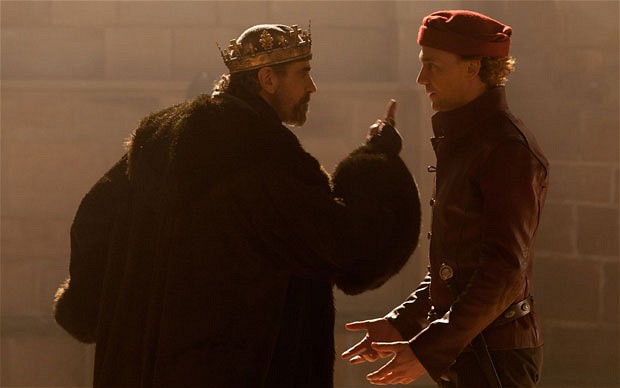
And he plays Henry IV in Shakespeare’s Henry IV, Part 1 & 2  in the BBC’s the Hallow Crown series.

Still from Henry IV, Part 1 with Irons and Tom Hiddleston as Prince Hal (Image Courtesy: The Telegraph)

Here’s Ennio Morricone’s BAFTA Award winning song Gabriel’s Oboe from the film The Mission. [The soundtrack holds a very special place in my heart because we used parts of it, including Gabriel’s Oboe at our wedding. I wrote the publisher to see if I could get the sheet music, but it wasn’t published yet. They contacted Mr. Morricone and they supplied us with a copy of the hand written piano score. How’s that for romantic? This was played on a pipe organ as I walked up the aisle with my dad. ]


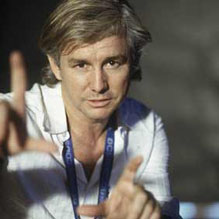
Thought of the Day 9.17.12 Baz Luhrmann

n”I only achieve about 60 per cent of what I’ve dreamed of. Perhaps that’s a good thing – if I did ever get the whole way with anything, I think I’d probably want to destroy it.”

 Baz Luhrmann

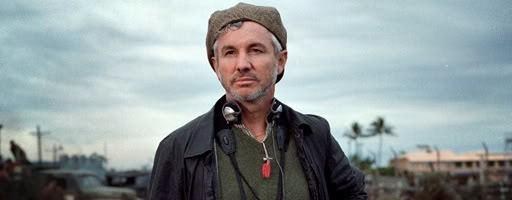
On the set of Australia [Image Courtesy: The Play List]

Mark Anthony Luhrmann was born on this day in Sydney, Australia in 1962. He is 50 years old.

His mother, Barbara, owned a dress shop. His father, Leonard, was a farmer and owned a gas station and movie theater in the small town of Herons Creek near where they lived. Barbara and Leonard competed in ballroom dance competitions and Barbara taught ballroom dance at a local studio.

“What kind of kid was I? …Extremely busy. My father was a bit mad, you see. He thought that we had to be the renaissance kids of Herons Creek. We had to learn commando training as well as photography, how to grow corn as well as how to play a musical instrument. We were up at 5 in the morning, and then we just went until we dropped. The town consisted of a gas station, a pig farm, a dress shop and a movie theatre – and we ran them all.” [Baz Luhrmann, as quoted on Baz the Great! fansite]

Growing up the Luhrmann kids helped run the various family businesses. In their free time they rode horses, learned to ballroom dance (of course), and made amateur movies. As a gas jockey at the service station Mark saw a stream of people  pass through. He was invisible to them, and  so was able to observe  their stories unfiltered and unedited for the 5 minutes it took to fill up their tank.  Later, after his parents divorced he eventually found himself in Sydney. Prior to the move he (and his brothers) had to keep their hair closely cropped in a buzz cut, but once in Sydney he was allowed grow it out. When he was teased that his new hair do made him look like a puppet fox on TV, Basil Bush, he embraced the  taunting and officially changed his first name to Bazmark.  In high school he acted in Henry IV, Part 1.  And at 17 he got a role in the Judy Davis, Bryan Brown film The Winter of Our Dreams.

He worked with the Australian Opera to bring in a younger audience and directed and performed in a number of stage productions for the company.

In 1987, while working on an experimental opera, Lake Lost, He met Catherine Martin, a production designer. She became his exclusive production designer and his wife.  (They now have two children.)

Luhrmann mounted productions of La Boheme, A Midsummer’s Night’s Dream and other classics in modern or unusual settings.

[Image Courtesy: NNDB]

His break out film was Strictly Ballroom. The project began as a 30-minute play, but Luhrmann developed it into a full blown motion picture in 1992. The story centers around handsome, spoiled, Scott. He’s a leading ballroom dancer who’s set to win the Pan-Pacific Ballroom Championships. But Scott wants to break the rules and dance his own steps. Enter Fran, a shy, ugly duckling of a girl from the beginner class at his mother’s studio. He teaches her how to dance and along the way she teaches him a thing or two as well. It’s quirky, funny, over the top, and wonderful. Here’s a scene about mid-way through the movie:

It is the first of his Red Curtain Trilogy.  Romeo + Juliet and Moulin Rouge! round out the trio. Luhrmann describes a Red Curtain film as having the following attributes:

  1. the audience knows how it will end right from the start;
  2. the storyline is thin and simple;
  3. the world created in the film is one of heightened reality; and
  4. there is to be a specific device driving the story. For Strictly Ballroom it was dance, for Romeo + Juliet it was iambic pentameter, and for Moulin Rouge! it was characters breaking into song.

The success of Strictly Ballroom  brought Luhrmann to the attention of 20th Century Fox  who signed him to a 3-year deal. For second movie Luhrmann gave Romeo + Juliet a modern jump. It starred Leonardo DiCaprio and Claire Danes and is both fast paced and action packed.  In both style and weirdness factors there is a 15% increase from Ballroom, but still, it works.

The third movie of the set was Moulin Rouge!, a highly stylized musical love story starring Nicole Kidman and Ewan McGregor.

“. . . if you make a film full of risk, studios don’t run towards you to give you $50,000,000 in order to reinvent the post-modern musical, I can tell you. If you do manage to cajole them into doing it and you want to maintain the flag of creative freedom, you better make sure that it pays its bill.”[Baz Luhrmann, IMDB]

It was somehow even bigger and stranger than J + R and Ballroom put together. With an odd combination of modern songs (with modified lyrics) that should not have fit in the 1900 Paris setting, this musical had no business becoming a hit. But it did. Frankly, once Ewan McGregor opened his mouth to sing… nothing else seemed to matter.  (As is evidenced by the bizarre beginning of this clip… Here McGregor’s Christian has snuck into courtesan Satine’s room. He is a penniless writer and he tries to win her over with the strength of his prose [well, in this case it’s Elton John’s lyrics] Kidman feign’s over excitement, hoping to get the shy wordsmith to leave, but then he starts to sing and the movie, and their attraction,  takes off.)

For his next project he brought  La Boheme to Broadway.  The show opened on December 8, 2002 and was declared a “brilliant reworking of Puccini’s masterpiece that appealed to all. [Baz the Great! fansite]

In 2008 he teamed with Kidman again, this time pairing her with Hugh Jackman, in the epic WWII Aussie drama, Australia. It’s beautifully shot. From a cattle drive worthy any Western… to the Japanese attack on Darwin… to the love story, Australia has a lot going for it. (But be warned it is a bit preachy too.)

<iframe width=”420″ height=”315″ src=”http://www.youtube.com/embed/p447zpUmbxw&#8221; frameborder=”0″ allowfullscreen>

His eclectic mix of images and music can make even the every day seem extrordinary…


Luhrmann’s latest project is Gatsby. This time he re-teams with DiCaprio. This stylish take on the Fitzgerald’s classic, The Great Gatsby is due out on Christmas Day. [Don’t buy your tickets just yet… seems like the release date has been pushed back to Summer 2013 — thanks to John for the heads up. ]


Thought of the Day 9.16.12 Henry V

“Once more unto the breach, dear friends, once more;
Or close the wall with our English dead.”
― William ShakespeareHenry V

Henry the Fifth of England was born in the tower above Monmouth Castle in Wales on this day in 1386. Today is the 626th anniversary of his birth.

Illustration of Henry V from Cassell’s History of England [Image Courtesy: Wiki Commons]

Henry’s birthday was not officially recorded but it is believed to be either September 16 or August 9, and in either 1386 or 1387. He was born into one of the most important families in England. As such, he had the best education and upbringing available at the time. He learned to ride, fight and hunt. In the class room he learned history, literature, and music (he could play the harp) and he could speak English, French and Latin fluently. Because he was born in Monmouth Castle he was referred to as Henry Monmouth during his early life.

His grandfather, John of Gaunt was the son of Edward III, his parents were Henry Bolingbroke, the Earl of Derby and Mary Bonhun. At the time of Monmouth’s birth Richard II sat on the English throne. John of Gaunt, the King’s uncle, was an ardent support, Bolingbroke had a less steadfast relationship with the King. Although the two had been childhood friends Bolingbroke took part in the Lords Appellant’s rebellion against Richard in 1387. Richard forgave him and even promoted him to Duke of Hereford. But in 1397…

“Henry Bolingbroke reported treasonous comments made by the Duke of Norfolk; a court was convened but, as it was one Duke’s word against another, trial by battle was arranged. It never took place. Instead, Richard II intervened in 1398 by exiling Bolingbroke for ten years…
[Henry V, of England by Robert Wilde, About.com Guide]

At that time Richard “invited” 12-year-old Henry Monmouth to be his “guest” at court. Essentially Monmouth was a hostage. If  the father returned to England to cause any trouble, the son would be forfeit. Things were not so grim in the Royal castle, however, Richard treated Monmouth kindly. The two became friends. The King even knighted Monmouth.

But in 1399 Monmouth’s grandfather, John of Gaunt died. Instead of Bolingbroke automatically inheriting his father’s lands Richard II “kept them for himself and extended Bolingbroke’s exile to life. ”

In 1399, whilst Richard was in Ireland, Henry of Bolingbroke returned to claim his father’s inheritance. … Henry captured and deposed Richard. Bolingbroke was crowned King as Henry IV. [The Official website of The British Monarchy]

Richard was thrown in jail, and, on October 13th 1399 Henry Bolingbroke became Henry the Fourth of England, his son, was named

“heir to the throne, Prince of Wales, Duke of Cornwall and Earl of Chester. Two months later he was given the further titles Duke of Lancaster and Duke of Aquitaine.” [Henry V, of England by Robert Wilde, About.com Guide]

Detail of miniature of Henry, Prince of Wales, receiving a book from Thomas Hoccleve. [Image Courtesy: Wiki Commons]

So… Henry  Monmouth becomes Prince Hal. He was at his father’s side in battle at the Battle of Shrewsbury. He also fought bravely (and effectively) in Wales, Scotland and France. As his father’s health began to fail the Prince took on more and more responsiblity at court. He became a  major political player. Shakespeare’s portrayal of him laughing it up with Falstaff was more dramatic fiction than historic truth.

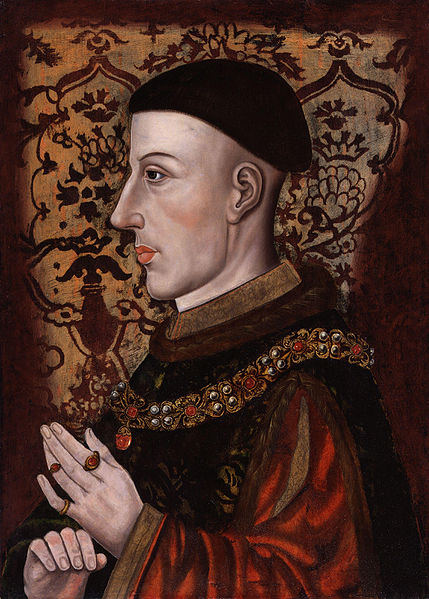
Henry as King. [Image Courtesy: Wiki Commons]

He ascended to the throne upon his father’s death on March 21st, 1413 and was crowned Henry V on April 9th. He transferred the remains of Richard II — who died of starvation in Pontefract Castle tower  to Winchester Cathedral and gave him an honorable burial. He prepared the nation for a war with France. He straighten out the royal finances by editing royal budgets. He decreed that all government documents be written in English. He  tackled the lawless no-man’s-lands and reduced the number of roving bandits (mostly by funneling them into the army.) He crushed the religiously “deviant” Lollards. And he united the people — noble and common alike — behind him.

Kenneth Branagh as Henry V [Image Courtesy: Renaissance Films PLC 1989]

“And Crispin Crispian shall ne’er go by,
From this day to the ending of the world,
But we in it shall be remembered-
We few, we happy few, we band of brothers;
For he to-day that sheds his blood with me
Shall be my brother”
― William ShakespeareHenry V

“In August 1415, after dealing with a conspiracy to remove him from the throne, he led an army of 20,000 foot soldiers and 9,000 horsemen to attack Harfleur and, after sending a large part of his army home due to illness, marched to Calais to secure a base for further operations. On the way, unable to avoid a vastly superior French army, he gave battle at Agincourt on Oct. 25, 1415, gaining a great victory and capturing the constable of France and the Duke of Orléans.” [Henry V Biography, Your Dictionary.com]

In May 1420 the Treaty of Troyes was signed. Under the treaty  Charles VI remained King of France, Henry married his daughter Katherine, was named heir, and ruled the country in all but name.
Alas, Henry took ill in 1422 while laying siege to one of the last French hold outs.  He lingered for three weeks before dying at Vincennes on August 31st.  He was 35 years old.
“I see you stand like greyhounds in the slips,
Straining upon the start. The game’s afoot;
Follow your spirit: and upon this charge,
Cry — God for Harry! England and Saint George!”
― William ShakespeareHenry V

Romeo and Juliet and Benvolio and Mercutio


Apologies, gentle reader, for it taking so long to post a review of something I saw on Sunday! (I’ve been busy doing actual freelance graphic design and writing work, so I’m sure you’ll understand.)

If you haven’t already seen Romeo and Juliet at the Chesapeake Shakespeare Company this Summer you’d better hurry. This nice little production of  the classic Shakespeare tale is something you don’t want to miss. Remaining performances are on Friday, July 27th at 8:00 and Sunday, July 29 at 6:00 at the Patapsco Female Institute in Ellicott City Maryland. The CSC is running R&J in rep with Pride and Prejudice (another excellent production) which concludes its run tonight, Thursday and Saturday. Here’s my review of R&J:

Benvolio as interpreted by artist Hannah Tompkins

I particularly liked the first half.  They had a LOT of fun here and it was nice to see actors who were so hemmed in and corseted by their roles in Pride and Prejudice let loose on the stage and really enjoy themselves. Julian Elijah Martinez (Romeo / Wickham) and Rachael Jacobs (Juliet / Lydia) played much more likable characters here, and it was lovely to see the nuances in the shift of the lovers characters. Jacobs’ bubbly Juliet is all innocence while her Lydia was appropriately bratty. But the actors who played Benvolio / Darcy, Adam Sheaffer, and Mercurio / Lizzy, Blythe Coon, were even more fun to watch. He was SO RESERVED and stately in P&P and is so fun loving in R&J (and then so angst ridden when needed) he stole the show for me. (… Yeah, maybe because I am predisposed to like him because he was also Darcy, I admit it.) And she took all the energy and vitality she had as Elizabeth Bennett and just cut loose  with bawdy humor and physicality for Mercurio. They both were damn fine swordsmen too. I was really impressed.
The staging was really nice too, they did a lot out and about the audience, really addressing the crowd — sometimes eating the food from the picnic tables in the back, or performing small scenes in the pockets of the audience. There was this beautiful moment  when Jamie Jager, (Paris/ Bingley) goes semi “Off stage” as Paris to watch (in character) as Romeo enters the vault. As an audience member we have all been following Paris– he’s just given a heart breaking speech (love him too, btw) and we — especially those of us who can hear him breathing — can’t take our eyes off him. But Jamie — knowing that our attention needs to be with Romeo, who is entering stage left — put his fingers to his eyes and gestured for us to look across the stage. Everyone’s head turned to where it needed to be. It could have been 1595 and we could have been the groundlings. He had just gotten us to happily suspend our disbelief and manipulated us to continue with the story. I loved it.
So kudos to director Jenny Leopold for getting the most out of her fine actors and the minimal set.
The second half of the play (YES, I know there are really 5 acts) is much, much more serious. The body count went up, poison came out. And  they had to get down to business. You know how it ends. I knew how it ends. Actually KNOWING how it ends was kind of  a bummer. Like a lot of Shakespeare (and Austen) there’s a double edged sword in coming to a performance knowing the material ahead of time. You have the inside joke of knowing the inside jokes, but you don’t have the zing of surprise or the intake of breath when some one is unexpectedly run through with a rapier. I, personally, did not weep openly at the end of R& J, but I did hear sniffling around me.
Jaded? Perhaps. But mostly I was thinking that the second half didn’t have enough BENVOLIO!