Category Archives: postaday

Daffy Duck 4.17.13 Thought of the Day b

“Relax sister. I don’t know the meaning of the word fear!” — Daffy Duck

Daffy Duck, as he appears in The Looney Tunes ...

Daffy Duck, as he appears in The Looney Tunes Show. (Photo credit: Wikipedia)

Daffy Dumas Horacio Tiberius Armando Sheldon Duck was “born” on this day in Warner Brothers Studio, Burbank, California, USA in 1937. He is 76 years old.

He was first brought to life by animator Bob Clampett and voiced by Mel Blanc in director Tex Avery‘s Porky’s Duck Hunt.  Warner Brothers was looking to carve a niche out the cartoon market (and take market share away from Disney). They had had some success with Porky Pig, but  Tex Avery “wanted a character so incongruous, so nuts, so out-of place that it would put Walt Disney’s cute “Silly Symphonies” to shame.” [The Complete History of Daffy Duck]  With Daffy he had just the duck for the mission.

Daffy Duck as he first appeared in Porky's Duc...

Daffy Duck as he first appeared in Porky’s Duck Hunt (1937). (Photo credit: Wikipedia)

Daffy’s personality changed as the years went on. He became a slightly different duck for each of his directors. For Tex Avery he was wacky. He put the Loon in Looney Tunes. He literally bounced all over the place like a lunatic shouting “Woo-hoo! Woo-hoo!”

By 1940 he’d grown more focused and ambitious. He wanted to be a movie star.

He was still crazy, but he had purpose and had control over the scenes he was in. During World War II Daffy reflected the times, first he was a draft dodging duck, then he collects scrap metal for a scrap drive (Scrap Happy Daffy). He even confronts Adolf Hitler in Daffy the Commando.

Director Robert McKimson made Daffy dapper, instilling the cartoon fowl with a bit of brains to go with his bonkers.

When Chuck Jones took the helm Daffy changed again.  Where Daffy had been “a hyperactive, carefree, if not patriotic, duck ” [The Complete History of Daffy Duck] Jones gave us “a more power-hungry and greed-driven loser. … Jones made him taller, skinnier, beakier and scruffier-looking…While he had been a winner before, and happier, Jones made him him a loser who was never satisfied. [Ibid] Jones also did a run of movie spoofs starring Daffy and Porky that were enormously popular.

By the 1950s Daffy was struggling to reclaim the spotlight from Bugs Bunny, who had become the leading Warner Brothers character. Led by Chuck Jones, the directors of this era brought out a darker side of Daffy’s personality, showing him as desperately self-glorifying and consumed by jealousy—though also more introspective. [Encyclopedia Britannica.com]

By the mid 1960s movie studios had soured on making cartoon shorts. Television, not movies theaters were the entertainment venues of choice, and the theaters couldn’t afford cartoon shorts. “the post-1964… Warner Bros…. cartoons,  are quite cheaply produced compared to the cartoons of the 40’s and 50’s.” [The Complete History of Daffy Duck]

So Daffy, along with Bugs and Porky were relegated to Television. Mostly the Warner Bros. favorites appeared as reruns on Saturday mornings, but occasionally they were given fresh material for TV specials  like Daffy’s “Duck Dodgers In the 24 1/2 Century.”  He found a home on the Cartoon Network’s The Looney Tunes Show (now voiced by Jeff Bergman and Bill Farmer)

Most recently DD’s most recent appearances have been in Robot Chicken: Immortal  and Spread Those Wings and Fly  (both came out in February of this year)

Daffy Duck

Daffy Duck (Photo credit: Wikipedia)


This one goes out to my friend Angie and my sister Joan.


Charlie Chaplin 4.16.13 Thought of the Day Part two

[Continued from Charlie Chaplin 4.16.13 Thought of the Day: Part One]


The Gold Rush (1925)

The Gold Rush (1925) (Photo credit: quicheisinsane)

Having fulfilled his contract with National, Chaplin  was free to work on independent projects for United Artists, a group he formed with  Douglas Fairbanks, Mary Pickford, and D. W. Griffith in 1919. With the Gold Rush in 1925 he made the movie he wanted to be remembered by.


Through his work, Chaplin came to be known as a grueling perfectionist. His love for experimentation often meant countless retakes and it was not uncommon for him to order the rebuilding of an entire set. It also wasn’t rare for him to begin with one leading actor, realize he’d made a mistake in his casting, and start again with someone new…But the results were hard to refute. [Biography]


The Tramp working on the giant machine in the ...

The Tramp working on the giant machine in the film’s most famous scene (Photo credit: Wikipedia) Modern times

His later films include City Lights, 1931, Modern Times, 1936 and The Great Dictator, 1940. He made a half dozen more films (most noteably Lime Light co starring Buster Keaton) but they paled  in comparison to his earlier work. No one, it seemed, was interested in Chaplin sans bowler hat and mustache.


Charlie Chaplin from the film The Great Dictat...

Charlie Chaplin from the film The Great Dictator (with “double cross” emblem in background and on cap). (Photo credit: Wikipedia)

Chaplin’s personal life was always in the spot light. He was married 4 times to women decades his junior. He had numerous affairs with his leading ladies. He didn’t join the British Army in WWI (which caused a lot of controversy back home in England. –Chaplin had registered for the draft, but had not been called up. He also worked for the War effort raising money through Liberty Bonds and producing propaganda films — but it wasn’t enough to satiate the flag waving mania sweeping his home country.) He was never afraid to voice his political views and after The Great Dictator (with it’s brilliant, but preachy six-minute closing speech) he was branded a radical. In the 1950’s he was a target of the House Un-American Activities Committee who “saw him as a nonconformist and therefore a communist.” [About.com] When he tried to return to the States after a trip  abroad he was denied entry. (He went to live in Switzerland.)


Charlie Chaplin, Vevey, Switzerland - Project ...

Charlie Chaplin, Vevey, Switzerland – Project 1/365 (Photo credit: Airflore)

He stayed away… until 1972 when he was awarded an Honorary Academy Award. He was given a 12 minuted standing ovation at the ceremony.


Chaplin also composed music. He wrote the songs “Smile” and “This is My Song” along with 500 other melodies.


After finishing his last film A Countess from Hong Kong … he composed the music to many of his silent movies, among them The Circus,… The Kidand A Woman of Paris: A Drama of Fate [IMDb]

Charlie Chaplin died of a stroke on Christmas morning 1977.


Awards:


  • 1929 WON Special Academy Award “for versatility and genius in acting, writing, directing and producing The Circus
  • 1941 Nominated for Best Actor Oscar  for his dual role in The Great Dictator.
  • 1941 Nominated for Best Writing Oscar for The Great Dictator..
  • 1948 Nominated for Best Screenplay Oscar for Monsieur Verdoux.
  • 1972 WON Special Honorary Academy Award for “the incalculable effect he  has had in making motion pictures the art form of this century”.
  • 1973 WON The Academy Award for Best Original Score for Limelight. (The film had not been released in the US until 1972).

CLICK HERE for Charlie Chaplin Part One


Charlie Chaplin 4.16.13 Thought of the Day: Part ONE

“I remain just one thing, and one thing only, and that is a clown. It places me on a far higher plane than any politician.” — Charlie Chaplin

Charlie Chaplin The Tramp debuted in 1914 -- p...

Charlie Chaplin The Tramp debuted in 1914 — pre-1923 (Photo credit: Wikipedia)

Charles Spencer Chaplin was born on this day in 1889 in London, England. Today is the 124th anniversary of his birth.

He was practically born to the stage. Both his parents were musical hall entertainers. His father, Charles Chaplin, Sr.  was a singer and actor, his mother, Hannah Chaplin — her stage name was Lily Harley — sang light opera. The marriage didn’t last long, and Chaplin, Sr. abandoned the family when Charlie was an infant. He had two half brothers. Sydney Hill Chaplin was four years older than Charlie and was born to Hannah a year before she married Chaplin, Sr. (who was not his father.) Hannah had another baby, George Wheeler Dryden in 1892, by entertainer Leo Dryden. Sydney and Charlie hardly knew this brother, however, because Leo took the boy away when he was 6 months old. George didn’t resurface until his mid thirties.

Hannah continued her stage career for a few years, but…

in a performance that would introduce her youngest boy to the world of performance, Hannah inexplicably lost her voice in the middle of a show, prompting the stage manager to push the five-year-old Chaplin, whom he’d heard sing, onto the stage to replace her…[Biography]

The audience loved little Charlie, but it was a disaster for Hannah…

Her singing voice never returned and she eventually ran out of money. For a time, Charlie and Sydney had to make a new, temporary home for themselves in London’s tough workhouses. [Ibid]

Hannah was in and out of mental institutions until 1905 when she was committed permanently. With the exception of one disastrous stint with their alcoholic father, the boys were left to fend for themselves,  and, eventually, thrown into the workhouse. Sydney was trained as a seaman, but both boys wanted to act. Charlie charmed his way into a clog dancing group called the Eight Lancashire Lads in 1897.

It was a short stint, and not a terribly profitable one, forcing the go-getter Chaplin to make ends meet anyway he could…”I (was) newsvendor, printer, toymaker, doctor’s boy, etc., but during these occupational digressions, I never lost sight of my ultimate aim to become an actor,” Chaplin later recounted. “So, between jobs I would polish my shoes, brush my clothes, put on a clean collar and make periodic calls at a theatrical agency.” [Ibid]

His first play was  Jim, a Romance of Cockayne by H.A. Saintsbury in 1903.  Although the show closed after two weeks Chaplin’s comedic performance  as the newsboy received good reviews. Real stage experience came later that year with a 2.5 year run with  Sherlock Holmes in which Chaplin played the Page-boy.

He toured with a vaudeville outfit named Casey’s Court Circus and in 1908 teamed up with the Fred Karno pantomime troupe, where Chaplin became one of its stars as The Drunk in the comedic sketch, A Night in an English Music Hall. [Ibid]

Español: Esta es una fotografia del Sr. Charle...

Español: Esta es una fotografia del Sr. Charles Spencer Chaplin tomada en Estados Unidos, durante su juventud, en un momento en el que, como se aprecia, se encontraba al natural, tal como era, sin los clasicos caracteres que usaba para protagonizar a su recordado personaje de cine mudo Charlot. Français : Charles Chaplin, acteur américain, célèbre pour son personnage Charlot. (Photo credit: Wikipedia)

He twice came to America on tour with the Karno troupe and film producer Mack Sennett promptly signed Chaplin to a contract for a $150 a week with Keystone Pictures. Chaplin didn’t like his first film, Making a Living, and it wasn’t a hit, but he was singled out for his comic timing and presence.

He wanted to create a persona that made him stand out from the crowd of comedic actors at Keystone, so he borrowed Fatty Arbuckle’s pants, Ford Sterling’s size 14 shoes and Arbuckle’s father-in-law’s bowler to invent the Little Tramp. The Tramp made his debut in  Kid Auto Races at Venice.

Chaplin with Edna Purviance in The Immigrant (...

Chaplin with Edna Purviance in The Immigrant (1917) (Photo credit: Wikipedia)

Charlie yearned for more creative input in his film and finally got a chance to direct in 1914. With the caveat that Chaplin would return $1,500 to producer Sennett should the film fail, he helmed Caught in the Rain . (He did not have to return the money. )

When Keystone wouldn’t give him a raise (he wanted $1,000 a week)  he went to Essanay Film Manufacturing Company  (they gave him $1,250 a week.) He made 14 films with Essanay.

By the age of 26, Chaplin, just three years removed from his vaudeville days was a movie superstar. He’d moved over to the Mutual Company, which paid him a whopping $670,000 a year. The money made Chaplin a wealthy man, but it didn’t seem to derail his artistic drive. With Mutual, he made some of his best work, including One A.M. (1916), The Rink (1916), The Vagabond(1916), and Easy Street (1917). [Biography]

He got a million dollar deal with First National Exhibitors’ Circuit to make 8 films. (His brother Sydney was his financial manager by then, and he was instrumental in making the deal.) Two of the eight movies broke the old show business rule about not working with children and animals, and those films — The Kid and A Dog’s Life were two of Chaplin’s best.

Charlie Chaplin and Jackie Coogan in The Kid

Charlie Chaplin and Jackie Coogan in The Kid (Photo credit: Wikipedia)

Click HERE for Charlie Chaplin 4.16.13 Thought of the Day: Part TWO


Claire Danes

“It’s very difficult to judge yourself. Extreme self-doubt is only attractive when it’s fictionalized. Which is why people love the movies. They are so reassuring.”– Claire Danes

[Image Courtesy: Fan Quarterly.com]

[Image Courtesy: Fan Quarterly.com]

Claire Catherine Danes was born on this day in  New York City, New York, USA in 1979. She is 34 years old.

She was born to “Chris, an architectural photographer turned computer consultant, and Carla, a textile designer.” [People.com] She has an older brother named Asa. The family lived in the Soho area of New York when she was growing up. When Danes was 5 she saw Madonna on TV and she knew she wanted to be a performer. By 6 she was taking modern dance classes. Her focus soon changed to acting and she attended a number of top ranked schools that feed both her academic and dramatic needs…Dalton School, New York, the Lee Strasberg Theater Institute, The New York City Lab School for Collaborative Studies, The Professional Performing Arts School and Lycée Français de Los Angeles.

Her film debut came at 13  in a short film called Dreams of Love.

Angela Chase (Claire Danes) and Jordan Catalan...

Angela Chase (Claire Danes) and Jordan Catalano (Jared Leto) (Photo credit: Wikipedia)

She had a half dozen shorts and TV guest roles before landing her big break in the TV series My So Called Life.

Angela Chase, an inquisitive everygirl dealing with the common struggles of high school and adolescence. The Washington Post’s Tom Shales describes Danes as “deep and mercurial and strikingly complex.” [Ibid]

The same year she played Beth in  Little Women with Christian Bale and Winona Ryder.

She made 12 movies in the next five years, Including:

  • How to Make an American Quilt (again with Ryder)
  • Home for the Holidays (made in my hometown of Baltimore)
"Clair Danes to  join 'The Flock'"

“Clair Danes to join ‘The Flock'” (Photo credit: Lloyd Dewolf)

Then she took a break from Hollywood to attend Yale University. She took her time returning to the big screen, opting for smaller roles in films like The Hours and Terminator 3.

She shared leading “lady” status with co-star Billy Crudup in Stage Beauty, a film about where “A female theatre dresser creates a stir and sparks a revolution in seventeenth century London theatre by playing Desdemona in Othello.” [IMDb –Stage Beauty] It was a challenging role.  Danes says: “I was intimidated. There was the accent, the period of the film, and I had to act badly. I kept laughing during those scenes because I was god-awful. I’ve worked so hard to be good, and now I had to work even harder to be bad.”

She followed Stage Beauty with a couple of RomComs (Shop Girl and The Family Stone), an ensemble drama (Evening— where she met her husband Hugh Dancy)  and the fantasy Stardust (an adaptation of the Neil Gaiman novel).

Danes as a fallen star in Stardust [Image courtesy: About.com]

Danes as a fallen star in Stardust [Image courtesy: About.com]

The same year (2007) she made her Broadway debut  at the Roundabout Theatre Company’s production of George Bernard Shaw’s Pygmalion.

In 2010 she did a Emmy winning turn in Temple Grandin. The HBO movie is about “an autistic woman who has become one of the top scientists in the humane livestock handling industry.” [IMDb — Temple Grandin]  Danes won an Emmy for her role in the film. She won another Emmy (and two People’s Choice Awards) for her role in Homeland on Showtime. The show, which co-stars Damian Lewis is in production for its third season.

Related articles

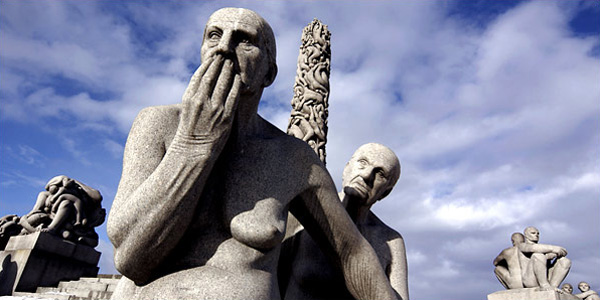
Gustav Vigeland 4.11.13 Thought of the Day

[Image courtesy: Red Ice Creations]

[Image courtesy: Red Ice Creations]

Adolf Gustav Vigeland was born on this day outside Halse og Harkmark  in Mandal, Norway in 1869. Today is the 144th anniversary of his birth.

He was born to Anne and  Elesæus Vigeland. His father was a master cabinetmaker. Gustave was interested in wood as a medium too, but he wanted to carve it, not make cabinets with it. He went to Oslo at 15 to apprentice at wood carving. His education was put on hold when his father died and Gustav returned home to help support he family. But by 1888 he was back in Oslo studying under sculptor Brynjulf Bergslien. In 1889 he premiered his first work, Hagar and Ishmael.

Portrett av Gustav Vigeland

Portrett av Gustav Vigeland (Photo credit: National Library of Norway)

Starting in 1891 she traveled to Copenhagen, Paris, Berlin and Florence. His stay in Paris, studying  at Auguste Rodin’s studio had a particular influence on the young sculptor.

Themes of life, death and  love — at once intimate and grand in scale — made their way into his sculpture.

Conceptions of death recur in a number of his works, and his portrayals range from melancholy and desolation to deep affection and ecstasy of the embrace. [The Robinson Library]

Frogner famous for housing the Vigeland Sculpt...

Frogner famous for housing the Vigeland Sculpture Park, which was created by Gustav Vigeland in the 20th century. en.wikipedia.org/wiki/Vigeland_Sculpture_Park (Photo credit: Wikipedia)

His works were well received in art circles and by critics, but Gustav found he couldn’t make a living sculpting naked images of death or love.

He took a unfulfilling job helping to restore the Nidaros Cathedral in 1897 for a few years — it was there that he began to carve dragons and lizards, animals he used later to symbolize sin and the force of nature working against man. He spent a decade carving busts of Norway’s famous writers and thinkers. He designed the Nobel Peace Prize which was first awarded in 1901.

[Image courtesy: Red Ice Creations]

Back of the Nobel Peace Prize. [Image courtesy: Red Ice Creations]

Gustav secured an abandoned studio from the city of Oslo starting in 1902. He used the work space for nearly two decades before it was demolished to make way for the new Deichman Library. At that point he negotiated with the city council for a new workspace. They would provide him with a new studio/living space and he would donate all his future art works to the city. (Which explains why so little is of Vigeland’s art is found outside of Oslo, and why the city is so beautifully decorated by it.)

11100vigeland1

Detail of some of the hundreds of sculpture in Vigeland Park. [Image courtesy: Red Ice Creations]

Oslo’s Vigeland Park  is the world’s largest sculpture park designed by a single artist. The park boast…

over 600 human figures engraved in 192 different sculptures. All of them, amazing. The masterpiece of the park is “The Monolith” a towering spire figures ascending to eternity. Gustav Vigeland is the man who designed the models for every sculpture in the park. A team of sculptures work for years to create all the granite and bronze statues. The various sculptures portray lots of widely ranging aspects of the human condition. There are many sculptures depicting intense emotions and feelings; love, parenthood, innocence, violence, suffering and joy. In all of the sculptures, there is a deeply moving and poetic statement about life. [Answer.com]

When he died in 1943 his studio was converted into The Vigeland Museum. Today the museum “houses approximately 1,600 sculptures, 420 woodcuts, and 12,000 drawings, as well as other artifacts such as notebooks, photographs, books, and thousands of letters belonging to Vigeland.” [Real Scandinavia]

Wheel of Life scuopture at Vigeland Park [Image courtesy: Red Ice Creations]

Wheel of Life scuopture at Vigeland Park [Image courtesy: Red Ice Creations]

"Ball of Babies" at the Vigeland Park [Image courtesy: Red Ice Creations]

“Ball of Babies” at the Vigeland Park [Image courtesy: Red Ice Creations]

Related blogs:

Happy Birthday Gustav Vigeland

http://realscandinavia.com/sculpture-on-a-grand-scale-oslos-vigeland-museum-and-park/

http://www.arisamtravel.com/Gallery/GUSTAV_VIGELAND_EXIT/photo2234.htm

http://www.redicecreations.com/article.php?id=11101


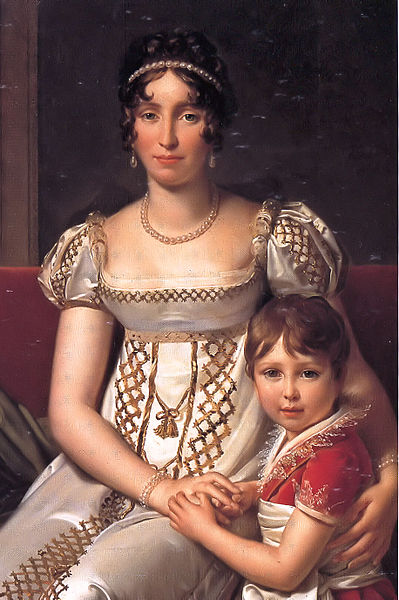
Hortense de Beauharnais 4.10.13 Thought of the Day

[Image courtesy: Wikipedia]

[Image courtesy: Wikipedia]

Hortense E de Beauharnais was born on this day in Paris, France in 1783. Today is the 230th anniversary of her birth.

She was born to French aristocrats Alexandre, Vicomte de Beauharnais and Joséphine Tascher de la Pagerie. Both her parents were arrested during the French Revolution, and her father was guillotined at the Place de la Révolution on July 23, 1794. Josephine was released in August of that year. In 1796 she married Napoleon Bonaparte.

Hortense was a pretty child. She had long blond hair and blue eyes. She attended school Napoleon’s youngest sister, Caroline.

[Image courtesy: Wikimedia Commons

[Image courtesy: Wikimedia Commons

At 19 this “Flower of the Bonapartes” was married off to Napoleon’s brother Louis. It was not a marriage of love, but, rather, it was a marriage of convenience, arranged at Napoleon’s request. The couple never got along, but they did manage to have three children together: Napoléon Louis Charles Bonaparte, Napoleon Louis Bonaparte and Charles Louis Napoléon Bonaparte. (Charles would later become Napoleon III, Emperor of France.)

The Royal Monogram of Hortense [Image Courtesy Wikipedia]

The Royal Monogram of Hortense de Beauharnais, Queen of Holland [Image Courtesy Wikipedia]

The Emperor appointed Louis King of Holland and Hortense had to leave her beloved Paris to follow her no-so-beloved husband to Holland. The Netherlands won her over and she learned to enjoy the people, customs and landscapes. But her relationship with Louis did not improve.

After the death of their first son Hortense was allowed to return to Paris because it would provide a more healthy environment for both the Queen and her remaining children. When Napoleon prepared to remarry he decided that it wouldn’t do to have the daughter of his first wife living at court, so he had her shuttled north again. Her stay in Holland was temporary and she left, again for “health” reasons, in 1810.

Now officially separated Hortense moved to Switzerland where she had a long-term affair with Colonel Charles Joseph, Comte de Flahaut. The couple had an illegitimate son together, Charles Auguste Louis Joseph.

[Image courtesy: Wikipedia]

[Image courtesy: Wikipedia]

She remained a loyal Bonapartist. When the Bourbon monarchy was restored in Paris, Hortense — like all the Bonapartes –went into exile. She, Charles Louis Napoléon Bonaparte and Charles Auguste Louis Joseph moved to Arenenberg Castle, near Lake Constance in Switzerland. While there she transformed…

The medieval castle and its gardens …. into an island of French culture amidst the rather provincial region of Lake Constance. The castle was surrounded by a 12 ha park with hermitage, fountains, waterfalls and nymphaeum, steep paths and viewpoints.  [www.bodensee-magazine]

The main house, which still stands, had living quarters and rooms for entertainment (including a theatre). She continued to expand the house and  revamp the estate, adding the latest in Parisian style almost until her death on October 5,  1837.

[Image courtesy: Kreuzlingen tourism]

Arenenberg Castle  [Image courtesy: Kreuzlingen tourism]


Gabriela Mistral 4.7.13 Thought of the Day

“At this moment, by an undeserved stroke of fortune, I am the direct voice of the poets of my race and the indirect voice for the noble Spanish and Portuguese tongues.”–Gabriela Mistral

Gabriela Mistral

Gabriela Mistral (Photo credit: Wikipedia)

Lucila Goday y Alcayaga was born one this day in Vicuña , Chile in 1889.

Daughter of a poet and school teacher, Juan Gerónimo Godoy Villanueva, and a seamstress, Petronila Alcayaga, she was raised in a small Andean village. The family lived in poverty, a situation that worsened when her father left when Lucila was three. She was close to her older sister, Emelina Molina, who was also her teacher.

Despite having only a few years of formal education, she became a teacher’s aide at 15 to help support her family. As a teacher she had a number of positions in rural Chilean towns. By 1912 she was teaching at the high school level. Her star as an educator continued to rise,  in 1921, she became the director of Santiago’s Liceo (high school) #6, the best girls’ school in Chile. She went on to help reform the Mexican education and library system.

English: Gabriela Mistral, Chilean poet, educa...

English: Gabriela Mistral, Chilean poet, educator, diplomat, and feminist (Photo credit: Wikipedia)

A poet all her life…

“At age sixteen she moved to La Cantera to take a job and fell in love with a young railway worker. The relationship didn’t last and two years later the young man committed suicide. The only item found in his possession was a postcard from Mistral. This affected her deeply and she wrote Sonetas de la Muerte (Sonnets of Death) to express her feelings.” [Distinguished Women.com]

Lucila took the pen name Gabiela Mistral. Her poems reflected her experiences in life. When she “…was appointed director of a secondary school for girls located in rural Punta Arenas. The rough terrain of Punta Arenas became an inspiration for a series of poems entitled Patagonian Landscapes.“[ Ibid]

Her time in Mexican inspired   Readings for Women

“The dominant themes in her poetry were love, death, childhood, maternity, religion and the beauty of nature and of her native land. She also had a burning desire for justice.”[Ibid]

Major works include:

  • Sonetos de la muerte (1914)
  • Desolación  1922
  • Ternura 1924
  • Tala 1938
English: Gabriela Mistral, Nobel laureate in L...

English: Gabriela Mistral, Nobel laureate in Literature 1945 Deutsch: Gabriela Mistral, Nobelpreisträgerin für Literatur 1945 (Photo credit: Wikipedia)

She was the first Latin American and (so far is) the only Latin American woman to receive the Nobel Prize for Literature.

At the time of her death in 1957, her poems had been translated into English, French, German, Swedish and Italian.

The Rose

by Gabriela Mistral

The treasure at the heart of the rose
is your own heart’s treasure.
Scatter it as the rose does:
your pain becomes hers to measure.

Scatter it in a song,
or in one great love’s desire.
Do not resist the rose
lest you burn in its fire.

Click HERE to go to Poem Hunter.com and read more of Mistral’s works.


Secondary Character Saturday — Iago

Illustration of Othello and Iago

Illustration of Othello and Iago (Photo credit: Wikipedia)

“…What’s he then that says I play the villain?” — Iago

Who: Iago

From: Othello

By: William Shakespeare

Written: Around 1603

Pros: Intelligent, ambitious, funny. Although he is the play’s worst character, he is also its most interesting and complex by far… you can’t take your eyes off the scum ball.

Cons: Manipulative, abusive, sociopathic, vengeful, bitter, jealous, petty. He’s a liar and bully that will literally commit murder to get what he wants.

English: Carl Schurz as Iago from Shakespeare'...

English: Carl Schurz as Iago from Shakespeare’s play Othello, amidst his co-conspirators, prepares to enter the limelight. (Photo credit: Wikipedia)

Most Shining Moment: (Yeah, I’m leaving this one BLANK)

Least Shining Moment: So many to choose from. I’m going to go with killing his wife, Emilia. He’s treated her like dirt the entire play, and when she finally looses it and stands up to him he doesn’t think twice about running her through with a rapier.

Why I chose Iago: As you may have noticed most my Secondary Characters are pretty stand up guys. They all  have something going for them…maybe its charm… maybe they have good heart… but there is usually some nice feature that makes me like a character enough to give them the honored Saturday spot. Not so with Iago. Honestly I’m hard pressed to think of anything really nice to say about him. But…it is a really juicy role. He’s the one people remember. It is kind of the Darth Vader effect. You aren’t supposed to like him at all, but he’s the one whose theme song you remember.

English: Photographic full-length portrait of ...

English: Photographic full-length portrait of Edwin Booth as Iago in Shakespeare’s Othello, the Moor of Venice (Photo credit: Wikipedia)

Is Iago a SECONDARY character: I often struggle with whether a character is indeed Secondary. And it is hard to make that case with Iago when he is on stage more than any other character in Othello.  (He has 1,070 lines.) Without his wicked machinations you’d have a very different/happier story so, unlike other Secondary Characters, he is pivotal to the plot. But, when it comes down to it, the play is called Othello, not Iago. So I’m giving the slimy little so-and-so the nod this week.

Othello (1995 film)

Othello (1995 film) (Photo credit: Wikipedia)

————————————————————-

I’m feeling very Shakespeare-y today. I had the good fortune to attend the Baltimore Shakespeare Factory‘s Bard’s Birthday Gala last night. We were treated to scenes from their upcoming production of Romeo and Juliet (April 6-27) as well as a 3 person / 20 minute version of Othello. It was a fabulous lesson in suspending disbelief as the actors literally transformed before your eyes from one character another, and it worked beautifully. With a handful of props, no set and no furniture these three actors told the this timeless story in an engaging, new way. Play on! Indeed!


Gregory Peck 4.5.13 Thought of the Day

“I don’t lecture and I don’t grind any axes. I just want to entertain.”–Gregory Peck

Cropped screenshot of Gregory Peck from the tr...

Cropped screenshot of Gregory Peck from the trailer for the film Gentleman’s Agreement. (Photo credit: Wikipedia)

Eldred Gregory Peck was born on this day in La Jolla, California, USA in 1916. Today is the 97th anniversary of his birth.

He was born to Bernice Mae “Bunny” and Gregory Pearl Peck. Bunny was Scottish, English and Protestant, Gregory senior was Irish and Catholic. She converted when they married and they raised Eldred Catholic. When the couple split  little Eldred was six, he went to live with his grandmother.

Peck…”never felt he had a stable childhood. His fondest memories are of his grandmother taking him to the movies every week and of his dog, which followed him everywhere.” [IMDb]  When he was ten his grandmother passed away and he went to live with his father full-time.

He went to St. John’s Military Academy, a Roman Catholic military school in Los Angeles, then to  San Diego High School. He enrolled at San Diego State Teacher’s College for one year before transferring to the University of California, Berkley where he settled on Acting. Working as a truck driver and kitchen assistant helped pay the bills.

Upon graduation Peck headed east to New York City.  Gregory Peck was ‘born’ when he dropped his first name. “I never liked the name Eldred. Since nobody knew me in New York, I just changed to my middle name.” He worked as an usher at Radio City Music Hall and a tour guide at NBC. He worked for the acting experience and for food, landing progressively larger roles as he honed his craft.

His debut was in Emlyn Williams‘ play “The Morning Star” (1942). By 1943 he was in Hollywood, where he debuted in the RKO film Days of Glory (1944).

Stardom came with his next film, The Keys of the Kingdom (1944), for which he was nominated for an Academy Award. Peck’s screen presence displayed the qualities for which he became well-known. He was tall, rugged and heroic, with a basic decency that transcended his roles. [IMDb]

Cropped screenshot of Gregory Peck from the tr...

Cropped screenshot of Gregory Peck from the trailer for the film The Yearling. (Photo credit: Wikipedia)

He was nominated for four Academy Awards in the 1940’s for his work in: The Keys of the Kingdom, The Yearling, Gentleman’s Agreement and Twelve O’Clock High. He’d have to wait another 20 years before winning the statue.

An old back injury keep him out of the service during World War II (he’d hurt himself while taking dance and movement classes — not while on the UC Berkley Rowing team as 20th Century Fox claimed.)

He kept his stage skills up at The La Jolla Playhouse, a theatre he co-founded with Mel Ferrer and Dorothy McGuire in 1947.

To Kill a Mockingbird, 1962

To Kill a Mockingbird, 1962 (Photo credit: mystuart)

His best known and most love role came in 1962 as Atticus Finch in the film adaptation of Harper Lee’s To Kill a Mocking Bird. He won an Academy Award for his portrayal of the soft-spoken, southern lawyer. And his portrait of Finch was voted as the #1 greatest hero in American film by the American Film Institute in 2003.

Other notable films from his large library of movies include:

  • Spellbound
  • Captain Horatio Hornblower
  • The Snows of Kilimanjaro
  • Designing Women with Lauren Bacall
  • On the Beach
  • The Guns of Navarone
  • Cape Fear
  • The Omen
  • The Boys From Brazil

and my other favorite (besides Mocking Bird)… Roman Holiday with Audrey Hepburn.

Cropped screenshot of Gregory Peck from the tr...