Category Archives: Fiction

Thought of the Day 10.17.12 Elinor Glyn

“All the legislation in the world will not abolish kissing”
Elinor Glyn

Portrait of Elinor Glyn, 1927

Portrait of Elinor Glyn, 1927 (Photo credit: Wikipedia)

Elinor Southerland was born on this day in Jersey, Channel Islands, England in 1864. Today is the 148th anniversary of her birth.

Elinor’s father died when she was a toddler and the family moved for a while to Canada. They returned to Jersey when she was eight and her mother remarried.  Elinor…

was a voracious reader interested in French history and mythology, though she had no formal education … She would later be drawn to mysticism and romance. [The Literature Network]

She liked to write and she kept a diary.

At 28 she married Clayton Glyn. The couple had two daughters, Margot and Juliet. The marriage was not a happy one.  and, although Elinor and Clayton officially remained together both had affairs.

Elinor had affairs with a succession of British aristocrats and some of her books are supposedly based on her various affairs… [Good Reads]

English: Elinor Glyn portrait

English: Elinor Glyn portrait (Photo credit: Wikipedia)

She contributed articles to Scottish Life and Cosmopolitan but her real break through in the literary world came with the serialization of her first book The Visits of Elizabeth in 1900. The book, was written as a series of letters by an innocent young woman. Elizabeth.

The naive and charming narrator gets herself into social scrapes due to her innocence, … they are actually funny over a hundred years later because you know what Elizabeth doesn’t know–and perhaps that was the appeal for the more knowing Edwardian readers. Glyn’s book is a bit of a satire, but a romantic one, and Elizabeth gets her happily-ever-after, but not before making every handsome gentleman fall deeply in love with her.  [Amazon.com review]

Elinor was prolific in turning out her novels (she had to be, finances at home had taken a turn for the worse and the once wealthy Clayton Glyn was in debt by 1908. He died in 1915.)  Her reputation as a writer of romance grew with the publications  of The Seventh Commandment (1902), The Reflections of Ambrosine (1903), The Damsel and the Sage (1903), The Vicissitudes of Evangeline (1905) and Beyond the Rocks (1906).
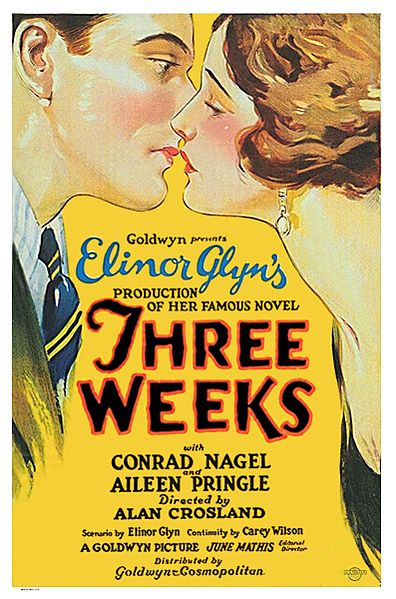
Movie poster for Three Weeks

Her risqué Three Weeks, about an exotic Balkan queen who seduces a young British aristocrat, was allegedly inspired by her affair with Lord Alistair Innes Ker. On the one hand it scandalized Edwardian aristocrats and jeopardized Glyn’s status. [The Literature Network]

Deemed immoral and banned at elite schools like Eton and panned by some critics who considered it disjointed and dull, the book non the less sold out within weeks of its publication and  it  “ensured her meteoric rise to fame.” [ibid]. It also brought about the anonymous  ditty:

Would you like to sin
With Elinor Glyn
On a tiger skin?
Or would you prefer
To err
With her
On some other fur

Her private life seemed to either echo or prelude the romantic interludes of the heroines in her novels as she continued to crank out “romances” until the start of World War One. During the Great War she worked in France as a war correspondent and Glyn was one of two women to witness the signing of the Treaty of Versailles.

Elinor Glyn looks up at Rudolph Valentino, fro...

Elinor Glyn looks up at Rudolph Valentino, from the frontispiece of Beyond The Rocks (Photo credit: Wikipedia)

She made the move to Hollywood in 1920 where she worked as a scriptwriter  for MGM and Paramount. The Great Moment was filmed in 1920.  In 1922 Beyond the Rocks was made into a major motion picture with red-hot Rudolph Valentino and Gloria Swanson. Three Weeks was given the big screen treatment not once, but twice, first in 1914 and then in 1924. And Glyn wrote the screenplay and was closely involved in the production of the 1926 Love’s Blindness.

In 1927 she wrote a novella that gave us the expression “the IT girl.”  She coined the phrase and quickly  crowned Clara Bow, who was staring in Red Hair (a movie based on Glyn’s The Vicissitudes of Evangeline), as the first IT girl. Here autobiography Romantic Adventure was published in 1936. She continued writing until 1940 when she published her last — and 42nd — book, The Third Eye.

English novelist and scriptwriter Elinor Glyn ...

English novelist and scriptwriter Elinor Glyn (1864-1943) (Photo credit: Wikipedia)

Elinor Glyn died in September of 1943 in Chelsea, London.

————————————————————————–

Bookshelf:

Interested in reading some of Elinor Glyn’s books? You can find them through the links below.

Red Hair (Classic Reprint)<img src=”http://www.assoc-amazon.com/e/ir?t=rico095-20&l=as2&o=1&a=B0094JHIEE&#8221; width=”1″ height=”1″ border=”0″ alt=”” style=”border:none !important; margin:0px !important;” />

Man and maid<img src=”http://www.assoc-amazon.com/e/ir?t=rico095-20&l=am2&o=1&a=117680328X&#8221; width=”1″ height=”1″ border=”0″ alt=”” style=”border:none !important; margin:0px !important;” />

Three Weeks<img src=”http://www.assoc-amazon.com/e/ir?t=rico095-20&l=am2&o=1&a=0715603612&#8243; width=”1″ height=”1″ border=”0″ alt=”” style=”border:none !important; margin:0px !important;” />

The Visits Of Elizabeth<img src=”http://www.assoc-amazon.com/e/ir?t=rico095-20&l=am2&o=1&a=1162711698&#8243; width=”1″ height=”1″ border=”0″ alt=”” style=”border:none !important; margin:0px !important;” />

The man and the moment<img src=”http://www.assoc-amazon.com/e/ir?t=rico095-20&l=am2&o=1&a=1178145077&#8243; width=”1″ height=”1″ border=”0″ alt=”” style=”border:none !important; margin:0px !important;” />

The man and the moment<img src=”http://www.assoc-amazon.com/e/ir?t=rico095-20&l=am2&o=1&a=1178145077&#8243; width=”1″ height=”1″ border=”0″ alt=”” style=”border:none !important; margin:0px !important;” />

The Point of View<img src=”http://www.assoc-amazon.com/e/ir?t=rico095-20&l=am2&o=1&a=1444425269&#8243; width=”1″ height=”1″ border=”0″ alt=”” style=”border:none !important; margin:0px !important;” />


Thought of the Day 10.15.12 P. G. Wodehouse

“I just sit at a typewriter and curse a bit.”“There is only one cure for gray hair. It was invented by a Frenchman. It is called the guillotine.”“I know I was writing stories when I was five. I don’t know what I did before that. Just loafed I suppose.”–P.G. Wodehouse

P. G. Wodehouse, Bolton's friend and collaborator

“I just sit at a typewriter and curse a bit.”

Pelham Grenville Wodehouse was born on this day in Guildford, Surrey, England in 1881. This is the 131st anniversary of his birth.

Wodehouse, called “Plum” as a child, spent much of his early life in the care of a gaggle of aunts and at boarding schools in England, while his parents lived in the Far East. Third of four boys, Wodehouse was close to his brothers.  He went to The Chalet School, Elizabeth College in Guernsey, Malvern House (near Dover) and finally at Dulwich College with his older brother Armine. He flourished at Dulwich where he played sports (especially boxing, cricket and rugby), studied the classics, sang and acted in the school’s theatricals, and of course, wrote.)

Psmith in the City

Psmith in the City (Photo credit: Wikipedia)

Upon graduation in 1900 ailing family finances meant he couldn’t go on to Oxford like Armine. Instead, Plum’s father got him a job in the London branch of the Hong Kong and Shanghai Bank. He wrote about his experiences at the bank in Psmith in the City, but he said he “never learned a thing about banking.”  In 1902 he gave up the financial farce and dove into journalism  with a job writing a comic column at The Globe newspaper. He moved to New York and published his first novel, The Pothunters the same year.  A Prefect’s Uncle; Love Among the Chickens; The Swoop; Psmith In the City; Psmith, Journalist; The Prince and Betty; and  Something New followed fairly quickly there after.

The Prince and Betty

The Prince and Betty (Photo credit: Wikipedia)

He also wrote for musicals. He penned the book for Cole Porter’s Anything Goes; the Gershwin’ s Oh Kay . He worked with Ira Gershwin on the lyrics for Rosalie. And he wrote dozens of musicals — generically called the Princess Theatre Musicals — with Guy Bolton and Jerome Kern. [For a complete list of Wodehouse musicals go to The Playwrights Database at doolee.com]   The Princess Theatre Musical are generally seen as a stepping stone that took the best of vaudeville and operetta and blended them into modern musical theatre. They transitioned

“… the haphazard musicals of the past to the newer, more methodical modern musical comedy … the libretto is remarkably pun-free and the plot is natural and unforced. Charm was uppermost in the creators’ minds … the audience could relax, have a few laughs, feel slightly superior to the silly undertakings on stage, and smile along with the simple, melodic, lyrically witty but undemanding songs” [Bloom and Vlastnic Broadway Musicals: The 101 Greatest Shows of All Time]

My Man Jeeves

My Man Jeeves (Photo credit: Wikipedia)

Starting with My Man Jeeves in 1919 Wodehouse published the series of books for which is he best known, The Jeeves and Wooster books.  Here’s a clip from the 1990 Granada Television production of Jeeves and Wooster starring Hugh Laurie and Stephen Fry:

He also wrote the Blandings Castle series about a fictional castle with Lord Emsworth and his prize-winning pig, the “Empress of Blandings.”

Since he and his wife, Ethel Wayman, were officially residents of both England and the US they were being taxed by both countries. To alleviate the tax burden they moved to France in 1934. The Wodehouse’s remained in France when the Nazi troops moved in. Wodehouse was interned as an “enemy alien” eventually landing in Tost, Upper Silesia, Poland. He later quipped of  his ‘lodgings’ “If this is Upper Silesia, what on earth must Lower Silesia be like?” He entertained his fellow prisoners with dialogues and wrote during his two-year internment (he completed one novel and started two more). He was released just prior to his 60th birthday when a German friend from his Hollywood days, Werner Plack, approached him about doing a broadcast for the Americans describing his life as an internee.  America was not at war with Germany yet, and he had received many letters of encouragement from his fans in the US while in the camp. He saw this as a way to thank them. And, Wodehouse claimed,  he was simply reflecting the “flippant, cheerful attitude of all British prisoners.” [the Guardian]  in the broadcasts. But the British public didn’t see it that way, and neither did MI5. He was interrogated for suspected collaboration with the Germans — something that shocked the aging author. “I thought that people, hearing the talks, would admire me for having kept cheerful under difficult conditions,” [ibid] Wodehouse maintained that he never had intended to aid the enemy. But the incident left a bad taste with both the Wodehouses and the British public. The author moved to the US in 1945, and never went back to England.

Wodehouse died in 1975.

books - wodehouse

books – wodehouse (Photo credit: rocketlass)


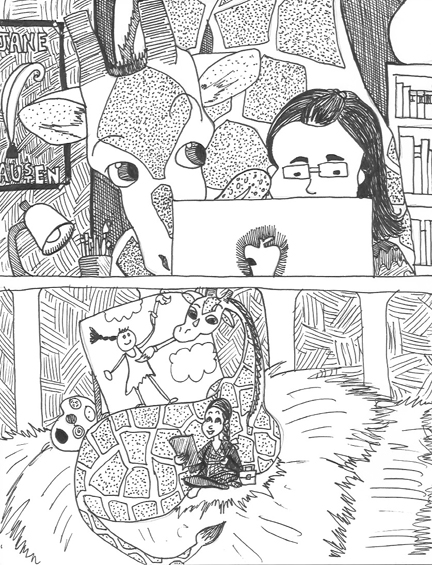
Mangahoota [a special fiction post]

[Since I will be AFK (Away From Keyboard) I thought I’d share the following short children’s story called “Mangahoota.” My daughter was kind enough to do the wonderful images. (I especially love the author/illustrator image at the end.) Needless to say this is copyrighted material and may not be duplicated in any form. Same goes for the illustrations. ]

———————————————————————————————————

Mangahoota

by Rita Baker-Schmidt, illustrations by Maggie Schmidt


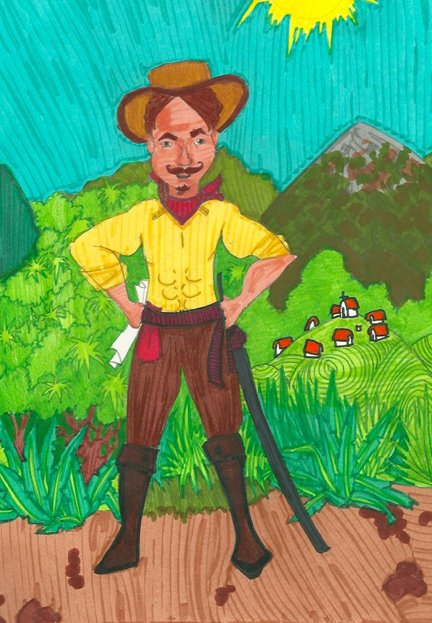
There once was an explorer named Juan Diego Benetiz Jorges Alanzo Perez. He loved to explore the wild and wonderful jungles of the Mexican country side. One day he was walking through a field, eating a mango, when something fell– plop– right on his head. It hit Juan with such a force that the poor man was knocked out cold.

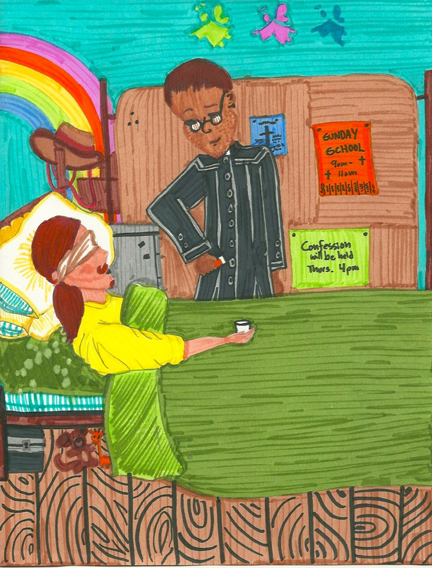
When he woke up there was a bandage across his eyes. He couldn’t see and he had a terrible headache. “Please, Please, where am I?” Juan asked in Spanish.

“Senior, you are in my hospital.” Brother Christos put a gentle hand on the man’s arm. “You had a terrible blow, but you will be all right.”

“All right? I can’t see!”

“That is because your eyes have been bandaged.” Brother Cristos told him, “In a few days we will take off the bandages and you will be all better.”

Brother Christos stayed with Juan for a little while and then he left to go to Mass. But, before he left he promised Juan he would visit him again just before evening prayers.

Juan fell back asleep. He had odd dreams of gigantic flying creatures. He woke with a start. There was a thunderous sound outside. “Bam, Bam! Bam, Bam!” The whole hut shook! But, then a second later a softer “Bam, Bam,” came, and a tiny “Ouch.”

“What is that?” Juan called out, but he was the only one in the hospital that day so there was no one to answer he question.

When the good brother came back that evening he asked Juan if he had gotten any rest.

“I did rest” Juan told him, agitated, “but then I was awaken by a terrible noise.” He described it to Brother Christos.

Because the bandages, Juan could not see Brother Christos smile.

“Did we have an earth quake, Brother?”

“Oh, no.” Brother Christos said calmly, “That was only Mangahoota.”

“What on Earth is Mangahoota?” Juan demanded.

“It is a creature that lives in this area.” Brother explained. “It is usually very sweet and gently, but I’m afraid he lost his control yesterday and he fell from the sky.” There was a note of apology in the holy man’s voice. “That is how you got hurt, you see. Mangahoota fell on you.”

“A bird that is big enough to knock a man cold?”

“Oh, not a bird exactly, but yes, it is quite big.” Brother Christos told him.  “It is a difficult thing to explain.”

The next day, when Juan was sitting in the garden of the hospital, enjoying the warm sun on his bandaged face, it happened again. There was an enormous swooshing sound and then “Bam, Bam!” The Earth shook and the water spilled from his glass, “Bam, Bam!” Then softer “Bam, Bam, ouch”

“Help!” Juan cried in horror. “Help! Help! That Mangahoota is trying to get me! Help!”

The Mangahoota must have been frightened by the tone in Juan’s voice because it flew away again immediately.

Brother Christos came running. “What it is Senior? Are you all right?”

“That beast, that Mangahoota swooped down on me again!” Juan cried. “Take me inside, Brother, please.”

“But, senior, I assure you the Mangahoota is a loving animal. It will not hurt you.”

Juan pointed to his bandages, “It has already hurt me!” He said angrily, “Now, Please, I beg you, take me inside.”

“That was an accident.” Brother Cristos said soothingly, but he obliged Juan and walked him into the hut. “Forgive me Senior,” He said gently,  as he helped the explorer sit down “I am a bit confused.”

“Why is that Brother?” Juan asked. He was much calmer now that they were inside.

“I thought you were an explorer.”

“I am an explorer.”

Brother Cristos fluffed his pillow. “I see.” He said patiently.

“Why?”

The Holy man poured Juan a drink of cool water and put it in his hand. “Humm?”

“Why did you ask me if I was an explorer?”

“It is only that I thought that explorers liked to learn new things.” He said quietly.

“We do.” Juan told him. “We love to learn new things. That is what we live for!”

“Ahhh.” Brother Christos nodded. He sat down in the chair opposite Juan.

“‘Ahhh’ what?” Juan asked. He wished Brother Christos would just come out and say what was on his mind.

“Well… here you are a man who loves to explore new things, and out there is the Mangahoota, a new thing to you, and yet….”

Juan was quiet.

“I understand your hesitation, Senior. It must have been frightening.”

Juan grabbed at the brothers sleeve. “It was! It is a terribly frightening thing to have a Mangahoota land on your head.”

“I’m sure.” Brother Christos patted his arm. “And you just frightened the Mangahoota by shouting so fiercely. So perhaps it would be best if you didn’t meet.” He pushed himself off his chair and went to leave the room. “You are right, Senior. A meeting would be a bad thing.”

Juan thought for a long time about what Brother Christos had said. He was an explorer and this was a new and strange thing. He’s instincts as a man of knowledge kicked in and curiosity replaced his fear. By the time Brother Christos returned after evening prayers Juan had made up his mind to meet the beast.

The next day Brother Christos walked Juan into the bean field by the mission. When they stopped he handed Juan a bunch of mangos. “What is this?” Juan asked.

“Those are mangoes. Mangahoota loves mangoes.” He held Juan’s hand so it was straight out then he brought it in a slow arch above his head and back down again. “You must wave the mangoes like this, Senior.”

Juan did as he was instructed. “Like this Brother?”

“Yes, but a little faster.” Brother Christos told him. “And you must call him to  you, Senior.”

Juan stopped waving. “How?”

“You must wave your mangoes and call in a loud voice ‘Mangahoota, Mangahoota, come and get them, Mangahoota.”

Juan thought he must be joking.

“Please, go on Senior, or he may not come.”

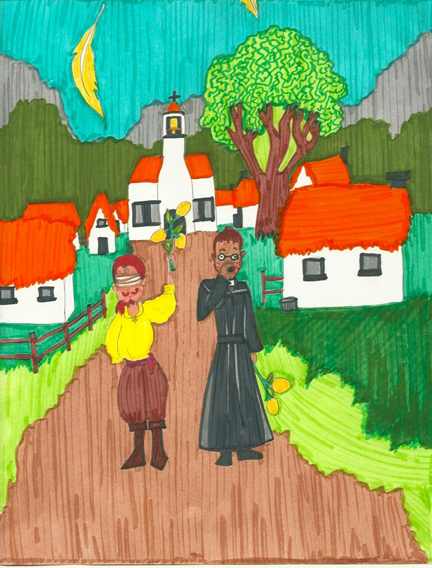
Feeling silly, Juan waved the bouquet of mangoes over his head and called out “Mangahoota, Mangahoota, come and get them, Mangahoota.”

And from high above the mountains came the swoosh, swooshing sound of enormous wings. Then, “Bam, Bam…Bam, Bam…” and more quietly “Bam, Bam,” and just a whisper of a sound “Ouch.”

The Mangahoota clip-clopped over to them and took a nibble of the mangoes. Sweet smelling, sticky, mango juice pored over Juan’s hands as the creature ate. “Does he like them, Brother?”

Brother Christos laughed as the Mangahoota bent over and gave Juan a sticky lick of a kiss. “Oh, yes, Senior, as I say, they are his favorites.”

They spent some time in the field with the Mangahoota. Both Juan and Brother Christos kept their voices calm and soothing. And the Mangahoota let Juan pet his long fur covered body.

Juan could tell that the creature had long legs with big knobby knees. He had enormous wings, of course, which he kept tucked in against his body. And he had a long muscular neck. His neck was so long that Juan couldn’t reach the top unless the Mangahoota bent down.  But Juan couldn’t form a picture of the Mangahoota in his mind’s eye.

As the Mangahoota flew away and the men walked back into the compound of the mission Juan turned to Brother Christos. “I must know what a Mangahoota looks like.”

“Tomorrow,” Brother Christos told him, “We will take the bandages off, and if you are strong enough we will take our walk outside and you can call him again.”

Juan tried to sleep that night, but he couldn’t keep his mind off the Mangahoota. In the morning Brother Christos came to him and, as promised cut away the bandages.

It took a minute for Juan’s eyes to register his surroundings. The simple thatched hut with the crucifix on the wall, the four camp beds made up with white linens, and the kind young man who had been his doctor smiling at him. Juan smiled back. “Lets go.”

Brother Christos nodded to the bedside table. There were two bouquets of mangoes.

“I must warn you Senior,” Brother Christos told him, “the Mangahootas are very unusual creatures.”

“I should say so!” Instead of the monk helping support Juan, he was being pulled by him. They walked to the middle of the field.

“So unusual that you must employ all of your powers of imagination to see him as he is.”

“I understand. Don’t worry Brother, I have a very good imagination.”

Brother Christos smiled at him and gave him some mangoes.

With out hesitation Juan waved them frantically over her head. “Mangahoota, Mangahoota, come and get them Mangahoota!”

No creatures emerged.

“Mangahoota, Mangahoota, come and get them Mangahoota!” Juan looked at the monk. “Perhaps he doesn’t recognize me with out my bandages.

“We will both try, Senior.” And, holding his robes so he wouldn’t trip, he waved his too mangoes in the air.

“Mangahoota, Mangahoota, come and get them Mangahoota!” They both called. “Mangahoota, Mangahoota, come and get them Mangahoota!”

Then they saw him. Flying high over the mountains, so big that for a second he blocked out the Sun.

“Mangahoota, Mangahoota, come and get them Mangahoota!”

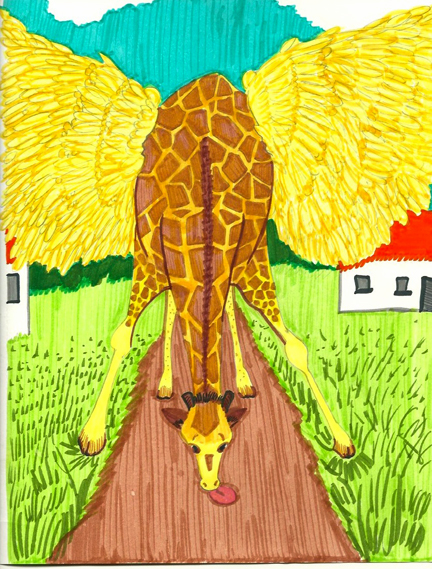
It flew lower over the field. Then with a ground shaking “Bam, Bam” its front hooves hit the ground. “Bam, Bam” the back hooves touched down. Then  a slow unforgiving arch of unstoppable motion bent his long neck and with a  softer, “Bam, Bam” the knobs on the tops of the Mangahoota’s short antlers tapped the ground, and the creature gave a soft, childlike “Ouch.”

It shook away the small pain and  brought its face up to the mangoes. It began to eat, showering Juan and Brother Christos with mango juice. They laughed out loud. When he had devoured the mangoes he eyed them with his big giraffe eyes and lowered his sweet face first to Juan and then to Brother Christos and administered a lick of appreciation.

Later, as the giant animal took flight, Juan turned to Brother Christos. “Why didn’t you tell me a Mangahoota is a flying giraffe?”

“Some times it is better to believe without seeing, Senior, but some things are better believed when seen. The trick,” the young man smiled at Juan, “Is to know which is which.”

The End.

Rita is a writer, designer, musician, animal lover and Austen enthusiast. She thinks her daughter is extra awesome for doing these illustrations. 
 
Maggie is an aspiring educator, perpetual doodler and actress. 

Thought of the Day 10.8.12 Frank Herbert

“There is no real ending. It’s just the place where you stop the story.”
–Frank Herbert

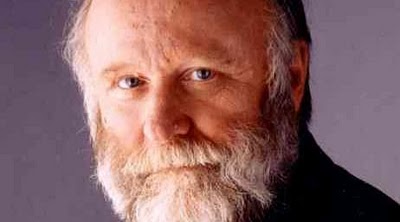
[Image courtesy: Otras musicas]


Frank Herbert was born on this day in Tacoma, Washington, USA in 1920. Today is the 92nd anniversary of his birth.

Frank’s mother came from a large Irish Catholic family (10 girls; 3 boys) (his invention of the Ben Gesserit for the Dune universe was likely an off shoot of the deep influence this gaggle of Aunts had on young Herbert’s life.) Frank’s father was a bus driver,  security guard, salesman, motorcycle patrolman and farmer. The family did a lot of traveling around before they settled on the farm.

Young Frank knew what he wanted be early in life.

On the morning of his eighth birthday Frank Junior famously announced to his family: “I wanna be a author.” (sic.) That day he wrote his first short story, which he called “Adventures in Darkest Africa.”  [Frank Herbert: The Works]

He was an explorer who thought nothing of paddling solo around Puget Sound to the San Juan Islands and back (200 miles) when he was ten or swimming across the Tacoma Narrows. He was also a great reader. “By the age of 12 he had, incredibly, already read the complete works of Shakespeare and discovered Ezra Pound.” [Frank Herbert: The Works]

Both Herbert’s parents were alcoholics and their drinking worsened as Frank entered his teen years. His sister, Patricia, was born when Frank was 13  and he took on parenting duties. By 1935 his parents were on the verge of a divorce. During high school he worked at his writing. He wrote short stories — he even wrote  novel, a boilerplate western, that he published under a pen name. He got a part-time job at the Tacoma Ledger. But by November of 1938 the situation at home had become too much. He left home with his baby sister and went to live with an aunt and uncle in Salem, Oregon. He graduated from North Salem High School and became a newspaper journalist. After a stint as a Photographer in the US Navy during WWII (he received a medical discharge because of a cranial blood clot he  developed after a fall)  he returned to Oregon and worked as a copy editor for the Oregon Journal in Portland. He worked for a number of west coast newspapers in a variety of cities for next two decades.

Besides his work in journalism: he lectured at University of Washington; he was a social and ecological consultant in Vietnam and Pakistan; and he wrote, directed and produced the documentary “The Tillers” based on the work of Roy Posterman.

[Image courtesy: Poor William’s Almanack]


Success on the fiction front was more difficult to come by. He had short stories published — his first was “The Survival of the Cunning,” a war story published in Esquire magazine.  In 1952 Herbert published his first science fiction story, “Looking For Something,” in Startling Stories. It is about a stage hypnotist who discovers that the entire world is under alien hypnosis. Other short stories followed, but no publishers seemed interested when Herbert showed them Dune.

The Dragon in the Sea
The Dragon in the Sea (Photo credit: Wikipedia)


In 1956  Herbert’s first novel, The Dragon in the Sea was published. It had been serialized in Astounding Magazine as”Under Pressure“.

 “he used the environment of a 21st-century submarine as a way to explore sanity and madness. The book predicted worldwide conflicts over oil consumption and production. It was a critical success, but it was not a major commercial one.”  [Biblio.com]

While working on an article about sand dunes for the US Department of Agriculture in Florence, Oregon he got the idea of a sand dune so big that it could swallow up whole cities. In 1965, Dune was finished, a labor of love more than six years in the making. It was serialized in the magazine Analog then largely revised and expanded into book form. It was rejected 20 times before little Chilton Books — an auto repair manual publisher —  took a chance on it.

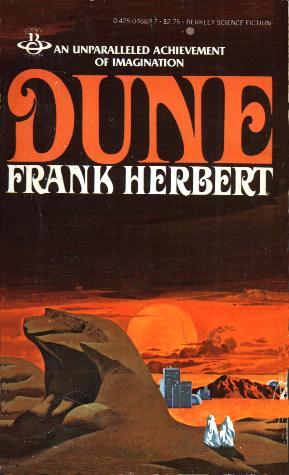
Dune cover art [Image courtesy: Book Wit]


Dune won the very first Nebula Award and was the co-winner of the Hugo Award. Published in 1965 it sets the scene for the Dune Series that follows — a series that is often considered the Lord of the Rings of Science Fiction. “Set on the desert planet Arrakis, Dune is the story of the boy Paul Atreides, who would become the mysterious man known as Muad’Dib. He would avenge the traitorous plot against his noble family–and would bring to fruition humankind’s most ancient and unattainable dream.” [Amazon.com review]

Dune was the first ecological science fiction novel, containing a multitude of big, inter-relating themes and multiple character viewpoints, a method which ran through all Herbert’s mature work. ” [Biblio.com]

Dune Messiah hit stores in 1969.   Children of Dune (1976)  was the first hardcover science fiction book to reach best-seller status. It was nominated for a Hugo Award.   And the spice kept flowing… God Emperor of Dune,  came out in 1981, followed by Heretics of Dune in 1984 and Chapterhouse: Dune in 1985.

Frank Herbert died of pancreatic cancer in 1986. But the Dune series lives on…Using Frank Herbert’s notes his son  Brian Herbert has co-authored additional Dune sequels with Kevin J. Anderson.

Frank Herbert Books
Frank Herbert Books (Photo credit: cobalt123)


Thought of the day 10.6.12 David Brin

“When it comes to privacy and accountability, people always demand the former for themselves and the latter for everyone else.”
David Brin

[Image courtesy: Scientific American.com]

David Brin was born on this day in Glendale, California, USA in 1950. He is 61 years old.

Brin is a graduate of the California Institute of Technology where he majored in astrophysics. He earned a Masters in applied physics and Doctor of Philosophy in space science from the University of  California, San Diego.

He is a consultant for NASA and the writer of  hard science fiction.

Brin serves on advisory committees dealing with subjects as diverse as national defense and homeland security, astronomy and space exploration, SETI and nanotechnology, future/prediction and philanthropy. His non-fiction book — The Transparent Society: Will Technology Force Us to Choose Between Freedom and Privacy? — deals with secrecy in the modern world. It won the Freedom of Speech Prize from the American Library Association. [The Worlds of David Brin]

Some of Brin’s book covers. [Image courtesy: The worlds of David Brin]

Brin won two Hugo Awards for his Uplift series. The “Uplift Universe explores a future when humans genetically engineer higher animals like dolphins to become equal members of our civilization.” [The Worlds of David Brin] The books in the series are: Sundiver, Startide Rising (which won the Hugo, Locus and Nebula awards,) The Uplift War (which won the Hugo  and Locus awards) and The Uplift Trilogy: Brightness Reef, Infinity’s Shore and Heaven’s Reach.

Other books he’s written include:

  • The Postman (which won  a Campbell and Locus Award and — after some major reworking– was made into a movie starring Kevin Costner.)
  • Earth (which ” foreshadowed global warming, cyberwarfare and near-future trends such as the World Wide Web” [The Worlds of David Brin])
  • Kiln People (“a fast-moving and fun noir detective story, set in a future when new technology enables people to physically be in more than two places at once.”[The Worlds of David Brin])
  • Foundation’s Triumph (a book that “brings a grand finale to (Isaac) Asimov’s famed Foundation Universe.”  [The Worlds of David Brin]
  • Sky Horizon (Winner of the Hal Clement Award for Best Sci Fi for young readers.)
  • Existence (“Existence – is set forty years ahead, in a near future when human survival seems to teeter along not just on one tightrope, but dozens, with as many hopeful trends and breakthroughs as dangers… a world we already see ahead.” [Amazon.com]

He has a trio of Graphic Novels on the shelf: Forgiveness (A Star Trek the Next Generation graphic novel), The Life Eaters (a graphic novel that loooks at what the world would be like if WWII had ended differently) and Tinkerers.

On the nonfiction front Brin has written : The Transparent Society: Will Technology Force Us to Choose Between Privacy and Freecom?  (Won the Freedom of Speech Award) and Star Wars on Trail: Science Fiction and Fantasy Writers Debat the Most Popular Science Fiction Films of All Time.

[Image courtesy: The Worlds of David Brin]

He’s also written novels for young adults, short stories, and a plethora of articles (both fiction and non fiction) like the excellent guest blog in Scientific American  “Too Hard For Science?”
http://blogs.scientificamerican.com/guest-blog/2011/04/29/too-hard-for-science-david-brin-raising-animals-to-human-levels-of-intelligence/


Thought of the Day 9.29.12 Elizabeth Gaskell

“Sometimes one likes foolish people for their folly, better than wise people for their wisdom.”
Elizabeth Gaskell

Elizabeth Gaskell, in portrait of 1851 by Geor...

Elizabeth Gaskell, in portrait of 1851 by George Richmond (Photo credit: Wikipedia)

Elizabeth Cleghorn Stevenson was born on this day in London, England in 1810. Today is the 202nd anniversary of her birth.

The youngest of eight children, she was just a little over a year old when her mother died. Her father, William Stevenson, a Scottish Unitarian minister, was not up to taking care of the baby  and Elizabeth (Lily) went to live with her maternal aunt Hannah Lumb, whom she affectionately referred to as her “more than mother,” at Heathwaite House  in  the small town of Knutsford, Cheshire. There she enjoyed the affections of several aunts and other single ladies (either widows or spinsters) in the town. Her aunt taught her read. She went to Miss Byerlys school at Barford House and later to Avonbank in Stratford-on-Avon. Her education was traditional for a well-bred Victorian girl. She learned the classics, art, music and social graces at finishing school, while her father encouraged her writing and her brother John (John and Elizabeth were the only siblings to survive past infancy), who was in the Merchant Navy, sent her books and wrote her letters from his posts around the world .

When Elizabeth was nine she visited her father in London. He had remarried, and, unfortunately, Elizabeth did not get along with her new stepmother, Catherine Thomson. To complicate matters William and Catherine preferred their own children, and Elizabeth often felt like the odd man out. Eventually she was sent to live with a distant relative, another William, William Turner. Turner was a

A staunch proponent of reform and the abolition of oppressive and inhumane practices such as slavery, his outspoken criticisms profoundly affected Elizabeth’s values and her perspective on life. [The Literature Network]

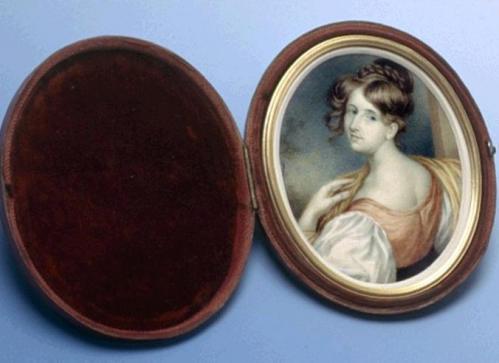
Elizabeth Gaskell around the time of her marriage, 1832 (Image courtesy: Jane Austen’s World)

She married William Gaskell, a minister in Knutsford in 1832. The Gaskells lived in Manchester. They had six children; a stillborn daughter, a son, who died in infancy from scarlet fever, and four girls.  “As the wife of a minister and mother to four growing girls, Gaskell’s life was hectic: they both taught Sunday school and volunteered for much-needed charitable causes in Manchester.” [The Literature Network] — Manchester, a mill town, had a lot of poor and working poor and Gaskell witnessed it first hand as she worked among them lending charity where she could.

Still, Elizabeth found time to write, keeping a diary about her growing daughters and the job she and her husband were doing as parents. William and Elizabeth collaborated  on some poems, Sketches among the Poor which were published in 1837.

In 1840 Clopton Hall, Elizabeth’s first solo work to be published, appeared in William Howitt’s  Visits to Remarkable Places. It was attributed to “a lady.” Later that year Howitt included her Notes on Cheshire Customs in his The Rural Life of England.

She used the pseudonym Cotton Mather Mills to write short story fiction until she published her first novel, Mary Barton in 1948.

In Mary Barton Gaskell drew on the devastation she felt after loosing her son. She also wrote about the hardships of the poor she saw all around her. The novel was published anonymously but it garnered praise from admirers like Charles Dickens, Thomas Carlyle, Charles Kingsley and John Ruskin. Other critics, however, were not so kind. They didn’t appreciate her scathing portrait of conditions in the mills or her calls for social reforms.

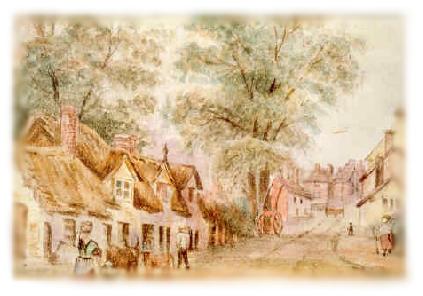
Real life Knutsford circa 1860, was the model for fictional Cranford. [Image courtesy Jane Austen World]

Dickens was so enamored with her writing that he published her next work Cranford in serial installments in his journal Household Words. Gaskell drew on her life with her Aunt Lumb and the kind (if opinionated) women of Knutsford for the characters and setting of her fictionalized Cranford.

In this witty and poignant comedy of early Victorian life in a country town, Elizabeth Gaskell describes the uneventful lives of the lady-like inhabitants so as to offer an ironic commentary on the diverse experiences of men and women. [The Literature Network]

Cranford was published in book form in 1853. As was Gaskell’s novel Ruth.

Like Mary Barton, Ruth raised a lot of eyebrows in Victorian England as its title character is a “fallen woman.” But Gaskell’s point is not the seduction or Ruth’s “loose morals” but the circumstances that led to the affair, and the web of lies and deception that cover up her “fall”. The novel is a little uneven with some of the characters merely looking down their Victorian noses disapprovingly  in a 2 demensional cartoon manner — Mrs. Benson–  or accepting their fate with angelic grace — Ruth– while, fortunately others are more fleshed out and interesting — the kind Thurstons totally won my heart. [Can some one please make this novel into a movie so Peter Dinklage can play Rev. Thurston?]

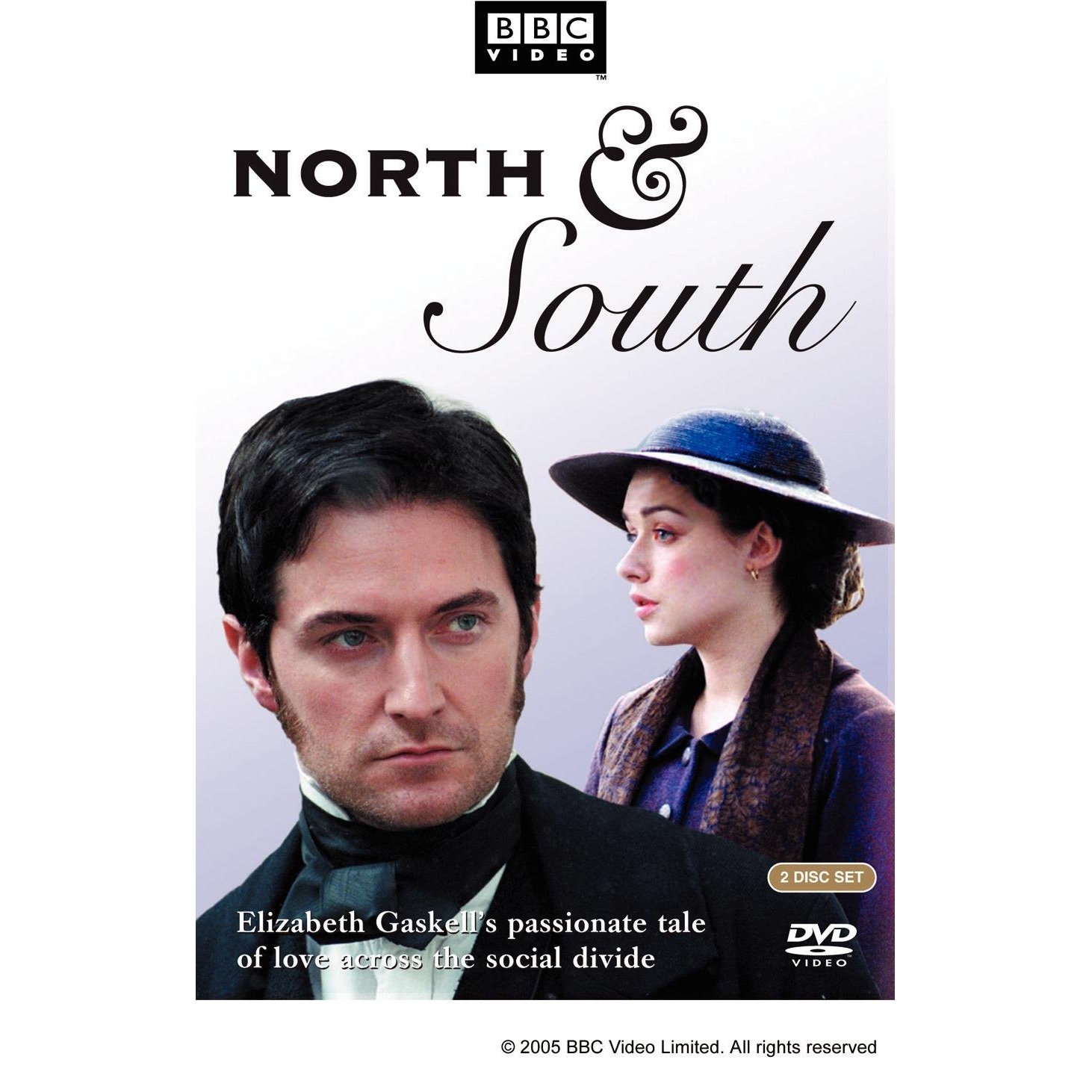
North and South is the second of Gaskell’s “industrial novels.” It was better received than Mary Barton because it gave  a more even-handed description of life in a mill town. In North and South Gaskell has the working poor (and — when a strike devastates the town — the sometimes NOT working poor) but she also gets into the head of the Mill Owner, Mr. Thornton. Between both camps is Margaret Hale who happens to be the daughter of a minister. North and South was serialized in Household Words before it was published as book.

DVD box art from the mini series of North and South. [Image courtesy: Amazon]

Her next book was far more personal. Elizabeth Gaskell met Charlotte Bronte in 1850 while in the Lake District.  The two became close friends, writing frequently. They visited each other several times. After Charlotte’s death in 1855.

the Reverend Patrick Bronte, for himself and on behalf of Brontes’s husband Arthur Bell Nicholls, asked Gaskell to write her biography in response to gossip and speculation. The Life of Charlotte Bronte was published in 1857. Gaskell spent much time researching, gathering material, and reading the letters of the eldest Bronte sister, and while she had set out to write a biography, the first edition was seen as an artful weaving of fact and fiction.  [The Literarure Network]

It was  “a pioneering biography of one great Victorian woman novelist by another.” [Google Books]

In 1863 she was paid 1,000 pounds for her novel Sylvia’s Lovers. (Mary Barton had brought her only 100 pounds.) A tragic love story set against the Napoleonic Wars Sylvia’s Lovers is one of her least well known novels.

England is at war with France, and press-gangs wreak havoc by seizing young men for service. One of their victims is a whaling harpooner named Charley Kinraid, whose charm and vivacity have captured the heart of Sylvia Robson. But Sylvia’s devoted cousin, Philip Hepburn, hopes to marry her himself and, in order to win her, deliberately withholds crucial information—with devastating consequences. [Good Reads]

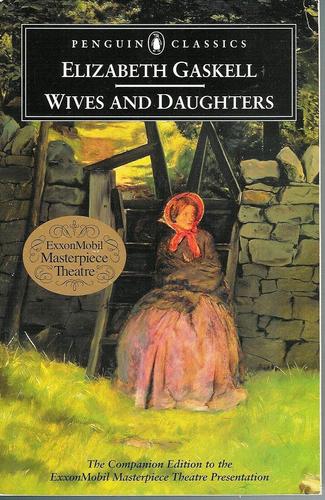
Cover of Wives and Daughters. [ Image courtesy: Amazon.com]

Wives and Daughters was also serialized (this time in Cornhill Magazine) before it came out as a novel.  It was the last book Gaskell wrote before she died (She didn’t quite finish it, and it was left to Frederick Greenwood to finish it off.)  Molly Gibson’s mother died when she was very young

Wives and Daughters centers on the story of youthful Molly Gibson, brought up from childhood by her father. When he remarries, a new step-sister enters Molly’s quiet life – loveable, but worldly and troubling, Cynthia. The narrative traces the development of the two girls into womanhood within the gossiping and watchful society of Hollingford. [Good Reads]

Gaskell also wrote dozens of short stories, especially ghost stories that she published both in magazines and in collections.

English: Elizabeth Gaskell (1810-1865)

English: Elizabeth Gaskell (1810-1865) (Photo credit: Wikipedia)

Elizabeth Gaskell died unexpectantly of a heart attack on November 12, 1865.

————————-

Published works by Elizabeth Gaskell  [Courtesy: The Titi Tudorancea Learning Center]

Novels

Mary Barton (1848)
Cranford (1851–3)
Ruth (1853)
North and South (1854–5)
Sylvia’s Lovers (1863)
Wives and Daughters: An Everyday Story (1865)

Novellas and collections

”The Moorland Cottage” (1850)
”Mr. Harrison’s Confessions (1851)
”The Old Nurse’s Story” (1852)
”Lizzie Leigh” (1855)
”My Lady Ludlow” (1859)
”Round the Sofa” (1859)
”Lois the Witch” (1861)
”A Dark Night’s Work” (1863)
”Cousin Phillis” (1864)

Short stories (partial)

Libbie Marsh’s Three Eras (1847)
Christmas Storms and Sunshine (1848)
The Squire’s Story (1853)
Half a Life-time Ago (1855)
An Accursed Race (1855)
The Poor Clare (1856)
“The Manchester Marriage” (1858), a chapter of A House to Let, co-written with Charles Dickens, Wilkie Collins, and Adelaide Anne Procter
The Haunted House (1859), co-written with Charles Dickens, Wilkie Collins, Adelaide Proctor, George Sala and Hesba Stretton.
The Half-brothers (1859)
The Grey Woman (1861)

Non-fiction

The Life of Charlotte Brontë (1857)


Thought of the Day 9.17.12 Baz Luhrmann

n”I only achieve about 60 per cent of what I’ve dreamed of. Perhaps that’s a good thing – if I did ever get the whole way with anything, I think I’d probably want to destroy it.”

 Baz Luhrmann

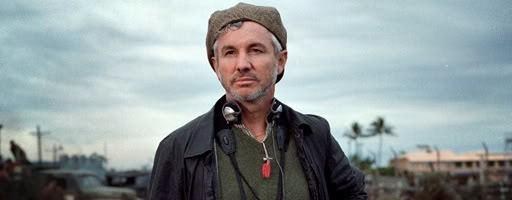
On the set of Australia [Image Courtesy: The Play List]

Mark Anthony Luhrmann was born on this day in Sydney, Australia in 1962. He is 50 years old.

His mother, Barbara, owned a dress shop. His father, Leonard, was a farmer and owned a gas station and movie theater in the small town of Herons Creek near where they lived. Barbara and Leonard competed in ballroom dance competitions and Barbara taught ballroom dance at a local studio.

“What kind of kid was I? …Extremely busy. My father was a bit mad, you see. He thought that we had to be the renaissance kids of Herons Creek. We had to learn commando training as well as photography, how to grow corn as well as how to play a musical instrument. We were up at 5 in the morning, and then we just went until we dropped. The town consisted of a gas station, a pig farm, a dress shop and a movie theatre – and we ran them all.” [Baz Luhrmann, as quoted on Baz the Great! fansite]

Growing up the Luhrmann kids helped run the various family businesses. In their free time they rode horses, learned to ballroom dance (of course), and made amateur movies. As a gas jockey at the service station Mark saw a stream of people  pass through. He was invisible to them, and  so was able to observe  their stories unfiltered and unedited for the 5 minutes it took to fill up their tank.  Later, after his parents divorced he eventually found himself in Sydney. Prior to the move he (and his brothers) had to keep their hair closely cropped in a buzz cut, but once in Sydney he was allowed grow it out. When he was teased that his new hair do made him look like a puppet fox on TV, Basil Bush, he embraced the  taunting and officially changed his first name to Bazmark.  In high school he acted in Henry IV, Part 1.  And at 17 he got a role in the Judy Davis, Bryan Brown film The Winter of Our Dreams.

He worked with the Australian Opera to bring in a younger audience and directed and performed in a number of stage productions for the company.

In 1987, while working on an experimental opera, Lake Lost, He met Catherine Martin, a production designer. She became his exclusive production designer and his wife.  (They now have two children.)

Luhrmann mounted productions of La Boheme, A Midsummer’s Night’s Dream and other classics in modern or unusual settings.

[Image Courtesy: NNDB]

His break out film was Strictly Ballroom. The project began as a 30-minute play, but Luhrmann developed it into a full blown motion picture in 1992. The story centers around handsome, spoiled, Scott. He’s a leading ballroom dancer who’s set to win the Pan-Pacific Ballroom Championships. But Scott wants to break the rules and dance his own steps. Enter Fran, a shy, ugly duckling of a girl from the beginner class at his mother’s studio. He teaches her how to dance and along the way she teaches him a thing or two as well. It’s quirky, funny, over the top, and wonderful. Here’s a scene about mid-way through the movie:

It is the first of his Red Curtain Trilogy.  Romeo + Juliet and Moulin Rouge! round out the trio. Luhrmann describes a Red Curtain film as having the following attributes:

  1. the audience knows how it will end right from the start;
  2. the storyline is thin and simple;
  3. the world created in the film is one of heightened reality; and
  4. there is to be a specific device driving the story. For Strictly Ballroom it was dance, for Romeo + Juliet it was iambic pentameter, and for Moulin Rouge! it was characters breaking into song.

The success of Strictly Ballroom  brought Luhrmann to the attention of 20th Century Fox  who signed him to a 3-year deal. For second movie Luhrmann gave Romeo + Juliet a modern jump. It starred Leonardo DiCaprio and Claire Danes and is both fast paced and action packed.  In both style and weirdness factors there is a 15% increase from Ballroom, but still, it works.

The third movie of the set was Moulin Rouge!, a highly stylized musical love story starring Nicole Kidman and Ewan McGregor.

“. . . if you make a film full of risk, studios don’t run towards you to give you $50,000,000 in order to reinvent the post-modern musical, I can tell you. If you do manage to cajole them into doing it and you want to maintain the flag of creative freedom, you better make sure that it pays its bill.”[Baz Luhrmann, IMDB]

It was somehow even bigger and stranger than J + R and Ballroom put together. With an odd combination of modern songs (with modified lyrics) that should not have fit in the 1900 Paris setting, this musical had no business becoming a hit. But it did. Frankly, once Ewan McGregor opened his mouth to sing… nothing else seemed to matter.  (As is evidenced by the bizarre beginning of this clip… Here McGregor’s Christian has snuck into courtesan Satine’s room. He is a penniless writer and he tries to win her over with the strength of his prose [well, in this case it’s Elton John’s lyrics] Kidman feign’s over excitement, hoping to get the shy wordsmith to leave, but then he starts to sing and the movie, and their attraction,  takes off.)

For his next project he brought  La Boheme to Broadway.  The show opened on December 8, 2002 and was declared a “brilliant reworking of Puccini’s masterpiece that appealed to all. [Baz the Great! fansite]

In 2008 he teamed with Kidman again, this time pairing her with Hugh Jackman, in the epic WWII Aussie drama, Australia. It’s beautifully shot. From a cattle drive worthy any Western… to the Japanese attack on Darwin… to the love story, Australia has a lot going for it. (But be warned it is a bit preachy too.)

<iframe width=”420″ height=”315″ src=”http://www.youtube.com/embed/p447zpUmbxw&#8221; frameborder=”0″ allowfullscreen>

His eclectic mix of images and music can make even the every day seem extrordinary…


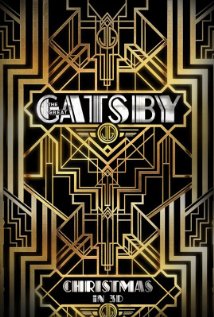
Luhrmann’s latest project is Gatsby. This time he re-teams with DiCaprio. This stylish take on the Fitzgerald’s classic, The Great Gatsby is due out on Christmas Day. [Don’t buy your tickets just yet… seems like the release date has been pushed back to Summer 2013 — thanks to John for the heads up. ]


Thought of the Day 9.13.12 Roald Dahl

“We are the music makers, and we are the dreamers of dreams.”

–Roald Dahl

My Roald Dahl collage featuring some of his most popular characters (as drawn by the amazing Quentin Blake). Surrounding Mr. Dahl and his pups are: at the top left The BFG & Sophie, The Enormous Crocodile, Mr. Fox, James (inside the Peach,) the Grand High Witch, Willy Wonka, Danny (Champion of the World) and Matilda.

[I gave a little inward squeak of delight when I saw that it was Roald Dahl’s birthday today. I can’t think of a better way to spend a few hours than to reminisce with my old friends Charlie, Matilda, Sophie, James and the rest. What joy!]

Roald Dahl was born on this day in Llandaff, Cardiff, Wales, in 1916. Today is the 96th anniversary of this birth.

Although Dahl grew up in Wales his parents were from Norway and the family spoke Norwegian at home. His older sister, Astrid, and his father,Harald, died within weeks of each other when Roald was a toddler. Sophie, his mother, was pressured to bring the family home and live with relatives, but she knew Harald had wanted the children to have a proper English education. So she split the difference.  Summers were spent visiting relatives across the North Sea. Roald and his sisters enjoyed long, sun drenched days on the water and beaches of the Norwegian coast and the family visited with their grandparents in Oslo.

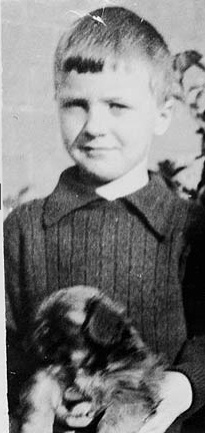
Roald Dahl aged 8. [Image courtesy: The Telegraph]

It was a lovely break for the dreary days at English public school that Dahl described as  being filled with “rules, rules and still more rules to be obeyed.”  His biography Boy: Tales Childhooddetails his exploits, dramas, and adventures growing up… like the time he mixed goat droppings into his older sister’s fiance’s pipe tobacco or the when he and his friend were given Cadbury chocolate samples to taste test at school.

After school Roald wanted adventure…

Though not a good student, his mother nevertheless offered him the option of attending Oxford or Cambridge University …. His reply, …was, “No, thank you. I want to go straight from school to work for a company that will send me to wonderful faraway places like Africa or China.”…Dahl took a position with the Shell Oil Company in Tanganyika (now Tanzania)

He worked for Shell in Mombasa, Kenya and Dar-es-Salaam, Tanganyika and had a famous encounter with a black mamba and some lions. At the outbreak of WWII Dahl joined the British Royal Air Force as a pilot — not an easy thing for him to do as he was 6’6″ and the open cockpit of his De Havilland Tiger Moth was built for men who were considerably smaller.  His head stuck up above the windshield.

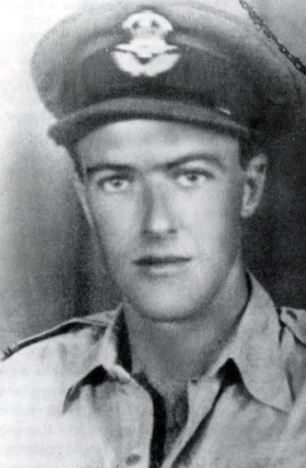
Dahl in his RAF uniform. [Image Courtesy: Mail Online]

In September 1940 while flying the last leg of a trip across the top of Africa he found himself  running out fuel and was lost. He couldn’t find the target airstrip near Mersa Matruh, Egypt, and had to make a desert landing. He cracked his skull, broke his nose, and was temporarily blinded in the crash. When he woke up he found out that the coordinates he’d been given for the airstrip had been all wrong. HQ had sent him by mistake into a no man’s land between Allied and Axis forces.

He flew other missions — bravely flying with the 80th Squadron  in the Greek Campaign. He described the “Battle of Athens” as “an endless blur of enemy fighters whizzing towards me from every side.” [Going Solo, Scholastic] After that he was sent back to Egypt and flew sorties over the Mediterranean against Vichy France, but he’d begun to have severe headaches — a result of the earlier crash. When the headaches got so bad that he began to black out he was grounded.  He writes about his adventures in Africa and in the War in his second, equally wonderful biography, Going Solo.

Dahl was sent to Washington DC as an assistant air attaché. While in Washington he stepped briefly into the role of a spy. He passed information to MI6 and worked on propoganda to promote the British agenda within the US. It was in DC that he began to write. The Saturday Evening Post published his first piece, “A Piece of Cake” (which it retitled to the more sensational, if less accurate “Shot Down Over Libya,”) in 1942. He also wrote his first book, a novel for adults about  the mythical creatures gremlins. Walt Disney optioned the story for a potential animated film.

The Gremlins is the story of Gus, a British World War II fighter pilot, who during the Battle of Britain turned to look out on the wing of his plane only to see an amazing sight: a little man, no more than six inches tall with horns growing from his head, drilling a hole in the plane’s wing. [Amazon.com]

Although the film was never made a companion book was released on a limited run. The book was re-released in 2006. (The classic Twilight Zone episode “Nightmare at 20,000 Feet” is an homage to the story.)

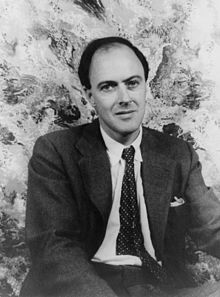
Dahl in 1954 [Image Courtesy Wikipedia]

He began to write for children when his own family came along. ( He was married to actress Patricia Neal and had five children with her.)

…Dahl began making up stories for them each night before they went to bed. These stories became the basis for his career as a children’s writer, which began seriously with the publication of James and the Giant Peach in 1961. …Dahl insisted that having to invent stories night after night was perfect practice for his trade… [Roald Dahl Biography]

His other childrens’ books include: Charlie and the Chocolate Factory 1964; The Fantastic Mr. Fox 1970, Danny, the Champion of the World 1975;  The BFG 1982; The Witches 1983;  Matilda 1988 and others. He also wrote books of verse for children including the hilarious Revolting Rhymes and Dirty Beasts.  Most of his books have nasty adults who mistreat children, those adults do not fare well in the end. The justification that “Beastly people must be punished,” made Dahl very popular with children of all ages.

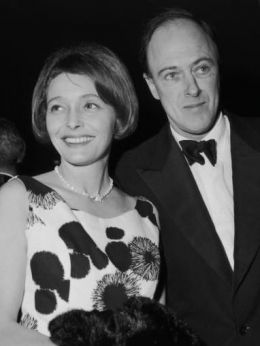
Neal and Dahl prior to their marriage. [HubPages.com]

He wrote fiction for adults as well, though it is much more difficult to find. Roald Dahl: Collected Stories is a good place to start and it contains dozens of the writer’s short stories. As does The Best of Roald Dahl.

“Dahl has the mastery of plot and characters possessed by great writers of the past, along with the wildness and wryness of his own. One of his trademarks is writing beautifully about the ugly, even the horrible.” [– The Los Angeles Times on the back of The Best of Roald Dahl]

He also wrote screen plays. He wrote a full script for The Gremlins for Disney, as well as the screenplay for Chitty Chitty Bang Bang (1968)– that creepy child catcher  who trolls the streets of Vulgaria with his candy festooned wagon is 100% Dahl– and the 1971 version of Willy Wonka & the Chocolate Factory.  For the small screen he penned  6 episodes of Alfred Hitchcock Presents  and several other suspense shows.

Dahl died at the age of 74 from Leukemia.

[Image courtesy: Wikipedia]


Thought of the Day 9.4.12 Paul Harvey

“In times like these, it helps to recall that there have always been times like these.”

–Paul Harvey

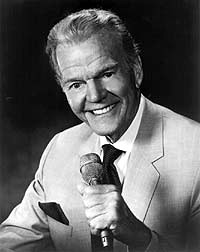
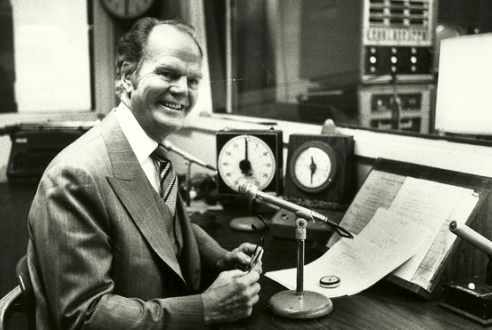
Broadcaster Paul Harvey (Image courtesy of: Arcane Radio Trivia.)

Paul Harvey Aurandt was born on this day in Tulsa, Oklahoma in 1918. Today is the 94th anniversary of his birth.

He was the son of a police officer and was interested in radio early on. He made radio receivers as a child and when he was in high school his smooth voice and distinctive reading style attracted the attention of a teacher who suggested to audition for the local radio station, KVOO.

He was hired at KVOO, but, the road to on air personality began humbly with Harvey starting out by sweeping the floor. Eventually he began to read the news and do commercials. He continued to work as KVOO, both as an announcer and a program director, while he attended the University of Tulsa. He had stints as Salina Kansas’ KFBI, Oklahoma City’s KOMA and St. Louis’ KXOK before he moved to Hawaii. He enlisted in the US Army Air Corps  in December of 1943, but he only served for 14 weeks at which time he was given a medical discharge for a cut on his heel. (Some sources say it was a Section 8 discharge and that Harvey changed his orders to make himself a ranking officer,  stole a plane and inflicted the wound himself during a psychotic dream. Harvey denied all those charges saying:

“It was an honorable medical discharge… There was a little training accident…a minor cut on the obstacle course…I don’t recall seeing anyone I knew who was a psychaitrist…I cannot tell you the exact wording of my discharge.” [The Washington Examiner])

Harvey moved to Chicago and he worked for the ABC affiliate WENR-AM.

Paul Harvey at the broadcasting counsel in Chicago (image courtesy Time Out Chicago)

He had a run-in with national security when he attempted to infiltrate the Argonne National Laboratory outside of Chicago. The Lab was a favorite target of Harvey’s for it’s “lack of security” and the radio host wanted to prove it.

Shortly past 1 a.m. on February 6, 1951, Argonne guards discovered reporter Paul Harvey near the 10-foot (3.0 m) perimeter fence, his coat tangled in the barbed wire. Searching his car, guards found a previously prepared four-page broadcast detailing the saga of his unauthorized entrance into a classified “hot zone”. He was brought before a federal grand jury on charges of conspiracy to obtain information on national security and transmit it to the public, but was not indicted. [Argonne National Laboratory; History]

Harvey had friends in high places, most notably Senator Joseph McCarthy and FBI Director J. Edgar Hoover, and the charges against him were dropped. Of the incident Harvey later went on air to say  “Though my methods may be questioned, my accuracy and my loyalty never will be.”

In 1951, while the grand jury was still out in the Argonne case, Harvey debuted a new program on ABC,  Paul Harvey News and Comment. The show came on weekdays at noon and ran  for 58 years — the longest running radio show in history — until Harvey’s death in 2009. It was:

an idiosyncratic mix of headlines, comments, quips and advertisements, all voiced by Harvey — …syndicated at its peak to more than 1200 radio stations around the country each day. Harvey … wrote and recorded his shows six days a week from studios in Chicago. His brisk, quirky delivery and signature greeting “Hello, Americans!” were widely (if fondly) parodied. In 1976 Harvey began a companion radio feature, The Rest of the Story, telling little-known tales from the lives of famous people.  [Who 2 Biographies]

The Rest of the Story, while broadcast by Harvey, were written and produced by his son, Paul Harvey, Jr.. According to the production team the stories were completely true, but, in reality were either poorly researched or simply skewed to represent Harvey’s (Sr. and Jr) point of view.

He is the author of 7 books including: Autumn of Liberty; Our Lives, Our Fortunes, Our Sacred Honor; Paul Harvey’s For What It’s Worth; and several collections of The Rest of the Story. His biography Good Day! The Paul Harvey Story was published in 2009.

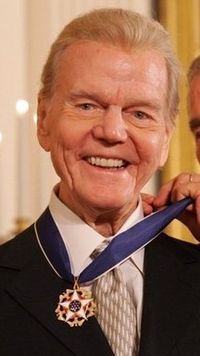
Harvey was inducted into the Radio Hall of Fame in 1990. In 2005 he received the Presidential Medal of Freedom.

Other Paul Harvey quotes include:

“Golf is a game in which you yell ‘fore!’ shoot six, and write down five.”

“If there is a 50-50 chance that something can go wrong, then 9 times out of ten it will.”

“Like what you do, if you don’t like it, do something else.”

Radios at the Vintage Radio and Communications Museum of Connecticut (Image courtesy Arcane Radio Trivia)

[This is one of those Thought of the Day birthday nods that I have a sentimental link to. I’m not a big fan of Paul Harvey and his conservative, folksy style, but there is a touchstone here.

I clearly remember listening to his gravely voice and pregnant pauses while in the car with my dad. He’d sign off with ‘good day’ and we’d echo back a ‘good day’ to each other.

The A&E Biography page links Harvey with Joseph McCarthy, J. Edgar Hoover and Billy Graham as “friends”, not three people I’d hope to see as the top three friends in my bio. And it is pretty clear that Harvey was less than diligent in his research. But I guess when you have to put out 5 days worth of “Story” to 23 MILLION fans facts can take a back seat.

…Still anytime I can spend a few hours remember my dad is worth the effort. And THAT’s the REST of the story. ‘Good day!’]