Category Archives: Baltimore

Martha Carey Thomas 1.2.13 Thought of the Day

John Singer Sargent's Miss Carey Thomas [Image courtesy Jssgallery.org]

John Singer Sargent’s Miss Carey Thomas [Image courtesy Jssgallery.org]

“One thing I am determined on is that by the time I die my brain shall weigh as much as a man’s if study and learning can make it so.”
Martha Carey Thomas

Martha Carey Thomas was born on this day in Baltimore, Maryland, USA  in 1857. Today is the 155th anniversary of her birth.

M. Carey Thomas as a child [Image courtesy National Portrait Gallery]

M. Carey Thomas as a child [Image courtesy National Portrait Gallery]

She was the eldest of ten children in a prominent Quaker family. She got her feminist streak from her mother and maternal aunt, Hannah Whitall Smith. She studied at the Society of Friends school in Baltimore, then at Howland Institute, a Quaker boarding school near Ithaca, New York. When her education at this  “dame’s school” ended in the 1860’s she yearned for the chance for further education open to her brothers.

So, in 1872, Thomas persuaded her father to allow her to attend a newly opened school for girls in New York.  While studying there her father asked her to investigate Cornell University for him.  He later decided that it had been a mistake, because as soon as she saw it, she was determined to attend. [Maryland Women’s Hall of Fame]

She received her bachelor’s from Cornell in 1877. She did graduate work at both Johns Hopkins University in Baltimore and at the University of Leipzig, but withdrew from both — Hopkins did not permit her to attend classes and Leipzig did not grant degrees to women. In the end she earned her PhD. in linguistics from the University of Zürich. She graduated summa cum laude.  She stayed in Europe for a while, living in Paris, before returning to the US.

M. Carey Thomas. [Image courtesy Explore PA History.com]

M. Carey Thomas. [Image courtesy Explore PA History.com]

While studying in Europe she heard about a “proposed women’s college at Bryn Mawr, Pennsylvania, and applied for presidency. [Ibid] Although she didn’t get the presidency of the college — that went to a man — in 1884 she became the Dean of Bryn Mawr and the chair of the English department.  She was instrumental in forming the college’s curriculum.

She desired to build it into an institution that would encourage women to follow careers without having to face the difficulties with which she had struggled. Convinced that women deserved exactly the same education as men and needed even higher standards than men to succeed, she molded a curriculum that offered more advanced work than that given in many men’s colleges and upheld the highest academic standards. [Bookrags.com]

She also continued to work in Baltimore to  help form a “school where girls could obtain an education which would prepare them to attend a good college.” [Maryland Women’s Hall of Fame] In 1885 that school, The Bryn Mawr School for Girls in Baltimore, opened its doors.

She was also instrumental getting Johns Hopkins Medical School to change their admission policy on Women.

With the help of four of her friends, a total of $500,000 was raised to aid the Medical School in its financial struggle.  The funds raised were used as a leverage to get the University to accept women.  Thus, thanks largely to the efforts of these five women, women were to be admitted on precisely the same basis as men. [Ibid]

She was active in the suffragette movement and in 1908 became the first president of the National College Women’s Equal Suffrage League. She became the first woman trustee at Cornell.  And she helped organized the Bryn Mawr Summer School for Women Workers.

screen_shot_2012-08-12_at_8_medium

[Image courtesy: Geni.com]

In 1894 Thomas became president of Bryn Mawr College. It was a post she held until she retired at age 65 in 1922.

Carey Thomas died in Philadelphia on Dec 2, 1935.


Thought of the Day 10.25.12 Anne Tyler

“My family can always tell when I’m well into a novel because the meals get very crummy.”
Anne Tyler

Anne Tyler was born on this day in Minneapolis, Minnesota in 1941. She is 71 years old.

She is the oldest of four children. Her parents moved around, searching for the best place to raise the family, but settled, when Anne was six, in the Celo Quaker Community near Burnsville North Carolina. Anne and her siblings attended a small local school. She says she never planned on being a writer, but would tell herself stories to get to sleep at night. She liked Westerns, but, her favorite book was Virginia Lee Burton’s tale, The Little House. Later she read Eudora Welty who showed her “that very small things are often really larger than the large things.” [Tyler from a 1977 New York Times interview. nytimes.com]

She majored in Russian at Duke University, but an English 101 class with Professor Reynolds Price started her on a literary career. Tyler  graduated at 19 Phi Beta Kappa and Price introduced her to his literary agent.  Tyler won the Anne Flexner creative writing award twice at Duke. She went on to Columbia to do post-graduate work in Russian studies at Columbia. She worked  as a bibliographer at Duke and at the law library at McGill University in Montreal after graduating. She published short stories in The New Yorker, the Saturday Evening Post and Harper’s Magazine prior to settling in Baltimore and marrying psychiatrist Taghi Modarressi.

Her first novel, If Morning Ever Comes was published in 1964. The Tin Can Tree followed a  year later. Tyler doesn’t like either of the books, and almost left the manuscript for ‘Morning’ on a plane on purpose. There is a five-year gap between ‘Tin Can’ and her third novel A Slipping-Down Life. She spent the time productively — she had her two daughters, Tezh and Mitra.

In 1974 she published Celestial Navigation. It is one of her favorite’s (one of mine too.) Here’s the Amazon write up…

Thirty-eight-year-old Jeremy Pauling has never left home. He lives on the top floor of a Baltimore row house where he creates collages of little people snipped from wrapping paper. His elderly mother putters in the rooms below, until her death. And it is then that Jeremy is forced to take in Mary Tell and her child as boarders. Mary is unaware of how much courage it takes Jeremy to look her in the eye. For Jeremy, like one of his paper creations, is fragile and easily torn–especially when he’s falling in love…. [Amazon.com]

Tyler wrote one book about every two years. So by 1980 she’d published eight novels.  Searching for Caleb, Earthly Possessions and Morgan’s Passing rounded out the early list.

In 1982 she published Dinner at the Homesick Restaurant. ‘Homesick’ “explores tensions inside a family – for Tyler it is the basic battlefield of all society.” [Books and Writers] The book was a finalist for the Pulitzer Prize and the Pen/Faulkner Award. [And it remains my favorite of Tyler’s novels. This book would be on my Desert Island Bookshelf*.]

Book #10, The Accidental Tourist, put Tyler on the map. Not only did she win the national Book Critics Circle Award for it in 1985, but it was made into a major motion picture starring William Hurt and Geena Davis. It too was shortlisted for a Pulitzer, but Tyler had to wait one more book before capturing that prize. [I loved the sibling interaction in this one, as well as the hope for new and unlooked for love.]

Of her writing process Tyler said:

“I think of my work as a whole. And really what it seems to me I’m doing is populating a town. Pretty soon it’s going to be just full of lots of people I’ve made up. None of the people I write about are people I know. That would be no fun. And it would be very boring to write about me. Even if I led an exciting life, why live it again on paper?… I hate to travel, but writing a novel is like taking a long trip. This way I can stay peacefully at home.” [Tyler from a 1977 New York Times interview. nytimes.com]

Breathing Lessons earned the Pulitzer and was named Time Magazine’s Book of the Year. Maggie and Ira have been married for 28 years. Things have gotten, shall we say “comfortable?” Like an old leather recliner is comfortable. They take a 90-mile trip to a funeral and “Tyler explores the problems of marriage, love and happiness” [Ibid] [Read it, and you’ll never eat fried chicken again with out a remembering the melancholy cooking scene near the end of this book.] It was made into a Hallmark Hall of Fame television movie in 1994 starring James Garner and Joanne Woodward and into a stage play.

1991 brought Saint Maybe with guilt ridden 17-year-old Ian Bedloe dropping out of school to take care of his dead brother’s children.  School Library Journal says of the novel:

“Tyler’s remarkable novel pulls at the heart-strings and jogs the memories of forgotten youth. Ian’s story is neither action packed nor fast-moving, but each page will be eagerly anticipated. “[Amazon.com]

Ever feel like your family takes your for granted and no one listens to you when you speak?  Delia Grinstead, the heroine of Ladder of Years, does. She REALLY does. And when things come to a head during a trip to the beach she walks away from it all to re-discover who she really is.

A Patchwork Planet was another of my favorites. 29-year-old Barnaby is the family’s black sheep. He got into trouble as a teen and now he doesn’t aspire to much more than helping out old people in his job at “RENT-A-BACK.” There’s a cast of fantastic, spindly, eccentric clients, and Barnaby’s less than loveable family. Then there’s Barnaby himself…

“Sharp and impatient at painful–and painfully funny–family dinners, apparently unable to keep his finger off the auto-self-destruct button every time his life improves. As much as his superb creator, he is a poet of disappointment, resignation, and minute transformation.” [Kerry Field review on Amazon.com]

Tyler’s 15th Novel is Back When We Were Grownups. The book is about widow, Rebecca Davitch, who reassesses her life at the age of 53.  The Amateur Marriage centers on the crumbling marriage of Michael and Pauline Anton. Married just after he returned from WWII the couple wonders if they know anything more about each now than they did 30 years ago. Two families adopting Korean infant daughters meet at the airport at the beginning of Digging To America. The novel follows the two different families (with wildly different parenting techniques) who meet up every year for an annual Arrival Party. Tyler’s handling of mixed cultures adds a new dimension to her usual mix of excellent social commentary.
Liam Pennywell is the protagonist of Noah’s Compass. He is a teacher forced into early retirement who struggles with the fact that he’s never really reached his full potential.

Her latest novel is The Beginner’s Goodbye, which the Boston Globe calls:

“An absolute charmer of a novel about grief, healing, and the transcendent power of love . . . With sparkling prose and undeniable charm, Tyler gets at the beating heart of what it means to lose someone, to say goodbye, and to realize how we are all, perhaps, always ultimate beginners in the complex business of life . . . A dazzling meditation on marriage, community, and redemption.” [Boston Globe review, Amazon.com]

Tyler wrote two children’s book, Tumble Tower and Timothy Tugbottom Says NO! Both were illustrated by her daughter Mitra Modarressi. Tumble Tower with the fabulous Molly the Messy is a must for emergent readers who want a giggle and a hug. (I haven’t read Timothy.)

She jots notes on index card where ever she happens to be in her house then collects them in one of two metal boxes. There is a blue box for NOVEL notes and a second box for SHORT STORIES.
She says she isn’t driven to write but is “driven to get things written down before (she) forget(s) them.” [Ibid] Then once it is all written down she reads it all back and “suddenly it seems as if someone else is telling me the story and I say ‘now I see’ and then I go all the way back and drop references to what it means.”[Tyler from a 1977 New York Times interview. nytimes.com]

“Sometimes a book will start with a picture that pops into my mind and I ask myself questions about it and if I put all the answers together I’ve got a novel.” [Tyler from a 1977 New York Times interview. nytimes.com]

——————————

You may have noticed that I’ve quoted a rather old New York Time’s interview quite a bit in this bioBlog. That’s because Tyler very seldom gives interviews.

I read most of her early books in my twenties but I’m going to go put them on my Kindle now. I wonder how much they’ve changed because of how much I’ve changed over the years? I know one thing that will change… the font size. I will pump up that font size to something nice and big for these ole eyes. Ha!

———————————

*So … what 10 books would you want on your Desert Island Bookshelf ? I’d definitely have Dinner at the Homesick Restaurant on my shelf. I know that Persuasion, Sense and Sensibility and Pride and Prejudice would be on there too. (I’d like to be clever and get a Jane Austen collection with all six novels, but then the font size would be too small to read) How about you? What books would make the list?

———————————


Thought of the Day 10.24.12 Kweisi Mfume

“And it really gets down to an issue of class. The poor and the poorest of the poor tend to be the ones that are being missed by the census,”
–Kweisi Mfume

Mfume delivering a speech at NOAA during Black...

Mfume delivering a speech at NOAA during Black History Month, 2005 (Photo credit: Wikipedia)

Frizzel Gerald Gray was born on this day in Tuner Station, Dundalk just outside of Baltimore, Maryland in 1948. He is 64 years old.

He is the oldest of four siblings. His father left the family when Gray was a 11 and his mother, Mary Elizabeth Gray, raised the children as best she could as a single mother. She died of cancer when he was 16.

“After she died of cancer, things spun out of control.” Mfume quit high school during his second year and went to work to help support his sisters. At times he worked as many as three different jobs in a single week.” [Kweisi Mfume Biography. Encyclopedia of the World Biography

He began to hang out on the corner drinking with friends to blow off steam. He admits to hanging with the wrong crowd. He could feel his life spiraling out of control as he was arrested on suspicion of theft “Because” he said in a U.S. News and World Report interview ” I happened to be black and happened to be young.” And soon found himself the teenaged parent of five children.

But on a July night in the late 60s all that changed. He felt something come over him and he stepped away from the corner and toward the future. He spent “the rest of the night in prayer, then proceeded to earn his high-school diploma and pursue a college degree.” [IBID] He changed his name to Kweisi Mfume, a phrase that means “conquering son of kings” in Ghana.

He began to work in radio, first as a volunteer than as an announcer. When his college, Morgan State University  opened its own radio station Mfume became the program director.
Flag of Baltimore, Maryland. Image created by ...

Flag of Baltimore, Maryland. Image created by uploader based on images found at crwflags.com and nava.org, as well as other images found on the web. (Photo credit: Wikipedia)

He parlayed his popularity on the Radio and in Baltimore’s African-American community into politics in 1978 when he ran for Baltimore City Council. There he became a vocal critic of Mayor William Donald Schaefer whom he accused  of ignoring poor neighborhoods. Eventually Mfume learned the three-pronged art of negotiation, compromise and coalition building.
DSC_0120

DSC_0120 (Photo credit: owillis)

In 1986 he ran for U.S. House of Representatives and won a seat in Congress. He worked on the House Committee on Banking, Finance and Urban Affairs and later on farming and zoning issues. He maintained a strong tie to Baltimore City and the residents that lived in the inner city.
By his fourth term, Mfume had enough influence to become chairman of the Congressional Black Caucus, a group in Congress that supports the interests of African-Americans. Soon after his election as chairman, Mfume and the Caucus presented a list of demands to President Bill Clinton (1946–), most of them having to do with federal aid to cities and the poor. [IBID]
In 1996 Mfume left Congress and became the president of the NAACP (the National Association for the Advancement of Colored People. He successfully managed the organization’s financial issues and illuminated the NAACP’s $4.5 million debt. He worked to address “affordable health care, conservation, voting reform, and hate crimes.” [IBID.] He helped raise over $90 million and created the NAACP’s National Corporate Diversity Project during his tenure at the organization. His term at the NAACP ended on January 1, 2005.
Kwesi Mfume, Fmr Prez of NAACP

Kwesi Mfume, Fmr Prez of NAACP (Photo credit: Youth Radio)

Mfume made an unsuccessful bid for a U.S. Senate seat. Although he remains active as a political supporter and organizer he has not run for public office since. Currently he serves on a number of boards of public and private institutions such as the National Advisory Council on Minority Health and Health Disparities, the Platform Committee of the Democratic National Convention and the National Advisory Council of Boy Scouts of America. He actively lectures at…
Colleges, Universities, Corporations, and Bar Associations across the country on corporate diversity, compliance, inclusion, disparities in health care, tolerance and the new challenges of gender and race. [kweisimfume.com]

Thought of the Day 9.12.12 H.L.Mencken

“Love is the triumph of imagination over intelligence.”

— H. L. Mencken

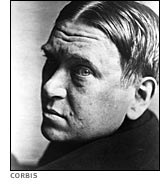
The Sage of Baltimore. [Image courtesy: The American Mercury]

Henry Louis Mencken was born on this day  in Baltimore, Maryland in 1880. Today is the 132nd anniversary of his birth.

Mencken lived in the same house in the Union Square neighborhood of the city for all but 5 years of his life. At 9 he read Huckleberry Finn by Mark Twain and knew he wanted to become a writer. His family had other ideas.

His grandfather had prospered in the tobacco business and his father, August, continued the family tradition. Mencken studied at the Baltimore Polytechnic Institute (1892-96) and then worked at his father’s cigar factory. [Books and Writers]

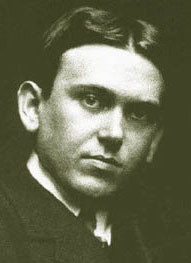
[Image Courtesy: Wikimedia Commons]

He worked for 3 years at the family owned business and would have stayed indefinitely, but upon his father’s death in 1899  Mencken was “free to choose his own trade in the world.”

Within a week, Mencken “invaded” the city room of the old Baltimore Morning Herald to face down the city editor and ask for a job…There were no jobs that day, but Mencken, persistent, returned daily for two weeks. “Finally I was sent out on a small assignment — it was a stable robbery at Govans — and a few days later I was on the staff,” [H.L. Mencken, Pioneer Journalist, By Jacques Kelly The Baltimore Sun]

His skill as a writer and his reputation for being able to turn a phrase grew. So 6 years later when the Herald closed its doors Mencken applied for a position at the larger Baltimore Sun.  He started at “The Sun as its Sunday editor, became an editorial writer, and in 1911 started writing his own column, the Free Lance Mencken.”  He worked at The Sun until 1948, bring his unflinching wit and critical eye to everything he saw.

“I believe that a young newspaper reporter in a big city… led a live that has never been matched… for romance and interest.” [Mencken from his only known audio interview. Courtesy of: The American Mercury.com]/

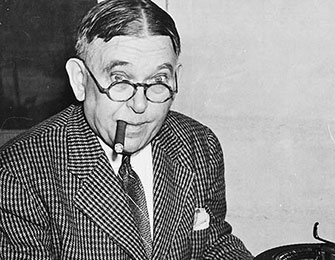
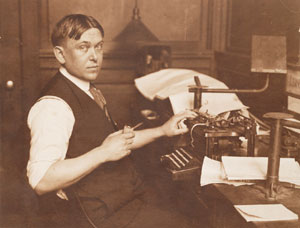
Mencken at work. [Image Courtesy: Enoch Pratt free Library Digital Collections.]

He was a war correspondent in Germany and Russia from 1916 to 1918. During WWI Mencken was pro-German (a very unpopular thing to be in patriotic Baltimore of 1917).

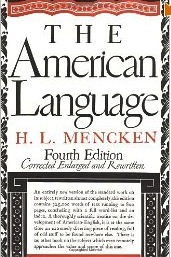
In 1919 he published The American Language, a guide to American expressions and idioms.

From 1914 to 1923 Mencken co-edited with drama critic George Jean Nathan (1882-1958) the Smart Set, which mocked everything from politics to art, universities to the Bible…[Books and Writers]

He preferred realism to modernism and he helped the careers of Sinclair Lewis, Dorothy Parker and Eugene O’Neill.

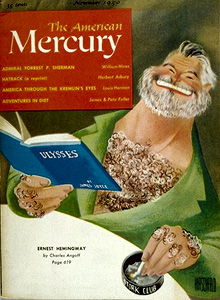
Cover of the American Mercury [Image Courtesy: Wikipedia]

He started The American Mercury monthly magazine, working on the magazine from 1924 t0 1933.

A stroke in 1948 left him nearly unable to read or write. Speaking took a lot of effort, and he grew easily frustrated. He spent his remaining days organizing his papers and letters (which can now be found in H.L. Mencken Room and Collection at the Central Branch of the Enoch Pratt Free Library on Cathedral Street in Baltimore.

[Image courtesy: MPT]

Here are a few more quips from the Sage of Baltimore:

  • “A cynic is a man who, when he smells flowers, looks around for a coffin.”
  • “Nature abhors a moron”
  • “Do not overestimate the decency of the human race”
  • “A man loses his sense of direction after four drinks; a woman loses hers after four kisses”
  • “Love is like war; easy to begin but very hard to stop”
  • “It is a sin to believe evil of others, but it is seldom a mistake.”
  • “Conscience is the inner voice that warns us somebody may be looking.”
  • “You come into the world with nothing, and the purpose of your life is to make something out of nothing”
  • “Most people are unable to write because they are unable to think, and they are unable to think because they congenitally lack the equipment to do so, just as they congenitally lack the equipment to fly over the moon.”
  • “I believe that it is better to tell the truth than a lie. I believe it is better to be free than to be a slave. And I believe it is better to know than to be ignorant.”

Heck yes! I’m a Stats Junkie

I’m a total Stats Junkie.

I turn on my computer. I check my email. I check my Facebook page. And in one last attempt to check the validity of my existence as a human being, I check the stats on my WordPress page.

The funny thing is I’m not generally a narcissistic creature. But in this electronic, faux culture of cyber space I have become addicted to the monkey on my back that is FEEDBACK. So even while I’m writing and researching the Thought of the Day I find myself glancing up to that mini stat indicator eyelash above the Edit Post. [Yes, I just did it.]

Honestly, I’m happy when I get 30 or so hits in a day. That’s decent, right? 30 people stopping by is worth the effort I’ve put into any given post. Maybe I’ve touched some one, made them laugh, given them a nugget of new information that they can share at the water cooler. That’s cool.

A fifty day? Boy-ya! I’m feeling good about myself. Seriously. “Give that fan a contract.” (That’s an Oriole’s thing, if you’re wondering.)

Up until this week my best day was 95! It was a Shakespeare inspire day and it was pretty awesome.

My stats as of about 48 minutes ago.

Then a couple of days ago I wrote a little tribute to my cousin Pat “Scunny” McCusker (who, sadly, had just passed away) and things went  through the roof. My stats topped out at 105. That’s an awesome day. Except, well,  it wasn’t. The only thing awesome about getting those stats was that it served as a continuing reminder that Pat touched a lot of hearts. Believe me, I’d much rather have a month of single digit days than have the reason for the spike you see over Aug 29.

So what about today? Well… it’s a rainy day, and a holiday, and people are home with nothing to do. No doubt that explains that second spike. And I’ve got to give another nod to Pat because 10 of these hits were from web searches on his name. But that’s still a pretty awesome day. This is how it looked  when I checked in at 7:00 Eastern Time…

At 8:00, when the stats click over for another day, the views had ticked up to 110 hits from 13 countries for 12 blog posts and the current home page.  Not bad at all. That plus… the Orioles won today.

So thanks everybody! Keep on stopping by virtual desk to see what I’m working on.

Cheers,

Rita


Ain’t THAT beer cold? Remembering Scunny McCusker

First of all… he was Pat to me.

Pat McCusker and I were cousins — a trio of kids born with-in a few months of each other (my cousin Mike rounded out the triumvirate.)

But to the rest of the world he was Scunny McCusker.

Scunny died last Friday night when he was hit by a bus while riding his bike in Ocean City, Maryland.

The outpouring of sympathy and love from all the people he has touched over the years has been amazing and incredibly touching.  There were thousands of visitors at  funeral parlor both Monday and Tuesday, with lines out the door and around the building. And today at the Cathedral of Mary our Queen the church was standing room only with over 2,000 loving supporters.

The funeral procession was lead by a National Bohemian Beer truck. I guess I need to tell you that Pat owned two bars/ restaurants in the Canton area of Baltimore, and he was a huge Natty Boh fan. A police escort helped the mile long procession of cars navigate the route to the cemetery by closing down sections of I-83 and the Beltway. The crowd around the grave site was the size of the infield at Oriole’s Park.

Why such the fuss? Well, Pat had a big heart. “He never met a charity he didn’t like” according to US Representative Ben Cardin, but he was especially active in the Believe In Tomorrow Children’s Foundation.  The charity:

 provides exceptional hospital and respite housing services to critically ill children and their families. We believe in keeping families together during a child’s medical crisis, and that the gentle cadence of normal family life has a powerful influence on the healing process.

and along with fund-raising for the organization Scunny provided thousands of meals for the families in need.

I have to admit that I’ve lost touch with Pat over the years. We only saw each other at the occasional wedding and funeral. He owned a bar… I don’t really drink. We grew up and older and apart. But listening to the stories this week I wish I HAD stay in touch better.

This one’s for you, Pat / Scunny.

May the road rise to meet you.

May the wind be ever at your back.

May the sun shine sweet upon your face,

the rains fall soft upon your fields.

And until we meet again,

may God hold you in the palm of your hand.

http://www.abc2news.com/dpp/lifestyle/memorial-for-patrick-scunny-mccusker-today

http://northbaltimore.patch.com/articles/funeral-held-for-patrick-scunny-mccusker#photo-11168610


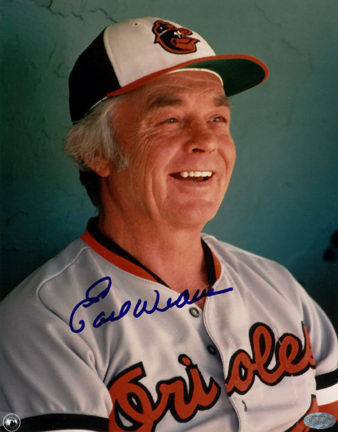
Thought of the Day 8.14.12 Earl Weaver

“I became an optimist when I discovered that I wasn’t going to win any more games by being anything else.”

Earl Weaver

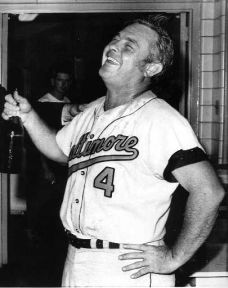
Earl Sidney Weaver was born on this day in St. Louis, Missouri in 1930. He is 82 years old.

Weaver managed the Baltimore Orioles from 1968-1982 and again from 1985-1986.  He became a Hall of Famer a decade later.

He played second base for 13 years in the minor leagues, then he managed for another dozen years in the minors before making it to the Show as a first-base coach for the Orioles in 1968. He took over as Manager in July of that season.

He wore #4 on his Oriole’s jersey and had a .583 winning record while managing the club. The team won 6 American League East titles, had 5 100+ win seasons, won 4 A.L. pennants, and won the 1970 World Series under his leadership.

Weaver didn’t want to bunt or sacrifice to advance a runner, according Hall of Fame player Frank Robinson, “He didn’t even have a hit and run sign…” Earl was all about the three run home run.

He pioneered the use of radar guns to track fast balls in 1975’s Spring Training season (according to the National Baseball Hall of Fame.)

He was famous for his heated arguments with umpires that often ended with the manager kicking Memorial Stadium’s infield dirt at the official. Weaver was tossed from 91 regular season games.

Locals also remember the “Tomato Wars” he had with groundskeeper Pat Santarone. Santarone had a patch of plants in the left field foul area, Weaver grew his maters at home. The two argued (good naturedly) for 17 years over who had the best tomatoes in Baltimore.

After he left the O’s he worked as broadcaster for ABC television providing color commentary during the 1983-84 baseball seasons. He also did Manager’s Corner with Tom Marr while he was with the O’s (some times to very colorful effect.)

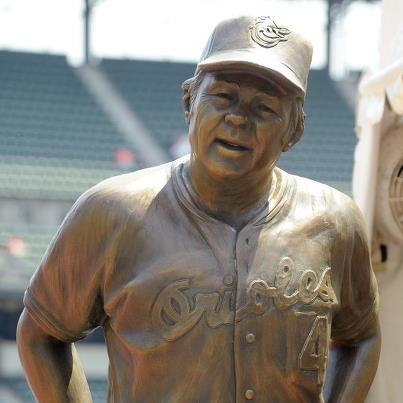
He was elected to the Baseball Hall of Fame in 1996.  A bronze statue of the manager was erected at Camden Yards (the “new” home of the Orioles) in June of this year.  At seven feet the statue towers over the real life Weaver, who is only 5’7″.  Weaver quipped “I guess there will be a lot of kids looking up at me…saying, ‘who is this?'”


Thought of the Day 8.3.12 Leon Uris

“Often we have no time for our friends but all the time in the world for our enemies.”

–Leon Uris

Leon Marcus Uris was born on this day in Baltimore, Maryland in 1924. This is the 88th anniversary of his birth.

Son of Polish and Russian Jewish immigrants Leon went to schools in Baltimore, Norfolk and Philadelphia. He failed English three times, but he loved History and Literature. He allegedly wrote an operetta about the death of his dog when he was only six years old.

When the Japanese attacked Pearl Harbor on December 7, 1941 Uris dropped out of high school and enlisted in the Marine Corps. He served from 1942 to 1945 in the South Pacific. He  was a radio operator  and saw combat at Guadalcanal and Tarawa. When he contracted malaria he was sent to San Francisco to recuperate. There he met his first wife Marine sergeant Betty Beck.

1st edition cover Pages: 694 pp (Mass Market P...

1st edition cover Pages: 694 pp (Mass Market Paperback) (G.P. Putnam’s Sons) (Photo credit: Wikipedia)

After his discharge from the service he worked  for the San Francisco Call-Bulletin and wrote fiction in his spare time. His first book, Battle Cry,  retold his war experiences. Published in 1953 ,and made into a movie by Warner Brothers with Uris as screen writer, the film did well at the box office.

His second novel also took place during WWII, but this time in the European Theatre. The Angry Hills is about Greek resistance fighters.  It too was made into a movie, this one starring Robert Mitchum.

Research Uris did for The Angry Hills and his time  as a war correspondent during Arab-Israeli fighting in 1956  lead to most his most successful novel, Exodus. Published in 1958 the book is the result of  thousands of interviews. Uris traveled 12,000 miles in Israel and read hundreds of books on Jewish history. Doubleday bought the book which out sold Gone with the Wind, becoming the biggest bestseller in the United States. It was translated into 50  languages. A blockbuster movie starring Paul Newman came out in 1960.

Mila 18 is about Jewish resistance fighters during the Warsaw uprising. Armageddon: A Novel of Berlin is about the complications of the Cold War during and after and the Berlin Airlift. Topaz, a spy story, has the Cuban Missile Crisis and the Cold War in its cross hairs. Alfred Hitchcock  directed it for the big screen.  QBVII  is a courtroom drama about a doctor who was pressed into service in a Nazi concentration camp.  It was made into a mini series starring Anthony Hopkins in 1974.

In Trinity Uris tacked the troubles in Ireland, following the lives of several families from the potato famine to the Easter Uprising. Redemption, written two decades later follows up on the Irish story.

The Haj delves again into the troubled Middle East. The Milta Pass is about the Suez Crisis.

A God in Runs takes on the American political scene when Quinn Patrick O’Connell runs for president. His last novel, O’Hara’s Choice, was published posthumously, and was not well received.

Non fiction works include: Ireland: A terrible Beauty and Jerusalem: Song of Songs both include photographs by his with Jill Uris.

More on Leon Uris try this site: http://www.kirjasto.sci.fi/uris.htm


Thought of the Day 7.18.12

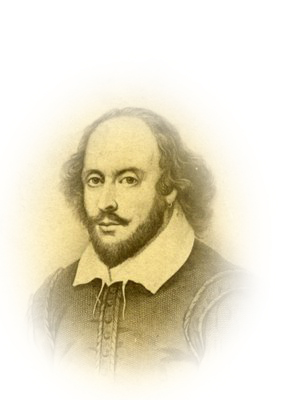
Today I’m thinking about Shakespeare. Why? because I got to see Baltimore Shakespeare Factory’s Love’s Labour’s Lost last Friday and I’m going to see Chesapeake Shakespeare Company’s Romeo and Juliet this Sunday. Two very different plays and two very different approaches. How lucky am I to live in a city that offers two ways to experience the Bard?

So instead of the regular birthday tribute (Shakespeare’s birthday is April 23rd for any one who is keeping track) I give you… Shakespearian insults. Because you never know when you might need a really tell some one that they are “a flesh-monger, a fool and a coward.” (Measure for Measure).

An 1870 oil painting by Ford Madox Brown depicting Romeo and Juliet’s famous balcony scene.

Here are a few from Romeo and Juliet:

… He’s a man of wax
You kiss by the book
He heareth not, he stirreth not, he moveth not, the ape is dead
She speaks yet she says nothing
He is not the flower of courtesy
You rat catcher
A dog, a cat, a mouse, a rat to scratch a man to death
A plague on both your houses
Thou detestable maw
Thou womb of death

A scene from Love’s Labour’s Lost as put on by the Acting Co. of New York in 1974. Here the boys try to fool the girls into thinking they are a bunch of visiting Russians.

Here are a few from LLL:

Taffeta phrases, silken terms precise,
Three-piled hyperboles, spruce affectation,
Figures pedantical; these summer flies
Have blown me full of maggot ostentation:
I do forswear them.

They have been at a great feast of languages, and stolen the scraps.

From other Plays:

A most notable coward, an infinite and endless liar, an hourly promise breaker, the owner of no one good quality. (Alls Well That Ends Well.)

Thine face is not worth sunburning. (Henry V)

There’s no more faith in thee than in a stewed prune. (Henry V)

Thou art as loathsome as a toad. (Troilus and Cressida)

Thou art like a toad; ugly and venemous. (As You Like It)

I must tell you friendly in your ear, sell when you can, you are not for all markets.” (As You Like It.)

Thou art a flesh-monger, a fool and a coward. (Measure for Measure)

You secret, black and midnight hags (Macbeth)

Thou subtle, perjur’d, false, disloyal man! (The Two Gentleman of Verona)

“Thou art a base, proud, shallow, beggarly, three-suited, hundred-pound, filthy worsted-stocking knave; a lily-liver’d, action-taking, whoreson, glass-gazing, superserviceable, finical rogue; one-trunk-inheriting slave; one that wouldst be a bawd in way” (King Lear)

“Thou art a boil, a plague sore, an embossed carbuncle in my corrupted blood.” (King Lear)

“I’ll beat thee, but I should infect my hands.” (Timon of Athens)