Category Archives: Art

Thought of the Day 9.25.12 Shel Silverstein

“Listen to the mustn’ts, child. Listen to the don’ts. Listen to the shouldn’ts, the impossibles, the won’ts. Listen to the never haves, then listen close to me… Anything can happen, child. Anything can be.”

–Shel Silverstein
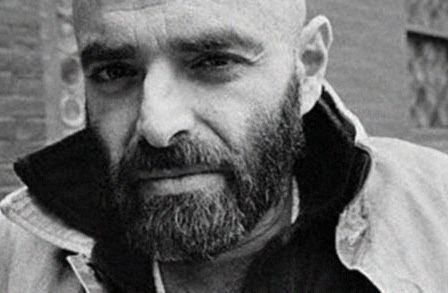
[Image courtesy: Poetry Foundation]

Sheldon Allan Silverstein was born on this day in Chicago, Illinois in 1930. Today is the  82nd anniversary of his birth.

Shel grew up in the Logan Square area of Chicago. He was notoriously private and seldom gave interviews so there is not much know about his early life. In one of the rare interviews he gave he said:

“When I was a kid—12 to 14, around there—I would much rather have been a good baseball player or a hit with the girls, but I couldn’t play ball. I couldn’t dance. Luckily, the girls didn’t want me. Not much I could do about that. So I started to draw and to write. I was also lucky that I didn’t have anybody to copy, be impressed by. I had developed my own style…” [Publishers Weekly, February 24, 1975.]

At 12 he became interested in cartooning and would practice his drawing by tracing comics, including Al Capp, from the “funny papers.” He attended the University of Illinois (for “One useless semester”), and the Art Institute of Chicago (for a summer session) before landing at Roosevelt University. It was a Roosevelt that he was first published, his cartoons appeared in the Roosevelt Torch.

In 1953 he was drafted into the US Army. He served from 1953-1955 and worked as a cartoonist for Stars and Stripes Newspaper. He said in a later Stars and Stripes interview that the Army  helped his art work because he didn’t have to worry about selling the cartoons anywhere. He was guaranteed 3 square meals a day. The Army also gave him the structure of a daily deadline. [To read the entire Stars and Stripes interview go to Off On a Tangent: Shel Silverstein Stars & Stripes Interview] His book Take Ten is a compilation of the cartoons he drew for Stars and Stripes.

Take Ten cover art. (Image courtesy: Amazon.com]

When he got out of the Army he found it difficult to sell his work on a regular basis. He freelanced for Sports Illustrated and Playboy and in 1956 he became a staff cartoonist for Playboy. He contributed poems and published several collections of his cartoons through the magazine.

Then in 1963 things took a turn.

“…at the suggestion of fellow illustrator Tomi Ungerer, he was introduced to Ursula Nordstrom who convinced him to begin writing for children. One of Silverstein’s most popular books, The Giving Tree, was published in 1964.” [Shel Silverstein, Introduction by Meghan Ung. Humanities on the Internet]
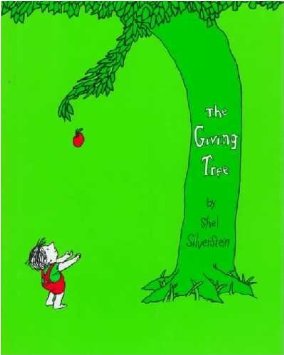
Cover art for The Giving Tree [Image courtesy: Amazon.com]

No on had wanted to publish the book. They thought it was too sad for a children’s book. They thought it was too short. They couldn’t pigeonhole it as either for adults or children. But they all agreed it was wonderful. Then Harper and Row gave it a chance and it became a classic in children’s literature.

Here’s the 1973 animated movie of The Giving Tree narrated by Silverstein:

1974’s Where the Sidewalk Ends, a collection of poetry for children, won the New York Times Outstanding Book Award. The collection has been republished several times with Silverstein added poems at the 25th and 30th anniversary.  Here’s one of my favorite poems from the book, Hug o’ War:

Hug o’ War

I will not play at tug o’ war.

I’d rather play at hug o’war.

Where everyone hugs

instead of tugs,

Where everyone giggles

and rolls on the rug,

Where everyone kisses,

And everyone grins,

And everyone cuddles,

And everyone wins.

Next up was The Missing Piece is a beautifully written story about a circle who is looking for its soul mate. The nontraditional ending is both truthful and bittersweet.

A Light In the Attic brought more wonderful poems and illustrations. [Backward Bill always cracked us up at our house…]

…Backward Bill’s got a backward pup.

They eat their supper when the sun comes up…

Silverstein’s illustration of Backward Bill. [Image courtesy: Amazon.com]

Silverstein wrote a sequel to The Missing Piece called The Missing Piece Meets the Big O (see below) which won the 1982 International Reading Association’s Children’s Choice Award.

The Shel Silverstein collection  — “borrowed” from the shelves of an obliging independent brick and mortar bookstore, Greetings and Readings, Hunt Valley, Maryland.

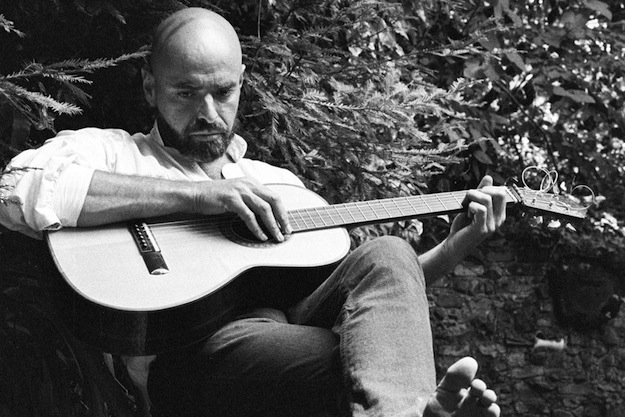
Silverstein also had a musical side. He played guitar and wrote songs, including the Johnny Cash hit A Boy Named Sue, the Irish Rovers “Unicorn Song” and the Dr. Hook song “The Cover of the Rolling Stone.” He performed on several albums (both his own and others.)

He was also a playwright. He had a hit with The Lady or the Tiger Show a play where contestants in a game show have to choose between two doors. Behind one door is a beautiful woman, behind the other door is a man-eating tiger. He co-wrote Oh, Hell! with David Mamet for Lincoln Center. The two worked together again on the film Things Change.

Silverstein died of a heart attack on May 10th, 1999 in Key West.
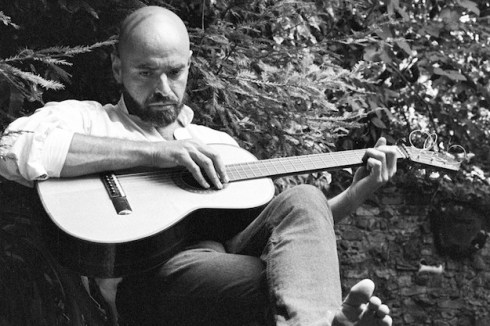
Shel playing his guitar. [Image courtesy: 105.7 Hawk]
Here’s the YouTube video for The Missing Piece Meets the Big O, I’d never read this book, or seen this video, but I just loved the message and had to share it…
Thought of the Day 9/24/12 Jim Henson

“My hope still is to leave the world a bit better than when I got here.”
–Jim Henson

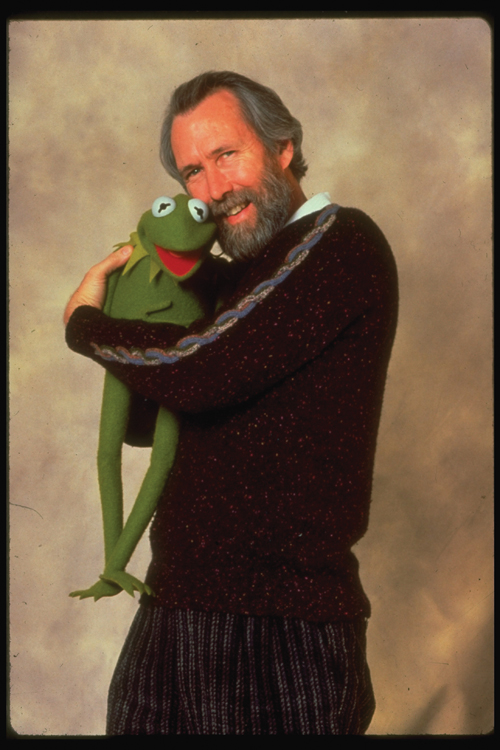
James Maury Hensonwas born on this day in Greenville, Mississippi in 1936. Today is the 76th anniversary of his birth.

He grew up  near Leland,  Mississippi exploring the countryside around his home. He was encouraged to pursue his artistic side, but he didn’t see a puppet show until the family moved to Washington, D.C. in the late 40’s. Henson recalled the family getting their first television as “the biggest event of his adolescence.” He enjoyed watching early puppet shows like Kukla, Fran and Ollie, Edgar Bergen and Charlie McCarthy, and Bil Baird and Charlemagne the lion. While still at Northwestern High School he got his first TV experience on WTOP-TV where he created and performed puppets for The Junior Morning Show on Saturday mornings. At the University of Maryland  Henson  was a studio arts major with hopes of working that into a career in stage or television design.

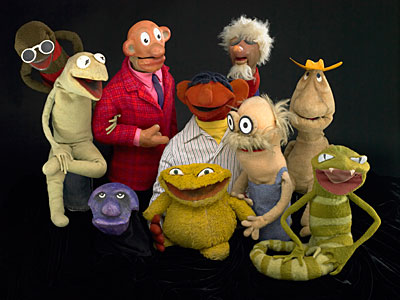
As a freshman he worked for WRC-TV on a five-minute long program that ran nightly at 6:40 pm called Sam and Friends. For the show he created a cross-breed of a marionettes and hand puppets  which he called “muppets.” Muppets were more flexible and could express more emotion than traditional puppets. Instead of painted wood he used foam rubber-covered with fabric which gave the creatures soft bodies. He gave them large mouths “that allowed them to convey a wide range of emotions.” [The Mississippi Writers Page]

The Sam and Friends characters were donated to the National Museum of American History in Washington, DC [Image courtesy: National Museum of American History]

Here’s a sketch from Sam and Friends

He asked fellow UofM freshman Jane Nebel to help him on the show. Hensen and Nebel married in 1959 and had five children together.

Sam and Friends ran for six seasons and…

proved the stepping stone for a series of commercials that brought him nationwide fame. Soon, he was making guest appearances on such national network programs as The Steve Allen ShowThe Jack Paar ShowThe Tonight ShowEd Sullivan, and The Jimmy Dean Show, and weekly appearances on The Today Show …[The Mississippi Writers Page]

Muppets, Inc. grew. Jim and Jane added puppeteer and writer Jerry Juhl, puppet builder Don Sahlin and puppeteer Frank Oz to the fold. In 1968 they created a special for National Education Television “Muppets on Puppets” a 9 minute mini documentary on the world of puppeteering.

<iframe width=”420″ height=”315″ src=”http://www.youtube.com/embed/MUdJVsDpGTI&#8221; frameborder=”0″ allowfullscreen>

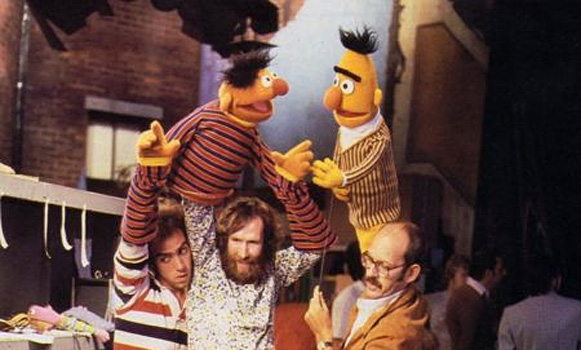
The next year Sesame Street premiered. Children’s Television Workshop asked Henson and his creative team to develop a family of muppets to populate Sesame Street. They came up with Bert and Ernie, Big Bird, Oscar the Grouch, Grover, the Cookie Monster and others.

Hensen, center, works on Sesame Street. [Image courtesy: Jedimouseketeer.com]

Next came  the weekly syndicated variety show, The Muppet Show, starring Kermit. The show included an expanded cast of muppets (like Miss Piggy, Gonzo, the Count, and Elmo) and featured a human guest star. It ran from 1976 to 1981.

Here’s a clip from the show featuring John Cleese…

<iframe width=”420″ height=”315″ src=”http://www.youtube.com/embed/EyMCG0dWeQA&#8221; frameborder=”0″ allowfullscreen>

Movies followed. Henson found success with both Muppet productions and other puppet enhanced movies like The Dark Crystal and Labyrinth.

Henson won 18 Emmy Awards, 7 Grammy Awards and 4 Peabody Awards in his 30 year career and touched millions of lives. He died from complications of pneumonia in New York on May 16, 1990. Here’s “Just One Person” (one of my favorite Muppet songs) performed at Henson’s tribute.

<iframe width=”420″ height=”315″ src=”http://www.youtube.com/embed/0Zzfdlxjx4Y&#8221; frameborder=”0″ allowfullscreen>


Thought of the Day 9.22.12 Louise Nevelson

“I never feel age…If you have creative work, you don’t have age or time.”

–Louise Nevelson

Leah Berliaswsky was born on this day in Perislav, Russia in 1899. This is the 113th anniversary of her birth.

Her family lived in Czarist Russia until 1905 when they emigrated to Rockland, Maine in the United States. Her father worked as a woodcutter, owned a junkyard, a lumberyard and became a realtor.

When Leah saw a bust of Joan of Arc at the local library she knew she wanted to become an artist. She started to take art lessons, and experimented in drawing & watercolors.

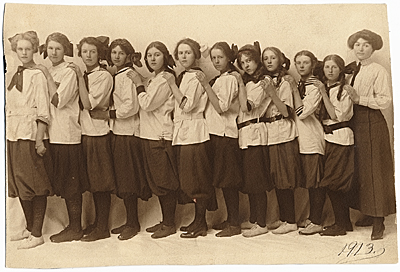
Nevelson in a 1913 class picture. (She is fourth from the left) [Image is courtesy Wikimedia Commons.]

Upon graduating high school she began to work as a stenographer in New York. She met Charles Nevelson of the Nevelson Brothers shipping company. The two married in 1920. She began to study art in earnest adding singing, acting and dancing to the mix. In 1922 she gave birth to Myron (Mike) Nevelson. Two years later the family moved to Mount Vernon, NY. Louise felt stifled by the small town environment and role she was expected to play as dutiful wife. She longed for the artistic life she knew in New York City.

Louise Nevelson as a young woman. [Image courtesy: Abstract Artist.org]

In 1931 she left both her husband and her son and took a trip to Europe. She studied with cubist Hans Hofmann in Munich, but as the NAZIs began their stranglehold on the city she left for Italy and France.  In 1932 she came back to the United States, where she continued to work with Hofmann (he was now teaching at the Art Students League) and she officially separated from her husband. In 1933 she worked with Diego Rivera on his Man at the Crossroads mural at Rockefeller Plaza. Shortly after that she took a sculpture class at the Education Alliance, and decided to focus on sculpture as her medium of choice.

At first she produced…

primarily cubist figure studies made from bronze, plaster and clay… It wasn’t until 1943 that the art-world got their first glimpse of what would become Nevelson’s signature style of assembling wood.  [Abstract Artist.org]

In the 1940s she began to make pieces from reclaimed materials and scraps of wood.

Nevelson… crafted surreal, totemic monuments that served loosely as maps to the artist’s mind. … Nevelson also cultivated her extravagant personal style, which included long dresses and false eyelashes, to dovetail with her desire to express emotion through art. [The Art Story.org]

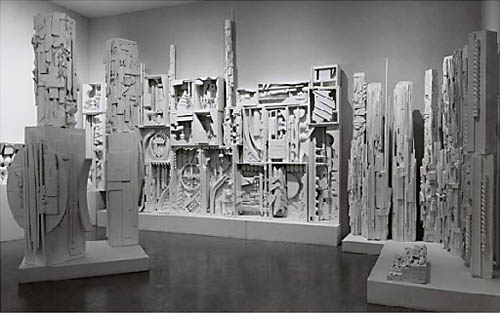
One of her most famous sculptures is Dawn’s Wedding Feast, a room size installation created in 1959 made of wood and white paint. The installation has four chapels, a bride, groom, wedding cake, various other pieces and hanging columns that represent the wedding guests. It was too big and too expensive for one buyer to purchase so Nevelson broke the installation into sixteen stand alone pieces.


Dawn’s Wedding Feast, 1959-60 [Image Courtesy

In her “Late Period” she abandoned “typical carpentry” and “Her process became purely additive, wherein she stacked and balanced objects before nailing together and painting them…” [The Art Story.org]  She selected small scaled pieces that worked together to form a larger installation.

Black Zag Z — 1969 [Image courtesy: Abstract Artist.org]

Nevelson and her granddaughter Neith in 1967. Photo by Ugo Mullas. [Image Courtesy Amazon.com]

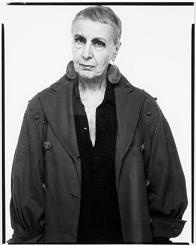
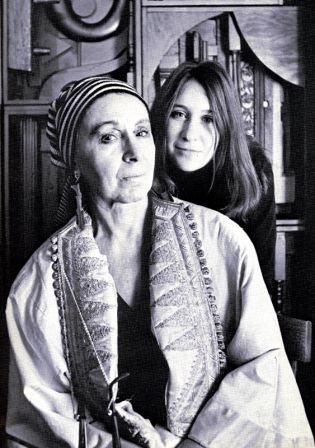
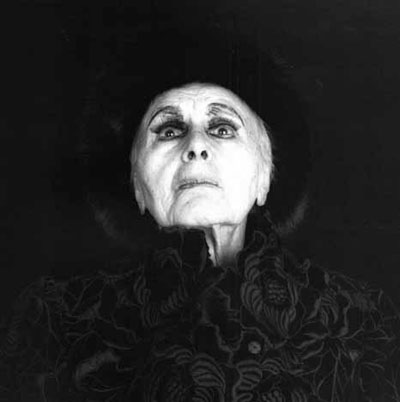
Nevelson toward the end of her life. [Abstract Artist.org]

By the time she died in on April 17,1988, Louise Nevelson was considered by many to be one of the most important American sculptors of the twentieth century and one of the world’s best-known woman artists.  [Abstract Artist.org]


Thought of the Day 9.5.12 Freddie Mercury

“F*ck today, it’s tomorrow.”

“What will I be doing in twenty years’ time? I’ll be dead, darling! Are you crazy?”

— Freddie Mercury

(Image courtesy of Fan Pop)

Farrokh Bulsara was born on this day in British Zanzibar, East Africa in 1946. He would have been 66 years old.

He grew up in Zanzibar and India. He attended St. Peter’s School, a British-style boarding school in Panchgani. The students at St. Peter’s anglicized his name to Freddie. Although he hated some of the school’s sports — running and cricket — he like others — hockey & boxing, and he became the school champion at table tennis at 10. He preferred art and music. He took private piano lessons and enjoyed Bollywood musicals. At school he formed a cover band that performed rock and roll. He also joined the school choir and participated in several theatre productions.

In 1964 when Freddie was 17 there was a great deal of unrest in Zanzibar, most of it directed at the British and Indian ex-pats. So Freddie and his family moved to Feltham, Middlesex, England. There he received a Diploma in Art and Graphic Design from the Ealing Art College. All the while he performed in bands. He also worked part-time selling second-hand clothes at Kensington Market and worked in a catering department at  nearby Heathrow Airport.

After stints with the bands Ibex and Sour Milk Sea he, Brian May (guitar) and Roger Taylor (drums) formed Queen. John Deacon rounded out the group in 1971.

Mercury designed Queen’s logo. (Image courtesy of Lost at E Minor.com)

Freddie changed his last name to Mercury when he started Queen.  As lead singer for the group Mercury’s range went from a low bass F to a high tenor F, 3  full octaves. He wrote the lion share of the group’s songs including Bohemian Rhapsody, Killer Queen, Somebody to Love, We Are the Champions and Crazy Little Thing Called Love.

http://youtu.be/k-ARuoSFflc

He hated to do the same thing twice so he borrowed from a variety of genres when writing. So from the opera inspired Bohemian Rhapsody to the rockabilly Crazy Little Thing Called Love, Mercury proved just how mercurial he could be.

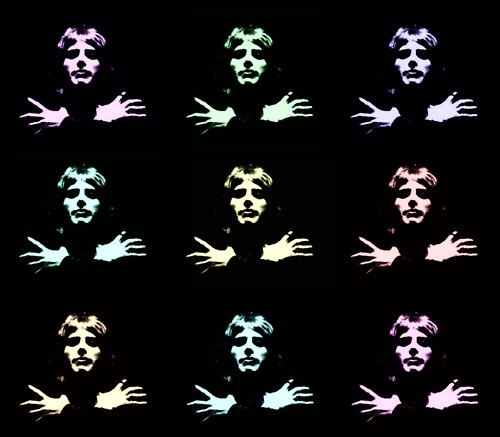
(Image courtesy of Fan Pop)

He was an amazing show man on stage. Queen gave over 700 concerts worldwide.

It wasn’t anything that could be developed. It was his charisma, his pure natural gift that was in perfect harmony with his voice, his appearance, his delicate taste and his musicianship in the wide sense of the word. The fact that he realized it himself made him absolutely fascinating! [Freddie Mercury: biography by Jacky Gunn & Jim Jenkins]

Their 20 minute set at Live Aid at Wembley Stadium stole the show. Freddie sings, struts, dances, plays piano and guitar, gives 110%,  and has a hell of a good time. (Plus, how much fun is it to hear 72,000 people singing along to a Queen song?)

He  produced two solo albums, Mr. Bad Guy and Barcelona and several singles. And he did solo side gigs including a performance with the Royal Ballet where he danced  in font of a packed audience of ballet enthusiasts to orchestral versions of Bohemian Rhapsody and Crazy Little Thing Called Love. He received  a standing ovation. Freddie co-wrote Love Kills for the re-release of Fritz Lang’s 1926 classic film Metropolis.

Freddie Mercury died of AIDS in 1991 at the age of 45.


Thought of the Day 9.3.12 Ludovico Ariosto

“When the devil grows old he turns hermit”

Ludovico Ariosto 

c. 1510

c. 1510 (Photo credit: Wikipedia)

Ludovico Ariosto was born on this day in Reggio Emilia, Italy, in 1474. Today is the 538th anniversary of his birth.

Ariosto was the eldest of 10 children born to an affluent family. His father, Count Niccolo Ariosto, was the commander of the citadel, and Ludovico was supposed to follow in the his footsteps. He studied law, languages and literature.  He had a great love of poetry and wanted to become a writer, but he was obliged to support his family. When his father died, in 1500, he took over the family estate. In 1503 he began to work for Cardinal Ippolito D’Este who acted as Ariosto’s patron for a few years. Later he worked for the Cardinal’s brother, Alfonso I, Duke of Ferrara. In 1522 he was sent to wilderness of Garfagnana, Ferrara as governor. He did not take to the remote location of the bandits.

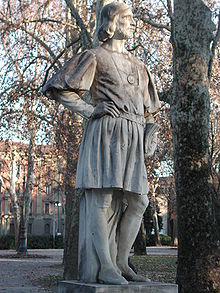
Statue of Ludovico Ariosto in Reggio Emilia

Ariosto snuck time to write some comedies, prose and poetry when his duties permitted. His play Cassaria was staged in 1508 and I Suppositi followed in 1509. (It was translated into English and was the inspiration for parts of  Shakespeare’s The Taming of the Shrew.) He wrote 5 comedies and 7 satires.

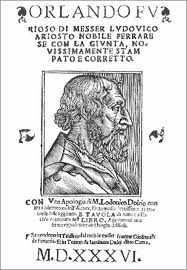
His greatest work, indeed ” the most celebrated narrative poem of the Italian high Renaissance” [Books and Writers] was Orlando Furioso. It was first published in 1516 at a length of  40 cantos.  The epic poem was revised and added to several times with the final version, at 46 cantos, appearing in 1532.  An additional 5 cantos , the Cinque canti were published by his son Virgino after the poet’s death.

 The plot revolves around the conflict of the Christian versus the Moor, the war between Charles, the Holy Roman Emperor, and Agramante, King of North Africa, and Marsilio, King of Spain. With the defeat and death of Agramante, the conflict ends, and Marsilio returns to Spain. [Books and Writers]

Two editions of Orlando Furioso.

The piece was so popular that, rumor has it, when the last revision came out Queen Elizabeth banned the English translator of the work from Court until he completed his task so he wouldn’t be distracted. Artist, composers and other writers have used characters from Orlando Furioso as their muse. Portrait of a Gentleman by Titian is one such work. His A Man with a Quilted Sleeve is believed to be Ludovico.


Celebrate Good Times, Come ON! 100 post!!!


Wordpress Button Closeup

WordPress Button Closeup (Photo credit: Titanas)

Instead of my usual Thought of the Day I wanted to share the exciting news that ritaLOVEStoWRITE has hit a milestone.  This is my 100th post on WordPress!

Thank you to all of the readers who have hit the blog 2,700 plus times in the last three months. And especially to my 57 dedicated followers (plus those 300 plus of you on Facebook and Twitter who follow that way.) Your LIKES, feedback and support have made these lonely hours in front of my computer well worth it.

Of course the act of researching, writing, adding the photos and editing the posts  has been its own reward. How else would I have found out about Mata Hari?

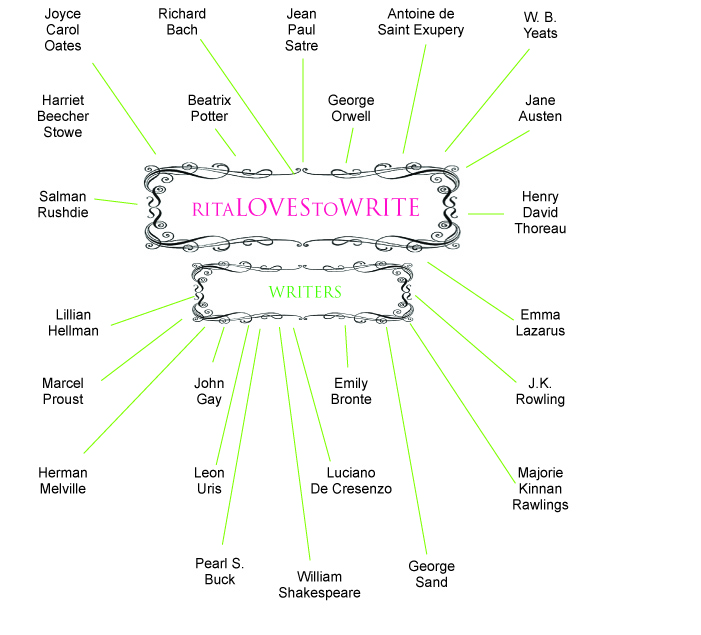
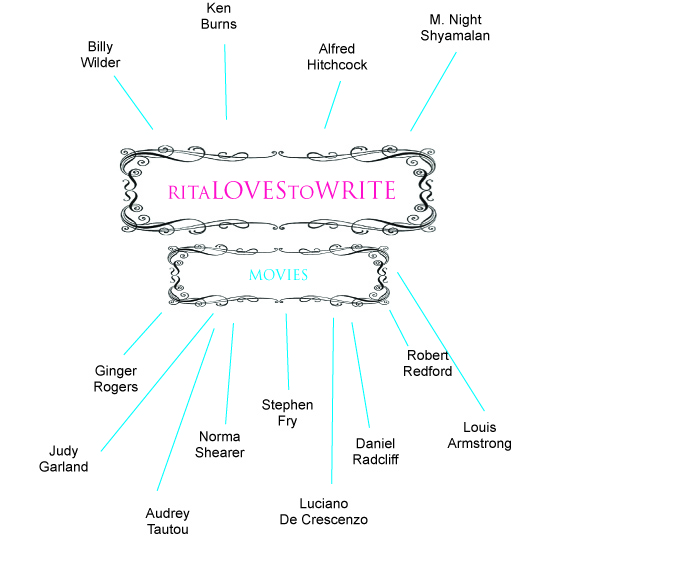
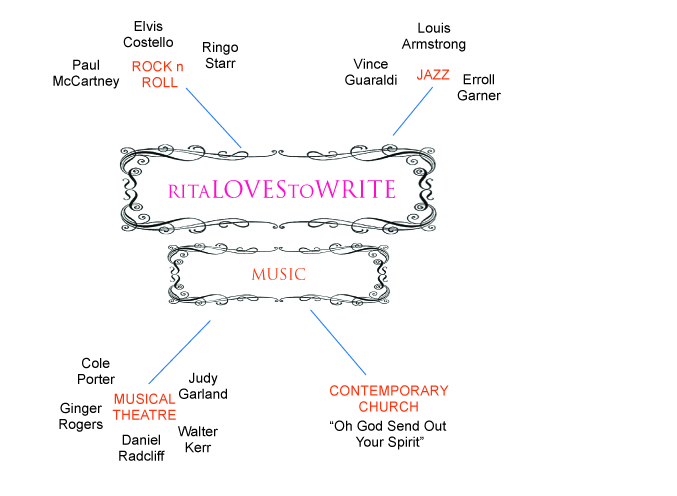
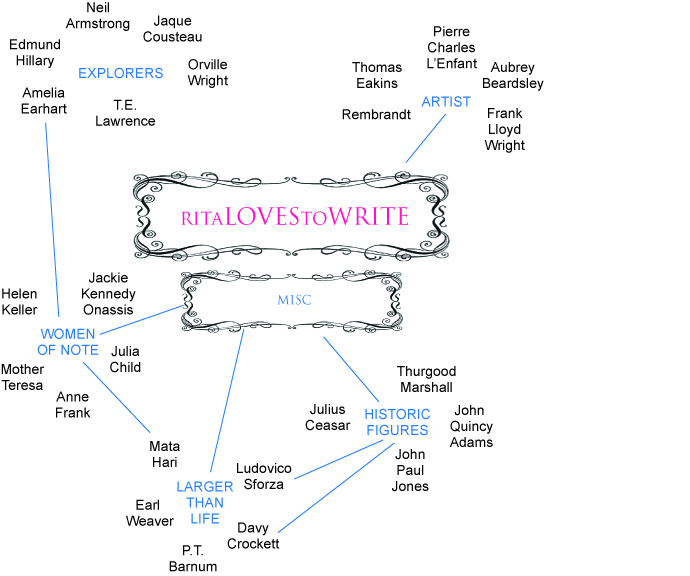
So, incase any one asks, here’s what rita WRITES about: 


I was somewhat surprised at how that broke down. While in the trenches of writing the blog I thought it weighed way to heavily on the celebrity and was too light on the cerebral, but actually I had more WRITERS than anyone else.


There was some nice cross over between Movies and Music (in Musical Theatre)…


The bulk of my 100 posts are in the Thought of the Day category, and the MISC. chart gives a who’s who of folks who didn’t fit nicely into Writing, Movies or Music. I liked the cross referencing here too.


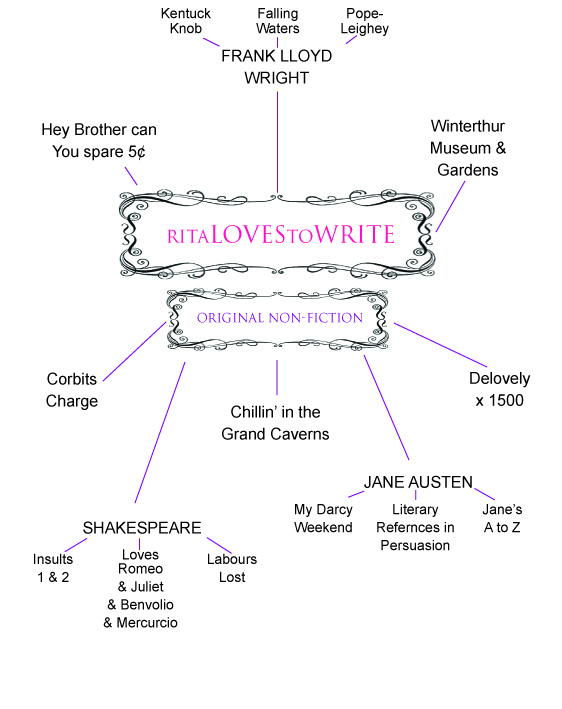
The last chart is for post that didn’t appear as a Thought of the Day entry, “Original Non-Fiction.” Hmmm. Well everything on my blog is my original work (except one repost from my friend Lynn Reynolds about Books and How to Sell Them) and so far it has been all non-fiction. So I guess EVERYTHING could be on this chart.

In the future I hope to add some fiction to the site. Would you like that?

Please know that I love to get feedback, but I’m pretty fierce about SPAM. If there is any chance something is SPAM I throw it in the trash. So if I have inadvertently trashed your perfectly legitimate comment, I apologize. It was thrown into my SPAM folder and I probably couldn’t see your website to check. PLEASE write something referring back to “ritaLOVEStoWRITE” in your comment then I’ll know it is the real deal and not some bot trolling for unsuspecting bloggers.

I’ll leave you with a Thought for Today from Australian politician Arthur Calwell who was born on this day in 1896…

“It is better to be defeated on principle than to win on lies.”

Hmmm something to think about as the (American) political season goes super nova.


Thought of the Day 8.21.12 Aubrey Beardsley

“No language is rude that can boast polite writers.”

Aubrey Beardsley

[ E ] Frederick Henry Evans - Aubrey Beardsley...

[ E ] Frederick Henry Evans – Aubrey Beardsley (1895) (Photo credit: Cea.)

Aubrey Vincent Beardsley was born on this day in Brighton, England in 1872. Today is the 140th anniversary of his birth.

Beardsley grew up in a middle class family. His paternal grandfather was in trade, but his father, Vincent,  lived on the income from an inheritance from his maternal grandfather (Aubrey’s great-grandfather). As the money from that fund began to run out Vincent worked in London Breweries. Aubrey’s mother, Ellen, gave piano lessons.  Both Aubrey and his sister, Mabel, showed a talent for music as children. The two were displayed as “infant musical phenomenons” in 1884.

He went to Bristol Grammar School and developed a talent for drawing caricatures of his teachers. He had drawing and cartoons published in the school newspaper. He set about illustrating all his favorite books. He illustrated “The Pay of the Pied Piper” for the school’s Christmas show in 1888.

At 17 he started entered the workforce as a clerk  for Guardian Life and Fire Insurance Company, but he found the job unfulfilling. Beardsley wanted a full-time employment as an artist.  With Mabel in tow he made an unannounced visit  Edward Burne-Jones’ studio. Beardsley impressed the famous Pre-Raphaelite painter with his portfolio (which he just happened to have with him,) and Burne-Jones recommended that he attend Westminster School of Art at night. The older man also introduced him to Oscar Wilde, something he later regretted.

English: How Sir Bedivere Cast the Sword Excal...

English: How Sir Bedivere Cast the Sword Excalibur into the Water. Illustration from: Sir Thomas Malory, Le Morte d’Arthur. London: Dent, 1894. Français : How Sir Bedivere Cast the Sword Excalibur into the Water (littéralement « Comment Sir Bedivere jeta l’Epée Excalibur dans l’eau). Illustration tirée de Le Morte d’Arthur par Sir Thomas Malory, London: Dent, 1894. (Photo credit: Wikipedia)

Beardsley was busy in 1893 and 94. He worked steadily on covers and book illustrations (for both books and periodicals) and worked on J.M. Dent’s version of Malory’s Morte Darthur — a 12 volume work that contained over 300 illustrations.  Burne-Jones, his mentor, wasn’t pleased with the work he completed for ‘Arthur’, finding some of the borders filled with vulgar  phallic flowers  and some of the illustrations sloppily done.  In truth, Beardsley had lost interest in the massive project and told Burne-Jones that he had come to hate King Arthur ‘and all mediaeval things’.

The Climax

The Climax (Photo credit: Wikipedia)

"The Peacock Skirt", illustration by...

“The Peacock Skirt”, illustration by Aubrey Beardsley for Oscar Wilde’s play Salomé (1892) (Photo credit: Wikipedia)

Wilde commissioned Beardsley to illustrate the English edition of his play Salome. Beardsley also translated it from the original French.

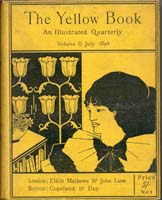
The cover of the Yellow Book periodical 1890s ...

The cover of the Yellow Book periodical 1890s Downloaded from http://www.library.unt.edu/rarebooks/exhibits/binding/images/yellows.jpg (The cover is by Aubrey Beardsley, d. 1898.) (Photo credit: Wikipedia)

He worked with Henry Harland on the art and literature quarterly The Yellow Book (Beardsley was Art Editor) the same year.

It was Beardsley’s starling black-and-white drawings, title-pages, and covers which, combined with the writings of the so-called “decadents,” a unique format, and publisher John Lane’s remarkable marketing strategies, made the journal an overnight sensation. Although well received by much of the public, The Yellow Book was attacked by critics as indecent. [Victorianweb.org]

In 1895 the Oscar Wilde sodomy scandal errupted, and Beardsley (was one of the many friends) who officially severed ties with the writer. None the less, even though Wilde’s work never appeared in The Yellow Book, there was a ‘perceived link’ between the two men and the publication dismissed the illustrator lest it be similarly  tainted.

Beardsley went to work for a rival publisher of Victorian erotica, Leonard Smithers. The two created a new magazine, The Savoy,  for which Beardsley both illustrated and wrote.  When the Savoy ran until December 1896. Beardsley and Smithers continued to work together with Beardsley illustrating books for other authors in the publisher’s stable, most famously Pope’s The Rape of the Lock and (very explicit) Jonson’s The Lysistrata of AristophanesHe also saw the publication of his own book of illustrations A book of Fifty Drawings.

"The New Star," Illustration by Aubr...

“The New Star,” Illustration by Aubrey Beardsley for The Rape of the Lock (Photo credit: Wikipedia)

His black and white, highly stylized, Art Nouveau illustrations challenged the Victorian notions of what was proper.

Beardsley was only 25 was he died of tuberculosis in 1898.


Thought of the Day 7.28.12 Beatrix Potter

“Thank goodness I was never sent to school; it would have rubbed off some of the originality.”*

-Beatrix Potter

English: A picture of Beatrix Potter

English: A picture of Beatrix Potter (Photo credit: Wikipedia)

Helen Beatrix Potter was born on this day  in South Kensington, London in 1866. Today is the 146th anniversary of her birth.

Beatrix and her younger brother (Walter) Bertram were raised in London, but enjoyed long holidays in rural Scotland and the English Lake District. According to the web site for the Beatrix Potter Society she was educated by a governess at home and loved languages and literature especially fairy tales and folk tales. Her early talent for drawling and as a water colorist was encouraged and she illustrated several popular fairy tales for her family’s entertainment. She wrote stories about the family pets . The children kept  “rabbits, a hedgehog, some mice and bats…” most of which would one day wind up in her stories.

She kept a journal — written in a code she invented herself (and which was not deciphered until 1958) — and a sketchbook. In her 20’s she “sold some of her artwork for greetings (sic) cards and illustrations” but she largely concerned herself with the study of natural  history, giving special focus to mycology — the study of fungi. She produced beautiful and technically accurate watercolors of mushrooms and became an adept scientific illustrator. She wrote a paper on the reproduction of fungi. On April 1, 1897 the paper was presented by a male scientist since women weren’t allowed to attend, much less present at, The Linnean Society (“the world’s oldest biological society” has since changed their  Men Only policy).

She also wrote delightful letters to children of her acquaintance that were wonderfully illustrated and told tales of little woodland creatures and pets. In 1901 she adapted some of those letters into The Tale of Peter Rabbit.

Cover of the first, privatley printed edition ...

Cover of the first, privatley printed edition of The Tale of Peter Rabbit by Beatrix Potter (Photo credit: Wikipedia)

Since she couldn’t get any commercial publishers to take on the book she self published the initial edition. But then Frederick Warne & Co.  agreed print Peter Rabbit and Potter converted the black and white illustrations to color.

Cover of the first edition, The Tale of Peter ...

Cover of the first edition, The Tale of Peter Rabbit (Photo credit: Wikipedia)

Norman Warne, the youngest son of the publishing magnet was assigned as Potter’s editor and the two brought twenty Potter books to market, usually at a rate of 2 or 3 a year. Potter also marketed stuffed animals, paint books and wall paper based on the characters in her books.

In 1905 Norman Warne proposed to Beatrix Potter. Her parents vehemently against the match because Warne was socially inferior and “from Trade.” Beatrix found this ironic since her grand parents had been engaged in the cotton trade. But ultimately their pressure won out and she kept the engagement a secret. It didn’t matter. Norman had lymphatic leukemia — a disease that was hard to diagnose at the turn of the century — he died within a month. Potter was summoned to the sick bed, but she arrived too late.

Photo of Norman Warne ca 1900

Photo of Norman Warne ca 1900 (Photo credit: Wikipedia)

Beatrix bought Hill Top Farm in the Lake District  in Lancashire as a sanctuary. She wanted to paint, write and learn about  land management. Later she purchased Castle Farm across the road from Hill Top Farm. Her goal was to preserve land in the area from development.

English: Hill Top Farm, Near Sawrey, Cumbria. ...

English: Hill Top Farm, Near Sawrey, Cumbria. Home of children’s author, Beatrix Potter. As requested in her will, the interior has been “left as if she had just gone out to the post”: a fire burning in the hearth, cups and saucers on the table ready for a visitor! (Photo credit: Wikipedia)

In 1923 she bought and restored Troutbeck Park. The sheep at Troutbeck were disease-ridden and under her stewardship the Herdwick sheep were restored to health.  She became very involved in the local community and joined several committees to help improve rural live including the founding of  a nursing trust to improve local health care. In 1913 she married a local solicitor, William Heelis.In 1926 the semi-autobiographical The Fairy Caravan was published in the United States (it didn’t show up in England until after she passed away).

At her death Beatrix Potter Heelis left 4,000 acres, on 15 farms, in the Lake District to the National Trust.

Beatrix Potter and her husband William Heelis ...

Beatrix Potter and her husband William Heelis on their wedding day (Photo credit: Wikipedia)

The Beatrix Potter Society was founded in 1980 to promotes the appreciation of the life and works the author. Please see their web site and the excellent article by  Linda Lear for more information on Potter.

The relationship between Beatrix Potter and Norman Warne is basis of the film Ms. Potter starring Renee Zellweger and Ewan McGregor.

——————————————————————————————————————–

*Perhaps her teachers were forced to teach to the TEST!

AND Maggie would like you to know that Beatrix Potter is NOT Harry Potter’s Muggle cousin.

Harry Potter

NOT related to this guy. Also not a lego. Yet I love all three. Harry Potter (Photo credit: Profound Whatever)


Thought of the Day 7.27.12

[No quote for Today’s Thought, just some interesting history and some lovely paintings.]

Ludovico Sforza, called the Moor

Ludovico Sforza, called the Moor (Photo credit: Wikipedia)

Ludovico Sforza [il Moro],  born on this day in Vigevano, Lombardy, Italy in 1452. Today is the 518 anniversary of his Birth.

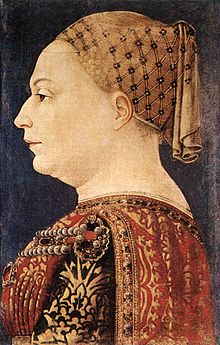
The fourth son of the powerful Sforza family Ludovico was not supposed to become Duke of Milan. But his mother, Bianca Maria Visconti Sforza insisted that he be educated in the arts, government and warfare.

Bianca Maria Visconti Sforza (Photo courtesy Wikipedia)

When Ludovico was 14 his father died and his bother Galeazzo Maria became Duke. Galeazzo, was cruel and sadistic ruler. He reigned for 10 years until he was assassinated on St. Steven’s Day (Dec 26) 1476.

Galeazzo Maria Sforza (Image courtesy Wikipedia)

The next in line was Galeazzo’s 7 year old son Gian Galeazzo Sforza.

Alleged portrait of Gian Galeazzo Maria Sforza...

Alleged portrait of Gian Galeazzo Maria Sforza as Saint Sebastian, by Giovanni Ambrogio de Predis in 1483. Portrait of a Youth as Saint Sebastian, Cleveland Museum of Art, Ohio (Photo credit: Wikipedia)

Ludovico, called the More because of his black hair and swarthy appearance, saw his chance and made a play to become Regent for young Gian, but the boy’s mother, Bona of Savoy, fended him off. Ludovico went into exile for a while but returned in 1481 and seized control of Milan.

With Bona out of the way he  became Regent and de facto ruler. He kept a tight reign on the young Duke and refused to turn over power when Gian came of age. And when Gian died from natural causes (many believed his uncle had him poisoned) Ludovico took official control of the Dukedom.

As Regent and then as Duke Ludovico  built Milan into a powerhouse among Italian city states. He invested in infrastructure, building  up the cattle and horse industries as well as the silk industry. He widened the streets,  funded the universities and supported the the continued building of the Cathedral of MIlan.

Ludovico married Beatrice d’Este, a charming and beautiful 15 year old in 1491. Ludovico was already a patron of the arts — Leonardo Da Vinci helped bring about his marriage —  but with Beatrice’s sense of style (and extravagance) Sforza castle blossomed into a center of entertainment.

Portrait of a lady

Portrait of a lady  Beatrice d’Este by Giovanni Ambrogio de Predis and Leonardo da Vinci. (Photo credit: Wikipedia)

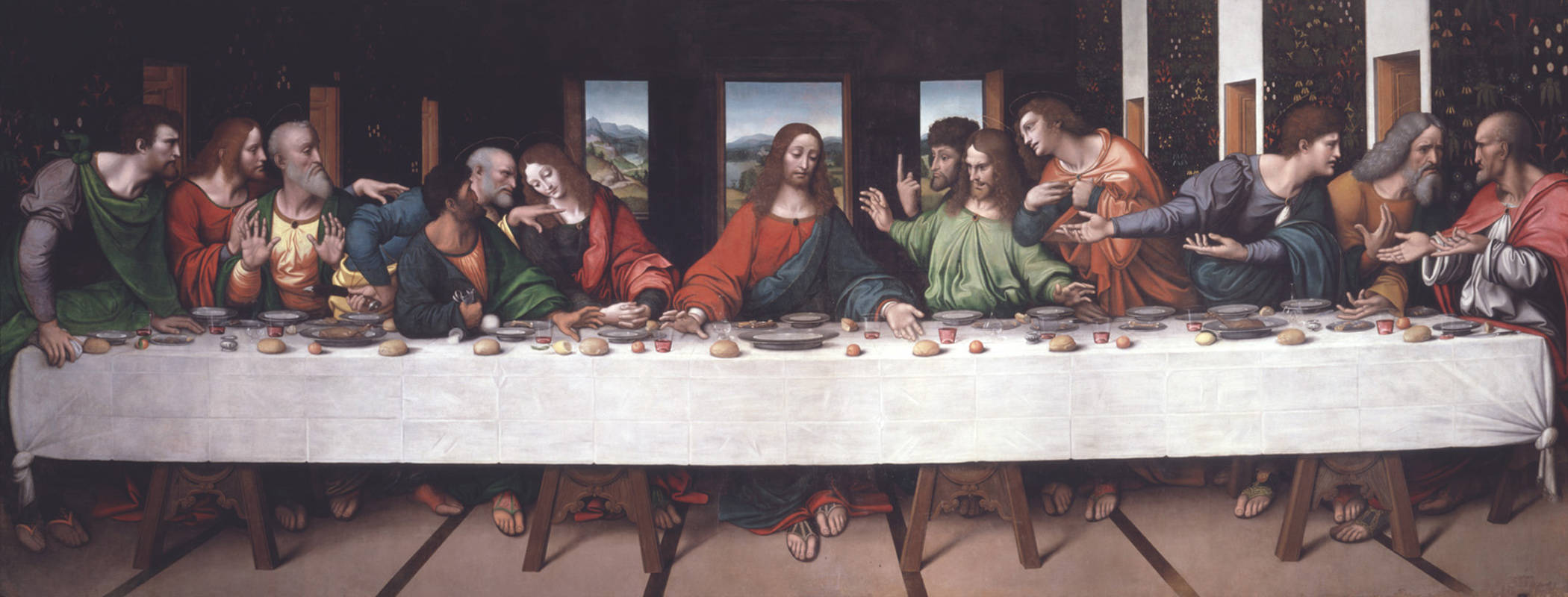
Perhaps Ludovico’s most famous contributions to history is his commissioning of The Last Supper by Leonardo da Vinci. The masterpiece, based on the Gospel of John 13:21 depicts Jesus breaking bread with his 12 disciples shortly before his death. Specifically it shows the reaction of the 12 to Jesus telling them that one of them will betray him  It measures 15 x 29 feet and graces the wall of a dining hall at the monastery of Santa Maria delle Grazie in Milan. (Ludovico’s father, Francesco is buried at Santa Maria).

The Last Supper

As the Duke of Milan he was one of many players on the game board that was Italy (Venice, Florence, Naples, and the Vatican in Rome being some others.) Ludovico played a key roll in the Italian Wars.  It was a game he ultimately lost.  He was captured and handed over to the French. He died in the dungeon at Loches on May17, 1508.