Keeley Hawes 2.10.13 Thought of the Day

“I’ve been really lucky with my career so far. I haven’t been pigeon-holed, which sometimes happens to actors. … I’m even lucky enough to have done my pocket version of Lady Macbeth!”– Keeley Hawes

Zoe Reynolds

Zoe Reynolds (Photo credit: Wikipedia)

Clare Julia “Keeley”  Hawes was born on this day in  Marylebone, London, UK in 1976. She is 37 years old.

The youngest of four siblings she grew up in a working class family. Her father drives a taxi, and her brothers followed suit. Keeley is the only one in the family who was bit by the acting bug. They lived near the Sylvia Young Theatre School and she attended on a grant. There she took ten years of elocution lessons to lose her cockney accent. She also took acting lessons.  At 16 she began modelling for a year and half before making the switch to working as a fashion assistant for Cosmopolitan magazine.

In 1996 she landed a role in Dennis Potter’s Karaoke with Albert Finney and her acting career started in earnest. She had a starring role in the BBC’s 1998 adaptation of Dicken’s Our Mutual Friend. Her Lizzie Hexam is shy, humble, poor, innocent.

Her next major mini series role, Cynthia Kirkpatrick, in Elizabeth Gaskell’s Wives and Daughters is none of those things. The only thing Lizzie and Cynthia have in common is that  they both wear a corset… and Hawes is wonderful in both parts.

In 2002 she took on a much more modern role as Zoe Reynolds in the BBC One spy series Spo0ks (MI-5 in the US). She met her husband, Matthew MacFayden, while working on the series.

Keeley Hawes and Matthew MacFayden from Spooks (Image courtesy Fanpop.com

Keeley Hawes and Matthew MacFayden from Spooks (Image courtesy Fanpop.com]

Speaking of modern, Hawes starred in two modernized Shakespeare plays; an Andrew Davies penned retelling of Othello for Masterpiece Theatre, and as Ella MacBeth in BBC’s  Shakespeare Retold  with James MacAvoy.

Hawes has been busy (I’m only mentioning the performances I’ve seen == all of which have been excellent).

Her latest “Masterpiece” was last year’s Lady Agnes Holland on the reboot of Upstairs Downstairs.


Secondary Character Saturday — Samwise Gamgee

Sean Astin [Image courtesy: New Line Cinema]

Sean Astin as Sam in the 2001 LOTR  [Image courtesy: New Line Cinema]

Samwise Gamgee

“I feel as if I was inside a song, if you take my meaning.” –Sam from The Fellowship of the Ring

“I wonder if we shall ever be put into songs or tales. We’re in one, or course; but I mean: put into words, you know, told by the fireside, or read out of a great big book with red and black letters, years and years afterwards. And people will say: “Let’s hear about Frodo and the Ring!” And they’ll say: “Yes, that’s one of my favourite stories. Frodo was very brave. wasn’t he, dad?” “Yes, my boy, the famousest of the hobbits, and that’s saying a lot.“‘–Sam from the Two Towers

Who: Samwise “Sam” Gamgee

From: The Lord of the Rings

Written by: JRR Tolkien

Date Published: July 21, 1954

Why: Sam is the heart of the novel. The Lord of the Rings is essentially a quest/buddy story with a 9 member fellowship of adventurers trying to get the Ring to Mt. Doom. It is hard to stand out in a group of nine when you are small, socially unconnected and unskilled. Sam isn’t a wizard (Gandalf), he’s not a prince (BoromirAragorn), he’s not a warrior (Legolas, Gimli),  and he’s not even a well-born Hobbit (Frodo, Meriadoc and Pippin). He’s just Frodo’s servant. Yet his character arch from simple Shire gardener to determined hero is one of the 20th Century literature’s most endearing.

Pros: Loyal, Brave, Selfless, Kind, Modest, Inquisitive, Humble, Optimistic,

Cons: Occasionally slow-witted and jealous, Sam can also holds a grudge.

Frodo and Sam enter Mordor (Image courtesy Wallpapermay.com]

Frodo and Sam enter Mordor, while Gollum looks on(Image courtesy Wallpapermay.com]

Shining moment: Sam has several shining moments in the books ( saving the Frodo, Merry and Pippen from Old Man Willow, his fight with Shelob, keeping Frodo fed, sane and going thru Mordor, singlehandedly battling the orcs at Cirith Ungol to rescue Frodo among them) but I think his most shiny moment is when he carries Frodo up the side of Mount Doom…

“Come, Mr. Frodo!” he cried. “I can’t carry it for you, but I can carry you and it as well. So up you get! Come on, Mr. Frodo dear! Sam will give you a ride. Just tell him where to go, and he’ll go.” [The Return of the King]

Least shining moment: Like all of us Sam has his doubts, and Gollum is a master manipulator who plays on those doubts. Sam doesn’t trust Gollum or his alter ego Sméagol, and he doesn’t treat the creature kindly.

Sean Astin embodied Sam for the Peter Jackson trilogy [Image courtesy: New Line Cinema]

Sean Astin [Image courtesy: New Line Cinema]

Conclusion: Sam manages to stay true to himself while evolving into a wonderful hero. He has just as much chance to take the Ring as bigger, more powerful characters, but he doesn’t. He doesn’t need the Ring (or its power) to make him happy. It tempts him with visions of greatness, but he knows himself.  “The one small garden of a free gardener was all his need and due, not a garden swollen to a realm; his own hands to use, not the hands of others to command.” [The Return of the King] So he carries it but never puts it on his finger.

In “The Lord of the Rings” it is difficult to find a more honest character. During the journey Sam was to Frodo what Sancho was to Don Quixote – confident, conscious and supportive…Sam is a pledge for the prosperity of Hobbiton both in the literal and figurative sense of the word. When in Lyrien, he received a box with the blessed soil, which would fertilize the land in every corner of Middle-earth. This is what Galadriel said: “Well, Master Samwise. I hear and see that you have used my gift well. The Shire shall now be more than ever blessed and beloved.” [Lord of the Rings.org]

For more on Sam, The Lord of the Rings and Tolkien go to Tolkien Gateway HERE

Lego Sam

Don’t mess with Lego Sam


Elizabeth Bishop 2.8.13 Thought of the Day

“The whole shadow of Man is only as big as his hat.”–Elizabeth Bishop

[Image courtesy: Poetry Foundation.org]

[Image courtesy: Poetry Foundation.org]

Elizabeth Bishop was born on this day in Worcester, Massachusetts, USA in 1911 .  Today is the 102nd anniversary of her birth.

She was an only child whose father died when she was 8 moths old. Her mother suffered a series of mental breakdowns and was “permanently committed to an institution when Elizabeth was only five years old.” [Poetry Foundation]

[Image courtesy: The Elizabeth Bishop Legacy]

[Image courtesy: The Elizabeth Bishop Legacy]

Bishop, who went to live with her maternal grandparents in Nova Scotia, never saw her mother again. After several years her paternal grandparents took her to live with them in Massachusetts. The Bishops were well to do  and could afford a first class education for the little girl. They sent her to “Walnut Hills School for Girls and to Vassar College.” [Ibid]

[Image courtesy Elizabeth Bishop Society]

[Image courtesy Elizabeth Bishop Society]

After graduating Vassar Bishop, who was independently wealthy traveled extensively in Europe and North Africa. She lived for four years in Key West Florida where she wrote of her travels.  In 1946 those poems were compiled into her first book, North and South.  (The book won a Pulitzer Prize.) In 1951 she received a traveling fellowship and decided to circumnavigate South America. She made it as far as Santo, Brazil. Her intended stay of 2 weeks lasted over fifteen years. Upon returning to the United States she lived in New York, San Francisco, and New England.

Her style “focuses … with great subtlety on her impressions of the physical world… Her images are precise and true to life, and they reflect her own sharp wit and moral sense.” [Poets.org] The New York Times Called Bishop “One of the most important American poets” of the 20th Century. Bishop wrote slowly and precisely. She didn’t write a huge volume of poems, but each was measured perfection.

Here is my favorite Bishop poem, The Map:

map

The Map

Land lies in water; it is shadowed green.
Shadows, or are they shallows, at its edges
showing the line of long sea-weeded ledges
where weeds hang to the simple blue from green.
Or does the land lean down to lift the sea from under,
drawing it unperturbed around itself?
Along the fine tan sandy shelf
is the land tugging at the sea from under?

The shadow of Newfoundland lies flat and still.
Labrador’s yellow, where the moony Eskimo
has oiled it. We can stroke these lovely bays,
under a glass as if they were expected to blossom,
or as if to provide a clean cage for invisible fish.
The names of seashore towns run out to sea,
the names of cities cross the neighboring mountains
-the printer here experiencing the same excitement
as when emotion too far exceeds its cause.
These peninsulas take the water between thumb and finger
like women feeling for the smoothness of yard-goods.

Mapped waters are more quiet than the land is,
lending the land their waves’ own conformation:
and Norway’s hare runs south in agitation,
profiles investigate the sea, where land is.
Are they assigned, or can the countries pick their colors?
-What suits the character or the native waters best.
Topography displays no favorites; North’s as near as West.
More delicate than the historians’ are the map-makers’ colors.

Elizabeth Bishop

compass

Bishop died  at age 68 in October of 1979 in Boston. Besides her Pulitzer she won a National Book Award for Poetry in 1970, the Neustadt Internaional Prize in 1976 and two Guggenheim Fellowships (1947 & 1978).

[Image courtesy: Poets.org]

[Image courtesy: Poets.org]

Other Bishop poems I highly recommend:

A Visit to St. Elizabeths

Conversation

Five Flights Up

In The Waiting Room


Charles Dickens 2.7.13 Thought of the Day

“A loving heart is the truest wisdom.”–Charles Dickons

English: Detail from photographic portrait of ...

English: Detail from photographic portrait of Charles Dickens (Photo credit: Wikipedia)

Charles John Huffam Dickens was born on this day in Landport, Portsmouth, Hampshire, England in 1812. Today is 201st anniversary of his birth.

He was the second eldest child in a family of eight. His parents were of modest means but dreamed of a bigger, better life. His father, John, was a clerk, Elizabeth wanted to be a teacher — but with 8 children afoot never made it to the head of the classroom. The family was always poor, sometimes destitute.

When Dickens was four the family moved to Chatham, Kent. Dickens and his brothers and sisters roamed “he countryside and explore(d) the old castle at Rochester.” [Biography.com] They were happy years, and Dickens attended school and read ferociously. But the good times did not last. John outspent his income and was sent to debtor’s prison at the Marshalsea debtors’ prison in London in 1824. Elizabeth and the younger children moved in with  the father, but Frances, the eldest and Charles were sent to live with family friends.

Dickens at the Blacking Warehouse. Charles Dic...

Dickens at the Blacking Warehouse. Charles Dickens is here shown as a boy of twelve years of age, working in a factory. (Photo credit: Wikipedia)

So at 12 years old Charles Dickens was…

forced to leave school to work at a boot-blacking factory alongside the River Thames. At the rundown, rodent-ridden factory, Dickens earned six shillings a week labeling pots of “blacking,” a substance used to clean fireplaces. [Ibid]

John Dickens came into some money when his paternal grandmother died and he was released from the Marshalsea, but  Charles’ mother didn’t let him quit the boot-black factory right away. The family had grown accustomed to his six shillings a week. He never forgave her for making him go back to dirt and rats of the factory. Eventually he was able to go back to school, this time to The Wellington House Academy. Unfortunately the experience was anything but pleasant. The headmaster was sadistic, the teaching haphazard and fellow students undisciplined.

Charles Dickens described the second Marshalse...

Charles Dickens described the second Marshalsea in Little Dorrit. (Photo credit: Wikipedia)

At 15 he got a job as an office boy at a law office.

As it turned out, the job became an early launching point for his writing career. Within a year of being hired, Dickens began freelance reporting at the law courts of London. Just a few years later, he was reporting for two major London newspapers. [Ibid]

Dickens, who had a near photographic memory, stored all the experiences, the injustices, the cruelties, and the people he met in his head. They came out later on the pages of his novels. (Amy and her family live in the Marshalsea in Little Dorrit. David, Pip and Oliver relive some of his worst experiences in David Copperfield, Great Expectations, and Oliver Twist.)

Copy of Sketch of Charles Dickens

Copy of Sketch of Charles Dickens (Photo credit: Wikipedia)

By 1833 he was being published under a pseudonym, “Boz,” in magazines and three years later his first book, a collection of articles, Sketches by Boz, was published.

He wrote often wrote serialization for magazines (sometimes magazines in which he had a financial interest) and then published the finished story in the form of a book.

Charles Dickens (1812-1870)

Charles Dickens (1812-1870) (Photo credit: Wikipedia)

Here’s a list of his books:

  • The Posthumous Papers of the Pickwick Club
  • The Adventures of Oliver Twist
  • The Life and Adventures of Nicholas Nickleby
  • The Old Curiosity Shop
  • Barnaby Rudge: A Tale of the Riots of ‘Eighty
  • The Life and Adventures of Martin Chuzzlewit
  • Dombey and Son
  • David Copperfield
  • Bleak House
  • Hard Times: For These Times    
  • Little Dorrit     
  • A Tale of Two Cities
  • Great Expectations     
  • Our Mutual Friend
  • The Mystery of Edwin Drood

The Christmas books:

  •         A Christmas Carol (1843)
  •         The Chimes (1844)
  •         The Cricket on the Hearth (1845)
  •         The Battle of Life (1846)
  •         The Haunted Man and the Ghost’s Bargain (1848)

————————————————————————————————-

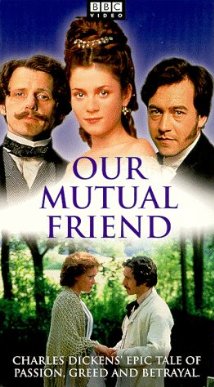
If you are looking for a good Dicken’s dvd to watch during the snow storm we are promised this weekend I can recommend both Little Dorrit with Clair Foy and Matthew MacFayden or Our Mutual Friend with Keely Hawes and Steven Mackintosh.

Our Mutual Friend DVD (Image courtesy IMDB)

Our Mutual Friend DVD (Image courtesy IMDB)

Little Dorrit dvd  (Image courtesy Amazon.com)

Little Dorrit dvd (Image courtesy Amazon.com)


MoNOTpoly

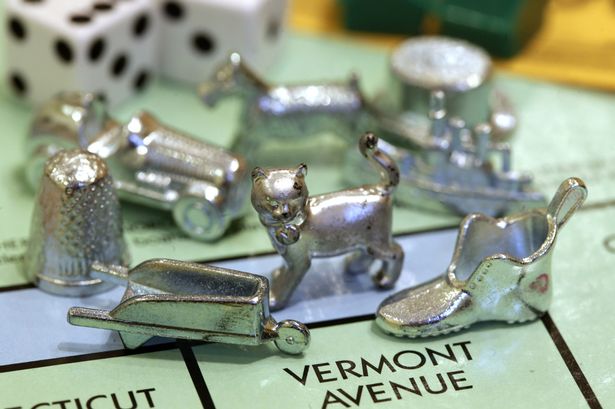
monopoly-cat-iron2-060113-jpg_143448I’m not against cats.

REALLY.

I like cats.

Not as much as I like dogs, maybe, but I do like cats.

I have nothing against them….

Scratch that. I have nothing against the breathing, furry kind of cats that curl up in your lap and let you scratch them behind their ears…the kind who eat catnip.

I’m not so sure about the little metallic guy who just entered the world of board games.

He’s cute enough, I guess. But he doesn’t look like a very stable kind of creature.

Currently the least stable game piece on the Monopoly board is the Scotty Dog.

Monpoly dogFun loving, adorable, excitable…you can’t go two moves with out this little fella falling on his side to roll over and play dead.

But at least you can upend him and sit him on his hind legs for a little more stability. I don’t think that’s an option for Felix.


And when you think of what the Cat is replacing! Well, the instability issue seems even worse.

The IRON, the steady dependable iron, is now cast aside for ms. kitty.

IronMonopolyThe humble Monopoly Iron was always the easiest game piece to manipulate. It never fell over. It came with its own handle for heaven’s sake.

Oh, it may not have been the cutest or most glamorous of game pieces, but it got the job done. It quietly went about the board biding its time, paying its rent, collecting its $200 for passing go.

I don’t know about this CAT. I suspect it will slink about from spot to spot at its leasure…looking for the sunniest  location in which to lounge away the afternoon. It’ll curl up into a nice fuzzy ball and …you know what? That kitty’s not movin’ til it hears the can opener in the kitchen.

Yeah… have fun playing with THAT.

Meoooooow.

The+newest+Monopoly+token,+a+cat


Babe Ruth 2.6.13 Thought of the Day

“Never let the fear of striking out get in your way.” — Babe Ruth

Babe Ruth

Babe Ruth (Photo credit: carloscappaticci)

George Herman Ruth was born on this day in Baltimore, Maryland, USA in 1895. Today is the 118th anniversary of his birth.

He was one of eight children born to George and Kate Ruth. Only he and his sister Mamie survived.  His parents ran a saloon  at 426 West Camden Street, a job that took much of their time. So George, Jr and Mamie were left to their own devices. As an adult Ruth reflected that he ran the streets as a kid, skipped school, chewed tobacco and drank beer while his father wasn’t looking. He was “incorrigible,” and that’s what his parents recorded on his entry documentation to St. Mary’s Industrial School for Boys when he was sent he was just 7 years old.

St. Mary’s was part reformatory, part orphanage, part school and part work house. It was run by the Xavier Brothers and it served boys from ages 5 to 21. Ruth learned to make shirts as well as carpentry skills at the school. He lived there for 12 years. His parents seldom had the time to visit the school.

Ruth (top row, far left) at St Mary's Industri...
Ruth (top row, far left) at St Mary’s Industrial School for Boys, Baltimore, Maryland, c. 1912 (Photo credit: Wikipedia)

Fortunately for Ruth, the prefect of discipline at St. Mary’s, Brother Matthias Boutlier, took him under his wing.

Ruth particularly looked up to a monk named Brother Mathias, who became a father figure to the young boy… Matthias, along with several other monks of the order, introduced Ruth to baseball, a game at which the boy excelled. [Biography.com]

Brother Matthias worked with Ruth to hone his hitting, pitching and fielding abilities. Ruth showed such promise that …

the Brothers invited Jack Dunn, owner of the Baltimore Orioles, to come watch (him)  play. Dunn was obviously impressed, as he offered a contract to (Ruth) in February 1914 after watching him for less than an hour…. Upon seeing (Ruth) for the first time, the Orioles players referred to him as “Jack’s newest babe”…[baberuth.com]

The nickname stuck and he was known as Babe Ruth from then on.

Babe Ruth pitching with Boston Red Sox, Comins...
Babe Ruth pitching with Boston Red Sox, Cominsky Park, 1914 (Photo credit: Wikipedia)

He started as a pitcher. First for Baltimore and then for the Boston Red Sox. By 1915 he was a “permanent fixture in the Red Sox rotation, …accumulating an 18-8 record with an ERA of 2.44.” [Ibid] Both his pitching and hitting game improved over the next few years and “In 1918, Babe Ruth pitched his 29th scoreless inning in a World Series. That record stood for 43 years!” [about.com]

English: American baseball player Babe Ruth in...
English: American baseball player Babe Ruth in 1921 (Photo credit: Wikipedia)

The following year he shifted his focus to his hitting game and earned a new record. This time for a whopping 29 home runs in a single season. Ruth was traded to the Yankees in 1920 and topped his home run tally (coming in at 54 for the year.) In 1921 he broke the record again with 59 home runs.  In 1927 Ruth, as part of the Yankees famous “Murderer’s Row” hit an amazing 60 home runs for the season — a record that stood for 34 years.


Over the course of his career, Ruth went on to break baseball’s most important slugging records, including:

  • most years leading a league in home runs (12);
  • most total bases in a season (457)
  • and highest slugging percentage for a season (.847).

In all he hit 714 home runs, a mark that stood until 1974, when Hank Aaron of the Atlanta Braves surpassed him. [Biography.com]


Baseball player Babe Ruth
Baseball player Babe Ruth (Photo credit: Wikipedia)

Ruth helped the Yankees win seven pennants and four World Series. He wore pinstripes until 1934. He was ready to retire from the active roster and wanted to manage, but his off-field hijinks — he was almost as famous for his love of alcohol, women and food as he was for his ability to swing a bat — made owners think twice about placing him in a supervisory position. He was traded to the Boston Braves for his final season where he hoped to have both playing and assistant-management duties, but he soon realized the “management” part of his job was mostly P.R., public appearances and giving autographs.

Ruth with the Boston Braves in 1935, his last ...
Ruth with the Boston Braves in 1935, his last year as a player (Photo credit: Wikipedia)


On May 25, 1935, an overweight and greatly diminished Babe Ruth reminded fans of his greatness one last time when hit three home runs in a single game at Forbes Field in Pittsburgh, Pennsylvania. The following week, Ruth officially retired. [Biography.com]

The Sultan of Swat, The Bambino, Number “3” (Babe’s number in the Yankee batting line up and eventually the number on the back of his pinstripes) was inaugurated into the Baseball Hall of Fame in 1936.

Babe Ruth
Babe Ruth (Photo credit: Wikipedia)

A decade later doctors discovered a tumor on his neck. Ruth had cancer. He died on August 16, 1948.

Babe still remains the greatest figure in major league baseball, and one of the true icons in American history. The Babe helped save baseball from the ugly Black Sox scandal, and gave hope to millions during The Great Depression. …He continues to be the benchmark by which all other players are measured. Despite last playing nearly 75 years ago, Babe is still widely considered the greatest player in Major League Baseball history. [baberuth.com]


Gehrig_&_Ruth[1]
#4 Gehrig and #3 Ruth were the heart of Murderer’s Row and the Yankees.

—————————————————————————–

Sigh, it kills this Baltimore Orioles girl to write “Y – A – N – K – E – E -S”  so often in a post. Please know I could only do it for the Babe (and for Lou Gehrig when it is his turn). When is Brooks Robinson’s birthday?



Richard the 3rd UPDATE

R3 UPDATE!

Those bones found at the Leicester car park are those of King Richard! DNA testing matched the bones to one of Richard’s descendants.

[The play Richard III  at Chesapeake Shakespeare has run its course, But you can catch Vince Eisensen (who played Richard) and James Jager (who played Henry) as Proteus and Valentine in the company’s current production of The Two Gentlemen of Verona weekends from Feb 22nd to March 17th. Click HERE for details

————————————————————————————————————


Blog Note:  Richard the Third’s Birthday was Oct 3 1452.

——————————————————————————–

Richard III Royal Collection
Richard III Royal Collection (Photo credit: Wikipedia)

Today I’m thinking about Richard the Third of England.

We just saw the terrific Moveable Shakespeare production of Richard III at Chesapeake Shakespeare Company in the ruins of the Patapsco Female Institute in Ellicott City Maryland.

Director Ian Gallanar chose to pick the characters up from the 15th century and time warp them  to something resembling War War One. Clever, especially considering the Patapsco Female Institute was used as a war hospital during the Great War. In his director’s notes he says:

“The production really uses the visual palate and the historic technology of the World War One era as a way to clarify the relationships of the characters….[The audience] might also recognize the futility and wastefulness of a war that, much like the English “Wars of the Roses,” seemed more about resolving who would inherit power rather than who ought to inherit power.” [Chesapeake Shakespeare Company, Richard III: Program Notes]

So on a cold October night we got to see one of Shakespeare’s bloodiest plays in and around the shell of a burned out 19th Century building that some people claim is haunted. The occasional gas-masked actors quietly playing cards in a dimly lit corner or typing away orders on an antique typewriter upped the creep factor. As did the lighting effects, the period music and wonderful costumes.

Vince Eisenson as Richard III. Photo by Teresa Castracane. [Image courtesy: Chesapeake Shakespeare Company]


This version of Richard really worked. I really liked the “Moveable” aspect too. It added to the length of the play (instead of quick scene changes the audience literally did a scene change by moving to a new part of the building or grounds, and that took a while.) My only problem was that there was a scene or two where I couldn’t see the action because I had the bad luck of standing behind some one tall.)  Still, I liked that we kept moving through the building, and “discovering” new rooms. It really put the audience DEAD center into the action of the play (and moving about  kept us warm.)

Richard III runs for one more weekend at Chesapeake Shakespeare. So if you are local to Maryland jump on their website and grab some tickets before they sell out. http://chesapeakeshakespeare.com/

————————————

Scrap for a Shakespeare character card: Richar...

Scrap for a Shakespeare character card: Richard III., c. 1890; Printer: Siegmund Hildesheimer & Co. Victoria and Albert Museum, London, Museum number: S.63-2008, Link (Photo credit: Wikipedia)

Of course they didn’t have instant fact checkers in Shakespeare’s day, and history, as they say is written by the winners. So it comes as no surprise that the Richard the Third we met last night was a real piece of work. Shakespeare was writing for an Elizabethan audience. Elizabeth, a Tudor, was the granddaughter of the man who finally brought about Richard’s undoing on Bosworth Field in Leicestershire, Henry VII. It was in his interest to make Richard as loathsome as possible.

Henry VII’s claim to the thrown was weak at best. So he took…

“every opportunity of enhancing his own reputation at the expense of his predecessor. Richard’s actions and behaviour were the subject of attention and scrutiny and were presented, in the weeks and years after his death, as those of a wicked and unscrupulous tyrant.” [The Richard III Society]

While he was alive Richard was well thought of.

  • He was loyal to his brother Edward.
  • He was effective in his administration of the North.
  • He defended the country against the Scots.
  • He handled the premature death of Edward with out plunging the country into crisis.

Shakespeare wasn’t the first writer to take up the thread of anti- Richard-ism. (Yes, I just made that up.)

By the time the Elizabethan playwright William Shakespeare penned what was to become one of his most popular and frequently performed plays, The Tragedy of King Richard III, the works of the anonymous Croyland Chronicler, John Rous, Bernard André, Polydore Vergil, Sir Thomas More, Edward Hall, Richard Grafton and Raphael Holinshed had been written. [Ibid]

So, as Chesapeake Shakespeare Managing  Director and Richard III Dramaturge says in her note… The Bard’s “fictitious villainous Richard has triumphed over the historic Richard for centuries now.” [CSC Program]

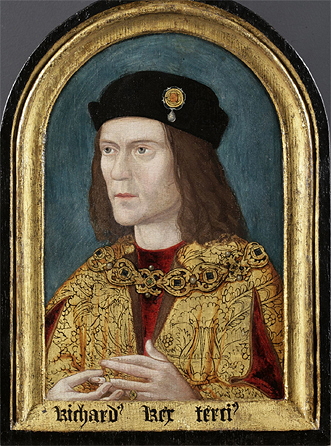
Richard III earliest surviving portrait. [Image courtesy: Wikipedia]


In a timely twist of history archeologists digging up a parking lot in Leicester have found the remains of  the Greyfriars Church that might be those of Richard, the last King of England to die on the battlefield. They have found a skeleton in the choir area (Richard was buried in the choir of Friars Minor at Leicester), that had a skull injury caused by a bladed implement, an arrowhead was found between its vertebrae and upper back, and it had spinal abnormalities.

“the individual would have had severe scoliosis – which is a form of spinal curvature. This would have made his right shoulder appear visibly higher than the left shoulder.” [University of Leicester Press Release : The Leicester Greyfriars Dig]

——————————————————————————-

Bonus Material:

Not sure how many of you watch HBO’s Boardwalk Empire… but I couldn’t stop thinking how much Michael Shannon  (who plays messed up Treasury agent turned iron salesman Nelson Van Alden) looks like our boy Richard.  I think they ought to do a new film version of Richard cubed with Shannon in the lead. He certainly has the intensity to play the role.


Laura Linney 2.5.13 Thought of the Day

Just because you’re not famous, doesn’t mean you’re not good. — Laura Linney

[Image courtesy: theplace2.com]

[Image courtesy: theplace2.com]

Laura Leggett Linney was born on this day in New York City, New York, USA in 1964. She is 49 years old.

Linney is the daughter of Romulus Linney, a playwright, and Miriam Perse, a nurse. Her parents divorced when she was an infant and she grew up in a modest 1 bedroom apartment with her mother. “Linney grew up working in the theater, both behind the scenes and, in her late teens, on the stage.” [Starpulse.com] After graduating from  Northfield Mount Hermon School, a New England prep school, she went to Northwestern University and Brown University for undergraduate work. (She received her BA in Fine Arts from Brown in 1986). She did post-graduate work with Group 19 at the Juillard School.

She took the stage in such Broadway productions as The Seagull, Six Degrees of Separation and Hedda Gabler before making the leap to film.

Linney’s screen debut was a minor role in Lorenzo’s Oil. She played Kevin Kline’s mistress in Dave, and landed the role of Mary Ann Singleton in Armistead Maupin’s Tales of the City (a role she would reprise two more times.) She played in a trio of thrillers, Congo, Primal Fear and Absolute Power, before getting her big break as Meryl Burbank in The Truman Show.

Linney played the "perfect wife" in Truman.

Linney played the “perfect wife” in Truman.

2000’s You Can Count On Me earned Linney her first Academy Award nomination for Best Actress. (Her second nomination was for her work in 2004’s Kinsey opposite Liam Neeson.) Also in 2000 she did the lush, delightful The House of Mirth (based on the Edith Wharton novel, with Gillian Anderson, Eric Stoltz and Elizabeth McGovern).

Linney won an Emmy Award for her work on Wild Iris opposite Gena Rowlands. She won another Emmy, this time for Outstanding Guest Actress in a Comedy Series for her story arc as Charlotte on the TV show Frasier.

She played Zelda Fitzgerald in American Master’s F.Scott Fitzgerald: Winter Dreams. She worked on ensemble films  including Love Actually and The Laramie Project. She’s equally stunning as the intellectual mom struggling as her family crumbles around her in the Squid and the Whale as she is in the supernatural thriller The Mothman Prophecies  as small town police officer.

On screen, Linney has mastered quite a line in striving. Her most memorable characters have had a combination of astute wit, career focus and either a leavening daffiness or a chilly sort of overbrightness. This tends to hinge on whether they’re good apples (as in You Can Count On Me or The Savages) or bad (The Truman Show, The House of Mirth). [The Telegraph 2.1.13]

She brought Abigail Adams to life with her beautiful, strong portrayal of our second First Lady in HBO’s mini-series John Adams. Linney won  her most recent  Emmy Award for her efforts.

She can currently be seen on Showtime’s The Big C — for which she won a Golden Globe — and as the host of Masterpiece Theatre on PBS. Her latest film role is as Margaret “Daisy” Suckley  in Hyde Park on Hudson opposite Bill Murray’s FDR.


Rosa Parks 2.4.13 Thought of the Day

“I have learned over the years that when one’s mind is made up, this diminishes fear; knowing what must be done does away with fear.” –Rosa Parks

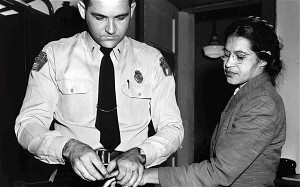
Rosa Parks getting fingerprinted after her arrest.

Rosa Parks getting fingerprinted after her arrest. [Image courtesy  abcnews.go.com]

Rosa Louise McCauley was born on this day in Tuskegee, Alabama in 1913. Today is the 100th anniversary of her birth.

Rosa’s father James was a carpenter and her mother Leona was a teacher. Her parents separated when Rosa was 2, and she moved with her mother a little brother Sylvester to Pine Level, Alabama (just outside the capital, Montgomery) to live with her maternal grandparents. He mother taught her to read. The segregated one room school-house she attended seldom had enough desks  or other supplies. At 11 she went to the Montgomery Industrial School for Girls, an institution a laboratory school set up by the Alabama State Teachers College for Negroes and founded “liberal-minded women from the northern United States. The school’s philosophy of self-worth was …to ‘take advantage of the opportunities, no matter how few they were.'” [Achievement.org] She dropped out of the school to care first for her grandmother then her mother.

At 19 she married Raymond Parks and moved to Montgomery. Raymond encouraged Rosa to finish high school, and she earned her degree in 1933.  The two were active in the National Association for the Advancement of Colored People (Raymond had been an active member when they met.) They worked to raise money to help defend the Scottsboro Boys and were members of the Voter’s League. Mrs. Parks managed to get her voter’s card (it took her three tries because of the Jim Crow laws in Montgomery.)

English: Photograph of Rosa Parks with Dr. Mar...

English: Photograph of Rosa Parks with Dr. Martin Luther King jr. (ca. 1955) Mrs. Rosa Parks altered the negro progress in Montgomery, Alabama, 1955, by the bus boycott she unwillingly began. National Archives record ID: 306-PSD-65-1882 (Box 93). Source: Ebony Magazine Ελληνικά: Φωτογραφία της Rosa Parks με τον Dr. Martin Luther King jr. (περ. 1955.) Español: Fotografía de Rosa Parks con Martin Luther King jr. (aprox. 1955). Français : Photographie Rosa Parks (ca. 1955) (Photo credit: Wikipedia)

Rosa served as the chapter’s youth leader. And in 1944 she became the secretary to NAACP President E.D. Nixon—a post she held until 1957. (She recalls that they needed a secretary, she was the only woman there, and she was too timid to decline.)

“I worked on numerous cases with the NAACP,” Mrs. Parks recalled, “but we did not get the publicity. There were cases of flogging, peonage, murder, and rape. We didn’t seem to have too many successes. It was more a matter of trying to challenge the powers that be, and to let it be known that we did not wish to continue being second-class citizens.” [Rosa Parks quoted on Achievement.org]

On Thursday, December 1, 1955

Rosa Parks boarded the Cleveland Avenue bus for home. She took a seat in the first of several rows designated for “colored” passengers. …As the bus Rosa was riding continued on its route, it began to fill with white passengers. Eventually, the bus was full and the driver noticed that several white passengers were standing in the aisle. He stopped the bus and moved the sign separating the two sections back one row and asked four black passengers to give up their seats. Three complied, but Rosa refused and remained seated. The driver demanded, “Why don’t you stand up?” to which Rosa replied, “I don’t think I should have to stand up.” The driver called the police and had her arrested. …The police arrested Rosa at the scene and charged her with violation of Chapter 6, Section 11, of the Montgomery City Code. She was taken to police headquarters, where, later that night, she was released on bail. [biography.com]

Booking photo of Parks

Booking photo of Parks (Photo credit: Wikipedia)

On the day of her trial the NAACP and the Montgomery Improvement Association (with its new leader Dr. Martin Luther King, Jr.) organized a Bus Boycott.  The

13-month mass protest that ended with the U.S. Supreme Court ruling that segregation on public buses is unconstitutional. …The bus boycott demonstrated the potential for nonviolent mass protest to successfully challenge racial segregation and served as an example for other southern campaigns that followed. In Stride Toward Freedom, King’s 1958 memoir of the boycott, he declared the real meaning of the Montgomery bus boycott to be the power of a growing self-respect to animate the struggle for civil rights. [Stanford.edu]

“At the time I was arrested I had no idea it would turn into this, … It was just a day like any other day. The only thing that made it significant was that the masses of the people joined in.” –Rosa Parks

After her arrest Parks lost her job  as a seamstress in a department store. “her husband was fired after his boss forbade him to talk about his wife or their legal case.” [biography.com] The couple was unable to find work and eventually they moved to Detroit, Michigan with Rosa’s Mother.

In Michigan Rosa Parks worked U.S. House of Representative John Conyer as a secretary and receptionist. In 1987 she helped found the Rosa and Raymond Parks Institute for Self-Development which runs bust tours  to civil rights and Underground Railroad sites for young people.

Rosa Parks receives an award from Bill Clinton.

Rosa Parks receives an award from Bill Clinton. (Photo credit: Wikipedia)

She published a biography, Rosa Parks: My Story and a memoir, Quiet Strength in the 1990s. In 1996 she received the Presidential Medal of Freedom from President Clinton.

Rosa Parks died on October 24, 2005 at the age of 93. She was honored by lying in state at the Capitol Rotunda in Washington, DC.

Today, on the centennial of her birth the US Postal Service is releasing a Forever Stamp with her likeness.

[Image courtesy USPS]

[Image courtesy USPS]

“I would like to be remembered as a person who wanted to be free… and other people would be also free.” –Rosa Parks