George Harrison PART TWO

[George Harrison PART TWO

English: George Harrison in the Oval Office du...

English: George Harrison in the Oval Office during the Ford administration. (Photo credit: Wikipedia)

]In 1968 Harrison’s interest in Indian music …

extended into a yearning to learn more about eastern spiritual practices. In 1968, he led the Beatles on a journey to northern India to study transcendental meditation under Maharishi Mahesh Yogi. [Biography.com]

That year the group’s White Album came out. Harrison penned “While My Guitar Gently Weeps,” “Piggies,” “Long, Long, Long” and “Savoy Truffle.” “While My Guitar Gently Weeps,” is ranked as #7 Greatest Guitar Song of All Time by Rolling Stone Magazine.

On Yellow Submarine he  penned “Only A Northern Song” and “It’s All Too Much” both of which — like the rest of the album — were self indulgent and over produced.

He bounced back with Abbey Road which has two of Harrison’s best songs, “Something” and  “Here Comes The Sun”

Let It Be had “I Me Mine Mine” and “For You Blue.” While recording Let It Be Harrison grew frustrated with the poor working conditions of the film studio as well as with the Lennon-McCartney lock on creative input on songs. He walked way from the recording sessions on January 10th, 1969. The other Beatles convinced him to return 12 days later but the writing was on the wall. The end was near for the super group.

When Beatles broke up in April of 1970 Harrison had a back log of music written and ready to produce. His first post-Beatles album was a triple disk, All Things Must Pass. The album yielded two hits “My Sweet Lord” and “What Is Life”

In 1971  he organized a charity concert at Madison Square Garden to raise money and awareness for the refugees in Bangladesh. The Concert for Bangladesh (and the concert film) was a fore runner to other multi-band high-profile charity concerts to come a decade later like Live Aid.

His next Album, Living in the Material World went Gold  with in a week of its release. The single from the album, “Give Me Love (Give Me Peace on Earth)” became an international  best seller.

But then things began to flatten out musically–sales wise at least. Harrison continued to write and experiment musically.

He “started his own film production company, Handmade Films. The outfit underwrote Monty Python’s Life of Brian and would go on to put out 26 other movies before Harrison sold his interest in the company in 1994.” [Biography.com]

In 1987 released Cloud Nine and began to work with a collection of rockers who formed the group the Traveling Wilburys.

The Traveling Wilburys, 1988. L–R: Roy Orbison...

The Traveling Wilburys, 1988. L–R: Roy Orbison, Jeff Lynne, Bob Dylan, George Harrison, and Tom Petty. (Photo credit: Wikipedia)

“In 1998, Harrison, a longtime smoker, reportedly was successfully treated for throat cancer.” [Ibid] Two years later the cancer returned, this time it had spread to his brain. He died in Los Angeles in November of 2001.


—————————–

Oy! Yesterday was full of frustration WordPress wise. I could NOT get a YouTube song/vid to successfully link.(And believe me I had TONS of great George clips to share.) So I’m trying again to day… with fresh optimism. … Here Comes the Sun…


George Harrison PART ONE 2.25.13

“I think people who can truly live a life in music are telling the world, “You can have my love, you can have my smiles. Forget the bad parts, you don’t need them. Just take the music, the goodness, because it’s the very best, and it’s the part I give”– George Harrison

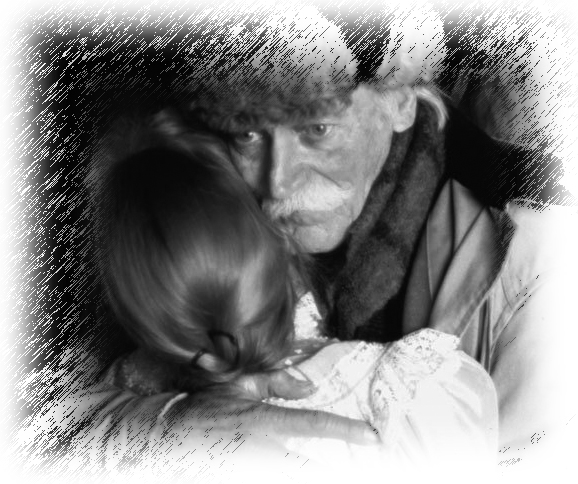
[Image courtesy: IMDb]

[Image courtesy: IMDb]

George Harrison was born on this day in Liverpool, England in 1943. today is the 70th anniversary of his birth.

Harrison was the youngest of four children born to Harold, a school bus driver, and Louise as shop assistant and stay a home mother. He went to school at Dovedale Primary School until he was 11 when he transferred to the prestigious Liverpool Institute.

By his own admission, Harrison was not much of a student and what little interest he did have for his studies washed away with his discovery of the electric guitar and American rock ‘n roll. [Biography.com]

He was riding his bike through the streets of Liverpool one day when he heard Elvis Presley’s Heartbreak Hotel coming through a window. Harrison said it was an epiphany. His father bought him an acoustic guitar and he taught himself how to play.  He formed a pop, jazz, blues, folk, roots band with his older brother Peter and their friend Arthur Kelly called the Rebels.

Harrison knew Paul McCartney from school and in 1958 he auditioned for McCartney and John Lennon’s band The Quarrymen. Lennon was reluctant to bring on the 14-year-old Harrison, but after a second audition — this on the upper deck of a bus — he was sufficiently wowed by Harrison’s rock and roll guitar that the younger guitarist began to fill in with the group.

By 16 Harrison had left school and was working as an apprentice electrician as well as a musician both for the Quarrymen and for the Les Stewart Quartet.

By 1960 Harrison’s music career was in full swing. Lennon had renamed the band the Beatles and the young group began cutting their rock teeth in the small clubs and bars around Liverpool and Hamburg, Germany. Within two years, the group had a new drummer, Ringo Starr, and a manager, Brian Epstein,… Before the end of 1962, Harrison and the Beatles recorded a top 20 U.K. hit, Love Me Do. [Biography.com]

They followed that with Please, Please me and produced an album (also called Please, Please Me.) Harrison sang lead on two songs, Chains, a cover of  the Little Eva hit by Gerry Goffin and Carole King, and Do You Want to Know a Secret by Lennon and McCartney. The album (literally) rocked the UK charts

Given that the UK album chart in those days tended to be dominated by more ‘adult’ tastes such as film soundtracks and easy listening vocalists, it was a surprise when Please Please Me hit the top of the chart in May 1963 and remained there for thirty weeks before being replaced by With The Beatles. [TheBeatles.com]

The 1963 UK release of With The Beatles, hosted the first Harrison penned song to make it to vinyl;  Don’t Bother Me.

It wasn’t until Help! that another Harrison song made it onto a Beatles album. He contributed “I Need You” and “You Like Me Too Much” to Help!

Harrison’s influence grew in the band with the release of Rubber Soul. Again he has two songs on the album, Think For Yourself and If I Needed Some One. He brought both a folk rock flavor to the group and an interest in classical Indian music.

Harrison soon developed a deep interest in Indian music.He taught himself the sitar, introducing the instrument to many western ears on John Lennon’s song, “Norwegian Wood.”” [Biography.com]

By bringing sitar player Ravi Shankar to the attention of the Western World Harrison introduced the instrument to other rock groups (like the Rolling Stones.) And his willingness to stray from the traditional western rock instruments (guitar, bass, drums, piano) helped “pave the way for such groundbreaking Beatles albums as Revolver and Sgt. Pepper’s Lonely Hearts Club Band” [Ibid]

He scored with three singles on Revolver, “Taxman,” “Love You To” and “I Want to Tell You.” You can really hear the Eastern influence on “Love You To”

He only contributed one song to Sgt. Pepper’s Lonely Hearts Club Band, “Within You Without You.”  He’s the only Beatle to play on the song.

[Continued in PART TWO]


Steve Jobs 2.24.13 Thought of the Day

“Don’t let the noise of others’ opinions drown out your own inner voice.”

English: Steve Jobs shows off the white iPhone...

English: Steve Jobs shows off the white iPhone 4 at the 2010 Worldwide Developers Conference Español: Presentación del iPhone 4 por Steve Jobs en la Worldwide Developers Conference del año 2010 (Photo credit: Wikipedia)*

Steven Paul Jobs was born on this day in San Francisco, California, USA in 1955. Today is the 58th anniversary of his birth.

Adopted by Paul and Clara Jobs when he was a baby, he was five when the family moved to Mountain View, California. His parents later adopted a second child, his sister Patty. His dad worked with Steve on electronics and woodworking projects  in the family’s garage.

My father was a machinist, and he was a sort of genius with his hands. … I started to gravitate more toward electronics, and he used to get me things I could take apart and put back together. –Steve Jobs [AllAboutSteveJobs.com]

He was a bright, inquisitive child, but he lacked focus and motivation. Because he was bored he became a class prankster. Then he met Imogene Hill, his fourth grade advanced class teacher, who “kindled a passion in me for learning things. I learned more that year than I think I learned in any year in school.” [Ibid] He scored so well in standardized testing that he could have skipped two grades (his parents let him skip one grade.)

He began Homestead High School in 1971. When he was a teen he met another electronics enthusiast, Steve  “Woz” Wozniak. They two became friends over their shared interest in computer chips and electronics.

jobs_woz

jobs_woz (Photo credit: Revolweb)

After High School  Jobs went to Reed College but dropped out after a half a year. He felt the school was taking to much of his parent’s nest egg and he wasn’t getting enough from it. He continued to take creative classes for another year and a half, most notably calligraphy, which sparked his interest in typography. Then in 1974 he took a job with video game designer Atari.

An original Apple I Computer. [Image courtesy:  Wikimedia Commons]

An original Apple I Computer. [Image courtesy: Wikimedia Commons]

In 1976 he and Wozniak formed Apple Computer Company to sell circuit boards. The company was housed in the Jobs family garage. Wozniak invented the Apple 1 computer. They displayed it in July at he Homebrew computer Club in Palo Alto. To finance the  production of the computer Jobs sold his VW Microbus and Wozniak sold his HP-65 calculator. The price of the computer was $666.66. About 200 computers were produced, about 50 of which are documented to still be in existence.

Jobs and Wozniak are credited with revolutionizing the computer industry by democratizing the technology and making the machines smaller, cheaper, intuitive and accessible to everyday consumers. [Biography.com]

In April of 1977 the Apple 11 came out. The Apple 11 ran at a lightning fast 1MHz with a whopping 4kb of RAM. The next improvement involved a floppy disk drive and a color monitor.

Apple 11 with floppy disk drive [Image courtesy: Wikipedia]

Apple 11 with floppy disk drive [Image courtesy: Wikipedia]

Apple Computer became a publicly traded company in 1980. John Scully, formerly of Pepsi, came on board as Apple’s president.

But as the 80’s dawned so did IBM’s dominance in the personal computing world.

Steve Jobs - Placard

Steve Jobs – Placard (Photo credit: The Seg)

“In 1984, Apple released the Macintosh, marketing the computer as a piece of a counter culture lifestyle: romantic, youthful, creative.”[Biography.com] Apple has always had a certain attitude and style to their marketing. This is especially evident with the famous “1984” Apple ad …

Despite Jobs’ creative influence in including things like a WYSIWYG screen interface (vs the PC’s coded  approach) choices in typography and a drawing package the Mac couldn’t compete with Big Blue’s stronghold in the business world. Sales were still strong, especially among the graphic design and art world, but Mac executives began to see Jobs as “hurting Apple” and began “to phase him out.” [Ibid]

This NeXT Computer was used by Sir Tim Berners...

This NeXT Computer was used by Sir Tim Berners-Lee at CERN and became the world’s first Web server. (Photo credit: Wikipedia)

He resigned in 1985 and started a new company called NeXT. In 1986 he joined with George Lucas to form what became Pixar Animation (“Jobs invested $50 million of his own money into the company.” [Ibid]) Pixar became one of the most successful animation studios in Hollywood history. It was eventually bought by Disney and Jobs became Disney’s largest shareholder.

Apple bought our NeXT in 1997 for $429 million and “Jobs returned to his post as Apple’s CEO.” [Ibid]

For much of the 90’s Apple, Inc. was a follower. It’s designed resembled IBM PCs and PC clones. a lot of the Apple magic was squandered.

With a new management team, altered stock options and a self-imposed annual salary of $1 a year, Jobs put Apple back on track. His ingenious products such as the iMac, effective branding campaigns, and stylish designs caught the attention of consumers once again. [Ibid]

An iMac looked nothing like the tower, keyboard and screen of its competitors. (Yes, I have one.)

An iMac looked nothing like the tower, keyboard and screen of its competitors.*

The Macbook Air, iPod, iPhone and iPad followed. As did 2008s music and media download service iTunes.

English: Steve Jobs while introducing the iPad...

English: Steve Jobs while introducing the iPad in San Francisco on 27th January 2010. Version without watermark and with reduced noise in the background. Deutsch: Steve Jobs stellt das iPad in San Francisco am 27. Januar 2010 vor. Version ohne Wasserzeichen und reduziertem Bildrauschen im Hintergrund. (Photo credit: Wikipedia)*

in 2003 Jobs was diagnosed with a neuroendocrine tumor. He had it successfully removed in 2004, but battled pancreatic cancer for nearly a decade until his death in 2011.

My first Mac was a Mac SE with dual floppy drive. It still sits on my shelf, and it still works (though the software and cables are so antiquated it can't communicate to anything.)

My first Mac was a Mac SE with dual floppy drive. It still sits on my shelf, and, as I found out  in 2011,  it still works.  However, the software and cables are so antiquated it can’t communicate to anything.*

——————————————————

So are you a Mac or a PC?

Apple Product Timeline [Image courtesy: Innovations In Newspapers]

Apple Product Timeline [Image courtesy: Innovations In Newspapers]

* Yeah, I got that.

Apple Logo created in 1977 by Rob Janoff. [Image courtesy:  Wikimedia Commons]

Apple Logo created in 1977 by Rob Janoff. [Image courtesy: Wikimedia Commons]


Secondary Character Saturday — Matthew Cuthbert

Matthew Cuthbert had never been known to volunteer
information about anything in his whole life.”

Richard Farnsworth played Matthew in the CBC miniseries.

Richard Farnsworth played the ultimate Matthew in the  1985 CBC miniseries of Anne of Green Gables.

WHO:  Matthew Cuthbert

FROM:  Anne of Green Gables

BY: Lucy Maude Montgomery

PUBLISHED: 1908

Matthew is a bachelor farmer who lives at Green Gables with his spinster sister Marilla. They decided to bring an orphan boy on board to help him with chores around the farm. But the orphanage made a mistake and sent Anne instead. He

PROS: Matthew is shy, hard workings, a good listener, loyal, caring, moral, and he thinks about others.

CONS He’s SO shy he’s almost socially paralyzed.  He could stand up to Marilla more.

MOST SHINING MOMENT: He puts aside his extreme shyness and goes into town to buy a dress with puffy sleeves for Anne. It is an incredibly embarrassing experience for him but he does it because he loves her, and he knows it will make her happy.

When Anne comes into his life, he treats her like a rare treasure that he can’t believe he is lucky enough to be around. [NerdGirlBlogging.com]

Be sure to leave a comment of you are a Matthew fan!

Click HERE to get to the Project Gutenberg on-line copy of Anne of Green Gables.

Click HERE to get the Kindle version of the Anne Stories (all the stories of $.99).

Or go to you local bookstore or library and get a hardbound paper version and enjoy reading this classic page by lovely page.

English: Cover of Anne of Green Gables by Lucy...

English: Cover of Anne of Green Gables by Lucy Maud Montgomery, published 1908. (Photo credit: Wikipedia)


Related articles

————————————————-

Next Month: So…. a while back we were discussing who to “honor” in Secondary Character Saturday and we kept coming up with characters played by Alan Rickman. So the Saturdays in March will feature Alan Rickman Characters! PLEASE send me a thoughts regarding your favorite Rickman characters and why you love/hate them (you know the formula by now.) Cheers, Rita


George Washington 2.22.13 Thought of the Day

“Labor to keep alive in your breast that little spark of celestial fire, called conscience.”-George Washington

1795 - 1823

1795 – 1823 (Photo credit: Wikipedia)

George Washington was born on this day in Westmoreland County, Virginia, USA in 1732. Today is the 281st anniversary of his birth.

Did you know that if your name is George and you went to Mt. Vernon–Washington’s home south of Alexandria Virginia — today you’d get in at a reduced rate?

So much has been said and written about our first president that that (the “George” Discount) is about the only thing I can bring to the table that is new.

Therefor  I decided that for today’s blog I’d focus on images of Washington.

For an excellent biography of the surveyor, soldier, statesman, farmer and cherry-tree-chopper I refer you to the whitehouse.gov bio. Another terrific bio can be found on the Mount Vernon site at mountvernon.org. Indeed if you are anywhere near the Northern Virginia area I strongly suggest a trip to Mount Vernon where you can not only tour Washington’s house and the grounds of his estate, but can explore Ford Orientation Center and the The Donald W. Reynolds Museum and Education Center. If you have a little extra time you might want to drive over to the Washington Grist Mill and Distillery.

Washington was one of the most successful liquor distributors in the new nation. He built a state-of-the-art distillery at Mt. Vernon, where he made rye whiskey, apple brandy and peach brandy. The distillery has been restored in recent years, and is now open to visitors. [Bio.now]

George Washington dollar

George Washington dollar (Photo credit: Wikipedia)

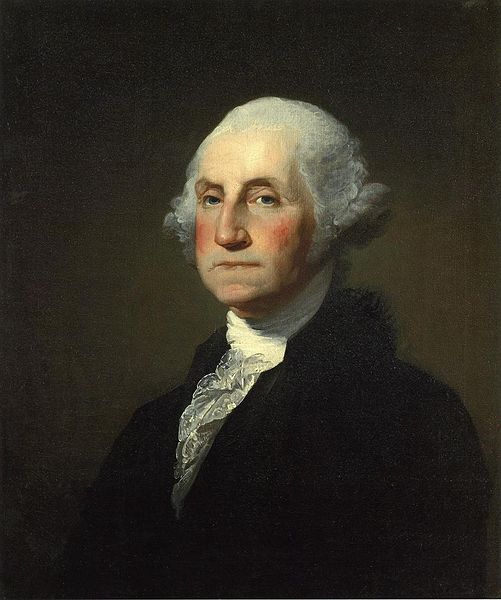
Perhaps the best known image of George Washington is this one done by Gilbert Stuart.

Perhaps the best known image of George Washington is this one done by Gilbert Stuart.

Gilbert Stuart was another artist who was inspired to paint Washington. [Image courtesy: The Library of Congress]

Stuart was inspired by Washington and painted him several times . [Image courtesy: The Library of Congress]

Tompkins H. Matteson's Washington at Valley Forge. [Image courtesy the Pocontico Hills School Washington site]

Tompkins H. Matteson’s Washington at Valley Forge. [Image courtesy the Pocontico Hills School Washington site]

General of the Armies [Image courtesy: the US Military Hall of Fame.]

General of the Armies [Image courtesy: the US Military Hall of Fame.]

A young George Washington [Image courtesy: The History Channel.]

A young George Washington [Image courtesy: The History Channel.]


An etching showing George Washington addressing the troops in 1775 [Image courtesy: The National Archives]

An etching showing George Washington addressing the troops in 1775 [Image courtesy: The National Archives]

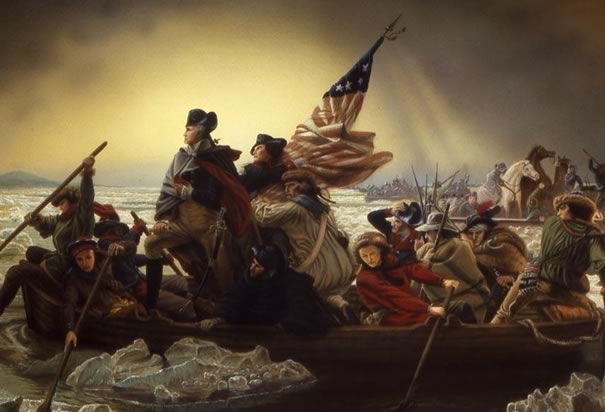
Emanuel Leutze's famous (and highly stylized) version of Washington crossing the Delaware river.

Emanuel Leutze’s famous (and highly stylized) version of Washington crossing the Delaware river.

Washington at Valley Forge. [Image courtesy: the Library of Congress]

Washington at Valley Forge. [Image courtesy: the Library of Congress]

Washington was one of artist John Trumbull's favorite subjects. Here he is  resigning as commander and chief.

Washington was one of artist John Trumbull’s favorite subjects. Here he is resigning as commander and chief.

[Image courtesy Bartleby.com]

[Image courtesy Bartleby.com]

George Washington at Mt. Vernon. George Washin...

George Washington at Mt. Vernon. George Washington seated, half-length, with Martha Washington, and two children. (cropped) (Photo credit: Wikipedia)

An older Washington [Image courtesy: The Independent]

An older Washington [Image courtesy: The Independent]

English: The equestrian sculpture of George Wa...

English: The equestrian sculpture of George Washington at the center of Washington Circle, a traffic circle and public park, located on the boundary of the Foggy Bottom and West End neighborhoods in Washington, D.C. (Photo credit: Wikipedia)

Click HERE to see a forensic model of what George Washington looked like.


John Henry Newman 2.21.13 Thought of the Day

“To live is to change, and to be perfect is to have changed often” –John Newman

English: Portrait painting of John Henry Newman

English: Portrait painting of John Henry Newman (Photo credit: Wikipedia)

John Henry Newman was born on this day in London, England in 1801. Today is the 212th anniversary of his birth.

Newman was the oldest of six children, three boys and three girls, born to John Newman and  Jemima Fourdrinier Newman. He went to Trinity College, Oxford then attended Oriel College.  He received his bachelor’s degree from Oriel in 1820 and became a fellow then tutor at the school.

He had held academic and pastoral assignments simultaneously for several years, serving first as both fellow of Oriel and curate of St. Clement’s and later as both tutor and vicar of St. Mary’s. He remained in his pastoral office until 1843, attracting hundreds of students, university officials, and townspeople to St. Mary’s [this church’s UK site] with his scholarly yet earnest preaching. [The Victorian Web]

He was a leader in the Oxford Movement —  a “19th-century movement centred at the University of Oxford that sought a renewal of “catholic,” or Roman Catholic, thought and practice within the Church of England in opposition to the Protestant tendencies of the church.” [Encyclopedia Britannica] .

Newman…was the Movement’s primary spokesman, promoting its doctrinal and moral concerns through his editorship of the British Critic, his contributions to Tracts for the Times, and his weekly sermons at St. Mary’s. [The Victorian Web]

However, “In 1839, Newman began to lose confidence in the cause… and he soon became convinced that Rome, not Canterbury, was the home of the true Church.” [Ibid] He withdrew from Anglican life and left Oxford. He took back anti Catholic and anti Papal statements he’d said and written  in his youth. In 1845 he converted to Catholicism and became a preist.

Newman worked just as energetically for the Catholic Church as he had for the Anglican. He was instrumental in the creation of the Catholic University of Ireland, and he wrote…

Cover of "Parochial and Plain Sermons"

Cover of Parochial and Plain Sermons

The 1870s brought Newman special recognition for his work as both an Anglican and a Roman Catholic. In 1877 he became the first person elected to an honorary fellowship of Trinity College; two years later, Pope Leo XIII awarded him a place in the College of Cardinals.[The Victorian Web]

Cardinal Newman died of pneumonia in August of 1890.

He wrote the lyrics to the hymn Lead Kindly Light. Here’s the Wells Cathedral Choir singing the song…


Kurt Cobain 2.20.13 Thought of the Day

“I’d rather be hated for who I am, than for who I am not.” — Kurt Cobain

[Image courtesy: FanPop.com]

[Image courtesy: FanPop.com]

Kurt Donald Cobain was born on this day in Aberdeen, Washington, USA in 1967. Today is the 46th anniversary of his birth.

Cobain came from musical and artistic roots. He had uncles and aunts who played and sang in bands and his grandmother was a professional artist. By four his bedroom looked like an art studio and he could crank out a drawing of his favorite cartoon characters on demand. He could also play piano by ear, sing and play his toy drum kit. But his seemingly idyllic childhood was crumbling at home where his parent’s stormy marriage was coming to a messy end. “I had a really good childhood up until I was nine, then a classic case of divorce really affected me.” [Cobain] After his parents divorce Cobain withdrew and became a moody pre-teen. Both his parents remarried and he felt he didn’t fit with either of the blended families. He began to experiment with drugs in his teens. He got into trouble with the law, and by 1984 he was on his own bouncing from one friend’s couch to the next, sometimes sleeping in apartment hallways and hospital waiting rooms when a friendly sofa wasn’t available.

His love of music and art were always positive outlets in his troubled life. He got a second-hand guitar as a birthday present from an uncle and threw himself into learning how to play. Cobain followed the Pacific Northwest Punk scene, especially the band The Melvins. He met bassist Krist Novoselic through Novoselic’s brother, Robert, a fellow The Melvin’s fan. Both men wanted to start a band. When Aaron Burkhard joined them on drums Nirvana was born.

[Image courtesy: The Quiet one]

[Image courtesy: The Quiet Front.com]

Their first album, Bleach came out in 1989. “Their signature sound, which included elements of punk and heavy metal, was … apparent on the album.” [Biography.com]

Here’s the unplugged version of “About the Girl” from Bleach. [Yeah, I know this a blog about Kurt Cobain, but just take a minute to listen to Novoselic’s awesome acoustic bass guitar line — nice! ]

Dave Grohl had taken over on drums by the time they release their next album.  Their “Grunge” sound continued to evolve with  Nevermind. The single “Smells Like Teen Spirit” launched Nirvana and Nevermind into the Billboard Top 100.

Here’s Smells Like Teen Spirit… [Warning I couldn’t find an unplugged version, so this rocks out.]

And here’s Come As You Are… [Unplugged]

Cobain was suddenly put into the spotlight not just as a musician, but as the poster child for the Grunge movement. He rebelled against the scrubbed alternative version the media seemed to demand of him, and he resented the fans who heard one song (Teen Spirit) and called themselves Nirvana fans.

In an effort to get regain a more natural, raw sound the group put out their third studio album, In Utero. The album is …

Full of highly personal lyrics by Cobain about his many life struggles, the recording featured a fair amount of hostility toward people and situations that Cobain reviled. He took on the recording industry with “Radio Friendly Unit Shifter.” It also had some more tender moments with “Heart-Shaped Box,” which is supposed to be about his marriage to Love. Guitar Player magazine described the album as having “a startling level of anger, energy, and jaded intelligence.”[Biograph.com]

Here’s “Heart Shaped Box”

His relationship and marriage to punk rocker Courtney Love garnered even more attention from the paparazzi. He was actively taking drugs (as was she — something that landed the both in trouble with social services when she gave an interview admitting she used heroin while pregnant with their daughter, Francis Bean). The cocktail of media pressure, unhappiness, touring, and drugs proved too much for him. He attempted suicide in March of 1994 while in Rome with Love. He returned to the US and at her urging,  eventually sought treatment for his drug addiction at the Exodus Recovery Center in Los Angeles,, but he only lasted 2 days at the facility before scaling a 6 foot wall to escape. He returned to the Seattle area and took his life in the guest house on his estate. He shot himself with a shot gun.  His body was found three days later along with a lengthy suicide note.

The group released Unplugged in New York shortly after Cobain’s death and it went to the top of the charts. Two years later, a collection of their songs entitled From the Muddy Banks of the Wishkah was released, and again the group scored a huge hit, reaching the number three spot on the album charts. [Biograph.com]

—————————————————-

I like Nirvana’s music. I have for a long time. (Although as I mature I’ll admit I like those softer MTV Unplugged versions a bit better than the full-out concert rock versions.)  However…In writing and researching this bioBLOG I got a little icky feeling. In every thing I read Cobain comes off as the great artist who feels too sorry for himself. But why? Because his parents argued in front of him and got a divorce? That’s about half of America isn’t it? It is such a shame that this very talented (very handsome) young man was so determined to be unhappy. Doubly shameful is that he had such easy access to drugs.

Still he, Krist Novoselic, and Dave Grohl made some of the best music of their generation. And for that I salute him. … I think I’ll listen to “All Apologies” to play us out.


Jeff Daniels 2.19.13 Thought of the Day

“I’ve got a lot of friends who make $20 million, and I don’t. I could feel unappreciated. So I fanned those flames [to play the part].” — Jeff Daniels

images

Jeff Daniels was born on this day in Athens, Georgia, USA in 1955. He is 58 years old.

His family left Georgia when Daniels was an infant eventually landing in Chelsea, Michigan. His father, Bob Daniels owned a lumber yard in the town and was the town’s mayor for a while. Jeff still calls Michigan home. He lives there now with his wife and three kids.

When he was 18, in 1976,  Jeff Daniels was part of a Bicentennial Repertory program at Eastern Michigan University. The guest director for the program, Marshall Mason encouraged him to come to New York where Daniels worked with the Circle Repertory Theatre in The Fifth of July. He won a Drama Desk Award for the play. Other plays, both in New York and in regional theatre followed.

Jeff in Terms

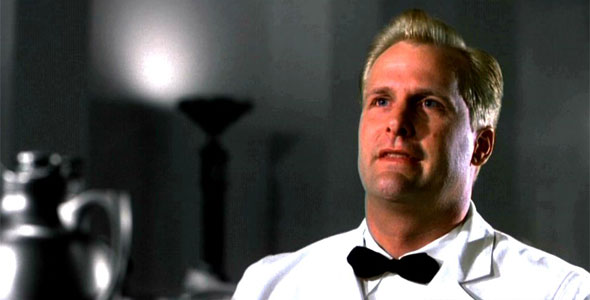
His film premier was in 1981 with Ragtime as P.C. O’Donnell.  He gained a wilder audience as Debra Winger‘s cheating, disengaged, husband Flap Horton in Terms of Endearment. The movie won a slew of awards (including 5 Academy Awards) and raised Daniel’s visibility considerably. In 1985 he teamed up with director Woody Allen for The Purple Rose of Cairo. He played the dual roles of Tom Baxter (literally a character that comes off the screen)  and Gil Shepherd (the actor who plays the character) in the movie. Another terrific movie from his early career is the quirky “romance,” Something Wild.

Daniels is one of those actors who blends so seamlessly with a role that you kind of forget that he’s in a movie. So when you go to the dvd shelf you have a kind of ah-ha moment. This guy has done a LOT of movies.  In part that is by design. He’s never been keen on being a movie star, and has always been content to just be a good actor. He is equally at home with comedy and drama.

Pleasantville

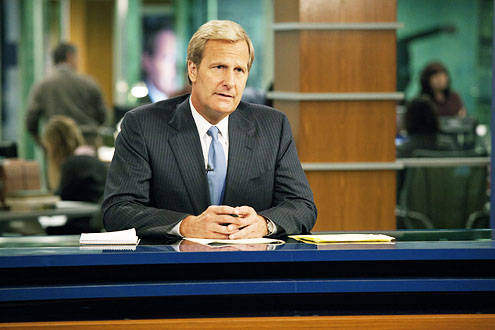
He plays the Everyman in mid-America, sometimes a little goofy, like in  Arachnophobia, some times sweet, like his delightful performance in Pleasantville. But watch out, his characters can have a real zing of intellectual ass-hole-ed-ness to them too, like his Bernard Berkman in The Squid and the Whale (I loved the movie, but I didn’t love him.)Last year he starred in the new HBO series Newsroom as Will McAvoy. He is fantastic in the show. The faced paced dialog and occasional rant seem like a dream role for an actor who too often has to dampen down his acting palette to shades a vanilla. It is nice to see him chew a bit a scenery, and in Will McAvoy it really works.

the-newsroom1

Here’s a link to an NPR Terry Gross interview with Daniels shortly after the debut of HBO’s Newsroom.

http://www.npr.org/2012/06/20/155426877/jeff-daniels-anchoring-the-cast-of-the-newsroom


Thomas Cole 2.1.13 REPOST

Here’s the promised repost of the Thomas Cole bioBLOG. (The original got spammed.) His birthday is 2.1.1801.

———————————————————–

“How lovely are the portals of the night, when stars come out to watch the daylight die.”– Thomas Cole

Thomas Cole [Image courtesy www.abcgallery.com]
Thomas Cole [Image courtesy http://www.abcgallery.com]

Thomas Cole was born on this in Bolton-le-Moor, Lancashire, England. in 1801. Today is the 211th anniversary of his birth.

Cole was the seventh child born to James and Mary Cole. James was a woolen manufacturer. Accounts of Cole’s childhood in England vary, but it seems that family was poor and his life was pretty grim.

In 1810, at the age of nine, Thomas was sent to school in the city of Chester, where he allegedly suffered from malnutrition, harsh discipline and sickness enough to scar him with memories of the experience for the rest of his life. [ABC Gallery.com]

In 1815 his lot improved marginally as he apprenticed “to an engraver of designs working at a calico print factory” [Ibid] By 17 he was an engraver’s assistant in Liverpool. When the company his father worked for folded the family moved to the United States.

They lived in Philadelphia, Pennsylvania for a while before moving on to Steubenville, Ohio, but Thomas stayed in Philadelphia. He …

worked as a wood engraver and a textile print designer. The next year, 1819, Cole traveled to St. Eustatius in the Caribbean where he made some of his earliest artistic efforts, sketches of the mountainous landscape. [questoryalfineart.com]

He joined his family in Ohio later that year. He worked with his father as a wallpaper manufactuer . In 1820 he learned the basics of portrait painting from a traveling painter named Stein. Although Cole was more interested in landscapes, portraits sold better. He also painted theatre sets.

In 1823, the young aspiring artist took his development to a new level by enrolling at the Pennsylvania Academy of Fine Arts in Philadelphia. The next year, Cole exhibited his first work, at the Pennsylvania Academy. He moved to New York City in 1825 and began his long relationship with and reverence for the Hudson River Valley. [Ibid]

Cole, Thomas - Kaaterskill Falls

Cole, Thomas – Kaaterskill Falls (Photo credit: Wikipedia)

Cole is considered the father of the Hudson River School, “America’s first true artistic fraternity” [metmuseum.org]

…a tourist hotel was opened in the Catskill Mountains one hundred miles upriver from New York. Once in New York in late 1825, Cole sailed for the Catskills, making sketches there and elsewhere along the banks of the Hudson. He produced a series of paintings that, when spotted in a bookstore window by three influential artists, gained him widespread commissions and almost instant fame. [Ibid]

The end of the Edenic period, Adam and Eve are...
The end of the Edenic period, Adam and Eve are thrust into a bleak Antediluvian world. Thomas Cole, 1828 (Photo credit: Wikipedia)

He painted lush landscapes throughout the North Eastern United States “including the White Mountains in New Hampshire in 1827 and the Niagara Falls in 1829.” [ABC Gallery.com] That summer he went to England and then, in 1831 toured Europe.

NYC - Metropolitan Musem of Art - Thomas Cole'...
NYC – Metropolitan Museum of Art – Thomas Cole’s View from Mount Holyoke, Northampton, Massachusetts, after a Thunderstorm—The Oxbow (Photo credit: wallyg)

He based his famous The Course of Empire series on landscapes he’d seen in Europe.

Thomas Cole - The Consummation of the Empire -...
Thomas Cole – The Consummation of the Empire – WGA05143 (Photo credit: Wikipedia)

He moved back to New York and married  Maria Bartow in 1836 a big year  “The newlyweds settled in the village of Catskill, where Cole had made a habit of spending summers before his departure to Europe.” [ABC Gallery.com]

WLA brooklynmuseum Thomas Cole Catskill Mounta...

WLA brooklynmuseum Thomas Cole Catskill Mountains Morning 1844 (Photo credit: Wikipedia)

Cole continued to paint, and lecture until 1848 when he was “struck by a debilitating disease which left him with a lung infection…. After lingering for almost a week, Cole died on February 8, 1848.” [ibid]

Thomas Cole
Thomas Cole (Photo credit: Paul Lowry)
Related articles

For a nice interactive tour of Cole’s artwork CLICK HERE

To learn about the Thomas Cole National Historic Site in Catskill CLICK HERE