Gustav Vigeland 4.11.13 Thought of the Day

[Image courtesy: Red Ice Creations]

[Image courtesy: Red Ice Creations]

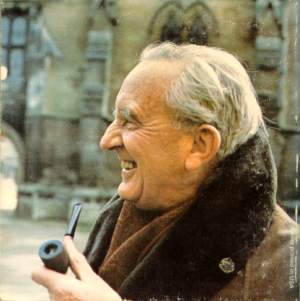
Adolf Gustav Vigeland was born on this day outside Halse og Harkmark  in Mandal, Norway in 1869. Today is the 144th anniversary of his birth.

He was born to Anne and  Elesæus Vigeland. His father was a master cabinetmaker. Gustave was interested in wood as a medium too, but he wanted to carve it, not make cabinets with it. He went to Oslo at 15 to apprentice at wood carving. His education was put on hold when his father died and Gustav returned home to help support he family. But by 1888 he was back in Oslo studying under sculptor Brynjulf Bergslien. In 1889 he premiered his first work, Hagar and Ishmael.

Portrett av Gustav Vigeland

Portrett av Gustav Vigeland (Photo credit: National Library of Norway)

Starting in 1891 she traveled to Copenhagen, Paris, Berlin and Florence. His stay in Paris, studying  at Auguste Rodin’s studio had a particular influence on the young sculptor.

Themes of life, death and  love — at once intimate and grand in scale — made their way into his sculpture.

Conceptions of death recur in a number of his works, and his portrayals range from melancholy and desolation to deep affection and ecstasy of the embrace. [The Robinson Library]

Frogner famous for housing the Vigeland Sculpt...

Frogner famous for housing the Vigeland Sculpture Park, which was created by Gustav Vigeland in the 20th century. en.wikipedia.org/wiki/Vigeland_Sculpture_Park (Photo credit: Wikipedia)

His works were well received in art circles and by critics, but Gustav found he couldn’t make a living sculpting naked images of death or love.

He took a unfulfilling job helping to restore the Nidaros Cathedral in 1897 for a few years — it was there that he began to carve dragons and lizards, animals he used later to symbolize sin and the force of nature working against man. He spent a decade carving busts of Norway’s famous writers and thinkers. He designed the Nobel Peace Prize which was first awarded in 1901.

[Image courtesy: Red Ice Creations]

Back of the Nobel Peace Prize. [Image courtesy: Red Ice Creations]
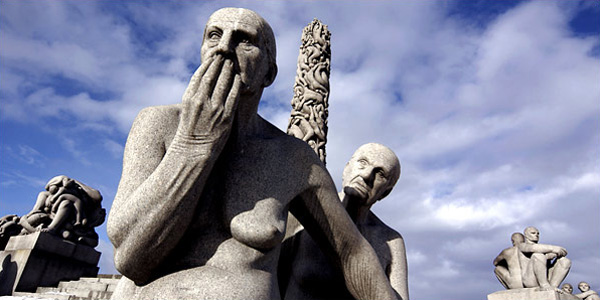
Gustav secured an abandoned studio from the city of Oslo starting in 1902. He used the work space for nearly two decades before it was demolished to make way for the new Deichman Library. At that point he negotiated with the city council for a new workspace. They would provide him with a new studio/living space and he would donate all his future art works to the city. (Which explains why so little is of Vigeland’s art is found outside of Oslo, and why the city is so beautifully decorated by it.)

11100vigeland1

Detail of some of the hundreds of sculpture in Vigeland Park. [Image courtesy: Red Ice Creations]

Oslo’s Vigeland Park  is the world’s largest sculpture park designed by a single artist. The park boast…

over 600 human figures engraved in 192 different sculptures. All of them, amazing. The masterpiece of the park is “The Monolith” a towering spire figures ascending to eternity. Gustav Vigeland is the man who designed the models for every sculpture in the park. A team of sculptures work for years to create all the granite and bronze statues. The various sculptures portray lots of widely ranging aspects of the human condition. There are many sculptures depicting intense emotions and feelings; love, parenthood, innocence, violence, suffering and joy. In all of the sculptures, there is a deeply moving and poetic statement about life. [Answer.com]

When he died in 1943 his studio was converted into The Vigeland Museum. Today the museum “houses approximately 1,600 sculptures, 420 woodcuts, and 12,000 drawings, as well as other artifacts such as notebooks, photographs, books, and thousands of letters belonging to Vigeland.” [Real Scandinavia]

Wheel of Life scuopture at Vigeland Park [Image courtesy: Red Ice Creations]

Wheel of Life scuopture at Vigeland Park [Image courtesy: Red Ice Creations]

"Ball of Babies" at the Vigeland Park [Image courtesy: Red Ice Creations]

“Ball of Babies” at the Vigeland Park [Image courtesy: Red Ice Creations]

Related blogs:

Happy Birthday Gustav Vigeland

http://realscandinavia.com/sculpture-on-a-grand-scale-oslos-vigeland-museum-and-park/

http://www.arisamtravel.com/Gallery/GUSTAV_VIGELAND_EXIT/photo2234.htm

http://www.redicecreations.com/article.php?id=11101


Hortense de Beauharnais 4.10.13 Thought of the Day

[Image courtesy: Wikipedia]

[Image courtesy: Wikipedia]

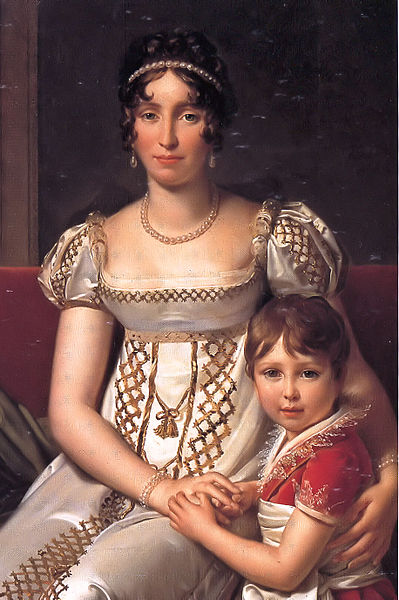
Hortense E de Beauharnais was born on this day in Paris, France in 1783. Today is the 230th anniversary of her birth.

She was born to French aristocrats Alexandre, Vicomte de Beauharnais and Joséphine Tascher de la Pagerie. Both her parents were arrested during the French Revolution, and her father was guillotined at the Place de la Révolution on July 23, 1794. Josephine was released in August of that year. In 1796 she married Napoleon Bonaparte.

Hortense was a pretty child. She had long blond hair and blue eyes. She attended school Napoleon’s youngest sister, Caroline.

[Image courtesy: Wikimedia Commons

[Image courtesy: Wikimedia Commons

At 19 this “Flower of the Bonapartes” was married off to Napoleon’s brother Louis. It was not a marriage of love, but, rather, it was a marriage of convenience, arranged at Napoleon’s request. The couple never got along, but they did manage to have three children together: Napoléon Louis Charles Bonaparte, Napoleon Louis Bonaparte and Charles Louis Napoléon Bonaparte. (Charles would later become Napoleon III, Emperor of France.)

The Royal Monogram of Hortense [Image Courtesy Wikipedia]

The Royal Monogram of Hortense de Beauharnais, Queen of Holland [Image Courtesy Wikipedia]

The Emperor appointed Louis King of Holland and Hortense had to leave her beloved Paris to follow her no-so-beloved husband to Holland. The Netherlands won her over and she learned to enjoy the people, customs and landscapes. But her relationship with Louis did not improve.

After the death of their first son Hortense was allowed to return to Paris because it would provide a more healthy environment for both the Queen and her remaining children. When Napoleon prepared to remarry he decided that it wouldn’t do to have the daughter of his first wife living at court, so he had her shuttled north again. Her stay in Holland was temporary and she left, again for “health” reasons, in 1810.

Now officially separated Hortense moved to Switzerland where she had a long-term affair with Colonel Charles Joseph, Comte de Flahaut. The couple had an illegitimate son together, Charles Auguste Louis Joseph.

[Image courtesy: Wikipedia]

[Image courtesy: Wikipedia]

She remained a loyal Bonapartist. When the Bourbon monarchy was restored in Paris, Hortense — like all the Bonapartes –went into exile. She, Charles Louis Napoléon Bonaparte and Charles Auguste Louis Joseph moved to Arenenberg Castle, near Lake Constance in Switzerland. While there she transformed…

The medieval castle and its gardens …. into an island of French culture amidst the rather provincial region of Lake Constance. The castle was surrounded by a 12 ha park with hermitage, fountains, waterfalls and nymphaeum, steep paths and viewpoints.  [www.bodensee-magazine]

The main house, which still stands, had living quarters and rooms for entertainment (including a theatre). She continued to expand the house and  revamp the estate, adding the latest in Parisian style almost until her death on October 5,  1837.

[Image courtesy: Kreuzlingen tourism]

Arenenberg Castle  [Image courtesy: Kreuzlingen tourism]


Eadweard Muybridge 4.9.13 Thought of the Day

“…we have become so accustomed to see [the galloping horse] in art that it imperceptibly dominated our understanding, and we think the representation to be unimpeachable, until we throw off all our preconceived impressions on one side, and seek the truth by independent observation from Nature herself.” — Eadweard Muybridge


Eadweard Muybridge (photographer) was born in ...

Eadweard Muybridge (photographer) was born in the town in 1830 (Photo credit: Wikipedia)


Edward James Muggeridge was born on this day in Kingston upon Thames, England in 1830. Today is the 183rd anniversary of his birth.


He was one of four boys born to John and Susan Muggeridge. John ran a grain and coal business from the first floor of their house while the family lived on the second floor.


When he was 25, Edward emigrated to San Francisco and started a book selling business. California had just become a state and San Fransisco was plush with Gold Rush money.  At 30, in 1860 he decided to go back to England on a book buying expedition. As he travelled across the US en route to New  York City his stagecoach had a terrible accident. He was thrown from the coach (another passenger died) and hit his head on a rock. It took him months to recover from his double vision, confusion and impaired senses. His behavior was erratic and he was emotionally unstable for years afterwards.


In England he took up photography. He studied the wet-plate collodion process and learned composition and other skills. He changed his last name to Muybridge and returned to San Fransisco. His reputation as a photographer grew. He specialized in landscapes and architectural photos he took using a converted carriage as a darkroom. He used the pseudonym Helios for his published photographic works. (Helios was also the name of his studio.)


English: Gait of Leptoptilos dubius - photogra...

English: Gait of Leptoptilos dubius – photographic study by Eadweard Muybridge (Photo credit: Wikipedia)


Muybridge…


gained worldwide fame photographing animal and human movement imperceptible to the human eye. Hired by railroad baron Leland Stanford in 1872, Muybridge used photography to prove that there was a moment in a horse’s gallop when all four hooves were off the ground at once. He spent much of his later career at the University of Pennsylvania, producing thousands of images that capture progressive movements within fractions of a second. [Freeze Frame.com]


Animated sequence of a race horse galloping. P...

Animated sequence of a race horse galloping. Photos taken by Eadweard Muybridge (died 1904), first published in 1887 at Philadelphia (Animal Locomotion). (Photo credit: Wikipedia)


He developed a high-speed shutter and electronic timer and used as many as 24 cameras to take his rapid motion pictures. Because of his advances in photography  moving pictures were on the horizon.


Muybridge actually came tantalizingly close to producing cinema himself with his projection device the ‘Zoöpraxiscope’. With this device, Muybridge lectured across Europe and America, using the Zoöpraxiscope to animate sequences from his motion studies. [Eadweard Muybridge Collection]


The sequence is set to motion using these fram...

The sequence is set to motion using these frames (Human and Animal Locomotion, plate 700, Buffalo galloping). (Photo credit: Wikipedia)

He was an eccentric man, he married a woman less than half his age, then in a jealous fit shot the man who might have fathered their seven-month-old son Florado. Muybridge was tried for murder, but pleaded insanity because of his stage-coach accident 14 years before. He was acquitted on the grounds of “Justifiable Homicide.”  He left the States for planned work in Central America.

Eadweard Muybridge eventually went back to England where he published  Animals in Motion (1899) and The Human Figure in Motion (1901), He died on May 8, 1904 in Kingston upon Thames.


Muffin Monday! Fruit Buckwheat Muffins (Vegan?)

Hi everybody! Back with another delicious muffin recipe. I like to use what I’ve got on hand… and since last week’s macarons left me with some unused almond flour I used it here in place of some of the whole wheat pastry flour. I also tried Demerara sugar for the first time. These are great for breakfast or a snack, but they are moist so eat them up quickly or refrigerate them.

I think this one is Vegan too. (Any of my Vegan buddies want to check me on that, please?)

————————————————————-

Fruit Buckwheat Muffins

Ingredients:

IMG_4689

  • 3/4 cups almond flour

IMG_4683

  • 3/4 cups white whole wheat pastry flour

IMG_4691

  • 1/3 cup Demerara sugar (or other raw sugar)

IMG_4697

  • 1/4 cup ground flaxseed

IMG_4694

  • 2 tsp baking powder
  • 1/2 tsp baking soda
  • 1/2 tsp salt

IMG_4712

  • 1 cup orange juice ( I used the juice of 1 orange and enough of the juice from the cranberries/dates — see below — to make one cup.)

IMG_4713

  • 1/2 cup of canola oil

IMG_4720

  • 2 tsp orange zest

IMG_4517

  • 2 tsp almond extract
[Image courtesy: SmellLikeFoodInHere.com]

[Image courtesy: SmellLikeFoodInHere.com]

  • 1 1/2 cups dry cranberries

IMG_4678

  • 1 cup dry chopped dates

IMG_4510

  • 1 medium zucchini grated

IMG_4520

  • sliced almonds

IMG_4582

Part One: put the dry cranberries and the dates in a medium-sized microwaveable bowl. Add enough water to cover the fruit. Cover loosely with plastic wrap/lid. Microwave on high for three minutes, stirring after each minute. (Don’t over cook or the juice will boil over and you’ll have a mess — you don’t want a mess.) Remove plastic wrap/lid and cool about 10 minutes. Drain the cranberries/dates. (Reserve the juice. You can either use it with the OJ in the recipe — which is what I did — or you can add some cold water and drink it. Its pretty tasty).

IMG_4680

Part Two: Pre-heat the oven to 375 degrees. Line muffin tin with muffin pants and spray lightly with cooking spray.

IMG_4551

Part Three: In a large bowl mix all the ingredients except the almonds together, adding the cranberries/dates, last. Mix just well enough to incorporate all the ingredients. Don’t over mix.

IMG_4723

IMG_4726

Part Four: Fill the muffin tins almost all the way full.  Garnish with a few almond slices.

IMG_4728

Bake for 25 minutes and test with a toothpick. If the toothpick comes out clean pull the muffins out and let cool a bit before your devour.

IMG_4732

These didn’t rise very much, so they are dense and filling.

IMG_4730

This recipe made 18 muffins.

IMG_4735

Moist, fruity and delicious. These are some yummy muffins.


Gabriela Mistral 4.7.13 Thought of the Day

“At this moment, by an undeserved stroke of fortune, I am the direct voice of the poets of my race and the indirect voice for the noble Spanish and Portuguese tongues.”–Gabriela Mistral

Gabriela Mistral

Gabriela Mistral (Photo credit: Wikipedia)

Lucila Goday y Alcayaga was born one this day in Vicuña , Chile in 1889.

Daughter of a poet and school teacher, Juan Gerónimo Godoy Villanueva, and a seamstress, Petronila Alcayaga, she was raised in a small Andean village. The family lived in poverty, a situation that worsened when her father left when Lucila was three. She was close to her older sister, Emelina Molina, who was also her teacher.

Despite having only a few years of formal education, she became a teacher’s aide at 15 to help support her family. As a teacher she had a number of positions in rural Chilean towns. By 1912 she was teaching at the high school level. Her star as an educator continued to rise,  in 1921, she became the director of Santiago’s Liceo (high school) #6, the best girls’ school in Chile. She went on to help reform the Mexican education and library system.

English: Gabriela Mistral, Chilean poet, educa...

English: Gabriela Mistral, Chilean poet, educator, diplomat, and feminist (Photo credit: Wikipedia)

A poet all her life…

“At age sixteen she moved to La Cantera to take a job and fell in love with a young railway worker. The relationship didn’t last and two years later the young man committed suicide. The only item found in his possession was a postcard from Mistral. This affected her deeply and she wrote Sonetas de la Muerte (Sonnets of Death) to express her feelings.” [Distinguished Women.com]

Lucila took the pen name Gabiela Mistral. Her poems reflected her experiences in life. When she “…was appointed director of a secondary school for girls located in rural Punta Arenas. The rough terrain of Punta Arenas became an inspiration for a series of poems entitled Patagonian Landscapes.“[ Ibid]

Her time in Mexican inspired   Readings for Women

“The dominant themes in her poetry were love, death, childhood, maternity, religion and the beauty of nature and of her native land. She also had a burning desire for justice.”[Ibid]

Major works include:

  • Sonetos de la muerte (1914)
  • Desolación  1922
  • Ternura 1924
  • Tala 1938
English: Gabriela Mistral, Nobel laureate in L...

English: Gabriela Mistral, Nobel laureate in Literature 1945 Deutsch: Gabriela Mistral, Nobelpreisträgerin für Literatur 1945 (Photo credit: Wikipedia)

She was the first Latin American and (so far is) the only Latin American woman to receive the Nobel Prize for Literature.

At the time of her death in 1957, her poems had been translated into English, French, German, Swedish and Italian.

The Rose

by Gabriela Mistral

The treasure at the heart of the rose
is your own heart’s treasure.
Scatter it as the rose does:
your pain becomes hers to measure.

Scatter it in a song,
or in one great love’s desire.
Do not resist the rose
lest you burn in its fire.

Click HERE to go to Poem Hunter.com and read more of Mistral’s works.


Secondary Character Saturday — Iago

Illustration of Othello and Iago

Illustration of Othello and Iago (Photo credit: Wikipedia)

“…What’s he then that says I play the villain?” — Iago

Who: Iago

From: Othello

By: William Shakespeare

Written: Around 1603

Pros: Intelligent, ambitious, funny. Although he is the play’s worst character, he is also its most interesting and complex by far… you can’t take your eyes off the scum ball.

Cons: Manipulative, abusive, sociopathic, vengeful, bitter, jealous, petty. He’s a liar and bully that will literally commit murder to get what he wants.

English: Carl Schurz as Iago from Shakespeare'...

English: Carl Schurz as Iago from Shakespeare’s play Othello, amidst his co-conspirators, prepares to enter the limelight. (Photo credit: Wikipedia)

Most Shining Moment: (Yeah, I’m leaving this one BLANK)

Least Shining Moment: So many to choose from. I’m going to go with killing his wife, Emilia. He’s treated her like dirt the entire play, and when she finally looses it and stands up to him he doesn’t think twice about running her through with a rapier.

Why I chose Iago: As you may have noticed most my Secondary Characters are pretty stand up guys. They all  have something going for them…maybe its charm… maybe they have good heart… but there is usually some nice feature that makes me like a character enough to give them the honored Saturday spot. Not so with Iago. Honestly I’m hard pressed to think of anything really nice to say about him. But…it is a really juicy role. He’s the one people remember. It is kind of the Darth Vader effect. You aren’t supposed to like him at all, but he’s the one whose theme song you remember.

English: Photographic full-length portrait of ...

English: Photographic full-length portrait of Edwin Booth as Iago in Shakespeare’s Othello, the Moor of Venice (Photo credit: Wikipedia)

Is Iago a SECONDARY character: I often struggle with whether a character is indeed Secondary. And it is hard to make that case with Iago when he is on stage more than any other character in Othello.  (He has 1,070 lines.) Without his wicked machinations you’d have a very different/happier story so, unlike other Secondary Characters, he is pivotal to the plot. But, when it comes down to it, the play is called Othello, not Iago. So I’m giving the slimy little so-and-so the nod this week.

Othello (1995 film)

Othello (1995 film) (Photo credit: Wikipedia)

————————————————————-

I’m feeling very Shakespeare-y today. I had the good fortune to attend the Baltimore Shakespeare Factory‘s Bard’s Birthday Gala last night. We were treated to scenes from their upcoming production of Romeo and Juliet (April 6-27) as well as a 3 person / 20 minute version of Othello. It was a fabulous lesson in suspending disbelief as the actors literally transformed before your eyes from one character another, and it worked beautifully. With a handful of props, no set and no furniture these three actors told the this timeless story in an engaging, new way. Play on! Indeed!


Gregory Peck 4.5.13 Thought of the Day

“I don’t lecture and I don’t grind any axes. I just want to entertain.”–Gregory Peck

Cropped screenshot of Gregory Peck from the tr...

Cropped screenshot of Gregory Peck from the trailer for the film Gentleman’s Agreement. (Photo credit: Wikipedia)

Eldred Gregory Peck was born on this day in La Jolla, California, USA in 1916. Today is the 97th anniversary of his birth.

He was born to Bernice Mae “Bunny” and Gregory Pearl Peck. Bunny was Scottish, English and Protestant, Gregory senior was Irish and Catholic. She converted when they married and they raised Eldred Catholic. When the couple split  little Eldred was six, he went to live with his grandmother.

Peck…”never felt he had a stable childhood. His fondest memories are of his grandmother taking him to the movies every week and of his dog, which followed him everywhere.” [IMDb]  When he was ten his grandmother passed away and he went to live with his father full-time.

He went to St. John’s Military Academy, a Roman Catholic military school in Los Angeles, then to  San Diego High School. He enrolled at San Diego State Teacher’s College for one year before transferring to the University of California, Berkley where he settled on Acting. Working as a truck driver and kitchen assistant helped pay the bills.

Upon graduation Peck headed east to New York City.  Gregory Peck was ‘born’ when he dropped his first name. “I never liked the name Eldred. Since nobody knew me in New York, I just changed to my middle name.” He worked as an usher at Radio City Music Hall and a tour guide at NBC. He worked for the acting experience and for food, landing progressively larger roles as he honed his craft.

His debut was in Emlyn Williams‘ play “The Morning Star” (1942). By 1943 he was in Hollywood, where he debuted in the RKO film Days of Glory (1944).

Stardom came with his next film, The Keys of the Kingdom (1944), for which he was nominated for an Academy Award. Peck’s screen presence displayed the qualities for which he became well-known. He was tall, rugged and heroic, with a basic decency that transcended his roles. [IMDb]

Cropped screenshot of Gregory Peck from the tr...

Cropped screenshot of Gregory Peck from the trailer for the film The Yearling. (Photo credit: Wikipedia)

He was nominated for four Academy Awards in the 1940’s for his work in: The Keys of the Kingdom, The Yearling, Gentleman’s Agreement and Twelve O’Clock High. He’d have to wait another 20 years before winning the statue.

An old back injury keep him out of the service during World War II (he’d hurt himself while taking dance and movement classes — not while on the UC Berkley Rowing team as 20th Century Fox claimed.)

He kept his stage skills up at The La Jolla Playhouse, a theatre he co-founded with Mel Ferrer and Dorothy McGuire in 1947.

To Kill a Mockingbird, 1962

To Kill a Mockingbird, 1962 (Photo credit: mystuart)

His best known and most love role came in 1962 as Atticus Finch in the film adaptation of Harper Lee’s To Kill a Mocking Bird. He won an Academy Award for his portrayal of the soft-spoken, southern lawyer. And his portrait of Finch was voted as the #1 greatest hero in American film by the American Film Institute in 2003.

Other notable films from his large library of movies include:

  • Spellbound
  • Captain Horatio Hornblower
  • The Snows of Kilimanjaro
  • Designing Women with Lauren Bacall
  • On the Beach
  • The Guns of Navarone
  • Cape Fear
  • The Omen
  • The Boys From Brazil

and my other favorite (besides Mocking Bird)… Roman Holiday with Audrey Hepburn.

Cropped screenshot of Gregory Peck from the tr...


Top 100 Books proves that Jane Austen is the Teacher’s Pet

CLASS lets get reading…

TES (Think, Educate, Share) a website dedicated to bringing the latest teaching news and strategies to educators and the public asked 500 primary and secondary teachers what their top 10 books were. They crunched the numbers and came up with the following list of 100 top books.

It is an interesting list and it ranges nicely from early-ish chapter books — the kind that got us all hooked on reading in the first place, like Dahl and Lewis — to more mature novels like Atonement.

I was glad to see that my girl Jane made the grade (#1, 32, 52, 58). And you’ll recognize lots of other Thought of the Day authors on here too (I put them in italics — if you  are interested in reading the bioBlogs go to the search box to the right and type in their name.)

1. Pride and Prejudice Jane Austen

Jane Austen, Watercolour and pencil portrait b...

Jane Austen, Watercolour and pencil portrait by her sister Cassandra, 1810 (Photo credit: Wikipedia)


2. To Kill a Mockingbird Harper Lee

3. Harry Potter (series) J.K. Rowling

4. Wuthering Heights Emily Bronte

5. Jane Eyre Charlotte Bronte

6. Nineteen Eighty-Four George Orwell

7. The Lord of the Rings (series) J.R.R. Tolkien

[Image courtesy Biography online

[Image courtesy Biography online

8. The Book Thief Markus Zusak9. The Hobbit J.R.R. Tolkien10. The Great Gatsby F. Scott Fitzgerald11. The Kite Runner Khaled Hosseini12. The Hunger Games (series) Suzanne Collins13. The Time Traveller’s Wife Audrey Niffenegger

14. The Chronicles of Narnia (series) C.S. Lewis

15. Of Mice and Men John Steinbeck

16. Birdsong Sebastian Faulks

17. His Dark Materials (series) Philip Pullman

18. The Gruffalo Julia Donaldson and Axel Scheffler

19. The Catcher in the Rye J.D. Salinger

20. Life of Pi Yann Martel

21. Tess of the d’Urbervilles Thomas Hardy

22. Rebecca Daphne du Maurier

23. The Curious Incident of the Dog in the Night-Time Mark Haddon

24. Lord of the Flies William Golding

25. Matilda Roald Dahl

My Roald Dahl collage featuring some of his most popular characters (as drawn by the amazing Quentin Blake).  Surrounding Mr. Dahl and his pups are: at the top left are: The BFG, Sophie, Dahl with his pups, The Enormous Crocodile, Mr. Fox, James, the Grand High Witch, Willy Wonka, and Matilda.

My Roald Dahl collage featuring some of his most popular characters (as drawn by the amazing Quentin Blake).


26. Catch-22 Joseph Heller

27. Millennium (series) Stieg Larsson

28. Animal Farm George Orwell

29. The Handmaid’s Tale Margaret Atwood

30. Persuasion Jane Austen

31. One Hundred Years of Solitude Gabriel Garcia Marquez

32. Kensuke’s Kingdom Michael Morpurgo

33. Goodnight Mister Tom Michelle Magorian

34. The Grapes of Wrath John Steinbeck

35. Charlie and the Chocolate Factory Roald Dahl

36. The Boy in the Striped Pyjamas John Boyne

37. Little Women Louisa May Alcott

English: Bust of Louisa May Alcott

English: Bust of Louisa May Alcott (Photo credit: Wikipedia)

38. One Day David Nicholls

39. We Need to Talk About Kevin Lionel Shriver

40. The Twits Roald Dahl

41. Wolf Hall Hilary Mantel

42. A Thousand Splendid Suns Khaled Hosseini

43. The Wind in the Willows Kenneth Grahame

44. Frankenstein Mary Shelley

45. Great Expectations Charles Dickens

46. Captain Corelli’s Mandolin Louis de Bernieres

47. George’s Marvellous Medicine Roald Dahl

48. The Hitchhiker’s Guide to the Galaxy Douglas Adams

douglas adams inspired "Hitch hikers guid...

douglas adams inspired “Hitch hikers guide to the galaxy” H2G2 http://www.hughes-photography.eu (Photo credit: Wikipedia)

49. Room Emma Donoghue

50. Anna Karenina Leo Tolstoy

51. Atonement Ian McEwan

52. Emma Jane Austen

53. Middlemarch George Eliot

54. The Shadow of the Wind Carlos Ruiz Zafon

55. The Color Purple Alice Walker

56. The Very Hungry Caterpillar Eric Carle

57. Brave New World Aldous Huxley

58. Sense and Sensibility Jane Austen

59. The Bell Jar Sylvia Plath

60. Alice’s Adventures in Wonderland Lewis Carroll

61. Charlotte’s Web E.B. White

62. Dracula Bram Stoker

63. We’re Going on a Bear Hunt Michael Rosen and Helen Oxenbury

64. A Prayer for Owen Meany John Irving

65. The Secret History Donna Tartt

66. The Little Prince Antoine de Saint-Exupery.

Antoine de Saint-Exupery. Scanned drawing.

Antoine de Saint-Exupery. Scanned drawing. (Photo credit: Wikipedia)

67. Crime and Punishment Fyodor Dostoevsky

68. The Poisonwood Bible Barbara Kingsolver

69. Jude the Obscure Thomas Hardy

70. Skellig David Almond

71. The Woman in White Wilkie Collins

72. Gone with the Wind Margaret Mitchell

73. Game of Thrones (series) George R.R. Martin

74. David Copperfield Charles Dickens

Charles Dickens, a former resident of Lant Street.

Charles Dickens, a former resident of Lant Street. (Photo credit: Wikipedia)

75. Never Let Me Go Kazuo Ishiguro

76. Where the Wild Things Are Maurice Sendak

77. Twilight (series) Stephenie Meyer

78. Beloved Toni Morrison

79. The Help Kathryn Stockett

80. Sherlock Holmes (series) Arthur Conan Doyle

81. Half of a Yellow Sun Chimamanda Ngozi Adichie

82. Moneyball Michael Lewis

83. My Family and Other Animals Gerald Durrell

84. Memoirs of a Geisha Arthur Golden

85. On the Road Jack Kerouac

86. Cloud Atlas David Mitchell

87. Wild Swans Jung Chang

88. Anne of Green Gables L.M. Montgomery

89. Les Miserables Victor Hugo

90. Room on the Broom Julia Donaldson and Axel Scheffler

91. Private Peaceful Michael Morpurgo

92. Noughts and Crosses Malorie Blackman

93. Cider with Rosie Laurie Lee

94. Danny the Champion of the World Roald Dahl

95. Down and Out in Paris and London George Orwell

English: George Orwell in Hampstead On the cor...

English: George Orwell in Hampstead On the corner of Pond Street and South End Road, opposite the Royal Free Hospital. The bookshop has long gone. (Photo credit: Wikipedia)

96. The Magic Faraway Tree Enid Blyton

97. The Witches Roald Dahl

98. The God of Small Things Arundhati Roy

99. Holes Louis Sachar

100. The Picture of Dorian Gray Oscar Wilde.

English: Oscar Wilde, three-quarter length por...

English: Oscar Wilde, three-quarter length portrait, facing front, seated, leaning forward, left elbow resting on knee, hand to chin, holding walking stick in right hand, wearing coat. (Photo credit: Wikipedia)

So… what do you think? Did the teachers get an A+ for their list?  Are there any other books that you treasure that didn’t make the top 100?

If you were asked to list your top 10 books what would you include?


Dorothea Dix 4.4.13 Thought of the Day

“In a world where there is so much to be done, I felt strongly impressed that there must be something for me to do” — Dorothea Dix

Ninth plate daguerreotype of Dorothea Lynde Dix.

Ninth plate daguerreotype of Dorothea Lynde Dix. (Photo credit: Wikipedia)

Dorothea Lynde Dix was born on this day in Hampden, Maine, USA in 1802. Today is  211th anniversary of her birth.

She was the oldest child of Joseph and Mary Dix. Joseph was an itinerant Methodist preacher and sometime laborer. He was also an alcoholic and an abusive father. “Her mother was not in good mental health” [Webster.edu] so by the time her two brothers, Joseph and Charles, were born Dorothea was taking care of the house. She also cared for her brothers.

During the war of 1812 the British took control of Hampden and the family moved Vermont. She also spent much of her early life in Worcester, Massachusetts. Her father taught her to read and write when she was little, “when she entered school she was way ahead of everyone else. This developed a passion for reading and teaching, as she taught her brothers how to read as well” [Ibid]

When she was about 12 it was decided that her parents could not care for the children (her mother was suffering from severe, incapacitating headaches and her father’s alcoholism was spiraling out of control) so the Dorothea, Joseph and Charles went to live with their Grandmother Dix in Boston. Madame Dix was a wealthy woman and life in the Dix Mansion was far cry from the poverty at home. But her grandmother had a very narrow vision of what well brought up young ladies did and did not do. They DID take dancing lessons and wear fine clothing. They DID NOT give food and clothing to children begging at the front gate. When Dorothea was 14 Madame Dix asked her sister, Dorothea’s great-aunt, Mrs. Duncan, to take in the girl and teach her how to be a proper young lady. That relationship fared better, but Dorothea did everything she could to get back to her brothers.

Dorothea wanted to be a teacher and with the help of an older cousin, Edward Bangs, she opened a Dame School for young ladies. “In the fall of 1816, at age fifteen, she faced her first twenty pupils between the ages of six and eight. She ran this school of sorts for three years.” [Ibid]

She continued teaching and began a formal school for older children in a cottage on her grandmother´s property. The school was named “the Hope” and it served the poor children of Boston whose parents could not afford a formal education. At this time, Dorothea wrote her first book, Conversations on Common Things. This encyclopedia for children was quite popular and sold many copies.[Learning to Give.org]

Dorothea Dix

Dorothea Dix (Photo credit: elycefeliz)

in 1826 she had to close the school because of health problems. It took her several years to recover, during this time she “wrote four more books including Hymns for Children and American Moral Tales for Young Persons.” [Ibid] Although she took on a governess job and later returned to teaching her bouts with illness recurred. She had tuberculosis, and had to eventually give up teaching. On advice from her doctors she took a long trip to England to recuperate. There she stayed with the Rathbone family. The Rathbones were Quakers and social reformers.

While in England she toured the York Retreat insane asylum. It was built by William Tuke in 1796 as was a state of the art facility for the mentally ill.

The idea that full recovery could be made if the mentally ill were treated and cared for compassionately was a principle Dix never forgot and brought to every aspect of her work. [Ibid]

When she came back to the U.S. she was asked to teach Sunday school at the East Cambridge Jail.

She discovered the appalling treatment of the prisoners, particularly those with mental illnesses, whose living quarters had no heat. She immediately went to court and secured an order to provide heat for the prisoners, along with other improvements. [Biography.com]

She embarked on a 2 year fact-finding mission, touring every facility for the mentally ill in the state. The appalling conditions she found at East Cambridge Women’s Jail (no heat, no light, scant clothing, no furniture, scarce sanitation…) was the rule rather than the exception. Much to the chagrin of those running the facilities “she compiled a detailed report and submitted it to the legislature in January 1843.” .[Learning to Give.org] A bill to remedy the abuses was quickly passed.

U.S. Library of Congress DIX, DOROTHEA LYNDE. ...

U.S. Library of Congress DIX, DOROTHEA LYNDE. Retouched photograph. date found on item. Location: Biographical File Reproduction Number: LC-USZ62-9797 (Photo credit: Wikipedia)

Dorothea set her sights on neighboring states and soon had New York and Rhode Island reforms underway. New Jersey, Pennsylvania, Alabama, Louisiana, Georgia, South Carolina, Mississippi and Arkansas were next.

In 1848, Dix submitted a bill to Congress that called for five million acres to be set aside for the use of building mental institutions to care for the ill. … For the next three years, the bill was passed back and forth. Finally, in 1854, it passed both the Senate and House, but President Franklin Pierce vetoed the bill. President Millard Fillmore was a supporter of Dorothea Dix and, in 1852, signed an executive order to begin construction of a hospital that would benefit Army and Navy veterans . [Ibid]

When the Civil War broke out..

“she volunteered her services and was named superintendent of nurses. She was responsible for setting up field hospitals and first-aid stations, recruiting nurses, managing supplies and setting up training programs” [Biography.com]

As her health continued to deteriorate she entered the state hospital in Trenton, New Jersey, a hospital she help establish. She spent 6  year there before passing away on July 17, 1887.

In all she played a major role in founding 32 mental hospitals, 15 schools for the feeble-minded, a school for the blind, and numerous training facilities for nurses. Her efforts were an indirect inspiration for the building of many additional institutions for the mentally ill. She was also instrumental in establishing libraries in prisons, mental hospitals and other institutions. [Webster.edu]

the Fountain for thirsty horses that Dorothea ...

the Fountain for thirsty horses that Dorothea Dix gave to the city of Boston to honor the Massachusetts Society for the Prevention of Cruelty to Animals, located at the intersection of Milk and India Streets. (Photo credit: Wikipedia)