“The important thing is to do good work, no matter what medium you do it in.”– Roy Scheider
Roy Scheider in Jaws (Photo credit: Michael Heilemann)
Roy Richard Scheider was born on this day in Orange, New Jersey, USA in 1932. Today is the 81st anniversary of his birth.
He is the older of two boys born to Anna and Roy Bernhard Scheider.
Roy was very athletic growing up. He loved basketball, and especially boxing. At 140 pounds he was a welter weight. He boxed between 1947 and 1953 and even participated in the Golden Gloves.
He put down the gloves in college and began to act. After studying acting at both Rutgers and Franklin and Marshall he spent 3 years in the Air Force. Once out the military he landed the yin yang of acting roles (he worked with the New York Shakespeare Festival and on two soap operas — Love of Life and The Secret Storm.)
After a few low-budget films he scored in Klute with Jane Fonda in 1971. Then came his break out role (and first Oscar nom.) in The French Connection.
In 1975 Scheider took the role of everyman police chief Brody in the film adaptation of Peter Benchley’s Jaws.
Scheider … shared lead billing with Robert Shaw and Richard Dreyfuss in the tale of a New England seaside community terrorized by a hungry Great White shark. “Jaws” was a blockbuster, and for many years held the record as the highest-grossing film of all time. Scheider then turned up as the shady CIA agent brother of Dustin Hoffman in the unnerving Marathon Man (1976). [IMBD]
After a few years of so-so movies he hit gold again with his mesmerizing portrayal of Bob Fosse in All That Jazz. Scheider earned another Oscar nomination for the film.
Mr. Joe Gideon (Photo credit: geminicollisionworks)
Other work includes: Blue Thunder, 2010, 52 Pick-Up Cohen and Tate The Russia House and the TV series SeaQuest 2032, but for Scheider his trifecta would always be The French Connection, Jaws and All That Jazz.
He died in Febrary 2008 in Little Rock, Arkansas after a long battle with multiple myeloma.
Intertitle from the HBO television program Boardwalk Empire (Photo credit: Wikipedia)
Premiered: 2009
Pros: Loyalty to his wife and children, and to a lessor degree his brother, Nucky. Complex character.
Cons: Breaks the law if it fits his, or Nucky’s, agenda.
Most Shining Moment: Eli’s character arch took quite a twist after he was released from prison. He went from one of my least favorite characters to one of my favorite. He goes from being an Atlantic City sheriff to a nobody. That humility helps his character enormously. Even when he is given a nothing job under the show’s most annoying minor mob boss, Eli holds his own. His best moment is when he tries to warn a caravan of truck drivers carry a shipment of hooch that there is an ambush in the next town. The truckers ignore him, and the insuring massacre is the start of a gang war. Another excellent Eli moment happens at the end of the season when Nucky and his troops are help up at a lumber yard. Eli drives thru the night to get help from a certain Al Capone in Chicago.
Least Shining Moment: All of Season One.
[Image Courtesy: HBO]
Why I choose Eli: I’m a sucker for flawed, conflicted characters, and Eli Thompson is certainly that. Boardwalk Empire is full of characters I have no business rooting for. A corrupt, murderous sheriff shouldn’t be any where on my list of favorite characters, but there he is. That is in part due to Shea Whigham who plays Eli with employing a full pallet of emotions (from violent to vulnerable, sometimes subtle, sometimes blunt) and in part due to the writers of Boardwalk Empire.
Of course, this being HBO, the show is filled with rude language and R rated behavior. The network doesn’t seem capable — or at least willing — to tell a good story with out bad language, gratuitous sex, and the objectification of women. Given the subject matter of Boardwalk Empire I supposed a certain amount of that is part of the story, but I think HBO takes the simple, titillating way to ratings, when good story telling and terrific acting — which they have in spades — will get them there.
Boardwalk Empire is based on the book Boardwalk Empire: The Birth, High Times, and Corruption of Atlantic City by Nelson Johnson. The show is now in its fourth season on HBO.
My smart, funny, creative daughter is directing/producing a tribute to David Ives at St. Mary’s College of Maryland this weekend. That got me thinking about the brilliant, strange playwright David Ives.
The two one acts they will be doing at St. Mary’s are “Words, Words, Words” and “Variations on The Death of Trotsky.”
David Ives was born in Chicago, Illinois, USA on July 11, 1950. He grew up on the south side of Chicago and attended Northwestern University. He worked for a few years as an editor at Foreign Affairs Magazine before entering the Yale School of Drama where he earned his MFA in playwriting. Ives is a Guggenheim Fellow and he currently lives in New York City.
Playwright David Ives [Image courtesy: Broadway.com]
He is…
probably best known for his evenings of one-act comedies called All In The Timing and Time Flies. All In The Timing won the Outer Critics Circle Playwriting Award, ran for two years Off-Broadway, and in the 1995-96 season was the most performed play in the country after Shakespeare productions. His full-length plays include Venus In Fur, which recently enjoyed a vast critical and audience success Off-Broadway; New Jerusalem: The Interrogation of Baruch de Spinoza, which won the prestigious Hull-Warriner Award; Is He Dead? (adapted from Mark Twain); Irving Berlin’s White Christmas; Polish Joke; and Ancient History. He has translated Feydeau’s classic farce A Flea In Her Ear as well as Yazmina Reza’s drama A Spanish Play, and his translation/adaptation of Pierre Corneille’s The Liar premieres this spring at Washington’s Shakespeare Theatre Company. He is also the author of three young-adult novels, Monsieur Eek, Scrib, and Voss. [American Theatre Wing.org]
He was nominated for a Tony Award for his play Venus In Fur which he later turned into a film script.
How many monkeys would it take to write Hamlet? I guess it depends on the monkey. [Image purchased from BigStock.com]
Words, Words, Words features three monkeys in a large cage with typewriters. The monkeys, Kafka, Milton and Swift, are part of a scientific experiment which hopes to prove that given enough time three apes hitting random keys on a typewriter will produce great literature — in this case, Hamlet.
Trotsky cor 05 (Photo credit: Luiz Fernando / Sonia Maria)
Variations on the Death of Trotsky is (as its title indicates) a series of fictional variations on a very real historic event, the death of Russian revolutionary Leon Trotsky. There are eight variations that echo both high and low brow literature.
Words is a long time Ive’s favorite of mine (along withPhiladelphia and Philip Glass Buys a Loaf of Bread) But I’ve never seen or read Trotsky so I’m really looking forward to this weekend’s showcase. If you are reading this at SMCM I’ll see you at the White Room (theatre).
“Truly there would be reason to go mad were it not for music.” — Tchiakovsky
Deutsch: Pjotr I. Tschaikowski (Photo credit: Wikipedia)
Peter Ilyich Tchaikovsky died on this day in St. Petersburg, Russia, at age 53.
He was born Pyotr Tchaikovsky in Votkinsk, Vyatka Guberniya, Russia on April 23, 1840.
His father, Ilya Petrovich Tchaikovsky, was a mining engineer who was the manager of the Kamsko-Votkinsk Ironworks. His mother, Alexandra, was Ilya Petrovich’s second wife. She was Russian of French descent. Alexandra was 18 years younger than Ilya Petrovich. Both his parents were artistic and musical.
He received piano lessons from a freed serf, beginning at the age of five, and within a few months he was already proficient in Friedrich Kalkbrenner’s composition Le Fou. [New World Encylopedia.org]
The Tchiakovskys moved to St. Petersburg In 1850 and Peter attended the School of Jurisprudence. He continued to study piano. His mother’s death (from cholera) while his was away at school was one of the most devastating events of his life. He wrote one of his first real compositions, a waltz, in her memory.
Tchaikovsky left school in 1858 and received employment as an under-secretary at the Ministry of Justice at the time when the Ministry was drafting legislation for emancipation of the serfs and implementation of various reforms. [Ibid]
He longed to further his musical studies, but hesitated giving up his secure position at the Ministry. In 1862, with his father’s permission (and promise of financial support) he enrolled at the new St Petersburg Conservatory where he studied “harmony, counterpoint and the fugue… instrumentation and composition” [Ibid]
Russian composer Pyotr Ilyich Tchaikovsky (1840–1893) as a young man – Picture from 1874. Italiano: Il compositore russo Piotr Ilič Čaikovskij (1840–1893) da giovane (1874). Deutsch: Der junge Tschaikowski – Bild um 1874 (Photo credit: Wikipedia)
In 1865, after graduating from the Conservatory he secured a post as “professor of harmony, composition, and the history of music” at the Moscow Conservatory. Besides teaching he continued to compose and added music criticism to CV. Teaching proved to much for him and he suffered a nervous break down in 1877.
The next several years were spent recovering and “wandering” (he toured Italy and Switzerland) before he landed at his sister Alexandra’s estate near Kiev. There he began to write and conduct for the orchestra.
In 1891 he had a triumphant tour America which included his May 5 performance of “Marche Solennelle on the opening night of New York’sCarnegie Hall.” [Ibid]
Here’s his Serenade for Strings in C:
Tchaikovsky died, like his mother before him, of cholera. The composer drank “contaminated water in a restaurant, well aware of the risk of drinking unboiled water during a cholera epidemic” [Ibid] on this date in 1893. He was 53 years old.
1. Preheat oven to 400 degrees, and prep muffin cups with cooking spray.
2. Chop the fresh Cranberries and put in a bowl of cold water. [This causes the tiny seeds to sink to the bottom and the fruit to float to the top. Use your fingers to swish around the fruit to dislodge any stuborn seeds. Then use a slotted spoon to scoop off the fruit. Opt: strain the juice, add a teaspoon of sugar and ice for a Cranberry cocktail. Discard the seeds.]
Chopped cranberries in cold water.
3. In a large bowl combine all the dry ingredients … Whole Wheat Flour, Buck Wheat Flour, Wheat Bran, Brown Sugar, Salt, Cinnamon, Ginger, and Lemon Peel.
4. Gently stir in the Cranberries. Set aside.
5. In a smaller bowl combine the Milk, Melted Butter, Hazelnut Syrup and Eggs.
6. Mix the liquid ingredients into the dry and mix well.
7. Fill the muffin cups (but don’t over fill them).
Cranberry Muffins ready for the oven.
8. Bake for 25 minutes or until muffins pass the toothpick test. Let cool a few minutes before removing from muffin cups.
I’d put these muffins in the adult flavor profile category. They aren’t particularly sweet, but they are still mighty tasty.
The leaves are turning and starting to fall in my part of the world so we took a car trip to catch some color. The weather was perfect and the sky was an amazing blue.
Sunday country drive through South Central Pennsylvania.
We came to York Furnace and Indian Bridge Park and got out to stretch our legs and I took a 360 of the view…
180 looking over the water to the trees beyond.
I used my Iphone camera with the HDR on. Then I combined the images in Photoshop. I like how you can tell where one photo starts / ends. And left that in on purpose.
180 looking back at the shore and boat ramp.
That’s about it for this little journey.
Are the leaves turning where you live? What’s your favorite thing about fall?
Advertisement for Beauty and the Beast (Photo credit: Wikipedia)
WHO: The Beast
FROM: Beauty and the Beast (Disney version)
BY: Linda Woolverton, Roger Allersetal et al — Writers Alan Menken — Music, Howard Ashman — Lyrics.
WHEN RELEASED: 1991
PROS: Under his furry, grumpy exterior he’s really a kind, warm person.
CONS: he’s hot-tempered and tends toward self loathing and self-pity. At the beginning of the tale he was also selfish, vain, and judged other by the way they looked.
BEST SHINING MOMENT: Letting Belle go to her father even though it means he’ll always be a Beast.
LEAST SHINING MOMENT: Imprisoning Maurice.
WHY I CHOOSE HIM: I like the Beast’s story arch. He learns something in the course of 84 minutes that changed how he saw himself and how he saw the world. He learned to love, and was willing to let that love go if it meant her happiness.
Honestly I didn’t need the last five minutes of the show. I’m glad [SPOILER ALERT] Belle saved his life. But for me he could have stayed in Beast form. He’d already proven that he was beautiful on the inside. He didn’t need to transform outwardly. BUT I do think the absolute glee that he feels for his friends after their transformation is a lovely touch.
I’m somewhat jaded when it comes to Disney. It seems that the Mouse is rather ham-fisted in the way it monopolizes children’s entertainment. They often opt for a watered down, sugared up, “what-will-sell-best” version of a story over the original classic (Winnie the Pooh, anyone?) But with Beauty and the Beast they got it right. It’s not the original French fairytale, but it is a lovely version of the story and it is told with depth and … well… beauty.
A frame from the famous “Beauty and the Beast” ballroom dance sequence. Using Disney’s CAPS software, the traditionally animated characters of Belle and the Beast are combined with a rendered computer-generated background to give the illusion of a dollying film camera. (Photo credit: Wikipedia)
The movie was the first animated featured film ever nominated for an Oscar. Although it didn’t win Best Picture, Beauty and the Beast did win Best Original Score and Best Original Song. It was made into a Broadway musical in 1994.
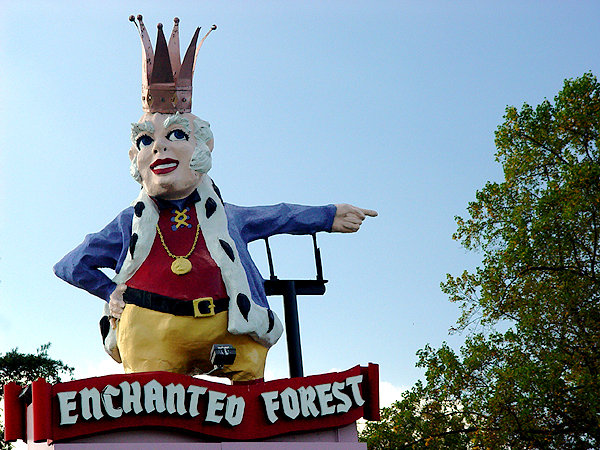
Old King Cole pointed the way to adventure… Now he points the way to high finance.
Thank god the Enchanted Forest is being plowed under to make way for a bank! Because, really what the world needs more of is less creative, imaginative play spaces and more banks… and pharmacies. We just don’t have enough of either of those.
Why, just the other day I was looking out the car window and thinking “you know what I haven’t seen in the last 2 blocks? A bank or a pharma — no wait there’s one. And there’s another. And another…”
Hmmmmmmm I guess we’re actually pretty good at the bank-to-people / pharmacy-to-people ratio after all. [I know they are necessary establishments, but I just don’t think we need to pave every bit of green space and convert every park to build one. Enough with the Bank/Pharmacy arms race, already. I think we know who already won.]
What we don’t have enough of are places where people (especially little people) can explore their imaginations and get lost in their creative whims.
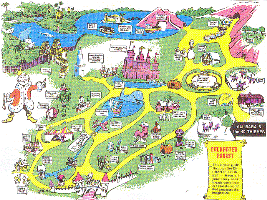
That’s what the Enchanted Forest was. It was a “Storybook land where fairy tales came true!” (according to a vintage ad for the theme park.) I know that was the case for this little 1960s era Baltimorean girl.
The once popular 20-acre theme park located at the corner of Route 40 and Bethany Lane hosted families for decades after opening in August of 1955. [Ellicott City Patch.com]
The Rainbow Slide
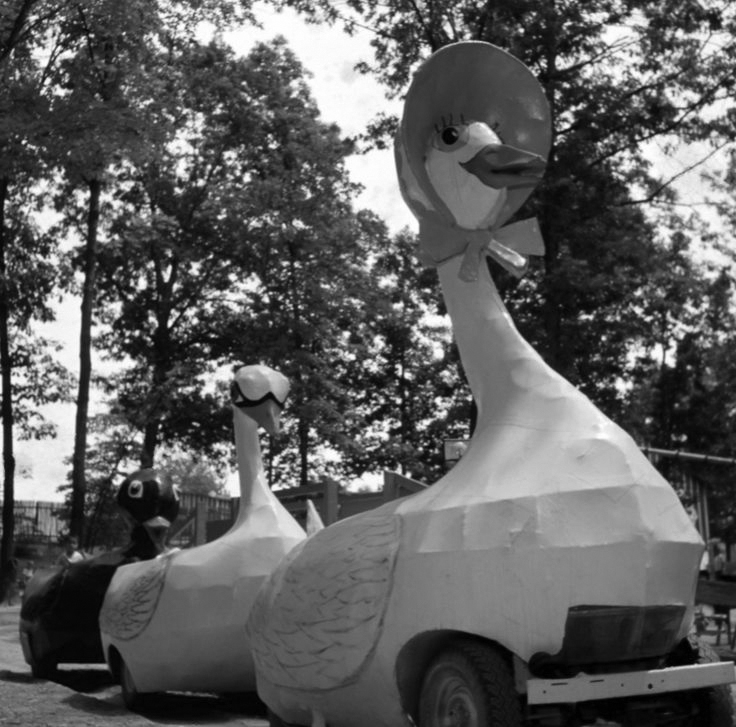
For just $2.55 admission per person your family could explore the park all day. The rides, like the Mother Goose “train” were $.40 a piece. There were things to look at (story book tableaux any one?) and things to do (like the awesome Rainbow Slide.)
The Mother Goose ride. I always wanted to ride on the cute little baby black duck in the back. He was the BEST!
Alas, the drawbridge entrance to the Enchanted Forest was closed for the last time in 1989 when a developer bought the property and built a shopping center on part of the lot. “There were attempts to re-open the theme park in the 90s, and a community-led effort to preserve the fiberglass structures at the site in the woods fell short.” [Ibid]
Entropy and greed are evidently more powerful than the magic of childhood.
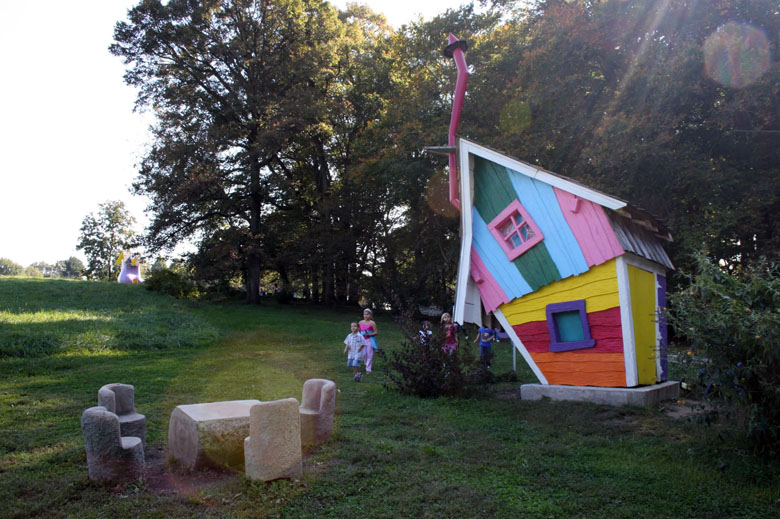
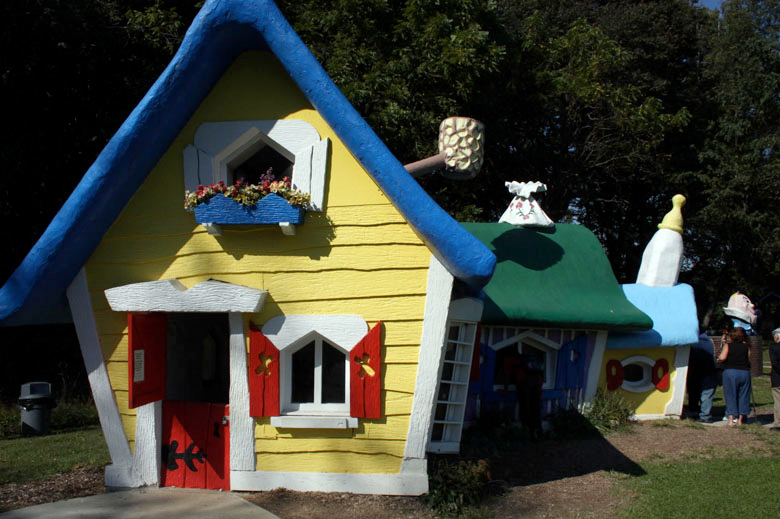
Restored crooked house at Clark’s Elioak Farm
Some of the buildings and iconic statues were saved. The good folks at Clark’s Elioak Farm (not far from Enchanted Forest’s Ellicott City location) acquired dozens of them
In 2005, the owners of the property, Kimco, agreed to allow many of the structures to be moved to Clark’s Elioak Farm in Ellicott City. Clark’s, with the help of community members, hauled items including Mother Goose, Papa Bear, the giant Mushrooms, the Gingerbread Man, Wille the Whale, the Little Red Schoolhouse and many others to the farm, where they are now maintained and preserved.[Ibid]
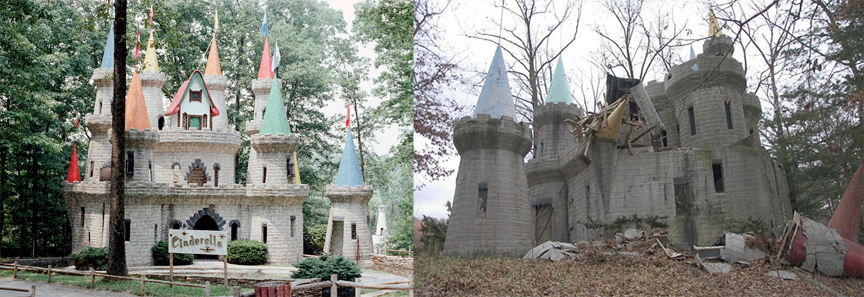
But others languished beside and behind the strip mall. Unfortunately the amusement park seemed to have used “First Little Pig Building and Supply Co.” when it constructed the buildings, and the modern day equivalent to the pig’s straw house, fiberglass, is just not holding up. They are all suffering from neglect and age. And the mightiest of them all, Cinderella’s castle is crumbling.
My childhood dreams… literally crumbling. Cinderella’s Castle, as viewed from the front, circa 1970; and from the back, circa 2009.
The most depressing 9 minutes and 28 seconds of my day was watching this YouTube Video showing what the Enchanted Forest looks like now…
But then I found this site that shows the work being done at Clark Elioak farms …
The Three Bears House is one of the newest rescued houses from the Enchanted Forest now “living” at Clark Elioak Farm.
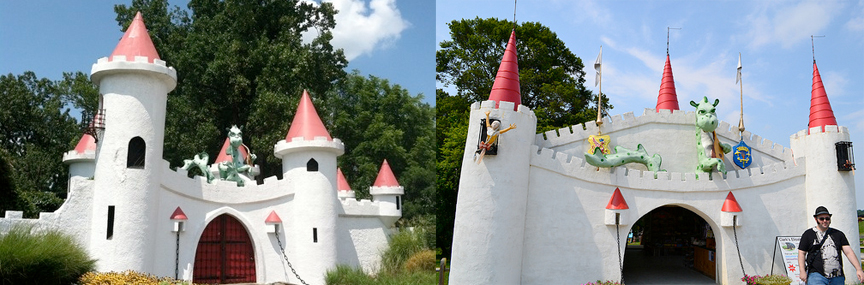
The entrance to the Enchanted Forest and the new entrance to Clark Elioak Farms.
————————————————-
Please note: None of the photos on this post are mine. I found them on Pinterest. Alas they did not have identification. If you see YOUR photo I would be very happy to give your credit. (Or, if you wish, remove it from the post.)
Today is John Adam’s birthday so you really should revisit my John Adam’s blog (Part 1 and Part 2) to celebrate this great American President.
—————————————————————————————————
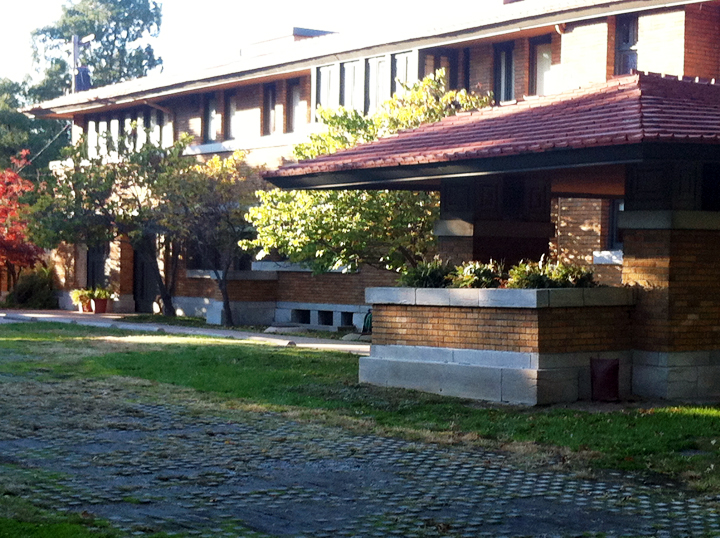
Planters /fence along the edge of the Allen-Lambe property line.
My copy of the Frank Lloyd Wright Field Guide lists two FLLW buildings for the state of Kansas, the Corbin Educational Center (built as the Juvenile Cultural Center in 1957) and the beautiful Allen-Lambe House.
The Allen-Lambe House was built in 1917. Wright considered it one of his best houses, and it the last of his Prairie Houses to be occupied (by its original owners.) It was commissioned by Henry Allen, a successful newspaper man and single term Governor of Kansas and his wife Elsie Nuzman Allen a socialite and arts activist.
The house is at the corner of 2nd and Roosevelt streets.
Designs and drawings on the house began in 1915 and the Allens moved in by 1918. They lived there until 1947.
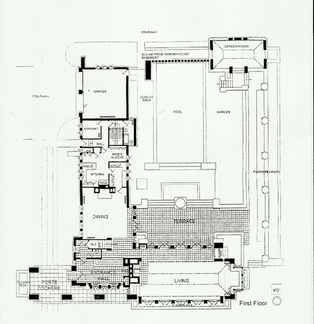
The Allen-Lambe House is located at 255 North Roosevelt Street, in the northwest portion of Wichita, Kansas. The site is approximately one acre of flat land in a residential neighborhood on a corner lot. The house is a two-story Prairie-style home with a partial basement…. Mr. Wright designed the house in a L-shape for privacy purposes. There is a courtyard on the north side of the main section of the house, which is enclosed by the building on the south and east, by a garden teahouse on the west, and by a brick wall on the north. Even though the house is very open, it is well protected from neighbors by the L-shaped plan and the garden wall that runs parallel to the street. [eakpersectivedesign.weebly.com]
Floor plan (including garden and tea house.) The planters are on the right. [Image courtesy: eaksperspectivedesign.weebly.com]
Governor Allen must have been a pretty strong-willed man. He held Wright and the construction crew firm to the original budget of $30,000. (Not something that happened often with Wright’s houses.) The house, which came with a built-in vacuum system and a security system had an additional $6,500 budget for custom furniture. He also got Wright to include two items that the architect notoriously despised, a basement and a garage. Wright thought both promoted clutter.
The 2 story wing of the Allen-Lambe house. (Right side of the Floor plan)
Wright specified the following materials for the construction of the Allen house:
INSIDE:
Oak wood (for the trim)
Red quarry tile
Red gum wood
Brick
Copper (for the sinks)
Marble
OUTSIDE:
Brick
Clay tile (for the roof — He wanted to
create an Asian feel, as an omage to
the Imperial Hotel in Tokyo he was working on
at the time)
Marble
The materials reflected the local landscape. Bringing the outside INSIDE was very much on Wrights mind.
The walls are a gold color, the ceilings are a hazy blue color to make you feel like you are outside, and the ledges underneath the ceilings are a green color, which is suppose to make you feel like you are standing under trees. [eakpersectivedesign.weebly.com
A tile flooring flows from the terrace into the living room and dining room. The only things separating the indoor space from the outdoor space are glass doors.
Views to the exterior are through “light screens” which consist of clear glass doors and windows with terminal windows or side windows framing the views to nature with art glass. Exterior window flower boxes raise the prairie floor up to establish a strong visual relationship to nature. [Onemain.com]
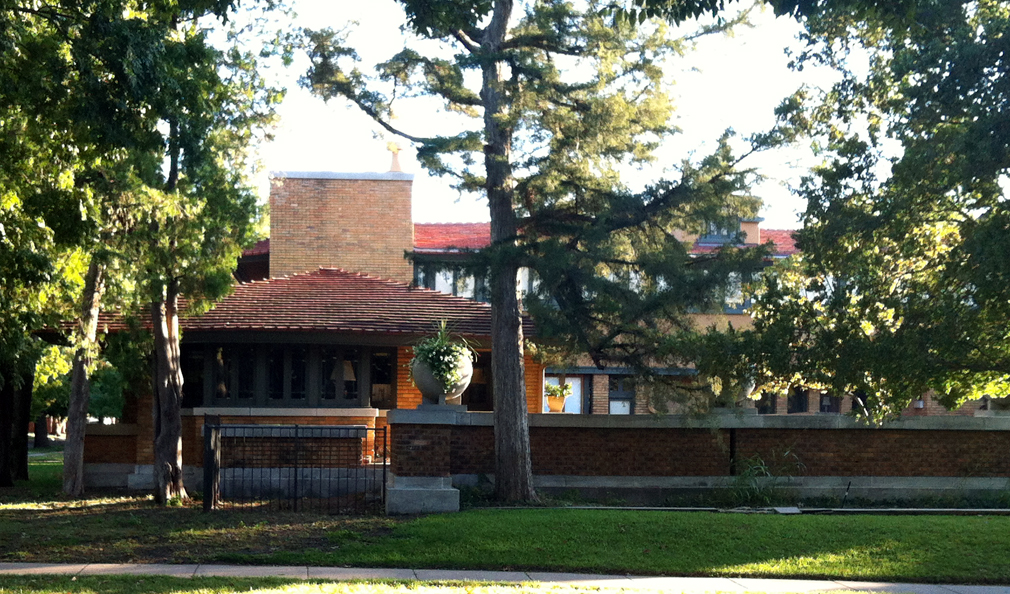
The Allen-Lambe house is open to the public on a limited basis. Tours are by appointment and must be arranged 10 days in advance of your visit. Call 1-316-687-1027 to book a tour. ($10 per guest.) Guest must be 16 years old and up. And each tour must be between 5 and 20 people. Can’t book a tour? Consider a walk by. The exterior is easily seen from the street.
Another angle of the house. (Garden side)
——————————————————————-
Thanks to my husband, Bill for going out of his way to take all the original photos in this post and feeding my love of all things FLLW.
If you like the Allen-Lambe house you might want to check out another lovely Prairie style home we visited, the Martin House, it is in Buffalo, New York.


![[Image courtesy: HBO]](https://ritalovestowrite.com/wp-content/uploads/2013/11/eli-2.jpg)

![[Image Courtesy: HBO]](https://ritalovestowrite.com/wp-content/uploads/2013/11/eli-1.jpg)
![[Image courtesy: HBO]](https://ritalovestowrite.com/wp-content/uploads/2013/11/eli-3.jpg)

![Playwright David Ives [Image courtesy: Broadway.com]](https://ritalovestowrite.com/wp-content/uploads/2013/11/david-ives.jpg)

















 ritaLOVEStoWRITE