Category Archives: Today’s Birthday

Gustav Vigeland 4.11.13 Thought of the Day

[Image courtesy: Red Ice Creations]

[Image courtesy: Red Ice Creations]

Adolf Gustav Vigeland was born on this day outside Halse og Harkmark  in Mandal, Norway in 1869. Today is the 144th anniversary of his birth.

He was born to Anne and  Elesæus Vigeland. His father was a master cabinetmaker. Gustave was interested in wood as a medium too, but he wanted to carve it, not make cabinets with it. He went to Oslo at 15 to apprentice at wood carving. His education was put on hold when his father died and Gustav returned home to help support he family. But by 1888 he was back in Oslo studying under sculptor Brynjulf Bergslien. In 1889 he premiered his first work, Hagar and Ishmael.

Portrett av Gustav Vigeland

Portrett av Gustav Vigeland (Photo credit: National Library of Norway)

Starting in 1891 she traveled to Copenhagen, Paris, Berlin and Florence. His stay in Paris, studying  at Auguste Rodin’s studio had a particular influence on the young sculptor.

Themes of life, death and  love — at once intimate and grand in scale — made their way into his sculpture.

Conceptions of death recur in a number of his works, and his portrayals range from melancholy and desolation to deep affection and ecstasy of the embrace. [The Robinson Library]

Frogner famous for housing the Vigeland Sculpt...

Frogner famous for housing the Vigeland Sculpture Park, which was created by Gustav Vigeland in the 20th century. en.wikipedia.org/wiki/Vigeland_Sculpture_Park (Photo credit: Wikipedia)

His works were well received in art circles and by critics, but Gustav found he couldn’t make a living sculpting naked images of death or love.

He took a unfulfilling job helping to restore the Nidaros Cathedral in 1897 for a few years — it was there that he began to carve dragons and lizards, animals he used later to symbolize sin and the force of nature working against man. He spent a decade carving busts of Norway’s famous writers and thinkers. He designed the Nobel Peace Prize which was first awarded in 1901.

[Image courtesy: Red Ice Creations]

Back of the Nobel Peace Prize. [Image courtesy: Red Ice Creations]
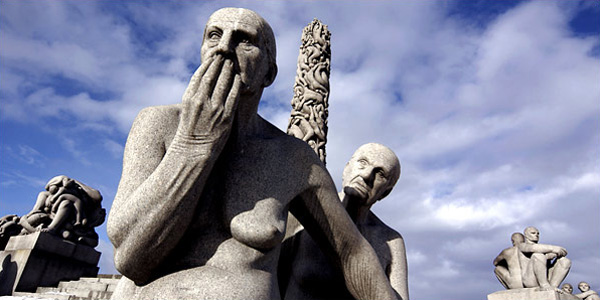
Gustav secured an abandoned studio from the city of Oslo starting in 1902. He used the work space for nearly two decades before it was demolished to make way for the new Deichman Library. At that point he negotiated with the city council for a new workspace. They would provide him with a new studio/living space and he would donate all his future art works to the city. (Which explains why so little is of Vigeland’s art is found outside of Oslo, and why the city is so beautifully decorated by it.)

11100vigeland1

Detail of some of the hundreds of sculpture in Vigeland Park. [Image courtesy: Red Ice Creations]

Oslo’s Vigeland Park  is the world’s largest sculpture park designed by a single artist. The park boast…

over 600 human figures engraved in 192 different sculptures. All of them, amazing. The masterpiece of the park is “The Monolith” a towering spire figures ascending to eternity. Gustav Vigeland is the man who designed the models for every sculpture in the park. A team of sculptures work for years to create all the granite and bronze statues. The various sculptures portray lots of widely ranging aspects of the human condition. There are many sculptures depicting intense emotions and feelings; love, parenthood, innocence, violence, suffering and joy. In all of the sculptures, there is a deeply moving and poetic statement about life. [Answer.com]

When he died in 1943 his studio was converted into The Vigeland Museum. Today the museum “houses approximately 1,600 sculptures, 420 woodcuts, and 12,000 drawings, as well as other artifacts such as notebooks, photographs, books, and thousands of letters belonging to Vigeland.” [Real Scandinavia]

Wheel of Life scuopture at Vigeland Park [Image courtesy: Red Ice Creations]

Wheel of Life scuopture at Vigeland Park [Image courtesy: Red Ice Creations]

"Ball of Babies" at the Vigeland Park [Image courtesy: Red Ice Creations]

“Ball of Babies” at the Vigeland Park [Image courtesy: Red Ice Creations]

Related blogs:

Happy Birthday Gustav Vigeland

http://realscandinavia.com/sculpture-on-a-grand-scale-oslos-vigeland-museum-and-park/

http://www.arisamtravel.com/Gallery/GUSTAV_VIGELAND_EXIT/photo2234.htm

http://www.redicecreations.com/article.php?id=11101


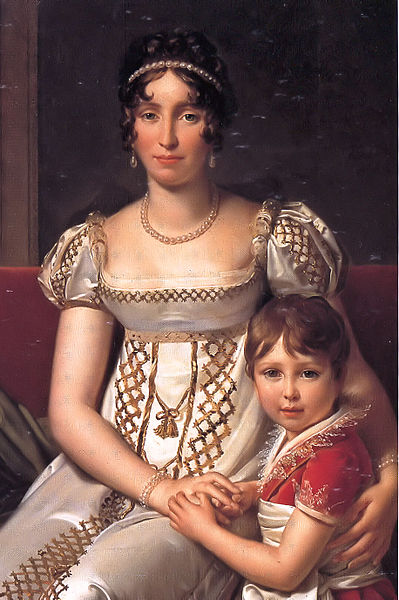
Hortense de Beauharnais 4.10.13 Thought of the Day

[Image courtesy: Wikipedia]

[Image courtesy: Wikipedia]

Hortense E de Beauharnais was born on this day in Paris, France in 1783. Today is the 230th anniversary of her birth.

She was born to French aristocrats Alexandre, Vicomte de Beauharnais and Joséphine Tascher de la Pagerie. Both her parents were arrested during the French Revolution, and her father was guillotined at the Place de la Révolution on July 23, 1794. Josephine was released in August of that year. In 1796 she married Napoleon Bonaparte.

Hortense was a pretty child. She had long blond hair and blue eyes. She attended school Napoleon’s youngest sister, Caroline.

[Image courtesy: Wikimedia Commons

[Image courtesy: Wikimedia Commons

At 19 this “Flower of the Bonapartes” was married off to Napoleon’s brother Louis. It was not a marriage of love, but, rather, it was a marriage of convenience, arranged at Napoleon’s request. The couple never got along, but they did manage to have three children together: Napoléon Louis Charles Bonaparte, Napoleon Louis Bonaparte and Charles Louis Napoléon Bonaparte. (Charles would later become Napoleon III, Emperor of France.)

The Royal Monogram of Hortense [Image Courtesy Wikipedia]

The Royal Monogram of Hortense de Beauharnais, Queen of Holland [Image Courtesy Wikipedia]

The Emperor appointed Louis King of Holland and Hortense had to leave her beloved Paris to follow her no-so-beloved husband to Holland. The Netherlands won her over and she learned to enjoy the people, customs and landscapes. But her relationship with Louis did not improve.

After the death of their first son Hortense was allowed to return to Paris because it would provide a more healthy environment for both the Queen and her remaining children. When Napoleon prepared to remarry he decided that it wouldn’t do to have the daughter of his first wife living at court, so he had her shuttled north again. Her stay in Holland was temporary and she left, again for “health” reasons, in 1810.

Now officially separated Hortense moved to Switzerland where she had a long-term affair with Colonel Charles Joseph, Comte de Flahaut. The couple had an illegitimate son together, Charles Auguste Louis Joseph.

[Image courtesy: Wikipedia]

[Image courtesy: Wikipedia]

She remained a loyal Bonapartist. When the Bourbon monarchy was restored in Paris, Hortense — like all the Bonapartes –went into exile. She, Charles Louis Napoléon Bonaparte and Charles Auguste Louis Joseph moved to Arenenberg Castle, near Lake Constance in Switzerland. While there she transformed…

The medieval castle and its gardens …. into an island of French culture amidst the rather provincial region of Lake Constance. The castle was surrounded by a 12 ha park with hermitage, fountains, waterfalls and nymphaeum, steep paths and viewpoints.  [www.bodensee-magazine]

The main house, which still stands, had living quarters and rooms for entertainment (including a theatre). She continued to expand the house and  revamp the estate, adding the latest in Parisian style almost until her death on October 5,  1837.

[Image courtesy: Kreuzlingen tourism]

Arenenberg Castle  [Image courtesy: Kreuzlingen tourism]


Gabriela Mistral 4.7.13 Thought of the Day

“At this moment, by an undeserved stroke of fortune, I am the direct voice of the poets of my race and the indirect voice for the noble Spanish and Portuguese tongues.”–Gabriela Mistral

Gabriela Mistral

Gabriela Mistral (Photo credit: Wikipedia)

Lucila Goday y Alcayaga was born one this day in Vicuña , Chile in 1889.

Daughter of a poet and school teacher, Juan Gerónimo Godoy Villanueva, and a seamstress, Petronila Alcayaga, she was raised in a small Andean village. The family lived in poverty, a situation that worsened when her father left when Lucila was three. She was close to her older sister, Emelina Molina, who was also her teacher.

Despite having only a few years of formal education, she became a teacher’s aide at 15 to help support her family. As a teacher she had a number of positions in rural Chilean towns. By 1912 she was teaching at the high school level. Her star as an educator continued to rise,  in 1921, she became the director of Santiago’s Liceo (high school) #6, the best girls’ school in Chile. She went on to help reform the Mexican education and library system.

English: Gabriela Mistral, Chilean poet, educa...

English: Gabriela Mistral, Chilean poet, educator, diplomat, and feminist (Photo credit: Wikipedia)

A poet all her life…

“At age sixteen she moved to La Cantera to take a job and fell in love with a young railway worker. The relationship didn’t last and two years later the young man committed suicide. The only item found in his possession was a postcard from Mistral. This affected her deeply and she wrote Sonetas de la Muerte (Sonnets of Death) to express her feelings.” [Distinguished Women.com]

Lucila took the pen name Gabiela Mistral. Her poems reflected her experiences in life. When she “…was appointed director of a secondary school for girls located in rural Punta Arenas. The rough terrain of Punta Arenas became an inspiration for a series of poems entitled Patagonian Landscapes.“[ Ibid]

Her time in Mexican inspired   Readings for Women

“The dominant themes in her poetry were love, death, childhood, maternity, religion and the beauty of nature and of her native land. She also had a burning desire for justice.”[Ibid]

Major works include:

  • Sonetos de la muerte (1914)
  • Desolación  1922
  • Ternura 1924
  • Tala 1938
English: Gabriela Mistral, Nobel laureate in L...

English: Gabriela Mistral, Nobel laureate in Literature 1945 Deutsch: Gabriela Mistral, Nobelpreisträgerin für Literatur 1945 (Photo credit: Wikipedia)

She was the first Latin American and (so far is) the only Latin American woman to receive the Nobel Prize for Literature.

At the time of her death in 1957, her poems had been translated into English, French, German, Swedish and Italian.

The Rose

by Gabriela Mistral

The treasure at the heart of the rose
is your own heart’s treasure.
Scatter it as the rose does:
your pain becomes hers to measure.

Scatter it in a song,
or in one great love’s desire.
Do not resist the rose
lest you burn in its fire.

Click HERE to go to Poem Hunter.com and read more of Mistral’s works.


Gregory Peck 4.5.13 Thought of the Day

“I don’t lecture and I don’t grind any axes. I just want to entertain.”–Gregory Peck

Cropped screenshot of Gregory Peck from the tr...

Cropped screenshot of Gregory Peck from the trailer for the film Gentleman’s Agreement. (Photo credit: Wikipedia)

Eldred Gregory Peck was born on this day in La Jolla, California, USA in 1916. Today is the 97th anniversary of his birth.

He was born to Bernice Mae “Bunny” and Gregory Pearl Peck. Bunny was Scottish, English and Protestant, Gregory senior was Irish and Catholic. She converted when they married and they raised Eldred Catholic. When the couple split  little Eldred was six, he went to live with his grandmother.

Peck…”never felt he had a stable childhood. His fondest memories are of his grandmother taking him to the movies every week and of his dog, which followed him everywhere.” [IMDb]  When he was ten his grandmother passed away and he went to live with his father full-time.

He went to St. John’s Military Academy, a Roman Catholic military school in Los Angeles, then to  San Diego High School. He enrolled at San Diego State Teacher’s College for one year before transferring to the University of California, Berkley where he settled on Acting. Working as a truck driver and kitchen assistant helped pay the bills.

Upon graduation Peck headed east to New York City.  Gregory Peck was ‘born’ when he dropped his first name. “I never liked the name Eldred. Since nobody knew me in New York, I just changed to my middle name.” He worked as an usher at Radio City Music Hall and a tour guide at NBC. He worked for the acting experience and for food, landing progressively larger roles as he honed his craft.

His debut was in Emlyn Williams‘ play “The Morning Star” (1942). By 1943 he was in Hollywood, where he debuted in the RKO film Days of Glory (1944).

Stardom came with his next film, The Keys of the Kingdom (1944), for which he was nominated for an Academy Award. Peck’s screen presence displayed the qualities for which he became well-known. He was tall, rugged and heroic, with a basic decency that transcended his roles. [IMDb]

Cropped screenshot of Gregory Peck from the tr...

Cropped screenshot of Gregory Peck from the trailer for the film The Yearling. (Photo credit: Wikipedia)

He was nominated for four Academy Awards in the 1940’s for his work in: The Keys of the Kingdom, The Yearling, Gentleman’s Agreement and Twelve O’Clock High. He’d have to wait another 20 years before winning the statue.

An old back injury keep him out of the service during World War II (he’d hurt himself while taking dance and movement classes — not while on the UC Berkley Rowing team as 20th Century Fox claimed.)

He kept his stage skills up at The La Jolla Playhouse, a theatre he co-founded with Mel Ferrer and Dorothy McGuire in 1947.

To Kill a Mockingbird, 1962

To Kill a Mockingbird, 1962 (Photo credit: mystuart)

His best known and most love role came in 1962 as Atticus Finch in the film adaptation of Harper Lee’s To Kill a Mocking Bird. He won an Academy Award for his portrayal of the soft-spoken, southern lawyer. And his portrait of Finch was voted as the #1 greatest hero in American film by the American Film Institute in 2003.

Other notable films from his large library of movies include:

  • Spellbound
  • Captain Horatio Hornblower
  • The Snows of Kilimanjaro
  • Designing Women with Lauren Bacall
  • On the Beach
  • The Guns of Navarone
  • Cape Fear
  • The Omen
  • The Boys From Brazil

and my other favorite (besides Mocking Bird)… Roman Holiday with Audrey Hepburn.

Cropped screenshot of Gregory Peck from the tr...


Dorothea Dix 4.4.13 Thought of the Day

“In a world where there is so much to be done, I felt strongly impressed that there must be something for me to do” — Dorothea Dix

Ninth plate daguerreotype of Dorothea Lynde Dix.

Ninth plate daguerreotype of Dorothea Lynde Dix. (Photo credit: Wikipedia)

Dorothea Lynde Dix was born on this day in Hampden, Maine, USA in 1802. Today is  211th anniversary of her birth.

She was the oldest child of Joseph and Mary Dix. Joseph was an itinerant Methodist preacher and sometime laborer. He was also an alcoholic and an abusive father. “Her mother was not in good mental health” [Webster.edu] so by the time her two brothers, Joseph and Charles, were born Dorothea was taking care of the house. She also cared for her brothers.

During the war of 1812 the British took control of Hampden and the family moved Vermont. She also spent much of her early life in Worcester, Massachusetts. Her father taught her to read and write when she was little, “when she entered school she was way ahead of everyone else. This developed a passion for reading and teaching, as she taught her brothers how to read as well” [Ibid]

When she was about 12 it was decided that her parents could not care for the children (her mother was suffering from severe, incapacitating headaches and her father’s alcoholism was spiraling out of control) so the Dorothea, Joseph and Charles went to live with their Grandmother Dix in Boston. Madame Dix was a wealthy woman and life in the Dix Mansion was far cry from the poverty at home. But her grandmother had a very narrow vision of what well brought up young ladies did and did not do. They DID take dancing lessons and wear fine clothing. They DID NOT give food and clothing to children begging at the front gate. When Dorothea was 14 Madame Dix asked her sister, Dorothea’s great-aunt, Mrs. Duncan, to take in the girl and teach her how to be a proper young lady. That relationship fared better, but Dorothea did everything she could to get back to her brothers.

Dorothea wanted to be a teacher and with the help of an older cousin, Edward Bangs, she opened a Dame School for young ladies. “In the fall of 1816, at age fifteen, she faced her first twenty pupils between the ages of six and eight. She ran this school of sorts for three years.” [Ibid]

She continued teaching and began a formal school for older children in a cottage on her grandmother´s property. The school was named “the Hope” and it served the poor children of Boston whose parents could not afford a formal education. At this time, Dorothea wrote her first book, Conversations on Common Things. This encyclopedia for children was quite popular and sold many copies.[Learning to Give.org]

Dorothea Dix

Dorothea Dix (Photo credit: elycefeliz)

in 1826 she had to close the school because of health problems. It took her several years to recover, during this time she “wrote four more books including Hymns for Children and American Moral Tales for Young Persons.” [Ibid] Although she took on a governess job and later returned to teaching her bouts with illness recurred. She had tuberculosis, and had to eventually give up teaching. On advice from her doctors she took a long trip to England to recuperate. There she stayed with the Rathbone family. The Rathbones were Quakers and social reformers.

While in England she toured the York Retreat insane asylum. It was built by William Tuke in 1796 as was a state of the art facility for the mentally ill.

The idea that full recovery could be made if the mentally ill were treated and cared for compassionately was a principle Dix never forgot and brought to every aspect of her work. [Ibid]

When she came back to the U.S. she was asked to teach Sunday school at the East Cambridge Jail.

She discovered the appalling treatment of the prisoners, particularly those with mental illnesses, whose living quarters had no heat. She immediately went to court and secured an order to provide heat for the prisoners, along with other improvements. [Biography.com]

She embarked on a 2 year fact-finding mission, touring every facility for the mentally ill in the state. The appalling conditions she found at East Cambridge Women’s Jail (no heat, no light, scant clothing, no furniture, scarce sanitation…) was the rule rather than the exception. Much to the chagrin of those running the facilities “she compiled a detailed report and submitted it to the legislature in January 1843.” .[Learning to Give.org] A bill to remedy the abuses was quickly passed.

U.S. Library of Congress DIX, DOROTHEA LYNDE. ...

U.S. Library of Congress DIX, DOROTHEA LYNDE. Retouched photograph. date found on item. Location: Biographical File Reproduction Number: LC-USZ62-9797 (Photo credit: Wikipedia)

Dorothea set her sights on neighboring states and soon had New York and Rhode Island reforms underway. New Jersey, Pennsylvania, Alabama, Louisiana, Georgia, South Carolina, Mississippi and Arkansas were next.

In 1848, Dix submitted a bill to Congress that called for five million acres to be set aside for the use of building mental institutions to care for the ill. … For the next three years, the bill was passed back and forth. Finally, in 1854, it passed both the Senate and House, but President Franklin Pierce vetoed the bill. President Millard Fillmore was a supporter of Dorothea Dix and, in 1852, signed an executive order to begin construction of a hospital that would benefit Army and Navy veterans . [Ibid]

When the Civil War broke out..

“she volunteered her services and was named superintendent of nurses. She was responsible for setting up field hospitals and first-aid stations, recruiting nurses, managing supplies and setting up training programs” [Biography.com]

As her health continued to deteriorate she entered the state hospital in Trenton, New Jersey, a hospital she help establish. She spent 6  year there before passing away on July 17, 1887.

In all she played a major role in founding 32 mental hospitals, 15 schools for the feeble-minded, a school for the blind, and numerous training facilities for nurses. Her efforts were an indirect inspiration for the building of many additional institutions for the mentally ill. She was also instrumental in establishing libraries in prisons, mental hospitals and other institutions. [Webster.edu]

the Fountain for thirsty horses that Dorothea ...

the Fountain for thirsty horses that Dorothea Dix gave to the city of Boston to honor the Massachusetts Society for the Prevention of Cruelty to Animals, located at the intersection of Milk and India Streets. (Photo credit: Wikipedia)


Leslie Howard 4.3.13 Thought of the Day

“I hate the damn part. I’m not nearly beautiful or young enough for Ashley, and it makes me sick being fixed up to look attractive.”–Leslie Howard

[Image courtesy: The Rebel Reader]

[Image courtesy: The Rebel Reader]

Leslie Howard Steiner was born on this day in Forest Hill, London, England in 1893. Today is the 120th anniversary of his birth.

Both his parents, Lilian and Ferdinand “Frank” Steiner, were of Jewish descent. Leslie’s father was from Hungary. His mother’s grandfather immigrated from East Prussia and married into well to do English society. She wanted the family to assimilate into English society as seamlessly as possible. She raised Leslie as a Christian, and when World War One broke out the family Anglicized their name from Steiner to Stainer. Leslie changed his name legally to Leslie Howard on February 24, 1920.

Although clearly bright, Howard’s sheltered upbringing and severe near-sightedness made him extremely self-conscious. Never a good student, the young Howard loathed his time at Alleyn’s School in Dulwich, London, preferring to lose himself in the comfort of books. Fiercely protective of her son, Lilian encouraged her boy’s participation in the arts, particularly theatre, as a means of improving his social and academic skills. [TMC.com]

The stage was good fit. By 14 he had written his first play and it wasn’t long before Lilian established the Upper Norwood Dramatic Club to showcase Leslie and his friends. His father, however, thought a more down to earth career was in Leslie’s future. At Frank’s insistence he took a job as a clerk at a London bank — which he hated. “When war finally did break out, Howard saw his chance to escape the monotony of his life and promptly enlisted with the British Cavalry.” [Ibid] He served on the front lines for a while before returning home in 1916 with a severe case of shell shock.

He returned to the theatre again as a kind of a therapy.

In a few years, his name was famous on the stages of London and New York. He made his first movie in 1914 (The Heroine of Mons (1914)). He became known as the perfect Englishman (slim, tall, intellectual and sensitive), a part that he played in many movies, and a part women would dream about. [IMDb]

He had a long career on stage and screen, with his top movies being:

Oh, Ashley! [Image courtesy: The Rebel Reader]

Oh, Ashley! [Image courtesy: The Rebel Reader]

  • Gone with the Wind, as Ashley Wilkes (a role he thought he was too old for — he was 46 at the time. He didn’t want to play another soft-spoken, dreamer. But the producer promised Leslie if he did the role he could co-produce Intermezzo  — a movie he’d been longing to make.)
  • Intermezzo, a Love Story , as Holger Brandt
Giving a smouldering look with Igrid Berman in Intermezzo [Image courtesy: DoctoreMacro.com]

Sharing a smouldering look with Igrid Berman in Intermezzo [Image courtesy: DoctorMacro.com]

  • Pygmalion, as Professor Henry Higgins
In Pygmalion [Image couresty: DoctorMarco.com]

In Pygmalion [Image couresty: DoctorMacro.com]

Howard in Scarlet Pimpernel. He was nominated for an Academy Award for the role. [Image courtesy The Telegraph]

Howard in Scarlet Pimpernel. He was nominated for an Academy Award for the role. [Image courtesy The Telegraph]

He returned to England at the onset of WWII to help with the war effort. Leslie Howard died in 1943 when the plane he was flying in from Lisbon to England was shot down over the Bay of Biscay.


Ewan McGregor 3.31.13 Thought of the Day

“I’m fiercely proud to be Scottish.”– Ewan McGregor

[Image courtesy: Ewan McGregor.Tumbler.com]
[Image courtesy: Ewan McGregor.Tumbler.com]

Ewan Gordon McGregor was born on this day in Perth, Scotland, United Kingdom in 1971. He is 42.

His parents are both educators. His mother, Carole, was a teacher and school administrator, and his father, Jim, was  a phys. ed teacher. McGregor has an older brother, Colin, who is in the Royal Air Force.

At age 16, he left Crieff and Morrison Academy to join the Perth Repertory Theatre. His parents encouraged him to leave school and pursue his acting goals rather than be unhappy. McGregor studied drama for a year at Kirkcaldly in Fife, then enrolled at London’s Guildhall School of Music and Drama for a three-year course. [IMDb]

He left Guildhall School early to take a major role in Lipstick on Your Collar (1993).

He got international attention in 1996. as Mark Renton, the heroin addicted anti-hero in Danny Boyle’s Transpotting. He won a BAFTA Scotland award for Best Actor for his performance. He took on two sharply different roles the same year. He was charming, rich, glib, and not (as far as I know) a drug addict as Frank Churchill  in an adaptation of Jane Austen’s Emma opposite Gwyneth Paltrow.  And he played the romantic lead in Brassed Off. [Put both Emma and Brassed Off in your queue. Both are terrific. Transpotting was too gritty for me. As big of a fan as I am of McGregor, Kevin McKidd, Robert Carlyle, and Kelly Macdonald, I can’t say that I like the movie. It did, however, teach me that I categorically do NOT want to EVER try heroin– so there’s that, I guess.]

Ewan McGregor as Obi-Wan Kenobi in the Star Wa...

McGregor was  Obi-Wan Kenobi — a role originated by Sir Alec Guinness — in the first of the Star Wars prequels, Star Wars: Episode I – The Phantom Menace , in 1999. (He reprised the role twice in Star Wars Episode II: Attack of the Clones and  Star Wars Episode III: Revenge of the Sith) It was a real labor of love for McGregor who adored the Star Wars films growing up. He watched countless Guinness films in preparation for the role so he could get the screen legend’s pacing and accent down. And when it came time to film the light saber scenes …”he kept imitating the noise … during his fights. George Lucas explained many times that this would be added in by the special effects people later on. Ewan said “I keep getting carried away.”.” [IMDb]

Still from Mulan Rouge with Nicolle Kidman [http://ewan-mcgregor.tumblr.com/]
Still from Moulin Rouge with Nicolle Kiddman [Image courtesy: Ewan McGregor.Tumbler.com]] I wasn’t really sure if I was going to like this odd movie, but then Ewan opened his mouth to sing and I was hooked.

2001 was another big year for McGregor with two major motion pictures, the fantasy musical Moulin Rouge and gripping war story Black Hawk Down coming in short order.

He was terrific in Big Fish as the young protagonist, Edward Bloom.

I also liked him in The Island, Miss Potter, The Men Who Stare at Goats, Beginners, and especially Salmon Fishing in the Yemen. 

But with 60+ movies and TV appearances I’ve only scratched the surface of Mr. McGregor’s film garden. I’ll need to do more research.

In 2004 he and best mate Charley Boorman travelled through Europe, Asia and North America on motorcycles in the TV documentary Long Way Round. The 19,000 trek helped bring attention to UNICEF projects around the world. In 2006 They did a similar trip/ documentary called Long Way Down, this time traveling from Scotland to Cape Town, South Africa.

New to DVD release (it was in limited theatrical release late last year) is The Impossible, a drama about the 2004 tsunami.


<iframe width=”560″ height=”315″ src=”http://www.youtube.com/embed/Bgw394ZKsis&#8221; frameborder=”0″ allowfullscreen>


John Tyler 3.29.13 Thought of the Day

“Popularity, I have always thought, may aptly be compared to a coquette – the more you woo her, the more apt is she to elude your embrace.”–John Tyler


English: A portrait of John Tyler located insi...

English: A portrait of John Tyler located inside the National Portrait Gallery in Washington, D.C. (Photo credit: Wikipedia)


John Tyler was born on this day near Charles City County, Virginia, USA in 1790. Today is the 223rd anniversary of his birth.


Born to a wealthy family on his father’s Greenway plantation. His family had been members of Virginia’s elite since the 17th century. His father, John Tyler, Sr. was a judge who was friends with Thomas Jefferson, served in the Virginia House of Delegates, was Speaker for that House, and was the 15th Governor of Virginia (when John junior was 18.) His mother Mary Armistead Tyler died when he was 7.  The younger John Tyler was the sixth of eight children.


Tyler attended William and Mary College in Williamsburg, Virginia. He


studied law under private tutors. He began his political career in 1811, when he was elected to the Virginia legislature at age 21. [History.com]


He served in the legislature until 1816 when he was elected to the US House of Representatives. He was a strict Constitutionalist and a strong proponent of States Rights. He voted against “nationalist legislation and opposed the Missouri compromise” [WhiteHouse.gov] He didn’t run again in 1820, returning to his private law practice instead.  But by 1823 he was back in the Virginia House of Delegates.


English: An engraving (c. 1826, authorship unk...


In 1825 he was appointed as Governor of Virginia (as Governor he gave the eulogy at Thomas Jefferson’s funeral.) He served as Governor for two terms.

He won a slim majority to US Senate in 1827 as a Democrat, but  his support for President Andrew Jackson was rocky at best. By 1835 he was aligned with Henry Clay’s Whig Party.


The Whigs nominated Tyler for Vice President in 1840, hoping for support from southern states’-righters who could not stomach Jacksonian Democracy. The slogan “Tippecanoe and Tyler Too” implied flagwaving nationalism plus a dash of southern sectionalism. [WhiteHouse.gov]


The “Tippecanoe”  in the campaign slogan was William Henry Harrison who fought in the Battle of Tippecanoe in 1811. The Harrison/Tyler ticket won the election with 53% of popular vote and an electoral vote of 234-60. The Whigs also won control of both the House and Senate. Tyler took the oath of the Vice Presidency, presided over the confirmations of Harrison’s cabinet appointments (as President of the Senate) and after a few days went home to Williamsburg. But then Harrison caught pneumonia and died (the first sitting president to do so) and “Tyler Too” became, suddenly, the 10th President of the United States.


The U.S. Constitution was unclear on the matter of presidential succession; however, Tyler moved into the White House and was sworn into office on April 6. At 51 years old, the man dubbed “His Accidency,” was younger than any previous president. (The ambiguity surrounding the order of succession issue was officially clarified with the 25th Amendment to the Constitution, which was ratified in 1967 and states that if the president dies or resigns, the vice president becomes president.) [History.com]


John Tyler, tenth President of the United States

John Tyler, tenth President of the United States (Photo credit: Wikipedia)


“His four year term was a shambles…” [Findagrave.com] Unable to follow both his conscience and the Whig’s political agenda he was kicked out of the part. All but one member of his (well, Harrison’s) cabinet resigned. And members of the House tried to have him impeached for misuse of veto power.


His Presidency however produced some historic events: The annexation of Texas, a reorganized Navy, The ending of the Seminole war and the signing of a treaty with China. [Findagrave.com]


He did not make a bid for a second term in the White House.

He retired to his plantation, Sherwood Forest near Richmond. When the Civil War broke out “Tyler led a compromise movement; failing, he worked to create the Southern Confederacy.” [WhiteHouse.gov] He  was elected to the House of Representatives of the Confederate Congress in 1862.  “With the war raging, he was giving a speech in front of the Exchange Hotel when he suffered a stroke and was taken to a room where he died at the age of 71.” [Findagrave.com]


Picture of President John Tyler's grave in the...

Picture of President John Tyler’s grave in the Hollywood Cemetery in Richmond, VA (Photo credit: Wikipedia)


St. Teresa of Avila March 28 Thought of the Day

“What a great favor God does to those He places in the company of good people!”–St. Teresa of Avila

Teresa of Ávila, Ulm, Germany

Teresa of Ávila, Ulm, Germany (Photo credit: Wikipedia)

Teresa de Cepeda y Ahumada was born on this day in Gotarrendura, Ávila, Spain in 1515. Today is the 498th anniversary of her birth.

Teresa’s grandfather converted to Christianity to avoid persecution from the Spanish Inquisitors. It didn’t quite work. Although his son, Teresa’s father, Alonso Sánchez de Cepeda, became a prominent member of Catholic Avila society, her grandfather was later condemned for allegedly returning to his Jewish roots. Alonso was a strict and pious man and Teresa grew up fascinated with the mysteries of the faith and the lives of the Saints.

At seven she tried to run away with her brother. The plan was to find some Moors and convince the “barbarians” to chop of their heads so they could become martyrs. Fortunately their uncle found the children before they could get too far.

She was 15 when her mother, Beatriz, died, and Teresa was sent to live with the Augustinian nuns. She soon decided to enter religious life

In 1535, she joined the Carmelite Order. She spent a number of relatively average years in the convent, punctuated by a severe illness that left her legs paralyzed for three years, but then experienced a vision of “the sorely wounded Christ” that changed her life forever. [CCEL.org]

When she was ill she claimed to have experienced a number of religious ecstasies and visions. At about age 41 some of her friends thought these visions might be the work of the devil, but her confessor assured her that they were  of Christ’s doing.

From this point forward, Teresa moved into a period of increasingly ecstatic experiences in which she came to focus more and more sharply on Christ’s passion. With these visions as her impetus, she set herself to the reformation of her order, beginning with her attempt to master herself and her adherence to the rule. Gathering a group of supporters, Teresa endeavored to create a more primitive type of Carmelite. [CCEL.org]

She had opposition from her original order, the local church and the town. At some point she was threatened with the Inquisition, but she pushed on.

In 1567, she met St. John of the Cross, who she enlisted to extend her reform into the male side of the Carmelite Order. [CCEL.org]

She died while on a journey from Alba de Tormes in 1582. Forty years later she was canonized a saint by Pope Gregory XV.

"It is love alone that gives worth to all...

“It is love alone that gives worth to all things.” – St. Teresa of Avila (Photo credit: Wikipedia)