Category Archives: Today’s Birthday

Laura Linney 2.5.13 Thought of the Day

Just because you’re not famous, doesn’t mean you’re not good. — Laura Linney

[Image courtesy: theplace2.com]

[Image courtesy: theplace2.com]

Laura Leggett Linney was born on this day in New York City, New York, USA in 1964. She is 49 years old.

Linney is the daughter of Romulus Linney, a playwright, and Miriam Perse, a nurse. Her parents divorced when she was an infant and she grew up in a modest 1 bedroom apartment with her mother. “Linney grew up working in the theater, both behind the scenes and, in her late teens, on the stage.” [Starpulse.com] After graduating from  Northfield Mount Hermon School, a New England prep school, she went to Northwestern University and Brown University for undergraduate work. (She received her BA in Fine Arts from Brown in 1986). She did post-graduate work with Group 19 at the Juillard School.

She took the stage in such Broadway productions as The Seagull, Six Degrees of Separation and Hedda Gabler before making the leap to film.

Linney’s screen debut was a minor role in Lorenzo’s Oil. She played Kevin Kline’s mistress in Dave, and landed the role of Mary Ann Singleton in Armistead Maupin’s Tales of the City (a role she would reprise two more times.) She played in a trio of thrillers, Congo, Primal Fear and Absolute Power, before getting her big break as Meryl Burbank in The Truman Show.

Linney played the "perfect wife" in Truman.

Linney played the “perfect wife” in Truman.

2000’s You Can Count On Me earned Linney her first Academy Award nomination for Best Actress. (Her second nomination was for her work in 2004’s Kinsey opposite Liam Neeson.) Also in 2000 she did the lush, delightful The House of Mirth (based on the Edith Wharton novel, with Gillian Anderson, Eric Stoltz and Elizabeth McGovern).

Linney won an Emmy Award for her work on Wild Iris opposite Gena Rowlands. She won another Emmy, this time for Outstanding Guest Actress in a Comedy Series for her story arc as Charlotte on the TV show Frasier.

She played Zelda Fitzgerald in American Master’s F.Scott Fitzgerald: Winter Dreams. She worked on ensemble films  including Love Actually and The Laramie Project. She’s equally stunning as the intellectual mom struggling as her family crumbles around her in the Squid and the Whale as she is in the supernatural thriller The Mothman Prophecies  as small town police officer.

On screen, Linney has mastered quite a line in striving. Her most memorable characters have had a combination of astute wit, career focus and either a leavening daffiness or a chilly sort of overbrightness. This tends to hinge on whether they’re good apples (as in You Can Count On Me or The Savages) or bad (The Truman Show, The House of Mirth). [The Telegraph 2.1.13]

She brought Abigail Adams to life with her beautiful, strong portrayal of our second First Lady in HBO’s mini-series John Adams. Linney won  her most recent  Emmy Award for her efforts.

She can currently be seen on Showtime’s The Big C — for which she won a Golden Globe — and as the host of Masterpiece Theatre on PBS. Her latest film role is as Margaret “Daisy” Suckley  in Hyde Park on Hudson opposite Bill Murray’s FDR.


Rosa Parks 2.4.13 Thought of the Day

“I have learned over the years that when one’s mind is made up, this diminishes fear; knowing what must be done does away with fear.” –Rosa Parks

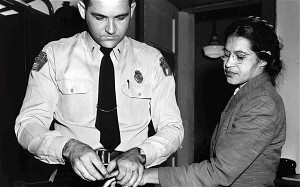
Rosa Parks getting fingerprinted after her arrest.

Rosa Parks getting fingerprinted after her arrest. [Image courtesy  abcnews.go.com]

Rosa Louise McCauley was born on this day in Tuskegee, Alabama in 1913. Today is the 100th anniversary of her birth.

Rosa’s father James was a carpenter and her mother Leona was a teacher. Her parents separated when Rosa was 2, and she moved with her mother a little brother Sylvester to Pine Level, Alabama (just outside the capital, Montgomery) to live with her maternal grandparents. He mother taught her to read. The segregated one room school-house she attended seldom had enough desks  or other supplies. At 11 she went to the Montgomery Industrial School for Girls, an institution a laboratory school set up by the Alabama State Teachers College for Negroes and founded “liberal-minded women from the northern United States. The school’s philosophy of self-worth was …to ‘take advantage of the opportunities, no matter how few they were.'” [Achievement.org] She dropped out of the school to care first for her grandmother then her mother.

At 19 she married Raymond Parks and moved to Montgomery. Raymond encouraged Rosa to finish high school, and she earned her degree in 1933.  The two were active in the National Association for the Advancement of Colored People (Raymond had been an active member when they met.) They worked to raise money to help defend the Scottsboro Boys and were members of the Voter’s League. Mrs. Parks managed to get her voter’s card (it took her three tries because of the Jim Crow laws in Montgomery.)

English: Photograph of Rosa Parks with Dr. Mar...

English: Photograph of Rosa Parks with Dr. Martin Luther King jr. (ca. 1955) Mrs. Rosa Parks altered the negro progress in Montgomery, Alabama, 1955, by the bus boycott she unwillingly began. National Archives record ID: 306-PSD-65-1882 (Box 93). Source: Ebony Magazine Ελληνικά: Φωτογραφία της Rosa Parks με τον Dr. Martin Luther King jr. (περ. 1955.) Español: Fotografía de Rosa Parks con Martin Luther King jr. (aprox. 1955). Français : Photographie Rosa Parks (ca. 1955) (Photo credit: Wikipedia)

Rosa served as the chapter’s youth leader. And in 1944 she became the secretary to NAACP President E.D. Nixon—a post she held until 1957. (She recalls that they needed a secretary, she was the only woman there, and she was too timid to decline.)

“I worked on numerous cases with the NAACP,” Mrs. Parks recalled, “but we did not get the publicity. There were cases of flogging, peonage, murder, and rape. We didn’t seem to have too many successes. It was more a matter of trying to challenge the powers that be, and to let it be known that we did not wish to continue being second-class citizens.” [Rosa Parks quoted on Achievement.org]

On Thursday, December 1, 1955

Rosa Parks boarded the Cleveland Avenue bus for home. She took a seat in the first of several rows designated for “colored” passengers. …As the bus Rosa was riding continued on its route, it began to fill with white passengers. Eventually, the bus was full and the driver noticed that several white passengers were standing in the aisle. He stopped the bus and moved the sign separating the two sections back one row and asked four black passengers to give up their seats. Three complied, but Rosa refused and remained seated. The driver demanded, “Why don’t you stand up?” to which Rosa replied, “I don’t think I should have to stand up.” The driver called the police and had her arrested. …The police arrested Rosa at the scene and charged her with violation of Chapter 6, Section 11, of the Montgomery City Code. She was taken to police headquarters, where, later that night, she was released on bail. [biography.com]

Booking photo of Parks

Booking photo of Parks (Photo credit: Wikipedia)

On the day of her trial the NAACP and the Montgomery Improvement Association (with its new leader Dr. Martin Luther King, Jr.) organized a Bus Boycott.  The

13-month mass protest that ended with the U.S. Supreme Court ruling that segregation on public buses is unconstitutional. …The bus boycott demonstrated the potential for nonviolent mass protest to successfully challenge racial segregation and served as an example for other southern campaigns that followed. In Stride Toward Freedom, King’s 1958 memoir of the boycott, he declared the real meaning of the Montgomery bus boycott to be the power of a growing self-respect to animate the struggle for civil rights. [Stanford.edu]

“At the time I was arrested I had no idea it would turn into this, … It was just a day like any other day. The only thing that made it significant was that the masses of the people joined in.” –Rosa Parks

After her arrest Parks lost her job  as a seamstress in a department store. “her husband was fired after his boss forbade him to talk about his wife or their legal case.” [biography.com] The couple was unable to find work and eventually they moved to Detroit, Michigan with Rosa’s Mother.

In Michigan Rosa Parks worked U.S. House of Representative John Conyer as a secretary and receptionist. In 1987 she helped found the Rosa and Raymond Parks Institute for Self-Development which runs bust tours  to civil rights and Underground Railroad sites for young people.

Rosa Parks receives an award from Bill Clinton.

Rosa Parks receives an award from Bill Clinton. (Photo credit: Wikipedia)

She published a biography, Rosa Parks: My Story and a memoir, Quiet Strength in the 1990s. In 1996 she received the Presidential Medal of Freedom from President Clinton.

Rosa Parks died on October 24, 2005 at the age of 93. She was honored by lying in state at the Capitol Rotunda in Washington, DC.

Today, on the centennial of her birth the US Postal Service is releasing a Forever Stamp with her likeness.

[Image courtesy USPS]

[Image courtesy USPS]

“I would like to be remembered as a person who wanted to be free… and other people would be also free.” –Rosa Parks


Elizabeth Blackwell 2.3.13 Thought of the Day


“If society will not admit of woman’s free development, then society must be remodeled.”
Elizabeth Blackwell

[Image courtesy History.com]

[Image courtesy History.com]

Elizabeth Blackwell was born on this day in Bristol, England in 1821. Today is the 192nd anniversary of her birth.


Elizabeth was the third of nine children born to Samuel and Hannah Blackwell. She had a happy childhood growing up with her large family (four aunts also lived with them.) Her father encouraged all his children in their education. Elizabeth had both a governess and private tutors.


In 1832, when Elizabeth was 11, the Blackwells moved to America. Her father wanted to get the family away from Bristol’s chaotic atmosphere. He also wanted to move to America to help the abolitionist movement. He started a new sugar refinery but this business in New York, but it did not do as well as his Bristol refinery. They moved to Ohio in 1838 to begin again. But soon after the move west Samuel Blackwell died. He left a large family and a good deal of debt.

T909228_08

[Image courtesy Biography.com]


Elizabeth and two of her sisters started a school, The Cincinnati English and French Academy for Young Ladies.


Blackwell later decided to pursue a career in medicine. But the road to becoming a doctor was not an easy one for her. She studied independently with a doctor before getting accepted to the Geneva Medical College in upstate New York in 1847. [Biography.com]

Notwithstanding the opposition of fellow students and the townspeople of Geneva, New York, and despite being keep from attending medical demonstrations that were considered inappropriate for women Elizabeth Blackwell graduated in 1849…


becoming thereby the first woman to graduate from medical school, the first woman doctor of medicine in the modern era. [about.com]

She went to Europe and trained in midwifery at La Maternite in Paris. In England she “worked at St. Bartholomew’s Hospital with Dr. James Paget…and became friends with Florence Nightingale.”[Ibid]


English: u.s. postage stamp of 1974, depicting...

English: u.s. postage stamp of 1974, depicting Elizabeth Blackwell Français : Timbre des Etats-unis de 1974, portrait de Elizabeth Blackwell (Photo credit: Wikipedia)

But on returning to the States she was unable to find a hospital willing to allow her to practice under their roof. She couldn’t get office space, “and she had to purchase a house in which to begin her practice.” [Ibid]


Her sister, Dr. Emily Blackwell, joined her in 1856 and, together with Dr. Marie Zakrzewska, they opened the New York Infirmary for Women and Children at 64 Bleecker Street in 1857. This institution and its medical college for women (opened 1867) provided training and experience for women doctors and medical care for the poor. [NIH.gov]

Health Education and maintaining Sanitary Conditions were core to the school. She helped establish the U.S. Sanitary Commission.


Blackwell returned to England “and served as a lecturer at the London School of Medicine for Women.” [Biography.com]


Cover of "Pioneer Work In Opening The Med...

Cover via Amazon

In 1877 she retired to Hastings, England. She published her biography, Pioneer Work in Opening the Medical Profession to Women in 1895.  On May 31, 1910 she died from complications of a stroke.

Portrait of Elizabeth Blackwell by Joseph Stan...

Portrait of Elizabeth Blackwell by Joseph Stanley Kozlowski, 1905. Syracuse University Medical School collection. (Photo credit: Wikipedia)


Franz Schubert 1.31.13 Thought of the Day

“When I wished to sing of love, it turned to sorrow. And when I wished to sing of sorrow, it was transformed for me into love.”–Franz Schubert

English: Oil painting of Franz Schubert Deutsc...

English: Oil painting of Franz Schubert Deutsch: Gemälde von Franz Schubert (Photo credit: Wikipedia)

Franz Peter Schubert was born on this day in  Himmelpfortgrund, Austria in 1797. It is the 216th anniversary of his birth.

Schubert demonstrated his love of music early. He could sing, play piano, violin and organ at a young age. His father and older brother were his first musical instructors. “Eventually, Schubert enrolled at the Stadtkonvikt” [Biography.com] The school was a training ground for young singers who aspired to the chapel choir of the Imperial Court. In…

1808 he earned a scholarship that awarded him a spot in the court’s chapel choir. His educators at the Stadtkonvikt included Wenzel Ruzicka, the imperial court organist, and, later, the esteemed composer Antonio Salieri, who lauded Schubert as a musical genius.[Ibid]

He was the leader of the violin section of the student’s orchestra. He also conducted.

English: Oil painting of Franz Schubert, after...

English: Oil painting of Franz Schubert, after an 1825 watercolor (Photo credit: Wikipedia)

When his voice broke in 1812 he left the college, though he still took lessons from Salieri. In 1814 he enrolled at a teacher’s college and began composing.

By 1814, the young composer had written a number of piano pieces, and had produced string quartets, a symphony, and a three-act opera. Over the next year, his output included two additional symphonies and two of his first Lieds, “Gretchen am Spinnrade” and “Erlkönig.” Schubert is, in fact, largely credited with creating the German Lied.

He left the teaching college to pursue a music career full-time in 1818.

That summer he completed a string of material, including piano duets “Variations on a French Song in E minor” and the “Sonata in B Flat Major,” as well as several dances and songs. [Ibid]

At about that time wrote his first operetta “Die Zwillingsbrüder” (The Twin Brothers) followed by the score for “Die Zauberharfe” (The Magic Harp).

His composition “Quartettsatz [Quartz-Movement] in C minor,” helped spark a wave of string quartets that would dominate the music scene later in the decade.[Ibid]

He continued to produce symphonies, string quartets, fantasies, piano sonatas and songs. He wrote over 500 songs, and is perhaps best known today for his setting of Ave Maria.

Schubert suffered from syphilis for years leading up to his death. The official diagnosis was typhoid fever, but it is likely that he also suffered from mercury poisoning as well. He died on November 19, 1828 at the age of 31.

Deutsch: Ehemaliges Grab von Franz Schubert

Deutsch: Ehemaliges Grab von Franz Schubert (Photo credit: Wikipedia)


Franklin D. Roosevelt 1.30.13 Thought of the Day

“There is nothing to fear but fear itself.”


“The truth is found when men are free to pursue it.”


“Repetition does not transform a lie into a truth”


“Today is a day that will live in infamy.”


— Franklin D. Roosevelt


President Franklin D. Roosevelt faced strong o...


Franklin Delano Roosevelt was born on this day in Hyde Park, New York, USA in 1882. It is the 131st anniversary of his birth.


FDR was born into wealth and luxury. The only child of James Roosevelt and Sara Anne Delano Roosevelt, Franklin was fifth cousins with Teddy Roosevelt.


An athletic child, Franklin enjoyed horseback riding, shooting, rowing, tennis, polo, golf and sailing.  He went to an Episcopal boarding school, the Groton School for boys with other privileged, connected students.  At Groton, under the influence of headmaster Endicott Peabody,  he learned the values of serving his fellow-man, of public service and helping the less fortunate. From Groton he went on to Harvard College where he served as editor-in-chief of the Harvard Crimson.


Franklin D. Roosevelt and Eleanor Roosevelt wi...


He also began to date his fifth cousin Eleanor Roosevelt while he was at Harvard. They married “On St. Patrick’s Day, 1905” [whitehouse.gov] The couple had six children together, Anna Eleanore, James, Franklin Delano, Jr., (who died before he was a year old) Elliot, a second Franklin Delano, Jr. and John  Aspinwall.


He attended Columbia Law School but dropped out when he passed the bar. He worked for the law firm Carter Ledyard & Milburn  focusing in Corporate Law. In 1910 he ran for New York State Senate and won by a landslide. In 1913 he was appointed Assistant US Secretary of the Navy. And by 1920 had risen in the ranks of the Democratic party to such a degree that he was their nominee for Vice President.


Franklin Delano Roosevelt, three-quarter lengt...

Franklin Delano Roosevelt, three-quarter length portrait, seated, facing left as Asst. Sect. of the Navy. (Photo credit: Wikipedia)


Roosevelt was struck by Polio in the summer of 1921.


At first, he refused to accept that he was permanently paralyzed. He tried numerous therapies and even bought the Warm Springs resort in Georgia seeking a cure. Despite his efforts, he never regained the use of his legs. He later established a foundation at Warm Springs to help others, and instituted the March of Dimes program that eventually funded an effective polio vaccine. [Biography]


It took almost a decade but determination and Eleanor’s support he managed to take the stage at the 1924 Democratic National Convention “on crutches to nominate Alfred E. Smith” [whitehouse.gov]  Smith in turn convinced Roosevelt to run for NY Governor  in 1928.


English: Color photo of U.S. President Frankli...

English: Color photo of U.S. President Franklin Delano Roosevelt, “Man of The Year” on the cover of TIME Magazine, January 2, 1933 edition: http://www.time.com/time/magazine/0,9263,7601330102,00.html The file is a cropped, digitally-retouched version of the original large-resolution file at the Google Images/LIFE Magazine archives (see “Original source” link). According to the information posted here, the cover of this edition of the magazine is of public domain. (Photo credit: Wikipedia)


In 1932, as the country struggled in the throes of the Great Depression, Roosevelt was elected  to the first of his four terms as President of the United States.


In his first 100 days, President Franklin Roosevelt proposed sweeping economic reform, calling it the “New Deal.” He ordered the temporary closure on all banks to halt the run on deposits. He formed a “Brain Trust” of economic advisors who designed the alphabet agencies such as the AAA (Agricultural Adjustment Administration) to support farm prices, the CCC (Civilian Conservation Corps) to employ young men, and the NRA (National Recovery Administration), which regulated wages and prices. Other agencies insured bank deposits, regulated the stock market, subsidized mortgages, and provided relief to the unemployed. [Biography]


By mid-decade the country was turning the corner on the depression, Roosevelt’s bold policies had worked. But some wondered if he had gone too far, especially his decision to take the nation off the gold standard.


Roosevelt responded with a new program of reform: Social Security, heavier taxes on the wealthy, new controls over banks and public utilities, and an enormous work relief program for the unemployed. [whitehouse.gov]


As the winds of war blew through Europe and the Pacific he pledged a “good neighbor” policy of mutual action against aggressors. “He also sought through neutrality legislation to keep the United States out of the war in Europe, yet at the same time to strengthen nations threatened or attacked.” [Ibid] After the German’s invaded France and the threat to England became omnipresent Roosevelt “send Great Britain all possible aid short of actual military involvement.” [Ibid]


But after December 7, 1941 there was no hedging America’s involvement in the War.


When the Japanese attacked Pearl Harbor on December 7, 1941, Roosevelt directed organization of the Nation’s manpower and resources for global war. [Ibid]


By 1944 as World War II was beginning wind down, Roosevelt’s health was starting to deteriorate. “hospital tests indicated he had atherosclerosis, coronary artery disease and congestive heart failure.” [Biography] Regardless of the test results Roosevelt ran for a fourth term. this time he choose Missouri Senator Harry S. Truman as his running mate.


He attended the Yalta Conference to discuss post-war Europe with Churchill and Joseph Stalin.


He then returned to the United States and the sanctuary of Warm Springs, Georgia. On the afternoon of April 12, 1945, Roosevelt suffered a massive cerebral hemorrhage and died. [Ibid]


Franklin Delano Roosevelt's funeral procession...

Franklin Delano Roosevelt’s funeral procession with horse-drawn casket, Pennsylvania Ave. (Photo credit: Wikipedia)


W.C. Fields 1.29.13 thought of the Day

“I cook with wine, sometimes I even add it too the food.” — W.C. Fields

Revision rhinoplasty: The American actor W.C. ...

William Claude Dukenfield was born on this day in Darby, Pennsylvania, USA in 1880. Today is the 133rd anniversary of his birth.

His father, James, was an imigrant from Sheffield, England. He fought in the 72nd Pennsylvania Infantry in the American Civil War and was wounded in the war. His mother, Kate, who was of German ancestry, was  15 years younger than James. James was a clerk after the war. He sold vegetables and was a part time hotel-keeper when W.C. came along.

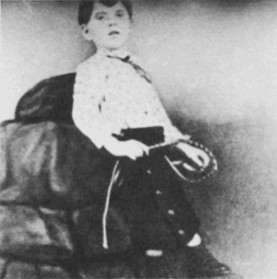
W.C. at 5

It is hard to tell the myth from reality in W.C. Fields’ youth. It depends on where you look. But he seems to have gone to school for about four years before joining his father in selling vegetables on a horse drawn cart. W.C. also worked in a department store and  and oyster house.  His relationship with his father, who was an alcholic, was not good.

At eleven, after many fights with his alcoholic father (who hit him on the head with a shovel), he ran away from home. [IMDB]

Fields told tales of living on the street, sleeping in a whole in the ground and stealing food and clothing to stay alive. In reality, though he did run away it was usually to his grandmothers and return home the next day.

His first regular job was delivering ice. By age thirteen he was a skilled pool player and juggler. …In 1893 he was employed as a juggler at Fortescue’s Pier, Atlantic City. When business was slow he pretended to drown in the ocean (management thought his fake rescue would draw customers). By nineteen he was billed as “The Distinguished Comedian” and began opening bank accounts in every city he played.  [Ibid]

Fields at 15  (Image courtesy wcfields.com]

Fields at 15 (Image courtesy wcfields.com]

By 23 he was opening at the Palace in London and performing with Sarah Bernhardt at Buckingham Palace. Starting in 1915 he was in the Ziegfeld Follies for six years. 1915 was also his first movie, Pool Sharks. In 1923 he was in the musical Poppy. The play was made into a movie, Sally of the Sawdust in 1925 by legendary D.W. Griffith.

Here he is in the Diner Sketch from Never Give a Sucker an Even Break

Other film highlights include David Copperfield (1935), You Can’t Cheat an Honest Man (1939) , My Little Chickadee (1940) and Never Give a Sucker an Even Break (1941).

He made over 37 moves for Paramount before switching to Universal

W.C. Fields was an actor whose flawless timing and humorous cantankerousness made him one of America’s greatest comedians. [Biography]

He died in 1946 on Christmas Day from an alcohol-related stomach hemorrhage. He was 66 years old.

English: W.C. Fields


Buzz Aldrin 1.20.13 Thought of the Day

“Beautiful, beautiful, magnificent desolation.”–Buzz Aldrin

Aldrin on the Moon [Image courtesy: Buzz Aldrin.com]

Aldrin on the Moon [Image courtesy: Buzz Aldrin.com]

Edwin EugeneBuzzAldrin, Jr. was born on this day in Montclair, New Jersey in 1930. He is 83 years old.

Aldrin’s father was a Colonel in the Air Force, an aviation pioneer and a Doctor of Science graduate from MIT. His mother, whose maiden name was, appropriately enough, Moon, was the daughter of an Army Chaplain. He had two older sisters, the younger of whom couldn’t pronounce brother, instead she said “Buzzer.” That was shortened to Buzz.

[Image courtesy: Buzz Aldrin.com]

[Image courtesy: Buzz Aldrin.com]

He was offered a full scholarship to MIT, but turned it down, choosing instead to enter West Point Military Academy. He graduated third in his class.

He then joined the Air Force where he flew F86 Sabre Jets in 66 combat missions in Korea, shot down two MIG-15′s, and was decorated with the Distinguished Flying Cross.  After a tour of duty in Germany flying F100’s, he went on to earn his Doctorate of Science in Astronautics at MIT and wrote his thesis on Manned Orbital Rendezvous. [BuzzAlrdrin.com]

He joined NASA as part of the third group of astronauts. His expertise on docking techniques earned him the nickname “Dr. Rendezvous”

The docking and rendezvous techniques he devised for spacecraft in Earth and lunar orbit became critical to the success of the Gemini and Apollo programs, and are still used today.  He also pioneered underwater training techniques, as a substitute for zero gravity flights, to simulate spacewalking. [Ibid]

[Image courtesy: Buzz Aldrin.com]

[Image courtesy: Buzz Aldrin.com]

During his Gemini 12 Mission he “performed the world’s first successful spacewalk” [Ibid].

In July of 1969 he landed on the Moon with Neil Armstrong while Michael Collins orbited over head during the Apollo 11 Mission. Aldrin and Armstrong   became “the first two humans to set foot on another world. They spent 21 hours on the lunar surface and returned with 46 pounds of moon rocks.” [Ibid]

Image Courtesy: NASA]

Image Courtesy: NASA]

Although he has since retired from NASA he remains a tireless advocate for Space exploration, especially the exploration of Mars. He has written a children’s book, an autobiography, and two space based science-fact-fiction novels.

[Image courtesy: Buzz Aldrin.com]

[Image courtesy: Buzz Aldrin.com]

At the passing of Neil Armstrong he wrote:

Whenever I look at the moon I am reminded of that precious moment, over four decades ago, when Neil and I stood on the desolate, barren, yet beautiful, Sea of Tranquility, looking back at our brilliant blue planet Earth suspended in the darkness of space, I realized that even though we were farther away from earth than two humans had ever been, we were not alone. Virtually the entire world took that memorable journey with us. I know I am joined by many millions of others from around the world in mourning the passing of a true American hero and the best pilot I ever knew. My friend Neil took the small step but giant leap that changed the world and will forever be remembered as a historic moment in human history…. [Buzz Aldrin.com]

When people talk about Neil Armstrong they sometimes say he was the “First man on the Moon.” I’m a huge Armstrong fan, but that statement is just not true. Armstrong was the first man to WALK on the Moon, because he descended the ladder of the Lunar Lander first, but he and Aldrin landed on the Moon at the same time.

English: One of the first steps taken on the M...

English: One of the first steps taken on the Moon, this is an image of Buzz Aldrin’s bootprint from the Apollo 11 mission. Neil Armstrong and Buzz Aldrin walked on the Moon on July 20, 1969. (Photo credit: Wikipedia)

Click here the ritaLOVEStoWRITE bioBLOG on Neil Armstrong.


A.A. Milne 1.18.13 Thought of the Day

“One of the advantages of being disorganized is that one is always having surprising discoveries.”
–A.A. Milne
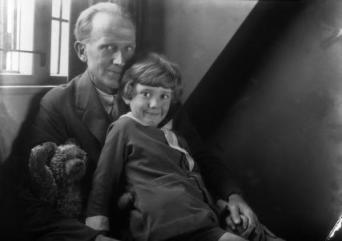
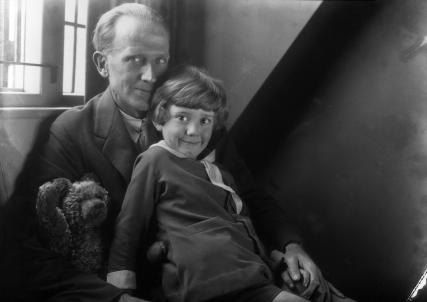
 A.A. Milne; Christopher Robin Milne and Pooh Bear  by: Howard Coster


A.A. Milne; Christopher Robin Milne and Pooh Bear by: Howard Coster

A. A. Milne was born  on this day in Kilburn, London, England in 1882. Today is the 131st anniversary of his birth.

Alan Alexander Milne  was the youngest of three boys born to John Vine and Sarah Maria Milne. John Milne ran a school, Henley House, and it was here that the boys took their first steps in the world of learning. One of the teachers at the school was H.G. Wells and he and Alan would remain friends for the rest of their lives. After Henley House Alan went on to Westminster School before attending Cambridge on a mathematics scholarship.

A.A. Milne’s first literary efforts came during his Cambridge days. He edited the college’s humorist publication, The Granta. Alan and his brother Ken worked together, by mail, on light verse that was published in The Granta under a mash-up of their initials A.K.M.

After graduation Alan moved to London and worked as a freelance writer. He had articles published in both newspapers, like the St. James Gazette, and in humor magazines, such as Punch.

In February of 1906 he became an assistant editor and weekly contributor to Punch magazine. His  contributions included stories on sports (especially cricket and golf), the exploits of the fictional middle class Rabbit Family, and children stories that he wrote with his niece Marjorie in mind.

In 1913 he married Dorothy “Daphne” de Selincourt. When World War I broke out he volunteered as a signalling officer. He saw action in France until returning to England in November 1916 with a fever. Once recovered he was

…put in charge of a company at a new formed signalling school at Fort Southwick. He stayed there until he was released from the army on February 14, 1919. [Pooh-Corner.org — The Author]

A.A. Milne on the Western Front 1916. [Image courtesy Spartacus.Schoolnet.co.uk]

A.A. Milne on the Western Front 1916. [Image courtesy Spartacus.Schoolnet.co.uk]

While in the Army he wrote his first play Wurzel-Flummery. Alan didn’t go back to Punch after the war — his job had been given to some one else — and he preferred the freedom of not having a weekly deadline. He also liked writing plays and collaborating with the actors.

…he had several successes, both in London and in New York. Mr Pim Passes By… opened in London on January 5, 1920, and ran for 246 performances in London. It also had a successful run in New York…. Within the next year, Milne had another four plays running in London. Other notable plays include Belinda, The Lucky One, The Romantic Age, The Dover Road, and The Truth About Bladys. … At one time, A. A. Milne was England’s most successful, prolific, and best-known playwright. [Pooh-Corner.org — The Author]

Ironically his biggest flop was called Success.

He wrote an adaptation of Mr. Pim Passes By and a mystery, The Red House Mystery. When he proposed writing Red House his agent bulked, suggesting the public wanted more humor stories. But Milne stuck to his guns, and The Red House Mystery was “his most successful book other than his four children’s books.” [Ibid]

The Red House Mystery

The Red House Mystery (Photo credit: Wikipedia)

Alan and Daphne Milne had a son Christopher Robin in 1920. They called the little boy “Billy Moon”  at home and among friends (the first name was a nickname, the “Moon” came from Christopher’s mispronunciation of his last name). Alan wrote the first Billy Moon poem “Vespers” after watching the little boy say his prayers before going to bed. It proved so popular that Milne was

asked to provide another children’s verse for a new children’s magazine entitled The Merry-Go-Round. That poem was “The Dormouse and the Doctor“, and also became quickly famous. Alan toyed with the idea of writing a whole book of children’s verse, and the result was When We Were Very Young, published in 1924. To illustrate the book, Milne enlisted the aid of Punch illustrator, Ernest Shepard. The combination of Milne’s poetry and Shepard’s drawings proved to be a winner, as the book sold over 50.000 copies within eight weeks of its first publication. [Ibid]

The family moved to Cotchford Farm, in Hartfield, East Sussex, in 1925 and Alan used the bucolic setting as his backdrop for his next book,Winnie-the-Pooh. Shepard was on board again as illustrator. Milne thought so highly of Shepard’s role in the success of the first children’s books that he insisted Shepard get an 80/20 share of the royalties of Winnie-the-Pooh instead of a flat rate. Winnie-the -Pooh was enormously well received.

Cover of Winnie-the-Pooh

Cover of Winnie-the-Pooh (Photo credit: Wikipedia)

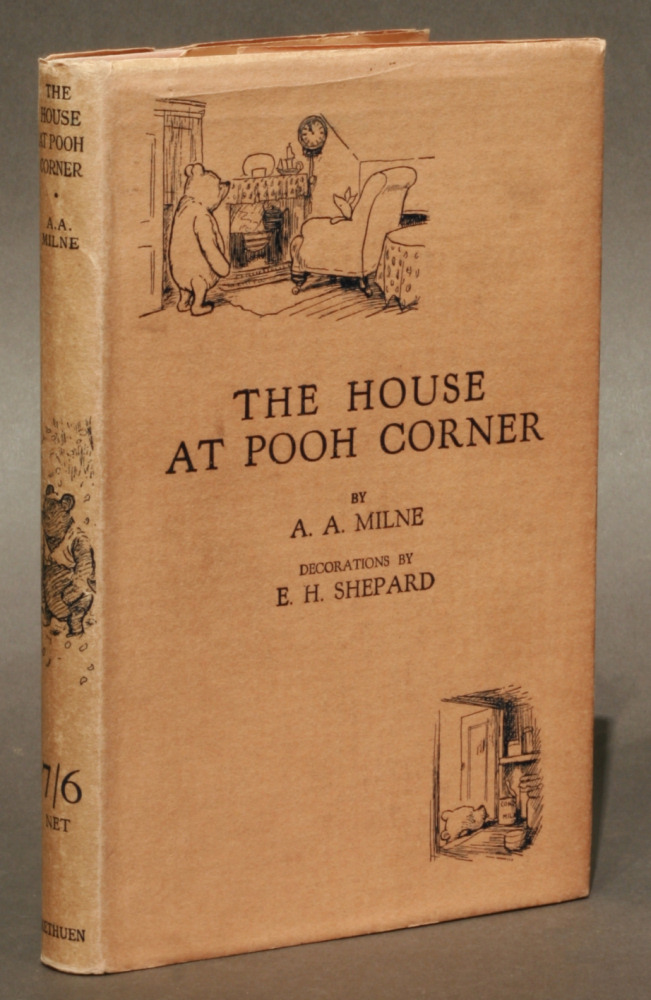
The second Pooh book, The House at Pooh Corner was equally loved. (Except by Dorothy Parker who famously quipped in her Constant Reader column in the New Yorker that by page 5 of the book the “tonstant Weader fwowed up”. Milne was unfazed by Parker’s quip, noting that “no writer of children’s books says gaily to his publisher, “Don’t bother about the children, Mrs Parker will love it.””[Ibid])

Milne House at Pooh Corner1000

Alan wrote more plays. His Toad of Toad Hall, based on Grahame’s The Wind in the Willows, got it’s stage debut in 1929. The play was hailed as a “family classic” and Milne was quickly getting painted into a corner. Especially in London, his works for adults were being ignored as the public clamored for more Pooh, or at least more children’s fiction. New York was more forgiving and his plays had longer runs on Broadway, including The Ivory Door and Michael and Mary. In 1933 his adult novel Four Days of Wonder sold moderately well, but he didn’t publish another novel for another 13 years.

At the dawn of World War II Milne, the pacifist, wrote Peace With Honour in which he outlined that nothing was

“worth repeating the Somme for. He would later change his mind and would write a pamphlet called War With Honour, in which he explained his changed views. ‘If anyone reads Peace With Honour now, he must read it with that one word HITLER scrawled across every page. One man’s fanaticism has cancelled rational argument.’ [Ibid]

The Milnes had moved away from the ‘Hundred Acre Woods’ and Cotchford Farm for London and New York, but with the War they moved back to East Sussex. Alan was Captain of the Home Guard for the area. His relationship with Daphne, which had waned, rekindled, but his ties with Christopher, which had always been strong, weakened. Christopher joined the Royal Engineers as a Sapper.

In 1946 Milne’s Chloe Marr, his last novel, came out to good reviews. It sold well. He continued to see success with his plays, which were now running in repertory.

[Image courtesy pdxretro.com]

[Image courtesy pdxretro.com]

But his relationship with Christopher — who ” had begun to resent his father and hated the books that made his name famous” [Ibid] — was crumbling. By the early 1950’s Christopher was married and living 200 miles away.

In October 1952, Milne had a stroke which left him an invalid for his remaining years. … A. A. Milne died on January 31, 1956. [Ibid]


Naveen Andrews 1.17.13 Thought of the Day

“I was always in trouble from an early age. I had a fraught relationship with my parents, who were very traditional. Doing plays at school was a joyous release.”–Naveen Andrews

[Image courtesy FanPop.com]

[Image courtesy FanPop.com]

Naveen William Sidney Andrews was born on this day in London, England in 1969. He is 43 years old.

Andrews was raised in the Wandsworth neighborhood of South London in a conservative parents, both of whom are first generation immigrants from Kerala, India. He attended London’s Guildhall School of Music and Drama.

He broke into film with the role of Bike in London Kills Me (1991).

In 1996 he played Kip, a British sapper, in The English Patient.  Kip’s relationship with Hana is a gentle, romantic shadow of the sensual, adulterous relationship between Almasy and Katharine Clifton. Here he is defusing a bomb…

He was clearly having a good time with his role of Bairaj (Bingley) in Bollywood’s Bride and Prejudice. Bonus: we get to see him dance and sing.

He played a considerably darker character on Lost for 116 episodes. Sayid Jarrah is a former member of Iraqi’s Special Republican Guard. His character is equally well versed in mechanical and radio engineering and in torture.  On an Island where nothing is as simple as it appears, and all the heroes come with a big helping of “anti-” … Sayid isn’t a bad person to have on your team.

[Image courtesy FanPop.com]

[Image courtesy FanPop.com]