Category Archives: Theatre

Secondary Character Saturday — Iago

Illustration of Othello and Iago

Illustration of Othello and Iago (Photo credit: Wikipedia)

“…What’s he then that says I play the villain?” — Iago

Who: Iago

From: Othello

By: William Shakespeare

Written: Around 1603

Pros: Intelligent, ambitious, funny. Although he is the play’s worst character, he is also its most interesting and complex by far… you can’t take your eyes off the scum ball.

Cons: Manipulative, abusive, sociopathic, vengeful, bitter, jealous, petty. He’s a liar and bully that will literally commit murder to get what he wants.

English: Carl Schurz as Iago from Shakespeare'...

English: Carl Schurz as Iago from Shakespeare’s play Othello, amidst his co-conspirators, prepares to enter the limelight. (Photo credit: Wikipedia)

Most Shining Moment: (Yeah, I’m leaving this one BLANK)

Least Shining Moment: So many to choose from. I’m going to go with killing his wife, Emilia. He’s treated her like dirt the entire play, and when she finally looses it and stands up to him he doesn’t think twice about running her through with a rapier.

Why I chose Iago: As you may have noticed most my Secondary Characters are pretty stand up guys. They all  have something going for them…maybe its charm… maybe they have good heart… but there is usually some nice feature that makes me like a character enough to give them the honored Saturday spot. Not so with Iago. Honestly I’m hard pressed to think of anything really nice to say about him. But…it is a really juicy role. He’s the one people remember. It is kind of the Darth Vader effect. You aren’t supposed to like him at all, but he’s the one whose theme song you remember.

English: Photographic full-length portrait of ...

English: Photographic full-length portrait of Edwin Booth as Iago in Shakespeare’s Othello, the Moor of Venice (Photo credit: Wikipedia)

Is Iago a SECONDARY character: I often struggle with whether a character is indeed Secondary. And it is hard to make that case with Iago when he is on stage more than any other character in Othello.  (He has 1,070 lines.) Without his wicked machinations you’d have a very different/happier story so, unlike other Secondary Characters, he is pivotal to the plot. But, when it comes down to it, the play is called Othello, not Iago. So I’m giving the slimy little so-and-so the nod this week.

Othello (1995 film)

Othello (1995 film) (Photo credit: Wikipedia)

————————————————————-

I’m feeling very Shakespeare-y today. I had the good fortune to attend the Baltimore Shakespeare Factory‘s Bard’s Birthday Gala last night. We were treated to scenes from their upcoming production of Romeo and Juliet (April 6-27) as well as a 3 person / 20 minute version of Othello. It was a fabulous lesson in suspending disbelief as the actors literally transformed before your eyes from one character another, and it worked beautifully. With a handful of props, no set and no furniture these three actors told the this timeless story in an engaging, new way. Play on! Indeed!


Gregory Peck 4.5.13 Thought of the Day

“I don’t lecture and I don’t grind any axes. I just want to entertain.”–Gregory Peck

Cropped screenshot of Gregory Peck from the tr...

Cropped screenshot of Gregory Peck from the trailer for the film Gentleman’s Agreement. (Photo credit: Wikipedia)

Eldred Gregory Peck was born on this day in La Jolla, California, USA in 1916. Today is the 97th anniversary of his birth.

He was born to Bernice Mae “Bunny” and Gregory Pearl Peck. Bunny was Scottish, English and Protestant, Gregory senior was Irish and Catholic. She converted when they married and they raised Eldred Catholic. When the couple split  little Eldred was six, he went to live with his grandmother.

Peck…”never felt he had a stable childhood. His fondest memories are of his grandmother taking him to the movies every week and of his dog, which followed him everywhere.” [IMDb]  When he was ten his grandmother passed away and he went to live with his father full-time.

He went to St. John’s Military Academy, a Roman Catholic military school in Los Angeles, then to  San Diego High School. He enrolled at San Diego State Teacher’s College for one year before transferring to the University of California, Berkley where he settled on Acting. Working as a truck driver and kitchen assistant helped pay the bills.

Upon graduation Peck headed east to New York City.  Gregory Peck was ‘born’ when he dropped his first name. “I never liked the name Eldred. Since nobody knew me in New York, I just changed to my middle name.” He worked as an usher at Radio City Music Hall and a tour guide at NBC. He worked for the acting experience and for food, landing progressively larger roles as he honed his craft.

His debut was in Emlyn Williams‘ play “The Morning Star” (1942). By 1943 he was in Hollywood, where he debuted in the RKO film Days of Glory (1944).

Stardom came with his next film, The Keys of the Kingdom (1944), for which he was nominated for an Academy Award. Peck’s screen presence displayed the qualities for which he became well-known. He was tall, rugged and heroic, with a basic decency that transcended his roles. [IMDb]

Cropped screenshot of Gregory Peck from the tr...

Cropped screenshot of Gregory Peck from the trailer for the film The Yearling. (Photo credit: Wikipedia)

He was nominated for four Academy Awards in the 1940’s for his work in: The Keys of the Kingdom, The Yearling, Gentleman’s Agreement and Twelve O’Clock High. He’d have to wait another 20 years before winning the statue.

An old back injury keep him out of the service during World War II (he’d hurt himself while taking dance and movement classes — not while on the UC Berkley Rowing team as 20th Century Fox claimed.)

He kept his stage skills up at The La Jolla Playhouse, a theatre he co-founded with Mel Ferrer and Dorothy McGuire in 1947.

To Kill a Mockingbird, 1962

To Kill a Mockingbird, 1962 (Photo credit: mystuart)

His best known and most love role came in 1962 as Atticus Finch in the film adaptation of Harper Lee’s To Kill a Mocking Bird. He won an Academy Award for his portrayal of the soft-spoken, southern lawyer. And his portrait of Finch was voted as the #1 greatest hero in American film by the American Film Institute in 2003.

Other notable films from his large library of movies include:

  • Spellbound
  • Captain Horatio Hornblower
  • The Snows of Kilimanjaro
  • Designing Women with Lauren Bacall
  • On the Beach
  • The Guns of Navarone
  • Cape Fear
  • The Omen
  • The Boys From Brazil

and my other favorite (besides Mocking Bird)… Roman Holiday with Audrey Hepburn.

Cropped screenshot of Gregory Peck from the tr...


Leslie Howard 4.3.13 Thought of the Day

“I hate the damn part. I’m not nearly beautiful or young enough for Ashley, and it makes me sick being fixed up to look attractive.”–Leslie Howard

[Image courtesy: The Rebel Reader]

[Image courtesy: The Rebel Reader]

Leslie Howard Steiner was born on this day in Forest Hill, London, England in 1893. Today is the 120th anniversary of his birth.

Both his parents, Lilian and Ferdinand “Frank” Steiner, were of Jewish descent. Leslie’s father was from Hungary. His mother’s grandfather immigrated from East Prussia and married into well to do English society. She wanted the family to assimilate into English society as seamlessly as possible. She raised Leslie as a Christian, and when World War One broke out the family Anglicized their name from Steiner to Stainer. Leslie changed his name legally to Leslie Howard on February 24, 1920.

Although clearly bright, Howard’s sheltered upbringing and severe near-sightedness made him extremely self-conscious. Never a good student, the young Howard loathed his time at Alleyn’s School in Dulwich, London, preferring to lose himself in the comfort of books. Fiercely protective of her son, Lilian encouraged her boy’s participation in the arts, particularly theatre, as a means of improving his social and academic skills. [TMC.com]

The stage was good fit. By 14 he had written his first play and it wasn’t long before Lilian established the Upper Norwood Dramatic Club to showcase Leslie and his friends. His father, however, thought a more down to earth career was in Leslie’s future. At Frank’s insistence he took a job as a clerk at a London bank — which he hated. “When war finally did break out, Howard saw his chance to escape the monotony of his life and promptly enlisted with the British Cavalry.” [Ibid] He served on the front lines for a while before returning home in 1916 with a severe case of shell shock.

He returned to the theatre again as a kind of a therapy.

In a few years, his name was famous on the stages of London and New York. He made his first movie in 1914 (The Heroine of Mons (1914)). He became known as the perfect Englishman (slim, tall, intellectual and sensitive), a part that he played in many movies, and a part women would dream about. [IMDb]

He had a long career on stage and screen, with his top movies being:

Oh, Ashley! [Image courtesy: The Rebel Reader]

Oh, Ashley! [Image courtesy: The Rebel Reader]

  • Gone with the Wind, as Ashley Wilkes (a role he thought he was too old for — he was 46 at the time. He didn’t want to play another soft-spoken, dreamer. But the producer promised Leslie if he did the role he could co-produce Intermezzo  — a movie he’d been longing to make.)
  • Intermezzo, a Love Story , as Holger Brandt
Giving a smouldering look with Igrid Berman in Intermezzo [Image courtesy: DoctoreMacro.com]

Sharing a smouldering look with Igrid Berman in Intermezzo [Image courtesy: DoctorMacro.com]

  • Pygmalion, as Professor Henry Higgins
In Pygmalion [Image couresty: DoctorMarco.com]

In Pygmalion [Image couresty: DoctorMacro.com]

Howard in Scarlet Pimpernel. He was nominated for an Academy Award for the role. [Image courtesy The Telegraph]

Howard in Scarlet Pimpernel. He was nominated for an Academy Award for the role. [Image courtesy The Telegraph]

He returned to England at the onset of WWII to help with the war effort. Leslie Howard died in 1943 when the plane he was flying in from Lisbon to England was shot down over the Bay of Biscay.


Glenn Close 3.19.13 Thought of the Day

“As an actor, I go where the good writing is. That’s the bottom line.“–Glenn Close

[Image courtesy: FanPOP.com]

[Image courtesy: FanPOP.com]

Glenn Close was born on this day in Greenwich, Connecticut, USA in 1947. She is 66 years old.

She is one of four children born to Bettine and Dr. William Taliaferro Close. The first seven years of her live were ones of privilege. She fondly remembers the ease and freedom of living in on her grandmother’s estate in the Connecticut countryside. But then things changed. Her parents joined the conservative salvation group Moral Re-Armament. The family moved into communal living centers and eventually her parents traveled to the Belgian Congo where her father ran several medical clinics and became a personal physician to  Mobutu Sese Seko. Close went to school in Switzerland. She attended Choate Rosemary Hall in Greenwich. And for a while in the mid-to-late 1960’s she performed with the MRA’s singing group “Up With People.”

At 22 she left the MRA and entered William and Mary College in Williamsburg, Virginia. There she took up acting in earnest.  Upon graduation she moved to New York and found work on the stage. She had her Broadway debut in 1974 as Angelica in Love for Love. Her break out role on the Great White Way was as Chairy Barnum in the Original Broadway Production of Barnum in 1980.

Close in The World According to Garp. [Image courtesy: Fixster.com]

Close in The World According to Garp. [Image courtesy: Fixster.com]

She made the jump to film in 1982 with The World According to Garp. She played Jenny Fields. The role earned her the first of her many Academy Award nominations. Another Oscar nomination came for her role as Sarah Cooper in The Big Chill in 1983, and yet another for her part as Iris Gaines in 1984’s the Natural.

She went against type and starred as Alex Forrest in Fatal Attraction in 1987. She got another Academy nod — this time for Best Actress. And got nominated again in that category for Dangerous Liaisons in 1988.

Close as Marquise de Merteuil in Dangerous Liaisons. [Image courtesy: the Oscar Nerd.com]

Close as Marquise de Merteuil in Dangerous Liaisons. [Image courtesy: the Oscar Nerd.com]

In 1990 she played Queen Gertrude to Mel Gibson’s Hamlet, And Sunny Von Bulow to Jeremy Iron’s Claus  in Reversal of Fortune.

In 1991 She played Sarah Wheaton in Sarah, Plain and Tall. It was the first of a Hallmark trilogy which also includes Skylark and Sarah, Plain and Tall: Winter’s End.

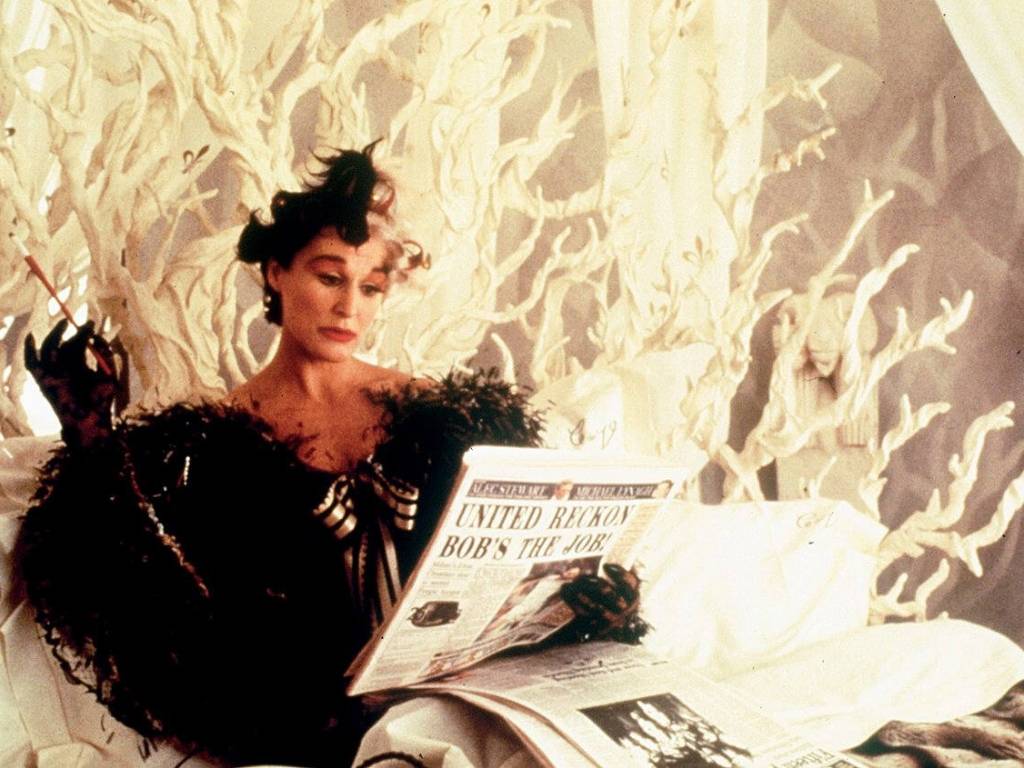
Cruella De Ville (Image courtesy: FanPop.com)

Cruella De Ville (Image courtesy: FanPop.com)

But not everything on her CV is a drama. In 1996 she co-starred as First Lady Marsha Dale in Tim Burton’s Mars Attacks! and the first of her gigs as the villainous, puppy hating Curella de Vil in 101 Dalmatians.

Dvd cover for Paradise Road. [Image courtesy: Amazon.com]

Dvd cover for Paradise Road. [Image courtesy: Amazon.com]

In 1997 she was Adrienne Pargiter in the brilliant and under rated Paradise Road. The film is a…

Fact-based recounting of a group of women who are imprisoned on the island of Sumatra by the Japanese during World War II and used music as a relief to their misery. [IMDb]

The movie co-stars Pauline Collins, Frances McDormand, Cate Blanchette, Jennifer Ehle and Julianna Margulies  and is a beautiful testament to the human spirit and the power of music. If you haven’t seen it… do your self a favor and put it in your queue.

She showed off her pipes again as Nellie Forbush in a made for TV version of South Pacific. (An interesting counter part to Paradise Road — considering both films cover the same period in history, the same conflict,  and approximately the same geography, and both contain some lovely music… yet they take a very different look at WWII.)

Close was Eleanor of Aquitaine opposite Patrick Stewart’s Henry II  in the TV version of The Lion in Winter, in 2003.

Promo shoot for Damages. [Image courtesy: FanPop.com]

Promo shoot for Damages. [Image courtesy: FanPop.com]

She had a 13 episode character arch as Captain Monica Rawling on The Shield. She voiced Mother Simpson on the Simpsons several times, and, more dramatically,   played Patty Hewes  on the TV series Damages starting in 2007.

Close was nominated for yet another Best Actress Oscar for her work in Albert Nobbs. The film came out in 2012.

Close as Albert Nobbs (Image courtesy: NPR.com photo by Patrick Redmond.]

Close as Albert Nobbs (Image courtesy: NPR.com photo by Patrick Redmond.]

Currently she has two films in the works for 2014, The Grace That Keeps This World, and Always on My Mind. Maybe she’ll get nominated again for one of these, and maybe, just maybe, the 7th time will be a charm!


Edward Albee 3.12.13 Thought of the Day

“If you’re willing to fail interestingly, you tend to succeed interestingly.”–Edward Albee
[Image courtesy: The Modern World.com]

[Image courtesy: The Modern World.com]

Edward Harvey was born on this day in Washington, DC in 1928. He is 85 years old.
When he was 2 weeks old he was adopted by Reed and Frances Albee. The family moved to Larchmont, New York soon afterward. The Albees had a theatre pedigree. Grandfather Edward Franklin Albee II  was the owner of several theaters, part of the Keith-Albee chain. With its roots in vaudeville the theatres hosted touring companies and eventually made the leap to movies. The company merged with two other companies and became RKO pictures….and the Albees were set for life.
Albee grew up in an affluent family. He had access to the stage from a young age and his love of theatre and art was well founded from his childhood. He did not do well at school. He was rebellious, and he was expelled from a number of public, private and military schools.
Almost from the beginning he clashed with the strong-minded Mrs. Albee, rebelling against her attempts to make him a success as well as a sportsman and a member of the Larchmont, New York, social set. Instead, young Albee pursued his interest in the arts, writing macabre and bitter stories and poetry, while associating with artists and intellectuals considered objectionable by Mrs. Albee. [The Kennedy Center. org]

After he dropped out of Trinity College in his sophomore year he had a rift with his family. (He never saw his father again.) He moved to New York’s Greenwich Village and lived on a small inheritance and by doing odd jobs — like delivering telegrams — while honing his writing skills. Albee tried his hand at poetry and fiction before finding his groove as a playwright.

Edward Albee [Image courtesy: Academy Achievement.]

Edward Albee [Image courtesy: Academy Achievement.]

In 1959 his first play, The Zoo Story was produced in Berlin, Germany. I came to New York, Off-Broadway in 1960. The Zoo Story is a one-act play “in which a loquacious drifter meets a conventional family man on a park bench and provokes him to violence” [Academy of Achievement]  Other one acts and short dramas followed including : The Sandbox, The American Dream and The Death of Bessie Smith.

By 1962, he was ready to storm Broadway, the bastion of commercial theater in America. His first Broadway production, Who’s Afraid of Virginia Woolf?, was a runaway success and a critical sensation. The play received a Tony Award, and Albee was enshrined in the pantheon of American dramatists alongside Eugene O’Neill, Arthur Miller and Tennessee Williams. [Academy of Achievement] 

Elizabeth Taylor and Richard Burton in the movie version of Who's Afraid of Virginia Woolf (Image courtesy: The Movie Jerk]

Elizabeth Taylor and Richard Burton in the movie version of Who’s Afraid of Virginia Woolf (Image courtesy: The Movie Jerk]

His first Pulitzer Prize came for the 1966 drama A Delicate Balance.  Albee won his second Pulitzer in 1975 with Seascape, “which combined theatrical experiment and social commentary in a story about a retired vacationing couple who meet a pair of sea lizards at the beach.” [The Kennedy Center. org] “As bizarre as the idea sounded on first hearing, the result was both humorous and moving. The play charmed audiences and critics…” [Academy of Achievement] 

After Seascape the theater critics, unexpectedly, fell out of love with Albee. For nearly two decades he struggled to get the audiences and critical praise he deserved.

In an era of Hollywood-style “play development” by committee, Albee has remained an uncompromising defender of the integrity of his own texts, and a champion of the work of younger authors. Over the years, he has scrupulously reserved part of his time for the training of younger writers. He has conducted regular writing workshops in New York, and … taught playwriting at the University of Houston. He has persistently asked young writers to hold themselves to the highest artistic standards, and to resist what he sees as the encroachment of commercialism on the dramatic imagination.  [Academy of Achievement] 

In 1994 he was back with Three Tall Women. The play won Albee his third Pulitzer. “In 1996, Albee was one of the recipients of the Kennedy Center Honors and was awarded the National Medal of Arts.” [Ibid] The triumph of Three Tall Women launched the second act for the playwright who saw The Play About the Baby, The Goat or Who Is Sylvia? (Tony Award / Drama Desk Award) and  Occupant (the story of artist Louise Nevelson*), hit the Great White Way within a decade.  Next Albee reworked The Zoo Story in Homelife and presented both plays as Peter and Jerry.

Cover of "The Play About The Baby"

Cover of The Play About The Baby

He was honored with a Special Lifetime Achievement Tony Award  in 2005.

At 85 Albee continues to write for the stage.

—————————————————


Aidan Quinn 3.9.13 Thought of the Day

“I think my being such a nomad let me into acting. I was always having to create a new image whenever we moved.” — Aidan Quinn

Legends of a Fall [Image courtesy: Tristar films]

Legends of the Fall [Image courtesy: Tristar films]

Aidan Quinn  was born on this day in Chicago, Illinois, USA in 1959. He is 54.

Born to an Irish American family, he grew up in Illinois ( in Chicago and Rockford) and in Ireland. His mother, Teresa, was a bookkeeper, his father, Michael, was a literature professor. Brothers Robert, Paul,  and Declan  and  sister Marian  round out the Quinn brood. He studied acting at the Piven Theatre Workshop in Evanston, Illinois and has a BFA in acting from DePaul University in Chicago, IL.

Quinn in Desperately Seeking Susan.

Quinn in Desperately Seeking Susan.

After working on the stage in Chicago he made the jump to film in 1984 with the drama Reckless, but broke through with the comedy Desperately Seeking Susan in the role of Dez in 1985. The Television drama An Early Frost, in which Quinn plays a young man with AIDS, earned him his first Emmy nomination. The next year he played a small role in [one of my favorite movies of all time] The Mission. “…Quinn found a niche playing sensitive, intelligent male characters, often in supporting roles. Notable films include Avalon, Benny & Joon, Michael Collins and Practical Magic.” [Biography.com]

One film that was close to his heart was also a family affair. He plays Kieran O’Day in 1998’s This is My Father.

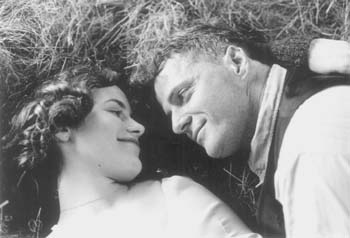
This Is My Father

He plays a poor Irish farm hand in love with Moya Farrelly’s Fionna in This Is My Father

The film was written and directed by his brother Paul, brother Declan was the cinematographer, and sister Marian had a cameo.

Although having starred alongside “big names …and in some “big” films such as Legends of the Fall, Mary Shelley’s Frankensteinand Michael Collins he has managed to keep a fairly low profile. This is not something he’s unhappy about, since he likes to keep his private life private. [Aidan Quinn — The Biography]

“Celebrity” he says  ” is not a thing to seek.” That’s not to say he doesn’t keep busy. Between films, television and the stage Quinn has performed regularly (averaging 3 or 4 projects a year) since he entered the business.

Recently he’s been in the movie  Sarah’s Key and the US version of Prime Suspect. You can currently catch him in Elementary.

Aidan Quinn 2 by David Shankbone

Aidan Quinn 2 by David Shankbone (Photo credit: david_shankbone)


Keeley Hawes 2.10.13 Thought of the Day

“I’ve been really lucky with my career so far. I haven’t been pigeon-holed, which sometimes happens to actors. … I’m even lucky enough to have done my pocket version of Lady Macbeth!”– Keeley Hawes

Zoe Reynolds

Zoe Reynolds (Photo credit: Wikipedia)

Clare Julia “Keeley”  Hawes was born on this day in  Marylebone, London, UK in 1976. She is 37 years old.

The youngest of four siblings she grew up in a working class family. Her father drives a taxi, and her brothers followed suit. Keeley is the only one in the family who was bit by the acting bug. They lived near the Sylvia Young Theatre School and she attended on a grant. There she took ten years of elocution lessons to lose her cockney accent. She also took acting lessons.  At 16 she began modelling for a year and half before making the switch to working as a fashion assistant for Cosmopolitan magazine.

In 1996 she landed a role in Dennis Potter’s Karaoke with Albert Finney and her acting career started in earnest. She had a starring role in the BBC’s 1998 adaptation of Dicken’s Our Mutual Friend. Her Lizzie Hexam is shy, humble, poor, innocent.

Her next major mini series role, Cynthia Kirkpatrick, in Elizabeth Gaskell’s Wives and Daughters is none of those things. The only thing Lizzie and Cynthia have in common is that  they both wear a corset… and Hawes is wonderful in both parts.

In 2002 she took on a much more modern role as Zoe Reynolds in the BBC One spy series Spo0ks (MI-5 in the US). She met her husband, Matthew MacFayden, while working on the series.

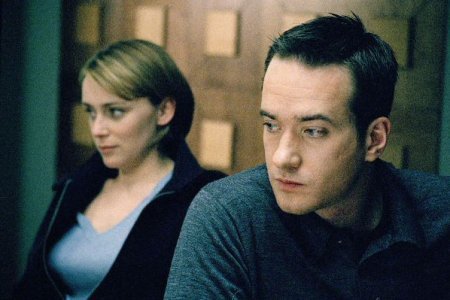
Keeley Hawes and Matthew MacFayden from Spooks (Image courtesy Fanpop.com

Keeley Hawes and Matthew MacFayden from Spooks (Image courtesy Fanpop.com]

Speaking of modern, Hawes starred in two modernized Shakespeare plays; an Andrew Davies penned retelling of Othello for Masterpiece Theatre, and as Ella MacBeth in BBC’s  Shakespeare Retold  with James MacAvoy.

Hawes has been busy (I’m only mentioning the performances I’ve seen == all of which have been excellent).

Her latest “Masterpiece” was last year’s Lady Agnes Holland on the reboot of Upstairs Downstairs.


Imelda Staunton 1.9.13 Thought of the Day

“…It was the best job of my life. It’s rather like falling out of an aeroplane with no parachute.”
–Imelda Staunton

Imelda

Imelda (Photo credit: Lizzie Wells)

Imelda Mary Philomena Bernadette Staunton was born on this day in London, England, in 1956. She is 57 years old.

Staunton, an only child, lived with her mum and dad over her mother’s hair dressing salon. Her mother was also a gifted natural musician who could pick up  songs by ear (but couldn’t read music.) She passed on her love of music to Staunton who attended La Sainte Union Convent Catholic school. After graduation she attended the Royal Academy of Dramatic Arts.

Staunton wasted no time launching her career following graduation, becoming associated with such prestigious venues as The Old Vic and the National Theatre. [Moviefone: Imelda Staunton Biography.]

Musical theatre and Shakespeare fill her Stage CV. She won the prestigious Olivier Award twice.

On film she landed a role in the ensemble movie Peter’s Friends with Kenneth Branagh, Stephen Fry, Emma Thompson and Hugh Laurie. She worked with Branagh and Thompson again in Much Ado About Nothing. Then paired up with Laurie as Mr. and Mrs. Jennings in Thompson’s wonderful adaption of Jane Austen’s Sense and Sensibility in 1995. (Thompson both wrote the screen play and starred in the film). She was Maria in Twelfth Night and the nurse in Shakespeare in Love.

As Staunton’s numerous stage roles continued to earn her critical success, frequent television and film roles made her a familiar and endearing face to the general public. [Ibid]

She stepped away from the crowd with a starring dramatic role in Vera Drake.

Her undeniably affecting portrayal of the title role — a selfless housewife and cleaning woman who makes a name for herself performing illegal abortions — earned her near-universal praise. After earning accolades from both The Venice Film Festival and The New York Film Festival as well as the Los Angeles and Chicago film critic associations, Staunton had undeniably arrived when the role earned her a Best Actress nomination for the 77th Annual Academy Awards. [Ibid]

She took home a BAFTA for Vera.

Français : Avant-Première Mondiale d'Harry Pot...

Français : Avant-Première Mondiale d’Harry Potter et les Reliques de la Mort, à Londres, le 7 Juillet 2011 (Photo credit: Wikipedia)

In 2007 she, like many other classically trained British actors, found a new audience when she took a role in a Harry Potter film. Staunton played the nasty Defense Against the Dark Arts Professor in a fluffy pink cardigan, Dolores Umbridge in Harry Potter and the Order of the Phoenix.

Some Ministry officials in Harry Potter and th...

Some Ministry officials in Harry Potter and the Order of the Phoenix, from left to right: John Dawlish, auror; Dolores Umbridge, Senior Undersecretary to the Minister; Cornelius Fudge, Minister for Magic; and Kingsley Shacklebolt, auror. (Photo credit: Wikipedia)

She laced up a corset again for her supporting role as Miss Octavia Pole in the BBC’s delightful adaptation of Elizabeth Gaskell’s Cranford (and again for Return to Cranford).

Julia Mackenzie and Imelda Staunton

Julia Mackenzie and Imelda Staunton (Photo credit: Wikipedia)

Staunton has lent her voice to a number of acting projects including and animated version of the Wind in the Willows, The Adventures of Mole, The Adventures of Toad, The Ugly Duckling, and Chicken Run. She’s even did a turn as the voice of Interface on Dr. Who.


Maggie Smith 12.28.12 Thought of the Day

“I like the ephemeral thing about theatre, every performance is like a ghost – it’s there and then it’s gone.”
Maggie Smith
Maggie Smith was author J. K. Rowling's person...

Maggie Smith was author J. K. Rowling’s personal choice for the role of McGonagall in the film series. (Photo credit: Wikipedia)

Margaret Natalie Smith was born on this day in Ilford, London, England in 1934. She is 78 years old.
The daughter of a secretary and a public health pathologist, she has twin older brothers. When Smith was 4 the family moved to Oxford where her father took a position at Oxford University.
Upon graduating from high school,
Smith attended the Oxford Playhouse School in 1951-53. She made her professional stage début in 1952, playing Viola in an Oxford University Dramatics Society production of Shakespeare’s Twelfth Night. [Biography]
She worked on Broadway in a comedy review, New Faces of 1956. 1956 also saw her first film role, an uncredited part in Child in the House.  She did a number of guest spots on television shows  before she landed a larger role in 1959’s Nowhere to Go. (For which she won  the British Academy of Film and Television Arts “Most Promising Newcomer” award.)
Back home she worked with the National Theatre of Great Britain, and had her break out role as Desdemona opposite Laurence Olivier’s Othello in 1964. The duo “reprised their roles in a film version of Othello the following year.” [Ibid] The film earned Smith her first Oscar nomination
While at the National Theatre, she acted in classic dramas by major authors such as Henrik Ibsen and Anton Chekhov. [Ibid]
She played Beatrice to Robert Stephens’ Benedict in the 1967 television version of Much Ado About Nothing.
In June of 1967 Smith and Stephens married (’67 – ’74)  and had two sons, Chris Larken and Toby Stephens. Both of boys grew up to become actors.
The Prime of Miss Jean Brodie, the story of a headstrong Scottish school teacher, won her both an Oscar and a BAFTA award in 1969.  In 1978 she won her second Oscar, this time for Best Supporting Actress in California Suite.
By the mid ’80s  she was winning accolades (and awards) for more mature roles, like her turn as Charlotte Bartlett in A Room with a View, Mrs. Medlock in The Secret Garden, Lady Random inTea With Mussolini, and as the elitist Constance, Countess of Trentham in the wonderful Gosford Park.
In 1975 she married playwright and librettist Beverly Cross, who died 1998.
In 1990 she won a Tony Award for Best Lead Actress in Lettice and Lovage on Broadway.
While she donned a pointy hat and tartan accented witch robes for the role of Professor Minerva McGonagall in the Harry Potter series, she continued to perform in an eclectic mix of movies, television and stage shows in both England and the US.
She won an Emmy for My House in Umbria in 2003,   and two more as the Dowager Countess of Grantham, Cousin Violet Crawley in Downton Abbey.
On the big screen she recently won a Screen Actors Guild Award for her performance in The Best Exotic Marigold Hotel (2012).  You can also see her  Quartet with Michael Gabon and Billy Connolly.

In 1990 Smith was made a Dame commander of the Order of the British Empire.