Category Archives: postaday

Tycho Brahe 12.14.12 Thought of the Day

“I conclude, therefore, that this star is not some kind of comet or a fiery meteor… but that it is a star shining in the firmament itself one that has never previously been seen before our time, in any age since the beginning of the world.”
–Tycho Brahe

The astronomer Tycho Brahe

The astronomer Tycho Brahe (Photo credit: Wikipedia)

Tycho Ottesen Brahe was born on this day in Knutstrop Castle, Scania, Denmark-Norway in 1546. Today is the 466th anniversary of his birth.

Noble by birth Brahe’s twin brother died before he could be baptized. Tycho’s ode to his dead brother was his first published work. At two his  uncle,  Jorgen Thygesen Brahe,  took him (perhaps kidnapped him) to live at Tosterup Castle, and Tycho became Jorgen’s heir.  At 12 he entered the University of Copenhagen to study philosophy and rhetorics. There was a solar eclipse in 1560 and young Tycho was fascinated by it. He began studying astronomy. When he started at Leipzig he  began to study astronomy without permission…

but was soon forgiven after demonstrating successes. He found that old observations were very inaccurate, and started to design methods and instruments for high-precision measurement of positions of celestial bodies. [TychoBrahe]

From Leipzig he continued his academic pursuits  in  Germany, studying at Wittenberg, Rostock and Basel. In Rostock he had a famous duel with another student to determine who was the best mathematician.

Tycho Brahe

Tycho Brahe (Photo credit: lilspikey)

His nose was cut so badly that  for the rest of his life “he covered the scar with a plate probably made of a silver-copper alloy to imitate the colour of the skin.” [Ibid]

During this period his interest in alchemy and astronomy was aroused, and he bought several astronomical instruments.[The Galileo Project]

He returned to Scania and built a laboratory to study chemistry. In November of 1572 he turned his sights to the heavens again and observed …

a new brilliant star in the constellation of Cassiopeia. Tycho’s measurements showed that it really was a distant star and not any local phenomena. This was very intriguing at that time, since the sphere of the stars was considered to be divine and perfect, hence no changes ought to take place there. Tycho observed its brightness evolve until it faded away the next year. He reported the event in his book “De stella nova”, which made him famous all over Europe. [TychoBrahe]

With his new found fame he could have studied anywhere in Europe, but he chose to return to his beloved Denmark. King Frederick II  granted him the Island of Hven.

Map of Hven from the Blaeu Atlas 1663, based o...

“…There he built his observatory, Uraniburg, which became the finest observatory in Europe.” [The Galileo Project] He designed new instruments and developed a nightly program of observations.

Tycho Brahe's Stjerneborg observatory on the i...

Tycho Brahe’s Stjerneborg observatory on the island of Hven, restored. 2005 (Photo credit: Wikipedia)

The observatory was visited by many scholars, and Tycho trained a generation of young astronomers there in the art of observing. [Ibid]

He left Hven after he had an argument with King Christian IV and, after traveling for several years, wound up in Prague.

Tycho Brahe died 24th October 1601 of a urinary bladder infection. It has long been thought that the cure (a self-induced potion that may have contained lead) was the real culprit. But that has recently been disproved.

English: Signature of Tycho Brahe.

English: Signature of Tycho Brahe. (Photo credit: Wikipedia)

Tycho Brahe ved Knutstorp, Knudstrup

Tycho Brahe ved Knutstorp, Knudstrup (Photo credit: Wikipedia)


Pride and Prejudice Essay Contests

Today’s blog features two essay contests: the official JASNA Student Essay Contest,
and the ritaLOVEStoWRITE Essay Contest for the rest of us.


JASNA essay contest


JASNA STUDENT ESSAY CONTEST:


Attention: Students at the high school, college and post-graduate levels:


In celebration of the 200th anniversary of the publication of Pride and Prejudice, JASNA (The Jane Austen Society of North America) is looking for short essays on the following topic:


“Though Pride and Prejudice may be regarded as timeless, nevertheless within the novel Austen plots her time very carefully. Timing is everything for important relationships and events. And the characters are deeply connected to the time in which they live, which is both like and unlike our times. What do we discover about time, times, or timeliness from reading Pride and Prejudice?”


Title page from the first edition of the first...

Title page from the first edition of the first volume of Pride and Prejudice (Photo credit: Wikipedia)

Judges will be awarding scholarships ranging from $250 to $1000, plus a years membership to JASNA, plus tickets and lodging to the 2013 JASNA Annual General Meeting in Minneapolis. The winning essays will also appear on the JASNA website.


Deadline is May 15, 2013. 


Click HERE to go to the JASNA Essay Contest Page for more details.


[Please note that the contest is open to students outside the United States too, but the essay must be written in English.]


———————————————————————————————-


English: Mr. and Mrs. Bennet. Austen, Jane. Pr...

English: Mr. and Mrs. Bennet. Austen, Jane. Pride and Prejudice. London: George Allen, 1894, page 5. (Photo credit: Wikipedia)

ritaLOVEStoWRITE  Contest for the rest of us:


So what about the rest of us Pride and Prejudice lovers? Can’t WE write an essay*? Well, sure you can. I’m calling for entries right here and right now.


We too will be celebrating the 200th anniversary of P&P! But guess what? Any one can participate!  Couple of RULES here:


  1. TRY and keep it under 1200 words please.
  2. The “essay” should be Pride and Prejudice centric.
  3. Please submit your essay in English.
  4. Have fun with it!
  5. Oh, and no pornography == THIS is Austen after all!


English: Français : Une gravure de 1833 illust...

English: Français : Une gravure de 1833 illustrant une scène du chapitre 59 du roman Orgueil et Préjugés de Jane Austen. À gauche M. Bennet, à droite Elizabeth. Avec File:Pickering – Greatbatch – Jane Austen – Pride_and_Prejudice – This is not to be borne, Miss Bennet.jpg, il s’agit des toutes premières illustrations de l’œuvre. (Photo credit: Wikipedia)


Prizes include… All entries will be published in an upcoming special edition of the award-winning ritaLOVEStoWRITE blog. All entries will receive a participation banner for your blog. The top three entries will receive a special “Finalist” banner for their Blog Page, and the top entry will win a Darcy mug! (Please make sure to include an email contact — which I will remove before posting so the whole world doesn’t see it.)


Deadline: 28 January 2013 (That’s the anniversary date of the novel’s publication)


*I seriously encourage you to think outside the box. For you illustrators out there… how about some character studies? Are you a play wright? Why not treat us to a re-imagined scene or two?


AND … Although I’m not going to snark on your intellectual property I strongly suggest you throw a copyright on all your original material in case any one else takes a liking to it.


English: This diagram, or map, illustrates the...

English: This diagram, or map, illustrates the relationships between each of the main characters in the novel Pride and Prejudice by Jane Austen. (Photo credit: Wikipedia)


Steve Buscemi 12.13.12 Thought of the Day

“My favorite review described me as the cinematic equivalent of junk mail.”
Steve Buscemi


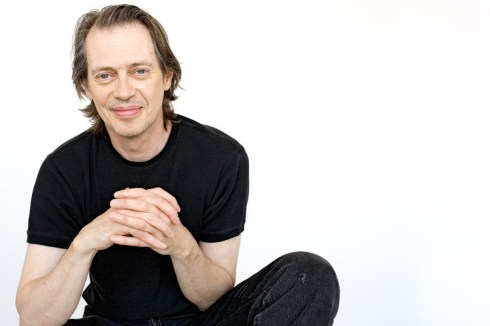
(Image courtesy: fan pop)

(Image courtesy: fanpop.com)


Steven Vincent Buscemi was born on this day in Brooklyn, New York, USA in 1957. He is 55 years old.


Buscemi is part Irish and part Italian, he’s one of four boys born to John Buscemi, a sanitation worker, and Dorthy Buscemi a hostess. He went to Valley Stream Central High School where he wrestled and acted. After graduating in 1975 he attended Nassau Community College then moved Manhattan to attend the Lee Strasberg Institute. He worked on FDNY Engine #55 as a fire fighter. He has worked as a bartender, a stand-up comedian, an ice-cream truck driver before breaking into acting. One of his brothers, Michael, is also an actor.


He made his film debut with a short called Tommy’s (in which he played Tommy), in 1985. He took on the odd ball, character actor roles — often the mafia types and worked in dozens of TV shows and movies. When he hooked up with the Coen Brother’s his off beat sensibilities found a home.


As of 2010, has appeared in six Coen Brothers films (Miller’s Crossing (1990), The Hudsucker Proxy (1994), Barton Fink (1991), Fargo (1996), The Big Lebowski (1998), and Paris, je t’aime (2006)), more than any other actor. [IMDB.com]


He played Mr. Pink in Quentin Tarntino’s Reservoir Dogs. Then paired up with the director again for a bit part in Pulp Fiction.


English: Photo of a young Steve Buscemi (Ameri...

English: Photo of a young Steve Buscemi (American actor). Taken in Silverlake / Los Angeles. (Photo credit: Wikipedia)


Buscemi was brilliant as Carl Showalter, the can’t-catch-a-break smal-time crook in Fargo.


His movie and tv CV is impressive, and he’s the kind of actor where you see a movie title  and you think “Oh, yeah, he WAS in that.”  From Templeton the Rat (in 2006’s Charlotte’s Web) to Donny (in 1998’s The Big Lebowski) to Lenny Wosniak (his recurring guest spot on 30 Rock) Buscemi is wonderful to watch — even when you want to turn away.


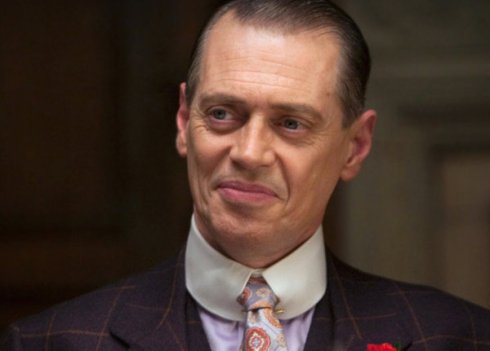
Most recently he’s been the star of HBO’s Boardwalk Empire. As amoral Nucky Thompson he manages to hang on to a thread of inner humanity to keep his character viable. And , oh, yeah, he’s a hoot. (When he’s not killing people.)

Buscemi as Nucky Thompson. (Image courtesy HBO)

Buscemi as Nucky Thompson. (Image courtesy HBO)


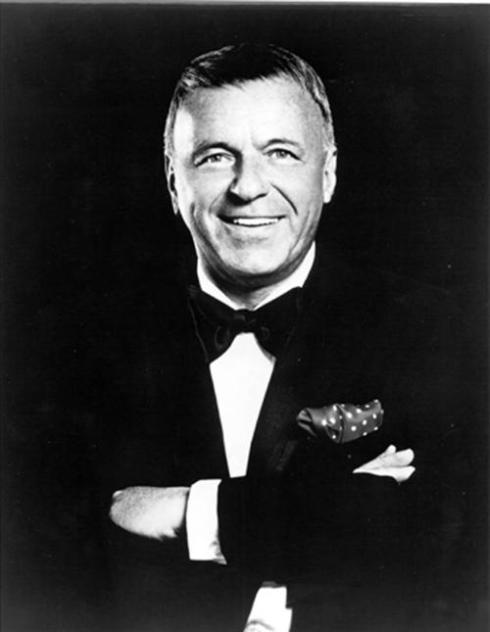
Frank Sinatra 12.12.12 Thought of the Day

“May you live to be 100 and may the last voice you hear be mine.”
— Frank Sinatra

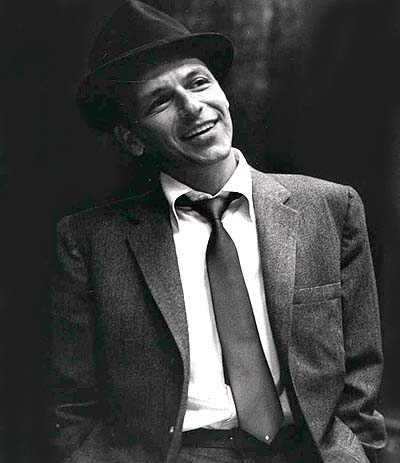
Image courtesy last.fm

Image courtesy last.fm

Francis Albert Sinatra was born on this day in Hoboken, New Jersey, USA in 1915. Today is the 97th anniversary of his birth.

Frank was the only child of Marty and Dolly Sinatra. As a kid he stood on top of the bar at a local nightclub and sang for tips. He dropped (or was kicked) out of high school, and help make ends meet at home by delivering the local paper, the Jersey Observer. He also worked as a riveter at a local shipyard. Although he couldn’t read music he began singing professionally by the mid 1930s when he joined the Three Flashes (they changed their name to the Hoboken Four.)

He worked as a singing waiter in Englewood Cliffs for $15 a week for almost 4 years. Then Henry James signed him for a one year contract at $75 a week. On July 13th, 1939, as the US was emerging from a decade of Depression and the world was on the advent of another great War, 23-year-old  Frank Sinatra recorded his first record, From the Bottom of my Heart, with the Harry James Orchestra.

He released 10 songs with James (none of which charted particularly high in their original pressing.) Sinatra switched to the more popular Tommy Dorsey’s band (with James’ blessing) in November. He recorded over 40 songs on Dorsey. One of his biggest hits with Dorsey was I’ll Never Smile Again.

By 1941 he was at the top of  both the Billboard and Down Beat magazine polls. Not only did he sell records, he opened up an entirely new audience — the bobby soxers (aka teenagers.) [It seems odd today — when so much of a company’s advertising budget goes toward capturing the 12-20 year old’s pocketbook — but prior to 1940 most consumers were adults.  Sinatra appealed to both adult women and bobby sox wearing girls.]

Image courtesy last.fm

Image courtesy last.fm

He went solo in 1943 and in the next three years he charted 17 times.  Sinatra was classified 4-F for military service because of a perforated eardrum, so he did not serve in the military.

He started making films as part of the Dorsey Band  with Las Vegas Nights and  Ship Ahoy, he had a walk on / singing part in the wonderfully named Reveille with Beverly but then had his first real role in Higher and Higher. He teamed with Gene Kelly for the hugely successful Anchors Aweigh in 1945.  It was the first of three Sinatra/Kelly films with Take Me Out to the Ball Game and On the Town coming out in 1949.  He won a special academy award for his work on the (dated) short film The House I Live In. (1945)

At the beginning of the 1950’s Sinatra saw his popularity wane somewhat. The bobby soxers who had screamed out deafening choruses of “FRANKIE” for the thin, blue-eyed singer had found new idols to adore.

He came back with a bang with his next movie, 1953’s From Here to Eternity. He won an Oscar as bad boy Angelo Maggio.

Cover of "From Here to Eternity"

Cover of From Here to Eternity

The same year he signed with Capitol Records. In 1954 his album Swing Easy! was named Album of the Year by Billboard and the single Young At Heart was picked for Song of the year. Swing Easy was arranged by Nelson Riddle. Sinatra and Riddle worked together again for Songs for Swingin’ Lovers! which included I’ve Got You Under My Skin.

He poked fun at his mobster image in the movie version of Guys and Dolls. in 1955 as Nathan Detroit.  In 1956 he played Mike Connor to Grace Kelly’s Tracy Lord in High Society.  The next year he was Joey in Pal Joey.

He started his own record label in 1960, Reprise Records. 

In 1962 he starred in his most dramatic movie the classic political thriller, The Manchurian Candidate. [For my money The Manchurian Candidate is the best movie of the bunch.]

He was a founding member of the Rat Pack and worked alongside Dean Martin, Peter Lawford, Sammy Davis Jr., and Joey Bishop in several movies and countless nightclub acts.

Here he is  having a ton of fun singing Lady Is a Tramp with the incomparable Ella Fitzgerald

Sinatra was a sucker for charities.  He raised over a billion dollars in the course of his life for charities all over the world.

His generosity touched the worlds of education, medicine, science, and children’s needs, his favorite cause. … Sometimes it was a late-night phone call that moved him; sometimes he just caught wind of a hard-luck story on the news or in the paper and did what he could to fix it. [Sinatra.com]

In 1962 he led a 12 country World Tour for Children that raised over a million dollars for children’s charities worldwide. He paid for the entire cost of the tour himself, and recruited other musical luminaries to join him.

He also worked against segregation , taking a major role in the desegregation of Nevada entertainment and hospitality industry in the 1960s. He boycotted venues and hotels where black performers and guest were banned. And he played benefits for Martin Luther King, Jr. and the Equal Right Movement.

Sinatra received the Presidential medal of Freedom from Ronal Reagan in 1985.

Ole’ Blue Eyes faced his final curtain on May 14, 1998. He was 82 years old.

Frank older

Image courtesy last.fm


Rita Moreno 12.11.12 Thought of the Day

“Then there’s the story of ill-fated love. It’s universal.”
Rita Moreno

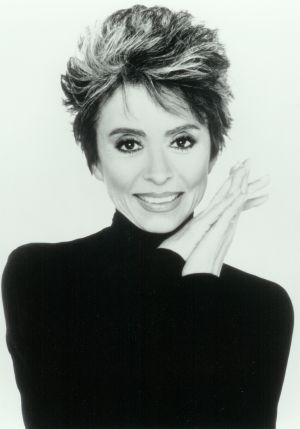
Caption for Rita Moreno

[Image courtesy: Berkeleyside]

Rosita Dolores Alverio was born on this day in Humacao, Puerto Rico in 1931. She is 81.

She moved to New York with her mother when she was six. Her first entertainment gig was doing Spanish voice overs to American films when she was 11. She made her Broadway debut in November of 1945 in Skydrift at the Belasco Theatre. Her name appeared in the program as Rita Moreno.

She appeared as Zelda Zanders in Singin’ in the Rain in 1952 and as Tuptim in The King and I in 1956. She also played a lot of  Latino “sexpot” roles, something she found degrading, but that she put up with.

Then came West Side Story…

Moreno (co-stars) as “Anita”, the Puerto Rican girlfriend of Sharks’ leader Bernardo, whose sister Maria is the piece’s Juliet. A seasoned singer and dancer, Moreno delivered a superb performance that completely overshadowed the Maria of the movie, the non-singer (and non-Hispanic) Natalie Wood, the only movie star in the ensemble cast. [IMDB Rita Moreno]

Watch her sing and dance up a storm with Geroge Chakiris and the Sharks (et al) in West Side Story…

But her performance went well beyond wise cracking, dancing and singing. She was…

…unforgettable in a harrowing scene where she had to deliver a message from Maria to the Romeo of the piece, the Jets’ member Tony, and is assaulted by his fellow gang-members. This is the real climax of the film.[Ibid]

She won an Oscar for her Anita.

Moreno is, in fact, the first person to win an Oscar, Emmy, Tony and Grammy — something only 12 other people have managed to achieve.. (She won Emmys for The Muppet Show and The Rockford Files; The Tony was for the musical The Ritz (’76), and the Grammy was for the soundtrack to the “Electric Company.”) In 2010 President Obama awarded Moreno a National Medal of  Arts.

Here she mets her match with the Muppet Show‘s Animal (or was it the other way around?)

From PBS kids shows like Where In the World is Carmen Sandiego to the hard-hitting HBO prison drama OZ (she won 3 American Latino Media Arts awards for her role as Sister Peter Marie Reimondo) Moreno always gives herself 100% to a project.

Here she is singing It’s An Art from the musical Working...

Moreno has over 130 credits listed in her TV and Movie database and has been working for over 6 decades. At 81 she still looks and sounds great, and shows little sign of slowing down.

Moreno in 2009. [Image courtesy NOVA Southeastern University.]

Moreno in 2009. [Image courtesy NOVA Southeastern University.]


Jakob Dylan 12.9.12 Thought of the Day

“Tolerance can lead to learning something.”
— Jakob Dylan

Cover of "Red Letter Days"

Jakob Luke Dylan was born on this day in New York City, New York, USA in 1969. He is 43 years old.

Dylan is the youngest son of  Bob Dylan and his wife Sara, and he is the only one of his siblings to become a musician. He has long been under the shadow of his more famous father, something he takes in stride. He is determined not to sell tickets based on his last name, but he’s also had to bear the burden of 45 years worth of fans expecting him to be the next Bob Dylan.

On one hand, he acknowledges that no one forced him into a recording studio at knifepoint. On the other hand, the result has been, at times, preposterous; he was somehow elected chairman of the Child Musicians Who Could Never Live Up to Their Fathers Assn. [The Essential Jakob Dylan; Los Angeles Times  June 08, 2008]

The younger Dylan played in bands in high school and, after taking some time off to attend the Parsons School for Design in New York, formed The Wallflowers in the late 1980s. They put out a The Wallflowers in 1992 to lukewarm response, but fared better with their sophomore release, Bringing Down the Horse.  Horse was one of 1997s best-selling albums and it featured hits like 6th Avenue Heartache, One Headlight, Three Marlenas, and The Difference.  (Breach) and Red Letter Days came out in 2000 and 2002 respectively.

Here’s 6th Avenue Heartache…

I prefer my Jakob Dylan unplugged… like in this Austin City Limits Festival version of Evil is Alive & Well from 2008.

The song is off his first solo album, Seeing Things which was released in June of 2008.

Here’s an “unplugged” studio version of One Headlight with The Wallflowers.

His second “solo” album is really a collaborative effort with 15 other artists. Here’s Everybody’s Hurting from that album.

The Wallflowers reunited earlier this year. They put out a new album, Glad All Over in October. The group picks up touring again at the end of the month. So if you are in the little town of Bethlehem (PA) you can see them on the 27th at the Sands Casino. (Austin fans; they’ll be at the Erwin Center on St. Patty’s Day). A complete list of tour dates are on the Wallflower web site HERE.

ACL - Jakob Dylan

ACL – Jakob Dylan (Photo credit: kfjmiller)


Williamsburg & Richmond (part 5)

Richmond banner

[This is part Five of my What To Do in Williamsburg & Richmond Blog for part one go HERE. For part two go HERE. For part three go HERE.  and for part four go HERE.]

Previous tips included:

Williamsburg–

  1. Planning your trip in the Fall or Winter to avoid the heat and crowds.
  2. Staying in a Colonial House.
  3. Engaging with the locals.
  4. Visit the Wren Building
  5. Take the Rubbish, Treasures and Colonial Life Tour & the Behind the Scenes Tour
  6. Visit the De Witt Wallace and Abby Aldrich Rockefeller Folk Art Museums
  7. Tour the Governor’s Palace
  8. Tour the Thomas Everard House.
  9. Visit Bassett Hall.
  10. Get spooky with it.
  11. Stop in to see the craftsmen making things with wood.
  12. Get your Ps and Qs in line at the Printers.
  13. Stroll along Duke of Gloucester Street.
  14. Stand witness for the prosecution at the Courthouse.
  15. EAT.

Richmond —

  1. Visit a Civil War museum like the Tredegar Iron Works
  2. Go Shopping in Carytown
  3. Eat at the Can Can Brasserie

———————————————————————————————————–

Today we’ll finish up our tour of Williamsburg and Richmond with a stop at the Virginia Museum of Fine Arts.

The VMFA has an impressive collection of paintings, sculptures, furniture and decorative arts. We particularly enjoyed the American Art with its Mary Cassatt, William Merritt Chase and Robert Henri paintings.

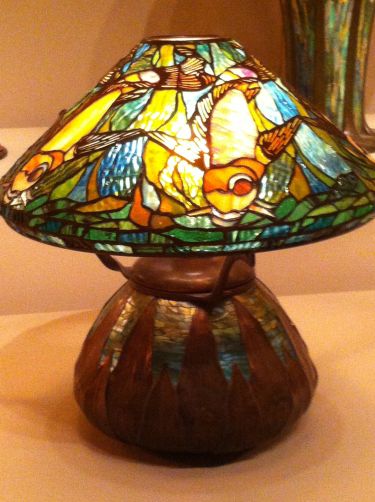
Their collection of Art Nouveau and Art Deco decorative arts is one of the largest collections outside of Paris. It includes a beautiful display of Tiffany lamps.

A Tiffany "Goldfish" lamp on display at the VMFA.

A Tiffany “Goldfish” lamp on display at the VMFA.

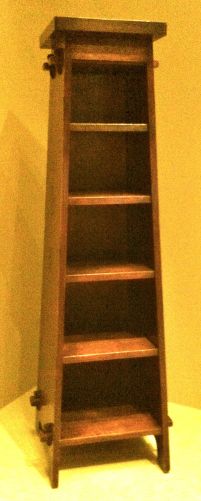
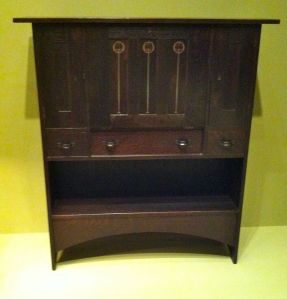
The collection of Arts and Craft furniture was really impressive. From Roycroft…

Roycroft bookcase

To Stickley…

Stickley Fall Front Desk

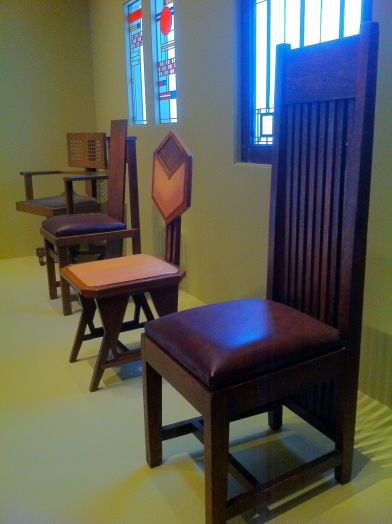
To Frank Lloyd Wright…

Frank Lloyd Wright Chairs and windows

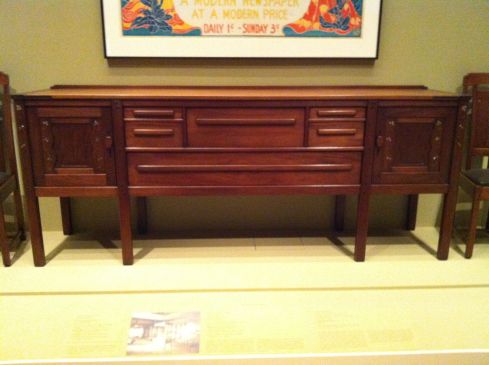
To Greene and Greene Brothers

Greene sideboard

the display was surprising comprehensive. Admission is free to the museum’s permanent exhibits. And the Museum is open 365 days a year starting at 10:00 in the morning.

But the real reason we went to the VMFA was to see the traveling Chihuly “Breathe Art Into Life”  exhibit. The exhibit, which runs thru Feb 10, 2013 is a filled with spectacular light and shapes that defy gravity. And (especially coming from a pallet of muted earth tones in Williamsburg) it was a feast for the eyes.

There are 9 installations in the exhibit (including the giant chandelier that hangs in the atrium. Arrive a little before your entrance time so you can see the PBS film on the artist.

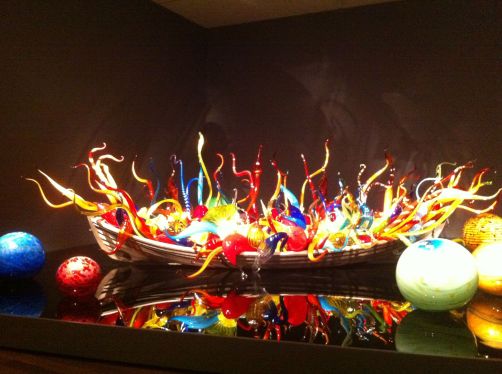
Chihuly boat 1

One of the Float Boats filled with Chihuly’s Fiori. The smooth glass floor reflects the dazzling glass, And you feel like you are walking along the smooth waters of a Venetian Canal.

The first room you enter holds Fiori and Float Boats. The artist was inspired to create Fiori and Float Boats when he was installing Chihuly Over Venice.  There he hung his massive, intricate chandeliers over the Venetian Canals, but he also dropped pieces of into the water. Locals were hired to  collect the floating orbs. When Chihully saw their row boats filled to the brim with his art he had the spark for Fiori and Float Boats. (The image in the RICHMOND banner at the top of the blog is the other Float Boat  in this display.)

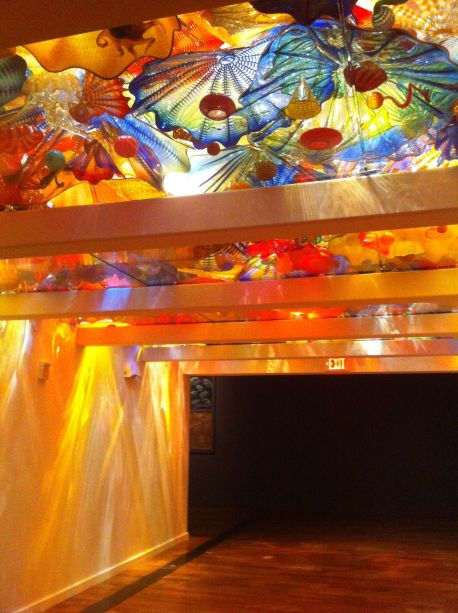
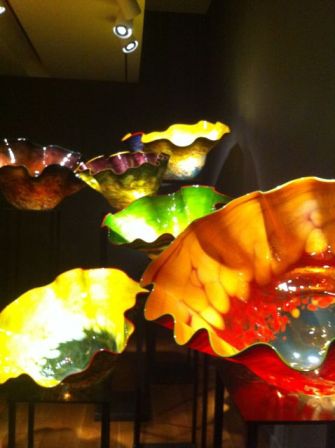
You walk under Persian Ceiling. It is lit from above, and this time you get the feeling as if you are walking through the water, in an aquarium of light.

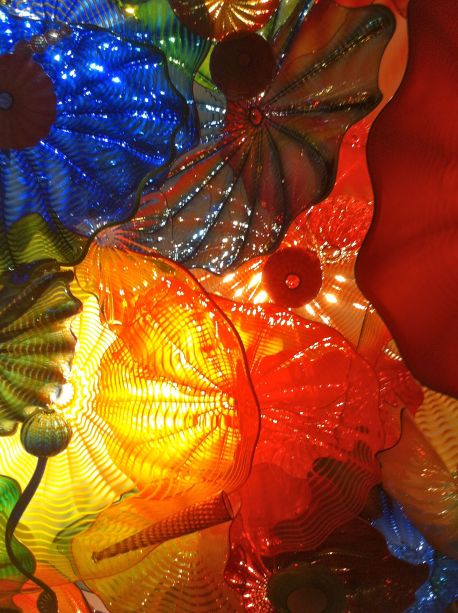
Persian Ceiling consists of over a thousand piece of blown glass

Persian Ceiling consists of over a thousand piece of blown glass

Chihuly layers pieces and nest smaller shapes into larger shapes in his Persian Ceiling. (Detail.)

Chihuly layers pieces and nest smaller shapes into larger shapes in his Persian Ceiling. (Detail.)

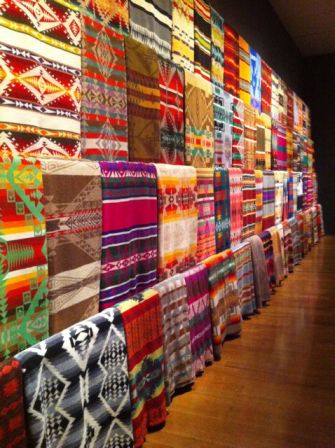
Chihuly, a native of Tacoma, Washington, drew inspiration from the “Slumped, sagging forms” [VMFA display card] of Indian baskets he saw on display at a museum for the “glass”  baskets he displayed in his Northwest Room. He also drew from his extensive personal collection of Native American blankets.

Some of Chihuly's blanket collection line the wall of the gallery.

Some of Chihuly’s blanket collection line the wall of the gallery.

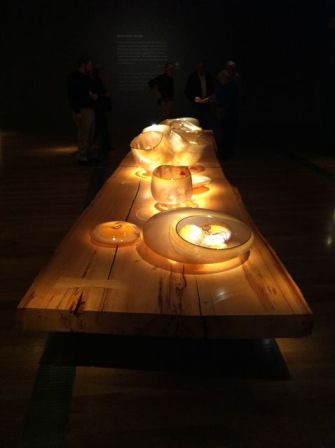
A long low table runs the length of the room.

NorthWest table

Do you see the dovetail joining the split in the wood on the left? I loved how that echoed the patterns in the blankets.

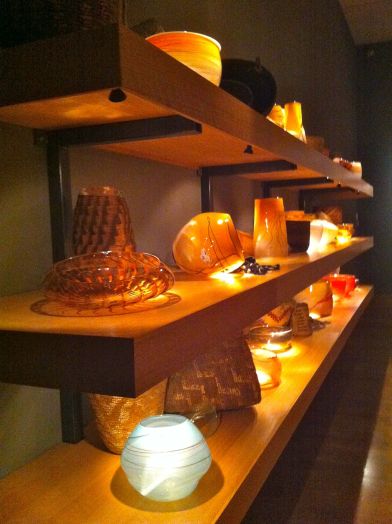
And a wall of “baskets” — both the Chihuly glass versions and the traditional woven ones that acted as inspiration — line the other wall.

The glass in this room takes on the color of sand. We have definitely moved to the West.

The glass in this room takes on the color of sand. We have definitely moved to the West.

In Macchia Forrest the artist combines nine giant flower like bowls. Each bowl has thousands of colors.

Just one of the Macchia measures 27" x 38" x 30"

Just one of the Macchia measures 27″ x 38″ x 30″

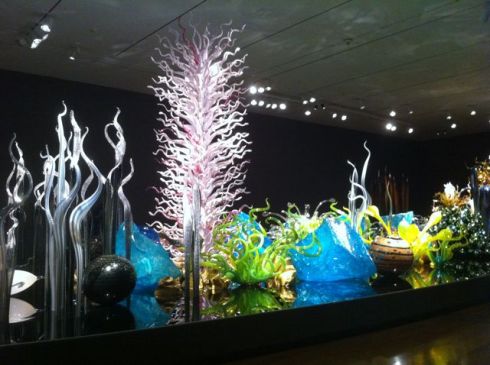
The central installment in the exhibit is a room size garden of glass called Laguna Torcello. [Think “room” as in the size-of -my-house “room”.]

It is monocromanic at either end, but burst with exotic colors in the middle -- an entire years worth of glass winter, spring summer and fall.

It is monochromatic at either end but burst with exotic colors in the middle — an entire year’s worth of glass — winter, spring summer and fall.

A pink coral-esque structure soars to the ceiling, looking all the world like some Dr. Suessian underwater Christmas Tree.

"Welcome, Christmas! Fah who rahmus!" [The Whoville Christmas Song]

“Welcome, Christmas! Fah who rahmus!” [The Whoville Christmas Song]

A flower of white at one end of the installation. [Detail.]

A “flower” of white at one end of the installation. [Detail.]

This room returns us to “water”. The over 1,500 pieces almost seem to sway in the waves.

Colorful middle portion of Laguna Torcello. [Detail.]

Colorful middle portion of Laguna Torcello. [Detail.]

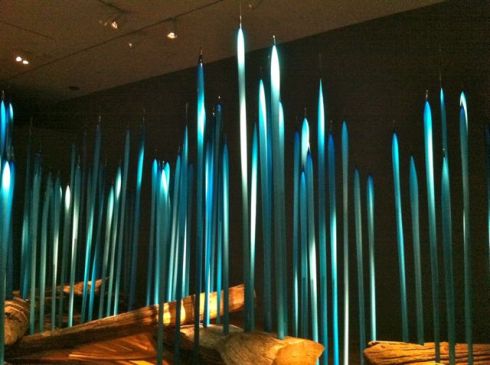
Chihuly began making Spears (known as Reeds on Logs) in Finland in 1995. The glass reeds are surprisingly strong. He uses salvaged red cedar from his home state for the logs.

Reeds On Logs

Reeds On Logs

Chihuly Breathe Art Into Life is $20 for Adults/$16 for Seniors, students and groups of 10 or more. It is worth every penny.

Chihuly sig


Williamsburg (part 4)

Textile 3

[This is part four of my What To Do in Williamsburg Blog for part one go HERE. For part two go HERE. For part three go HERE. ]

Previous tips included:

  1. Planning your trip in the Fall or Winter to avoid the heat and crowds.
  2. Staying in a Colonial House.
  3. Engaging with the locals.
  4. Visit the Wren Building
  5. Take the Rubbish, Treasures and Colonial Life Tour & the Behind the Scenes Tour
  6. Visit the De Witt Wallace and Abby Aldrich Rockefeller Folk Art Museums
  7. Tour the Governor’s Palace
  8. Tour the Thomas Everard House.
  9. Visit Bassett Hall.
  10. Get spooky with it.

Today we’ll  touch on some odds and ends in Williamsburg and travel down the road to the current capital of Virginia, Richmond.

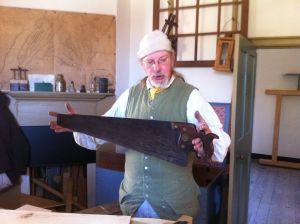
11. Stop in to see the craftsmen making things with wood.  Bill likes woodworking so we spent time at the joiners near the Capitol on Frances Street…

Saw envy at the Joiners.

Saw envy at the Joiners.

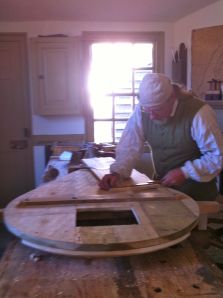
Where they do ordinary work, like making sashes for windows and  bellows for the Gunsmith Shop….

Making 1 of three large wooden panels for the bellows.

Making 1 of three large wooden panels for the bellows.

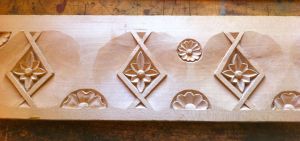
…and fancy work, like this decorative piece.

The craftsmen at the Joiners used a lot of fine carving skills to make this wooden ornamental panel.

The craftsmen at the Joiners used a lot of fine carving skills to make this wooden ornamental panel.

We also went to the Cabinetmaker’s shop, which is on Nicholson Street, closer to the Palace Green.

Bill has a talk with one of the cabinet makers.

Bill has a talk with one of the cabinet makers.

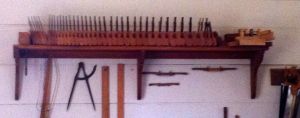
Both shops had beautiful sets of hollows and rounds for making moldings.

Hollow and round plains on the shelf.

Hollow and round plane sets on the shelf.

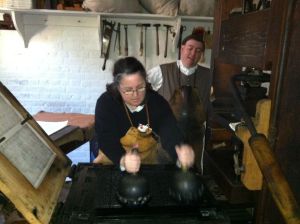
12.) Get your Ps and Qs in line at the Printers. Bill indulged my love of graphic design with a trip to the Printers. We had a nice long talk with printer and he was kind enough to let me have a go at the press.

First I inked the plate.

First I inked the plate.

IMG_0168

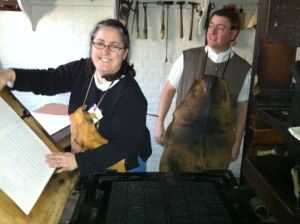
Added paper, cranked the carriage into place then PULLED the press down.

Rita putting paper on press

Cranked the carriage back out and lifted the paper tray and…

Gazette rita's pull

Taadaaa… my impression of a colonial paper. (Get it? IMPRESSION? It’s a letter-press. Never mind, it’s a printing joke.)

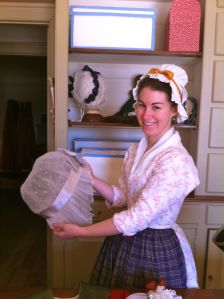
13.) Stroll along Duke of Gloucester Street. We  especially enjoyed the Blacksmith, the Silversmith and the Milliner.

Milliner

The Milliner shows off a hat that would have been popular around 1790. I like to think of it as a Mrs. Bennett or Mrs. Dashwood appropriate hat. (Yes that is Jane Austen reference.)

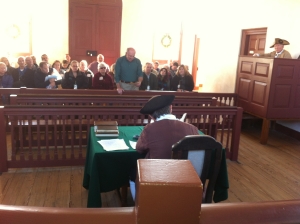
14.) Stand witness for the prosecution at the Courthouse. Learn about the 18th Century justice system first hand with the Order In The Court program (it runs several times a day and is free with your Williamsburg pass).

Courthouse

The Williamsburg Courthouse is one of the original buildings and was still in use when Goodwin and Rockefeller began to rebuild the town.

We saw several civil trials which required audience participation.

A Williamsburg visitor takes on the roll of a townsperson who has failed to come to church -- an offense which was against the law.

A Williamsburg visitor takes on the roll of a towns person who has failed to come to church — an offense which was against the law.

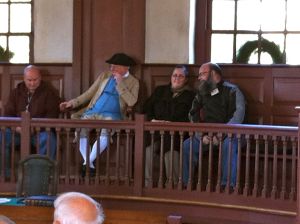
You MIGHT even get a chance to be on the judge’s bench (even if you’re a woman == as long as you go along with premise that you are a man for the purposes of historical accuracy.)

Court House Judge Rita

Yes, that’s judge Rita conferring with the bearded judge to the right on the fate of some poor soul. Don’t worry I was very easy. Every body else was a hangin’ mood, but not me.

15. EAT. There are four Colonial Taverns to choose from in the city, Christiana Campbell’s, Shield’s, King’s Arms, and Chownings. I liked King’s Arms the best because they have an amazing Peanut Soup.  Dinner at any of the Taverns is by candle light and includes period entertainment, but be warned … it will be an expensive meal. You might choose to eat at one of the restaurants at Merchant’s Square  (which is between Colonial Williamsburg and Williams and Mary. The bus that runs in a clockwise circle around the historic district has a stop at Merchants Square so you wont have to get in your car.) We liked the Cheese Shop on the square, and especially the Aroma Coffee Shop on Prince George Street. If you do decide to step into your horseless carriage just go out Richmond Road and you’ll find the usual suspect of chain eateries, an oddly prolific collection of pancake establishments and some rather nice restaurants of the non-chain variety (yes, there are still some of them out there.) We enjoyed sushi at Kyoto and American fare at Food for Thought (the best food I ate all week was the Food for Thought’s quinoa salad.)

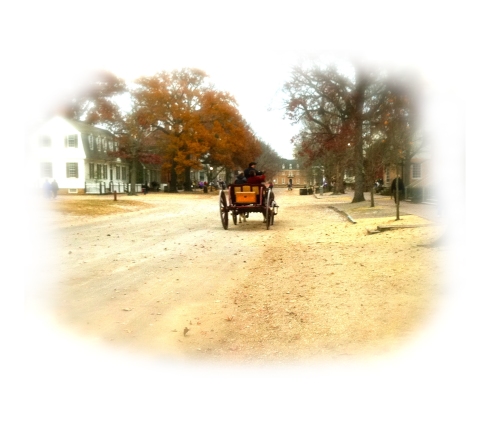
carriage riding down the roadTime to travel down the road and into the present, leaving 18th Century Williamsburg for 21st Century Richmond. Well, almost… there’s still a lot of history to explore on this trip.

Richmond is the capital of Virginia and during the American Civil War it was the Capital of the Confederacy. The city is ripe with monuments & museums to the South (and given the whole Slavery thing, that made me a mite itchy. But I do love my history, so…) While in the city you can visit the Museum and White House of the Confederacy, the Virginia Historical Society,  Hollywood Cemetery or take a stroll down Monument Avenue.

We went to Tredegar Iron Works on the James River. You get two museums in one location here. One is run by the National Park Service and the other is part of the American Civil War Center. We went into the (free) Park Service museum and enjoyed the displays and movie on the third floor. The Map Room is a great way to orient yourself on Richmond’s role in the war.

Photograph of the Tredegar Iron Works, shortly...

Photograph of the Tredegar Iron Works, shortly after the Evacuation Fire of 1865; despite the original caption of the image, the works themselves survived largely unscathed. (Photo credit: Wikipedia)

The outdoor exhibits had seen better days, but this museum is a gem in the rough. I hope they get some funding and can restore all the exhibits to top-notch condition.

Next stop: Shopping. Carytown  is Richmond’s “Mile of Style” and we enjoyed a mild weather stroll down the main drag of boutiques and unique shops. This quaint shopping district won Southern Living Magazine’s “Best Neighborhood to Shop In” nod by the magazine’s readers.

Flower Power Case at Anthill Antiques, Carytow...

Flower Power Case at Anthill Antiques, Carytown, Richmond, VA (Photo credit: kayadams.com)

We ate at the Can Can Brasserie a beautifully restored building that made you feel like you’d stepped off the streets of Paris. I kept expecting to see Henri de Toulouse-Lautrec stroll by the table. The atmosphere was delightful, so was the food (I got half a Roast Chicken Salad and a half order of their Roasted Apple & Rutabaga Soup. ) And don’t forget to order a Eloise (their special version of a Shirley Temple.)

But our big find in Richmond, besides the wonderful company, was the Virginia Museum of Fine Arts… which I will talk about tomorrow.


Williamsburg (part 3)

Textile 3

[This is part three of my What To Do in Williamsburg Blog for part one go HERE. For part two go HERE. ]

Previous tips included:

  1. Planning your trip in the Fall or Winter to avoid the heat and crowds.
  2. Staying in a Colonial House.
  3. Engaging with the locals.
  4. Visit the Wren Building
  5. Take the Rubbish, Treasures and Colonial Life Tour & the Behind the Scenes Tour
  6. Visit the De Witt Wallace and Abby Aldrich Rockefeller Folk Art Museums

Today we’ll go inside some of Williamsburg’s beautiful houses and get a little spooky after dark.

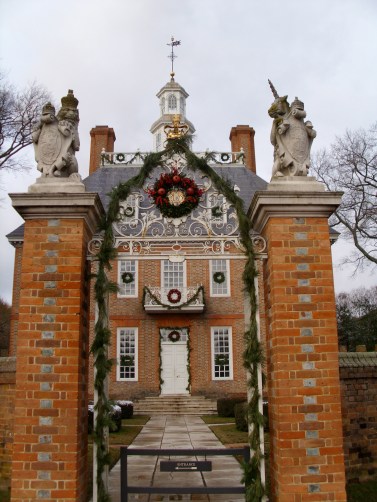
7. Tour the Governor’s Palace. It is the largest and finest residence in Williamsburg and it is meant to awe, inspire and intimidate all who see it. The moment you walk into the entrance hall lined with fire arms and crossed swords you know the power behind the man who lives here. It was home to seven colonial governors and two elected Virginia governors before Thomas Jefferson moved the Capital further west to Richmond in 1780.

Front gate leading to the Palace.

Front gate leading to the Palace.

Tours, which require a separate ticket, will bring you through the public and private portions of the house.

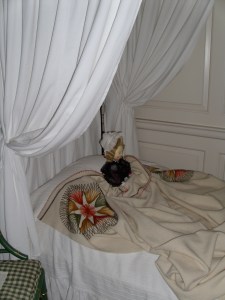
One of the beds in the Palace.

One of the beds in the Palace.

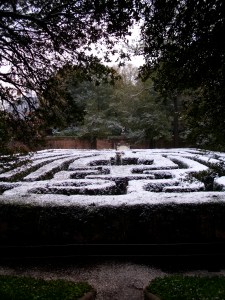
After your tour explore the vast gardens. Don’t miss the box wood maze. And be sure to climb the pyramid over the ice house. I found the gardens more enchanting than the building itself.

View of the box wood maze taken from the top of the pyramid. This was from our 2010 trip, and it had just snowed.

View of the box wood maze taken from the top of the pyramid. This was from our 2010 trip, and it had just snowed.

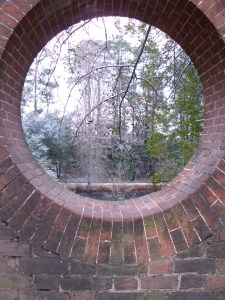
There were dozens of hidden treasures.

Window through the garden wall looking out to the canal.

Window through the garden wall looking out to the canal.

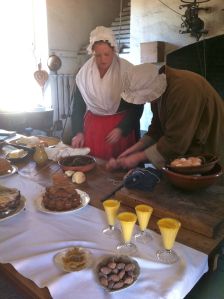
Even if you don’t take a formal Palace tour be sure to stop in to see the cellars and the kitchen. It will give you a fascinating glimpse on how they kept this huge home running. The cook, a man, was one of the highest paid and best regarded people in Williamsurg btw.

They made one big meal for the day. What kept was "left over" for breakfast.

They made one big meal for the day. What kept was “left over” for breakfast.

8. Tour the Thomas Everard House. On a prime piece of real estate on the Palace Green is the Thomas Everard House. Everard was an orphan when he arrived in Virginia as an apprentice to Matthew Kemp. Everard trained for seven years as a clerk. Soon after his apprenticeship was finished he was appointed clerk of Elizabeth City County court. Eventually he became the clerk of York county court for 36 years,  Mayor of Williamsburg and held other prestigious post in the city. He purchased the house on the corner of Palace Green and expanded it.

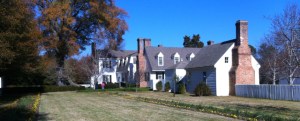
The front of the Everard House faces the Palace Green.

The front of the Everard House faces the Palace Green.

His wife died fairly young but his two daughters, Fanny and Patsy lived with him as they grew up.

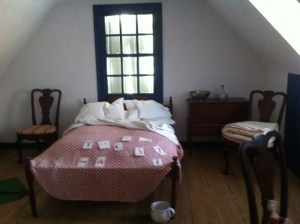
One of the girl's bedroom.

One of the girl’s bedroom.

Fanny married Rev. James Horrocks in 1765. He was the rector of Bruton Parish Church and president of Williams and Mary. He was a powerful man in the colony. When Rev. Horrocks died she returned to her father’s house. Sadly she died a year later. Her sister, Patsy lived, there until 1774 when she married.

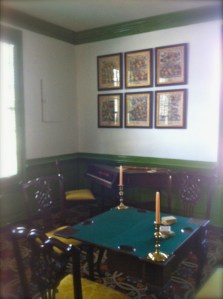
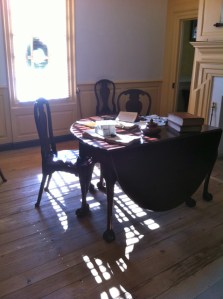
Parlor

The house is in a “U” configuration. On the main floor the parlor and dining room face the front. The Parlor is a public room in the house. This multi use room can be set up for music, games or dancing.

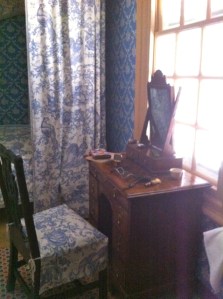
Thomas’ bedroom was accessible through the drawling room.

Everett's bedroom

He  had a quieter prospect  of the yard and garden out his window. A back door allowed for special friends to enter his cozy retreat.

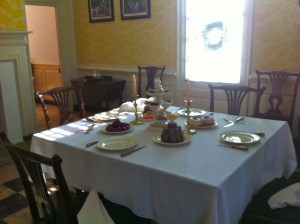
Like the Parlor, the Dinning Room also faces the Palace Green. Dining

The door in the back of the dining room led to Thomas’ study. This room was also accessible through a rear door.

Evert's study

The Thomas Everard House is open 9-4 Tue, Wed & Friday.

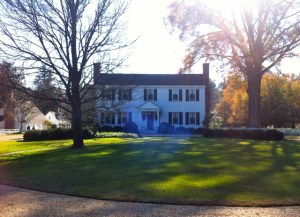
9. Visit Bassett Hall. Williamsburg would not have been possible without the vision of one man and the generosity of another. The first man was Rev. W.A.R. Goodwin, The second was John D. Rockefeller, Jr.. Goodwin convinced Rockefeller to help him rebuild the Revolutionary City to its Colonial glory. Rockefeller and his wife Abby Aldrich Rockefeller.

Bassett Hall front

It was their retreat from the outside world. The Rockefellers visited there twice each year. The house and grounds have been restored not to the colonial era, but to the 1930s when the Rockefellers lived there.

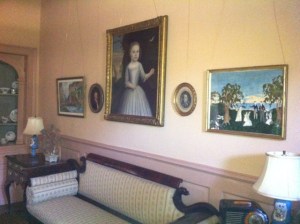
Abby filled the rooms with her folk art finds.

The drawing room at Bassett Hall.

Folk art graces the walls at Bassett Hall.

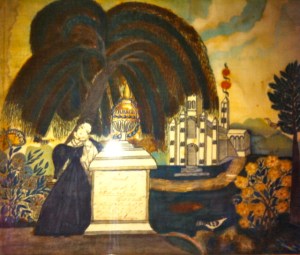
One of her special interest was “School Girl Art.”  A sub set of her Folk Art collection the School Girl Art was literally done by girls who were away at school, usually finishing school in the 19 and 18th centuries.

A sample of School Girl Mourning Art memoralizing some one close to them who has died.

A sample of School Girl Mourning Art. The artist was encouraged to memorialize some one close to them who had died.

The family entertained  the locals — rich and poor– at their dinner table.

Dining rm

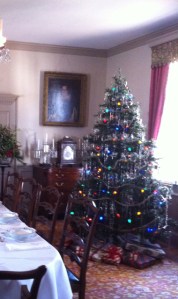
Dining Room decorated to Christmas

During the summer guest were often invited to tea in the Tea Room which was in a building overlooking the garden.

Looking back at the house from the garden.

Looking back at the house from the garden.

Bassett Hall is open Wed-Sun 9-5. Don’t miss the informative movie at the beginning of the tour. You’ll learn a lot about the Rockefellers and the re-making of Williamsburg.

10. Get spooky with it. When you visit a 300 + year old city you expect a lot of history, and probably a few ghosts. So join in the fun and take a Ghost tour. We did the Tavern Ghost tour and it was fun (if not very scary.)  Better still participate in the Cry Witch Program at the Capitol.

Capital for cry witch

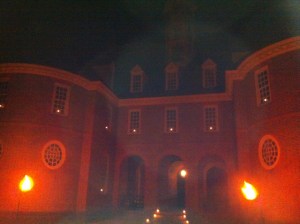
The Capitol Building at night before the Cry Witch program.

You’ll witness the trial of Grace Sherwood with first person interpreters bringing the transcript and court room drama to life. We don’t know what the actual verdict was, those documents have been lost. So the audience in the courtroom gets to weigh the evidence and decide Grace’s fate.

Tomorrow we finish up with Williamsburg and move up the road to Richmond.