Category Archives: Europe

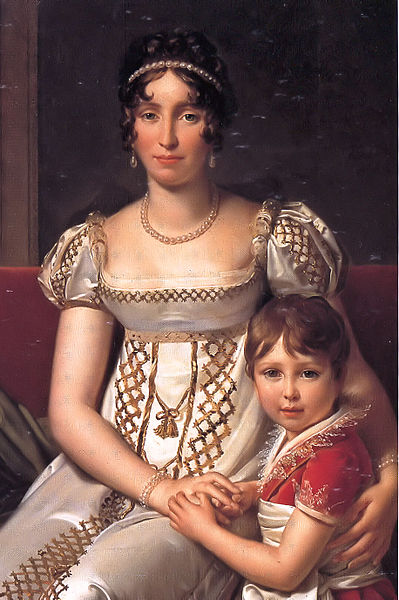
Hortense de Beauharnais 4.10.13 Thought of the Day

[Image courtesy: Wikipedia]

[Image courtesy: Wikipedia]

Hortense E de Beauharnais was born on this day in Paris, France in 1783. Today is the 230th anniversary of her birth.

She was born to French aristocrats Alexandre, Vicomte de Beauharnais and Joséphine Tascher de la Pagerie. Both her parents were arrested during the French Revolution, and her father was guillotined at the Place de la Révolution on July 23, 1794. Josephine was released in August of that year. In 1796 she married Napoleon Bonaparte.

Hortense was a pretty child. She had long blond hair and blue eyes. She attended school Napoleon’s youngest sister, Caroline.

[Image courtesy: Wikimedia Commons

[Image courtesy: Wikimedia Commons

At 19 this “Flower of the Bonapartes” was married off to Napoleon’s brother Louis. It was not a marriage of love, but, rather, it was a marriage of convenience, arranged at Napoleon’s request. The couple never got along, but they did manage to have three children together: Napoléon Louis Charles Bonaparte, Napoleon Louis Bonaparte and Charles Louis Napoléon Bonaparte. (Charles would later become Napoleon III, Emperor of France.)

The Royal Monogram of Hortense [Image Courtesy Wikipedia]

The Royal Monogram of Hortense de Beauharnais, Queen of Holland [Image Courtesy Wikipedia]

The Emperor appointed Louis King of Holland and Hortense had to leave her beloved Paris to follow her no-so-beloved husband to Holland. The Netherlands won her over and she learned to enjoy the people, customs and landscapes. But her relationship with Louis did not improve.

After the death of their first son Hortense was allowed to return to Paris because it would provide a more healthy environment for both the Queen and her remaining children. When Napoleon prepared to remarry he decided that it wouldn’t do to have the daughter of his first wife living at court, so he had her shuttled north again. Her stay in Holland was temporary and she left, again for “health” reasons, in 1810.

Now officially separated Hortense moved to Switzerland where she had a long-term affair with Colonel Charles Joseph, Comte de Flahaut. The couple had an illegitimate son together, Charles Auguste Louis Joseph.

[Image courtesy: Wikipedia]

[Image courtesy: Wikipedia]

She remained a loyal Bonapartist. When the Bourbon monarchy was restored in Paris, Hortense — like all the Bonapartes –went into exile. She, Charles Louis Napoléon Bonaparte and Charles Auguste Louis Joseph moved to Arenenberg Castle, near Lake Constance in Switzerland. While there she transformed…

The medieval castle and its gardens …. into an island of French culture amidst the rather provincial region of Lake Constance. The castle was surrounded by a 12 ha park with hermitage, fountains, waterfalls and nymphaeum, steep paths and viewpoints.  [www.bodensee-magazine]

The main house, which still stands, had living quarters and rooms for entertainment (including a theatre). She continued to expand the house and  revamp the estate, adding the latest in Parisian style almost until her death on October 5,  1837.

[Image courtesy: Kreuzlingen tourism]

Arenenberg Castle  [Image courtesy: Kreuzlingen tourism]


Hans Christian Andersen 4.2.13 Thought of the Day

“Where words fail, music speaks.” — Hans Christian Andersen

Painting of Andersen, 1836, by Christian Albre...
Painting of Andersen, 1836, by Christian Albrecht Jensen (Photo credit: Wikipedia)

Hans Christian Andersen was born on this day in Odense, Denmark in 1805. This is the 208th anniversary of his birth.

Andersen was the only son of Anna Maria and Hans Andersen. She was a washerwoman and he was a shoemaker. The family was very poor, and Hans senior made all his son’s toys. He inspired Hans’ love of reading (he read to the boy from 1,001 Arabian Nights) and theater (by taking him to the local playhouse.)

The house he grew up in was shared by 11 other people, (his mother and a father and 2 other families were all crowded into the little house.) “since he was unable to have any real physical privacy … he was forced to escape into the privacy of his mind.” [DanishNet.com] “Young Hans grew to be tall and lanky, awkward and effeminate, but he loved to sing and dance, and he had a vivid imagination that would soon find its voice.” [Online-Literature.com] Hans was educated in the basics, and trained as both a weaver’s and tailor’s apprentice. But what he really wanted to do was act.

After his father’s death he moved to Copenhagen where he worked as a boy soprano in a choir. But when his voice changed, so did his job. He left the choir to try his luck as a ballet dancer, but that didn’t work out either. At 17  he met Jonas Collin, the Director of Royal Danish Theatre. Collins became his patron and sent the boy to school.

Hans Christian did not excel as a student, he was alienated by his fellow students, and he was continually mocked by his teachers for his ambition to become a writer. Andersen has described his time in school as the bitterest time of his life. Today it is believed that he suffered from dyslexia …. [DanishNet.com]

Collins pulled Andersen from school in 1827 and had him privately tutored. Hans began to write again. He had success in 1829 with A Journey on Foot from Homen’s Canal to the East Point of Amager and his play Love on St. Nicholas Church Tower and then again in 1835, with his first novel, The Improvisatore.

He went on to write plays, poems, prose, travelogues,  and, of course, fairy tales.

In the poet’s lifetime 156 “fairy tales and stories” were published. But if other texts of his in the nature of fairy tales and those which were printed only after his death are included, it makes a total of 212….he had the special knack of turning ideas into tales – in a particularly Nordic, melancholy and, at the same time, witty way. His fairy tales are philosophical, told with amazing narrative joy and sparkling imagination in beautiful, elegant language. [Odense.dk]

He is probably the most read author in the World today, his stories have been translated into hundreds of languages and have an international appeal. Some of his best known fairy tales include:

HCA statue in New York City's Central Park
HCA statue in New York City’s Central Park (Photo credit: Wikipedia)
  • The Princess and the Pea
  • Thumbellina
  • The Little Mermaid
  • The Emperor’s New Suit
  • The Brave Tin Soldier
  • The Ugly Duckling
  • The Snow Queen
  • The Red Shoes
  • The Little Match Seller

Click here to read The Beetle Who Went on His Travels and The Conceited Apple Branch

Want to read some of Hans Christian Andersen’s fairy tales? Click Here for a link to a free Kindle book.

Hans Christian Andersen
Hans Christian Andersen (Photo credit: Wikipedia)

Czar Alexander II 3.13.13 Thought of the Day

Switching it up a bit on ritaLOVEStoWRITE. Instead of picking some one who was BORN on this day I picked some one who DIED on this day, Alexander II of Russia.  In grad school we did a big group project where we developed a magazine concept. My group did a history magazine based on slices of time called Epoch. Our sample magazine’s Epoch was the year 1881 and I wrote an article and designed spreads on Alexander II.

——————————————

“It is better to abolish serfdom from above than to wait for it to abolish itself from below”–Alexander II or Russia

English: Photo taken by A. A. Pasetti of Tsar ...

English: Photo taken by A. A. Pasetti of Tsar Nicholas II of Russia, near age 30, at St. Petersburg, Russia, 1898. Français : Photo de Nicolas II de Russie, prise par A. A. Pasetti en 1898, alors que Nicolas II a 30 ans. Русский: Фотография A. A. Pasetti царя Николая Второго, в возрасте 30 лет в Санкт-Петербурге, 1898 год. (Photo credit: Wikipedia)

Alexander Nikolaevich Romanov was born on April 29th, 1818 in Moscow, Russia. He died on this day in the Winter Palace, St. Petersburg, Russia in 1881.

He was the first-born son of grand duke Nikolay Pavlovich and his wife Alexandra Fyodorovna (who became Czar Nicholas II and Charlotte of Prussia in 1825). His father’s larger than life personality dominated family and palace life and Alexander was completely overshadowed by him. Alexander was schooled in a broad field of disciplines (his principal instructor was poet Vasily Zhukovsky), but he was a passive student. At 19 he did a tour of Europe and plus 20 of the Russian provinces. He was the first Romanov to visit Siberia. While he was in Europe he met his future wife Princess Marie of Hesse. The two married in 1841.

14 years later, after the death of his father, Alexander became Czar.

The country was in the throes of the bloody Crimean War. The war was both draining the country financially and costing a tremendous loss of life. Russia was clearly overpowered her British, French and Ottoman foes.  The Czar negotiated for peace. “The Treaty of Paris ended the bloodshed but Russia lost its dominance in the Balkans and its warships were banned from the Black Sea.” [Russiapedia]

Portrait by unknown of Tsar Alexander II of Ru...

Portrait by unknown of Tsar Alexander II of Russia, wearing the greatcoat and cap of the Imperial Horse-Guards Regiment, circa 1865. The portrait is the property of the Hermitage Museum of St Petersburg, Russia. (Photo credit: Wikipedia)

He embarked on a number of reforms in hopes of modernizing Russia. He:

  1. Improved the railway. When he took office there was one line from Moscow to St. Petersburg (about 600 miles). At the time of his death about 14,000 miles of track had been laid.
  2. Developed the Economy, promoting banks and join-stock companies.
  3. Freed the Serfs. Despite fierce opposition from the land owners he “took an active personal part in the arduous legislative labours that on February 19, 1861, culminated in the Emancipation Act. By a stroke of the autocrat’s pen, tens of millions of human chattels were given their personal freedom.” [Britannica.com] They were given a small amount of land. (Of course they had to pay taxes on those lands.)
  4. Modernized the judicial system
  5. Improved  the Russian military
  6. Set up elective local assemblies known as Zemstvos

Their gradual introduction extended the area of self-government, improved local welfare (education, hygiene, medical care, local crafts, agronomy), and brought the first rays of enlightenment to the benighted Russian villages. [Ibid]

Political changes included:

  1. The release of political prisoners
  2. Greater religious freedoms for “Jews and sectarians.” [Ibid]
  3. Lifting of foreign travel restrictions
  4. Relaxing Russian rule over Poland
  5. Abolishing medieval punishments

Despite all the reforms and attempts at  modernization there was great unrest in the country. The great land owners weren’t happy about loosing their free labor force. National pride was bruised over Poland — and there were riots in the streets. And anarchists and nihilists seemed to be on every street corner.

Alexander’s reforms were drawing more and more criticism. For some his extraordinary efforts to change his country were too much while others believed he didn’t go far enough. Alexander became a victim of numerous murder plots – one dramatic assassination attempt followed another. [Russiapedia]

The more people protested. The more he drew back, and the less reform minded he became.

Alexander II of Russia

Alexander II of Russia (Photo credit: Wikipedia)

There were four assignation attempts made on Alexander’s life.  April the 4th 1866, April 20th 1879, December 1879, and  February 5th  1880. Then…

In February 1880 Alexander announced that he was considering granting the Russian people a constitution. But the plan never went ahead. On March 13, 1881 the Tsar’s carriage was bombed in the streets of St. Petersburg by members of a revolutionary organisation People’s Will. He emerged shaken but unhurt and wanted to see the site of the explosion and check on the wounded Cossacks that accompanied him. As he made his way over, another terrorist threw his bomb. Fatally wounded, Alexander died an hour later. [Russiapedia]

English: The assassination of Alexander II of ...

English: The assassination of Alexander II of Russia 1881 Deutsch: Das Attentat auf den Kaiser Alexander II. in St. Petersburg (Photo credit: Wikipedia)


Michelangelo 3.6.13 bonus Thought of the Day

“I live and love in God’s peculiar light.” — Michelangelo

Michelangelo Buonarroti

Michelangelo Buonarroti (Photo credit: Wikipedia)

———————————————————

Some days are deserts I struggle to find some one to profile on this blog…and some days are overwhelming. Today, besides Dame Kiri (who got the official Thought of the Day birthday nod) Michelangelo, Cyrano De Bergerac, Gabriel Garcia Marquez, Elizabeth Barrett Browning, Willie Mays, and astronaut Gordo Cooper were on the A List for a possible birthday nod. I think it came down to the fact that I wanted to listen to some opera today, so Kiri won.

But I just can’t ignore Michelangelo. 

Especially given what is happening RIGHT NOW in what is arguably his most famous “installation” the Sistine Chapel.

———————————————————–

Michelangelo di Lodovico Buonarroti Simoni was born  on this day in Caprese, Italy in 1475. Today is the 538th anniversary of his birth.

The family soon moved to Florence, when Michelangelo was still a baby. His mother was ill, so little Michelangelo was sent to a wet-nurse who was part of a family of stone cutters.

Michelangelo’s father realized early on that his son had no interest in the family financial business, so agreed to apprentice him, at the age of 13, to the fashionable Florentine painter’s workshop. There, Michelangelo was exposed to the technique of fresco. Michelangelo had spent only a year at the workshop when an extraordinary opportunity opened to him: At the recommendation of Ghirlandaio, he moved into the palace of Florentine ruler Lorenzo the Magnificent, of the powerful Medici family, to study classical sculpture in the Medici gardens. [Biography.com]

“Faith in oneself is the best and safest course.” — Michelangelo

He went back to Florence in 1495 and worked  as a sculptor. Three years later he moved to Rome where he met Cardinal Jean Bilhères de Lagraulas.

Michelangelo sculpted his Pieta, a sculpture of Mary holding the dead Jesus across her lap, for the Cardinal’s tomb.


Rome tickets & pictures 2010 082


Carved from a single piece of Carrara marble, the fluidity of the fabric, positions of the subjects, and “movement” of the skin of the Pieta—meaning “pity” or “compassion”—created awe for its early spectators. [Ibid]

His next major work was David.

front

front (Photo credit: Wikipedia)

He “turned the 17-foot piece of marble into a dominating figure.” [Ibid]

“A man paints with his brains and not with his hands.”— Michelangelo

Next he was asked by Pope Julius II to paint the ceiling of the Sistine Chapel.

The project fueled Michelangelo’s imagination, and the original plan for 12 apostles morphed into more than 300 figures on the ceiling of the sacred space. … Michelangelo fired all of his assistants, whom he deemed inept, and completed the 65-foot ceiling alone, spending endless hours on his back and guarding the project jealously until revealing the finished work, on October 31, 1512…. The resulting masterpiece is a transcendent example of High Renaissance art incorporating the Christian symbology, prophecy and humanist principles that Michelangelo had absorbed during his youth. The vivid vignettes of Michelangelo’s Sistine ceiling produce a kaleidoscope effect, with the most iconic image being the Creation of Adam… [Ibid]

michelangelo

michelangelo (Photo credit: 熊͘)

The ceiling of the Sistine Chapel

The ceiling of the Sistine Chapel (Photo credit: Wikipedia)

Click here for a virtual 3-d tour of the Sistine Chapel.

“I am still learning.”— Michelangelo

After the Sistine Chapel his work moved more toward architecture. He designed the tomb for Pope Julius II, the Laurentian Library in Florence, and the Medici Chapel. In 1546 he was appointed as the new architect for St. Peters Basilica in Rome. He designed the famous dome that crowns the church and work was well underway on it when Michelangelo died on Feb 18, 1564.

Robert MacPherson (1811-1872) - Rome - St. Pet...

Robert MacPherson (1811-1872) – Rome – St. Peter’s Dome in the Vatican. (Photo credit: Wikipedia)

Last Judgment of Michelangelo Buonarroti

Last Judgment of Michelangelo Buonarroti (Photo credit: Wikipedia) The Last Judgement is a massive painting that takes up the alter wall of the Sistine Chapel. It took 4 years to complete.


Henry II 3.5.13 Thought of the Day — Part 2

English: Henry II and Thomas Becket

English: Henry II and Thomas Becket (Photo credit: Wikipedia)

Click here for PART ONE

When word reached Henry that Becket was hiring armed men to protect him he said “What miserable drones and traitors have I nourished and brought up in my household, who let their lord be treated with such shameful contempt by a low-born cleric?” [History of Britain, Schama, pg 142] It was said in a moment of frustration and anger, and probably not given as command, but it was all the anti- Becket faction needed. Four knights set out to murder the Archbishop while he was at Vespers in Canterbury Cathedral.   “Almost overnight Becket became a saint. Henry reconciled himself with the church.” [BBC.co.uk] He was genuinely grief-stricken over the loss of his former friend. He did penance at Beckett’s tomb and reversed the Constitution of Clarendon.

Family

English: Henry II and his wife Eleonora

English: Henry II and his wife Eleonora (Photo credit: Wikipedia)

Henry had trust issues. Those extended to his family. Eleanor, 10 years Henry’s senior, was very much in love with him when they first married. She was a dutiful wife and bore him seven children, five of whom were boys. She traveled with him when she could. But he preferred to have Becket entertain visiting royalty — usually the Queen’s job — and he was a restless busy man who gave her titles but not power. She put up with it for 14 years before returning to Aquitaine to “assume personal control of the lands. Henry was left to his own affairs (of every sort) back in England.” [About.com]

Henry now had problems within his own family. His sons – Henry, Geoffrey, Richard and John – mistrusted each other and resented their father’s policy of dividing land among them. There were serious family disputes in 1173, 1181 and 1184. The king’s attempt to find an inheritance for John led to opposition from Richard and Philip II of France. Henry was forced to give way. [BBC.co.uk]

[James Goldman’s excellent play The Lion in Winter portrays a fictionalized Christmas between the imbittered royal family in 1183.]

Henry and Richard were at war in France when Henry took seriously ill. After so many years of refusing to name Richard his heir he was forced to do so at Ballan. He died  on the 6th of July, 1189.

Henry II & his children

———————————————-

Links:

We saw The Lion in Winter at the  American Shakespeare Center in Staunton, Virginia last summer. It was an amazing theatre and an awesome Shakespeare (and historical) experience. Click on the link and check them out.


Henry II 3.5.13 Thought of the Day PART ONE

“Will no one rid me of this turbulent priest?” — Henry II of England

James Keegan as King Henry in The Lion in Winter, 2012. Photo by Michael Bailey. James Keegan as Henry II in last summer's production of The Lion in Winter at the American Shakespeare Center.]

James Keegan as King Henry in The Lion in Winter, 2012. Photo by Michael Bailey. [At the American Shakespeare Center.]

Henry II of England was born on this day in Le Mans, France  in 1133. Today is the 880th anniversary of his birth.

Henry, Count of Anjou, Count of Maine, Duke of Normandy, Duke of Aquitaine, Count of Nantes, Lord of Ireland, and  eventually King of England (1154–89)  was the oldest child of Empress Matilda and Geoffrey the Fair. Matilda was the eldest daughter of England’s Henry I who died unexpectedly in 1135 without naming an heir. She had a strong claim that her baby boy, a direct male descendant should be next in line for the throne, but her cousin Stephen, Count of Blois,  (aka Stephen the Usurper), got there  first. Matilda, aided by her half-brother Robert of Gloucester, raised an army and a 17 year civil war ensued.

Stephen and Henry discuss across the River Tha...

Stephen and Henry discuss across the River Thames how to settle the succession of the English throne. (Photo credit: Wikipedia)

Henry’s early years were spent in the Court of Anjou with his father, but beginning in 1142 the boy traveled to England to join the campaign.  The years he spent living in a Spartan manner followed him the rest of his life and Henry eschewed the opulence and soft pleasures of other monarchs.

1151, Henry became ruler of Normandy and Anjou, after the death of his father. In 1152, he married Eleanor of Aquitaine, the greatest heiress in western Europe. In 1153, he crossed to England to pursue his claim to the throne, reaching an agreement that he would succeed Stephen on his death, which occurred in 1154. [BBC.co.uk]

Henry and Becket

The next order of business was to restore peace and order in England. To do that Henry turned to Thomas Becket. Together they rid the country of the robber barons, disloyal knights and criminals who were lapping up the offal of 17 years of war. As a reward for a job well done (and to strengthen his own power over the church) Henry named Becket Archbishop of Canterbury when the old Archbishop died. The church hierarchy was stunned and dismayed, Becket was the King’s man. He wasn’t even a priest. He was ordained on June 2nd, 1162, and consecrated Archbishop on June 3rd. But Becket surprised everyone, especially Henry. He undertook a religious transformation, and where he had been loyal wholly to the King he was now loyal only to God.  He began to work to restore the powers of the  Archbishop and the Church, especially in matters of Law.

English: King Henry II and Thomas Archbishop Č...

English: King Henry II and Thomas Archbishop Česky: Jindřich II. a Thomas Beckett From the Liber Legum Antiquorum Regum, a 12th century work (Photo credit: Wikipedia)

Henry thought the Law of the Land superseded the Law of the Church. Becket disagreed. Henry called and assembly of clergy to Clarendon Palace  in January 1164 where he demanded that Becket sign the Constitution of Clarendon which “established procedures of criminal justice, establishing courts and prisons for those awaiting trial. In addition, the assizes gave fast and clear verdicts, enriched the treasury and extended royal control.” [BBC.co.uk]  In other words it gave Henry power over the church. After much heated debate Becket pledged an oath to the  idea of the Constitution, but he refused to sign. Henry was satisfied. But later when Becket refused to say mass until the oath was overturned. Henry was outraged and had the Archbishop put on trail for treason. Becket fled for exile in France. A  battle of wills ensued between two of Europe’s most stubborn men and neither Queen Elinor nor the Pope Alexander III could bring the parties together. Becket used the last most powerful arrow in his quiver. He tried to excommunicate Henry. Henry countered by threatening to arrest any one who supported Becket with treason. Becket’s support dwindled. He agreed to meet Henry in July of 1170. Becket accepted Henry’s legal supremacy in England. He was allowed to return to England. But he wasn’t willing to leave well enough alone.

Henry II with Thomas Becket, from a 13th-centu...

Henry II with Thomas Becket, from a 13th-century illuminated manuscript (Photo credit: Wikipedia)

Click here for PART TWO


Antionio Vivaldi 3.4.13 Thought of the Day

Français : VIVALDI: Portrait d’un violoniste v...

Français : VIVALDI: Portrait d’un violoniste vénitien du XVIIIe siècle, par François Morellon de La Cave (1723), portrait généralement considéré comme étant celui de Vivaldi Museo internazionale e biblioteca della musica (Bologna) (Photo credit: Wikipedia)

Antonio Vivaldi was born on this day in Venice, Italy in 1678. Today is the 335th anniversary of his birth.


Vivaldi was born into a working class family. He was the eldest of 9 children. His father, who started out as  a tailor, then a barber, learned how to play the violin and eventually landed a gig as church violinist for St. Marks in Vienna. Antonio’s father taught him to play violin as well.


“In 1703, he became ordained as a priest and was widely known as the “Red Priest” due to his red hair.” [Biography.com] But he  really had no calling to religious life. His religious training was a way for him to get an education (a common practice amongst the poor). Once ordained he…”no longer wished to celebrate mass because of physical complaints.” [Baroque Music.org] It is uncertain whether the illness was angina, asthma or a nervous disorder.


He began to teach violin at Ospedale della Pieta, a girls “orphanage” (it was really a home for the illegitimate daughters of wealthy noble men.) He also composed for the girls.


Vivaldi is best known for his Concertos (especially those for violin), his choral works and his operas (he wrote over 40.)


Here’s Autumn from his Four Seasons:


http://youtu.be/mGqF4ZgjLnc


and  here’s Gloria in a in Excelsis Deo.


Antonio Vivaldi by François Morellon la Cave; 1725

Antonio Vivaldi by François Morellon la Cave; 1725 (Photo credit: Wikipedia)

Orchestral music


  • over 230 vn concs., incl. “Four Seasons,” op.8 nos. 1-4 (circa 1725)
  • circa 120 other solo concs. (bn, vc, ob, fl, rec etc)
  • circa 40 double concs. ensemble concs. ripieno concs. and sinfonias
  • 4 concs. for double orch

Chamber music


  • circa 40 vn sonatas
  • 9 vc sonatas
  • circa 10 fl sonatas
  • 27 trio sonatas
  • 22 chamber concs.

Sacred vocal music


  • Gloria, D
  • Magnificat, g
  • psalms, hymns, motets etc
  • Juditha triumphans (oratorio, 1716)

Secular vocal music


  • circa 50 operas, circa 20 surviving, incl. Teuzzone (1719), Tito Manlio (1720), Giustino (1724), Orlando (1727), La fida ninfa (1732), Griselda (1735)
  • 3 serenatas
  • circa 40 solo cantatas

[List from Great Performances]


Franz Schubert 1.31.13 Thought of the Day

“When I wished to sing of love, it turned to sorrow. And when I wished to sing of sorrow, it was transformed for me into love.”–Franz Schubert

English: Oil painting of Franz Schubert Deutsc...

English: Oil painting of Franz Schubert Deutsch: Gemälde von Franz Schubert (Photo credit: Wikipedia)

Franz Peter Schubert was born on this day in  Himmelpfortgrund, Austria in 1797. It is the 216th anniversary of his birth.

Schubert demonstrated his love of music early. He could sing, play piano, violin and organ at a young age. His father and older brother were his first musical instructors. “Eventually, Schubert enrolled at the Stadtkonvikt” [Biography.com] The school was a training ground for young singers who aspired to the chapel choir of the Imperial Court. In…

1808 he earned a scholarship that awarded him a spot in the court’s chapel choir. His educators at the Stadtkonvikt included Wenzel Ruzicka, the imperial court organist, and, later, the esteemed composer Antonio Salieri, who lauded Schubert as a musical genius.[Ibid]

He was the leader of the violin section of the student’s orchestra. He also conducted.

English: Oil painting of Franz Schubert, after...

English: Oil painting of Franz Schubert, after an 1825 watercolor (Photo credit: Wikipedia)

When his voice broke in 1812 he left the college, though he still took lessons from Salieri. In 1814 he enrolled at a teacher’s college and began composing.

By 1814, the young composer had written a number of piano pieces, and had produced string quartets, a symphony, and a three-act opera. Over the next year, his output included two additional symphonies and two of his first Lieds, “Gretchen am Spinnrade” and “Erlkönig.” Schubert is, in fact, largely credited with creating the German Lied.

He left the teaching college to pursue a music career full-time in 1818.

That summer he completed a string of material, including piano duets “Variations on a French Song in E minor” and the “Sonata in B Flat Major,” as well as several dances and songs. [Ibid]

At about that time wrote his first operetta “Die Zwillingsbrüder” (The Twin Brothers) followed by the score for “Die Zauberharfe” (The Magic Harp).

His composition “Quartettsatz [Quartz-Movement] in C minor,” helped spark a wave of string quartets that would dominate the music scene later in the decade.[Ibid]

He continued to produce symphonies, string quartets, fantasies, piano sonatas and songs. He wrote over 500 songs, and is perhaps best known today for his setting of Ave Maria.

Schubert suffered from syphilis for years leading up to his death. The official diagnosis was typhoid fever, but it is likely that he also suffered from mercury poisoning as well. He died on November 19, 1828 at the age of 31.

Deutsch: Ehemaliges Grab von Franz Schubert

Deutsch: Ehemaliges Grab von Franz Schubert (Photo credit: Wikipedia)


J.R.R. Tolkien 1.3.13 Thought of the Day

“All that is gold does not glitter; not all those that wander are lost.”
–J.R.R. Tolkien

[Image courtesy Biography online

[Image courtesy Biography online

John Ronald Reuel Tolkien was born on this day in Bournemouth, Orange Free State, South Africa) in 1892. Today is the 120th anniversary of his birth.

Tolkien is the older of two boys born to Arthur Reuel Tolkien and Mabel Suffield Tolkien. The family lived in South Africa where Arthur was head of the Bloemfontein office of a British bank. While he was in England on an extended holiday with his mother and brother Hilary his father passed away from rheumatic fever. Mabel Tolkien then moved in with her parents and a succession of relatives in the West Midlands. Mabel and her sister May caused quite a stir when they (and the boys) converted to Catholicism in 1900. Sadly, Mabel died in 1904, leaving her son’s well-being in the hands of a series of relatives and acquaintances until they were eventually taken in by a catholic educator, Father Francis. It was he who encouraged and refined Tolkien’s already blooming gift with words.

When he was sixteen, Tolkien met and developed a close friendship Edith Bratt. As friendship progressed to love, Father Francis forbade him from communicating with Edith until Ronald was 21 in order to keep his focus on his education. By the time they were reunited, Edith had converted to Catholicism, and Tolkien had completed his Oxford degree. They were together at the outbreak of World War I. [Tolkien Society]

J.R.R.Tolkien

J.R.R.Tolkien (Photo credit: proyectolkien)

Tolkien enlisted as a second lieutenant in the Lancashire Fusiliers, but married Edith while still in England on March 22, 1916. The match resulted in four children, three boys and a girl: John Francis Reuel Tolkien (November 17th, 1917 – January 22nd, 2003), Michael Hilary Reuel Tolkien (October 22nd, 1920 – February 27th, 1984), Christopher John Reuel Tolkien (born November 21st, 1924) and Priscilla Mary Anne Reuel Tolkien (born June 18th, 1929).  He was sent into active duty at the start of the Somme offensive, and after four months succumbed to “trench fever”[Ibid] He was sent back to a hospital in Birmingham, England, and was joined by Edith in Staffordshire. It is there that his work on the “Book of Lost Tales” (posthumously published) began. He was promoted to lieutenant and served out the rest of the war on home duty. [Ibid]

He floated through several postwar academic positions finally settling in the Rawlinson and Bosworth Professorship of Anglo-Saxon back at Oxford [Ibid]. He moved through several other posts, but always remained at Oxford until his retirement in 1959. It was there that he founded a group for those of similar interests called “The Inklings”. In 1936, Susan Dagnall, of the publishing firm of George Allen and Unwin, received and incomplete draft of Tolkien’s “The Hobbit” and implored the author to finish it.

J.R.R. Tolkien - illustration for The Hobbit

J.R.R. Tolkien – illustration for The Hobbit (Photo credit: deflam)

“The Hobbit” was published in 1937 and has remained a staple of school reading lists since then. Stanley Unwin was so pleased by the work that he asked if Tolkien had any similar works [Ibid]. Tolkien initially submitted his current draft of “the Silmarillion” ( posthumously published in 1977), but it was rejected by Unwin, who requested something like “the New Hobbit”(2). Understandably disappointed, Tolkien then began work on what would become The Lord of the Rings“.

English: A 3D model of the One Ring Italiano: ...

English: A 3D model of the One Ring Italiano: L’Unico Anello di Sauron da Il Signore degli Anelli di J.R.R. Tolkien. Immagine 3D realizzata da Hill. (Photo credit: Wikipedia)

He continued to write through the outbreak of World War II, the duration of which he served as an Air-Raid Warden, a job, it is said, he participated in with great zeal and enjoyment [“J.R.R. Tolkien: Master of Fantasy” by David R. Collins – Lerner Publications Company – 1992].

“The Lord of the Rings” was published as six books in three parts from 1954 through 1955. The work’s success was as unexpected as Bilbo’s journey in the Hobbit, Tolkien soon received an occult following, as well as a deal to make a highly condensed BBC radio adaption [Tolkien Society].

Tolkien died on September 2, 1973, two years after Edith. Both are buried beneath the same headstone in the Catholic section of Wolvercote cemetery, just north of Oxford.

[Image courtesy: Geeks of Doom]

[Image courtesy: Geeks of Doom]

Author’s Note: The majority of today’s blog was written by Maggie (Rita’s kid), so if there are mistakes, they are her fault. However, if you really, really like it, Maggie is partial to tea and dark chocolate, so you ought to convince Rita to gives her exorbitant amounts of both.


Rita’s Note: Done! Thanks Maggie!