Author Archives: ritalovestowrite

About ritalovestowrite

Unknown's avatar
Freelance writer, graphic designer, musician, foodie and Jane Austen enthusiast in Northern Baltimore County, Maryland. As a writer I enjoy both fiction and non fiction (food, travel and local interest stories.) As an advocate for the ARTS, one of my biggest passions is helping young people find a voice in all the performing arts. To that end it has been my honor to give one-on-one lessons to elementary, middle and high school students in graphic design and music. And as JANE-O I am a member of the Jane Austen Society of North America, Maryland. I acted as that group's Regional Coordinator for several years. In 2025 I sat on the JASNA AGM (Annual General Meeting) Planning Committee where I held the post of Head of User Experience. I'm also the coordinator for the Maryland Jane Austen Fest in Monkton, Maryland. This year the Fest takes place on May 1, 2 and 3rd.

Thought of the Day 7.30.12 Emily Bronte

“Love is like the wild rose-briar; Friendship like the holly-tree. The holly is dark when the rose-briar blooms, But which will bloom most constantly?”

–Emily Bronte

A portrait of Emily, painted by her brother Br...

A portrait of Emily, painted by her brother Branwell. (Photo credit: Wikipedia)

Emily Jane Bronte was born this day in Thornton, near Bradford, Yorkshire England in 1818. Today is the 194th anniversary of her birth.

Maria Branwell and Patrick Bronte had six children; Maria, Elizabeth, Charlotte, Patrick Branwell, Emily and Anne. The young family moved to Haworth Parsonage in 1824 where Patrick Bronte was curate. Emily was only three when her mother died, probably of stomach cancer, and she remembered little of the vivacious, lively woman who had brought so much joy to the house.

English: Brontë Parsonage Museum

English: Brontë Parsonage Museum (Photo credit: Wikipedia)

In 1824 the older girls were sent to Cowan Bridge School, a school for the daughters of middle class clergymen in Lancashire. The students endured harsh conditions, corporal punishment and fire and brimstone sermons along with long hours of study and prayer. The dormitories were unheated. In the morning  the students shared a basin of water to wash. Often it was so cold that the water had frozen over. It’s not surprising that the students took ill. There was an outbreak typhus and tuberculosis. The girls were brought home, but both Maria and Elizabeth died with in weeks of each other. The family was devastated.  Charlotte changed the name of the horrible school to Lowood and wrote about it in Jane Eyre,

Charlotte and Emily stayed at home and were educated by their Aunt Elizabeth Branwell along with their Brother and little sister Anne.  The children had very vivid imaginations and created fantasy adventures. “Glasstown” featured Branwell’s 12 wooden soldiers. Charlotte and Branwell  invented “Angria”  and Emily and Anne created “Gondal.” Gondal was and island in the South Pacific and was ruled by a woman who “was in control of herself fan her life.” Both Charlotte and Emily return to themes from Angria and Gondal in their later novels.

Brontë

Brontë (Photo credit: Wikipedia)

After a brief stint as a teacher in Halifax Emily return to Haworth Parsonage and took over as housekeeper.  In 1845 Charlotte discovered two notebooks of Emily’s poems and encouraged her to publish them. Emily felt betrayed and refused, but relented when she found out that Anne writing about Gondal too.

Cover of the first edition of Poems by Currer,...

Cover of the first edition of Poems by Currer, Ellis, and Acton Bell, by the Brontë sisters, 1846 (Photo credit: Wikipedia)

Aylott and Jones published 62 of the sister’s poems in “Poems by Currer, Ellis and Acton Bell.”  The initial run sold only 2 copies, but the sisters were undaunted.  By 1847 they had each had a novel published (with in months of one another. Charlotte penned  Jane Eyre (October). Emily  and Anne had a three volume deal. Emily took two volumes for Wuthering Heights, and Anne had the the last volume for Agnes Grey. The set was published in December.  Anne quickly followed up with The Tenant of Wildfell Hall in June of 1848. Emily was working on a second novel at the time of her death, but it has been lost. (Some speculation has it that Charlotte destroyed the manuscript.)

Emily took ill after her brother Branwell’s funeral. She died of tuberculosis on December 19, 1948.

Wuthering Height is Emily Bronte’s literary legacy. CLICK HERE For a readers guide to the novel. You can pick up a FREE Kindle edition  or read the book on line at Bibliomania. Prefer a hard copy? (and don’t we all?) Go to the library or click here.
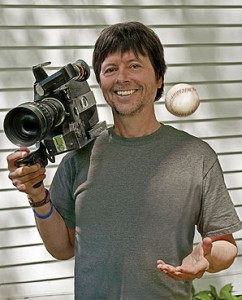

Thought of the Day 7.29.12 Ken Burns

“Good history is a question of survival. Without any past, we will deprive ourselves of the defining impression of our being.”

–Ken Burns

His family, including his brother Ric Burns, who is also a documentary film maker, traveled often through out Europe and the North East US. They settled in Ann Arbor.  Burns enjoyed reading, especially history. For his 17th birthday he got an 8mm movie camera and made his first documentary (it was about a factory in Ann Arbor.)  He attended Hampshire College in Amherst, MA. He Graduated in 1975 and co-founded Florentine Films in 1976 with Roger Sherman, Buddy Squires and Larry Hott.

Burns’ work as a director, writer, producer, cinematographer, and film music director began in earnest in 1977  when he started work on a documentary based on the book The Great Bridge by David McCullough.  The result, Brooklyn Bridge (1981) brought Burns an Academy Award nomination. He followed that success with 23 (and counting) award winning documentaries most of which saw their debut on PBS.

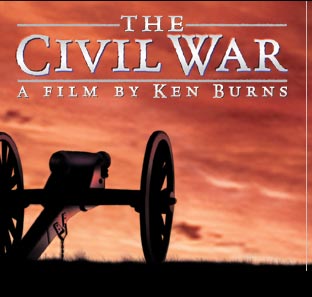
His break out series was the 11 hour  The Civil War which first ran in 1990. Burns used over 16,000 photographs  and archival images. He had first person narratives (mostly letters) read by different actors, giving each historic figure their on personality in the film. He had live interviews with noted historians. And the finishing touch was the music — a mix of Civil War era tunes and the haunting theme song, Jay Unger’s Ashokan Farewell.  The Civil War won two Emmy Awards, two Grammy Awards, a Peabody Award,  a Producers Guild of America Award, a People’s Choice Award and a slew of other accolades.


Films by Ken Burns:

  • The Shakers: Hands to Work, Hearts to God
  • The Statue of Liberty (which also received an Oscar nomination)
  • Huey Long
  • The Congress
  • Thomas Hart Benton
  • The Civil War
  • Empire of the Air: The Men Who Made Radio
  • Baseball
  • The West
  • Thomas Jefferson
  • Lewis & Clark: the Journey of the Corps of Discovery
  • Frank Lloyd Wright
  • Not for Ourselves Alone: Elizabeth Cady Stanton and Susan B. Anthony
  • Jazz
  • Mark Twain
  • Horatio’s Drive: America’s First Road Trip
  • Unforgivable Blackness: The Rise and Fall of Jack Johnson
  • The War
  • The National Parks: America’s Best Idea
  • The 10th Inning
  • Prohibition
  • The Dust Bowl

Films in production include:

  • The Central Park Five
  • The Roosevelts
  • Jackie Robinson
  • Vietnam
  • Country Music
  • Ernest Hemingway

The Baltimore Sun’s Media Critic, David Zurawik, has called Burns “… not only the greatest documentarian of the day, but also the most influential filmmaker period. ”


Beatrix Potter update

OK… so I thought we could have a little informal discussion on who is everyone’s favorite Beatrix Potter character.

Mine is Mr. McGregor.

What? How could mean old Mr. McGregor be your favorite character in the beloved Potter cannon?

Well, first of all as a gardener I’ve had my McGregor moments when it comes to rabbits.

Secondly, and most importantly, I remember reading the stories to my daughter when she was a wee little bit of lass. I would draw out Mr. McGregor’s name as long as I could in my mock Scottish accent. It was always good for a giggle.

Thirdly, with out Mr. McGregor there isn’t much drama in the story is there?


Who is YOUR favorite Potter character? and why?

Please leave a comment and let us all know.


Cheers,

ritaLOVEStoWRITE.


Thought of the Day 7.28.12 Beatrix Potter

“Thank goodness I was never sent to school; it would have rubbed off some of the originality.”*

-Beatrix Potter

English: A picture of Beatrix Potter

English: A picture of Beatrix Potter (Photo credit: Wikipedia)

Helen Beatrix Potter was born on this day  in South Kensington, London in 1866. Today is the 146th anniversary of her birth.

Beatrix and her younger brother (Walter) Bertram were raised in London, but enjoyed long holidays in rural Scotland and the English Lake District. According to the web site for the Beatrix Potter Society she was educated by a governess at home and loved languages and literature especially fairy tales and folk tales. Her early talent for drawling and as a water colorist was encouraged and she illustrated several popular fairy tales for her family’s entertainment. She wrote stories about the family pets . The children kept  “rabbits, a hedgehog, some mice and bats…” most of which would one day wind up in her stories.

She kept a journal — written in a code she invented herself (and which was not deciphered until 1958) — and a sketchbook. In her 20’s she “sold some of her artwork for greetings (sic) cards and illustrations” but she largely concerned herself with the study of natural  history, giving special focus to mycology — the study of fungi. She produced beautiful and technically accurate watercolors of mushrooms and became an adept scientific illustrator. She wrote a paper on the reproduction of fungi. On April 1, 1897 the paper was presented by a male scientist since women weren’t allowed to attend, much less present at, The Linnean Society (“the world’s oldest biological society” has since changed their  Men Only policy).

She also wrote delightful letters to children of her acquaintance that were wonderfully illustrated and told tales of little woodland creatures and pets. In 1901 she adapted some of those letters into The Tale of Peter Rabbit.

Cover of the first, privatley printed edition ...

Cover of the first, privatley printed edition of The Tale of Peter Rabbit by Beatrix Potter (Photo credit: Wikipedia)

Since she couldn’t get any commercial publishers to take on the book she self published the initial edition. But then Frederick Warne & Co.  agreed print Peter Rabbit and Potter converted the black and white illustrations to color.

Cover of the first edition, The Tale of Peter ...

Cover of the first edition, The Tale of Peter Rabbit (Photo credit: Wikipedia)

Norman Warne, the youngest son of the publishing magnet was assigned as Potter’s editor and the two brought twenty Potter books to market, usually at a rate of 2 or 3 a year. Potter also marketed stuffed animals, paint books and wall paper based on the characters in her books.

In 1905 Norman Warne proposed to Beatrix Potter. Her parents vehemently against the match because Warne was socially inferior and “from Trade.” Beatrix found this ironic since her grand parents had been engaged in the cotton trade. But ultimately their pressure won out and she kept the engagement a secret. It didn’t matter. Norman had lymphatic leukemia — a disease that was hard to diagnose at the turn of the century — he died within a month. Potter was summoned to the sick bed, but she arrived too late.

Photo of Norman Warne ca 1900

Photo of Norman Warne ca 1900 (Photo credit: Wikipedia)

Beatrix bought Hill Top Farm in the Lake District  in Lancashire as a sanctuary. She wanted to paint, write and learn about  land management. Later she purchased Castle Farm across the road from Hill Top Farm. Her goal was to preserve land in the area from development.

English: Hill Top Farm, Near Sawrey, Cumbria. ...

English: Hill Top Farm, Near Sawrey, Cumbria. Home of children’s author, Beatrix Potter. As requested in her will, the interior has been “left as if she had just gone out to the post”: a fire burning in the hearth, cups and saucers on the table ready for a visitor! (Photo credit: Wikipedia)

In 1923 she bought and restored Troutbeck Park. The sheep at Troutbeck were disease-ridden and under her stewardship the Herdwick sheep were restored to health.  She became very involved in the local community and joined several committees to help improve rural live including the founding of  a nursing trust to improve local health care. In 1913 she married a local solicitor, William Heelis.In 1926 the semi-autobiographical The Fairy Caravan was published in the United States (it didn’t show up in England until after she passed away).

At her death Beatrix Potter Heelis left 4,000 acres, on 15 farms, in the Lake District to the National Trust.

Beatrix Potter and her husband William Heelis ...

Beatrix Potter and her husband William Heelis on their wedding day (Photo credit: Wikipedia)

The Beatrix Potter Society was founded in 1980 to promotes the appreciation of the life and works the author. Please see their web site and the excellent article by  Linda Lear for more information on Potter.

The relationship between Beatrix Potter and Norman Warne is basis of the film Ms. Potter starring Renee Zellweger and Ewan McGregor.

——————————————————————————————————————–

*Perhaps her teachers were forced to teach to the TEST!

AND Maggie would like you to know that Beatrix Potter is NOT Harry Potter’s Muggle cousin.

Harry Potter

NOT related to this guy. Also not a lego. Yet I love all three. Harry Potter (Photo credit: Profound Whatever)


Thought of the Day 7.27.12

[No quote for Today’s Thought, just some interesting history and some lovely paintings.]

Ludovico Sforza, called the Moor

Ludovico Sforza, called the Moor (Photo credit: Wikipedia)

Ludovico Sforza [il Moro],  born on this day in Vigevano, Lombardy, Italy in 1452. Today is the 518 anniversary of his Birth.

The fourth son of the powerful Sforza family Ludovico was not supposed to become Duke of Milan. But his mother, Bianca Maria Visconti Sforza insisted that he be educated in the arts, government and warfare.

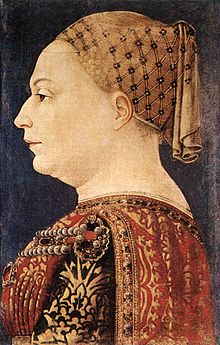
Bianca Maria Visconti Sforza (Photo courtesy Wikipedia)

When Ludovico was 14 his father died and his bother Galeazzo Maria became Duke. Galeazzo, was cruel and sadistic ruler. He reigned for 10 years until he was assassinated on St. Steven’s Day (Dec 26) 1476.

Galeazzo Maria Sforza (Image courtesy Wikipedia)

The next in line was Galeazzo’s 7 year old son Gian Galeazzo Sforza.

Alleged portrait of Gian Galeazzo Maria Sforza...

Alleged portrait of Gian Galeazzo Maria Sforza as Saint Sebastian, by Giovanni Ambrogio de Predis in 1483. Portrait of a Youth as Saint Sebastian, Cleveland Museum of Art, Ohio (Photo credit: Wikipedia)

Ludovico, called the More because of his black hair and swarthy appearance, saw his chance and made a play to become Regent for young Gian, but the boy’s mother, Bona of Savoy, fended him off. Ludovico went into exile for a while but returned in 1481 and seized control of Milan.

With Bona out of the way he  became Regent and de facto ruler. He kept a tight reign on the young Duke and refused to turn over power when Gian came of age. And when Gian died from natural causes (many believed his uncle had him poisoned) Ludovico took official control of the Dukedom.

As Regent and then as Duke Ludovico  built Milan into a powerhouse among Italian city states. He invested in infrastructure, building  up the cattle and horse industries as well as the silk industry. He widened the streets,  funded the universities and supported the the continued building of the Cathedral of MIlan.

Ludovico married Beatrice d’Este, a charming and beautiful 15 year old in 1491. Ludovico was already a patron of the arts — Leonardo Da Vinci helped bring about his marriage —  but with Beatrice’s sense of style (and extravagance) Sforza castle blossomed into a center of entertainment.

Portrait of a lady

Portrait of a lady  Beatrice d’Este by Giovanni Ambrogio de Predis and Leonardo da Vinci. (Photo credit: Wikipedia)

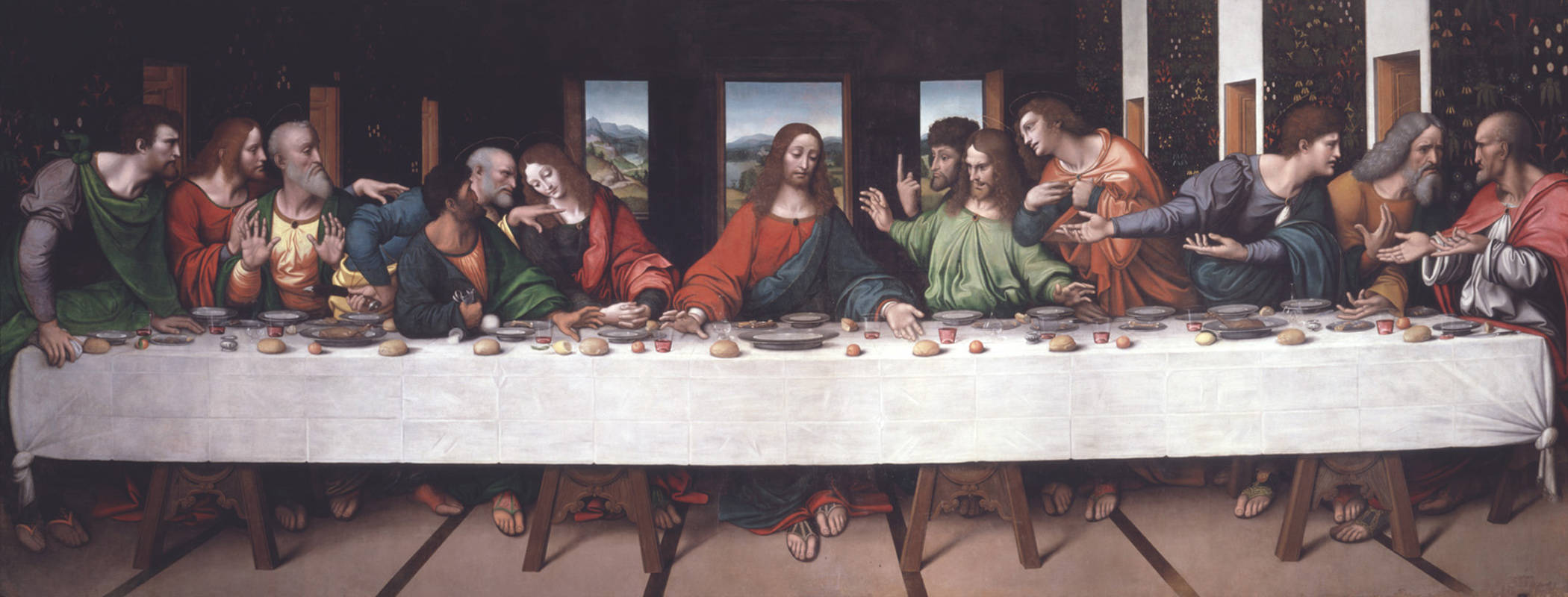
Perhaps Ludovico’s most famous contributions to history is his commissioning of The Last Supper by Leonardo da Vinci. The masterpiece, based on the Gospel of John 13:21 depicts Jesus breaking bread with his 12 disciples shortly before his death. Specifically it shows the reaction of the 12 to Jesus telling them that one of them will betray him  It measures 15 x 29 feet and graces the wall of a dining hall at the monastery of Santa Maria delle Grazie in Milan. (Ludovico’s father, Francesco is buried at Santa Maria).

The Last Supper

As the Duke of Milan he was one of many players on the game board that was Italy (Venice, Florence, Naples, and the Vatican in Rome being some others.) Ludovico played a key roll in the Italian Wars.  It was a game he ultimately lost.  He was captured and handed over to the French. He died in the dungeon at Loches on May17, 1508.


Thought of the Day 7.26.12

“Experience is not what happens to you. It is what you do with what happens to you.”

–Aldous Huxley

Aldous Leonard Huxleywas born on this day in Godalming, Surrey in 1894. Today is the 118th anniversary of his birth.

Huxley was born into a family of scientist, educators and writers. His grandfather, Thomas Henry Huxley was a biologist and anatomist who was know as “Darwin’s Bulldog” for his strong support of Darwin’s theories on evolution. His father, Leonard Huxley, who was a writer, editor, and schoolmaster, had a botanical laboratory  of his own that he shared with Aldous and his siblings. Both his older brother, Julian, and his step brother, Andrew, became renowned scientist (Julian was a leading evolutionary biologist and the first director of UNESCO;  Andrew won a Nobel Prize in Physiology or Medicine in 1963.) Aldous attended Eton College, but he suffered from keratitis punctata at 16 and was almost totally blind for a year and a half.  By learning Braille and with the use of special glasses he was able to continue his studies, but he could no longer follow his dream of becoming a scientist (his first career choice). It also meant he couldn’t fight in WWI.

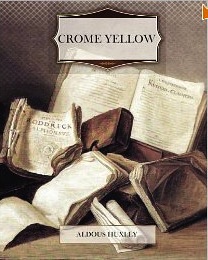
2011 edition of Chrome Yellow published by Create Space.

He taught French at Eton (Eric Blair aka George Orwell was one of his students) and began to write poetry and novels. Chrome Yellow was his first novel, a social satire that was published in 1921. With his use of social criticism, snappy dialogue and cynicism Huxley saw critical and financial success as a writer. He published a dozen books during the 1920s.

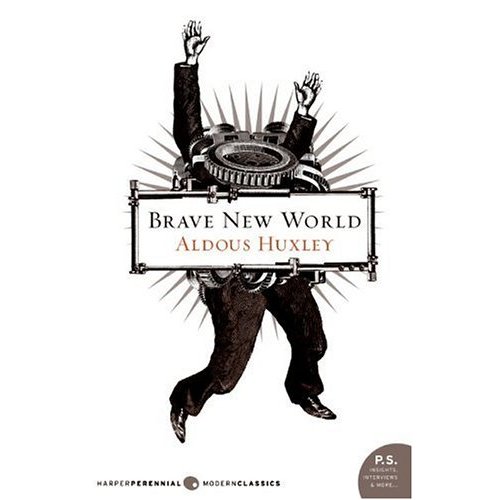
2006 edition of Brave New World published by Harper Perennial Modern Classics
Huxley met D.H. Lawrence when he moved to Italy part time in 1920. The two authors remained close friends until Lawrence’s death.  While in Italy Huxley wrote his masterpiece, Brave New World It is a dystopian vision of a world controlled by genetic engineering, it’s citizens pacified by institutional drug use.
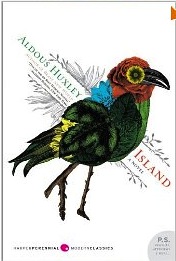
He moved to Hollywood, CA in 1937. Here he wrote essays and worked on screenplays (including the 1940 version Pride and Prejudice and the 1944 version of Jane Eyre.)  He became involved with the counter culture  and experimented with self-directed psychedelic drugs. In 1962 he published  Island, a “good” Utopia. Where the people of Brave New World took the drug Soma to numb and intoxicate themselves, the people of Island take a perfected (and fictional) LSD variant that helps them expand their world in a religious way.

The 2009 edition of Island published by Harper Perennial Modern Classics

Huxley died on November 22nd, 1963, the same days as C.S. Lewis and President John F. Kennedy.

Thought of the Day 7.25.12

“The big artist keeps an eye on nature and steals her tools.” –Thomas Eakins

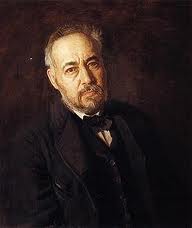
Thomas Eakins Self Portrait 1894. national Academy of Design, New York.
Photo courtesy Wikimedia Commons.

Thomas Cowperthwait Eakins was born on this day in Philadelphia, PA in 1844.

Today is the 168th anniversary of his birth. He went to the Pennsylvania Academy of the Fine Arts  and attended classes on anatomy at Jefferson Medical College. He spent a few years abroad studying in Paris and Spain then returned home to Philadelphia. He worked in watercolor, oil and photography to capture realistic landscapes and the human figure. He taught at the Pennsylvania Academy stressing the importance of realism. He  ran into trouble with Victorian sensibilities with his emphasis on using nude subjects and was forced to retire from that institution.

John Biglin in a Single Scull, ca 1873 by Thomas Eakins a Watercolor on paper

Early paintings reflected things he liked to do like rowing on the Schuykill river. He also painted portraits of women and children (usually of family or friends) at home in intimate, shadowed settings.

The Thinker: Portrait of Louis N. Kenton, 1900 by Thomas Eakins, Oil on Canvas.
Kenton was Eakin’s brother-in-law. The painting is 82 x 42″ and is in the New York Metropolitan Museum of Art.

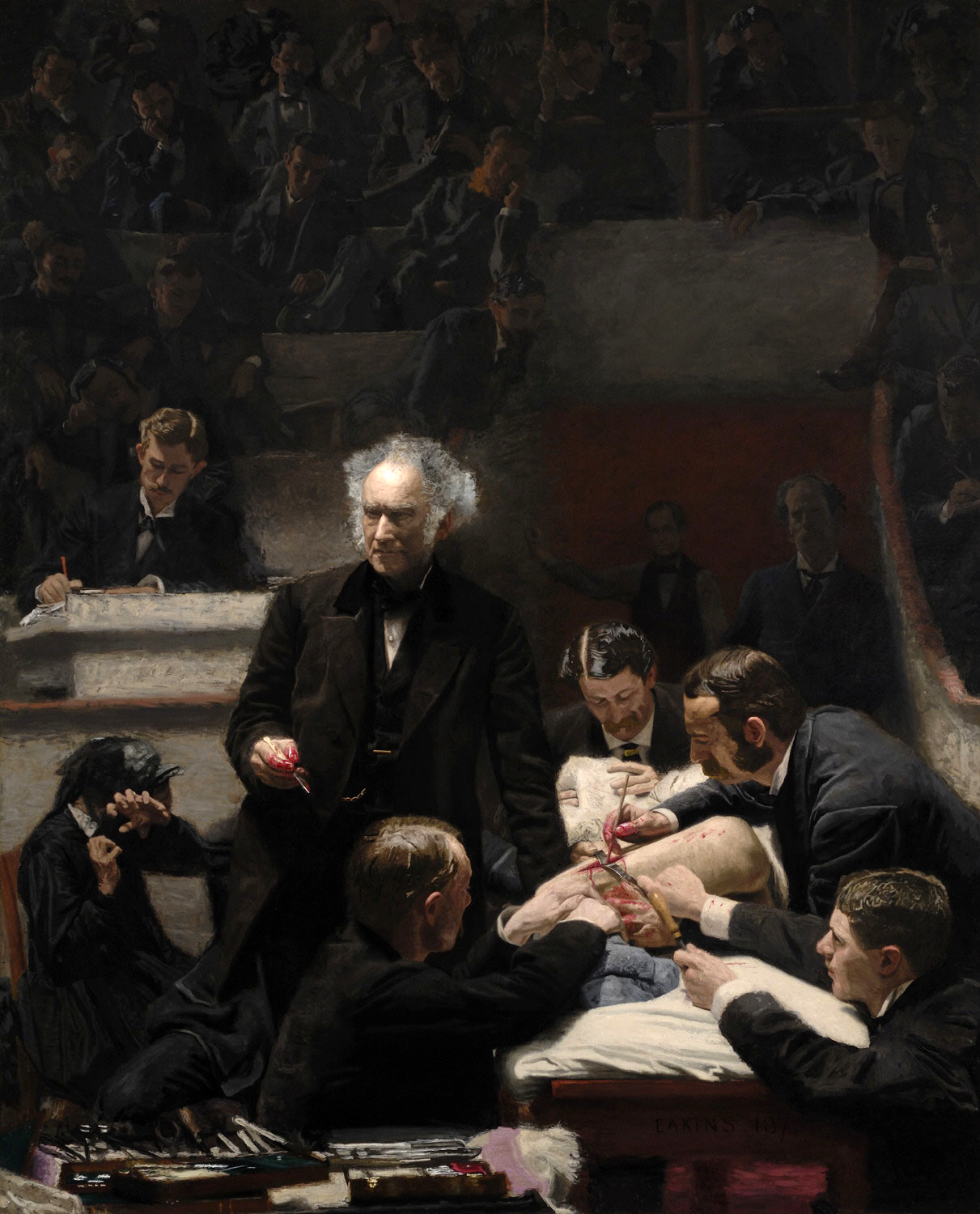
During his lifetime his was not well received in the art world. His portraits — he painted several hundred of them — were rarely done on commission and  were often painted to scale, inside  and in isolation. He was also very interested in science and medicine (especially anatomy) as is reflected in two of his most famous works The Gross Clinic and The Agnew Clinic. 

The Gross Clinic by Thomas Eakins, 1875. Oil on Canvas 96 x 78″. Philadelphia Museum of Art. Photo Courtesy Wikimedia Commons.

Thomas Eakins' "The Agnew Clinic," a...

Thomas Eakins’ “The Agnew Clinic,” a companion piece to “The Gross Clinic.” (Photo credit: zpeckler)


Romeo and Juliet and Benvolio and Mercutio


Apologies, gentle reader, for it taking so long to post a review of something I saw on Sunday! (I’ve been busy doing actual freelance graphic design and writing work, so I’m sure you’ll understand.)

If you haven’t already seen Romeo and Juliet at the Chesapeake Shakespeare Company this Summer you’d better hurry. This nice little production of  the classic Shakespeare tale is something you don’t want to miss. Remaining performances are on Friday, July 27th at 8:00 and Sunday, July 29 at 6:00 at the Patapsco Female Institute in Ellicott City Maryland. The CSC is running R&J in rep with Pride and Prejudice (another excellent production) which concludes its run tonight, Thursday and Saturday. Here’s my review of R&J:

Benvolio as interpreted by artist Hannah Tompkins

I particularly liked the first half.  They had a LOT of fun here and it was nice to see actors who were so hemmed in and corseted by their roles in Pride and Prejudice let loose on the stage and really enjoy themselves. Julian Elijah Martinez (Romeo / Wickham) and Rachael Jacobs (Juliet / Lydia) played much more likable characters here, and it was lovely to see the nuances in the shift of the lovers characters. Jacobs’ bubbly Juliet is all innocence while her Lydia was appropriately bratty. But the actors who played Benvolio / Darcy, Adam Sheaffer, and Mercurio / Lizzy, Blythe Coon, were even more fun to watch. He was SO RESERVED and stately in P&P and is so fun loving in R&J (and then so angst ridden when needed) he stole the show for me. (… Yeah, maybe because I am predisposed to like him because he was also Darcy, I admit it.) And she took all the energy and vitality she had as Elizabeth Bennett and just cut loose  with bawdy humor and physicality for Mercurio. They both were damn fine swordsmen too. I was really impressed.
The staging was really nice too, they did a lot out and about the audience, really addressing the crowd — sometimes eating the food from the picnic tables in the back, or performing small scenes in the pockets of the audience. There was this beautiful moment  when Jamie Jager, (Paris/ Bingley) goes semi “Off stage” as Paris to watch (in character) as Romeo enters the vault. As an audience member we have all been following Paris– he’s just given a heart breaking speech (love him too, btw) and we — especially those of us who can hear him breathing — can’t take our eyes off him. But Jamie — knowing that our attention needs to be with Romeo, who is entering stage left — put his fingers to his eyes and gestured for us to look across the stage. Everyone’s head turned to where it needed to be. It could have been 1595 and we could have been the groundlings. He had just gotten us to happily suspend our disbelief and manipulated us to continue with the story. I loved it.
So kudos to director Jenny Leopold for getting the most out of her fine actors and the minimal set.
The second half of the play (YES, I know there are really 5 acts) is much, much more serious. The body count went up, poison came out. And  they had to get down to business. You know how it ends. I knew how it ends. Actually KNOWING how it ends was kind of  a bummer. Like a lot of Shakespeare (and Austen) there’s a double edged sword in coming to a performance knowing the material ahead of time. You have the inside joke of knowing the inside jokes, but you don’t have the zing of surprise or the intake of breath when some one is unexpectedly run through with a rapier. I, personally, did not weep openly at the end of R& J, but I did hear sniffling around me.
Jaded? Perhaps. But mostly I was thinking that the second half didn’t have enough BENVOLIO!


Thought of the Day 7.24.12

“Never interrupt someone doing what you said couldn’t be done.”

–Amelia Earhart

Famous aviator Amelia Earhart is thought to ha...

Famous aviator Amelia Earhart is thought to have crash landed on Nikumaroro Island when she disappeared in 1937. (Photo credit: Wikipedia)

Amelia Mary Earhart was born on this day in Atchison, Kansas in 1897. Today is the 115th anniversary of her birth.

She was unimpressed with the first plane she saw, a rickety thing of “rusty wire and wood” at the Iowa State Fair. When she was 23 pilot Frank Hawks took her up for her first ride in a plane and she was hooked. “By the time I had got two or three hundred feet off the ground, I knew I had to fly.” (– from Amelia Earhart, the Official Website.)

Earhart was a nurse’s aid at Spadina Military Hospital in Toronto, Ontario, during WWI. She was there when the Spanish Flu broke out in 1918 and she was hospitalized for pneumonia and sinusitis. She suffered from chronic sinusitis for the rest of her life.

She took her first lesson at Kinner Field in Long Beach in 1921. She had to take a bus and then walk four miles to get there. She cropped her hair and bought a leather jacket to ward off the chill morning flights (Amelia slept in the jacket for three nights straight to break it in before she dared to wear it to the field.) On Oct 22, 1922 she broke the altitude record for a female pilot  by flying over 14,000 feet, and on May 15, 1923 she became the 16th woman to earn her pilot’s license.

Family financial problems limited her time in the air as Amelia took jobs as a photographer a teacher and a social worker. But with Lucky Lindy’s solo flight over the Atlantic the hunt was on to find the first woman to fly (either solo or with a crew) over the ocean too. Amelia was chosen to join pilot Wilmer Stultz and copilot/mechanic Louis “Slim” Gordon. They took off from Newfoundland and landed in Wales about 21 hours later. Although her contribution to the flight was minimal — she kept the flight log and later said she that Stultz did all the flying and she was as useful as a “sack of potatoes” — it was a publicity smash. They returned to New York to a ticker-tape parade and were greeted at the White House with a reception by President Calvin Coolidge.

She become romantically involved with George Putnam, who had handled the publicity for the trans-Atlantic flight, and (after Putnam proposed six times) the two married in February of 1932. Amelia saw the marriage as a partnership. Their honeymoon was a lecture/promotional tour.  She also did a number of endorsements for luggage, clothing and cigarettes.  She became an associate editor for Cosmopolitan. And she and Lindbergh promoted commercial air travel, investing in Transcontinental Air Transport (which later became TWA).

In May of 1932, 5 years after Lindberg’s trip, she became the first woman to fly solo across Atlantic (she landed in Ireland.)  She also flew solo from Hawaii to California, from LA to Mexico City and from Mexico City to New York.

Amelia was one of the organizers and the first  president of The Ninety-Nines, an organization that advanced the cause of women in aviation.

In 1936 she started to plan a trip around the world. The first attempt ended in Hawaii when a blown tire (or perhaps pilot error) when the plane ground-looped. The damaged plane and the deflated crew went back to Oakland, CA.  For the second attempt Amelia and Fred Noonan  headed east, to Miami. They made several stops in South America, Africa, India and Southeast Asia. On June 29, 1937 they landed in Lae, New Guinea. The next stop would be Howland Island… but the plane never made it.

An intense air and sea rescue attempt ensued, but after searching a quarter million square miles of ocean the US Government gave up.

Amelia Earhart - GPN-2002-000211