Archives: 2013

Let the Austen-ing begin…

One week to go before the 200th Anniversary of the publication of Pride and Prejudice!

Jane's silo 2

To lead up to this “Austentatious” event we’ll be taking a look at the novel’s characters this week.

Next MONDAY, JANUARY 28th is the deadline for  the super fun, creative, Jane Austen “Essay” Contest. I’m really looking forward to reading/viewing your unique takes on the novel. Send you entries to: ritaLOVEStoWRITE@gmail.com

—————————————————————————

So get your creative juice flowing for the Jane Austen “Essay” Contest to celebrate the 200th anniversary of Pride and Prejudice.

Deadline: 28 January 2013

THIS JUST IN: New prize — just for entering…the first 25 people who send in an entry will receive a cool refrigerator magnet like this brand new Austen Neon magnet…

[TM ritaLOVEStoWRITE]

[TM ritaLOVEStoWRITE]

Any one can participate!  Couple of RULES here:

  1. TRY and keep it under 1200 words please.
  2. The “essay” should be Pride and Prejudice centric.
  3. Please submit your “essay” in English.
  4. Have fun with it!
  5. Oh, and no pornography == THIS is Austen after all!

English: Français : Une gravure de 1833 illust...

Prizes include… All entries will be published in an upcoming special edition of the award-winning ritaLOVEStoWRITE blog. All entries will receive a participation banner for your blog. The top three entries will receive a special “Finalist” banner for their Blog Page, and the top entry will win a Darcy mug! (Please make sure to include an email contact — which I will remove before posting so the whole world doesn’t see it.)

Deadline: 28 January 2013 (That’s the anniversary date of the novel’s publication)

*I seriously encourage you to think outside the box. For you illustrators out there… how about some character studies? Are you a playwright? Why not treat us to a re-imagined scene or two?… This should be a fun expression of your love for Austen and Pride and Prejudice. Don’t be afraid of a little well written/thought out fan fiction. (But no vampires, please.)

AND … Although I’m not going to snark  your intellectual property I strongly suggest you throw a copyright on all your original material in case any one else takes a liking to it.


Buzz Aldrin 1.20.13 Thought of the Day

“Beautiful, beautiful, magnificent desolation.”–Buzz Aldrin

Aldrin on the Moon [Image courtesy: Buzz Aldrin.com]

Aldrin on the Moon [Image courtesy: Buzz Aldrin.com]

Edwin EugeneBuzzAldrin, Jr. was born on this day in Montclair, New Jersey in 1930. He is 83 years old.

Aldrin’s father was a Colonel in the Air Force, an aviation pioneer and a Doctor of Science graduate from MIT. His mother, whose maiden name was, appropriately enough, Moon, was the daughter of an Army Chaplain. He had two older sisters, the younger of whom couldn’t pronounce brother, instead she said “Buzzer.” That was shortened to Buzz.

[Image courtesy: Buzz Aldrin.com]

[Image courtesy: Buzz Aldrin.com]

He was offered a full scholarship to MIT, but turned it down, choosing instead to enter West Point Military Academy. He graduated third in his class.

He then joined the Air Force where he flew F86 Sabre Jets in 66 combat missions in Korea, shot down two MIG-15′s, and was decorated with the Distinguished Flying Cross.  After a tour of duty in Germany flying F100’s, he went on to earn his Doctorate of Science in Astronautics at MIT and wrote his thesis on Manned Orbital Rendezvous. [BuzzAlrdrin.com]

He joined NASA as part of the third group of astronauts. His expertise on docking techniques earned him the nickname “Dr. Rendezvous”

The docking and rendezvous techniques he devised for spacecraft in Earth and lunar orbit became critical to the success of the Gemini and Apollo programs, and are still used today.  He also pioneered underwater training techniques, as a substitute for zero gravity flights, to simulate spacewalking. [Ibid]

[Image courtesy: Buzz Aldrin.com]

[Image courtesy: Buzz Aldrin.com]

During his Gemini 12 Mission he “performed the world’s first successful spacewalk” [Ibid].

In July of 1969 he landed on the Moon with Neil Armstrong while Michael Collins orbited over head during the Apollo 11 Mission. Aldrin and Armstrong   became “the first two humans to set foot on another world. They spent 21 hours on the lunar surface and returned with 46 pounds of moon rocks.” [Ibid]

Image Courtesy: NASA]

Image Courtesy: NASA]

Although he has since retired from NASA he remains a tireless advocate for Space exploration, especially the exploration of Mars. He has written a children’s book, an autobiography, and two space based science-fact-fiction novels.

[Image courtesy: Buzz Aldrin.com]

[Image courtesy: Buzz Aldrin.com]

At the passing of Neil Armstrong he wrote:

Whenever I look at the moon I am reminded of that precious moment, over four decades ago, when Neil and I stood on the desolate, barren, yet beautiful, Sea of Tranquility, looking back at our brilliant blue planet Earth suspended in the darkness of space, I realized that even though we were farther away from earth than two humans had ever been, we were not alone. Virtually the entire world took that memorable journey with us. I know I am joined by many millions of others from around the world in mourning the passing of a true American hero and the best pilot I ever knew. My friend Neil took the small step but giant leap that changed the world and will forever be remembered as a historic moment in human history…. [Buzz Aldrin.com]

When people talk about Neil Armstrong they sometimes say he was the “First man on the Moon.” I’m a huge Armstrong fan, but that statement is just not true. Armstrong was the first man to WALK on the Moon, because he descended the ladder of the Lunar Lander first, but he and Aldrin landed on the Moon at the same time.

English: One of the first steps taken on the M...

English: One of the first steps taken on the Moon, this is an image of Buzz Aldrin’s bootprint from the Apollo 11 mission. Neil Armstrong and Buzz Aldrin walked on the Moon on July 20, 1969. (Photo credit: Wikipedia)

Click here the ritaLOVEStoWRITE bioBLOG on Neil Armstrong.


Secondary Character Saturday — SPIDER (Anansi Boys)

Who: Spider

My take on the Anansi brothers, Fat Charlie and Spider. [Copyright: ritaLOVEStoWRITE.]

My take on the Anansi brothers, Fat Charlie and Spider. [Copyright: ritaLOVEStoWRITE.]

From: Anansi Boys

Written by: Neil Gaiman

Date of Publication: Jan 2008.

Why: He’s the trickster brother to the book’s everyman hero, Fat Charlie.  He’s the cool, funny, magical brother you’d always wish you had. Kinda. [Full disclosure: I’m really a card-carrying member of “Team Fat Charlie. ” But, as he’s the lead character, I couldn’t really pick him for this profile could I?  So I picked Spider, who is so like Fat Charlie! –Except he’s completely different.]

Here’s what happened when the brothers met:

“Fat Charlie blew his nose. “I never knew I had a brother,” he said.
“I did,” said Spider. “I always meant to look you up, but I got distracted. You know how it is.”
“Not really.”
“Things came up.”
“What kind of things?”
“Things. They came up. That’s what things do. They come up. I can’t be expected to keep track of them all.”
“Well, give me a f’rinstance.”
Spider drank more wine. “Okay. The last time I decided that you and I should meet, I, well, I spent days planning it. Wanted it to go perfectly. I had to choose my wardrobe. Then I had to decide what I’d say to you when we met. I knew that the meeting of two brothers, well, it’s the subject of epics, isn’t it? I decided that the only way to treat it with the appropriate gravity would be to do it in verse. But what kind of verse? Am I going to rap it? Declaim it? I mean, I’m not going to greet you with a limerick. So. It had to be something dark, something powerful, rhythmic, epic. And then I had it. The perfect line: Blood calls to blood like sirens in the night. It says so much. I knew I’d be able to get everything in there – people dying in alleys, sweat and nightmares, the power of free spirits uncrushable. Everything was going to be there. And then I had to come up with a second line, and the whole thing completely fell apart. The best I could come up with was Tum-tumpty-tumpty-tumpty got a fright.”
Fat Charlie blinked. “Who exactly is Tum-tumpty-tumpty-tumpty?”
“It’s not anybody. It’s just there to show you where the words ought to be. But I never really got any futher on it than that, and I couldn’t turn up with just a first line, some tumpties and three words of an epic poem, could I? That would have been disrespecting you.”
“Well….”
“Exactly. So I went to Hawaii for the week instead. Like I said, something came up.” [Anansi Boys]

Anasi Boys 2

Pros: He’s pretty much a god. He can make people do things with the power of suggestion. He talks to spiders. After living most of his life in hedonistic selfishness (he is a god after all) he learns to grow and love.

Cons: When we first meet him he is selfish and destructive.  He’s a liar and a cheat. And he never thinks about the real world consequences since he never sticks around long enough to deal with them. He steal’s Fat Charlie’s fiance, Rosie, and takes over his flat. He pretty much ruins Fat Charlie’s life.

——————————————————————————–

If you haven’t guessed… I’m a big Neil Gaiman fan. So I was thrilled when one of my besties, Lynn Reynolds gifted me Anansi Boys as an Audible Book  for Christmas. I’d only really done a handful of books on tape before, most notably the Harry Potter books (I’ve also done various books  through my Kindle’s text-too-speech while gardening or painting. But those sound like the “Garman car man” guy  so they don’t count.) Any way, I was really pleased with this Audible Book both for Lenny Henry’s narration and, especially, for the wonderful writing. I think you should give it a try…

Here’s the Kindle link: http://www.amazon.com/Anansi-Boys-ebook/dp/B000FCKENQ/ref=tmm_kin_title_0

And here’s the link for the Audio version – http://www.amazon.com/Anansi-Boys-Neil-Gaiman/dp/0060823844/ref=tmm_abk_title_0

[Image courtesy Amazon.com]

[Image courtesy Amazon.com]

  Click here to read the ritaLOVEStoWRITE Neil Gaiman bioBLOG


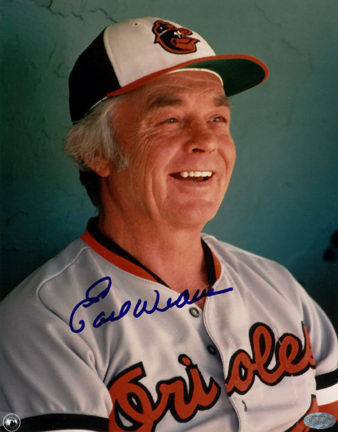
RIP Earl Weaver

RIP Earl Weaver. The Earl of Baltimore passed away yesterday while on an Oriole themed cruise.

“On my tombstone just write, ‘The sorest loser that ever lived,’ ” he once said. [The Baltimore Sun]

Here’s the ritaLOVEStoWRITE bioBLOG that I posted on his 82nd Birthday on Aug 14, 2012.

—————————————————————————————-

“I became an optimist when I discovered that I wasn’t going to win any more games by being anything else.”

Earl Weaver

Earl Sidney Weaver was born on this day in St. Louis, Missouri in 1930. He is 82 years old.

Weaver managed the Baltimore Orioles from 1968-1982 and again from 1985-1986.  He became a Hall of Famer a decade later.

He played second base for 13 years in the minor leagues, then he managed for another dozen years in the minors before making it to the Show as a first-base coach for the Orioles in 1968. He took over as Manager in July of that season.

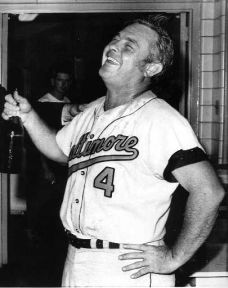
He wore #4 on his Oriole’s jersey and had a .583 winning record while managing the club. The team won 6 American League East titles, had 5 100+ win seasons, won 4 A.L. pennants, and won the 1970 World Series under his leadership.

Weaver didn’t want to bunt or sacrifice to advance a runner, according Hall of Fame player Frank Robinson, “He didn’t even have a hit and run sign…” Earl was all about the three run home run.

He pioneered the use of radar guns to track fast balls in 1975’s Spring Training season (according to the National Baseball Hall of Fame.)

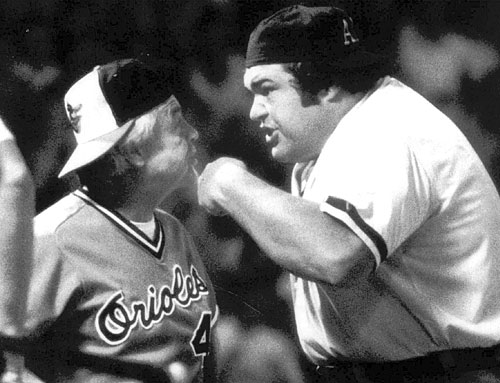
He was famous for his heated arguments with umpires that often ended with the manager kicking Memorial Stadium’s infield dirt at the official. Weaver was tossed from 91 regular season games.

Locals also remember the “Tomato Wars” he had with groundskeeper Pat Santarone. Santarone had a patch of plants in the left field foul area, Weaver grew his maters at home. The two argued (good naturedly) for 17 years over who had the best tomatoes in Baltimore.

After he left the O’s he worked as broadcaster for ABC television providing color commentary during the 1983-84 baseball seasons. He also did Manager’s Corner with Tom Marr while he was with the O’s (some times to very colorful effect.)

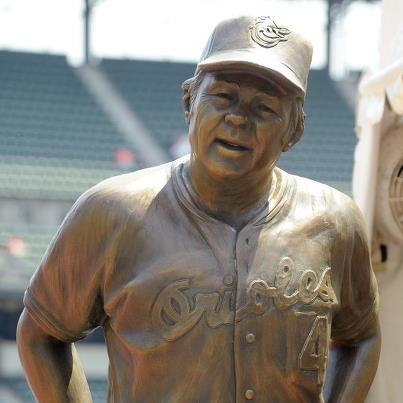
He was elected to the Baseball Hall of Fame in 1996.  A bronze statue of the manager was erected at Camden Yards (the “new” home of the Orioles) in June of this year.  At seven feet the statue towers over the real life Weaver, who is only 5’7″.  Weaver quipped “I guess there will be a lot of kids looking up at me…saying, ‘who is this?'”


A.A. Milne 1.18.13 Thought of the Day

“One of the advantages of being disorganized is that one is always having surprising discoveries.”
–A.A. Milne
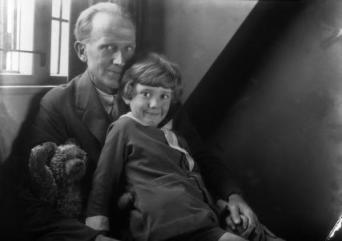
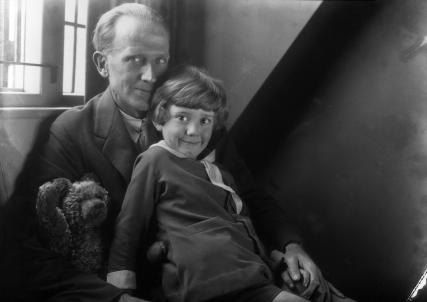
 A.A. Milne; Christopher Robin Milne and Pooh Bear  by: Howard Coster


A.A. Milne; Christopher Robin Milne and Pooh Bear by: Howard Coster

A. A. Milne was born  on this day in Kilburn, London, England in 1882. Today is the 131st anniversary of his birth.

Alan Alexander Milne  was the youngest of three boys born to John Vine and Sarah Maria Milne. John Milne ran a school, Henley House, and it was here that the boys took their first steps in the world of learning. One of the teachers at the school was H.G. Wells and he and Alan would remain friends for the rest of their lives. After Henley House Alan went on to Westminster School before attending Cambridge on a mathematics scholarship.

A.A. Milne’s first literary efforts came during his Cambridge days. He edited the college’s humorist publication, The Granta. Alan and his brother Ken worked together, by mail, on light verse that was published in The Granta under a mash-up of their initials A.K.M.

After graduation Alan moved to London and worked as a freelance writer. He had articles published in both newspapers, like the St. James Gazette, and in humor magazines, such as Punch.

In February of 1906 he became an assistant editor and weekly contributor to Punch magazine. His  contributions included stories on sports (especially cricket and golf), the exploits of the fictional middle class Rabbit Family, and children stories that he wrote with his niece Marjorie in mind.

In 1913 he married Dorothy “Daphne” de Selincourt. When World War I broke out he volunteered as a signalling officer. He saw action in France until returning to England in November 1916 with a fever. Once recovered he was

…put in charge of a company at a new formed signalling school at Fort Southwick. He stayed there until he was released from the army on February 14, 1919. [Pooh-Corner.org — The Author]

A.A. Milne on the Western Front 1916. [Image courtesy Spartacus.Schoolnet.co.uk]

A.A. Milne on the Western Front 1916. [Image courtesy Spartacus.Schoolnet.co.uk]

While in the Army he wrote his first play Wurzel-Flummery. Alan didn’t go back to Punch after the war — his job had been given to some one else — and he preferred the freedom of not having a weekly deadline. He also liked writing plays and collaborating with the actors.

…he had several successes, both in London and in New York. Mr Pim Passes By… opened in London on January 5, 1920, and ran for 246 performances in London. It also had a successful run in New York…. Within the next year, Milne had another four plays running in London. Other notable plays include Belinda, The Lucky One, The Romantic Age, The Dover Road, and The Truth About Bladys. … At one time, A. A. Milne was England’s most successful, prolific, and best-known playwright. [Pooh-Corner.org — The Author]

Ironically his biggest flop was called Success.

He wrote an adaptation of Mr. Pim Passes By and a mystery, The Red House Mystery. When he proposed writing Red House his agent bulked, suggesting the public wanted more humor stories. But Milne stuck to his guns, and The Red House Mystery was “his most successful book other than his four children’s books.” [Ibid]

The Red House Mystery

The Red House Mystery (Photo credit: Wikipedia)

Alan and Daphne Milne had a son Christopher Robin in 1920. They called the little boy “Billy Moon”  at home and among friends (the first name was a nickname, the “Moon” came from Christopher’s mispronunciation of his last name). Alan wrote the first Billy Moon poem “Vespers” after watching the little boy say his prayers before going to bed. It proved so popular that Milne was

asked to provide another children’s verse for a new children’s magazine entitled The Merry-Go-Round. That poem was “The Dormouse and the Doctor“, and also became quickly famous. Alan toyed with the idea of writing a whole book of children’s verse, and the result was When We Were Very Young, published in 1924. To illustrate the book, Milne enlisted the aid of Punch illustrator, Ernest Shepard. The combination of Milne’s poetry and Shepard’s drawings proved to be a winner, as the book sold over 50.000 copies within eight weeks of its first publication. [Ibid]

The family moved to Cotchford Farm, in Hartfield, East Sussex, in 1925 and Alan used the bucolic setting as his backdrop for his next book,Winnie-the-Pooh. Shepard was on board again as illustrator. Milne thought so highly of Shepard’s role in the success of the first children’s books that he insisted Shepard get an 80/20 share of the royalties of Winnie-the-Pooh instead of a flat rate. Winnie-the -Pooh was enormously well received.

Cover of Winnie-the-Pooh

Cover of Winnie-the-Pooh (Photo credit: Wikipedia)

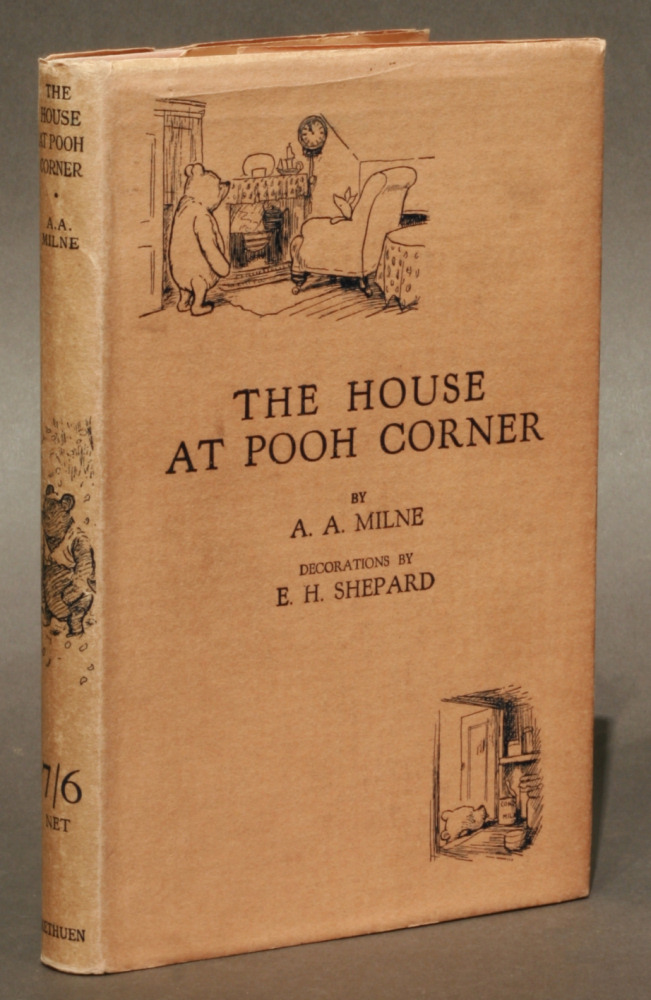
The second Pooh book, The House at Pooh Corner was equally loved. (Except by Dorothy Parker who famously quipped in her Constant Reader column in the New Yorker that by page 5 of the book the “tonstant Weader fwowed up”. Milne was unfazed by Parker’s quip, noting that “no writer of children’s books says gaily to his publisher, “Don’t bother about the children, Mrs Parker will love it.””[Ibid])
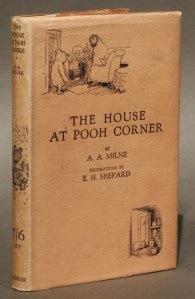
Milne House at Pooh Corner1000

Alan wrote more plays. His Toad of Toad Hall, based on Grahame’s The Wind in the Willows, got it’s stage debut in 1929. The play was hailed as a “family classic” and Milne was quickly getting painted into a corner. Especially in London, his works for adults were being ignored as the public clamored for more Pooh, or at least more children’s fiction. New York was more forgiving and his plays had longer runs on Broadway, including The Ivory Door and Michael and Mary. In 1933 his adult novel Four Days of Wonder sold moderately well, but he didn’t publish another novel for another 13 years.

At the dawn of World War II Milne, the pacifist, wrote Peace With Honour in which he outlined that nothing was

“worth repeating the Somme for. He would later change his mind and would write a pamphlet called War With Honour, in which he explained his changed views. ‘If anyone reads Peace With Honour now, he must read it with that one word HITLER scrawled across every page. One man’s fanaticism has cancelled rational argument.’ [Ibid]

The Milnes had moved away from the ‘Hundred Acre Woods’ and Cotchford Farm for London and New York, but with the War they moved back to East Sussex. Alan was Captain of the Home Guard for the area. His relationship with Daphne, which had waned, rekindled, but his ties with Christopher, which had always been strong, weakened. Christopher joined the Royal Engineers as a Sapper.

In 1946 Milne’s Chloe Marr, his last novel, came out to good reviews. It sold well. He continued to see success with his plays, which were now running in repertory.

[Image courtesy pdxretro.com]

[Image courtesy pdxretro.com]

But his relationship with Christopher — who ” had begun to resent his father and hated the books that made his name famous” [Ibid] — was crumbling. By the early 1950’s Christopher was married and living 200 miles away.

In October 1952, Milne had a stroke which left him an invalid for his remaining years. … A. A. Milne died on January 31, 1956. [Ibid]


Naveen Andrews 1.17.13 Thought of the Day

“I was always in trouble from an early age. I had a fraught relationship with my parents, who were very traditional. Doing plays at school was a joyous release.”–Naveen Andrews

[Image courtesy FanPop.com]

[Image courtesy FanPop.com]

Naveen William Sidney Andrews was born on this day in London, England in 1969. He is 43 years old.

Andrews was raised in the Wandsworth neighborhood of South London in a conservative parents, both of whom are first generation immigrants from Kerala, India. He attended London’s Guildhall School of Music and Drama.

He broke into film with the role of Bike in London Kills Me (1991).

In 1996 he played Kip, a British sapper, in The English Patient.  Kip’s relationship with Hana is a gentle, romantic shadow of the sensual, adulterous relationship between Almasy and Katharine Clifton. Here he is defusing a bomb…

He was clearly having a good time with his role of Bairaj (Bingley) in Bollywood’s Bride and Prejudice. Bonus: we get to see him dance and sing.

He played a considerably darker character on Lost for 116 episodes. Sayid Jarrah is a former member of Iraqi’s Special Republican Guard. His character is equally well versed in mechanical and radio engineering and in torture.  On an Island where nothing is as simple as it appears, and all the heroes come with a big helping of “anti-” … Sayid isn’t a bad person to have on your team.

[Image courtesy FanPop.com]

[Image courtesy FanPop.com]


Richard Thompson 1.16.13 Though of the Day

“To stand up on a stage alone with an acoustic guitar requires bravery bordering on heroism. Bordering on insanity.”–Richard Thompson

[Image courtesy Helpless Dancer]

[Image courtesy Helpless Dancer]

Richard John Thompson was born on this day in Notting Hill, London, England in 1949. He is 64 years old.
Thompson was born into a musical family. His father was an amateur guitarist and other family members played music professionally. His first band, which he started in school, was called Emil and the Detectives. Thompson embraced rock and roll, jazz and traditional Scottish music influences as he kerned his skills.
At 18 he joined Fairport Convention, a folk, electric folk, folk rock band.
In his four years with the group, they released a half a dozen albums that married electric rock with acoustic folk, changing the musical landscape in Britain… [NPR.org]
His strong guitar playing helped the band gain traction both in the UK and in the States. Thompson also wrote most of Convention’s songs like “Meet on the Ledge” .
Thompson left Fairport Convention in 1971 and struck out on his own. His first solo album, Henry the Human Fly failed to impress critics and the record buying public, but it did yield an important professional and personal connection — Thompson worked with Linda Peters on the project. Peters and Thompson fell in love and married in October of 1972.
Richard Thompson

Richard Thompson (Photo credit: artolog)

Richard and Linda Thompson put out a half-dozen albums including I Want to See the Bright Lights Tonight, Hokey Pokey and Pour Down Like Silver.
The duo hit their professional stride with the well received album Shoot Out the Lights. Unfortunately their personal life together had begun to unravel. After touring to support the album the couple divorced in 1982.
Here’s Wall of Death from Shoot Out the Lights
From 1983 on Thompson was a solo act — kind of — he found a myriad of other performers who mixed well with his vocal, guitar and folk/rock style.
No artist to emerge in the second half of the ’60s has gone on to have a more productive and vital career than Richard Thompson. The England-born, L.A.-based artist has amassed an astounding body of work comprising more than 40 albums, containing artfully shaped material that seamlessly and expressively integrates traditional and contemporary modes. And Thompson is among the most distinctive of guitar virtuosos, capable of breathtaking drama and sublime delicacy, prompting Rolling Stone to hail him as “a perennial dark-horse contender for the title of greatest living rock guitarist.” [Amazon.com — Richard Thompson Biography]
Richard Thompson at Cambridge Folk Festival

Richard Thompson at Cambridge Folk Festival (Photo credit: Wikipedia)

Here’s 1952 Vincent Black Lightning a beautiful exhibition of his storytelling and musical skills.
The Thompson’s son Teddy began singing professionally with his father in the 1990’s. The two performed a duet, Persausion, for Action Packed, Richard Thompson’s 1999 best-of record.
That same year Thompson was asked for a list of the most popular music of the previous millennium for Playboy Magazine.  Thompson knew they were only looking for a pop look at the past 20 years or so, but he took the task to heart and researched songs stretching back 1068.  He started with Sumer is Icumen In and ended with his own take on Oops! I Did It Again. Thompson decided to record the songs (he did 23 in all).
To get a comprehensive taste of Thompson music you can listen to this NPR concert:

RICHARD THOMPS SM


Martin Luther King 1.15.13 Thought of the Day

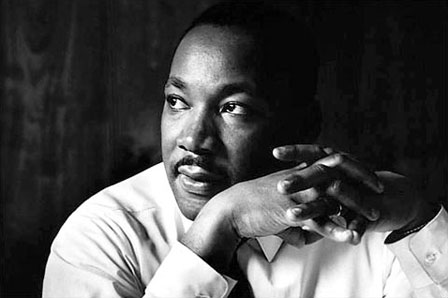
“I had a dream…” Martin Luther King, Jr.


[Image courtesy the Seattle Times

[Image courtesy the Seattle Times

Michael Luther King, Jr. was born on this day in Atlanta, Georgia, USA in 1929. Today is the 84th anniversary of his birth.


Born to into a “preaching” family. Both his father and grandfather were Baptist ministers. His maternal grandfather, A.D. Williams took over the Ebenezer Baptist church in Atlanta when its congregation numbered only 13. Under his leadership that quickly changed.  King’s father married Alberta Williams (A.D.’s only surviving child) in 1926.


Michael King Sr. stepped in as pastor of Ebenezer Baptist Church upon the death of his father-in-law in 1931. He too became a successful minister, and adopted the name Martin Luther King Sr. in honor of the German Protestant religious leader Martin Luther. In due time, Michael Jr. would follow his father’s lead and adopt the name himself. [Biography]


Martin was the middle of three children in the King household. He grew up in Atlanta attending Booker T. Washington High School. He entered Morehouse College at age fifteen. He graduated from Morehouse in 1948 and went on to get his Bachelor of Divinity degree at Crozer Theological Seminary in Chester, PA. and his Doctor of Philosophy from Boston University.


He emerged as a Civil Rights leader with the Montgomery Bus Boycott in December of 1955. In 1957 he worked with Ralph Abernathy and other ministers to create …


the Southern Christian Leadership Conference to harness the moral authority and organizing power of black churches. They would help conduct non-violent protests to promote civil rights reform. [Ibid]


The SCLC organize voter registration drives in the South. In 1959 King traveled to India


The trip affected him in a deeply profound way, increasing his commitment to America’s civil rights struggle. African-American civil rights activist Bayard Rustin, who had studied Gandhi’s teachings, became one of King’s associates and counseled him to dedicate himself to the principles of non-violence. [Ibid]


The “Sit-In” movement began in 1960. By summer 27 sit-ins had successfully ended lunch counter segregation. King joined an Atlanta lunch-counter sit in and was arrested with 36 others.


King was arrested again in 1963 after he organized a demonstration in Birmingham, Alabama. The demonstration, which included families, ended when the


City police turned dogs and fire hoses on demonstrators. Martin Luther King was jailed along with large numbers of his supporters, but the event drew nationwide attention. …However, King was personally criticized by black and white clergy alike for taking risks and endangering the children who attended the demonstration. From the jail in Birmingham, King eloquently spelled out his theory of non-violence: “Nonviolent direct action seeks to create such a crisis and foster such a tension that a community, which has constantly refused to negotiate, is forced to confront the issue.”[Ibid]


On August 28, 1963 King and his supporters marched peacefully to the Lincoln Memorial in Washington DC and he gave his “I Have a Dream” speech.


The Civil Rights Act passed 1964. The same year King received the Nobel Peace Prize. King continued to advocate for civil rights. He saw the passage of the Voting Rights Act in 1965 and worked to bring the Civil Rights Movement to larger cities.


President Lyndon B. Johnson and Rev. Dr. Marti...

President Lyndon B. Johnson and Rev. Dr. Martin Luther King, Jr. meet at the White House, 1966 (Photo credit: Wikipedia)


He also added his voice to the chorus of protesters against the Vietnam War.


He felt that America’s involvement in Vietnam was politically untenable and the government’s conduct of the war discriminatory to the poor…[Ibid]


In the spring of 1968 King went to Memphis, Tennessee to support sanitation workers who were on strike.


On April 3, in what proved to be an eerily prophetic speech, he told supporters, “I’ve seen the promised land. I may not get there with you. But I want you to know tonight that we, as a people, will get to the promised land.” The next day, while standing on a balcony outside his room at the Lorraine Motel, Martin Luther King Jr. was struck by a sniper’s bullet. [Ibid]


Julia Louis-Dreyfus 1.13.13 Thought of the Day


“I like playing somebody who has to apologize to their kid, all the time, for screwing up. That seems really real.” —Julia Louis-Dreyfus

Elaine Benes

Elaine Benes (Photo credit: Wikipedia)


Julia Scarlett Elizabeth Louis-Dreyfus was born on this day in New York, New York, USA in 1961. She is 52 years old.


Louis-Dreyfus was born into a wealthy family. Her father, Gerard Louis-Dreyfus, is a billionaire and the chairman of Louis Dreyfus Energy Services. Her mother is a writer. They divorced with Louis-Dreyfus was a baby and she went with her mother to live in Washington DC.  She studied acting at Northwestern University.

English: "The Golden 50th Anniversary Jub...

English: “The Golden 50th Anniversary Jubilee” cast photo: Brad Hall, Gary Kroeger, Julia Louis-Dreyfus and Paul Barrosse (Photo credit: Wikipedia)

She worked with Chicago’s Second City comedy group before moving to New York and joining the cast of Saturday Night Live for a three-year stint from 1982 to 1985. She left the show to do movies — landing supporting roles in Hannah and Her Sisters, Soul Man, and North  among others, and  to do prime time TV. She co-starred in Day by Day for that show’s two season run, and did a number of guest spots.

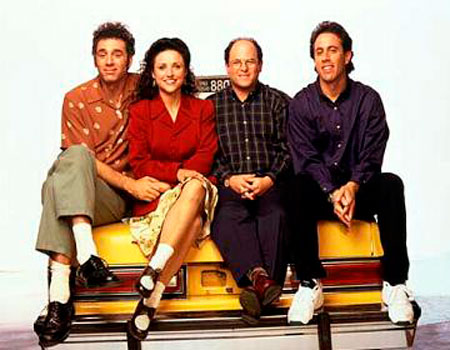
The Seinfeld gang. (Image courtesy NBC.)

The Seinfeld gang. (Image courtesy NBC.)


But Louis-Dreyfus really broke through with her role as Elaine Benes on the Seinfeld show.  She


proved that she could hold her own as the sole female member of Seinfeld’s do-nothing quartet of neurotic New Yorkers. With her “big wall of hair,” signature shoes and penchant for over-enthusiastic exclamations, Louis-Dreyfus’ Elaine was no mere foil, but rather a full participant in the show’s increasingly popular, irony-laden comic shenanigans. [Star Pulse.com]

She won her first Emmy award for the role in 1996. The show ran for nine seasons.


After Seinfeld she starred in the short-lived comedy Watching Ellie with fellow Second City alum Steve Carell. She had recurring rolls on high profiles shows like Arrested Development, The Simpsons and Curb Your Enthusiasm.

The New Adventures of Old Christine

The New Adventures of Old Christine (Photo credit: Wikipedia)

She won her second Emmy for her next sit-com, The New Adventures of Old Christine which ran for 5 seasons.


2012 saw her starring in a new series, HBO’s Veep. Louis-Dreyfus won her third Emmy for her role as Selina Meyer. She is a co-producer for the series.

English: Julia Louis-Dreyfus attending a cerem...

English: Julia Louis-Dreyfus attending a ceremony to receive a star on the Hollywood Walk of Fame. (Photo credit: Wikipedia)