Thought of the Day 10.29.12 Marie of Romania

Love, Faith, Courage with these three we can win the world..”

–Marie of Romania

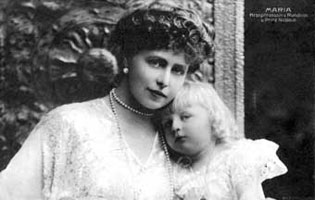
Marie Alexandra Victoria, Princess Marie of Edinburgh, was born on this day at Eastwell Park in Kent, England in 1875. Today is the 137th anniversary of her birth.

She was the eldest daughter of Prince Alfred of England and Grand Duchess Maria Alexandrovna of Russia and the granddaughter of Queen Victoria  on her father’s side and of Tsar Alexander II on her mother’s side. Because of  her double royal lineage she was considered highly suitable for a Royal match of her own.

When Marie was 17 she was married to Prince Ferdinand of Romania, a German raised nephew of King Carol I of Romania in Sigmaringen German in 1893. Ferdinand was 27 at the time. They had 6 children. Three boys and three girls. However, the marriage was not a happy one and The Princess took a lover, Barbu Stirbey. It is likely that Mircea (and possibly Mignon and Ileana) were Stirbey’s.

In 1914 King Carol I died and Ferdinand took the throne. Marie became Her Majesty the Queen of Romania but the couple were delayed in becoming the King and Queen until after World War 1.

During the War Princess Marie influenced the country to side with the Allies (and away from the Germans), she volunteered with the Red Cross  and nursed the sick and wounded. Her book My Country raised money for the Red Cross.

When WWI was over and the Allies were trying to figure out how to partition Europe and scold Germany, Marie herself went to Versailles and represented Romania. She wooed the ministers so much that they gave back territory that Romania had lost and promised not to partition her. [GEH — Queen Marie of Romania Study Notes]

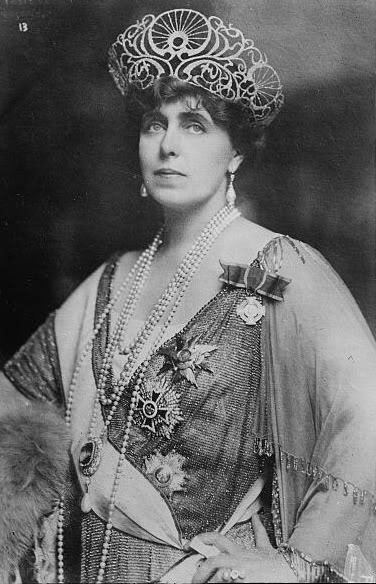
Queen Marie [Image courtesy Alexanderpalace.org]

Ferdinand and Marie were finally crowned in 1922. She was determined to be a modern queen.

A Queen who was not stuck in the Victorian time warp like Queen Mary of England, and a Queen who listened to her people and made herself available to her people. [Ibid]

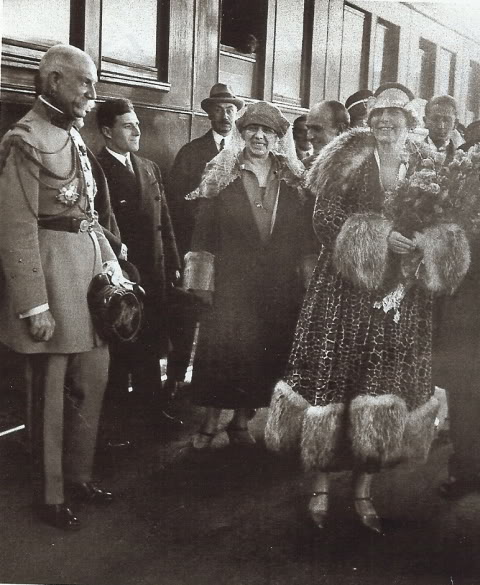
Queen Marie was very popular and travelled through out Europe and the US.

The Queen, on the right, traveling in Europe. [Image courtesy Alexanderpalace.org]

Although she was close with her younger children she was never on good terms with Crown Prince Carol (who became King Carol II after Ferdinand’s death in 1927). After Carol’s coronation he excluded his mother. She remained the Romania and wrote her two-part memoir, The Story of My Life. 

She died after a sudden illness in 1938. Following the Queen’s instructions her heart was removed from her body and kept at a cloister at Balchik Palace. The rest of her remains were interred with her husband.


Bonus Thought of the Day…Sandy

“Whhoooo…Clash….Bam…”
–Hurricane Sandy

Sandy pummels the Bahamas. [Universetoday.com]

There’s an old Irish saying: Sometimes you laugh to keep from crying. Please, keep that in mind in light of my flippant quote about the current weather conditions on the East Coast. I earnestly hope everyone keeps safe, dry and powered-up through this mess.

Hurricane Sandy was born a few weeks ago somewhere in the middle of the Atlantic.

It brought havoc and death to the Caribbean as it raged through The Virgin Islands, Puerto Rico, the Dominican Republic, Haiti, Jamaica, Cuba, and the Bahamas.  Sandy caused 65 deaths and was a “…disaster of major proportions” according Haitian Prime Minister Larent Lamothe in an interview with the Associated Press.  Crops and houses have been destroyed, bridges have collapsed,  and the Grand Bahamas’ airport suffered major damage.

Now the beast is snarling at the US main land, so people are really starting to take notice.

Sandy is barreling in from the Atlantic, and as of now the bombastic hype that’s been issuing on every weather report, news outlet and social media page for the past week far out weighs the rather gentle rain and soft to moderate wind outside.

I do anticipate an up tick in the weather, and fully expect a power outage, maybe even some flooding.

So, it seems, does every one else. Schools are closed, the Governor has urged everyone to stay home and off the streets — except in the case of an emergency!!! — and of yesterday there was no bottled water, milk or toilet paper on the shelves at the grocery store.

We are expecting high winds (40mph) and coastal waves in the 6-11 foot range. “Making matters even worse, Sandy will hit during a full moon and the astronomical highest tides.” [Universetoday.com]

At one point yesterday the weather map projected Sandy’s eye to be dead center over my town at 2 pm today, but that has shifted a bit northward.

I find it somewhat alarming how powerfully this storm has blown EVERY other news item off the radar. I suspect there might be something else of importance happening in the World, even if it ISN’T happening here. But for now all eyes are focused on weather gauge.

…Since I started this blog the winds have picked up a bit. So I guess she’s a-coming. Better go do the real blog before the lights go out…

Stay safe every one!


Thought of the Day 10.28.12 Jonas Salk

“I have had dreams and I have had nightmares, but I have conquered my nightmare because of my dreams.”
Jonas Salk

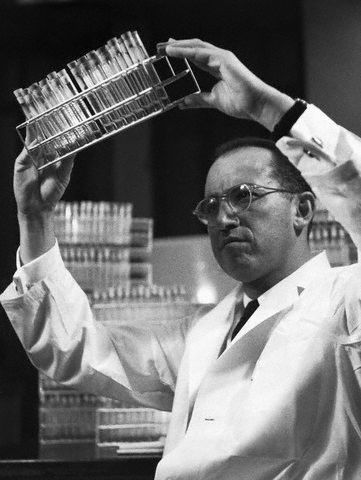
Salk in his University of Pittsburgh  lab. [Image courtesy: ExplorePAHistory.com]

Jonas Salk was born on this day in New York City in 1914 Today is the 98th anniversary of his birth.

He was the oldest of three boys born to Russian/Jewish immigrants, Daniel and Dora Salk. He was an excellent student and he attended Townsend Harris High School, a high school for gifted students and a springboard  for boys who had the talent but not the money or social connections to get into private colleges. At Townsend Harris he read everything he could find, he studied hard and always got good grades. At 16 he started the College of the City of New York. At first he focused on Law, but he soon changed his mind and decided to study medicine.

In 1934 he enrolled in the College of Medicine of New York University, from which he graduated in 1939. Salk worked at New York’s Mount Sinai Hospital from 1940 to 1942, when he went to the University of Michigan. There he helped develop an influenza (flu) vaccine. [Encyclopedia of World Biography]

The flu virus had recently been discovered and Salk worked on a way to “deprived of its ability to infect, while still giving immunity to the illness.” [Academy of Achievement]  His work in fighting the flu and in developing vaccines helped prevent a repeat of the flu epidemic like the one that ravished the country in 1919.

In 1947, Salk accepted an appointment to the University of Pittsburgh Medical School. While working there, with the National Foundation for Infantile Paralysis, Salk saw an opportunity to develop a vaccine against polio, and devoted himself to this work for the next eight years. [Academy of Achievement] 

Photo of polio patients in iron lungs during 1...

Photo of polio patients in iron lungs during 1952 epidemic (Photo credit: Wikipedia)

At Pittsburgh he researched the polio virus (in 1949 it was discovered that there were three types of polio viruses) and he worked on a vaccine that tackled the disease. By 1950 testing began, in 1955 the vaccine was ready for general use. Salk had developed a “killed-virus” vaccine that required three or four injections.

In countries where Salk’s vaccine has remained in use, the disease has been virtually eradicated. [Ibid]

Photo of newspaper headlines about polio vacci...

Photo of newspaper headlines about polio vaccine tests (Photo credit: Wikipedia)

Salk won the Lasker science award in 1956 for his work on Polio.

The Salk Institute for Biological Studies, which focused on the autoimmune functions of the body opened in San Diego, California in 1963.  While heading up the institute Salk published Man Unfolding (1972), The Survival of the Wisest (1973), World Population and Human Values: A New Reality (1981), and Anatomy of Reality (1983).

Towards the end of his life Dr. Salk took up the fight against AIDS and searched for an effective vaccine for the disease.

He died at the age of 80 in 1995 in La Jolla, California.

Jonas Salk, American medical scientist (bust i...

Jonas Salk, American medical scientist (bust in the Polio Hall of Fame) (Photo credit: Wikipedia)


Thought of the Day 10.27.12 Desiderius Erasmus

“Give light, and the darkness will disappear of itself.”

“The desire to write grows with writing.”

“War is delightful to those who have had no experience of it.”

Desiderius Erasmus

Desiderius Erasmus, 1466-1536, Rotterdam Renai...

Desiderius Erasmus, 1466-1536, Rotterdam Renaissance humanist, Catholic priest and theologian, by Hans Holbein the Younger, 1523. (Photo credit: Wikipedia)

Desiderius Erasmus was born on this day in Rotterdam, Holland in 1467 (or perhaps 1466). Today is the 545th (546th) anniversary of his birth.

He was the illegitimate son of Gerard (aka Roger) of Gouda and his housekeeper, Margaret Rogers. He was their second son.  Gerard either was a Catholic priest at the time of Erasmus’ birth or he took vows soon after. Although his parents never married the boys weren’t neglected. Their father saw to it that they were well educated. He sent 9-year-old Erasmus and 12-year-old Pieter to “one of the best Latin grammar schools in the Netherlands near Deventer.” [Stanford Encyclopedia of Philosophy] Margaret moved to the town to take care of the boys. At this semi-monastic school they and learned Latin, Greek and a humanist approach to literature and culture.

In 1483 the Black Plague hit the city. Margaret died and the boys went back to Gouda. Gerard soon fell ill too. At his death the brothers were left with a small inheritance in the hands of three guardians. At first they were sent to a grammar school. “The highest level of study there did not go up to the level the brothers had already completed at Deventer. Erasmus regarded this period as a total waste.” [Ibid] The boy’s options were limited.

“Since the two boys had only a small inheritance and, being born out-of-wedlock, were not eligible for an ordinary career as secular priests or for membership in many professions, entry into a monastery was their only realistic option.”[ibid]

It was an option neither of them wanted, but Pieter agreed, and after much pressure Erasmus finally gave in. He entered the Steyn monastery in 1487 as a novice.

“He felt no true religious vocation for such a step, and in later years characterized this act as the greatest misfortune of his life. … He was left free, however, to pursue his studies, and devoted himself mainly to the ancient classics, whose content and formal beauty he passionately admired.”[New Advent Catholic Encyclopedia]

Here he found kindred spirits who shared his love of classical literature. He wrote De Contemptu mundi (On Contempt of the World) while at Steyn (although it wasn’t published until 1521). Still he resented the limits on his activities and freedoms, and he felt thwarted by the limited intellect of some of the other monks (he wrote about that in Antibarbarorum liber (Book Against the Barbarians). None the less he agreed to be ordained as a priest in 1492.

Ordination should have turned the lock in the monastery, gate as it were, but Erasmus’ was already  “identified as an intelligent and widely read monk with an outstanding Latin style.” [Stanford Encyclopedia of Philosophy] and about a year after taking final vows he was plucked from the monastery to act as secretary to the Bishop of Cambrai, Henry of Bergen. It was to be a temporary assignment, but some how he managed never to return.

Erasmus persuaded the bishop to send him to study theology at the University of Paris, in the Collège de Montaigu. He found Montaigu less than wonderful. The food was so bad it ruined his digestive system for life. The housing was filthy.  And the students were expected to do menial labor along with their studies. He also “expressed hostility to the traditional scholastic theology based on questions, disputations, and reliance on Aristotle.” [Ibid] He found it, in a word, medieval. ” But Paris also had an active literary life and had been thoroughly exposed to the humanistic culture of Italy. The city and the court had a substantial circle of humanists.” [Ibid]

For the next two decades he travelled back and forth across Europe staying in Paris, Leuven (Belgium), England, Basel (Switzerland) and Italy but he consciously avoided any permanent alliances that would limit his intellectual freedom or literary expression. “…after his return from England in 1500, religion as well as the study of Greek became more prominent in his thought.”[Ibid] He was determined to master Greek so he could translate biblical texts and he focused a good deal of his attention on the writings of “St. Jerome, the most learned of the ancient Latin Fathers… ” [Ibid]  He received the degree of Doctor of Divinity at Turin. He befriended printer/publisher Aldus Manutius and embraced the new technology of the printing press as a way to communicate.

In 1514 he went to Basel and met with publisher Johann Froben who became his publisher of choice for the rest of his life. He worked with Froben to publish Novum Instumentum  (later Novum Testamentum  which “included the first published edition of the Greek text of the New Testament, accompanied by a cautious revision of the traditional Latin New Testament and by Erasmus’ annotations explaining how in specific passages…” [Stanford Encyclopedia of Philosophy] This ‘new testament’ was a marketing coup as much as it was a literary masterpiece. In Spain a bigger, better financed (and probably better researched — they had better Greek manuscripts) New Testament was sitting in a warehouse waiting the blessing of Cardinal-Archbishop of Toledo (the work’s sponsor.)  Erasmus and Froben were under no such editorial control. The Spanish…

“Edition was made obsolete even before publication by Erasmus’ humanistic methods of textual criticism. The future of biblical studies belonged to the new philological and critical methods developed by Erasmus, not to the cautious and traditionalist approach of the Spanish scholars Their edition was obsolete  [Stanford Encyclopedia of Philosophy]

It didn’t hurt that he dedicated his Greek/Latin hybrid New Testament to Pope Leo X. in 1517 He published his research on St. Jerome (all seven volumes of it) ” confirming his status as the greatest scholar of his generation.” [Ibid] Erasmus and Froben also put out a new addition of the former’s Adages with additional proverbs.
The Adages became not only a handy tool for those who wrote in Latin but also a medium for expressing Erasmus’ opinions, and the book was another literary and financial success, frequently reprinted throughout the century. [Ibid]
In 1516 Erasmus petitioned the Pope Leo X for “relief from certain legal disabilities.”[Ibid]

1.    the burden and consequences of his illegitimate birth
2.    his membership in the monastery at Steyn
3.    having to wear the robes of the Augustinian monks

Leo  approved the petition. Erasmus moved to the University of Louvain in the Netherlands.Although his German Humanism was not a perfect match with the more conservative Louvian theology Erasmus seemed to have found a home.
But then there was that GERMAN,  Martin Luther, who went and nailed his protest to the door of a church.  “With remarkable rapidity, reform-minded young German humanists (and many older ones also) who had become admirers of Erasmus identified Luther’s ideas and reform program with those of Erasmus, regarding Luther and Erasmus as leaders of a single movement.” [Ibid]  Erasmus HAD been a vocal critic regarding the follies and abuses of the clergy, but  it was against his nature to take up a partisan position on the issue of Protestantism.

“The emergence of Luther caused serious problems for Erasmus across a broad front, including his situation in Louvain….Erasmus came under intense pressure to join in their denunciation of Luther, but he was unwilling to do so, claiming that he was so busy that he had read none, or almost none, of Luther’s publications. In reality, he had read at least some of Luther’s books with great interest and had concluded that while Luther took extreme positions on some questions and might have made some errors, there was much to be praised in his works.” [Ibid]

Unable to denounce Luther Erasmus moved from Louvian to Basel, back to his old friend the printer, Froben.  He lived there for eight years until the city “reformed” in 1529. He felt morally obligated “to leave a city where open Catholic worship was suppressed. He moved to the near-by city of Freiburg-im-Breisgau, also a university town. ” [Ibid]
He died in 1536 …
“He did not have a priest available to administer last rites, and there is no evidence that he desired such ministrations, which he had always respected if done in the right spirit but never considered very important. He died during the night of 11–12 July. A whole host of ailments contributed to his end, but dysentery was the immediate cause.”[Ibid]

English: bust of Ermasmus, made by Hildo Krop ...


Thought of the Day 10.26.12 Natalie Merchant

“If I ever write this letter
Bitter words it would contain
Just an unrequited lover
Wishing she had never
Spoken your name
Had never known your name”
— Natalie Merchant

MTV Unplugged (10,000 Maniacs album)

MTV Unplugged (10,000 Maniacs album) (Photo credit: Wikipedia)

Natalie Anne Merchant was born on this day in Jamestown, New York, USA in 1963. She is 49 years old.
Merchant is the third of four children. Although her parents never allowed their children to watch television there was always plenty of music in the house. Her mother listened to an eclectic mix of classical music, show tunes, jazz and pop music and it rubbed off on little Natalie. Merchant dropped out of high school at 16 and worked briefly at a health food store. After a stint working at a summer program for handicapped children she considered going back to school become a special education teacher.

…But that changed when she met Robert Buck in 1981 and became the lead singer for 10,000 Maniacs. The band released eight albums together: Human Conflict Number Five (1982), The Secrets of the I Ching (1983), The Wishing Chair (1985), In My Tribe (1987), Blind Man’s Zoo (1989), Hope Chest (1990), Our Time in Eden (1992) and MTV Unplugged (1993). [IMDB]

10,000 Maniacs reached its peak of popularity around 1988. They weren’t “chart driven” and never topped Billboard’s Top 100, but they had a loyal fan base, due in large part to their videos on MTV.

This was another of the off-center, non-mainstream acts that assembled a fine collection of tunes. They were often ignored by head-in-the-sand mainstream radio. But their music was refreshing as well as stimulating. Natalie Merchant certainly was the driving force behind 10,000 Maniacs.[Top Ten Songs by 10,000 Maniacs, Yahoo! Voices]

Here’s Trouble Me from Blind Man’s Zoo:

Merchant left the group shortly after the MTV Unplugged session in 1993 and began work writing and producing her first solo effort Tigerlily. The album came out in 1995 to wide acclaim. It sold over 5 million copies and earned her a spot in the top-ten lists with Carnival.

Her second release was Ophelia, with Kind and Generous, and her Live in Concert CD also sold well.  In 2000 she went on the road with the alt-country band Wilco in the “American Folk Music Tour”. She produced Motherland the following year with Tell Yourself and  Build a Levee. (Here’s the later performed on the David Letterman Show.)

Motherland was her last release on Elektra Records. Merchant started her own label, Myth America Records, to release 2003’s The House of Carpenter’s Daughter. The album has a mix of traditional tunes and covers of contemporary folk songs (like Richard Thompson’s Crazy Man Michael and Florence Reece’s Which Side are You On?)

In 2004 Campfire Songs, a compilation album of “popular, obscure, and unknown”  10,000 Maniac songs, was released. Merchant put out her own Retrospectivealbum the next year.

Leave Your Sleep came out in 2010. This concept album includes songs adapted from poetry about childhood.

…An ambitious double-album that draws upon multiple literary giants for inspiration. The new set, “Leave Your Sleep,” features lyrical tributes to famous poems by e.e. cummings, Christina Rossetti, Robert Louis Stevenson and many others throughout the course of 26 tracks. Despite the elaborate concept and overwhelming length, the album soars with gorgeous folk arrangements and Merchant’s daring creativity. [BillBoard.com]

In June of this year Leave Your Sleep became a 48 page picture book  with illustrations by Barbara McClintock. The book includes a CD with 19 songs.

Merchant continues to write and perform. She will be at the Milwaukee Theatre tomorrow night. If you’re lucky enough to snag tickets… be sure to wish her a happy birthday.

Click HERE to see other upcoming Natalie Merchant Shows.


Thought of the Day 10.25.12 Anne Tyler

“My family can always tell when I’m well into a novel because the meals get very crummy.”
Anne Tyler

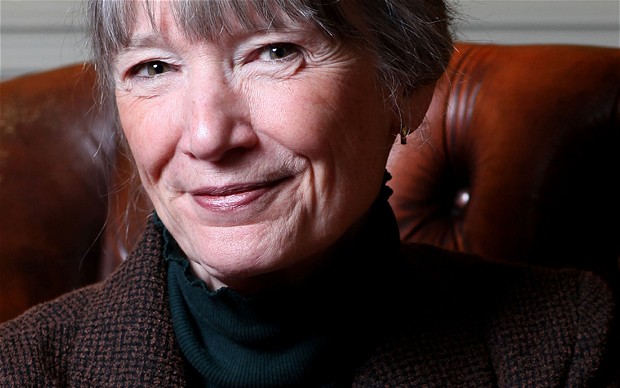
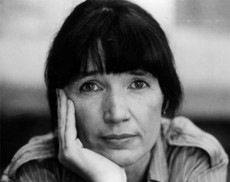
Anne Tyler was born on this day in Minneapolis, Minnesota in 1941. She is 71 years old.

She is the oldest of four children. Her parents moved around, searching for the best place to raise the family, but settled, when Anne was six, in the Celo Quaker Community near Burnsville North Carolina. Anne and her siblings attended a small local school. She says she never planned on being a writer, but would tell herself stories to get to sleep at night. She liked Westerns, but, her favorite book was Virginia Lee Burton’s tale, The Little House. Later she read Eudora Welty who showed her “that very small things are often really larger than the large things.” [Tyler from a 1977 New York Times interview. nytimes.com]

She majored in Russian at Duke University, but an English 101 class with Professor Reynolds Price started her on a literary career. Tyler  graduated at 19 Phi Beta Kappa and Price introduced her to his literary agent.  Tyler won the Anne Flexner creative writing award twice at Duke. She went on to Columbia to do post-graduate work in Russian studies at Columbia. She worked  as a bibliographer at Duke and at the law library at McGill University in Montreal after graduating. She published short stories in The New Yorker, the Saturday Evening Post and Harper’s Magazine prior to settling in Baltimore and marrying psychiatrist Taghi Modarressi.

Her first novel, If Morning Ever Comes was published in 1964. The Tin Can Tree followed a  year later. Tyler doesn’t like either of the books, and almost left the manuscript for ‘Morning’ on a plane on purpose. There is a five-year gap between ‘Tin Can’ and her third novel A Slipping-Down Life. She spent the time productively — she had her two daughters, Tezh and Mitra.
In 1974 she published Celestial Navigation. It is one of her favorite’s (one of mine too.) Here’s the Amazon write up…

Thirty-eight-year-old Jeremy Pauling has never left home. He lives on the top floor of a Baltimore row house where he creates collages of little people snipped from wrapping paper. His elderly mother putters in the rooms below, until her death. And it is then that Jeremy is forced to take in Mary Tell and her child as boarders. Mary is unaware of how much courage it takes Jeremy to look her in the eye. For Jeremy, like one of his paper creations, is fragile and easily torn–especially when he’s falling in love…. [Amazon.com]

Tyler wrote one book about every two years. So by 1980 she’d published eight novels.  Searching for Caleb, Earthly Possessions and Morgan’s Passing rounded out the early list.
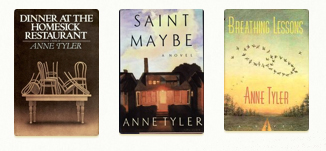
In 1982 she published Dinner at the Homesick Restaurant. ‘Homesick’ “explores tensions inside a family – for Tyler it is the basic battlefield of all society.” [Books and Writers] The book was a finalist for the Pulitzer Prize and the Pen/Faulkner Award. [And it remains my favorite of Tyler’s novels. This book would be on my Desert Island Bookshelf*.]

Book #10, The Accidental Tourist, put Tyler on the map. Not only did she win the national Book Critics Circle Award for it in 1985, but it was made into a major motion picture starring William Hurt and Geena Davis. It too was shortlisted for a Pulitzer, but Tyler had to wait one more book before capturing that prize. [I loved the sibling interaction in this one, as well as the hope for new and unlooked for love.]

Of her writing process Tyler said:

“I think of my work as a whole. And really what it seems to me I’m doing is populating a town. Pretty soon it’s going to be just full of lots of people I’ve made up. None of the people I write about are people I know. That would be no fun. And it would be very boring to write about me. Even if I led an exciting life, why live it again on paper?… I hate to travel, but writing a novel is like taking a long trip. This way I can stay peacefully at home.” [Tyler from a 1977 New York Times interview. nytimes.com]

Breathing Lessons earned the Pulitzer and was named Time Magazine’s Book of the Year. Maggie and Ira have been married for 28 years. Things have gotten, shall we say “comfortable?” Like an old leather recliner is comfortable. They take a 90-mile trip to a funeral and “Tyler explores the problems of marriage, love and happiness” [Ibid] [Read it, and you’ll never eat fried chicken again with out a remembering the melancholy cooking scene near the end of this book.] It was made into a Hallmark Hall of Fame television movie in 1994 starring James Garner and Joanne Woodward and into a stage play.

1991 brought Saint Maybe with guilt ridden 17-year-old Ian Bedloe dropping out of school to take care of his dead brother’s children.  School Library Journal says of the novel:

“Tyler’s remarkable novel pulls at the heart-strings and jogs the memories of forgotten youth. Ian’s story is neither action packed nor fast-moving, but each page will be eagerly anticipated. “[Amazon.com]

Ever feel like your family takes your for granted and no one listens to you when you speak?  Delia Grinstead, the heroine of Ladder of Years, does. She REALLY does. And when things come to a head during a trip to the beach she walks away from it all to re-discover who she really is.

A Patchwork Planet was another of my favorites. 29-year-old Barnaby is the family’s black sheep. He got into trouble as a teen and now he doesn’t aspire to much more than helping out old people in his job at “RENT-A-BACK.” There’s a cast of fantastic, spindly, eccentric clients, and Barnaby’s less than loveable family. Then there’s Barnaby himself…

“Sharp and impatient at painful–and painfully funny–family dinners, apparently unable to keep his finger off the auto-self-destruct button every time his life improves. As much as his superb creator, he is a poet of disappointment, resignation, and minute transformation.” [Kerry Field review on Amazon.com]

Tyler’s 15th Novel is Back When We Were Grownups. The book is about widow, Rebecca Davitch, who reassesses her life at the age of 53.  The Amateur Marriage centers on the crumbling marriage of Michael and Pauline Anton. Married just after he returned from WWII the couple wonders if they know anything more about each now than they did 30 years ago. Two families adopting Korean infant daughters meet at the airport at the beginning of Digging To America. The novel follows the two different families (with wildly different parenting techniques) who meet up every year for an annual Arrival Party. Tyler’s handling of mixed cultures adds a new dimension to her usual mix of excellent social commentary.
Liam Pennywell is the protagonist of Noah’s Compass. He is a teacher forced into early retirement who struggles with the fact that he’s never really reached his full potential.

Her latest novel is The Beginner’s Goodbye, which the Boston Globe calls:

“An absolute charmer of a novel about grief, healing, and the transcendent power of love . . . With sparkling prose and undeniable charm, Tyler gets at the beating heart of what it means to lose someone, to say goodbye, and to realize how we are all, perhaps, always ultimate beginners in the complex business of life . . . A dazzling meditation on marriage, community, and redemption.” [Boston Globe review, Amazon.com]

Tyler wrote two children’s book, Tumble Tower and Timothy Tugbottom Says NO! Both were illustrated by her daughter Mitra Modarressi. Tumble Tower with the fabulous Molly the Messy is a must for emergent readers who want a giggle and a hug. (I haven’t read Timothy.)
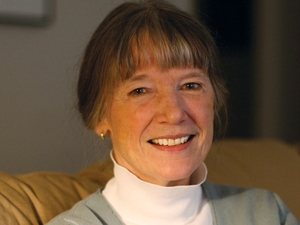
She jots notes on index card where ever she happens to be in her house then collects them in one of two metal boxes. There is a blue box for NOVEL notes and a second box for SHORT STORIES.
She says she isn’t driven to write but is “driven to get things written down before (she) forget(s) them.” [Ibid] Then once it is all written down she reads it all back and “suddenly it seems as if someone else is telling me the story and I say ‘now I see’ and then I go all the way back and drop references to what it means.”[Tyler from a 1977 New York Times interview. nytimes.com]

“Sometimes a book will start with a picture that pops into my mind and I ask myself questions about it and if I put all the answers together I’ve got a novel.” [Tyler from a 1977 New York Times interview. nytimes.com]

——————————

You may have noticed that I’ve quoted a rather old New York Time’s interview quite a bit in this bioBlog. That’s because Tyler very seldom gives interviews.

I read most of her early books in my twenties but I’m going to go put them on my Kindle now. I wonder how much they’ve changed because of how much I’ve changed over the years? I know one thing that will change… the font size. I will pump up that font size to something nice and big for these ole eyes. Ha!

———————————

*So … what 10 books would you want on your Desert Island Bookshelf ? I’d definitely have Dinner at the Homesick Restaurant on my shelf. I know that Persuasion, Sense and Sensibility and Pride and Prejudice would be on there too. (I’d like to be clever and get a Jane Austen collection with all six novels, but then the font size would be too small to read) How about you? What books would make the list?

———————————


Thought of the Day 10.24.12 Kweisi Mfume

“And it really gets down to an issue of class. The poor and the poorest of the poor tend to be the ones that are being missed by the census,”
–Kweisi Mfume

Mfume delivering a speech at NOAA during Black...

Mfume delivering a speech at NOAA during Black History Month, 2005 (Photo credit: Wikipedia)

Frizzel Gerald Gray was born on this day in Tuner Station, Dundalk just outside of Baltimore, Maryland in 1948. He is 64 years old.

He is the oldest of four siblings. His father left the family when Gray was a 11 and his mother, Mary Elizabeth Gray, raised the children as best she could as a single mother. She died of cancer when he was 16.

“After she died of cancer, things spun out of control.” Mfume quit high school during his second year and went to work to help support his sisters. At times he worked as many as three different jobs in a single week.” [Kweisi Mfume Biography. Encyclopedia of the World Biography

He began to hang out on the corner drinking with friends to blow off steam. He admits to hanging with the wrong crowd. He could feel his life spiraling out of control as he was arrested on suspicion of theft “Because” he said in a U.S. News and World Report interview ” I happened to be black and happened to be young.” And soon found himself the teenaged parent of five children.

But on a July night in the late 60s all that changed. He felt something come over him and he stepped away from the corner and toward the future. He spent “the rest of the night in prayer, then proceeded to earn his high-school diploma and pursue a college degree.” [IBID] He changed his name to Kweisi Mfume, a phrase that means “conquering son of kings” in Ghana.

He began to work in radio, first as a volunteer than as an announcer. When his college, Morgan State University  opened its own radio station Mfume became the program director.
Flag of Baltimore, Maryland. Image created by ...

Flag of Baltimore, Maryland. Image created by uploader based on images found at crwflags.com and nava.org, as well as other images found on the web. (Photo credit: Wikipedia)

He parlayed his popularity on the Radio and in Baltimore’s African-American community into politics in 1978 when he ran for Baltimore City Council. There he became a vocal critic of Mayor William Donald Schaefer whom he accused  of ignoring poor neighborhoods. Eventually Mfume learned the three-pronged art of negotiation, compromise and coalition building.
DSC_0120

DSC_0120 (Photo credit: owillis)

In 1986 he ran for U.S. House of Representatives and won a seat in Congress. He worked on the House Committee on Banking, Finance and Urban Affairs and later on farming and zoning issues. He maintained a strong tie to Baltimore City and the residents that lived in the inner city.
By his fourth term, Mfume had enough influence to become chairman of the Congressional Black Caucus, a group in Congress that supports the interests of African-Americans. Soon after his election as chairman, Mfume and the Caucus presented a list of demands to President Bill Clinton (1946–), most of them having to do with federal aid to cities and the poor. [IBID]
In 1996 Mfume left Congress and became the president of the NAACP (the National Association for the Advancement of Colored People. He successfully managed the organization’s financial issues and illuminated the NAACP’s $4.5 million debt. He worked to address “affordable health care, conservation, voting reform, and hate crimes.” [IBID.] He helped raise over $90 million and created the NAACP’s National Corporate Diversity Project during his tenure at the organization. His term at the NAACP ended on January 1, 2005.
Kwesi Mfume, Fmr Prez of NAACP

Kwesi Mfume, Fmr Prez of NAACP (Photo credit: Youth Radio)

Mfume made an unsuccessful bid for a U.S. Senate seat. Although he remains active as a political supporter and organizer he has not run for public office since. Currently he serves on a number of boards of public and private institutions such as the National Advisory Council on Minority Health and Health Disparities, the Platform Committee of the Democratic National Convention and the National Advisory Council of Boy Scouts of America. He actively lectures at…
Colleges, Universities, Corporations, and Bar Associations across the country on corporate diversity, compliance, inclusion, disparities in health care, tolerance and the new challenges of gender and race. [kweisimfume.com]

Logo Design: Hereford UMC Venture Zone Blast

Logo Design: Hereford UMC Venture Zone Blast


I bet you are wondering what this is doing here, right? Well, I spent most of the morning posting on my sister site… ritaLOVEStoDESIGN@wordpress.com, and I wanted to encourage my ritaLOVEStoWRITE folks to jump over there and take a look.

Because design is the Dr. Jekyll to my writing Mr. Hyde (except the both know about the other and nobody dies == at least I  THINK nobody has died…)

I have lots more to put up on the design side, but the book covers, mag covers, logos etc will give you an idea of what I do.
Enjoy,

Cheers,

Rita

http://www.ritaLOVEStoDesign.wordpress.com


Thought of the Day 10.23.12 Ang Lee

“I did a women’s movie, and I’m not a woman. I did a gay movie, and I’m not gay. I learned as I went along.”
— Ang Lee

Ang Lee

Ang Lee (Photo credit: Wikipedia)

Ang Lee was born on this day in Chaochou in Pingtung, Taiwan in 1954. He is 58 years old.

His parents put a heavy emphasis on a classical Chinese education, including culture, art, and calligraphy. His father was the principal at his high school, and Ang was expected to become an academic, perhaps a professor. But, his interests in drama took him in another direction.

After graduating from The national Taiwan College of Arts and completing his mandatory service in the Republic of China’s military, Ang Lee attended the University of Illinois at Urbana-Champaign where he received his BFA in Theatre/Theater Direction and New York University where he earned his Masters in Film Production.

At NYU he worked with Spike Lee on Joe’s Bed-Stuy Barbershop: We Cut Heads. His Shades of the Lake was a Best Drama pick in Short Film in Taiwan and his Fine Line, his thesis film, won the Outstanding Direction Wasserman Award and was later shown on the BBC.

Cover of "The Wedding Banquet"

Cover of The Wedding Banquet

His professional career was off to a slow start. After struggling for six years he submitted the screenplays for Pushing Hands and The Wedding Banquet to a Taiwanese  competition in 1990. The scripts came in first and second.

Lee … eventually making his directorial debut in 1992 with Pushing Hands. A comedy about the generational and cultural gaps in a Taiwanese family in New York, it won awards in Lee‘s native country. [NYTimes.com]

The Wedding Banquet had an art house release in the US and Lee found a much wider audience. It was the second film in his “Taiwanese Trilogy” and like the others it featured generational and cultural conflicts. Here Winston Chao played…

a homosexual Chinese man who feigns a marriage in order to satisfy the traditional demands of his Taiwanese parents. It garnered Golden Globe and Oscar nominations, and won a Golden Bear at the Berlin Film Festival. [IMDB]

The third film in his valentine to Taiwan  was Eat Drink Man Woman. It tells the story of a semi-retired chef and his three grown daughters. It cemented his role as “A warmly engaging storyteller [Janet Maslin, The New York Times]

Cover of "Eat Drink Man Woman"

Cover of Eat Drink Man Woman

Lee switched continents  and centuries when he helmed his next film, Emma Thompson’s wonderful adaptation of Jane Austen’s Sense and Sensibility. It won a BAFTA  and Golden Globe award for Best Picture. Lee was voted Best Director by New York Film Critics Circle.  Austen’s resurgence in popularity can be traced back to Lee’s Sense and Sensibility and the Colin Firth/Jennifer Ehle Pride and Prejudice mini-series that came a half decade later. [S&S is one of my personal favorite Austen film adaptations. Alan Rickman’s Col. Brandon still makes me sigh.]

Back in 20th century (this time 1973 Connecticut), Lee tackled a dysfunction family in crisis in The Ice Storm. The film starred Kevin Kline, Joan Allen, Sigourney Weaver, Tobey Maguire, Christina Ricci and Elijah Wood.

He worked with Tobey Maguire again in Ride with the Devil, a Civil War tale about two friends who join the Bushwhackers in Missouri.

Cover of "Crouching Tiger, Hidden Dragon ...

Cover via Amazon

Next came the magical Crouching Tiger, Hidden Dragon. It is the story of a mysterious young assassin who steals a magical sword and the two martial arts masters who set out retrieve it. The chase through the bamboo forest alone is worth the price of a rental.

With movies about family drama, English classical literature and Asian mystical martial arts under his belt Lee did  the next logical thing… he directed a movie based on the Marvel Comic’s hero the Hulk.

Star-crossed lovers. The poster was fashioned ...

Star-crossed lovers. The poster was fashioned after Titanic ‘ s. (Photo credit: Wikipedia)

IN 2005 Lee tackled his most controversial movie yet, Brokeback Mountain. The film starred Heath Ledger, Jake Gyllenhaal,

The film’s sensitive and epic portrayal of a thriving romance that survives between two Wyoming cowboys in the 1960’s was praised as both elegiac and grounded. Lee‘s deft handling of material that simultaneously drew on the established themes of classic cinema and pioneered completely unexplored territory in mass media could not have been more exalted…[NYTimes.com]

Lee won Best Director  at the Academy Awards, BAFTAs and Gold Globes for Brokeback Mountain.

Lust, Caution  takes place in Japanese occupied 1938 Hong Kong and 1940s Shanghai. A group of Chinese university students plot to assassinate a government official. The film was called tense, sensual and beautifully-shot. The film did well in Hong Kong and China, but because of  its adult content it earned  an NC-17 rating in the US and didn’t do well in this market.

2009’s Comedy/Drama Taking Woodstock offers a  groovy look on how the world’s most famous music concert came to be. The Chicago Time’s Michael Phillips called it “A mosaic…drifting in and out of focus — stitching the story of how the peace-and-music bash fell together.”

His latest film, Life of Pi is due out next month. Life of Pi is based on the novel by Yann Martel and is about a 16-year-old survivor of a ship wreck. He finds himself on a lifeboat with another unusual (and dangerous) castaway.