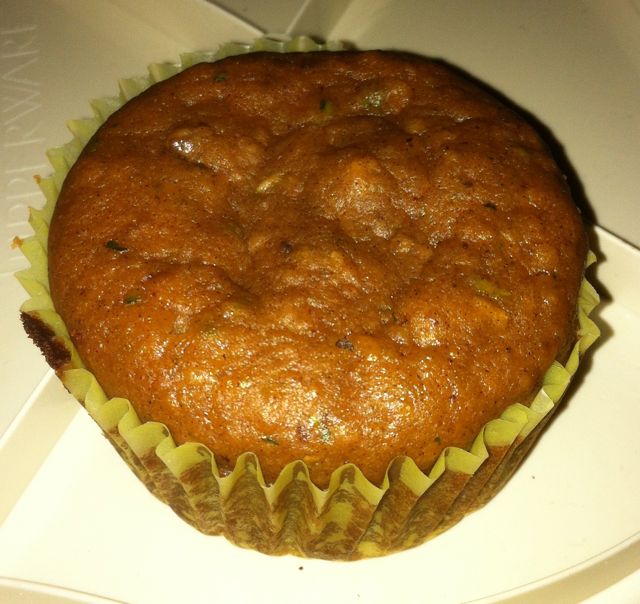
Muffin Monday! Date Zucchini Orange Muffins

So… I thought I’d indulge in another of my passions — BAKING — one day a week. What do you think? Unless I hear some serious uproar in protest I proclaim Mondays “Muffin Monday” in all the land. You may have noticed the amended bit at of the legal portion of my Home Page… please note that although the recipes I’ll be highlighting in Muffin Monday worked brilliantly in my kitchen they may not work for you. I’m not calling you a bad cook or any thing, but SOMETHING might happen… and since I’m not there watching you add the ingredients one at time or setting the temperature I can’t be responsible for the end results. Having said that… give it a go and see if you like it.  If you do please let me know.

————————————————————————————

Date Zucchini Orange Muffins

CookbookCupcakePan

CookbookCupcakePan (Photo credit: Wikipedia)

Ingredients:

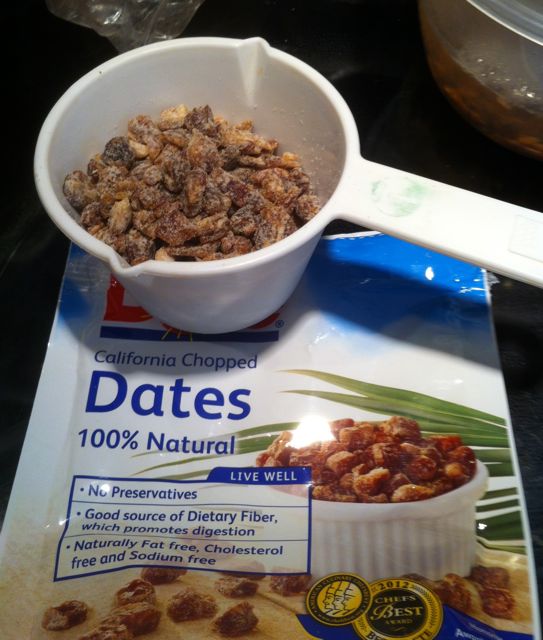
  • 1 cup of chopped dates

IMG_4510

  • 1 teaspoon baking soda

IMG_4513

  • 1 1/4 cup of very hot water
  • 3/4 cups of butter (1 1/2 sticks) melted and slightly cooled

IMG_4518

  • 2/3 cup Tuvia sugar substitute (or 1 cup sugar)

IMG_4532

  • 2 eggs

IMG_4522

  • 1 orange (peeled and sectioned)

IMG_4517

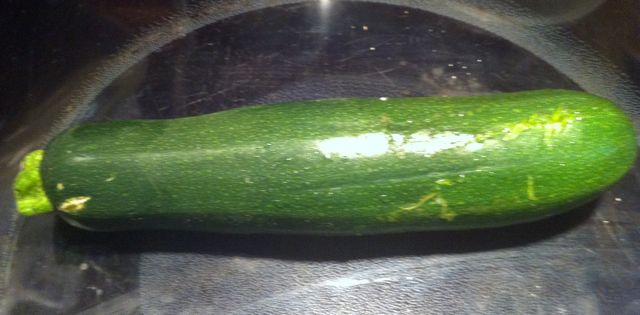
  • 1 medium zucchini grated

IMG_4520

  • 1 teaspoon vanilla

IMG_4540

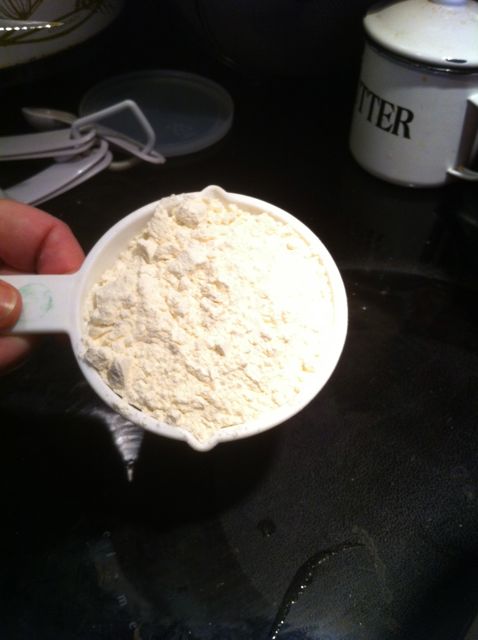
  • 2 cups flour

IMG_4535

  • 1/4 teaspoon salt

IMG_4537

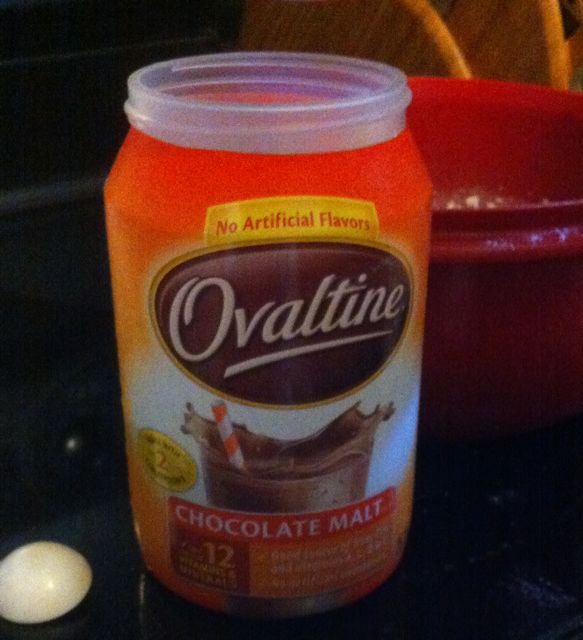
  • 1/2 cup Ovaltine Chocolate Malt mix (optional)

IMG_4542

Directions:

Heat the oven to 375 degrees F.

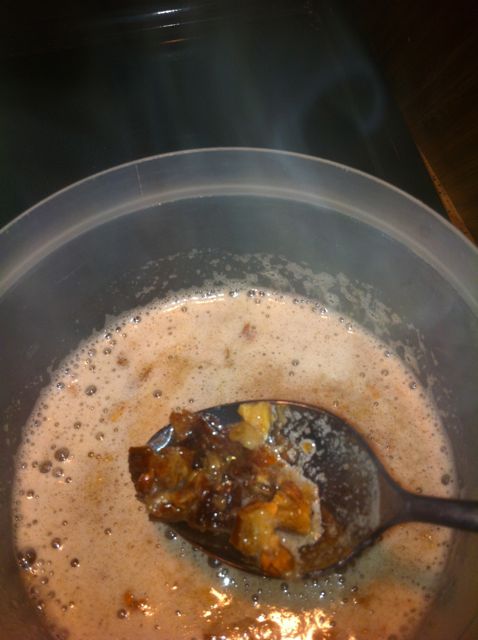
Step One: Put Dates and Baking Soda into the hot water and stir. Set aside to cool.

IMG_4515

Step Two: Put the peeled/sectioned Orange in a blender …

IMG_4525

…add the Tuvia (or sugar),  the Eggs…

IMG_4526

…and melted (liquid but cooled) Butter and blend.

…Add the grated Zucchini and Vanilla and blend.

…Add the Date mixture and blend.

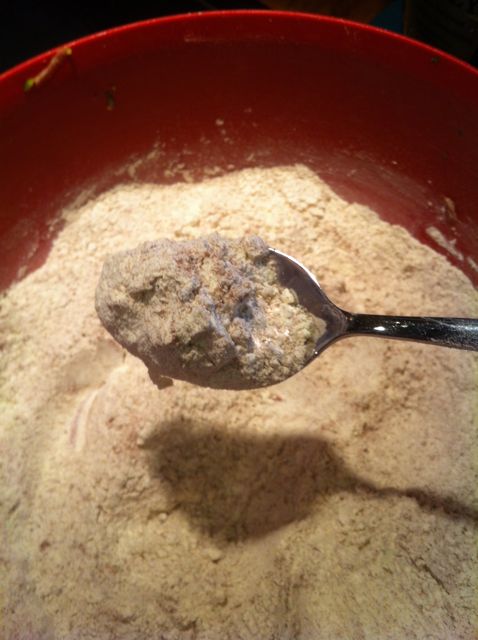
Step Three: In a bowl mix the Flour, Ovaltine, and Salt.

IMG_4544

Slowly incorporate the liquid from the blender into the dry ingredients in the bowl.

IMG_4549

Prepare the muffin cups (this recipe will make about 18 muffins.) Put “muffin pants” into the tin and spray lightly with cooking spray.

IMG_4551

Divide the batter evenly into the muffin cups. They should be about 2/3rds of the way full.

Place into hot oven and bake for 20 – 25 minutes until tops are brown and a tooth pick stuck into the center of the muffin comes out clean.

Let cool and enjoy.

IMG_4556


St. Patrick 3.17.13 Thought of the Day

“Christ beside me, Christ before me, Christ behind me,
Christ within me, Christ beneath me, Christ above me.”
St. Patrick

[Image courtesy: Wikipedia]

[Image courtesy: Wikipedia]

St. Patrick died on this day in 461, in Saul, Ireland. Today is his Feast Day.

Patrick was born in Scotland sometime around 385 AD to Roman parents, Calpurnius and Conchessa. When he was about 14 he was kidnapped by a raiding party and taken to Ireland to work as a slave. There he tended sheep.

In the despair of his captivity he turned to God in intense and desperate prayer, drawing comfort from the Christian faith that he and so many others of his people had abandoned under Roman rule. …Patrick’s captivity became a preparation for his future in ministry. He learned the language and customs of the Irish people who held him, and even while he practiced devotion to Christ he also became very familiar with the pagan and druidic practices that were popular throughout Ireland at that time. After six years as a slave he was told by an angel in a dream to run away to the coast. He travelled over 200 miles from Ballymena to Wexford and escaped on a ship that was taking dogs to Gaul (France). After landing in England he was recaptured and returned to slavery, but this time he escaped again after only two months and traveled around Europe seeking his destiny. [All Saints Brookline.org]

Once home he had another dream that called him back to Ireland to teach the people about God. He studied to become a priest and eventually be came a Bishop. At 48 he was sent to Ireland.

Patrick preached and converted all of Ireland for 40 years. He worked many miracles and wrote of his love for God in Confessions. After years of living in poverty, traveling and enduring much suffering he died March 17, 461. [Catholic Online.org]

His ability to connect with the people on a personal level helped him win over hundreds of thousands of converts from peasants to tribal kings.

Oxalis Shamrocks, Two Kinds

Oxalis Shamrocks, Two Kinds (Photo credit: cobalt123)

He is, perhaps, most famously known for using the common shamrock [NOT THE 4-LEAF CLOVER] to explain the Holy Trinity.

Familiar with the Irish language and culture, Patrick chose to incorporate traditional ritual into his lessons of Christianity instead of attempting to eradicate native Irish beliefs. For instance, he used bonfires to celebrate Easter since the Irish were used to honoring their gods with fire. He also superimposed a sun, a powerful Irish symbol, onto the Christian cross to create what is now called a Celtic cross, so that veneration of the symbol would seem more natural to the Irish. [History.com]

Mythology has Patrick “bringing Christianity to Ireland,” but the Church was already there. He expanded it and made it more appealing to the Irish. He’s also suppose to have “driven the snakes out of Ireland.” Another myth. There weren’t any snakes in Ireland to drive out.

The Patrick of historical record is just as compelling as the Patrick of legend. … He was the first real organizer of the Catholic Church in Ireland by dividing the church into territorial sees; he raised the standard of biblical scholarship and especially encouraged the wider teaching of Latin; he travelled throughout the country preaching, teaching, building churches, and opening schools and monasteries; and he converted countless people of all social classes, and inspired many to become monks and nuns. He not only shared God with the people of Ireland, but also grew in his understanding of God through them. [All Saints Brookline.org]

In Ireland St. Patrick’s day is a holy day of obligation, but Catholics and non Catholics alike celebrate it world wide. So whether you are saying a rosary or lifting a glass in St. Patrick’s name today… I wish you Sláinte (good health)…. and …

May the strength of God pilot us,
may the wisdom of God instruct us,
may the hand of God protect us,
may the word of God direct us.
Be always ours this day and for evermore.

Statue of St. Patrick in Aughagower, County Mayo


Secondary Character Saturday: Alan Rickman: Steven Spurrier (Bottle Shock)

“Great wine is great art, my friend. I am, in effect, a shepherd… whose mission is to offer the public another form of great art and to guide its appreciation thereof.”–Steven Spurrier

“Wine is sunlight, held together by water.” The poetic wisdom of the Italian physicist, philosopher, and stargazer, Galileo Galilei. It all begins with the soil, the vine, the grape. The smell of the vineyard – like inhaling birth. It awakens some ancestral, some primordial… anyway, some deeply imprinted, and probably subconscious place in my soul.” — Steven Spurrier

Alan Rickman as Stephen Spurrier  in Bottle Shock [Image courtesy: 20th Century Fox]

Alan Rickman as Stephen Spurrier in Bottle Shock [Image courtesy: 20th Century Fox]

Who: Steven Spurrier

From: Bottle Shock

…The British owner of a struggling Parisian wine shop, Steven Spurrier (Alan Rickman), concocts an idea to jumpstart his business and attract new customers – pit the French against the Americans in a wine tasting showdown. Certain that the established French wines will emerge victorious, Spurrier travels to the New World to sample the wines of Napa Valley with the intention of bringing back a few bottles to include in the blind tasting. Upon landing in California, Spurrier meets Chateau Montelena Winery owner, Jim Barrett (Bill Pullman), an attorney who left the legal field to start a winery, and his wayward son, Bo (Chris Pine), who works at the winery alongside his father. Spurrier samples the Barretts’ Chardonnay, finds himself impressed, and realizes that his planned publicity stunt may have a more profound impact than he had initially imagined. Back in Paris, on May 24, 1976, a panel of some of the most respected names in the French wine industry convenes to participate in Steven Spurrier’s tasting event. In the end, America emerges triumphant as the 1973 Chateau Montelena Chardonnay takes top honors, putting California at the forefront of the wine world and changing the future of the wine industry forever. When asked for comment about the victory, Jim Barrett simply replied, “Not bad for kids from the sticks.” [montelena.com]

By: Jody Savin, Randall Miller, Ross Schwartz & Lannett Pabon

Produced: 2008

Pros: He’s passionate about wine. Although he comes off aloof, he’s actually a pretty good guy underneath it all. He’s such a snob that by dropping his out of his element and forcing him to drive an AMC Gremlin around the hills of California eating Kentucky Fried Chicken and guacamole and drinking wine from jelly jars gives the movie a comic rhythm that it would otherwise be too earnest without, so he’s funny too.

Cons: He’s a terrific snob. “My definition of palatable might be slightly different from yours.”

Most Shining Moment: Realizing the Americans have won, he pulls Bo aside and encourages him to put on a coat and comb his hair. Spurrier pads his speech until Bo is ready then tells the assembled Francophiles that the distinguished panel of judges have just picked a wine from Bo’s American vineyard.

CD cover of Bottle Shock [Image courtesy: 20th Century Fox]

CD cover of Bottle Shock [Image courtesy: 20th Century Fox]

Why Rickman is so good: “Rickman is a hoot as Spurrier, though nothing like the actual man …. Making the wine merchant a pompous ass … ” [Los Angeles Times.com] Rickman does fish-out-of-water disdain so beautifully. And this is one of his best examples of it. He’s kind of the Mr. Darcy of Wine and the Napa Valley chardonnay and cab sauvignon  is the Lizzie that makes him rethink his prejudice and let down his guard (a bit.)

Why I picked Bottle Shock: Odds are you have never heard of Bottle Shock. So I wanted to make people aware of this little gem. It doesn’t have a good Rotten Tomatoes (49%) and it wasn’t critically acclaimed. But foo-foo on that. It’s a terrific little movie that makes me smile every time I see it. I don’t really drink wine, but when we left the theater after seeing this movie I did get a glass (though NOT of the 73 Montelena Chardonna). The Movie is a video valentine to the beautiful, lush Napa Valley. And the Doobie Brothers / Allman Brothers / Harry Nilsson /America,  California acoustic guitar heavy, soundtrack will leave you wishing you still had that vintage record collection of your youth.

Rickman as Spurrier toward the end of Bottle Shock [Image courtesy: 20th Century Fox]

Rickman as Spurrier toward the end of Bottle Shock [Image courtesy: 20th Century Fox]

Related articles

Andrew Jackson 3.15.13 thought of the Day

“Take time to deliberate; but when the time for action arrives, stop thinking and go in.” –Andrew Jackson

English: Andrew Jackson - 7 th President of th...

English: Andrew Jackson – 7 th President of the United States (1829–1837) (Photo credit: Wikipedia)

Andrew Jackson was born on this day in the  Waxhaws region between North and South Carolina in 1767. Today is the 246th anniversary of his birth.

He was born to Andrew and Elizabeth Hutchinson Jackson, Scots-Irish emigrants who had come over from Ireland two years before with their young sons Hugh and Robert. Andrew Jackson never met his father, who died three weeks before the baby was born.

Raised by his widowed mother, Jackson grew up with a large extended family—aunts, uncles, and cousins— who were also Irish immigrant farmers. As a youth, Jackson attended a good school and his mother had hopes of him becoming a Presbyterian minister. However, young Jackson’s propensity for pranks, cursing, and fighting quickly dashed those hopes. [The Hermitage.com]

The American Revolutionary War left the Jackson family devastated. All three boys signed up to fight the British (Andrew was just 13 and became a courier.) Older bother Hugh died of heat stroke at the Battle of Stono Ferry in 1779. In 1781 Jackson and his remaining brother Robert were taken prisoner. The boys nearly starved to death in the camp, and Jackson was slashed with a sword when he refused to polish a British officer’s boots. He carried the scars on his hand and head for the rest of his life. Both Jackson and Robert

contracted smallpox in prison and were gravely ill when Jackson’s mother arranged for their release in a prisoner exchange. Jackson survived, however, his brother died. After Jackson recovered, his mother traveled to Charleston to aid the war effort by nursing injured and sick soldiers. She contracted cholera and died leaving Jackson an orphan. [Ibid]

Growing up in the backwoods of the Carolinas, Jackson’s education was sporadic. He attended a “old-field” school in his youth. (An old-field school was a school that washeld on– either an open field or in a building built — on an exhausted corn, tobacco or cotton field.)  After the Revolutionary War he worked for a while at a saddle makers shop, but then took up law.

In 1787, after three years of studying law, Jackson received his license to practice law in several counties scattered through the North Carolina back country. To supplement his income, he also worked in small-town general stores. While living in North Carolina, Jackson gained a reputation for being charismatic, wild, and ambitious. He loved to dance, entertain, gamble, and spend his free time with friends in taverns. [Ibid]

At 21 he became public prosecutor of the Western District of North Carolina. He became the prosecutr for both Jonesborough and Nashville. It was during this time that he met Rachel Donelson Robards (who was separated — and she assumed divorced — from her first husband Lewis Robards.) Jackson married Rachel while the two were in the wilderness of the Western District only to come back to Nashville to find out that Robards had not completed the divorce proceedings. He, Robards, then used  Rachel’s ‘bigomy’ as grounds  to finalize the divorce. Jackson and Rachel remarried, but the controversy followed them for the rest of their lives, and Jackson was willing to duel with any man who  besmirched his wife’s name.

English: Portrait of Rachel Donelson Jackson, ...

English: Portrait of Rachel Donelson Jackson, wife of U.S. President Andrew Jackson, by the artist Ralph E. W. Earl. Oil on canvas, 30 in. x 20 in. Circa 1830-1832. Portrait is in the collection of The Hermitage, Nashville, Tennessee. Image courtesy of the Tennessee Portrait Project. (Photo credit: Wikipedia)

None of that stopped Jackson’s rise in the political arena. “He was the first man elected from Tennessee to the House of Representatives, and he served briefly in the Senate” [Whitehouse.gov]

During the War of 1812 President Madison “commissioned Jackson Major General of U.S. Volunteers and ordered him to lead 1,500 troops south to Natchez and eventually to defend New Orleans” [The Hermitage.com] His leadership in the Battle of New Orleans made “Old Hickory ” a national hero. In 1824 he made an unsuccessful run for President against John Quincy Adams. Four years later he ran again. This time he won the White House.

Accomplishments of his presidency:

  1. He paid off the National Debt
  2. Fought against corrupt bureaucracy with the Spoil System
  3. Enfranchisement policy

Crisis / Negatives of his presidency:

  1. Nullification Crisis
  2. Ethnic cleansing of  about 45,000 Native Americans from their ancestral lands under his “Indian Removal Act”  which lead to the Trail of Tears .

Neutral effects of his presidency:

  1. Tried to eliminate the Electorial College
  2. Opposed the National Bank

After leaving the White House he retired The Hermitage in Nashville. He died on June 8, 1845, of chronic tuberculosis, dropsy, and heart failure.

78 year old Andrew Jackson

78 year old Andrew Jackson (Photo credit: Wikipedia)


Frank Borman 3.14.13 Thought of the Day

“Exploration is really the essence of the human spirit.” — Frank Borman

Frank Borman

Frank Borman (Photo credit: Wikipedia)
Frank Frederick Borman, II was born on this day in Gary, Indiana, USA in 1928. He is 85  years old.

The Bormans, Frank, his father Edwin, and mother, Marjorie moved to Tucson, Arizona when he was a kid . He began to take flying lessons at 15. After graduating from Tuscon High School He attended the United States Military Academy. He graduated in 1950 and joined the US Air Force.

He was “a fighter pilot, an operational pilot and instructor, an experimental test pilot and an assistant professor of Thermodynamics and Fluid Mechanics at West Point.” [NASA.gov] during his time in the USAF. Later he went to the California Institute of Technology and earned his MS in aeronautical engineering in 1957 before become a test pilot and instructor at the Aerospace Research Pilot School at Edwards Air Force Base.

Astronaut Groups 1 and 2 - GPN-2000-001333

Astronaut Groups 1 and 2 – GPN-2000-001333 (Photo credit: Wikipedia)
The National Aeronautics and Space Administration (NASA) chose him to be a member  of the “New Nine” group of astronauts in 1962. The New Nine (which included Neil Armstrong, Pete Conrad, Jim Lovell, James McDivitt, Elliott See, Tom Stafford, Ed White, and John Young as well as Borman) augmented the 7 Mercury Astronauts and  assured that the space agency was staffed through the Gemini and Apollo missions (with the addition of NASA’s Astronaut Group 3) During his NASA days…

Apollo8 Prime Crew

Apollo8 Prime Crew (Photo credit: Wikipedia) Borman is on the right.

  • Borman and Lovell performed the first rendezvous in of two spacecraft in orbit during their Gemini 7 flight.  The 1965 flight set a 14 day long endurance record. (Borman was commander.)
  • He served on the AS-204 Accident Review Board investigating the fire on Apollo 1 that killed Astronauts Gus Grissom, Ed White and Roger Chaffee.
  • He led “the team that re-engineered the Apollo spacecraft” [NASA.gov] after the accident.
  •  “As commander of the Apollo-8 mission, he and his crew (James A. Lovell and William Anders) were launched into Earth’s orbit on December 21, 1968. They then became the first men to leave Earth’s gravity and journey to the moon. After 10 lunar orbits, they returned safely to the Earth.” [National Aviation Hall of Fame]
  • He was President Nixon’s special ambassador when Apollo-11 landed on the Moon.

After Borman retired from NASA he…

“joined Eastern Airlines as vice president of operations and, after completing an advanced management course, became senior vice president of operations. In 1974 he was named executive vice president, general operations manager and a member of the board of directors. By 1976 he had risen to chairman, president and chief executive officer of Eastern. ” [Ibid]

In 1986 Borman retired from Eastern and moved to New Mexico with his wife Susan where he acts as a consultant.

Earth rise taken during Apollo 8 [Image courtesy: NASA]

Earth rise taken during Apollo 8 [Image courtesy: NASA]


Czar Alexander II 3.13.13 Thought of the Day

Switching it up a bit on ritaLOVEStoWRITE. Instead of picking some one who was BORN on this day I picked some one who DIED on this day, Alexander II of Russia.  In grad school we did a big group project where we developed a magazine concept. My group did a history magazine based on slices of time called Epoch. Our sample magazine’s Epoch was the year 1881 and I wrote an article and designed spreads on Alexander II.

——————————————

“It is better to abolish serfdom from above than to wait for it to abolish itself from below”–Alexander II or Russia

English: Photo taken by A. A. Pasetti of Tsar ...

English: Photo taken by A. A. Pasetti of Tsar Nicholas II of Russia, near age 30, at St. Petersburg, Russia, 1898. Français : Photo de Nicolas II de Russie, prise par A. A. Pasetti en 1898, alors que Nicolas II a 30 ans. Русский: Фотография A. A. Pasetti царя Николая Второго, в возрасте 30 лет в Санкт-Петербурге, 1898 год. (Photo credit: Wikipedia)

Alexander Nikolaevich Romanov was born on April 29th, 1818 in Moscow, Russia. He died on this day in the Winter Palace, St. Petersburg, Russia in 1881.

He was the first-born son of grand duke Nikolay Pavlovich and his wife Alexandra Fyodorovna (who became Czar Nicholas II and Charlotte of Prussia in 1825). His father’s larger than life personality dominated family and palace life and Alexander was completely overshadowed by him. Alexander was schooled in a broad field of disciplines (his principal instructor was poet Vasily Zhukovsky), but he was a passive student. At 19 he did a tour of Europe and plus 20 of the Russian provinces. He was the first Romanov to visit Siberia. While he was in Europe he met his future wife Princess Marie of Hesse. The two married in 1841.

14 years later, after the death of his father, Alexander became Czar.

The country was in the throes of the bloody Crimean War. The war was both draining the country financially and costing a tremendous loss of life. Russia was clearly overpowered her British, French and Ottoman foes.  The Czar negotiated for peace. “The Treaty of Paris ended the bloodshed but Russia lost its dominance in the Balkans and its warships were banned from the Black Sea.” [Russiapedia]

Portrait by unknown of Tsar Alexander II of Ru...

Portrait by unknown of Tsar Alexander II of Russia, wearing the greatcoat and cap of the Imperial Horse-Guards Regiment, circa 1865. The portrait is the property of the Hermitage Museum of St Petersburg, Russia. (Photo credit: Wikipedia)
He embarked on a number of reforms in hopes of modernizing Russia. He:

  1. Improved the railway. When he took office there was one line from Moscow to St. Petersburg (about 600 miles). At the time of his death about 14,000 miles of track had been laid.
  2. Developed the Economy, promoting banks and join-stock companies.
  3. Freed the Serfs. Despite fierce opposition from the land owners he “took an active personal part in the arduous legislative labours that on February 19, 1861, culminated in the Emancipation Act. By a stroke of the autocrat’s pen, tens of millions of human chattels were given their personal freedom.” [Britannica.com] They were given a small amount of land. (Of course they had to pay taxes on those lands.)
  4. Modernized the judicial system
  5. Improved  the Russian military
  6. Set up elective local assemblies known as Zemstvos

Their gradual introduction extended the area of self-government, improved local welfare (education, hygiene, medical care, local crafts, agronomy), and brought the first rays of enlightenment to the benighted Russian villages. [Ibid]

Political changes included:

  1. The release of political prisoners
  2. Greater religious freedoms for “Jews and sectarians.” [Ibid]
  3. Lifting of foreign travel restrictions
  4. Relaxing Russian rule over Poland
  5. Abolishing medieval punishments

Despite all the reforms and attempts at  modernization there was great unrest in the country. The great land owners weren’t happy about loosing their free labor force. National pride was bruised over Poland — and there were riots in the streets. And anarchists and nihilists seemed to be on every street corner.

Alexander’s reforms were drawing more and more criticism. For some his extraordinary efforts to change his country were too much while others believed he didn’t go far enough. Alexander became a victim of numerous murder plots – one dramatic assassination attempt followed another. [Russiapedia]

The more people protested. The more he drew back, and the less reform minded he became.

Alexander II of Russia

Alexander II of Russia (Photo credit: Wikipedia)

There were four assignation attempts made on Alexander’s life.  April the 4th 1866, April 20th 1879, December 1879, and  February 5th  1880. Then…

In February 1880 Alexander announced that he was considering granting the Russian people a constitution. But the plan never went ahead. On March 13, 1881 the Tsar’s carriage was bombed in the streets of St. Petersburg by members of a revolutionary organisation People’s Will. He emerged shaken but unhurt and wanted to see the site of the explosion and check on the wounded Cossacks that accompanied him. As he made his way over, another terrorist threw his bomb. Fatally wounded, Alexander died an hour later. [Russiapedia]

English: The assassination of Alexander II of ...

English: The assassination of Alexander II of Russia 1881 Deutsch: Das Attentat auf den Kaiser Alexander II. in St. Petersburg (Photo credit: Wikipedia)


Edward Albee 3.12.13 Thought of the Day

“If you’re willing to fail interestingly, you tend to succeed interestingly.”–Edward Albee
[Image courtesy: The Modern World.com]

[Image courtesy: The Modern World.com]

Edward Harvey was born on this day in Washington, DC in 1928. He is 85 years old.
When he was 2 weeks old he was adopted by Reed and Frances Albee. The family moved to Larchmont, New York soon afterward. The Albees had a theatre pedigree. Grandfather Edward Franklin Albee II  was the owner of several theaters, part of the Keith-Albee chain. With its roots in vaudeville the theatres hosted touring companies and eventually made the leap to movies. The company merged with two other companies and became RKO pictures….and the Albees were set for life.
Albee grew up in an affluent family. He had access to the stage from a young age and his love of theatre and art was well founded from his childhood. He did not do well at school. He was rebellious, and he was expelled from a number of public, private and military schools.
Almost from the beginning he clashed with the strong-minded Mrs. Albee, rebelling against her attempts to make him a success as well as a sportsman and a member of the Larchmont, New York, social set. Instead, young Albee pursued his interest in the arts, writing macabre and bitter stories and poetry, while associating with artists and intellectuals considered objectionable by Mrs. Albee. [The Kennedy Center. org]

After he dropped out of Trinity College in his sophomore year he had a rift with his family. (He never saw his father again.) He moved to New York’s Greenwich Village and lived on a small inheritance and by doing odd jobs — like delivering telegrams — while honing his writing skills. Albee tried his hand at poetry and fiction before finding his groove as a playwright.

Edward Albee [Image courtesy: Academy Achievement.]

Edward Albee [Image courtesy: Academy Achievement.]

In 1959 his first play, The Zoo Story was produced in Berlin, Germany. I came to New York, Off-Broadway in 1960. The Zoo Story is a one-act play “in which a loquacious drifter meets a conventional family man on a park bench and provokes him to violence” [Academy of Achievement]  Other one acts and short dramas followed including : The Sandbox, The American Dream and The Death of Bessie Smith.

By 1962, he was ready to storm Broadway, the bastion of commercial theater in America. His first Broadway production, Who’s Afraid of Virginia Woolf?, was a runaway success and a critical sensation. The play received a Tony Award, and Albee was enshrined in the pantheon of American dramatists alongside Eugene O’Neill, Arthur Miller and Tennessee Williams. [Academy of Achievement] 

Elizabeth Taylor and Richard Burton in the movie version of Who's Afraid of Virginia Woolf (Image courtesy: The Movie Jerk]

Elizabeth Taylor and Richard Burton in the movie version of Who’s Afraid of Virginia Woolf (Image courtesy: The Movie Jerk]

His first Pulitzer Prize came for the 1966 drama A Delicate Balance.  Albee won his second Pulitzer in 1975 with Seascape, “which combined theatrical experiment and social commentary in a story about a retired vacationing couple who meet a pair of sea lizards at the beach.” [The Kennedy Center. org] “As bizarre as the idea sounded on first hearing, the result was both humorous and moving. The play charmed audiences and critics…” [Academy of Achievement] 

After Seascape the theater critics, unexpectedly, fell out of love with Albee. For nearly two decades he struggled to get the audiences and critical praise he deserved.

In an era of Hollywood-style “play development” by committee, Albee has remained an uncompromising defender of the integrity of his own texts, and a champion of the work of younger authors. Over the years, he has scrupulously reserved part of his time for the training of younger writers. He has conducted regular writing workshops in New York, and … taught playwriting at the University of Houston. He has persistently asked young writers to hold themselves to the highest artistic standards, and to resist what he sees as the encroachment of commercialism on the dramatic imagination.  [Academy of Achievement] 

In 1994 he was back with Three Tall Women. The play won Albee his third Pulitzer. “In 1996, Albee was one of the recipients of the Kennedy Center Honors and was awarded the National Medal of Arts.” [Ibid] The triumph of Three Tall Women launched the second act for the playwright who saw The Play About the Baby, The Goat or Who Is Sylvia? (Tony Award / Drama Desk Award) and  Occupant (the story of artist Louise Nevelson*), hit the Great White Way within a decade.  Next Albee reworked The Zoo Story in Homelife and presented both plays as Peter and Jerry.

Cover of "The Play About The Baby"

Cover of The Play About The Baby

He was honored with a Special Lifetime Achievement Tony Award  in 2005.

At 85 Albee continues to write for the stage.

—————————————————


Fab blogger Kate Shrewsday gives us a lesson on real life and Sunday Tea. Yet another delightful post from Kate. This really makes me want to have a proper tea. Who’s up for it?

kateshrewsday's avatarKate Shrewsday

It is a truth universally accepted that a tea which takes hours to create can disappear in a a matter of minutes.

I speak, of course, not of a hastily compiled plate of snacks in front of the telly. No; I refer to Afternoon Tea, that iconic repast, that halcyon meal taken best on good china with one’s little finger cocked daintily at odds with all the others.

Afternoon tea, whose single redeeming green thing is a thin sliver of cucumber imprisoned between bread slices trimmed within inches of their existence; the meal which graces every decent London hotel at four sharp  every afternoon; the meal of the tiered cake stand and the doily.

Ah, yes, the doily. Doily was a London draper who invented this small round finely crocheted phenomenon to protect furniture. His work was renowned for the genteel, but these days it has metamorphosed into the strangest…

View original post 485 more words

Continue reading

Leibster Award

liebster

Thanks to Random Dorkness who has nominated ritaLOVEStoWRITE for the Leibster Award.

The award is a “blogger to blogger award” that both allows us to show our appreciation to other worthy  bloggers and  lets us get to know some one new.

Here are the rules:

1. Each person must post 11 things about themselves.
2. Answer the questions that the tagger set for you plus create 11 questions for the people you’ve tagged to answer.
3. Choose 11 people and link them in your post.
4. Go to their page and tell them.
5. No tag backs!

11 Things About Me:

  1. I’m a wife, mother and dog owner who lives in Northern Baltimore County, Maryland, USA
  2. I’m a writer and graphic designer.
  3. I support the ARTS.
  4. I like all the colors in the crayon box, but the color that likes me best is probably dark red. However, given a choice, the color I wear the most is black.
  5. I need to clean my office and walk the dog.
  6. I like an eclectic range of music (as you probably have guessed from my blog posts.)
  7. Jane Austen IS my homegirl.
  8. I am surprised when people don’t know who Jane Austen is. Just as they are surprised that I like to read novels by a 200 year old author.
  9. I love to bake and am seriously thinking of making Mondays “Muffin Mondays”  where I post a muffin recipe, make the recipe, and show the results. I might even SHARE the results.  What do you think?
  10. I sing, play guitar and bass guitar (acoustic) and do a little song writing.
  11. My goal for this blog is to do at least one post entry every day for a year. I started in late May 20112 and  I haven’t missed a day… YET!

Answers to Random Dorkness‘ 11 Questions:

1.  What is the answer to the great question of Life, the Universe, and Everything? Well, since it IS Douglas Adams’ birthday I’m going with “42”.
2.  In your opinion, is the climbing hydrangea or the bougainvillea more evil? Bougainvillea, because you can spell ” Big evil” with letters if you mix them up (and leave out a bunch.
3.  Can you hula-hoop? Not really. But I can on the Wii Fit, does that count?
4.  Even if you could hula-hoop, why the heck would you want to? To obtain a rockin’ mid section, and gain Wii points.I also like the sound of the marble going around the hoop.
5.  What’s the magic word? Well, in my house it’s “Please.” Of course the magic phrase is “Thank you.”
6.  Rock, paper, scissors, lizard, or Spock? SPOCK.
7.  What sort of punishment should a blogger be subjected to, who recycles his or her old ideas and just hopes against hope that no one will notice? Wait… you can do that???  I’ve got to get in on the game. I don’t know… Make them read their own boring stuff?
8.  If I gave you a bucket of water balloons and let you loose, who would you splosh first, and why? Is it a hot day outside? Hmmm my friends. To cool them off.
9.  What is the first thing that pops into your head when you cross your eyes, stick out your tongue, and hop up and down on one foot? “Do not bite tongue!”
10.  What is your superpower? I hope it is finding the good in people/things/life. And I hope everyone knows that they have that power inside them and that they just need to ignore the Kryptonite of negativity around us and use it to make our lives (and the world) a little bit better. 11.  Do you have a secret identity? I can’t tell you. Its a SECRET.

The 11 Blogs I’ve picked to Nominate (in no particular order):

  1. Kate Shrewsday
  2. Lynn Reynolds
  3. Austenprose
  4. Bell Grove Plantation
  5. Peter Galan Massey
  6. Writer Vs. the World
  7. The Roaming Gastronome
  8. J.G. Burdette
  9. retireediary (photo challenge of the week)
  10. Seth Snap
  11. Irevue