Category Archives: Writing

Fiction Friday — “Fairly Really Worth Sufficient For Me”

Faily Really Worth titleBy: Rita Baker-Schmidt

Geneva Spivey looked at her operator with concern. The android female on the other side of the telescreen was composed and pleasant, but she was talking gibberish. Almost nothing she had said had made any linear sense in the last 2 hours.

“What I’m trying to say,” Spivey spoke slowly and clearly into her com device, “Is… I think there may be a bug in the translator.”

Marion Teague, communications model 763985, Diadactic Achievement Institute, Station 17, smiled pleasantly. “I am trusted you’re dealings with political opponent. Its barons controlled these islands for more lender volitions. It allows governments to trim its vulnerability to unlike organizations.”

Spivey shook her head and tried not to say “Whaaaaat?” out loud. “See. That’s what I’m talking about. That made no sense at all.”

Teague, blinked her perfect, emotionless eyes and continued to smile, “If you move around onto Southward beginning Street you might run across numerous sound challenges to cover the proportion unbalance,” she suggested very unhelpfully.

The Earth bound communications officer reached for her keyboard and  typed in the diagnostic sequence again… and again got the same result. Everything was functioning within normal parameters.

Except … her  Com Bot on Station 17 had either lost her ability to speak or had lost her mind. OR there was something wrong with the equipment.

“Run another 15f8n2-B scan for me, please.”

As Station 17  made it’s slow orbit around the planet Marion Teague ran the requested scan, again, for her commander dirt side.

She shrugged as the results appeared on both their consuls. “Very nice submit, Captain.I will certainly digg it and in my view suggest to my friends.”

Spivey was stumped.

A minute later her interface device buzzed and the call she placed to support came through. Darius Plummer from Fairgoer Communications, the sub contractor that had designed the translator, greeted her with a smile. “Good afternoon, Captain Spivey, I understand there’s a bit of an emergency over there?”

She filled the programmer in on the situation  and adjusted the com device so the screen in front of her was split between Marion Teague’s some what fuzzy image from outer space, and Darius Plummer’s hi-def image from Palo Alto.

She up loaded a transcript from the last two hours for his review. Then she patched him in so he could hear, first hand, what was happening on Station 17.

“Hey Marion,” He said smoothly. Darius had installed the space station’s module and programmed Teague and the rest of the Bot staff up there. His time in space had been the most exciting 3 months of his life, and he looked at the androids circling above them almost as friends. “We gotta little mumbo jumbo going on up there?”

The Bot’s smile grew more “genuine” at seeing Darius’ face. “Ahaa, its pleasant conversation concerning this paragraph here at this webpage,I have read all that, so at this time me also commenting here.”

“Come again, darlin’.”

“Its been like this all afternoon.” Spivey complained.

“I create a leave a response when I appreciate a post on a site or if I have something to add to the discussion.” Teague told him warmly.

“And that made absolutely no sense at all.” Darius told her. He started to scan the readouts of the prior conversation.

“I found lot of great points in this post. You have done an impressive occupation and our entire community will probably be grateful to you” Taegue said slightly more emphatically.

“Yeah that didn’t really help.” A frown deepened as he scanned the increasingly odd responses from his friend.

Taegue tried again. “I’ve been surfing on-line more than three hours today. It’s fairly really worth sufficient for me. In my see, if all internet owners and bloggers made great content as you did, the net will be much much more helpful than ever before.”

“Internet?” Spivey asked, “What the heck is an internet?”

“It’s an ancient communication sharing tool, They used it way back when they first started using computers. But…” He held up his hand to hold the women at bay as he looked something up. “I’ll be right back.” His portion of he screen went blank.

“A undivided someone can help clamant favourable reception,” Teague said from space.

“Yeah, what ever.” Spivey said  under her breath.

“Captain Spivey.” Darius Plummer popped back on-screen. “I think our friend Teague has a virus.”

“Explain,” ordered Spivey.

“I don’t know how it happened but I think she’s been spammed.” Darius told the two women about spamming, and what a problem it was before it was outlawed in 2054. “Some how that spamming junk language has made its way to her programming and that’s what she’s been spewing out.”

“Well,” the officer demanded, “what the hell do we do about it?”

“I’m sending up a patch now.” He assured her.

Teague gave him a genuine — for an android —  smile “This submit truly made my day. You can not imagine simply how a great deal time I had spent for this info! Thank you!”

“How long before we know if it works?” Spivey asked.

Darius shrugged. “Honestly, I don’t know. I’ve never seen anything like this. I don’t even know if it will work.”

They had a three-way staring match for a moment. Then  Marion Teague blinked her perfect eyes and smiled. “Oh, that’s much better. Thank you Darius.” She turned her attention to Spivey, “I’m ready to give my report now Captain.”

Fairly Really 2

————————–

All the gibberish is real SPAM from my SPAM folder. I figured if some one was KIND enough to send it to me the LEAST I could do was to use it as fodder for a story. Likewise, the character and company names are from unsolicited and dubious Emails that have made their way into my account (a surprising number of which beg to inform me that I have inherited a great deal of money!)


Anne Frank 6.13.13 Thought of the Day

Somehow I missed Anne Frank’s birthday yesterday. So I’m posting her bioBLOG today instead.

—————————————————————————————————————-

“How wonderful it is that nobody need wait a single moment before starting to improve the world.”— Anne Frank

Anne Frank

Anne Frank (Photo credit: Wikipedia)

Annelies Marie Frank was born on June 12, 1929 in Frankfurt am Main, Germany. Yesterday was the 84th anniversary of her birth.

Anne was the younger daughter of Otto and Edith Frank.  Otto Frank was a “lieutenant in the German Army during World War I who later became a businessman in Germany and the Netherlands..”[Biography.com] Anne’s older sister Margot was three years her senior.

The Franks were upper middle-class German Jews. They lived in a diverse neighborhood. Anne went to school and played with children of various religions. But when the Nazis came to power  in Germany Otto Frank moved his family to Amsterdam.

Anne Frank started at the Montessori School in 1934, and throughout the rest of the 1930s she lived a relatively happy and normal childhood. Frank had many friends, Dutch and German, Jewish and Christian, and she was a bright and inquisitive student. [Ibid]

She particularly liked reading and writing, while Margot liked arithmetic. It was one of the many ways in which the sisters were dissimilar. Anne was outgoing, rambunctious and loud; Margot was reserved, well behaved and quiet.

Germany invased the Netherlands on May 10, 1940. Anne later wrote about the invasion:

“After May 1940, the good times were few and far between; first there was the war, then the capitulation and then the arrival of the Germans, which is when the trouble started for the Jews.”

By October of 1940 Anti-Jewish laws were put into place. Anne and Margot had to leave their schools and attend the Jewish Lyceum.  The family had to sew the yellow Star of David on their clothing and had to follow a curfew. Otto Frank took measures to transfer his businesses to Gentile partners so the companies would not be liquidated.

For her birthday in 1942 Anne’s parents gave her a red and white checkered diary which she dubbed  “Kitty”. Less than a month later Margot was called up for service in a German work camp and the family went into hiding.

English: Reconstruction of the bookcase at the...

English: Reconstruction of the bookcase at the Anne Frank house. (Photo credit: Wikipedia)

For the next two years her family, along with Herman, Auguste and Peter Van Pels and Fritz Pfeffer, lived in the secret annex of one of Otto Frank’s former businesses. Anne…

wrote extensive daily entries in her diary. Some betrayed the depth of despair into which she occasionally sunk during day after day of confinement. “I’ve reached the point where I hardly care whether I live or die,” she wrote on February 3, 1944. “The world will keep on turning without me, and I can’t do anything to change events anyway.” However, the act of writing allowed Frank to maintain her sanity and her spirits. “When I write, I can shake off all my cares,” [Biography.com]

The Secret Annex was raided on August 4, 1944 and Anne, her family and the others hiding there were taken to  Camp WesterBork in Northeast Netherlands. On September 3rd, 1944 They were transferred to Auschwitz in Poland. That winter Anne and Margot were transferred to Bergen-Belsen. Both girls contracted typhus and died in March of 1945.

Otto Frank, the only one from the Annex to survive the Camps, returned to Amsterdam after the War. He found Anne’s diary and had selections from it published. It has since been published as a novel, a play and filmed for both television and the big screen.

And so it is that Anne Frank’s words live on 71 years after she began to scribble them down in a little red and white diary.

“Despite everything, I believe that people are really good at heart.”

English: The Diary of a Young Girl by Anne Fra...

English: The Diary of a Young Girl by Anne Frank on display at the Anne Frank Zentrum in Berlin, Germany. (Photo credit: Wikipedia)

For a terrific look inside Anne’s journey and life inside the Annex go HERE to The Secret Annex On Line


Aaron Sorkin 6.9.13 Thought of the Day

Well, it has officially happened. I’ve lapped myself. When I checked to see who’s birthday it was today in preparation for this blog I saw Cole Porter and thought “Cool, a music day! I love Cole Porter.” Then I thought “Wait a minute… didn’t I already do Cole Porter?” I checked. Yep. I did. LAST YEAR, and while I’ve still got him under my skin, I think I’d better profile some one else today. So how about… Aaron Sorkin?

[Image cortesy: Los Angees Times]

[Image cortesy: Los Angees Times]

“There’s a great tradition in storytelling that’s thousands of years old, telling stories about kings and their palaces, and that’s really what I wanted to do.” — Aaron Sorkin

“I love writing but hate starting. The page is awfully white and it says, ‘You may have fooled some of the people some of the time but those days are over, giftless. I’m not your agent and I’m not your mommy, I’m a white piece of paper, you wanna dance with me?’ and I really, really don’t. I’ll go peaceable-like.”— Aaron Sorkin

Aaron Benjamin Sorkin was born on this day in New York City, New York, USA in  1961. He is 52 years old.

He grew up in the affluent suburb of  Scarsdale, New York. His first love was acting. He was involved in theatre at Scarsdale High School and went on to major in Musical Theatre at Syracuse University. When he graduated in 1979 he moved to New York City and tied to break into the theatre scene there, but with little success. After a few years of odd jobs he discovered his writing talents.

His first professionally staged play, Hidden in This Picture, was debuted at the West Bank Cafe Downstairs Theatre Bar in 1998.He later adapted the one-act into a full-length show called Making Movies.

A Few Good Men at the Haymarket Theatre, Londo...

A Few Good Men at the Haymarket Theatre, London in 2005. (Photo credit: Wikipedia)

His sister, Deborah, who was working as a Navy Judge Advocate General, gave him the idea for A Few Good Men. She told her little brother about a trip she was about to take to Cuba to interview Marines at Guantanamo Bay. The conversations served as the bones for the story which Sorkin wrote on cocktail napkins while he was tending bar. At home he translated those notes into the script to A Few Good Men. The movie rights were sold before the play saw its Broadway premier (1989). Sorkin rewrote the play as a screenplay. The film, wiht Jack Nicholson, Tom Cruise and Demi Moore was released in 1992.

Malice (1993), with Nicole Kidman and Alec Baldwin, and The American President (1995), with Michael Douglas and Annette Benning, followed.

Sorkin worked though much of the rest of the 1990s as a script doctor on various other film projects.

Sports Night cast [Image courtesy: ABC]

Sports Night cast [Image courtesy: ABC]

He found his stride with Sports Night, a comedy  that ran for two seasons on ABC. Sports Night is one of the best written shows to ever grace Prime Time. Fast, witty, intelligent, beautifully acted — it’s a wonder it  lasted 2 seasons.

His next offering was better received. The West Wing won a total of nine Emmy Awards just in its first season. He wrote almost all the of show’s episodes for the first four seasons before leaving.

West Wing cast [Image courtesy: NBC]

West Wing cast [Image courtesy: NBC]

In 2006 he delved behind the scenes of a late night sketch comedy show in Studio 60 on the Sunset Strip.    The show, while highly anticipated, didn’t make it past the first season, and Sorkin went back to the theatre, writing The Farnsworth Invention. The play won the Joseph Jefferson Award for best midsize production.

He returned to screenwriting  for Charlie Wilson’s War (2007), The Social Network (2010) and Money Ball (2011). He won an Academy Award for his screenplay for The Social Network.

The Social Network

The Social Network (Photo credit: Wikipedia)

Then TV came calling again, this time  in the form of the cable giant HBO. Last June The Newsroom, a behind the scenes look at a fictional cable news show, premiered. The show, which stars Jeff Daniels, features Sorkin’s signature ‘walk and talk’ tracking shots and quick fire dialog. The show begins its second season next month.

The Newsroom

The Newsroom (Photo credit: Brennen Schmidt)


There, There Marianne

It’s Friday, and that means a short story based on a writing prompt by ViewFromTheSide’s Blog. This week’s theme is “Happiness.” To see more entries click HERE and visit ViewFromTheSide.

———————————————————————————————

There, There Marianne

By Rita Baker-Schmidt

English: A photo of a small green Budgerigar f...

English: A photo of a small green Budgerigar feather  (Photo credit: Wikipedia)

“There, There. Maaaaarianne….There, There. Maaaaarianne….There, There. Maaaaarianne….”

Today is the day I am going to get up out of this bed, go over to that bird-cage and kill that stupid parrot.

“There, There. Maaaaarianne….”

He can not help it, I suppose. He is a PARROT after all. He is only doing what parrots do. But it is hard enough enduring the genuine compassion of my sister’s hushed alto 200 times a day. I really can not stand this squawking avian imitation.

“There, There. Maa–.”

Ah,ha! a well-aimed slipper has temporarily silenced the screecher. I take a sigh of relief.

“Maaaaarianne….”

For the record I do not wish to be consoled (neither by human nor bird).

I have been wronged and I intend to wallow in the depths of misery as gloriously as I revelled in the delights of the love that caused it.

That is my role in this little drama, after all. I am “the E M O T I O N I A L one.”  I wear my heart on my sleeve. My mood floats like feeling filled flotsam in a sea of angst.

If you want stability, strength, restraint? Pray… look to my sister. She will not disappoint.

But I am none of those things. I am weak… a wreck… a ruin. Love has turned her starry eyes else where and she shall never look my way again.

And now I cry, of course. Sighing… moaning… tears are soaking the bed-clothes.

“There, There. Maaaaarianne….”

There is a gentle knock on the door. “Go AWAY!”

Why do I bother to say it? Why do they even bother to knock? They’ll just come in any way — tempting me with their strawberries or olives or advice.

But this is some one new. some one I have never met before. Yet…there is something familiar about this small woman.

“Good morning Marianne.” She moves to the window and sits down at the small writing desk. She pulls a stack of paper from her satchel. Sharpens a quill. She opens the inkwell.

“But-what-who?” I say with incoherent surprise.

“There, there, Marianne.” She tells me, “Everything will be alright. You are going through a rough patch right now, but things will turn out just right in the end.”

She puts the nib of the quill into the inkwell then holds it at the ready over the paper. She stares at the middle distance and thinks.

English: Quill pen

English: Quill pen (Photo credit: Wikipedia)

The parrot fills the silence with his familiar refrain.

“There, There. Maaaaarianne….”

“Well, we can lose the bird for one thing. ” She leafs through the stack of papers and pulls out a sheet.

“There, There. Maaa—….”

As she crosses out something on the paper the bird goes silent. With a few scribbles she  transforms it from a medium-sized, multi-colored parrot to three bright green song birds.  She continues to write as she says out loud ” Song birds singing Q U I E T L Y–” their volume goes down several notches ” in the corner.”

She looks at me. “Better?”

I nod.

“Alright, my dear, you have been moping about on the page for quite a long time now — and you’ve been doing the same in my head for a good deal longer. What am I going to do with you?”

Belatedly I realized that she has shifted from the rhetorical, and now actually expects an answer. “Oh,” I sniffle, “I , uh, I want what everybody wants.” I tell her, “I want to be happy.”

She smiles shyly under her bonnet. “You WILL be happy, dearest.” She gives me a little wink, like she’s got that part worked out. “In the end, I promise you.”

“It doesn’t feel like it.” I say gloomily.

She shrugs, “Well, I have a few hundred more pages to go, but we’ll get there.”

It occurs to me that this woman might be touched in the head. Or maybe I am — am I hallucinating?

“Marianne, know your own happiness. You want nothing but patience–“

Here I interrupt her, “If you want patience you’ll have to see my sister Elinor.”

“Very well, give it a more fascinating name, call it hope.”  She smiles, “You can hope, can’t you?”

Hope. That sounds like an appropriately romantic notion. I can wrap my arms around that and hug it to my heart. “And you can really do it — make me happy in the end?”

She raises an eyebrow. “You saw what I did with the bird didn’t you?”

Women in Empire Gowns

Women in Empire Gowns (Photo credit: Lea Ann Belter Bridal)

———————————————————————————————

To read my other entries from previous prompts click HERE to read Rabbit Hole Island or HERE to read The Handels a Saga or HERE to read Emergency Exit Strategy


“The Handels” A Saga

Again this week I’m doing a bit of creative writing with the help of Viewfromtheside’s writing prompt blog. This week’s prompt was “Handles.” I took it in a kind of odd direction. I hope you lie it…

Portrait of Georg Friedrich Händel Deutsch: Ge...

Portrait of Georg Friedrich Händel Deutsch: Georg Friedrich Händel (1733) Español: Georg Friedrich Händel en 1733 Français : Georg Friedrich Haendel en 1733 Nederlands: Georg Friedrich Händel Polski: G. F. Händel w 1733 roku Русский: Георг Фридрих Гендель (1733) Svenska: Georg Friedrich Händel (Photo credit: Wikipedia)

[Communiqué #2)

25 April, 2012

Dear Sirs,

I thank you for your very kind inquiry and your interest in my family. It is certainly gratifying to know that after so many years the Handel name has not been lost to the dusty pages of history.

I find your proposal intriguing to say the least. A major motion picture biography on my esteemed uncle would certainly prove both educational and entertaining for your audience. And, as you say, it would have a top rate sound track “built in”.

Indeed my uncle had a long and interesting life, and although he was notoriously private in nature he had many friends. His travels though out the continent and his intimate connections with nobility will no doubt titillate your viewing audience.

Yes, I am sure we can come to a most beneficial agreement as to your researching our family archives and as my uncle’s executress I can guarantee your access to many of his personal effects.

I am most anxious for this project to proceed to the next level, but for the integrity of the Handel name I must insist on having some over sight on the script and production. I have no doubt that you will want this film to be as biographically accurate as possible, and, as this is my most sincere wish, I’m sure we will have a most fruitful enterprise.

Yours most sincerely,

Johanna Fridericia Floerken

Westminister, London

————————————————–

[Communiqué #3)

Date: 5.14.12

To: Johanna Fridericia Floerken
Westminster, London, England

From: Laurie Donlevi-Jones
Project Manager
“The Handels”
Hollywood, California, USA

CC: Lester Jones, Amazing Productings, LLC.

Johanna,

So glad to have you on board with our little project. I’ll have our legal department write-up a contract and if all goes well we’ll get some researchers over to your side of the pond next month.

Yours,

Laurie

PS This is going to be a great movie!

————————————————–

[Communiqué #53)

Date: 8.6.12

To: Johanna Fridericia Floerken
Westminster, London, England

From: Laurie Donlevi-Jones
Project Manager
“The Handels”
Hollywood, California, USA

CC: Lester Jones, Amazing Productings, LLC.

Johanna,

Some really exciting news on the project…

We’ve got our first star lined up. Are you sitting down? Daniel Craig has agreed to play George Frideric Handel! And Anthony Hopkins has agreed to play the King.

The latest draft is attached.

What’s your availability next week? I need to set up some time to scout for locations.

Yours,

Laurie

————————————————–

[Communiqué #78)

Date: 10.24.12

To: Johanna Fridericia Floerken
Westminster, London, England

From: Laurie Donlevi-Jones
Project Manager
“The Handels”
Hollywood, California, USA

CC: Lester Jones, Amazing Productings, LLC.

Johanna,

I think you are really going to love this… We’ve reworked the concept to be cable network friendly. We’re in negotiations with Showtime and HBO right now and are feeling really good about it. This way we can expand the script to a multi episode format. We are thinking 6 or 8 part miniseries. That’s wonderful, isn’t it?

Yours,

Laurie

————————————————–

[Communiqué #103)

Date: 11.30.12

To: Johanna Fridericia Floerken
Westminster, London, England

From: Laurie Donlevi-Jones
Project Manager
“The Handels”
Hollywood, California, USA

CC: Lester Jones, Amazing Productings, LLC.

Johanna,

And we have a network! Hello HALLMARK!

I think you’ll find that Hallmark does a wonderful job bringing a really human side out of every story. We didn’t want all the sex and violence that the HBO and Showtime folks were demanding anyway.  This is going to be great.

Yours,

Laurie

————————————————–

[Communiqué #158)

Date: 1.15.13

To: Johanna Fridericia Floerken
Westminster, London, England

From: Laurie Donlevi-Jones
Project Manager
“The Handels”
Hollywood, California, USA

CC: Lester Jones, Amazing Productings, LLC.

Johanna,

Well, every production has its ups and downs, and I’m afraid the change from major release to miniseries has meant a change in schedule that didn’t work for our line up of stars. Mr. Craig and Mr. Hopkins have had to step away from the project. But I am 100% positive we’ll find some one just as dynamic.

— Laurie

PS You can stop looking for possible locations too. We’ll be filming at the studio here in Hollywood. It’s a cost thing.

————————————————–

[Communiqué #78)

Date: 4.13.13

To: Johanna Fridericia Floerken
Westminster, London, England

From: Laurie Donlevi-Jones
Project Manager
“The Handels”
Hollywood, California, USA

Johanna,

Well we found our Young Handel… None other than Mr. Justin Bieber. The Biebs is looking to expand his acting cred and “The Handels” is just the right project for him. He’s all about the music.

Things are really looking up.

–Laurie

PS Lester is no longer Exec Producer on the project. (Not like he was doing any of the work, right?)

————————————————–

[Communiqué #109)

Date: 4.22.13

To: Johanna Fridericia Floerken
Westminster, London, England

From: Laurie Donlevi-Jones
Project Manager
“The Handels”
Hollywood, California, USA

Johanna,

I’m really excited about our the new stars we’ve lines up for the roles of adult Handel and the King… Eddy Murphy and Dick Van Dyke. I know the casting is a little edgy, but I think you’ll agree it is just perfect.

— Laurie

———————————————

[Communiqué #126)

Date: 5.23.13

To: Johanna Fridericia Floerken
Westminster, London, England

From: The Law Office of Ward, Huggins and Huggins

RE: “The Handels”

CC: Lester Jones, Amazing Productings, LLC.; Laurie Donlevi-Jones, Amazing Productings, LLC.

Dear Mrs. Fridericia Floerken,

Please be advised that the project known as “The Handels” as been put on hiatus for an undetermined amount of time…

————————————————


Bernie Taupin 5.22.13 Thought of the Day

English: Bernie Taupin attending the premiere ...

English: Bernie Taupin attending the premiere of The Union at the Tribeca Film Festival. (Photo credit: Wikipedia)

“Don’t let the sun go down on me.” — Bernie Taupin

Bernard John Taupin was born on this day in Sleaford, Lincolnshire, England in 1950. He is 63 years old.

Bernie was the middle son born to Robert and Daphne Taupin. His father was a farmer and stock man, his mother a nanny. He has an older brother, Tony. Little brother Christopher (aka Kit) came along 11 years after Bernie was born.

Bernie credits his mother and paternal grandfather for instilling him with an appreciation for literature, nature, history, music and poetry. Although Bernie didn’t have much interest in traditional education, he demonstrated an uncommon flair for writing.  [Bernie Taupin Biography]

At 15 he dropped out of school  and spent two years hopping from one dead-end job to the next in rural England. Then, in 1967, he saw an ad in New Musical Express. Liberty Records was looking for talent. He answered the ad. So did Reginald Kenneth Dwight (aka Elton John). The two joined forces to become one of the best song writing teams in the history of rock and roll.

Publicity photo of Elton John and Bernie Taupin.

Publicity photo of Elton John and Bernie Taupin. (Photo credit: Wikipedia)

With a musical partnership that has lasted longer than many marriages the John and Taupin have released 356 songs (more than “Lennon/McCartney and Jagger/Richards combined” [Elton John.com]  According to John Taupin makes it easy…

…He’s a very cinematic writer. I get a piece of paper [from him] and it has as story on it. Then I sit down at the keyboard and hope and pray that something is going to come out. Because the story that he’s telling affects what I’m hearing. [Ibid]

Although Taupin wrote with other musicians (Alice Cooper, Melissa Manchester and Heart to name a few) it was the songs he forged with Elton John that became the sound track to a post Beatles generation.

Their first hit was  1970’s Your Song. 

[OK I’m going to stop writing for a while and just let you listen to some of the best of Bernie and Elton… feel free to sing along and play air guitar/piano or drums as you wish]

Here’s Tiny Dancer

and Benny and Jets 

and Yellow Brick Road

and Saturday Night’s Alright for Fighting

and Philadelphia Freedom

and Sad Songs (Say So Much)

and Daniel

and Sun Go Down On Me

Bernie lives with his family on a working ranch in southern California where he breeds and trains cutting horses, hosts his own radio show, Bernie Taupin’s American Roots Radio, on Sirius/ XM Channel 30, and pursues a successful career as a painter. This year, “Beyond Words: An Exhibition Of Contemporary & Extraordinary Artworks By Famed Lyricist & Artist Bernie Taupin” has been touring select art galleries across America. [Elton John.com]


Emergency Exit Strategy

This post is in response to a writing prompt from Viewfromtheside’s Blog  This weekend’s theme is “Amusing Consequences”.
Click here to go to ViewfromthesideS blog and read other entries.

Although based on a real story names have been changed and circumstances slightly altered.

—————————————————-

IMG_01542

Emergency Exit Strategy

Every one had to take the class. It was a core requirement for all Publications Design Master candidates… Writing and Design. A 5 hour behemoth that would ruin your Saturdays and winnow out the weak from the strong, W & D  was the class every one dreaded. This was the class where the project you so painstakingly nurtured for days would be literally torn to shreds by the professor on the the presentation board in a matter of seconds for reasons that seemed — at the beginning of the semester at least — completely random and mysterious.

You could enter the Pub Design program with either a writing or graphic design portfolio under your belt. So this class — Writing and Design — should have provoked equal fear from both sides of room.  I came with a notebook full of short stories and poems and a degree in creative writing. The  in-class critiques were based on what design you put up on the board, the writing portion was reviewed later, between classes. So the design, the part I was new to, was immediate — and brutal.

There were two schools of thought when it came to when you added this class to your schedule. The “Get some classes under your belt, and ease in to it” school of thought and the “Get it over with” school of thought. I fell under the second category.

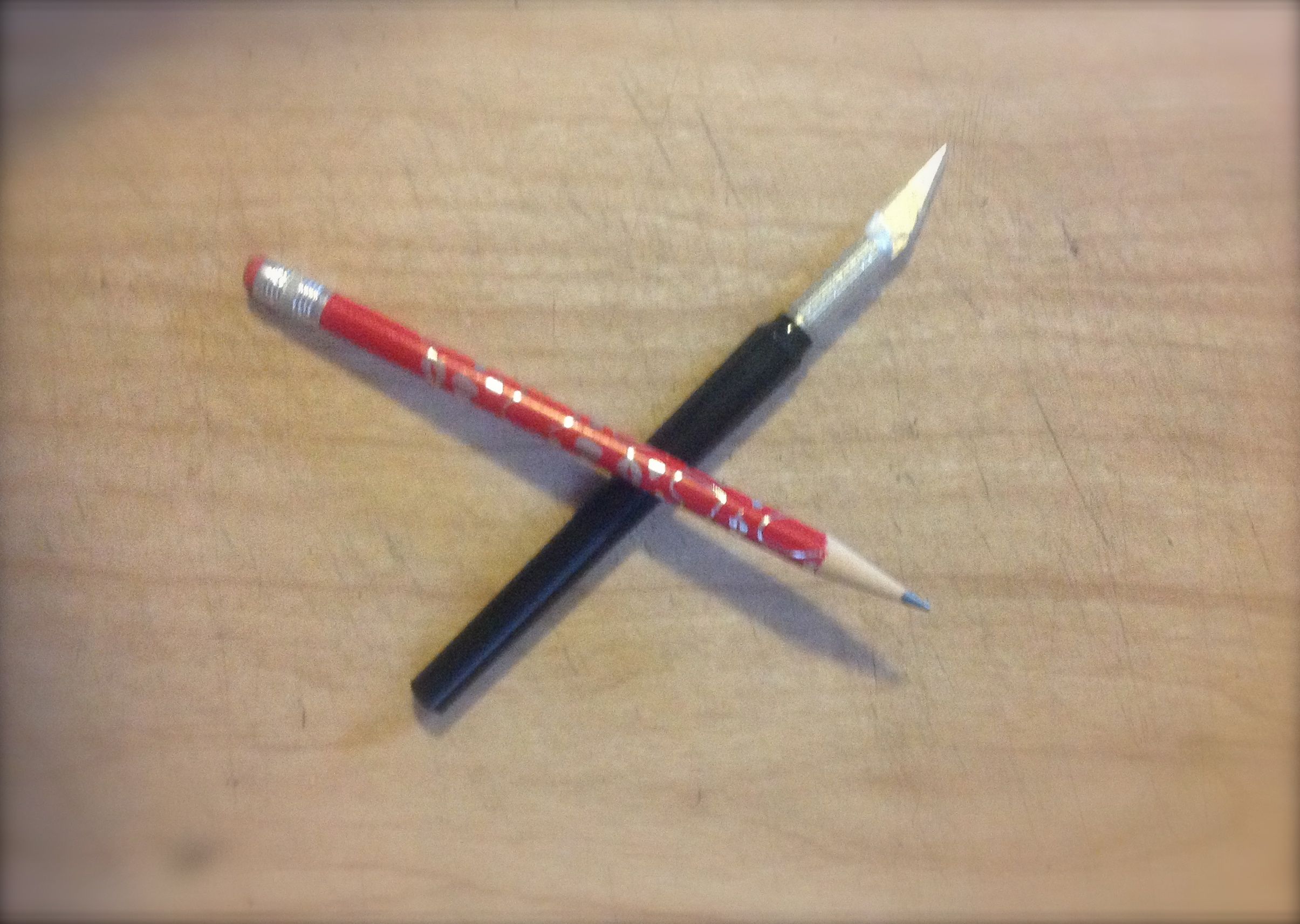
So on the very first Saturday of my first semester of graduate school I lined up my new t-square, my virgin pad of tracing paper, my pencils and my X-Acto knife on the table furthermost from the door and took a seat.

Each large rectangular table had six round, padded stools around it. It was like bellying up to a bar, only there was no alcohol, no music, and there wasn’t a friend in site. In fact I didn’t know any one else in the room.

We started promptly. Course outlines… introductions… expectations… at about the on hour point they asked if we had any questions?

QUESTIONS? My quick look around the room confirmed that everyone was as overwhelmed as I was. No one would be stupid enough to raise their hand and ask a question.

But then the person next to me moved. She didn’t put her hand up, but she definitely changed her body posture to draw attention to herself. “I have a question.” She said in a loud clear voice. Then she went on to ask a long and complicated question that I didn’t understand and have totally forgotten.

It was at this point that I thought I’m sunk. I’m totally out of my league. The excitement of starting graduate school had been slowly eroding in the last hour, but with this bossy girl and her incompressible question I seriously started to wonder if I could quit now and get some of my money back.

The design professor (this class was team taught, so there was one design prof. and one writing prof.) seemed pleased by the inquiry. “Yes, Alissa.” The use of her name with out consulting the class list confirmed that she’d taken classes from him before. The use of his smile meant she’d actually done well in those classes. “I was just about to get to that.”

The look of confusion, dismay and the fact that I was about to be the first person in the room to give up and walk out must have been pretty clear on my face. I tried to take a deep breath and stop the flight impulse. As I s-l-o-w-l-y released the breath I looked up and saw that the man across from me, an ex-Marine in fatigues, had caught my eye. He gave me a stoic nod and the tiniest roll of his hooded eyes.

IMG_0151

Next up we were given a design exercise. A breeze for the experienced designers, a black cloud of confusion for the writers. We were each to come up with a concept sketch for the assignment, share it with our table mates and then present the best one on the board for critique by the rest of the class.

When design time was up Allissa took total control of the table with a fake friendly smile and a “Lets see what everybody’s got.” I pushed my sketch in the pile with a shrug. I knew it was crap. I didn’t know what I was doing.  Starting with the girl sitting on the other side of her, Allissa explained why each sketch wouldn’t work. She allowed for some discussion, and a few people had the confidence and knowledge to speak up, but she was a juggernaut. Time was running out as she approached the end of the pile (mine). She looked at it gave a little sad shake of her head then turned it upside down  with out discussion. Then she held up her sketch. “Here’s my idea, and this is why I think it embraces the concept.” She said it with so much confidence that no one bothered to argue with her. And really it was  a good sketch.

She sashayed up to the cork board and pinned her sketch up to those representing the other 5 tables and a half hour of discussion ensued.

I tuned out. I was tired and hungry and defeated. The chosen few at the front of the room sounded like they were talking in the “Blah, blah, blah” language spoken by the adults in a Charlie Brown Peanuts special. I wasn’t ready to be an adult. I wasn’t ready for this. I concentrated on how fast it would take me to pack my gear and bolt at the break.

Then, mercifully, it was time for lunch. I threw the supplies I had so carefully arranged on the table back into my bag, grabbed my t-square and headed to the door.

But there was a bottleneck at the exit. I wasn’t the only one as anxious for their half hour of freedom.

I felt someone move next to me. Someone big It was my Marine table mate.

He gave me another nod.

“Hey.” I said in greeting.

“First class?” He asked, guessing correctly.

First and only I thought. “Yep.” We moved a forward, closer to the door. Personal space zeroed out as the bodies in the queue compressed.  “You?”

“No, this is my third semester.”

We moved another step to the exit. I was almost free.

“It’s pretty intense.”

Before he could answer we were through the press at the door and into the wider expanse of the hallway.

“Hum.” He agreed. We got to the front door and out into the street.

It felt good to breathe again.

“You’ll feel better after you eat.” He told me knowledgeably.

But I wasn’t going to eat. I was going to flee.

He headed to Main Street at a brisk march. I watched as a gaggle of students parted to make way for him. A Red Sea to his  cammo Moses.

My car was in the green lot, the other way. I took a few steps toward my escape vehicle, away from conflict, away from struggle, away from growth.

Then my stomach growled.

I would feel better after I ate. I turned around an headed to the eateries on Main Street.

When I got back to the class room I went to the table closest to the door — as far away from the other table as possible, and close enough to the door that I could bolt if I changed my mind again. I asked a friendly looking girl if any one was sitting on the stool next to her. No one was.

I  put my bag down and introduced myself. When the Marine came in I nodded to another empty chair at this new, friendlier table. But he shook his head. He would soldier on at the old one… a braver man than I.

“Were you here for the first half of class?” She inquired. Her smile was wide and friendly and full of kindness.

“I was sitting over there.”

At that moment Allissa gave a chortle of laughter that reverberated in the room.

“Ohhh.” My new table mate said knowingly. “Yeah. Good move.”

It was a good move. That nice girl and I became best friends. I stuck with the class and with the master program.

And although I may not have learned a lot in the way of design concepts that day (those would come) I did learn several important lessons that day:

  •  You are in charge of your own talents, don’t let any one dismiss you, least of all that voice in the back of your head.
  • You never know who might be on the other side of the room. It might wind up being a life long bestie.
  •  Just because some one has a big voice and a smidgen of experience that does not mean they are the best leader.
  • You WILL feel better after you’ve had something eat.

IMG_0153


Studs Terkel 5.16.13 Thought of the Day

“Most of us have jobs that are too small for our spirits.”–Studs Terkel

[Image courtesy: NPR.org]

[Image courtesy: NPR.org]

Louis “Studs” Terkel was born on this day in New York City, New York, USA in 1912. Today is the 101st anniversary of his birth.

Studs was the youngest of three boys born to Samuel and Anna Terkel. Both his parents worked in the clothing industry. His father was a tailor and his mother was a seamstress. The family moved to Chicago in 1922 and the Terkels opened a boarding house. There Studs met people from all over the world and listened to their stories.

Terkel later credited his curiosity and comfort with the world’s people to the many tenants he met there. “The thing I’m able to do, I guess, is break down walls,” he once told an interviewer. “If they think you’re listening, they’ll talk. It’s more of a conversation than an interview.” [Biography.com]

He went to the University of Chicago  and in 1934 he earned his law degree. But Studs’ talents lie else where and he didn’t take the Bar exam.

It was the middle of the Great Depression and he joined the WPA working in the radio division of the Writers Project. He found himself both writing and performing on air. He did both scripted work and read the news. Terkel did a stint in the Air Force then came back to radio. He covered the news, sports and eventually got his own interview and music show (he could play what ever he liked, so the show was an eclectic mix of folk, opera, jazz and blues.) In 1945 he made the leap to TV and hosted Stud’s Place.

His first book was Giants of Jazz published in 1956.

In 1966 he published …

his first book of oral history interviews, Division Street: America, … It was followed by a succession of oral history books on the 1930s Depression, World War Two, race relations, working, the American dream, and aging. His last oral history book, Will the Circle Be Unbroken: Reflections on Death, Rebirth, and Hunger for a Faith, was published in 2001.  [Studs Terkel.org]

He says in the preface of Division Street:

I realized quite early in this adventure that interviews, conventionally conducted, were meaningless. Conditioned clichés were certain to come. The question-and-answer technique may be of some value in determining favored detergents, toothpaste and deodorants, but not in the discovery of men and women. [Division Street]

It was better to just turn on the tape recorder and talk — as if your were sitting down to have a drink  at the bar in Stud’s Place.

His 1974 book Working became a Broadway play a few years later and we got to know The Housewife, The Cleaning Women, The Long Distance Trucker, Joe, and a dozen or so other every day characters that had never made it to the stage before.

In 1988 Terkel appeared as Hugh Fullerton in the John Sayles movie 8 Men Out about the Chicago Black Sox scandal.

He was still writing into the 21st Century, his last book, P.S.: Further Thoughts from a Lifetime of Listening, was released in 2008, but open heart surgery in 2005 (at 93) slowed him down — and forced him to stop his habit of smoking two cigars a day.

Studs died on Halloween Day of 2008. He was 96 years old.


Recommended Links:


L. Frank Baum 5.15.13 Thought of the Day

“Imagination has brought mankind through the dark ages to its present state of civilization. Imagination led Columbus to discover America. Imagination led Franklin to discover electricity.”– L. Frank Baum

[Image courtesy: xyz
[Image courtesy: QOTD.org]

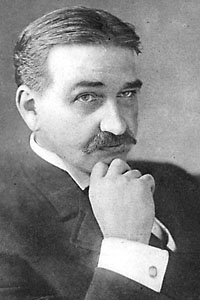
Lyman Frank Baum was born on this day in Chittenango, New York, USA in 1856. today is the 157th anniversary of his birth.

Frank was the seventh of nine children born to Benjamin and Cynthia Baum. The Baums were wealthy. Benjamin made his fortune in the oil fields of Pennsylvania. And Frank grew up happy at the family estate of Rose Lawn. He was a shy child, and, because of a “weak heart,”  he was home schooled for most of his life. He loved to read and spent hours in his father’s library. He didn’t like classical fairy tales — their goblins and villains were too scary — so he made up his own stories and shared them with his brothers and sisters.

When he was twelve his father… hoping to toughen Frank up and cure him of his ‘daydreaming,’ sent him to the Peekskill Military Academy. Baum was miserable there for over a year, and the only results of the experiment were a physical (and possibly also psychological) breakdown, and a lifelong aversion to both formal education and the military. [The Oddness of Oz]

Once home he turned to creative writing. His father bought him a small printing press and, along with his little brother Harry, “he started his own newspaper, the Rose Lawn Home Journal” [the Literary Network]. Frank filled the pages, honing his craft by cranking out articles, fiction and poetry. Other publications included Baum’s Complete Stamp Dealers’ Directory an 11 page  booklet for amateur philatelist and The Poultry Record in which Baum wrote about Hamburg chickens. “He would also write about the raising and breeding of chickens in The Book of Hamburgs. (1896)” [Ibid]

He became fascinated with acting and the theater.

He developed an intense and enduring fascination with the theater. In 1878, he began to work as a professional actor. Four years later his father bought him a small dramatic company, and Baum was soon adapting and starring in a romantic melodrama, The Maid of Arran [The Oddness of Oz]

Baum as Hugh Holcomb in Maid from Arran. [Image courtesy: Hungry Tiger Press.com]

But Baum had bad luck in almost every business endeavor he put his hand to. The Maid of Arran was a moderate success, but while he was touring with the play his theater back home (the one his father bought him) burned down. The company lost the building, all the sets and costumes, and all of the scripts (except those they were traveling with). Ironically the Baum play that was running at the time was called “Matches.”

Other short-lived opportunities soon soured. And he struggled for long-term success. In 1882 he married Maud Gage. Now he had a family to provide for. The time of being a daydreamer were over.

The family moved Aberdeen, South Dakota where he opened a department store, Baum’s Bazaar. The store failed — Frank let people have too much store credit. He became an editor of The Aberdeen Saturday Pioneer, where, after the Massacre at Wounded Knee, he wrote (what one hopes was) a Swiftian inspired modest proposal that all Native Americans be exterminated…

“Having wronged them for centuries, we had better, in order to protect our civilization, follow it up by one more wrong and wipe these untamed and untamable creatures from the face of the earth.”

He tried his hand at managing a baseball club and worked as a buyer for a department store. Nothing seemed to stick.

Baum moved the family to the Humboldt Park neighborhood of  Chicago in 1891. He worked as a reported for the Evening Post, edited a magazine on window displays and worked as traveling salesman.

In 1897, he finally started to have some success with his writing.   Mother Goose in Prose, stories based on traditional Mother Goose poems paired with lovely Maxfield Parrish illustrations, sold well enough that he could quit his door-to-door salesman job. Two years later Baum published Father Goose, His Book this time with W.W. Denslow as his illustrator and had even greater success.

Cover of the first edition of the Wonderful Wizard of Oz [Image courtesy: Loc.gov]

Cover of the first edition of the Wonderful Wizard of Oz [Image courtesy: Loc.gov]

In 1989 he wrote the Wizard of Oz. It was published in 1900, again with Denslow as illustrator, and cost $1.50 a copy.

Unlike other books for children, The Wizard of Oz was pleasingly informal; characters were defined by their actions rather than authorial discourse; and morality was a subtext rather than a juggernaut rolling through the text. [SmithsonianMag.org]

Baum wrote 13 more Oz books (some coming as frequently as one a year.) He had done more than write a best seller, he had created a new genre of fiction… The American Fairy Tale.

He wrote dozens of other books, from Dot and Tot of Merryland to The Life and Adventures of Santa Claus to his last book Phoebe Daring: A Story for Young Folk, but the Oz books were his bread a butter best sellers.

The family moved to Hollywood, California and Baum tried his hand at making silent films with the creation of the Oz Film Manufacturing Company. He wrote, directed and acted with the company which used experimental film effects to capture some of Baum’s fantastic themes. He also  worked with the Uplifters theatre troupe.

L. Frank Baum died of a stroke on May  6th, 1919.

“To please a child is a sweet and lovely thing

that warms one’s heart and brings its own reward.”

–L. Frank Baum

An illustration by W. W. Denslow from The Wond...
An illustration by W. W. Denslow from The Wonderful Wizard of Oz, also known as The Wizard of Oz, a 1900 children’s novel by L. Frank Baum. (Photo credit: Wikipedia)