Category Archives: Writing

Friday Fiction: Last Dance

Thanks to Viewfromtheside.com for this week’s writing prompt of “Dancing”. I came up with (yet another) HAPPY story for you all (not).  So, put your hoop skirts and fingerless gloves on and “enjoy” Last Dance…

—————————————————————

Corn Field 2

Our last dance together was in the church hall of St. Peter and St. Paul’s. It was May 21st, 1861, and Jimmy Bedlow had taken Mary Alice McGee for a wife.

Gabriel wore his Army blues. There were a lot of dark blue uniforms in the congregation when Pastor Lumley pronounced Jimmy and Mary Alice man and wife. Most of the boys of certain age in our town had heeded Mr. Lincoln’s call.

Blue became my young man. It turned Gabe’s hazel eyes a shade more azure, and it made his black hair seem all the more adumbral.

Gabe wasn’t the first to volunteer. He didn’t run after the flag when the band wagon came down main street. He didn’t raise his hand when Captain Haterfield made his rousing recruitment speech at the town square. He’d been thoughtful about the decision. He pondered over what it might mean to his parents — to his Ma, especially. And to me.  But in the end he knew what he had to do and he signed on.

Gabe was a brave, smart young man. He would do alright in this war — which by all accounts would be brief — then he would return home a hero. He would retake his place in his daddy’s law firm and we would be married.

Things were planned out neatly — both by our parents and in our hearts.

Our happily ever after was a well scripted certainty in our young minds.

When the boys mustered at the train station for the ride south Gabe stole a few seconds alone with me for a farewell. I gave him a kiss on his cleanly shaved cheek and a promise that I would wait for him, and pray for him… and that yes, I would marry him when he returned.

I pressed the a 1/6 plate Ferrotype I’d had made specially for him into his hand. He opened the leather case and looked at the small tintype photograph inside. His eyes misted up then.  “My dear Evelina” he whispered in a rough voice that seemed too old for him, “I shall treasure this to my last dying breath.”

Then some one blew a whistle and he was called from my side. I watched him for as long as I could, following his form as he melded with the other men in blue coats and black slouch caps. But then he marched onto the train and I lost sight of him.

The town seemed strangely empty after the militia left. The war had left us with school boys and old men.

The red, white and blue bunting that danced so merrily in the breeze that spring day of the mustering hung stagnant and lifeless on the porches and bandstand. The colors seemed bleached in the hot summer sun.

We heard little from our boys at the front. The mail was painfully slow. The news — even the  intelligence brought to us from the St. Cloud Monitor — was stale before it reached us. So it was near a full week before we heard about the Battle of Bull Run.

That bloody battle took many of our brave boys. The list was hung on the court room door.

The patriotic bunting was replaced by black morning cloth.

But my prayers were answered and Gabe’s name did not appear on the list of  men who had been killed or wounded. He was safe and I quietly rejoiced.

As I did the next April when we heard about Shiloh…

And in June when the Monitor listed the casualties from Seven Pines…

But one day in September when we were making apple butter I felt an odd kind of numbness come over me that I could not explain. Perhaps I was over tired — we were all tired from trying to put up as much food as we could for what was to be another long winter — but it was more than that.

Then 5 days letter the church bell rang mid afternoon and called us to the square. A new piece of paper had been nailed to the court house door and we knew there had been another battle.

On September 17th, 1862 thirty-one of our young men had been among the 2,108 killed  and 9,549 wounded Union soldiers near the creek of Antietam, Maryland.

The numbness I felt days before returned. As I climbed the courthouse steps and joined the scrum of women near the list I knew I would find what I dreaded most. And there in the second column, under Minnesota, half way down was  his name “Gabriel Pulson”.

Faces turned to me as they saw the name and associated it with my own.

A buzzing rang through me as the numbness escalated to full-scale panic. I tried to swallow it down and be brave.  I   KNEW   GABE  WOULD   WANT   ME   TO   BE   BRAVE.  But the buzzing, the numbness, overtook me with a powerful wave of grief and like a child I fainted right there on the courthouse porch.

I had a dream while I lie there.

I was not myself… I was a bird… and I flew low over a cornfield that was a cornfield no more. It was in the process of being destroyed by a great angry army of men… and trampled upon …and shot through until bullets and ears of corn littered the ground.

The bullets were buzzing still. And men would dance from side to side. The lucky ones were able to avoid the deadly leaded bees, the unlucky ones felt the sting and soon fell.

One man two-stepped ungracefully in a circle and fell in front of my dream  self… the bird. Despite the stubble of beard and dirty face I recognized this soldier, and I grew angry that his last dance had been in a cornfield and with out me.

Death came soon for my beloved Gabriel, but he had a brief respite to whisper his prayers. And as he had promised he pulled out my tintype and looked upon me one last time. The glass was broken now and the leather scuffed from wear, but it made him smile in his last moment on this mortal plain. And I… the bird… the girl.. realized he didn’t die alone.

corn field 4


Tommy Lee Jones 9.15.13 Thought of the Day

“Acting is fun for me and it doesn’t really matter how, whether it’s hard work or easy work, it’s always fun.” — Tommy Lee Jones

Français : Tommy Lee Jones au festival de Cannes.

Tommy Lee Jones was born on this day in San Saba, Texas, USA in 1946. He is 67 years old.

His father, Clyde, was an oil field worker, his mother, Lucille,  held various jobs while Tommy was growing up, including teacher and police officer. She also owned her own beauty shop. He went to Robert E. Lee High School, then got a scholarship to St. Marks, an elite Dallas prep school. When he graduated from high school he got a football scholarship to Harvard where he roomed with future Vice President Al Gore. Jones played varsity ball for Harvard. The team was undefeated in his Junior year. He graduated in 1969  Cum Laude.

Jones was realistic about his chances of playing professional ball, he was too small to be an NFL athlete, so he pursued his interest in acting. He moved to New   York and quickly landed jobs off broadway . He was a regular for 4 years on the soap One Life to Live. His first movie role was a Ryan O’Niel’s roommate in Love Story.

In 1975 he moved to the West Coast and continued to add to his movie and television resume. His first big break was landing the role of “Do” Lynn in A Coal Miner’s Daughter (opposite Sissy Spacek). He earned his first Golden Globe nomination for his work on the film, and gained national attention.

He won an Emmy Award for Executioner’s Song in 1982.

His work in the ensemble western Lonesome Dove earned Jones an Emmy nomination and a Golden Globe Award. He was in Oliver Stone’s JFK (and got nominated for an Academy Award) in 1991 Then he worked with Andrew Davis in Under Siege in 1992.

He  worked with Davis again in 1993 on The Fugitive. Jones was pitch perfect as the determined detective hunting Harrison Ford. And although The Fugitive was supposed to be Ford’s vehicle it was clear that Tommy Lee was in the driver’s seat. The movie made $170 million dollars and Jones won a Best Supporting Actor Oscar.

He let his (dry) comic side out when he teamed up with Will Smith for Men In Black in 1997. The sci-fi summer blockbuster spawned two sequels.

Last year Jones took on the role of abolitionist Thaddeus Stevens in Steven Speilberg’s Lincoln. He was nominated for another Best Supporting Actor Oscar.

Tommy Lee Jones on hand for his new movie, The...

Tommy Lee Jones on hand for his new movie, The Three Burials of Melquiades Estrada. Cropped image from the file below. (Photo credit: Wikipedia)


Secondary Character Saturday: Augustus Waters — TFiOS

OKAY

WHO: Augustus Water

FROM: The Fault  In Their Stars

[Image courtesy: Amazon.com]

[Image courtesy: Amazon.com]

BY: John Green

PUBLISHED: 2012

PROS: Funny, confident, determined to squeeze every ounce of life  out of the time left to him Augustus is the perfect foil to the depressed, lonely, self-conscious Hazel. He’s creative, supportive, kind, and amazingly generous. He’s also just a guy, and Green takes pains not to make him into a saint.

heart broken

CONS: Not much to write in this category. Maybe his over indulgence in violent video games…

MOST SHINING MOMENT: Giving up his “Wish” to make Hazel’s come true.

MORE QUOTES:

  • “The world is not a wish granting factory.”
  • “I’m on a roller coaster ride that only goes up.”

WHY I CHOSE GUS: I was worried when Gus made his appearance on the “page” of my Kindle. He seemed too good to be true and I wondered if this beautifully written, dark story about an intelligent, sarcastic girl with cancer (Hazel) was about to grind into a Sweet Valley High wannabee  of girl-meets-hunk-teen-romance. Fortunately, Green made Augustus Waters a lot more than just a boy with dreamy good looks. In a book about teens living with and dyeing from various types of cancer one would expect a certain amount of melodrama but again Green manages to side step that. Where he could have poured on the sugary sweetness of young love he opted for tragic realism with a lopsided smile in Gus.

Get Hurt-9

Fox 2000 is making a film adaptation of the book in which Ansel Elgort is playing the role of Gus.


6 Ways WordPress could make my life easier

writting 2

Writing two ways. Some days I write my blog post long hand in CURSIVE! in a notebook. Other days I go direct to the computer. This is a picture of my brand spanking new keyboard. Ain’t she a beauty?

Dearest WordPress,

Thank you for lovely blogging experience (most of the time.) I really do appreciate your hosting my little daily nothings. But I wonder if I might bend your ear a tick and request a few tiny adjustments that would make my life just a bit easier. Perhaps my fellow bloggers could chime in with their own suggestions.

1. Could you possibly put the Add Media, Text Controls, Link Buttons and  Spell Check along the side? Like, maybe add a Formatting menu under “Settings”. Would that be so hard? You could include all the stuff from the top. That way when we lowly bloggers write more than 4″ of text we wouldn’t have to constantly scroll up and down to add a link or put in an image.

Formatting bar

Duplicate the functionality found at the top of the blog in a pop out menu to the left. (Please.)

2. Give us options on the ADS you attach to our blogs. You know in Widgets how there are about 50 options to choose from so we can customize our sidebar? What if you gave us a poll and let us choose, say 10 (or more) out of 100 types of ads that would best speak to our audience. Wouldn’t that be a better selling tool for you when you approached a potential advertiser? See I’m looking out for you too.

3. Make it easier to open a new file through the Dashboard. Experience has taught me that opening a new file by going to the drop down menu under my blog name then clicking on Dashboard / Post / Add New produces the best results with the least amount of grief. However, clicking on Dashboard is a wonky proposal at best. Sometimes nothing happens and I’m left hovering over the Dashboard waiting (im)patiently, or, more often than not, I’m shuffled right back to the  main page.

4. How about a nice Character Style box for those of us who know what we’re doing with text? I wont abuse it, I promise. But it sure would be nice to have some choices on font and size.

I won't even use Comic Sans. I promise.

I won’t even use Comic Sans. I promise.

5. If a person does a weekly article on a certain subject (say… Muffin Monday) would it be possible to have those previous post come up FIRST in the Related Article suggestions? Or how about this… ONE panel for MY related articles …and ANOTHER pull down panel for related articles from other WordPress bloggers! So say some one was writing about, I don’t know, Colin Firth, then one could easily link to all the other articles about Colin Firth one has done in the past… as well as other germane Colin Firth blogs on WordPress.

Just another excuse use this picture of Colin Firth.

Just another excuse use this picture of Colin Firth. [Image courtesy:  hdwpapers.com]

6. What’s a girl gotta do to get selected for FRESHLY PRESSED? You’d think one of my 528 post in the last 14 months would have piqued your interest, but I guess not. Sigh. [And yes I’ve read the FAQ suggestions, thank you very much.]

Anyway… thanks again for hosting the blog.

Cheers, Your friend,

ritaLOVEStoWRITE


O. Henry 9.11.13 Thought of the Day

“A straw vote only shows which way the hot air blows.”   — O. Henry

William Sydney Porter

William Sydney Porter (aka O. Henry) was born on this day in Greensboro, North Carolina, USA in 1862. Today is the151st anniversary of his birth.
He died in New York City on June 5th, 1910.
Instead of writing a biography (sorry I’ve run out of time today), I thought I’d share he’s most famous story…

The Gift of the Magi

One dollar and eighty-seven cents. That was all. And sixty cents of it was in pennies. Pennies saved one and two at a time by bulldozing the grocer and the vegetable man and the butcher until one’s cheeks burned with the silent imputation of parsimony that such close dealing implied. Three times Della counted it. One dollar and eighty-seven cents. And the next day would be Christmas.

There was clearly nothing to do but flop down on the shabby little couch and howl. So Della did it. Which instigates the moral reflection that life is made up of sobs, sniffles, and smiles, with sniffles predominating.

While the mistress of the home is gradually subsiding from the first stage to the second, take a look at the home. A furnished flat at $8 per week. It did not exactly beggar description, but it certainly had that word on the lookout for the mendicancy squad. In the vestibule below was a letter-box into which no letter would go, and an electric button from which no mortal finger could coax a ring. Also appertaining thereunto was a card bearing the name “Mr. James Dillingham Young.” The “Dillingham” had been flung to the breeze during a former period of prosperity when its possessor was being paid $30 per week. Now, when the income was shrunk to $20, the letters of “Dillingham” looked blurred, as though they were thinking seriously of contracting to a modest and unassuming D. But whenever Mr. James Dillingham Young came home and reached his flat above he was called “Jim” and greatly hugged by Mrs. James Dillingham Young, already introduced to you as Della. Which is all very good.

Della finished her cry and attended to her cheeks with the powder rag. She stood by the window and looked out dully at a grey cat walking a grey fence in a grey backyard. Tomorrow would be Christmas Day, and she had only $1.87 with which to buy Jim a present. She had been saving every penny she could for months, with this result. Twenty dollars a week doesn’t go far. Expenses had been greater than she had calculated. They always are. Only $1.87 to buy a present for Jim. Her Jim. Many a happy hour she had spent planning for something nice for him. Something fine and rare and sterling– something just a little bit near to being worthy of the honour of being owned by Jim.

There was a pier-glass between the windows of the room. Perhaps you have seen a pier-glass in an $8 flat. A very thin and very agile person may, by observing his reflection in a rapid sequence of longitudinal strips, obtain a fairly accurate conception of his looks. Della, being slender, had mastered the art.

Suddenly she whirled from the window and stood before the glass. Her eyes were shining brilliantly, but her face had lost its colour within twenty seconds. Rapidly she pulled down her hair and let it fall to its full length.

Now, there were two possessions of the James Dillingham Youngs in which they both took a mighty pride. One was Jim’s gold watch that had been his father’s and his grandfather’s. The other was Della’s hair. Had the Queen of Sheba lived in the flat across the airshaft, Della would have let her hair hang out the window some day to dry just to depreciate Her Majesty’s jewels and gifts. Had King Solomon been the janitor, with all his treasures piled up in the basement, Jim would have pulled out his watch every time he passed, just to see him pluck at his beard from envy.

So now Della’s beautiful hair fell about her, rippling and shining like a cascade of brown waters. It reached below her knee and made itself almost a garment for her. And then she did it up again nervously and quickly. Once she faltered for a minute and stood still while a tear or two splashed on the worn red carpet.

Young woman, with long hair, wearing nightgown...

On went her old brown jacket; on went her old brown hat. With a whirl of skirts and with the brilliant sparkle still in her eyes, she fluttered out the door and down the stairs to the street.

Where she stopped the sign read: “Mme. Sofronie. Hair Goods of All Kinds.” One flight up Della ran, and collected herself, panting. Madame, large, too white, chilly, hardly looked the “Sofronie.”

“Will you buy my hair?” asked Della.

“I buy hair,” said Madame. “Take yer hat off and let’s have a sight at the looks of it.”

Down rippled the brown cascade. “Twenty dollars,” said Madame, lifting the mass with a practised hand.

“Give it to me quick,” said Della.

Oh, and the next two hours tripped by on rosy wings. Forget the hashed metaphor. She was ransacking the stores for Jim’s present.

She found it at last. It surely had been made for Jim and no one else. There was no other like it in any of the stores, and she had turned all of them inside out. It was a platinum fob chain simple and chaste in design, properly proclaiming its value by substance alone and not by meretricious ornamentation–as all good things should do. It was even worthy of The Watch. As soon as she saw it she that it must be Jim’s. It was like him. Quietness and value– the description applied to both. Twenty-one dollars they took from her for it, and she hurried home with the 87 cents. With that chain on his watch Jim might be properly anxious about the time in any company. Grand as the watch was, he sometimes looked at it on the sly on account of the old leather strap that he used in place of a chain.

When Della reached home her intoxication gave way a little to prudence and reason. She got out her curling irons and lighted the gas and went to work repairing the ravages made by generosity added to love. Which is always a tremendous task, dear friends–a mammoth task.

Within forty minutes her head was covered with tiny, close-lying curls that made her look wonderfully like a truant schoolboy. She looked at her reflection in the mirror long, carefully, and critically.

“If Jim doesn’t kill me,” she said to herself, “before he takes a second look at me, he’ll say I look like a Coney Island chorus girl. But what could I do–oh! what could I do with a dollar and eighty- seven cents?”

At 7 o’clock the coffee was made and the frying-pan was on the back of the stove hot and ready to cook the chops.

Jim was never late. Della doubled the fob chain in her hand and sat on the corner of the table near the door that he always entered. Then she heard his step on the stair away down on the first flight, and she turned white for just a moment. She had a habit for saying little silent prayers about the simplest everyday things, and now she whispered: “Please God, make him think I am still pretty.”

The door opened and Jim stepped in and closed it. He looked thin and very serious. Poor fellow, he was only twenty-two–and to be burdened with a family! He needed a new overcoat and he was without gloves.

Jim stopped inside the door, as immovable as a setter at the scent of quail. His eyes were fixed upon Della, and there was an expression in them that she could not read, and it terrified her. It was not anger, nor surprise, nor disapproval, nor horror, nor any of the sentiments that she had been prepared for. He simply stared at her fixedly with that peculiar expression on his face.

Della wriggled off the table and went for him.

“Jim, darling,” she cried, “don’t look at me that way. I had my hair cut off and sold because I couldn’t have lived through Christmas without giving you a present. It’ll grow out again–you won’t mind, will you? I just had to do it. My hair grows awfully fast. Say ‘Merry Christmas!’ Jim, and let’s be happy. You don’t know what a nice–what a beautiful, nice gift I’ve got for you.”

“You’ve cut off your hair?” asked Jim, laboriously, as if he had not arrived at that patent fact yet even after the hardest mental labor.

“Cut it off and sold it,” said Della. “Don’t you like me just as well, anyhow? I’m me without my hair, ain’t I?”

Jim looked about the room curiously.

“You say your hair is gone?” he said, with an air almost of idiocy.

“You needn’t look for it,” said Della. “It’s sold, I tell you–sold and gone, too. It’s Christmas Eve, boy. Be good to me, for it went for you. Maybe the hairs of my head were numbered,” she went on with sudden serious sweetness, “but nobody could ever count my love for you. Shall I put the chops on, Jim?”

Week 7 - Antique Pocket Watch

Week 7 – Antique Pocket Watch (Photo credit: KimCarpenter NJ)

Out of his trance Jim seemed quickly to wake. He enfolded his Della. For ten seconds let us regard with discreet scrutiny some inconsequential object in the other direction. Eight dollars a week or a million a year–what is the difference? A mathematician or a wit would give you the wrong answer. The magi brought valuable gifts, but that was not among them. This dark assertion will be illuminated later on.

Jim drew a package from his overcoat pocket and threw it upon the table.

“Don’t make any mistake, Dell,” he said, “about me. I don’t think there’s anything in the way of a haircut or a shave or a shampoo that could make me like my girl any less. But if you’ll unwrap that package you may see why you had me going a while at first.”

White fingers and nimble tore at the string and paper. And then an ecstatic scream of joy; and then, alas! a quick feminine change to hysterical tears and wails, necessitating the immediate employment of all the comforting powers of the lord of the flat.

For there lay The Combs–the set of combs, side and back, that Della had worshipped long in a Broadway window. Beautiful combs, pure tortoise shell, with jewelled rims–just the shade to wear in the beautiful vanished hair. They were expensive combs, she knew, and her heart had simply craved and yearned over them without the least hope of possession. And now, they were hers, but the tresses that should have adorned the coveted adornments were gone.

But she hugged them to her bosom, and at length she was able to look up with dim eyes and a smile and say: “My hair grows so fast, Jim!”

And them Della leaped up like a little singed cat and cried, “Oh, oh!”

Jim had not yet seen his beautiful present. She held it out to him eagerly upon her open palm. The dull precious metal seemed to flash with a reflection of her bright and ardent spirit.

“Isn’t it a dandy, Jim? I hunted all over town to find it. You’ll have to look at the time a hundred times a day now. Give me your watch. I want to see how it looks on it.”

Instead of obeying, Jim tumbled down on the couch and put his hands under the back of his head and smiled.

“Dell,” said he, “let’s put our Christmas presents away and keep ’em a while. They’re too nice to use just at present. I sold the watch to get the money to buy your combs. And now suppose you put the chops on.”

The magi, as you know, were wise men–wonderfully wise men–who brought gifts to the Babe in the manger. They invented the art of giving Christmas presents. Being wise, their gifts were no doubt wise ones, possibly bearing the privilege of exchange in case of duplication. And here I have lamely related to you the uneventful chronicle of two foolish children in a flat who most unwisely sacrificed for each other the greatest treasures of their house. But in a last word to the wise of these days let it be said that of all who give gifts these two were the wisest. Of all who give and receive gifts, such as they are wisest. Everywhere they are wisest. They are the magi.

One dollar and eighty-seven cents. That was all. And sixty cents of it was in pennies. Pennies saved one and two at a time by bulldozing the grocer and the vegetable man and the butcher until one’s cheeks burned with the silent imputation of parsimony that such close dealing implied. Three times Della counted it. One dollar and eighty-seven cents. And the next day would be Christmas.

There was clearly nothing to do but flop down on the shabby little couch and howl. So Della did it. Which instigates the moral reflection that life is made up of sobs, sniffles, and smiles, with sniffles predominating.

While the mistress of the home is gradually subsiding from the first stage to the second, take a look at the home. A furnished flat at $8 per week. It did not exactly beggar description, but it certainly had that word on the lookout for the mendicancy squad. In the vestibule below was a letter-box into which no letter would go, and an electric button from which no mortal finger could coax a ring. Also appertaining thereunto was a card bearing the name “Mr. James Dillingham Young.” The “Dillingham” had been flung to the breeze during a former period of prosperity when its possessor was being paid $30 per week. Now, when the income was shrunk to $20, the letters of “Dillingham” looked blurred, as though they were thinking seriously of contracting to a modest and unassuming D. But whenever Mr. James Dillingham Young came home and reached his flat above he was called “Jim” and greatly hugged by Mrs. James Dillingham Young, already introduced to you as Della. Which is all very good.

Della finished her cry and attended to her cheeks with the powder rag. She stood by the window and looked out dully at a grey cat walking a grey fence in a grey backyard. Tomorrow would be Christmas Day, and she had only $1.87 with which to buy Jim a present. She had been saving every penny she could for months, with this result. Twenty dollars a week doesn’t go far. Expenses had been greater than she had calculated. They always are. Only $1.87 to buy a present for Jim. Her Jim. Many a happy hour she had spent planning for something nice for him. Something fine and rare and sterling– something just a little bit near to being worthy of the honour of being owned by Jim.

There was a pier-glass between the windows of the room. Perhaps you have seen a pier-glass in an $8 flat. A very thin and very agile person may, by observing his reflection in a rapid sequence of longitudinal strips, obtain a fairly accurate conception of his looks. Della, being slender, had mastered the art.

Suddenly she whirled from the window and stood before the glass. Her eyes were shining brilliantly, but her face had lost its colour within twenty seconds. Rapidly she pulled down her hair and let it fall to its full length.

Now, there were two possessions of the James Dillingham Youngs in which they both took a mighty pride. One was Jim’s gold watch that had been his father’s and his grandfather’s. The other was Della’s hair. Had the Queen of Sheba lived in the flat across the airshaft, Della would have let her hair hang out the window some day to dry just to depreciate Her Majesty’s jewels and gifts. Had King Solomon been the janitor, with all his treasures piled up in the basement, Jim would have pulled out his watch every time he passed, just to see him pluck at his beard from envy.

So now Della’s beautiful hair fell about her, rippling and shining like a cascade of brown waters. It reached below her knee and made itself almost a garment for her. And then she did it up again nervously and quickly. Once she faltered for a minute and stood still while a tear or two splashed on the worn red carpet.

On went her old brown jacket; on went her old brown hat. With a whirl of skirts and with the brilliant sparkle still in her eyes, she fluttered out the door and down the stairs to the street.

Where she stopped the sign read: “Mme. Sofronie. Hair Goods of All Kinds.” One flight up Della ran, and collected herself, panting. Madame, large, too white, chilly, hardly looked the “Sofronie.”

“Will you buy my hair?” asked Della.

“I buy hair,” said Madame. “Take yer hat off and let’s have a sight at the looks of it.”

Down rippled the brown cascade. “Twenty dollars,” said Madame, lifting the mass with a practised hand.

“Give it to me quick,” said Della.

Oh, and the next two hours tripped by on rosy wings. Forget the hashed metaphor. She was ransacking the stores for Jim’s present.

She found it at last. It surely had been made for Jim and no one else. There was no other like it in any of the stores, and she had turned all of them inside out. It was a platinum fob chain simple and chaste in design, properly proclaiming its value by substance alone and not by meretricious ornamentation–as all good things should do. It was even worthy of The Watch. As soon as she saw it she that it must be Jim’s. It was like him. Quietness and value– the description applied to both. Twenty-one dollars they took from her for it, and she hurried home with the 87 cents. With that chain on his watch Jim might be properly anxious about the time in any company. Grand as the watch was, he sometimes looked at it on the sly on account of the old leather strap that he used in place of a chain.

fob

fob (Photo credit: snail’s trail)

When Della reached home her intoxication gave way a little to prudence and reason. She got out her curling irons and lighted the gas and went to work repairing the ravages made by generosity added to love. Which is always a tremendous task, dear friends–a mammoth task.

Within forty minutes her head was covered with tiny, close-lying curls that made her look wonderfully like a truant schoolboy. She looked at her reflection in the mirror long, carefully, and critically.

“If Jim doesn’t kill me,” she said to herself, “before he takes a second look at me, he’ll say I look like a Coney Island chorus girl. But what could I do–oh! what could I do with a dollar and eighty- seven cents?”

At 7 o’clock the coffee was made and the frying-pan was on the back of the stove hot and ready to cook the chops.

Jim was never late. Della doubled the fob chain in her hand and sat on the corner of the table near the door that he always entered. Then she heard his step on the stair away down on the first flight, and she turned white for just a moment. She had a habit for saying little silent prayers about the simplest everyday things, and now she whispered: “Please God, make him think I am still pretty.”

The door opened and Jim stepped in and closed it. He looked thin and very serious. Poor fellow, he was only twenty-two–and to be burdened with a family! He needed a new overcoat and he was without gloves.

Jim stopped inside the door, as immovable as a setter at the scent of quail. His eyes were fixed upon Della, and there was an expression in them that she could not read, and it terrified her. It was not anger, nor surprise, nor disapproval, nor horror, nor any of the sentiments that she had been prepared for. He simply stared at her fixedly with that peculiar expression on his face.

Della wriggled off the table and went for him.

“Jim, darling,” she cried, “don’t look at me that way. I had my hair cut off and sold because I couldn’t have lived through Christmas without giving you a present. It’ll grow out again–you won’t mind, will you? I just had to do it. My hair grows awfully fast. Say ‘Merry Christmas!’ Jim, and let’s be happy. You don’t know what a nice–what a beautiful, nice gift I’ve got for you.”

“You’ve cut off your hair?” asked Jim, laboriously, as if he had not arrived at that patent fact yet even after the hardest mental labor.

“Cut it off and sold it,” said Della. “Don’t you like me just as well, anyhow? I’m me without my hair, ain’t I?”

Jim looked about the room curiously.

“You say your hair is gone?” he said, with an air almost of idiocy.

“You needn’t look for it,” said Della. “It’s sold, I tell you–sold and gone, too. It’s Christmas Eve, boy. Be good to me, for it went for you. Maybe the hairs of my head were numbered,” she went on with sudden serious sweetness, “but nobody could ever count my love for you. Shall I put the chops on, Jim?”

Out of his trance Jim seemed quickly to wake. He enfolded his Della. For ten seconds let us regard with discreet scrutiny some inconsequential object in the other direction. Eight dollars a week or a million a year–what is the difference? A mathematician or a wit would give you the wrong answer. The magi brought valuable gifts, but that was not among them. This dark assertion will be illuminated later on.

Jim drew a package from his overcoat pocket and threw it upon the table.

365/016 - bringing back the comb

365/016 – bringing back the comb (Photo credit: *lynne*)

“Don’t make any mistake, Dell,” he said, “about me. I don’t think there’s anything in the way of a haircut or a shave or a shampoo that could make me like my girl any less. But if you’ll unwrap that package you may see why you had me going a while at first.”

White fingers and nimble tore at the string and paper. And then an ecstatic scream of joy; and then, alas! a quick feminine change to hysterical tears and wails, necessitating the immediate employment of all the comforting powers of the lord of the flat.

For there lay The Combs–the set of combs, side and back, that Della had worshipped long in a Broadway window. Beautiful combs, pure tortoise shell, with jewelled rims–just the shade to wear in the beautiful vanished hair. They were expensive combs, she knew, and her heart had simply craved and yearned over them without the least hope of possession. And now, they were hers, but the tresses that should have adorned the coveted adornments were gone.

But she hugged them to her bosom, and at length she was able to look up with dim eyes and a smile and say: “My hair grows so fast, Jim!”

And them Della leaped up like a little singed cat and cried, “Oh, oh!”

Jim had not yet seen his beautiful present. She held it out to him eagerly upon her open palm. The dull precious metal seemed to flash with a reflection of her bright and ardent spirit.

“Isn’t it a dandy, Jim? I hunted all over town to find it. You’ll have to look at the time a hundred times a day now. Give me your watch. I want to see how it looks on it.”

Instead of obeying, Jim tumbled down on the couch and put his hands under the back of his head and smiled.

“Dell,” said he, “let’s put our Christmas presents away and keep ’em a while. They’re too nice to use just at present. I sold the watch to get the money to buy your combs. And now suppose you put the chops on.”

The magi, as you know, were wise men–wonderfully wise men–who brought gifts to the Babe in the manger. They invented the art of giving Christmas presents. Being wise, their gifts were no doubt wise ones, possibly bearing the privilege of exchange in case of duplication. And here I have lamely related to you the uneventful chronicle of two foolish children in a flat who most unwisely sacrificed for each other the greatest treasures of their house. But in a last word to the wise of these days let it be said that of all who give gifts these two were the wisest. Of all who give and receive gifts, such as they are wisest. Everywhere they are wisest. They are the magi.

O. Henry Home and Museum

O. Henry Home and Museum (Photo credit: Franklin B Thompson) We visited this lovely little museum when we were in Austin. It’s worth the seeking out.

UPDATE: Here’s a special take on the story via Sesame Street…  (Thanks to Megan for the hint)…

Secondary Character Saturday: Lettie Hempstock, The Ocean at the End of the Lane

If only the "He" had held onto Lettie's hand a little bit more firmly...

If only the “He” had held onto Lettie’s hand a little bit more firmly…

WHO: Lettie Hempstock

FROM: The Ocean at the End of the Lane

Cover art for The Ocean at the End of the Lane [Image courtesy NPR]

Cover art for The Ocean at the End of the Lane [Image courtesy NPR]

BY: Neil Gaiman

PUBLISHED: June 18, 2013

PROS: Kind, powerful, brave, compassionate, mysterious, plucky…

CONS: Not quite cautious enough when it comes to flapping burlapy evil creatures

MOST SHINING MOMENT: I wont give away her MOST shining moment. But I will tell you her second to the MOST shining moment… which is when she stands up the big flapping burlapy evily creature and demands that it/she leave the Hempstock farm.

WHY I CHOSE LETTIE: A beautifully written female adolescent heroine… how could I not choose her? Lettie is marvelously kind to the unnamed main character in this book, but she’s never syrupy about it. She protects and cares for him (much better than his family does) and he has the gumption and pluck of many other female teen characters I can think of (*cough* Bella Swan). “The struggle between Lettie’s family and this evil force takes on darkly beautiful, dreamlike proportions.” [NPR.org]

Gaiman has written another wonderful book. This one is catalogued as adult, but it lies somewhere in the dreamy zone between growing up and grown up. The Ocean at the End of the Lane is a relatively quick read (compared to American Gods or Anansi Boys and, perhaps because its protagonist is a child, it reminded me of his brilliant and haunting children’s book Coraline. Please add this to your to read book list. It is funny and scary and mysterious and sad and lovely.

For those of you keeping score this is not my first Neil Gaiman Secondary Character. I did SPIDER from Anansi Boys a while back. What can I say? As long as Gaiman keeps writing wonderful drawn characters they are going to keep showing up here.

English writer Neil Gaiman. Taken at the 2007 ...

English writer Neil Gaiman. Taken at the 2007 Scream Awards. (Photo credit: Wikipedia)


e.e. cummings memorial Thought of the Day

“To be nobody but yourself in a world that’s doing its best to make you somebody else, is to fight the hardest battle you are ever going to fight. Never stop fighting.” — e.e. cummings

English: Grave of poet E. E. Cummings, located...

English: Grave of poet E. E. Cummings, located at Forest Hills Cemetery in Jamaica Plain, Massachusetts. (Photo credit: Wikipedia)

Today is the anniversary of the death of poet e.e. cummings. He died 51 years ago. To read his full ritaLOVEStoWRITE bioBLOG click HERE.

Cummings had a magical way of playing with words so they transcended form and meaning.

Cummings experimented radically with form, punctuation, spelling and syntax, abandoning traditional techniques and structures to create a new, highly idiosyncratic means of poetic expression. [Poets.org]
Here’s his poem ‘my love’.

my love
thy hair is one kingdom
the king whereof is darkness
thy forehead is a flight of flowers

thy head is a quick forest
filled with sleeping birds
thy breasts are swarms of white bees
upon the bough of thy body
thy body to me is April
in whose armpits is the approach of spring

thy thighs are white horses yoked to a chariot
of kings
they are the striking of a good minstrel
between them is always a pleasant song

my love
thy head is a casket
of the cool jewel of thy mind
the hair of thy head is one warrior
innocent of defeat
thy hair upon thy shoulders is an army
with victory and with trumpets

thy legs are the trees of dreaming
whose fruit is the very eatage of forgetfulness

thy lips are satraps in scarlet
in whose kiss is the combinings of kings
thy wrists
are holy
which are the keepers of the keys of thy blood
thy feet upon thy ankles are flowers in vases
of silver

in thy beauty is the dilemma of flutes

thy eyes are the betrayal
of bells comprehended through incense

E.E. Cummings, full-length portrait, facing le...

E.E. Cummings, full-length portrait, facing left, wearing hat and coat / World-Telegram photo by Walter Albertin. (Photo credit: Wikipedia)

Here’s a list of selected poetry and prose by cummings: [List from Poets.org]

Poetry

  • Tulips and Chimneys (1923)
  • & (1925) XLI Poems (1925)
  • ViVa (1931) No Thanks (1935)
  • Tom (1935) 1/20 (1936)
  • Fifty Poems (1941)
  • 1 x 1 (1944)
  • Xaipe: Seventy-One Poems (1950)
  • Ninety-five Poems (1958)
  • 73 Poems (1962)
  • Complete Poems (1991)

Prose

  • The Enormous Room (1922)
  • Eimi (1933)

Secondary Character Saturday: Mama (who Makes Up Her Mind)

WHO: Mama White

FROM: Mama Makes Up Her Mind, and Other Dangers of Souther Living

BY: Bailey White

Bailey White [Image courtesy: FreshFiction.com]

Bailey White [Image courtesy: FreshFiction.com]

PUBLISHED: 1993

PROS: Sweet, Southern, elderly lady who has a lot of experience and a lot of class.

CONS: She’s also stubborn and opinionated. (But you still love her.)

MOST SHINING MOMENT:  While Bailey White might charm you with stories of Aunt Belle and her bellowing pet alligator. Or Uncle Jimbuddy with hus appalling “knack for losing pieces of himself. ” [Amazon.com] You will “succumb utterly to the charms of Bailey’s mama, who will take you to a juke joint so raunchy it scared Ernest Hemingway or tuck you into her antique guest bed that has the disconcerting habit of folding up on people while they sleep. [Ibid]

Here’s a taste from Mama’s Memoirs…

For years we’ve been trying to get Mama to write her memoirs. she actually started once. She was writing them on old envelopes with a blue ballpoint pen. but she wold make her grocery list on the other side of the envelope, and she kept leaving her memoirs at the checkout counter of the Piggly Wiggly. [Mama Makes Up Her Mind, Bailey White]

WHY I CHOOSE HER: Bailey White is an amazing story-teller. She could spin a yarn from alphabet soup.  But she’s at her best when she pulls a story from something Mama did or said.  Why’d I choose Mama? In hopes that you’d go out and find one of White’s books and read them. You’ll be glad you did.

Other Books by Bailey White:

Bailey White used to be a contributor to National Public Radio, but not so anymore. I guess she’s gone back to teaching in her first grade class room full-time. Shame. We miss you Bailey.

She lives in the same house she grew up in, now with her sister. Her mother, Rosalee White passed away in 1994.


Fiction Friday; Secret Watcher in the Sky

[Its Friday and that means a story prompt from ViewfromtheSide’s Blog.  This week we explore “Secret Watcher”.  I putzed around the house this morning wondering what the heck I was going to write about and then my hubby invited me along on a trip to the hardware store. Sure I said… but would he mind a quick side trip? Here’s our story…]

Trees

Trees (Photo credit: @Doug88888)

The trees were beginning to crowd the tarmac.

The road had gone from 2 lanes to one about a mile ago. Now the trees — lush with the previous night’s rain — had encroached on the shoulder. Their branches arched overhead playing a jazzy sonata of light/not light on the windshield as they alternately allowed or blocked the sun.

I’d reduced our speed to 25 (slower than the posted 30) to compensate for the fact that we really didn’t know where we were going. It wasn’t that we were LOST exactly, we just had never travelled this path before.

That was O.K. though because, although WE didn’t know where we were going, the GPS assured us that IT DID.

Our goal was a yarn shop in South Central Pennsylvania. I’d remembered how to get to their original location from a previous visit. Alas, that was a half a decade ago and the shop had since moved.

No problem. WE had an iPhone. WE were up for adventure.

After checking the yarn shop’s web site we plugged in the new address. In seconds our secret GPS watcher in the sky plotted a course over the scenic Seven Valleys to the new spot.

Away we drove.

The hiccup came when the roads of Pennsylvania decided that life is not as clear-cut as the GPS elves up in that satellite would have it be.

On the screen the little blue dot that represented our car passed the turn that would take us to the yarn shop. In the car we saw nothing but trees.

We RECALCULATED and found a second route.

One road crested  hill and turned from smooth asphalt to crushed gravel.

NO WORRIES — we had all wheel drive! And soon enough we popped on to another paved road.

Our blue dot moved along, obeying the GPS. It indicated a right turn. I made a right turn.

Artist Interpretation of GPS satellite, image ...

A few hundred feet in the trees began to crowd us. The asphalt again turned to gravel.  We considered abandoning our faith in the GPS and turning around, but the road wasn’t wide enough.

There was only one way to go and that way was FORWARD.

So we drove forward.

The road, if you could call it that at this point, got considerably worse. An irregular strip of grass and weeds grew between the tire tracks. The tire tracks became less gravel and more mud. My fingers tightened around the steering wheel.

Still, hovering miles above us Big Brother cheerily showed our little blue dot closing in on the little red dot of the yard shop.

The words “How the hell do they expect any one to find them out here?” were sputtered more than once.

Finally, FINALLY, we came out of the trees into a lane that skirted a barn yard.

A skinny black kitten eyed us than ran away (YES! a sign of life!)

We drove around the barn and saw a middle school aged boy hammering aimless at an old box

“Excuse me?” I said after rolling down the window. “Do you know where the yarn shop is?”

“Yarn shop?” He rolled the words around in his mouth like they were alien to him.

“Yes, we’re looking for a yarn shop.”

“I don’t know about a yarn shop… but the fiber mill is over there.” He waved the hammer in the vague direction of a long low gray barn. He was a pleasant enough fellow, but we had waisted enough of his valuable time. He had important things to do. That box wasn’t going to beat the hell out of its self you know.

“O.K. Thanks.”

Hmmmmm. The blue dot and the red dot appeared as one.  The GPS overlord seemed to think we had arrived at our destination.

We checked the web site again. This time we saw something further down the page that said “If you are interested in visiting please feel free to make an appointment.”

Ahh.

Beyond the long low gray barn was a paved county road and the GPS happily showed us the way back to civilization.

The eye in the sky didn’t get us to the yarn shop, but it was able to find us just a good. It had pointed us squarely at adventure.

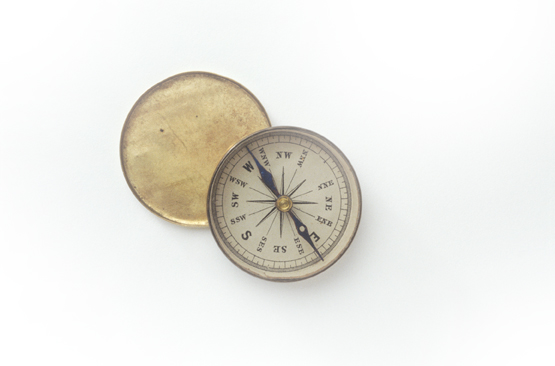
compass