Category Archives: United States

Glenn Close 3.19.13 Thought of the Day

“As an actor, I go where the good writing is. That’s the bottom line.“–Glenn Close

[Image courtesy: FanPOP.com]

[Image courtesy: FanPOP.com]

Glenn Close was born on this day in Greenwich, Connecticut, USA in 1947. She is 66 years old.

She is one of four children born to Bettine and Dr. William Taliaferro Close. The first seven years of her live were ones of privilege. She fondly remembers the ease and freedom of living in on her grandmother’s estate in the Connecticut countryside. But then things changed. Her parents joined the conservative salvation group Moral Re-Armament. The family moved into communal living centers and eventually her parents traveled to the Belgian Congo where her father ran several medical clinics and became a personal physician to  Mobutu Sese Seko. Close went to school in Switzerland. She attended Choate Rosemary Hall in Greenwich. And for a while in the mid-to-late 1960’s she performed with the MRA’s singing group “Up With People.”

At 22 she left the MRA and entered William and Mary College in Williamsburg, Virginia. There she took up acting in earnest.  Upon graduation she moved to New York and found work on the stage. She had her Broadway debut in 1974 as Angelica in Love for Love. Her break out role on the Great White Way was as Chairy Barnum in the Original Broadway Production of Barnum in 1980.

Close in The World According to Garp. [Image courtesy: Fixster.com]

Close in The World According to Garp. [Image courtesy: Fixster.com]

She made the jump to film in 1982 with The World According to Garp. She played Jenny Fields. The role earned her the first of her many Academy Award nominations. Another Oscar nomination came for her role as Sarah Cooper in The Big Chill in 1983, and yet another for her part as Iris Gaines in 1984’s the Natural.

She went against type and starred as Alex Forrest in Fatal Attraction in 1987. She got another Academy nod — this time for Best Actress. And got nominated again in that category for Dangerous Liaisons in 1988.

Close as Marquise de Merteuil in Dangerous Liaisons. [Image courtesy: the Oscar Nerd.com]

Close as Marquise de Merteuil in Dangerous Liaisons. [Image courtesy: the Oscar Nerd.com]

In 1990 she played Queen Gertrude to Mel Gibson’s Hamlet, And Sunny Von Bulow to Jeremy Iron’s Claus  in Reversal of Fortune.

In 1991 She played Sarah Wheaton in Sarah, Plain and Tall. It was the first of a Hallmark trilogy which also includes Skylark and Sarah, Plain and Tall: Winter’s End.
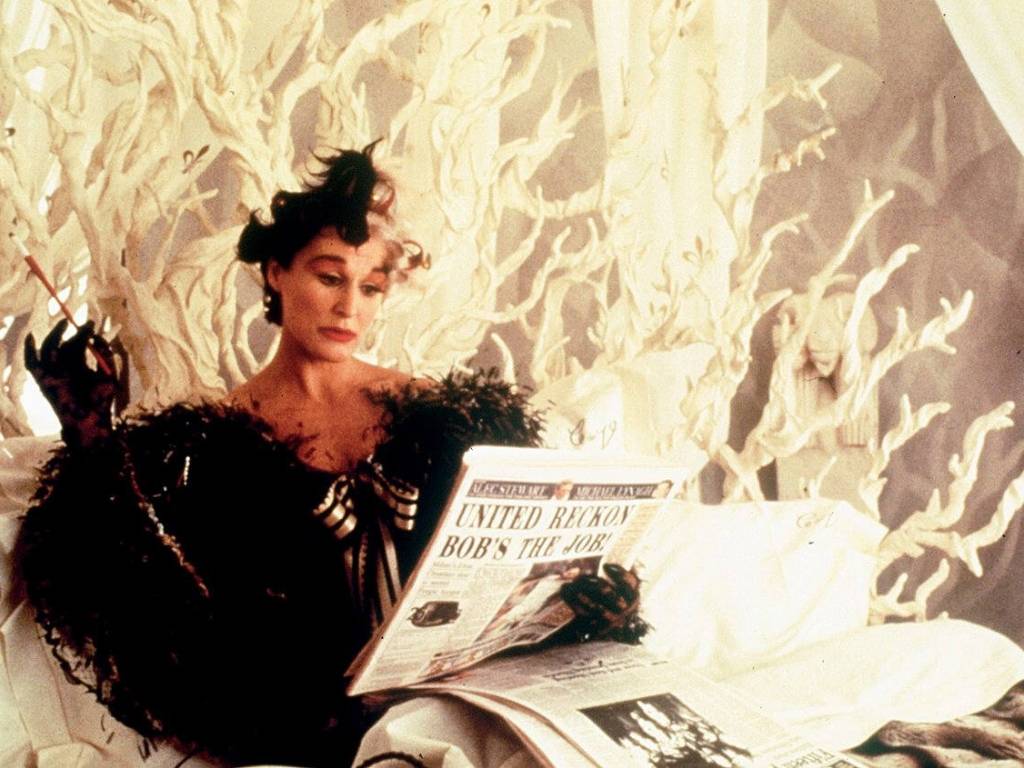
Cruella De Ville (Image courtesy: FanPop.com)

Cruella De Ville (Image courtesy: FanPop.com)

But not everything on her CV is a drama. In 1996 she co-starred as First Lady Marsha Dale in Tim Burton’s Mars Attacks! and the first of her gigs as the villainous, puppy hating Curella de Vil in 101 Dalmatians.

Dvd cover for Paradise Road. [Image courtesy: Amazon.com]

Dvd cover for Paradise Road. [Image courtesy: Amazon.com]

In 1997 she was Adrienne Pargiter in the brilliant and under rated Paradise Road. The film is a…

Fact-based recounting of a group of women who are imprisoned on the island of Sumatra by the Japanese during World War II and used music as a relief to their misery. [IMDb]

The movie co-stars Pauline Collins, Frances McDormand, Cate Blanchette, Jennifer Ehle and Julianna Margulies  and is a beautiful testament to the human spirit and the power of music. If you haven’t seen it… do your self a favor and put it in your queue.

She showed off her pipes again as Nellie Forbush in a made for TV version of South Pacific. (An interesting counter part to Paradise Road — considering both films cover the same period in history, the same conflict,  and approximately the same geography, and both contain some lovely music… yet they take a very different look at WWII.)

Close was Eleanor of Aquitaine opposite Patrick Stewart’s Henry II  in the TV version of The Lion in Winter, in 2003.

Promo shoot for Damages. [Image courtesy: FanPop.com]

Promo shoot for Damages. [Image courtesy: FanPop.com]

She had a 13 episode character arch as Captain Monica Rawling on The Shield. She voiced Mother Simpson on the Simpsons several times, and, more dramatically,   played Patty Hewes  on the TV series Damages starting in 2007.

Close was nominated for yet another Best Actress Oscar for her work in Albert Nobbs. The film came out in 2012.

Close as Albert Nobbs (Image courtesy: NPR.com photo by Patrick Redmond.]

Close as Albert Nobbs (Image courtesy: NPR.com photo by Patrick Redmond.]

Currently she has two films in the works for 2014, The Grace That Keeps This World, and Always on My Mind. Maybe she’ll get nominated again for one of these, and maybe, just maybe, the 7th time will be a charm!


Andrew Jackson 3.15.13 thought of the Day

“Take time to deliberate; but when the time for action arrives, stop thinking and go in.” –Andrew Jackson

English: Andrew Jackson - 7 th President of th...

English: Andrew Jackson – 7 th President of the United States (1829–1837) (Photo credit: Wikipedia)

Andrew Jackson was born on this day in the  Waxhaws region between North and South Carolina in 1767. Today is the 246th anniversary of his birth.

He was born to Andrew and Elizabeth Hutchinson Jackson, Scots-Irish emigrants who had come over from Ireland two years before with their young sons Hugh and Robert. Andrew Jackson never met his father, who died three weeks before the baby was born.

Raised by his widowed mother, Jackson grew up with a large extended family—aunts, uncles, and cousins— who were also Irish immigrant farmers. As a youth, Jackson attended a good school and his mother had hopes of him becoming a Presbyterian minister. However, young Jackson’s propensity for pranks, cursing, and fighting quickly dashed those hopes. [The Hermitage.com]

The American Revolutionary War left the Jackson family devastated. All three boys signed up to fight the British (Andrew was just 13 and became a courier.) Older bother Hugh died of heat stroke at the Battle of Stono Ferry in 1779. In 1781 Jackson and his remaining brother Robert were taken prisoner. The boys nearly starved to death in the camp, and Jackson was slashed with a sword when he refused to polish a British officer’s boots. He carried the scars on his hand and head for the rest of his life. Both Jackson and Robert

contracted smallpox in prison and were gravely ill when Jackson’s mother arranged for their release in a prisoner exchange. Jackson survived, however, his brother died. After Jackson recovered, his mother traveled to Charleston to aid the war effort by nursing injured and sick soldiers. She contracted cholera and died leaving Jackson an orphan. [Ibid]

Growing up in the backwoods of the Carolinas, Jackson’s education was sporadic. He attended a “old-field” school in his youth. (An old-field school was a school that washeld on– either an open field or in a building built — on an exhausted corn, tobacco or cotton field.)  After the Revolutionary War he worked for a while at a saddle makers shop, but then took up law.

In 1787, after three years of studying law, Jackson received his license to practice law in several counties scattered through the North Carolina back country. To supplement his income, he also worked in small-town general stores. While living in North Carolina, Jackson gained a reputation for being charismatic, wild, and ambitious. He loved to dance, entertain, gamble, and spend his free time with friends in taverns. [Ibid]

At 21 he became public prosecutor of the Western District of North Carolina. He became the prosecutr for both Jonesborough and Nashville. It was during this time that he met Rachel Donelson Robards (who was separated — and she assumed divorced — from her first husband Lewis Robards.) Jackson married Rachel while the two were in the wilderness of the Western District only to come back to Nashville to find out that Robards had not completed the divorce proceedings. He, Robards, then used  Rachel’s ‘bigomy’ as grounds  to finalize the divorce. Jackson and Rachel remarried, but the controversy followed them for the rest of their lives, and Jackson was willing to duel with any man who  besmirched his wife’s name.

English: Portrait of Rachel Donelson Jackson, ...

English: Portrait of Rachel Donelson Jackson, wife of U.S. President Andrew Jackson, by the artist Ralph E. W. Earl. Oil on canvas, 30 in. x 20 in. Circa 1830-1832. Portrait is in the collection of The Hermitage, Nashville, Tennessee. Image courtesy of the Tennessee Portrait Project. (Photo credit: Wikipedia)

None of that stopped Jackson’s rise in the political arena. “He was the first man elected from Tennessee to the House of Representatives, and he served briefly in the Senate” [Whitehouse.gov]

During the War of 1812 President Madison “commissioned Jackson Major General of U.S. Volunteers and ordered him to lead 1,500 troops south to Natchez and eventually to defend New Orleans” [The Hermitage.com] His leadership in the Battle of New Orleans made “Old Hickory ” a national hero. In 1824 he made an unsuccessful run for President against John Quincy Adams. Four years later he ran again. This time he won the White House.

Accomplishments of his presidency:

  1. He paid off the National Debt
  2. Fought against corrupt bureaucracy with the Spoil System
  3. Enfranchisement policy

Crisis / Negatives of his presidency:

  1. Nullification Crisis
  2. Ethnic cleansing of  about 45,000 Native Americans from their ancestral lands under his “Indian Removal Act”  which lead to the Trail of Tears .

Neutral effects of his presidency:

  1. Tried to eliminate the Electorial College
  2. Opposed the National Bank

After leaving the White House he retired The Hermitage in Nashville. He died on June 8, 1845, of chronic tuberculosis, dropsy, and heart failure.

78 year old Andrew Jackson

78 year old Andrew Jackson (Photo credit: Wikipedia)


Frank Borman 3.14.13 Thought of the Day

“Exploration is really the essence of the human spirit.” — Frank Borman

Frank Borman

Frank Borman (Photo credit: Wikipedia)

Frank Frederick Borman, II was born on this day in Gary, Indiana, USA in 1928. He is 85  years old.

The Bormans, Frank, his father Edwin, and mother, Marjorie moved to Tucson, Arizona when he was a kid . He began to take flying lessons at 15. After graduating from Tuscon High School He attended the United States Military Academy. He graduated in 1950 and joined the US Air Force.

He was “a fighter pilot, an operational pilot and instructor, an experimental test pilot and an assistant professor of Thermodynamics and Fluid Mechanics at West Point.” [NASA.gov] during his time in the USAF. Later he went to the California Institute of Technology and earned his MS in aeronautical engineering in 1957 before become a test pilot and instructor at the Aerospace Research Pilot School at Edwards Air Force Base.

Astronaut Groups 1 and 2 - GPN-2000-001333

Astronaut Groups 1 and 2 – GPN-2000-001333 (Photo credit: Wikipedia)

The National Aeronautics and Space Administration (NASA) chose him to be a member  of the “New Nine” group of astronauts in 1962. The New Nine (which included Neil Armstrong, Pete Conrad, Jim Lovell, James McDivitt, Elliott See, Tom Stafford, Ed White, and John Young as well as Borman) augmented the 7 Mercury Astronauts and  assured that the space agency was staffed through the Gemini and Apollo missions (with the addition of NASA’s Astronaut Group 3) During his NASA days…

Apollo8 Prime Crew

Apollo8 Prime Crew (Photo credit: Wikipedia) Borman is on the right.

  • Borman and Lovell performed the first rendezvous in of two spacecraft in orbit during their Gemini 7 flight.  The 1965 flight set a 14 day long endurance record. (Borman was commander.)
  • He served on the AS-204 Accident Review Board investigating the fire on Apollo 1 that killed Astronauts Gus Grissom, Ed White and Roger Chaffee.
  • He led “the team that re-engineered the Apollo spacecraft” [NASA.gov] after the accident.
  •  “As commander of the Apollo-8 mission, he and his crew (James A. Lovell and William Anders) were launched into Earth’s orbit on December 21, 1968. They then became the first men to leave Earth’s gravity and journey to the moon. After 10 lunar orbits, they returned safely to the Earth.” [National Aviation Hall of Fame]
  • He was President Nixon’s special ambassador when Apollo-11 landed on the Moon.

After Borman retired from NASA he…

“joined Eastern Airlines as vice president of operations and, after completing an advanced management course, became senior vice president of operations. In 1974 he was named executive vice president, general operations manager and a member of the board of directors. By 1976 he had risen to chairman, president and chief executive officer of Eastern. ” [Ibid]

In 1986 Borman retired from Eastern and moved to New Mexico with his wife Susan where he acts as a consultant.

Earth rise taken during Apollo 8 [Image courtesy: NASA]

Earth rise taken during Apollo 8 [Image courtesy: NASA]


John Steinbeck 2.27.13 Thought of the Day

“Power does not corrupt. Fear corrupts… perhaps the fear of a loss of power.” — John Steinbeck

English: John Steinbeck

English: John Steinbeck (Photo credit: Wikipedia)

John Ernst Steinbeck, Jr. was born on this day in Salinas, California in 1902. Today is the 111st anniversary of his birth.

John Steinbeck home

John Steinbeck home (Photo credit: sjb4photos)

His father was the treasurer for Monterey County, California. His mother, who had been a school teacher, instilled a love a reading and writing in he young Steinbeck. He graduated from high school in 1919 and went to Stanford University.
He worked his way through college at Stanford University but never graduated. In 1925 he went to New York, where he tried for a few years to establish himself as a free-lance writer, but he failed and returned to California. [Nobel Prize.org]
Back on California he met and married his first wife,Carol Henning, but he struggled to find work as a writer. For the first few years of the Great Depression his parents supported the junior Steinbecks and gave them a cottage to live in.  “Steinbeck first became widely known with Tortilla Flat (1935), a series of humorous stories about Monterey paisanos.” [Ibid]
Of Mice and Men

Of Mice and Men (Photo credit: Wikipedia)

The 1930s was …
his most productive decade, he wrote several novels about his native California, including Tortilla Flat (1935), set in Monterey; In Dubious Battle (1936), about fruit-pickers on strike in a California valley; and Of Mice and Men (1937), set on a ranch in Soledad, southeast of Steinbeck’s birth town. [Writer’s Almanac]
He had worked on local farms and ranches during the summers when he was growing up and he wrote from that first hand observation of the  struggles of migrants and farm workers in his novels.
Cover of "The Grapes of Wrath"

Cover of The Grapes of Wrath

In 1939 he published what is considered his best work, The Grapes of Wrath, the story of Oklahoma tenant farmers who, unable to earn a living from the land, moved to California where they became migratory workers. [Nobel Prize.org]
He won a Pulitzer Prize for the novel.
Steinbeck became a war correspondent for the  New York Herald Tribune during World War II. He wrote from the Mediterranean and North Africa. He collected some of those stories in There Was a War.
Cover of "Viva Zapata! [Region 2]"

Cover of Viva Zapata! [Region 2]

After the war he wrote Cannery Row and  the screenplay for Lifeboat for Alfred Hitchcock. He recycled his characters from Tortilla Flat for the film A Medal for Benny. And he wrote The Pearl, which also was turned quickly into a movie. Followed by the screenplay for  Viva Zapata!
East of Eden (novel)

East of Eden (novel) (Photo credit: Wikipedia)

He considered his next novel, East of Eden, his masterpiece. Other late works include …
The Winter of Our Discontent (1961), and Travels with Charley (1962), a travelogue in which Steinbeck wrote about his impressions during a three-month tour in a truck that led him through forty American states. He died in New York City in 1968. [Nobel Prize.org]
Steinbeck won “Nobel Prize in literature for his “realistic and imaginative writing, combining as it does sympathetic humor and keen social perception.” [Writer’s Almanac] in 1962.
He died six years later, in 1968,  of congestive heart failure in New York City.

Steve Jobs 2.24.13 Thought of the Day

“Don’t let the noise of others’ opinions drown out your own inner voice.”

English: Steve Jobs shows off the white iPhone...

English: Steve Jobs shows off the white iPhone 4 at the 2010 Worldwide Developers Conference Español: Presentación del iPhone 4 por Steve Jobs en la Worldwide Developers Conference del año 2010 (Photo credit: Wikipedia)*

Steven Paul Jobs was born on this day in San Francisco, California, USA in 1955. Today is the 58th anniversary of his birth.

Adopted by Paul and Clara Jobs when he was a baby, he was five when the family moved to Mountain View, California. His parents later adopted a second child, his sister Patty. His dad worked with Steve on electronics and woodworking projects  in the family’s garage.

My father was a machinist, and he was a sort of genius with his hands. … I started to gravitate more toward electronics, and he used to get me things I could take apart and put back together. –Steve Jobs [AllAboutSteveJobs.com]

He was a bright, inquisitive child, but he lacked focus and motivation. Because he was bored he became a class prankster. Then he met Imogene Hill, his fourth grade advanced class teacher, who “kindled a passion in me for learning things. I learned more that year than I think I learned in any year in school.” [Ibid] He scored so well in standardized testing that he could have skipped two grades (his parents let him skip one grade.)

He began Homestead High School in 1971. When he was a teen he met another electronics enthusiast, Steve  “Woz” Wozniak. They two became friends over their shared interest in computer chips and electronics.

jobs_woz

jobs_woz (Photo credit: Revolweb)

After High School  Jobs went to Reed College but dropped out after a half a year. He felt the school was taking to much of his parent’s nest egg and he wasn’t getting enough from it. He continued to take creative classes for another year and a half, most notably calligraphy, which sparked his interest in typography. Then in 1974 he took a job with video game designer Atari.

An original Apple I Computer. [Image courtesy:  Wikimedia Commons]

An original Apple I Computer. [Image courtesy: Wikimedia Commons]

In 1976 he and Wozniak formed Apple Computer Company to sell circuit boards. The company was housed in the Jobs family garage. Wozniak invented the Apple 1 computer. They displayed it in July at he Homebrew computer Club in Palo Alto. To finance the  production of the computer Jobs sold his VW Microbus and Wozniak sold his HP-65 calculator. The price of the computer was $666.66. About 200 computers were produced, about 50 of which are documented to still be in existence.

Jobs and Wozniak are credited with revolutionizing the computer industry by democratizing the technology and making the machines smaller, cheaper, intuitive and accessible to everyday consumers. [Biography.com]

In April of 1977 the Apple 11 came out. The Apple 11 ran at a lightning fast 1MHz with a whopping 4kb of RAM. The next improvement involved a floppy disk drive and a color monitor.

Apple 11 with floppy disk drive [Image courtesy: Wikipedia]

Apple 11 with floppy disk drive [Image courtesy: Wikipedia]

Apple Computer became a publicly traded company in 1980. John Scully, formerly of Pepsi, came on board as Apple’s president.

But as the 80’s dawned so did IBM’s dominance in the personal computing world.

Steve Jobs - Placard

Steve Jobs – Placard (Photo credit: The Seg)

“In 1984, Apple released the Macintosh, marketing the computer as a piece of a counter culture lifestyle: romantic, youthful, creative.”[Biography.com] Apple has always had a certain attitude and style to their marketing. This is especially evident with the famous “1984” Apple ad …

http://youtu.be/HhsWzJo2sN4

Despite Jobs’ creative influence in including things like a WYSIWYG screen interface (vs the PC’s coded  approach) choices in typography and a drawing package the Mac couldn’t compete with Big Blue’s stronghold in the business world. Sales were still strong, especially among the graphic design and art world, but Mac executives began to see Jobs as “hurting Apple” and began “to phase him out.” [Ibid]

This NeXT Computer was used by Sir Tim Berners...

This NeXT Computer was used by Sir Tim Berners-Lee at CERN and became the world’s first Web server. (Photo credit: Wikipedia)

He resigned in 1985 and started a new company called NeXT. In 1986 he joined with George Lucas to form what became Pixar Animation (“Jobs invested $50 million of his own money into the company.” [Ibid]) Pixar became one of the most successful animation studios in Hollywood history. It was eventually bought by Disney and Jobs became Disney’s largest shareholder.

Apple bought our NeXT in 1997 for $429 million and “Jobs returned to his post as Apple’s CEO.” [Ibid]

For much of the 90’s Apple, Inc. was a follower. It’s designed resembled IBM PCs and PC clones. a lot of the Apple magic was squandered.

With a new management team, altered stock options and a self-imposed annual salary of $1 a year, Jobs put Apple back on track. His ingenious products such as the iMac, effective branding campaigns, and stylish designs caught the attention of consumers once again. [Ibid]

An iMac looked nothing like the tower, keyboard and screen of its competitors. (Yes, I have one.)

An iMac looked nothing like the tower, keyboard and screen of its competitors.*

The Macbook Air, iPod, iPhone and iPad followed. As did 2008s music and media download service iTunes.

English: Steve Jobs while introducing the iPad...

English: Steve Jobs while introducing the iPad in San Francisco on 27th January 2010. Version without watermark and with reduced noise in the background. Deutsch: Steve Jobs stellt das iPad in San Francisco am 27. Januar 2010 vor. Version ohne Wasserzeichen und reduziertem Bildrauschen im Hintergrund. (Photo credit: Wikipedia)*

in 2003 Jobs was diagnosed with a neuroendocrine tumor. He had it successfully removed in 2004, but battled pancreatic cancer for nearly a decade until his death in 2011.

My first Mac was a Mac SE with dual floppy drive. It still sits on my shelf, and it still works (though the software and cables are so antiquated it can't communicate to anything.)

My first Mac was a Mac SE with dual floppy drive. It still sits on my shelf, and, as I found out  in 2011,  it still works.  However, the software and cables are so antiquated it can’t communicate to anything.*

——————————————————

So are you a Mac or a PC?

Apple Product Timeline [Image courtesy: Innovations In Newspapers]

Apple Product Timeline [Image courtesy: Innovations In Newspapers]

* Yeah, I got that.

Apple Logo created in 1977 by Rob Janoff. [Image courtesy:  Wikimedia Commons]

Apple Logo created in 1977 by Rob Janoff. [Image courtesy: Wikimedia Commons]


George Washington 2.22.13 Thought of the Day

“Labor to keep alive in your breast that little spark of celestial fire, called conscience.”-George Washington

1795 - 1823

1795 – 1823 (Photo credit: Wikipedia)

George Washington was born on this day in Westmoreland County, Virginia, USA in 1732. Today is the 281st anniversary of his birth.

Did you know that if your name is George and you went to Mt. Vernon–Washington’s home south of Alexandria Virginia — today you’d get in at a reduced rate?

So much has been said and written about our first president that that (the “George” Discount) is about the only thing I can bring to the table that is new.

Therefor  I decided that for today’s blog I’d focus on images of Washington.

For an excellent biography of the surveyor, soldier, statesman, farmer and cherry-tree-chopper I refer you to the whitehouse.gov bio. Another terrific bio can be found on the Mount Vernon site at mountvernon.org. Indeed if you are anywhere near the Northern Virginia area I strongly suggest a trip to Mount Vernon where you can not only tour Washington’s house and the grounds of his estate, but can explore Ford Orientation Center and the The Donald W. Reynolds Museum and Education Center. If you have a little extra time you might want to drive over to the Washington Grist Mill and Distillery.

Washington was one of the most successful liquor distributors in the new nation. He built a state-of-the-art distillery at Mt. Vernon, where he made rye whiskey, apple brandy and peach brandy. The distillery has been restored in recent years, and is now open to visitors. [Bio.now]

George Washington dollar

George Washington dollar (Photo credit: Wikipedia)

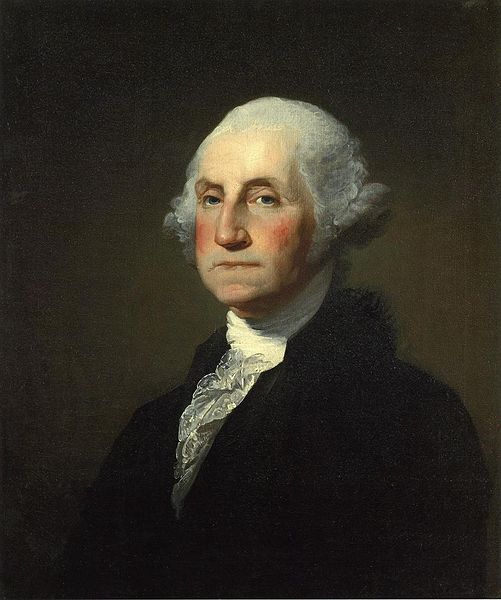
Perhaps the best known image of George Washington is this one done by Gilbert Stuart.

Perhaps the best known image of George Washington is this one done by Gilbert Stuart.

Gilbert Stuart was another artist who was inspired to paint Washington. [Image courtesy: The Library of Congress]

Stuart was inspired by Washington and painted him several times . [Image courtesy: The Library of Congress]

Tompkins H. Matteson's Washington at Valley Forge. [Image courtesy the Pocontico Hills School Washington site]

Tompkins H. Matteson’s Washington at Valley Forge. [Image courtesy the Pocontico Hills School Washington site]

General of the Armies [Image courtesy: the US Military Hall of Fame.]

General of the Armies [Image courtesy: the US Military Hall of Fame.]

A young George Washington [Image courtesy: The History Channel.]

A young George Washington [Image courtesy: The History Channel.]


An etching showing George Washington addressing the troops in 1775 [Image courtesy: The National Archives]

An etching showing George Washington addressing the troops in 1775 [Image courtesy: The National Archives]

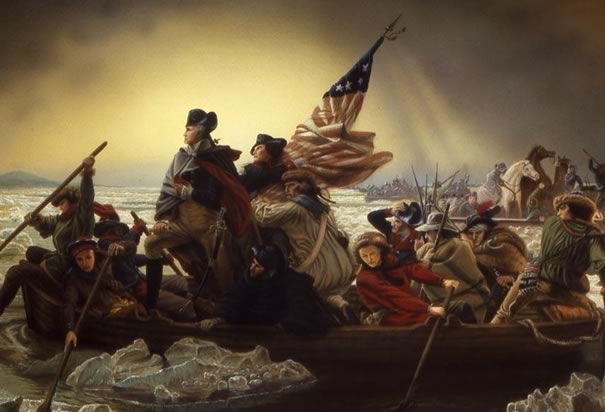
Emanuel Leutze's famous (and highly stylized) version of Washington crossing the Delaware river.

Emanuel Leutze’s famous (and highly stylized) version of Washington crossing the Delaware river.

Washington at Valley Forge. [Image courtesy: the Library of Congress]

Washington at Valley Forge. [Image courtesy: the Library of Congress]

Washington was one of artist John Trumbull's favorite subjects. Here he is  resigning as commander and chief.

Washington was one of artist John Trumbull’s favorite subjects. Here he is resigning as commander and chief.

[Image courtesy Bartleby.com]

[Image courtesy Bartleby.com]

George Washington at Mt. Vernon. George Washin...

George Washington at Mt. Vernon. George Washington seated, half-length, with Martha Washington, and two children. (cropped) (Photo credit: Wikipedia)

An older Washington [Image courtesy: The Independent]

An older Washington [Image courtesy: The Independent]

English: The equestrian sculpture of George Wa...

English: The equestrian sculpture of George Washington at the center of Washington Circle, a traffic circle and public park, located on the boundary of the Foggy Bottom and West End neighborhoods in Washington, D.C. (Photo credit: Wikipedia)

Click HERE to see a forensic model of what George Washington looked like.


Frederick Douglas 2.14.13 Thought of the Day

It is easier to build strong children than to repair broken men.

A sketch of Douglass, from the 1845 edition of...

Frederick Augustus Washington Bailey was born on this day in Talbot County, Maryland, USA in 1818. Today is the 195th anniversary of his birth.

The exact day and year of his birth is unknown, but he decided on February 14th, 1818.  He never met his father, a white man,  and almost never saw his mother.  He lived with his grandparents in their cabin west of the Tuckahoe Creek. In his first autobiography he wrote:

“I do not recollect ever seeing my mother by the light of day. … She would lie down with me, and get me to sleep, but long before I waked she was gone.” [Narrative of the life of Frederick Douglass, an American slave. Written by himself. (1851)

At seven he was sent to Wye House plantation near Easton, in Talbot County, Maryland. Soon he was sent to Hugh Auld a Baltimore carpenter. Auld’s wife, Sophia,  taught him to read until the master (her husband)  stopped her. Hugh Auld thought teaching slaves lead to rebellious slaves. Frederick practiced reading and writing in secret. When he was in Baltimore he heard about Abolition for the first time, and in 1831 he  read an article “on John Quincy Adams’s antislavery petitions in Congress” [Frederick Douglass Timeline]

At 13 he was sent to the shipping town of St. Michael’s, Maryland to work for Thomas Auld. When Auld discovered that Frederick was teaching other slaves to read he rented him out to a brutal slavebreaker, Edward Covey.”The treatment he received was indeed brutal. Whipped daily and barely fed, Douglass was “broken in body, soul, and spirit.” “ [PBS.org]

In 1838 he was back in Baltimore hired out to work as a caulker in a shipyard. He made his escape to freedom by…

Travelling by train, then steamboat, then train, he arrived in New York City the following day. Several weeks later he had settled in New Bedford, Massachusetts, living with his newlywed bride (whom he met in Baltimore and married in New York) under his new name, Frederick Douglass. [Ibid]

Douglass became active in the Abolitionist movement. He became a “licensed preacher for the African Methodist Episcopal Zion Church.” [Frederick Douglass Timeline] In 1841 he spoke at an antislavery meeting in New Bedford about his life in Maryland. The Massachusetts Anti-Slavery Society hired him as a speaker.

English: Portrait of Frederick Douglass as a y...

English: Portrait of Frederick Douglass as a younger man (Photo credit: Wikipedia)

Some people didn’t believe that a former slave could speak so eloquently and assumed Douglass was a fraud. In response to that criticism he wrote Narrative of the Life of Frederick Douglass. In 1845 he toured England and Ireland to raise money to buy his freedom. (Auld  manumitted him for $711.66.) Douglass used the remaining money from the Great Britain tour to buy a printing press and began to publish the North Star, a weekly Abolitionist paper. The paper later became the Frederick Douglass’ Paper and is joined in 1859 by the Douglass’ Monthy.

In 1855 he published his second autobiography, My Bondage and My Freedom. During the American Civil War Douglass was a recruiter for the all African-American 54th Massachusetts Infantry.

After the ratification of the 13th Amendment to the Constitution (which outlaws slavery) Douglass continued to fight for civil rights and woman’s rights. A fringe political party, The Equal Rights Party nominated Douglass as its vice-presidential Nominee in 1872.

The title page of the 1845 edition of Narrativ...

The title page of the 1845 edition of Narrative of the Life of Frederick Douglass, An American Slave (Photo credit: Wikipedia)

In 1881 he published his final autobiography, The Life and Times of Frederick Douglass.

He was appointed to the post of US Marshal of the District of Columbia and the Recorder of Deed of the District of Columbia before becoming Minister Resident and Consul General to the Republic of Haiti in 1889.

Frederick Douglass

Frederick Douglass (Photo credit: Wikipedia)

Frederick Douglass died on February 20th, 1895 of heart failure.

The gravestone of Frederick Douglass located a...


Abraham Lincoln 2.12.13 Thoughts of the Day

President Abraham Lincoln was descended from S...

Abraham Lincoln was born on this day near Hodgenville, Harden Co., Kentucky in 1809. Today is the 204th anniversary of his birth.

I’m going to assume that you are all familiar with the 16th President of United States — the man who grew up in a log cabin, was a simple country lawyer and  went on to become president during this country’s darkest days. [For more information on his life might I suggest the White House.gov biography, Lincoln’s write-up on Biography.com , or the article on History.com ]  Frankly, there is little I can bring to the table that you don’t already know or couldn’t read about on more lofty websites… so instead I thought I’d bring you my favorite Lincoln quotes.

LIncoln logo

  • Better to remain silent and be thought a fool than to speak out and remove all doubt.
  • Sir, my concern is not whether God is on our side; my greatest concern is to be on God’s side, for God is always right.
  • You can fool all the people some of the time, and some of the people all the time, but you cannot fool all the people all the time.
  • In the end, it’s not the years in your life that count. It’s the life in your years.
  • Character is like a tree and reputation like a shadow. The shadow is what we think of it; the tree is the real thing.
  • Give me six hours to chop down a tree and I will spend the first four sharpening the axe.
  • Whatever you are, be a good one.
  • Be sure you put your feet in the right place, then stand firm.
  • The things I want to know are in books; my best friend is the man who’ll get me a book I ain’t read.
  • No man has a good enough memory to be a successful liar.
  • I destroy my enemies when I make them my friends.
  • My great concern is not whether you have failed, but whether you are content with your failure.
  • It has been my experience that folks who have no vices have very few virtues.
  • If I were two-faced, would I be wearing this one?
  • I want it said of me by those who knew me best, that I always plucked a thistle and planted a flower where I thought a flower would grow.
  • The time comes upon every public man when it is best for him to keep his lips closed.
Abraham Lincoln

Abraham Lincoln (Photo credit: George Eastman House)

Lastly if you haven’t had a chance to see the Steven Spielberg film LINCOLN with Daniel Day-Lewis as the President, I recommend it. Why not Celebrate Lincoln’s birthday watching this tribute to the man’s indomitable spirit?

——————-

UPDATE: Daniel Day Lewis won the Oscar last night for his amazing portrayal of Lincoln. Well deserved!

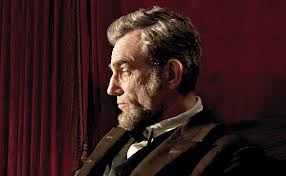
Daniel Day Lewis embodied Lincoln in last year's Oscar nominated the Steven Speilberg movie.

Daniel Day Lewis embodied Lincoln in last year’s Oscar nominated the Steven Speilberg movie.

Daniel Day Lewis won the BEST ACTOR OSCAR for his performance of Lincoln.

Daniel Day Lewis won the BEST ACTOR OSCAR for his performance of Lincoln.

Daniel Day Lewis embodied Lincoln in last year's Oscar nominated the Steven Speilberg movie.

Daniel Day Lewis embodied Lincoln in last year’s Oscar nominated the Steven Speilberg movie.


Elizabeth Bishop 2.8.13 Thought of the Day

“The whole shadow of Man is only as big as his hat.”–Elizabeth Bishop

[Image courtesy: Poetry Foundation.org]

[Image courtesy: Poetry Foundation.org]

Elizabeth Bishop was born on this day in Worcester, Massachusetts, USA in 1911 .  Today is the 102nd anniversary of her birth.

She was an only child whose father died when she was 8 moths old. Her mother suffered a series of mental breakdowns and was “permanently committed to an institution when Elizabeth was only five years old.” [Poetry Foundation]

[Image courtesy: The Elizabeth Bishop Legacy]

[Image courtesy: The Elizabeth Bishop Legacy]

Bishop, who went to live with her maternal grandparents in Nova Scotia, never saw her mother again. After several years her paternal grandparents took her to live with them in Massachusetts. The Bishops were well to do  and could afford a first class education for the little girl. They sent her to “Walnut Hills School for Girls and to Vassar College.” [Ibid]

[Image courtesy Elizabeth Bishop Society]

[Image courtesy Elizabeth Bishop Society]

After graduating Vassar Bishop, who was independently wealthy traveled extensively in Europe and North Africa. She lived for four years in Key West Florida where she wrote of her travels.  In 1946 those poems were compiled into her first book, North and South.  (The book won a Pulitzer Prize.) In 1951 she received a traveling fellowship and decided to circumnavigate South America. She made it as far as Santo, Brazil. Her intended stay of 2 weeks lasted over fifteen years. Upon returning to the United States she lived in New York, San Francisco, and New England.

Her style “focuses … with great subtlety on her impressions of the physical world… Her images are precise and true to life, and they reflect her own sharp wit and moral sense.” [Poets.org] The New York Times Called Bishop “One of the most important American poets” of the 20th Century. Bishop wrote slowly and precisely. She didn’t write a huge volume of poems, but each was measured perfection.

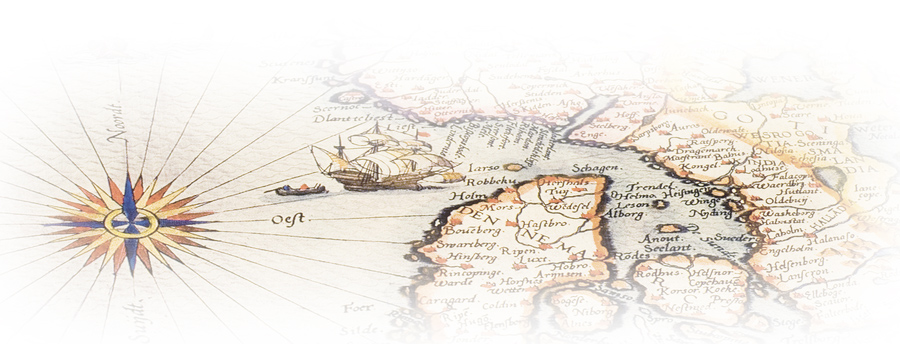
Here is my favorite Bishop poem, The Map:

map

The Map

Land lies in water; it is shadowed green.
Shadows, or are they shallows, at its edges
showing the line of long sea-weeded ledges
where weeds hang to the simple blue from green.
Or does the land lean down to lift the sea from under,
drawing it unperturbed around itself?
Along the fine tan sandy shelf
is the land tugging at the sea from under?

The shadow of Newfoundland lies flat and still.
Labrador’s yellow, where the moony Eskimo
has oiled it. We can stroke these lovely bays,
under a glass as if they were expected to blossom,
or as if to provide a clean cage for invisible fish.
The names of seashore towns run out to sea,
the names of cities cross the neighboring mountains
-the printer here experiencing the same excitement
as when emotion too far exceeds its cause.
These peninsulas take the water between thumb and finger
like women feeling for the smoothness of yard-goods.

Mapped waters are more quiet than the land is,
lending the land their waves’ own conformation:
and Norway’s hare runs south in agitation,
profiles investigate the sea, where land is.
Are they assigned, or can the countries pick their colors?
-What suits the character or the native waters best.
Topography displays no favorites; North’s as near as West.
More delicate than the historians’ are the map-makers’ colors.

Elizabeth Bishop

compass

Bishop died  at age 68 in October of 1979 in Boston. Besides her Pulitzer she won a National Book Award for Poetry in 1970, the Neustadt Internaional Prize in 1976 and two Guggenheim Fellowships (1947 & 1978).

[Image courtesy: Poets.org]

[Image courtesy: Poets.org]

Other Bishop poems I highly recommend:

A Visit to St. Elizabeths

Conversation

Five Flights Up

In The Waiting Room