Category Archives: United States

Errol Flynn 06.20.13 Thought of the Day

“I allow myself to be understood as a colorful fragment in a drab world.”


“It isn’t what they say about you, it’s what they whisper.”


“By instinct I’m an adventurer; by choice I’d like to be a writer; by pure, unadulterated luck, I’m an actor.”


— Errol Flynn


English: The front cover of Errol Flynn's auto...

English: The front cover of Errol Flynn’s autobiography, “My Wicked, Wicked Ways”. The front cover is part of John Kobal’s Kobal Collection images. (Photo credit: Wikipedia)


Errol Leslie Thomson Flynn was born on this day in Hobart, Tasmania, Australia in 1909. Today is the 104th anniversary of his birth.


Son of Theodore and Lily Mary “Marelle” Flynn, Errol had a knack for adventure and trouble,


 Young Flynn was a rambunctious child who could be counted on to find trouble.
Errol managed to have himself thrown out of every school he was enrolled in. [IMDb]


That included Sydney Church of England Grammar School, the Shore School, which he managed to get expelled from for both fightiing and for having a romanitic assignation with the school’s laundress. [Per his autobiography “My Wicked, Wicked Ways”]


By the time he was in his late teens he’d left (or was ejected from) school for good and set out to find his fortune… literally…


he set out to find gold, but instead found a series of short lived odd jobs. Information is sketchy, but the positions of police constable, sanitation engineer, treasure hunter, sheep castrator, shipmaster for hire, fisherman, and soldier seem to be among his more reputable career choices. [Ibid]


By the early 1930s he was in England, and by 1933 his good looks, atheletic ability, and smooth voice had landed him a gig with the Northampton Repertory company. That same year he appeared in his first movie as Fletcher Christian on In the Wake of the Bounty. (Ironically, Flynn claimed that his mother descended from a midshipman of the Bounty).


Cover of "Captain Blood"

Cover of Captain Blood


Now that he had his sea legs under him, Warner Brothers signed him to a contract and he moved to America to star in Captain Blood.


He quickly rocketed to stardom as the undisputed king of swashbuckler films, a title inherited from Douglas Fairbanks, but which remains his to this day. Onscreen, he was the freedom loving rebel, a man of action who fought against injustice and won the hearts of damsels in the process. [Ibid]


He wasn’t fulfilled with the roles Hollywood was offering him.  Of the well over 50 movies he made he said, “I’ve made six or seven good films – the others, not so good.” He also noted, “I felt like an impostor, taking all that money for reciting ten or twelve lines of nonsense a day.”


Cropped screenshot of Errol Flynn from the fil...

Cropped screenshot of Errol Flynn from the film That Forsyte Woman (Photo credit: Wikipedia)


Off Screen he ran at life full throttle. He drank hard, romanced the ladies (especially the young ladies) and self-medicated with both legal and illegal drugs.  He lead –as author Benjamin S. Johnson put it–an “Errolesque” life. His hard living eventually caught up to him. His youthful, handsome face gave way to a puffy lined one. He was no longer able to do his own stunts. Roles came fewer and father between.  “A few good roles did come his way late in life, however…” [IMDb]  and he was finally “making a name as a serious actor before his death.” [Ibid] The Sun Also Rises (1957) was, perhaps the best performance of his career.


Flynn in The Sun Also Rises. [Image courtesy: Warner Brothers]

Flynn in The Sun Also Rises. [Image courtesy: Warner Brothers]

Flynn died  on October 14, 1959 of  myocardial infarction, coronary thrombosis, coronary atherosclerosis, liver degeneration, liver sclerosis and diverticulitis of the colon. Allegedly his last words were “I’ve had a hell of a lot of fun and I’ve enjoyed every minute of it.” He was 50 years old.


This image shows a photograph of Errol Flynn, ...

This image shows a photograph of Errol Flynn, taken ca. 1940. Under Australian law, all photographs taken in Australia before 1955 are in the public domain. This image is in the public domain under both Australian copyright law and US copyright law. (Photo credit: Wikipedia)


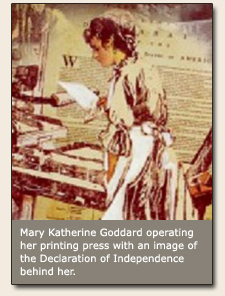
Mary Katherine Goddard 6.16.13 Thought of the Day

“He carries every point, who blends the useful with the agreeable, amusing the reader while he instructs him.”
the English translation of the Goddard family motto.

[Image courtesy: The Baltimore Sun]

[Image courtesy: The Baltimore Sun]

Mary Katherine Goddard was born on this day n Groton, Connecticut, USA, in 1738. Today is the 275th anniversary of her birth.

She was elder of two children born to Sarah Updike Goddard and Dr. Giles Goddard. Mary Katherine and her brother William learned to read and write at their New London, Connecticut home. Their mother also taught them “Latin, French, and the literary classics.” [WHMN.org] Shakespeare, Pope and Swift  were favorite reading assignments.

When Mary Katherine was 19 her father passed away. The family stayed in Connecticut for a few years while William was apprenticed to a local printer, but in 1762 they moved to Providence, Rhode Island, and  Sarah Goddard lent William the money to start his own printing business. All three members of the family pitched in to help establish the business.

William was ostensibly in charge, (but) he traveled a great deal, and it was Sarah Updike Goddard who was the true publisher of the Providence Gazette and Country Journal.  Mary Katherine took a great interest in the business and forewent many of the usual activities for young ladies to work as a typesetter, printer, and journalist.  The mother/daughter team made their print shop a hub of activity at a time when newspapers exerted great political influence.  They added a bookbindery, and in addition to the Gazette, printed almanacs, pamphlets, and occasionally books.[WHMN.org]

In 1765 William left Rhode Island for the more metropolitan Philadelphia.  Mary Katherine took over the printing operation in Providence.

…Left with a burden upon her shoulders, Mary Katherine acquired the skills she needed to print a successful publication. “It was probably during the years of [William’s] absence… that his sister… learned the practical side of typography and journalism… ” Lawrence C. Wroth wrote.[University of Rhode Island web site URI.edu]

Three years later William asked the two women to sell the Providence business (They sold the Gazette,  press and building for $550) and move to Pennsylvania to help him with the Philadelphia Chronicle.

Upon their arrival they ran the newspaper and press and William headed to Baltimore, Maryland  on a new venture.  Mary Katherine followed him again in 1774 when she took over her brother’s weekly publications the Maryland Journal and Baltimore Advertiser as he continued to travel.

With her mother dead and her brother prioritizing his political inclinations, Mary Katherine Goddard finally assumed the title of publisher of the Maryland Journal and the Baltimore Advertiser.  She put “Published by M.K. Goddard” on the masthead on May 10, 1775 — and it remained there even when William returned from his New Hampshire-to-Georgia travels in 1776.  [WHMN.org]

She also became a postmaster in 1775 — the first woman in the colonies to do so. As postmaster she was at the  “center of the information exchange.”  [Ibid] and was privy to the news before her competitors. The Journal broke important news stories  (like the skirmishes at Lexington and Concord).

[Image courtesy the Library of Congress]

[Image courtesy the Library of Congress]

Mary Katherine kept the tone of the Journal professional. Other newspapers — and William — editorialized and included op eds that advanced political agendas. “Mary Katherine Goddard used a more objective, impersonal, and professional tone.” [Ibid]

She was a shrewd business woman who accepted alternate forms of payment when the taxes or the War made cash subscription payments difficult.

These included beef, pork, animal food, butter, hog’s lard, tallow, beeswax, flour, wheat, rye, Indian corn, beans and other goods she could sell in her shop. [University of Rhode Island web site URI.edu]

She ran a stationary and printing press where fine printing was produced. She also had a local paper mill.

Mary Katherine biggest scoop as a newspaper woman came in January of 1777 when her press printed the first official copy of the Declaration of  Independence to include the names of the signers.

Goddard's published copy of the Declaration of Independence with all the signers identified. [Image courtesy McHenry Country Turning Point.org]

Goddard’s published copy of the Declaration of Independence with all the signers identified. [Image courtesy McHenry Country Turning Point.org]

She successfully ran both the publication and the related printing and paper companies AND served as postmaster through out the long Revolutionary War. But things changed in 1784. She had a falling out with William and he forced her off the paper’s staff. Then in 1789 Mary Katherine was forced to give up her postmaster position. As a woman — it was as argued — she could not handle the traveling the job would demand. Her appeals — backed by a petition of endorsement signed by over 200 Baltimore businessmen — went to President Washington and Congress but got nowhere. She resigned her self to running her bookstore.

Mary Katherine Goddard died att he age of 78 on April 12, 1816. “A copy of the Declaration of Independence printed by her is at the Maryland Hall of Records.”[WHMN.org]


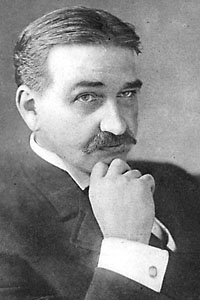
L. Frank Baum 5.15.13 Thought of the Day

“Imagination has brought mankind through the dark ages to its present state of civilization. Imagination led Columbus to discover America. Imagination led Franklin to discover electricity.”– L. Frank Baum

[Image courtesy: xyz
[Image courtesy: QOTD.org]

Lyman Frank Baum was born on this day in Chittenango, New York, USA in 1856. today is the 157th anniversary of his birth.

Frank was the seventh of nine children born to Benjamin and Cynthia Baum. The Baums were wealthy. Benjamin made his fortune in the oil fields of Pennsylvania. And Frank grew up happy at the family estate of Rose Lawn. He was a shy child, and, because of a “weak heart,”  he was home schooled for most of his life. He loved to read and spent hours in his father’s library. He didn’t like classical fairy tales — their goblins and villains were too scary — so he made up his own stories and shared them with his brothers and sisters.

When he was twelve his father… hoping to toughen Frank up and cure him of his ‘daydreaming,’ sent him to the Peekskill Military Academy. Baum was miserable there for over a year, and the only results of the experiment were a physical (and possibly also psychological) breakdown, and a lifelong aversion to both formal education and the military. [The Oddness of Oz]

Once home he turned to creative writing. His father bought him a small printing press and, along with his little brother Harry, “he started his own newspaper, the Rose Lawn Home Journal” [the Literary Network]. Frank filled the pages, honing his craft by cranking out articles, fiction and poetry. Other publications included Baum’s Complete Stamp Dealers’ Directory an 11 page  booklet for amateur philatelist and The Poultry Record in which Baum wrote about Hamburg chickens. “He would also write about the raising and breeding of chickens in The Book of Hamburgs. (1896)” [Ibid]

He became fascinated with acting and the theater.

He developed an intense and enduring fascination with the theater. In 1878, he began to work as a professional actor. Four years later his father bought him a small dramatic company, and Baum was soon adapting and starring in a romantic melodrama, The Maid of Arran [The Oddness of Oz]

Baum as Hugh Holcomb in Maid from Arran. [Image courtesy: Hungry Tiger Press.com]

But Baum had bad luck in almost every business endeavor he put his hand to. The Maid of Arran was a moderate success, but while he was touring with the play his theater back home (the one his father bought him) burned down. The company lost the building, all the sets and costumes, and all of the scripts (except those they were traveling with). Ironically the Baum play that was running at the time was called “Matches.”

Other short-lived opportunities soon soured. And he struggled for long-term success. In 1882 he married Maud Gage. Now he had a family to provide for. The time of being a daydreamer were over.

The family moved Aberdeen, South Dakota where he opened a department store, Baum’s Bazaar. The store failed — Frank let people have too much store credit. He became an editor of The Aberdeen Saturday Pioneer, where, after the Massacre at Wounded Knee, he wrote (what one hopes was) a Swiftian inspired modest proposal that all Native Americans be exterminated…

“Having wronged them for centuries, we had better, in order to protect our civilization, follow it up by one more wrong and wipe these untamed and untamable creatures from the face of the earth.”

He tried his hand at managing a baseball club and worked as a buyer for a department store. Nothing seemed to stick.

Baum moved the family to the Humboldt Park neighborhood of  Chicago in 1891. He worked as a reported for the Evening Post, edited a magazine on window displays and worked as traveling salesman.

In 1897, he finally started to have some success with his writing.   Mother Goose in Prose, stories based on traditional Mother Goose poems paired with lovely Maxfield Parrish illustrations, sold well enough that he could quit his door-to-door salesman job. Two years later Baum published Father Goose, His Book this time with W.W. Denslow as his illustrator and had even greater success.

Cover of the first edition of the Wonderful Wizard of Oz [Image courtesy: Loc.gov]

Cover of the first edition of the Wonderful Wizard of Oz [Image courtesy: Loc.gov]

In 1989 he wrote the Wizard of Oz. It was published in 1900, again with Denslow as illustrator, and cost $1.50 a copy.

Unlike other books for children, The Wizard of Oz was pleasingly informal; characters were defined by their actions rather than authorial discourse; and morality was a subtext rather than a juggernaut rolling through the text. [SmithsonianMag.org]

Baum wrote 13 more Oz books (some coming as frequently as one a year.) He had done more than write a best seller, he had created a new genre of fiction… The American Fairy Tale.

He wrote dozens of other books, from Dot and Tot of Merryland to The Life and Adventures of Santa Claus to his last book Phoebe Daring: A Story for Young Folk, but the Oz books were his bread a butter best sellers.

The family moved to Hollywood, California and Baum tried his hand at making silent films with the creation of the Oz Film Manufacturing Company. He wrote, directed and acted with the company which used experimental film effects to capture some of Baum’s fantastic themes. He also  worked with the Uplifters theatre troupe.

L. Frank Baum died of a stroke on May  6th, 1919.

“To please a child is a sweet and lovely thing

that warms one’s heart and brings its own reward.”

–L. Frank Baum

An illustration by W. W. Denslow from The Wond...
An illustration by W. W. Denslow from The Wonderful Wizard of Oz, also known as The Wizard of Oz, a 1900 children’s novel by L. Frank Baum. (Photo credit: Wikipedia)

James Monroe 4.28.13 Thought of the Day

“The best form of government is that which is most likely to prevent the greatest sum of evil.”–James Monroe

James Madison, Hamilton's major collaborator, ...

James Madison, Hamilton’s major collaborator, later President of the United States and “Father of the Constitution” (Photo credit: Wikipedia)

James Monroe was born on this day in Westmoreland County, Virginia, USA in 1758. Today is the 258th anniversary of his birth.
Monroe’s was born to Spence and Elizabeth Monroe a moderately well to do couple of Scottish, Welsh and French Huguenot descent. His father was a planter and carpenter. Elizabeth tutored her children at home, and James didn’t start school until he was 11, when he went to “Campbelltown Academy between 1769 and 1774,” [Biography.com]

In 1774 his father died and Monroe inherited the family’s plantation and slaves.  His mother passed soon after. James and his brothers  be came ward of uncle.  the same  year he entered the College of William and Mary. William and Mary is in Williamsburg, Virginia, which was then the capital of the colony of the State. It was quiet an interesting time to be studying in the city. The Royal Governor  and his family had fled the city, the arsenal and Governor’s Palace had been looted and ‘revolution’ was in the air. Monroe was part of a group of men who raided the Governor’s Palace and liberated its cash of weapons. They used the weapons to form the Williamsburg Militia.

In Winter of 1776 he left school and volunteered with the Continental Army.  He was shot in the shoulder at the Battle of Trenton, New Jersey.  And he fought with distinction throughout the war.

He met Thomas Jefferson during the war, and Monroe studied law under the Virginia statesman when the Revolution drew to a close. After passing the bar he was quickly elected to the Virginia Assembly  (probably through Jefferson’s influence.)

Elected to the Continental Congress in 1783, Monroe worked for expanding the power of Congress, organizing government for the western country, and protecting American navigation on the Mississippi River. [Mille Center.org]

He was initially opposed to the ratification of the Constitution and fought to have senators and the President directly elected. He also fought for the inclusion of a Bill of Rights.

As a youthful politician, he joined the anti-Federalists in the Virginia Convention which ratified the Constitution, and in 1790, an advocate of Jeffersonian policies, was elected United States Senator. [Whitehouse.gov]

He lost the 1790 race for the US House of Representatives to James Madison, but “was quickly elected by the Virginia legislature as a United States senator.” [Biography.com] Jefferson, Madision and Monroe joined forces to oppose Federalist policies of Vice President John Adams and Secretary of Treasury Alexander Hamilton.

James Monroe, fifth President of the United States

James Monroe, fifth President of the United States (Photo credit: Wikipedia)

Monroe served as Minister to France from 1794-1796 and he helped negotiate the Louisiana Purchase.

In 1816 he ran for  president with the blessing of his friend and  outgoing POTUS Madison. He won, becoming the 5th president of the United States. (4 of the first 5 US presidents were from Virginia, Monroe is the last of the “Virginia Dynasty”.)

His term started with a honeymoon dubbed the “Era of Good Feelings.” However, Economic depression and slavery disputes meant that the honeymoon didn’t last long.

The Monroe Doctorine is his legacy in foreign affairs. Foreign powers  must leave the American continents alone and “henceforth not to be considered as subjects for future colonization by any European Power.”[Whitehouse.gov]

During his presidence five states were admitted to the Union: Mississippi (1817), Illinois (1818), Alabama (1819), Main (1820), and Missouri (1821).

Monroe died on the Fourth of July, 1831.

James Monroe County (New York)


James Buchanan

“What is right and what is practicable are two different things.”– James Buchanan

English: I took photo of James Buchanan in Nat...
English: I took photo of James Buchanan in National Portrait Gallery with Canon camera. Public domain. (Photo credit: Wikipedia)

James Buchanan was born on this day in Cove Gap, Pennsylvania, USA in 1791. Today is the 222nd anniversary of his birth.

James Buchanan Log House

Although he was born in a log cabin Buchanan’s family was well to do. His father was a prosperous businessman. His father, James Buchanan, Sr. was a farmer, businessman and merchant, his mother, Elizabeth Speer, was intelligent and well-respected. James was the second of 11 children, 8 of whom lived to adulthood.

Young James attended school in the Mercersberg area, but his father’s business triumphs and his mother’s interest in education dictated better opportunities for the boy. At age sixteen, he entered Dickinson College in Carlisle, seventy miles from home. [the Miller Center.org]

After graduation in 1809 he went to Lancaster, PA, to study Law. He passed the bar in 1812.

Although he was against the War of 1812 (he thought it was unnecessary) He joined the light dragoon unit when the British invaded Maryland and helped defend the city of Baltimore. Although the Battle of Baltimore would later become famous because of Francis Scott Key’s poem The Star Spangled Banner, Buchanan’s unit didn’t see any action.

He returned to Lancaster after the war. At 23 he ran for Pennsylvania House of Representatives and won a seat as a Federalist.

Toward the end of his time in the legislature, Buchanan fell in love with Ann Caroline Coleman. … The young woman’s family opposed the match with Buchanan, however. … Ann Coleman sent him a letter breaking off the engagement. A few days later she died. The Coleman family turned its grief and guilt on the young lawyer and forbade him to attend the funeral. The experience severely shook Buchanan; he vowed he would not marry another, and he never became seriously involved with any other woman for the rest of his life, though he carried on many flirtations. He would be the nation’s first and only bachelor President. [the Miller Center.org]

He threw himself into his work and was elected to the U.S. House of Representatives in 1820.

He was elected five times to the House of Representatives; then, after an interlude as Minister to Russia, served for a decade in the Senate. He became Polk’s Secretary of State and Pierce’s Minister to Great Britain. [White House.gov]

Being out of the country during a contentious primary season helped Buchanan side step the bloody Slavery debate. “The overseas post enabled Buchanan to be unblemished by the political bloodshed that resulted from the disastrous Kansas-Nebraska Act of 1854.” [the Miller Center.org]  He became the Democratic Party’s nominee for President in 1856. He beat Republican John C. Frémont and took the White House on March 4, 1857 as the 15th president of the United States.

James Buchanan: Fifteenth President of the Uni...
James Buchanan: Fifteenth President of the United States (Photo credit: Wikipedia)

The first crisis of his presidency happened when the Supreme Court handed down the Dread Scott Decision…

Asserting that Congress had no constitutional power to deprive persons of their property rights in slaves in the territories. Southerners were delighted, but the decision created a furor in the North. [White House.gov]

More slavery woes were in store in the territory of Kansas. The choice in Bleeding Kansas was between two rival state constitutions, the Free-Soil (anti-slavery settlers) took Topeka as their capital, those who were pro-slavery picked Lecompton as the seat of government. The Free-Soil party was in the majority but the Lecomptons managed (through a number of shady means) to get their platform passed.

Buchanan decided to end the troubles in Kansas by urging the admission of the territory as a slave state. Although he directed his Presidential authority to this goal, he further angered the Republicans and alienated members of his own party. Kansas remained a territory. [Ibid]

By the mid-term elections Buchanan’s political star had fallen and the Republican took the House and Senate. He was the lamest of lame ducks and the government was at a stalemate. In the presidential election of 1860 the Democrats split with Buchanan taking the Southern states and Douglas taking the Northern states.

Consequently, when the Republicans nominated Abraham Lincoln, it was a foregone conclusion that he would be elected even though his name appeared on no southern ballot. Rather than accept a Republican administration, the southern “fire-eaters” advocated secession…President Buchanan, dismayed and hesitant, denied the legal right of states to secede but held that the Federal Government legally could not prevent them. He hoped for compromise, but secessionist leaders did not want compromise. [White House.gov]

South Carolina was first to secede (on December 20, 1860.) Six other states joined South Carolina and formed the Confederate States of America. “When Buchanan left office on March 3, 1861, to retire to his estate outside of Lancaster, Pennsylvania, he left the nation on the brink of civil war.” [Biography.com ]

James Buchanan
James Buchanan (Photo credit: Wikipedia)

He lived out the war at his home, Wheatland, in Lancaster, PA.

Rightly or wrongly, considerable blame for the Civil War fell upon him. His portrait had to be removed from the Capitol to keep vandals from damaging it, and posters captioned “Judas” depicted him with his neck in a hangman’s noose. A wave of second-guessing condemned Buchanan’s actions with regard to Fort Sumter. The Republican press attacked him while absolving the Republican Party and Lincoln from all responsibility for the conflict. Although Buchanan vocally supported the Union cause, many branded him an appeaser of the South and a lover of slavery.  [the Miller Center.org]

He died of respiratory failure in 1868. He 77.


Charlie Chaplin 4.16.13 Thought of the Day: Part ONE

“I remain just one thing, and one thing only, and that is a clown. It places me on a far higher plane than any politician.” — Charlie Chaplin

Charlie Chaplin The Tramp debuted in 1914 -- p...

Charlie Chaplin The Tramp debuted in 1914 — pre-1923 (Photo credit: Wikipedia)

Charles Spencer Chaplin was born on this day in 1889 in London, England. Today is the 124th anniversary of his birth.

He was practically born to the stage. Both his parents were musical hall entertainers. His father, Charles Chaplin, Sr.  was a singer and actor, his mother, Hannah Chaplin — her stage name was Lily Harley — sang light opera. The marriage didn’t last long, and Chaplin, Sr. abandoned the family when Charlie was an infant. He had two half brothers. Sydney Hill Chaplin was four years older than Charlie and was born to Hannah a year before she married Chaplin, Sr. (who was not his father.) Hannah had another baby, George Wheeler Dryden in 1892, by entertainer Leo Dryden. Sydney and Charlie hardly knew this brother, however, because Leo took the boy away when he was 6 months old. George didn’t resurface until his mid thirties.

Hannah continued her stage career for a few years, but…

in a performance that would introduce her youngest boy to the world of performance, Hannah inexplicably lost her voice in the middle of a show, prompting the stage manager to push the five-year-old Chaplin, whom he’d heard sing, onto the stage to replace her…[Biography]

The audience loved little Charlie, but it was a disaster for Hannah…

Her singing voice never returned and she eventually ran out of money. For a time, Charlie and Sydney had to make a new, temporary home for themselves in London’s tough workhouses. [Ibid]

Hannah was in and out of mental institutions until 1905 when she was committed permanently. With the exception of one disastrous stint with their alcoholic father, the boys were left to fend for themselves,  and, eventually, thrown into the workhouse. Sydney was trained as a seaman, but both boys wanted to act. Charlie charmed his way into a clog dancing group called the Eight Lancashire Lads in 1897.

It was a short stint, and not a terribly profitable one, forcing the go-getter Chaplin to make ends meet anyway he could…”I (was) newsvendor, printer, toymaker, doctor’s boy, etc., but during these occupational digressions, I never lost sight of my ultimate aim to become an actor,” Chaplin later recounted. “So, between jobs I would polish my shoes, brush my clothes, put on a clean collar and make periodic calls at a theatrical agency.” [Ibid]

His first play was  Jim, a Romance of Cockayne by H.A. Saintsbury in 1903.  Although the show closed after two weeks Chaplin’s comedic performance  as the newsboy received good reviews. Real stage experience came later that year with a 2.5 year run with  Sherlock Holmes in which Chaplin played the Page-boy.

He toured with a vaudeville outfit named Casey’s Court Circus and in 1908 teamed up with the Fred Karno pantomime troupe, where Chaplin became one of its stars as The Drunk in the comedic sketch, A Night in an English Music Hall. [Ibid]

Español: Esta es una fotografia del Sr. Charle...

Español: Esta es una fotografia del Sr. Charles Spencer Chaplin tomada en Estados Unidos, durante su juventud, en un momento en el que, como se aprecia, se encontraba al natural, tal como era, sin los clasicos caracteres que usaba para protagonizar a su recordado personaje de cine mudo Charlot. Français : Charles Chaplin, acteur américain, célèbre pour son personnage Charlot. (Photo credit: Wikipedia)

He twice came to America on tour with the Karno troupe and film producer Mack Sennett promptly signed Chaplin to a contract for a $150 a week with Keystone Pictures. Chaplin didn’t like his first film, Making a Living, and it wasn’t a hit, but he was singled out for his comic timing and presence.

He wanted to create a persona that made him stand out from the crowd of comedic actors at Keystone, so he borrowed Fatty Arbuckle’s pants, Ford Sterling’s size 14 shoes and Arbuckle’s father-in-law’s bowler to invent the Little Tramp. The Tramp made his debut in  Kid Auto Races at Venice.

Chaplin with Edna Purviance in The Immigrant (...

Chaplin with Edna Purviance in The Immigrant (1917) (Photo credit: Wikipedia)

Charlie yearned for more creative input in his film and finally got a chance to direct in 1914. With the caveat that Chaplin would return $1,500 to producer Sennett should the film fail, he helmed Caught in the Rain . (He did not have to return the money. )

When Keystone wouldn’t give him a raise (he wanted $1,000 a week)  he went to Essanay Film Manufacturing Company  (they gave him $1,250 a week.) He made 14 films with Essanay.

By the age of 26, Chaplin, just three years removed from his vaudeville days was a movie superstar. He’d moved over to the Mutual Company, which paid him a whopping $670,000 a year. The money made Chaplin a wealthy man, but it didn’t seem to derail his artistic drive. With Mutual, he made some of his best work, including One A.M. (1916), The Rink (1916), The Vagabond(1916), and Easy Street (1917). [Biography]

He got a million dollar deal with First National Exhibitors’ Circuit to make 8 films. (His brother Sydney was his financial manager by then, and he was instrumental in making the deal.) Two of the eight movies broke the old show business rule about not working with children and animals, and those films — The Kid and A Dog’s Life were two of Chaplin’s best.

Charlie Chaplin and Jackie Coogan in The Kid

Charlie Chaplin and Jackie Coogan in The Kid (Photo credit: Wikipedia)

Click HERE for Charlie Chaplin 4.16.13 Thought of the Day: Part TWO


Gregory Peck 4.5.13 Thought of the Day

“I don’t lecture and I don’t grind any axes. I just want to entertain.”–Gregory Peck

Cropped screenshot of Gregory Peck from the tr...

Cropped screenshot of Gregory Peck from the trailer for the film Gentleman’s Agreement. (Photo credit: Wikipedia)

Eldred Gregory Peck was born on this day in La Jolla, California, USA in 1916. Today is the 97th anniversary of his birth.

He was born to Bernice Mae “Bunny” and Gregory Pearl Peck. Bunny was Scottish, English and Protestant, Gregory senior was Irish and Catholic. She converted when they married and they raised Eldred Catholic. When the couple split  little Eldred was six, he went to live with his grandmother.

Peck…”never felt he had a stable childhood. His fondest memories are of his grandmother taking him to the movies every week and of his dog, which followed him everywhere.” [IMDb]  When he was ten his grandmother passed away and he went to live with his father full-time.

He went to St. John’s Military Academy, a Roman Catholic military school in Los Angeles, then to  San Diego High School. He enrolled at San Diego State Teacher’s College for one year before transferring to the University of California, Berkley where he settled on Acting. Working as a truck driver and kitchen assistant helped pay the bills.

Upon graduation Peck headed east to New York City.  Gregory Peck was ‘born’ when he dropped his first name. “I never liked the name Eldred. Since nobody knew me in New York, I just changed to my middle name.” He worked as an usher at Radio City Music Hall and a tour guide at NBC. He worked for the acting experience and for food, landing progressively larger roles as he honed his craft.

His debut was in Emlyn Williams‘ play “The Morning Star” (1942). By 1943 he was in Hollywood, where he debuted in the RKO film Days of Glory (1944).

Stardom came with his next film, The Keys of the Kingdom (1944), for which he was nominated for an Academy Award. Peck’s screen presence displayed the qualities for which he became well-known. He was tall, rugged and heroic, with a basic decency that transcended his roles. [IMDb]

Cropped screenshot of Gregory Peck from the tr...

Cropped screenshot of Gregory Peck from the trailer for the film The Yearling. (Photo credit: Wikipedia)

He was nominated for four Academy Awards in the 1940’s for his work in: The Keys of the Kingdom, The Yearling, Gentleman’s Agreement and Twelve O’Clock High. He’d have to wait another 20 years before winning the statue.

An old back injury keep him out of the service during World War II (he’d hurt himself while taking dance and movement classes — not while on the UC Berkley Rowing team as 20th Century Fox claimed.)

He kept his stage skills up at The La Jolla Playhouse, a theatre he co-founded with Mel Ferrer and Dorothy McGuire in 1947.

To Kill a Mockingbird, 1962

To Kill a Mockingbird, 1962 (Photo credit: mystuart)

His best known and most love role came in 1962 as Atticus Finch in the film adaptation of Harper Lee’s To Kill a Mocking Bird. He won an Academy Award for his portrayal of the soft-spoken, southern lawyer. And his portrait of Finch was voted as the #1 greatest hero in American film by the American Film Institute in 2003.

Other notable films from his large library of movies include:

  • Spellbound
  • Captain Horatio Hornblower
  • The Snows of Kilimanjaro
  • Designing Women with Lauren Bacall
  • On the Beach
  • The Guns of Navarone
  • Cape Fear
  • The Omen
  • The Boys From Brazil

and my other favorite (besides Mocking Bird)… Roman Holiday with Audrey Hepburn.

Cropped screenshot of Gregory Peck from the tr...


Dorothea Dix 4.4.13 Thought of the Day

“In a world where there is so much to be done, I felt strongly impressed that there must be something for me to do” — Dorothea Dix

Ninth plate daguerreotype of Dorothea Lynde Dix.

Ninth plate daguerreotype of Dorothea Lynde Dix. (Photo credit: Wikipedia)

Dorothea Lynde Dix was born on this day in Hampden, Maine, USA in 1802. Today is  211th anniversary of her birth.

She was the oldest child of Joseph and Mary Dix. Joseph was an itinerant Methodist preacher and sometime laborer. He was also an alcoholic and an abusive father. “Her mother was not in good mental health” [Webster.edu] so by the time her two brothers, Joseph and Charles, were born Dorothea was taking care of the house. She also cared for her brothers.

During the war of 1812 the British took control of Hampden and the family moved Vermont. She also spent much of her early life in Worcester, Massachusetts. Her father taught her to read and write when she was little, “when she entered school she was way ahead of everyone else. This developed a passion for reading and teaching, as she taught her brothers how to read as well” [Ibid]

When she was about 12 it was decided that her parents could not care for the children (her mother was suffering from severe, incapacitating headaches and her father’s alcoholism was spiraling out of control) so the Dorothea, Joseph and Charles went to live with their Grandmother Dix in Boston. Madame Dix was a wealthy woman and life in the Dix Mansion was far cry from the poverty at home. But her grandmother had a very narrow vision of what well brought up young ladies did and did not do. They DID take dancing lessons and wear fine clothing. They DID NOT give food and clothing to children begging at the front gate. When Dorothea was 14 Madame Dix asked her sister, Dorothea’s great-aunt, Mrs. Duncan, to take in the girl and teach her how to be a proper young lady. That relationship fared better, but Dorothea did everything she could to get back to her brothers.

Dorothea wanted to be a teacher and with the help of an older cousin, Edward Bangs, she opened a Dame School for young ladies. “In the fall of 1816, at age fifteen, she faced her first twenty pupils between the ages of six and eight. She ran this school of sorts for three years.” [Ibid]

She continued teaching and began a formal school for older children in a cottage on her grandmother´s property. The school was named “the Hope” and it served the poor children of Boston whose parents could not afford a formal education. At this time, Dorothea wrote her first book, Conversations on Common Things. This encyclopedia for children was quite popular and sold many copies.[Learning to Give.org]

Dorothea Dix

Dorothea Dix (Photo credit: elycefeliz)

in 1826 she had to close the school because of health problems. It took her several years to recover, during this time she “wrote four more books including Hymns for Children and American Moral Tales for Young Persons.” [Ibid] Although she took on a governess job and later returned to teaching her bouts with illness recurred. She had tuberculosis, and had to eventually give up teaching. On advice from her doctors she took a long trip to England to recuperate. There she stayed with the Rathbone family. The Rathbones were Quakers and social reformers.

While in England she toured the York Retreat insane asylum. It was built by William Tuke in 1796 as was a state of the art facility for the mentally ill.

The idea that full recovery could be made if the mentally ill were treated and cared for compassionately was a principle Dix never forgot and brought to every aspect of her work. [Ibid]

When she came back to the U.S. she was asked to teach Sunday school at the East Cambridge Jail.

She discovered the appalling treatment of the prisoners, particularly those with mental illnesses, whose living quarters had no heat. She immediately went to court and secured an order to provide heat for the prisoners, along with other improvements. [Biography.com]

She embarked on a 2 year fact-finding mission, touring every facility for the mentally ill in the state. The appalling conditions she found at East Cambridge Women’s Jail (no heat, no light, scant clothing, no furniture, scarce sanitation…) was the rule rather than the exception. Much to the chagrin of those running the facilities “she compiled a detailed report and submitted it to the legislature in January 1843.” .[Learning to Give.org] A bill to remedy the abuses was quickly passed.

U.S. Library of Congress DIX, DOROTHEA LYNDE. ...

U.S. Library of Congress DIX, DOROTHEA LYNDE. Retouched photograph. date found on item. Location: Biographical File Reproduction Number: LC-USZ62-9797 (Photo credit: Wikipedia)

Dorothea set her sights on neighboring states and soon had New York and Rhode Island reforms underway. New Jersey, Pennsylvania, Alabama, Louisiana, Georgia, South Carolina, Mississippi and Arkansas were next.

In 1848, Dix submitted a bill to Congress that called for five million acres to be set aside for the use of building mental institutions to care for the ill. … For the next three years, the bill was passed back and forth. Finally, in 1854, it passed both the Senate and House, but President Franklin Pierce vetoed the bill. President Millard Fillmore was a supporter of Dorothea Dix and, in 1852, signed an executive order to begin construction of a hospital that would benefit Army and Navy veterans . [Ibid]

When the Civil War broke out..

“she volunteered her services and was named superintendent of nurses. She was responsible for setting up field hospitals and first-aid stations, recruiting nurses, managing supplies and setting up training programs” [Biography.com]

As her health continued to deteriorate she entered the state hospital in Trenton, New Jersey, a hospital she help establish. She spent 6  year there before passing away on July 17, 1887.

In all she played a major role in founding 32 mental hospitals, 15 schools for the feeble-minded, a school for the blind, and numerous training facilities for nurses. Her efforts were an indirect inspiration for the building of many additional institutions for the mentally ill. She was also instrumental in establishing libraries in prisons, mental hospitals and other institutions. [Webster.edu]

the Fountain for thirsty horses that Dorothea ...

the Fountain for thirsty horses that Dorothea Dix gave to the city of Boston to honor the Massachusetts Society for the Prevention of Cruelty to Animals, located at the intersection of Milk and India Streets. (Photo credit: Wikipedia)


John Tyler 3.29.13 Thought of the Day

“Popularity, I have always thought, may aptly be compared to a coquette – the more you woo her, the more apt is she to elude your embrace.”–John Tyler


English: A portrait of John Tyler located insi...

English: A portrait of John Tyler located inside the National Portrait Gallery in Washington, D.C. (Photo credit: Wikipedia)


John Tyler was born on this day near Charles City County, Virginia, USA in 1790. Today is the 223rd anniversary of his birth.


Born to a wealthy family on his father’s Greenway plantation. His family had been members of Virginia’s elite since the 17th century. His father, John Tyler, Sr. was a judge who was friends with Thomas Jefferson, served in the Virginia House of Delegates, was Speaker for that House, and was the 15th Governor of Virginia (when John junior was 18.) His mother Mary Armistead Tyler died when he was 7.  The younger John Tyler was the sixth of eight children.


Tyler attended William and Mary College in Williamsburg, Virginia. He


studied law under private tutors. He began his political career in 1811, when he was elected to the Virginia legislature at age 21. [History.com]


He served in the legislature until 1816 when he was elected to the US House of Representatives. He was a strict Constitutionalist and a strong proponent of States Rights. He voted against “nationalist legislation and opposed the Missouri compromise” [WhiteHouse.gov] He didn’t run again in 1820, returning to his private law practice instead.  But by 1823 he was back in the Virginia House of Delegates.


English: An engraving (c. 1826, authorship unk...


In 1825 he was appointed as Governor of Virginia (as Governor he gave the eulogy at Thomas Jefferson’s funeral.) He served as Governor for two terms.

He won a slim majority to US Senate in 1827 as a Democrat, but  his support for President Andrew Jackson was rocky at best. By 1835 he was aligned with Henry Clay’s Whig Party.


The Whigs nominated Tyler for Vice President in 1840, hoping for support from southern states’-righters who could not stomach Jacksonian Democracy. The slogan “Tippecanoe and Tyler Too” implied flagwaving nationalism plus a dash of southern sectionalism. [WhiteHouse.gov]


The “Tippecanoe”  in the campaign slogan was William Henry Harrison who fought in the Battle of Tippecanoe in 1811. The Harrison/Tyler ticket won the election with 53% of popular vote and an electoral vote of 234-60. The Whigs also won control of both the House and Senate. Tyler took the oath of the Vice Presidency, presided over the confirmations of Harrison’s cabinet appointments (as President of the Senate) and after a few days went home to Williamsburg. But then Harrison caught pneumonia and died (the first sitting president to do so) and “Tyler Too” became, suddenly, the 10th President of the United States.


The U.S. Constitution was unclear on the matter of presidential succession; however, Tyler moved into the White House and was sworn into office on April 6. At 51 years old, the man dubbed “His Accidency,” was younger than any previous president. (The ambiguity surrounding the order of succession issue was officially clarified with the 25th Amendment to the Constitution, which was ratified in 1967 and states that if the president dies or resigns, the vice president becomes president.) [History.com]


John Tyler, tenth President of the United States

John Tyler, tenth President of the United States (Photo credit: Wikipedia)


“His four year term was a shambles…” [Findagrave.com] Unable to follow both his conscience and the Whig’s political agenda he was kicked out of the part. All but one member of his (well, Harrison’s) cabinet resigned. And members of the House tried to have him impeached for misuse of veto power.


His Presidency however produced some historic events: The annexation of Texas, a reorganized Navy, The ending of the Seminole war and the signing of a treaty with China. [Findagrave.com]


He did not make a bid for a second term in the White House.

He retired to his plantation, Sherwood Forest near Richmond. When the Civil War broke out “Tyler led a compromise movement; failing, he worked to create the Southern Confederacy.” [WhiteHouse.gov] He  was elected to the House of Representatives of the Confederate Congress in 1862.  “With the war raging, he was giving a speech in front of the Exchange Hotel when he suffered a stroke and was taken to a room where he died at the age of 71.” [Findagrave.com]


Picture of President John Tyler's grave in the...

Picture of President John Tyler’s grave in the Hollywood Cemetery in Richmond, VA (Photo credit: Wikipedia)