Category Archives: Today’s Birthday

Nathan Fillion 3.27.13 Thought of the Day

Nathan Fillion at the 2005 Serenity premiere.

“What could be better than captain of a space ship? I get to ride horses, shoot guns, have adventures …” —Nathan Fillion

Nathan Christopher Fillion was born on this day in Alberta, Canada in 1971. He is 42 years old.

Nathan is the second son born to Cookie and Bob Fillion, of Edmonton, Alberta, Canada. He attended Holy Trinity Catholic High School then went to Concordia University College of Alberta and the University of Alberta. His parents and brother Jeff are all teachers, and Nathan was on the path to becoming one as well, but just before graduation he was offered a role on ABC’s One Life To Live.

He proved very popular as the show’s character Joey Buchanan and was nominated for a Daytime Emmy Award, as well as a Soap Opera Digest Award, for “Outstanding Young Actor” in 1996. [Nathan Fillion.org]

As Joey Buchannon on One Life to Live [Image courtesy: Sop Opera Weekly]
As Joey Buchannon on One Life to Live [Image courtesy: Soap Opera Weekly]

His first film role was as the “Minnesota” Ryan in Steven Spielberg’s  Saving Private Ryan.

In 1998 he turned a recurring guest appearance as Johnny Donnelly  into a permanent role on To Guys, a Girl and  Pizza Place. The series ran for three more years.

Fillion as Caleb in Buffy the Vampire Slayer. [Image courtesy: Wikipedia]

A character arch as Caleb, a defrocked priest, serial killer and really, really bad guy on Joss Whedon’s Buffy the Vampire Slayer helped bring the series to its dramatic finale.

Fillion worked with Whedon again in 2002 on the science fiction series Firefly. He played Captain Malcolm Reynolds,

Once a sergeant in the losing war for independence, Mal captains a team of misfits in smuggling operations on the edge of the galaxy. His main goal in life is to be left alone and avoid the Alliance government—until he discovers (in the movie Serenity), their heavy-handed plan to fix (i.e., medicate and subdue) the world, at which point he aims to misbehave. He’s broken, bitter and faithless. He’s also damn funny and the one person his crew can count on without reservation. [ PasteMagazine.com]

An example of the Wild West influenced clothin...
He aims to misbehave. …An example of the Wild West influenced clothing and weaponry in Firefly and Serenity. (Photo credit: Wikipedia)

Fox rather famously (and stupidly imho) cancelled the series 11 episodes in, but loyal Browncoats kept the faith. The creative team and cast came together again for the motion picture  Serenity in 2005.

He played the “hapless, frustrated hero, Police Chief Bill Pardy” [Nathan Fillion.org] in the campy horror film Slither in 2006.  Then went more romantic as an understanding gynecologist in 2007’s Waitress with Keri Russell.

He joined forces again with Whedon  (this time with Neil Patrick Harris and Felicia Day) for the three-part musical Dr. Horrible’s Sing-Along Blog.

You can currently catch Fillion as the mystery novelist turned detective Rick Castle on ABC’s Castle. The series is in its fifth season.


Leonard Nimoy 3.26.13 Thought of the Day

“The miracle is this: the more we share the more we have”–Leonard Nimoy

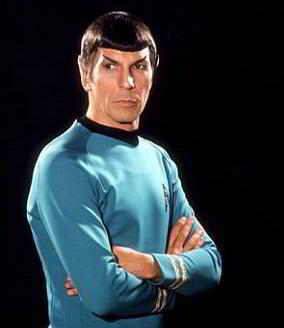
“Logic is the beginning of wisdom, not the end” — Nimoy as Spock

Nimoy as Spock [Image courtesy: Fanpop]

Nimoy as Spock [Image courtesy: Fanpop]

Leonard Simon Nimoy was born on this day in Boston, Massachusetts, USA in 1931.  He is 82 years old.

He is the youngest son of Max and Dora Nimoy. His parents and grandparents were Yiddish speaking Orthodox Jews who fled from the Ukrainian region of Stalinist Russia and settled in the West End neighborhood of Boston. Max owned a barbershop and was a neighborhood fixture. Leonard and his older brother Melvin sold newspapers in Boston Commons. His parents wanted him to go to college or at least take up the accordion so he’d have a  reliable means to make a living, but Leonard was set on being an actor. It was his Grandfather who stood up for him and encouraged him to pursue his dream.

Nimoy started to act in neighborhood theater when he was eight. He continued to act while at Boston’s English High School.

…After his graduation in 1949, he attended Boston College. While playing the role of Ralphie in a collegiate production of Clifford OdetsAwake and Sing, Nimoy noticed that another Odets play was making a professional, pre-Broadway debut in Boston. After seeking career advice from one of the play’s established cast members, Nimoy submitted an application to California’s Pasadena Playhouse. He made his way out to the West Coast using money he earned by selling vacuum cleaners. [Biography.com]

He landed a few guest spots on tv before getting his first starring role as a boxer in Kid Monk Baroni.

He served in the United States Army and reached the rank of Sergeant before being honorably discharged in November of 1955. He went back to acting, taking small parts in film and television and larger roles on stage.

After carving out a niche with day-player roles on the likes of Dragnet, The Rough Riders, Sea Hunt, Bonanza, The Twilight Zone, Dr. Kildaire and Perry Mason, Nimoy’s featured role on a 1965 episode of The Lieutenant earned the attention of producer and writer Gene Roddenberry. [Biography.com]

Roddenberry was developing a science fiction series, Star Trek,  and he needed a tall, thin, logical, intelligent science officer. Nimoy got the role of Mr. Spock.

Half-Vulcan and half-human, Spock is largely emotionless and operates on a level of pure logic, serving as a counterpart to Shatner’s more combustible Captain James T. Kirk. It was Nimoy himself who came up with the concept of the Vulcan Nerve Pinch, since he believed it would be out of character for Spock to punch or chop an enemy combatant. [Daily Press.com]

He also introduced the Vulcan hand salute in the episode “Amok Time.” It is a derivation of a Jewish blessing. The show ran from 1966 to 1969. Nimoy earned three Emmy nominations for the iconic role of Mr. Spock.

Looking very logical in a publicity still from Star Trek. (Image courtesy: Collider.com)

Looking very logical in a publicity still from Star Trek. (Image courtesy: Collider.com)

Nimoy was almost immediately picked up by Mission: Impossible where he played master of disguise The Great Paris.

…He was one of the world’s greatest magicians (billed as ‘The Great Paris’)…after Rollin Hand quit his position with the Impossible Missions Force …Paris was recruited … as the team’s master of disguise. … Paris has played everything from a Japanese kabuki actor to a mobster … [IMDb]

Still from Mission Impossible with Nimoy in disguise. [Image Courtesy : Ribbonrain]

Still from Mission Impossible with Nimoy in disguise. [Image Courtesy : Ribbonrain]

After Star Trek and Mission Impossible he went back to the stage, notably as Tevye in Fiddler on the Roof, as Vincent Van Gogh in his one man show Vincent, and in Sherlock Homes and  Equus.

Back on TV he was the narrator for paranormal series In Search Of... and he picked up another Emmy nomination for his role as Golda Meir’s husband in 1982’s  A Woman Called Golda.

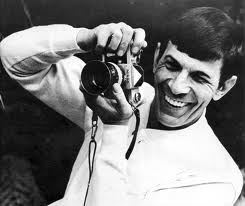
His post Star Trek time also included directing, photography and writing (poetry and autobiography.)

Fanpop.com

[Image courtesy: Fanpop.com]

Back on the big screen he starred alongside Donal Sutherland in the remake of Invasion of the Body Snatchers in 1978 before putting the pointy ears on once again.

Buoyed by the success of George Lucas’ 1977 Star Wars, Roddenberry and crew brought the Star Trek franchise back to life with a big budget for the big screen.

The film, Star Trek: The Motion Picture, was released in 1979. It was a box-office smash, and was nominated for three Oscars. Nimoy returned for 1982’s sequel, Star Trek: The Wrath of Khan, and even directed the third and fourth installments in the series — 1984’s Star Trek III: The Search for Spock and 1986’s Star Trek IV: The Voyage Home. [IMDb]

The movie series limped on with two more releases (Final Frontier and Undiscovered Country) and Nimoy played Spock in guest spots on Star Trek: The Next Generation, and voiced the character for video games and on-line. He was Spock “Prime” for the J.J. Abrams reboot of the series in 2009 and got to meet his Spock doppelgänger (actor Zachary Quinto) in the final scenes of the movie.

In between he’s done lots of made-for-television movies, while “honing his directing chops, voicing animated projects, and appearing in the occasional acting role.” [Ibid]

A 2003 photo from The Jewish Journal.com [Image courtesy: Jewish Journal.com]

A 2003 photo from The Jewish Journal.com [Image courtesy: Jewish Journal.com]


Fatty Arbuckle 3.24.13 Thought of the Day

“I don’t weigh a pound over one hundred and eighty and, what’s more, I never did.”–Fatty Arbuckle

Fatty (Roscoe) Arbuckle -

Fatty (Roscoe) Arbuckle – (Photo credit: Movie-Fan)

Roscoe Conkling Arbuckle was born on this day in Smith Center, Kansas, USA in 1887. Today is the 126th anniversary of his birth.

He was the youngest of nine children born to Mollie and William Goodrich Arbuckle. He was a big baby (some sources say 13 pounds, some say 16 pounds) too big, apparently. His father thought the baby wasn’t his.

Roscoe never lost his baby fat and soon earned the nickname “Fatty.” When he was a year old the family moved to California. With his mother’s encouragement, Fatty, who had a good singing voice, started singing and doing comedy on stage when he was eight years old. He worked in vaudeville until 1899 when his mother died. At that point his father, who never accepted Fatty and would often beat the child, turned him out of the house. Fatty supported himself by doing odd jobs at a hotel. Luckily for him he soon won a talent contest and was back on stage…

performing as an acrobat, clown and singer. His first real professional engagement was in 1904, singing illustrated songs for Sid Grauman at the Unique Theater in San Jose, CA, at $17.50 a week. He later worked in the Morosco Burbank stock company and traveled through China and Japan with Ferris Hartman. His last appearance on the stage was with Hartman in Yokahama, Japan, in 1913, where he played the Mikado. [IMDB]

By 1909 he was working in films. He started at the Keystone Film Company as an extra — making a whopping $3 a day — but his star soon rose. He was featured in several Keystone Cop adventures. He also starred with Mabel Norman in a number of movie shorts called “Fatty and Mabel.” He invented the thrown-pie-in-the-face gag for his film “A Noise from the Deep“.  He started his own company, Comique, but sold his interest to friend Buster Keaton  before signing with Paramount Pictures for an unheard of $3 million for 3 years.

Arbuckle's photo on the cover of the UK based ...

Arbuckle’s photo on the cover of the UK based Pictures motion picture magazine of the July 23, 1921 issue (Photo credit: Wikipedia)

Arbuckle helped Buster Keaton get started in the film industry. He also mentored Charlie Chaplin and Bob Hope.

His weight plagued him all his life. He was 185 pounds when he was 12, and “It was written in his contract that his weight remain above 250 pounds and that he would be given a healthy yearly bonus if he exceeded that by 50 to 100 pounds. During his career he kept it well over 300.” [IMDB]  He also had substance abuse issues with both alcohol and morphine.

[Image courtesy: The Hairpin.com]

[Image courtesy: The Hairpin.com]

Scandal put a halt to Arbuckle’s career in 1921. He attended a three-day Labor day weekend bash held by his friend Fred Hibbard at the St. Francis Hotel in San Francisco. There was…

“a jazz band, catered food, and ample illegal alcoholic beverages. It was by all accounts a weekend of debauchery, and the party gave Arbuckle more lasting fame than any of his films.” [NNDB]

Fatty was getting ready to leave and went into one of the bedrooms to change when he found his friend Virginia Rappe “weak, sick, and vomiting in the bathroom. He helped her onto the bed.” [Ibid]  Rappe suffered from cystitis, a condition that was aggravated when she drank heavily. It caused her so much pain that she would rip off her clothing to try to get some relief. That’s what she did at the party. As Fatty and another guest, Maude Delmont,  tried to comfort her, but she complained she couldn’t breath and began to rip off her clothes. Delmount put ice on her stomach and thighs, Fatty called hotel doctor and manager. The hotel doctor told them that Rappe was just drunk, and, with the situation under control, Fatty left the party as planned. However, “Rappe died of a ruptured bladder several days later, and as soon as Arbuckle heard of her death, he returned from Los Angeles to San Francisco. He was arrested on 11 September 1921, and tried for manslaughter.” [Ibid]

The newspapers, led by William Randolph Hearst‘s group, made this incident Hollywood’s first truly major scandal. Roscoe was tried not once but three times for the criminal charges; the trials began in November 1921 and lasted until April 1922; the first two ended with hung juries … [IMDB]

Delmont claimed that Fatty had raped Rappe, but it later came out that she tried to extort money from Arbuckle and only went to the police with the claim after he refused to pay. Rappe’s manager Al Semnacker said Fatty, who’s obesity made him impotent,  used a piece of ice to rape the actress (the object morphed into a Coca-Cola or champagne bottle in later newspaper retellings of the story.) The more lurid the story grew, the more newspapers it sold.

Matthew Brady, the San Francisco District Attorney who acted as prosecutor for the trial pressured witnesses into making false statements against Arbuckle.

At his third and final trial in April of 1922, the jury not only returned a “not guilty” verdict but excoriated the prosecution for pursuing what they said was a flimsy case with no evidence of Arbuckle having committed any crime; several jury members walked to Arbuckle after the verdict was read and hugged him and shook his hand. [IMDB]

But the damage to his career was done. Paramount cancelled his contract and the new Hayes Commission banned his movies. He sunk into alcoholism. He got some work through his friend Buster Keaton. He was able to direct under the name of “William Goodrich.” And in 1932 he appeared before the cameras again, this time in a short talkie, “Hey, Pop!” for Warner Brothers.

With the success of the shorts Warner Brothers signed Roscoe to a feature film contract, but he died in his sleep on June 29, 1933 , at age 46, the night after he signed the contract. [NNDB]

Roscoe Arbuckle

Roscoe Arbuckle (Photo credit: Luke McKernan)


Charlotte Bronte 4.21.13 ritaLOVEStoWRITE

Dear reader: Cut another piece of birthday cake for Charlotte Bronte. It seems I was a month early in celebrating (oops, sorry Char!) Today, April 21st is really her big day. Happy Birthday, girl! Cheers, Rita

————————————————————————————————

“Better to be without logic than without feeling.” — Charlotte Bronte

Portrait of Charlotte Brontë

Portrait of Charlotte Brontë (Photo credit: Wikipedia)

Charlotte Bronte was born in Thornton, Yorkshire, England in 1816. Today is the 197th anniversary of her birth. Charlotte Bronte was the third child born to Maria and Rev. Patrick Bronte. Brother Branwell joined his older sisters, Maria, Elizabeth and baby Charlotte in 1817. Emily came along the next year and Anne was born in 1820. The Brontes moved to Haworth parsonage in 1820.

The parsonage where they lived stood midway between natural beauty and human squalor. To the rear stretched clear, broad moorland. On the other side, the township sprawled up the hill like an ugly sore. Most families shared an outhouse with their neighbors, and the main street was awash with sewage. Disease lurked in every filthy corner. The average age of death was twenty-five. [Charlotte Bronte and Jane Eyre, by Stewart Ross, Viking Press, 1997]

It wasn’t long after the family settled at Haworth that Mrs. Bronte was diagnosed with incurable stomach cancer. After her mother’s death in 1821 Charlotte, her brother and sisters were raised by their father and her Aunt Elizabeth Branwell.  The family was squarely middle class (although Rev. Bronte insisted on referring to himself as a gentleman), so they neither fit in with their working class neighbors in town, nor did they mix with the local gentry. The children grew up isolated from everyone but their immediate family.

They loved to explore the wilds of moors. They made up stories and games and performed plays they had penned themselves.

In 1824 Rev. Bronte felt the older children needed to be formally educated. He chose for the girls a school called “Cowan Bridge, a boarding school for the daughters of clergymen… it was cheap and respectable and promised a good education.” [Ibid]  The brochure skipped the part about the cruel teachers and the Tuberculosis and Typhus.

Charlotte found the school to be a prison.

She had to wear a “charity girl” uniform and was allowed to write home only once every three months. The cook ruined the food. The dormitory was cold, the rules strict, the education narrow. [Ibid]

Her older sisters took ill. First Maria came down with TB and had to go home (she died in May of 1825) Then the school was hit with a typhus epidemic. 10-year-old Elizabeth was returned home “to Haworth where, on June 15, she, too died of tuberculosis. ” [Ibid]

That was enough, Charlotte and Emily were called home in the summer of 1825. Rev. Bronte and Aunt Branwell once again took over the children’s education. “They read widely and freely,” had private music and art lessons and some Latin and Greek , but no science and limited math, history and geography.

Brontë

Brontë (Photo credit: Wikipedia)

There was plenty of time to play and explore as well. When Rev. Bronte gave Branwell a set of toy soldiers as a gift the four remaining children created a whole fantasy world called“ Glasstown.” Charlotte and Branwell  created “Angria” for the 12 wooden soldiers. (Emily and Anne made up “Gondal.”)

Unmarried middle class women of limited income in Victorian England had two choices in employment. They could become a teacher or a governess. But either profession would require more formal training. Charlotte was sent to Roe Head school in 1831. It was a much nicer institution than the dreaded Cowan Bridge, and Charlotte enjoyed her year and a half there. She returned home to help teach her brother and sister.  She went back to the school a few years later as a teacher, this time with Emily in tow.  (Emily didn’t take to the school. Anne replaced her after a few months.) After that, “She made two attempts at being a governess, first with a local family, then with a merchant in Bradford. Neither was a success. She found the children hard to control and her work humiliating and boring.” [Ibid]

In 1841, backed by Aunt Branwell, Charlotte, Emily and Anne decided to start their own school. But first the girls needed to be educated abroad. Charlotte went to Brussels to stay with her friend Mary Taylor.  Overseas travel changed her. The food, freedom and culture excited her. And in her teacher, Monsieur Heger, she had found her intellectual equal.  When their term ended Charlotte suggested she Emily stay on and pay their way by teaching. Slowly she fell in love with her  older, married teacher. But eventually she was forced to face reality and leave for home.

In 1845 Charlotte needed to regroup and focus on something positive.  She was  determined to get published. She convinced her sisters to publish some of their poems. They used the pseudonyms Currer, Ellis and Acton Bell (their initials) because they would be taken more seriously if readers thought they were men. Aylott and Jones published 62 of the sister’s poems in “Poems by Currer, Ellis and Acton Bell.”  Although the collection received favorable reviews, it sold only 2 copies.

Their next literary projects, this time in prose, would fare much better. Emily penned Wuthering Heights, Anne, Agnes Gray and Charlotte wrote The Professor about her time with Monsieur Heger. Although the first two novels were published (after Emily and Anne put up 50 pounds to help with the printing costs) The Professor was not picked up.

Undaunted, Charlotte wrote her second novel, Jane Eyre while nursing her father after an operation to restore his eye sight. Smith, Elder & Co. published Jane Eyre for 100 pounds  in 1847. They optioned her next two novels for the same amount.  Charlotte began work on Shirley.

Emily and Anne were busy on new novels too. Anne’s The Tenant of Wildfell Hall was published, but Emily was ill, TB again, and, although she may have finished the novel it never saw publication. Branwell was sick too, both physically and mentally.  He died in September of 1848, Emily passed away in December of the same year.  By spring of the  1849 Anne was showing “the familiar symptoms of tuberculosis.”  She died on May 23.

Charlotte Brontë Photography from 1854, free l...

Charlotte Brontë Photography from 1854, free licence (Photo credit: Wikipedia)

Charlotte continued to write. The mysterious Currier Bell was by now revealed to be the shy, plain Charlotte Bronte to her publisher George Smith. Smith and his mother did what they could to bring her out into society. Charlotte met fellow writers Harriet Martineau and Elizabeth Gaskell both of whom she remained friends with for the rest of her life.

She wrote her fourth novel Villette.

Rev. Bronte’s curate, Arthur Bell Nicholls fell in love with Charlotte and he proposed to her. At first Charlotte didn’t take to the idea. She found him both dull-looking and narrow-minded. Her father objected to the union as well. Nicholls was socially (and financial) inferior to the Brontes. She turned him down. But Gaskell encouraged her in the match, and as Charlotte watched the younger man’s devotion to her father she reconsidered. (Gaskell also used her influence to improve Nicholl’s financial standing.) Rev. Bronte continued to object, but he finally gave in, and the couple were married in June of that year of 1854.

Charlotte was soon with child, suffered from constant morning sickness.

The strain of pregnancy at the age of thrity-nine taxed her strength to its limits. By February she had grown alarmingly thin and was vomiting blood… The wasting sickness dragged painfully on until, by mid-March , all hope was gone. [Ibid]

Bronte died on March 31, 1855. Her novel, The Professor was published two years later, the same year as Elizabeth Gaskell’s biography The Life of Charlotte Brontë.

——————————–

Related articles


Fred Rogers 3.20.13 Thought of the Day

“Anyone who does anything to help a child in his life, is a hero to me.” — Fred Rogers

Mister Rogers' Neighborhood
Mister Rogers’ Neighborhood (Photo credit: Wikipedia)

Fred McFeely Rogers was born on this day in Latrobe, Pennsylvania, USA in 1928.  Today is the 85th anniversary of his birth.

Rogers was born to James and Nancy Rogers. He also spent a lot of time with maternal grandparents the McFeelys. James started out as a laborer at McFeely Brick Factory and wound up buying out his father-in-law to own the business. From there he bought Latrobe Die Casting Company. The family was well-respected and influential in town.  His mother, Nancy, volunteered as a nurses aid. Rogers said she had  “something like 25,000 volunteer hours at the hospital…. And during the Second World War she was in charge of making surgical dressings for the troops.” [The Wonder of It All] Nancy also knitted sweaters for the troops.

In fact, my mother, as long as I could remember, made at least one sweater every month. And at Christmas time, she… would give us each a hand-knit sweater … Until she died, those zipper sweaters that I wear on the Neighborhood were all made by my mother.” [Ibid]

That iconic red cardigan — the one that is in the Smithsonian? — Fred’s mom knit that for him.

Hand-made sweater worn by Fred Rogers, on disp...
Hand-made sweater worn by Fred Rogers, on display in the Smithsonian Institution’s Museum of American History. (Photo credit: Wikipedia)

But despite the outward Norman Rockwell appearance not everything was sugar and sweetness in Fred Rogers childhood. He was painfully shy, overweight and sickly. His parents were hyper protective of the little boy. They worried that he’d get sick, get hurt, or worse, get kidnapped (the Lindbergh kidnapping was fresh in every one’s mind.) The summer air was humid and the Pittsburgh’s factories added to the low air quality. That meant asthmatic Fred spent almost all his time inside his air-conditioned room during school break. He was isolated and lonely.

I was… very, very shy when I was in grade school. And when I got to high school, I was scared to death to go to school. Every day, I was afraid I was going to fail… I resented those kids for not seeing beyond my fatness or my shyness. I didn’t know that it was all right to resent it, to feel bad about it, even to feel very sad about it. … because the advice I got from the grown-ups was, “Just let on you don’t care, then nobody will bother you.” [Ibid]

One thing he did to make himself feel better was to play the piano. He started taking lessons when he was five and he soon found that music allowed him to express the feelings he otherwise had to keep inside.

He blossomed by Senior year, and finished high school as the, and was no longer the painfully shy child he had been when he entered as a Freshman. He started at Dartmouth College but transferred to Rollin College in Florida because their had a better music program. He got his degree in music composition and planned to attend Pittsburg Theological Seminary.

But then he saw his first  TV show. It was a base affair — with “people throwing pies at each other” — and Rogers “decided he wanted to be involved with this new medium to make it something better.” [Ibid]

He went to New York and began to work at NBC. He started as an assistant to the producer for NBC Opera Theater and later became floor manager for various music programs. His work on the Gabby Hayes children’s show convinced him that programing for children should be commercial free and educational. He quit NBC.

In 1954 he started  as a puppeteer on The Children’s Corner at WQED, a public  television station at Pittsburgh. Other shows followed, most famously Mr. Rogers’ Neighborhood. The show went national in 1968.

Not only was Fred Rogers a pioneer in children’s media, but he also was an artist, minister, composer and musician, environmentalist, and advocate for children and families.  With his gentle, unassuming manner, he made a profound impression on everyone he encountered. [Fred Roger Center]

Rogers authored the following books:

  • Mister Rogers Talks with Parents, 1983;
  • The New Baby (Mister Rogers’ First Experiences Books), 1985;
  • Making Friends (Mister Rogers’ First Experiences Books), 1987;
  • Mister Rogers: How Families Grow, 1988;
  • You Are Special, 1994.
President George W. Bush greets Fred Rogers of...
President George W. Bush greets Fred Rogers of Mister Rogers Neighborhood in the Blue Room before an early childhood education event in the East Room April 3, 2002. (Photo credit: Wikipedia)

He won the following awards:

  • Lifetime Achievement Award from the National Academy of Television Arts and Sciences as well as the TV Critics Association.
  • The Presidential Medal of Freedom
  • Two George Foster Peabody Awards.
  • Rogers was appointed Chairman of the Forum on Mass Media and Child Development of the White House Conference on Youth in 1968.
  • “Pennsylvania Founder’s Award” in June 1999 for his “lifelong contribution to the Commonwealth in the spirit of Pennsylvania’s founder, William Penn.”

In December of 2002 Rogers was diagnosed with stomach cancer.  He died on February 27, 2003.


Glenn Close 3.19.13 Thought of the Day

“As an actor, I go where the good writing is. That’s the bottom line.“–Glenn Close

[Image courtesy: FanPOP.com]

[Image courtesy: FanPOP.com]

Glenn Close was born on this day in Greenwich, Connecticut, USA in 1947. She is 66 years old.

She is one of four children born to Bettine and Dr. William Taliaferro Close. The first seven years of her live were ones of privilege. She fondly remembers the ease and freedom of living in on her grandmother’s estate in the Connecticut countryside. But then things changed. Her parents joined the conservative salvation group Moral Re-Armament. The family moved into communal living centers and eventually her parents traveled to the Belgian Congo where her father ran several medical clinics and became a personal physician to  Mobutu Sese Seko. Close went to school in Switzerland. She attended Choate Rosemary Hall in Greenwich. And for a while in the mid-to-late 1960’s she performed with the MRA’s singing group “Up With People.”

At 22 she left the MRA and entered William and Mary College in Williamsburg, Virginia. There she took up acting in earnest.  Upon graduation she moved to New York and found work on the stage. She had her Broadway debut in 1974 as Angelica in Love for Love. Her break out role on the Great White Way was as Chairy Barnum in the Original Broadway Production of Barnum in 1980.

Close in The World According to Garp. [Image courtesy: Fixster.com]

Close in The World According to Garp. [Image courtesy: Fixster.com]

She made the jump to film in 1982 with The World According to Garp. She played Jenny Fields. The role earned her the first of her many Academy Award nominations. Another Oscar nomination came for her role as Sarah Cooper in The Big Chill in 1983, and yet another for her part as Iris Gaines in 1984’s the Natural.

She went against type and starred as Alex Forrest in Fatal Attraction in 1987. She got another Academy nod — this time for Best Actress. And got nominated again in that category for Dangerous Liaisons in 1988.

Close as Marquise de Merteuil in Dangerous Liaisons. [Image courtesy: the Oscar Nerd.com]

Close as Marquise de Merteuil in Dangerous Liaisons. [Image courtesy: the Oscar Nerd.com]

In 1990 she played Queen Gertrude to Mel Gibson’s Hamlet, And Sunny Von Bulow to Jeremy Iron’s Claus  in Reversal of Fortune.

In 1991 She played Sarah Wheaton in Sarah, Plain and Tall. It was the first of a Hallmark trilogy which also includes Skylark and Sarah, Plain and Tall: Winter’s End.

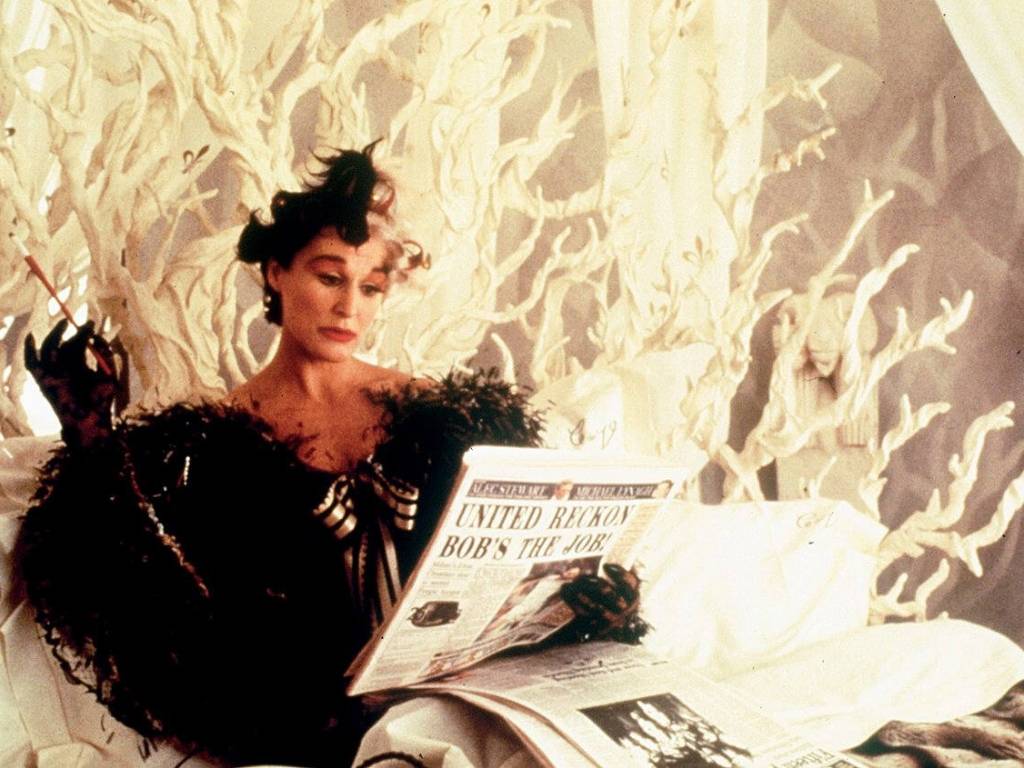
Cruella De Ville (Image courtesy: FanPop.com)

Cruella De Ville (Image courtesy: FanPop.com)

But not everything on her CV is a drama. In 1996 she co-starred as First Lady Marsha Dale in Tim Burton’s Mars Attacks! and the first of her gigs as the villainous, puppy hating Curella de Vil in 101 Dalmatians.

Dvd cover for Paradise Road. [Image courtesy: Amazon.com]

Dvd cover for Paradise Road. [Image courtesy: Amazon.com]

In 1997 she was Adrienne Pargiter in the brilliant and under rated Paradise Road. The film is a…

Fact-based recounting of a group of women who are imprisoned on the island of Sumatra by the Japanese during World War II and used music as a relief to their misery. [IMDb]

The movie co-stars Pauline Collins, Frances McDormand, Cate Blanchette, Jennifer Ehle and Julianna Margulies  and is a beautiful testament to the human spirit and the power of music. If you haven’t seen it… do your self a favor and put it in your queue.

She showed off her pipes again as Nellie Forbush in a made for TV version of South Pacific. (An interesting counter part to Paradise Road — considering both films cover the same period in history, the same conflict,  and approximately the same geography, and both contain some lovely music… yet they take a very different look at WWII.)

Close was Eleanor of Aquitaine opposite Patrick Stewart’s Henry II  in the TV version of The Lion in Winter, in 2003.

Promo shoot for Damages. [Image courtesy: FanPop.com]

Promo shoot for Damages. [Image courtesy: FanPop.com]

She had a 13 episode character arch as Captain Monica Rawling on The Shield. She voiced Mother Simpson on the Simpsons several times, and, more dramatically,   played Patty Hewes  on the TV series Damages starting in 2007.

Close was nominated for yet another Best Actress Oscar for her work in Albert Nobbs. The film came out in 2012.

Close as Albert Nobbs (Image courtesy: NPR.com photo by Patrick Redmond.]

Close as Albert Nobbs (Image courtesy: NPR.com photo by Patrick Redmond.]

Currently she has two films in the works for 2014, The Grace That Keeps This World, and Always on My Mind. Maybe she’ll get nominated again for one of these, and maybe, just maybe, the 7th time will be a charm!


Andrew Jackson 3.15.13 thought of the Day

“Take time to deliberate; but when the time for action arrives, stop thinking and go in.” –Andrew Jackson

English: Andrew Jackson - 7 th President of th...

English: Andrew Jackson – 7 th President of the United States (1829–1837) (Photo credit: Wikipedia)

Andrew Jackson was born on this day in the  Waxhaws region between North and South Carolina in 1767. Today is the 246th anniversary of his birth.

He was born to Andrew and Elizabeth Hutchinson Jackson, Scots-Irish emigrants who had come over from Ireland two years before with their young sons Hugh and Robert. Andrew Jackson never met his father, who died three weeks before the baby was born.

Raised by his widowed mother, Jackson grew up with a large extended family—aunts, uncles, and cousins— who were also Irish immigrant farmers. As a youth, Jackson attended a good school and his mother had hopes of him becoming a Presbyterian minister. However, young Jackson’s propensity for pranks, cursing, and fighting quickly dashed those hopes. [The Hermitage.com]

The American Revolutionary War left the Jackson family devastated. All three boys signed up to fight the British (Andrew was just 13 and became a courier.) Older bother Hugh died of heat stroke at the Battle of Stono Ferry in 1779. In 1781 Jackson and his remaining brother Robert were taken prisoner. The boys nearly starved to death in the camp, and Jackson was slashed with a sword when he refused to polish a British officer’s boots. He carried the scars on his hand and head for the rest of his life. Both Jackson and Robert

contracted smallpox in prison and were gravely ill when Jackson’s mother arranged for their release in a prisoner exchange. Jackson survived, however, his brother died. After Jackson recovered, his mother traveled to Charleston to aid the war effort by nursing injured and sick soldiers. She contracted cholera and died leaving Jackson an orphan. [Ibid]

Growing up in the backwoods of the Carolinas, Jackson’s education was sporadic. He attended a “old-field” school in his youth. (An old-field school was a school that washeld on– either an open field or in a building built — on an exhausted corn, tobacco or cotton field.)  After the Revolutionary War he worked for a while at a saddle makers shop, but then took up law.

In 1787, after three years of studying law, Jackson received his license to practice law in several counties scattered through the North Carolina back country. To supplement his income, he also worked in small-town general stores. While living in North Carolina, Jackson gained a reputation for being charismatic, wild, and ambitious. He loved to dance, entertain, gamble, and spend his free time with friends in taverns. [Ibid]

At 21 he became public prosecutor of the Western District of North Carolina. He became the prosecutr for both Jonesborough and Nashville. It was during this time that he met Rachel Donelson Robards (who was separated — and she assumed divorced — from her first husband Lewis Robards.) Jackson married Rachel while the two were in the wilderness of the Western District only to come back to Nashville to find out that Robards had not completed the divorce proceedings. He, Robards, then used  Rachel’s ‘bigomy’ as grounds  to finalize the divorce. Jackson and Rachel remarried, but the controversy followed them for the rest of their lives, and Jackson was willing to duel with any man who  besmirched his wife’s name.

English: Portrait of Rachel Donelson Jackson, ...

English: Portrait of Rachel Donelson Jackson, wife of U.S. President Andrew Jackson, by the artist Ralph E. W. Earl. Oil on canvas, 30 in. x 20 in. Circa 1830-1832. Portrait is in the collection of The Hermitage, Nashville, Tennessee. Image courtesy of the Tennessee Portrait Project. (Photo credit: Wikipedia)

None of that stopped Jackson’s rise in the political arena. “He was the first man elected from Tennessee to the House of Representatives, and he served briefly in the Senate” [Whitehouse.gov]

During the War of 1812 President Madison “commissioned Jackson Major General of U.S. Volunteers and ordered him to lead 1,500 troops south to Natchez and eventually to defend New Orleans” [The Hermitage.com] His leadership in the Battle of New Orleans made “Old Hickory ” a national hero. In 1824 he made an unsuccessful run for President against John Quincy Adams. Four years later he ran again. This time he won the White House.

Accomplishments of his presidency:

  1. He paid off the National Debt
  2. Fought against corrupt bureaucracy with the Spoil System
  3. Enfranchisement policy

Crisis / Negatives of his presidency:

  1. Nullification Crisis
  2. Ethnic cleansing of  about 45,000 Native Americans from their ancestral lands under his “Indian Removal Act”  which lead to the Trail of Tears .

Neutral effects of his presidency:

  1. Tried to eliminate the Electorial College
  2. Opposed the National Bank

After leaving the White House he retired The Hermitage in Nashville. He died on June 8, 1845, of chronic tuberculosis, dropsy, and heart failure.

78 year old Andrew Jackson

78 year old Andrew Jackson (Photo credit: Wikipedia)


Frank Borman 3.14.13 Thought of the Day

“Exploration is really the essence of the human spirit.” — Frank Borman

Frank Borman

Frank Borman (Photo credit: Wikipedia)

Frank Frederick Borman, II was born on this day in Gary, Indiana, USA in 1928. He is 85  years old.

The Bormans, Frank, his father Edwin, and mother, Marjorie moved to Tucson, Arizona when he was a kid . He began to take flying lessons at 15. After graduating from Tuscon High School He attended the United States Military Academy. He graduated in 1950 and joined the US Air Force.

He was “a fighter pilot, an operational pilot and instructor, an experimental test pilot and an assistant professor of Thermodynamics and Fluid Mechanics at West Point.” [NASA.gov] during his time in the USAF. Later he went to the California Institute of Technology and earned his MS in aeronautical engineering in 1957 before become a test pilot and instructor at the Aerospace Research Pilot School at Edwards Air Force Base.

Astronaut Groups 1 and 2 - GPN-2000-001333

Astronaut Groups 1 and 2 – GPN-2000-001333 (Photo credit: Wikipedia)

The National Aeronautics and Space Administration (NASA) chose him to be a member  of the “New Nine” group of astronauts in 1962. The New Nine (which included Neil Armstrong, Pete Conrad, Jim Lovell, James McDivitt, Elliott See, Tom Stafford, Ed White, and John Young as well as Borman) augmented the 7 Mercury Astronauts and  assured that the space agency was staffed through the Gemini and Apollo missions (with the addition of NASA’s Astronaut Group 3) During his NASA days…

Apollo8 Prime Crew

Apollo8 Prime Crew (Photo credit: Wikipedia) Borman is on the right.

  • Borman and Lovell performed the first rendezvous in of two spacecraft in orbit during their Gemini 7 flight.  The 1965 flight set a 14 day long endurance record. (Borman was commander.)
  • He served on the AS-204 Accident Review Board investigating the fire on Apollo 1 that killed Astronauts Gus Grissom, Ed White and Roger Chaffee.
  • He led “the team that re-engineered the Apollo spacecraft” [NASA.gov] after the accident.
  •  “As commander of the Apollo-8 mission, he and his crew (James A. Lovell and William Anders) were launched into Earth’s orbit on December 21, 1968. They then became the first men to leave Earth’s gravity and journey to the moon. After 10 lunar orbits, they returned safely to the Earth.” [National Aviation Hall of Fame]
  • He was President Nixon’s special ambassador when Apollo-11 landed on the Moon.

After Borman retired from NASA he…

“joined Eastern Airlines as vice president of operations and, after completing an advanced management course, became senior vice president of operations. In 1974 he was named executive vice president, general operations manager and a member of the board of directors. By 1976 he had risen to chairman, president and chief executive officer of Eastern. ” [Ibid]

In 1986 Borman retired from Eastern and moved to New Mexico with his wife Susan where he acts as a consultant.

Earth rise taken during Apollo 8 [Image courtesy: NASA]

Earth rise taken during Apollo 8 [Image courtesy: NASA]


Edward Albee 3.12.13 Thought of the Day

“If you’re willing to fail interestingly, you tend to succeed interestingly.”–Edward Albee
[Image courtesy: The Modern World.com]

[Image courtesy: The Modern World.com]

Edward Harvey was born on this day in Washington, DC in 1928. He is 85 years old.
When he was 2 weeks old he was adopted by Reed and Frances Albee. The family moved to Larchmont, New York soon afterward. The Albees had a theatre pedigree. Grandfather Edward Franklin Albee II  was the owner of several theaters, part of the Keith-Albee chain. With its roots in vaudeville the theatres hosted touring companies and eventually made the leap to movies. The company merged with two other companies and became RKO pictures….and the Albees were set for life.
Albee grew up in an affluent family. He had access to the stage from a young age and his love of theatre and art was well founded from his childhood. He did not do well at school. He was rebellious, and he was expelled from a number of public, private and military schools.
Almost from the beginning he clashed with the strong-minded Mrs. Albee, rebelling against her attempts to make him a success as well as a sportsman and a member of the Larchmont, New York, social set. Instead, young Albee pursued his interest in the arts, writing macabre and bitter stories and poetry, while associating with artists and intellectuals considered objectionable by Mrs. Albee. [The Kennedy Center. org]

After he dropped out of Trinity College in his sophomore year he had a rift with his family. (He never saw his father again.) He moved to New York’s Greenwich Village and lived on a small inheritance and by doing odd jobs — like delivering telegrams — while honing his writing skills. Albee tried his hand at poetry and fiction before finding his groove as a playwright.

Edward Albee [Image courtesy: Academy Achievement.]

Edward Albee [Image courtesy: Academy Achievement.]

In 1959 his first play, The Zoo Story was produced in Berlin, Germany. I came to New York, Off-Broadway in 1960. The Zoo Story is a one-act play “in which a loquacious drifter meets a conventional family man on a park bench and provokes him to violence” [Academy of Achievement]  Other one acts and short dramas followed including : The Sandbox, The American Dream and The Death of Bessie Smith.

By 1962, he was ready to storm Broadway, the bastion of commercial theater in America. His first Broadway production, Who’s Afraid of Virginia Woolf?, was a runaway success and a critical sensation. The play received a Tony Award, and Albee was enshrined in the pantheon of American dramatists alongside Eugene O’Neill, Arthur Miller and Tennessee Williams. [Academy of Achievement] 

Elizabeth Taylor and Richard Burton in the movie version of Who's Afraid of Virginia Woolf (Image courtesy: The Movie Jerk]

Elizabeth Taylor and Richard Burton in the movie version of Who’s Afraid of Virginia Woolf (Image courtesy: The Movie Jerk]

His first Pulitzer Prize came for the 1966 drama A Delicate Balance.  Albee won his second Pulitzer in 1975 with Seascape, “which combined theatrical experiment and social commentary in a story about a retired vacationing couple who meet a pair of sea lizards at the beach.” [The Kennedy Center. org] “As bizarre as the idea sounded on first hearing, the result was both humorous and moving. The play charmed audiences and critics…” [Academy of Achievement] 

After Seascape the theater critics, unexpectedly, fell out of love with Albee. For nearly two decades he struggled to get the audiences and critical praise he deserved.

In an era of Hollywood-style “play development” by committee, Albee has remained an uncompromising defender of the integrity of his own texts, and a champion of the work of younger authors. Over the years, he has scrupulously reserved part of his time for the training of younger writers. He has conducted regular writing workshops in New York, and … taught playwriting at the University of Houston. He has persistently asked young writers to hold themselves to the highest artistic standards, and to resist what he sees as the encroachment of commercialism on the dramatic imagination.  [Academy of Achievement] 

In 1994 he was back with Three Tall Women. The play won Albee his third Pulitzer. “In 1996, Albee was one of the recipients of the Kennedy Center Honors and was awarded the National Medal of Arts.” [Ibid] The triumph of Three Tall Women launched the second act for the playwright who saw The Play About the Baby, The Goat or Who Is Sylvia? (Tony Award / Drama Desk Award) and  Occupant (the story of artist Louise Nevelson*), hit the Great White Way within a decade.  Next Albee reworked The Zoo Story in Homelife and presented both plays as Peter and Jerry.

Cover of "The Play About The Baby"

Cover of The Play About The Baby

He was honored with a Special Lifetime Achievement Tony Award  in 2005.

At 85 Albee continues to write for the stage.

—————————————————