Category Archives: Thought of the Day

Samuel Mudd 12.20.12 Thought of the Day

English: Samuel Mudd

English: Samuel Mudd (Photo credit: Wikipedia)

Samuel Alexander Mudd was born on this day in Charles County, Maryland, USA in 1833. Today is the 179th anniversary of his birth.


Mudd grew up on a tobacco plantation about 30 miles southeast of Washington DC. He was the fourth of ten children . He was home schooled until age 15 when he went to St. John’s boarding school in Frederick, MD. He went to college at Georgetown in Washington, and graduated from  the University of Maryland, Baltimore having studied medicine with an emphasis on dysentery. In 1856 he returned to Charles County and began a family with his long time sweetheart Sarah “Frankie” Dyer. Mudd’s father gave the couple a 218 acre tobacco farm called St. Catherine’s. He supplemented his income as a doctor with the sale of tobacco from the farm. (He grew the tobacco with the help of five slaves.)


Dr. Mudd's House

Dr. Mudd’s House (Photo credit: jimmywayne)

When the Civil War began Maryland was a border state. If Washington, with its large number of Union soldiers had not be located in its southern border along the Potomac River the state may have voted to succeed from the Union. When Maryland abolished slavery in 1864 ( a year after the Emancipation Proclamation) Mudd could no longer effectively run his farm. He began looking for a buyer and was introduced to a young, dashing, actor in the market for some property. That actor’s name was John Wilkes Booth.


Booth and Mudd met in November  at St. Mary’s Catholic Church  to discuss the purchase. Booth stayed overnight at the farm before returning to Washington. Unbeknownst to Mudd, Booth wasn’t interested in real estate at all, but was scouting out an escape path from the Nation’s Capital. The actor was planning on kidnapping President Lincoln to bring him to Richmond (the capital of the Confederacy). He would ransom Lincoln for a large number of Confederate POWS.


Portrait of John Wilkes Booth (1838–1865)

Portrait of John Wilkes Booth (1838–1865) (Photo credit: Wikipedia)

Mudd and Booth met again shortly before Christmas 1964, this time in Washington. They met John Surratt and Louis Weichmann for drinks.


Before Booth could pull off his ill-advised and grandiose plan Lee surrendered at Appomatox, Virginia and the War was over. Booth was furious. He altered his plan and decided to kill the president instead of kidnapping him. Booth shot Lincoln in the head five days after Lee surrendered. The President and Ms. Lincoln were watching a play, Our American Cousin at Ford’s Theatre in Washington, DC. After shooting Lincoln at point-blank range he jumped down from the Presidential Box to the stage to escape. He broke his leg in the fall but managed to get out the stage door and onto his horse and escape the city.


English: Interior of Ford's Theatre, Washingto...

English: Interior of Ford’s Theatre, Washington, D.C., where Abraham Lincoln was assassinated. The presidential box is towards the right. The theatre is still in operation and the stage is set up for a current stage play (i.e., it is not set up as it was when Lincoln was shot). (Photo credit: Wikipedia)

About four o’clock on the morning following the Lincoln assassination two men on horseback arrived at the Mudd farm near Bryantown.  The men, it turned out, were John Wilkes Booth–in severe pain with a badly fractured leg that he received from his fall to the stage after shooting the President–and David Herold.  Mudd welcomed the men into his house, first placing Booth on his sofa, then later carrying him upstairs to a bed where he dressed the limb. 

After daybreak, Mudd made arrangements with a nearby carpenter to construct a pair of crutches for Booth and tried, unsuccessfully, to secure a carriage for his two visitors.  Booth (after having shaved off his moustache in Mudd’s home) and Herold left later on the fifteenth, after Mudd pointed the route to their next destination, Parson Wilmer’s. [UMKC.edu]

Military investigators followed Booth’s trail to the Mudd farm and Dr. Mudd admitted to having seen a patient, but claimed…”‘I never saw either of the parties before, nor can I conceive who sent them to my house.” [Historynet.com]  When Lt. Lovett, the lead investigator on the Mudd end of the trail returned again to the farm Sarah “brought down from upstairs a boot that had been cut off the visitor’s leg three days earlier.” [Ibid.] Booth’s initials were in the boot’s cuff, but Mudd still denied knowing who it was.


Booth's boot, found at the Mudd's farm .[Image courtesy]

Booth’s boot, found at the Mudd’s farm . [Image courtesy UMKC.edu]

During the trail Mudd’s lie about not recognizing Booth, compounded by his not coming forward  about “suspicions … aroused by a broken-legged visitor who, during his brief stay the Mudd farm, shaved off his moustache” [Ibid] stained his character far more deeply than the circumstantial evidence of witnesses who claimed he knew of the conspiracy.


Defense Attorney Thomas Ewing argued to the Commission that it is no crime to fix  a broken leg, even if it were the leg of a presidential assassin and even if the doctor knew it was the leg of a presidential assassin. [Ibid}

Mudd was convicted by a Military Commission and sentenced to life in prison.


English: Broadside advertising reward for capt...

English: Broadside advertising reward for capture of Lincoln assassination conspirators, illustrated with photographic prints of John H. Surratt, John Wilkes Booth, and David E. Herold. Français : Avis de recherche avec prime de 100.000 $ pour la capture de John Wilkes Booth, le meurtrier du président Abraham Lincoln, et deux de ses complices, David Edgar Herold et John Harrison Surratt. (Photo credit: Wikipedia)

He, and the other conspirators who escaped the noose were sent to Fort Jefferson in the Dry Tortugas 70 miles west of Key West,  Florida. He tried to escape once, but was quickly discovered. He and other prisoners were transferred to “the dungeon” a ground-level gunroom. They were let out six days a week to work, but were forced to stay inside the dungeon on Sundays and holidays. He wore leg irons while outside the cell.


Dr. Mudd as he appeared when working in the ca...

Dr. Mudd as he appeared when working in the carpenter’s shop in the prison at Fort Jefferson. (Photo credit: Wikipedia)

.


In 1867, an outbreak of yellow fever overtook the Dry Tortugas, claiming the lives of fellow conspirator and inmate Michael O’Lauglin, as well as the prison doctor.  Mudd assumed the role as the new prison doctor. [Ibid]

Mudd was pardoned in March of 1869 by President Andrew Johnson. The Doctor returned to his Maryland farm and his wife (they had 4 more children.) He had always been interested in politics and in 1877 he ran (unsuccessfully) for the Maryland House Delegates. In 1880 his farm was destroyed by a fire. and by 1883, at just 49 years old, Mudd was dead of pneumonia.


———————————————————————–


Lincoln’s death brought on a media circus the likes of which we are only all too familiar with in 2012. But then, when the nation need to be healed from its bloody civil war a swift and definitive trial was essential. Yellow journalism was in full swing. Certainly some of the men (and possible the one woman) on trial were guilty … but what do you think? Did was Dr. Mudd innocent or guilty?


English: John Wilkes Booth's escape route Türk...


Edith Piaf 12.19.12 Thought of the Day


I think you have to pay for love with bitter tears.
Edith Piaf


Edith Piaf

Edith Piaf (Photo credit: tsweden)

Édith Giovanna Gassion was born on this day in Belleville, Paris, France in 1915. Today is the 97tj ammoversary of her birth.


Her mother was a cafe singer and her father was a street acrobat. She was abandoned by her parents to the care of her maternal grandmother, then was taken to her father’s mother. Her paternal grandmother ran a brothel and Édith grew up amongst the prostitutes. She was blinded as a result of meningitis at three but recovered by seven (supposedly because the “prostitutes pooled money to send her on a pilgrimage honoring Sainte Thérèse de Lisieux, which … resulted in a miraculous healing.”[geni.com] by 14 she was performing with her father on the streets of France. “Piaf’s songs and singing style seemed to reflect the tragedies of her own difficult life.” [Encyclopedia Britannica]

Français : Edith Piaf enfant

Français : Edith Piaf enfant (Photo credit: Wikipedia)

She left her father’s act and performed on her own singing in the streets for years before being discovered by a nightclub owner. She changed her last name to Piaf (and became known as “the little sparrow.” ) She switched to ballads.


She entertained French POWS during WWII, and gained world wide fame after the war with such songs as Non, je ne regrette rien and La Vie en rose by touring extensively.


Her throaty, expressive voice, combined with her fragile appearance and a dramatic tight spotlight on her face and hands, made her concerts memorable. [Answers.com]

She died  of liver cancer at age 47 in 1963.


English: Bust of Edith Piaf in Celebrity Alley...

English: Bust of Edith Piaf in Celebrity Alley in Kielce (Poland) Česky: Busta Edith Piaf v polských Kielcích (Photo credit: Wikipedia)


Steven Spielberg 12.18.12 Thought of the Day

“I dream for a living.”
— Steven Spielberg

Français : Centrage sur le visage de Steven Sp...

Français : Centrage sur le visage de Steven Spielberg (Photo credit: Wikipedia)

Steven Allan Spielberg was born on this day in Cincinnati, Ohio, USA in 1946. He is 66 years old.

Spielberg grew up in Haddon Township, New Jersey and Scottsdale, Arizona. He made 8mm films that he charged his friends a quarter a piece to see, his sister sold popcorn. He’d do special effects train wrecks using his model trains. He earned the photography merit badge in Boy Scouts producing an 8mm movie called “The Last Gunfight. (Spielberg went on to become an Eagle Scout.)

While attending California State University, Long Beach he took an unpaid internship at Universal Studios. When studio VP Sid Sheinberg saw his 26 minute, silent film Amblin’ he offered Spielberg a seven-year contract with Universal Television. Thus making Spielberg the youngest director to be signed to a long-term deal with a major motion picture studio. He left Cal State, Long Beach to take the gig, but eventually finished his degree in 2002.

At Universal Television he directed episodes of Marcus Welby, MD, Rod Sterling’s Night Gallery, The Name of the Game, The Psychiatrist, Columbo and TV movies.

His first feature film was The Sugarland Express with Goldie Hawn (1974).  Sugarland Express was a good first effort, and the critics liked it, but it got tepid reaction at the box office.

[Image courtesy: Wikimedia]

[Image courtesy: Wikimedia]

In 1975  he made everybody afraid to get into the water with Jaws.  Based on a Peter Benchley novel Jaws had that mix of small town life invaded by something big and ominous — in this case a great white shark named “Bruce” — that became a Spielberg hallmark. Jaws starred Roy Scheider as the mild-mannered sheriff, Marty Brody, Richard Dreyfuss as smart, hyper Matt Hooper and Robert Shaw as crusty Quint. Jaws was the highest-grossing film of all time until Star Wars knocked it off the top of the list.

He revisited the theme of an earlier, student, film, Firelight, to make his third film, Close Encounters of the Third Kind. Firelight had a budged of $500 and, with tickets that cost $1 each and the film made a profit of exactly $1. The budget and profit for Close Encounters was considerably larger. He wore both writing and directing hats on Close Encounters.

World wide adventure came calling with Indiana Jones in 1981  in Raiders of the Lost Ark, the first [and best] of the Indiana Jones series.

Then he came home for another small town meets alien film with E.T. The Extra-Terrestrial. [Spielberg fans are generally split  on this one with some voting it as their favorite and others dismissing it as over sentimental and saccharine. I’m on team saccharine. Discuss.]

He did two segments of the Twilight Zone movie (no, not the Vampire one with Edward Cullen) and a couple of TV shows before making the wonderful The Color Purple. Based on the Alice Walker novel, the film was nominated for eleven Academy Awards — but not for directing — however, it didn’t win any Oscars.

[Image courtesy: Wikimedia]

[Image courtesy: Wikimedia]

Empire of the Sun is a war movie and is set in almost the same time frame at the Indiana Jones flicks, but it couldn’t be more different. Based on the J.G. Ballard novel and with a screen play by Tom Stoppard this move starred John Malkovich, Miranda Richardson, Nigel Havers and a young Christian Bale (in one of his first roles for film.) Empire of the Sun did well with the critics, although  it did not do as well at the box office as some of Spielberg’s more action packed films. It (along with Color Purple) marked a transition point for the film maker. From here on out he had the chutzpah to make a full-fledged drama. [Empire is my #1 favorite Spielberg film. It is beautifully filmed,  has amazing performances, and  a wonderful score, go put it on you Netflix queue right now.]

He closed out the 1980s with the third installment in his Raider’s series — this time with Sean Connery along for the ride with Harrison Ford; and an under appreciated movie about daredevil pilots who put out forest fires, Always. Spielberg teamed up with Richard Dreyfus again for Always, and it’s Audrey Hepburn’s last role.

Hook, a spin on the Peter Pan story came in 1991, followed by Jurassic Park. Both seem like a perfect fit for this director who revels in letting his inner child come out on the screen. Jurassic Park has DINOSAURS! What’s not to like? [Well if you’ve read the book, you might cite a the lack of character or plot development, which Michael Crichton taut novel had in spades.  The movie relied more on special effects and product placement than writing. — Seemed to work though, they made a LOT of money and squeeze out a couple of sequels.]

[Image courtesy: Wikimedia]

[Image courtesy: Wikimedia]

Schindler’s List is another of his best movies. It won Spielberg his first Academy Award for Best Director (it also won for Best Film). He found a very human way to tell a very inhumane story. Like Empire of the Sun it is a WWII drama, and it also takes place largely in a concentration camp. But Schindler’s List is in the European theater and it encompasses a larger scope. Amazing acting, story, sets, and it is largely done in black and white. [It is my other favorite of Spielberg, and needless to say, you ought to put it on your queue.]

After another dance with dinos in The Lost World: Jurassic Park, he returned to drama with Amistad. Amistad tells the true story of an uprising that took place on the slave ship La Amistad and the legal battle that followed. Look for Anthony Hopkins as [my guy] John Quincy Adams. Amistad lacked box office appeal, but did well critically.

Saving Private Ryan showed yet another side to WWII, this time from the US soldier’s point of view. It was a big box office hit.  and Spielberg won his second Academy Award as Best Director. Wonderful acting, especially from his lead, Tom Hanks, again a great story line, and beautifully shot. [A bit too realistic in the graphic depiction of the battle scenes for me, but still a great movie. Queue it.]

2001 brought A.I. Artificial Intelligence, which was started on Stanley Kubrick’s watch. 2002 gave us Minority Report based on the Philip K. Dick novel. Both are nearish future sci-fi stories.  Catch Me If You Can goes back in time (a little) to tell the story of a con artist played by Leonardo DiCaprio and the cop that chases him, Tom Hanks. Hanks stars again in The Terminal as kind-hearted Eastern European traveller stuck in an airport when his country experiences a coupe. [All of them deserve a spot in your queue. As does…]

[Image courtesy: Wikimedia]

[Image courtesy: Wikimedia]

Spielberg’s reboot of War of the Worlds is creepy good with a capital C. The director joined forces again with Tom Cruise for this blockbuster, and it pulled in the big bucks — but it was also a darn good movie.

[It seems odd to me that I have seen SO many Spielberg movies, and yet after the 2005 War of the Worlds I haven’t seen any! How did that happen?  I want to see Munich; War Horse; and definitely Lincoln. Any body up for a movie night?]


Ludwig van Beethoven 12.17.12 Thought of the day

“Music should strike fire from the heart of man, and bring tears from the eyes of woman.”
Ludwig van Beethoven

English: Photograph of bust statue of Ludwig v...

Ludwig van Beethoven was born on this day in Vienna, Austria in 1770. Today is the 242nd anniversary of his birth.

He was the eldest of the three surviving Beethoven children. His father taught him the violin and clavier. The elder Beethoven was an alcoholic and a draconian teacher, “Beethoven was flogged, locked in the cellar” [Biography], beaten if he played a wrong note, and deprived of sleep so he could practice. The boy had his debut with a public performance in Cologne in March 1778. His father shaved a few years off his age so Ludwig’s talents made him seem more of a child prodigy.

Musically talented he was, but little Ludwig  struggled at school. Math and spelling eluded him his entire life. “Music” he said “comes to me more readily than words.”

At 10 he left school and began to take lessons on the organ and in composition from Court Organist Christian Neefe. Neefe was a much better teacher than his father and he introduced the boy to a world outside the scope of music, including philosophy. By 12 he published his first musical piece, 9 Variations in C Minor for Piano.

When Beethoven was 14 Neefe recommended Beethoven as court organist for Maxcimmian Franz of Cologne.

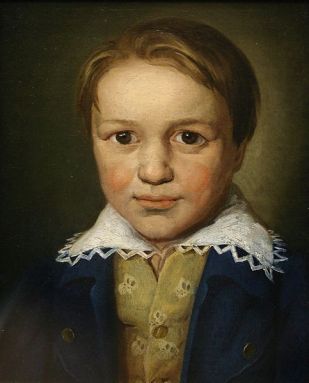
"Ludwig van Beethoven was recognised as a child prodigy. He worked at the age of 13 as organist, pianist/harpsichordist and violist at the court in Bonn, and had published three early piano sonatas. This portrait in oils is the earliest authenticated likeness of Beethoven." Circa 1782 (Wikimedia commons)

“Ludwig van Beethoven was recognised as a child prodigy. He worked at the age of 13 as organist, pianist/harpsichordist and violist at the court in Bonn, and had published three early piano sonatas. This portrait in oils is the earliest authenticated likeness of Beethoven.” Circa 1782 (Wikimedia commons)

At 17 Prince Maximilian sent him to Vienna to meet Mozart, but returned home two weeks later upon hearing that his beloved mother (who he called his best friend) had become severely ill. Heartbroken, he stayed in Bonn for several years. He took over the care of his younger brothers — his father had sunk further into alcoholism and was no longer contributing to the family.

In 1790  he wrote a musical memorial in honor of the death of Emperor Joseph II.

For reasons that remain unclear, Beethoven’s composition was never performed … more than a century later, Johannes Brahms discovered that Beethoven had in fact composed a “beautiful and noble” piece of music entitled Cantata on the Death of Emperor Joseph II. It is now considered his earliest masterpiece. [Biography]

Here’s the Soprano aria with Judith Howarth and the Corydon Orchestra.

He went back to Vienna at 22 and studied with Haydn, Salieri and Albrechtsberger. His skills as a virtuoso pianist helped him win patrons among the Viennese aristocracy. His composing allowed him to highlight his  piano playing skills.  In 1795 he performed and published his Opus number 1, three piano trios.

In April of 1800 “Beethoven debuted his Symphony No. 1 in C major” [Biography]. As he matured as a composer he found fault with the symphony saying “In those days I did not know how to compose.” But when it came out Symphony No. 1 was a hit.  It…

established him as one of Europe’s most celebrated composers. As the new century progressed, Beethoven composed piece after piece that marked him as a masterful composer reaching his musical maturity. [Ibid]

Portrait of Ludwig van Beethoven (1803) by Christian Horneman [Image courtesy: Wikimedia Commons]

Portrait of Ludwig van Beethoven (1803) by Christian Horneman [Image courtesy: Wikimedia Commons]

His Sonata quasis un fantasia (aka Moonlight Sonata) and the ballet The Creatures of Prometheus came next. He was transitioning from Classical world to the Romantic world.

He followed the ballet with his Symphony No. 3, The “Eroica Symphony” which he originally wrote in Napoleon’s honor.

it was his grandest and most original work to date — so unlike anything heard before that through weeks of rehearsal, the musicians could not figure out how to play it. A prominent reviewer proclaimed Eroica, “one of the most original, most sublime, and most profound products that the entire genre of music has ever exhibited.” [Biography]

Here’s the first movement as played by New York Philharmonic, conducted by Leonard Bernstein.

By 26 Beethoven had begun to loose his hearing. He could not hear from the persistent ringing in his ears. He stopped attending social functions and moved to Heiligenstadt, a small town outside of Vienna.

He was  depressed and angry over the fate life had handed him. He confessed in the Helligenstadt Testament that he considered suicide, but …

it was only my art that held me back. Ah, it seemed impossible to leave the world until I had brought forth all that I felt was within me. [Ibid]

Tenaciously he continued to compose, producing “an opera, six symphonies, four solo concerti, five string quartets, six string sonatas, seven piano sonatas, five sets of piano variations, four overtures, four trios, two sextets and seventy-two songs” [Ibid] in his heroic or Middle period.

Beethoven in 1814

Beethoven in 1814 (Photo credit: Wikipedia)

He kept conversation books where friends would writing down what they were talking about to keep him in the loop, and he would respond orally (and sometimes would respond on paper.)  He had about 400 of these books, but only 136 exist today.

Portrait Ludwig van Beethoven when composing t...

Portrait Ludwig van Beethoven when composing the Missa Solemnis (Photo credit: Wikipedia)

His late period includes the Missa Solemnis, String Quartet No. 14 and his infamous Ninth Symphony.

The symphony’s famous choral finale, with four vocal soloists and a chorus singing the words of Friedrich Schiller’s poem “Ode to Joy,” is perhaps the most famous piece of music in history. While connoisseurs delighted in the symphony’s contrapuntal and formal complexity, the masses found inspiration in the anthem-like vigor of the choral finale and the concluding invocation of “all humanity.” [Biography]

Beethoven died on March 26, 1827. He was 56 years old.

Here is the Kyrie Eleison from his Missa Solemnis performed by the London Symphony Orchestra and Chorus,  Sir Colin Davis conducting…


Jane Austen 12.16.12 Thought of the Day

“If I loved you less, I might be able to talk about it more.”
Jane Austen

Jane Austen

Jane Austen was born in the Steventon Rectory, Hampshire, England in 1775. Today is the 237th anniversary of her birth.

The second youngest of eight children, Jane was also the younger of two girls in the Austen family. As was the custom for a family of the Austen’s class and means, baby Jane was sent to live with a wet-nurse, Elizabeth Little, until she was 18-months old. She was very close to her sister Cassandra and the two girls, along with their cousin Jane Cooper, were sent to Mrs. Cawley’s school in Oxford when Jane was 7. The school moved to Southampton when measles broke out in Oxford. But Southampton proved no safer. Typhus broke out there and all three girls caught the disease. The girls came back to Steventon where they were home schooled for a year before going to school at Mrs. La Tournelles (aka Sarah Hacket) where the girls received instruction in spelling, needlework and French. But by 1786 she was back home, this time for good.

Jane never had any formal education again…From their experience of school we can gather that Jane and Cassandra had perhaps learned some social skills, had had the opportunity to read, take part in plays, learn some French and learn the piano. These were things that were all available at home anyway. [Janeaustensworld]

And the Austen home was an excellent place at which to be home schooled. Her father took in tutors and taught his own sons. He had an impressive library (which Jane had free access to) The older boys included her in their theatricals  and charades and “even as a little girl Jane was encouraged to write” [jasa.net]

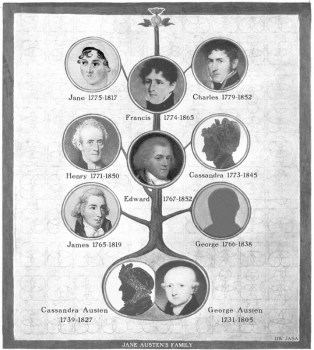
familytreelowres

Austen’s immediate family tree. [Image courtesy: jasa.net]

Jane had six older brothers: James, George, Edward, Henry, Francis and Charles.

By 14 she was writing to entertain her friends and family, penning such comedies as Love and Freindship (sic) and the parody   A History of England by a partial, prejudiced and ignorant Historian.  She collected 29 of her stories into three bound books, now known as Juvenilia.

In 1793 she began to write longer works in the epistolary style. Lady Susan was one such novel in letters.  She wrote Elinor and Marianne in the same style before she rewrote the work as a third person narrative and changed the title to Sense and Sensibility.

Jane Austen, Watercolour and pencil portrait b...

Jane Austen, Watercolour and pencil portrait by her sister Cassandra, 1810 (Photo credit: Wikipedia)

In 1801 Rev. Austen moved (with Mrs. Austen, Cassandra and Jane) to Bath. Jane’s productivity took a nose-dive. She was either too busy to write — with all the shopping and socializing in Bath — or too depressed to write. The Austens lived in Sydney Place, no.4…

which offered both an easy walk into town and handy access to Sydney Gardens, a great outdoor attraction at that time with regular gala nights featuring music and fireworks.[Seeking Jane Austen]

…until Mr. Austen died  in 1804. By 1806 the ladies had left Bath for good, and moved Chawton in Southampton. As soon as they had settled in their new home she renewed her writing in earnest .

English: Back View of Jane Austen, Watercolor

English: Back View of Jane Austen, Watercolor (Photo credit: Wikipedia)

In 1811, Thomas Egerton, a military Library publishing house printed 750 copies Sense and Sensibility, largely on Austen’s dime. The book sold out of its first edition by 1813. And Austen eventually made 140 pounds on it.  It  appeared under the pseudonym “A Lady,” and Austen carefully guarded her anonymity .

Encouraged by this success, Jane Austen turned to revising First Impressions, a.k.a. Pride and Prejudice. She sold it in November 1812, and her “own darling child” (as she called it in a letter) was published in late January 1813. [Pemberley.com]

In May of 1814 her third novel, Mansfield Park was published. It sold out in six months.

Austen's

Despite carefully guarding her name, word had begun to leak out. People knew who  the  “Lady” was…important people…like the Prince Regent. While she was writing Emma she was summoned to the palace and invited to dedicate her next novel to the Prince. Austen was less than thrilled to be given the honor, but couldn’t exactly refuse, so in wonderful Austen wit she flattered him as only she could…

TOHIS ROYAL HIGHNESS THE PRINCE REGENT, THIS WORK IS,BY HIS ROYAL HIGHNESS’S PERMISSION,MOST REPECTFULLY DEDICATED,BY HIS ROYAL HIGHNESS’S DUTIFUL AND OBEDIENT HUMBLE SERVANT, THE AUTHOR

In 1815 she began working on Persuasion. By then her health had begun to deteriorate. She completed the first draft by 1816 and began The Brothers which later became  Sanditon. Her condition rapidly worsened. In May her bother Henry took Jane to Winchester for treatment, but on July 18, 1817 at the age of 41 Jane Austen passed away. She was buried at Winchester Cathedral.

English: Jane Austen's memorial gravestone in ...

English: Jane Austen’s memorial gravestone in the nave of Winchester Cathedral (Photo credit: Wikipedia)

Henry, with Cassandra’s help, got Persuasion and Northanger Abbey published in December of 1817. For the first time the author was listed as “Jane Austen.”

Happy Birthday Jane!!!

Ooops forgot to link to my own blog on the Pride and Prejudice Essay Contest!

  • JASNA (Jane Austen Society of North America)

Secondary Character Saturday: Piglet!


[It’s Second Character Saturday! Today’s character is Piglet. I’ll be going straight to the source and discussing the AA Milne Piglet with illustrations by Ernest Shepard— not the Disney-fied Piglet.]

“But Piglet is so small that he slips into a pocket, where it is very comfortable to feel him when you are not quite sure whether twice seven is twelve or twenty-two.”― A.A. Milne, Winnie-the-Pooh

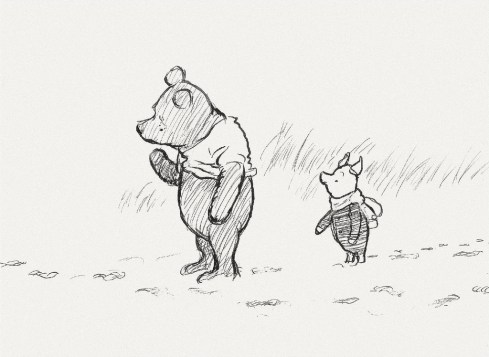
Piglet and Pooh think about fall.

Piglet and Pooh think about fall.


Who: Piglet


From: Winnie-the-Pooh


By: A.A. Milne


Date: 1926


Why: Piglet is shy, but brave. He reminds us that no matter how small and un-impowered we are… we are still big enough to stand up for what is right and face our fears.He is a role model for friendship.


In the stories he grounds the more popular (and more flighty) Pooh. He has a very strong relationship with Pooh, Eeyore and Christopher Robin. As readers (especial children) we relate to him because of his size and soft voice and WE want to be his friend too.


Piglet plants a haycorn plant.

Piglet plants a haycorn plant.


Pros: Loyal, brave, innocent, earnest, creative, humble, good listener, hard worker.


Cons: Excitable, follower, gullible.


Pooh and Piglet on an adventure

Pooh and Piglet on an adventure


Shining Moment: I love all the moments with Piglet in the books. I especially the quiet moments between Pooh and Piglet that just say “friendship” to me…


Piglet sidled up to Pooh from behind. “Pooh?” he whispered.
“Yes, Piglet?”
“Nothing,” said Piglet, taking Pooh’s hand. “I just wanted to be sure of you.”


“I don’t feel very much like Pooh today,” said Pooh.
“There there,” said Piglet. “I’ll bring you tea and honey until you do.”


“How do you spell ‘love’?” – Piglet
“You don’t spell it…you feel it.” – Pooh”


When you wake up in the morning, Pooh,” said Piglet at last, “what’s the first thing you say to yourself?”
“What’s for breakfast?” said Pooh. “What do you say, Piglet?”
“I say, I wonder what’s going to happen exciting today?” said Piglet.
Pooh nodded thoughtfully. “It’s the same thing,” he said.”


Piglet gets ready for the party


I love when he listens to Eeyore and does something to help him out of his funk.


He’s there for his friends and always willing to help. Despite his diminutive size he is brave enough to face great odds. He may be afraid of everything, but that doesn’t get in the way of his standing up for what is right, or standing next to a friend to face a challenge.


The Disney-fied version of my beloved porcine friend. [Image courtesy: render-graphiques.fr]

The Disney-fied version of my beloved porcine friend. [Image courtesy: render-graphiques.fr]


Least Shining Moment: I do not like what Disney did with Piglet. They turned his innocence into a cartoon. I was OK with that as a kid, but as I get older, and Disney keeps chugging out more and more Pooh related crap, I resent that they are forcing the Milne characters into cookie-cutter cartoons of themselves to sell more DVDs and plastic  stuff. Piglet just gets squeekier and squeekier and the tender, brave, humble pig gets more and more diluted. SHAME.


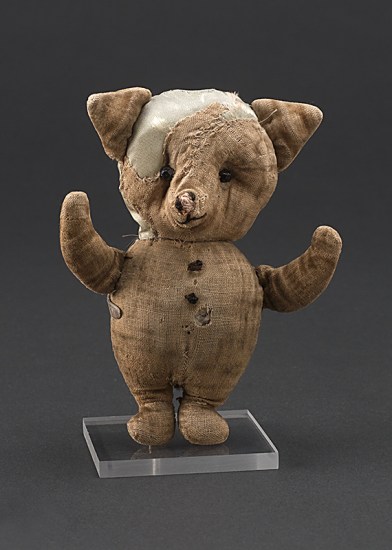
Well loved and well used, this is the original Piglet. One of Christopher Robin Milne's surviving stuffed animals, Piglet resides at the New York Public Library.

Well loved and well used, this is the original Piglet. One of Christopher Robin Milne‘s surviving stuffed animals, Piglet resides at the New York Public Library.

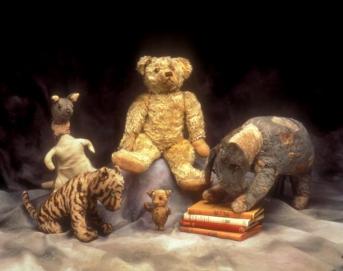
In 1921, as a first-birthday present, Christopher Robin Milne received a small stuffed bear, which had been purchased at Harrods in London. Eeyore, Piglet, Kanga, and Tigger soon joined Winnie-the-Pooh as Christopher’s playmates and the inspiration for the children’s classics When We Were Very Young (1924), Winnie-the-Pooh (1926), Now We Are Six (1927), and The House at Pooh Corner (1928), written by his father, A.A. Milne, and illustrated by Ernest H. Shepard.

You can see just how small Piglet is compared to the other stuffed animals in this photo. [Image courtesy: The New York Public Library

You can see just how small Piglet is compared to the other stuffed animals in this photo. [Image courtesy: The New York Public Library

Brought to the United States in 1947, the toys remained with the American publisher E.P. Dutton until 1987, when they were donated to The New York Public Library. [Treasures of The New York Public Library.]


Cover of Winnie-the-Pooh

Cover of Winnie-the-Pooh (Photo credit: Wikipedia)


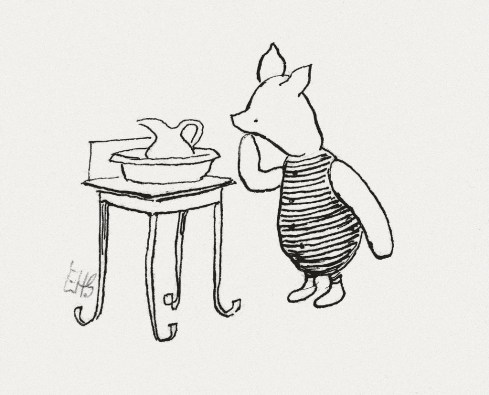
One more image... Piglet dancing with delight. Keep that image in your heart today, OK?

One more image… Piglet dancing with delight. Keep that image in your heart today, OK?


Tycho Brahe 12.14.12 Thought of the Day

“I conclude, therefore, that this star is not some kind of comet or a fiery meteor… but that it is a star shining in the firmament itself one that has never previously been seen before our time, in any age since the beginning of the world.”
–Tycho Brahe

The astronomer Tycho Brahe

The astronomer Tycho Brahe (Photo credit: Wikipedia)

Tycho Ottesen Brahe was born on this day in Knutstrop Castle, Scania, Denmark-Norway in 1546. Today is the 466th anniversary of his birth.

Noble by birth Brahe’s twin brother died before he could be baptized. Tycho’s ode to his dead brother was his first published work. At two his  uncle,  Jorgen Thygesen Brahe,  took him (perhaps kidnapped him) to live at Tosterup Castle, and Tycho became Jorgen’s heir.  At 12 he entered the University of Copenhagen to study philosophy and rhetorics. There was a solar eclipse in 1560 and young Tycho was fascinated by it. He began studying astronomy. When he started at Leipzig he  began to study astronomy without permission…

but was soon forgiven after demonstrating successes. He found that old observations were very inaccurate, and started to design methods and instruments for high-precision measurement of positions of celestial bodies. [TychoBrahe]

From Leipzig he continued his academic pursuits  in  Germany, studying at Wittenberg, Rostock and Basel. In Rostock he had a famous duel with another student to determine who was the best mathematician.

Tycho Brahe

Tycho Brahe (Photo credit: lilspikey)

His nose was cut so badly that  for the rest of his life “he covered the scar with a plate probably made of a silver-copper alloy to imitate the colour of the skin.” [Ibid]

During this period his interest in alchemy and astronomy was aroused, and he bought several astronomical instruments.[The Galileo Project]

He returned to Scania and built a laboratory to study chemistry. In November of 1572 he turned his sights to the heavens again and observed …

a new brilliant star in the constellation of Cassiopeia. Tycho’s measurements showed that it really was a distant star and not any local phenomena. This was very intriguing at that time, since the sphere of the stars was considered to be divine and perfect, hence no changes ought to take place there. Tycho observed its brightness evolve until it faded away the next year. He reported the event in his book “De stella nova”, which made him famous all over Europe. [TychoBrahe]

With his new found fame he could have studied anywhere in Europe, but he chose to return to his beloved Denmark. King Frederick II  granted him the Island of Hven.

Map of Hven from the Blaeu Atlas 1663, based o...

“…There he built his observatory, Uraniburg, which became the finest observatory in Europe.” [The Galileo Project] He designed new instruments and developed a nightly program of observations.

Tycho Brahe's Stjerneborg observatory on the i...

Tycho Brahe’s Stjerneborg observatory on the island of Hven, restored. 2005 (Photo credit: Wikipedia)

The observatory was visited by many scholars, and Tycho trained a generation of young astronomers there in the art of observing. [Ibid]

He left Hven after he had an argument with King Christian IV and, after traveling for several years, wound up in Prague.

Tycho Brahe died 24th October 1601 of a urinary bladder infection. It has long been thought that the cure (a self-induced potion that may have contained lead) was the real culprit. But that has recently been disproved.

English: Signature of Tycho Brahe.

English: Signature of Tycho Brahe. (Photo credit: Wikipedia)

Tycho Brahe ved Knutstorp, Knudstrup

Tycho Brahe ved Knutstorp, Knudstrup (Photo credit: Wikipedia)


Pride and Prejudice Essay Contests

Today’s blog features two essay contests: the official JASNA Student Essay Contest,
and the ritaLOVEStoWRITE Essay Contest for the rest of us.


JASNA essay contest


JASNA STUDENT ESSAY CONTEST:


Attention: Students at the high school, college and post-graduate levels:


In celebration of the 200th anniversary of the publication of Pride and Prejudice, JASNA (The Jane Austen Society of North America) is looking for short essays on the following topic:


“Though Pride and Prejudice may be regarded as timeless, nevertheless within the novel Austen plots her time very carefully. Timing is everything for important relationships and events. And the characters are deeply connected to the time in which they live, which is both like and unlike our times. What do we discover about time, times, or timeliness from reading Pride and Prejudice?”


Title page from the first edition of the first...

Title page from the first edition of the first volume of Pride and Prejudice (Photo credit: Wikipedia)

Judges will be awarding scholarships ranging from $250 to $1000, plus a years membership to JASNA, plus tickets and lodging to the 2013 JASNA Annual General Meeting in Minneapolis. The winning essays will also appear on the JASNA website.


Deadline is May 15, 2013. 


Click HERE to go to the JASNA Essay Contest Page for more details.


[Please note that the contest is open to students outside the United States too, but the essay must be written in English.]


———————————————————————————————-


English: Mr. and Mrs. Bennet. Austen, Jane. Pr...

English: Mr. and Mrs. Bennet. Austen, Jane. Pride and Prejudice. London: George Allen, 1894, page 5. (Photo credit: Wikipedia)

ritaLOVEStoWRITE  Contest for the rest of us:


So what about the rest of us Pride and Prejudice lovers? Can’t WE write an essay*? Well, sure you can. I’m calling for entries right here and right now.


We too will be celebrating the 200th anniversary of P&P! But guess what? Any one can participate!  Couple of RULES here:


  1. TRY and keep it under 1200 words please.
  2. The “essay” should be Pride and Prejudice centric.
  3. Please submit your essay in English.
  4. Have fun with it!
  5. Oh, and no pornography == THIS is Austen after all!


English: Français : Une gravure de 1833 illust...

English: Français : Une gravure de 1833 illustrant une scène du chapitre 59 du roman Orgueil et Préjugés de Jane Austen. À gauche M. Bennet, à droite Elizabeth. Avec File:Pickering – Greatbatch – Jane Austen – Pride_and_Prejudice – This is not to be borne, Miss Bennet.jpg, il s’agit des toutes premières illustrations de l’œuvre. (Photo credit: Wikipedia)


Prizes include… All entries will be published in an upcoming special edition of the award-winning ritaLOVEStoWRITE blog. All entries will receive a participation banner for your blog. The top three entries will receive a special “Finalist” banner for their Blog Page, and the top entry will win a Darcy mug! (Please make sure to include an email contact — which I will remove before posting so the whole world doesn’t see it.)


Deadline: 28 January 2013 (That’s the anniversary date of the novel’s publication)


*I seriously encourage you to think outside the box. For you illustrators out there… how about some character studies? Are you a play wright? Why not treat us to a re-imagined scene or two?


AND … Although I’m not going to snark on your intellectual property I strongly suggest you throw a copyright on all your original material in case any one else takes a liking to it.


English: This diagram, or map, illustrates the...

English: This diagram, or map, illustrates the relationships between each of the main characters in the novel Pride and Prejudice by Jane Austen. (Photo credit: Wikipedia)


Steve Buscemi 12.13.12 Thought of the Day

“My favorite review described me as the cinematic equivalent of junk mail.”
Steve Buscemi


(Image courtesy: fan pop)

(Image courtesy: fanpop.com)


Steven Vincent Buscemi was born on this day in Brooklyn, New York, USA in 1957. He is 55 years old.


Buscemi is part Irish and part Italian, he’s one of four boys born to John Buscemi, a sanitation worker, and Dorthy Buscemi a hostess. He went to Valley Stream Central High School where he wrestled and acted. After graduating in 1975 he attended Nassau Community College then moved Manhattan to attend the Lee Strasberg Institute. He worked on FDNY Engine #55 as a fire fighter. He has worked as a bartender, a stand-up comedian, an ice-cream truck driver before breaking into acting. One of his brothers, Michael, is also an actor.


He made his film debut with a short called Tommy’s (in which he played Tommy), in 1985. He took on the odd ball, character actor roles — often the mafia types and worked in dozens of TV shows and movies. When he hooked up with the Coen Brother’s his off beat sensibilities found a home.


As of 2010, has appeared in six Coen Brothers films (Miller’s Crossing (1990), The Hudsucker Proxy (1994), Barton Fink (1991), Fargo (1996), The Big Lebowski (1998), and Paris, je t’aime (2006)), more than any other actor. [IMDB.com]


He played Mr. Pink in Quentin Tarntino’s Reservoir Dogs. Then paired up with the director again for a bit part in Pulp Fiction.


English: Photo of a young Steve Buscemi (Ameri...

English: Photo of a young Steve Buscemi (American actor). Taken in Silverlake / Los Angeles. (Photo credit: Wikipedia)


Buscemi was brilliant as Carl Showalter, the can’t-catch-a-break smal-time crook in Fargo.


His movie and tv CV is impressive, and he’s the kind of actor where you see a movie title  and you think “Oh, yeah, he WAS in that.”  From Templeton the Rat (in 2006’s Charlotte’s Web) to Donny (in 1998’s The Big Lebowski) to Lenny Wosniak (his recurring guest spot on 30 Rock) Buscemi is wonderful to watch — even when you want to turn away.


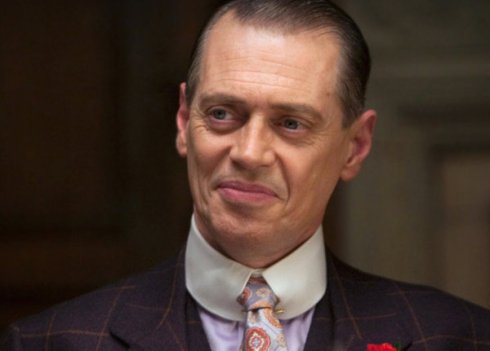
Most recently he’s been the star of HBO’s Boardwalk Empire. As amoral Nucky Thompson he manages to hang on to a thread of inner humanity to keep his character viable. And , oh, yeah, he’s a hoot. (When he’s not killing people.)

Buscemi as Nucky Thompson. (Image courtesy HBO)

Buscemi as Nucky Thompson. (Image courtesy HBO)