Category Archives: Film

L. Frank Baum 5.15.13 Thought of the Day

“Imagination has brought mankind through the dark ages to its present state of civilization. Imagination led Columbus to discover America. Imagination led Franklin to discover electricity.”– L. Frank Baum
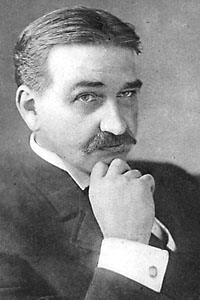
[Image courtesy: xyz
[Image courtesy: QOTD.org]

Lyman Frank Baum was born on this day in Chittenango, New York, USA in 1856. today is the 157th anniversary of his birth.

Frank was the seventh of nine children born to Benjamin and Cynthia Baum. The Baums were wealthy. Benjamin made his fortune in the oil fields of Pennsylvania. And Frank grew up happy at the family estate of Rose Lawn. He was a shy child, and, because of a “weak heart,”  he was home schooled for most of his life. He loved to read and spent hours in his father’s library. He didn’t like classical fairy tales — their goblins and villains were too scary — so he made up his own stories and shared them with his brothers and sisters.

When he was twelve his father… hoping to toughen Frank up and cure him of his ‘daydreaming,’ sent him to the Peekskill Military Academy. Baum was miserable there for over a year, and the only results of the experiment were a physical (and possibly also psychological) breakdown, and a lifelong aversion to both formal education and the military. [The Oddness of Oz]

Once home he turned to creative writing. His father bought him a small printing press and, along with his little brother Harry, “he started his own newspaper, the Rose Lawn Home Journal” [the Literary Network]. Frank filled the pages, honing his craft by cranking out articles, fiction and poetry. Other publications included Baum’s Complete Stamp Dealers’ Directory an 11 page  booklet for amateur philatelist and The Poultry Record in which Baum wrote about Hamburg chickens. “He would also write about the raising and breeding of chickens in The Book of Hamburgs. (1896)” [Ibid]

He became fascinated with acting and the theater.

He developed an intense and enduring fascination with the theater. In 1878, he began to work as a professional actor. Four years later his father bought him a small dramatic company, and Baum was soon adapting and starring in a romantic melodrama, The Maid of Arran [The Oddness of Oz]

Baum as Hugh Holcomb in Maid from Arran. [Image courtesy: Hungry Tiger Press.com]

But Baum had bad luck in almost every business endeavor he put his hand to. The Maid of Arran was a moderate success, but while he was touring with the play his theater back home (the one his father bought him) burned down. The company lost the building, all the sets and costumes, and all of the scripts (except those they were traveling with). Ironically the Baum play that was running at the time was called “Matches.”

Other short-lived opportunities soon soured. And he struggled for long-term success. In 1882 he married Maud Gage. Now he had a family to provide for. The time of being a daydreamer were over.

The family moved Aberdeen, South Dakota where he opened a department store, Baum’s Bazaar. The store failed — Frank let people have too much store credit. He became an editor of The Aberdeen Saturday Pioneer, where, after the Massacre at Wounded Knee, he wrote (what one hopes was) a Swiftian inspired modest proposal that all Native Americans be exterminated…

“Having wronged them for centuries, we had better, in order to protect our civilization, follow it up by one more wrong and wipe these untamed and untamable creatures from the face of the earth.”

He tried his hand at managing a baseball club and worked as a buyer for a department store. Nothing seemed to stick.

Baum moved the family to the Humboldt Park neighborhood of  Chicago in 1891. He worked as a reported for the Evening Post, edited a magazine on window displays and worked as traveling salesman.

In 1897, he finally started to have some success with his writing.   Mother Goose in Prose, stories based on traditional Mother Goose poems paired with lovely Maxfield Parrish illustrations, sold well enough that he could quit his door-to-door salesman job. Two years later Baum published Father Goose, His Book this time with W.W. Denslow as his illustrator and had even greater success.

Cover of the first edition of the Wonderful Wizard of Oz [Image courtesy: Loc.gov]

Cover of the first edition of the Wonderful Wizard of Oz [Image courtesy: Loc.gov]

In 1989 he wrote the Wizard of Oz. It was published in 1900, again with Denslow as illustrator, and cost $1.50 a copy.

Unlike other books for children, The Wizard of Oz was pleasingly informal; characters were defined by their actions rather than authorial discourse; and morality was a subtext rather than a juggernaut rolling through the text. [SmithsonianMag.org]

Baum wrote 13 more Oz books (some coming as frequently as one a year.) He had done more than write a best seller, he had created a new genre of fiction… The American Fairy Tale.

He wrote dozens of other books, from Dot and Tot of Merryland to The Life and Adventures of Santa Claus to his last book Phoebe Daring: A Story for Young Folk, but the Oz books were his bread a butter best sellers.

The family moved to Hollywood, California and Baum tried his hand at making silent films with the creation of the Oz Film Manufacturing Company. He wrote, directed and acted with the company which used experimental film effects to capture some of Baum’s fantastic themes. He also  worked with the Uplifters theatre troupe.

L. Frank Baum died of a stroke on May  6th, 1919.

“To please a child is a sweet and lovely thing

that warms one’s heart and brings its own reward.”

–L. Frank Baum

An illustration by W. W. Denslow from The Wond...
An illustration by W. W. Denslow from The Wonderful Wizard of Oz, also known as The Wizard of Oz, a 1900 children’s novel by L. Frank Baum. (Photo credit: Wikipedia)

Katharine Hepburn 5.11.13 Thought of the Day

“. . . as one goes through life one learns that if you don’t paddle your own canoe, you don’t move.”–Katharine Hepburn

From Woman of the Year [Image courtesy: Wikimedia]

From Woman of the Year [Image courtesy: Wikimedia]

Katharine Houghton Hepburn was born on this day in Hartford, Connecticut, USA in 1907. Today is the 106th anniversary of her birth.

She was the second of six children born to Thomas and Katharine Hepburn. Her father was a urologist, her mother was a suffragette. Her parents “encouraged her to speak her mind, develop it fully, and exercise her body to its full potential.” [IMDb] She decided to become an actress while attending Bryn Mawr College.

Upon graduation  in 1928 (she got her degree in history and philosophy) she went to Broadway  where she got a number of small roles before starring as Antiope, the Amazon princess, in A Warrior’s Husband in 1932. The same year she made her first film A Bill of Divorce with John Barrymore. She won her first Academy Award for 1933’s Morning Glory.

Hepburn was always her own woman. She wore pants, but didn’t wear makeup. She spoke her mind and she certainly didn’t fit into the Hollywood starlet mold. That made for a difficult road for the actress in the mid to late 1930’s. Although she had a few stage and screen successes  she struggled until she starred in The Philadelphia Story on Broadway in 1938.

Cropped screenshot of the film The Philadelphi...

Cropped screenshot of the film The Philadelphia Story (Photo credit: Wikipedia)

She quickly bought the film rights, and so was able to negotiate her way back to Hollywood on her own terms, including her choice of director and co-stars. The film version of The Philadelphia Story (1940), was a box-office hit, and Hepburn, who won her third Oscar nomination for the film, was bankable again. For her next film, Woman of the Year (1942), she was paired with Spencer Tracy, and the chemistry between them lasted for eight more films, spanning the course of 25 years, and a romance that lasted that long off-screen. (She received her fourth Oscar nomination for the film.) Their films included the very successful Adam’s Rib (1949), Pat and Mike (1952), and Desk Set (1957). [Ibid]

Cover of "The Hepburn & Tracy Signature C...

Cover via Amazon

By the 1950’s she was pegged for more mature roles like Oscar nominated role opposite Humphrey Bogart in The African Queen.

She won her second Oscar opposite Spencer Tracy in Guess Who’s Coming to Dinner (Tracy’s last movie) in 1967. And repeated the walk down the red carpet to pick up Oscar #3 the following year for The Lion In Winter.

Hepburn added more TV work to she schedule in the 1970s, but still found some plum film work  including Rooster Cogburn and On Golden Pond. She won her 4th Oscar for Golden Pond.

From On Golden Pond [Image courtesy: The Hairpin.com]

From On Golden Pond [Image courtesy: The Hairpin.com]

Katharine Hepburn died on June 29, 2003. She was 96 years old.


Secondary Character Saturday: Sean Bean; Boromir

Those of you who have been reading this blog for a bit will recall that March featured Secondary Characters played by the wonderful Alan Rickman. This month I thought I’d focus on another terrific secondary character (mostly) player, Sean Bean.

Secondary Character Saturday: Sean Bean; Boromir

———————————————–

Sean Bean as Boromir in Peter Jackson's live-a...
Sean Bean as Boromir in Peter Jackson’s live-action version of The Lord of the Rings. (Photo credit: Wikipedia)

WHO: Boromir; Son of the Steward of Gonor, Captain of the White Tower

FROM: The Lord of the Rings

J.R.R. Tolkien's The Fellowship of the Ring is...
J.R.R. Tolkien’s The Fellowship of the Ring is by a Christian author, and contains Christian themes, Matthew T. Dickerson, Following Gandalf: Epic Battles and Moral Victory in The Lord of the Rings, Brazos Press, 2003, though its wide popularity means that many would not consider it a specifically Christian novel. (Photo credit: Wikipedia)

BY: J.R.R. Tolkien

PUBLISHED: July 29, 1954

PROS: Boromir is honorable, noble, strong, brave, couragous , a natural leader, loyal to Gondor and a great big brother.

CONS: His single minded desire to protect his homeland blinds him to the dangers of the Ring. He questions Gandalf’s leadership of the Fellowship and Frodo‘s ability to carry out the task of destroying the Ring. He is stubborn, proud, arrogant. He’s afraid of the Elves of Lothlorien and things start to sour in his relationship with the Fellowship after they’ve passed through the forest.

MOST SHINING MOMENT: Fights to the death in an attempt to keep Merry and Pippin safe from the Orcs.

LEAST SHINING MOMENT: His attempt to take the RING from Frodo. His motive — to take the Ring to protect Gondor — may have been noble, but it is misguided. And he breaks the trust and the bond of friendship of the Fellowship when he tries to take the Ring from Frodo. At first he tries to cajole the hobbit into turning the Ring over, but when that doesn’t work he attempts to seize it physically. Frodo has to put the Ring on to escape (he disappears, but it also alerts the Orcs to his location.) Boromir recovers his senses, but the hobbit knows he can’t trust him anymore. Frodo must go forward on the quest alone. (Until, of course, his faithful servant/friend Sam tags along too.)

WHY SEAN BEAN IS SO GOOD IN THE ROLE: Despite the fact that Boromir dies a third of the way through The Lord of the Rings Trilogy he is still one of the most interesting characters. He’s a leader of men, but Tolkien hasn’t seemed to decide if MAN is really a redeemable species. If the battle for Middle Earth was between Hobbits / Elves  and  Orcs … things would be so much neater. The battles would be black and white. You’d know who to cheer for. But Tolkien throws in Dwarves and Men — greed, pride,  doubt, all kinds of deadly sins — and suddenly the lines are not so pristine. When Peter Jackson made is epic 2001 (yes it was 12 years ago!!!) movie of the book he couldn’t have picked a better actor to play Boromir.  Sean Bean has a look of tired conflict written all over his face. He’s not a  man to be messed with. He’s a soldier who has been fighting for decades to keep his country safe, and he will do anything to further that goal.

But Bean’s performance is multi layered too. He’s gentle, playful, and protective of  the hobbits as they take their long journey.

But there’s heart ache there too…

The perfect flawed hero. And a  truly human performance.

—————————————————–

What other Sean Bean roles do you think we should discuss? Drop me a line and let me know.


Second Character Saturday: Glenda

“When all the stars have fallen down into the sea and on the ground, and angry voices carry on the wind, a beam of light will fill your head and you’ll remember what’s been said by all the good men this world’s ever known.”–Glinda the Good Witch

Cover of the Glinda of Oz

Cover of the Glinda of Oz (Photo credit: Wikipedia)

Who: Glinda the Good Witch

From: The Wizard of Oz

By: L. Frank Baum

Published: 1900

The portrait of Glinda the Good appearing in G...

The portrait of Glinda the Good appearing in Glinda of Oz, by L. Frank Baum. (Photo credit: Wikipedia)

Pros: Kind, protective, wise, thoughtful, brave, magical, friendly, and a strong female role model — her court is almost entirely made up of women. Her leadership style involves letting people figure things out on their own. She keeps a careful eye on the situation and guides them as necessary but she lets them come to the conclusions on their own without spoon-feeding them the knowledge or answers. She’s also there to help when called on.

Why I chose Glinda: I choose her because my daughter recommended this TED talk. Although Mr. Stokes speaks to the Glinda character in the 1939 Movie (and I’m going back to the source Glinda in the book) I think he hits the nail on the head. And it inspired me to choose her for today’s Secondary Character.

http://www.wellhappypeaceful.com/glinda-the-good-witch/

Billie Burke as Glinda and Judy Garland as Dorothy in the 1939 movie of The Wizard of Oz [Image courtesy: Well Happy Peaceful]

Billie Burke as Glinda and Judy Garland as Dorothy in the 1939 movie of The Wizard of Oz [Image courtesy: Well Happy Peaceful]


Daffy Duck 4.17.13 Thought of the Day b

“Relax sister. I don’t know the meaning of the word fear!” — Daffy Duck

Daffy Duck, as he appears in The Looney Tunes ...

Daffy Duck, as he appears in The Looney Tunes Show. (Photo credit: Wikipedia)

Daffy Dumas Horacio Tiberius Armando Sheldon Duck was “born” on this day in Warner Brothers Studio, Burbank, California, USA in 1937. He is 76 years old.

He was first brought to life by animator Bob Clampett and voiced by Mel Blanc in director Tex Avery‘s Porky’s Duck Hunt.  Warner Brothers was looking to carve a niche out the cartoon market (and take market share away from Disney). They had had some success with Porky Pig, but  Tex Avery “wanted a character so incongruous, so nuts, so out-of place that it would put Walt Disney’s cute “Silly Symphonies” to shame.” [The Complete History of Daffy Duck]  With Daffy he had just the duck for the mission.

Daffy Duck as he first appeared in Porky's Duc...

Daffy Duck as he first appeared in Porky’s Duck Hunt (1937). (Photo credit: Wikipedia)

Daffy’s personality changed as the years went on. He became a slightly different duck for each of his directors. For Tex Avery he was wacky. He put the Loon in Looney Tunes. He literally bounced all over the place like a lunatic shouting “Woo-hoo! Woo-hoo!”

By 1940 he’d grown more focused and ambitious. He wanted to be a movie star.

He was still crazy, but he had purpose and had control over the scenes he was in. During World War II Daffy reflected the times, first he was a draft dodging duck, then he collects scrap metal for a scrap drive (Scrap Happy Daffy). He even confronts Adolf Hitler in Daffy the Commando.

Director Robert McKimson made Daffy dapper, instilling the cartoon fowl with a bit of brains to go with his bonkers.

When Chuck Jones took the helm Daffy changed again.  Where Daffy had been “a hyperactive, carefree, if not patriotic, duck ” [The Complete History of Daffy Duck] Jones gave us “a more power-hungry and greed-driven loser. … Jones made him taller, skinnier, beakier and scruffier-looking…While he had been a winner before, and happier, Jones made him him a loser who was never satisfied. [Ibid] Jones also did a run of movie spoofs starring Daffy and Porky that were enormously popular.

By the 1950s Daffy was struggling to reclaim the spotlight from Bugs Bunny, who had become the leading Warner Brothers character. Led by Chuck Jones, the directors of this era brought out a darker side of Daffy’s personality, showing him as desperately self-glorifying and consumed by jealousy—though also more introspective. [Encyclopedia Britannica.com]

By the mid 1960s movie studios had soured on making cartoon shorts. Television, not movies theaters were the entertainment venues of choice, and the theaters couldn’t afford cartoon shorts. “the post-1964… Warner Bros…. cartoons,  are quite cheaply produced compared to the cartoons of the 40’s and 50’s.” [The Complete History of Daffy Duck]

So Daffy, along with Bugs and Porky were relegated to Television. Mostly the Warner Bros. favorites appeared as reruns on Saturday mornings, but occasionally they were given fresh material for TV specials  like Daffy’s “Duck Dodgers In the 24 1/2 Century.”  He found a home on the Cartoon Network’s The Looney Tunes Show (now voiced by Jeff Bergman and Bill Farmer)

Most recently DD’s most recent appearances have been in Robot Chicken: Immortal  and Spread Those Wings and Fly  (both came out in February of this year)

Daffy Duck

Daffy Duck (Photo credit: Wikipedia)


This one goes out to my friend Angie and my sister Joan.


Charlie Chaplin 4.16.13 Thought of the Day Part two

[Continued from Charlie Chaplin 4.16.13 Thought of the Day: Part One]


The Gold Rush (1925)

The Gold Rush (1925) (Photo credit: quicheisinsane)

Having fulfilled his contract with National, Chaplin  was free to work on independent projects for United Artists, a group he formed with  Douglas Fairbanks, Mary Pickford, and D. W. Griffith in 1919. With the Gold Rush in 1925 he made the movie he wanted to be remembered by.


Through his work, Chaplin came to be known as a grueling perfectionist. His love for experimentation often meant countless retakes and it was not uncommon for him to order the rebuilding of an entire set. It also wasn’t rare for him to begin with one leading actor, realize he’d made a mistake in his casting, and start again with someone new…But the results were hard to refute. [Biography]


The Tramp working on the giant machine in the ...

The Tramp working on the giant machine in the film’s most famous scene (Photo credit: Wikipedia) Modern times

His later films include City Lights, 1931, Modern Times, 1936 and The Great Dictator, 1940. He made a half dozen more films (most noteably Lime Light co starring Buster Keaton) but they paled  in comparison to his earlier work. No one, it seemed, was interested in Chaplin sans bowler hat and mustache.


Charlie Chaplin from the film The Great Dictat...

Charlie Chaplin from the film The Great Dictator (with “double cross” emblem in background and on cap). (Photo credit: Wikipedia)

Chaplin’s personal life was always in the spot light. He was married 4 times to women decades his junior. He had numerous affairs with his leading ladies. He didn’t join the British Army in WWI (which caused a lot of controversy back home in England. –Chaplin had registered for the draft, but had not been called up. He also worked for the War effort raising money through Liberty Bonds and producing propaganda films — but it wasn’t enough to satiate the flag waving mania sweeping his home country.) He was never afraid to voice his political views and after The Great Dictator (with it’s brilliant, but preachy six-minute closing speech) he was branded a radical. In the 1950’s he was a target of the House Un-American Activities Committee who “saw him as a nonconformist and therefore a communist.” [About.com] When he tried to return to the States after a trip  abroad he was denied entry. (He went to live in Switzerland.)


Charlie Chaplin, Vevey, Switzerland - Project ...

Charlie Chaplin, Vevey, Switzerland – Project 1/365 (Photo credit: Airflore)

He stayed away… until 1972 when he was awarded an Honorary Academy Award. He was given a 12 minuted standing ovation at the ceremony.


Chaplin also composed music. He wrote the songs “Smile” and “This is My Song” along with 500 other melodies.


After finishing his last film A Countess from Hong Kong … he composed the music to many of his silent movies, among them The Circus,… The Kidand A Woman of Paris: A Drama of Fate [IMDb]

Charlie Chaplin died of a stroke on Christmas morning 1977.


Awards:


  • 1929 WON Special Academy Award “for versatility and genius in acting, writing, directing and producing The Circus
  • 1941 Nominated for Best Actor Oscar  for his dual role in The Great Dictator.
  • 1941 Nominated for Best Writing Oscar for The Great Dictator..
  • 1948 Nominated for Best Screenplay Oscar for Monsieur Verdoux.
  • 1972 WON Special Honorary Academy Award for “the incalculable effect he  has had in making motion pictures the art form of this century”.
  • 1973 WON The Academy Award for Best Original Score for Limelight. (The film had not been released in the US until 1972).

CLICK HERE for Charlie Chaplin Part One


Charlie Chaplin 4.16.13 Thought of the Day: Part ONE

“I remain just one thing, and one thing only, and that is a clown. It places me on a far higher plane than any politician.” — Charlie Chaplin

Charlie Chaplin The Tramp debuted in 1914 -- p...

Charlie Chaplin The Tramp debuted in 1914 — pre-1923 (Photo credit: Wikipedia)

Charles Spencer Chaplin was born on this day in 1889 in London, England. Today is the 124th anniversary of his birth.

He was practically born to the stage. Both his parents were musical hall entertainers. His father, Charles Chaplin, Sr.  was a singer and actor, his mother, Hannah Chaplin — her stage name was Lily Harley — sang light opera. The marriage didn’t last long, and Chaplin, Sr. abandoned the family when Charlie was an infant. He had two half brothers. Sydney Hill Chaplin was four years older than Charlie and was born to Hannah a year before she married Chaplin, Sr. (who was not his father.) Hannah had another baby, George Wheeler Dryden in 1892, by entertainer Leo Dryden. Sydney and Charlie hardly knew this brother, however, because Leo took the boy away when he was 6 months old. George didn’t resurface until his mid thirties.

Hannah continued her stage career for a few years, but…

in a performance that would introduce her youngest boy to the world of performance, Hannah inexplicably lost her voice in the middle of a show, prompting the stage manager to push the five-year-old Chaplin, whom he’d heard sing, onto the stage to replace her…[Biography]

The audience loved little Charlie, but it was a disaster for Hannah…

Her singing voice never returned and she eventually ran out of money. For a time, Charlie and Sydney had to make a new, temporary home for themselves in London’s tough workhouses. [Ibid]

Hannah was in and out of mental institutions until 1905 when she was committed permanently. With the exception of one disastrous stint with their alcoholic father, the boys were left to fend for themselves,  and, eventually, thrown into the workhouse. Sydney was trained as a seaman, but both boys wanted to act. Charlie charmed his way into a clog dancing group called the Eight Lancashire Lads in 1897.

It was a short stint, and not a terribly profitable one, forcing the go-getter Chaplin to make ends meet anyway he could…”I (was) newsvendor, printer, toymaker, doctor’s boy, etc., but during these occupational digressions, I never lost sight of my ultimate aim to become an actor,” Chaplin later recounted. “So, between jobs I would polish my shoes, brush my clothes, put on a clean collar and make periodic calls at a theatrical agency.” [Ibid]

His first play was  Jim, a Romance of Cockayne by H.A. Saintsbury in 1903.  Although the show closed after two weeks Chaplin’s comedic performance  as the newsboy received good reviews. Real stage experience came later that year with a 2.5 year run with  Sherlock Holmes in which Chaplin played the Page-boy.

He toured with a vaudeville outfit named Casey’s Court Circus and in 1908 teamed up with the Fred Karno pantomime troupe, where Chaplin became one of its stars as The Drunk in the comedic sketch, A Night in an English Music Hall. [Ibid]

Español: Esta es una fotografia del Sr. Charle...

Español: Esta es una fotografia del Sr. Charles Spencer Chaplin tomada en Estados Unidos, durante su juventud, en un momento en el que, como se aprecia, se encontraba al natural, tal como era, sin los clasicos caracteres que usaba para protagonizar a su recordado personaje de cine mudo Charlot. Français : Charles Chaplin, acteur américain, célèbre pour son personnage Charlot. (Photo credit: Wikipedia)

He twice came to America on tour with the Karno troupe and film producer Mack Sennett promptly signed Chaplin to a contract for a $150 a week with Keystone Pictures. Chaplin didn’t like his first film, Making a Living, and it wasn’t a hit, but he was singled out for his comic timing and presence.

He wanted to create a persona that made him stand out from the crowd of comedic actors at Keystone, so he borrowed Fatty Arbuckle’s pants, Ford Sterling’s size 14 shoes and Arbuckle’s father-in-law’s bowler to invent the Little Tramp. The Tramp made his debut in  Kid Auto Races at Venice.

Chaplin with Edna Purviance in The Immigrant (...

Chaplin with Edna Purviance in The Immigrant (1917) (Photo credit: Wikipedia)

Charlie yearned for more creative input in his film and finally got a chance to direct in 1914. With the caveat that Chaplin would return $1,500 to producer Sennett should the film fail, he helmed Caught in the Rain . (He did not have to return the money. )

When Keystone wouldn’t give him a raise (he wanted $1,000 a week)  he went to Essanay Film Manufacturing Company  (they gave him $1,250 a week.) He made 14 films with Essanay.

By the age of 26, Chaplin, just three years removed from his vaudeville days was a movie superstar. He’d moved over to the Mutual Company, which paid him a whopping $670,000 a year. The money made Chaplin a wealthy man, but it didn’t seem to derail his artistic drive. With Mutual, he made some of his best work, including One A.M. (1916), The Rink (1916), The Vagabond(1916), and Easy Street (1917). [Biography]

He got a million dollar deal with First National Exhibitors’ Circuit to make 8 films. (His brother Sydney was his financial manager by then, and he was instrumental in making the deal.) Two of the eight movies broke the old show business rule about not working with children and animals, and those films — The Kid and A Dog’s Life were two of Chaplin’s best.

Charlie Chaplin and Jackie Coogan in The Kid

Charlie Chaplin and Jackie Coogan in The Kid (Photo credit: Wikipedia)

Click HERE for Charlie Chaplin 4.16.13 Thought of the Day: Part TWO


Secondary Character Saturday: Aliena of Kingsbridge

Hayley Atwell as Aliena in the miniseries based on the book. [Image courtesy: Ken Follett.com]

Hayley Atwell as Aliena in the miniseries based on the book. [Image courtesy: Ken Follett.com]

Who: Aliena of Kingsbridge

From: Pillars of the Earth

Cover of "The Pillars of the Earth"

Cover of The Pillars of the Earth

By: Ken Follett

Written: 1989

Pros: Strong, compassionate, loving, determined, resourceful, intelligent, resilient, self-sacrificing.

Aliena has a tumbled mass of unruly dark curls, a straight, imperious nose, soft smooth cheeks, large dark eyes and full sensous lips. She is slim but full breasted, and careless in what she wears, often going barefoot. [Ken Follett.com]

Cons: Emotionally reserved, at times aloof, stubborn and short-tempered.

Donald Southerland as the Earl and Hayley Atwell as Aliena in the miniseries [Image courtesy: TV Somthing]
Donald Southerland as the Earl and Hayley Atwell as Aliena in the miniseries [Image courtesy: Locate TV]

Prior to the novel  Aliena leads a storybook life. Then things start to go wrong. In short order she finds her father, the Earl of Shiring, thrown out of his castle and held in jail for treason. She is raped and her younger brother, Richard, has his ear cut off  before they too  are thrown out of their castle. But having promised her father that Richard will one day take back the title of Earl of Shiring she does everything in her power to toughen the boy and build a fortune.  That means denying herself  her one true love so Richard can be outfitted as a Knight.

Publicity shot for Pillars of the Earth with Eddy Redmayne (Jack) and Hayley Atwell (Aliena) [Image courtesy: xyz]
Publicity shot for Pillars of the Earth with Eddy Redmayne (Jack) and Hayley Atwell (Aliena) [Image courtesy: Eddie Redmayne Forum.com]

Best Shining Moment: Traveling over most of Western Europe in search of Jack. Because true love is worth it.

Least Shining Moment: Marrying Alfred (when she really loves Jack) because Alfred can outfit her brother as a Knight.

Why I chose Aliena: Aliena has the ability to look beyond appearances and see a person’s inner worth (or flaws).  She’s a hard worker who inspires the best in others. She’s not afraid to get her hands dirty, as she showed when helping to build the wall to protect the town. She knows her inner strength and she’s not afraid to use it.

Character relationship tree from Pillars of the Earth. [Image courtesy: Ken Follett.com]

Character relationship tree from Pillars of the Earth. [Image courtesy: Ken Follett.com]


Claire Danes

“It’s very difficult to judge yourself. Extreme self-doubt is only attractive when it’s fictionalized. Which is why people love the movies. They are so reassuring.”– Claire Danes

[Image Courtesy: Fan Quarterly.com]

[Image Courtesy: Fan Quarterly.com]

Claire Catherine Danes was born on this day in  New York City, New York, USA in 1979. She is 34 years old.

She was born to “Chris, an architectural photographer turned computer consultant, and Carla, a textile designer.” [People.com] She has an older brother named Asa. The family lived in the Soho area of New York when she was growing up. When Danes was 5 she saw Madonna on TV and she knew she wanted to be a performer. By 6 she was taking modern dance classes. Her focus soon changed to acting and she attended a number of top ranked schools that feed both her academic and dramatic needs…Dalton School, New York, the Lee Strasberg Theater Institute, The New York City Lab School for Collaborative Studies, The Professional Performing Arts School and Lycée Français de Los Angeles.

Her film debut came at 13  in a short film called Dreams of Love.

Angela Chase (Claire Danes) and Jordan Catalan...

Angela Chase (Claire Danes) and Jordan Catalano (Jared Leto) (Photo credit: Wikipedia)

She had a half dozen shorts and TV guest roles before landing her big break in the TV series My So Called Life.

Angela Chase, an inquisitive everygirl dealing with the common struggles of high school and adolescence. The Washington Post’s Tom Shales describes Danes as “deep and mercurial and strikingly complex.” [Ibid]

The same year she played Beth in  Little Women with Christian Bale and Winona Ryder.

She made 12 movies in the next five years, Including:

  • How to Make an American Quilt (again with Ryder)
  • Home for the Holidays (made in my hometown of Baltimore)
"Clair Danes to  join 'The Flock'"

“Clair Danes to join ‘The Flock'” (Photo credit: Lloyd Dewolf)

Then she took a break from Hollywood to attend Yale University. She took her time returning to the big screen, opting for smaller roles in films like The Hours and Terminator 3.

She shared leading “lady” status with co-star Billy Crudup in Stage Beauty, a film about where “A female theatre dresser creates a stir and sparks a revolution in seventeenth century London theatre by playing Desdemona in Othello.” [IMDb –Stage Beauty] It was a challenging role.  Danes says: “I was intimidated. There was the accent, the period of the film, and I had to act badly. I kept laughing during those scenes because I was god-awful. I’ve worked so hard to be good, and now I had to work even harder to be bad.”

She followed Stage Beauty with a couple of RomComs (Shop Girl and The Family Stone), an ensemble drama (Evening— where she met her husband Hugh Dancy)  and the fantasy Stardust (an adaptation of the Neil Gaiman novel).

Danes as a fallen star in Stardust [Image courtesy: About.com]

Danes as a fallen star in Stardust [Image courtesy: About.com]

The same year (2007) she made her Broadway debut  at the Roundabout Theatre Company’s production of George Bernard Shaw’s Pygmalion.

In 2010 she did a Emmy winning turn in Temple Grandin. The HBO movie is about “an autistic woman who has become one of the top scientists in the humane livestock handling industry.” [IMDb — Temple Grandin]  Danes won an Emmy for her role in the film. She won another Emmy (and two People’s Choice Awards) for her role in Homeland on Showtime. The show, which co-stars Damian Lewis is in production for its third season.

Related articles