Category Archives: Fiction

Pride and Prejudice Characters: Lady Catherine & Caroline part 1

Today is the second installment in a week’s worth of Pride and Prejudice character studies leading up to next Monday’s 200th anniversary of the Austen novel.

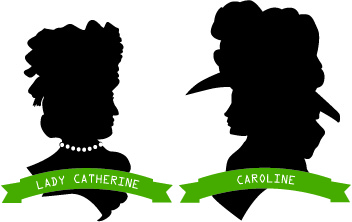
Lady Catherin and Caroline

If there is a truth universally known in the world of Austen it is that the rich play by a different set of rules than the poor or middle class. Lady Catherine de Bourgh and Miss Caroline Bingley are two of her richest women and they play to win.

Lady Catherine was born to her title. Her father was an Earl, so  “She is referred to as “Lady” followed by her first name because she is the daughter of a higher nobleman” [Pemberly.com]— (as was her sister Lady Anne Darcy, Darcy’s mother.) She married well, taking for her husband the landed Sir Lewis de Bourgh. She has one daughter, the sickly Anne de Bourgh, whom she hopes to marry off of to Darcy. (It was”the favourite wish of his mother, as well as of her’s. While in their cradles,” they “planned the union.” )

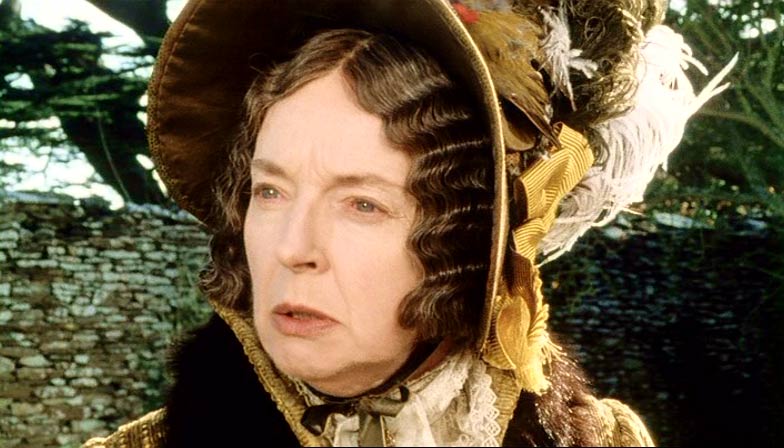
Barbara Leigh Hunt played the ultimate Lady Catherine in the 1995 Pride and Prejudice series with Colin Firth and Jennifer Ehle.

Barbara Leigh Hunt played the ultimate Lady Catherine in the 1995 Pride and Prejudice series with Colin Firth and Jennifer Ehle.

She is from old money and represents the old way of doing things. She follows the rules of society strictly and “likes to have the distinction of rank preserved.” [Pride and Prejudice] In fact she spends most of her time CONDESCENDING to her inferiors and giving them advice. Staying in Lady Catherine’s good graces has its benefits — you might be offered a ride home in the Barouche — but it is hard to hold one’s tongue. The woman had an…

opinion on every subject in so decisive a manner as proved that she was not used to have her judgment controverted. She enquired into Charlotte’s domestic concerns familiarly and minutely, and gave her a great deal of advice as to the management of them all;…  Elizabeth found that nothing was beneath this great lady’s attention, which could furnish her with an occasion of dictating to others. [Pemberly.com quote from Pride and Prejudice]

She is a large, imposing woman who may have once been handsome. “…Whatever she said, was spoken in so authoritative a tone, as marked her self-importance…” [Pride and Prejudice] She is not used to people disagreeing with her. So she’s surprised when Lizzie answers her personal questions candidly.

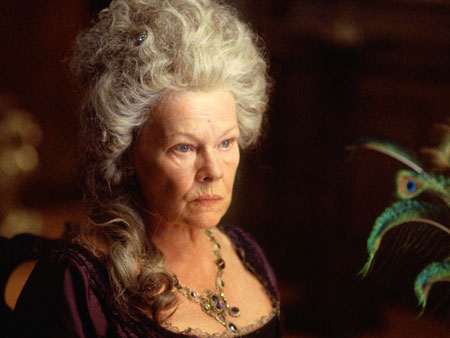
    Dame Judy Dench took on the role for the Kiera Knightly movie version of P&P

Dame Judy Dench took on the role for the Kiera Knightly movie version of P&P

I’ll give Lady Catherine one thing– for being such a traditionalist she represents a progressive, for the time, position on woman’s property rights.

Your father’s estate is entailed on Mr. Collins, I think. For your sake, I am glad of it; but otherwise I see no occasion for entailing estates from the female line. [Pride and Prejudice]

By actively seeking an eligible partner for her sickly daughter she is attempting to secure Anne’s future by getting a strong husband to run the estate. . “It’s ironic”, says Karen Hornig, of JASNA Maryland, that “one of the least liked characters in the novel is the one established figure who has the most progressive view with respect to women inheriting property and fortune.”

End of Part One go to Part Two


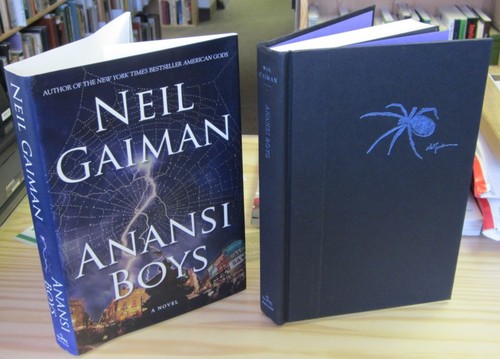
Secondary Character Saturday — SPIDER (Anansi Boys)

Who: Spider

My take on the Anansi brothers, Fat Charlie and Spider. [Copyright: ritaLOVEStoWRITE.]

My take on the Anansi brothers, Fat Charlie and Spider. [Copyright: ritaLOVEStoWRITE.]

From: Anansi Boys

Written by: Neil Gaiman

Date of Publication: Jan 2008.

Why: He’s the trickster brother to the book’s everyman hero, Fat Charlie.  He’s the cool, funny, magical brother you’d always wish you had. Kinda. [Full disclosure: I’m really a card-carrying member of “Team Fat Charlie. ” But, as he’s the lead character, I couldn’t really pick him for this profile could I?  So I picked Spider, who is so like Fat Charlie! –Except he’s completely different.]

Here’s what happened when the brothers met:

“Fat Charlie blew his nose. “I never knew I had a brother,” he said.
“I did,” said Spider. “I always meant to look you up, but I got distracted. You know how it is.”
“Not really.”
“Things came up.”
“What kind of things?”
“Things. They came up. That’s what things do. They come up. I can’t be expected to keep track of them all.”
“Well, give me a f’rinstance.”
Spider drank more wine. “Okay. The last time I decided that you and I should meet, I, well, I spent days planning it. Wanted it to go perfectly. I had to choose my wardrobe. Then I had to decide what I’d say to you when we met. I knew that the meeting of two brothers, well, it’s the subject of epics, isn’t it? I decided that the only way to treat it with the appropriate gravity would be to do it in verse. But what kind of verse? Am I going to rap it? Declaim it? I mean, I’m not going to greet you with a limerick. So. It had to be something dark, something powerful, rhythmic, epic. And then I had it. The perfect line: Blood calls to blood like sirens in the night. It says so much. I knew I’d be able to get everything in there – people dying in alleys, sweat and nightmares, the power of free spirits uncrushable. Everything was going to be there. And then I had to come up with a second line, and the whole thing completely fell apart. The best I could come up with was Tum-tumpty-tumpty-tumpty got a fright.”
Fat Charlie blinked. “Who exactly is Tum-tumpty-tumpty-tumpty?”
“It’s not anybody. It’s just there to show you where the words ought to be. But I never really got any futher on it than that, and I couldn’t turn up with just a first line, some tumpties and three words of an epic poem, could I? That would have been disrespecting you.”
“Well….”
“Exactly. So I went to Hawaii for the week instead. Like I said, something came up.” [Anansi Boys]

Anasi Boys 2

Pros: He’s pretty much a god. He can make people do things with the power of suggestion. He talks to spiders. After living most of his life in hedonistic selfishness (he is a god after all) he learns to grow and love.

Cons: When we first meet him he is selfish and destructive.  He’s a liar and a cheat. And he never thinks about the real world consequences since he never sticks around long enough to deal with them. He steal’s Fat Charlie’s fiance, Rosie, and takes over his flat. He pretty much ruins Fat Charlie’s life.

——————————————————————————–

If you haven’t guessed… I’m a big Neil Gaiman fan. So I was thrilled when one of my besties, Lynn Reynolds gifted me Anansi Boys as an Audible Book  for Christmas. I’d only really done a handful of books on tape before, most notably the Harry Potter books (I’ve also done various books  through my Kindle’s text-too-speech while gardening or painting. But those sound like the “Garman car man” guy  so they don’t count.) Any way, I was really pleased with this Audible Book both for Lenny Henry’s narration and, especially, for the wonderful writing. I think you should give it a try…

Here’s the Kindle link: http://www.amazon.com/Anansi-Boys-ebook/dp/B000FCKENQ/ref=tmm_kin_title_0

And here’s the link for the Audio version – http://www.amazon.com/Anansi-Boys-Neil-Gaiman/dp/0060823844/ref=tmm_abk_title_0

[Image courtesy Amazon.com]

[Image courtesy Amazon.com]

  Click here to read the ritaLOVEStoWRITE Neil Gaiman bioBLOG


Secondary Character Saturday — John Thornton (North and South)

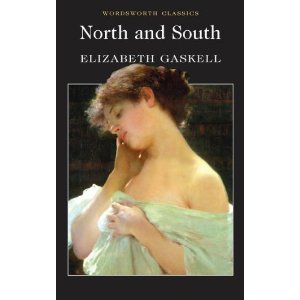
First, let me be clear, the North and South of which I speak is the wonderful Victorian novel by Elizabeth Gaskell, not the 1980’s mini series about the Civil War. If you haven’t read it do yourself a favor and put it on your reading list… Click HERE for the free Guttenberg file to read on-line or HERE for the Kindle file

—————————————————————————————-

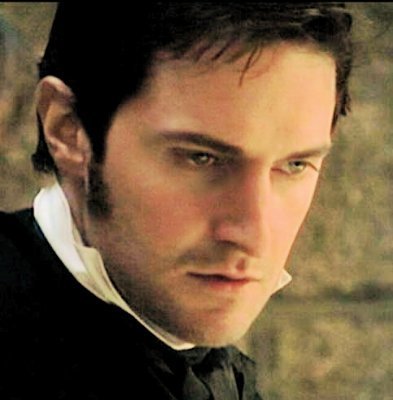
Richard Armitage played John Thornton in the 2008 BBC miniseries North and South.

Richard Armitage played John Thornton in the 2005 BBC miniseries North and South.

Who: John Thornton

From: North and South

Written by: Elizabeth Cleghorn Gaskell

Date of Publication: 1855

Why: John Thornton is a self-made man whose stoic exterior conceals a heart waiting for the love of the right woman. He has spent his life building a business and taking care of his mother and sister. He’s the owner of a mill in the fictional city of Milton in northern England. He has “never loved any woman before.” His “life has been to busy,” his “thoughts too much absorbed with other things.” But, when a beautiful young woman, Margaret Hale, comes to the city from the rural, gentrified, south  the walls of indifference he has built up around his heart begin to tumble.  …Are the two of them so different in manners and customs…(and is their timing too flawed) for love to bloom?

Pros: Strong, loyal, generous, disciplined, intense, genuinely concerned with both his worker’s health and the mill’s financial viability.

Cons: Hot tempered and initially inflexible with his workers. Bad timing.

Shining Moment: During a strike against the mill (it’s a town-wide strike) he has brought in Irish workers to run the mill. When the town’s workers hear about the scabs they storm the mill. Thornton protects the Irish workers, and, at Margaret’s urging, attempts to talk to the rioters and calm them.  (ALSO: the ending, but I wont give that away.)

Least Shining Moment: When Margaret first see’s Thornton. He’s in the mill and has caught a worker smoking. The slightest flame can set the entire works ablaze and he beats the worker for his carelessness.


North+and+South

Click here to read my Elizabeth Gaskell Thought of the Day.

51dj-uo3U0L._SL500_AA300_

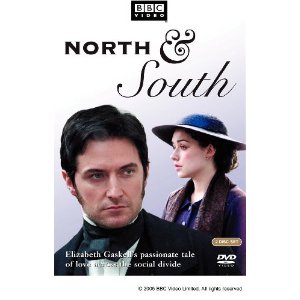
And you should really watch the 2005 BBC mini series of North and South. (Which has the added bonus of co-starring Brendan Coyle — Downton Abbey’s Mr. Bates — as mill worker Nicholas Higgins.)


J.R.R. Tolkien 1.3.13 Thought of the Day

“All that is gold does not glitter; not all those that wander are lost.”
–J.R.R. Tolkien

[Image courtesy Biography online

[Image courtesy Biography online

John Ronald Reuel Tolkien was born on this day in Bournemouth, Orange Free State, South Africa) in 1892. Today is the 120th anniversary of his birth.

Tolkien is the older of two boys born to Arthur Reuel Tolkien and Mabel Suffield Tolkien. The family lived in South Africa where Arthur was head of the Bloemfontein office of a British bank. While he was in England on an extended holiday with his mother and brother Hilary his father passed away from rheumatic fever. Mabel Tolkien then moved in with her parents and a succession of relatives in the West Midlands. Mabel and her sister May caused quite a stir when they (and the boys) converted to Catholicism in 1900. Sadly, Mabel died in 1904, leaving her son’s well-being in the hands of a series of relatives and acquaintances until they were eventually taken in by a catholic educator, Father Francis. It was he who encouraged and refined Tolkien’s already blooming gift with words.

When he was sixteen, Tolkien met and developed a close friendship Edith Bratt. As friendship progressed to love, Father Francis forbade him from communicating with Edith until Ronald was 21 in order to keep his focus on his education. By the time they were reunited, Edith had converted to Catholicism, and Tolkien had completed his Oxford degree. They were together at the outbreak of World War I. [Tolkien Society]

J.R.R.Tolkien

J.R.R.Tolkien (Photo credit: proyectolkien)

Tolkien enlisted as a second lieutenant in the Lancashire Fusiliers, but married Edith while still in England on March 22, 1916. The match resulted in four children, three boys and a girl: John Francis Reuel Tolkien (November 17th, 1917 – January 22nd, 2003), Michael Hilary Reuel Tolkien (October 22nd, 1920 – February 27th, 1984), Christopher John Reuel Tolkien (born November 21st, 1924) and Priscilla Mary Anne Reuel Tolkien (born June 18th, 1929).  He was sent into active duty at the start of the Somme offensive, and after four months succumbed to “trench fever”[Ibid] He was sent back to a hospital in Birmingham, England, and was joined by Edith in Staffordshire. It is there that his work on the “Book of Lost Tales” (posthumously published) began. He was promoted to lieutenant and served out the rest of the war on home duty. [Ibid]

He floated through several postwar academic positions finally settling in the Rawlinson and Bosworth Professorship of Anglo-Saxon back at Oxford [Ibid]. He moved through several other posts, but always remained at Oxford until his retirement in 1959. It was there that he founded a group for those of similar interests called “The Inklings”. In 1936, Susan Dagnall, of the publishing firm of George Allen and Unwin, received and incomplete draft of Tolkien’s “The Hobbit” and implored the author to finish it.

J.R.R. Tolkien - illustration for The Hobbit

J.R.R. Tolkien – illustration for The Hobbit (Photo credit: deflam)

“The Hobbit” was published in 1937 and has remained a staple of school reading lists since then. Stanley Unwin was so pleased by the work that he asked if Tolkien had any similar works [Ibid]. Tolkien initially submitted his current draft of “the Silmarillion” ( posthumously published in 1977), but it was rejected by Unwin, who requested something like “the New Hobbit”(2). Understandably disappointed, Tolkien then began work on what would become The Lord of the Rings“.

English: A 3D model of the One Ring Italiano: ...

English: A 3D model of the One Ring Italiano: L’Unico Anello di Sauron da Il Signore degli Anelli di J.R.R. Tolkien. Immagine 3D realizzata da Hill. (Photo credit: Wikipedia)

He continued to write through the outbreak of World War II, the duration of which he served as an Air-Raid Warden, a job, it is said, he participated in with great zeal and enjoyment [“J.R.R. Tolkien: Master of Fantasy” by David R. Collins – Lerner Publications Company – 1992].

“The Lord of the Rings” was published as six books in three parts from 1954 through 1955. The work’s success was as unexpected as Bilbo’s journey in the Hobbit, Tolkien soon received an occult following, as well as a deal to make a highly condensed BBC radio adaption [Tolkien Society].

Tolkien died on September 2, 1973, two years after Edith. Both are buried beneath the same headstone in the Catholic section of Wolvercote cemetery, just north of Oxford.

[Image courtesy: Geeks of Doom]

[Image courtesy: Geeks of Doom]

Author’s Note: The majority of today’s blog was written by Maggie (Rita’s kid), so if there are mistakes, they are her fault. However, if you really, really like it, Maggie is partial to tea and dark chocolate, so you ought to convince Rita to gives her exorbitant amounts of both.


Rita’s Note: Done! Thanks Maggie!


Jane Austen 12.16.12 Thought of the Day

“If I loved you less, I might be able to talk about it more.”
Jane Austen

Jane Austen

Jane Austen was born in the Steventon Rectory, Hampshire, England in 1775. Today is the 237th anniversary of her birth.

The second youngest of eight children, Jane was also the younger of two girls in the Austen family. As was the custom for a family of the Austen’s class and means, baby Jane was sent to live with a wet-nurse, Elizabeth Little, until she was 18-months old. She was very close to her sister Cassandra and the two girls, along with their cousin Jane Cooper, were sent to Mrs. Cawley’s school in Oxford when Jane was 7. The school moved to Southampton when measles broke out in Oxford. But Southampton proved no safer. Typhus broke out there and all three girls caught the disease. The girls came back to Steventon where they were home schooled for a year before going to school at Mrs. La Tournelles (aka Sarah Hacket) where the girls received instruction in spelling, needlework and French. But by 1786 she was back home, this time for good.

Jane never had any formal education again…From their experience of school we can gather that Jane and Cassandra had perhaps learned some social skills, had had the opportunity to read, take part in plays, learn some French and learn the piano. These were things that were all available at home anyway. [Janeaustensworld]

And the Austen home was an excellent place at which to be home schooled. Her father took in tutors and taught his own sons. He had an impressive library (which Jane had free access to) The older boys included her in their theatricals  and charades and “even as a little girl Jane was encouraged to write” [jasa.net]

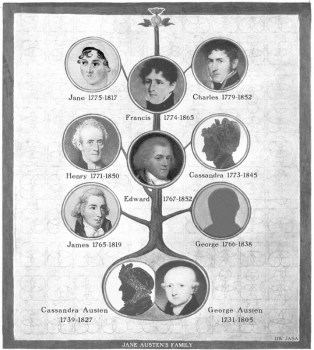
familytreelowres

Austen’s immediate family tree. [Image courtesy: jasa.net]

Jane had six older brothers: James, George, Edward, Henry, Francis and Charles.

By 14 she was writing to entertain her friends and family, penning such comedies as Love and Freindship (sic) and the parody   A History of England by a partial, prejudiced and ignorant Historian.  She collected 29 of her stories into three bound books, now known as Juvenilia.

In 1793 she began to write longer works in the epistolary style. Lady Susan was one such novel in letters.  She wrote Elinor and Marianne in the same style before she rewrote the work as a third person narrative and changed the title to Sense and Sensibility.

Jane Austen, Watercolour and pencil portrait b...

Jane Austen, Watercolour and pencil portrait by her sister Cassandra, 1810 (Photo credit: Wikipedia)

In 1801 Rev. Austen moved (with Mrs. Austen, Cassandra and Jane) to Bath. Jane’s productivity took a nose-dive. She was either too busy to write — with all the shopping and socializing in Bath — or too depressed to write. The Austens lived in Sydney Place, no.4…

which offered both an easy walk into town and handy access to Sydney Gardens, a great outdoor attraction at that time with regular gala nights featuring music and fireworks.[Seeking Jane Austen]

…until Mr. Austen died  in 1804. By 1806 the ladies had left Bath for good, and moved Chawton in Southampton. As soon as they had settled in their new home she renewed her writing in earnest .

English: Back View of Jane Austen, Watercolor

English: Back View of Jane Austen, Watercolor (Photo credit: Wikipedia)

In 1811, Thomas Egerton, a military Library publishing house printed 750 copies Sense and Sensibility, largely on Austen’s dime. The book sold out of its first edition by 1813. And Austen eventually made 140 pounds on it.  It  appeared under the pseudonym “A Lady,” and Austen carefully guarded her anonymity .

Encouraged by this success, Jane Austen turned to revising First Impressions, a.k.a. Pride and Prejudice. She sold it in November 1812, and her “own darling child” (as she called it in a letter) was published in late January 1813. [Pemberley.com]

In May of 1814 her third novel, Mansfield Park was published. It sold out in six months.

Austen's

Despite carefully guarding her name, word had begun to leak out. People knew who  the  “Lady” was…important people…like the Prince Regent. While she was writing Emma she was summoned to the palace and invited to dedicate her next novel to the Prince. Austen was less than thrilled to be given the honor, but couldn’t exactly refuse, so in wonderful Austen wit she flattered him as only she could…

TOHIS ROYAL HIGHNESS THE PRINCE REGENT, THIS WORK IS,BY HIS ROYAL HIGHNESS’S PERMISSION,MOST REPECTFULLY DEDICATED,BY HIS ROYAL HIGHNESS’S DUTIFUL AND OBEDIENT HUMBLE SERVANT, THE AUTHOR

In 1815 she began working on Persuasion. By then her health had begun to deteriorate. She completed the first draft by 1816 and began The Brothers which later became  Sanditon. Her condition rapidly worsened. In May her bother Henry took Jane to Winchester for treatment, but on July 18, 1817 at the age of 41 Jane Austen passed away. She was buried at Winchester Cathedral.

English: Jane Austen's memorial gravestone in ...

English: Jane Austen’s memorial gravestone in the nave of Winchester Cathedral (Photo credit: Wikipedia)

Henry, with Cassandra’s help, got Persuasion and Northanger Abbey published in December of 1817. For the first time the author was listed as “Jane Austen.”

Happy Birthday Jane!!!

Ooops forgot to link to my own blog on the Pride and Prejudice Essay Contest!

  • JASNA (Jane Austen Society of North America)

Secondary Character Saturday: Piglet!


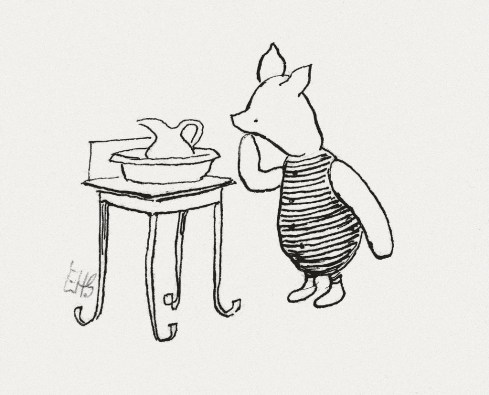
[It’s Second Character Saturday! Today’s character is Piglet. I’ll be going straight to the source and discussing the AA Milne Piglet with illustrations by Ernest Shepard— not the Disney-fied Piglet.]

“But Piglet is so small that he slips into a pocket, where it is very comfortable to feel him when you are not quite sure whether twice seven is twelve or twenty-two.”― A.A. Milne, Winnie-the-Pooh

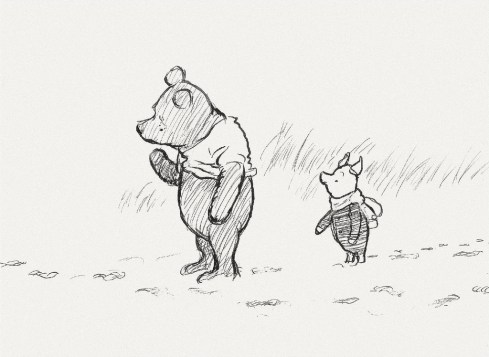
Piglet and Pooh think about fall.

Piglet and Pooh think about fall.


Who: Piglet


From: Winnie-the-Pooh


By: A.A. Milne


Date: 1926


Why: Piglet is shy, but brave. He reminds us that no matter how small and un-impowered we are… we are still big enough to stand up for what is right and face our fears.He is a role model for friendship.


In the stories he grounds the more popular (and more flighty) Pooh. He has a very strong relationship with Pooh, Eeyore and Christopher Robin. As readers (especial children) we relate to him because of his size and soft voice and WE want to be his friend too.


Piglet plants a haycorn plant.

Piglet plants a haycorn plant.


Pros: Loyal, brave, innocent, earnest, creative, humble, good listener, hard worker.


Cons: Excitable, follower, gullible.


Pooh and Piglet on an adventure

Pooh and Piglet on an adventure


Shining Moment: I love all the moments with Piglet in the books. I especially the quiet moments between Pooh and Piglet that just say “friendship” to me…


Piglet sidled up to Pooh from behind. “Pooh?” he whispered.
“Yes, Piglet?”
“Nothing,” said Piglet, taking Pooh’s hand. “I just wanted to be sure of you.”


“I don’t feel very much like Pooh today,” said Pooh.
“There there,” said Piglet. “I’ll bring you tea and honey until you do.”


“How do you spell ‘love’?” – Piglet
“You don’t spell it…you feel it.” – Pooh”


When you wake up in the morning, Pooh,” said Piglet at last, “what’s the first thing you say to yourself?”
“What’s for breakfast?” said Pooh. “What do you say, Piglet?”
“I say, I wonder what’s going to happen exciting today?” said Piglet.
Pooh nodded thoughtfully. “It’s the same thing,” he said.”


Piglet gets ready for the party


I love when he listens to Eeyore and does something to help him out of his funk.


He’s there for his friends and always willing to help. Despite his diminutive size he is brave enough to face great odds. He may be afraid of everything, but that doesn’t get in the way of his standing up for what is right, or standing next to a friend to face a challenge.


The Disney-fied version of my beloved porcine friend. [Image courtesy: render-graphiques.fr]

The Disney-fied version of my beloved porcine friend. [Image courtesy: render-graphiques.fr]


Least Shining Moment: I do not like what Disney did with Piglet. They turned his innocence into a cartoon. I was OK with that as a kid, but as I get older, and Disney keeps chugging out more and more Pooh related crap, I resent that they are forcing the Milne characters into cookie-cutter cartoons of themselves to sell more DVDs and plastic  stuff. Piglet just gets squeekier and squeekier and the tender, brave, humble pig gets more and more diluted. SHAME.


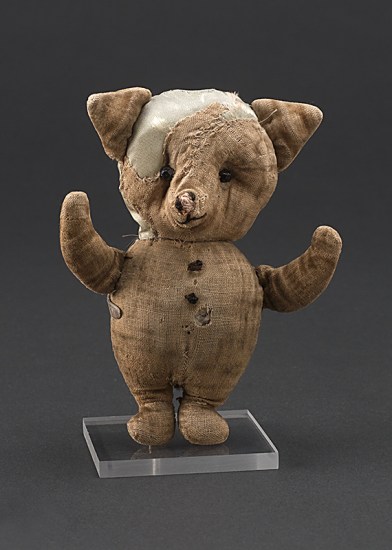
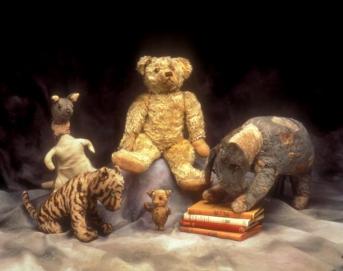
Well loved and well used, this is the original Piglet. One of Christopher Robin Milne's surviving stuffed animals, Piglet resides at the New York Public Library.

Well loved and well used, this is the original Piglet. One of Christopher Robin Milne‘s surviving stuffed animals, Piglet resides at the New York Public Library.

In 1921, as a first-birthday present, Christopher Robin Milne received a small stuffed bear, which had been purchased at Harrods in London. Eeyore, Piglet, Kanga, and Tigger soon joined Winnie-the-Pooh as Christopher’s playmates and the inspiration for the children’s classics When We Were Very Young (1924), Winnie-the-Pooh (1926), Now We Are Six (1927), and The House at Pooh Corner (1928), written by his father, A.A. Milne, and illustrated by Ernest H. Shepard.

You can see just how small Piglet is compared to the other stuffed animals in this photo. [Image courtesy: The New York Public Library

You can see just how small Piglet is compared to the other stuffed animals in this photo. [Image courtesy: The New York Public Library

Brought to the United States in 1947, the toys remained with the American publisher E.P. Dutton until 1987, when they were donated to The New York Public Library. [Treasures of The New York Public Library.]


Cover of Winnie-the-Pooh

Cover of Winnie-the-Pooh (Photo credit: Wikipedia)


One more image... Piglet dancing with delight. Keep that image in your heart today, OK?

One more image… Piglet dancing with delight. Keep that image in your heart today, OK?


Secondary Character Saturday — Ron Weasley

Welcome to the next edition of Secondary Character Saturday.

———————————————————————————–

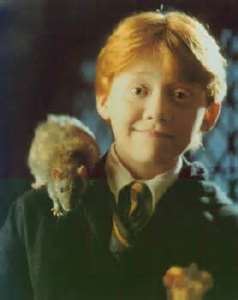
Rupert Grint played Ron in the Harry Potter movies.

Rupert Grint played Ron in the Harry Potter movies.

Name: Ronald Bilius “Ron” Weasley

From: The Harry Potter series

By: J. K. Rowling

Written in: Ron first appeared in Harry Potter and the Philosopher’s Stone which was published in 1997.

Why: Ron is the everyman of the Potter series. In the triumvirate that crowns  the Harry Potter food chain you’ve got the hero (Harry), the brains (Hermione), and the foil (Ron). He is flawed, there’s no doubt about it. As the youngest brothers he’s neither the smartest, nor the bravest, nor the funniest.

I’m the sixth in our family to go to Hogwarts. You could say I got a lot to live up to. Bill and Charlie have already left – Bill was Head Boy and Charlie was captain of Quidditch. Now Percy’s a prefect. Fred and George mess around a lot, but they still get really good marks and everyone thinks they’re really funny. Everyone expects me to do as well as the others, but if I do, it’s no big deal, because they did it first.” [Harry Potter and the Sorcerer’s Stone, by JK Rowling, Scholastic Inc. New York, New York, pg 98]

Throw his little sister Ginny into the mix and he’s not even the cutest. He doesn’t seem to have any special “thing” that he can point to and say “this is what I do best.” So Ron is always searching for his moment in the sun. It doesn’t help that his best mate is the world-famous (at least in the wizarding world) Harry Potter. Ron suffers from insecurity from the start and it gets worse as the books go along. He is also largely clueless when it comes to women. Just ask Hermione. But Ron is loyal, funny, and generous. He’s grounded in a way that neither Harry or Hermione seem to be. And in this way Ron seems the most human of the central characters in the series. (In fact, as a pure blood Wizard he’s the least human. But while other Pure Bloods hold that over mere Mud Bloods it never seems to enter into Ron’s equation of friendship.)

Pros: Loyalty, Nerve, Sense of Humor

Cons: Easily frustrated, occasionally lapses in his loyalty, procrastinates, jealous

Shining moment: Ron’s shining moment (imho) comes in the first book when he plays the game of Wizard’s Chess. It takes both courage and skill to play the game, and Ron willingly sacrifices his piece (and himself) so the others can win the game and advance in their goal to stop Quirell.

“We’re nearly there,” he muttered suddenly. “Let me think… let me think…”
The white queen turned her blank face toward him.
“Yes…” said Ron softly, “it’s the only way…I’ve got to be taken.”
“NO!” Harry and Hermione shouted.
“That’s chess!” snapped Ron. “You’ve got to make some sacrifices! I take one step forward and she’ll take me— that leave you free to checkmate the king, Harry!” [Ibid, pg 283]

Runner up Shining Moment: Working with Harry to save Ginny from the Chamber of Secrets in book two.

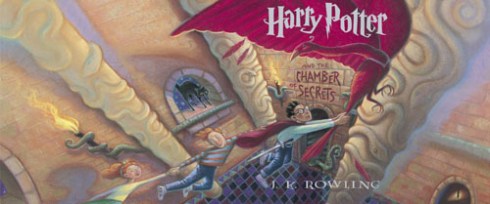
Cover of Harry Potter and the Chamber of Secrets

Cover of Harry Potter and the Chamber of Secrets

Silliest moment: Probably my favorite Ron moment happens in the second book, and it involves belching slugs. ‘Nugh said.

Least shining moment: He is least likeable in the last book when he leaves Harry and Hermione to finish the quest for the Horcurxes on their own. That is pretty weak. It is almost unforgivable. But Ron is human (well, he’s a wizard, but he has very human tendencies) and his weaknesses and failures make him more relatable to us. And Ron realizes his mistake, of course, and comes back.

Lego Ron

Lego Ron

So I know some of you are not going to like the fact that Ron is listed here as secondary character, but before you throw an unspeakable curse my way please consider that the books are named “Harry Potter and the…” Harry is the primary character.  Ron and every one else are, therefore, secondary.

AND lest you Snape or Luna lovers loose heart, just because I picked Ron this time doesn’t mean I wont pick another H.P. character another time. Saturday comes around once a week after all, and, clearly, I’ve got some pretty strong opinions up my sleeves.

Thanks to Ellie, Maggie, Bill and Stevie for their input on this blog post.


Thought of the Day 11.10.12 Neil Gaiman

“It has always been the prerogative of children and half-wits to point out that the emperor has no clothes. But the half-wit remains a half-wit, and the emperor remains an emperor.”

“The one thing that you have that nobody else has is you. Your voice, your mind, your story, your vision. So write and draw and build and play and dance and live as only you can.”

“The moment that you feel that just possibly you are walking down the street naked…that’s the moment you may be starting to get it right.”

— Neil Gaiman

Neil Gaiman

Neil Gaiman (Photo credit: Wikipedia)

Neil Richard MacKinnon Gaiman was born on this day in Portchester, Hampshire, England in 1960. He is 52 years old.

Gaiman is the oldest of three siblings. He learned to read at about four, and loved books from early on.

As a child he discovered his love of books, reading, and stories, devouring the works of C.S. Lewis, J.R.R. Tolkien, James Branch Cabell, Edgar Allan Poe, Michael Moorcock, Ursula K. LeGuin, Gene Wolfe, and G.K. Chesterton.  A self-described “feral child who was raised in libraries…as a boy were when I persuaded my parents to drop me off in the local library on their way to work, and I spent the day there.”[neilgaiman.com — biography]

He worked his way through the children’s section and  into the young adult literature. He did well at school because he’d already read all the books. Gaiman especially loved Tolkien’s The Lord of the Rings, which he got out from his school library. The only problem was the library only had The Fellowship of the Ring and The Two Towers, the third book was missing. When he won the school’s English prize for reading he was finally able to buy The Return of the King and finish the trilogy.

Hew also enjoyed C.S. Lewis’ Narnia series and Lewis Carol’s Alice in Wonderland — he read Alice so often that he had it memorized. But he also read more popular genres including science fiction and comic books (he was especially fond of Bat Man.)

Gaiman started his career writing pop bios for the music group Duran Duran and author Douglas Adams.

His first foray into the graphic novel genre  was with Terry Pratchett on Good Omens… The end of the world is at hand (it’s next Saturday) and the end game is coming to its inevitable conclusion.

Except that a somewhat fussy angel and a fast-living demon — each of whom has lived among Earth’s mortals for many millennia and has grown rather fond of the lifestyle — are not particularly looking forward to the coming Rapture. If Crowley and Aziraphale are going to stop it from happening, they’ve got to find and kill the Antichrist (which is a shame, as he’s a really nice kid). [Ibid  — works]

Cover of "The Sandman: Book of Dreams"

Cover of The Sandman: Book of Dreams

Gaiman worked on a number of comics  and graphic novels before being offered a chance to develop the Sandman series. The comic followed Morpheus (aka Sandman or Dream)

…There are seven brothers and sisters who have been since the beginning of time, the Endless. They are Destiny, Death, Dream, Desire, Despair, Delirium who was once Delight, and Destruction who turned his back on his duties. Their names describe their function and the realms that they are in charge of. Several years ago, a coven of wizards attempted to end death by taking Death captive, but captured Dream instead. When he finally escapes he must face the changes that have gone on in his realm, and the changes in himself. [Ibid  — works]

It first appeared in 1989 and spanned 10 years of single issues, collections and books.  This “dark, soulful, literary epic” [Guardian.co.uk] is thickly layered in mythology and beautifully written (and equally beautifully illustrated by a number of top comic book illustrators.) It is creepy and touching and magical.  [I read them as they came out, one issue at a time, and it was a thrill to watch it unfold.] The collections are available in bookstores  [but you wont have that feeling of angst and anticipation of the serialized comic book if you read it as a comic novel.]

American Gods

American Gods (Photo credit: Jhack❦)

Gaiman easily transitioned to novels with Neverwhere, Stardust, American Gods and Ananasi Boys. He won a Nebula Award for American Gods  which has just been re-released in an expanded version for its 10th anniversary. HBO is working on an adaptation of the novel.

Coraline

Coraline (Photo credit: M.J.Ambriola)

For children he spans the market from  illustrated book to chapter books — like his excellent Coraline and The Graveyard Book.  His picture books include:

M is for Magic’ (2007); ‘Interworld’ (2007), co-authored with Michael Reaves; The Day I Swapped My Dad for Two Goldfish (1997); The Wolves in the Walls’ (2003); the Greenaway-shortlisted ‘Crazy Hair’ (2009), illustrated by Dave McKean; ‘The Dangerous Alphabet (2008), illustrated by Gris Grimly; Blueberry Girl (2009); and ‘Instructions’ (2010), illustrated by Charles Vess. [neilgaiman.com — works]

Here is Gaiman reading the Blueberry Girl.

He’s written screenplays for his own Neverwhere, MirrorMask and English translation of Miyazaki’s Princess Mononoke. He co-wrote the screenplay for the 2007 version of Beowulf. Recently he fulfilled a lifelong dream by writing an episode of Dr. Who (“The Doctor’s Wife”)

At the San Diego Comic-Con this year Gaiman confirmed that he will release a prequel to the Sandman series.

“When I finished writing The Sandman, there was one tale still untold – the story of what had happened to Morpheus to allow him to be so easily captured in The Sandman No 1, and why he was returned from far away, exhausted beyond imagining, and dressed for war.” [Guardian.co.uk]

Gaiman tours extensively with his wife, musician Amanda Palmer. If you happen to be in Pittsburgh, PA on November 14th you can catch him for “An Evening of Stardust” at Carnegie Music Hall. [Sadly I will not be there, but if you snag me a signed copy of Stardust I’ll be your friend forever.]


Thought of the Day 10.25.12 Anne Tyler

“My family can always tell when I’m well into a novel because the meals get very crummy.”
Anne Tyler

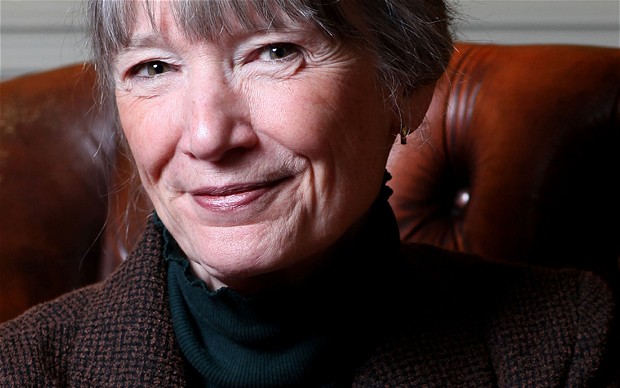
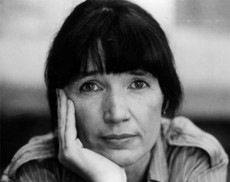
Anne Tyler was born on this day in Minneapolis, Minnesota in 1941. She is 71 years old.

She is the oldest of four children. Her parents moved around, searching for the best place to raise the family, but settled, when Anne was six, in the Celo Quaker Community near Burnsville North Carolina. Anne and her siblings attended a small local school. She says she never planned on being a writer, but would tell herself stories to get to sleep at night. She liked Westerns, but, her favorite book was Virginia Lee Burton’s tale, The Little House. Later she read Eudora Welty who showed her “that very small things are often really larger than the large things.” [Tyler from a 1977 New York Times interview. nytimes.com]

She majored in Russian at Duke University, but an English 101 class with Professor Reynolds Price started her on a literary career. Tyler  graduated at 19 Phi Beta Kappa and Price introduced her to his literary agent.  Tyler won the Anne Flexner creative writing award twice at Duke. She went on to Columbia to do post-graduate work in Russian studies at Columbia. She worked  as a bibliographer at Duke and at the law library at McGill University in Montreal after graduating. She published short stories in The New Yorker, the Saturday Evening Post and Harper’s Magazine prior to settling in Baltimore and marrying psychiatrist Taghi Modarressi.

Her first novel, If Morning Ever Comes was published in 1964. The Tin Can Tree followed a  year later. Tyler doesn’t like either of the books, and almost left the manuscript for ‘Morning’ on a plane on purpose. There is a five-year gap between ‘Tin Can’ and her third novel A Slipping-Down Life. She spent the time productively — she had her two daughters, Tezh and Mitra.
In 1974 she published Celestial Navigation. It is one of her favorite’s (one of mine too.) Here’s the Amazon write up…

Thirty-eight-year-old Jeremy Pauling has never left home. He lives on the top floor of a Baltimore row house where he creates collages of little people snipped from wrapping paper. His elderly mother putters in the rooms below, until her death. And it is then that Jeremy is forced to take in Mary Tell and her child as boarders. Mary is unaware of how much courage it takes Jeremy to look her in the eye. For Jeremy, like one of his paper creations, is fragile and easily torn–especially when he’s falling in love…. [Amazon.com]

Tyler wrote one book about every two years. So by 1980 she’d published eight novels.  Searching for Caleb, Earthly Possessions and Morgan’s Passing rounded out the early list.
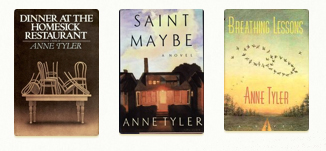
In 1982 she published Dinner at the Homesick Restaurant. ‘Homesick’ “explores tensions inside a family – for Tyler it is the basic battlefield of all society.” [Books and Writers] The book was a finalist for the Pulitzer Prize and the Pen/Faulkner Award. [And it remains my favorite of Tyler’s novels. This book would be on my Desert Island Bookshelf*.]

Book #10, The Accidental Tourist, put Tyler on the map. Not only did she win the national Book Critics Circle Award for it in 1985, but it was made into a major motion picture starring William Hurt and Geena Davis. It too was shortlisted for a Pulitzer, but Tyler had to wait one more book before capturing that prize. [I loved the sibling interaction in this one, as well as the hope for new and unlooked for love.]

Of her writing process Tyler said:

“I think of my work as a whole. And really what it seems to me I’m doing is populating a town. Pretty soon it’s going to be just full of lots of people I’ve made up. None of the people I write about are people I know. That would be no fun. And it would be very boring to write about me. Even if I led an exciting life, why live it again on paper?… I hate to travel, but writing a novel is like taking a long trip. This way I can stay peacefully at home.” [Tyler from a 1977 New York Times interview. nytimes.com]

Breathing Lessons earned the Pulitzer and was named Time Magazine’s Book of the Year. Maggie and Ira have been married for 28 years. Things have gotten, shall we say “comfortable?” Like an old leather recliner is comfortable. They take a 90-mile trip to a funeral and “Tyler explores the problems of marriage, love and happiness” [Ibid] [Read it, and you’ll never eat fried chicken again with out a remembering the melancholy cooking scene near the end of this book.] It was made into a Hallmark Hall of Fame television movie in 1994 starring James Garner and Joanne Woodward and into a stage play.

1991 brought Saint Maybe with guilt ridden 17-year-old Ian Bedloe dropping out of school to take care of his dead brother’s children.  School Library Journal says of the novel:

“Tyler’s remarkable novel pulls at the heart-strings and jogs the memories of forgotten youth. Ian’s story is neither action packed nor fast-moving, but each page will be eagerly anticipated. “[Amazon.com]

Ever feel like your family takes your for granted and no one listens to you when you speak?  Delia Grinstead, the heroine of Ladder of Years, does. She REALLY does. And when things come to a head during a trip to the beach she walks away from it all to re-discover who she really is.

A Patchwork Planet was another of my favorites. 29-year-old Barnaby is the family’s black sheep. He got into trouble as a teen and now he doesn’t aspire to much more than helping out old people in his job at “RENT-A-BACK.” There’s a cast of fantastic, spindly, eccentric clients, and Barnaby’s less than loveable family. Then there’s Barnaby himself…

“Sharp and impatient at painful–and painfully funny–family dinners, apparently unable to keep his finger off the auto-self-destruct button every time his life improves. As much as his superb creator, he is a poet of disappointment, resignation, and minute transformation.” [Kerry Field review on Amazon.com]

Tyler’s 15th Novel is Back When We Were Grownups. The book is about widow, Rebecca Davitch, who reassesses her life at the age of 53.  The Amateur Marriage centers on the crumbling marriage of Michael and Pauline Anton. Married just after he returned from WWII the couple wonders if they know anything more about each now than they did 30 years ago. Two families adopting Korean infant daughters meet at the airport at the beginning of Digging To America. The novel follows the two different families (with wildly different parenting techniques) who meet up every year for an annual Arrival Party. Tyler’s handling of mixed cultures adds a new dimension to her usual mix of excellent social commentary.
Liam Pennywell is the protagonist of Noah’s Compass. He is a teacher forced into early retirement who struggles with the fact that he’s never really reached his full potential.

Her latest novel is The Beginner’s Goodbye, which the Boston Globe calls:

“An absolute charmer of a novel about grief, healing, and the transcendent power of love . . . With sparkling prose and undeniable charm, Tyler gets at the beating heart of what it means to lose someone, to say goodbye, and to realize how we are all, perhaps, always ultimate beginners in the complex business of life . . . A dazzling meditation on marriage, community, and redemption.” [Boston Globe review, Amazon.com]

Tyler wrote two children’s book, Tumble Tower and Timothy Tugbottom Says NO! Both were illustrated by her daughter Mitra Modarressi. Tumble Tower with the fabulous Molly the Messy is a must for emergent readers who want a giggle and a hug. (I haven’t read Timothy.)
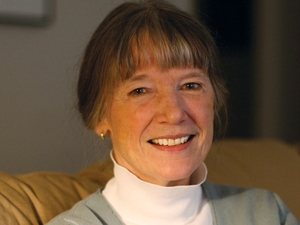
She jots notes on index card where ever she happens to be in her house then collects them in one of two metal boxes. There is a blue box for NOVEL notes and a second box for SHORT STORIES.
She says she isn’t driven to write but is “driven to get things written down before (she) forget(s) them.” [Ibid] Then once it is all written down she reads it all back and “suddenly it seems as if someone else is telling me the story and I say ‘now I see’ and then I go all the way back and drop references to what it means.”[Tyler from a 1977 New York Times interview. nytimes.com]

“Sometimes a book will start with a picture that pops into my mind and I ask myself questions about it and if I put all the answers together I’ve got a novel.” [Tyler from a 1977 New York Times interview. nytimes.com]

——————————

You may have noticed that I’ve quoted a rather old New York Time’s interview quite a bit in this bioBlog. That’s because Tyler very seldom gives interviews.

I read most of her early books in my twenties but I’m going to go put them on my Kindle now. I wonder how much they’ve changed because of how much I’ve changed over the years? I know one thing that will change… the font size. I will pump up that font size to something nice and big for these ole eyes. Ha!

———————————

*So … what 10 books would you want on your Desert Island Bookshelf ? I’d definitely have Dinner at the Homesick Restaurant on my shelf. I know that Persuasion, Sense and Sensibility and Pride and Prejudice would be on there too. (I’d like to be clever and get a Jane Austen collection with all six novels, but then the font size would be too small to read) How about you? What books would make the list?

———————————