Category Archives: American History

Thought of the Day 11.3.12 Shirley Chisholm

I don’t measure America by its achievement but by its potential.

The emotional, sexual, and psychological stereotyping of females begins when the doctor says: It’s a girl.

Service is the rent that you pay for room on this earth.

–Shirley Chisholm

Shirley Chisholm, future member of the U.S. Ho...

Shirley Anita St. Hill  was born on this day in Brooklyn, New York, USA in 1924. Today is the 88th anniversary of her birth.
Her parents were recent immigrants to this country. Her father, Charles, was born in British Guiana, her mother, Ruby, was from Barbados. At three Shirley went to live with her Grandmother in Barbados.  She attended Vauxhall Primary School, in Christ Church.
“…I had my early education in the strict, traditional, British-style schools of Barbados. If I speak and write easily now, that early education is the main reason.” [Chisholm in her autobiography Unbought and Unbossed.]
At 10 she came back to the Brooklyn. She attended Girls High School, an integrated and prestigious public prep school in Brooklyn then earned her BA from Brooklyn College. She married Conrad Chisholm, a private investigator in 1949. In 1952 she received her Masters in elementary education from Columbia University.
Shirley Chisholm, Congresswoman from New York,...

Shirley Chisholm, Congresswoman from New York, looking at list of numbers posted on a wall (Photo credit: Wikipedia)

Chisholm spent six years as director of the Hamilton-Madison Child Care Center then an addition six-year as consultant to the Division of Day Care before delving in politics.
After a few years in local New York politics Chisholm became the first black Congresswoman in the US House of Representatives in 1969. She served in the House for seven terms.
English: Founding members of the . Standing L-...

English: Founding members of the Congressional Black Caucus. Chisholm is seated in Orange.  (Photo credit: Wikipedia)

After initially being assigned to the House Forestry Committee, she shocked many by demanding reassignment. She was placed on the Veterans’ Affairs Committee, eventually graduating to the Education and Labor Committee. She became one of the founding members of the Congressional Black Caucus in 1969. [Biography.com]

In 1972 Chisholm entered the US presidential race as a candidate for the Democratic Party. She ran in 12 primaries and won three (Louisiana, Mississippi and New Jersey, garnering 152 delegates from an ethnically diverse base that spanned social economic backgrounds and the gender divide. She was an advocate for “minority education and employment opportunities, (and) also a vocal opponent of the draft.” [Ibid] She said she ran “in spite of hopeless odds… to demonstrate the sheer will and refusal to accept the status quo.” She was the…

  • First African-American woman to seek a major party nomination for President of the United States (1972)
  • First woman to have her name placed in nomination for President at the Democratic National Convention
  • First African-American to be on the ballot as a candidate for President [About.com]
Gwendolyn Sawyer Cherry and Shirley Chisholm a...

Gwendolyn Sawyer Cherry and Shirley Chisholm at the Democratic National Convention: Miami Beach, Florida (Photo credit: State Library and Archives of Florida)

Although she lost the nomination to George McGovern (who lost the election to incumbant Richard Nixon), Chisholm “had brought the voice of the disenfranchised to the forefront.” [Ibid]

Back in Congress she continued to fight for the poor and middle class. She  worked to get domestic workers a minimum wage and to improve opportunities for inner-city residents through better education, health care and social services. She was the author of a 1970 child care bill that was vetoed by President Nixon (he called it Sovietization of American children.)
Congressman Edlophus Towns (left) and his wife...

Congressman Edlophus Towns (left) and his wife, Gwen Towns (right) pose with former Congresswoman and Brooklyn native, Shirley Chisholm (center) (Photo credit: Wikipedia)

She retired from the House in 1982 and went back to education (with a little politicking on the side.) Shirley Chisholm died on New Years Day 2005 in Ormon Beach, Florida.
She was the author of two books, Unbought and Unbossed (1970) and The Good Fight (1973). [Biography.com]

Bonus Mini Blog 11.2.12 Warren G. Harding

English: Warren G. Harding

English: Warren G. Harding (Photo credit: Wikipedia)

“America’s present need is not heroics, but healing; not nostrums, but normalcy; not revolution, but restoration; not agitation, but adjustment; not surgery, but serenity; not the dramatic, but the dispassionate; not experiment, but equipoise; not submergence in internationally, but sustainment in triumphant nationality….”
— Warren G. Harding

Warren Harding, age 17

He soon joined the political ranks himself, serving as state senator then US Senator. In 1920 he became the Republican candidate for President because, as fellow Ohioan  Harry Daugherty later explained, “He looked like a President.” [Whitehouse.gov] He won by a landslide.

Republicans in Congress easily got the President’s signature on their bills. They eliminated wartime controls and slashed taxes, established a Federal budget system, restored the high protective tariff, and imposed tight limitations upon immigration. [Ibid]

His administration was rife with cronyism and scandal and led him to say “My…friends…they’re the ones that keep me walking the floors nights!”

Harding died of a heart attack in 1923 while on a trip to San Francisco.

Warren G. Harding, seated at desk, wearing bow...

Warren G. Harding, seated at desk, wearing bow-tie, with newspaper in hand. (Photo credit: Wikipedia)


Thought of the Day 11.2.12 James K. Polk

“The Presidency is no bed of roses.”
James Knox Polk

President Polk, 1858 portrait, by George Healy

President Polk, 1858 portrait, by George Healy (Photo credit: Wikipedia)

James Knox Polk was born on this day in Mecklenburg County in North Carolina, USA in 1795. Today is the 217th anniversary of his birth.

Polk was the eldest of 10 children of Samuel and Jane Polk. His father was a farmer and slave holder. The family moved to Maury County, Tennessee when Polk was 11. And Samuel became a land speculator, owned a mercantile and a county judge.  Polk was home schooled and a good student. At 17 he suffered from urinary stones that had to be removed surgically (with only brandy for anesthetic.)

He went to the University of North Carolina where he joined the Dialectic Society and learned to debate. After graduating with honors in 1818 he studied law in Nashville and clerked for the Tennessee State Senate. He passed the bar in 1820.

English: Picture of James K. Polk

English: Picture of James K. Polk (Photo credit: Wikipedia)

He ran for state legislature in 1823 and became a Andrew Jackson supporter  when the latter ran for US Senator from Tennessee.  Two years later Polk ran for US House of representatives. He became chair of the House Ways and Means committee in 1833 and Speaker of the House in 1835.

In the House of Representatives, Polk was a chief lieutenant of Jackson in his Bank war. He served as Speaker between 1835 and 1839, leaving to become Governor of Tennessee. [Whitehouse.gov]

As Speaker he worked tirelessly to advance the agendas of both Presidents Jackson and Van Buren through the House. Polk issued the gag rule — a resolution that automatically tabled any petition having to do with Slavery without review — opposed by Northerners like John Quincy Adams* in the House. He left Congress in 1839 and ran for (and won) the office of Governor of Tennessee.

Polk ran for President of the United States in 1844. On March 4th, 1845 he was sworn in as the US’s 11th President.  (He is the only former Speaker of the House to become President.)

James Knox Polk (11th president of the United ...

James Knox Polk (11th president of the United States) (Photo credit: Wikipedia)

One of the highlights of his single term in office  was the acquisition of the Oregon Country (Oregon, Washington, Idaho and part of Montana), California, and New Mexico.

President Polk added a vast area to the United States, but its acquisition precipitated a bitter quarrel between the North and the South over expansion of slavery. [Whitehouse.gov]

He also reduced tariffs from 32% to 25% with a set of tariff rates known as the Walker Tariff in 1846.  and established a treasury system that lasted into the next century. During his tenure The U.S. Naval Academy in Annapolis, Maryland was opened,  as was The Smithsonian Institution on the Mall in DC.  Also in DC ground was broken for 555 foot tall, marble and granite obelisk, The Washington Monument.

The Mexican American War was fought under his administration. Although the US handily defeated the Mexican army the declaration of the war was much opposed in the North.

He was a President who “Said what he intended to do and did it” according to Harry S. Truman. That included increasing the US’s land mass by 1/3rd.

By the end of his term in 1949 Polk was in ill-health — he’d contracted cholera on a trip to New Orleans. He died on June 15, three months after leaving office. His will stated that his slaves were to be set freed upon the death of his wife, Sarah Childress Polk, but since she lived past the Civil War they were set free with the Emancipation Proclamation and the 13th Amendment.

James K. Polk's tomb lies on the grounds of th...

James K. Polk’s tomb lies on the grounds of the state capitol in Nashville, Tennessee. (Photo credit: Wikipedia)

[CLICK HERE to see The Thought of the Day on John Quincy Adams and get a different perspective of this period in American History.]

—————————————-

Programming Note:

At this point in the ritaLOVEStoWRITE blog history I’m finding a lot of references to previous Thought of the Day bios. I’d like to link back to them (to refresh the memory for those of you who have been around for a while and to introduce them to those of you who are newish to the blog.) But I don’t want to be intrusive. So yesterday I imbedded the links to Gwyneth Paltrow in the Toni Collette bioBlog, today I moved the JQ Adams link to the bottom.  I could also do something like [ see TotD LINK]  with a link imbedded. Would that be too intrusive? I feel there is value in knowing that the link is back to a previous blog from this serious and not to an external web site. What do you think? What’s the best way to handle this?  I really want to hear from you… Cheers, Rita


Thought of the Day 10.31.12 Juliette Gordon Low

If you are a Girl Scout you know who JGLow is. This is one of those bioBlogs that I knew I was going to do weeks before the date. It is my honor to celebrate her birthday.

————————————————–

“Right is right, even if no one else does it.”
Juliette Gordon Low

English: A portrait of Juliette Gordon Low (18...

English: A portrait of Juliette Gordon Low (1887, Edward Hughes) located in the National Portrait Gallery in Washington, D.C. (Photo credit: Wikipedia)

Juliette Magill Kinzie Gordon was born on this day in Savannah Georgia in 1860. Today is the 152nd anniversary of her birth.

“Daisy” was a beautiful baby with a sweet disposition. She was the second of the Gordon’s six children. The family lived at 10 East Oglethorpe Avenue in a double town house in a wealthy section of town. She had all the advantages of a well to do Southern girl. But she was born on the cusp of the Civil War. Daisy was born in October 1860 and hostilities at Fort Sumter, South Carolina marked the official beginning of the war on April 12th 1861. The Gordon’s was a house divided. Her father was pro-succession and a slave holder, her mother was from the Chicago and an abolitionist.

While Daisy’s father was joining the war efforts on behalf of the South, her maternal relatives were enlisting in the Northern militias. Daisy’s mother struggled with the conflicting feelings of having loved ones on both sides of the war, and often faced wrath from angry neighbors. [Biography.com]

: Juliette Gordon Low Historic District: Wayne...

: Juliette Gordon Low Historic District: Wayne-Gordon House (Photo credit: Wikipedia)

Her father joined the Confederate Army and was away from home for most Daisy’s early life. She didn’t see him for more than a few days at a time. Food shortages in the city meant that even the wealthy Gordons suffered from malnutrition. Savannah’s coastal location meant illnesses like malaria were always a threat.  By 1864 things were looking grim for the Confederacy. General Sherman had taken Atlanta and was marching through Georgia to the sea burning a path in his wake. Savannah was the last city in his way. When the city surrendered Eleanor Kinzie Gordon invited the General, an old friend, to tea.  He brought her letters and packages from her friends and family in Chicago.

He also brought the two older girls, Nelly and Daisy, a gift of rock sugar candy, the first sugar the girls had ever eaten….He often recounted a funny anecdote about the 4-year-old Daisy Gordon. After eating her sugar, she sat on his lap and began to curiously inspect his head. When he asked what she was doing, she told him she had heard him called that ”old Devil Sherman” and she wanted to see his horns. [Juliette Gordon Low Birthplace]

Some say he was so charmed by the little girl and her mother’s hospitality that he spared the city [it probably had more to do with city’s strategic sea port.] Eleanor Gordon packed up her daughters and headed north (under the protection of General Sherman) to her family in Chicago to wait out the rest of the war. (All wives of Southern officers were ordered to leave the city.)

At her grandparents’ home in Illinois, Daisy was exposed to an entirely different way of life…As a result of her maternal grandparents’ influence in the community, Daisy encountered a variety of new people, including many Native Americans… Her interactions with Native Americans gave her an early appreciation of Native American culture, which she would idealize for the rest of her life….By 1865, the family had reunited in Savannah and, thanks to her mother’s efforts to recoup their financial losses in the South, Daisy’s father was able to revitalize Belmont cotton plantation.  [Biography.com]

As a child Daisy learned to sketch, paint and sculpt, write poems, write and act in plays. Daisy loved her pets including dogs and birds. She was a good swimmer and captain of the rowing team. She liked to play tennis. She learned to stand on her head [a trick she repeated annually on her birthday to prove that she could still do it.]

When she was a teen Daisy went to the Virginia Female Institute (now Stuart Hall School) in Staunton, Virginia. Then she went to Mesdemoiselles Charbonniers for finishing school in New York City.

…She was taught the typical social graces of a highborn lady in school—excelling in drawing, piano and speech—she yearned instead to explore, hike, play tennis and ride horses—all activities discouraged by her restrictive finishing schools. Defiant in nature, Daisy was frequently caught breaking the rules.[Ibid]

As a young woman she traveled  in the US and Europe. She spent time in New York trying to make a living painting. She met and married a wealthy English cotton merchant, William Mackay Low on December 21, 1886.  When well-wishers threw the traditional rice at the newlyweds a grain became lodged in Daisy’s ear. The pain became so bad that she went to a doctor to have the rice removed. “When trying to remove the rice, the doctor punctured the eardrum and damaged the nerve-endings resulting in a total loss of hearing in that ear.” [Juliette Gordon Low Birthplace] It was an omen of things to come.

The Lows lived in England and traveled extensively. They spent their summers in England and their winters in the US.

During the Spanish-American War, Juliette came back to America to aid in the war effort. She helped her mother organize a convalescent hospital for wounded soldiers returning from Cuba…At the end of the war, Juliette returned to England to a disintegrating marriage. [Juliette Gordon Low Birthplace]

The couple, who had been unable to conceive children had begun to drift apart.

William, who had limitless funds and no restrictions, began spending more and more time apart from his wife, gambling, partying, hunting, and splurging on extravagant toys. Daisy was also gone on frequent trips, searching for cures for her hearing loss. [Biography.com]

One of William Low‘s new hobbies was his mistress, Ms. Anna Bateman. By 1901 he had asked Daisy repeatedly for a divorce, but she refused. At that time a divorce brought shame on all parties involved. But when Daisy returned home from a trip to find Ms. Bateman living in the house and her (Daisy’s) things moved to the servants quarters she gave in. Daisy went to stay with friends and the Lows were legally seperated. Before their final divorce papers could come through William Low died. He left everything to Bateman, Daisy had to go through the embaressment of contesting the will. She eventually got the Savannah Lafayette Ward estate.

Daisy began to look for new purpose in her life. She traveled, this time as far as Egypt and India. In 1911 she met Sir Robert Baden-Powell, the founder of the Boy Scouts. She worked with Baden-Powell, his wife Olive, and his sister Agnes in their efforts to create girl’s version of the scouts.

Low started several troops in Scotland and London, for girls of varying income brackets. The effect on the girls’ self-esteem was so striking that Low decided she had to take the program to the United States.  [Biography.com]

So she returned to Savannah and hatched her plans to start the Girl Guides on this side of the Atlantic…

English: Juliette Gordon Low Category:Girl Sco...

English: Juliette Gordon Low Category:Girl Scouts of the USA images (Photo credit: Wikipedia)

Less than a year later, she… made her historic telephone call to her cousin Nina Pape, saying, “I’ve got something for the girls of Savannah, and all of America, and all the world, and we’re going to start it tonight!” On March 12, 1912, Juliette Low gathered 18 girls to register the first two patrols of American Girl Guides.  [Juliette Gordon Low Birthplace]

Low used her own money (with contributions from her friends and family) and her considerable energy to forge the new organization. The name of the group was changed to Girl Scouts a year later.

It was her goal to bring girls from all backgrounds together as equals to enjoy the outdoors, to learn new skills and to be ambassadors of peace in the world.

She encouraged girls to prepare not only for traditional homemaking, but also for possible future roles as professional women—in the arts, sciences and business—and for active citizenship outside the home. [Ibid]

She remained friends with the Baden-Powells and “she helped lay the foundation for the World Association of Girl Guides and Girl Scouts.” [Ibid]

In 1923 Daisy was diagnosed with breast cancer. She died four years late on January 17, 1927. She was laid to rest at the Laurel Grove Cemetery in Savannah, Georgia. A Scout to the end, Daisy is burried her Girl Scout uniform.

Girl Scouts is the largest educational organization for girls in the world and has influenced the more than 50 million girls, women and men who have belonged to it. [Ibid]

: Juliette Gordon Low Historic District: Site ...

: Juliette Gordon Low Historic District: Site of first Girl Scout meeting (Photo credit: Wikipedia)


Thought of the Day 10.30.12 John Adams PART TWO

John Adams [PART TWO] [Click here to read PART ONE]

“If we do not lay out ourselves in the service of mankind, whom should we serve?”
–John Adams

John Adams, ca 1816, by Samuel F.B. Morse (Bro...

John Adams, ca 1816, by Samuel F.B. Morse (Brooklyn Museum) (Photo credit: Wikipedia)

In 1777 Adams was dispatched to Europe as Ambassador to France. Unfortunately he didn’t speak French, (and his background as a New England farmer’s son left him a little adrift in the powdered wig-ed drawing rooms of the French court.)

The Hague to obtain a much needed loan and to open commerce. In 1781, together with Franklin, John Jay, and Henry Laurens, Adams was part of the commission of American diplomats that negotiated the Treaty of Paris, the pact that brought an end to the War of Independence. [Miller Center.org]

After the war he was the first US minister to England.

In 1787 He wrote Defence of the Constitutions of Government of the United States of America, that called for a strong Executive branch that would act as “father and protector” of the nation.

He expanded on this theme in a series of essays for a Philadelphia newspaper that were ultimately known as “Discourses on Davila.” Many contemporaries mistakenly believed that they advocated a hereditary monarchy for the United States.[Ibid]

After  ten years in Europe he came back to America in 1788. He was elected Vice President (under George Washington) the next year. He faithfully served as Washington’s Vice President for eight years, a job he describe as “the most insignificant office that ever the invention of man contrived or his imagination conceived.”[Thinkexist.com]

John Adams, ca.1788, by Mather Brown.

When Washington announced that he would retire after his second term the first contested American Presidential election took place. It was four man race with the Federalist nominating Adams and Thomas Pinckney of  South Carolina, and the Democratic-Republicans nominating Thomas Jefferson and Aaron Burr. Jefferson was labeled a Francophile, a coward and an atheist. “Adams was portrayed as a monarchist and an Anglophile who was secretly bent on establishing a family dynasty by having his son succeed him as President.”  [Miller Center.org]  Adams won  by three votes; Jefferson came in second, making him Vice President.

When Adams became President, the war between the French and British was causing great difficulties for the United States on the high seas and intense partisanship among contending factions within the Nation. [Our Presidents/2.John Adams. whitehouse.gov.]

Adams sent commissioners to France, but Paris refused to meet with them unless they paid a bribe. “Adams reported the insult to Congress, and the Senate printed the correspondence, in which the Frenchmen were referred to only as “X, Y, and Z.”” [Ibid] The X,Y,Z affair increased Adam’s and the Federalist’s popularity.  Congress passed the Alien and Sedition act and  funded three new frigates for the navy.

President Adams did not call for a declaration of war, but hostilities began at sea. At first, American shipping was almost defenseless against French privateers, but by 1800 armed merchantmen and U.S. warships were clearing the sea-lanes. [Ibid]

The US had some spectacular victories at sea and France sent word that it would now receive an envoy (this time without a bribe). Negotiations ensued and the quasi war ended.  But by sending an envoy to France to sue for peace the Adams Administration infuriated the Democratic-Republicans. The Federalist were weakened. Washington’s death in 1799 hurt the party even more. In the 1800 Election Jefferson won the electoral vote  by 8 votes.

Just before he left the office of Presidency, Adams arrived at the new Capital City (now Washington DC)

to take up his residence in the White House. On his second evening in its damp, unfinished rooms, he wrote his wife, “Before I end my letter, I pray Heaven to bestow the best of Blessings on this House and all that shall hereafter inhabit it. May none but honest and wise Men ever rule under this roof.” [Ibid]

In retirement he moved back to Massachusetts to his farm at Peacefield. He did not attend Jefferson’s inauguration (Adam’s son Charles had just died and he was anxious to get home).

English: One of the last letters between forme...

English: One of the last letters between former President Thomas Jefferson and Abigail Adams, wife of former President John Adams. Written by Jefferson at Monticello, his Virginia home, 15 May 1817. The Thomas Jefferson Papers, Series 1, General Correspondence, The Library of Congress, Washington, D. C. (Photo credit: Wikipedia)

Charles’s widow, Sally, and her young daughters moved in with John and Abigail, filling the house with laughter and life. For five years, John Quincy’s son lived there as well while his parents were abroad on public service. The family of Thomas Adams, another son, also lived nearby.[Miller Center.org]

The farm was a lively and happy place. John Quincy was a frequent visitor as he sought his father’s advice on matters “that ranged from diplomatic to elected office and culminated in his election as President in 1824.” [Ibid]

John Adams wrote his biography (which he did not complete) in which he addressed everything “from the nature of his manure piles at the farm to history and political philosophy.” [Ibid] In 1812 He and Jefferson renewed their friendship through an exchange of letters that lasted for 14 years. The two men died on the same day, July 4th 1826.

"The original sketch of Mr. Adams, taken ...

“The original sketch of Mr. Adams, taken when dying by A.J.S. in the Rotunda of the Capitol at Washington” “Sketch showing head of John Q. Adams as he lay unconscious in the Rotunda after suffering a stroke.” (Photo credit: Wikipedia)


Thought of the Day 10.30.12 John Adams (PART ONE)

“Let us tenderly and kindly cherish, therefore, the means of knowledge. Let us dare to read, think, speak, and write.”
John Adams

President of the Senate John Adams

President of the Senate John Adams (Photo credit: Wikipedia)

John Adams was born on this day in Braintree, Massachusetts Bay Colony, USA in 1735. Today is the 275th anniversary of his birth.

His ancestors came over on the Mayflower. His father was a farmer, shoemaker, a Puritan deacon, a lieutenant in the militia and a member of town council.  John loved being outdoors and he sometimes skipped school to hunt or fish.

He said later that he would have preferred a life as a farmer, but his father insisted that he receive a formal education. His father hoped that he might become a clergyman. John attended a dame school, a local school taught by a female teacher that was designed to teach the rudimentary skills of reading and writing, followed by a Latin school, a preparatory school for those who planned to attend college. He eventually excelled at his studies and entered Harvard College at age fifteen. He graduated in 1755. [Miller Center.org]

After graduation he taught school for a time to earn enough money to study law.  In 1756 he began a two-year apprenticeship studying law with John Putnam  and was admitted to the bar  at 26. He opened his practice in 1758, but things were slow going at first. He had only one case in his first year of practicing law which he lost.

Abigail Adams by Benjamin Blythe, 1766

Abigail Adams by Benjamin Blythe, 1766 (Photo credit: Wikipedia)

His Law practice began to grow and he felt he was on sturdy enough financial ground to begin courting Abigail Smith. They married in 1764. John and Abigail Adams had six children together (including John Quincy Adams [click HERE for my John Quincy bioBlog ] and one of American History’s most endearing relationships.

“He early became identified with the patriot cause.” [Our Presidents/2.John Adams. whitehouse.gov.]  He gained a reputation by opposing the Stamp Act 1765 that same year he published an article “Essay on the Canon and Feudal Law.” 

When the Incident on King Street (aka the Boston Massacre) resulted in the death of five civilians in March of 1770 Adams defended the eight British soldiers and Captain Preston, the lone officer, charged with the crime. It was important that the soldiers receive a fair trail so the Crown would not have grounds for retaliation. Adams, with his Patriot pedigree and commitment to the letter of the law, was the perfect man for the job. His impassioned speech that “Facts are stubborn things; and whatever may be our wishes, our inclinations, or the dictates of our passion, they cannot alter the state of facts and evidence.”[Quotes.net] saved the men’s lives. (Sam Adams was on the prosecuting team).

He was elected to the Massachusetts Assembly in 1770, and was chosen one of five to represent the colony at the First Continental Congress in 1774. [Signers of the Declaration of Independence. US History.org]

While his flashier (and more popular) cousin Samuel Adams rallied/roused crowds in the square, John worked in the courts, taking a more measured approach to American equality.

He was reelected to the Second Continental Congress, … in May 1775, just a few days after war … erupted at Lexington and Concord. When Congress created the Continental army in June 1775, Adams nominated George Washington… to be its commander. Adams soon emerged as the leader of the faction in Congress that pushed to declare independence. . [Miller Center.org]

In June of 1776 the Continental Congress appointed Adams, Thomas Jefferson, Benjamin Franklin, Roger Sherman and Robert Livingston to the Committee of Five to draft a Declaration of Independence. “A Declaration by the Representatives of the United States of America, in General Congress assembled” was presented on June 28th. After much debate (especially about the slavery issue) the Declaration was adopted late in the morning of July 4th 1776.

John Adams, Second President (1797-1801)

John Adams  (Photo credit: cliff1066™)

Adams wrote a pamphlet detailing his Thoughts on Government. In it he advised that the new Continental government be one which benefited the happiness and virtue of the greatest number of people (not one that benefited the knighted few or the King). He advocated  a government with separate executive, judicial and legislative branches.

[Continued in PART TWO]


Thought of the Day 10.28.12 Jonas Salk

“I have had dreams and I have had nightmares, but I have conquered my nightmare because of my dreams.”
Jonas Salk

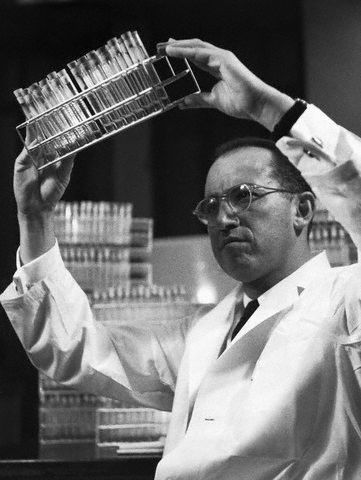
Salk in his University of Pittsburgh  lab. [Image courtesy: ExplorePAHistory.com]

Jonas Salk was born on this day in New York City in 1914 Today is the 98th anniversary of his birth.

He was the oldest of three boys born to Russian/Jewish immigrants, Daniel and Dora Salk. He was an excellent student and he attended Townsend Harris High School, a high school for gifted students and a springboard  for boys who had the talent but not the money or social connections to get into private colleges. At Townsend Harris he read everything he could find, he studied hard and always got good grades. At 16 he started the College of the City of New York. At first he focused on Law, but he soon changed his mind and decided to study medicine.

In 1934 he enrolled in the College of Medicine of New York University, from which he graduated in 1939. Salk worked at New York’s Mount Sinai Hospital from 1940 to 1942, when he went to the University of Michigan. There he helped develop an influenza (flu) vaccine. [Encyclopedia of World Biography]

The flu virus had recently been discovered and Salk worked on a way to “deprived of its ability to infect, while still giving immunity to the illness.” [Academy of Achievement]  His work in fighting the flu and in developing vaccines helped prevent a repeat of the flu epidemic like the one that ravished the country in 1919.

In 1947, Salk accepted an appointment to the University of Pittsburgh Medical School. While working there, with the National Foundation for Infantile Paralysis, Salk saw an opportunity to develop a vaccine against polio, and devoted himself to this work for the next eight years. [Academy of Achievement] 

Photo of polio patients in iron lungs during 1...

Photo of polio patients in iron lungs during 1952 epidemic (Photo credit: Wikipedia)

At Pittsburgh he researched the polio virus (in 1949 it was discovered that there were three types of polio viruses) and he worked on a vaccine that tackled the disease. By 1950 testing began, in 1955 the vaccine was ready for general use. Salk had developed a “killed-virus” vaccine that required three or four injections.

In countries where Salk’s vaccine has remained in use, the disease has been virtually eradicated. [Ibid]

Photo of newspaper headlines about polio vacci...

Photo of newspaper headlines about polio vaccine tests (Photo credit: Wikipedia)

Salk won the Lasker science award in 1956 for his work on Polio.

The Salk Institute for Biological Studies, which focused on the autoimmune functions of the body opened in San Diego, California in 1963.  While heading up the institute Salk published Man Unfolding (1972), The Survival of the Wisest (1973), World Population and Human Values: A New Reality (1981), and Anatomy of Reality (1983).

Towards the end of his life Dr. Salk took up the fight against AIDS and searched for an effective vaccine for the disease.

He died at the age of 80 in 1995 in La Jolla, California.

Jonas Salk, American medical scientist (bust i...

Jonas Salk, American medical scientist (bust in the Polio Hall of Fame) (Photo credit: Wikipedia)


Thought of the Day 10.24.12 Kweisi Mfume

“And it really gets down to an issue of class. The poor and the poorest of the poor tend to be the ones that are being missed by the census,”
–Kweisi Mfume

Mfume delivering a speech at NOAA during Black...

Mfume delivering a speech at NOAA during Black History Month, 2005 (Photo credit: Wikipedia)

Frizzel Gerald Gray was born on this day in Tuner Station, Dundalk just outside of Baltimore, Maryland in 1948. He is 64 years old.

He is the oldest of four siblings. His father left the family when Gray was a 11 and his mother, Mary Elizabeth Gray, raised the children as best she could as a single mother. She died of cancer when he was 16.

“After she died of cancer, things spun out of control.” Mfume quit high school during his second year and went to work to help support his sisters. At times he worked as many as three different jobs in a single week.” [Kweisi Mfume Biography. Encyclopedia of the World Biography

He began to hang out on the corner drinking with friends to blow off steam. He admits to hanging with the wrong crowd. He could feel his life spiraling out of control as he was arrested on suspicion of theft “Because” he said in a U.S. News and World Report interview ” I happened to be black and happened to be young.” And soon found himself the teenaged parent of five children.

But on a July night in the late 60s all that changed. He felt something come over him and he stepped away from the corner and toward the future. He spent “the rest of the night in prayer, then proceeded to earn his high-school diploma and pursue a college degree.” [IBID] He changed his name to Kweisi Mfume, a phrase that means “conquering son of kings” in Ghana.

He began to work in radio, first as a volunteer than as an announcer. When his college, Morgan State University  opened its own radio station Mfume became the program director.
Flag of Baltimore, Maryland. Image created by ...

Flag of Baltimore, Maryland. Image created by uploader based on images found at crwflags.com and nava.org, as well as other images found on the web. (Photo credit: Wikipedia)

He parlayed his popularity on the Radio and in Baltimore’s African-American community into politics in 1978 when he ran for Baltimore City Council. There he became a vocal critic of Mayor William Donald Schaefer whom he accused  of ignoring poor neighborhoods. Eventually Mfume learned the three-pronged art of negotiation, compromise and coalition building.
DSC_0120

DSC_0120 (Photo credit: owillis)

In 1986 he ran for U.S. House of Representatives and won a seat in Congress. He worked on the House Committee on Banking, Finance and Urban Affairs and later on farming and zoning issues. He maintained a strong tie to Baltimore City and the residents that lived in the inner city.
By his fourth term, Mfume had enough influence to become chairman of the Congressional Black Caucus, a group in Congress that supports the interests of African-Americans. Soon after his election as chairman, Mfume and the Caucus presented a list of demands to President Bill Clinton (1946–), most of them having to do with federal aid to cities and the poor. [IBID]
In 1996 Mfume left Congress and became the president of the NAACP (the National Association for the Advancement of Colored People. He successfully managed the organization’s financial issues and illuminated the NAACP’s $4.5 million debt. He worked to address “affordable health care, conservation, voting reform, and hate crimes.” [IBID.] He helped raise over $90 million and created the NAACP’s National Corporate Diversity Project during his tenure at the organization. His term at the NAACP ended on January 1, 2005.
Kwesi Mfume, Fmr Prez of NAACP

Kwesi Mfume, Fmr Prez of NAACP (Photo credit: Youth Radio)

Mfume made an unsuccessful bid for a U.S. Senate seat. Although he remains active as a political supporter and organizer he has not run for public office since. Currently he serves on a number of boards of public and private institutions such as the National Advisory Council on Minority Health and Health Disparities, the Platform Committee of the Democratic National Convention and the National Advisory Council of Boy Scouts of America. He actively lectures at…
Colleges, Universities, Corporations, and Bar Associations across the country on corporate diversity, compliance, inclusion, disparities in health care, tolerance and the new challenges of gender and race. [kweisimfume.com]

Thought of the Day 8.19.12 Orville Wright

If we worked on the assumption that what is accepted as true really is true, then there would be little hope for advance

— Orville Wright

The Wright brothers patent war

The Wright brothers patent war (Photo credit: Wikipedia)

Orville Wright was born in Dayton, Ohio on this day in 1871. Today is the 141st anniversary of his birth.

Orville was the fourth of five children to Milton and Susan Wright. He was very close to his brother Wilbur, who was four years his senior. The Wrights grew up in Dayton and Iowa.

“We were lucky enough to grow up in an environment where there was always much encouragement to children to pursue intellectual interests; to investigate whatever aroused curiosity.” [–Orville Wright/NASA.Gov]

When they wanted to find out how something mechanical worked they asked their mother. In matters of a religious or intellectual nature they asked their minister father. Their father bought the boys a toy “helicopter” made of paper and bamboo with a cork weight and a rubber band “motor.” The toy ignited their interest in flight.

Of the two, Orville was the mischievous one. While Wilbur was good at school and an earnest student, Orville preferred to hone his skills as a champion bicyclist. It seemed Wilbur was destined to go to college (Yale) but an accident while the boys were playing hockey left him injured. Some one lost control of their hockey stick and it flew out of their hands and struck Wilber, he fell and knocked out his front teeth. A few weeks later he began to have heart palpitations. He withdrew socially, and spent his days reading in the family’s extensive library. He also cared for his mother who was dying from TB.

Wright brothers bicycle

Wright brothers bicycle (Photo credit: nicomachus)

Orville was able to bring his more bookish brother out of his funk. When Orville was 18 (and Wilbur was 22) the brothers started a printing firm with a press they built themselves out of used buggy parts and a damaged tombstone. They began to publish their own weekly paper. The brothers were both cyclist and they repaired bikes for friends. They opened their own bicycle shop, The Wright Cycle Exchange (which later became the Wright Cycle Company ), in 1893 and in 1896 made their own bikes called Van Cleves and St. Clairs.

When Orville came down with typhoid fever Wilber helped nurse him by reading articles about German and French attempts at aviation. The brothers were hooked.  Wilber threw himself into research writing to the Smithsonian Institute requesting their information on aeronautical research. He studied all he could find about pitch, roll and yaw and designed a unique wing warping system. They contacted the US Weather  Bureau and found out where the most windy regions of the country were. They settled on Kitty Hawk which had average wind speeds of 13 mph.

The brothers travelled to Kitty Hawk in 1900 and 1901 testing the glider. They constructed a wind tunnel  to test different wing shapes. In October 1902 with a glider using a new wing design they glided over the sands of Kitty Hawk for 602 feet (a record). They went back to Ohio and worked on an engine propelled flying machine.

First successful flight of the Wright Flyer, b...

First successful flight of the Wright Flyer, by the Wright brothers. The machine traveled 120 ft (36.6 m) in 12 seconds at 10:35 a.m. at Kitty Hawk, North Carolina. (Photo credit: Wikipedia)
On December 14, 1903 the brothers tossed a coin to see who would take the Wright Flyer on its maiden flight. Wilbur won the coin toss. It lasted  just 3 seconds and ended in a minor crash requiring some repairs. On December 17 the flyer was ready again. This time it was Orville’s turn.  He flew for 12 seconds for about 120 feet. The brothers traded off twice more and by the fourth flight of the day Wilbur  was able to fly for 59 seconds  for 852 feet before the plane began to pitch and it hit the ground. None of the flights reached more than 10 feet in altitude that day, so Wilbur wasn’t really hurt.

The Wrights returned to Dayton and established an airfield in a cow pasture called Huffman Prairie. They spend the next two years perfecting their airplane design  and flying skills.  Eventually they won contracts from the US Signal Corp and the French Government. Their flying ability and engineering genius made them famous.

Wilbur died of typhoid fever at the Wright home in Dayton on May 20 1912.

English: Orville Wright, 1928.

English: Orville Wright, 1928. (Photo credit: Wikipedia)

Orville was a founding member of  National Advisory Committee for Aeronautics (the NACA). He served on its board for 28 years  and was elected a member of the National Academy of Sciences in 1936. He died of a heart attack in 1948.