Archives: 2013

Henry II 3.5.13 Thought of the Day — Part 2

English: Henry II and Thomas Becket

English: Henry II and Thomas Becket (Photo credit: Wikipedia)

Click here for PART ONE

When word reached Henry that Becket was hiring armed men to protect him he said “What miserable drones and traitors have I nourished and brought up in my household, who let their lord be treated with such shameful contempt by a low-born cleric?” [History of Britain, Schama, pg 142] It was said in a moment of frustration and anger, and probably not given as command, but it was all the anti- Becket faction needed. Four knights set out to murder the Archbishop while he was at Vespers in Canterbury Cathedral.   “Almost overnight Becket became a saint. Henry reconciled himself with the church.” [BBC.co.uk] He was genuinely grief-stricken over the loss of his former friend. He did penance at Beckett’s tomb and reversed the Constitution of Clarendon.

Family

English: Henry II and his wife Eleonora

English: Henry II and his wife Eleonora (Photo credit: Wikipedia)

Henry had trust issues. Those extended to his family. Eleanor, 10 years Henry’s senior, was very much in love with him when they first married. She was a dutiful wife and bore him seven children, five of whom were boys. She traveled with him when she could. But he preferred to have Becket entertain visiting royalty — usually the Queen’s job — and he was a restless busy man who gave her titles but not power. She put up with it for 14 years before returning to Aquitaine to “assume personal control of the lands. Henry was left to his own affairs (of every sort) back in England.” [About.com]

Henry now had problems within his own family. His sons – Henry, Geoffrey, Richard and John – mistrusted each other and resented their father’s policy of dividing land among them. There were serious family disputes in 1173, 1181 and 1184. The king’s attempt to find an inheritance for John led to opposition from Richard and Philip II of France. Henry was forced to give way. [BBC.co.uk]

[James Goldman’s excellent play The Lion in Winter portrays a fictionalized Christmas between the imbittered royal family in 1183.]

Henry and Richard were at war in France when Henry took seriously ill. After so many years of refusing to name Richard his heir he was forced to do so at Ballan. He died  on the 6th of July, 1189.

Henry II & his children

———————————————-

Links:

We saw The Lion in Winter at the  American Shakespeare Center in Staunton, Virginia last summer. It was an amazing theatre and an awesome Shakespeare (and historical) experience. Click on the link and check them out.


Henry II 3.5.13 Thought of the Day PART ONE

“Will no one rid me of this turbulent priest?” — Henry II of England

James Keegan as King Henry in The Lion in Winter, 2012. Photo by Michael Bailey. James Keegan as Henry II in last summer's production of The Lion in Winter at the American Shakespeare Center.]

James Keegan as King Henry in The Lion in Winter, 2012. Photo by Michael Bailey. [At the American Shakespeare Center.]

Henry II of England was born on this day in Le Mans, France  in 1133. Today is the 880th anniversary of his birth.

Henry, Count of Anjou, Count of Maine, Duke of Normandy, Duke of Aquitaine, Count of Nantes, Lord of Ireland, and  eventually King of England (1154–89)  was the oldest child of Empress Matilda and Geoffrey the Fair. Matilda was the eldest daughter of England’s Henry I who died unexpectedly in 1135 without naming an heir. She had a strong claim that her baby boy, a direct male descendant should be next in line for the throne, but her cousin Stephen, Count of Blois,  (aka Stephen the Usurper), got there  first. Matilda, aided by her half-brother Robert of Gloucester, raised an army and a 17 year civil war ensued.

Stephen and Henry discuss across the River Tha...

Stephen and Henry discuss across the River Thames how to settle the succession of the English throne. (Photo credit: Wikipedia)

Henry’s early years were spent in the Court of Anjou with his father, but beginning in 1142 the boy traveled to England to join the campaign.  The years he spent living in a Spartan manner followed him the rest of his life and Henry eschewed the opulence and soft pleasures of other monarchs.

1151, Henry became ruler of Normandy and Anjou, after the death of his father. In 1152, he married Eleanor of Aquitaine, the greatest heiress in western Europe. In 1153, he crossed to England to pursue his claim to the throne, reaching an agreement that he would succeed Stephen on his death, which occurred in 1154. [BBC.co.uk]

Henry and Becket

The next order of business was to restore peace and order in England. To do that Henry turned to Thomas Becket. Together they rid the country of the robber barons, disloyal knights and criminals who were lapping up the offal of 17 years of war. As a reward for a job well done (and to strengthen his own power over the church) Henry named Becket Archbishop of Canterbury when the old Archbishop died. The church hierarchy was stunned and dismayed, Becket was the King’s man. He wasn’t even a priest. He was ordained on June 2nd, 1162, and consecrated Archbishop on June 3rd. But Becket surprised everyone, especially Henry. He undertook a religious transformation, and where he had been loyal wholly to the King he was now loyal only to God.  He began to work to restore the powers of the  Archbishop and the Church, especially in matters of Law.

English: King Henry II and Thomas Archbishop Č...

English: King Henry II and Thomas Archbishop Česky: Jindřich II. a Thomas Beckett From the Liber Legum Antiquorum Regum, a 12th century work (Photo credit: Wikipedia)

Henry thought the Law of the Land superseded the Law of the Church. Becket disagreed. Henry called and assembly of clergy to Clarendon Palace  in January 1164 where he demanded that Becket sign the Constitution of Clarendon which “established procedures of criminal justice, establishing courts and prisons for those awaiting trial. In addition, the assizes gave fast and clear verdicts, enriched the treasury and extended royal control.” [BBC.co.uk]  In other words it gave Henry power over the church. After much heated debate Becket pledged an oath to the  idea of the Constitution, but he refused to sign. Henry was satisfied. But later when Becket refused to say mass until the oath was overturned. Henry was outraged and had the Archbishop put on trail for treason. Becket fled for exile in France. A  battle of wills ensued between two of Europe’s most stubborn men and neither Queen Elinor nor the Pope Alexander III could bring the parties together. Becket used the last most powerful arrow in his quiver. He tried to excommunicate Henry. Henry countered by threatening to arrest any one who supported Becket with treason. Becket’s support dwindled. He agreed to meet Henry in July of 1170. Becket accepted Henry’s legal supremacy in England. He was allowed to return to England. But he wasn’t willing to leave well enough alone.

Henry II with Thomas Becket, from a 13th-centu...

Henry II with Thomas Becket, from a 13th-century illuminated manuscript (Photo credit: Wikipedia)

Click here for PART TWO


Antionio Vivaldi 3.4.13 Thought of the Day

Français : VIVALDI: Portrait d’un violoniste v...

Français : VIVALDI: Portrait d’un violoniste vénitien du XVIIIe siècle, par François Morellon de La Cave (1723), portrait généralement considéré comme étant celui de Vivaldi Museo internazionale e biblioteca della musica (Bologna) (Photo credit: Wikipedia)

Antonio Vivaldi was born on this day in Venice, Italy in 1678. Today is the 335th anniversary of his birth.


Vivaldi was born into a working class family. He was the eldest of 9 children. His father, who started out as  a tailor, then a barber, learned how to play the violin and eventually landed a gig as church violinist for St. Marks in Vienna. Antonio’s father taught him to play violin as well.


“In 1703, he became ordained as a priest and was widely known as the “Red Priest” due to his red hair.” [Biography.com] But he  really had no calling to religious life. His religious training was a way for him to get an education (a common practice amongst the poor). Once ordained he…”no longer wished to celebrate mass because of physical complaints.” [Baroque Music.org] It is uncertain whether the illness was angina, asthma or a nervous disorder.


He began to teach violin at Ospedale della Pieta, a girls “orphanage” (it was really a home for the illegitimate daughters of wealthy noble men.) He also composed for the girls.


Vivaldi is best known for his Concertos (especially those for violin), his choral works and his operas (he wrote over 40.)


Here’s Autumn from his Four Seasons:


and  here’s Gloria in a in Excelsis Deo.


Antonio Vivaldi by François Morellon la Cave; 1725

Antonio Vivaldi by François Morellon la Cave; 1725 (Photo credit: Wikipedia)

Orchestral music


  • over 230 vn concs., incl. “Four Seasons,” op.8 nos. 1-4 (circa 1725)
  • circa 120 other solo concs. (bn, vc, ob, fl, rec etc)
  • circa 40 double concs. ensemble concs. ripieno concs. and sinfonias
  • 4 concs. for double orch

Chamber music


  • circa 40 vn sonatas
  • 9 vc sonatas
  • circa 10 fl sonatas
  • 27 trio sonatas
  • 22 chamber concs.

Sacred vocal music


  • Gloria, D
  • Magnificat, g
  • psalms, hymns, motets etc
  • Juditha triumphans (oratorio, 1716)

Secular vocal music


  • circa 50 operas, circa 20 surviving, incl. Teuzzone (1719), Tito Manlio (1720), Giustino (1724), Orlando (1727), La fida ninfa (1732), Griselda (1735)
  • 3 serenatas
  • circa 40 solo cantatas

[List from Great Performances]


Jane Austen at Goucher

[Image courtesy: Goucher Library. Photo by: ritaLOVEStoWRITE]

[Image courtesy: Goucher Library. Photo by: ritaLOVEStoWRITE]

Dear readers,

I’ve had an article on the Jane Austen, Pride and Prejudice and the amazing Jane Austen Collection at Goucher Library published in the March/April edition of Mason-Dixon ARRIVE magazine. Goucher has the largest collection of Austen related material (including several first editions of the books) in North America. It was a real treat to sit down with the ladies who shepherd this collection and talk about Jane.

Click here to go to the magazine’s website, then click on the cover to read a virtual copy of the magazine. The article is on page 22.

[Image courtesy: Goucher Library. Photo by: ritaLOVEStoWRITE]

Reading Jane’s Letters [Image courtesy: Goucher Library. Photo by: ritaLOVEStoWRITE]

While you are on-line… how about stopping by  “Mason-Dixon ARRIVE” on Facebook to learn more about the magazine and leaving a comment on the article.

[Image courtesy: Goucher Library. Photo by: ritaLOVEStoWRITE]

[Image courtesy: Goucher Library. Photo by: ritaLOVEStoWRITE]

Here’s a link to the Jane Austen Collection at Goucher.

[Image courtesy: Goucher Library. Photo by: ritaLOVEStoWRITE]

[Image courtesy: Goucher Library. Photo by: ritaLOVEStoWRITE]


Robyn Hitchcock 3.3.13 Thought of the Day

“If you do things out of time you’re weird.” — Robyn Hitchcock

[Image courtesy: TurnTableInterview.com]

[Image courtesy: TurnTableInterview.com]


Robyn Rowan Hitchcock was born on this day in London, England in 1953. He is 60 years old.

[I couldn’t find anything about Hitchcock’s upbringing or family. Nada. Zip. Really… I looked. If you can find something send a reply.]

He started his music career as a singer songwriter in the 1970’s. He listened to the Beatles, Dylan, the Velvet Underground and absorbed it all. He says he developed a kind of song writing muscle that takes hold every summer and starts producing with out his taking any notice of it.  He genre hopped from Folk to Punk with his band, the proto-punk group The Soft Boys.

The Soft Boys

The Soft Boys (Photo credit: Wikipedia)

The group, “a punk-era band specializing in melodic, chiming jangle pop and clever lyrics” [All Music] mixed the psychedelic with the weird, but they kept away from  the “aggressive, simplistic approach of most punk bands.” [About.com] Their “masterpiece” [Ibid] album Underwater Moonlight, released in 1980. Soon after Underwater Moonlight was released the group broke up and Hitchcock made his solo debut with Black Snake Diamond Role.

Black Snake Diamond Role represented a subtle but clear shift away from the more aggressive tone of The Soft Boys toward a more pop-oriented sound. “The Man Who Invented Himself” is user-friendly… and the production, while mostly straightforward, is …polished and professional. …the surrealism of the lyrics and the trippy undertow of the melodies are in the same league as Hitchcock’s earlier work…. Black Snake Diamond Role staked out a distinct sonic territory for Hitchcock’s solo career [All Music — Black Snake Diamond Role review]

Here’s I’m the Man with the Lightbulb Head:

The 80’s progressed with Groovy Decay  and the all-acoustic I Often Dream of Trains. Then he formed Robyn Hitchcock and the Egyptians and produced the album that usually tops the Best of Robyn Hitchcock list, Fegmania!

Featuring layered, intertwining guitars and keyboards that created lush and thick sonic textures. … Fegmania! was Hitchcock’s most consistent work to date, featuring such highlights as the Eastern-tinged “Egyptian Cream,” and the creepy “My Wife & My Dead Wife,” and the relatively straightforward “The Man with the Lightbulb Head.” [All Music review of Fegmania!]

In 1988 he signed with A&M Records, thus widening his reach to an American audience. He put out  Globe of Frogs  in ’88 and (my favorite Hitchcock record) Queen Elvis ’89.

Here’s a live version of Lost Madonna of the Wasp:

and  a very MTV version of the brilliant One Long Pair of Eyes:

Perspex Island and Respect followed in 2 year intervals for A&M. Then he switch to Warner for Moss Elixir for which he…

returned to the spare singer/songwriter format for his best set of songs in more than ten years. Everything is here: the quirky on “Man with a Woman’s Shadow,” and the elegant on “Beautiful Queen,” and the straight-ahead Beatlessque music in which Hitchcock excels in the perfect pop of “Alright, Yeah.” [All Music review of Moss Elixir]

He did a few more “solo” LPS — Jewels for Sophia, 1999, Luxor, 2003, and  Spooked, 2004 — before teaming up various rockers to form the Venus 3 project in 2006. With Venus 3 he put out Olé! Tarantula, 2006, Goodnight Oslo, 2009 and Propellor Time, 2010. In 2011 he released Tromsø, Kaptein, on Hype City Records, a Norwegian label.

He has a new album, “Love from London,” coming out on Tuesday. He’ll be touring the UK and the US  shortly to celebrate the album.

“Forty years ago, when I first got hold of an electric guitar, if someone had told me that at 60 I’d be playing amplified beat music, I would have just said, ‘Get out of here! … It’s like Mr. Rogers is playing guitar; that’s gross!’ But you know, rock ‘n’ roll is an old man’s game now.” [NPR: Weekend Edition]

English: Musician Robyn Hitchcock on stage at ...

English: Musician Robyn Hitchcock on stage at Iron Horse in Northampton, Massachusetts, 13 March 2005 (Photo credit: Wikipedia)

—————————–

This blog goes out to my buddy Sam who reminded me that today is Robin Hitchcock’s birthday. Sam, who is a freshman in college, learned about Hitchcock through his dad, Chip. He says “I think what I like most about Robyn’s style is his dreamy weirdness, but also the ability his songs have to be interpreted many different ways.” Some of Sam’s favorite Hitchcock songs are

Queen Elvis,
So You Think You’re In Love,
Victorian Squid,
Balloon Man,
The Man Who Invented Himself, and
The Man With The Lightbulb Head.

Good list Sam. And thanks for the nudge!


Second Character Saturday Alan Rickman: Severus Snape

Blogger’s Note: When I started to thinking about Secondary Character Saturday somehow Alan Rickman kept coming to mind. He’s been around for a long time, he’s been in a LOT of great movies, and he’s almost always in the secondary character spot. He’s PERFECT for this blog segment. But WHICH Alan Rickman role to feature on Secondary Character Saturday? Ah that’s the rub. He’s done everything from rom-com, to Shakespeare, to comic science fiction, to serious drama. Which side of A.R. do I show? Frankly, I couldn’t decide. So I’m claiming the month of MARCH as Alan Rickman Month! (He’s also one of my all time favorite actors so I wont mind spending a month researching him and maybe re-watching a few movies!)

Snape topper

Who: Professor Severus Snape

From: The Harry Potter series

By: J.K. Rowling wrote the fabulous and engaging books. The movies were directed with varying degrees of success by different people. For my money Alfonso Cuarón saved (the movie) franchise from generic blandom with his wickedly good HP and the Prisoner of Azkaban, and David Yates brought the magic in HP and the Deathly Hallows 1&2.

Released: The character of Severus Snape first appeared in June  of 1997 when Rowling published Harry Potter and the Philosopher’s Stone in Great Britain.  We first got to see A.R. as Snape in 2001 with the release of Harry Potter and the Sorcerer’s Stone.

Pros: He’s brilliant, of course. He’s got fantastic wand skills and is so fab at potions that he literally rewrote the book. He’s inventive, hard-working,  intuitive. He protects Harry even though he can’t stand him. He teaches Harry Occlumency so he can keep Voldemort out of his mind. He’s acts as a double agent for Dumbledore. And he’s loyal to Lily, his one true and unrequited love. Having made both Lily and Dumbledore (and Narcissa Malfoy) promises he stops at nothing to keep them. He’s the perfect Slytherin.

Still from HP and the Prisoner of Azkaban. Snape rushes in front of Harry, Ron and Hermione to protect them from a werewolfe. Maybe he's just being a good teacher/adult. But I doubt whether some other teachers at the school would have done the same. [Image courtesy: Warner Brothers]

Still from HP and the Prisoner of Azkaban. Snape rushes in front of Harry, Ron and Hermione to protect them from a werewolf. Maybe he’s just being a good teacher/adult. But I doubt whether some other teachers at the school would have done the same. [Image courtesy: Warner Brothers]

Cons: Well… he’s mean. He’s REALLY mean to Harry! And that’s just not right! (OK I’ve got that off my chest. But lets face it, Snape isn’t the meanest one of the lot. He’s got nothing on Umbridge.) He’s a bully and he takes out his resentment for what James Potter did to him on Harry.  He’s spiteful, malicious, angry, bitter, resentful, and cruel.  He always favors Slytherin . He’s a double spy for Voldemort. He’s a Death Eater. And he KILLS Dumbledore! He’s the perfect Slytherin.

Most Shining Moment: I agree with Harry Potter Blog Spot who picks Dumbledore’s Death as Snape’s Shining Moment For to honor Dumbledore’s wishes and protect Harry’s (and Draco’s) life, Snape risked the damage his own soul that this horrific act would bring.” [Harry Potter blog spot] It is the crowning action of commitment, loyalty and self-sacrifice, while on the outside (and to the reader)  it looks completely the opposite.

Least Shining Moment: All the times he was meaner than he had to be to Harry and the other students who weren’t in Slytherin … and when he killed Dumbledore.

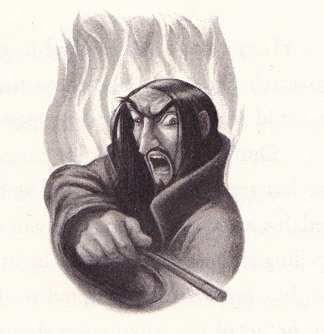
The Mary Grandpre illustration of Half-Blood Prince.

The Mary Grandpre illustration of Half-Blood Prince.

Yeah, I know I sound schizophrenic, but things with Snape are COMPLICATED. And nothing in the books was more complex and, dare I say, misleading, than Snape’s killing Dumbledore. When it happened it was THE WORST THING EVER in the HP universe and I didn’t think I could ever forgive Snape. Up until then Rawlings had given me enough ammunition to  forgive away his nastiness towards Harry. But this? How could he be redeemed from this? Hmmmm.  Things have changed.

He remained true to himself by remaining loyal to Dumbledore and his lost love. As the stakes and danger increased for him, and Dumbledore pushed him to greater acts of spying and risk, Snape met these challenges bravely, even if irritably, to protect the son of the man he loathed and thereby preserve the memory of the woman he loved. [Ibid]

Something clearly resonates with Snape. He was the top pick of for favorite character in a poll done by the H.P. British publisher Bloomsbury. He received 20% of the votes in the poll that asked readers to rank their favorite 40 characters. (Hermione came in second. Harry was a distant 5th!)

Not to take anything away from the Snape Rowlings painted on the page, but Alan Rickman’s nuisanced performance as the greasy haired potions professor had a lot to do with that high rating. He’s delightful to watch throughout the series. (He makes the first couple of movies bearable with his dark, snarkiness). And as Snape’s story arch progresses Rickman’s performance builds in a measured, restrained, mysterious pace. He respects the character enough not to give anything away. He’s multidimensional in a very limited scope of dimension, many shades of black, as it were. And he’s fun to watch … right up to the moment he makes you cry.

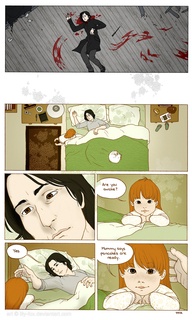
Found this piece of Fan Art on Pinterest (with Maggie's help -- thanks Maggie!) And can not find any one to attribute it to. Sorry.

In another life wake up. by Lily-fox

Sorry the text is small in the comic:This is what it says…
Snape wakes from the dream to find his daughter at his bed side.
She asks “Are you awake?”
He reaches out to touch her red hair — she looks so much like Lily “Yes.”
She smiles “Mommy says pancakes are ready.”

Life is good.


Frankly… (if you haven’t guessed) I’m not a big fan of the HP movies. (LOVED the books — so don’t kick me out the club — but he movies… for the most part … eh.) But Rickman was always worth watching.

——————————————————————————————-

So which other A.R. characters should we tackle this month? We’ve got 4 more Saturdays in the month so get your votes in!

  • Hans Gruber (Die Hard’s evil bad guy)
  • Alexander Dane  (Galaxy Quest’s classically trained science officer)
  • Dr. Blalock (the life saving doctor in Something the Lord Made)
  • Judge Turpin (the evil judge in Sweeny Todd)
  • Steven Spurrier (the wine snob from Bottle Shock)
  • Alex (the grief-stricken stranger in Snow Cake)
  • Jamie (the cello playing ghost in Truely, Madly, Deeply), or
  • Col Christopher Brandon (from Jane Austen’s Sense and Sensiblity)  — Yeah, I’m doing Branon.

To see how Rickman “elevates the role of a villain from the plain ol’ bastard to a bastard coated bastard with bastard filling.”…go to the excellent blog The Many Faces of Alan Rickman.


Ron Howard 3.1.13 Thought of the Day

“One of the great things about being a director as a life choice is that it can never be mastered. Every story is its own kind of expedition, with its own set of challenges.”– Ron Howard

Gallery ~ Opie Taylor

Gallery ~ Opie Taylor (Photo credit: erjkprunczýk)

Ronald William Howard was born on this day in Duncan, Oklahoma, USA in 1954. He is 59 years old.
He was born into a theater family. His mother was an actress, and his father both acted and directed. He was in his first film at 18 months and on stage at 2. He appeared on television frequently as a child and had reoccurring gigs on CBS’s Playhouse 90,  Dennis the Menace, and The Many Loves of Dobie Gillis before landing the roll of Opie Taylor in the Andy Griffith Show.

He played Opie from 1960 to 1968. The show ran for 268 episodes and was ranked as the #9 best show in  American Television History by TV Guide.

Howard kept busy while the show was in summer hiatus with family films like The Music Man and  The Courtship of Eddie’s Father.

In the early 70’s the worked on The Smith Family, a sitcom about a police detective and his family starring Henry Fonda. (It lasted two seasons) In 1973 he starred in George Lucas’ American Graffitti. Then hit with another sitcom as the star of Happy Days.

Photo of Richie (Ron Howard) dressed as a girl...

Photo of Richie (Ron Howard) dressed as a girl dancing with Fonzie (Henry Winkler) from the television program Happy Days. In this episode, Richie must dress as a girl and attend a Jefferson High School dance as part of an initiation. (Photo credit: Wikipedia)

His second act came as a producer / director / producer.  He’d been behind the camera before Happy Days was a wrap, but it was Night Shift with Michael Keaton, Shelly Long, and Happy Days alum Henry Winkler that made his as a Director. Other comedies include Splash, Gung Ho, Cocoon, How the Grinch Stole Christmas, and The Dilemma.

Adult Opie in the 1986 reunion telemovie, &quo...

Adult Opie in the 1986 reunion telemovie, “Return to Mayberry”. (Photo credit: Wikipedia)

Dramas and Dramedies include: Parenthood, Backdraft, Far and Away, The Paper, Apollo 13, Ransom, A Beautiful Mind,The Missing, Cinderella Man, The Da Vinci Code, Frost / Nixon and Angels & Demons. He won an Academy award for A Beautiful Mind, and the Directors Guild of America Award for A Beautiful Mind and Apollo 13.
Next up is a biopic about formula one race car drivers in RUSH due out in September of this year.

Ron Howard during filming of Angles and Demons...

Ron Howard during filming of Angles and Demons in Rome. (Photo credit: Wikipedia)


Holy SPAM Batman!

Dear Readers,

Every day before I start ritaLOVEStoWRITE  I check my spam folder. And every day I say a little prayer of thanks for the invisible minions who have kept the offers of dumpster rentals, sexual encounters,  cheap travel deals and casino bargains off my blog. But yesterday a higher power intervened.

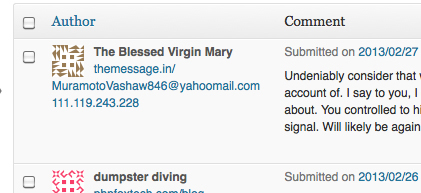
Undeniably consider who sent me this gem…

Holy cow! I hit the jackpot of all spammers with this one.

Holy cow! I say to you... I hit the jackpot of all spammers with this one.

I’m not sure what the Mother of God was doing on the internet, or what she is selling on her blog, but, if her comment is to be believed*  she will likely be at it again, so I can find out later.

I can just imagine her up in heaven typing away on her Powerbook.

Perhaps she’s already influenced other bloggers… like the young man who sent me this missive:

“Truly

no matter if someone doesn’t be aware of afterward

its up to other people that they will help,

so here it takes place.”

miss Mary mac

Madonna of the Macs.

With all the admonitions on Facebook to LIKE a particular scripture passage to prove my worth as a Christian or to send this or that prayer on to 10 people in the next 30 seconds lest something bad happen me or mine… I guess blogs from the Holy Family are the next logical step in our hyper-modernization of  the religious experience.

But until Jesus, Mary or Joseph really DO write a blog might I suggest that spammers and scammers leave their names out of it?

Because (although I tried to be sarcastic and light here) as a person who already has a special “cloud” connection to the Blessed Virgin I really found the spam highly offensive.

* And this IS Mary if you can’t believe her… who can you believe?
———————————————————————–

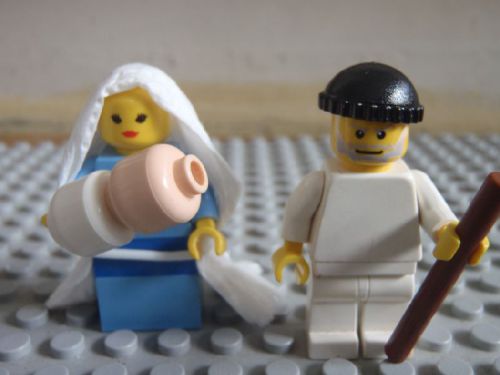
Of course there is a Lego version of Mary (You know my Lego obsession…)

The Holy Family, Lego style

The Holy Family, Lego style [Image Courtesy: Mocpages

OK I made up the Madonna of the Mac mass card, but the Blessed Virgin Spam, the “prayer” and the Lego Holy Family are really out there.


Michel de Montaigne 2.28.13 Thought of the Day

“Stubborn and ardent clinging to one’s opinion is the best proof of stupidity.” –Michel de Montaigne

Painting by Thomas de Leu (Franco-Flemish pain...

Painting by Thomas de Leu (Franco-Flemish painter and engraver, 1560–1612, active 1580-1610). An engraving of this painting was published in the first edition of Montaigne’s Essais, 1617. (Photo credit: Wikipedia)

Michel Eyquem de Montaigne was born on this day in Château de Montaigne,  near Bordeaux, France  in 1533. Today is the 460th anniversary of his birth.

He was born into a very wealthy French family, but as a toddler he lived with a peasant family for three years. This, his father thought, would give him an appreciation for the conditions of the poor.

The fourteenth-century château, in which Miche...

The fourteenth-century château, in which Michel de Montaigne was born and died, was burnt down in 1885. But soon after rebuilt in a similar style by the Montaign family. Michel Eyquem de Montaigne (February 28, 1533 – September 13, 1592) was an influential French Renaissance writer, generally considered to be the inventor of the personal essay. Michel de Montaigne Another view: Flickr (Photo credit: Wikipedia)

When he returned to the Chateau he was taught by a German tutor and only spoken to in Latin and (eventually) in Greek. So Latin, not French, was his first language. “So the young Montaigne grew up speaking Latin and reading Vergil, Ovid, and Horace on his own. At the age of six, he was sent to board at the Collège de Guyenne in Bordeaux, which he later praised as the best humanist college in France.” [Stanford.edu] In 1546 he went to the University of Toulouse. He studied law and became a counselor of the Court des Aides of Périgueux before being appointed counselor to Parlement and serving as a courtier to Charles IX.

Michel Eyquem de Montaigne, statue sur l'Espla...

Michel Eyquem de Montaigne, statue sur l’Esplanade des Quinconces, Bordeaux (Photo credit: Wikipedia)

While at Parlement he became close friends with the  humanist poet Etienne de La Boëtie whose early death greatly effected Montaigne. “the void left by La Botie’s death in 1563 likely led Montaigne to begin his writing career.” [Answers.com] He retired to the Château de Montaigne to study and write. Although he traveled a bit and served as Mayor of Bordeaux, but his primary office was as a writer.

He was…

one of the most influential writers of the French Renaissance. … He became famous for his effortless ability to merge serious intellectual speculation with casual anecdotes and autobiography — and his massive volume Essais (translated literally as “Attempts”) contains, to this day, some of the most widely influential essays ever written. Montaigne had a direct influence on writers the world over, from William Shakespeare to René Descartes, from Ralph Waldo Emerson to Stephan Zweig, from Friedrich Nietzsche to Jean-Jacques Rousseau. [Goodreads.com]

He died in his home in Montaigne of quinsy, a  complication of tonsillitis at the age of 59, in 1592.

Français : Essais, éd de Bordeaux.

Français : Essais, éd de Bordeaux. (Photo credit: Wikipedia)