Monthly Archives: February 2013

Richard the 3rd UPDATE

R3 UPDATE!

Those bones found at the Leicester car park are those of King Richard! DNA testing matched the bones to one of Richard’s descendants.

[The play Richard III  at Chesapeake Shakespeare has run its course, But you can catch Vince Eisensen (who played Richard) and James Jager (who played Henry) as Proteus and Valentine in the company’s current production of The Two Gentlemen of Verona weekends from Feb 22nd to March 17th. Click HERE for details

————————————————————————————————————


Blog Note:  Richard the Third’s Birthday was Oct 3 1452.

——————————————————————————–

Richard III Royal Collection
Richard III Royal Collection (Photo credit: Wikipedia)

Today I’m thinking about Richard the Third of England.

We just saw the terrific Moveable Shakespeare production of Richard III at Chesapeake Shakespeare Company in the ruins of the Patapsco Female Institute in Ellicott City Maryland.

Director Ian Gallanar chose to pick the characters up from the 15th century and time warp them  to something resembling War War One. Clever, especially considering the Patapsco Female Institute was used as a war hospital during the Great War. In his director’s notes he says:

“The production really uses the visual palate and the historic technology of the World War One era as a way to clarify the relationships of the characters….[The audience] might also recognize the futility and wastefulness of a war that, much like the English “Wars of the Roses,” seemed more about resolving who would inherit power rather than who ought to inherit power.” [Chesapeake Shakespeare Company, Richard III: Program Notes]

So on a cold October night we got to see one of Shakespeare’s bloodiest plays in and around the shell of a burned out 19th Century building that some people claim is haunted. The occasional gas-masked actors quietly playing cards in a dimly lit corner or typing away orders on an antique typewriter upped the creep factor. As did the lighting effects, the period music and wonderful costumes.

Vince Eisenson as Richard III. Photo by Teresa Castracane. [Image courtesy: Chesapeake Shakespeare Company]
 

This version of Richard really worked. I really liked the “Moveable” aspect too. It added to the length of the play (instead of quick scene changes the audience literally did a scene change by moving to a new part of the building or grounds, and that took a while.) My only problem was that there was a scene or two where I couldn’t see the action because I had the bad luck of standing behind some one tall.)  Still, I liked that we kept moving through the building, and “discovering” new rooms. It really put the audience DEAD center into the action of the play (and moving about  kept us warm.)

Richard III runs for one more weekend at Chesapeake Shakespeare. So if you are local to Maryland jump on their website and grab some tickets before they sell out. http://chesapeakeshakespeare.com/

————————————

Scrap for a Shakespeare character card: Richar...

Scrap for a Shakespeare character card: Richard III., c. 1890; Printer: Siegmund Hildesheimer & Co. Victoria and Albert Museum, London, Museum number: S.63-2008, Link (Photo credit: Wikipedia)

Of course they didn’t have instant fact checkers in Shakespeare’s day, and history, as they say is written by the winners. So it comes as no surprise that the Richard the Third we met last night was a real piece of work. Shakespeare was writing for an Elizabethan audience. Elizabeth, a Tudor, was the granddaughter of the man who finally brought about Richard’s undoing on Bosworth Field in Leicestershire, Henry VII. It was in his interest to make Richard as loathsome as possible.

Henry VII’s claim to the thrown was weak at best. So he took…

“every opportunity of enhancing his own reputation at the expense of his predecessor. Richard’s actions and behaviour were the subject of attention and scrutiny and were presented, in the weeks and years after his death, as those of a wicked and unscrupulous tyrant.” [The Richard III Society]

While he was alive Richard was well thought of.

  • He was loyal to his brother Edward.
  • He was effective in his administration of the North.
  • He defended the country against the Scots.
  • He handled the premature death of Edward with out plunging the country into crisis.

Shakespeare wasn’t the first writer to take up the thread of anti- Richard-ism. (Yes, I just made that up.)

By the time the Elizabethan playwright William Shakespeare penned what was to become one of his most popular and frequently performed plays, The Tragedy of King Richard III, the works of the anonymous Croyland Chronicler, John Rous, Bernard André, Polydore Vergil, Sir Thomas More, Edward Hall, Richard Grafton and Raphael Holinshed had been written. [Ibid]

So, as Chesapeake Shakespeare Managing  Director and Richard III Dramaturge says in her note… The Bard’s “fictitious villainous Richard has triumphed over the historic Richard for centuries now.” [CSC Program]
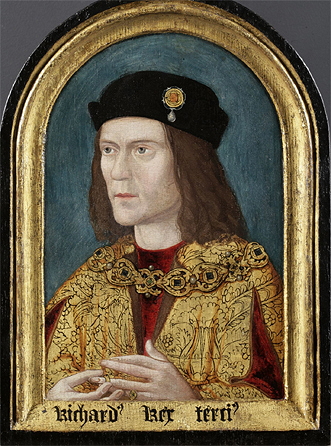
Richard III earliest surviving portrait. [Image courtesy: Wikipedia]
 

In a timely twist of history archeologists digging up a parking lot in Leicester have found the remains of  the Greyfriars Church that might be those of Richard, the last King of England to die on the battlefield. They have found a skeleton in the choir area (Richard was buried in the choir of Friars Minor at Leicester), that had a skull injury caused by a bladed implement, an arrowhead was found between its vertebrae and upper back, and it had spinal abnormalities.

“the individual would have had severe scoliosis – which is a form of spinal curvature. This would have made his right shoulder appear visibly higher than the left shoulder.” [University of Leicester Press Release : The Leicester Greyfriars Dig]

——————————————————————————-

Bonus Material:

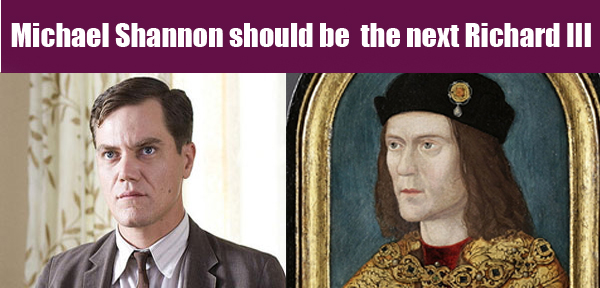
Not sure how many of you watch HBO’s Boardwalk Empire… but I couldn’t stop thinking how much Michael Shannon  (who plays messed up Treasury agent turned iron salesman Nelson Van Alden) looks like our boy Richard.  I think they ought to do a new film version of Richard cubed with Shannon in the lead. He certainly has the intensity to play the role.

Laura Linney 2.5.13 Thought of the Day

Just because you’re not famous, doesn’t mean you’re not good. — Laura Linney

[Image courtesy: theplace2.com]

[Image courtesy: theplace2.com]

Laura Leggett Linney was born on this day in New York City, New York, USA in 1964. She is 49 years old.

Linney is the daughter of Romulus Linney, a playwright, and Miriam Perse, a nurse. Her parents divorced when she was an infant and she grew up in a modest 1 bedroom apartment with her mother. “Linney grew up working in the theater, both behind the scenes and, in her late teens, on the stage.” [Starpulse.com] After graduating from  Northfield Mount Hermon School, a New England prep school, she went to Northwestern University and Brown University for undergraduate work. (She received her BA in Fine Arts from Brown in 1986). She did post-graduate work with Group 19 at the Juillard School.

She took the stage in such Broadway productions as The Seagull, Six Degrees of Separation and Hedda Gabler before making the leap to film.

Linney’s screen debut was a minor role in Lorenzo’s Oil. She played Kevin Kline’s mistress in Dave, and landed the role of Mary Ann Singleton in Armistead Maupin’s Tales of the City (a role she would reprise two more times.) She played in a trio of thrillers, Congo, Primal Fear and Absolute Power, before getting her big break as Meryl Burbank in The Truman Show.

Linney played the "perfect wife" in Truman.

Linney played the “perfect wife” in Truman.

2000’s You Can Count On Me earned Linney her first Academy Award nomination for Best Actress. (Her second nomination was for her work in 2004’s Kinsey opposite Liam Neeson.) Also in 2000 she did the lush, delightful The House of Mirth (based on the Edith Wharton novel, with Gillian Anderson, Eric Stoltz and Elizabeth McGovern).

Linney won an Emmy Award for her work on Wild Iris opposite Gena Rowlands. She won another Emmy, this time for Outstanding Guest Actress in a Comedy Series for her story arc as Charlotte on the TV show Frasier.

She played Zelda Fitzgerald in American Master’s F.Scott Fitzgerald: Winter Dreams. She worked on ensemble films  including Love Actually and The Laramie Project. She’s equally stunning as the intellectual mom struggling as her family crumbles around her in the Squid and the Whale as she is in the supernatural thriller The Mothman Prophecies  as small town police officer.

On screen, Linney has mastered quite a line in striving. Her most memorable characters have had a combination of astute wit, career focus and either a leavening daffiness or a chilly sort of overbrightness. This tends to hinge on whether they’re good apples (as in You Can Count On Me or The Savages) or bad (The Truman Show, The House of Mirth). [The Telegraph 2.1.13]

She brought Abigail Adams to life with her beautiful, strong portrayal of our second First Lady in HBO’s mini-series John Adams. Linney won  her most recent  Emmy Award for her efforts.

She can currently be seen on Showtime’s The Big C — for which she won a Golden Globe — and as the host of Masterpiece Theatre on PBS. Her latest film role is as Margaret “Daisy” Suckley  in Hyde Park on Hudson opposite Bill Murray’s FDR.


Rosa Parks 2.4.13 Thought of the Day

“I have learned over the years that when one’s mind is made up, this diminishes fear; knowing what must be done does away with fear.” –Rosa Parks

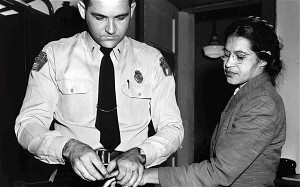
Rosa Parks getting fingerprinted after her arrest.

Rosa Parks getting fingerprinted after her arrest. [Image courtesy  abcnews.go.com]

Rosa Louise McCauley was born on this day in Tuskegee, Alabama in 1913. Today is the 100th anniversary of her birth.

Rosa’s father James was a carpenter and her mother Leona was a teacher. Her parents separated when Rosa was 2, and she moved with her mother a little brother Sylvester to Pine Level, Alabama (just outside the capital, Montgomery) to live with her maternal grandparents. He mother taught her to read. The segregated one room school-house she attended seldom had enough desks  or other supplies. At 11 she went to the Montgomery Industrial School for Girls, an institution a laboratory school set up by the Alabama State Teachers College for Negroes and founded “liberal-minded women from the northern United States. The school’s philosophy of self-worth was …to ‘take advantage of the opportunities, no matter how few they were.'” [Achievement.org] She dropped out of the school to care first for her grandmother then her mother.

At 19 she married Raymond Parks and moved to Montgomery. Raymond encouraged Rosa to finish high school, and she earned her degree in 1933.  The two were active in the National Association for the Advancement of Colored People (Raymond had been an active member when they met.) They worked to raise money to help defend the Scottsboro Boys and were members of the Voter’s League. Mrs. Parks managed to get her voter’s card (it took her three tries because of the Jim Crow laws in Montgomery.)

English: Photograph of Rosa Parks with Dr. Mar...

English: Photograph of Rosa Parks with Dr. Martin Luther King jr. (ca. 1955) Mrs. Rosa Parks altered the negro progress in Montgomery, Alabama, 1955, by the bus boycott she unwillingly began. National Archives record ID: 306-PSD-65-1882 (Box 93). Source: Ebony Magazine Ελληνικά: Φωτογραφία της Rosa Parks με τον Dr. Martin Luther King jr. (περ. 1955.) Español: Fotografía de Rosa Parks con Martin Luther King jr. (aprox. 1955). Français : Photographie Rosa Parks (ca. 1955) (Photo credit: Wikipedia)

Rosa served as the chapter’s youth leader. And in 1944 she became the secretary to NAACP President E.D. Nixon—a post she held until 1957. (She recalls that they needed a secretary, she was the only woman there, and she was too timid to decline.)

“I worked on numerous cases with the NAACP,” Mrs. Parks recalled, “but we did not get the publicity. There were cases of flogging, peonage, murder, and rape. We didn’t seem to have too many successes. It was more a matter of trying to challenge the powers that be, and to let it be known that we did not wish to continue being second-class citizens.” [Rosa Parks quoted on Achievement.org]

On Thursday, December 1, 1955

Rosa Parks boarded the Cleveland Avenue bus for home. She took a seat in the first of several rows designated for “colored” passengers. …As the bus Rosa was riding continued on its route, it began to fill with white passengers. Eventually, the bus was full and the driver noticed that several white passengers were standing in the aisle. He stopped the bus and moved the sign separating the two sections back one row and asked four black passengers to give up their seats. Three complied, but Rosa refused and remained seated. The driver demanded, “Why don’t you stand up?” to which Rosa replied, “I don’t think I should have to stand up.” The driver called the police and had her arrested. …The police arrested Rosa at the scene and charged her with violation of Chapter 6, Section 11, of the Montgomery City Code. She was taken to police headquarters, where, later that night, she was released on bail. [biography.com]

Booking photo of Parks

Booking photo of Parks (Photo credit: Wikipedia)

On the day of her trial the NAACP and the Montgomery Improvement Association (with its new leader Dr. Martin Luther King, Jr.) organized a Bus Boycott.  The

13-month mass protest that ended with the U.S. Supreme Court ruling that segregation on public buses is unconstitutional. …The bus boycott demonstrated the potential for nonviolent mass protest to successfully challenge racial segregation and served as an example for other southern campaigns that followed. In Stride Toward Freedom, King’s 1958 memoir of the boycott, he declared the real meaning of the Montgomery bus boycott to be the power of a growing self-respect to animate the struggle for civil rights. [Stanford.edu]

“At the time I was arrested I had no idea it would turn into this, … It was just a day like any other day. The only thing that made it significant was that the masses of the people joined in.” –Rosa Parks

After her arrest Parks lost her job  as a seamstress in a department store. “her husband was fired after his boss forbade him to talk about his wife or their legal case.” [biography.com] The couple was unable to find work and eventually they moved to Detroit, Michigan with Rosa’s Mother.

In Michigan Rosa Parks worked U.S. House of Representative John Conyer as a secretary and receptionist. In 1987 she helped found the Rosa and Raymond Parks Institute for Self-Development which runs bust tours  to civil rights and Underground Railroad sites for young people.

Rosa Parks receives an award from Bill Clinton.

Rosa Parks receives an award from Bill Clinton. (Photo credit: Wikipedia)

She published a biography, Rosa Parks: My Story and a memoir, Quiet Strength in the 1990s. In 1996 she received the Presidential Medal of Freedom from President Clinton.

Rosa Parks died on October 24, 2005 at the age of 93. She was honored by lying in state at the Capitol Rotunda in Washington, DC.

Today, on the centennial of her birth the US Postal Service is releasing a Forever Stamp with her likeness.

[Image courtesy USPS]

[Image courtesy USPS]

“I would like to be remembered as a person who wanted to be free… and other people would be also free.” –Rosa Parks


Elizabeth Blackwell 2.3.13 Thought of the Day


“If society will not admit of woman’s free development, then society must be remodeled.”
Elizabeth Blackwell

[Image courtesy History.com]

[Image courtesy History.com]

Elizabeth Blackwell was born on this day in Bristol, England in 1821. Today is the 192nd anniversary of her birth.


Elizabeth was the third of nine children born to Samuel and Hannah Blackwell. She had a happy childhood growing up with her large family (four aunts also lived with them.) Her father encouraged all his children in their education. Elizabeth had both a governess and private tutors.


In 1832, when Elizabeth was 11, the Blackwells moved to America. Her father wanted to get the family away from Bristol’s chaotic atmosphere. He also wanted to move to America to help the abolitionist movement. He started a new sugar refinery but this business in New York, but it did not do as well as his Bristol refinery. They moved to Ohio in 1838 to begin again. But soon after the move west Samuel Blackwell died. He left a large family and a good deal of debt.

T909228_08

[Image courtesy Biography.com]


Elizabeth and two of her sisters started a school, The Cincinnati English and French Academy for Young Ladies.


Blackwell later decided to pursue a career in medicine. But the road to becoming a doctor was not an easy one for her. She studied independently with a doctor before getting accepted to the Geneva Medical College in upstate New York in 1847. [Biography.com]

Notwithstanding the opposition of fellow students and the townspeople of Geneva, New York, and despite being keep from attending medical demonstrations that were considered inappropriate for women Elizabeth Blackwell graduated in 1849…


becoming thereby the first woman to graduate from medical school, the first woman doctor of medicine in the modern era. [about.com]

She went to Europe and trained in midwifery at La Maternite in Paris. In England she “worked at St. Bartholomew’s Hospital with Dr. James Paget…and became friends with Florence Nightingale.”[Ibid]


English: u.s. postage stamp of 1974, depicting...

English: u.s. postage stamp of 1974, depicting Elizabeth Blackwell Français : Timbre des Etats-unis de 1974, portrait de Elizabeth Blackwell (Photo credit: Wikipedia)

But on returning to the States she was unable to find a hospital willing to allow her to practice under their roof. She couldn’t get office space, “and she had to purchase a house in which to begin her practice.” [Ibid]


Her sister, Dr. Emily Blackwell, joined her in 1856 and, together with Dr. Marie Zakrzewska, they opened the New York Infirmary for Women and Children at 64 Bleecker Street in 1857. This institution and its medical college for women (opened 1867) provided training and experience for women doctors and medical care for the poor. [NIH.gov]

Health Education and maintaining Sanitary Conditions were core to the school. She helped establish the U.S. Sanitary Commission.


Blackwell returned to England “and served as a lecturer at the London School of Medicine for Women.” [Biography.com]


Cover of "Pioneer Work In Opening The Med...

Cover via Amazon

In 1877 she retired to Hastings, England. She published her biography, Pioneer Work in Opening the Medical Profession to Women in 1895.  On May 31, 1910 she died from complications of a stroke.

Portrait of Elizabeth Blackwell by Joseph Stan...

Portrait of Elizabeth Blackwell by Joseph Stanley Kozlowski, 1905. Syracuse University Medical School collection. (Photo credit: Wikipedia)


Second Character Saturday: Jim Halpert 2.2.13

Who: Jim Halpert/ Tim Canterbury

jimhalpertVStimcanterbury

From: The OFFICE (US/UK)

Played by:  John Krasinski / Martin Freeman

Created by: The US version of the Office was adapted from the UK series for an American audience by Greg Daniels  / The British version of the Office was  created by Ricky Gervais and Stephen Merchant

Date first appeared: 2005 / 2001

Jim attends an office Halloween party as s"Three whole Jim"

Jim attends an office Halloween party as “Three Whole Punch Jim” [Image courtesy: NBC]

Why: Is there a more “everyman” currently on television than Jim Halpert? His dogged humility, humor, kindness, and all around good guy-ness has appealed to audiences since the Office appeared on NBC’s schedule in 2005. Actually the character originated on the BBC as part of the Gervais/Merchant original Office in 2001.

Martin Freeman in the BBC's The Office (Image courtesy the BBC)

Martin Freeman in the BBC’s The Office (Image courtesy the BBC)

Martin Freeman (yes, today’s Bilbo and Dr. Watson) played put upon Tim Canterbury to Gervais’ David Brent.  Jim/Tim play the straight man to Michael/David and annoying co-worker Dwight / Gareth. There is also a certain Cinderella thread running in Jim/Tim’s story with Pam/Dawn the receptionist.

Pros: Friendly, creative, funny, inclusive.

Cons: Unmotivated, somewhat insecure, indecisive, competitive with Dwight/Gareth

Shining moment: My favorite Jim moment is when Michael and Dwight are away and he and Pam cook up the Office Olympics.

It helps that both John Krasinski and Martin Freeman are such good comic actors. Both men can evoke a lot of emotions without saying a word (something Krasinki had to do when he lost a jinx to Pam and couldn’t talk for most of an episode.)

Here’s a sampling of Freeman’s emotional facial expressions:

tim Canterbury faces

In general the BBC version of the show runs a little more on the blue  than it’s American off shoot. Garreth is more insufferable, the boss, David, is more slimy. That makes Tim’s road even more pathetic than Jim’s.

But Jim Halpert has had several more seasons to develop. The American version of the Office is still on the air and Jim is continuing to grow as a character. Here’s a youtube video featuring Krasinski’s Jim faces:

I think Jim or Tim would be an asset to any office.

So have you seen the BBC version? Who is your favorite? AND do you think Jim Harper (from HBO’s Newsroom) is the next generation Jim Halpert?   Discuss.

John Gallagher Jr. plays good guy Jim Harper on HBO's Newsroom. [Image courtesy HBO]

John Gallagher Jr. plays good guy Jim Harper on HBO’s Newsroom. [Image courtesy HBO]


Franz Schubert 1.31.13 Thought of the Day

“When I wished to sing of love, it turned to sorrow. And when I wished to sing of sorrow, it was transformed for me into love.”–Franz Schubert

English: Oil painting of Franz Schubert Deutsc...

English: Oil painting of Franz Schubert Deutsch: Gemälde von Franz Schubert (Photo credit: Wikipedia)

Franz Peter Schubert was born on this day in  Himmelpfortgrund, Austria in 1797. It is the 216th anniversary of his birth.

Schubert demonstrated his love of music early. He could sing, play piano, violin and organ at a young age. His father and older brother were his first musical instructors. “Eventually, Schubert enrolled at the Stadtkonvikt” [Biography.com] The school was a training ground for young singers who aspired to the chapel choir of the Imperial Court. In…

1808 he earned a scholarship that awarded him a spot in the court’s chapel choir. His educators at the Stadtkonvikt included Wenzel Ruzicka, the imperial court organist, and, later, the esteemed composer Antonio Salieri, who lauded Schubert as a musical genius.[Ibid]

He was the leader of the violin section of the student’s orchestra. He also conducted.

English: Oil painting of Franz Schubert, after...

English: Oil painting of Franz Schubert, after an 1825 watercolor (Photo credit: Wikipedia)

When his voice broke in 1812 he left the college, though he still took lessons from Salieri. In 1814 he enrolled at a teacher’s college and began composing.

By 1814, the young composer had written a number of piano pieces, and had produced string quartets, a symphony, and a three-act opera. Over the next year, his output included two additional symphonies and two of his first Lieds, “Gretchen am Spinnrade” and “Erlkönig.” Schubert is, in fact, largely credited with creating the German Lied.

He left the teaching college to pursue a music career full-time in 1818.

That summer he completed a string of material, including piano duets “Variations on a French Song in E minor” and the “Sonata in B Flat Major,” as well as several dances and songs. [Ibid]

At about that time wrote his first operetta “Die Zwillingsbrüder” (The Twin Brothers) followed by the score for “Die Zauberharfe” (The Magic Harp).

His composition “Quartettsatz [Quartz-Movement] in C minor,” helped spark a wave of string quartets that would dominate the music scene later in the decade.[Ibid]

He continued to produce symphonies, string quartets, fantasies, piano sonatas and songs. He wrote over 500 songs, and is perhaps best known today for his setting of Ave Maria.

Schubert suffered from syphilis for years leading up to his death. The official diagnosis was typhoid fever, but it is likely that he also suffered from mercury poisoning as well. He died on November 19, 1828 at the age of 31.

Deutsch: Ehemaliges Grab von Franz Schubert

Deutsch: Ehemaliges Grab von Franz Schubert (Photo credit: Wikipedia)