Monthly Archives: November 2012

Thought of the Day 11.14.12 Fred Haise

“I grew up on Buck Rodgers and Flash Gordon. There wasn’t a space program or NASA when I was a kid,”

“We just kept putting off the worry as we focused on the next problem and how to solve it,”

“Given that the movie had to condense four days into two hours, and given that the communications were sometimes rather tedious and technical, it was pretty accurate…”

–Fred Haise
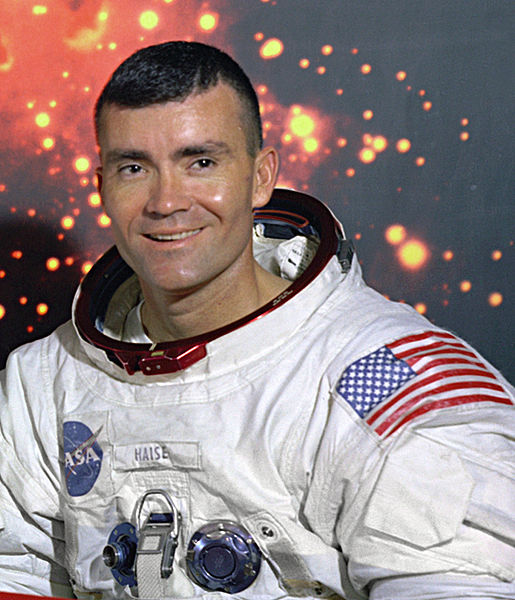
Astronaut Fred Haise in his Apollo 13 space suit. [Image courtesy: Wikimedia Commons.]

Fred Wallace Haise, Jr.was born in Biloxi, Mississippi, USA on his day in 1933. He is 79 years old.

His interest in flying happened by accident.  He was in junior college pursuing a career in Journalism when the Korean War broke out. Haise wanted to enlist

“The only program I could get into that would lead to a commission, which was my primary goal, was the Naval Aviation Cadet Program. So… I ended up in the flying business, which I loved.” [Johnson Space Center Oral History Project]

After being honorably discharged from the service –Haise went from the Cadet Program to the Marine Corps, served a tour of duty, then went into the Air National Guard —  he got his  BS in aeronautical engineering from the University of Oklahoma.

It was quite a path for a young man who had never been in a plane (not even for a commercial flight) prior to entering the Navy. He reckons he’s “flown about 80 types of aircraft.” [Ibid.]

While in the Oklahoma Air National Guard he was introduced to the idea of becoming a NASA research pilot. He was very interested, but the queue at Langley, Ames and Edwards Air Force Bases — NASA’s premier flight test centers at the time — was long. So Haise opted for Lewis Research Center. He worked for 7 years before entering the NASA astronaut program as a research pilot. This was the same path Neil Armstrong had taken three years ahead of him.

He was part of the “Original 19”  astronauts, nine of whom flew in the Apollo program and eight of whom flew in the Shuttle Program. Haise did both. He was a the back up Lunar Module Pilot for Apollo 8 and Apollo 11 and the back up commander for Apollo 16. But the flight he is best remembered for is Apollo 13.

Apollo 13 was slated to go to the Fra Mauro region of the Moon; deploy “a set of scientific experiments involved in the ALSEP [Apollo Lunar Surface Experiments Package] packages” [Ibid]  and do field geological work while on EVA.

English: S70-34854 (11 April 1970) --- The Apo...

English: S70-34854 (11 April 1970) — The Apollo 13 (Spacecraft 109/Lunar Module 7/Saturn 508) space vehicle is launched from Pad A, Launch Complex 39, Kennedy Space Center (KSC), at 2:13 p.m. (EST), April 11, 1970. The crew of the National Aeronautics and Space Administration’s (NASA) third lunar landing mission are astronauts James A. Lovell Jr., commander; John L. Swigert Jr., command module pilot; and Fred W. Haise Jr., lunar module pilot . (Photo credit: Wikipedia)

The mission took off from Kennedy Space Center, Florida on April 11, 1970. The crew included Commander by James Lovell, Lunar Module Pilot, Haise and Command Module Pilot, Jack Swigert. Swigert was a last-minute replacement for Ken Mattingly who was exposed to the measles and pulled off the primary crew a week before take off.

When the Saturn V rocket carrying the Apollo 13 crew was about 2/3rds to the Moon there was an explosion in the oxygen tank. Haise recalls:

‘I was still buttoning up and putting away equipment from a TV show we had completed, and… we were going to get ready to go to sleep. I knew it was a real happening, and I knew it was not normal and serious at…that instant. I did not necessarily know that it was life-threatening.” [Ibid]

He quickly went to his station where he encountered an “array of warning lights.” [Ibid] Haise looked at an instrument panel that read the pressure, temperature and quantity of the oxygen tanks. One had the needles at the bottom of all three gauges.

They had lost an oxygen tank, and, according to Mission Rules, that meant they had lost the Moon. They were now in abort mode.

Still, the situation didn’t seem life threatening. But after a few minutes it became evident that the second oxygen tank– the remaining tank — was also leaking.

“When it became obvious it was dwindling or losing oxygen, then the handwriting was on the wall that the command module was going to die and have to be powered-down.” [Ibid]

The crew transferred to the smaller Lunar Module.

Ground controllers in Houston faced a formidable task. Completely new procedures had to be written and tested in the simulator before being passed up to the crew. The navigation problem had to be solved; essentially how, when, and in what attitude to burn the LM descent engine to provide a quick return home. [NASA.gov]

Power and consumables were the first concern, but another danger, Carbon Dioxide, proved a hidden foe.

There were enough lithium hydroxide canisters, which remove carbon dioxide from the spacecraft, but the square canisters from the Command Module were not compatible with the round openings in the Lunar Module environmental system…Mission Control devised a way to attach the CM canisters to the LM system by using plastic bags, cardboard, and tape- all materials carried on board.[Ibid]

To navigate back to Earth the space craft was  put on a free-return course that required two burns of the engines. The first burn lasted  35 seconds and occurred  5 hours after the explosion. The second burn was 5 minutes and took place as they approached the Moon.

Apollo 13 crew aboard the USS Iwo Jima after splash in the Pacific. They are (l-r) Fred Haise, John Swigert and James Lovell. [Image courtesy: about.com]

Amazingly the three men in the capsule and the hundreds of people back at Mission Control were able to get the space craft back to Earth safely. Apollo 13 splashed down near Samoa  on April 17, 1970.

After Apollo 13 both Haise and Swigert had hopes of being assigned another Moon mission, but that did not come to pass.  (Swigert went on to become a member of the House of Representatives from Colorado in 1982 before dying of bone cancer.)  Haise stayed with NASA and worked on the Shuttle program.
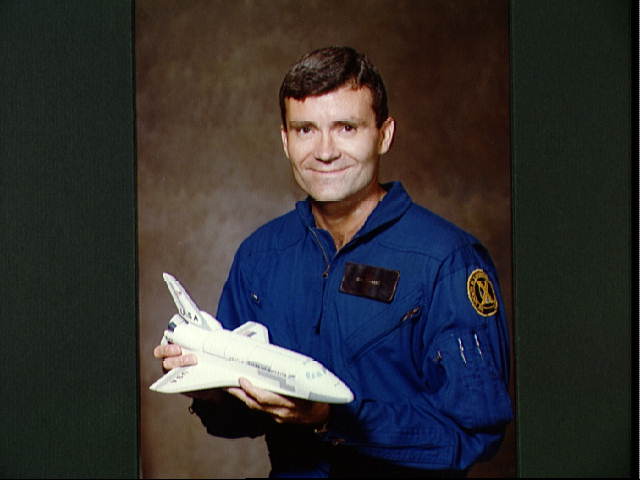
Portrait of Astronaut Fred H. Haise Jr. in flight suit holding a model of the space shuttle. [Image courtesy NASA]

He was commander of one of the two 2-man crews who piloted space shuttle approach and landing test (ALT) flights during the period June through October 1977. [Ibid]

There were a total of 8 “piggy back” flights that tested  the Shuttle’s critical glide, approach, landing, rollout, and flare capabilities.

After resigning from NASA in 1979 Haise became VP of Space Programs at Grumman Aerospace Corporation.

View of NASA 747 and T-38s flying over Shuttle Orbiter 101 “Enterprise” just after Haise and C. Gordon Fullerton landed the Shuttle on September 23, 1977. [Image courtesy NASA]


Thought of the Day 11.13.14 Steve Zahn

“Film is a strange thing.”
Steve Zahn

English: U.S. actor Steve Zahn

English: U.S. actor Steve Zahn (Photo credit: Wikipedia)


Steven James Zahn was born on this day in Marshall, Minnesota in 1967. He is 45 years old.

He started acting in high school when he discovered improv. After a year at Gustavus-Adolphus College and two years at the American Repertory Theatre he moved to New Jersey. Based in Hoboken he acted in New York and did odd jobs to pay the rent. He did a national tour of Bye, Bye Birdie directed by Tommy Tune. The gig last 13 months and Zahn met his future wife Robyn Peterman.


Cover of "That Thing You Do! - Tom Hank's...

Cover via Amazon

Zahn co-starred with Ethan Hawke in the play Sophistry  and Hawke recommended him for a part in the 1994 film Reality Bites. It was a break out role for Zahn and he followed it up with Crimson Tide and That Thing You Do!

He has made “an art out of portraying dysfunctional losers and likable freaks,” [AMG All Movie Guide: Steve Zahn] and he always made it look fun. From his turn as Rosencrantz in Michael Almereyda’s 2000 version of Hamlet to Wayne Wayne Wayne Jr. in Happy Texas it is hard to take your eyes off him when he is on-screen.


Cover of "Rescue Dawn"

Cover of Rescue Dawn

There are some dramatic roles in his CV, to be sure. For his part as Duane in Rescue Dawn. Zahn lost 40lbs.

He currently plays Jazz loving Davis McAlary on HBO’s Treme. He taps into his musical side for the show and sings and plays on screen.

Zahn lives on a farm in Kentucky with his wife and kids.  He raises hay on the farm because it is easy, it allows him time away from the farm to work, and it is just funny to say.


Thought of the Day 11.12.12 Grace Kelly

“Hollywood amuses me. Holier-than-thou for the public and unholier-than-the-devil in reality.”
–Grace Kelly


English: Studio publicity portrait for film Hi...

English: Studio publicity portrait for film High Society (Photo credit: Wikipedia)

Grace Patricia Kelly was born on this day in Philadelphia, Pennsylvania, USA in 1924. Today is the 88th anniversary of her birth.


Third of four children, Grace was born into a wealthy family of Irish and German background. The Kellys were athletic, her father, Jack, won three gold medals in the Olympics and her mother, Margaret, was the first female head of the University of Pennsylvania’s Physical Education Department. Her brother, John, also competed in the Olympics.


But Grace was drawn to acting. She modeled and acted in school plays starting at age 12.


At a young age, Grace decided she wanted to become an actress, and studied acting (primarily theater) at New York City’s American Academy of Dramatic Art and worked as a stage actress and model before moving to Hollywood. When in New York, Grace promoted Old Gold cigarettes and appeared on the covers of magazines such as Cosmopolitan and Redbook. [Grace Kelly Online — Biography]

She worked her way through the American Academy of Dramatic Arts by working as a model  on the side. At 19 she starred as Tracy Lord in the school’s performance of The Philadelphia Story (She reprised the role in High Society, her final film in 1956)


Television and stage gigs followed. Kelly played 39 roles on high brow television theatre shows such as the Kraft Television Theatre, the Philco-Goodyear Television Playhouse, and the Armstrong Circle Theatre. The shows were a hybrid of stage performances and scripted radio drama filmed live in front of a studio audience.


English: Screenshot of Grace Kelly and Clark G...

English: Screenshot of Grace Kelly and Clark Gable from the trailer of the film en:Mogambo (Photo credit: Wikipedia)

After a small role in Fourteen Hours her film career took off when she played the “mousey” Quaker bride” [Ibid] in High Noon in 1952. The following year  she went to Africa to shoot Mogambo with Clark Gable and Ava Gardner. Kelly was nominated for a best supporting actress Academy Award for the film.

1954 brought the first of three movies that Kelly did with director Alfred Hitchcock, Dial M for Murder. Here’s THE clip from the movie. [I think  it proves what a great actress she is… not just any actress can get this much drama out of one word and a pair of scissors.]

<iframe width=”560″ height=”315″ src=”http://www.youtube.com/embed/5QQjSUNVM7o&#8221; frameborder=”0″ allowfullscreen>

Her next movie with Hitch was Rear Window with Jimmy Stewart. There’s plenty of tension and murder here too, but there is also a huge helping of likeability too.  There is a lot of chemistry between Steward and Kelly. It’s dark, but it’s funny and romantic too. And Kelly’s Lisa Carol Fremont is soooo sophisticated and, well, graceful. [Rear Window is my favorite Grace Kelly movie and probably my favorite Hitchcock movie as well.]


Cropped screenshot from the trailer for the fi...

Cropped screenshot from the trailer for the film Rear Window (Photo credit: Wikipedia)

That same year, 1954, she also co-starred with [the always wonderful] William Holden in a Korean War drama, The Bridges at Toko-Ri; the South American emerald mining adventure, Green Fire; and as Bing Crosby’s wife in The Country Girl. Holden was the third leg of a romantic triangle in The Country Girl. Kelly’s performance as a woman torn between a verbally abusive, alcoholic, washed up husband and a charming, kind man who looks like WILLIAM HOLDEN won her an Academy Award.


English: Screenshot of Grace Kelly and Cary Gr...

English: Screenshot of Grace Kelly and Cary Grant from the trailer of the film en:To Catch a Thief (film) (Photo credit: Wikipedia)

In 1955 her last Hitchcock movie came out. In To Catch a Thief she co-starred with Cary Grant.


When a reformed jewel thief is suspected of returning to his former occupation, he must ferret out the real thief in order to prove his innocence. [IMDb]

Again Kelly’s onscreen chemistry with her co-star elevates a good movie to a great one. To Catch a Thief won the Academy Award for best picture that year.


Her next movie was The Swan with Alec Guinness and Louis Jourdan. She plays Princess Alexandra who needs to win the heart of Crown Prince Albert (Guinness) so her family can re enter the inner circle of court life. In real life Kelly was being courted by Prince Rainier III of Monaco whom she had met while attending the Cannes Festival. The engagement ring she wears in the movie is her real ring from Rainier. The studio timed the release of the film to corresponded with the date of the royal wedding.


Kelly’s last feature film was High Society, a musical reboot of The Philadelphia Story. In it Kelly and Crosby sing True Love, a song that went platinum — selling over a million records and and earning a best song Academy Award nod.


 Later that year, she married Prince Rainier Grimaldi III of Monaco to become Her Serene Highness Princess Grace of Monaco. As a princess, she gave up her successful acting career, in which she had made eleven films. She had three children: Princess Caroline, Prince Albert, and Princess Stéphanie. [Grace Kelly Online — Biography]

Wedding dress of Grace Kelly

Wedding dress of Grace Kelly (Photo credit: Wikipedia)

Kelly had a stroke while driving with her daughter Stephanie along the windy mountainside roads of Monaco. The car went off the road and Kelly suffered fatal injuries. She died on September 14th, 1982.


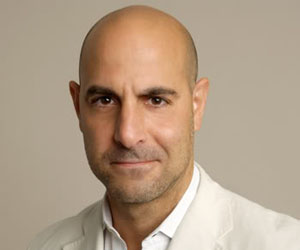
Thought of the Day 11.11.12 Stanley Tucci

“People wear shorts to the Broadway theater. There should be a law against that.”
–Stanley Tucci

Stanley Tucci was born on this day in Peekskill, New York in 1960. He is 52 years old.

His mom, Joan, was a writer and secretary and his father, Stanly, Sr., was an art teacher. His grandparents immigrated from Calabria Italy. He enjoyed playing soccer and baseball in school, and he acted in school plays. He went to SUNY Purchase where he got his BFA from the school’s Conservatory of Theatre Arts.

Tucci’s twin loves are acting and food — something he indulged in Big Night and Julie & Julia. [My personal favorite pair of Tucci films.]

He’s made 93 movies and television shows in his career thus far. [For a complete breakdown of his film credits go to his IMDb page  HERE] Starting 1985 with a bit part in Prizzi’s Honor and spanning nearly three decades to his role as Caeser Flickerman in the upcoming the Hunger Games: Catching Fire, Tucci has been a very busy man.

He’s a terrific collaborative actor and has been the backbone of many a movie. Think the Devil Wears Prada, orJulie and Julia for that matter,  in both he plays second fiddle to Meryl Streep. He never tries to out shine his co-star, but his performance is a little gem of acting goodness.

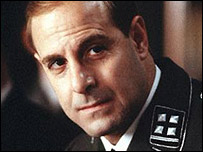
Movie still from Conspiracy [Image courtesy HBO]

Tucci also has the ability to take a one-dimensional character and breath so much life into it that he steals the picture. He’s done it with plenty of villains — most chillingly as Adolf Eichmann in Conspiracy and George Harvey in The Lovely Bones.

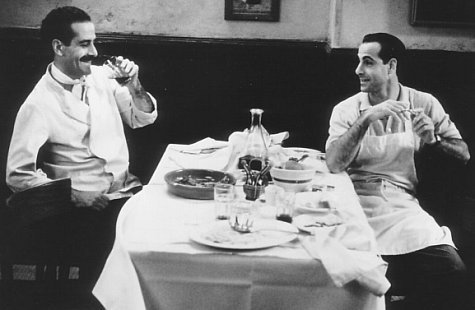
Still from Big Night.

When filming Big Night –which Tucci co-wrote, co-directed and starred in — he and his mother produced a short cook book called Cucina & Famiglia.  He worked with her again to put out The Tucci Cookbook“The Tucci Cookbook,” a paean to Italian cooking — and to Italian-American families…” [nytimes.com] was published in October. It’s a tribute to Tucci’s Italian grandmother who taught him his kitchen skills.

“The Tucci Cookbook,” in which the recipes are interlaced with reminiscences from two generations of Tuccis, suggests the meaty, saucy ways in which a love of food can bind and govern a family. That love has certainly shaped Stanley Tucci’s life and career, in which cooking and eating seem to be the glues for every relationship, the sidebars to every adventure, the grace notes of every achievement. [Ibid]

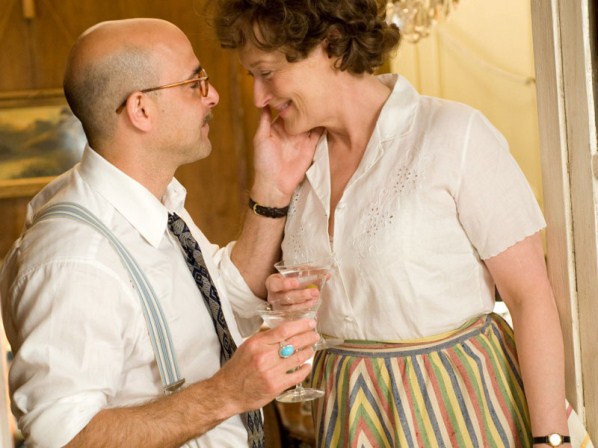
Still from Julie & Julia

When he was cast as Paul Child in Julie & Julia he called up Meryl Streep and encouraged her to research their roles by cooking together.

Mr. Tucci… is a proud and avid cook, and at his home in northern Westchester County, … his arsenal of equipment trumps what many restaurants have on hand. In addition to the six burners and acres of counter space in his kitchen, there’s a mammoth stone pizza oven, made in Italy, on the patio outside, along with a gas grill as large as a Fiat, a free-standing paella pan the size of a wading pool, and a coffinlike wood-and-aluminum roasting box, called a Caja China, that can accommodate up to 100 pounds of meat. He likes his dinner parties populous and his friends carnivorous.[Ibid]
You can also find him on Vine Talk reruns on PBS where he host a team of experts and celebrities as they talk casually (but knowledgeably) about everything from Cabernet to Chardonnay.


Thought of the Day 11.10.12 Neil Gaiman

“It has always been the prerogative of children and half-wits to point out that the emperor has no clothes. But the half-wit remains a half-wit, and the emperor remains an emperor.”

“The one thing that you have that nobody else has is you. Your voice, your mind, your story, your vision. So write and draw and build and play and dance and live as only you can.”

“The moment that you feel that just possibly you are walking down the street naked…that’s the moment you may be starting to get it right.”

— Neil Gaiman

Neil Gaiman

Neil Gaiman (Photo credit: Wikipedia)

Neil Richard MacKinnon Gaiman was born on this day in Portchester, Hampshire, England in 1960. He is 52 years old.

Gaiman is the oldest of three siblings. He learned to read at about four, and loved books from early on.

As a child he discovered his love of books, reading, and stories, devouring the works of C.S. Lewis, J.R.R. Tolkien, James Branch Cabell, Edgar Allan Poe, Michael Moorcock, Ursula K. LeGuin, Gene Wolfe, and G.K. Chesterton.  A self-described “feral child who was raised in libraries…as a boy were when I persuaded my parents to drop me off in the local library on their way to work, and I spent the day there.”[neilgaiman.com — biography]

He worked his way through the children’s section and  into the young adult literature. He did well at school because he’d already read all the books. Gaiman especially loved Tolkien’s The Lord of the Rings, which he got out from his school library. The only problem was the library only had The Fellowship of the Ring and The Two Towers, the third book was missing. When he won the school’s English prize for reading he was finally able to buy The Return of the King and finish the trilogy.

Hew also enjoyed C.S. Lewis’ Narnia series and Lewis Carol’s Alice in Wonderland — he read Alice so often that he had it memorized. But he also read more popular genres including science fiction and comic books (he was especially fond of Bat Man.)

Gaiman started his career writing pop bios for the music group Duran Duran and author Douglas Adams.

His first foray into the graphic novel genre  was with Terry Pratchett on Good Omens… The end of the world is at hand (it’s next Saturday) and the end game is coming to its inevitable conclusion.

Except that a somewhat fussy angel and a fast-living demon — each of whom has lived among Earth’s mortals for many millennia and has grown rather fond of the lifestyle — are not particularly looking forward to the coming Rapture. If Crowley and Aziraphale are going to stop it from happening, they’ve got to find and kill the Antichrist (which is a shame, as he’s a really nice kid). [Ibid  — works]

Cover of "The Sandman: Book of Dreams"

Cover of The Sandman: Book of Dreams

Gaiman worked on a number of comics  and graphic novels before being offered a chance to develop the Sandman series. The comic followed Morpheus (aka Sandman or Dream)

…There are seven brothers and sisters who have been since the beginning of time, the Endless. They are Destiny, Death, Dream, Desire, Despair, Delirium who was once Delight, and Destruction who turned his back on his duties. Their names describe their function and the realms that they are in charge of. Several years ago, a coven of wizards attempted to end death by taking Death captive, but captured Dream instead. When he finally escapes he must face the changes that have gone on in his realm, and the changes in himself. [Ibid  — works]

It first appeared in 1989 and spanned 10 years of single issues, collections and books.  This “dark, soulful, literary epic” [Guardian.co.uk] is thickly layered in mythology and beautifully written (and equally beautifully illustrated by a number of top comic book illustrators.) It is creepy and touching and magical.  [I read them as they came out, one issue at a time, and it was a thrill to watch it unfold.] The collections are available in bookstores  [but you wont have that feeling of angst and anticipation of the serialized comic book if you read it as a comic novel.]

American Gods

American Gods (Photo credit: Jhack❦)

Gaiman easily transitioned to novels with Neverwhere, Stardust, American Gods and Ananasi Boys. He won a Nebula Award for American Gods  which has just been re-released in an expanded version for its 10th anniversary. HBO is working on an adaptation of the novel.

Coraline

Coraline (Photo credit: M.J.Ambriola)

For children he spans the market from  illustrated book to chapter books — like his excellent Coraline and The Graveyard Book.  His picture books include:

M is for Magic’ (2007); ‘Interworld’ (2007), co-authored with Michael Reaves; The Day I Swapped My Dad for Two Goldfish (1997); The Wolves in the Walls’ (2003); the Greenaway-shortlisted ‘Crazy Hair’ (2009), illustrated by Dave McKean; ‘The Dangerous Alphabet (2008), illustrated by Gris Grimly; Blueberry Girl (2009); and ‘Instructions’ (2010), illustrated by Charles Vess. [neilgaiman.com — works]

Here is Gaiman reading the Blueberry Girl.

He’s written screenplays for his own Neverwhere, MirrorMask and English translation of Miyazaki’s Princess Mononoke. He co-wrote the screenplay for the 2007 version of Beowulf. Recently he fulfilled a lifelong dream by writing an episode of Dr. Who (“The Doctor’s Wife”)

At the San Diego Comic-Con this year Gaiman confirmed that he will release a prequel to the Sandman series.

“When I finished writing The Sandman, there was one tale still untold – the story of what had happened to Morpheus to allow him to be so easily captured in The Sandman No 1, and why he was returned from far away, exhausted beyond imagining, and dressed for war.” [Guardian.co.uk]

Gaiman tours extensively with his wife, musician Amanda Palmer. If you happen to be in Pittsburgh, PA on November 14th you can catch him for “An Evening of Stardust” at Carnegie Music Hall. [Sadly I will not be there, but if you snag me a signed copy of Stardust I’ll be your friend forever.]


Thought of the Day 11.9.12 Benjamin Banneker

“Evil communication corrupts good manners. I hope to live to hear that good communication corrects bad manners.”

“The colour of the skin is in no way connected with strength of the mind or intellectual powers.”

“Presumption should never make us neglect that which appears easy to us, nor despair make us lose courage at the sight of difficulties”

Benjamin Banneker

Woodcut of Benjamin Bannecker

Woodcut of Benjamin Bannecker (Photo credit: Wikipedia)

Benjamin Banneker was born on this day outside Ellicott City, Maryland USA  in 1731. Today is the 281st anniversary of his birth.

His maternal grandmother, Molly Walsh, had been an indentured servant who came to colonial Maryland from Ireland. At the end of her seven years of bondage she bought a small farm and two slaves. Eventually she freed the slaves, marrying one of them, Bannaky. Their daughter Mary Bannaky married a slave named Robert (who may have been a fugitive; may have been freed after the wedding;  or may have been bought out of slavery after the wedding).  Mary and Robert had four children, Benjamin and his three younger sister.

All of the children had to help run the tobacco farm. They weeded the tobacco plants, picked worms and caterpillars off the leaves… by Benjamin’s calculation it took 36 chores to raise a crop of tobacco. He also cared for the farm animals, helped plant the corn, and did other farm chores with this father.

His maternal grandmother used a Bible to teach Benjamin (and her other grandchildren) how to read.

He learned to play the flute and the violin, and when a Quaker school opened in the valley, Benjamin attended it during the winter where he learned to write and elementary arithmetic. He had an eighth-grade education by time he was 15, at which time he took over the operations for the family farm. He devised an irrigation system of ditches and little dams to control the water from the springs (known around as Bannaky Springs) on the family farm. Their tobacco farm flourished even in times of drought. [Mathematicians of the African Diaspora]

It was at school that a teacher suggested he change his last name to the more anglicized Banneker, the rest of the family followed suit.

He loved to read and to do arithmetic . He taught himself advanced mathematics and eventually astronomy.

He would borrow books from his neighbors and friends. His close friends, the Ellicott brothers, lent him most of their books. [American Heroes: Benjamin Banneker]

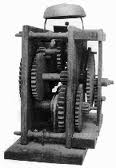
A clock similar to the one Banneker made.

He loved puzzles and challenges too.

Sometime in the early 1750s, Benjamin borrowed a pocket watch from a wealthy acquaintance, took the watch apart and studied its components. After returning the watch, he created a fully functioning clock entirely out of carved wooden pieces. The clock was amazingly precise, and would keep on ticking for decades. As the result of the attention his self-made clock received, Banneker was able to start-up his own watch and clock repair business. [Famous Black Inventors]

He predicted the solar eclipse of 1789. He earned the nickname the “Sable Astronomer” He started to compile information into Almanac and Ephemeris of Pennsylvania, Delaware and Maryland best-selling almanacs. He even put a skylight in the ceiling of his cabin so he could watch the stars at night. He sent a copy of his almanac to Thomas Jefferson along with “a letter urging the abolition of slavery.” [Ibid]

When Banneker was 60 George Washington appointed him along with his friend Andrew Ellicott to survey what would become the District of Columbia.

A contemporary reprint of Andrew Ellicott's 17...

A contemporary reprint of Andrew Ellicott’s 1792 “Plan of the City of Washington in the Territory of Columbia” (Photo credit: Wikipedia)

Banneker and Ellicott worked closely with Pierre L’Enfant, the architect in charge. However, L’Enfant could not control his temper and was fired. He left, taking all the plans with him. But Banneker saved the day by recreating the plans from memory. [Mathematicians of the African Diaspora]

[For more on Pierre L’Enfant visit his Thought of the Day bioBlog HERE]

He published a treatise on bees, did a mathematical study on the cycle of the seventeen-year locust, and became a pamphleteer for the anti-slavery movement. [Mathematicians of the African Diaspora]

On October 9, 1806 Banneker died at his Ellicott City/ Oella farm.

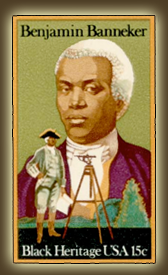
The Banneker postage stamp. [Image courtesy: USPS]

In 1980, the U.S. Postal Service issued a postage stamp in his honor. [Benjamin Banneker Center]

Benjamin Banneker

Benjamin Banneker (Photo credit: crazysanman.history)


Thought of the Day 11.8.12 Margaret Mitchell

“Death and taxes and childbirth! There’s never any convenient time for any of them”
–Margaret Mitchell

Margaret Mitchell all set to launch cruiser af...

Margaret Mitchell all set to launch cruiser after long training as Red Cross launchee / World Telegram & Sun photo by Al Aumuller. (Photo credit: Wikipedia)

Margaret Munnerlyn Mitchell was born on this day in Atlanta, Georgia, USA in 1900. today is the 112th anniversary of her birth.

Mitchell was the younger of two children born to an Atlanta attorney and suffragette. Her father’s family stretched back to colonial Georgia, and he had ancestors who fought in the War of Independence and the War of 1812. Her paternal grandfather was wounded twice in the head at Battle of Antietam, but he survived. After the war he made a fortune selling lumber to an Atlanta eager to rebuild.  Her mother’s people were from Ireland. Her maternal grandfather, Philip Fitzgerald, came over to America and bought a plantation in Georgia. He too fought in the Civil War.

If all of that has the Tara theme of Gone With The Wind playing in your head… well, lets just say Mitchell wrote what she knew, and growing up she was fed a steady diet of Old South stories along with the collard greens and fried chicken that graced every good Georgian table.

As a child Margaret Mitchell was saturated with stories of the Civil War told to her by family members who had lived through it. They indoctrinated her so effectively that Mitchell was ten years old before she learned that the South had lost the war. [Book Rags: Encyclopedia of the World]

Her mother was strict– she was “quick with the hairbrush whenever she thought her daughter was acting spoiled or ill-mannered.”[ReoCities; Margaret Mitchell] — When Mitchell came home from her first day of school frustrated at not being able to do the math and vowing not to go back Maybelle Mitchelle beat the little girl’s bottom with a hairbrush then took her in the carriage on a tour of ruined plantations near Atlanta.

‘ “Fine and wealthy people once lived in those houses,” she told the child, slowing the horses and pointing at the shabby former plantation houses they passed. “Now they are old ruins and some of them have been that way since Sherman marched through. Some fell to pieces when the families in them fell to pieces. …Now, those folk stood as staunchly as their house did. You remember that, child — that the world those people lived in was a secure world, just like yours is now. But theirs exploded right from underneath them. Your world will do that to you one day, too, and God help you, child, if you don’t have some weapon to meet that new world. Education!…People — and especially women — might as well consider they are lost without an education, both classical and practical… You will go back to school tomorrow,” she ended harshly, “and you will conquer arithmetic.” [Ibid]

Mitchell went back to school.

She was an avid reader and story-teller. She would snatch up her older brother’s books when he was finished with them. She loved sharing time with Maybelle as her mother read Mary Johnson’s historical/romance novels to her — they especially liked the ones dealing with the Old South. And she was a life long fan of children’s contemporary fantasy author Edith Nesbit. She told stories to her brother and his friends and made up plays for her school mates. She’d write the stories down and illustrate them. She created her own “publishing company” called “Urchin Publishing Co.” By 13 she’d written a 237 page book of Civil War stories.

When the First World War broke out Mitchell’s older brother joined up. She volunteered at refuge center. Toward the end of the war she met Lieutenant Clifford West Henry. He could

… quote poetry and passages from Shakespeare. Some of Margaret’s friends thought that he was of weak personality, strongly contrasting to Margaret’s, and was unmanly. But Margaret was quite taken by him. Clifford soon gave her a heavy gold family ring. In August, however, Clifford was told he was to be transferred overseas, and that night, he and Margaret secretly got engaged. [Ibid]

Mitchell went off to Smith College and Clifford went to war. At first she didn’t like Smith, which she called ‘a crusty old place,’ but soon enough she grew accustomed to it and the chic,  sophisticated, northern fellow students. They thought ‘Peggy’ cut a very romantic figure with her southern accent and her letters from an overseas lover.  Sadly in October Clifford died from shrapnel wounds he received from air bomb.

Mabelle  was sick too, but the news was kept from Mitchell. Her mother died  in January from the influenza epidemic and Mitchell returned home to take care of the household.

In 1922 she married Berrien Kinnard “Red” Upshaw, “an ex-football player and bootlegger.” [Margaret Mitchell House]  He was  “broad-shouldered, six feet and two inches, had brick-red hair, green eyes, and a cleft chin.”[ReoCities; Margaret Mitchell] so he towered over Mitchell, who was just 5 feet tall. Red was also violent and unpredictable. He physically and verbally abused Mitchell and marriage only lasted a few months.

Finances were not good. Her father had suffered financial setbacks. So, in 1922, Mitchell took a job as a features writer for the Atlanta Journal Sunday Magazine for $25 a week.

In 1925 she found true love with John Marsh. “Marsh was soft-spoken, not as tall as Red, and not extremely attractive. He was stoop-shouldered, wore glasses over his grey brown eyes, and had sandy hair which was receding and flecked with grey.” [Ibid] He’d long been  Red and Mitchell’s friend, and was the best man at their wedding. Whenever Red went too far Marsh was the first phone call Mitchell made. When things finally fell apart he was there to pick up the pieces, and Margaret Mitchell, finally, saw who the “best man” in the scenario really was.

English: Photograph of the Margaret Mitchell H...

English: Photograph of the Margaret Mitchell House in Atlanta, Georgia, USA taken by Jin-Ping Han on January 30th 2006 using a Canon Inc. Powershot S400 digital camera Category:Images of Atlanta, Georgia (Photo credit: Wikipedia)

When Mitchell injured her ankle in a car accident in May of 1926 she was bedridden for several weeks. Marsh dutifully stopped at the library to pick up stacks of novels for her to read. By the time she was able to hobble about on crutches she’d read her way through the library. Mitchell folk-lore has it that the next time he came home it was with a Remington Portable No. 3 typewriter. He gave it to her saying that she could write a better book than the thousands he’d been lugging back and forth.

She had no outline, but her authentic background gave her guidelines and structure. The story would commence with the war and end with Reconstruction, and it would be the story of Atlanta during that time as much as it would be the story of the characters she created. She did not come to the typewriter cold. She knew the story would involve four major characters, two men and two women, and that one of the men would be a romantic dreamer like Clifford Henry; and the other, a charming bounder like Red Upshaw…[Ibid]

For the women she would choose a paragon of Southern virtue for one character and some one  who was strong, hot-headed and “a bit of a hussy.” [Ibid] In other words some one vaguely like her maternal grandmother and herself. At first her heroine was named Pansy O’Hara.

She wrote ferociously 6 to eight hours a day “She kept index-card files for the characters, no matter how minor they were.” [Ibid] but the novel took years to complete.

Gone with the Wind cover

Gone with the Wind cover (Photo credit: Wikipedia)

Gone With the Wind was published in June 1936. Mitchell was awarded the Pulitzer Prize for her sweeping novel the following May.[Margaret Mitchell House]

It was a Book of the Month main selection. Mitchell won the Pulitzer Prize for fiction in 1937 and the book sold eight million copies by the time of her death.   Selznick-International purchased the movie rights for $50,000 shortly after its publication.

It was made into an equally famous motion picture starring Vivien Leigh and Clark Gable. The movie had its world premiere at the Loew’s Grand Theater in Atlanta December 15, 1939. [Ibid]

The film won 10 Academy Awards.

Mitchell “spent the rest of her life shepherding her book through many foreign editions, protecting her financial and copyright interests, and answering her extensive fan mail.” [Book Rags: Encyclopedia of the World]

Margaret Mitchell was killed by a drunk driver while crossing an Atlanta street in August 1949.

Mitchell's grave in Oakland Cemetery in Atlanta

Mitchell’s grave in Oakland Cemetery in Atlanta (Photo credit: Wikipedia)


Thought of the Day 11.7.12 Marie Curie

Well, I think my blog got hit with some residual radiation or something today. For some reason the text/formatting has just gone off the hook wacko. And I’ve run out of time and patience trying to trouble shoot it. I KNOW Madame Curie wouldn’t give up… but I am. Sorry, dear readers. I hope you can read past the odd formatting and enjoy this profile of this amazing woman…

————————————————————————————————————-


N o t h i n g   i n   l i f e   i s   t o   b e   f e a r e d .   I t   i s   o n l y   t o   b e   u n d e r s t o o d .
– –   M a r i e   C u r i e

Polish/French physicists Marie Curie

Polish/French physicists Marie Curie (Photo credit: Wikipedia)


M a r j a   S a l o m e a   S k l o d o w s k a     w a s   b o r n   i n   W a r s a w ,   P o l a n d   i n   1 8 6 7 .   T o d a y   i s   t h e   1 4 5 t h   a n n i v e r s a r y   o f
h e r   b i r t h .
P o l a n d   a t   t h e   t i m e   w a s   u n d e r   C z a r i s t   R u s s i a n   r u l e ,   a n d   M a r j a ‘ s   p a r e n t s   w e r e   n a t i o n a l i s t s .   H e r
p a r e n t s   w e r e   t e a c h e r s .   H e r   f a t h e r ,   L a d i s l a s ,   t a u g h t   M a t h   a n d   p h y s i c s ;   h e r   m o t h e r   r a n   a   b o a r d i n g
s c h o o l   f o r   g i r l s .   W h e n   R u s s i a n   t i g h t e n e d   t h e   r u l e s   o n   e d u c a t i o n   a n d   n o   l o n g e r   a l l o w e d   l a b o r a t o r y
i n s t r u c t i o n   i n   P o l i s h   s c h o o l s ,   L a d i s l a s   b r o u g h t   h o m e   t h e   l a b   e q u i p m e n t   a n d   h o m e   s c h o o l e d   h i s   c h i l d r e n .   H e   w a s   a l s o   v o c a l   i n   h i s   p r o – P o l i s h   s e n t i m e n t s   a n d   “ w a s   r e p e a t e d l y   f i r e d   a n d   d e m o t e d   f r o m
t e a c h i n g   p o s i t i o n s   o v e r   h i s   l o y a l t i e s . “   [ T h e   W r i t e r ‘ s   A l m a n a c ]     T h i n g s   g o t   w o r s e   w h e n   h e r   o l d e r
s i s t e r ,   Z o f i a ,   d i e d   o f   T y p h u s   w h e n   s h e   w a s   8 ,     a n d   t w o   y e a r s   l a t e r   h e r   m o t h e r ,   B r o n s i t w a ,   d i e d   o f
t u b e r c u l o s i s .
L a d i s l a s   r a i s e d   M a r j a   a n d   h e r   r e m a i n i n g   s i b l i n g s ,   J Û z e f ,   B r o n i s B a w a     a n d   H e l e n a .   M a r j a   w a s
b r i g h t   a n d   d i d   w e l l   w i t h   h e r   l e s s o n s .   S h e   w a s   s e n t   t o   b o a r d i n g   s c h o o l ,   b u t   w a s   u n a b l e   t o   g o   t o
u n i v e r s i t y   b e c a u s e   s h e   w a s   a   g i r l .   I n s t e a d   s h e   a t t e n d e d   “ T h e   F l o a t i n g   U n i v e r s i t y , “   a   s e c r e t
i n s t i t u t i o n   t h a t   t a u g h t   d e f i e d   t h e   R u s s i a n   a u t h o r i t i e s   a n d   t a u g h t   a   p r o – P o l i s h   c u r r i c u l u m .

D e t e r m i n e d   t o   g e t   a   p r o p e r   e d u c a t i o n ,   t h e   t w o   s i s t e r s   m a d e   a   p a c t   t o   t a k e   t u r n s   f u n d i n g   e a c h
o t h e r ‘ s   s c h o o l i n g .   M a r i e   t o o k   w o r k   f o r   t h r e e   y e a r s   a s   a   g o v e r n e s s   o n   a   s u g a r   b e e t   p l a n t a t i o n ,   w h i l e   s h e   f u n d e d   B r o n y a   t o   s t u d y   m e d i c i n e   i n   P a r i s .   . . . .   W h e n   s h e   f i n a l l y   g o t   h e r   o w n   c h a n c e   t o   s t u d y   a t
t h e   S o r b o n n e   i n   F r a n c e ,   M a r i e   t r a v e l e d   f o u r t h   c l a s s   w i t h   h e r   o w n   c h a i r   o n   t h e   t r a i n . . .   S h e   k e p t
w a r m   b y   w e a r i n g   e v e r y   p i e c e   o f   c l o t h i n g   s h e   o w n e d   a n d   w o u l d   g e t   s o   e n g r o s s e d   i n   s t u d y   t h a t   s h e
o f t e n   f a i n t e d   f o r   l a c k   o f   f o o d . . .   W i t h i n   a   f e w   y e a r s ,   s h e   g r a d u a t e d   t o p   o f   h e r   c l a s s   i n   p h y s i c s   a n d
m a t h .   [ I b i d ]

U p o n   g r a d u a t i o n   s h e   b e g a n   t o   i n v e s t i g a t e   t h e   m a g n e t i c   p r o p e r t i e s   o f   d i f f e r e n t   k i n d s   o f   s t e e l s .
S h e   m e e t   P i e r r e   C u r i e   w h e n   l o o k i n g   f o r   l a b   s p a c e .   “ T h e i r   p r o f e s s i o n a l   r e l a t i o n s h i p   s o o n   t u r n e d
r o m a n t i c ,   a n d   t h e   t w o   w e r e   m a r r i e d   i n   J u l y   1 8 9 5 . “   [ I b i d ]   M a r i e   r e c e i v e d   h e r   D o c t o r   o f   S c i e n c e
f r o m   t h e   S o r b o n n e .

M a r i e   C u r i e   w a s   n o t   a f r a i d   t o   t a k e   r i s k s .   H e r   f o r c e f u l   c h a r a c t e r   l e d   h e r   t o   a   l e v e l   o f   i n d e p e n d e n c e   u n u s u a l   f o r   h e r   t i m e .   I n   F r a n c e   d u r i n g   t h i s   p e r i o d ,   g i f t e d   w o m e n   w e r e   s c o r n e d   a n d   l o o k e d   d o w n
u p o n .   [ W i r e d . c o m ]

U n d a u n t e d   s h e   c o n t i n u e d   t o   p u r s u e   h e r   w o r k .   S h e   b e c a m e   f a s c i n a t e d   w i t h   F r e n c h   p h y s i c i s t   H e n r i   B e c q u e r e l ‘ s   w o r k   o n   u r a n i u m   c a s t   o f f   r a y s .

C u r i e   t o o k   B e c q u e r e l ‘ s   w o r k   a   f e w   s t e p s   f u r t h e r ,   c o n d u c t i n g   h e r   o w n   e x p e r i m e n t s   o n   u r a n i u m
r a y s .   S h e   d i s c o v e r e d   t h a t   t h e   r a y s   r e m a i n e d   c o n s t a n t ,   n o   m a t t e r   t h e   c o n d i t i o n   o r   f o r m   o f   t h e
u r a n i u m .   T h e   r a y s ,   s h e   t h e o r i z e d ,   c a m e   f r o m   t h e   e l e m e n t ‘ s   a t o m i c   s t r u c t u r e .   T h i s   r e v o l u t i o n a r y
i d e a   c r e a t e d   t h e   f i e l d   o f   a t o m i c   p h y s i c s   a n d   C u r i e   h e r s e l f   c o i n e d   t h e   w o r d   r a d i o a c t i v i t y   t o   d e s c r i b e   t h e   p h e n o m e n a .   [ B i o g r a p h y . c o m ]

M a r i e   a n d   P i e r r e   d i s c o v e r e d   a   t h e   r a d i o a c t i v e   e l e m e n t   p o l o n i u m   i n   1 9 8 9 ,   a n d   R a d i u m   i n   1 9 0 2 .
T h e   f o l l o w i n g   y e a r   M a r i e   C u r i e   b e c a m e   t h e   f i r s t   w o m a n   t o   r e c e i v e   t h e   N o b e l   P r i z e   i n   P h y s i c s .   “ S h e   w o n   t h e   p r e s t i g i o u s   h o n o r   a l o n g   w i t h   h e r   h u s b a n d   a n d   H e n r i   B e c q u e r e l ,   f o r   t h e i r   w o r k   o n
r a d i o a c t i v i t y . “   [ I b i d ]
I n   A p r i l   o f   1 9 0 6   P i e r r e   d i e d   t r a g i c a l l y   ( h e   w a s   h i t   b y   a   h o r s e – d r a w n   w a g o n ) ,   s h e   t o o k   o v e r   h i s
p o s i t i o n   a t   t h e   p h y s i c s   d e p a r t m e n t   a t   t h e   S o r b o n n e .   ( S h e   w a s   t h e   f i r s t   w o m a n   p r o f e s s o r   a t   t h e
S o r b o n n e .
I n   1 9 1 1   s h e   w o n   h e r   s e c o n d   N o b e l   P r i z e   – –   t h e   f i r s t   s c i e n t i s t   t o   d o   s o   – –   t h i s   t i m e   f o r   c h e m i s t r y .
I n   1 9 1 4   s h e   w a s   a p p o i n t e d   D i r e c t o r   o f   t h e   C u r i e   L a b o r a t o r y   a t   t h e   U n i v e r s i t y   o f   P a r i s .   D u r i n g
W a r   W o r l d   I   s h e   “ c h a m p i o n e d   t h e   u s e   o f   p o r t a b l e   X – r a y   m a c h i n e s   i n   t h e   f i e l d “ [ B i o g r a p h y . c o m ]     t h e   d e v i c e s   w e r e   n i c k n a m e d   “ L i t t l e   C u r i e s . “     A   d e c a d e   l a t e r   s h e   e s t a b l i s h e d   t h e   R a d i u m   I n s t i t u t e   i n   W a r s a w   w i t h   f u n d s   d o n a t e d   b y   P r e s i d e n t   H e r b e r t   H o o v e r   o f   t h e   U n i t e d   S t a t e s .   H e r   s i s t e r   B r o n i s l a w a
w a s   t h e   i n s t i t u t e ‘ s   f i r s t   d i r e c t o r .
I n   J u l y   o f   1 9 3 4   M a r i e   C u r i e   d i e d     f r o m   a p l a s t i c   a n e m i a .


Thought of the Day 11.6.12 John Philip Sousa

“Jazz will endure just as long people hear it through their feet instead of their brains.” –John Philip Sousa

John Philip Sousa, the composer of the song.

John Philip Sousa, the composer of the song. (Photo credit: Wikipedia)

I can’t think of any one who would make a better Thought of the Day Bio subject on Election Day 2012 than John Philip Sousa. He practically wrote the soundtrack for American patriotism AND he’s got a great mustache. What’s not to like?

He was born on this day in Washington, DC, USA in 1854. Today is the 158th anniversary of his birth.

He started his music career playing the violin, and soon added voice, piano, flute, cornet, baritone, trombone and alto horn to the mix.  After John Phillip tried to run away to join a circus band, his father, John Antonio Sousa,  “enlisted him in the Marines at age 13 as an apprentice…”[John Philip Sousa] in 1867.

He wrote and published his first composition “Moonlight on the Potomac Waltzes” in 1875 and was honorably discharged from the Marines two years later. Sousa “began performing (on violin), touring and eventually conducting theater orchestras. Conducted Gilbert & Sullivan’s H.M.S. Pinafore on Broadway.” [Ibid] While rehearsing Pinafore he met his wife Jane van Middlesworth Bellis.

In 1880 he returned to the US Marine Band as the Band’s leader, a post he kept for next 12 years.  Sousa conducted

“The President’s Own”, serving under presidents Hayes, Garfield, Cleveland, Arthur and Harrison. After two successful but limited tours with the Marine Band in 1891 and 1892, promoter David Blakely convinced Sousa to resign and organize a civilian concert band. [Ibid]

Sousa and his newly-formed civilian band, 1893

Sousa and his newly-formed civilian band, 1893 (Photo credit: Wikipedia)

Sousa wrote his own operetta, El Capitan in 1895.

He wrote 136 marches including Semper Fidelis March, King Cotton, Fairest of the Fair, Hands Across the Sea, And Stars and Stripes Forever — which he wrote in 1896. (In 1987 Congress proclaimed it the National March of the United States)

He designed a new type of bass tuba called the sousaphone. The Sousa Band toured throughout the world.

During World War I, Sousa joins the US Naval Reserve at age 62. He is assigned the rank of lieutenant and paid a salary of $1 per month…. After the war, Sousa continued to tour with his band. He championed the cause of music education, received several honorary degrees and fought for composers’ rights, testifying before Congress in 1927 and 1928.[Ibid]

Sousa died at the age of 77 in Reading, Pennsylvania after conducting a rehearsal. Fittingly, the last piece he conducted was Stars and Stripes Forever.

"Stars and Stripes Forever" (sheet m...

“Stars and Stripes Forever” (sheet music) Page 4 of 5 (Photo credit: Wikipedia)

Click HERE for a page with lots of audio clips of Sousa marches.

————————————-