Monthly Archives: October 2012

Thought of the Day 10.8.12 Frank Herbert

“There is no real ending. It’s just the place where you stop the story.”
–Frank Herbert
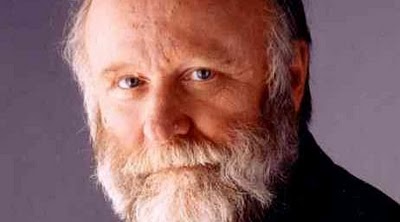
[Image courtesy: Otras musicas]


Frank Herbert was born on this day in Tacoma, Washington, USA in 1920. Today is the 92nd anniversary of his birth.

Frank’s mother came from a large Irish Catholic family (10 girls; 3 boys) (his invention of the Ben Gesserit for the Dune universe was likely an off shoot of the deep influence this gaggle of Aunts had on young Herbert’s life.) Frank’s father was a bus driver,  security guard, salesman, motorcycle patrolman and farmer. The family did a lot of traveling around before they settled on the farm.

Young Frank knew what he wanted be early in life.

On the morning of his eighth birthday Frank Junior famously announced to his family: “I wanna be a author.” (sic.) That day he wrote his first short story, which he called “Adventures in Darkest Africa.”  [Frank Herbert: The Works]

He was an explorer who thought nothing of paddling solo around Puget Sound to the San Juan Islands and back (200 miles) when he was ten or swimming across the Tacoma Narrows. He was also a great reader. “By the age of 12 he had, incredibly, already read the complete works of Shakespeare and discovered Ezra Pound.” [Frank Herbert: The Works]

Both Herbert’s parents were alcoholics and their drinking worsened as Frank entered his teen years. His sister, Patricia, was born when Frank was 13  and he took on parenting duties. By 1935 his parents were on the verge of a divorce. During high school he worked at his writing. He wrote short stories — he even wrote  novel, a boilerplate western, that he published under a pen name. He got a part-time job at the Tacoma Ledger. But by November of 1938 the situation at home had become too much. He left home with his baby sister and went to live with an aunt and uncle in Salem, Oregon. He graduated from North Salem High School and became a newspaper journalist. After a stint as a Photographer in the US Navy during WWII (he received a medical discharge because of a cranial blood clot he  developed after a fall)  he returned to Oregon and worked as a copy editor for the Oregon Journal in Portland. He worked for a number of west coast newspapers in a variety of cities for next two decades.

Besides his work in journalism: he lectured at University of Washington; he was a social and ecological consultant in Vietnam and Pakistan; and he wrote, directed and produced the documentary “The Tillers” based on the work of Roy Posterman.
[Image courtesy: Poor William’s Almanack]
 

Success on the fiction front was more difficult to come by. He had short stories published — his first was “The Survival of the Cunning,” a war story published in Esquire magazine.  In 1952 Herbert published his first science fiction story, “Looking For Something,” in Startling Stories. It is about a stage hypnotist who discovers that the entire world is under alien hypnosis. Other short stories followed, but no publishers seemed interested when Herbert showed them Dune.

The Dragon in the Sea
The Dragon in the Sea (Photo credit: Wikipedia)


In 1956  Herbert’s first novel, The Dragon in the Sea was published. It had been serialized in Astounding Magazine as”Under Pressure“.

 “he used the environment of a 21st-century submarine as a way to explore sanity and madness. The book predicted worldwide conflicts over oil consumption and production. It was a critical success, but it was not a major commercial one.”  [Biblio.com]

While working on an article about sand dunes for the US Department of Agriculture in Florence, Oregon he got the idea of a sand dune so big that it could swallow up whole cities. In 1965, Dune was finished, a labor of love more than six years in the making. It was serialized in the magazine Analog then largely revised and expanded into book form. It was rejected 20 times before little Chilton Books — an auto repair manual publisher —  took a chance on it.
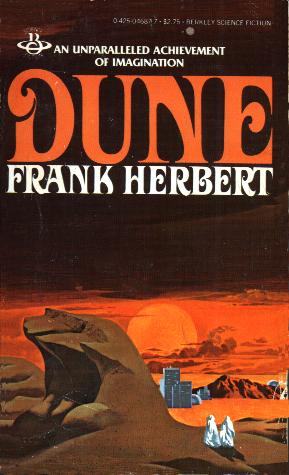
Dune cover art [Image courtesy: Book Wit]
 

Dune won the very first Nebula Award and was the co-winner of the Hugo Award. Published in 1965 it sets the scene for the Dune Series that follows — a series that is often considered the Lord of the Rings of Science Fiction. “Set on the desert planet Arrakis, Dune is the story of the boy Paul Atreides, who would become the mysterious man known as Muad’Dib. He would avenge the traitorous plot against his noble family–and would bring to fruition humankind’s most ancient and unattainable dream.” [Amazon.com review]

Dune was the first ecological science fiction novel, containing a multitude of big, inter-relating themes and multiple character viewpoints, a method which ran through all Herbert’s mature work. ” [Biblio.com]

Dune Messiah hit stores in 1969.   Children of Dune (1976)  was the first hardcover science fiction book to reach best-seller status. It was nominated for a Hugo Award.   And the spice kept flowing… God Emperor of Dune,  came out in 1981, followed by Heretics of Dune in 1984 and Chapterhouse: Dune in 1985.

Frank Herbert died of pancreatic cancer in 1986. But the Dune series lives on…Using Frank Herbert’s notes his son  Brian Herbert has co-authored additional Dune sequels with Kevin J. Anderson.

Frank Herbert Books
Frank Herbert Books (Photo credit: cobalt123)


Thought of the Day 10.7.12 John Cougar Mellencamp

“Forget all that macho shit, and learn how to play guitar.”
–John (Cougar) Mellencamp

Cover of "American Fool (Rpkg)"

Cover of American Fool (Rpkg)

John Mellencamp was born on this day in Seymour, Indiana, USA in 1951. He is 61 years old.

He had spinalbifida as baby. With a growth the size of a man’s fist on the back of his neck that was removed during a day-long operation when he was  three weeks old. His house was filled with music growing up, and Mellencamp learned to play guitar. He was troublemaker at school who drank, smoked, cursed and trolled for girls.

Mellencamp is first and foremost an American storyteller. His classic song Jack and Diane starts out “Little ditty about Jack and Diane /Two American kids growin up in the heartland…” He might as well have begun Once upon a time in a small town in the midwest.

“His songs document the joys and struggles of ordinary people seeking to make their way, and he has consistently brought the fresh air of common experience to the typically glamour-addled world of popular music.” [–Anthony DeCurtis]

He played in bands with names like “Crepe Soul,” “Trash,” “Snakepit Banana Barn” and “the Mason Brothers.” He spent more time partying and playing music than studying so he didn’t do well in school. At 18 he eloped with his older pregnant girlfriend while still a Senior in high school.

He worked odd jobs and took classes at community college, Vincennes, University where he binged on drugs and alcohol while listening to Roxy Music. But by 1974 he’d graduated from Vincesse, sobered up, and got serious about his career.

He cut a four song demo tape and moved to New York City. It took 18 months to get a manager,  Tony DeFries, and land a record deal, with MCA Records. DeFries is the one who came up with the idea of changing his Mellencamp’s last name to Cougar. It was all part of the pre-packaged “rebel” rock star that DeFries was putting together. And it was something Mellencamp didn’t know about until he saw the proofs for the album art  emblazoned with “Johnny Cougar.” No one, DeFries, thought, would buy records from some guy named Mellencamp. Thus Chestnut Street Incident, Johnny Cougar‘s first album was pressed in 1976 by MCA. The album was a mix of cover tunes and originals. It was hardly a chart topping effort and MCA declined to release a second album (The Kid Inside — it was released after Mellencamp made it big.) and “Cougar” and DeFries parted ways.

Mellencamp  signed  with Billy Gaff and release the album “A Biogrpahy” by Riva Records overseas. The single I Need a Lover  became a hit in Australia, and Pat Benatar had a top 40 hit with her cover of the tune. It became the single from his next U.S. album John Cougar.

He embraced his bad boy, rebel reputation with his next album and was rewarded with first top 40 album with Nothing Matters and What if It Did.

In American Fool he stripped away the pre-packaged pop of the Johnny Cougar /Chestnut Street Incident sound and went with two guitars, a bass and a drum to back up his raw, honest vocals. He found his voice as a singer songwriter and Jack and Diane were born. Other cuts from American Fool include: Hurt So Good and Hand to Hold On To.

Here is Hurts Good:

Pink Houses and Crumblin’ Down, two singles of Mellencamp’s 1983 album Uh-Huh hit #8 and #9 on the Billboard Top Ten.


Crumblin' Down

Crumblin’ Down (Photo credit: Wikipedia)

With Scarecrow he began to mix social issues with the music. The album was dedicated to his grandfather and sold 5 million copies. Singles Lonely Ol’ Night, R.O.C.K. in the U.S.A, and Small Town cracked the top 10 charts while  Rain on the Scarecrow became an American anthem.

Here’s Lonely Ol’ Night:

Mellencamp became active in helping farmers keep their farms when he worked with Willie Nelson and Neil Young to create FARM AID. Using the LIVE AID (see the 10.5.12 Thought of the Day on Bob Geldof ) Mellencamp et al held concerts to help American farmers who faced foreclosure. The first concert was in Champaign, Illinois on September 25, 1985 and raised over $9 million. Mellencamp and Nelson worked to bring farmers to US Congress to testify about plight of farmers, resulting in the Agricultural Credit Act. The effort continues, with the organizers coming together for annual concerts, and the organization (of which Mellencamp is a board member) establishing an emergency hot line for farm disaster relief when an area is hit with natural disaster.

Here’s Mellencamp performing Rain On The Scarecrow at Farm Aid 2008

For Lonesome Jubilee he added fiddle and backing vocals to his four piece band sound. The album garnered the hit singles  Paper in Fire, Check It Out and Cherry Bomb. It reached #1 on the Canadian Charts and #6 on US Billboard 200. 

Cover of "Lonesome Jubilee (Rpkg)"

Cover of Lonesome Jubilee (Rpkg)

After Big Daddy he stepped away from the music industry for three years and  took up a different artistic pursuit, painting. He used some of that art on the cover of his next album, Whenever We Want It.

While touring to promote his 1994 Dance Naked album he had a heart attack. Mellencamp smoked 5 packs prior to the attack. He started to eat a heart healthy diet and started to exercise and reduced the number of  cigarettes he smokes (but can’t seem to give them up all together.)

Mellencamp sept2000

Mellencamp sept2000 (Photo credit: Wikipedia)

He has put out 22 albums thus far and was inducted into the Rock and Roll Hall of Fame in 2008


“He’s painted little movies, little stories … a slice of America”  Kenny Aronoff, Mellencamp’s Drummer [A&E Biography]


Oh, you didn’t really think I’d leave you with out a little Jack and Diane, did you?


Thought of the day 10.6.12 David Brin

“When it comes to privacy and accountability, people always demand the former for themselves and the latter for everyone else.”
David Brin

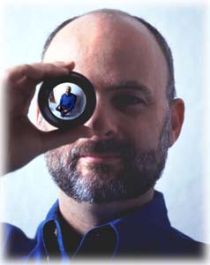
[Image courtesy: Scientific American.com]

David Brin was born on this day in Glendale, California, USA in 1950. He is 61 years old.

Brin is a graduate of the California Institute of Technology where he majored in astrophysics. He earned a Masters in applied physics and Doctor of Philosophy in space science from the University of  California, San Diego.

He is a consultant for NASA and the writer of  hard science fiction.

Brin serves on advisory committees dealing with subjects as diverse as national defense and homeland security, astronomy and space exploration, SETI and nanotechnology, future/prediction and philanthropy. His non-fiction book — The Transparent Society: Will Technology Force Us to Choose Between Freedom and Privacy? — deals with secrecy in the modern world. It won the Freedom of Speech Prize from the American Library Association. [The Worlds of David Brin]

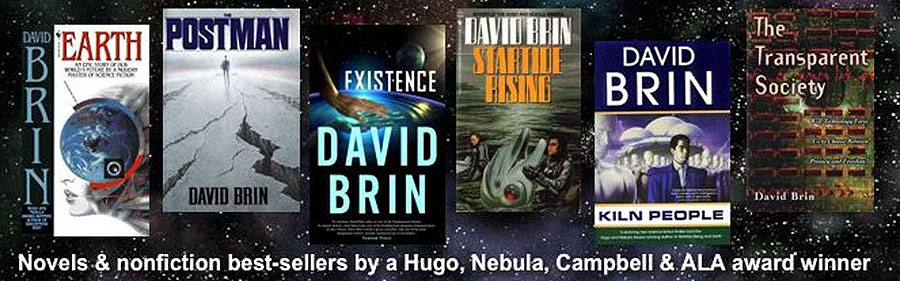
Some of Brin’s book covers. [Image courtesy: The worlds of David Brin]

Brin won two Hugo Awards for his Uplift series. The “Uplift Universe explores a future when humans genetically engineer higher animals like dolphins to become equal members of our civilization.” [The Worlds of David Brin] The books in the series are: Sundiver, Startide Rising (which won the Hugo, Locus and Nebula awards,) The Uplift War (which won the Hugo  and Locus awards) and The Uplift Trilogy: Brightness Reef, Infinity’s Shore and Heaven’s Reach.

Other books he’s written include:

  • The Postman (which won  a Campbell and Locus Award and — after some major reworking– was made into a movie starring Kevin Costner.)
  • Earth (which ” foreshadowed global warming, cyberwarfare and near-future trends such as the World Wide Web” [The Worlds of David Brin])
  • Kiln People (“a fast-moving and fun noir detective story, set in a future when new technology enables people to physically be in more than two places at once.”[The Worlds of David Brin])
  • Foundation’s Triumph (a book that “brings a grand finale to (Isaac) Asimov’s famed Foundation Universe.”  [The Worlds of David Brin]
  • Sky Horizon (Winner of the Hal Clement Award for Best Sci Fi for young readers.)
  • Existence (“Existence – is set forty years ahead, in a near future when human survival seems to teeter along not just on one tightrope, but dozens, with as many hopeful trends and breakthroughs as dangers… a world we already see ahead.” [Amazon.com]

He has a trio of Graphic Novels on the shelf: Forgiveness (A Star Trek the Next Generation graphic novel), The Life Eaters (a graphic novel that loooks at what the world would be like if WWII had ended differently) and Tinkerers.

On the nonfiction front Brin has written : The Transparent Society: Will Technology Force Us to Choose Between Privacy and Freecom?  (Won the Freedom of Speech Award) and Star Wars on Trail: Science Fiction and Fantasy Writers Debat the Most Popular Science Fiction Films of All Time.

[Image courtesy: The Worlds of David Brin]

He’s also written novels for young adults, short stories, and a plethora of articles (both fiction and non fiction) like the excellent guest blog in Scientific American  “Too Hard For Science?”
http://blogs.scientificamerican.com/guest-blog/2011/04/29/too-hard-for-science-david-brin-raising-animals-to-human-levels-of-intelligence/


Thought of the Day 10.5.12 Bob Geldof

“It’s really very simple, Governor. When people are hungry they die. So spare me your politics and tell me what you need and how you’re going to get it to these people.”
Bob Geldof

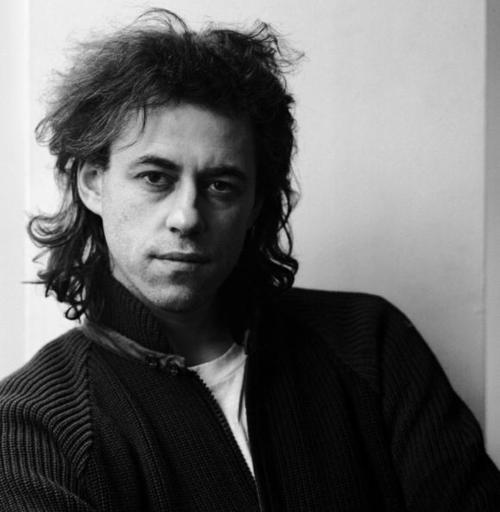
[Image courtesy: LastFM]

Robert Frederick Zenon Geldof was born on this day in Dun Laoghaire, County Dublin, Irelandin 1951. He is 61  years old.

After graduating from Black Rock College in Ireland, Geldof travelled to Canada to work as a journalist. In 1975 he co-founded the Dublin based punk band The Boomtown Rats for which he was the lead singer.  Rat Trap was their first #1 song on the New Wave charts in the UK. I Don’t Like Mondays brought the group international fame.

The band’s video  that song and for Up All Night scored high with MTV [Remember when MTV actually was known for introducing new music via music videos?]

Geldof as Pink in a still from Pink Floyd The Wall [Image courtesy: HQRock]

In 1982  Geldof played Pink in the movie Pink Floyd the Wall. 

Geldof  parted ways with the Rats in 1986 and sent solo. He co-wrote the beautiful This the World Calling with the Eurthmics’ Dave Stewart.

He worked with a variety of artist and continued to collaborate with David Gilmour of Pink Floyd. He sang Too Late God at the Freddie Mercury Tribute Concert (he co-wrote the tune with Mercury.)

Starting in the early 80s he performed in benefits like the Secret Policeman’s Ball for Amenesty International. By 1984 he came up with the idea of bring the pop music industry together for a concert to aid famine relief in Ethiopia. He co-wrote Do They Know It’s Christmas? With Midge Ure of Ultravox and brought together a supergroup of pop artist under the name Band Aid to the Sarm West Studios to record it.  The song eventually raised over 8 million pounds.

In July of 1985 Geldof and Ure expanded on the idea of Band Aid with a broadcast concerts, Live Aid. The concerts took place both in the UK, at Wembley Stadium, and in the US, at Philadelphia’s Kennedy Stadium. The BBC carried the whole thing live — all 16 hours of it. Geldof’s passionate, angry plea/demand for money helped the event raise over 150 million pounds in famine relief.  Live Aid set the standard for benefit concerts to come.

Geldof was knighted for his efforts.

Along with fellow rocker, Bono, he continues to work toward debt relief for developing countries. He is a member of the African Progress Panel, a watch dog group that keeps world leaders focused on their commitments to the African continent.

Bob Geldof at the Headquarters of the Internat...

Bob Geldof at the Headquarters of the International Monetary Fund in Washington, DC. (Photo credit: Wikipedia)


Thought of the Day 10.4.12 Buster Keaton

“Tragedy is a close-up; comedy is a long shot.”
Buster Keaton

Buster Keaton

Buster Keaton (Photo credit: twm1340)

Joseph Frank Keaton IV was born on this day in Piqua, Kansas, USA in 1895. Today is the 117th anniversary of his birth.

Keaton’s parents were vaudeville actors and he joined their act at age three. He got his nickname, Buster, when he fell down a flight a stairs and landed at Harry Houdini‘s feet. The magician picked him up and handed him to his mother saying “What a buster.”

Physical comedy and slapstick was part of the family act — redubbed “The Three Keatons” when Buster became a permanent fixture.  The little boy was

knocked over, thrown through windows, dropped down stairs, and essentially used as a living prop. It was this training in vaudeville that prepared him for the fast-paced slapstick comedy of the silent movies. [American Masters: Buster Keaton]

Keaton later noted that “It was the roughest knockout act that was ever in the history of the theater.” [Buster Keaton.biography] He knew how to land and never got hurt from the onstage antics as “the little boy who can’t be damaged,” he enjoyed flying about the stage so much that he would giggle when his father tossed him about. But when he realized that the audience liked the heightened sense of danger, Buster  developed his famous “deadpan face.”

Buster Keaton

Buster Keaton (Photo credit: Wikipedia)

Buster moved to Hollywood at 22 and began to work with Fatty Arbuckle. His first film was The Butcher Boy in 1917. Arbuckle was already an established comedian and he became Keaton’s mentor. Keaton earned $40 a week for his work with Arbuckle, and the two worked together until 1920 when Keaton was confident enough to go it alone.

He made a number of “two-reelers,” or shorts, and then feature films including One Week, The Playhouse, Cops, The Camera man, Steamboat Bill, Jr.Our Hospitality, Sherlock. Jr. and The General.  

Here’s the classic “hat” scene from Steamboat Bill, Jr...

He did all his own stunts — instructing the cameras to keep rolling “no matter what” until he yelled “cut” or he died.  And he didn’t use special effects.In another scene from Steamboat Bill, Jr. Keaton stands outside a dilapidated house. The front of the house (a 2 ton facade) falls on him, and he happens to be standing where an open window lets him escape injury. It is not a very big window (there is a much bigger on right next to him) and it must have taken both a lot of mathematics and a lot of courage to do the stunt, but it made for some movie magic…

The General is considered one of the greatest silent films ever made now, but when it came out the reception was tepid.  It resulted in Keaton’s switch to MGM studios, something he regretted for the rest of his career.  Keaton thought The General was his greatest movie, and the public, eventually, came around to his point of view. In 1989 the National Film Registry added The General  to its list. Roger Ebert named the film  the #1 greatest film of the silent era.

Buster Keaton

Buster Keaton (Photo credit: twm1340)

MGM let him make one more truly classic “Buster style” film, The Cameraman in 1928, but then MGM lowered the boom and  took away his creative control. How sweet is this scene from the Cameraman?

With the studio calling the shots Keaton became just another comic actor. He had a number of hits in the 30’s, many of them with Jimmy Durante at his side, but he lacked the stoic charm and the ownership of his previous movies. He worked on Marx Brothers and Red Skelton movies — uncredited — and did what he could to make a living.

Screen shot from Sunset Boulevard. [Image courtesy: Bobby Rivers TV]

In  1950 he played himself as a member of the “waxworks” in Billy Wilder‘s Sunset Boulevard and then in 1953 he was in  Charlie Chaplin’s Limelight. Interest in his old movies revived and he started to make television appearances. Paramount made a movie about his life, The Buster Keaton Story starring Donald O’Connor.

 “…By the 1960s, his films were returning to the theaters and he was being hailed as the greatest actor of the silent era.” [American Masters: Buster Keaton]

He was given an Honorary Academy Award “for his unique talents which brought immortal comedies to the screen” in 1960.

Keaton passed away on February 1, 1966. He was suffering from Cancer.


Thought of the Day 10.3.12 Clive Owens

“The sexiest part of the body is the eyes. That’s what I believe.”
Clive Owen


Clive Owen was born on this day in Coventry, West Midlands, England. he is 48 years old.

He grew up in a the small working class town of Coventry. He is fourth in a brood of five boys. His father exited the scene when Clive was 3, and he was raised by his mother and step father. He starting acting at 13 when he was cast as the Artful Dodger in a school play. (And there has been a little bit of the Artful Dodger in almost every role he’s played since.) He says he became “completely obsessed and decided to become an actor from then on.” He moved on to the Royal Academy of Dramatic Art in London in 1987. The audition process was daunting, two monologues, one modern and one from Shakespeare. If you nailed it you were in, if you didn’t, you weren’t. He nailed it. After RADA he continued doing Shakespeare at the Young Vic.

From theatre he moved to television. His most notable series being  Chancer –where he played a con-man with a heart of gold, he’s an anti-hero who is willing to use all the arrows in his –checkered past’s– quiver to help his friends. As the show’s tag line says “He’s rude, arrogant, ingenious, unprincipled … and utterly charming.”   [Owen’s is still growing into himself as an actor in Chancer. He’s good, but he’s not great. And The production values are definitely television level.]


Cover art for Croupier.

His big break in film came in the 1998 movie Croupier. Owens plays a an aspiring writer who takes a job as casino croupier to both pay the bills and help with research on a book. Owens narrates the movie in his deadpan quasi-noir style. [It is well written and well acted, and deserves a place on your Clive Owen’s Netflix queue.]

<iframe width=”420″ height=”315″ src=”http://www.youtube.com/embed/JhQpMqJMdnw&#8221; frameborder=”0″ allowfullscreen>

He shifted gears to play Colin Briggs a prisoner in an experimental English prison who gets rehabilitated  through gardening in Greenfingers. Helen Mirren also stars. [I really enjoyed this gentle movie. Although it is largely set in a prison it isn’t filled with the violence that is so often present in a Owen’s film. Make this #2 for your C.O. Netflix queue.]

<iframe width=”420″ height=”315″ src=”http://www.youtube.com/embed/lzvwH5EhNTI&#8221; frameborder=”0″ allowfullscreen>

Back on BBC One he starred in Second Sight as Chief Inspector Ross Tanner a detective who is loosing his eye sight.

He played a key role in Robert Altman’s ensemble film Gosford Park. [There’s so much to see in Gosford Park you’ll probably need to watch it more than once. Plus…Maggie Smith bonus!… put it in your queue.]

<iframe width=”560″ height=”315″ src=”http://www.youtube.com/embed/CjXdmXhwIQk&#8221; frameborder=”0″ allowfullscreen>

On stage he appeared as Dan both in the West End and Broadway versions of Closer. When the show was made into a movie in 2005 he switched roles and played Larry. He garnered a Golden Globe and BAFTA award for the film.

He followed Closer with a trio of films, Derailed, Sin City andInside Man in quick succession He was rumored to be the next James Bond, but the producers chose Daniel Craig instead. Which is fine because it left him open to take his best role to date, Theo Faron in Alfonso Cuaron’s Children of Men.

Children of Men is a gritty dystopian look at life in 2027 England. “It’s a heartbreaking, bullet-strewn valentine to what keeps us human.” (–Keith Phipps) and is loosely based on the P.D. James novel of the same name. Owen, whose characters are often anti heroes who spend a movie reacting to shit that thrown at them, is the anti-ist of heroes who has the most shit ever thrown at him in the roughly 100 minute running time of the film. And he is wonderful in it. [This is my favorite Owen’s movie and my number one pick for your Netflix queue.]

He is good in other films, Elizabeth: The Golden Age, King Arthur, andInside Man; and just OK in a slew of films where he always seems to play the same guy with a gun.  He was very funny poking fun at his leading man image in a guest spot on the Ricky Gervais show Extras. [ I didn’t make it through the HBO Hemingway & Gellhorn, (I’m not sure if was a too tense Nicolle Kidman, the excess of sex, Clive’s mustache, or a combination of  all three, but  I gave up about 45 minutes in.) There are a couple of films I’m looking forward to seeing– The Boys Are Back and Shadow Dancer both look interesting. ]

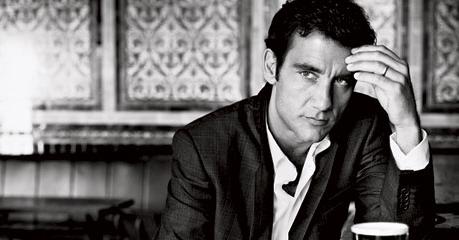
[Image courtesy: The Movie Blog]

He met his wife when they were cast opposite each other as Romeo and Juliet 20 years ago. For an actor considered an international sex symbol/tough guy he is very family oriented. He does a movie for several months then comes home where he enjoys being a homebody/nobody. They have two pre-teen girls.


Thought of the Day 10.2.12 Don McLean

American Pie (album)

Donald McLean was born on this day in New Rochelle, NY in 1945. He is 67 years old.

McLean had severe asthma as a child and missed a lot of school. He loved to sit and listen to his father’s large record collection while at home. Consequently his studies didn’t progress very quickly, but his love of music grew. As a teen he bought a guitar and took opera lessons. He worked on his breathing and got a handle on his asthma.

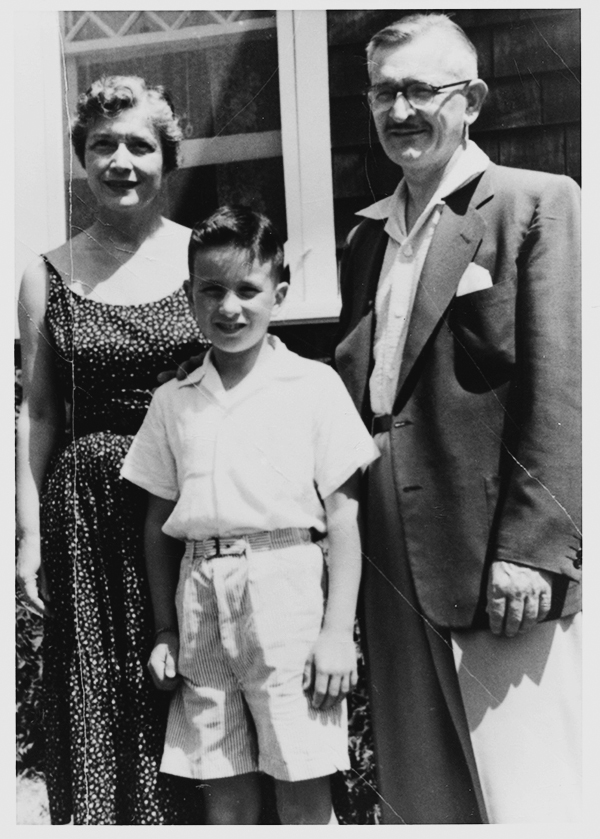
McLean with his parents. (Image courtesy: Don McLean Online]

When McLean was 15 he lost his father. It was his father’s death along with President Kennedy’s assassination and death of Buddy Holly that formed the catalyst for his most famous  song, American Pie.

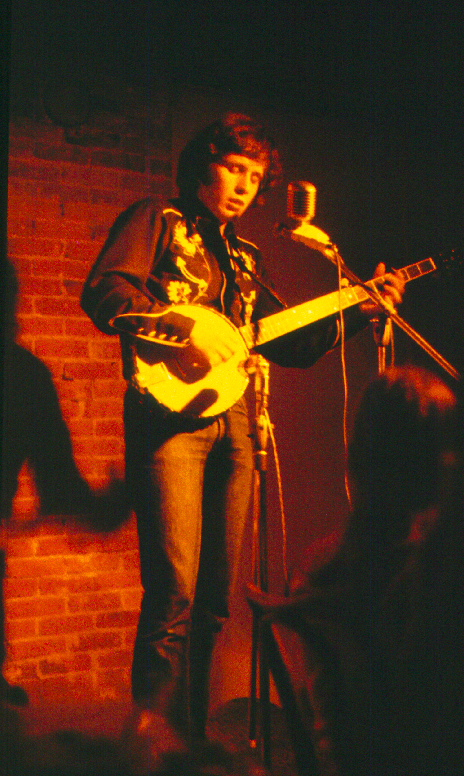
As a teen he began to work his way up through the music industry. McLean thought of himself as an American folk Troubadour, and he resisted efforts to be molded into other musical styles. He briefly attended Villanova University in 1963, where he met fellow songwriter Jim Croce, before dropping out to pursue music full-time. He worked the club, cafe, and college circuit appearing along with folk headliners like Arlo Guthrie, Pete Seeger and Janis Ian. McLean continued his education at night at Iona College.

McLean was offered a scholarship to attend Columbia for grad school, but he opted for a resident gig at Caffe Lena in NYC. Photo by Joseph Deuel. [Image courtesy: Don McLean Online.]

He worked with Pete Seeger in the group Sloop Clearwater, then put out his first solo album Tapestry. (1969). The album did well, but didn’t sky-rocket him to success. Singles include Castles in the Air and And I Love You So.

[Image courtesy: last.fm]

Here’s Castles in the Air [Besides Don’s smooth voice and great guitar playing, just listen and look as that bass player walks the bass line up and down the fret board,  I’m impressed.]

His second album, American Pie, was recorded in May of 1972.  The title song became a folk/rock anthem (and was voted the #5 Song of the Century by Recording Industry Association of America and the National Endowment for the Arts.) McLean was really a paper boy when he found out about the plane crash that killed Buddy Holly, so the song

:.. is partly biographical and partly the story of America during the idealized 1950s and the bleaker 1960s… “American Pie” presents an abstract story of McLean’s life from the mid-1950s until the end of the 1960s, and at the same time it represents the evolution of popular music and politics over these years… metaphorically the song continues to evolve to the present time…” [Don McLean Online]

[For all the lyrics scroll down to the bottom of this post.]

For Vincent, the second single on American Pie, McLean was inspired by  a book he was reading about Vincent Van Gough.

Other McLean hits include:

  •  Crying, his cover the Roy Orbison song.
  • Wonderful Baby which was not only influenced by Fred Astaire, but was also recorded by Astaire.
  • Till Tomorrow 
  • Babylon http://youtu.be/HpydaQgOviA?t=3m33s
  • He’s Got You, a cover the Patsy Cline standard

McLean has 24 albums to his credit and he continues to tour internationally (and have a great time on stage.) He’s in the UK this month.

Don McLean at Town Hall, NYC

Don McLean at Town Hall, NYC (Photo credit: ShellyS)

American Pie

Verse 1
A long long time ago
I can still remember how that music used to make me smile
And I knew if I had my chance
That I could make those people dance
And maybe they’d be happy for a while
But February made me shiver
With every paper I’d deliver
Bad news on the doorstep
I couldn’t take one more step
I can’t remember if I cried
When I read about his widowed bride
But something touched me deep inside
The day the music died

{Refrain}

So, bye-bye, Miss American Pie
Drove my chevy to the levee
But the levee was dry
And them good old boys were drinkin’ whiskey and rye
Singin’ this’ll be the day that I die
This’ll be the day that I die

Verse 2
Did you write the Book of Love
And do you have faith in God above
If the Bible tells you so
Do you believe in rock n’ roll
Can music save your mortal soul
And can you teach me how to dance real slow
Well, I know that you’re in love with him
‘Cause I saw you dancin’ in the gym
You both kicked off your shoes
Man, I dig those rhythm & blues
I was a lonely, teenage broncin’ buck
With a pink carnation and a pickup truck
But I knew I was out of luck
The day the music died
I started singin’

{Refrain}

Verse 3 
Now for ten years we’ve been on our own
And moss grows fat on a rollin’ stone
But that’s not how it used to be
When the Jester sang for the King and Queen
In a coat he borrowed from James Dean
In a voice that came from you and me
Oh, and while the King was looking down
The Jester stole his thorny crown
The courtroom was adjourned
No verdict was returned
And while Lenin read a book on Marx
The quartet practiced in the park
And we sang dirges in the dark
The day the music died
We were singin’

{Refrain}


Verse 4 

Helter Skelter in a summer swelter
The birds flew off with a fallout shelter
Eight miles high and falling fast
It landed foul on the grass
The players tried for a forward pass
With the Jester on the sidelines in a cast
Now the half-time air was sweet perfume
While the Sergeants played a marching tune
We all got up to dance
Oh but we never got the chance
‘Cause the players tried to take the field
The marching band refused to yield
Do you recall what was revealed
The day the music died
We started singing

{Refrain}

Verse 5 
Oh, and there we were, all in one place
A generation lost in space
With no time left to start again
So come on, Jack, be nimble, Jack be quick
Jack Flash sat on a candlestick
‘Cause fire is the devils only friend
Oh, and as I watched him on the stage
My hands were clenched in fists of rage
No angel born in Hell
Could break that Satan’s spell
And as flames climbed high into the night
To light the sacrificial rite
I saw Satan laughing with delight
The day the music died
He was singing

{Refrain}

Verse 6
I met a girl who sang the blues
And I asked her for some happy news
But she just smiled and turned away
I went down to the sacred store
Where I’d heard the music years before
But the man there said the music wouldn’t play

And in the streets the children screamed
The lovers cried, and the poets dreamed
But not a word was spoken
The church bells all were broken
And the three men I admire most
The Father, Son and the Holy Ghost
They caught the last train for the coast
The day the music died
And they were singin’

{Refrain}

Bye-bye, Miss American Pie
Drove my chevy to the levy
But the levy was dry
And them good old boys were drinking whiskey and rye
Singing this’ll be the day that I die

They were singin’
Bye-bye, Miss American Pie
Drove my chevy to the levy
But the levy was dry
And them good old boys were drinking whiskey and rye
Singing this’ll be the day that I die


Thought of the Day 10.1.12 Julie Andrews

“Sometimes I’m so sweet even I can’t stand it.”
–Julie Andrews

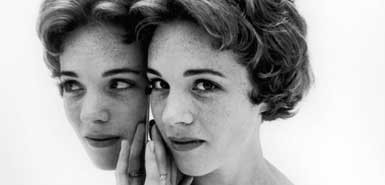
[Image courtesy: NNDB]

Julia Elizabeth Wellswas born on this day in Walton-on-Thames, Surrey, England in 1935. She is 77 years old.

Her parents divorced when  Julie was a baby. Both parents remarried and Julie lived primarily with her mother and stepfather Ted Andrews, whom she called “Pop.” Julie’s last name was changed to Andrews to make the transition easier. According to Julie they were “very poor and we lived in a bad slum area of London,”

In the movie version of The Sound of Music she sings “Perhaps I had a wicked childhood / Perhaps I had a miserable youth / But somewhere in my wicked, miserable past / There must have been a moment of truth…” While those lyrics were written for her character, Maria, they echo a past that Andrew’s called “a very black period in my life.” Her stepfather was an alcoholic (so was her mother to a lesser degree.) Julie had to put a lock on her bedroom door after Pop tried, drunkenly, to get into bed with her, twice.

Both her mother and her stepfather were entertainers. Her mother, who had trained as a classical pianist, helped to make ends meet by giving lessons and accompanying vaudeville acts. Mom and Pop had their own act and at about 10 Julie began to appear with them on stage. Soon Julie joined the act on a regular basis. She’d have to take a nap in the afternoon so she could be bright and alert on stage late into the night. She took singing lessons and was said to have both perfect pitch and a four octave range. (She denies the perfect pitch.)

During World War II she lived through the Blitz.

She remembers spending some nights on the neighborhood subway platform, listening for unmanned bombers so that she could alert the neighbors of danger. Her parents once awakened to find an unexploded incendiary bomb in the tenement courtyard just outside their kitchen window. They once watched a mid-air dogfight directly above them. [Visions Fantastic]

She performed for King George VI’s family during the 1948 Royal Command Variety Performance in London. (She is the youngest performer ever to do so.) The Andrews act went on radio and TV. She was a cast member on the radio show Educating Archie from 1950-1952.

Julie Andrews in a introspective moment [Image courtesy: VisualizeUs]

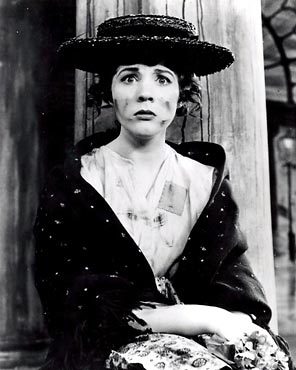
At 19 she made her Broadway debut as Polly Browne in The Boyfriend. Next she auditioned for the new musical adaptation of George Bernard Shaw’s Pygmalion and created the role of Eliza Doolittle in Lerner and Loewe’s My Fair Lady.

Andrews as Eliza in My Fair Lady circa 1956. [Image courtesy: The Seattle Times]

During her Broadway run of My Fair Lady she transformed from rags to riches again in the 1957 Rodgers and Hammerstein television musical version of Cinderella for CBS TV.

In 1959 she married set designer Tony Walton.

Her next Broadway triumph was in 1960 as Queen Guinevere to Richard Burton’s King Arthur and Robert Goulet’s Lancelot in Lerner and Loewe’s Camelot.

She was terrific as both Eliza and Guinevere, but when it came time to make major motion pictures of the musicals the producers opted  for actresses with more proven box office success. Jack Warner gave Eliza to Audrey Hepburn. Vanessa Redgrave got Guinevere. Andrews returned to England to have her daughter Emma instead.

The Disney company thought Andrews would be Practically Perfect for their adaptation of P.L. Travers’ Mary Poppins and offered her the role in their 1964 film. Andrews won an Oscar for this, her first, major motion picture. In her acceptance speech for the Golden Globe Andrews, with a bit of whimsy, thanked the man who “made all this possible in the first place, Mr. Jack Warner.”

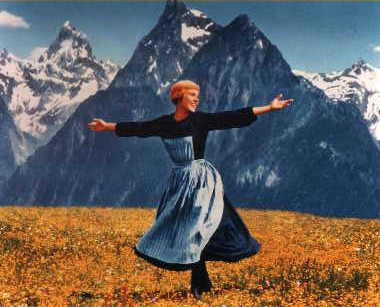
In 1965 Andrews stepped into the role of Maria Von Trapp for the 20th Century Fox movie of The Sound of Music. It went on to become the third highest grossing film ever made. The soundtrack sold more than 11 million copies.

United  Artists produced Andrews next movie, Hawaii based on the novel by James A Michener.  The film earned more than $6 million, and was 1966’s biggest box office hit.

Also in 1966, she co-starred with Paul Newman in Cold War psychological thriller Torn Curtain for director Alfred Hitchcock.

Andrew’s next movie musical was Thoroughly Modern Millie for Universal Pictures.

The 70s were quiet for Andrews. She divorced Warner and married director Blake Edwards. Although she continued to do television work — including a variety show, guest spots and specials — she focused much of her time during the disco decade raising her family.

In Edwards’s 1981 film S.O.B. she rather famously shed her innocent image by barring her breast. The next year she played dual roles in Victor Victoria and earned another Golden Globe Award.

The Princess Diaries gave her career yet another breath of fresh air as she co-starred as Queen Clarisse Renaldi with Anne Hathaway. She put on the crown again for The Princess Diaries 2: Royal Engagementt in 2004.  The same year she donned an animated crown was Queen Lillian for Shrek 2 (and the subsequent Shrek sequels) and she narrated Enchanted. She also voiced the character of Marlena in Despicable Me in 2010.

She was given the title Dame Commander of the British Empire by Queen Elizabeth II in 2000 for her work both in the entertainment industry and for her involvement in charitable organizations like Save the Children, the UN’s Fund for Women and the Foundation for Hereditary Disease.


Thought of the Day 9.30.12 Jalal ad-Din Rumi

“The minute I heard my first love story I started looking for you, not knowing how blind that was. Lovers don’t finally meet somewhere. They’re in each other all along.”

Jalal ad-Din Rumi 

Rumi's attributed photo

Rumi’s attributed photo (Photo credit: Eliza_Tasbihi)

Jalal ad-DinRumi was born on this day in Persia (in what is now Balkh Province, Afghanistan) in 1207. Today is the 805th anniversary of his birth.

When he was 12 the Mongols invaded his homeland and Jalal ad-Din Rumi’s family escaped to Turkey. His father Baha’Walad became

an important position as a religious teacher, and his son succeeded him in that role. Rumi married and had a son, who later wrote Rumi’s biography. [The Messenger, A Guide to Life’s Adventure]

He met the dervish Shams al-Din of Tabriz in 1244 and became his devoted friend.

Rumi started the mystical practice of the sema, an act of worship that takes the form of an ecstatic, whirling dance accompanied by music. The sema is performed to this day in Konya, Turkey, by the Mevlevi order created by Rumi’s disciples.[The Messenger, A Guide to Life’s Adventure]

Wirujący derwisze

Wirujący derwisze (Photo credit: mammal)

Rumi’s disciples were jealous of his friendship with Shams, and in December 1248 the dervish was either driven away of killed by one of them (maybe Rumi’s son). Rumi traveled far and wide looking for his friend, but eventually he accepted that Shams would not be found.

Eventually, Rumi made peace with his loss, returning to his home believing Shams to be a part of him: “His essence speaks through me.” [Poetry.org]

He honored his friend with “more than 40,000 lyric verses… odes, eulogies, quatrains and other styles of Eastern-Islamic poetry called Divan-e-Shams-e Tabrizi.” [Poetry.org]

Shams of Tabriz as portrayed in a 1500 paintin...

Shams of Tabriz as portrayed in a 1500 painting in a page of a copy of Rumi’s poem dedicated to Shams. BNF Paris. (Photo credit: Wikipedia)

He used music, poetry and dance as a path for reaching God.

His six-volume the Masnavi remains an important text to Sufis around the world.

He died on December 17, 1273.  His shrine in Konya, Turkey is a  pilgrimage destination.

Rumi's tomb and minaret

Rumi’s tomb and minaret (Photo credit: Queen Esoterica)

“Rumi is both a poet and a mystic, but he is a teacher first, trying to communicate what he knows to his audience. Like all good teachers, he trusts that ultimately, when the means to go any further fail him and his voice falls silent, his students will have learnt to understand on their own.” [Alan Williams, Spiritual Verses, Introduction]

———————————————-

Your task is not to seek for love, but merely to seek and find all the barriers within yourself that you have built against it. [Jalal ad-Din Rumi , The Messenger, A Guide to Life’s Adventure]