Monthly Archives: July 2012

7.17.12

Vince Guaraldi 

Couldn’t really find a verbal quote for today’s birthday honoree, but, please, isn’t this musical clip better? 

Vince Anthony Guaraldi was born today in San Francisco in 1928. He he would have been 84.

Guaraldi, aka “Dr. Funk,” began playing piano gigs in college. His first record was with the Cal Tjader Trio in 1953, entitled “Vibratharpe.” in 1955 he started his own trio with guitarist Eddie Duran and bass player Dean Reilly. The trio released “The Vince Guaraldi Trio” in 56 and “A Flower is a Lonesome Thing” in ’57. Guaraldi continued to do album work with other musicians throughout the late 1950s.

He picked up on the Latin vibe with a reformed trio (Bassist Monte Budwig and drummer Colin Bailey) and  put out Jazz Impressions of Black Orpheus.” The track Cast Your Fate to the Wind became his first Gold Record and earned him a Jazz Grammy.

He was chosen by Reverend Charles Gompertz of San Francisco’s Grace Cathedral to compose a “modern setting for the choral Eucharist.” The  40 minute piece, for jazz trio and 68-voice choir,  took him a year an half to write, and includes an 11 minute instrumental “Holy Communion Blues” and a syncopated “Kyrie Eleison.” Performed in May of 1965, the recording went on critical and popular success.

He became a household name when he  pennedLinus and Lucy and other songs for  A Charlie Brown Christmas.

Heres another version of the Linus and Lucy Theme that I really liked  (it takes a bit of time to start, but it’s nice).


Thought of the Day 7.16.12

“When two people love each other, they don’t look at each other, they look in the same direction”

–Ginger Rogers

Virginia Katherine McMathwas born in Independence, Missouri on this day in 1911. She would have been 101  years old today.

Her parents divorced when she was a baby and little Virginia, Ginger, stayed with her mother, Lela. When she remarried, Ginger took the name Lela’s second husband John Rogers. Ginger was introduced to the theater when Lela became a theater critic and took the girl to the shows that she reviewed. Legend has it that Ginger would hang out backstage picking up the songs and dances from the performers as her mother sat in the audience and took notes. One night while she was backstage at a traveling vaudeville show the act needed a stand-in, Rogers was tapped for the duty and had her first gig.

She was still in high school when she won  The Texas State Charleston Championship. The prize — a tour of theaters in Texas cities — was expanded to include  a wider tour of the Western US.. Ginger’s easy banter with the master of ceremonies was such an audience hit that it became as much of a draw as the dance routine.  At 17 she married vaudeville artist Jack “Pepper” Culpepper and the two formed the act known as “Ginger and Pepper.” The marriage was short lived, but Ginger’s career continued. She made it to New York where she had her Broadway debut in Top Speed in 1929.  Shortly thereafter the Gershwin Brothers picked Ginger to star in Girl Crazy along with Ethel Merman. The musical made a star of both actresses  and introduced Ginger to Fred Astaire who was hired as a dance coach. Ginger’s amazing renditions of  Embraceable You and But Not For Me in the musical helped the tunes become part of the American Song Book.

At 19 she switched to movies. Her breakthrough role was in Warner Brother’s 42nd Street. In 1933 she made her first film with Fred Astaire, Flying Down to Rio. The duo made nine musicals together, the most famous probably being Top Hat.

Dancing was only one arrow in her quiver, she was also an acclaimed singer and actor and her career went on long after she stopped making musicals with Fred. She won an Academy Award for Kitty Foyle in 1940.

She went back to the Great White Way when roles for mature women in film became scarce. Ginger took over for Carol Channing as Dolly in Hello! Dolly in 1965 and performed to packed houses for an 18-month run. She then took Mame to London’s West End for 14-months (and a Royal command performance.)

Ginger Rogers - 1920s

Ginger Rogers – 1920s (Photo credit: danceonair1986)


Thought of the Day 7.15.12

“Choose only one master — Nature.”

Rembrandt van Rijn

Self-portrait in cap, with eyes wide open. circa 1630.

Rembrandt van Rijn was born on this day in Leiden, the Netherlands in 1606. Today is the  406th  anniversary of his birth.

His father, a  miller, wanted his son to be an educated man and sent Rembrandt to the University of Leiden. There he learned science and anatomy, but he didn’t stay long. He wanted to paint. He  learned about light, form and composition from by studying the masters of Renaissance art like Da Vinci and Caravaggio. In 1630 he moved to Amsterdam and set up a studio painting portraits for individuals and for local guilds.

The Anatomy Lesson of Dr. Nicolas Tulp as an important early work. With its dark background and focus of light Rembrandt tells a story in the painting. It isn’t just a group of men sitting around having their picture painted. This is a narrative slice of action.

His reputation as a painter grew he established himself as in society. He married the beautiful and rich Saskia van Uylenburgh and the couple moved into an expensive house on the good side of town. Domestic bliss was not long lived however as the couple lost their first three children in infancy. The fourth child, Titus, survived, but Saskia died the next year. It seemed that life followed art for Rembrandt and every bright spot on his personal canvass had and equal patch of darkness.

In 1642 he painted The Night Watch. It  was almost 12 feet by 14.5 feet and was his masterpiece. Another guild painting, this one was commissioned by the Captain and guard of the Kloveniers (the civic guard). He was paid 1,600 guilders for the work.

Rembrandt van Rijn - Self-Portrait (1659)

Rembrandt van Rijn – Self-Portrait (1659) (Photo credit: Wikipedia)


Thought of the Day 7.14.12

“Sometimes love is stronger than a man’s convictions”

Isaac Bashevis Singer

Isaac Bashevis Singer was born on this day in Radzymin, Poland in 1904. He would have been 98 years old today.

He came from a religious family. His father was a rabbi and his mother had several rabbis in her family. He grew up surrounded in a world steeped in Hasidic traditions and even attended Rabbinical School. According to Singer’s Nobel Prize biography, it was a world:

which the reader encounters in Singer’s stories, … a very Jewish but also a very human world. It appears to include everything – pleasure and suffering, coarseness and subtlety…

But Singer wanted  a more secular life. The World was changing fast around him and he wanted to be a part of it.  The conflict of old verses new (both on a personal level and a global level as Eastern Europe churned through WWI and the build up and horrors of  WWII ) were fodder for Singer’s budding journalism and short story writing. Singer gave voice to those conflicts, mixing the tragic with the comic; breaking our hearts but warming them too, all on the same page.

He emigrated to the United States in 1935 and began to work  for Yiddish Newspapers. Because of the Holocaust the Yiddish language was nearly wiped out  in Europe, but Singer  reveled in the power of his native tongue and knew there was still an audience for it. His work often recalled a Poland before the War, but without the sugar coating of nostalgia.

He published memoirs, essays, novels, children’s books and short stories.  Singer won the Nobel Prize in Literature in 1978.

English: Isaac Bashevis Singer, Miami Book Fai...

English: Isaac Bashevis Singer, Miami Book Fair International, 1988 (Photo credit: Wikipedia)


Labour’s of Love’s

English: Title page of the first quarto of Lov...

English: Title page of the first quarto of Love’s Labours Lost (Photo credit: Wikipedia)

Love’s Labour’s Lost opened at the Baltimore Shakespeare Factory Friday night at the Great Hall Theatre at St. Mary’s Outreach Center on 3900 Roland Ave. The company moves to their outdoor space at the Meadow at Evergreen Museum and Library at 4545 N. Charles Street (between Loyola and Notre Dame) this weekend and runs thus August 5th.

The small company did a great job with this wordy show. The pacing was crisp, the comedy was spot on and the acting was tight. LLL is essentially a Shakespearian sit-com/rom-com and all the lovers on stage were delightfully witty. But this production really shines when the comedic characters strut onto the boards.  Chris Ryder’s Costard, Brian Hanson’s Boyet, Jess Behar’s Sir Nathaniel, Kerry Brady’s Holofernes, Kathryn Zoerb’s Moth and especially Ann Turiano’s Don Armado steal the show. The intimacy of the Factory and the way in which they involved the audience makes the comedy all the more engaging.

Contemporary songs add to the fun. The cast and director had a Q&A with audience members after the show to discuss how they brought the Bard’s play to life.

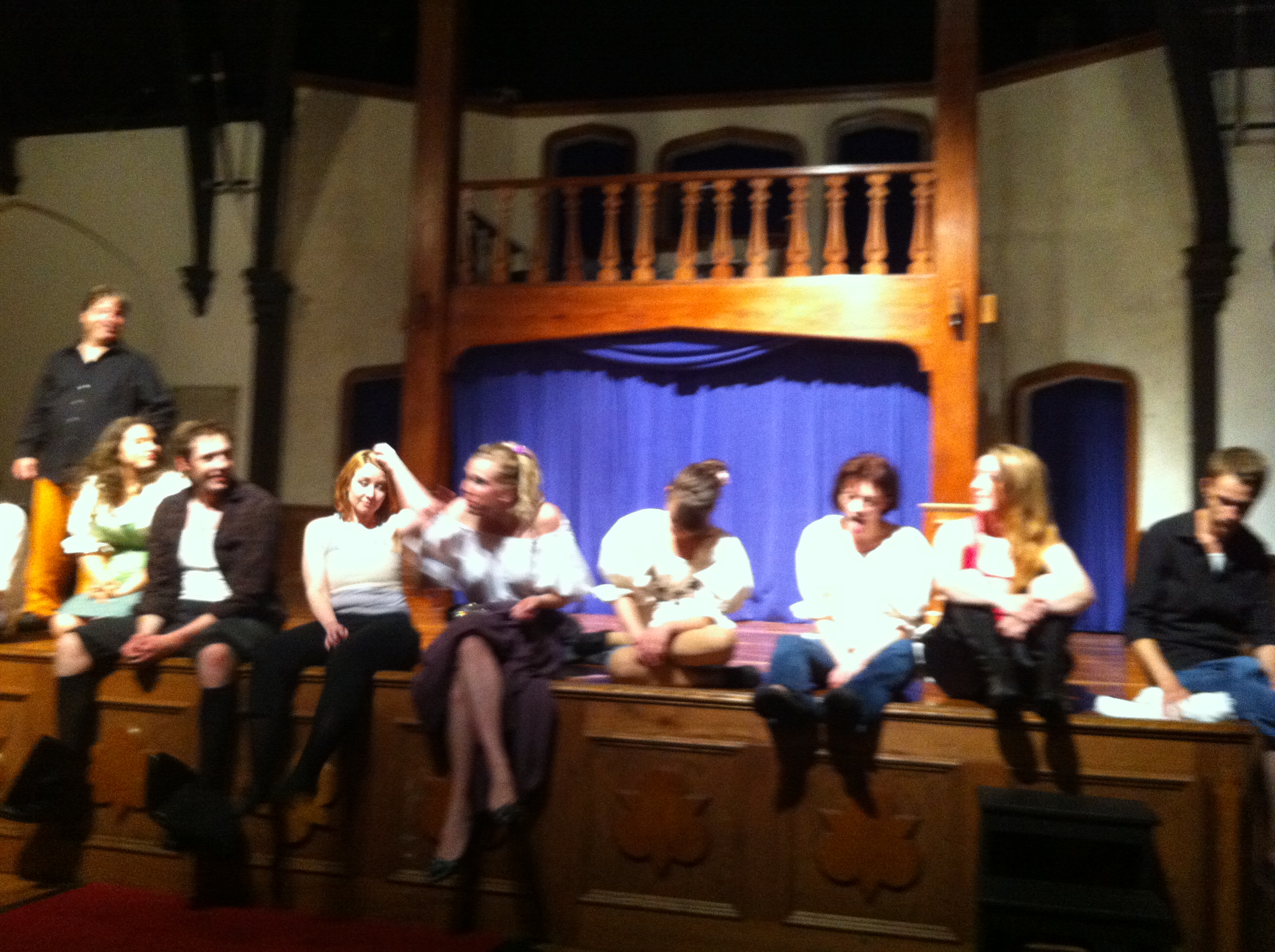
The cast, having partially changed out of their costumes sit at the edge of the stage for a Q&A.


The theatre at St. Mary’s Outreach Center has a thrust stage complete with balcony. The Baltimore Shakespeare Factory actors perform with out mics and with the audience lights up.

Later this season the group will present the Taming of the Shrew . For info or tickets call or email the Factory at info@theshakespearefactory.com or call 410-596-5036.


Thought of the Day 7.13.12

“All bad precedents begin as justifiable measures”

–Julius Caesar

Gaius Julius Caesar was born in Rome on this day in 100 BC.

He was a soldier, statesman and writer. After impressive victories on the battlefield Caesar turned to politics. He entered into a power sharing governorship, the First Triumvirate with Marcus Licinius Crassus and Gnaeus Pompeius Magnus (Pompey). Caesar proposed social reforms including the distribution of land to the poor (always popular with masses, but not so popular with the ruling class).

He went back to the provinces and looked toward unconquered territory to grow Rome’s (and his own) coffers. He conquered Gaul building a bridge to cross the Rhine and  invaded Britain. All the while his popularity with the people grew.

With the death of Crassus the Triumvirate was in trouble. Pompey was appointed sole consul. Caesar was told to disband his army  and return to Rome, but if he entered the city with out the immunity of a magistrate he could be prosecuted by his political enemies. Pompey accused him of insubordination and treason.  And when Caesar and his 13th Legion crossed the Rubicon the die was cast. Civil war ensued, and Caesar emerged the victor. He was appointed Dictator but after being elected to a second consulship he resigned as dictator.

Pompey had fled to  Egypt and Caesar went in pursuit. There he met the beautiful co-regent Cleopatra. The two became romantically involved, but, according to Roman law, could not get married. However their relationship continued for over a decade.

Caesar was assassinated on the floor of the Roman Senate by his political enemies on the Ides of March in 44 Ad.


Bust of Marcus Licinius Crassus located in the...

Bust of Marcus Licinius Crassus located in the Louvre, Paris (Photo credit: Wikipedia)


Thought of the Day 7.12.12

“There is no remedy for love but to love more.”

–Henry David Thoreau

Henry David Thoreau was born Concord Massachuset 1817. This is the 195th anniversary of his birth. 

Thoreau was an abolitionist, a naturalist,  a lecturer, a historian, a teacher, a surveyor, a pencil maker  and a writer.  He was inspired by his friend Emerson.. 

Thoreau made most of his money through surveying. He wrote that surveying “seems a noble employment  which brings you within hearing of [the birds].” He also helped to make Thoreau & Co., his family’s pencil making company one of the best in the America when he  developed a way of mixing clay with graphite to make a superior, “smudge-free” pencil. 

Thoreau loved nature. He would take long walks in the woods and he collected specimens of herbs, leaves and flowers, storing along the way. He stored them in his hat until he got home.,  then he or his sister Sophia carefully press them. He carried a notched stick that acted as both walking stick and a measuring stick. He also brought along a copy of Alexander Wilson’s bird anthology to identify the birds in the trees.  In 1845 he built his own cabin near  Walden Pond, on property owned by Emerson,  and lived for two years. His goal was to “live deliberately, to front only the essential facts of life, and see if I could not learn what I had to teach.”   He wrote about his time there in A week on the Concord and Merrimack Rivers (a memorial to his late brother) and, after seven full drafts,  Walden.

His work as an abolitionist  included “Slavery in Massachusetts, and a trio of essays about John Brown. 

English: Portrait drawing of Henry David Thoreau

English: Portrait drawing of Henry David Thoreau (Photo credit: Wikipedia)


Thought of the Day 7.11.12

“If your actions inspire others to dream more, learn more, do more and become more, you are a leader.”

–John Quincy Adams

English: John Quincy Adams

English: John Quincy Adams (Photo credit: Wikipedia)

John Quincy Adams was born in Braintree, Massachusetts in 1767. Today is the 245th anniversary of his birth.

Eldest son of John and Abigail Adams, John Quincy grew up a child of the Revolution. His father was THE voice calling for  Independence from Britain in the Continental  Congress.  When he was 8 years old he watched the Battle of Bunker Hill from his parent’s farm.

After the War he travelled with his father to Europe, acting as his secretary. He attended Harvard and became a lawyer and at 26 was appointed Minister to the Netherlands. He became a US Senator in 1802 and when his term was up he was appointed as Minister to Russia by President Madison.  His international service to the US included the negotiation of numerous treaties including the Treaty of Ghent (that ended the War of 1812.) While Secretary of State under President Monroe he nailed down America’s border with Canada as far as the Pacific Ocean and was instrumental in forming the Monroe Doctrine and acquiring Florida from Spain.

The Presidential election in 1824 was decided in the House of Representatives. Since no candidate had garner a majority of the electoral votes  in the popular count it  was a three-way run off between JQ Adams, Andrew Jackson and Henry Clay. Clay’s platform was similar to Adams’ so he ceded his support to Quincy. Adams in turn named Clay as Secretary of State. Jackson, left out in the cold, raised angry cries of “corrupt bargaining” and began an aggressive campaign to gain the White House in 1828.

As President, Quincy started the first system of interstate roads and canals (breaking ground for the C&O Canal in 1828), he worked to modernize the US economy and paid off much of the National Debt,  encouraged the arts and sciences with a national university, scientific expeditions and an observatory. But he was thwarted on many of his initiatives by an uncooperative Congress.

In 1828 he was defeated in his bid for a second term after a bitter and messy campaign against Jackson and returned to his beloved Massachusetts only to be unexpectedly elected to the US House of Representative in 1830. He is the only  man to have served first as President and then in the House of Representatives, but his 17 years in the House were far more successful than his 4 years in the White House. Ever a stalwart proponent of civil liberties, Adams now became a leading voice against Slavery. He fought against the “gag rule”   — a resolution that automatically tabled any petition having to do with Slavery without review — by attempting to use parliamentary procedures to circumvent the rule. Eventually enough Congressmen from the North came down on the side of  antislavery and freedom of expression, and Adam’s argument gained favor. In 1844, after 8 years of fighting against it, the House rescinded the “Gag Rule” on a motion made by John Quincy Adams.

In 1840 Adams, “Old Man Eloquent,”  argued successfully for the defendants in the  Amistad case in front of the Supreme Court.

JQ Adams suffered a stroke while on the floor of the House of Representatives. He was taken to the Speaker’s Chambers and died four days later.

John Quincy Adams portrait. "John Quincy ...

John Quincy Adams portrait. “John Quincy Adams”. Metropolitan Museum of Art . . Retrieved September 4, 2009 . (Photo credit: Wikipedia)


Hey Brother, can you spare 5 CENTS?

I’ve been thinking about the National Debt.

And I’ve been thinking about how much money is going to be spent by the candidates in both parties to get IN this Election this year.

President Obama and Governor Romney are both projected to spend at least a Billion dollars in their run for President. And billions more will be spent by those seeking office in Congress and on a state level.

We may never know how much the Super Packs spend to support the candidates and issues that they favor.

I propose that anyone running for public office (and any super pack) give 5 CENTS of every dollar they spend in advertising, polling, telemarketing, research, lawn signs… what ever… 5 cents out of ever dollar that they spend to get to the White House (or Congress or the Governor’s House) to pay down the NATIONAL DEBT.

I don’t think it should be a tax. I think it should be a good will offering.  They could declare it when the report how much they’ve received in donations… then cut a check to the IRS.

Its simple. If you’d like to represent me (and the other citizens of the United States), then I think you should put your money where your mouth is by giving a measly 5 cents per buck  you spend getting into office to help pay off the National Debt.

Do that…and you can proudly proclaim it during your next stump speech or at your next debate. Your really ARE doing something to pay down the Debt!

Do that… and you can use my nifty little logo on your advertising and stuff.

I know that even 5% of all the money spent on this election will not solve the Debt crisis, but at least it will put 5% of ALL THAT MONEY to some good use.


Feel free to repost to you favorite candidate’s site. Come on…lets get THIS party started.