Your words are my food, your breath my wine. You are everything to me.
–Sarah Bernhardt
English: Sarah Bernhardt, portrait by Nadar (d. 1910) Português: Sarah Bernhardt, fotografia de Nadar (d. 1910) (Photo credit: Wikipedia)
Henriette-Rosine Bernard was born on this day in Paris, France in 1844. Today is the 168th anniversary of her birth.
The illegitimate daughter of a Julie Bernardt, a Dutch courtesan working in Paris. She was sent to Grandchamp, a Augustine convent school. She was greatly influenced by her time at the religious school and showed a desire to become a nun herself. Her first role was as the Angel Raphael in Tobais Regains His Sight, a show performed for the Archbishop of Paris when he visited the convent.
When one of her mother’s lovers, the Duke of Monry (Napoleon III’s half-brother) took an interest in young Sarah’s acting abilities, he arranged for her to go to the Paris Conservatoire at age 16 in 1862. She was forced to forget her dreams of becoming a Bride of Christ and took up a life on stage instead.
With the Duke as her patron she moved from the Conservatoire to France’s national theatre company, Comedie-Francaise where she starred in Iphigene. She left Comedie-Francaise after she slapped another actress and had a two year run at Theatre du gymnase-Dramatique.
English: Sarah Bernhardt as Joan of Arc holding banner (Photo credit: Wikipedia)
At about that time she had an affair with Charles-Joseph Eugène Henri Georges Lamoral de Ligne (Belgium) and gave birth to her son Maurice in 1864. Although the prince proposed the royal family rejected the idea of his marrying an illegitimate actress. They forbade the union and Bernhardt was left to raise Maurine on her own. [See side bar below]
In 1866 she got a contract with Theatre de L’Odeon. During her six year run at the L’Odeon she had her first big success in the French version of King Lear as Cordelia and as the Queen in Ruy Blas by Victor Hugo. Perhaps her most memorable star making role was Zanetto in Le Passant (The Passerby), a role she played in a command performance for Napoleon III.
In 1870, in the midst of the Franco-German War, Bernhardt organized a military hospital in the Odéon, and by the late 1870s, when the war was over, she resumed acting and had reached the heights of her acting career, propelled in part by her quirky behavior both on and off the stage.” [biography.com]
In 1899 she took over the Theatre de Nations and renamed it the Theatre Sarah-Bernhardt. In May she premiered a prose adaptation of Hamlet in which she played the great Dane.
At 61 the actress was in Rio de Janeiro starring in La Tosca.
She… injured herself in a leap off the parapet at the end of … the stage play that later became a Puccini opera, and she was in constant pain. [Sarah Bernhardt’s leg, 02.02.09 NYTimes.com]
a decade later she take the pain no longer and she ordered doctors at Bordeaux University to amputate it above the knee. She was wheelchair bound for a while, but eventually she retuned to acting (with or with out the wooden leg which she found cumbersome.) Her last three movies were filmed after the leg was amputated.
English: Portrait of Sarah Bernhardt as Hamlet. (Photo credit: Wikipedia)
With the advent of film Bernhardt became the first classical actress to lend her talents to the new medium. She filmed her version of Hamlet (Le Duel d’Hamlet — which she thought was abysmal); La Tosca; La Dame aux Camelias; Adrienne Lecouvreur; Elisabeth Reine d’Angleterre; Meres Francaise; Jeanne Dore and La Voyante.
She’s alleged to have had over 1,000 lovers. When she was 15 she bought a rosewood coffin. She some times slept in it — allegedly it helped her prepare for her dramatic roles. The coffin was lined with letters from her lovers.
Bernhardt died of kidney failure in 1923.
Side Bar — The Importance of Being Sarah:
[Prince Henri was not completely out of the picture. When Maurice was about to be married Henri offered to “officially recognize him and offered him his name and a substantial fortune.” [IMDB.com] Maruice refused saying his mother had sacrificed so much to raise him that he would remain a Bernhardt. Later when the two were traveling by train Henri was frustrated at having to wait in a long line. He went to the man in charge and demanded to be let in front saying “I am the Prince de Ligne” The man had never heard of him and told him to take his place in the back. So Maurice came forward and said he was the son of Sarah Bernhardt. They were immediately brought through. [ibid]
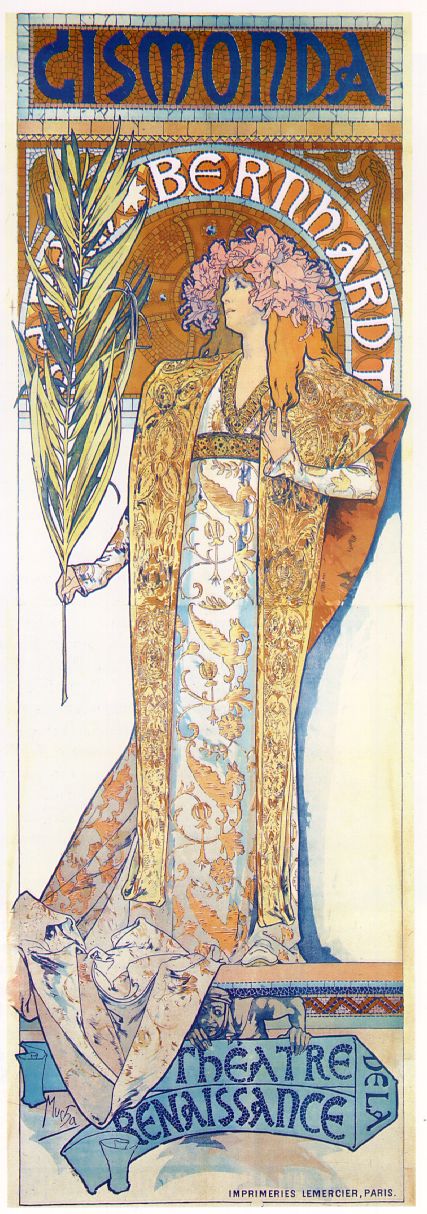
Alphonse Mucha’s poster for Bernhardt in as Gismonda [Image courtesy: Art Dish]
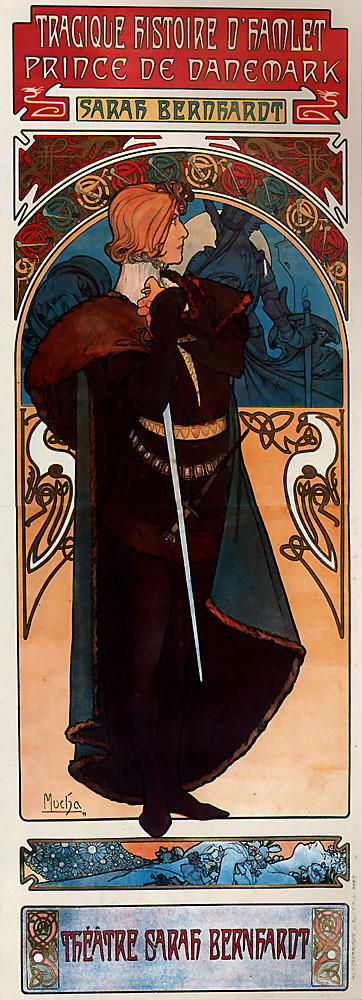
Mucha’s poster for Bernhardt’s Hamlet [Image Courtesy: Art Renewal]
Director Ian Gallanar chose to pick the characters up from the 15th century and time warp them to something resembling War War One. Clever, especially considering the Patapsco Female Institute was used as a war hospital during the Great War. In his director’s notes he says:
“The production really uses the visual palate and the historic technology of the World War One era as a way to clarify the relationships of the characters….[The audience] might also recognize the futility and wastefulness of a war that, much like the English “Wars of the Roses,” seemed more about resolving who would inherit power rather than who ought to inherit power.” [Chesapeake Shakespeare Company, Richard III: Program Notes]
So on a cold October night we got to see one of Shakespeare’s bloodiest plays in and around the shell of a burned out 19th Century building that some people claim is haunted. The occasional gas-masked actors quietly playing cards in a dimly lit corner or typing away orders on an antique typewriter upped the creep factor. As did the lighting effects, the period music and wonderful costumes.
Vince Eisenson as Richard III. Photo by Teresa Castracane. [Image courtesy: Chesapeake Shakespeare Company]
This version of Richard really worked. I really liked the “Moveable” aspect too. It added to the length of the play (instead of quick scene changes the audience literally did a scene change by moving to a new part of the building or grounds, and that took a while.) My only problem was that there was a scene or two where I couldn’t see the action because I had the bad luck of standing behind some one tall.) Still, I liked that we kept moving through the building, and “discovering” new rooms. It really put the audience DEAD center into the action of the play (and moving about kept us warm.)
Richard III runs for one more weekend at Chesapeake Shakespeare. So if you are local to Maryland jump on their website and grab some tickets before they sell out. http://chesapeakeshakespeare.com/
————————————
Scrap for a Shakespeare character card: Richard III., c. 1890; Printer: Siegmund Hildesheimer & Co. Victoria and Albert Museum, London, Museum number: S.63-2008, Link (Photo credit: Wikipedia)
Of course they didn’t have instant fact checkers in Shakespeare’s day, and history, as they say is written by the winners. So it comes as no surprise that the Richard the Third we met last night was a real piece of work. Shakespeare was writing for an Elizabethan audience. Elizabeth, a Tudor, was the granddaughter of the man who finally brought about Richard’s undoing on Bosworth Field in Leicestershire, Henry VII. It was in his interest to make Richard as loathsome as possible.
Henry VII’s claim to the thrown was weak at best. So he took…
“every opportunity of enhancing his own reputation at the expense of his predecessor. Richard’s actions and behaviour were the subject of attention and scrutiny and were presented, in the weeks and years after his death, as those of a wicked and unscrupulous tyrant.” [The Richard III Society]
While he was alive Richard was well thought of.
He was loyal to his brother Edward.
He was effective in his administration of the North.
He defended the country against the Scots.
He handled the premature death of Edward with out plunging the country into crisis.
Shakespeare wasn’t the first writer to take up the thread of anti- Richard-ism. (Yes, I just made that up.)
By the time the Elizabethan playwright William Shakespeare penned what was to become one of his most popular and frequently performed plays, The Tragedy of King Richard III, the works of the anonymous Croyland Chronicler, John Rous, Bernard André, Polydore Vergil, Sir Thomas More, Edward Hall, Richard Grafton and Raphael Holinshed had been written. [Ibid]
So, as Chesapeake Shakespeare Managing Director and Richard III Dramaturge says in her note… The Bard’s “fictitious villainous Richard has triumphed over the historic Richard for centuries now.” [CSC Program]
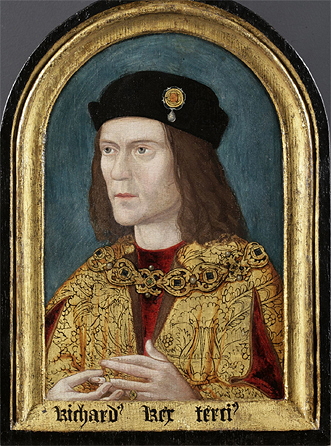
Richard III earliest surviving portrait. [Image courtesy: Wikipedia]
In a timely twist of history archeologists digging up a parking lot in Leicester have found the remains of the Greyfriars Church that might be those of Richard, the last King of England to die on the battlefield. They have found a skeleton in the choir area (Richard was buried in the choir of Friars Minor at Leicester), that had a skull injury caused by a bladed implement, an arrowhead was found between its vertebrae and upper back, and it had spinal abnormalities.
“the individual would have had severe scoliosis – which is a form of spinal curvature. This would have made his right shoulder appear visibly higher than the left shoulder.” [University of Leicester Press Release : The Leicester Greyfriars Dig]
——————————————————————————-
Bonus Material:
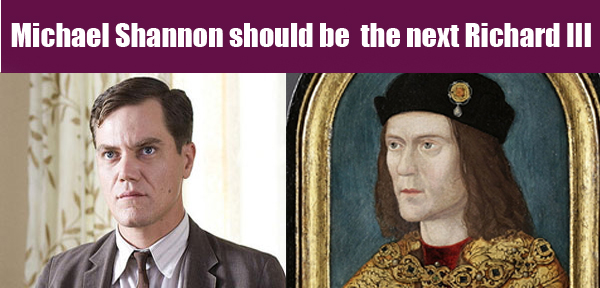
Not sure how many of you watch HBO’s Boardwalk Empire… but I couldn’t stop thinking how much Michael Shannon (who plays messed up Treasury agent turned iron salesman Nelson Van Alden) looks like our boy Richard. I think they ought to do a new film version of Richard cubed with Shannon in the lead. He certainly has the intensity to play the role.
“There’s no excuse to be bored. Sad, yes. Angry, yes. Depressed, yes. Crazy, yes. But there’s no excuse for boredom, ever.”
—Viggo Mortensen
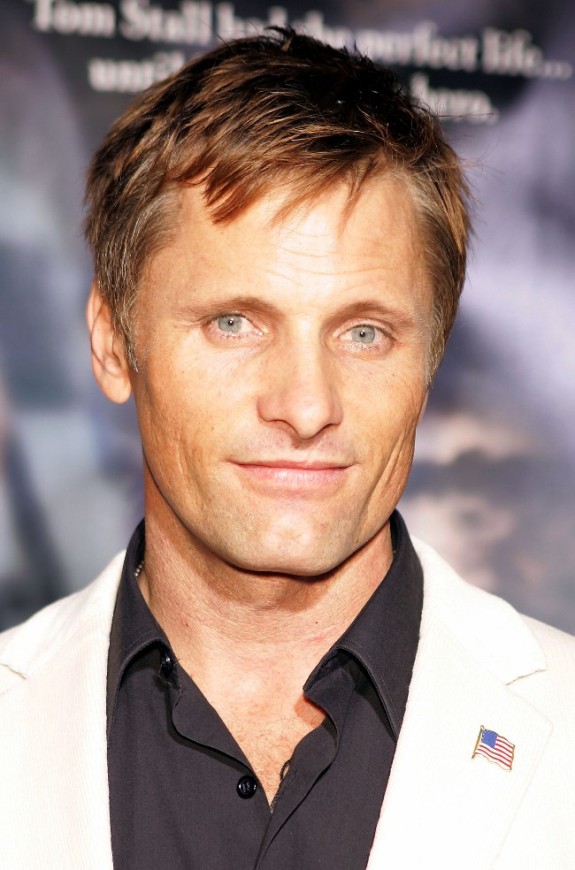
Viggo Mortensen was born on this day in New York City, New York, USA in 1958. He is 54 years old.
His family lived in Venezuela, Denmark and Argentina where his father managed farms and ranches. He learned to speak fluent Danish, Spanish and English growing up. His parents divorced when he was 11 and he moved with his mother back to New York. After graduating St. Lawrence University he moved to Europe and lived in Spain, England and Denmark making his way as a truck driver and flower seller. Eventually he returned to the US ready to try his hand at acting.
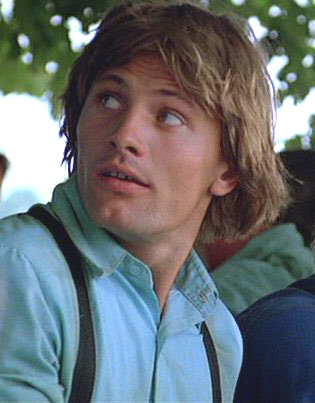
Viggo Mortensen in a still from Witness [Image courtesy: Brego.net]
He did some theatre then expanded to film. His footage in 1984’s Swing Shift and Woody Allen’s The Purple Rose of Cairo ended up on the cutting room floor, but he had more luck in Peter Weir’s Witness. Mortensen played Moses Hochleitner, the younger brother to Alexander Godunov’s Daniel Hochleitner. He didn’t have a lot of lines in the Harrison Ford flick, but some how he stood out from the sea of blond-haired Amish men in blue shirts.
His next step was to Television where he was cast as Bragg on Search for Tomorrow[BRAGG, what a great soap opera name, right?]
In 1987 he played a crooked cop on Miami Vice. There was more theatre too, this time in LA’s Coast Playhouse’s production of Bent, for which he earned a Dramalogue Critics’ Award.
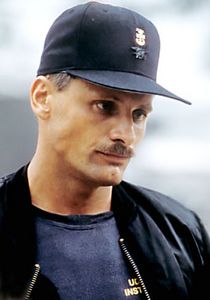
A splay of supporting roles in the 1990s saw him acting in some good movies (The Portrait of a Ladydirected by Jane Campion) and some not so good movies (Leatherface: The Texas Chainsaw Massacre III) Critics started to take notice when he starred opposite Demi Moore as brutal Master Chief John Urgayle in G.I. Jane (some critics said he stole the movie from Moore) and as the other man in A Walk on the Moon with Diane Lane. He played another ‘other’ man in A Perfect Murder, a reboot of Hitchcock’s Dial M for Murder with Michael Douglas and Gwyneth Paltrow. He was Eddie Boone, a major league baseball player with a trifecta of additions in rehab with Sandra Bullock in 28 Days. And rounded out the decade by playing the devil in The Prophecy.
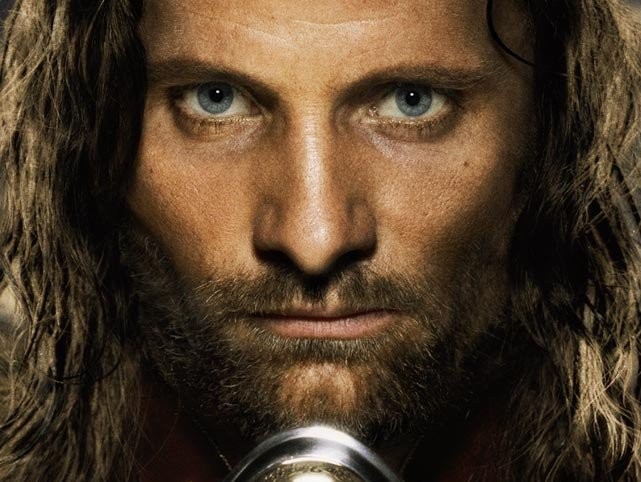
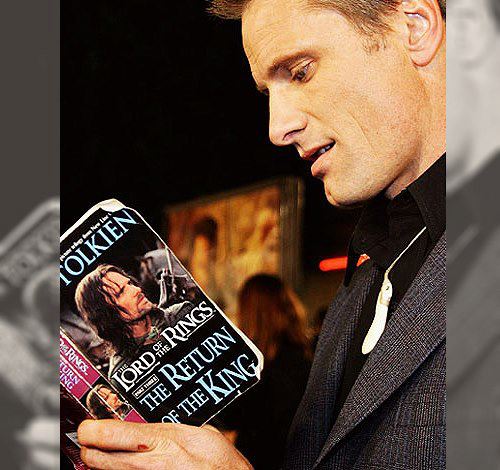
2001 saw the release of The Lord of the Rings: The Fellowship of the Rings, the first in Peter Jackson’s epic Tolkien cycle. With his role as the heroic Aragorn “Mortensen was established as a major leading man among Hollywood’s A-list ranks.” [Viggo Mortensen — Biography, Movies. yahoo.com ] The Two Towers followed in 2002 and The Return of the King premiered in 2003. He brought quiet strength, “commanding good looks”[ibid] and a rye sense of humor to Aragorn. He embraced the role whole heartedly. He did all his own stunts in the movies (and took quiet a few knocks in the process). He wore his sword and costume for days on end so they would have an authentic lived in look. And he became so attached to his equine co-stars, Uraeus and Kenny, that he purchased the horses after the film wrapped and took them home.
After his success in the Lord of the Rings Mortensen managed to keep himself centered…
Exceedingly humble about success and uncharacteristically un-Hollywood, Mortensen managed to stay somewhat reclusive and focused on other interests outside of acting, namely painting and writing poetry, despite becoming one of the most recognizable stars in the world. [Viggo Mortensen — Biography, Movies. yahoo.com ]
He used some of his earnings from playing Aragorn to start Perceval Press publishing house in Santa Monica, California.
Perceval Press is a small, independent publisher specializing in art, critical writing, and poetry. The intention of the press is to publish texts, images, and recordings that otherwise might not be presented. [Percival Press]
Mortensen’s own artistic, musical and written works are available through Perceval Press. He writes poetry, essays, and companion pieces for his paintings and photographic work in English, Spanish and Danish. Musically he has completed 16 albums, working almost exclusively with the guitarist Buckethead.
Back on the silver screen was Hidalgo in 2007. It is the true story of American Frank T. Hopkins who participation in a 3,000-mile race across the Najd desert called the “Ocean of Fire”.
He gave “his most compelling and carefully drawn performance to date” [ibid] as an everyday man who’s violent past catches up to him in A History of Violence a film directed by David Cronenberg. He worked with Cronenberg again in 2007 for Eastern Promises, where he played a Russian gangster. He was nominated for an Academy Award for his role in the film.
In 2008 he was Ed Harris’ sidekick in the Western Appaloosa. He also starred in Goodwhich takes place in the 1930s. Mortensen is a professor struggling to decide if he should join the Nazi party.
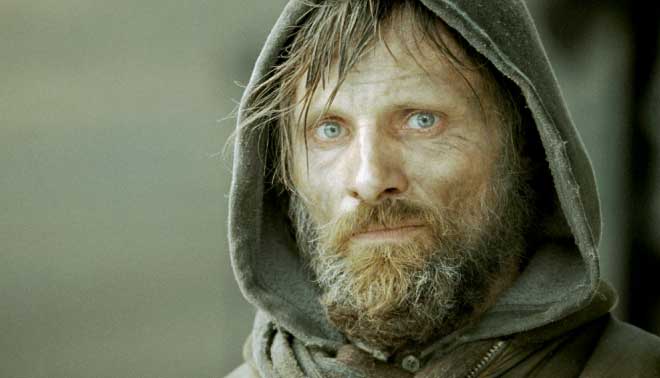
Movie still from The Road. [Image courtesy: Wired.com]
The grim Cormac McCarthy novel was the basis for Mortensen’s next movie, The Road. It is a post-apocalyptic story of a father and son trying to survive in a bleak wasteland.
Once again teaming up with Cronenberg, Mortensen plays Dr. Sigmund Freud in his the 2011 film, A Dangerous Method.
Coming up Mortensen has several film ready for release including: On The Roadand Everybody Has a Plan; and in 2013 The Faces of January and The Last Voyage of Demeter.
Her name was not recorded at her birth. Neither was the name of her mother. Her father’s name was Min Chi-rok, and he was a member of the wealthy and influential Min family.
She was orphaned by the time she was 8-years old, which was actually something of a benefit to her in terms of marriage as when the future Emperor Gojong went looking for a wife (when he was 15-years old) the preference was for a girl without many relatives who would be seeking favor at court and be inclined toward corruption. [Mad Monarchist. blogspot.com]
She was smart, pretty, from a good family, healthy, appropriately educated (for a woman), and (most likely) fertile. So, at 16, after a lengthy vetting period she was married to 15-year-old King Gojong and became Queen Min.
Typically, queen consorts concerned themselves with setting fashions for the noble women of the realm, hosting tea parties, and gossiping. Queen Min, however, had no interest in these pastimes. Instead, she read widely on history, science, politics, philosophy, and religion, giving herself the kind of education ordinarily reserved for men. [Asian History/About.com]
Her father-in-law, Taewongun, the regent and puppet master over the young king, was having none of it. He moved to weaken her influence on the king by giving him a royal consort. While Queen Min had difficulty in conceiving, the consort soon produced a little boy. Taewongun said Queen Min was infertile, but the Queen had a baby of her own with in the year, again a boy. Sadly the little boy died after just four days. She claimed her father-in-law had poisoned the baby with ginseng, and vowed revenge.
She went to the council. Her husband was now 22, surely he was old enough to run the country on his own. He no longer needed a regent. The counsel agreed and Taewongun was sent away to his property in the country. (But it would not be the last Queen Min heard from him.)
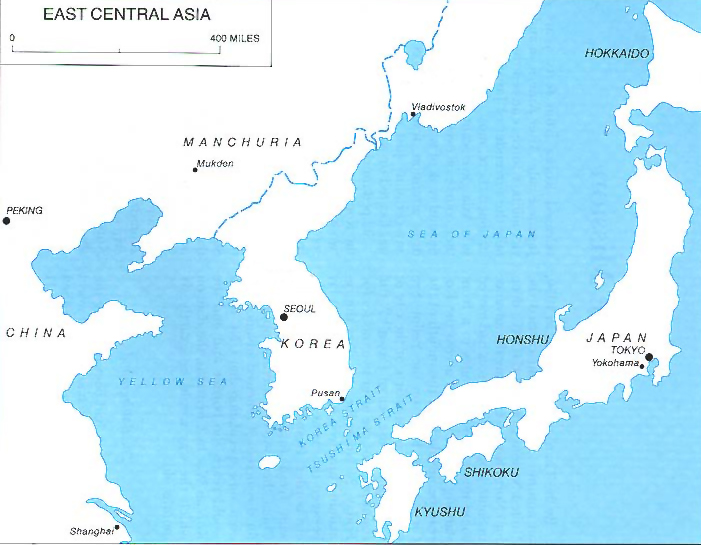
Traditionally Korea had been a tributary of Qing China, but when King Gojong took the throne Japan came seeking trade access and demanding tribute. Queen Lin encouraged the King to show strength and to send them packing. But in 1874 Japan came calling again. Although Queen Min counseled her husband to stand firm again and expel the dignitaries, he signed a trade treaty. When Japan sent a gunship, the Unyo, into restricted waters to ‘survey sea routes’ the Koreans fired on it. The ship retreated. But Japan retaliated when they…
sent a fleet of six naval vessels into Korean waters. Under the threat of force, Gojong once again folded rather than fighting back; Queen Min was unable to prevent this capitulation. The king’s representatives signed the Ganghwa Treaty. [Asian History/About.com]
According to the Ganghwa Treaty:
Japan had free access to some Korean ports and all Korean waters,
Japan gained special trading status
Japanese accused of crimes in Korea could only be tried under Japanese law – they were immune to local laws.
Koreans gained absolutely nothing from this treaty, which signaled the beginning of the end of Korean independence. Despite Queen Min’s best efforts, the Japanese would dominate Korea until 1945. [ibid]
Hwangwonsam: everyday clothes for queen/empress (Photo credit: Wikipedia)
The Queen commissioned fact finding missions to study Japanese westernization. It seemed that the Japanese had leap-frogged over Korea in their ability to Westernize. Where Seoul and Busan had been major commerce centers, they were now overshadowed by Tokyo and Osaka. Korea needed to change with the times. The country and the military needed to modernize.
Queen Min knew Korea would have to tread carefully and she favored a plan by which Korea would continue to deal with Japan in order to modernize and, once that was sufficiently completed, would then ally with the United States or some other or more western powers to drive the Japanese influence out of Korea. [Mad Monarchist. blogspot.com]
She reorganized the government, creating twelve new bureaus to handle foreign relations, commerce and update the military. In general she was determined to bring Korea into a more modern, technological age.
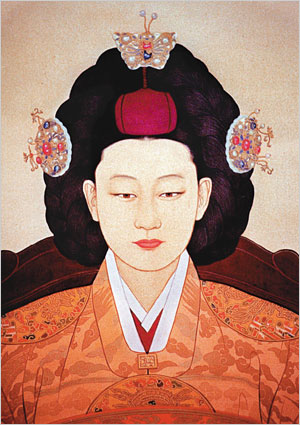
[Image courtesy: Wikipedia]
Needless to say all that modernization didn’t make the traditionalist very happy. In 1882 there was a rebellion seeking to over throw Queen Min and King Gojong and replace them with Gojong’s third brother. The Imo Incident was backed by their old nemesis (and Gojong’s father) Taewongun. “The uprising temporarily ousted Gojong and Min from the palace, returning the Taewongun to power.” [ibid] With the help of 4,500 Chinese soldiers the rebellion was foiled and the King and Queen were restored to power. The Japanese took advantage of the incident to strengthen their growing hold on the peninsula. They…
strong-armed Gojong into signing the Japan-Korea Treaty of 1882. Korea agreed to pay restitution for the Japanese lives and property lost in the Imo Incident, and also to allow Japanese troops into Seoul so that they could guard the Japanese Embassy. [Asian History/About.com]
The Queen countered by granting China access to ports that the Japanese were not privy to. She also asked that Chinese and German officers to head up improvements in the army.
English: Purportedly a photo of Queen Min of Korea, from an old Japanese travel book. (Photo credit: Wikipedia)
In 1894 The Tonghak Rebellion — a week-long popular rebellion against taxes and foreign influence ended with China sending 2,500 troops (invited) and Japan sending 4,500 troops (uninvited) to help quell the insurrection. The peasants quickly went home. The troops remained.
On July 23, Japanese troops marched in to Seoul and captured King Gojong and Queen Min. On August 1, China and Japan declared war on one another, fighting for control of Korea. [ibid]
The Sino-Japanese War ensued. Although China sent 390,000 more troops to Korea, the better prepared and more modern Japanese Meiji military easily won. China withdrew leaving Korea and other Asian allies to deal with the much stronger Japanese.
As many as 100,000 of Korea’s peasants had risen up late in 1894 to attack the Japanese as well, but they were slaughtered. Internationally, Korea was no longer a vassal state of the failing Qing; its ancient enemy, Japan, was now fully in charge. Queen Min was devastated. [ibid]
The queen did not give up she sent emissaries to Russia, hoping they would come to Korea’s aid.
The new caretaker government knew what she was up to. They aligned themselves with Taewongun (her father-in-law). He had no love for the Japanese, but he saw this as a way to get rid of Queen Lin once and for all and he took it.
In 1895 Operation Fox Hunt was put into place. A mixed group of Japanese and Korean assassins attacked Gyeongbokgung Palace. They found the King, but did not hurt him. They came upon the Queen’s sleeping quarters and dragged her out into the courtyard along with four of her attendants.
They brutally killed Queen Min, displayed her body to foreigners so there could be no doubt that she was dead, then took her outside the palace walls and burned her.
For two years Taewongun was in charge, but he lacked the desired “commitment…for modernizing Korea.” [ibid] and the Japanese ousted him.
Gojong took the throne back (with Russian support). He…
declared himself emperor of Korea. He also ordered a careful search of the woods where his queen’s body had been burned, which turned up a single finger bone. Emperor Gojong organized an elaborate funeral for this relic of his wife… The queen consort also received the posthumous title of Empress Myeongseong. [ibid]
The power-struggle over the Korean peninsula continued with Russia and Japan fighting the Russo-Japanese War in 1904-1905. Japan won again. In 1910 they formally annexed Korea. The country did not regain independence until after World War II.
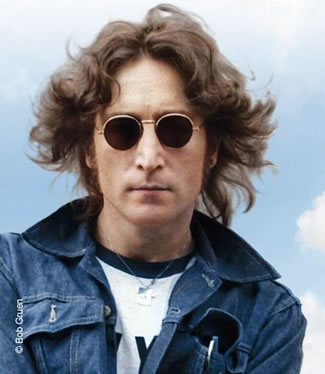
PROGRAMMING NOTE: Switching up the formula a little today as it is NOT John Lennon’s Birthday — that was October 9th — but I was away that day, so I thought I’d retroactively give John the birthday nod.
———————————————————————–
“If someone thinks that love and peace is a cliché that must have been left behind in the Sixties, that’s his problem. Love and peace are eternal.” — John Lennon
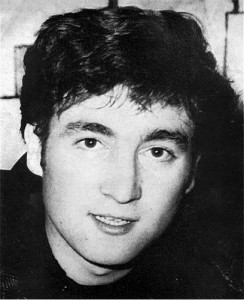
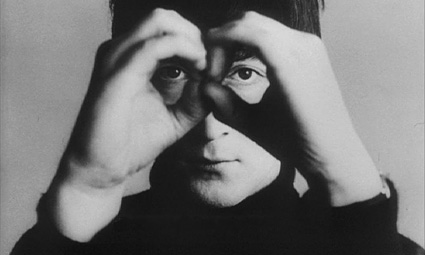
John Winston Lennon was born on October 9th, 1940 in Liverpool, England. He would be 72 years old this year.
John was born during World War II, indeed he was born during an air raid, to Julia and Alfred Lennon. His father worked as a merchant seaman and was often away from home. By the time John was four-years-old his parents were divorced and he went to live with his Aunt Mimi Smith. Although Alfred was largely out of the picture, Julia remained close, she visited John regularly.
She taught John how to play the banjo and the piano and purchased his first guitar. [biography.com]
Julia Lennon died when John was 18, she was stuck by a car.
He did not do well in school, and preferred to be the class clown rather than study. He did love art and music though. John drew unique (almost grotesque) line drawings that quickly and simply captured the image.
John started a ‘skiffle band’ (a band that used the instruments they had at hand) called the Quarry Men when he was 16. The Quarry Men take their name from John’s high school, Quarry Bank High School in Liverpool. The next year he asked Paul McCartney to join the group. George Harrison and Lennon’s art school mate Stu Sutcliffe also joined the band and they later added Pete Best on drums.
The group changed their name to the Beatles and played clubs in Hamburg, Germany and the Cavern Club in Liverpool. Brian Epstein came on board in 1961 as manager, and they got a recording contract with EMI records.
1962 saw huge changes for both Lennon and the group. In April of 1962 Sutcliffe died tragically of a brain aneurysm. In August John married Cynthia Powell, the couple had a son, Julian in April the next year. The band replaced drummer Pete Best with Ringo Starr. The realigned group recorded at EMI with George Martin as their producer, and released Love Me Do in October. The single reached #17 on the British Charts. Please, Please Me the follow-up single, topped the charts. And the Beatles were off.
Beatlemania invaded the US in 1964. They appeared on The Ed Sullivan Show and played sold out concerts.
Still from Hard Day’s Night. [Image courtesy: Cinematical]
Back in the UK they made the movie A Hard Day’s Night. The movie is a delightfully fun, pop romp of a mockumentary. It featured songs from the album of the same name, notably: A Hard Days Night, If I Fell, I’m Happy Just to Dance with You, Tell Me Why, Any Time At All and Can’t Buy Me Love. The popularity of the movie helped keep the album at #1 for 14 weeks on the Billboard chart. The budget was limited so it was shot in black and white, and everything was kept simple. Not so with their second film HELP! which still manages to be charming but not as charming as Hard Day’s Night. It is overproduced and over done. Lennon said that the Beatles felt like extras in their own movie with HELP! and it shows. Still the music was pretty awesome: Help!, You’ve Got to Hide Your Love Away, You’re Going to Lose That Girl! Ticket to Ride, It’s Only Love, I’ve Just Seen a Face, and Yesterday. The Album held the top spot on Billboard for 9 weeks.
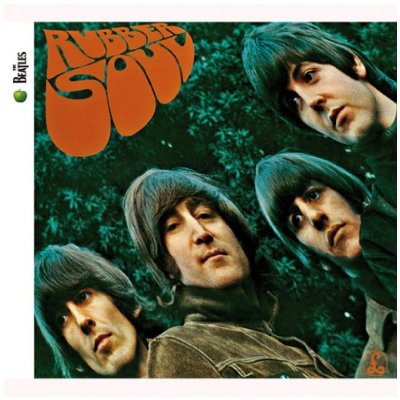
Musically the lads from Liverpool were in top form, releasing the breakthrough album, Rubber Soul in 1965. Their song writing had transformed from the harder R&B influenced Hold My Hand kind of song to lyrical, mature songs like Norwegian Wood, Nowhere Man, Michelle, Girl, In My Life, and If I Needed Someone. It was another #1 Billboard album (6 weeks). [I’m guessing that if you are still reading this blog you are a Beatles fan and already have most of their albums, but if you don’t… I’d put Rubber Soul at the top of the list. For my money Rubber Soul and Revolver are two of the best albums every made.]
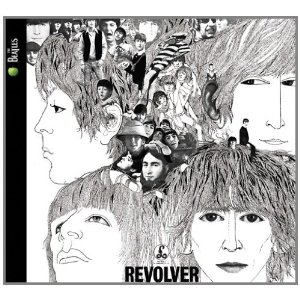
Yesterday…and Today came out in 1966. Stand out songs include: Drive My Car, Nowhere Man, Yesterday, If I Needed Someone, We Can Work It Out and Day Tripper. The album reached #1 for 5 weeks. Revolver also came out in 1966. Taxman, Eleanor Rigby, Here, There and Everywhere, Yellow Submarine, Good Day Sunshine, And Your Bird Can Sing, and Got to Get You Into My Life are some of the hits off the album, which spent 6 weeks at the #1 spot on Billboard’s chart. By 1966 the strain of constant touring, recording, and the hounding fans was weighing on the band. Lennon got in trouble for his “We’re more popular than Jesus now” remark. They played their last concert in Candlestick Park stadium, San Francisco in August.
The following year the Beatles put out their eighth LP, Sgt. Pepper’s Lonely Hearts Club Band. An eclectic mix of pop, rock n roll, and Indian influenced tracks. It won Album of the Year and was #1 on the Billboard charts for a whopping 15 weeks. Hits from the album include: With a Little Help from My Friends, Lucy in the Sky with Diamonds, Getting Better, –the amazing — A Day in the Life, and of course, Lovely Rita. But as good as Pepper was, and it was very good, it was also over produced. All those horns and whistles and animal sounds didn’t quite get in the way enough to ruin the songs, but were they really necessary? Listening back on them now… well, I prefer a simpler production. [It worked somehow in A Day in the Life; not so much in Lovely Rita, but still, the later has such a great title.]
Speaking of over produced…there’s Magical Mystery Tour — a movie that makes absolutely no sense. The LP had some lovely songs though. And even if it was becoming painfully clear that Lennon was writing the “Lennon” songs– which were leaning toward sarcasm — and McCartney was writing the “McCarntney” songs — which were tending to get more nostalgic and saccharine — both came up with some good ones here, like: The Fool on the Hill, Strawberry Fields Forever, Penny Lane, and All You Need Is Love.
1968 brought the animated (and equally bizarre) film Yellow Submarine. In November they release a new album called The Beatles aka The White Album. It was at the top of the charts for 9 weeks. This double album seems almost schizophrenic with some great songs like the hard rock and roll Back in the USSR, Why Don’t We Do It in the Road? Helter Skelter, and Revolution; others that are lovely and lyrical; While My Guitar Gently Weeps, Blackbird, Julia, Long, Long, Long, Good Night; And others that I’m not going to waste my time talking about.
On the personal side John divorced Cynthia Lennon in November of 1968. He and Yoko Ono, who he had been seeing since 1966, and living with since the summer of ’68, put out a collaborative album Two Virgins. The album showed the couple nude on the cover and was banned in most record stores. On March 20, 1969 John and Yoko married in Gibraltar.
The following week, the two master media manipulators used their celebrity for good, hosting a honeymoon “bed-in” for peace in room 902, the presidential suite of the Amsterdam Hilton. The… pajama-clad newlyweds spoke out about world peace. It was the honeymoon as performance art, interlaced with a protest against the Vietnam War. [About.com]
They repeated the “performance” in Montreal the following week and with a bedroom full of musicians, artist, writers and other 1960’s counter-culture dignitaries, they recorded Give Peace a Chance.
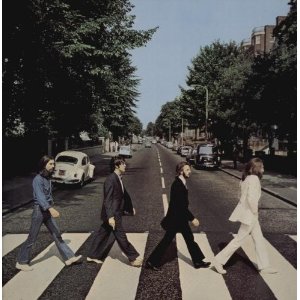
Abbey Road was released in 1969. It is actually the last album the Beatles recorded, but it was released before Let It Be.
Notable songs include: Come Together, Something, Here Comes the Sun, and I Want You. Abbey Road stayed at #1 for 11 weeks.
Recorded largely in January in 1969, Let it Be wasn’t released until 1970 and was #1 for 4 weeks. Lennon had already left the group (September of 1969.) A film of the same name came out the same year. The film was supposed to be a documentary that went behind the scenes to show the world’s most famous rock band making an album. Instead it showed the world’s most famous rock band dissolving. The film culminated in a rooftop concert on January 30th. Songs from the album include: Don’t Let Me Down, Get Back, Two of Us, Let It Be, and The Long and Winding Road.
After the Beatles John released Plastic Ono Band.
The raw, confessional nature of Plastic Ono Band reflected the primal-scream therapy that Lennon and Ono had been undergoing with psychologist Arthur Janov. He dealt with such fundamental issues as “God” and “Mother” and the class system (“Working Class Hero”) on an album as full of naked candor as any in rock has ever been. [Rock & Roll Hall of Fame]
1971 brought Imagine. Rolling Stone Magazine called the title track the third all-time best song ever written.
English: John Lennon and Yoko Ono (Photo credit: Wikipedia)
John and Yoko followed Imagine with an anti-war release Happy Xmas (War is Over). The Nixon administration was not amused. It decided to begin deportation proceeding against Lennon. The stress took its toll on Lennon’s marriage with Ono and the two separated. For 18 months he lived in Los Angeles with another woman, May Pang. It is a period he calls his “Lost weekend” of drinking a partying. He fished Mind Games, and recordedWalls and Bridges.Whatever Gets You Thru the Night, a single off the later album became a number one hit. He co-wrote Fame with David Bowie.
He and Ono were reunited in 1975 shortly before the release of Rock n Roll. The couple celebrated the birth of their son Sean in October of 1975. And, after releasing Shaved Fish, John became a stay at home dad for five years.
In 1980 he came out of retirement and released Double Fantasy with the single Just Like Starting Over.
On December 8, 1980 the music died. As Lennon and Ono were returning home from recording tracks for the following up album, Milk and Honey he was assassinated in front of his New York apartment building, the Dakota.
“All the legislation in the world will not abolish kissing” —Elinor Glyn
Portrait of Elinor Glyn, 1927 (Photo credit: Wikipedia)
Elinor Southerland was born on this day in Jersey, Channel Islands, England in 1864. Today is the 148th anniversary of her birth.
Elinor’s father died when she was a toddler and the family moved for a while to Canada. They returned to Jersey when she was eight and her mother remarried. Elinor…
was a voracious reader interested in French history and mythology, though she had no formal education … She would later be drawn to mysticism and romance. [The Literature Network]
She liked to write and she kept a diary.
At 28 she married Clayton Glyn. The couple had two daughters, Margot and Juliet. The marriage was not a happy one. and, although Elinor and Clayton officially remained together both had affairs.
Elinor had affairs with a succession of British aristocrats and some of her books are supposedly based on her various affairs… [Good Reads]
She contributed articles to Scottish Life and Cosmopolitan but her real break through in the literary world came with the serialization of her first book The Visits of Elizabeth in 1900. The book, was written as a series of letters by an innocent young woman. Elizabeth.
The naive and charming narrator gets herself into social scrapes due to her innocence, … they are actually funny over a hundred years later because you know what Elizabeth doesn’t know–and perhaps that was the appeal for the more knowing Edwardian readers. Glyn’s book is a bit of a satire, but a romantic one, and Elizabeth gets her happily-ever-after, but not before making every handsome gentleman fall deeply in love with her. [Amazon.com review]
Elinor was prolific in turning out her novels (she had to be, finances at home had taken a turn for the worse and the once wealthy Clayton Glyn was in debt by 1908. He died in 1915.) Her reputation as a writer of romance grew with the publications of The Seventh Commandment (1902), The Reflections of Ambrosine (1903), The Damsel and the Sage (1903), The Vicissitudes of Evangeline (1905) andBeyond the Rocks(1906).
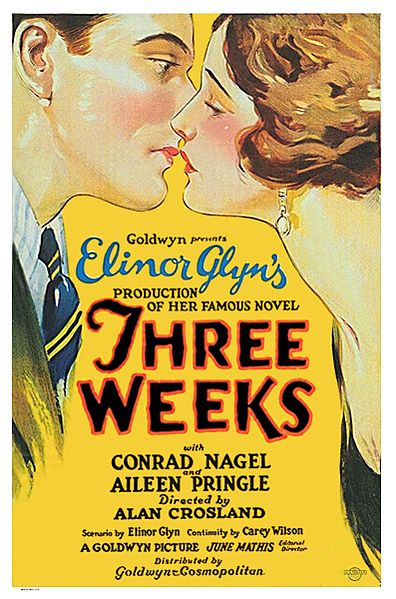
Movie poster for Three Weeks
Her risqué Three Weeks, about an exotic Balkan queen who seduces a young British aristocrat, was allegedly inspired by her affair with Lord Alistair Innes Ker. On the one hand it scandalized Edwardian aristocrats and jeopardized Glyn’s status. [The Literature Network]
Deemed immoral and banned at elite schools like Eton and panned by some critics who considered it disjointed and dull, the book non the less sold out within weeks of its publication and it “ensured her meteoric rise to fame.” [ibid]. It also brought about the anonymous ditty:
Would you like to sin
With Elinor Glyn
On a tiger skin?
Or would you prefer
To err
With her
On some other fur
Her private life seemed to either echo or prelude the romantic interludes of the heroines in her novels as she continued to crank out “romances” until the start of World War One. During the Great War she worked in France as a war correspondent and Glyn was one of two women to witness the signing of the Treaty of Versailles.
Elinor Glyn looks up at Rudolph Valentino, from the frontispiece of Beyond The Rocks (Photo credit: Wikipedia)
She made the move to Hollywood in 1920 where she worked as a scriptwriter for MGM and Paramount. The Great Momentwas filmed in 1920. In 1922 Beyond the Rockswas made into a major motion picture with red-hot Rudolph Valentino and Gloria Swanson. Three Weeks was given the big screen treatment not once, but twice, first in 1914 and then in 1924. And Glyn wrote the screenplay and was closely involved in the production of the 1926 Love’s Blindness.
In 1927 she wrote a novella that gave us the expression “the IT girl.” She coined the phrase and quickly crowned Clara Bow, who was staring in Red Hair (a movie based on Glyn’s The Vicissitudes of Evangeline), as the first IT girl. Here autobiography Romantic Adventure was published in 1936. She continued writing until 1940 when she published her last — and 42nd — book, The Third Eye.
English novelist and scriptwriter Elinor Glyn (1864-1943) (Photo credit: Wikipedia)
Elinor Glyn died in September of 1943 in Chelsea, London.
————————————————————————–
Bookshelf:
Interested in reading some of Elinor Glyn’s books? You can find them through the links below.
“I just sit at a typewriter and curse a bit.”“There is only one cure for gray hair. It was invented by a Frenchman. It is called the guillotine.”“I know I was writing stories when I was five. I don’t know what I did before that. Just loafed I suppose.”–P.G. Wodehouse
“I just sit at a typewriter and curse a bit.”
Pelham Grenville Wodehouse was born on this day in Guildford, Surrey, England in 1881. This is the 131st anniversary of his birth.
Wodehouse, called “Plum” as a child, spent much of his early life in the care of a gaggle of aunts and at boarding schools in England, while his parents lived in the Far East. Third of four boys, Wodehouse was close to his brothers. He went to The Chalet School, Elizabeth College in Guernsey, Malvern House (near Dover) and finally at Dulwich College with his older brother Armine. He flourished at Dulwich where he played sports (especially boxing, cricket and rugby), studied the classics, sang and acted in the school’s theatricals, and of course, wrote.)
Psmith in the City (Photo credit: Wikipedia)
Upon graduation in 1900 ailing family finances meant he couldn’t go on to Oxford like Armine. Instead, Plum’s father got him a job in the London branch of the Hong Kong and Shanghai Bank. He wrote about his experiences at the bank in Psmith in the City, but he said he “never learned a thing about banking.” In 1902 he gave up the financial farce and dove into journalism with a job writing a comic column at The Globe newspaper. He moved to New York and published his first novel, The Pothunters the same year. A Prefect’s Uncle; Love Among the Chickens; The Swoop; Psmith In the City; Psmith, Journalist; The Prince and Betty; and Something New followed fairly quickly there after.
The Prince and Betty (Photo credit: Wikipedia)
He also wrote for musicals. He penned the book for Cole Porter’s Anything Goes; the Gershwin’ s Oh Kay . He worked with Ira Gershwin on the lyrics for Rosalie. And he wrote dozens of musicals — generically called the Princess Theatre Musicals — with Guy Bolton and Jerome Kern. [For a complete list of Wodehouse musicals go to The Playwrights Database at doolee.com] The Princess Theatre Musical are generally seen as a stepping stone that took the best of vaudeville and operetta and blended them into modern musical theatre. They transitioned
“… the haphazard musicals of the past to the newer, more methodical modern musical comedy … the libretto is remarkably pun-free and the plot is natural and unforced. Charm was uppermost in the creators’ minds … the audience could relax, have a few laughs, feel slightly superior to the silly undertakings on stage, and smile along with the simple, melodic, lyrically witty but undemanding songs” [Bloom and Vlastnic Broadway Musicals: The 101 Greatest Shows of All Time]
My Man Jeeves (Photo credit: Wikipedia)
Starting with My Man Jeeves in 1919 Wodehouse published the series of books for which is he best known, The Jeeves and Wooster books. Here’s a clip from the 1990 Granada Television production of Jeeves and Wooster starring Hugh Laurie and Stephen Fry:
He also wrote the Blandings Castle series about a fictional castle with Lord Emsworth and his prize-winning pig, the “Empress of Blandings.”
Since he and his wife, Ethel Wayman, were officially residents of both England and the US they were being taxed by both countries. To alleviate the tax burden they moved to France in 1934. The Wodehouse’s remained in France when the Nazi troops moved in. Wodehouse was interned as an “enemy alien” eventually landing in Tost, Upper Silesia, Poland. He later quipped of his ‘lodgings’ “If this is Upper Silesia, what on earth must Lower Silesia be like?” He entertained his fellow prisoners with dialogues and wrote during his two-year internment (he completed one novel and started two more). He was released just prior to his 60th birthday when a German friend from his Hollywood days, Werner Plack, approached him about doing a broadcast for the Americans describing his life as an internee. America was not at war with Germany yet, and he had received many letters of encouragement from his fans in the US while in the camp. He saw this as a way to thank them. And, Wodehouse claimed, he was simply reflecting the “flippant, cheerful attitude of all British prisoners.” [the Guardian] in the broadcasts. But the British public didn’t see it that way, and neither did MI5. He was interrogated for suspected collaboration with the Germans — something that shocked the aging author. “I thought that people, hearing the talks, would admire me for having kept cheerful under difficult conditions,” [ibid] Wodehouse maintained that he never had intended to aid the enemy. But the incident left a bad taste with both the Wodehouses and the British public. The author moved to the US in 1945, and never went back to England.
“It takes courage to grow up and become who you really are.” –e.e. cummings
E. E. Cummings, 1958 by Edward Estlin Cummings, Oil on canvas (Photo credit: cliff1066™)
Edward Estlin Cummings was born on this day in Cambridge, Massachusetts, USA in 1894. Today is the 118th anniversary of his birth.
As a child Cummings enjoyed art and writing, as well as the outdoors. His mother encouraged him to write. And Cummings worked at his craft by writing daily. He went to Harvard where he became interested in non conventional poetry.
First edition dustjacket of The Enormous Room (Photo credit: Wikipedia)
During World War I he was an ambulance driver in France and fell in love with Paris. But he sent letters home that “holding views critical of French war effort” [e.e. cummings Biography] He was arrested and thrown in prison for three months. His book The Enormous Roomis based on his experiences in the French prison. He was later drafted into the US Army.
1st edition cover (Photo credit: Wikipedia)
His first collection of poems,Tulips and Chimneys came out in 1923. Although his poems received critical praise — he won the Dial Award for poetry in 1925 — Cummings found it hard to find a publisher. His poetry was considered too avant guard.
His my father moved through dooms of love is a tribute to his recently deceased father…
              34

my father moved through dooms of love
through sames of am through haves of give,
singing each morning out of each night
my father moved through depths of height

this motionless forgetful where
turned at his glance to shining here;
that if(so timid air is firm)
under his eyes would stir and squirm

newly as from unburied which
floats the first who,his april touch
drove sleeping selves to swarm their fates
woke dreamers to their ghostly roots

and should some why completely weep
my father's fingers brought her sleep:
vainly no smallest voice might cry
for he could feel the mountains grow.

Lifting the valleys of the sea
my father moved through griefs of joy;
praising a forehead called the moon
singing desire into begin

joy was his song and joy so pure
a heart of star by him could steer
and pure so now and now so yes
the wrists of twilight would rejoice

keen as midsummer's keen beyond
conceiving mind of sun will stand,
so strictly(over utmost him
so hugely) stood my father's dream

his flesh was flesh his blood was blood:
no hungry man but wished him food;
no cripple wouldn't creep one mile
uphill to only see him smile.

Scorning the Pomp of must and shall
my father moved through dooms of feel;
his anger was as right as rain
his pity was as green as grain

septembering arms of year extend
yes humbly wealth to foe and friend
than he to foolish and to wise
offered immeasurable is

proudly and(by octobering flame
beckoned)as earth will downward climb,
so naked for immortal work
his shoulders marched against the darkhis sorrow was as true as bread:
no liar looked him in the head;
if every friend became his foe
he'd laugh and build a world with snow.My father moved through theys of we,
singing each new leaf out of each tree
(and every child was sure that spring
danced when she heard my father sing)then let men kill which cannot share,
let blood and flesh be mud and mire,
scheming imagine,passion willed,
freedom a drug that's bought and soldgiving to steal and cruel kind,
a heart to fear,to doubt a mind,
to differ a disease of same,
conform the pinnacle of amthough dull were all we taste as bright,
bitter all utterly things sweet,
maggoty minus and dumb death
all we inherit,all bequeathand nothing quite so least as truth
--i say though hate were why men breathe--
because my Father lived his soul
love is the whole and more than all
Cummings died in 1962 from a stroke.
E.E. Cummings, full-length portrait, facing left, wearing hat and coat / World-Telegram photo by Walter Albertin. (Photo credit: Wikipedia)
‘Why am I so soft in the middle when the rest of my life is so hard?”
— Paul Simon
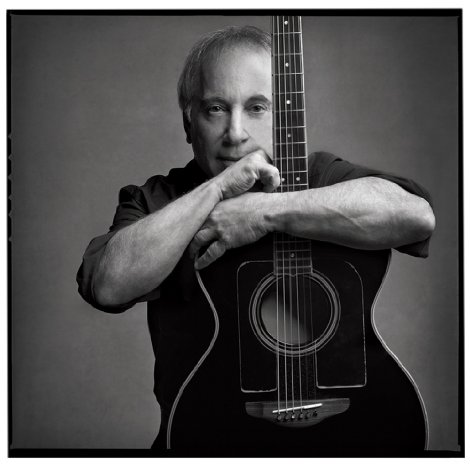
Paul Frederic Simon was born in Newark, New Jersey, USA on this day in 1941. He is 71 years old.
Paul’s other love is baseball. [Image courtesy Paul-Simon.info]
He grew up in Queens, New York loving baseball and music. Simon met Art Garfunkel in middle school. They were the White Rabbit and the Cheshire Cat in their 6th grade production of Alice and Wonderland and attended Forest Hills High School together. He and Garfunkel would use a tape recorder to practice singing together. In 1954 Paul got a guitar for his birthday. They tried to duplicate the tight harmonies of the Everly Brothers, who they idolized. In 1956 Simon wrote their first song “The Girl for Me” which his father, Louis (who was musician and college professor) wrote out and corded for the duo.
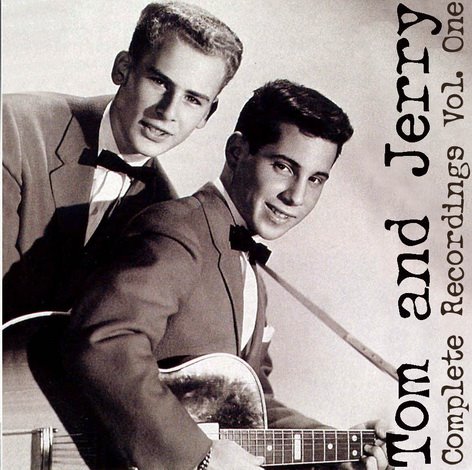
While juniors in high school they started the group Tom and Jerry. (Art was Tom; Paul was Jerry) They released a single, Hey, Schoolgirl. The song reached #49 on the Billboard charts.
After high school Simon went to Queen’s College, New York and studied English. He met singer songwriter Carol King at Queen’s and he did solo work and played with a group called Tico & The Triumphs. Although Tico et al put out a few singles the efforts weren’t very successful.
Worried that Simon and Garfunkel sounded too Jewish the duo opted for the more generic Tom and Jerry. [Image courtesy Paul-Simon.info]
Simon continued to write after graduation. He embraced the changing social climate of the early Sixties and “the burgeoning Greenwich Village folk scene.” [ Paul-Simon.info] His maturing style is reflected in the songs he wrote during this era, especially the Sound of Silence.
´Sound of Silence´ uses imagery of light and darkness to show how ignorance and apathy destroy people´s ability to communicate on even a simple level. The light symbolizes truth and enlightenment. Both music and lyrics are perfectly fitting. [Paul-Simon.info]
Simon reunited with Art Garfunkel in 1963. They began to sing in folk clubs, worked on songs and recorded a few of the songs Simon had earlier penned.
Here is He Was My Brother a song that Paul dedicated to Andrew Goodman, one of three civil rights workers killed in Mississippi in 1964.
They released Wednesday Morning, 3 A.M. as Simon and Garfunkel. A classic now, the album met with tepid response when it first came out. The songs are a mix of original Simon compositions; Bleecker Street, Sparrow, The Sound of Silence, Wednesday Morning, 3 A.M.; traditional tunes the duo arranged to best fit their voices; and covers. Sound of Silence hit #1 and gave Simon and Garfunkel their first gold record.
Simon moved to England and Garfunkel went back to school. Paul worked with the Australian band The Seekers and did some solo recording.
Back in the US Simon and Garfunkel released Sounds of Silence; Parsley, Sage, rosemary and Thyme, Bookends, andBridge Over Troubled Water. They also contributed heavily to the soundtrack for the movie Mrs. Robinson.
America (Simon & Garfunkel song) (Photo credit: Wikipedia)
The duo won GRAMMYs in 1969 and 1971 (plus a GRAMMY: Lifetime Achievement Award in 2003) and were inducted into the Rock and Roll Hall of Fame in 1990.
They split in 1970, again. Simon put out a self title album that was more World Beat inspired. The album featured Mother and Child Reunion and Me and Julio Down by the Schoolyard.
There Goes Rhymin’ Simon came out in 1973 and had the hits Kodachrome and Loves Me Like a Rock.
In 1975 he put out Still Crazy After All These Years with the hits My Little Town and 50 Ways to Leave YourLover. Simon picked up another Grammy for the album.
He switched record labels to Warner Brothers for One-Trick Pony. He starred in a movie of the same name. His next album was Hearts and Bones. That album was written around the famous 1981 Central Park reunion concert for Simon and Garfunkel and Art’s influence can be heard on several songs.
English: Front cover of the Paul Simon music album Graceland. (Photo credit: Wikipedia)
When Simon worked on the We Are the World single to raise money for USA for Africa his interest in world music was rekindled. His Graceland album — which celebrated its 25th anniversary on June 5th — was a
“…melding of South African styles and Simon’s trademark sensibility made for one of the most intriguing albums–not to mention commercial hits–of the ’80s. At once lively, thoughtful, gorgeous, and tough, Graceland acknowledges splits both in South Africa’s social fabric and in Simon’s personal life … Humor is hardly absent from the mix, though; witness the addled “I Know What I Know” and the fable-like “You Can Call Me Al.”[ –Rickey Wright. Amazon.com]
Rhythm of the Saints was recorded in Rio de Janeiro and New York in 1989. This album featured a latin beat, and Simon was quick to point out that the World Sound label was nothing new for his songs. He’d been writing with an international flavor since Julio after all.
Simon lent his talents to the 1998 musical play The Capeman. Although most critics liked his songs, and the production was nominated for several Tony’s the critics panned the effort and it lost millions.
In 2000 he produce a more conventional pop album You’re the One.
He continues to tour — often with other folk and rock icons, and occasionally with Garfunkel. In 2010 he put out So Beautiful or So What.




















 ritaLOVEStoWRITE
