Category Archives: Writing

Thought of the Day 7.30.12 Emily Bronte

“Love is like the wild rose-briar; Friendship like the holly-tree. The holly is dark when the rose-briar blooms, But which will bloom most constantly?”

–Emily Bronte

A portrait of Emily, painted by her brother Br...

A portrait of Emily, painted by her brother Branwell. (Photo credit: Wikipedia)

Emily Jane Bronte was born this day in Thornton, near Bradford, Yorkshire England in 1818. Today is the 194th anniversary of her birth.

Maria Branwell and Patrick Bronte had six children; Maria, Elizabeth, Charlotte, Patrick Branwell, Emily and Anne. The young family moved to Haworth Parsonage in 1824 where Patrick Bronte was curate. Emily was only three when her mother died, probably of stomach cancer, and she remembered little of the vivacious, lively woman who had brought so much joy to the house.

English: Brontë Parsonage Museum

English: Brontë Parsonage Museum (Photo credit: Wikipedia)

In 1824 the older girls were sent to Cowan Bridge School, a school for the daughters of middle class clergymen in Lancashire. The students endured harsh conditions, corporal punishment and fire and brimstone sermons along with long hours of study and prayer. The dormitories were unheated. In the morning  the students shared a basin of water to wash. Often it was so cold that the water had frozen over. It’s not surprising that the students took ill. There was an outbreak typhus and tuberculosis. The girls were brought home, but both Maria and Elizabeth died with in weeks of each other. The family was devastated.  Charlotte changed the name of the horrible school to Lowood and wrote about it in Jane Eyre,

Charlotte and Emily stayed at home and were educated by their Aunt Elizabeth Branwell along with their Brother and little sister Anne.  The children had very vivid imaginations and created fantasy adventures. “Glasstown” featured Branwell’s 12 wooden soldiers. Charlotte and Branwell  invented “Angria”  and Emily and Anne created “Gondal.” Gondal was and island in the South Pacific and was ruled by a woman who “was in control of herself fan her life.” Both Charlotte and Emily return to themes from Angria and Gondal in their later novels.

Brontë

Brontë (Photo credit: Wikipedia)

After a brief stint as a teacher in Halifax Emily return to Haworth Parsonage and took over as housekeeper.  In 1845 Charlotte discovered two notebooks of Emily’s poems and encouraged her to publish them. Emily felt betrayed and refused, but relented when she found out that Anne writing about Gondal too.

Cover of the first edition of Poems by Currer,...

Cover of the first edition of Poems by Currer, Ellis, and Acton Bell, by the Brontë sisters, 1846 (Photo credit: Wikipedia)

Aylott and Jones published 62 of the sister’s poems in “Poems by Currer, Ellis and Acton Bell.”  The initial run sold only 2 copies, but the sisters were undaunted.  By 1847 they had each had a novel published (with in months of one another. Charlotte penned  Jane Eyre (October). Emily  and Anne had a three volume deal. Emily took two volumes for Wuthering Heights, and Anne had the the last volume for Agnes Grey. The set was published in December.  Anne quickly followed up with The Tenant of Wildfell Hall in June of 1848. Emily was working on a second novel at the time of her death, but it has been lost. (Some speculation has it that Charlotte destroyed the manuscript.)

Emily took ill after her brother Branwell’s funeral. She died of tuberculosis on December 19, 1948.

Wuthering Height is Emily Bronte’s literary legacy. CLICK HERE For a readers guide to the novel. You can pick up a FREE Kindle edition  or read the book on line at Bibliomania. Prefer a hard copy? (and don’t we all?) Go to the library or click here.


Thought of the Day 7.28.12 Beatrix Potter

“Thank goodness I was never sent to school; it would have rubbed off some of the originality.”*

-Beatrix Potter

English: A picture of Beatrix Potter

English: A picture of Beatrix Potter (Photo credit: Wikipedia)

Helen Beatrix Potter was born on this day  in South Kensington, London in 1866. Today is the 146th anniversary of her birth.

Beatrix and her younger brother (Walter) Bertram were raised in London, but enjoyed long holidays in rural Scotland and the English Lake District. According to the web site for the Beatrix Potter Society she was educated by a governess at home and loved languages and literature especially fairy tales and folk tales. Her early talent for drawling and as a water colorist was encouraged and she illustrated several popular fairy tales for her family’s entertainment. She wrote stories about the family pets . The children kept  “rabbits, a hedgehog, some mice and bats…” most of which would one day wind up in her stories.

She kept a journal — written in a code she invented herself (and which was not deciphered until 1958) — and a sketchbook. In her 20’s she “sold some of her artwork for greetings (sic) cards and illustrations” but she largely concerned herself with the study of natural  history, giving special focus to mycology — the study of fungi. She produced beautiful and technically accurate watercolors of mushrooms and became an adept scientific illustrator. She wrote a paper on the reproduction of fungi. On April 1, 1897 the paper was presented by a male scientist since women weren’t allowed to attend, much less present at, The Linnean Society (“the world’s oldest biological society” has since changed their  Men Only policy).

She also wrote delightful letters to children of her acquaintance that were wonderfully illustrated and told tales of little woodland creatures and pets. In 1901 she adapted some of those letters into The Tale of Peter Rabbit.

Cover of the first, privatley printed edition ...

Cover of the first, privatley printed edition of The Tale of Peter Rabbit by Beatrix Potter (Photo credit: Wikipedia)

Since she couldn’t get any commercial publishers to take on the book she self published the initial edition. But then Frederick Warne & Co.  agreed print Peter Rabbit and Potter converted the black and white illustrations to color.

Cover of the first edition, The Tale of Peter ...

Cover of the first edition, The Tale of Peter Rabbit (Photo credit: Wikipedia)

Norman Warne, the youngest son of the publishing magnet was assigned as Potter’s editor and the two brought twenty Potter books to market, usually at a rate of 2 or 3 a year. Potter also marketed stuffed animals, paint books and wall paper based on the characters in her books.

In 1905 Norman Warne proposed to Beatrix Potter. Her parents vehemently against the match because Warne was socially inferior and “from Trade.” Beatrix found this ironic since her grand parents had been engaged in the cotton trade. But ultimately their pressure won out and she kept the engagement a secret. It didn’t matter. Norman had lymphatic leukemia — a disease that was hard to diagnose at the turn of the century — he died within a month. Potter was summoned to the sick bed, but she arrived too late.

Photo of Norman Warne ca 1900

Photo of Norman Warne ca 1900 (Photo credit: Wikipedia)

Beatrix bought Hill Top Farm in the Lake District  in Lancashire as a sanctuary. She wanted to paint, write and learn about  land management. Later she purchased Castle Farm across the road from Hill Top Farm. Her goal was to preserve land in the area from development.

English: Hill Top Farm, Near Sawrey, Cumbria. ...

English: Hill Top Farm, Near Sawrey, Cumbria. Home of children’s author, Beatrix Potter. As requested in her will, the interior has been “left as if she had just gone out to the post”: a fire burning in the hearth, cups and saucers on the table ready for a visitor! (Photo credit: Wikipedia)

In 1923 she bought and restored Troutbeck Park. The sheep at Troutbeck were disease-ridden and under her stewardship the Herdwick sheep were restored to health.  She became very involved in the local community and joined several committees to help improve rural live including the founding of  a nursing trust to improve local health care. In 1913 she married a local solicitor, William Heelis.In 1926 the semi-autobiographical The Fairy Caravan was published in the United States (it didn’t show up in England until after she passed away).

At her death Beatrix Potter Heelis left 4,000 acres, on 15 farms, in the Lake District to the National Trust.

Beatrix Potter and her husband William Heelis ...

Beatrix Potter and her husband William Heelis on their wedding day (Photo credit: Wikipedia)

The Beatrix Potter Society was founded in 1980 to promotes the appreciation of the life and works the author. Please see their web site and the excellent article by  Linda Lear for more information on Potter.

The relationship between Beatrix Potter and Norman Warne is basis of the film Ms. Potter starring Renee Zellweger and Ewan McGregor.

——————————————————————————————————————–

*Perhaps her teachers were forced to teach to the TEST!

AND Maggie would like you to know that Beatrix Potter is NOT Harry Potter’s Muggle cousin.

Harry Potter

NOT related to this guy. Also not a lego. Yet I love all three. Harry Potter (Photo credit: Profound Whatever)


Thought of the Day 7.26.12

“Experience is not what happens to you. It is what you do with what happens to you.”

–Aldous Huxley

Aldous Leonard Huxleywas born on this day in Godalming, Surrey in 1894. Today is the 118th anniversary of his birth.

Huxley was born into a family of scientist, educators and writers. His grandfather, Thomas Henry Huxley was a biologist and anatomist who was know as “Darwin’s Bulldog” for his strong support of Darwin’s theories on evolution. His father, Leonard Huxley, who was a writer, editor, and schoolmaster, had a botanical laboratory  of his own that he shared with Aldous and his siblings. Both his older brother, Julian, and his step brother, Andrew, became renowned scientist (Julian was a leading evolutionary biologist and the first director of UNESCO;  Andrew won a Nobel Prize in Physiology or Medicine in 1963.) Aldous attended Eton College, but he suffered from keratitis punctata at 16 and was almost totally blind for a year and a half.  By learning Braille and with the use of special glasses he was able to continue his studies, but he could no longer follow his dream of becoming a scientist (his first career choice). It also meant he couldn’t fight in WWI.

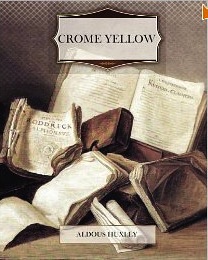
2011 edition of Chrome Yellow published by Create Space.

He taught French at Eton (Eric Blair aka George Orwell was one of his students) and began to write poetry and novels. Chrome Yellow was his first novel, a social satire that was published in 1921. With his use of social criticism, snappy dialogue and cynicism Huxley saw critical and financial success as a writer. He published a dozen books during the 1920s.

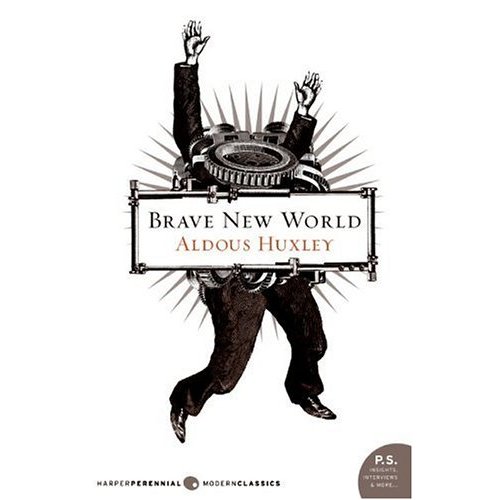
2006 edition of Brave New World published by Harper Perennial Modern Classics
Huxley met D.H. Lawrence when he moved to Italy part time in 1920. The two authors remained close friends until Lawrence’s death.  While in Italy Huxley wrote his masterpiece, Brave New World It is a dystopian vision of a world controlled by genetic engineering, it’s citizens pacified by institutional drug use.
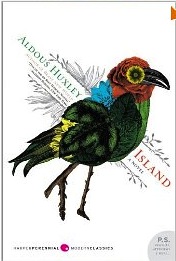
He moved to Hollywood, CA in 1937. Here he wrote essays and worked on screenplays (including the 1940 version Pride and Prejudice and the 1944 version of Jane Eyre.)  He became involved with the counter culture  and experimented with self-directed psychedelic drugs. In 1962 he published  Island, a “good” Utopia. Where the people of Brave New World took the drug Soma to numb and intoxicate themselves, the people of Island take a perfected (and fictional) LSD variant that helps them expand their world in a religious way.

The 2009 edition of Island published by Harper Perennial Modern Classics

Huxley died on November 22nd, 1963, the same days as C.S. Lewis and President John F. Kennedy.

Books and How to Sell Them

Books and How to Sell Them.

The always witty and creative Lynn Reynolds just posted this little nugget of book publishing advice. I know some of you are in the Biz so I thought I’d share.

Enjoy.


Thought of the Day 7.22.12

“Give me your tired, your poor,
Your huddled masses yearning to breathe free,
The wretched refuse of your teeming shore.
Send these, the homeless, tempest-tost to me,
I lift my lamp beside the golden door!”

Emma Lazarus

Engraving

Engraving (Photo credit: Wikipedia)

Emma Lazarus was born in New York City in 1849. Today is the 163 anniversary of her birth.

She was the middle of seven children born to Moses and Ester Lazarus. The family lived very comfortably in the Union Square neighborhood of the city. They had ties to some of the earliest Jewish American families and were part of the Jewish upper class. She received a classical education and excelled in German and French, she loved to write and translate poems.

As antisemitism began to rise in Europe and America, Lazarus became more and more involved in the fight against it. As the Russian Pogroms caused large numbers of Jews to immigrate to the US she became more outspoken on refugee issues.

She wrote “The New Colossus”  for an auction to help pay for the pedestal for the Statue of Liberty. (France had donated the statue, the US had to come up with the money for the pedestal.) The sonnet perfectly exemplified the Mother of Exiles in the the New York Harbor. The poem was engraved into the Statue of Liberty’s base after Lazarus’ death.


She was an accomplished writer, publishing books of poetry, a novel, a play, and several translations for the American market. She sought out Emerson as her mentor, and the two shared a long friendship.

"I lift my lamp. . .

“I lift my lamp. . . (Photo credit: ckaiserca)


Delovely x 1500

I’m feeling the LOVE.

Not quite sure how to say this with out sounding like I’m tooting my own horn, but I sincerely want to THANK every one who has been stopping by ritaLOVEStoWRITE this past month and a half, all 1,500 of you! I hit that benchmark today, and I’m pretty much in shock. I wasn’t really sure if any one would be reading.

I especially wish to thank those of you who FOLLOW the blog to catch my Thought of the Day and other posts, and those of you who have left comments.

A special nod goes to Lynn Reynolds who got me started. Lynn gave me all kinds of advice, ideas and encouragement.

Writing every day has been a great creative outlet and mental exercise. I’ve learned a lot about the people I’ve featured on Thought of the Day …and I’ve learned a lot about myself along the way.

So thanks everybody. Keep reading. Keep “Liking.”  And please consider “Following” along.

Cheers,

Rita


PS Please note that I’m pretty vicious when it comes to SPAM. If I it looks remotely like SPAM I’ll delete it. So If you want to write a comment — and I LOVE  getting comments — please mention something specific about the post you are commenting on. (If  I’ve deleted a valid comment accidentally because I thought it was SPAM, I apologize… SPAM happens. Try again, wont you?)


Thought of the Day 7.19.12

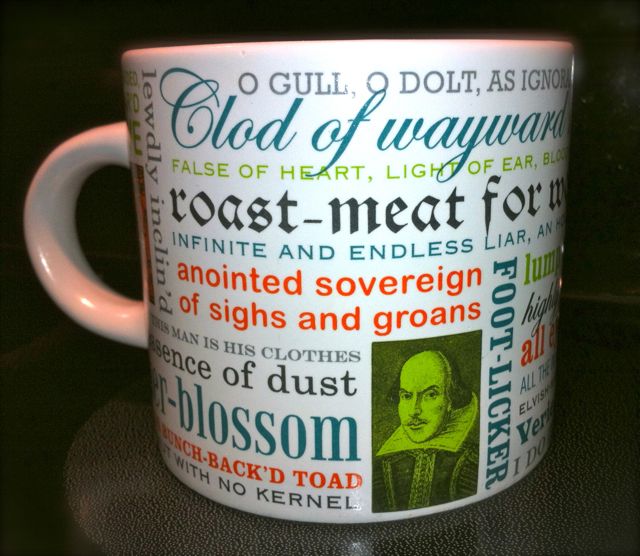
‘Tis the Shakespeare insult mug from our cupboard. Because sometimes inspiration IS as close as your morning cup of coffee.

Well, today I’m thinking that you, my clever, well read, blog followers must be in wont of a few additional Shakespearian insults to heap upon mankind. The response to yesterday’s list was pretty amazing (thank you!) And whilst I was compiling that list I kept finding quotes from/to/about this Falstaff guy…So, dear reader, I give you…

The Henry IV collection

You starvelling, you eel-skin, you dried neat’s-tongue, you bull’s-pizzle, you stock-fish–O for breath to utter what is like thee!-you tailor’s-yard, you sheath, you bow-case, you vile standing tuck! (Henry IV, Part 1) [ wow that’s all one curse! You might want to break it down and use a bit of moderation, lest some one thing you a bow-case.]

Peace, ye fat guts! (Henry IV, Part 1)

Falstaff sweats to death,
And lards the lean earth as he walks along. (Henry IV, Part 1)

Thou art as fat as butter (Henry IV, Part 1)

Thou clay-brained guts, thou knotty-pated fool, thou whoreson obscene greasy tallow-catch! (Henry IV, Part 1)

You are as a candle, the better burnt out. (Henry IV, Part 1)

That trunk of humours, that bolting-hutch of beastliness, that swollen parcel of dropsies, that huge bombard of sack, that stuffed cloak-bag of guts, that roasted Manningtree ox with pudding in his belly, that reverend vice, that grey Iniquity, that father ruffian, that vanity in years?  (Henry IV, Part 1)

You scullion! You rampallian! You fustilarian! I’ll tickle your catastrophe! (Henry V, Part 2)

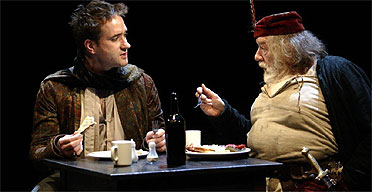
Matthew MacFadyen as Prince Hal and Michael Gambon as Falstaff in a scene from the National Theatre’s presentation of Henry IV in 2005. (Photo credit: Catherine Ashmore)

My secret Shakespearian wish… If you had a million dollars and could endow a classical theatre company what would your wish be?

My wish?  I’d  endow my two favorite Shakespearian troupes — the Baltimore Shakespeare Factory and the Chesapeake Shakespeare Company — for a Summer of Hal. Since they generally put on two shows a piece …they could do Henry  IV Parts 1 and 2 and go once more into the breach Henry V in rep. [For the fourth show I’d love to see another Jane Austen adaptation, maybe Persuasion?] …Oh, We few we happy few who could witness such a summer as that!  (Now if only I had a million dollars!)

[Discuss]


Thought of the Day 7.12.12

“There is no remedy for love but to love more.”

–Henry David Thoreau

Henry David Thoreau was born Concord Massachuset 1817. This is the 195th anniversary of his birth. 

Thoreau was an abolitionist, a naturalist,  a lecturer, a historian, a teacher, a surveyor, a pencil maker  and a writer.  He was inspired by his friend Emerson.. 

Thoreau made most of his money through surveying. He wrote that surveying “seems a noble employment  which brings you within hearing of [the birds].” He also helped to make Thoreau & Co., his family’s pencil making company one of the best in the America when he  developed a way of mixing clay with graphite to make a superior, “smudge-free” pencil. 

Thoreau loved nature. He would take long walks in the woods and he collected specimens of herbs, leaves and flowers, storing along the way. He stored them in his hat until he got home.,  then he or his sister Sophia carefully press them. He carried a notched stick that acted as both walking stick and a measuring stick. He also brought along a copy of Alexander Wilson’s bird anthology to identify the birds in the trees.  In 1845 he built his own cabin near  Walden Pond, on property owned by Emerson,  and lived for two years. His goal was to “live deliberately, to front only the essential facts of life, and see if I could not learn what I had to teach.”   He wrote about his time there in A week on the Concord and Merrimack Rivers (a memorial to his late brother) and, after seven full drafts,  Walden.

His work as an abolitionist  included “Slavery in Massachusetts, and a trio of essays about John Brown. 

English: Portrait drawing of Henry David Thoreau

English: Portrait drawing of Henry David Thoreau (Photo credit: Wikipedia)


Thought of the Day 7.10.12


“The real voyage of discovery consists not in seeking new landscapes but in having new eyes.”

Marcel Proust

Valentin Louis Georges Eugène Marcel Proust  was born in  Auteuil, France  1871.Today is the 141st anniversary of this birth.

[I’m writing today — real stuff that I might get paid for one day — and don’t have time to do the usual research / write up for my Thought of the Day birthday boy or girl. Instead I’ll let Proust speak for himself. Here’s a questionnaire he filled out at a social event when he was 20 years old. Looks like something that would be on Facebook, doesn’t it? Hmmmm I wonder how we’d answer some of these questions…]


Türkçe: en:wiki'den

Türkçe: en:wiki’den (Photo credit: Wikipedia)


  • Your most marked characteristic?
      A craving to be loved, or, to be more precise, to be caressed and spoiled rather than to be admired
  • The quality you most like in a man?
      Feminine charm
  • The quality you most like in a woman?
      A man’s virtues, and frankness in friendship
  • What do you most value in your friends?
      Tenderness – provided they possess a physical charm which makes their tenderness worth having
  • What is your principle defect?
      Lack of understanding; weakness of will
  • What is your favorite occupation?
      Loving
  • What is your dream of happiness?
      Not, I fear, a very elevated one. I really haven’t the courage to say what it is, and if I did I should probably destroy it by the mere fact of putting it into words.
  • What to your mind would be the greatest of misfortunes?
      Never to have known my mother or my grandmother
  • What would you like to be?
      Myself – as those whom I admire would like me to be
  • In what country would you like to live?
    One where certain things that I want would be realized – and where feelings of tenderness would always be reciprocated
  • What is your favorite color?
      Beauty lies not in colors but in thier harmony
  • What is your favorite flower?
      Hers – but apart from that, all
  • What is your favorite bird?
      The swallow
  • Who are your favorite prose writers?
      At the moment, Anatole France and Pierre Loti
  • Who are your favoite poets?
      Baudelaire and Alfred de Vigny
  • Who is your favorite hero of fiction?
      Hamlet
  • Who are your favorite heroines of fiction?
      Phedre (crossed out) Berenice
  • Who are your favorite composers?
      Beethoven, Wagner, Shuhmann
  • Who are your favorite painters?
      Leonardo da Vinci, Rembrandt
  • Who are your heroes in real life?
      Monsieur Darlu, Monsieur Boutroux (professors)
  • Who are your favorite heroines of history?
      Cleopatra
  • What are your favorite names?
      I only have one at a time
  • What is it you most dislike?
      My own worst qualities
  • What historical figures do you most despise?
      I am not sufficiently educated to say
  • What event in military history do you most admire?
      My own enlistment as a volunteer!
  • What reform do you most admire?
      (no response)
  • What natural gift would you most like to possess?
      Will power and irresistible charm
  • How would you like to die?
      A better man than I am, and much beloved
  • What is your present state of mind?
      Annoyance at having to think about myself in order to answer these questions
  • To what faults do you feel most indulgent?
      Those that I understand
  • What is your motto?
        I prefer not to say, for fear it might bring me bad luck.

For more on the Proust questionnaire and to see one he took when he was a child click here.