Category Archives: Writing

ritaLOVEStoWRITE hits 200

Yeah, I can’t believe it either… but that blog you read yesterday — the one on my hero Robert F. Kennedy — was the 200th blog post for ritaLOVEStoWRITE.

That’s 12,641 views! and 128 faithful followers (THANKS GUYS!!!) — not counting those folks who read it on Facebook.

So…Who was your favorite Thought of the Day birthday profile?

My quest for “world domination” is still on going. On the imaginary the RISK board playing out in my head I still need Guyana and French Guyana in South America; Nicaragua, the Bahamas, and Haiti in Central America/Caribbean; Greenland for North America; Macedonia and Moldova for Europe; and a bunch more in Africa and Asia. (But, hey, I got the island country of Reunion and I didn’t even know where that was*, so I figure I’m ahead of the game.) So if you know any body in one of the gray countries in the map below please ask them to stop by ritaLOVEStoWRITE.com — it’ll really make my day. (Yes, I know how pathetic that sounds.)

So… a couple of things…

1.) NAME CHANGE: I’ve been calling my bioBlogs Thought of the Day with the date and birthday person. I’m changing that to the birthday person’s name, then the date then, Thought of the Day. (So yesterday’s blog would now be “Robert F. Kennedy 11.20.12 Thought of the Day”) Hopefully that will make it easier for people to find the individual blog posts through a search engine.

2.) FEED BACK: PLEASE talk back! I love it when I get a response.  Cross my heart —  I do! But please be aware that the spam filter catches a lot of stuff and if your comment doesn’t specifically reference the blog; if I can’t see a legit web page or blog; or if there’s a hint of anything blue in the content of the comment or your web page name I’ll delete it. Gotta be safe.

3.) NEW!!! Secondary Character Saturday — I’m toying with the idea of dedicating Saturday (or maybe Sunday) to profiling a fictional character instead of an actual person. It wont necessarily be on their birthday. And they likely will not be the main character. WHAT DO YOU THINK?????

4.) If you have a famous (or semi famous) person with a birthday coming up, and you’d like to see them featured in Thought of the Day please submit their name and birth date. I’ll see what I can do.

5.) I’m looking for guest bloggers. Want to be a featured guest blogger and write a birthday bioBlog about some one you admire? Don’t be shy just drop me a line.


I think that’s it from here.  Thanks again for reading along!

Cheers,
Rita


* Reunion is off the coast of Madagascar in the Indian Ocean.


Thought of the Day 11.10.12 Neil Gaiman

“It has always been the prerogative of children and half-wits to point out that the emperor has no clothes. But the half-wit remains a half-wit, and the emperor remains an emperor.”

“The one thing that you have that nobody else has is you. Your voice, your mind, your story, your vision. So write and draw and build and play and dance and live as only you can.”

“The moment that you feel that just possibly you are walking down the street naked…that’s the moment you may be starting to get it right.”

— Neil Gaiman

Neil Gaiman

Neil Gaiman (Photo credit: Wikipedia)

Neil Richard MacKinnon Gaiman was born on this day in Portchester, Hampshire, England in 1960. He is 52 years old.

Gaiman is the oldest of three siblings. He learned to read at about four, and loved books from early on.

As a child he discovered his love of books, reading, and stories, devouring the works of C.S. Lewis, J.R.R. Tolkien, James Branch Cabell, Edgar Allan Poe, Michael Moorcock, Ursula K. LeGuin, Gene Wolfe, and G.K. Chesterton.  A self-described “feral child who was raised in libraries…as a boy were when I persuaded my parents to drop me off in the local library on their way to work, and I spent the day there.”[neilgaiman.com — biography]

He worked his way through the children’s section and  into the young adult literature. He did well at school because he’d already read all the books. Gaiman especially loved Tolkien’s The Lord of the Rings, which he got out from his school library. The only problem was the library only had The Fellowship of the Ring and The Two Towers, the third book was missing. When he won the school’s English prize for reading he was finally able to buy The Return of the King and finish the trilogy.

Hew also enjoyed C.S. Lewis’ Narnia series and Lewis Carol’s Alice in Wonderland — he read Alice so often that he had it memorized. But he also read more popular genres including science fiction and comic books (he was especially fond of Bat Man.)

Gaiman started his career writing pop bios for the music group Duran Duran and author Douglas Adams.

His first foray into the graphic novel genre  was with Terry Pratchett on Good Omens… The end of the world is at hand (it’s next Saturday) and the end game is coming to its inevitable conclusion.

Except that a somewhat fussy angel and a fast-living demon — each of whom has lived among Earth’s mortals for many millennia and has grown rather fond of the lifestyle — are not particularly looking forward to the coming Rapture. If Crowley and Aziraphale are going to stop it from happening, they’ve got to find and kill the Antichrist (which is a shame, as he’s a really nice kid). [Ibid  — works]

Cover of "The Sandman: Book of Dreams"

Cover of The Sandman: Book of Dreams

Gaiman worked on a number of comics  and graphic novels before being offered a chance to develop the Sandman series. The comic followed Morpheus (aka Sandman or Dream)

…There are seven brothers and sisters who have been since the beginning of time, the Endless. They are Destiny, Death, Dream, Desire, Despair, Delirium who was once Delight, and Destruction who turned his back on his duties. Their names describe their function and the realms that they are in charge of. Several years ago, a coven of wizards attempted to end death by taking Death captive, but captured Dream instead. When he finally escapes he must face the changes that have gone on in his realm, and the changes in himself. [Ibid  — works]

It first appeared in 1989 and spanned 10 years of single issues, collections and books.  This “dark, soulful, literary epic” [Guardian.co.uk] is thickly layered in mythology and beautifully written (and equally beautifully illustrated by a number of top comic book illustrators.) It is creepy and touching and magical.  [I read them as they came out, one issue at a time, and it was a thrill to watch it unfold.] The collections are available in bookstores  [but you wont have that feeling of angst and anticipation of the serialized comic book if you read it as a comic novel.]

American Gods

American Gods (Photo credit: Jhack❦)

Gaiman easily transitioned to novels with Neverwhere, Stardust, American Gods and Ananasi Boys. He won a Nebula Award for American Gods  which has just been re-released in an expanded version for its 10th anniversary. HBO is working on an adaptation of the novel.

Coraline

Coraline (Photo credit: M.J.Ambriola)

For children he spans the market from  illustrated book to chapter books — like his excellent Coraline and The Graveyard Book.  His picture books include:

M is for Magic’ (2007); ‘Interworld’ (2007), co-authored with Michael Reaves; The Day I Swapped My Dad for Two Goldfish (1997); The Wolves in the Walls’ (2003); the Greenaway-shortlisted ‘Crazy Hair’ (2009), illustrated by Dave McKean; ‘The Dangerous Alphabet (2008), illustrated by Gris Grimly; Blueberry Girl (2009); and ‘Instructions’ (2010), illustrated by Charles Vess. [neilgaiman.com — works]

Here is Gaiman reading the Blueberry Girl.

He’s written screenplays for his own Neverwhere, MirrorMask and English translation of Miyazaki’s Princess Mononoke. He co-wrote the screenplay for the 2007 version of Beowulf. Recently he fulfilled a lifelong dream by writing an episode of Dr. Who (“The Doctor’s Wife”)

At the San Diego Comic-Con this year Gaiman confirmed that he will release a prequel to the Sandman series.

“When I finished writing The Sandman, there was one tale still untold – the story of what had happened to Morpheus to allow him to be so easily captured in The Sandman No 1, and why he was returned from far away, exhausted beyond imagining, and dressed for war.” [Guardian.co.uk]

Gaiman tours extensively with his wife, musician Amanda Palmer. If you happen to be in Pittsburgh, PA on November 14th you can catch him for “An Evening of Stardust” at Carnegie Music Hall. [Sadly I will not be there, but if you snag me a signed copy of Stardust I’ll be your friend forever.]


Thought of the Day 10.27.12 Desiderius Erasmus

“Give light, and the darkness will disappear of itself.”

“The desire to write grows with writing.”

“War is delightful to those who have had no experience of it.”

Desiderius Erasmus

Desiderius Erasmus, 1466-1536, Rotterdam Renai...

Desiderius Erasmus, 1466-1536, Rotterdam Renaissance humanist, Catholic priest and theologian, by Hans Holbein the Younger, 1523. (Photo credit: Wikipedia)

Desiderius Erasmus was born on this day in Rotterdam, Holland in 1467 (or perhaps 1466). Today is the 545th (546th) anniversary of his birth.

He was the illegitimate son of Gerard (aka Roger) of Gouda and his housekeeper, Margaret Rogers. He was their second son.  Gerard either was a Catholic priest at the time of Erasmus’ birth or he took vows soon after. Although his parents never married the boys weren’t neglected. Their father saw to it that they were well educated. He sent 9-year-old Erasmus and 12-year-old Pieter to “one of the best Latin grammar schools in the Netherlands near Deventer.” [Stanford Encyclopedia of Philosophy] Margaret moved to the town to take care of the boys. At this semi-monastic school they and learned Latin, Greek and a humanist approach to literature and culture.

In 1483 the Black Plague hit the city. Margaret died and the boys went back to Gouda. Gerard soon fell ill too. At his death the brothers were left with a small inheritance in the hands of three guardians. At first they were sent to a grammar school. “The highest level of study there did not go up to the level the brothers had already completed at Deventer. Erasmus regarded this period as a total waste.” [Ibid] The boy’s options were limited.

“Since the two boys had only a small inheritance and, being born out-of-wedlock, were not eligible for an ordinary career as secular priests or for membership in many professions, entry into a monastery was their only realistic option.”[ibid]

It was an option neither of them wanted, but Pieter agreed, and after much pressure Erasmus finally gave in. He entered the Steyn monastery in 1487 as a novice.

“He felt no true religious vocation for such a step, and in later years characterized this act as the greatest misfortune of his life. … He was left free, however, to pursue his studies, and devoted himself mainly to the ancient classics, whose content and formal beauty he passionately admired.”[New Advent Catholic Encyclopedia]

Here he found kindred spirits who shared his love of classical literature. He wrote De Contemptu mundi (On Contempt of the World) while at Steyn (although it wasn’t published until 1521). Still he resented the limits on his activities and freedoms, and he felt thwarted by the limited intellect of some of the other monks (he wrote about that in Antibarbarorum liber (Book Against the Barbarians). None the less he agreed to be ordained as a priest in 1492.

Ordination should have turned the lock in the monastery, gate as it were, but Erasmus’ was already  “identified as an intelligent and widely read monk with an outstanding Latin style.” [Stanford Encyclopedia of Philosophy] and about a year after taking final vows he was plucked from the monastery to act as secretary to the Bishop of Cambrai, Henry of Bergen. It was to be a temporary assignment, but some how he managed never to return.

Erasmus persuaded the bishop to send him to study theology at the University of Paris, in the Collège de Montaigu. He found Montaigu less than wonderful. The food was so bad it ruined his digestive system for life. The housing was filthy.  And the students were expected to do menial labor along with their studies. He also “expressed hostility to the traditional scholastic theology based on questions, disputations, and reliance on Aristotle.” [Ibid] He found it, in a word, medieval. ” But Paris also had an active literary life and had been thoroughly exposed to the humanistic culture of Italy. The city and the court had a substantial circle of humanists.” [Ibid]

For the next two decades he travelled back and forth across Europe staying in Paris, Leuven (Belgium), England, Basel (Switzerland) and Italy but he consciously avoided any permanent alliances that would limit his intellectual freedom or literary expression. “…after his return from England in 1500, religion as well as the study of Greek became more prominent in his thought.”[Ibid] He was determined to master Greek so he could translate biblical texts and he focused a good deal of his attention on the writings of “St. Jerome, the most learned of the ancient Latin Fathers… ” [Ibid]  He received the degree of Doctor of Divinity at Turin. He befriended printer/publisher Aldus Manutius and embraced the new technology of the printing press as a way to communicate.

In 1514 he went to Basel and met with publisher Johann Froben who became his publisher of choice for the rest of his life. He worked with Froben to publish Novum Instumentum  (later Novum Testamentum  which “included the first published edition of the Greek text of the New Testament, accompanied by a cautious revision of the traditional Latin New Testament and by Erasmus’ annotations explaining how in specific passages…” [Stanford Encyclopedia of Philosophy] This ‘new testament’ was a marketing coup as much as it was a literary masterpiece. In Spain a bigger, better financed (and probably better researched — they had better Greek manuscripts) New Testament was sitting in a warehouse waiting the blessing of Cardinal-Archbishop of Toledo (the work’s sponsor.)  Erasmus and Froben were under no such editorial control. The Spanish…

“Edition was made obsolete even before publication by Erasmus’ humanistic methods of textual criticism. The future of biblical studies belonged to the new philological and critical methods developed by Erasmus, not to the cautious and traditionalist approach of the Spanish scholars Their edition was obsolete  [Stanford Encyclopedia of Philosophy]

It didn’t hurt that he dedicated his Greek/Latin hybrid New Testament to Pope Leo X. in 1517 He published his research on St. Jerome (all seven volumes of it) ” confirming his status as the greatest scholar of his generation.” [Ibid] Erasmus and Froben also put out a new addition of the former’s Adages with additional proverbs.
The Adages became not only a handy tool for those who wrote in Latin but also a medium for expressing Erasmus’ opinions, and the book was another literary and financial success, frequently reprinted throughout the century. [Ibid]
In 1516 Erasmus petitioned the Pope Leo X for “relief from certain legal disabilities.”[Ibid]

1.    the burden and consequences of his illegitimate birth
2.    his membership in the monastery at Steyn
3.    having to wear the robes of the Augustinian monks

Leo  approved the petition. Erasmus moved to the University of Louvain in the Netherlands.Although his German Humanism was not a perfect match with the more conservative Louvian theology Erasmus seemed to have found a home.
But then there was that GERMAN,  Martin Luther, who went and nailed his protest to the door of a church.  “With remarkable rapidity, reform-minded young German humanists (and many older ones also) who had become admirers of Erasmus identified Luther’s ideas and reform program with those of Erasmus, regarding Luther and Erasmus as leaders of a single movement.” [Ibid]  Erasmus HAD been a vocal critic regarding the follies and abuses of the clergy, but  it was against his nature to take up a partisan position on the issue of Protestantism.

“The emergence of Luther caused serious problems for Erasmus across a broad front, including his situation in Louvain….Erasmus came under intense pressure to join in their denunciation of Luther, but he was unwilling to do so, claiming that he was so busy that he had read none, or almost none, of Luther’s publications. In reality, he had read at least some of Luther’s books with great interest and had concluded that while Luther took extreme positions on some questions and might have made some errors, there was much to be praised in his works.” [Ibid]

Unable to denounce Luther Erasmus moved from Louvian to Basel, back to his old friend the printer, Froben.  He lived there for eight years until the city “reformed” in 1529. He felt morally obligated “to leave a city where open Catholic worship was suppressed. He moved to the near-by city of Freiburg-im-Breisgau, also a university town. ” [Ibid]
He died in 1536 …
“He did not have a priest available to administer last rites, and there is no evidence that he desired such ministrations, which he had always respected if done in the right spirit but never considered very important. He died during the night of 11–12 July. A whole host of ailments contributed to his end, but dysentery was the immediate cause.”[Ibid]

English: bust of Ermasmus, made by Hildo Krop ...


Thought of the Day 10.25.12 Anne Tyler

“My family can always tell when I’m well into a novel because the meals get very crummy.”
Anne Tyler

Anne Tyler was born on this day in Minneapolis, Minnesota in 1941. She is 71 years old.

She is the oldest of four children. Her parents moved around, searching for the best place to raise the family, but settled, when Anne was six, in the Celo Quaker Community near Burnsville North Carolina. Anne and her siblings attended a small local school. She says she never planned on being a writer, but would tell herself stories to get to sleep at night. She liked Westerns, but, her favorite book was Virginia Lee Burton’s tale, The Little House. Later she read Eudora Welty who showed her “that very small things are often really larger than the large things.” [Tyler from a 1977 New York Times interview. nytimes.com]

She majored in Russian at Duke University, but an English 101 class with Professor Reynolds Price started her on a literary career. Tyler  graduated at 19 Phi Beta Kappa and Price introduced her to his literary agent.  Tyler won the Anne Flexner creative writing award twice at Duke. She went on to Columbia to do post-graduate work in Russian studies at Columbia. She worked  as a bibliographer at Duke and at the law library at McGill University in Montreal after graduating. She published short stories in The New Yorker, the Saturday Evening Post and Harper’s Magazine prior to settling in Baltimore and marrying psychiatrist Taghi Modarressi.

Her first novel, If Morning Ever Comes was published in 1964. The Tin Can Tree followed a  year later. Tyler doesn’t like either of the books, and almost left the manuscript for ‘Morning’ on a plane on purpose. There is a five-year gap between ‘Tin Can’ and her third novel A Slipping-Down Life. She spent the time productively — she had her two daughters, Tezh and Mitra.
In 1974 she published Celestial Navigation. It is one of her favorite’s (one of mine too.) Here’s the Amazon write up…

Thirty-eight-year-old Jeremy Pauling has never left home. He lives on the top floor of a Baltimore row house where he creates collages of little people snipped from wrapping paper. His elderly mother putters in the rooms below, until her death. And it is then that Jeremy is forced to take in Mary Tell and her child as boarders. Mary is unaware of how much courage it takes Jeremy to look her in the eye. For Jeremy, like one of his paper creations, is fragile and easily torn–especially when he’s falling in love…. [Amazon.com]

Tyler wrote one book about every two years. So by 1980 she’d published eight novels.  Searching for Caleb, Earthly Possessions and Morgan’s Passing rounded out the early list.

In 1982 she published Dinner at the Homesick Restaurant. ‘Homesick’ “explores tensions inside a family – for Tyler it is the basic battlefield of all society.” [Books and Writers] The book was a finalist for the Pulitzer Prize and the Pen/Faulkner Award. [And it remains my favorite of Tyler’s novels. This book would be on my Desert Island Bookshelf*.]

Book #10, The Accidental Tourist, put Tyler on the map. Not only did she win the national Book Critics Circle Award for it in 1985, but it was made into a major motion picture starring William Hurt and Geena Davis. It too was shortlisted for a Pulitzer, but Tyler had to wait one more book before capturing that prize. [I loved the sibling interaction in this one, as well as the hope for new and unlooked for love.]

Of her writing process Tyler said:

“I think of my work as a whole. And really what it seems to me I’m doing is populating a town. Pretty soon it’s going to be just full of lots of people I’ve made up. None of the people I write about are people I know. That would be no fun. And it would be very boring to write about me. Even if I led an exciting life, why live it again on paper?… I hate to travel, but writing a novel is like taking a long trip. This way I can stay peacefully at home.” [Tyler from a 1977 New York Times interview. nytimes.com]

Breathing Lessons earned the Pulitzer and was named Time Magazine’s Book of the Year. Maggie and Ira have been married for 28 years. Things have gotten, shall we say “comfortable?” Like an old leather recliner is comfortable. They take a 90-mile trip to a funeral and “Tyler explores the problems of marriage, love and happiness” [Ibid] [Read it, and you’ll never eat fried chicken again with out a remembering the melancholy cooking scene near the end of this book.] It was made into a Hallmark Hall of Fame television movie in 1994 starring James Garner and Joanne Woodward and into a stage play.

1991 brought Saint Maybe with guilt ridden 17-year-old Ian Bedloe dropping out of school to take care of his dead brother’s children.  School Library Journal says of the novel:

“Tyler’s remarkable novel pulls at the heart-strings and jogs the memories of forgotten youth. Ian’s story is neither action packed nor fast-moving, but each page will be eagerly anticipated. “[Amazon.com]

Ever feel like your family takes your for granted and no one listens to you when you speak?  Delia Grinstead, the heroine of Ladder of Years, does. She REALLY does. And when things come to a head during a trip to the beach she walks away from it all to re-discover who she really is.

A Patchwork Planet was another of my favorites. 29-year-old Barnaby is the family’s black sheep. He got into trouble as a teen and now he doesn’t aspire to much more than helping out old people in his job at “RENT-A-BACK.” There’s a cast of fantastic, spindly, eccentric clients, and Barnaby’s less than loveable family. Then there’s Barnaby himself…

“Sharp and impatient at painful–and painfully funny–family dinners, apparently unable to keep his finger off the auto-self-destruct button every time his life improves. As much as his superb creator, he is a poet of disappointment, resignation, and minute transformation.” [Kerry Field review on Amazon.com]

Tyler’s 15th Novel is Back When We Were Grownups. The book is about widow, Rebecca Davitch, who reassesses her life at the age of 53.  The Amateur Marriage centers on the crumbling marriage of Michael and Pauline Anton. Married just after he returned from WWII the couple wonders if they know anything more about each now than they did 30 years ago. Two families adopting Korean infant daughters meet at the airport at the beginning of Digging To America. The novel follows the two different families (with wildly different parenting techniques) who meet up every year for an annual Arrival Party. Tyler’s handling of mixed cultures adds a new dimension to her usual mix of excellent social commentary.
Liam Pennywell is the protagonist of Noah’s Compass. He is a teacher forced into early retirement who struggles with the fact that he’s never really reached his full potential.

Her latest novel is The Beginner’s Goodbye, which the Boston Globe calls:

“An absolute charmer of a novel about grief, healing, and the transcendent power of love . . . With sparkling prose and undeniable charm, Tyler gets at the beating heart of what it means to lose someone, to say goodbye, and to realize how we are all, perhaps, always ultimate beginners in the complex business of life . . . A dazzling meditation on marriage, community, and redemption.” [Boston Globe review, Amazon.com]

Tyler wrote two children’s book, Tumble Tower and Timothy Tugbottom Says NO! Both were illustrated by her daughter Mitra Modarressi. Tumble Tower with the fabulous Molly the Messy is a must for emergent readers who want a giggle and a hug. (I haven’t read Timothy.)
She jots notes on index card where ever she happens to be in her house then collects them in one of two metal boxes. There is a blue box for NOVEL notes and a second box for SHORT STORIES.
She says she isn’t driven to write but is “driven to get things written down before (she) forget(s) them.” [Ibid] Then once it is all written down she reads it all back and “suddenly it seems as if someone else is telling me the story and I say ‘now I see’ and then I go all the way back and drop references to what it means.”[Tyler from a 1977 New York Times interview. nytimes.com]

“Sometimes a book will start with a picture that pops into my mind and I ask myself questions about it and if I put all the answers together I’ve got a novel.” [Tyler from a 1977 New York Times interview. nytimes.com]

——————————

You may have noticed that I’ve quoted a rather old New York Time’s interview quite a bit in this bioBlog. That’s because Tyler very seldom gives interviews.

I read most of her early books in my twenties but I’m going to go put them on my Kindle now. I wonder how much they’ve changed because of how much I’ve changed over the years? I know one thing that will change… the font size. I will pump up that font size to something nice and big for these ole eyes. Ha!

———————————

*So … what 10 books would you want on your Desert Island Bookshelf ? I’d definitely have Dinner at the Homesick Restaurant on my shelf. I know that Persuasion, Sense and Sensibility and Pride and Prejudice would be on there too. (I’d like to be clever and get a Jane Austen collection with all six novels, but then the font size would be too small to read) How about you? What books would make the list?

———————————


Thought of the Day 10.20.12 Viggo Mortensen

“There’s no excuse to be bored. Sad, yes. Angry, yes. Depressed, yes. Crazy, yes. But there’s no excuse for boredom, ever.”
Viggo Mortensen

Viggo Mortensen was born on this day in New York City, New York, USA  in 1958. He is 54 years old.

His family lived in Venezuela, Denmark and Argentina where his father managed farms and ranches.   He learned to speak fluent Danish, Spanish and English growing up. His parents divorced when he was 11 and he moved with his mother back to New York. After graduating St. Lawrence University he moved to Europe and lived in Spain, England and Denmark making his way as a truck driver and flower seller. Eventually he returned to the US ready to try his hand at acting.

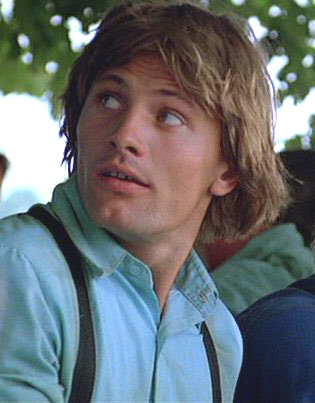
Viggo Mortensen in a still from Witness [Image courtesy: Brego.net]

He did some theatre then expanded to film. His footage in 1984’s Swing Shift and  Woody Allen’s The Purple Rose of Cairo ended up on the cutting room floor, but he had more luck in Peter Weir’s Witness. Mortensen played Moses Hochleitner, the younger brother to Alexander Godunov’s Daniel Hochleitner. He didn’t have a lot of lines in the Harrison Ford flick, but some how he stood out from the sea of blond-haired Amish men in blue shirts.

His next step was to Television where he was cast as Bragg on Search for Tomorrow [BRAGG, what a great soap opera name, right?]

In 1987 he played a crooked cop on Miami Vice. There was more theatre too, this time in LA’s Coast Playhouse’s production of Bent, for which he earned a Dramalogue Critics’ Award.

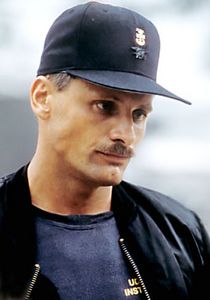
Movie still from G.I. Jane [Brego.net]

A splay of supporting roles in the 1990s saw him acting in some good movies (The Portrait of a Lady directed by Jane Campion) and some not so good movies (Leatherface: The Texas Chainsaw Massacre III)  Critics started to take notice when he starred opposite Demi Moore as brutal Master Chief John Urgayle in G.I. Jane (some critics said he stole the movie from Moore) and as the other man in A Walk on the Moon with Diane Lane. He played another ‘other’ man in A Perfect Murder, a reboot of Hitchcock’s Dial M for Murder with Michael Douglas and Gwyneth Paltrow. He was Eddie Boone, a major league baseball player with a trifecta of additions in rehab with Sandra Bullock in 28 Days. And rounded out the decade by playing the devil in The Prophecy.

Movie poster from Lord of the Rings [Image courtesy: Beyond Hollywood.com]

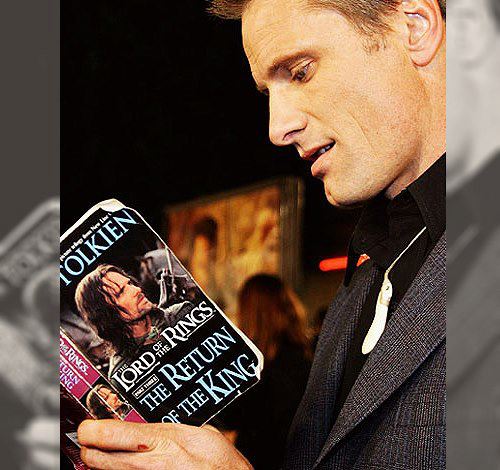
2001 saw the release of The Lord of the Rings: The Fellowship of the Rings, the first in Peter Jackson’s epic Tolkien cycle. With his role as the heroic Aragorn “Mortensen was established as a major leading man among Hollywood’s A-list ranks.” [Viggo Mortensen — Biography, Movies. yahoo.com The Two Towers followed in 2002 and The Return of the King premiered in 2003. He brought quiet strength, “commanding good looks”[ibid] and a rye sense of humor to Aragorn. He embraced the role whole heartedly. He did all his own stunts in the movies (and took quiet a few knocks in the process). He wore his sword and costume for days on end so they would have an authentic lived in look. And he became so attached to his equine co-stars, Uraeus and Kenny, that he purchased the horses after the film wrapped and took them home.

After his success in the Lord of the Rings Mortensen managed to keep himself centered…

Exceedingly humble about success and uncharacteristically un-Hollywood, Mortensen managed to stay somewhat reclusive and focused on other interests outside of acting, namely painting and writing poetry, despite becoming one of the most recognizable stars in the world. [Viggo Mortensen — Biography, Movies. yahoo.com ]

He used some of his earnings from playing Aragorn to start Perceval Press publishing house in Santa Monica, California.

Perceval Press is a small, independent publisher specializing in art, critical writing, and poetry. The intention of the press is to publish texts, images, and recordings that otherwise might not be presented. [Percival Press]

Mortensen’s own artistic, musical and written works are available through Perceval Press. He writes poetry, essays, and companion pieces for his paintings and photographic work in English, Spanish and Danish. Musically he has completed 16 albums, working almost exclusively with the guitarist Buckethead.

Back on the silver screen was Hidalgo in 2007.  It is the true story of American Frank T. Hopkins who participation in a 3,000-mile race across the Najd desert called the “Ocean of Fire”.

He gave “his most compelling and carefully drawn performance to date” [ibid] as an everyday man who’s violent past catches up to him in A History of Violence a film directed by David Cronenberg. He worked with Cronenberg again in 2007 for Eastern Promises, where he played a Russian gangster. He was nominated for an Academy Award for his role in the film.

In 2008 he was Ed Harris’ sidekick in the Western Appaloosa. He also starred in Good which takes place in the 1930s. Mortensen is a professor struggling to decide if he should join the Nazi party.

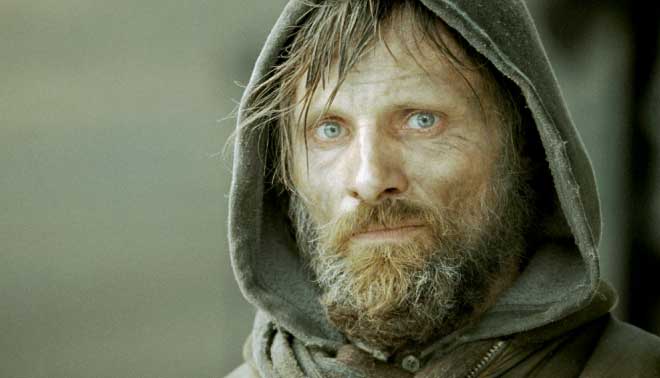
Movie still from The Road. [Image courtesy: Wired.com]

The grim Cormac McCarthy novel was the basis for Mortensen’s next movie, The Road. It is a post-apocalyptic story of a father and son trying to survive in a bleak wasteland.

Once again teaming up with Cronenberg, Mortensen plays Dr. Sigmund Freud in his the 2011 film,  A Dangerous Method.

Coming up Mortensen has several film ready for release including: On The Road and Everybody Has a Plan; and in 2013 The Faces of January and The Last Voyage of Demeter.

Publicity shot. [Image courtesy: TheReelist]

Found this on Facebook and had to share.


Thought of the Day 10.17.12 Elinor Glyn

“All the legislation in the world will not abolish kissing”
Elinor Glyn

Portrait of Elinor Glyn, 1927

Portrait of Elinor Glyn, 1927 (Photo credit: Wikipedia)

Elinor Southerland was born on this day in Jersey, Channel Islands, England in 1864. Today is the 148th anniversary of her birth.

Elinor’s father died when she was a toddler and the family moved for a while to Canada. They returned to Jersey when she was eight and her mother remarried.  Elinor…

was a voracious reader interested in French history and mythology, though she had no formal education … She would later be drawn to mysticism and romance. [The Literature Network]

She liked to write and she kept a diary.

At 28 she married Clayton Glyn. The couple had two daughters, Margot and Juliet. The marriage was not a happy one.  and, although Elinor and Clayton officially remained together both had affairs.

Elinor had affairs with a succession of British aristocrats and some of her books are supposedly based on her various affairs… [Good Reads]

English: Elinor Glyn portrait

English: Elinor Glyn portrait (Photo credit: Wikipedia)

She contributed articles to Scottish Life and Cosmopolitan but her real break through in the literary world came with the serialization of her first book The Visits of Elizabeth in 1900. The book, was written as a series of letters by an innocent young woman. Elizabeth.

The naive and charming narrator gets herself into social scrapes due to her innocence, … they are actually funny over a hundred years later because you know what Elizabeth doesn’t know–and perhaps that was the appeal for the more knowing Edwardian readers. Glyn’s book is a bit of a satire, but a romantic one, and Elizabeth gets her happily-ever-after, but not before making every handsome gentleman fall deeply in love with her.  [Amazon.com review]

Elinor was prolific in turning out her novels (she had to be, finances at home had taken a turn for the worse and the once wealthy Clayton Glyn was in debt by 1908. He died in 1915.)  Her reputation as a writer of romance grew with the publications  of The Seventh Commandment (1902), The Reflections of Ambrosine (1903), The Damsel and the Sage (1903), The Vicissitudes of Evangeline (1905) and Beyond the Rocks (1906).

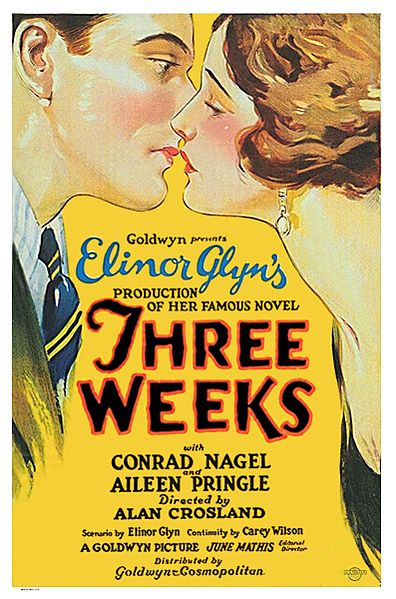
Movie poster for Three Weeks

Her risqué Three Weeks, about an exotic Balkan queen who seduces a young British aristocrat, was allegedly inspired by her affair with Lord Alistair Innes Ker. On the one hand it scandalized Edwardian aristocrats and jeopardized Glyn’s status. [The Literature Network]

Deemed immoral and banned at elite schools like Eton and panned by some critics who considered it disjointed and dull, the book non the less sold out within weeks of its publication and  it  “ensured her meteoric rise to fame.” [ibid]. It also brought about the anonymous  ditty:

Would you like to sin
With Elinor Glyn
On a tiger skin?
Or would you prefer
To err
With her
On some other fur

Her private life seemed to either echo or prelude the romantic interludes of the heroines in her novels as she continued to crank out “romances” until the start of World War One. During the Great War she worked in France as a war correspondent and Glyn was one of two women to witness the signing of the Treaty of Versailles.

Elinor Glyn looks up at Rudolph Valentino, fro...

Elinor Glyn looks up at Rudolph Valentino, from the frontispiece of Beyond The Rocks (Photo credit: Wikipedia)

She made the move to Hollywood in 1920 where she worked as a scriptwriter  for MGM and Paramount. The Great Moment was filmed in 1920.  In 1922 Beyond the Rocks was made into a major motion picture with red-hot Rudolph Valentino and Gloria Swanson. Three Weeks was given the big screen treatment not once, but twice, first in 1914 and then in 1924. And Glyn wrote the screenplay and was closely involved in the production of the 1926 Love’s Blindness.

In 1927 she wrote a novella that gave us the expression “the IT girl.”  She coined the phrase and quickly  crowned Clara Bow, who was staring in Red Hair (a movie based on Glyn’s The Vicissitudes of Evangeline), as the first IT girl. Here autobiography Romantic Adventure was published in 1936. She continued writing until 1940 when she published her last — and 42nd — book, The Third Eye.

English novelist and scriptwriter Elinor Glyn ...

English novelist and scriptwriter Elinor Glyn (1864-1943) (Photo credit: Wikipedia)

Elinor Glyn died in September of 1943 in Chelsea, London.

————————————————————————–

Bookshelf:

Interested in reading some of Elinor Glyn’s books? You can find them through the links below.

Red Hair (Classic Reprint)<img src=”http://www.assoc-amazon.com/e/ir?t=rico095-20&l=as2&o=1&a=B0094JHIEE&#8221; width=”1″ height=”1″ border=”0″ alt=”” style=”border:none !important; margin:0px !important;” />

Man and maid<img src=”http://www.assoc-amazon.com/e/ir?t=rico095-20&l=am2&o=1&a=117680328X&#8221; width=”1″ height=”1″ border=”0″ alt=”” style=”border:none !important; margin:0px !important;” />

Three Weeks<img src=”http://www.assoc-amazon.com/e/ir?t=rico095-20&l=am2&o=1&a=0715603612&#8243; width=”1″ height=”1″ border=”0″ alt=”” style=”border:none !important; margin:0px !important;” />

The Visits Of Elizabeth<img src=”http://www.assoc-amazon.com/e/ir?t=rico095-20&l=am2&o=1&a=1162711698&#8243; width=”1″ height=”1″ border=”0″ alt=”” style=”border:none !important; margin:0px !important;” />

The man and the moment<img src=”http://www.assoc-amazon.com/e/ir?t=rico095-20&l=am2&o=1&a=1178145077&#8243; width=”1″ height=”1″ border=”0″ alt=”” style=”border:none !important; margin:0px !important;” />

The man and the moment<img src=”http://www.assoc-amazon.com/e/ir?t=rico095-20&l=am2&o=1&a=1178145077&#8243; width=”1″ height=”1″ border=”0″ alt=”” style=”border:none !important; margin:0px !important;” />

The Point of View<img src=”http://www.assoc-amazon.com/e/ir?t=rico095-20&l=am2&o=1&a=1444425269&#8243; width=”1″ height=”1″ border=”0″ alt=”” style=”border:none !important; margin:0px !important;” />


Thought of the Day 10.15.12 P. G. Wodehouse

“I just sit at a typewriter and curse a bit.”“There is only one cure for gray hair. It was invented by a Frenchman. It is called the guillotine.”“I know I was writing stories when I was five. I don’t know what I did before that. Just loafed I suppose.”–P.G. Wodehouse

P. G. Wodehouse, Bolton's friend and collaborator

“I just sit at a typewriter and curse a bit.”

Pelham Grenville Wodehouse was born on this day in Guildford, Surrey, England in 1881. This is the 131st anniversary of his birth.

Wodehouse, called “Plum” as a child, spent much of his early life in the care of a gaggle of aunts and at boarding schools in England, while his parents lived in the Far East. Third of four boys, Wodehouse was close to his brothers.  He went to The Chalet School, Elizabeth College in Guernsey, Malvern House (near Dover) and finally at Dulwich College with his older brother Armine. He flourished at Dulwich where he played sports (especially boxing, cricket and rugby), studied the classics, sang and acted in the school’s theatricals, and of course, wrote.)

Psmith in the City

Psmith in the City (Photo credit: Wikipedia)

Upon graduation in 1900 ailing family finances meant he couldn’t go on to Oxford like Armine. Instead, Plum’s father got him a job in the London branch of the Hong Kong and Shanghai Bank. He wrote about his experiences at the bank in Psmith in the City, but he said he “never learned a thing about banking.”  In 1902 he gave up the financial farce and dove into journalism  with a job writing a comic column at The Globe newspaper. He moved to New York and published his first novel, The Pothunters the same year.  A Prefect’s Uncle; Love Among the Chickens; The Swoop; Psmith In the City; Psmith, Journalist; The Prince and Betty; and  Something New followed fairly quickly there after.

The Prince and Betty

The Prince and Betty (Photo credit: Wikipedia)

He also wrote for musicals. He penned the book for Cole Porter’s Anything Goes; the Gershwin’ s Oh Kay . He worked with Ira Gershwin on the lyrics for Rosalie. And he wrote dozens of musicals — generically called the Princess Theatre Musicals — with Guy Bolton and Jerome Kern. [For a complete list of Wodehouse musicals go to The Playwrights Database at doolee.com]   The Princess Theatre Musical are generally seen as a stepping stone that took the best of vaudeville and operetta and blended them into modern musical theatre. They transitioned

“… the haphazard musicals of the past to the newer, more methodical modern musical comedy … the libretto is remarkably pun-free and the plot is natural and unforced. Charm was uppermost in the creators’ minds … the audience could relax, have a few laughs, feel slightly superior to the silly undertakings on stage, and smile along with the simple, melodic, lyrically witty but undemanding songs” [Bloom and Vlastnic Broadway Musicals: The 101 Greatest Shows of All Time]

My Man Jeeves

My Man Jeeves (Photo credit: Wikipedia)

Starting with My Man Jeeves in 1919 Wodehouse published the series of books for which is he best known, The Jeeves and Wooster books.  Here’s a clip from the 1990 Granada Television production of Jeeves and Wooster starring Hugh Laurie and Stephen Fry:

He also wrote the Blandings Castle series about a fictional castle with Lord Emsworth and his prize-winning pig, the “Empress of Blandings.”

Since he and his wife, Ethel Wayman, were officially residents of both England and the US they were being taxed by both countries. To alleviate the tax burden they moved to France in 1934. The Wodehouse’s remained in France when the Nazi troops moved in. Wodehouse was interned as an “enemy alien” eventually landing in Tost, Upper Silesia, Poland. He later quipped of  his ‘lodgings’ “If this is Upper Silesia, what on earth must Lower Silesia be like?” He entertained his fellow prisoners with dialogues and wrote during his two-year internment (he completed one novel and started two more). He was released just prior to his 60th birthday when a German friend from his Hollywood days, Werner Plack, approached him about doing a broadcast for the Americans describing his life as an internee.  America was not at war with Germany yet, and he had received many letters of encouragement from his fans in the US while in the camp. He saw this as a way to thank them. And, Wodehouse claimed,  he was simply reflecting the “flippant, cheerful attitude of all British prisoners.” [the Guardian]  in the broadcasts. But the British public didn’t see it that way, and neither did MI5. He was interrogated for suspected collaboration with the Germans — something that shocked the aging author. “I thought that people, hearing the talks, would admire me for having kept cheerful under difficult conditions,” [ibid] Wodehouse maintained that he never had intended to aid the enemy. But the incident left a bad taste with both the Wodehouses and the British public. The author moved to the US in 1945, and never went back to England.

Wodehouse died in 1975.

books - wodehouse

books – wodehouse (Photo credit: rocketlass)


Thought of the Day 10.14.12 e.e.cummings

“It takes courage to grow up and become who you really are.”
–e.e. cummings

E. E. Cummings, 1958 by Edward Estlin Cummings...

E. E. Cummings, 1958 by Edward Estlin Cummings, Oil on canvas (Photo credit: cliff1066™)

Edward Estlin Cummings was born on this day in Cambridge, Massachusetts, USA in 1894. Today is the 118th anniversary of his birth.

As a child Cummings  enjoyed art and writing, as well as the outdoors. His mother encouraged him to write. And Cummings worked at his craft by writing daily. He went to Harvard where he became interested in non conventional poetry.

First edition dustjacket of The Enormous Room

First edition dustjacket of The Enormous Room (Photo credit: Wikipedia)

During World War I he was an ambulance driver in France and fell in love with Paris. But he sent letters home that “holding views critical of French war effort” [e.e. cummings Biography] He was arrested and thrown in prison for three months. His book The Enormous Room is based on his experiences in the French prison.  He was later drafted into the US Army.

1st edition cover

1st edition cover (Photo credit: Wikipedia)

His first collection of poems, Tulips and Chimneys came out in 1923. Although his poems received critical praise — he won the Dial Award for poetry in 1925 — Cummings found it hard to find a publisher. His poetry was considered too avant guard.

His my father moved through dooms of love is a tribute to his recently deceased father…

my father moved through dooms of love

by E. E. Cummings

              34

my father moved through dooms of love 
through sames of am through haves of give, 
singing each morning out of each night 
my father moved through depths of height

this motionless forgetful where 
turned at his glance to shining here; 
that if(so timid air is firm) 
under his eyes would stir and squirm

newly as from unburied which 
floats the first who,his april touch 
drove sleeping selves to swarm their fates 
woke dreamers to their ghostly roots

and should some why completely weep 
my father's fingers brought her sleep:
vainly no smallest voice might cry 
for he could feel the mountains grow.

Lifting the valleys of the sea 
my father moved through griefs of joy; 
praising a forehead called the moon 
singing desire into begin

joy was his song and joy so pure 
a heart of star by him could steer 
and pure so now and now so yes 
the wrists of twilight would rejoice

keen as midsummer's keen beyond
conceiving mind of sun will stand,
so strictly(over utmost him
so hugely) stood my father's dream

his flesh was flesh his blood was blood:
no hungry man but wished him food;
no cripple wouldn't creep one mile
uphill to only see him smile.

Scorning the Pomp of must and shall
my father moved through dooms of feel;
his anger was as right as rain
his pity was as green as grain

septembering arms of year extend 
yes humbly wealth to foe and friend 
than he to foolish and to wise  
offered immeasurable is

proudly and(by octobering flame 
beckoned)as earth will downward climb, 
so naked for immortal work 
his shoulders marched against the darkhis sorrow was as true as bread:
no liar looked him in the head; 
if every friend became his foe 
he'd laugh and build a world with snow.My father moved through theys of we, 
singing each new leaf out of each tree 
(and every child was sure that spring 
danced when she heard my father sing)then let men kill which cannot share, 
let blood and flesh be mud and mire, 
scheming imagine,passion willed, 
freedom a drug that's bought and soldgiving to steal and cruel kind, 
a heart to fear,to doubt a mind, 
to differ a disease of same,
conform the pinnacle of amthough dull were all we taste as bright, 
bitter all utterly things sweet,
maggoty minus and dumb death 
all we inherit,all bequeathand nothing quite so least as truth
--i say though hate were why men breathe--
because my Father lived his soul 
love is the whole and more than all

Cummings died in 1962 from a stroke.

E.E. Cummings, full-length portrait, facing le...

E.E. Cummings, full-length portrait, facing left, wearing hat and coat / World-Telegram photo by Walter Albertin. (Photo credit: Wikipedia)


Thought of the Day 10.10.12 Lin Yutang

“If you can spend a perfectly useless afternoon in a perfectly useless manner, you have learned how to live.”
-Lin Yutang

English: Lin Yutang 中文: 林语堂

English: Lin Yutang 中文: 林语堂 (Photo credit: Wikipedia)

Lin Yutang was born on this day in Banzai, Fujian province, China in 1895. today is the 117th anniversary of his birth.

China provinces fujian

China provinces fujian (Photo credit: Wikipedia)

He grew up in the mountains of Fujian province the son of a Chinese Presbyterian minister. He studied at Saint John’s University, Shanghai and at Harvard University in the US. At first he studied to be a minister, but he renounced Christianity and pursued a degree in English instead.

[Image courtesy: Amoymagic.com]

He bridged the cultural and linguistic divide writing and editing for both English and Chinese magazines and produced Lin Yutang’s Chinese-English Dictionary of Modern Usage.

His successful satirical magazine Analects Fortnightly was the first of its kind in China. In 1933 Pearl Buck introduced him to her publisher who took Lin Yutang on as a client.

English: Lin Yutang (Lin Yü-t'ang) (1895 - 197...

English: Lin Yutang (Lin Yü-t’ang) (1895 – 1976) 日本語: 林語堂 (1895 – 1976) ‪中文(简体)‬: 林语堂 (1895 – 1976) ‪中文(繁體)‬: 林語堂 (1895 – 1976) (Photo credit: Wikipedia)

In 1935 he moved to the US.

Lin published the first of his many English-language books, My Country and My People. It was widely translated and for years was regarded as a standard text on China. [Britannica.com]

He moved to New York and published Moment in Peking in 1939. His 1941 novel  A Leaf in the Storm, presents China on the brink of war with Japan. Wisdom of China and India  followed in 1942.

[Image courtesy: Amoymagic.com]

Lin’s fiction includes Chinatown Family — a look at culture, race and religion faced by an immigrant Chinese American family; and his 1968 The Flight of the Innocents.

Ming Kwai Typewriter

Ming Kwai Typewriter (Photo credit: Wikipedia)

During the WWII Lin developed a workable Chinese typewriter, the “Ming Kwai” typewriter.

His belief that literature should be a means of self-expression, not a tool for propaganda put him at odds with political movements in China when he returned to his homeland in 1943 and 1954.

Lin wrote more than three dozen books and is “arguably the most distinguished Chinese American writer of the twentieth century.” [Google Books] He died on March 26, 1976.

[Image courtesy: Amoymagic.com]

 “In his prolific literary career, Chinese author Lin Yutang wrote expertly about an unusual variety of subjects, creating fiction, plays, and translations as well as studies of history, religion, and philosophy. Working in English as well as in Chinese, he became the most popular of all Chinese writers to early 20th-century American readers.” [Britannica.com]