Category Archives: Writing

Its PRIDE and PREJUDICE DAY!!!

PRIDE AND PREJUDICE SILO COLLAGE

It is a truth universally acknowledged that a book by my favorite author, upon turning 200 years old, will be written about A LOT in this blog. Seriously I’m thinking about baking a birthday cake today. I’m just that excited.  [YES, I get this excited about Jane Austen, I realize its not everyone’s cuppa, but bear with me. It will be over soon and tomorrow I’ll be back to proper Thought of the Day bioBLOGS. Promise.]

So, as you may have noticed, for the past week I’ve been giving you my take on the major players in Pride and Prejudice. Today I thought we’d take a look at the different adaptations over the years.

The Originals

First the source… the Austenian Holy Grail if you will, the first editions. I was lucky enough to attend a Jane Austen Society of North America meeting that started at the Goucher College Special Collection Library. Their Jane Austen collection is the largest in North America and it houses several first editions and first illustrated editions.
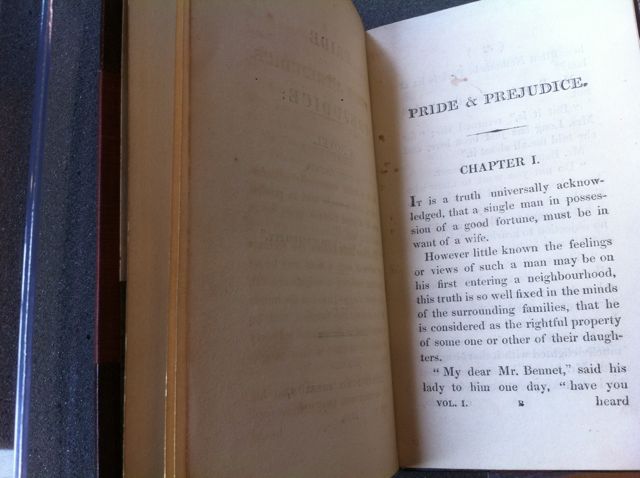
Opening page of a 200 year old first edition Pride and Prejudice.

Opening page of a 200 year old first edition Pride and Prejudice.

These beautifully letter pressed editions came in three volumes and are handsomely bound and typeset. The type size, letter and line spacing, weight and size of the books were perfectly designed for long afternoons when reading was a prime source of entertainment. One look at these beauties and you will never want to read another trade paper back again.

Goucher also has first illustrated editions and the illustrated editions that followed. It is fascinating to see how the look of the characters changed through the times.
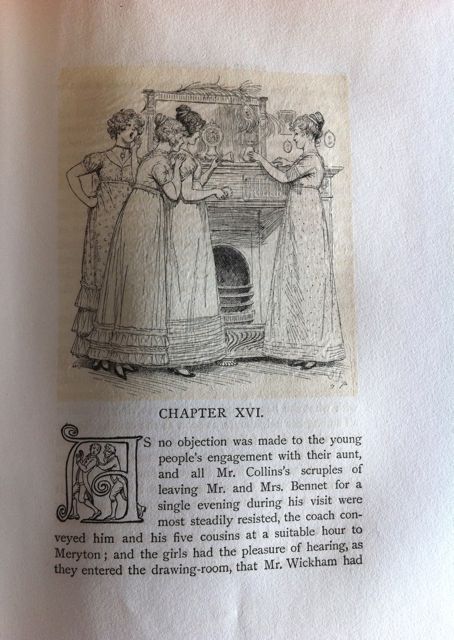
An early illustrated edition of Pride and Prejudice from the Goucher Library.

An early illustrated edition of Pride and Prejudice from the Goucher Library.

The Goucher Library is hosting a special 200th Anniversary exhibit from January 28, 2013 through July 26, 2013 Click Here for more information on Exhibit.   For more information of the Jane Austen Collection at Goucher you can Click Here. And if you are patient you can read all about the Goucher Austen Collection in an article I’ve written for ARRIVE magazine in the March edition!

The Adaptions
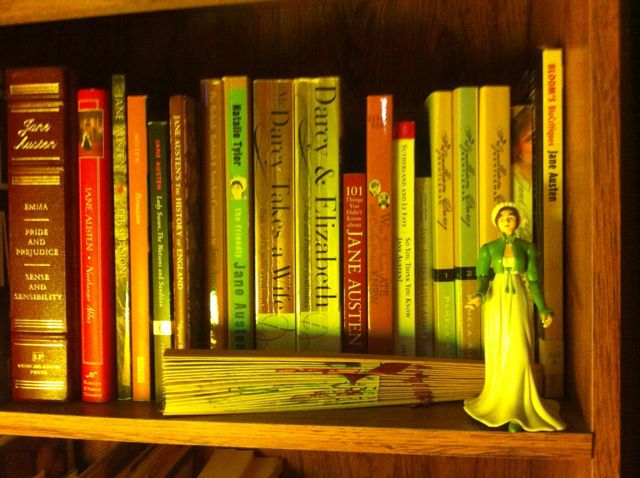
Here's my first Austen bookshelf.

Here’s my first Austen bookshelf.

From the original we move to adaptations. What happened BEFORE Mr. Bingley moved to Neitherfield? What happened AFTER Darcy and Lizzie got married? There are hundreds of these books out there and they vary in genre and quality. As an Austen fan I get one or two spin-off books every holiday and birthday. I recommend Mr. Darcy Takes a Wife and Darcy & Elizabeth  and the trio of Fitzwilliam Darcy, Gentleman books for those of you yearning to know what MIGHT happen next.
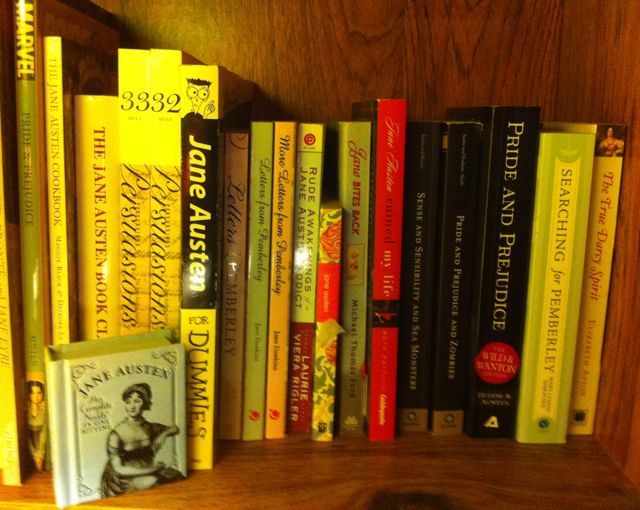
Here's my second Austen bookshelf

Here’s my second Austen bookshelf.

I’m all for anything that brings new reader to Austen. So I enjoyed the Marvel Comics version of Pride and Prejudice.

Cover of "Pride and Prejudice (Graphic No...

Cover of Pride and Prejudice (Graphic Novel)

I like Pride and Prejudice and Zombies too — I found myself reading along, enjoying the original Austen prose and then BAM Zombies. It was fun.
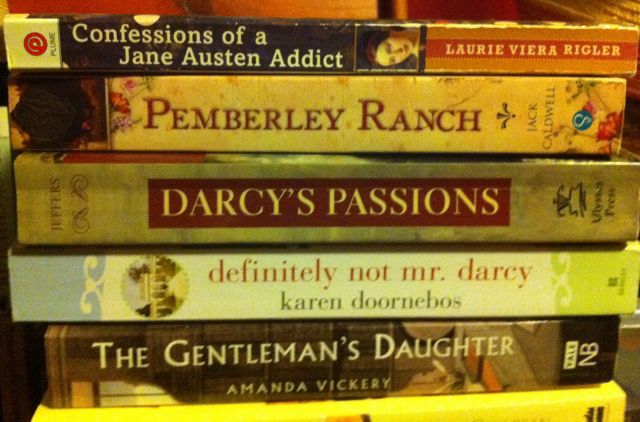
Oh, here are some more books that didn't fit on those other shelves.

Oh, here are some more books that didn’t fit on those other shelves.

I liked Confessions of a Jane Austen Addict and its companion Rude Awakenings for their Alice through the looking glass approach to P&P. And I’ll give a thumbs up the more romance-y Definitely Not Mr. Darcy too.

Others are either on the “To Read” pile or have been read so long ago that I don’t remember them well enough that I can’t give you n review. That’s the problem with a lot of these book adaptations… they don’t stick with you like the original.

The Multimedia

On to film. If you were to gather a table full of Jane Austen fans and ask them which is their favorite film version of Pride and Prejudice you’d probably get a half-dozen answers.
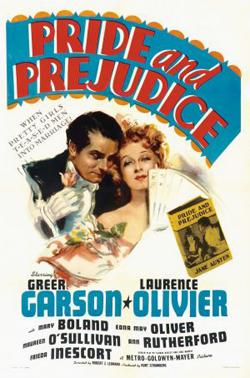
Prideundprejudice

In 1940 Greer Garson and Laurence Olivier starred in a “Hollywoodized” version of the novel. I liked the lead’s chemistry and think they did a good job portraying Elizabeth and Darcy. But the movie takes huge liberties with the novel — from the hoop skirts, to cutting out characters and scenes, to adding new scene (archery any one?),  to rewriting the reason Lady Catherine’s visit to Longbourn.
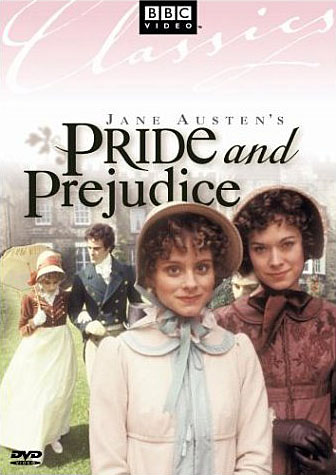
PrideAndPrejudiceBBCElizabeth Garvey and David Rintoul took on the famous Lizzie and Darcy in the BBC 1980 series. It is my friend and fellow JASNA:MD member Joyce Loney’s favorite of the movies.  She’s a big fan of Garvey’s Elizabeth. And, she writes:

David Rintoul’s Darcy is stiff (okay, some people have called him a stick), but he cracks during the Pemberley visit and he finally relaxes during the proposal scene.  Amy Patterson has a great article (Choose Your Darcy) in the current issue of Jane Austen’s Regency World, and she says that David Rintoul “gets closer than any other to capturing the essence of this wonderful, complicated, shy, angry and passionate hero.”

But Loney’s favorite Darcy, and mine, is Colin Firth. Firth played opposite the beautiful Jennifer Ehle in the A&E mini series in 1995. Ehle is my favorite Lizzie and Alison Steadman and Benjamin Whitrow are far and away my favorite Mr. and Mrs. Bennets.

Pride and Prejudice

Pride and Prejudice (Photo credit: elycefeliz)

At six hours the A&E version fits in almost all the book. And I believe it is the truest film adaptation out there. I could  (and do) watch it again and again. It is a delight (with or with out the wet shirt.)

330px-Bride-and-prejudice

Gurinda Chadha brought a distinctly Bollywood approach to her Bride & Prejudice version in 2004. The movie, complete with colorful blockbuster musical numbers, spans three continents and stars Aishwarya Rai as Lalita (Lizzie), Martin Henderson as Darcy, Namrata Shirodkar as Jaya (Jane) and Naveen Andrews as Balraj (Bingley). Obviously there are a lot of changes from the original novel, but it is fun and bright and they did a great job conveying the heart of the  story.
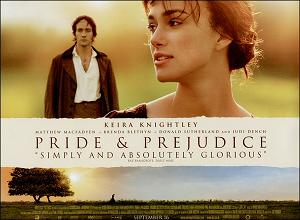
Prideandprejudiceposter

2005 brought us Kiera Knightly and Matthew Macfadyen in Joe Wright’s take on the Novel. Like the Greer Garson version this one leaves out characters and compresses the novel — I guess it has to in order to fit into the 129 minute running time. Personally I had a lot of hope for this version because I love a lot of the actors in it, but, sorry it just falls flat. Tons of style but not so much substance… and when you start with Pride and Prejudice there’s just not excuse for that. There are moments in the movie that are terrific — I thought Macfayden and Knightly were wonderful in the “taciturn” dance and the proposal scene (though why it was in a down pour I don’t understand.) And I give this version the best sound track award. I loved the music. I also really liked Simon Woods as Bingley.

The last adaptation I’m going to cover is also the most current. In fact it is still going on, the brilliant Lizzie Bennet Diaries. The LBD have completely reimagined the story as a video blog circa 2013 LA. Click HERE to go to the home page. From there you can follow the story from the top, explore twitter and tumblr accounts for both the characters and the actors (as well as the producers and director.)

The Wrap Up

I hope you’ve enjoyed my take on Pride and Prejudice. I thank those of you who played along and commented here and on Google and Facebook. As always, please drop me a line an let me know what you are thinking.


Pride and Prejudice Characters: Lizzie and Darcy

LIZZIE AND DARCY

Is there anything more delightful than a well written story of personal growth and discovery? Pride and Prejudice, Austen‘s “own darling child,” is a story of first mis-impressions that eventually resolve into true understanding, appreciation and love. The journey to that self discovery is the juiciest part of the novel. And that means that both Darcy and Lizzie must be willing to change the way they look at the world and at each other.

Jennifer Ehle is beautiful as Elizabeth  in the 1995 series [Image courtesy BBC Home.]

Jennifer Ehle is beautiful as Elizabeth in the 1995 series [Image courtesy BBC Home.]

Elizabeth Bennet is a pretty, charming, intelligent, self-assured 20-year-old. She is the second eldest daughter of the Bennet family. She takes second place to sister Jane in beauty as well, but she bares it well. She has a lively, playful disposition and a good-natured impertinence that is the delight of her father and the bane of her mother.

Cropped screenshot of Greer Garson from the tr...

Cropped screenshot of Greer Garson from the trailer for the film Pride and Prejudice (Photo credit: Wikipedia)

Lizzie prides herself on being a good judge of character. But when it comes to Darcy and Wickham that is hardly the case.

Keira Knightly as Lizzie in the 2005 Movie

Keira Knightly as Lizzie in the 2005 Movie

Lizzie’s first road block of prejudice is the snub she receives from Darcy at the Assembly Room Ball. At first everyone thinks Darcy is a major catch because he’s tall, handsome and rich. But then

… his manners gave a disgust which turned the tide of his popularity; for he was discovered to be proud, to be above his company, and above being pleased; and not all his large estate in Derbyshire could then save him from having a most forbidding, disagreeable countenance, and being unworthy to be compared with his friend.

It was decided that he was “He was the proudest, most disagreeable man in the world.” The icing on the cake is when he refuses to dance Lizzie, saying“She is tolerable; but not handsome enough to tempt me; and I am in no humour at present to give consequence to young ladies who are slighted by other men.”

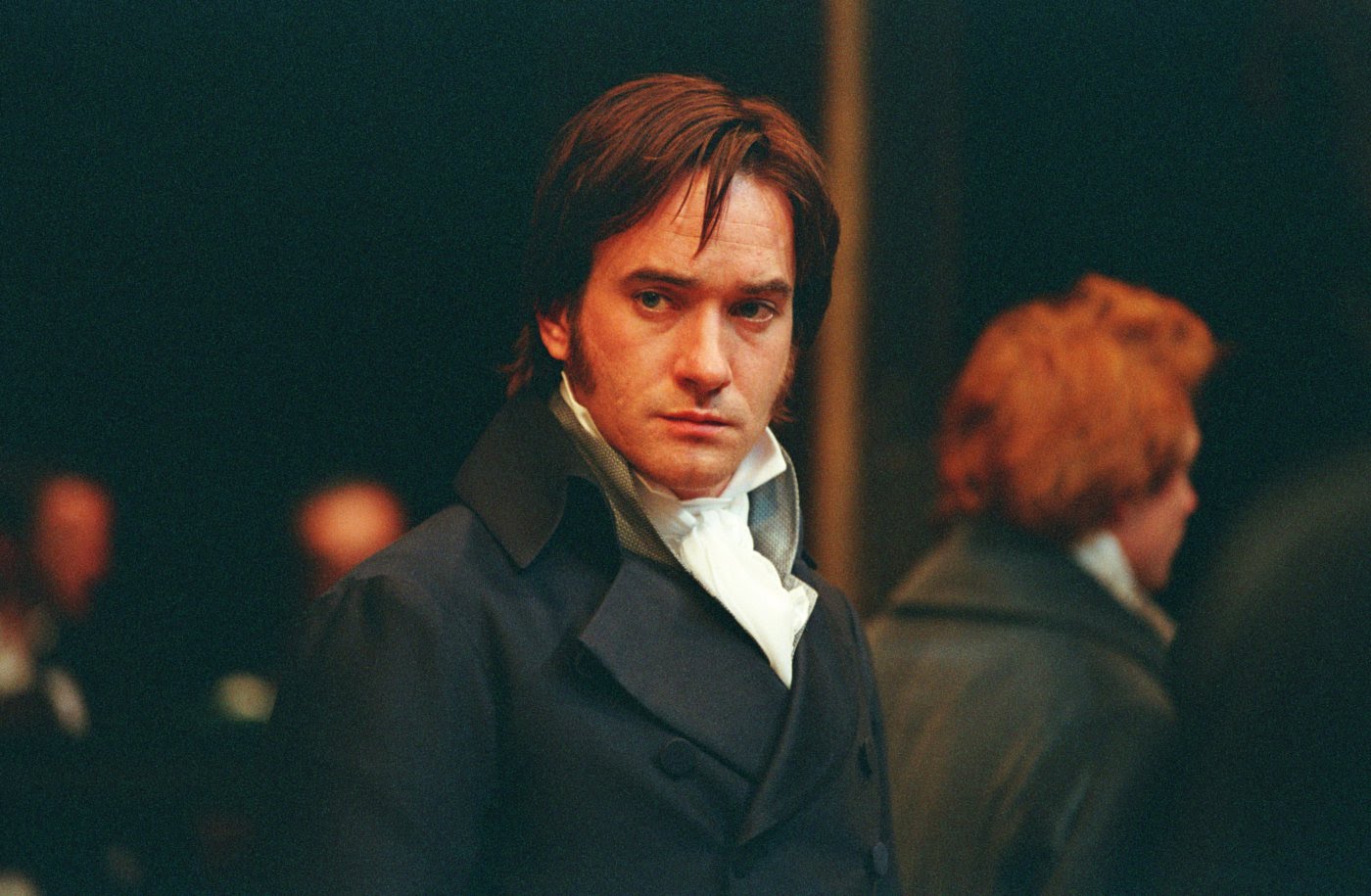
Matthew MacFadyen in the 2005 movie.

Matthew MacFadyen in the 2005 movie.

Although outwardly she takes the comment in stride, and even jokes about it with her friends, from that moment on she is prejudiced against him.

Darcy was …haughty, reserved, and fastidious, and his manners, though well bred, were not inviting…Bingley was sure of being liked wherever he appeared; Darcy was continually giving offence.

(It is a prejudice that Wickham easily manipulates.)

Had Darcy’s opinion of Lizzie not changed it would have been a very different book indeed. But shortly after the snub he begins to appreciate her  “fine eyes,” “light and pleasing figure,” and “easy playfulness.” He tries to shake it, but he falls completely in love with her.

Daniel Vincent Gordh and Ashley Clements tackle the proposal scene in the Lizzie Bennet Diaries

Daniel Vincent Gordh and Ashley Clements tackle the proposal scene in the Lizzie Bennet Diaries

He swallows his pride and familial duty and offers Lizzie the second of her two horrible proposals.  Basically he tells her that he likes her against his will, against his reason, and even against his character.

She refuses him, of course — He’s separated Jane and Bingley and ruined Wickham — how could he think for a moment that she’d accept him.. She calls him on his un-gentleman-like manner then tears into him…

“You could not have made me the offer of your hand in any possible way that would have tempted me to accept it…From the very beginning, from the first moment I may almost say, of my acquaintance with you, your manners, impressing me with the fullest belief of your arrogance, your conceit, and your selfish disdain of the feelings of others, … and I had not known you a month before I felt that you were the last man in the world whom I could ever be prevailed on to marry.”

It is a life changing moment for Darcy. He writes her a letter explaining his position on the Jane / Bingley situation and on his dealings in the Wickham narrative and then he leaves Kent. But he’s also forced to face the fact that he is a snob.

Upon reading the letter Lizzie recognizes that prejudice has colored her emotions to Mr. Darcy. She begins to question her assumption of Wickham’s innocence and his guilt.

Colin Firth, the ultimate Darcy, starred  in the 1995 series [Image courtesy BBC Home.]

Colin Firth, the ultimate Darcy, starred in the 1995 series [Image courtesy BBC Home.]

At Pemberly she’s presented by a completely different Darcy. Not only does the housekeeper, Reynolds, praise her master, but Darcy actually seems to have transformed. He is kind and welcoming even to her relatives the Gardiners, who he previously thought himself above.

He completely saves the day with the Lydia / Wickham elopement, and he does it all for Lizzie.

By the time Bingley and Jane reunite both Lizzie and Darcy have come 360 in their feelings toward one another. What was once intolerable is now precious. And all was happily ended.

Elizabeth Garvey and David Rintoulin in the 1980 BBC series [This one's for Joyce]

Elizabeth Garvey and David Rintoulin in the 1980 BBC series [This one’s for Joyce]


Pride and Prejudice characters: Charlotte and Mr. Collins

Charlotte & Collins

For a woman who came from a family of clergymen — her father, two brothers and four cousins wore a collar — Jane Austen certainly enjoys poking fun at them in her novels. And Pride and Prejudice’s  Mr. Collins is her most ridiculous clerical caricature. How on earth does sensible Charlotte wind up with such a buffoon?

A clergyman was a professional, just like a lawyer or doctor. He made his living in the pulpit, not at the bar or in the examining room, but he still needed to be a well educated man. Add to that a vicar needed have a high moral standard, be a good speaker and have compassion for the poor and needy.

David Bamber is Mr. Collins  in the 1995 series [Image courtesy BBC Home.]

David Bamber is Mr. Collins in the 1995 series [Image courtesy BBC Home.]

Instead we get conceited, pompous, narrow-minded, silly, self important Mr. Collins. He is a mixture of pride and obsequiousness, a social climber with a very good opinion of himself and his patroness Lady Catherine de Bourgh.

He comes to Meryton to visit the Bennets. As closest male relative he is set to inherit the Longbourn estate on Mr. Bennet’s death. That is something, to his credit, that he feels some guilt over. So he decides to marry one of the five Bennet sisters. Jane is all but engaged to Mr. Bingley so he sets his sites on Lizzie.

Tom Hollander as Mr. Collin in the 2005 movie

Tom Hollander as Mr. Collin in the 2005 movie

Poor Lizzie receives two of the worst proposals  of marriage in literature. The first is from Mr. Collins. He wants to get married because:

  1.  as a clergyman it would set a good example to the parish.
  2.  it will add to his happiness.
  3.  it is “the particular advice “ of Lady Catherine.
  4.  he has a violent affection for Elizabeth

Of course he doesn’t expect a rejected. For one thing he’s SUCH a catch, and for another he’s chosen well. The girls are desperate and he has them in a corner.

He literally can not believe that she declines his offer. Neither can her mother. And for a while Longbourn is long born with strife.

Queue Charlotte.

Charlotte Lucas is plain, pragmatic, good-tempered, funny, sensible, intelligent and unromantic.  She is 27 years old and Lizzie’s intimate friend. She’s such a good friend, in fact, that she comes to the rescue when Lizzie refuses Mr. Collins. She keeps him in good humor by listening to him and, one assumes, diverts him, making sure he’s out of ear shot of the shouting Mrs. Bennet and the giggling Lydia and Kitty.

Lucy Scott in the 1995 series

Lucy Scott in the 1995 series

Lizzie thanks her friend,  but “Charlotte’s kindness extended farther than Elizabeth had any conception of; — its object was nothing less than to secure her from any return of Mr. Collins’s addresses, by engaging them towards herself.” With a little encouragement on her part Mr. Collins transfers his ‘violent affections’ form one lady to the next and…

”In as short a time as Mr. Collins’s long speeches would allow, every thing was settled between them to the satisfaction of both… he earnestly entreated her to name the day that was to make him the happiest of men… and Miss Lucas, who accepted him solely from the pure and disinterested desire of an establishment, cared not how soon that establishment were gained.”

Lizzie is surprised that Mr. Collins could so quickly change his mind  and settle on another life partner. But she is astonished that Charlotte could accept his proposal.  Charlotte reminds her however that she is…

”not romantic, you know. I never was. I ask only a comfortable home; and considering Mr. Collins’s character, connections, and situation in life, I am convinced that my chance of happiness with him is as fair as most people can boast on entering the marriage state.”

In some ways Charlotte winds up in same situation as Mr. Bennet in the marriage department. Neither of them respect or love their partners. And both do what they can in daily life to avoid interacting with their spouses Mr. Bennet shuts the door to his library, while Charlotte sits in her parlor and encourages Mr. Collins to work with his bees or visit Lady Catherine.

Claudie Blakley in the 2005 movie

Claudie Blakley in the 2005 movie

At the end of the novel Mr. Bennet writes to Mr. Collins informing him that — despite warning to the contrary by both Collins and Lady Catherine — Lizzie and Darcy are soon to marry. Mr. Bennet advises Mr. Collins to  “Console Lady Catherine as well as you can. But, if I were you, I would stand by the nephew. He has more to give.” If Mr. Collins heeds this wise advice he’d shift his alliance to Darcy who would never put up with the vicar’s toady behavior. That, combined with Charlotte’s even handed temper–which (hopefully) would rub off on Collins–MIGHT make him a more tolerable fool.

—————————————————————–

Here’s a clip of the wonderful Julia Cho and Maxwell Glick in a scene from The Lizzie Bennet Diaries…


Pride and Prejudice characters: Mr. and Mrs. Bennet

Mr. and Mrs. Bennet

It is unlikely that either Mr. or Mrs. Bennet would win any parenting awards. Nor are they they a role model of a happy marriage.

Mr. Bennet is the easier to take of the two. Perhaps because Austen herself liked a witty conversationalist, she gives Mr. Bennet plenty of ironic banter. Sure, he’s got a quip for every idiotic thing that comes out of Mrs. Bennet’s mouth, and he puts down his daughters with unsettling regularity, but he’s on our girl Lizzie side of things. And when he does come out with a  snarky remark it isn’t said in a shrill scream. He’s calm — to the point of being detached. And if things get too hectic he just shuts the door to his man cave, er, I mean LIBRARY and lets the others put out the fire.

Benjamin Whitrow played Mr. Bennet in the 1995 series [Image courtesy BBC Home.]

Benjamin Whitrow played Mr. Bennet in the 1995 series [Image courtesy BBC Home.]

Mrs. Bennet on the other hand is constantly in emergency mode. She’s over excited about everything… from the arrival of the militia in Meryton to Jane’s budding romance. Her mood swings are so intense that she’s either quite shallow or bipolar. If Mr. Bennet is disengaged from his daughter’s lives (specifically the part of his daughter’s lives that involves them getting a husband) she is hyper involved. And while Mr. Bennet hides in his library, Mrs. Bennet prefers to take center stage. In case of emergency she succumbs to her palpitations and flutterings and retires to her lounge to be waited on hand and foot.

Both of them play favorites while neglecting to educate their daughters and have chosen an economic course that requires the girls to marry well or face lives of genteel poverty which their upbringings have made them entirely unprepared for.” [ Story and History; A guide to Everything Jane Austen ]

Mr. Bennet favor’s Lizzie with her sharp tongue and sense of irony. He has a soft spot for Jane who is so sweet he has a hard time finding anything negative about her. But by the time we get to Mary his patience wears thin. He makes fun of her zealous nature and doesn’t support her earnest attempts to exhibit. He has all but given up on Kitty and Lydia  and calls them the two silliest girls in the country.

Alison Steadman is Mrs. Bennet  in the 1995 series [Image courtesy BBC Home.]

Alison Steadman is Mrs. Bennet in the 1995 series [Image courtesy BBC Home.]

Mrs. Bennet admires Jane’s beauty and good nature, but she really dotes on Lydia (her twin in temperament and love of all things in a Red Coat.) Her second daughter is a source of anxiety for her– especially when she refuse a perfectly good offer of marriage from Mr. Collins.

Austen describes the couple at the end of the first chapter…

Mr. Bennet was so odd a mixture of quick parts, sarcastic humour, reserve, and caprice, that the experience of three and twenty years had been insufficient to make his wife understand his character. Her mind was less difficult to develope. She was a woman of mean understanding, little information, and uncertain temper. When she was discontented, she fancied herself nervous. The business of her life was to get her daughters married; its solace was visiting and news.

They married young. Mr. Bennet…

captivated by youth and beauty, and that appearance of good humour which youth and beauty generally give, had married a woman whose weak understanding and illiberal mind had, very early in their marriage, put an end to all real affection for her. Respect, esteem, and confidence had vanished for ever; and all his views of domestic happiness were overthrown. … To his wife he was very little otherwise indebted, than as her ignorance and folly had contributed to his amusement.

The novel is almost as much about economics as it is about love. Longbourn, the Bennet’s family estate is entailed away to the nearest male heir upon the untimely demise of Mr. Bennet.

When first Mr. Bennet had married, economy was held to be perfectly useless; for, of course, they were to have a son. This son was to join in cutting off the entail, as soon as he should be of age, and the widow and younger children would by that means be provided for.

But they didn’t have a son, so Mr. Collins is set to inherit the estate.

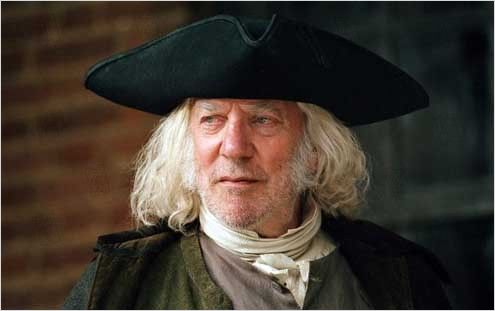
Donald Southerland in the 2005 Movie

Donald Southerland in the 2005 Movie

Even if they HAD had a son there’s no guarantee that  Junior would have agreed to end the entail. He could have wound up like John Dashwood from Sense and Sensibility and turned his back on his family financially. Given the hands off attitude the Bennets employed with their children’s education Junior could have been as feckless and week minded as Lydia. I doubt that the estate could have survived long in that case.  A son would not have necessarily solved the problem. Better if the Bennets had economized through the years.

English: C. E. Brock illustration for the 1895...

English: C. E. Brock illustration for the 1895 edition of Jane Austen’s novel Pride and Prejudice (Chapter 13 ): “Why, Jane — you never dropt a word of this; you sly thing! ” Français : C. E. Brock illustration pour l’édition C. E. Brock illustration pour l’édition 1895 du roman de Jane Austen Pride and Prejudice (Chapitre 13) Mrs Bennet est sûre que Bingley vient diner (alors qu’il s’agit de Mr Collins) (Photo credit: Wikipedia)

Better yet if the girls were better educated. If the girls  were really to be “marriage market” ready they should have had a governess or some one who insisted they learn to drawl (one of Caroline/Darcy’s requirements for a refined lady) read the classics, learn foreign languages, dance and play an instrument.  Only two of them can play an instrument, and they don’t play all that well.

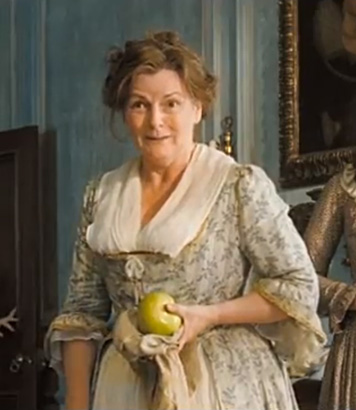
Brenda Blethyn in the 2005 movie

Brenda Blethyn in the 2005 movie

Given the economic uncertainty for the girls Mrs. Bennet should have at least prepared them with a more domestic education. At dinner when Mr. Collins wants to compliment which ever of his fair cousins has prepared the meal, Mrs. Bennet informs him that they keep a cook, “and that her daughters had nothing to do in the kitchen.” But maybe the girls should learn a little about cooking. Not to go into service but to be able to run their own kitchen as Lydia certainly will have to. Lady Catherine brags at finding a  governess position for some young ladies she knows. That’s another profession the girls could be readying for.
But neither parent seems at all interested in pushing them toward preparing for the future beyond winning the husband lottery.

Still, Mr. and Mrs. Bennet add a lot of humor to the novel (even if it is self/co inflicted.) And, given that I’ve been known to be sarcastic and I’m a lot closer to their age then Lizzie or Jane’s age I’ve got a soft spot for them. Perhaps they wont win Parent of the Year, 1813, but the novel just wouldn’t be the same with out them.


Pride and Prejudice Characters: Lydia and Wickham

Today is the third installment in a week’s worth of Pride and Prejudice character studies leading up to next Monday’s 200th anniversary of the Austen novel.
 
Lydia and Wickham

Was there ever a sillier, more insipid, selfish little sister than Lydia Bennet? One would need a thesaurus to accurately describe how crass she is… if Austen hadn’t painted such a wonderful picture for us.

On the kind side of the Lydia spectrum I could say she had an exuberant spirit. From there the rainbow of Lydia character trait runs from “Vain, ignorant, idle, and absolutely uncontrolled!” to selfish, reckless, and just a little bit mean. (Though she’s got nothing on Caroline Bingley in the Mean Girl department.)

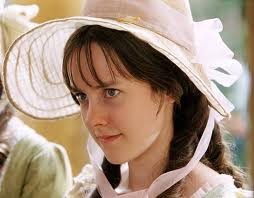
Jena Malon took on the Lydia role for the 2005 movie

Jena Malon took on the Lydia role for the 2005 movie

Although Jane and Lizzie attempt to “check the imprudence” of Kitty and Lydia their efforts have little effect. The girls are indulged by their mother but are …

“always affronted by their advice… Lydia, self-willed and careless, would scarcely give them a hearing….”

Lydia has no filter. She says what ever thought floats across her vapid mind, no matter how rude or inappropriate it might be.

Julia Sawalha in the 1995 version of Pride and Prejudice [Image courtesy BBC Home]

Julia Sawalha in the 1995 version of Pride and Prejudice [Image courtesy BBC Home]

“Lord” she tells Jane, “how ashamed I should be of not being married before three and twenty!” Likewise she does what ever she wants without regard for decorum or consequence.

Mary Kate Wiles embodies the 2012/13 party girl Lydia in the Lizzie Bennet Diaries VLOG [Image courtesy @TheLydiaBennett Twitter page]

Mary Kate Wiles embodies the 2012/13 party girl Lydia in the Lizzie Bennet Diaries VLOG [Image courtesy @TheLydiaBennett Twitter page]

She is…

“the most determined flirt that ever made herself and her family ridiculous. A flirt, too, in the worst and meanest degree of flirtation; without any attraction beyond youth and a tolerable person; and from the ignorance and emptiness of her mind, wholly unable to ward off any portion of that universal contempt which her rage for admiration will excite.”

Lizzie warns their father not to allow Lydia to go to Brighton, but Mr. Bennet, knows that there will be no peace at home if he doesn’t concede. He justifies the decision by saying…

“Colonel Forester is a sensible man, and will keep her out of any real mischief; and she is luckily too poor to be an object of prey to any body. At Brighton she will be of less importance, even as a common flirt, than she has been here. The officers will find women better worth their notice. Let us hope, therefore, that her being there may teach her her own insignificance. At any rate, she cannot grow many degrees worse without authorizing us to lock her up for the rest of her life.”

Lydia, of course, does not disappoint. She manages to do the least appropriate thing possible… she runs off, unmarried with a man. That man is George Wickham and it takes some doing to get the couple to the altar.

A triumphant Lydia returns home with her husband in the 1940 movie. With Ann Rutherford (Lydia), Edward Ashley (Wickham), Maureen O'Sullivan (Jane), and Greer Garson (Lizzie).

A triumphant Lydia returns home with her husband in the 1940 movie. With Ann Rutherford (Lydia), Edward Ashley (Wickham), Maureen O’Sullivan (Jane), and Greer Garson (Lizzie).

When they return to Longbourn …

“Lydia was Lydia still; untamed, unabashed, wild, noisy, and fearless. She turned from sister to sister, demanding their congratulations…”

She even insists that Jane take walk behind her as she is a married woman now, and therefore holds a higher rank.

Peeya Rai Chowdhury and Daniel Gilles as Lakhi Bakshi (Lydia) and George in Bride and Prejudice

Peeya Rai Chowdhury and Daniel Gilles as Lakhi Bakshi (Lydia) and George in Bride and Prejudice

“I find Lydia to be tiresome” says Austen fan Mary Baldauf Wiedel, “and Wickham is a true cad.” She adds that the two are ”fairly unlikable characters, although no one deserves to be with Wickham.”

Sometimes when I’m rereading the novel* or am watching one of the adaptations I try to remember back to my original impressions of Wickham. Was I suspicious? Did I like his easy manner and winning smile as much as the ladies of Longbourn? Or did I know right away that he was trouble?

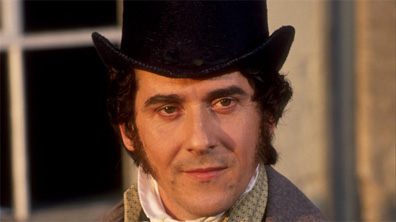
Adrian Lukis as Wickham in the 1995 series.

Adrian Lukis as Wickham in the 1995 series.

Not even Lizzie gets an accurate bead on Wickham’s character at first. She spends about a third of the book enjoying his company and listening to his poisonous tales about Darcy.

George Wickham is handsome. He has “a fine countenance, a good figure, and very pleasing address.” An officer in the militia, Wickham makes quite a dashing figure in his regimentals. But Lizzie observes that he has something more in his “person, countenance, air, and walk” than this companions. And he could make the “commonest, dullest, most threadbare topic” interesting.

Rupert Friend in the 2005 Movie [Image courtesy: AustenAuthors.net]

Rupert Friend in the 2005 Movie [Image courtesy: AustenAuthors.net]

He may not be rich, but, as he explains, that is not his fault. Its Darcy’s. Darcy has cruelly denied Wickham the church living promised to him. So now he must make his way as an “honest” soldier.

In reality he’s a gambler, a womanizer, a slacker and a liar. He uses his good looks and his social ease to manipulate people. He even manipulates Lizzie, who is usually a keen judge of character, into taking his side against Darcy. He leaves a trail of debt and broken hearts where ever he goes.

Wes Aderhold updates Wickham in the Lizzie Bennet Diaries

Wes Aderhold updates Wickham in the Lizzie Bennet Diaries

So why does Wickham elope with Lydia? For her part it is probably a romantic lark, an adventure. She seldom looks past the moment and he is fulfilling her immediate needs. But what does she have to offer him? Not money. Not status. Not love. My guess is that he initially does it as a lark too. Lydia is pretty and is certainly willing to run away with him. He can always leave her when he gets tired of the situation and travel to another country to find a rich wife. But, then he realizes that he can make a little money off this deal. When Darcy finds them he realizes he’s hit pay dirt. If Darcy cares enough to come looking for Lydia he’ll care enough to pay Wickham’s gambling debts and pay his overdue tavern bills and more.. All he has to do is marry one of the silliest girls in the country.

Ahhh marital bliss. [Image courtesy BBC]

Ahhh marital bliss. [Image courtesy BBC]

———————————————————————————

* for the record… I am not in a CONSTANT state of rereading one or the other of Ms. Austen’s novels. I just thought you should know.

The LY-Di-A Bennet  on Lizzie Bennet Diaries has her own VLOG. Here’s a taste:


Secondary Character Saturday — SPIDER (Anansi Boys)

Who: Spider

My take on the Anansi brothers, Fat Charlie and Spider. [Copyright: ritaLOVEStoWRITE.]

My take on the Anansi brothers, Fat Charlie and Spider. [Copyright: ritaLOVEStoWRITE.]

From: Anansi Boys

Written by: Neil Gaiman

Date of Publication: Jan 2008.

Why: He’s the trickster brother to the book’s everyman hero, Fat Charlie.  He’s the cool, funny, magical brother you’d always wish you had. Kinda. [Full disclosure: I’m really a card-carrying member of “Team Fat Charlie. ” But, as he’s the lead character, I couldn’t really pick him for this profile could I?  So I picked Spider, who is so like Fat Charlie! –Except he’s completely different.]

Here’s what happened when the brothers met:

“Fat Charlie blew his nose. “I never knew I had a brother,” he said.
“I did,” said Spider. “I always meant to look you up, but I got distracted. You know how it is.”
“Not really.”
“Things came up.”
“What kind of things?”
“Things. They came up. That’s what things do. They come up. I can’t be expected to keep track of them all.”
“Well, give me a f’rinstance.”
Spider drank more wine. “Okay. The last time I decided that you and I should meet, I, well, I spent days planning it. Wanted it to go perfectly. I had to choose my wardrobe. Then I had to decide what I’d say to you when we met. I knew that the meeting of two brothers, well, it’s the subject of epics, isn’t it? I decided that the only way to treat it with the appropriate gravity would be to do it in verse. But what kind of verse? Am I going to rap it? Declaim it? I mean, I’m not going to greet you with a limerick. So. It had to be something dark, something powerful, rhythmic, epic. And then I had it. The perfect line: Blood calls to blood like sirens in the night. It says so much. I knew I’d be able to get everything in there – people dying in alleys, sweat and nightmares, the power of free spirits uncrushable. Everything was going to be there. And then I had to come up with a second line, and the whole thing completely fell apart. The best I could come up with was Tum-tumpty-tumpty-tumpty got a fright.”
Fat Charlie blinked. “Who exactly is Tum-tumpty-tumpty-tumpty?”
“It’s not anybody. It’s just there to show you where the words ought to be. But I never really got any futher on it than that, and I couldn’t turn up with just a first line, some tumpties and three words of an epic poem, could I? That would have been disrespecting you.”
“Well….”
“Exactly. So I went to Hawaii for the week instead. Like I said, something came up.” [Anansi Boys]

Anasi Boys 2

Pros: He’s pretty much a god. He can make people do things with the power of suggestion. He talks to spiders. After living most of his life in hedonistic selfishness (he is a god after all) he learns to grow and love.

Cons: When we first meet him he is selfish and destructive.  He’s a liar and a cheat. And he never thinks about the real world consequences since he never sticks around long enough to deal with them. He steal’s Fat Charlie’s fiance, Rosie, and takes over his flat. He pretty much ruins Fat Charlie’s life.

——————————————————————————–

If you haven’t guessed… I’m a big Neil Gaiman fan. So I was thrilled when one of my besties, Lynn Reynolds gifted me Anansi Boys as an Audible Book  for Christmas. I’d only really done a handful of books on tape before, most notably the Harry Potter books (I’ve also done various books  through my Kindle’s text-too-speech while gardening or painting. But those sound like the “Garman car man” guy  so they don’t count.) Any way, I was really pleased with this Audible Book both for Lenny Henry’s narration and, especially, for the wonderful writing. I think you should give it a try…

Here’s the Kindle link: http://www.amazon.com/Anansi-Boys-ebook/dp/B000FCKENQ/ref=tmm_kin_title_0

And here’s the link for the Audio version – http://www.amazon.com/Anansi-Boys-Neil-Gaiman/dp/0060823844/ref=tmm_abk_title_0

[Image courtesy Amazon.com]

[Image courtesy Amazon.com]

  Click here to read the ritaLOVEStoWRITE Neil Gaiman bioBLOG


A.A. Milne 1.18.13 Thought of the Day

“One of the advantages of being disorganized is that one is always having surprising discoveries.”
–A.A. Milne

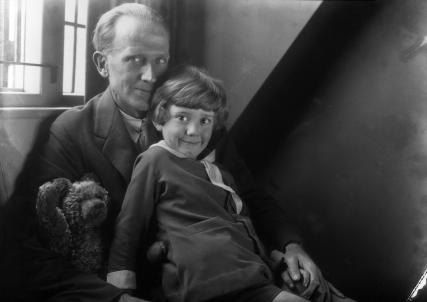
 A.A. Milne; Christopher Robin Milne and Pooh Bear  by: Howard Coster


A.A. Milne; Christopher Robin Milne and Pooh Bear by: Howard Coster

A. A. Milne was born  on this day in Kilburn, London, England in 1882. Today is the 131st anniversary of his birth.

Alan Alexander Milne  was the youngest of three boys born to John Vine and Sarah Maria Milne. John Milne ran a school, Henley House, and it was here that the boys took their first steps in the world of learning. One of the teachers at the school was H.G. Wells and he and Alan would remain friends for the rest of their lives. After Henley House Alan went on to Westminster School before attending Cambridge on a mathematics scholarship.

A.A. Milne’s first literary efforts came during his Cambridge days. He edited the college’s humorist publication, The Granta. Alan and his brother Ken worked together, by mail, on light verse that was published in The Granta under a mash-up of their initials A.K.M.

After graduation Alan moved to London and worked as a freelance writer. He had articles published in both newspapers, like the St. James Gazette, and in humor magazines, such as Punch.

In February of 1906 he became an assistant editor and weekly contributor to Punch magazine. His  contributions included stories on sports (especially cricket and golf), the exploits of the fictional middle class Rabbit Family, and children stories that he wrote with his niece Marjorie in mind.

In 1913 he married Dorothy “Daphne” de Selincourt. When World War I broke out he volunteered as a signalling officer. He saw action in France until returning to England in November 1916 with a fever. Once recovered he was

…put in charge of a company at a new formed signalling school at Fort Southwick. He stayed there until he was released from the army on February 14, 1919. [Pooh-Corner.org — The Author]

A.A. Milne on the Western Front 1916. [Image courtesy Spartacus.Schoolnet.co.uk]

A.A. Milne on the Western Front 1916. [Image courtesy Spartacus.Schoolnet.co.uk]

While in the Army he wrote his first play Wurzel-Flummery. Alan didn’t go back to Punch after the war — his job had been given to some one else — and he preferred the freedom of not having a weekly deadline. He also liked writing plays and collaborating with the actors.

…he had several successes, both in London and in New York. Mr Pim Passes By… opened in London on January 5, 1920, and ran for 246 performances in London. It also had a successful run in New York…. Within the next year, Milne had another four plays running in London. Other notable plays include Belinda, The Lucky One, The Romantic Age, The Dover Road, and The Truth About Bladys. … At one time, A. A. Milne was England’s most successful, prolific, and best-known playwright. [Pooh-Corner.org — The Author]

Ironically his biggest flop was called Success.

He wrote an adaptation of Mr. Pim Passes By and a mystery, The Red House Mystery. When he proposed writing Red House his agent bulked, suggesting the public wanted more humor stories. But Milne stuck to his guns, and The Red House Mystery was “his most successful book other than his four children’s books.” [Ibid]

The Red House Mystery

The Red House Mystery (Photo credit: Wikipedia)

Alan and Daphne Milne had a son Christopher Robin in 1920. They called the little boy “Billy Moon”  at home and among friends (the first name was a nickname, the “Moon” came from Christopher’s mispronunciation of his last name). Alan wrote the first Billy Moon poem “Vespers” after watching the little boy say his prayers before going to bed. It proved so popular that Milne was

asked to provide another children’s verse for a new children’s magazine entitled The Merry-Go-Round. That poem was “The Dormouse and the Doctor“, and also became quickly famous. Alan toyed with the idea of writing a whole book of children’s verse, and the result was When We Were Very Young, published in 1924. To illustrate the book, Milne enlisted the aid of Punch illustrator, Ernest Shepard. The combination of Milne’s poetry and Shepard’s drawings proved to be a winner, as the book sold over 50.000 copies within eight weeks of its first publication. [Ibid]

The family moved to Cotchford Farm, in Hartfield, East Sussex, in 1925 and Alan used the bucolic setting as his backdrop for his next book,Winnie-the-Pooh. Shepard was on board again as illustrator. Milne thought so highly of Shepard’s role in the success of the first children’s books that he insisted Shepard get an 80/20 share of the royalties of Winnie-the-Pooh instead of a flat rate. Winnie-the -Pooh was enormously well received.

Cover of Winnie-the-Pooh

Cover of Winnie-the-Pooh (Photo credit: Wikipedia)

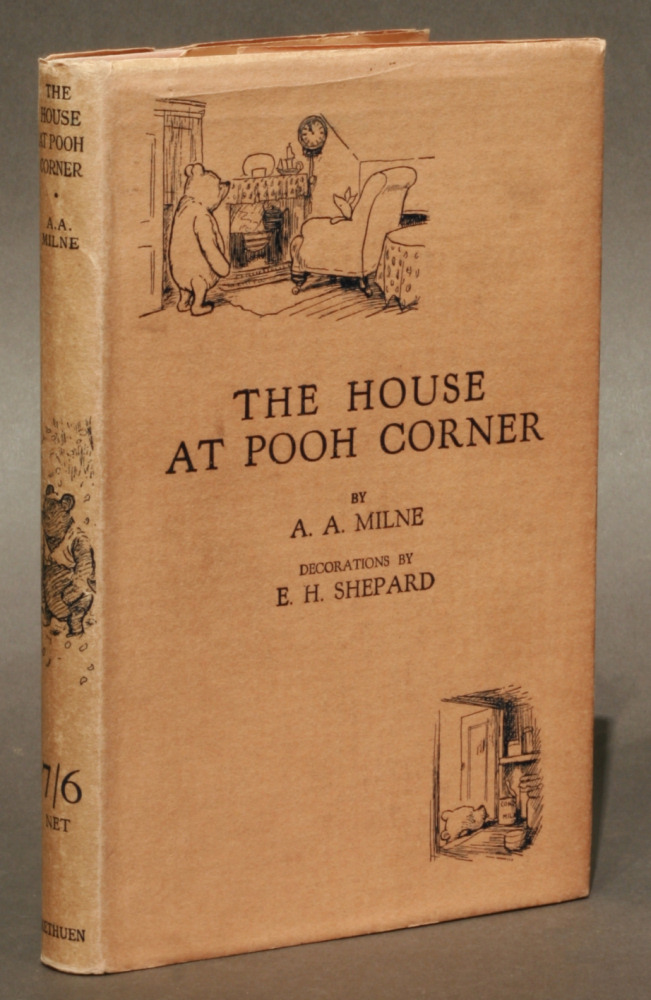
The second Pooh book, The House at Pooh Corner was equally loved. (Except by Dorothy Parker who famously quipped in her Constant Reader column in the New Yorker that by page 5 of the book the “tonstant Weader fwowed up”. Milne was unfazed by Parker’s quip, noting that “no writer of children’s books says gaily to his publisher, “Don’t bother about the children, Mrs Parker will love it.””[Ibid])

Milne House at Pooh Corner1000

Alan wrote more plays. His Toad of Toad Hall, based on Grahame’s The Wind in the Willows, got it’s stage debut in 1929. The play was hailed as a “family classic” and Milne was quickly getting painted into a corner. Especially in London, his works for adults were being ignored as the public clamored for more Pooh, or at least more children’s fiction. New York was more forgiving and his plays had longer runs on Broadway, including The Ivory Door and Michael and Mary. In 1933 his adult novel Four Days of Wonder sold moderately well, but he didn’t publish another novel for another 13 years.

At the dawn of World War II Milne, the pacifist, wrote Peace With Honour in which he outlined that nothing was

“worth repeating the Somme for. He would later change his mind and would write a pamphlet called War With Honour, in which he explained his changed views. ‘If anyone reads Peace With Honour now, he must read it with that one word HITLER scrawled across every page. One man’s fanaticism has cancelled rational argument.’ [Ibid]

The Milnes had moved away from the ‘Hundred Acre Woods’ and Cotchford Farm for London and New York, but with the War they moved back to East Sussex. Alan was Captain of the Home Guard for the area. His relationship with Daphne, which had waned, rekindled, but his ties with Christopher, which had always been strong, weakened. Christopher joined the Royal Engineers as a Sapper.

In 1946 Milne’s Chloe Marr, his last novel, came out to good reviews. It sold well. He continued to see success with his plays, which were now running in repertory.

[Image courtesy pdxretro.com]

[Image courtesy pdxretro.com]

But his relationship with Christopher — who ” had begun to resent his father and hated the books that made his name famous” [Ibid] — was crumbling. By the early 1950’s Christopher was married and living 200 miles away.

In October 1952, Milne had a stroke which left him an invalid for his remaining years. … A. A. Milne died on January 31, 1956. [Ibid]


Zora Neale Hurston 1.7.13 Thought of the Day

“I have been in Sorrow’s kitchen and licked out all the pots. Then I have stood on the peaky mountain wrapped in rainbows, with a harp and sword in my hands.”
Zora Neale Hurston

Zora Neale Hurston Photographer: Carl Van Vech...

Zora Neale Hurston Photographer: Carl Van Vechten. Silver geletin print, 1938 (Photo credit: Wikipedia)

Zora Neale Hurston was born on this day in Notasulag, Alabama, USA in 1891. Today is the 121st Anniversary of her birth.

Hurston was fifth of eight children born to John and Lucy Ann Hurston. Her father was a preacher, a tenant farmer and a carpenter. When Hurston was three the family moved to Eatonville, Florida. Hurston saw Eatonville as utopia where African-Americans could “live as they desired, independent of white society and all its ways.” [Women In History — Zora Neale Hurston] Her father was mayor of the town for a while, and Hurston enjoyed a happy childhood. While her preacher father tried to control his daughter’s exuberant love of life, her mother indulged her joyous nature.

“Mama exhorted her children at every opportunity to “jump at de sun.” We might not land on the sun, but at least we would get off the ground.”–Zora Neale Hurston

Her idyllic  childhood ended at thirteen with the death of her mother. Shortly afterward her father remarried. Hurston said she was “Passed around the family like a bad penny.” They sent her to  a boarding school, but when they stopped paying for her tuition she was kicked out.

Zora worked a series of menial jobs over the ensuing years, struggled to finish her schooling, and eventually joined a Gilbert & Sullivan traveling troupe as a maid to the lead singer. In 1917, she turned up in Baltimore; by then, she was 26 years old and still hadn’t finished high school. Needing to present herself as a teenager to qualify for free public schooling, she lopped 10 years off her life–giving her age as 16 and the year of her birth as 1901. [zoranealehurston.com/about]

Hurston finished Morgan Academy and in 1918 she went to Howard University in Washington, DC where she began pursue her literary career. She had her first story, “John Redding Goes to Sea” published in The Howard University literary magazine The Stylus. More stories followed and Hurston began to be noticed by the literary set of the Harlem Renaissance, like Langston Hughes. She transferred to Barnard College in New York and earned her degree in 1928.

The Harlem Renaissance was a period during which black artists broke with the traditional dialectal works and imitating white writers to explore black culture and express pride in their race.  This was expressed in literature, music, art, in addition to other forms of artistic expression.  Zora and her stories about Eatonville became a major force in shaping these ideals. Additionally, she combined her studies in anthropology with her literary output.  [Women In History — Zora Neale Hurston]

She received a Rosenwald fellowship and a Guggenheim Fellowship to do anthropological field research int he mid 1930s.

Zora Neale Hurston, beating the hountar, or ma...

Zora Neale Hurston, beating the hountar, or mama drum (Photo credit: Wikipedia)

Her first novel, Jonah’s Gourd Vine came out in 1934.  She followed that up with Mules and Men , a folklore classic based on her anthropological work in the South.

In 1937 she traveled to Jamaica and Haiti on a Guggenheim Fellowship to conduct field research on African rituals and voodoo. While in Haiti she wrote her most famous novel, Their Eyes Were Watching God, in seven weeks time.

Cover of "Their Eyes Were Watching God"

Cover of Their Eyes Were Watching God

Janie, the protagonist, returns to her home town at the beginning of the novel. She

recalls all the crucial moments of her life, from t he time she first discovers that she is a “colored” little girl…to the moment she returns to Eatonville, Florida, from the Everglades, not swindled and deceived, as had been expected, but heartbroken, yet boldly defiant, after having toiled in the bean fields, survived a hurricane and lost the man she loved. [Their Eyes Were Watching God, Forward]

Hurston prose is rich and colorful while her dialogue is dense with authentic slang. Here’s how she drops you into the story near the beginning of the novel…

So the beginning of this was a woman and she had come back from burying the dead. Not the dead of sick and ailing with friends at the pillow and the feet. She had come back from the sodden and the bloated; the sudden dead, their eyes flung wide open in judgement….

Seeing the woman as she was made them remember the envy they had stored up from other times. So they chewed up the back parts of their minds and swallowed with relish. They made burning statements with questions, and killing tools out of laughs. It was mass cruelty. A mood come alive. Words walking without masters; walking altogether like harmony in a song.

“What she doin’ coming back here in dem overhalls?  Can’t she find no dress to put on?– Where’s dat blue satin dress she left here in? — Where’s all dat money her husband took and died and left here? What dat ole forty year ole ‘omen doin’ wid her hair swingin’ down her back lak some young gal? …. [Their Eyes Were Watching God, Chapter One]

It takes a few pages to get used to, but the novel is more than worth the effort.

Portrait of Zora Neale Hurston: Eatonville, Fl...

Portrait of Zora Neale Hurston: Eatonville, Florida (Photo credit: State Library and Archives of Florida)

Other Major Hurston works include Tell My Horse, Moses, Man of the Mountain, Seraph on the Suwanee and her autobiography Dust Tracks on a Road.

Sadly, “Hurston never received the financial rewards she deserved. (The largest royalty she ever earned from any of her books was $943.75.)” [zoranealehurston.com/about] As the 40’s waned so did her career.

Never in her works did she address the issue of racism of whites toward blacks, and as this became a nascent theme among black writers in the post World War II ear of civil rights, Hurston’s literary influence faded. She further scathed her own reputation by railing the civil rights movement and supporting ultraconservative politicians. [Women In History — Zora Neale Hurston]

She opposed the New Deal and the Supreme Court’s ruling on Brown v. Board of Education. She struggled to get published, and took on jobs as a maid and a substitute teacher to try to make ends meet.

In 1959 she suffered from a stroke and had to enter the St. Lucie County Welfare Home. She died there in January of 1960 of hypertensive heart disease. Hurston was buried in an unmarked grave.


J.R.R. Tolkien 1.3.13 Thought of the Day

“All that is gold does not glitter; not all those that wander are lost.”
–J.R.R. Tolkien

[Image courtesy Biography online

[Image courtesy Biography online

John Ronald Reuel Tolkien was born on this day in Bournemouth, Orange Free State, South Africa) in 1892. Today is the 120th anniversary of his birth.

Tolkien is the older of two boys born to Arthur Reuel Tolkien and Mabel Suffield Tolkien. The family lived in South Africa where Arthur was head of the Bloemfontein office of a British bank. While he was in England on an extended holiday with his mother and brother Hilary his father passed away from rheumatic fever. Mabel Tolkien then moved in with her parents and a succession of relatives in the West Midlands. Mabel and her sister May caused quite a stir when they (and the boys) converted to Catholicism in 1900. Sadly, Mabel died in 1904, leaving her son’s well-being in the hands of a series of relatives and acquaintances until they were eventually taken in by a catholic educator, Father Francis. It was he who encouraged and refined Tolkien’s already blooming gift with words.

When he was sixteen, Tolkien met and developed a close friendship Edith Bratt. As friendship progressed to love, Father Francis forbade him from communicating with Edith until Ronald was 21 in order to keep his focus on his education. By the time they were reunited, Edith had converted to Catholicism, and Tolkien had completed his Oxford degree. They were together at the outbreak of World War I. [Tolkien Society]

J.R.R.Tolkien

J.R.R.Tolkien (Photo credit: proyectolkien)

Tolkien enlisted as a second lieutenant in the Lancashire Fusiliers, but married Edith while still in England on March 22, 1916. The match resulted in four children, three boys and a girl: John Francis Reuel Tolkien (November 17th, 1917 – January 22nd, 2003), Michael Hilary Reuel Tolkien (October 22nd, 1920 – February 27th, 1984), Christopher John Reuel Tolkien (born November 21st, 1924) and Priscilla Mary Anne Reuel Tolkien (born June 18th, 1929).  He was sent into active duty at the start of the Somme offensive, and after four months succumbed to “trench fever”[Ibid] He was sent back to a hospital in Birmingham, England, and was joined by Edith in Staffordshire. It is there that his work on the “Book of Lost Tales” (posthumously published) began. He was promoted to lieutenant and served out the rest of the war on home duty. [Ibid]

He floated through several postwar academic positions finally settling in the Rawlinson and Bosworth Professorship of Anglo-Saxon back at Oxford [Ibid]. He moved through several other posts, but always remained at Oxford until his retirement in 1959. It was there that he founded a group for those of similar interests called “The Inklings”. In 1936, Susan Dagnall, of the publishing firm of George Allen and Unwin, received and incomplete draft of Tolkien’s “The Hobbit” and implored the author to finish it.

J.R.R. Tolkien - illustration for The Hobbit

J.R.R. Tolkien – illustration for The Hobbit (Photo credit: deflam)

“The Hobbit” was published in 1937 and has remained a staple of school reading lists since then. Stanley Unwin was so pleased by the work that he asked if Tolkien had any similar works [Ibid]. Tolkien initially submitted his current draft of “the Silmarillion” ( posthumously published in 1977), but it was rejected by Unwin, who requested something like “the New Hobbit”(2). Understandably disappointed, Tolkien then began work on what would become The Lord of the Rings“.

English: A 3D model of the One Ring Italiano: ...

English: A 3D model of the One Ring Italiano: L’Unico Anello di Sauron da Il Signore degli Anelli di J.R.R. Tolkien. Immagine 3D realizzata da Hill. (Photo credit: Wikipedia)

He continued to write through the outbreak of World War II, the duration of which he served as an Air-Raid Warden, a job, it is said, he participated in with great zeal and enjoyment [“J.R.R. Tolkien: Master of Fantasy” by David R. Collins – Lerner Publications Company – 1992].

“The Lord of the Rings” was published as six books in three parts from 1954 through 1955. The work’s success was as unexpected as Bilbo’s journey in the Hobbit, Tolkien soon received an occult following, as well as a deal to make a highly condensed BBC radio adaption [Tolkien Society].

Tolkien died on September 2, 1973, two years after Edith. Both are buried beneath the same headstone in the Catholic section of Wolvercote cemetery, just north of Oxford.

[Image courtesy: Geeks of Doom]

[Image courtesy: Geeks of Doom]

Author’s Note: The majority of today’s blog was written by Maggie (Rita’s kid), so if there are mistakes, they are her fault. However, if you really, really like it, Maggie is partial to tea and dark chocolate, so you ought to convince Rita to gives her exorbitant amounts of both.


Rita’s Note: Done! Thanks Maggie!