Written By: Frances Goodrich, Albert Hackett, Frank Capra, Jo Swerling, Philip Van Doren Stern and Michael Wilson. From the 1939 short story “The Greatest Gift” by Philip Van Doren Stern.
Date Released: 1946
Why: ZuZu is the epitome of Christmas innocence.
Pros: Sweet, innocent, adorable.
Cons: Unrealistic. (But come on, she’s only 5!)
Shining Moment: When George realizes that he really IS better off alive then not… he reaches into to his pocket and finds the petals to ZuZu’s flower. He understands that he is back in the real world with his real family waiting for him at home. And no matter what other trouble might befall him, he has that love, and the love of his friends to rely on.
Least Shining Moment: (She really should have buttoned that coat.)
Iconic screen shot from the movie It’s a Wonderful Life. (Photo credit: Wikipedia)
Karolyn Grimes, the actress who played ZuZu in the movie, remembers making the movie 60+ years ago. She remembers Jimmy Stewart lifting her up for endless takes and gently setting her down each time after some one yelled “CUT”. She remembers Frank Capra squatting down to give her a direction. She only had 6 minutes of screen time in the movie, but it has stayed with her for a lifetime.
… A lifetime that hasn’t always been so wonderful, frankly. Her mother died when Karolyn was 14, her father passed a year later, she went to a an unhappy “bad” home from there. But she got out and went to college and had a family and career as a medical technologist. But then her first husband died in a hunting accident. Her son committed suicide. Her second husband died of cancer. And she lost her life savings in the economic down turn in 2001.
“You have a choice,” she says. “You can drown in your sorrows, be the grumpy old Mr. Potter and be hurt and be in pain … but I think you need to put that behind you because, my gosh, life is a wonderful gift.” [Today Entertainment]
So instead of turning bitter she remains upbeat. She wrote a cookbook, “ZuZu Bailey’s It’s a Wonderful Life Cookbook” and does personal appearances (especially around the holidays.)
“I’m that little girl and I stand for something those people love,” she says. “… For some reason or other, that little girl embodies the image, or maybe the power to make them happy.” [Ibid]
At one appearance, as Grimes analyzes the movie with the crowd, she asks them if they think ZuZu sees her father, George, hide the petals he can’t paste back on the flower? She thinks ZuZu is on to him.
“I think what Frank Capra is trying to say is she knows her father isn’t perfect,” she said. [Ibid]
And that speaks to LIFE and Christmas too. It isn’t perfect. And it doesn’t have to be, but it can still be WONDERFUL if you let it.
—————————————————-
Some Christmas seasons you can’t swing a candy cane without hitting a showing of It’s a Wonderful Life on television. Sadly this wonderfully done movie has become part of the forced sentiment I like to call “Christmas Sausage” (That’s stuff YOU HAVE TO DO!!! to fulfill some one’s requirement of the Holiday) But this year, thankfully, it looks like the movie is only on once. So catch ZuZu, George, Mary, Uncle Billy and the rest of the gang at 8:00 pm Christmas Eve on NBC.
I think you have to pay for love with bitter tears. — Edith Piaf
Edith Piaf (Photo credit: tsweden)
Édith Giovanna Gassion was born on this day in Belleville, Paris, France in 1915. Today is the 97tj ammoversary of her birth.
Her mother was a cafe singer and her father was a street acrobat. She was abandoned by her parents to the care of her maternal grandmother, then was taken to her father’s mother. Her paternal grandmother ran a brothel and Édith grew up amongst the prostitutes. She was blinded as a result of meningitis at three but recovered by seven (supposedly because the “prostitutes pooled money to send her on a pilgrimage honoring Sainte Thérèse de Lisieux, which … resulted in a miraculous healing.”[geni.com] by 14 she was performing with her father on the streets of France. “Piaf’s songs and singing style seemed to reflect the tragedies of her own difficult life.” [Encyclopedia Britannica]
Français : Edith Piaf enfant (Photo credit: Wikipedia)
She left her father’s act and performed on her own singing in the streets for years before being discovered by a nightclub owner. She changed her last name to Piaf (and became known as “the little sparrow.” ) She switched to ballads.
She entertained French POWS during WWII, and gained world wide fame after the war with such songs as Non, je ne regrette rien and La Vie en rose by touring extensively.
Her throaty, expressive voice, combined with her fragile appearance and a dramatic tight spotlight on her face and hands, made her concerts memorable. [Answers.com]
She died of liver cancer at age 47 in 1963.
English: Bust of Edith Piaf in Celebrity Alley in Kielce (Poland) Česky: Busta Edith Piaf v polských Kielcích (Photo credit: Wikipedia)
Français : Centrage sur le visage de Steven Spielberg (Photo credit: Wikipedia)
Steven Allan Spielberg was born on this day in Cincinnati, Ohio, USA in 1946. He is 66 years old.
Spielberg grew up in Haddon Township, New Jersey and Scottsdale, Arizona. He made 8mm films that he charged his friends a quarter a piece to see, his sister sold popcorn. He’d do special effects train wrecks using his model trains. He earned the photography merit badge in Boy Scouts producing an 8mm movie called “The Last Gunfight. (Spielberg went on to become an Eagle Scout.)
While attending California State University, Long Beach he took an unpaid internship at Universal Studios. When studio VP Sid Sheinberg saw his 26 minute, silent film Amblin’ he offered Spielberg a seven-year contract with Universal Television. Thus making Spielberg the youngest director to be signed to a long-term deal with a major motion picture studio. He left Cal State, Long Beach to take the gig, but eventually finished his degree in 2002.
At Universal Television he directed episodes of Marcus Welby, MD, Rod Sterling’s Night Gallery, The Name of the Game, The Psychiatrist,Columbo and TV movies.
His first feature film was The Sugarland Expresswith Goldie Hawn (1974). Sugarland Expresswas a good first effort, and the critics liked it, but it got tepid reaction at the box office.
[Image courtesy: Wikimedia]
In 1975 he made everybody afraid to get into the water with Jaws. Based on a Peter Benchley novel Jaws had that mix of small town life invaded by something big and ominous — in this case a great white shark named “Bruce” — that became a Spielberg hallmark. Jaws starred Roy Scheider as the mild-mannered sheriff, Marty Brody, Richard Dreyfuss as smart, hyper Matt Hooper and Robert Shaw as crusty Quint. Jaws was the highest-grossing film of all time until Star Wars knocked it off the top of the list.
He revisited the theme of an earlier, student, film, Firelight, to make his third film, Close Encounters of the Third Kind. Firelight had a budged of $500 and, with tickets that cost $1 each and the film made a profit of exactly $1. The budget and profit for Close Encounters was considerably larger. He wore both writing and directing hats on Close Encounters.
World wide adventure came calling with Indiana Jones in 1981 in Raiders of the Lost Ark, the first [and best] of the Indiana Jones series.
Then he came home for another small town meets alien film with E.T. The Extra-Terrestrial. [Spielberg fans are generally split on this one with some voting it as their favorite and others dismissing it as over sentimental and saccharine. I’m on team saccharine. Discuss.]
He did two segments of the Twilight Zone movie (no, not the Vampire one with Edward Cullen) and a couple of TV shows before making the wonderful The Color Purple. Based on the Alice Walker novel, the film was nominated for eleven Academy Awards — but not for directing — however, it didn’t win any Oscars.
[Image courtesy: Wikimedia]
Empire of the Sun is a war movie and is set in almost the same time frame at the Indiana Jones flicks, but it couldn’t be more different. Based on the J.G. Ballard novel and with a screen play by Tom Stoppard this move starred John Malkovich, Miranda Richardson, Nigel Havers and a young Christian Bale (in one of his first roles for film.) Empire of the Sun did well with the critics, although it did not do as well at the box office as some of Spielberg’s more action packed films. It (along with Color Purple) marked a transition point for the film maker. From here on out he had the chutzpah to make a full-fledged drama. [Empire is my #1 favorite Spielberg film. It is beautifully filmed, has amazing performances, and a wonderful score, go put it on you Netflix queue right now.]
He closed out the 1980s with the third installment in his Raider’s series — this time with Sean Connery along for the ride with Harrison Ford; and an under appreciated movie about daredevil pilots who put out forest fires, Always. Spielberg teamed up with Richard Dreyfus again for Always, and it’s Audrey Hepburn’s last role.
Hook, a spin on the Peter Pan story came in 1991, followed by Jurassic Park. Both seem like a perfect fit for this director who revels in letting his inner child come out on the screen. Jurassic Park has DINOSAURS! What’s not to like? [Well if you’ve read the book, you might cite a the lack of character or plot development, which Michael Crichton taut novel had in spades. The movie relied more on special effects and product placement than writing. — Seemed to work though, they made a LOT of money and squeeze out a couple of sequels.]
[Image courtesy: Wikimedia]
Schindler’s List is another of his best movies. It won Spielberg his first Academy Award for Best Director (it also won for Best Film). He found a very human way to tell a very inhumane story. Like Empire of the Sun it is a WWII drama, and it also takes place largely in a concentration camp. But Schindler’s Listis in the European theater and it encompasses a larger scope. Amazing acting, story, sets, and it is largely done in black and white. [It is my other favorite of Spielberg, and needless to say, you ought to put it on your queue.]
After another dance with dinos in The Lost World: Jurassic Park, he returned to drama with Amistad. Amistad tells the true story of an uprising that took place on the slave ship La Amistad and the legal battle that followed. Look for Anthony Hopkins as [my guy] John Quincy Adams. Amistad lacked box office appeal, but did well critically.
Saving Private Ryan showed yet another side to WWII, this time from the US soldier’s point of view. It was a big box office hit. and Spielberg won his second Academy Award as Best Director. Wonderful acting, especially from his lead, Tom Hanks, again a great story line, and beautifully shot. [A bit too realistic in the graphic depiction of the battle scenes for me, but still a great movie. Queue it.]
2001 brought A.I. Artificial Intelligence, which was started on Stanley Kubrick’s watch. 2002 gave us Minority Report based on the Philip K. Dick novel. Both are nearish future sci-fi stories. Catch Me If You Can goes back in time (a little) to tell the story of a con artist played by Leonardo DiCaprio and the cop that chases him, Tom Hanks. Hanks stars again in The Terminalas kind-hearted Eastern European traveller stuck in an airport when his country experiences a coupe. [All of them deserve a spot in your queue. As does…]
[Image courtesy: Wikimedia]
Spielberg’s reboot of War of the Worlds is creepy good with a capital C. The director joined forces again with Tom Cruise for this blockbuster, and it pulled in the big bucks — but it was also a darn good movie.
[It seems odd to me that I have seen SO many Spielberg movies, and yet after the 2005 War of the Worlds I haven’t seen any! How did that happen? I want to see Munich; War Horse; and definitely Lincoln. Any body up for a movie night?]
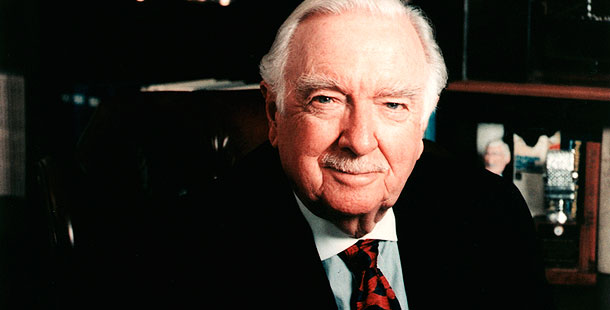
Walter Leland Cronkite, Jr was born on this day in Saint Joseph, Missouri, USA in 1916. Today is the 98th anniversary of his birth.
Walter was the oldest of six children. The Cronkites lived in Kansas City, Missouri (where young Walter was a paper boy for the Kansas City Star) until 1926 when the moved to Houston, Texas. At San Jacinto High School he worked for the school newspaper, eventually becoming editor.
Young Cronkite read the World Book Encyclopedia. He built a telegraph system to link the houses of friends. The churchgoing Boy Scout also learned he had an alcoholic father, and about divorce. His single mother taught him tolerance in a Jim Crow state. [Newsday.com]
According to Boy Scout lore Cronkite wanted to become a newsman after reading an article reporters in Boys Life Magazine.
He went to the University of Texas at Austin but dropped out in his Junior year to start working as a reporter. He worked for a number of newspapers (including the Huston Post) and radio stations (under the name “Walter Wilcox”) reporting the news and sports.
During World War II Cronkite became a War correspondent covering the North African and European campaigns for the United Press. After covering the Nuremberg Trials for that organization he was recruited to CBS News by Edward R. Murrow.
Cronkite started at the Washington, DC affiliate for CBS.
…He worked on a variety of programs, and covered national political conventions and elections. He helped launch the CBS Evening News in 1962 and served as its news anchor until his retirement in 1981. [Biography.com]
He was “The most trusted man in America” and he covered events from the assignations of John and Bobby Kennedy and Martin Luther King, to Apollo 11 landing on the Moon, to Watergate and Vietnam.
He also hosted: You Are There, a historical reenactment program; The Twentieth Century, a documentary using newsreel footage to explore historical events; and a game show, It’s News to Me.
He retired in 1981. He continued to report as a special correspondent and presenter.
After retiring, Cronkite hosted CBS’s Universe (1982), co-produced Why in the World (1981) for Public Broadcasting System, and hosted Dinosaur (1991) for the Arts and Entertainment cable television. He also did a special short series for CBS and the Discovery Channel in 1996 called Cronkite Remembers. In addition to his television work, Cronkite wrote several books, including A Reporter’s Life (1996) and Around America (2001). [Ibid]
Walter Cronkite passed away on July 17, 2009 in New York City.
“I just sit at a typewriter and curse a bit.”“There is only one cure for gray hair. It was invented by a Frenchman. It is called the guillotine.”“I know I was writing stories when I was five. I don’t know what I did before that. Just loafed I suppose.”–P.G. Wodehouse
“I just sit at a typewriter and curse a bit.”
Pelham Grenville Wodehouse was born on this day in Guildford, Surrey, England in 1881. This is the 131st anniversary of his birth.
Wodehouse, called “Plum” as a child, spent much of his early life in the care of a gaggle of aunts and at boarding schools in England, while his parents lived in the Far East. Third of four boys, Wodehouse was close to his brothers. He went to The Chalet School, Elizabeth College in Guernsey, Malvern House (near Dover) and finally at Dulwich College with his older brother Armine. He flourished at Dulwich where he played sports (especially boxing, cricket and rugby), studied the classics, sang and acted in the school’s theatricals, and of course, wrote.)
Psmith in the City (Photo credit: Wikipedia)
Upon graduation in 1900 ailing family finances meant he couldn’t go on to Oxford like Armine. Instead, Plum’s father got him a job in the London branch of the Hong Kong and Shanghai Bank. He wrote about his experiences at the bank in Psmith in the City, but he said he “never learned a thing about banking.” In 1902 he gave up the financial farce and dove into journalism with a job writing a comic column at The Globe newspaper. He moved to New York and published his first novel, The Pothunters the same year. A Prefect’s Uncle; Love Among the Chickens; The Swoop; Psmith In the City; Psmith, Journalist; The Prince and Betty; and Something New followed fairly quickly there after.
The Prince and Betty (Photo credit: Wikipedia)
He also wrote for musicals. He penned the book for Cole Porter’s Anything Goes; the Gershwin’ s Oh Kay . He worked with Ira Gershwin on the lyrics for Rosalie. And he wrote dozens of musicals — generically called the Princess Theatre Musicals — with Guy Bolton and Jerome Kern. [For a complete list of Wodehouse musicals go to The Playwrights Database at doolee.com] The Princess Theatre Musical are generally seen as a stepping stone that took the best of vaudeville and operetta and blended them into modern musical theatre. They transitioned
“… the haphazard musicals of the past to the newer, more methodical modern musical comedy … the libretto is remarkably pun-free and the plot is natural and unforced. Charm was uppermost in the creators’ minds … the audience could relax, have a few laughs, feel slightly superior to the silly undertakings on stage, and smile along with the simple, melodic, lyrically witty but undemanding songs” [Bloom and Vlastnic Broadway Musicals: The 101 Greatest Shows of All Time]
My Man Jeeves (Photo credit: Wikipedia)
Starting with My Man Jeeves in 1919 Wodehouse published the series of books for which is he best known, The Jeeves and Wooster books. Here’s a clip from the 1990 Granada Television production of Jeeves and Wooster starring Hugh Laurie and Stephen Fry:
He also wrote the Blandings Castle series about a fictional castle with Lord Emsworth and his prize-winning pig, the “Empress of Blandings.”
Since he and his wife, Ethel Wayman, were officially residents of both England and the US they were being taxed by both countries. To alleviate the tax burden they moved to France in 1934. The Wodehouse’s remained in France when the Nazi troops moved in. Wodehouse was interned as an “enemy alien” eventually landing in Tost, Upper Silesia, Poland. He later quipped of his ‘lodgings’ “If this is Upper Silesia, what on earth must Lower Silesia be like?” He entertained his fellow prisoners with dialogues and wrote during his two-year internment (he completed one novel and started two more). He was released just prior to his 60th birthday when a German friend from his Hollywood days, Werner Plack, approached him about doing a broadcast for the Americans describing his life as an internee. America was not at war with Germany yet, and he had received many letters of encouragement from his fans in the US while in the camp. He saw this as a way to thank them. And, Wodehouse claimed, he was simply reflecting the “flippant, cheerful attitude of all British prisoners.” [the Guardian] in the broadcasts. But the British public didn’t see it that way, and neither did MI5. He was interrogated for suspected collaboration with the Germans — something that shocked the aging author. “I thought that people, hearing the talks, would admire me for having kept cheerful under difficult conditions,” [ibid] Wodehouse maintained that he never had intended to aid the enemy. But the incident left a bad taste with both the Wodehouses and the British public. The author moved to the US in 1945, and never went back to England.
“If you can spend a perfectly useless afternoon in a perfectly useless manner, you have learned how to live.”
–-Lin Yutang
English: Lin Yutang 中文: 林语堂 (Photo credit: Wikipedia)
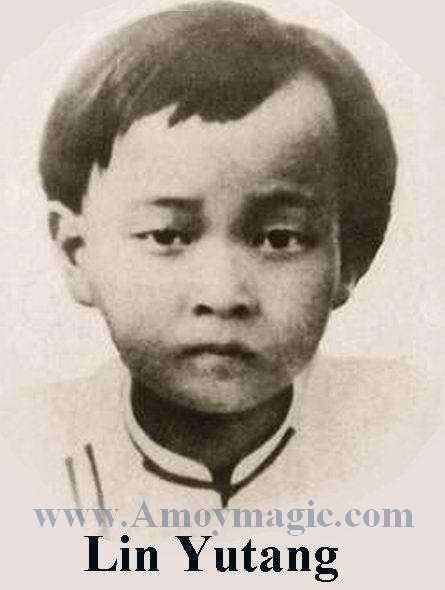
Lin Yutang was born on this day in Banzai, Fujian province, China in 1895. today is the 117th anniversary of his birth.
China provinces fujian (Photo credit: Wikipedia)
He grew up in the mountains of Fujian province the son of a Chinese Presbyterian minister. He studied at Saint John’s University, Shanghai and at Harvard University in the US. At first he studied to be a minister, but he renounced Christianity and pursued a degree in English instead.
[Image courtesy: Amoymagic.com]
He bridged the cultural and linguistic divide writing and editing for both English and Chinese magazines and produced Lin Yutang’s Chinese-English Dictionary of Modern Usage.
His successful satirical magazine Analects Fortnightly was the first of its kind in China. In 1933 Pearl Buck introduced him to her publisher who took Lin Yutang on as a client.
Lin published the first of his many English-language books, My Country and My People. It was widely translated and for years was regarded as a standard text on China. [Britannica.com]
He moved to New York and published Moment in Peking in 1939. His 1941 novel A Leaf in the Storm, presents China on the brink of war with Japan. Wisdom of China and India followed in 1942.
[Image courtesy: Amoymagic.com]
Lin’s fiction includes Chinatown Family— a look at culture, race and religion faced by an immigrant Chinese American family; and his 1968 The Flight of the Innocents.
Ming Kwai Typewriter (Photo credit: Wikipedia)
During the WWII Lin developed a workable Chinese typewriter, the “Ming Kwai” typewriter.
His belief that literature should be a means of self-expression, not a tool for propaganda put him at odds with political movements in China when he returned to his homeland in 1943 and 1954.
Lin wrote more than three dozen books and is “arguably the most distinguished Chinese American writer of the twentieth century.” [Google Books] He died on March 26, 1976.
[Image courtesy: Amoymagic.com]
“In his prolific literary career, Chinese author Lin Yutang wrote expertly about an unusual variety of subjects, creating fiction, plays, and translations as well as studies of history, religion, and philosophy. Working in English as well as in Chinese, he became the most popular of all Chinese writers to early 20th-century American readers.” [Britannica.com]
Julia Elizabeth Wellswas born on this day in Walton-on-Thames, Surrey, England in 1935. She is 77 years old.
Her parents divorced when Julie was a baby. Both parents remarried and Julie lived primarily with her mother and stepfather Ted Andrews, whom she called “Pop.” Julie’s last name was changed to Andrews to make the transition easier. According to Julie they were “very poor and we lived in a bad slum area of London,”
In the movie version of The Sound of Music she sings “Perhaps I had a wicked childhood / Perhaps I had a miserable youth / But somewhere in my wicked, miserable past / There must have been a moment of truth…” While those lyrics were written for her character, Maria, they echo a past that Andrew’s called “a very black period in my life.” Her stepfather was an alcoholic (so was her mother to a lesser degree.) Julie had to put a lock on her bedroom door after Pop tried, drunkenly, to get into bed with her, twice.
Both her mother and her stepfather were entertainers. Her mother, who had trained as a classical pianist, helped to make ends meet by giving lessons and accompanying vaudeville acts. Mom and Pop had their own act and at about 10 Julie began to appear with them on stage. Soon Julie joined the act on a regular basis. She’d have to take a nap in the afternoon so she could be bright and alert on stage late into the night. She took singing lessons and was said to have both perfect pitch and a four octave range. (She denies the perfect pitch.)
During World War II she lived through the Blitz.
She remembers spending some nights on the neighborhood subway platform, listening for unmanned bombers so that she could alert the neighbors of danger. Her parents once awakened to find an unexploded incendiary bomb in the tenement courtyard just outside their kitchen window. They once watched a mid-air dogfight directly above them. [Visions Fantastic]
She performed for King George VI’s family during the 1948 Royal Command Variety Performance in London. (She is the youngest performer ever to do so.) The Andrews act went on radio and TV. She was a cast member on the radio show Educating Archie from 1950-1952.
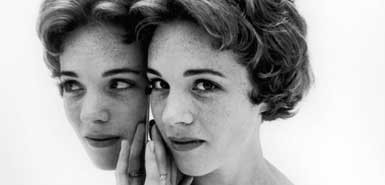
Julie Andrews in a introspective moment [Image courtesy: VisualizeUs]
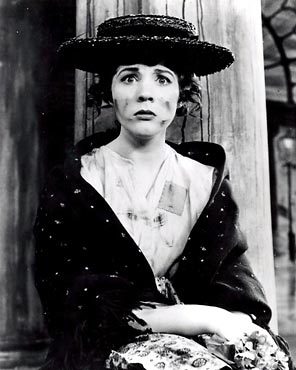
At 19 she made her Broadway debut as Polly Browne in The Boyfriend. Next she auditioned for the new musical adaptation of George Bernard Shaw’s Pygmalion and created the role of Eliza Doolittle in Lerner and Loewe’s My Fair Lady.
Andrews as Eliza in My Fair Lady circa 1956. [Image courtesy: The Seattle Times]
During her Broadway run of My Fair Lady she transformed from rags to riches again in the 1957 Rodgers and Hammerstein television musical version of Cinderellafor CBS TV.
In 1959 she married set designer Tony Walton.
Her next Broadway triumph was in 1960 as Queen Guinevere to Richard Burton’s King Arthur and Robert Goulet’s Lancelot in Lerner and Loewe’s Camelot.
She was terrific as both Eliza and Guinevere, but when it came time to make major motion pictures of the musicals the producers opted for actresses with more proven box office success. Jack Warner gave Eliza to Audrey Hepburn. Vanessa Redgrave got Guinevere. Andrews returned to England to have her daughter Emma instead.
The Disney company thought Andrews would be Practically Perfect for their adaptation of P.L. Travers’ Mary Poppins and offered her the role in their 1964 film. Andrews won an Oscar for this, her first, major motion picture. In her acceptance speech for the Golden Globe Andrews, with a bit of whimsy, thanked the man who “made all this possible in the first place, Mr. Jack Warner.”
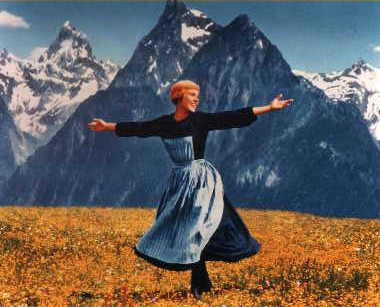
In 1965 Andrews stepped into the role of Maria Von Trapp for the 20th Century Fox movie of The Sound of Music. It went on to become the third highest grossing film ever made. The soundtrack sold more than 11 million copies.
United Artists produced Andrews next movie, Hawaii based on the novel by James A Michener. The film earned more than $6 million, and was 1966’s biggest box office hit.
Also in 1966, she co-starred with Paul Newman in Cold War psychological thriller Torn Curtain for director Alfred Hitchcock.
The 70s were quiet for Andrews. She divorced Warner and married director Blake Edwards. Although she continued to do television work — including a variety show, guest spots and specials — she focused much of her time during the disco decade raising her family.
In Edwards’s 1981 film S.O.B. she rather famously shed her innocent image by barring her breast. The next year she played dual roles in Victor Victoria and earned another Golden Globe Award.
The Princess Diaries gave her career yet another breath of fresh air as she co-starred as Queen Clarisse Renaldi with Anne Hathaway. She put on the crown again for The Princess Diaries 2: Royal Engagementt in 2004. The same year she donned an animated crown was Queen Lillian for Shrek 2 (and the subsequent Shrek sequels) and she narrated Enchanted. She also voiced the character of Marlena in Despicable Mein 2010.
She was given the title Dame Commander of the British Empire by Queen Elizabeth II in 2000 for her work both in the entertainment industry and for her involvement in charitable organizations like Save the Children, the UN’s Fund for Women and the Foundation for Hereditary Disease.
A quick note to thank every one for stopping by today.
I should have known that a Thought of the Day about Jim Henson and Kermie would do well, but I was pleasantly surprised to log on this evening and see the spikes in today’s stats. [Drumroll please…] I’m happy to report that today ritaLOVEStoWRITE had its very best day ever! By 7:40pm the site had reached a whopping 153 hits, for an all time total of over 5,000 hits! Whoot!
Here’s a map showing where all those hits are coming from…
Map reflecting all time hits.
Actually this is about a week old. Ghana, El Salvador, Suriname, Algeria, Oman, Kuwait and Reunion have joined since then. I’m learning a lot about geography. (Reunion is an island nation off the east coast of Madagascar, btw.)
Personally, I would love to see a few more of the countries on this map get filled in. Not just because it is cool to see the continents fill up, or because it would give me a RISK (game) sense of satisfaction to pick up Greenland so I would have all of “North America,” but because I have something to say.
If I could actually send a message to the world it would be similar to the advice Kermit gave in a Men’s Health interview in November of last year.
Challenge yourself to help others.
Accept people for who they are.
Roll with life’s ups and downs.
I would add
4. Live peacefully and with joy in your heart. And
5. Do something (small or large) to help save the planet every day.
So, thanks for stopping by the blog, and if you happen to know some one who might like ritaLOVEStoWRITE please send them a link and invite them to stop by (especially if they’re in Greenland.)
n”I only achieve about 60 per cent of what I’ve dreamed of. Perhaps that’s a good thing – if I did ever get the whole way with anything, I think I’d probably want to destroy it.”
— Baz Luhrmann
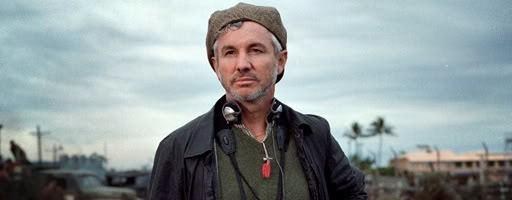
On the set of Australia [Image Courtesy: The Play List]
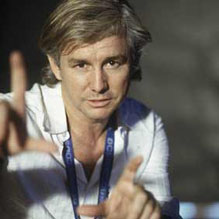
Mark Anthony Luhrmann was born on this day in Sydney, Australia in 1962. He is 50 years old.
His mother, Barbara, owned a dress shop. His father, Leonard, was a farmer and owned a gas station and movie theater in the small town of Herons Creek near where they lived. Barbara and Leonard competed in ballroom dance competitions and Barbara taught ballroom dance at a local studio.
“What kind of kid was I? …Extremely busy. My father was a bit mad, you see. He thought that we had to be the renaissance kids of Herons Creek. We had to learn commando training as well as photography, how to grow corn as well as how to play a musical instrument. We were up at 5 in the morning, and then we just went until we dropped. The town consisted of a gas station, a pig farm, a dress shop and a movie theatre – and we ran them all.” [Baz Luhrmann, as quoted on Baz the Great! fansite]
Growing up the Luhrmann kids helped run the various family businesses. In their free time they rode horses, learned to ballroom dance (of course), and made amateur movies. As a gas jockey at the service station Mark saw a stream of people pass through. He was invisible to them, and so was able to observe their stories unfiltered and unedited for the 5 minutes it took to fill up their tank. Later, after his parents divorced he eventually found himself in Sydney. Prior to the move he (and his brothers) had to keep their hair closely cropped in a buzz cut, but once in Sydney he was allowed grow it out. When he was teased that his new hair do made him look like a puppet fox on TV, Basil Bush, he embraced the taunting and officially changed his first name to Bazmark. In high school he acted in Henry IV, Part 1. And at 17 he got a role in the Judy Davis, Bryan Brown film The Winter of Our Dreams.
He worked with the Australian Opera to bring in a younger audience and directed and performed in a number of stage productions for the company.
In 1987, while working on an experimental opera, Lake Lost, He met Catherine Martin, a production designer. She became his exclusive production designer and his wife. (They now have two children.)
Luhrmann mounted productions of La Boheme, A Midsummer’s Night’s Dream and other classics in modern or unusual settings.
[Image Courtesy: NNDB]
His break out film was Strictly Ballroom. The project began as a 30-minute play, but Luhrmann developed it into a full blown motion picture in 1992. The story centers around handsome, spoiled, Scott. He’s a leading ballroom dancer who’s set to win the Pan-Pacific Ballroom Championships. But Scott wants to break the rules and dance his own steps. Enter Fran, a shy, ugly duckling of a girl from the beginner class at his mother’s studio. He teaches her how to dance and along the way she teaches him a thing or two as well. It’s quirky, funny, over the top, and wonderful. Here’s a scene about mid-way through the movie:
It is the first of his Red Curtain Trilogy. Romeo + Juliet and Moulin Rouge! round out the trio. Luhrmann describes a Red Curtain film as having the following attributes:
the audience knows how it will end right from the start;
the storyline is thin and simple;
the world created in the film is one of heightened reality; and
there is to be a specific device driving the story. For Strictly Ballroom it was dance, for Romeo + Juliet it was iambic pentameter, and for Moulin Rouge! it was characters breaking into song.
The success of Strictly Ballroom brought Luhrmann to the attention of 20th Century Fox who signed him to a 3-year deal. For second movie Luhrmann gave Romeo + Julieta modern jump. It starred Leonardo DiCaprio and Claire Danes and is both fast paced and action packed. In both style and weirdness factors there is a 15% increase from Ballroom, but still, it works.
The third movie of the set was Moulin Rouge!, a highly stylized musical love story starring Nicole Kidman and Ewan McGregor.
“. . . if you make a film full of risk, studios don’t run towards you to give you $50,000,000 in order to reinvent the post-modern musical, I can tell you. If you do manage to cajole them into doing it and you want to maintain the flag of creative freedom, you better make sure that it pays its bill.”[Baz Luhrmann, IMDB]
It was somehow even bigger and stranger than J + R and Ballroom put together. With an odd combination of modern songs (with modified lyrics) that should not have fit in the 1900 Paris setting, this musical had no business becoming a hit. But it did. Frankly, once Ewan McGregor opened his mouth to sing… nothing else seemed to matter. (As is evidenced by the bizarre beginning of this clip… Here McGregor’s Christian has snuck into courtesan Satine’s room. He is a penniless writer and he tries to win her over with the strength of his prose [well, in this case it’s Elton John’s lyrics] Kidman feign’s over excitement, hoping to get the shy wordsmith to leave, but then he starts to sing and the movie, and their attraction, takes off.)
For his next project he brought La Boheme to Broadway. The show opened on December 8, 2002 and was declared a “brilliant reworking of Puccini’s masterpiece that appealed to all. [Baz the Great! fansite]
In 2008 he teamed with Kidman again, this time pairing her with Hugh Jackman, in the epic WWII Aussie drama, Australia. It’s beautifully shot. From a cattle drive worthy any Western… to the Japanese attack on Darwin… to the love story, Australia has a lot going for it. (But be warned it is a bit preachy too.)
His eclectic mix of images and music can make even the every day seem extrordinary…
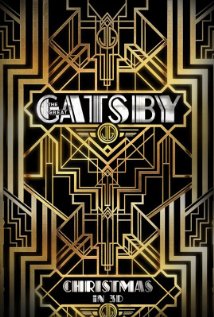
Luhrmann’s latest project is Gatsby. This time he re-teams with DiCaprio. This stylish take on the Fitzgerald’s classic, The Great Gatsby is due out on Christmas Day. [Don’t buy your tickets just yet… seems like the release date has been pushed back to Summer 2013 — thanks to John for the heads up. ]


![[Image courtesy: Wikimedia]](https://ritalovestowrite.com/wp-content/uploads/2012/12/jaws_movie_poster.jpg?w=490)
![[Image courtesy: Wikimedia]](https://ritalovestowrite.com/wp-content/uploads/2012/12/220px-empire_of_the_sun.jpg?w=490)
![[Image courtesy: Wikimedia]](https://ritalovestowrite.com/wp-content/uploads/2012/12/220px-schindlers_list_movie.jpg?w=490)
![[Image courtesy: Wikimedia]](https://ritalovestowrite.com/wp-content/uploads/2012/12/war_of_the_worlds_2005_poster.jpg?w=490)










 ritaLOVEStoWRITE