Category Archives: United States

Thought of the Day 8.19.12 Orville Wright

If we worked on the assumption that what is accepted as true really is true, then there would be little hope for advance

— Orville Wright

The Wright brothers patent war

The Wright brothers patent war (Photo credit: Wikipedia)

Orville Wright was born in Dayton, Ohio on this day in 1871. Today is the 141st anniversary of his birth.

Orville was the fourth of five children to Milton and Susan Wright. He was very close to his brother Wilbur, who was four years his senior. The Wrights grew up in Dayton and Iowa.

“We were lucky enough to grow up in an environment where there was always much encouragement to children to pursue intellectual interests; to investigate whatever aroused curiosity.” [–Orville Wright/NASA.Gov]

When they wanted to find out how something mechanical worked they asked their mother. In matters of a religious or intellectual nature they asked their minister father. Their father bought the boys a toy “helicopter” made of paper and bamboo with a cork weight and a rubber band “motor.” The toy ignited their interest in flight.

Of the two, Orville was the mischievous one. While Wilbur was good at school and an earnest student, Orville preferred to hone his skills as a champion bicyclist. It seemed Wilbur was destined to go to college (Yale) but an accident while the boys were playing hockey left him injured. Some one lost control of their hockey stick and it flew out of their hands and struck Wilber, he fell and knocked out his front teeth. A few weeks later he began to have heart palpitations. He withdrew socially, and spent his days reading in the family’s extensive library. He also cared for his mother who was dying from TB.

Wright brothers bicycle

Wright brothers bicycle (Photo credit: nicomachus)

Orville was able to bring his more bookish brother out of his funk. When Orville was 18 (and Wilbur was 22) the brothers started a printing firm with a press they built themselves out of used buggy parts and a damaged tombstone. They began to publish their own weekly paper. The brothers were both cyclist and they repaired bikes for friends. They opened their own bicycle shop, The Wright Cycle Exchange (which later became the Wright Cycle Company ), in 1893 and in 1896 made their own bikes called Van Cleves and St. Clairs.

When Orville came down with typhoid fever Wilber helped nurse him by reading articles about German and French attempts at aviation. The brothers were hooked.  Wilber threw himself into research writing to the Smithsonian Institute requesting their information on aeronautical research. He studied all he could find about pitch, roll and yaw and designed a unique wing warping system. They contacted the US Weather  Bureau and found out where the most windy regions of the country were. They settled on Kitty Hawk which had average wind speeds of 13 mph.

The brothers travelled to Kitty Hawk in 1900 and 1901 testing the glider. They constructed a wind tunnel  to test different wing shapes. In October 1902 with a glider using a new wing design they glided over the sands of Kitty Hawk for 602 feet (a record). They went back to Ohio and worked on an engine propelled flying machine.

First successful flight of the Wright Flyer, b...

First successful flight of the Wright Flyer, by the Wright brothers. The machine traveled 120 ft (36.6 m) in 12 seconds at 10:35 a.m. at Kitty Hawk, North Carolina. (Photo credit: Wikipedia)

On December 14, 1903 the brothers tossed a coin to see who would take the Wright Flyer on its maiden flight. Wilbur won the coin toss. It lasted  just 3 seconds and ended in a minor crash requiring some repairs. On December 17 the flyer was ready again. This time it was Orville’s turn.  He flew for 12 seconds for about 120 feet. The brothers traded off twice more and by the fourth flight of the day Wilbur  was able to fly for 59 seconds  for 852 feet before the plane began to pitch and it hit the ground. None of the flights reached more than 10 feet in altitude that day, so Wilbur wasn’t really hurt.

The Wrights returned to Dayton and established an airfield in a cow pasture called Huffman Prairie. They spend the next two years perfecting their airplane design  and flying skills.  Eventually they won contracts from the US Signal Corp and the French Government. Their flying ability and engineering genius made them famous.

Wilbur died of typhoid fever at the Wright home in Dayton on May 20 1912.

English: Orville Wright, 1928.

English: Orville Wright, 1928. (Photo credit: Wikipedia)

Orville was a founding member of  National Advisory Committee for Aeronautics (the NACA). He served on its board for 28 years  and was elected a member of the National Academy of Sciences in 1936. He died of a heart attack in 1948.


Thought of the Day 8.17.12 Davy Crockett

“Since you have chosen to elect a man with a timber toe to succeed me, you may all go to hell and I will go to Texas.”

–Davy Crockett

Davy Crockett

Davy Crockett (Photo credit: Wikipedia)

David Stern Crockett was born on this day near the Nolichucky River in Greene County, Tennessee in 1786. Today is the 226th anniversary of his birth.

Here’s what I THOUGHT I knew about Davy Crockett…

He was born on a mountain top in Tennessee. He wore a coon skin hat. He looked like either Fess Parker or John Wayne. He killed himself a bear when he was only three. He had a riffle named Ole Betsy. He was “King of the Wild Frontier.” He died in the Alamo.

English: Davy Crockett 1967 Issue, 5c

English: Davy Crockett 1967 Issue, 5c (Photo credit: Wikipedia)

Here’s what I LEARNED about Davy Crockett while researching this Thought of the Day segment…

John and Rebecca Crockett had 9 children, Davy was their 5th. His father taught him how to hunt and shoot (when he was 8 — so that bear probably lived another 5 years.) His father put him in school at 13, but Davy had some trouble with a bully and lasted only 4 days. After he “whupped the tar” out of the class bully  he reckoned he was in trouble with both the teacher and his parents so he ran away. He spent three years in the wilderness before coming home. He didn’t learn to read and write until he was 18. He married his first wife Mary Finley when he was 19 going on 20. They  had three children together, but then Mary passed away. Crockett then married Elizabeth Patton and fathered two more children.

Crockett enlisted in the army in 1813 as a scout  and was stationed in Winchester, Tennessee. He took part in the massacre against the Cree at Tallussahatchee on November 3rd, 1813. He left the  US Army in 1815 as a fourth sergeant. He joined the Tennesee Militia and became a lieutenant colonel.

English: Oil on canvas portrait of Davy Crocke...

English: Oil on canvas portrait of Davy Crockett; original size without frame 76.2×63.5 cm. (Photo credit: Wikipedia)

His folksy demeanor and larger than life frontiersman ways gave him a folk legend status. Crockett was elected to the Tennessee State Legislature  and in 1826  ran for US House of Representatives as a supporter of Andrew Jackson. He  was pro squatters rights and he won a second term. But when he opposed Jackson’s Indian Removal Act  he was defeated for his bid for a third consecutive term. He bounced back in 1832, insisting that he would remain independent of Jackson “I bark at no man’s bid. I will never come and go, and fetch and carry, at the whistle of the great man in the White House no matter who he is.”

When he was defeated in 1835 he decided he’d had enough of backstabbing Washington politics and he joined the fight for Texan Independence.

Cover of "The Alamo"

Cover of The Alamo

He arrived at the Alamo on February 8, 1836. He liked his new environment and his new companions. “I would rather be in my present situation” he wrote in a letter to his daughter, “than to be elected to a seat in Congress for life.” General Santa Anna’s Mexican army laid siege to the make shift fort on February 23. He fought at the Alamo with 189 defenders in San Antonio for 13 days against the much larger Mexican Army. On March 6, in a 20 minute final battle, the fort was over run and Crockett was killed.


Thought of the Day 8.15.12 Julia Child

“The only time to eat diet food is while you’re waiting for the steak to cook”

Julia Child

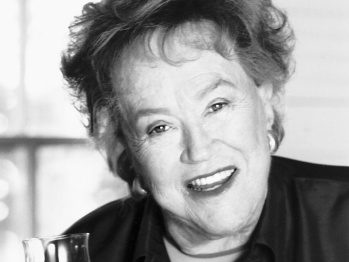
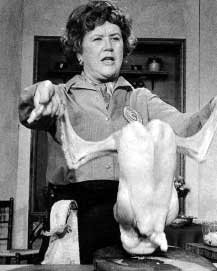
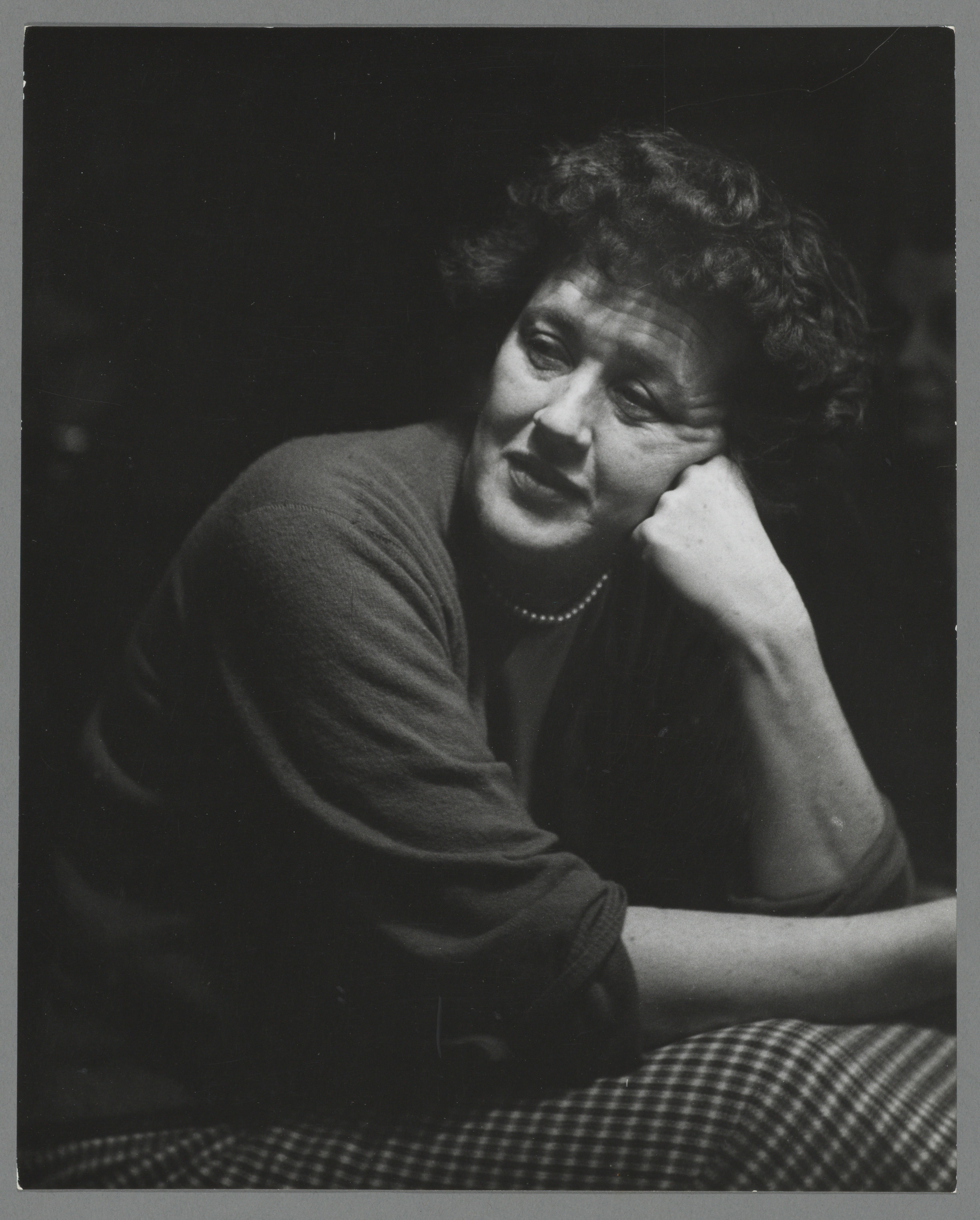
Julia McWilliams was born on this day in Pasadena, California in 1912. Today is the 100th Anniversary of her birth.

“Juju” was the oldest of three children in the McWilliams household. Their father was a real estate magnet, their mother a paper-company heiress and daughter of a lieutenant governor of Massachusetts. Julia was vivacious, athletic (she was 6’2″ by the time she graduated the exclusive Katherine Branson School for Girl’s in San Francisco) and loved a good laugh. She studied writing at Smith College and worked in advertising after graduation.

During WWII Julia tried to join the Woman’s Army Corps, but she was too tall to be a WAC, so she volunteered at the OSS, a government intelligence agency. She started as a typist in Washington but worked her way up to researcher for Top Secret intelligence. She worked overseas in China and Sri Lanka. The SPY Museum in Washington DC included a display on Julia’s time in the OSS as part of their collection. In 2009 they held a special event featuring Child’s Coq au Vin and a talk about the chef’s life as a spy.

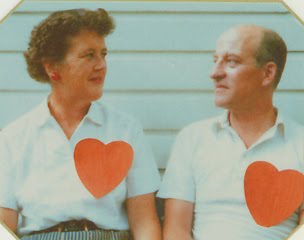
While she was in Sri Lanka on assignment she met fellow OSS employee Paul Child and the two began to date. In 1946 Paul and Julia were married. When Paul, now in the US State Department, was assigned to Paris the couple moved to France.

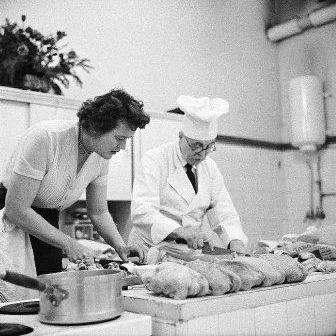
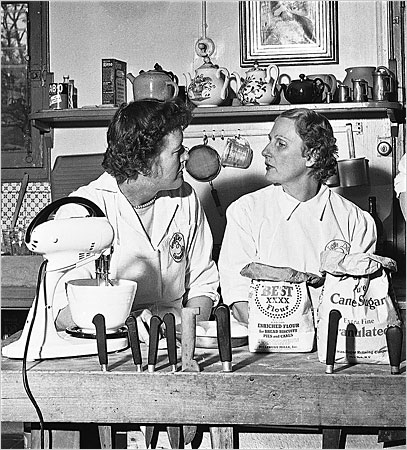
Julia loved food and loved a challenge, so she started to take classes at the Cordon Bleu cooking school. After graduation she worked with her colleagues Simone Beck and Louisette Bertholle to start The School of the Three Gourmands for American women in Paris. The three started to write a cookbook that would translate French cuisine to the American kitchen. After a lot of hard work and many revisions that cookbook became Mastering the Art of French Cooking, a best selling cookbook that changed the way people looked at French cuisine.

When Julia promoted the book by cooking an omelet on-air  at her local PBS station the response was so good that they offered her  her own cooking show for $50 a pop.  The French Chef premiered on WGBH Boston in 1962. It was the first cooking show on PBS. It ran for 10 years  and was syndicated nation wide. The show won a Peabody and Emmy award (Julia was first educational television personality to receive an Emmy. In her career she was nominated for a total of eight and won three). In 1966 Time Magazine anointed Julia as a culinary goddess by putting her on the cover with the title “Our Lady of the Ladle.” A dozen more TV shows (with bigger budgets) followed. You can still catch reruns of Baking with Julia on PBS. She used 753 pounds of butter during the filming of that series alone.

She wrote sixteen more cookbooks, most  were associated with her television series.

She was awarded the Presidential Medal of Freedom by President Bush in 2003. Her autobiography My Life in France was published posthumously. Her kitchen, designed by her husband Paul, is now installed at the Smithsonian Institute’s National Museum of American History in Washington DC.

Blogger Julie Powell digested the  Mastering the Art of French Cooking, working her way — recipe by recipe– through the  752 page book in one year. She documented the journey in a book, Julie and Julia: 365 Days, 524 Recipes, 1 Tiny Apartment Kitchen (which was then made into a movie, Julie & Julia starring Meryl Streep in 2009.)

“Something came out of Julia on television that was unexpected… it was just magical.  You can’t fake that. You can’t take classes to learn how to be wonderful. Our food culture is the better for it. Our stomaches are the better for it. ” — Julie Powell

This week restaurants are celebrating Julia’s 100th birthday by  featuring some of her most famous recipes.


Thought of the Day 8.14.12 Earl Weaver

“I became an optimist when I discovered that I wasn’t going to win any more games by being anything else.”

Earl Weaver

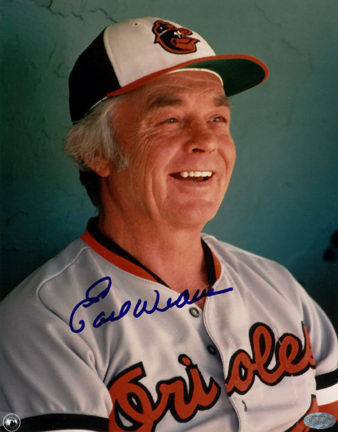
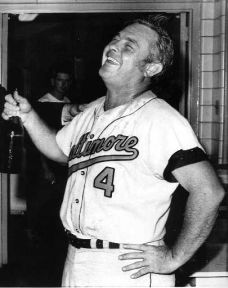
Earl Sidney Weaver was born on this day in St. Louis, Missouri in 1930. He is 82 years old.

Weaver managed the Baltimore Orioles from 1968-1982 and again from 1985-1986.  He became a Hall of Famer a decade later.

He played second base for 13 years in the minor leagues, then he managed for another dozen years in the minors before making it to the Show as a first-base coach for the Orioles in 1968. He took over as Manager in July of that season.

He wore #4 on his Oriole’s jersey and had a .583 winning record while managing the club. The team won 6 American League East titles, had 5 100+ win seasons, won 4 A.L. pennants, and won the 1970 World Series under his leadership.

Weaver didn’t want to bunt or sacrifice to advance a runner, according Hall of Fame player Frank Robinson, “He didn’t even have a hit and run sign…” Earl was all about the three run home run.

He pioneered the use of radar guns to track fast balls in 1975’s Spring Training season (according to the National Baseball Hall of Fame.)

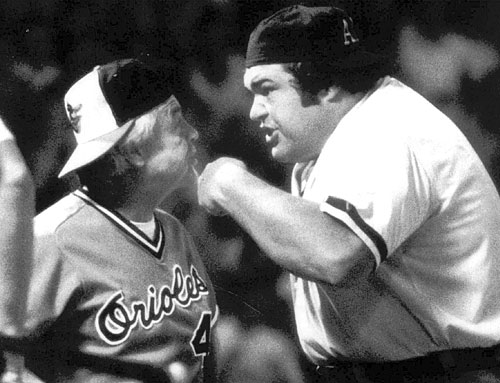
He was famous for his heated arguments with umpires that often ended with the manager kicking Memorial Stadium’s infield dirt at the official. Weaver was tossed from 91 regular season games.

Locals also remember the “Tomato Wars” he had with groundskeeper Pat Santarone. Santarone had a patch of plants in the left field foul area, Weaver grew his maters at home. The two argued (good naturedly) for 17 years over who had the best tomatoes in Baltimore.

After he left the O’s he worked as broadcaster for ABC television providing color commentary during the 1983-84 baseball seasons. He also did Manager’s Corner with Tom Marr while he was with the O’s (some times to very colorful effect.)

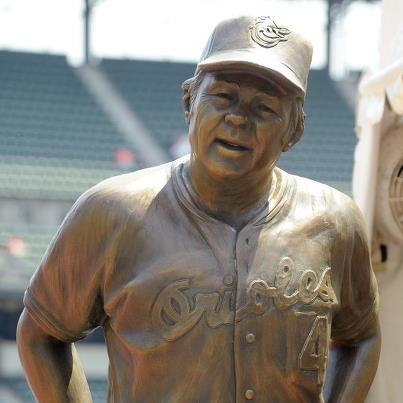
He was elected to the Baseball Hall of Fame in 1996.  A bronze statue of the manager was erected at Camden Yards (the “new” home of the Orioles) in June of this year.  At seven feet the statue towers over the real life Weaver, who is only 5’7″.  Weaver quipped “I guess there will be a lot of kids looking up at me…saying, ‘who is this?'”


Chillin’ out in GRAND CAVERNS

Who’d have thought that things that go drip in a cave could be so pretty?

On our way home from a family vacation in Staunton, VA we stopped at Grand Caverns. The cave was discovered in 1804 by a trapper and opened for tours two years later as “The Grottoes of the Shenandoah”. It is the oldest continually operating “show cave” in America and is rated 2nd best “show cave” (after Carlsbad Caverns in New Mexico) by Parade Magazine. In 1926 it was renamed “Grand Caverns” and it was declared a National Natural Landmark in 1973.

Drapery formations hang from the ceiling in the Persian  Palace  (once known as the Tannery).

During the Civil War soldiers from both sides explored the cave. 200 men signed the walls of the cave. Two of the signatures, one from a Northern soldier, one from a Confederate soldier, were left on the same day, only hours apart. A firearm accidentally discharged inside the cave, piercing one of the shield formations. The hole is still visible today.

The rock formations are always growing, albeit at an extremely slow rate. Oil from human hands block that growth, so visitors aren’t allowed to touch any of the rock formations.  However, visitors will inevitably feel a drip or two while taking a tour. Those are called “Cave Kisses” and are supposed to bring good luck.

The Cathedral Hall is the largest chamber in the caverns. An impressive stalagmite, “George Washington’s Ghost” (foreground) stands century at the center of the hall. The white spot on the ceiling is likely a spot where a shield broke off centuries ago.

Naturally occurring colors in the cave are White (from calcite/calcium carbonate), Red (from iron/iron oxide) or Grey (limestone or manganese). Another color  in the cave is Green (from cave algae which is the result of dampness of the cave combined with lint from clothing and heat and light from the light bulbs.) Colored lights enhance the cave formations in certain areas. With out artificial lights the cave would be pitch black, of course.

The Bridal Chamber has a shield formation with drapery that represents a bride’s veil. It is about 17 feet tall.

With over 200 shield formations, Grand Caverns has more cave shield formations than any other cave or cavern in the eastern United States. No one knows how these formations are made, but for some reason they form flat disks rather than columns.  Some notable shield formations in Grand Caverns are  the “Clam Shell”  formation, a triple shield formation in the Lily Room, and the “Bride’s Veil” formation that combines both a shield and drapery.

The Lily Room. A shield with drapery resembles a calla lily and takes center stage in the Lily Room

Another formation in the Lily Room.

Grand Caverns is open daily except Thanksgiving, Dec 24, 25 & Jan 1. Summer Hours (April to Oct 31) are 9-5. Winter Hours (Nov 1-March 31) are 10-4. Tours are given hourly. For pricing and directions click here.

At the lowest part of the cave (as seen on the tour) looking up to the highest part of the cave.


Thought of the Day 8.8.12 Marjorie Kinnan Rawlings

“I do not know how anyone can live without some small place of enchantment to turn to.”

Marjorie Kinnan Rawlings

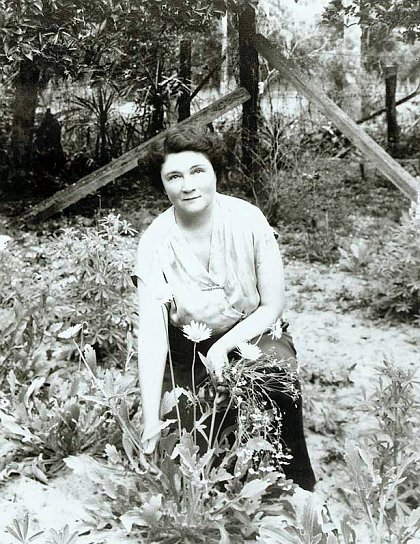
Rawlings in her garden.

Marjorie Kinnan was born on this day  in Washington D.C. in 1896. Today is the 116th anniversary of her birth.

She got her love of nature from her parents. Although her father was a principal examiner in the U.S. Patent Office, he was happiest when he was walking his Maryland farm. Her mother grew up on a farm in Southern Michigan, and Marjorie would spend summers at the family homestead. According to The Marjorie Kinnan Rawlings Society website:

Living close to the land as she was growing up “planted deep in [her] a love of the soil, the crops, the seasons and a sense of kinship with men and women everywhere who live close to the soil”

At six she started to write short stories, some of which she submitted to the children’s section of the Washignton Post. At 15 her short story “The Reincarnation of  Miss Hetty” won a literary prize and Marjorie was hooked.

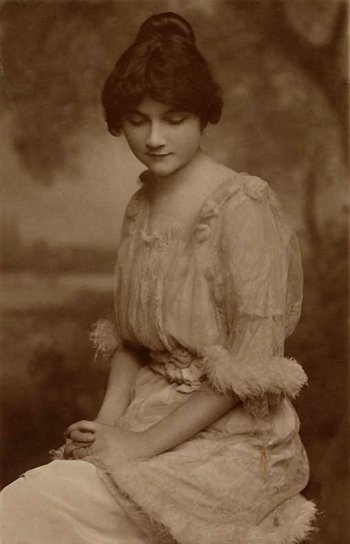
When she was 17 her father passed away and she moved with her mother to Wisconsin. She attended the University of Wisconsin and her works were published in  the Wisconsin Literary Magazine.  While at the University she met Charles Rawlings.

Rawlings in 1913.

After graduating with honors she moved to New York. She married Rawlings in 1919 and the couple moved to Louisville, Kentucky. They both wrote for the Louisville Courier-Journal (Charles was a features writer, Marjorie wrote the “Live Women in Louisville” column.  When they moved to Rochester, New York Marjorie wrote poems about cooking, mending, gardening, et ect. in the syndicated column  Songs of a Housewife.  It was distributed nationwide to 50 papers. She also worked  on a novel, Blood of My Blood.  The manuscript  for Blood was lost for years, and the novel wasn’t published until 2002, nearly sixty years after her death.)

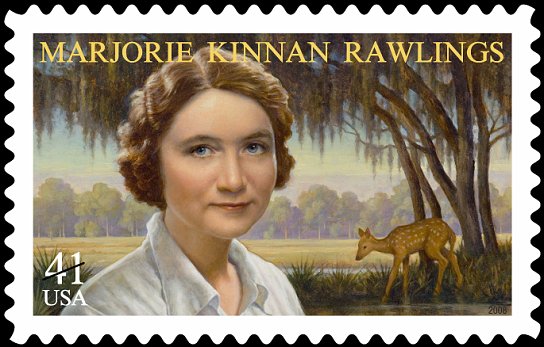
The US Postal Service stamp

When her mother passed away in 1928 she left Marjorie a small inheritance and the couple purchased an orange grove named Cross Creek near Hawthorne, Florida.

“This was not the Gold coast of Florida. . . . It was a primitive section off the beaten path, where men hunted and fished and worked small groves and farms for a meager living. . . . And the country was beautiful, with its mysterious swamps, its palms, its great live oaks, dripping gray Spanish moss, its deer and bear and raccoons and panthers and reptiles” [The Marjorie Kinnan Rawlings Society website]

Rawlings was smitten by the rough Floridian back wood and groves, and the people who lived there. She found a new voice as she began to chronicle their stories. Gal Young Un won the 1932 O Henry Award. She moved further into the “scrub” to research her novel South Moon Under. She stayed with Piety Fiddia and her son Leonard and learned how to kill rattlesnake and  to make moonshine. The book was a Pulitzer Prize finalist and Book-of-the Month Club selection.

But the Florida wild was not for Charles Rawlings and the couple divorced in 1933.

Cover of "The Yearling"

Cover of The Yearling

Rawlings wasn’t happy with her next novel, Golden Apples, which she called “interesting trash instead of literature.” But, in 1939, she rebounded with her follow-up novel, The Yearling. The Yearling is a coming of age tale about a back woods boy named Jody Baxter who adopts a fawn, Flag. The book earned Rawlings a Pulitzer Prize for Literature. MGM  made it into a major motion picture starring Gregory Peck as Jody’s kindly father “Penny” Baxter and Jane Wyman as his distant mother. (Both performers were nominated for Academy Awards).

Cover of "Cross Creek"

Cover of Cross Creek

The autobiographical Cross Creek hit in 1942. Upon reading it one critic called Rawlings a “female Thoreau.” It was a Book-of-the-Month Club pick and stayed at the top of the best sellers list for months. It was also published in a special armed forces edition for those serving overseas in WWII. According to Powells City of Books the novel tells the story…

of Marjorie Kinnan Rawlings’s experiences in the remote Florida hamlet of Cross Creek, where she lived for thirteen years. From the daily labors of managing a seventy-two-acre orange grove to bouts with runaway pigs and a succession of unruly farmhands, Rawlings describes her life at the Creek with humor and spirit. Her tireless determination to overcome the challenges of her adopted home in the Florida backcountry, her deep-rooted love of the earth, and her genius for character and description result in a most delightful and heartwarming memoir.

Cover of "Cross Creek Cookery"

Cover of Cross Creek Cookery

She wrote Cross Creek Cookery as kind of a companion piece in 1942. She’d been so descriptive about the food in Cross Creek that the readers deluged her with request for recipes. She shrugged, remembered the old adage that if you “Scratch a cook and you get a recipe” and began work on Cross Creek Cookery. It’s been called “the classic book on southern cooking” and is filled with over 250 recipes from alligator-tail, hush-puppies, sweet potato pone, grits, and desserts like Deadly Southern Pecan Pie. Rawlings loved to cook and entertain for, as she said:

“Food imaginatively and lovingly prepared, and eaten in good company, warms the being with something more than mere intake of calories.”

She married Norton S. Baskin, a long time friend and business associate  in 1941.

Through out the 40’s she worked on her last book The Sojourner. Rawlings leaves Florida behind and sets The Sojourner in Michigan. Good Reads gives this synopsis of the book:

The Sojourner is the story of a good man: of the influence of his steady, quiet strength upon others, especially the members of his immediate family, and of what they–characters less strong and less stable–do to him throughout the course of a long life.

She bought a farm-house in Upstate New York to aid in the research of the book. It was published in 1953.

Cross Creek

[All photos are courtesy of the Marjorie Kinnan Rawlings: Author of The Yearling site. Click on the link to see many more photos of Cross Creek, Mrs. Rawlings, her articles and book covers.)


Thought of the Day 8.5.12 Neil Armstrong

—————————————UPDATE—————————————

Sadly I have to give an update to this post.

One of America’s greatest heros, Neil Armstrong, passed away today due to complications from cardiovascular procedures. He had  heart surgery last month in Cincinnati, Ohio.

“Looking back, we were really very privileged to live in that thin slice of history where we changed how man looks at himself and what he might become and where he might go,” Armstrong said.

—————————————UPDATE—————————————

“I believe every human has a finite number of heartbeats. I don’t intend to waste any of mine”

–Neil Armstrong

Neil A. Armstrong was born on this day in Wapakoneta, Ohio, in 1930. He is 82 years old.

He grew up near the local airport and took flying lessons as a teenager. He got his pilots license before he got his driver’s license.

Armstrong was a naval aviator for three years, flying 78 combat missions during the Korean War,  prior to joining the National Advisory Committee of Aeronautics (NACA) in 1955. (The NACA was the precursor to NASA.) He  logged over 2,400 hours of air time testing experimental aircraft at Edwards Airforce Base.

According to the NASA’s Glenn Research Center web site:

He has flown over 200 different models of aircraft, including jets, rockets, helicopters and gliders.

In 1962 Armstrong became one of the “New Nine” NASA astronauts, the second group of men selected for US space flight to augment the Mercury 7. The Mercury astronauts established orbital space flight, the New Nine would fly in Gemini space capsules and would tackle docking two vehicles in space and space walks.

English: Close-up on orbiting Agena D rocket s...

English: Close-up on orbiting Agena D rocket stage Polski: Zbliżenie orbitującego członu rakietowego Agena D (Photo credit: Wikipedia)

On his historic Gemini 8 mission Armstrong and Dave Scott successfully docked their ship with an unmanned Agena target vehicle. It was an essential first step  towards getting to the moon. Unfortunately about 27 minutes after docking the two ships began to roll and yaw. Assuming the problem was with the Agena, Armstrong undocked, but it was a faulty thruster on the Gemini that was making the capsule spin, and undocking only exacerbated the problem. Armstrong and Scott had to shut down Gemini’s main reaction control system and use the reentry thrusters to zero out yaw and roll on the wildly spinning craft. Armstrong’s masterful flying skills were successful, but they used up 75% of the system’s fuel and Mission Control cut short the flight.

On the Gemini 11 flight he acted as CAPCOM — the person at Ground Control who interfaces with the astronauts in space — and he was the commander of the back-up crew for Apollo 8 (the first human space flight to leave Earth’s orbit, fly to the moon — but not land — and return to Earth.)

Flag of the United States on American astronau...

Flag of the United States on American astronaut Neil Armstrong’s space suit (Photo credit: Wikipedia)

Armstrong was the Commander of Apollo 11, the first manned space craft to land on the Moon. He accompanied by Michael Collins, who stayed aloft in the Command Module, and Edwin “Buzz” Aldrin, Jr. who touched down on the Moon’s surface on July 20, 1969 with with Armstrong. Armstrong descended a lader and took the first steps on the lunar surface. Armstrong and Aldrin had about 2 hours outside the lander, the Eagle,  to take photographs, set up experiments and collect moon rocks. The Eagle blasted off from the Sea of Tranquility and  Armstrong and Aldrin rejoined Collins on the Command Module, Columbia.

The reverse of the Anthony dollar is based upo...

The reverse of the Anthony dollar is based upon the insignia of the Apollo 11 mission, which was also used on the reverse of the Eisenhower dollar that preceded it. (Photo credit: Wikipedia)

He worked for NASA as Deputy Associate Administrator for aeronautics until 1971.

Post NASA he taught and did research as a professor of aerospace engineering at University of Cincinnati and served as the chairman of the board for several privately owned aerospace/defense industries.

Buzz Aldrin walks on the moon, July 20, 1969

Buzz Aldrin walks on the moon, July 20, 1969. The photo was taken by Armstrong. (Photo credit: Wikipedia)

[Please note that I did not say Armstrong was the first man to LAND on the moon. Both Aldrin and Armstrong landed on the Moon at the same time.  … Armstrong was the first man to WALK on the Moon.]


Thought of the Day 8.4.12 Louis Armstrong

“I got a simple rule about everybody. If you don’t treat me right / shame on you!”

–Louis Armstrong

Louis Armstrong

Louis Armstrong (Photo credit: late night movie)

Louis “Satchmo” Armstrong was born this day in New Orleans, Louisiana in 1901. Today would be his 111th birthday.

The grandson of slaves, his family was very poor. His father, William Armstrong, abandoned the family when Louis was a baby. His mother, Mayann often turned to prostitution to make ends meet and she left Louis and his little sister Beatrice with their grandmother Josephine Armstrong. The little boy did what he could to earn money. He worked as a  paper boy. He hauled coal to the red-light district — and lingered around the clubs to listen to the music. In 1907 he sang in a street quartet for change.  He did odd jobs for the Karnofsky family, a Lithuanian-Jewish family who took him in and treated him well. The Karnofskys lent Armstrong the money buy his first cornet.

b/w line drawing of cornet

b/w line drawing of cornet (Photo credit: Wikipedia)

When he was 11 years old he was sent to the New Orleans Home for Colored Waifs, a reform school, for firing his a pistol into the air on New Year’s Eve. While at the home Armstrong really learned to play the cornet (he had been self taught and could play by ear prior to the lessons he had at the home).

He was released from the home at 14. He worked hauling coal and unloading barges during the day and brought out his horn at night. He went to honky tonk clubs like “the Funky Butt Hall” to listen to established musicians and learn from them. Joe “King” Oliver mentored the young man. By 17 he was playing professionally.

By the 1920’s he was playing on riverboats and traveled up to St. Louis. His jazz trumpet solos and vocals became his signature style. In 1922 “King” Oliver invited him to join his Creole Jazz Band in Chicago. The money was good enough that Armstrong no longer had to work the menial labor day jobs to make ends meet. By 1925 he was headlining his own band and playing with artist like Bessie Smith and Ma Rainey. He was billed as “The World’s Greatest Jazz Cornetist” for a gig at the Dreamland Cafe, and cut his debut record with his own group Louis Armstrong and His Hot Five. By the 1930s his act had gone international.

[Portrait of Louis Armstrong, Carnegie Hall, N...

[Portrait of Louis Armstrong, Carnegie Hall, New York, N.Y., ca. Apr. 1947] (LOC) (Photo credit: The Library of Congress)

According to the Louis Armstrong House Museum Site he:

  • developed a way of playing jazz, as an instrumentalist and a vocalist, which has had an impact on all musicians to follow;
  • recorded hit songs for five decades, and his music is still heard today on television and radio and in films;
  • wrote two autobiographies, more than ten magazine articles, hundreds of pages of memoirs, and thousands of letters;
  • appeared in more than thirty films (over twenty were full-length features) as a gifted actor with superb comic timing and an unabashed joy of life;
  • composed dozens of songs that have become jazz standards;
  • performed an average of 300 concerts each year, with his frequent tours to all parts of the world earning him the nickname “Ambassador Satch,” and became one of the first great celebrities of the twentieth century.

Here’s Louis Armstrong (Trumpet), Trummy Young (Trombone), Peanuts Hucko (Clarinet), Billy Kyle (Piano), Mort Herbert (Bass), and Danny Barcelona (Drums) in Stutttgart Germany in 1959.

[note to self: MUST sing more jazz so I can play in a band with some one named Trummy and Peanuts.]


Thought of the Day 8.1.12 Herman Melville

“To the last, I grapple with thee; From Hell’s heart, I stab at thee; For hate’s sake, I spit my last breath at thee”

–Herman Melville


Photo of Herman Melville

Photo of Herman Melville (Photo credit: Wikipedia)

Herman Melvill was born this day on 1819 in New York City. Today is the 193 Anniversary of his birth.

He was the third of eight children. He grew up in Boston and Albany.  His father, Allan Melvill, was a successful merchant and the family lived comfortably for several years until an unsuccessful trading venture led to financial ruin. The elder Melvill sparked Herman’s love for adventure and the sea with stores of seafaring excitement and faraway places. Herman was 12 when his father died and the family moved to Lansingburg on the Hudson. It was then that his mother added the “e” to the end of the family name, and Melvill became Melville.

He got a job on a ship bound from New York to Liverpool as a cabin boy.  After several years as a teacher he heard the call of the sea again. In 1840 he signed on with the Acushnet from Fairhaven, Massachusetts. The ship left port for an 18 month journey in Pacific journey in January of 1841.  The Acushnet was a whaler and much of his material for Moby-Dick came from his time on board the ship. By the time they reached the Marquesas Islands in July of 1842 Melville had had enough of life on the Acushnet.

He deserted the ship and lived among the Typee tribe for three weeks. He then joined the crew of another whaler, this one, an  Australian ship called the Lucy Ann, was bound for Tahiti. Melville participated in a mutiny and landed in jail. Upon his release he signed up with yet another whaler and made it as far as Honolulu where he jumped ship again. He worked as a clerk until he was able to sign on with the USS United States which got him back to Boston in 1844. There Melville began to write about his adventures.

Cover of "Typee (Signet classics)"

Cover of Typee (Signet classics)

Typee is a quasi-autobiographical adventure novel about Tommo’s four month stay on a tropical paradise amidst the “nobel savages” (or cannibals) who may or may not be about to eat him,  and his relationship with the beautiful, and exotic, Faraway. He had trouble fining an American publisher, but the book was an overnight success when it was published in England. Omoo, continued the tale, again roughly following Melville’s adventures in the Pacific. Mardi, and a Voyage Thither showed a more sophisticated writing style. It was not a successful as the straight forward narratives of Typee and Omoo. In 1849 He published Redburn : His First Voyage, the fictionalized account of his first sea journey  as a cabin boy. In 1850 White-Jacket, based on his time as a seaman on the USS United States, was published. Because of its graphic depiction’s of flogging the U.S. Navy banned the punishment.

Sadly at this point the tides seem to have turned in his literary career. His popularity waned. Other books didn’t garner critical or popular acclaim in his lifetime. The Confidence-Man, Pierre, Billy Budd, and even Moby-Dick had to wait until a Melville revival, some 30 years after his death, to get their rightful praise.

Herman Melville: Moby-Dick

Herman Melville: Moby-Dick (Photo credit: wolfgraebel)

Melville went on the lecture circuit to supplement his writing income. He then moved his family to New York City and worked at the New York Custom House. He continued to write, working on both poetry and fiction, until his death.

http://www.online-literature.com/melville/

http://en.wikipedia.org/wiki/Herman_Melville