Category Archives: United States

Thought of the Day 11.15.12 Georgia O’Keeffe

“I found I could say things with color and shapes that I couldn’t say any other way –– things I had no words for.”
— Georgia O’Keeffe

Pineapple Bud, oil on canvas painting by ''Geo...

Pineapple Bud, oil on canvas painting by ”Georgia O’Keeffe, 1939 (Photo credit: Wikipedia)

Georgia Totto O’Keeffe was born in Sun Prairie, Wisconsin, USA in 1887. Today is the 125 anniversary of her birth.

O’Keeffe knew she wanted to be an artist by the time she was 10-years-old. At 18 she attended the Art Institute of Chicago and transferred to the Art Students League of New York a year later.

Though her student work was well received she found it unfulfilling, and for a short time abandoned the fine arts. She worked briefly as a commercial artist in Chicago before moving to Texas to teach. [American Masters]

At 28 she took some classes at the Teachers College of Columbia University in South Carolina. There she met instructor Arthur Down who “Helped O’Keeffe move away from the forms she had found so stifling” and toward her own, unique style.

Charcoal on paper 1915. [Image courtesy: Oberon’s Grove]

A friend mailed some of the charcoal drawings she did  in Texas to Alfred Stieglitz in 1916. The photographer and gallery owner was so “enthused with the vibrant energy of the work” [American Masters]that he put together an exhibition of the work. “So, without her knowledge, Georgia O’Keeffe had her first exhibition… at Steiglitz’s “291 Gallery.” [Ibid]

The following year O’Keeffe and Stieglitz worked together on a larger solo show that included both watercolors and oil paintings. By June 1918 Stieglitz had convinced her to move to New York and spend all her time painting.

Six years later the two were married, beginning one of the most fruitful and well-known collaborations of the modernist era. For the next twenty years the two would live and work together, Stieglitz creating an incredible body of portraits of O’Keeffe, while O’Keeffe showed new drawings and paintings nearly every year at the gallery. [Ibid]

1918 photograph of Georgia O’Keeffe taken by Stieglitz  [Image courtesy: Oberon’s Grove]

A vacation to New Mexico in 1929 proved a turning point for the artist. She discovered “the open skies and sun-drenched landscape” of the desert that she would return to  annually.  She bought a Model A Ford to drive around the desert, and if the heat got too intense she would crawl under the car for shade.

More than almost any of her other works, these early New Mexico landscapes and still lifes have come to represent her unique gifts. The rich texture of the clouds and sky were similar to her earlier, more sensuous representations of flowers. But beneath these clouds one found the bleached bones of animals long gone. [American Masters]

Georgia O'Keeffe, Ram's Head White Hollyhock a...

Her summer pilgrimages lasted until Stieglitz’s death in 1946 when she took up residence in a pre-Civil War period adobe outside Abiquiu.

“When I bought it, it was totally uninhabitable. Architecturally it is not a masterpiece, but a house that grew.” The rooms were mostly bare, though some contained dilapidated furniture. The house had been added to in various stages after the Civil War. A large summer house and a lilac tree stood in the garden. The rooms inside were in disarray…. However, the arrangement was appealing, and all the rooms opened to the patio. When O’Keeffe began to stay at Abiquiu… there was hardly a room she could live in. [Architectural Digest.com]

O’Keeffe’s reputation as an artist continued to grow throughout the 50’s and 60’s. In 1970 she has a solo show at the Whitney Museum of American Art which cemented her position among “the most important and influential American painters.” [American Masters]
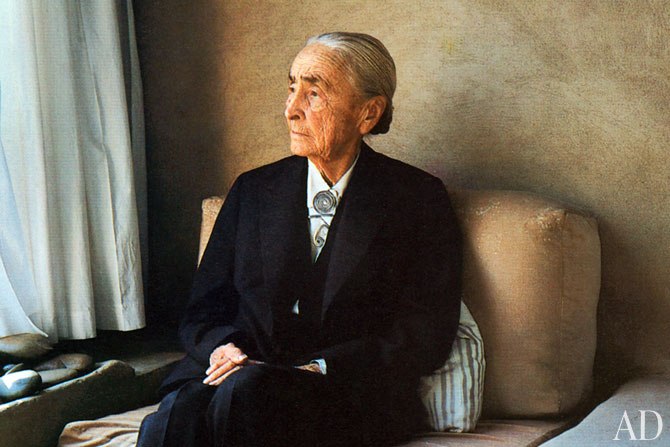
O’Keeffe later in life. [Image courtesy: Architectural Digest.com]

By 1972 her vision began to fail (she suffered from macular degeneration) and she stopped painting with oils. But when a young potter by the name of Juan Hamilton came to her house looking for work in 1973 a new artistic world opened up for O’Keeffe. “With his encouragement and assistance, she resumed painting and sculpting.” [Ibid] Hamilton became her business manager and closest companion.

In 1976 she wrote her autobiography “Georgia O’Keeffe.” It was  a best seller. In 1977 President Ford awarded her with the Medal of Freedom and in 1985 President Reagan gave her the Medal of the Arts.

Georgia O’Keeffe died at the age of 98 in Santa Fe, New Mexico in 1986.

————————————————–

UPDATE: We went to the Virginia Museum of Fine Arts in Richmond, Virginia on Friday and I snapped this shot of O’Keeffe’s White Iris.

Georgia O'Keeffe's White Iris, 1930, Oil on Canvas. At the VMFA.
Georgia O’Keeffe’s White Iris, 1930, Oil on Canvas. At the VMFA.


Thought of the Day 11.14.12 Fred Haise

“I grew up on Buck Rodgers and Flash Gordon. There wasn’t a space program or NASA when I was a kid,”

“We just kept putting off the worry as we focused on the next problem and how to solve it,”

“Given that the movie had to condense four days into two hours, and given that the communications were sometimes rather tedious and technical, it was pretty accurate…”

–Fred Haise

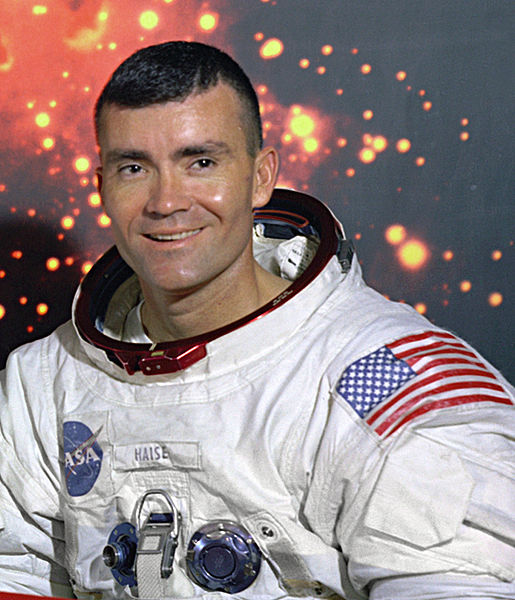
Astronaut Fred Haise in his Apollo 13 space suit. [Image courtesy: Wikimedia Commons.]

Fred Wallace Haise, Jr.was born in Biloxi, Mississippi, USA on his day in 1933. He is 79 years old.

His interest in flying happened by accident.  He was in junior college pursuing a career in Journalism when the Korean War broke out. Haise wanted to enlist

“The only program I could get into that would lead to a commission, which was my primary goal, was the Naval Aviation Cadet Program. So… I ended up in the flying business, which I loved.” [Johnson Space Center Oral History Project]

After being honorably discharged from the service –Haise went from the Cadet Program to the Marine Corps, served a tour of duty, then went into the Air National Guard —  he got his  BS in aeronautical engineering from the University of Oklahoma.

It was quite a path for a young man who had never been in a plane (not even for a commercial flight) prior to entering the Navy. He reckons he’s “flown about 80 types of aircraft.” [Ibid.]

While in the Oklahoma Air National Guard he was introduced to the idea of becoming a NASA research pilot. He was very interested, but the queue at Langley, Ames and Edwards Air Force Bases — NASA’s premier flight test centers at the time — was long. So Haise opted for Lewis Research Center. He worked for 7 years before entering the NASA astronaut program as a research pilot. This was the same path Neil Armstrong had taken three years ahead of him.

He was part of the “Original 19”  astronauts, nine of whom flew in the Apollo program and eight of whom flew in the Shuttle Program. Haise did both. He was a the back up Lunar Module Pilot for Apollo 8 and Apollo 11 and the back up commander for Apollo 16. But the flight he is best remembered for is Apollo 13.

Apollo 13 was slated to go to the Fra Mauro region of the Moon; deploy “a set of scientific experiments involved in the ALSEP [Apollo Lunar Surface Experiments Package] packages” [Ibid]  and do field geological work while on EVA.

English: S70-34854 (11 April 1970) --- The Apo...

English: S70-34854 (11 April 1970) — The Apollo 13 (Spacecraft 109/Lunar Module 7/Saturn 508) space vehicle is launched from Pad A, Launch Complex 39, Kennedy Space Center (KSC), at 2:13 p.m. (EST), April 11, 1970. The crew of the National Aeronautics and Space Administration’s (NASA) third lunar landing mission are astronauts James A. Lovell Jr., commander; John L. Swigert Jr., command module pilot; and Fred W. Haise Jr., lunar module pilot . (Photo credit: Wikipedia)

The mission took off from Kennedy Space Center, Florida on April 11, 1970. The crew included Commander by James Lovell, Lunar Module Pilot, Haise and Command Module Pilot, Jack Swigert. Swigert was a last-minute replacement for Ken Mattingly who was exposed to the measles and pulled off the primary crew a week before take off.

When the Saturn V rocket carrying the Apollo 13 crew was about 2/3rds to the Moon there was an explosion in the oxygen tank. Haise recalls:

‘I was still buttoning up and putting away equipment from a TV show we had completed, and… we were going to get ready to go to sleep. I knew it was a real happening, and I knew it was not normal and serious at…that instant. I did not necessarily know that it was life-threatening.” [Ibid]

He quickly went to his station where he encountered an “array of warning lights.” [Ibid] Haise looked at an instrument panel that read the pressure, temperature and quantity of the oxygen tanks. One had the needles at the bottom of all three gauges.

They had lost an oxygen tank, and, according to Mission Rules, that meant they had lost the Moon. They were now in abort mode.

Still, the situation didn’t seem life threatening. But after a few minutes it became evident that the second oxygen tank– the remaining tank — was also leaking.

“When it became obvious it was dwindling or losing oxygen, then the handwriting was on the wall that the command module was going to die and have to be powered-down.” [Ibid]

The crew transferred to the smaller Lunar Module.

Ground controllers in Houston faced a formidable task. Completely new procedures had to be written and tested in the simulator before being passed up to the crew. The navigation problem had to be solved; essentially how, when, and in what attitude to burn the LM descent engine to provide a quick return home. [NASA.gov]

Power and consumables were the first concern, but another danger, Carbon Dioxide, proved a hidden foe.

There were enough lithium hydroxide canisters, which remove carbon dioxide from the spacecraft, but the square canisters from the Command Module were not compatible with the round openings in the Lunar Module environmental system…Mission Control devised a way to attach the CM canisters to the LM system by using plastic bags, cardboard, and tape- all materials carried on board.[Ibid]

To navigate back to Earth the space craft was  put on a free-return course that required two burns of the engines. The first burn lasted  35 seconds and occurred  5 hours after the explosion. The second burn was 5 minutes and took place as they approached the Moon.

Apollo 13 crew aboard the USS Iwo Jima after splash in the Pacific. They are (l-r) Fred Haise, John Swigert and James Lovell. [Image courtesy: about.com]

Amazingly the three men in the capsule and the hundreds of people back at Mission Control were able to get the space craft back to Earth safely. Apollo 13 splashed down near Samoa  on April 17, 1970.

After Apollo 13 both Haise and Swigert had hopes of being assigned another Moon mission, but that did not come to pass.  (Swigert went on to become a member of the House of Representatives from Colorado in 1982 before dying of bone cancer.)  Haise stayed with NASA and worked on the Shuttle program.

Portrait of Astronaut Fred H. Haise Jr. in flight suit holding a model of the space shuttle. [Image courtesy NASA]

He was commander of one of the two 2-man crews who piloted space shuttle approach and landing test (ALT) flights during the period June through October 1977. [Ibid]

There were a total of 8 “piggy back” flights that tested  the Shuttle’s critical glide, approach, landing, rollout, and flare capabilities.

After resigning from NASA in 1979 Haise became VP of Space Programs at Grumman Aerospace Corporation.

View of NASA 747 and T-38s flying over Shuttle Orbiter 101 “Enterprise” just after Haise and C. Gordon Fullerton landed the Shuttle on September 23, 1977. [Image courtesy NASA]


Thought of the Day 11.12.12 Grace Kelly

“Hollywood amuses me. Holier-than-thou for the public and unholier-than-the-devil in reality.”
–Grace Kelly


English: Studio publicity portrait for film Hi...

English: Studio publicity portrait for film High Society (Photo credit: Wikipedia)

Grace Patricia Kelly was born on this day in Philadelphia, Pennsylvania, USA in 1924. Today is the 88th anniversary of her birth.


Third of four children, Grace was born into a wealthy family of Irish and German background. The Kellys were athletic, her father, Jack, won three gold medals in the Olympics and her mother, Margaret, was the first female head of the University of Pennsylvania’s Physical Education Department. Her brother, John, also competed in the Olympics.


But Grace was drawn to acting. She modeled and acted in school plays starting at age 12.


At a young age, Grace decided she wanted to become an actress, and studied acting (primarily theater) at New York City’s American Academy of Dramatic Art and worked as a stage actress and model before moving to Hollywood. When in New York, Grace promoted Old Gold cigarettes and appeared on the covers of magazines such as Cosmopolitan and Redbook. [Grace Kelly Online — Biography]

She worked her way through the American Academy of Dramatic Arts by working as a model  on the side. At 19 she starred as Tracy Lord in the school’s performance of The Philadelphia Story (She reprised the role in High Society, her final film in 1956)


Television and stage gigs followed. Kelly played 39 roles on high brow television theatre shows such as the Kraft Television Theatre, the Philco-Goodyear Television Playhouse, and the Armstrong Circle Theatre. The shows were a hybrid of stage performances and scripted radio drama filmed live in front of a studio audience.


English: Screenshot of Grace Kelly and Clark G...

English: Screenshot of Grace Kelly and Clark Gable from the trailer of the film en:Mogambo (Photo credit: Wikipedia)

After a small role in Fourteen Hours her film career took off when she played the “mousey” Quaker bride” [Ibid] in High Noon in 1952. The following year  she went to Africa to shoot Mogambo with Clark Gable and Ava Gardner. Kelly was nominated for a best supporting actress Academy Award for the film.

1954 brought the first of three movies that Kelly did with director Alfred Hitchcock, Dial M for Murder. Here’s THE clip from the movie. [I think  it proves what a great actress she is… not just any actress can get this much drama out of one word and a pair of scissors.]

<iframe width=”560″ height=”315″ src=”http://www.youtube.com/embed/5QQjSUNVM7o&#8221; frameborder=”0″ allowfullscreen>

Her next movie with Hitch was Rear Window with Jimmy Stewart. There’s plenty of tension and murder here too, but there is also a huge helping of likeability too.  There is a lot of chemistry between Steward and Kelly. It’s dark, but it’s funny and romantic too. And Kelly’s Lisa Carol Fremont is soooo sophisticated and, well, graceful. [Rear Window is my favorite Grace Kelly movie and probably my favorite Hitchcock movie as well.]


Cropped screenshot from the trailer for the fi...

Cropped screenshot from the trailer for the film Rear Window (Photo credit: Wikipedia)

That same year, 1954, she also co-starred with [the always wonderful] William Holden in a Korean War drama, The Bridges at Toko-Ri; the South American emerald mining adventure, Green Fire; and as Bing Crosby’s wife in The Country Girl. Holden was the third leg of a romantic triangle in The Country Girl. Kelly’s performance as a woman torn between a verbally abusive, alcoholic, washed up husband and a charming, kind man who looks like WILLIAM HOLDEN won her an Academy Award.


English: Screenshot of Grace Kelly and Cary Gr...

English: Screenshot of Grace Kelly and Cary Grant from the trailer of the film en:To Catch a Thief (film) (Photo credit: Wikipedia)

In 1955 her last Hitchcock movie came out. In To Catch a Thief she co-starred with Cary Grant.


When a reformed jewel thief is suspected of returning to his former occupation, he must ferret out the real thief in order to prove his innocence. [IMDb]

Again Kelly’s onscreen chemistry with her co-star elevates a good movie to a great one. To Catch a Thief won the Academy Award for best picture that year.


Her next movie was The Swan with Alec Guinness and Louis Jourdan. She plays Princess Alexandra who needs to win the heart of Crown Prince Albert (Guinness) so her family can re enter the inner circle of court life. In real life Kelly was being courted by Prince Rainier III of Monaco whom she had met while attending the Cannes Festival. The engagement ring she wears in the movie is her real ring from Rainier. The studio timed the release of the film to corresponded with the date of the royal wedding.


Kelly’s last feature film was High Society, a musical reboot of The Philadelphia Story. In it Kelly and Crosby sing True Love, a song that went platinum — selling over a million records and and earning a best song Academy Award nod.


 Later that year, she married Prince Rainier Grimaldi III of Monaco to become Her Serene Highness Princess Grace of Monaco. As a princess, she gave up her successful acting career, in which she had made eleven films. She had three children: Princess Caroline, Prince Albert, and Princess Stéphanie. [Grace Kelly Online — Biography]

Wedding dress of Grace Kelly

Wedding dress of Grace Kelly (Photo credit: Wikipedia)

Kelly had a stroke while driving with her daughter Stephanie along the windy mountainside roads of Monaco. The car went off the road and Kelly suffered fatal injuries. She died on September 14th, 1982.


Thought of the Day 11.9.12 Benjamin Banneker

“Evil communication corrupts good manners. I hope to live to hear that good communication corrects bad manners.”

“The colour of the skin is in no way connected with strength of the mind or intellectual powers.”

“Presumption should never make us neglect that which appears easy to us, nor despair make us lose courage at the sight of difficulties”

Benjamin Banneker

Woodcut of Benjamin Bannecker

Woodcut of Benjamin Bannecker (Photo credit: Wikipedia)

Benjamin Banneker was born on this day outside Ellicott City, Maryland USA  in 1731. Today is the 281st anniversary of his birth.

His maternal grandmother, Molly Walsh, had been an indentured servant who came to colonial Maryland from Ireland. At the end of her seven years of bondage she bought a small farm and two slaves. Eventually she freed the slaves, marrying one of them, Bannaky. Their daughter Mary Bannaky married a slave named Robert (who may have been a fugitive; may have been freed after the wedding;  or may have been bought out of slavery after the wedding).  Mary and Robert had four children, Benjamin and his three younger sister.

All of the children had to help run the tobacco farm. They weeded the tobacco plants, picked worms and caterpillars off the leaves… by Benjamin’s calculation it took 36 chores to raise a crop of tobacco. He also cared for the farm animals, helped plant the corn, and did other farm chores with this father.

His maternal grandmother used a Bible to teach Benjamin (and her other grandchildren) how to read.

He learned to play the flute and the violin, and when a Quaker school opened in the valley, Benjamin attended it during the winter where he learned to write and elementary arithmetic. He had an eighth-grade education by time he was 15, at which time he took over the operations for the family farm. He devised an irrigation system of ditches and little dams to control the water from the springs (known around as Bannaky Springs) on the family farm. Their tobacco farm flourished even in times of drought. [Mathematicians of the African Diaspora]

It was at school that a teacher suggested he change his last name to the more anglicized Banneker, the rest of the family followed suit.

He loved to read and to do arithmetic . He taught himself advanced mathematics and eventually astronomy.

He would borrow books from his neighbors and friends. His close friends, the Ellicott brothers, lent him most of their books. [American Heroes: Benjamin Banneker]

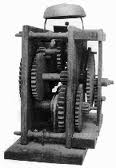
A clock similar to the one Banneker made.

He loved puzzles and challenges too.

Sometime in the early 1750s, Benjamin borrowed a pocket watch from a wealthy acquaintance, took the watch apart and studied its components. After returning the watch, he created a fully functioning clock entirely out of carved wooden pieces. The clock was amazingly precise, and would keep on ticking for decades. As the result of the attention his self-made clock received, Banneker was able to start-up his own watch and clock repair business. [Famous Black Inventors]

He predicted the solar eclipse of 1789. He earned the nickname the “Sable Astronomer” He started to compile information into Almanac and Ephemeris of Pennsylvania, Delaware and Maryland best-selling almanacs. He even put a skylight in the ceiling of his cabin so he could watch the stars at night. He sent a copy of his almanac to Thomas Jefferson along with “a letter urging the abolition of slavery.” [Ibid]

When Banneker was 60 George Washington appointed him along with his friend Andrew Ellicott to survey what would become the District of Columbia.

A contemporary reprint of Andrew Ellicott's 17...

A contemporary reprint of Andrew Ellicott’s 1792 “Plan of the City of Washington in the Territory of Columbia” (Photo credit: Wikipedia)

Banneker and Ellicott worked closely with Pierre L’Enfant, the architect in charge. However, L’Enfant could not control his temper and was fired. He left, taking all the plans with him. But Banneker saved the day by recreating the plans from memory. [Mathematicians of the African Diaspora]

[For more on Pierre L’Enfant visit his Thought of the Day bioBlog HERE]

He published a treatise on bees, did a mathematical study on the cycle of the seventeen-year locust, and became a pamphleteer for the anti-slavery movement. [Mathematicians of the African Diaspora]

On October 9, 1806 Banneker died at his Ellicott City/ Oella farm.

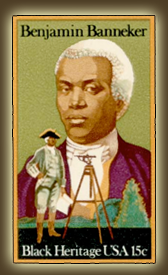
The Banneker postage stamp. [Image courtesy: USPS]

In 1980, the U.S. Postal Service issued a postage stamp in his honor. [Benjamin Banneker Center]

Benjamin Banneker

Benjamin Banneker (Photo credit: crazysanman.history)


Thought of the Day 11.4.12 Walter Cronkite

“And that’s the way it is.”
–Walter Cronkite, Jr.

Walter Leland Cronkite, Jr was born on this day in  Saint Joseph, Missouri, USA in 1916. Today is the 98th anniversary of his birth.

Walter was the oldest of six children. The Cronkites lived in Kansas City, Missouri (where young Walter was a paper boy for the Kansas City Star) until 1926 when the moved to Houston, Texas. At San Jacinto High School he worked for the school newspaper, eventually becoming editor.

Young Cronkite read the World Book Encyclopedia. He built a telegraph system to link the houses of friends. The churchgoing Boy Scout also learned he had an alcoholic father, and about divorce. His single mother taught him tolerance in a Jim Crow state. [Newsday.com]

According to Boy Scout lore Cronkite wanted to become a newsman after reading an article reporters in Boys Life Magazine.

He went to the University of Texas at Austin but dropped out in his Junior year  to start working as a reporter. He worked for a number of newspapers (including the Huston Post) and radio stations (under the name “Walter Wilcox”) reporting the news and sports.

... Walter Cronkite

During World War II Cronkite became a War correspondent covering the North African and European campaigns for the United Press. After covering the Nuremberg Trials for that organization  he was recruited to CBS News by Edward R. Murrow.

Cronkite started at the Washington, DC affiliate for CBS.

…He worked on a variety of programs, and covered national political conventions and elections. He helped launch the CBS Evening News in 1962 and served as its news anchor until his retirement in 1981. [Biography.com]

He was “The most trusted man in America” and he covered events from the assignations of John and Bobby Kennedy and Martin Luther King, to Apollo 11 landing on the Moon, to Watergate and Vietnam.

U.S. television journalist Walter Cronkite in ...

He also hosted:  You Are There, a historical reenactment program; The Twentieth Century, a documentary using newsreel footage to explore historical events; and a game show, It’s News to Me.

He retired in 1981. He continued to report as a special correspondent and presenter.

After retiring, Cronkite hosted CBS’s Universe (1982), co-produced Why in the World (1981) for Public Broadcasting System, and hosted Dinosaur (1991) for the Arts and Entertainment cable television. He also did a special short series for CBS and the Discovery Channel in 1996 called Cronkite Remembers. In addition to his television work, Cronkite wrote several books, including A Reporter’s Life (1996) and Around America (2001). [Ibid]

Walter Cronkite passed away on July 17, 2009 in New York City.

RIP 2009-Walter Cronkite


Thought of the Day 11.3.12 Shirley Chisholm

I don’t measure America by its achievement but by its potential.

The emotional, sexual, and psychological stereotyping of females begins when the doctor says: It’s a girl.

Service is the rent that you pay for room on this earth.

–Shirley Chisholm

Shirley Chisholm, future member of the U.S. Ho...

Shirley Anita St. Hill  was born on this day in Brooklyn, New York, USA in 1924. Today is the 88th anniversary of her birth.
Her parents were recent immigrants to this country. Her father, Charles, was born in British Guiana, her mother, Ruby, was from Barbados. At three Shirley went to live with her Grandmother in Barbados.  She attended Vauxhall Primary School, in Christ Church.
“…I had my early education in the strict, traditional, British-style schools of Barbados. If I speak and write easily now, that early education is the main reason.” [Chisholm in her autobiography Unbought and Unbossed.]
At 10 she came back to the Brooklyn. She attended Girls High School, an integrated and prestigious public prep school in Brooklyn then earned her BA from Brooklyn College. She married Conrad Chisholm, a private investigator in 1949. In 1952 she received her Masters in elementary education from Columbia University.
Shirley Chisholm, Congresswoman from New York,...

Shirley Chisholm, Congresswoman from New York, looking at list of numbers posted on a wall (Photo credit: Wikipedia)

Chisholm spent six years as director of the Hamilton-Madison Child Care Center then an addition six-year as consultant to the Division of Day Care before delving in politics.
After a few years in local New York politics Chisholm became the first black Congresswoman in the US House of Representatives in 1969. She served in the House for seven terms.
English: Founding members of the . Standing L-...

English: Founding members of the Congressional Black Caucus. Chisholm is seated in Orange.  (Photo credit: Wikipedia)

After initially being assigned to the House Forestry Committee, she shocked many by demanding reassignment. She was placed on the Veterans’ Affairs Committee, eventually graduating to the Education and Labor Committee. She became one of the founding members of the Congressional Black Caucus in 1969. [Biography.com]

In 1972 Chisholm entered the US presidential race as a candidate for the Democratic Party. She ran in 12 primaries and won three (Louisiana, Mississippi and New Jersey, garnering 152 delegates from an ethnically diverse base that spanned social economic backgrounds and the gender divide. She was an advocate for “minority education and employment opportunities, (and) also a vocal opponent of the draft.” [Ibid] She said she ran “in spite of hopeless odds… to demonstrate the sheer will and refusal to accept the status quo.” She was the…

  • First African-American woman to seek a major party nomination for President of the United States (1972)
  • First woman to have her name placed in nomination for President at the Democratic National Convention
  • First African-American to be on the ballot as a candidate for President [About.com]
Gwendolyn Sawyer Cherry and Shirley Chisholm a...

Gwendolyn Sawyer Cherry and Shirley Chisholm at the Democratic National Convention: Miami Beach, Florida (Photo credit: State Library and Archives of Florida)

Although she lost the nomination to George McGovern (who lost the election to incumbant Richard Nixon), Chisholm “had brought the voice of the disenfranchised to the forefront.” [Ibid]

Back in Congress she continued to fight for the poor and middle class. She  worked to get domestic workers a minimum wage and to improve opportunities for inner-city residents through better education, health care and social services. She was the author of a 1970 child care bill that was vetoed by President Nixon (he called it Sovietization of American children.)
Congressman Edlophus Towns (left) and his wife...

Congressman Edlophus Towns (left) and his wife, Gwen Towns (right) pose with former Congresswoman and Brooklyn native, Shirley Chisholm (center) (Photo credit: Wikipedia)

She retired from the House in 1982 and went back to education (with a little politicking on the side.) Shirley Chisholm died on New Years Day 2005 in Ormon Beach, Florida.
She was the author of two books, Unbought and Unbossed (1970) and The Good Fight (1973). [Biography.com]

Bonus Mini Blog 11.2.12 Warren G. Harding

English: Warren G. Harding

English: Warren G. Harding (Photo credit: Wikipedia)

“America’s present need is not heroics, but healing; not nostrums, but normalcy; not revolution, but restoration; not agitation, but adjustment; not surgery, but serenity; not the dramatic, but the dispassionate; not experiment, but equipoise; not submergence in internationally, but sustainment in triumphant nationality….”
— Warren G. Harding

Warren Harding, age 17

He soon joined the political ranks himself, serving as state senator then US Senator. In 1920 he became the Republican candidate for President because, as fellow Ohioan  Harry Daugherty later explained, “He looked like a President.” [Whitehouse.gov] He won by a landslide.

Republicans in Congress easily got the President’s signature on their bills. They eliminated wartime controls and slashed taxes, established a Federal budget system, restored the high protective tariff, and imposed tight limitations upon immigration. [Ibid]

His administration was rife with cronyism and scandal and led him to say “My…friends…they’re the ones that keep me walking the floors nights!”

Harding died of a heart attack in 1923 while on a trip to San Francisco.

Warren G. Harding, seated at desk, wearing bow...

Warren G. Harding, seated at desk, wearing bow-tie, with newspaper in hand. (Photo credit: Wikipedia)


Thought of the Day 11.2.12 James K. Polk

“The Presidency is no bed of roses.”
James Knox Polk

President Polk, 1858 portrait, by George Healy

President Polk, 1858 portrait, by George Healy (Photo credit: Wikipedia)

James Knox Polk was born on this day in Mecklenburg County in North Carolina, USA in 1795. Today is the 217th anniversary of his birth.

Polk was the eldest of 10 children of Samuel and Jane Polk. His father was a farmer and slave holder. The family moved to Maury County, Tennessee when Polk was 11. And Samuel became a land speculator, owned a mercantile and a county judge.  Polk was home schooled and a good student. At 17 he suffered from urinary stones that had to be removed surgically (with only brandy for anesthetic.)

He went to the University of North Carolina where he joined the Dialectic Society and learned to debate. After graduating with honors in 1818 he studied law in Nashville and clerked for the Tennessee State Senate. He passed the bar in 1820.

English: Picture of James K. Polk

English: Picture of James K. Polk (Photo credit: Wikipedia)

He ran for state legislature in 1823 and became a Andrew Jackson supporter  when the latter ran for US Senator from Tennessee.  Two years later Polk ran for US House of representatives. He became chair of the House Ways and Means committee in 1833 and Speaker of the House in 1835.

In the House of Representatives, Polk was a chief lieutenant of Jackson in his Bank war. He served as Speaker between 1835 and 1839, leaving to become Governor of Tennessee. [Whitehouse.gov]

As Speaker he worked tirelessly to advance the agendas of both Presidents Jackson and Van Buren through the House. Polk issued the gag rule — a resolution that automatically tabled any petition having to do with Slavery without review — opposed by Northerners like John Quincy Adams* in the House. He left Congress in 1839 and ran for (and won) the office of Governor of Tennessee.

Polk ran for President of the United States in 1844. On March 4th, 1845 he was sworn in as the US’s 11th President.  (He is the only former Speaker of the House to become President.)

James Knox Polk (11th president of the United ...

James Knox Polk (11th president of the United States) (Photo credit: Wikipedia)

One of the highlights of his single term in office  was the acquisition of the Oregon Country (Oregon, Washington, Idaho and part of Montana), California, and New Mexico.

President Polk added a vast area to the United States, but its acquisition precipitated a bitter quarrel between the North and the South over expansion of slavery. [Whitehouse.gov]

He also reduced tariffs from 32% to 25% with a set of tariff rates known as the Walker Tariff in 1846.  and established a treasury system that lasted into the next century. During his tenure The U.S. Naval Academy in Annapolis, Maryland was opened,  as was The Smithsonian Institution on the Mall in DC.  Also in DC ground was broken for 555 foot tall, marble and granite obelisk, The Washington Monument.

The Mexican American War was fought under his administration. Although the US handily defeated the Mexican army the declaration of the war was much opposed in the North.

He was a President who “Said what he intended to do and did it” according to Harry S. Truman. That included increasing the US’s land mass by 1/3rd.

By the end of his term in 1949 Polk was in ill-health — he’d contracted cholera on a trip to New Orleans. He died on June 15, three months after leaving office. His will stated that his slaves were to be set freed upon the death of his wife, Sarah Childress Polk, but since she lived past the Civil War they were set free with the Emancipation Proclamation and the 13th Amendment.

James K. Polk's tomb lies on the grounds of th...

James K. Polk’s tomb lies on the grounds of the state capitol in Nashville, Tennessee. (Photo credit: Wikipedia)

[CLICK HERE to see The Thought of the Day on John Quincy Adams and get a different perspective of this period in American History.]

—————————————-

Programming Note:

At this point in the ritaLOVEStoWRITE blog history I’m finding a lot of references to previous Thought of the Day bios. I’d like to link back to them (to refresh the memory for those of you who have been around for a while and to introduce them to those of you who are newish to the blog.) But I don’t want to be intrusive. So yesterday I imbedded the links to Gwyneth Paltrow in the Toni Collette bioBlog, today I moved the JQ Adams link to the bottom.  I could also do something like [ see TotD LINK]  with a link imbedded. Would that be too intrusive? I feel there is value in knowing that the link is back to a previous blog from this serious and not to an external web site. What do you think? What’s the best way to handle this?  I really want to hear from you… Cheers, Rita


Thought of the Day 10.31.12 Juliette Gordon Low

If you are a Girl Scout you know who JGLow is. This is one of those bioBlogs that I knew I was going to do weeks before the date. It is my honor to celebrate her birthday.

————————————————–

“Right is right, even if no one else does it.”
Juliette Gordon Low

English: A portrait of Juliette Gordon Low (18...

English: A portrait of Juliette Gordon Low (1887, Edward Hughes) located in the National Portrait Gallery in Washington, D.C. (Photo credit: Wikipedia)

Juliette Magill Kinzie Gordon was born on this day in Savannah Georgia in 1860. Today is the 152nd anniversary of her birth.

“Daisy” was a beautiful baby with a sweet disposition. She was the second of the Gordon’s six children. The family lived at 10 East Oglethorpe Avenue in a double town house in a wealthy section of town. She had all the advantages of a well to do Southern girl. But she was born on the cusp of the Civil War. Daisy was born in October 1860 and hostilities at Fort Sumter, South Carolina marked the official beginning of the war on April 12th 1861. The Gordon’s was a house divided. Her father was pro-succession and a slave holder, her mother was from the Chicago and an abolitionist.

While Daisy’s father was joining the war efforts on behalf of the South, her maternal relatives were enlisting in the Northern militias. Daisy’s mother struggled with the conflicting feelings of having loved ones on both sides of the war, and often faced wrath from angry neighbors. [Biography.com]

: Juliette Gordon Low Historic District: Wayne...

: Juliette Gordon Low Historic District: Wayne-Gordon House (Photo credit: Wikipedia)

Her father joined the Confederate Army and was away from home for most Daisy’s early life. She didn’t see him for more than a few days at a time. Food shortages in the city meant that even the wealthy Gordons suffered from malnutrition. Savannah’s coastal location meant illnesses like malaria were always a threat.  By 1864 things were looking grim for the Confederacy. General Sherman had taken Atlanta and was marching through Georgia to the sea burning a path in his wake. Savannah was the last city in his way. When the city surrendered Eleanor Kinzie Gordon invited the General, an old friend, to tea.  He brought her letters and packages from her friends and family in Chicago.

He also brought the two older girls, Nelly and Daisy, a gift of rock sugar candy, the first sugar the girls had ever eaten….He often recounted a funny anecdote about the 4-year-old Daisy Gordon. After eating her sugar, she sat on his lap and began to curiously inspect his head. When he asked what she was doing, she told him she had heard him called that ”old Devil Sherman” and she wanted to see his horns. [Juliette Gordon Low Birthplace]

Some say he was so charmed by the little girl and her mother’s hospitality that he spared the city [it probably had more to do with city’s strategic sea port.] Eleanor Gordon packed up her daughters and headed north (under the protection of General Sherman) to her family in Chicago to wait out the rest of the war. (All wives of Southern officers were ordered to leave the city.)

At her grandparents’ home in Illinois, Daisy was exposed to an entirely different way of life…As a result of her maternal grandparents’ influence in the community, Daisy encountered a variety of new people, including many Native Americans… Her interactions with Native Americans gave her an early appreciation of Native American culture, which she would idealize for the rest of her life….By 1865, the family had reunited in Savannah and, thanks to her mother’s efforts to recoup their financial losses in the South, Daisy’s father was able to revitalize Belmont cotton plantation.  [Biography.com]

As a child Daisy learned to sketch, paint and sculpt, write poems, write and act in plays. Daisy loved her pets including dogs and birds. She was a good swimmer and captain of the rowing team. She liked to play tennis. She learned to stand on her head [a trick she repeated annually on her birthday to prove that she could still do it.]

When she was a teen Daisy went to the Virginia Female Institute (now Stuart Hall School) in Staunton, Virginia. Then she went to Mesdemoiselles Charbonniers for finishing school in New York City.

…She was taught the typical social graces of a highborn lady in school—excelling in drawing, piano and speech—she yearned instead to explore, hike, play tennis and ride horses—all activities discouraged by her restrictive finishing schools. Defiant in nature, Daisy was frequently caught breaking the rules.[Ibid]

As a young woman she traveled  in the US and Europe. She spent time in New York trying to make a living painting. She met and married a wealthy English cotton merchant, William Mackay Low on December 21, 1886.  When well-wishers threw the traditional rice at the newlyweds a grain became lodged in Daisy’s ear. The pain became so bad that she went to a doctor to have the rice removed. “When trying to remove the rice, the doctor punctured the eardrum and damaged the nerve-endings resulting in a total loss of hearing in that ear.” [Juliette Gordon Low Birthplace] It was an omen of things to come.

The Lows lived in England and traveled extensively. They spent their summers in England and their winters in the US.

During the Spanish-American War, Juliette came back to America to aid in the war effort. She helped her mother organize a convalescent hospital for wounded soldiers returning from Cuba…At the end of the war, Juliette returned to England to a disintegrating marriage. [Juliette Gordon Low Birthplace]

The couple, who had been unable to conceive children had begun to drift apart.

William, who had limitless funds and no restrictions, began spending more and more time apart from his wife, gambling, partying, hunting, and splurging on extravagant toys. Daisy was also gone on frequent trips, searching for cures for her hearing loss. [Biography.com]

One of William Low‘s new hobbies was his mistress, Ms. Anna Bateman. By 1901 he had asked Daisy repeatedly for a divorce, but she refused. At that time a divorce brought shame on all parties involved. But when Daisy returned home from a trip to find Ms. Bateman living in the house and her (Daisy’s) things moved to the servants quarters she gave in. Daisy went to stay with friends and the Lows were legally seperated. Before their final divorce papers could come through William Low died. He left everything to Bateman, Daisy had to go through the embaressment of contesting the will. She eventually got the Savannah Lafayette Ward estate.

Daisy began to look for new purpose in her life. She traveled, this time as far as Egypt and India. In 1911 she met Sir Robert Baden-Powell, the founder of the Boy Scouts. She worked with Baden-Powell, his wife Olive, and his sister Agnes in their efforts to create girl’s version of the scouts.

Low started several troops in Scotland and London, for girls of varying income brackets. The effect on the girls’ self-esteem was so striking that Low decided she had to take the program to the United States.  [Biography.com]

So she returned to Savannah and hatched her plans to start the Girl Guides on this side of the Atlantic…

English: Juliette Gordon Low Category:Girl Sco...

English: Juliette Gordon Low Category:Girl Scouts of the USA images (Photo credit: Wikipedia)

Less than a year later, she… made her historic telephone call to her cousin Nina Pape, saying, “I’ve got something for the girls of Savannah, and all of America, and all the world, and we’re going to start it tonight!” On March 12, 1912, Juliette Low gathered 18 girls to register the first two patrols of American Girl Guides.  [Juliette Gordon Low Birthplace]

Low used her own money (with contributions from her friends and family) and her considerable energy to forge the new organization. The name of the group was changed to Girl Scouts a year later.

It was her goal to bring girls from all backgrounds together as equals to enjoy the outdoors, to learn new skills and to be ambassadors of peace in the world.

She encouraged girls to prepare not only for traditional homemaking, but also for possible future roles as professional women—in the arts, sciences and business—and for active citizenship outside the home. [Ibid]

She remained friends with the Baden-Powells and “she helped lay the foundation for the World Association of Girl Guides and Girl Scouts.” [Ibid]

In 1923 Daisy was diagnosed with breast cancer. She died four years late on January 17, 1927. She was laid to rest at the Laurel Grove Cemetery in Savannah, Georgia. A Scout to the end, Daisy is burried her Girl Scout uniform.

Girl Scouts is the largest educational organization for girls in the world and has influenced the more than 50 million girls, women and men who have belonged to it. [Ibid]

: Juliette Gordon Low Historic District: Site ...

: Juliette Gordon Low Historic District: Site of first Girl Scout meeting (Photo credit: Wikipedia)