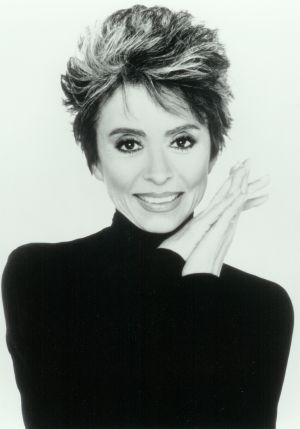
Rosita Dolores Alverio was born on this day in Humacao, Puerto Rico in 1931. She is 81.
She moved to New York with her mother when she was six. Her first entertainment gig was doing Spanish voice overs to American films when she was 11. She made her Broadway debut in November of 1945 in Skydriftat the Belasco Theatre. Her name appeared in the program as Rita Moreno.
She appeared as Zelda Zanders in Singin’ in the Rain in 1952 and as Tuptim in The King and I in 1956. She also played a lot of Latino “sexpot” roles, something she found degrading, but that she put up with.
Then came West Side Story…
Moreno (co-stars) as “Anita”, the Puerto Rican girlfriend of Sharks’ leader Bernardo, whose sister Maria is the piece’s Juliet. A seasoned singer and dancer, Moreno delivered a superb performance that completely overshadowed the Maria of the movie, the non-singer (and non-Hispanic) Natalie Wood, the only movie star in the ensemble cast. [IMDB Rita Moreno]
Watch her sing and dance up a storm with Geroge Chakiris and the Sharks (et al) in West Side Story…
But her performance went well beyond wise cracking, dancing and singing. She was…
…unforgettable in a harrowing scene where she had to deliver a message from Maria to the Romeo of the piece, the Jets’ member Tony, and is assaulted by his fellow gang-members. This is the real climax of the film.[Ibid]
She won an Oscar for her Anita.
Moreno is, in fact, the first person to win an Oscar, Emmy, Tony and Grammy — something only 12 other people have managed to achieve.. (She won Emmys for The Muppet Show and The Rockford Files; The Tony was for the musical The Ritz (’76), and the Grammy was for the soundtrack to the “Electric Company.”) In 2010 President Obama awarded Moreno a National Medal of Arts.
Here she mets her match with the Muppet Show‘s Animal (or was it the other way around?)
From PBS kids shows like Where In the World is Carmen Sandiegoto the hard-hitting HBO prison drama OZ (she won 3 American Latino Media Arts awards for her role as Sister Peter Marie Reimondo) Moreno always gives herself 100% to a project.
Here she is singing It’s An Art from the musical Working...
Moreno has over 130 credits listed in her TV and Movie database and has been working for over 6 decades. At 81 she still looks and sounds great, and shows little sign of slowing down.
[This is part Five of my What To Do in Williamsburg & Richmond Blog for part one go HERE. For part two go HERE. For part three go HERE. and for part four go HERE.]
Previous tips included:
Williamsburg–
Planning your trip in the Fall or Winter to avoid the heat and crowds.
Staying in a Colonial House.
Engaging with the locals.
Visit the Wren Building
Take the Rubbish, Treasures and Colonial Life Tour & the Behind the Scenes Tour
Visit the De Witt Wallace and Abby Aldrich Rockefeller Folk Art Museums
Tour the Governor’s Palace
Tour the Thomas Everard House.
Visit Bassett Hall.
Get spooky with it.
Stop in to see the craftsmen making things with wood.
Get your Ps and Qs in line at the Printers.
Stroll along Duke of Gloucester Street.
Stand witness for the prosecution at the Courthouse.
EAT.
Richmond —
Visit a Civil War museum like the Tredegar Iron Works
Go Shopping in Carytown
Eat at the Can Can Brasserie
———————————————————————————————————–
Today we’ll finish up our tour of Williamsburg and Richmond with a stop at the Virginia Museum of Fine Arts.
The VMFA has an impressive collection of paintings, sculptures, furniture and decorative arts. We particularly enjoyed the American Art with its Mary Cassatt, William Merritt Chase and Robert Henri paintings.
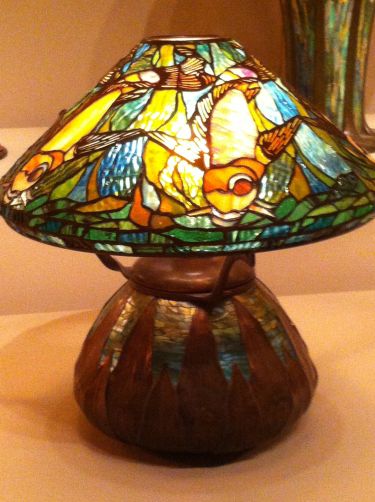
Their collection of Art Nouveau and Art Deco decorative arts is one of the largest collections outside of Paris. It includes a beautiful display of Tiffany lamps.
A Tiffany “Goldfish” lamp on display at the VMFA.
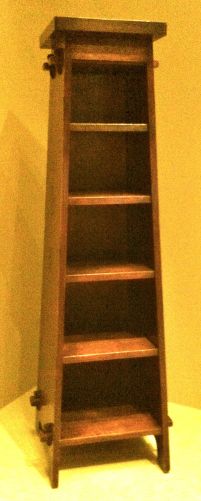
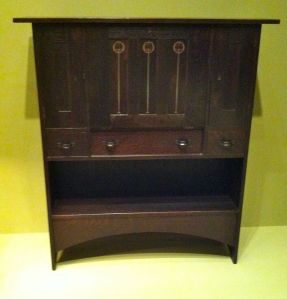
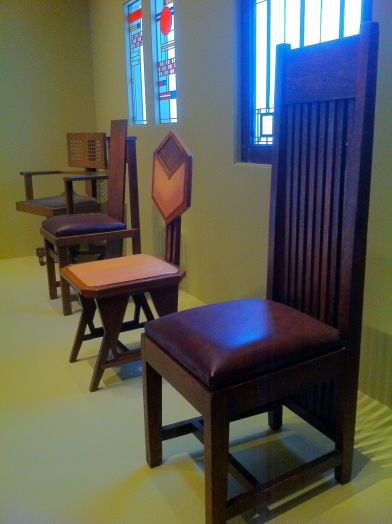
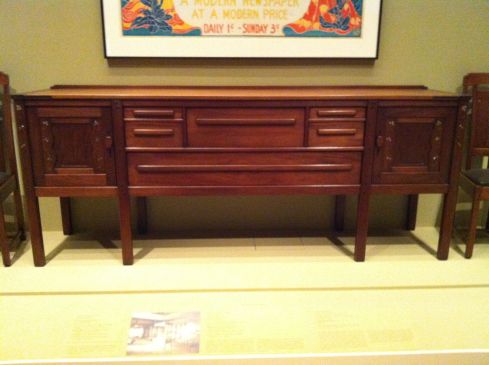
The collection of Arts and Craft furniture was really impressive. From Roycroft…
the display was surprising comprehensive. Admission is free to the museum’s permanent exhibits. And the Museum is open 365 days a year starting at 10:00 in the morning.
But the real reason we went to the VMFA was to see the traveling Chihuly “Breathe Art Into Life” exhibit. The exhibit, which runs thru Feb 10, 2013 is a filled with spectacular light and shapes that defy gravity. And (especially coming from a pallet of muted earth tones in Williamsburg) it was a feast for the eyes.
There are 9 installations in the exhibit (including the giant chandelier that hangs in the atrium. Arrive a little before your entrance time so you can see the PBS film on the artist.
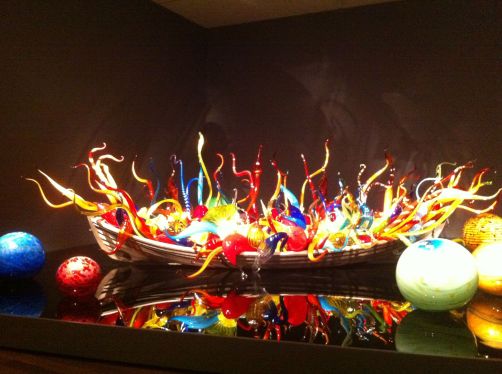
One of the Float Boats filled with Chihuly’s Fiori. The smooth glass floor reflects the dazzling glass, And you feel like you are walking along the smooth waters of a Venetian Canal.
The first room you enter holds Fiori and Float Boats. The artist was inspired to create Fiori and Float Boats when he was installing Chihuly Over Venice. There he hung his massive, intricate chandeliers over the Venetian Canals, but he also dropped pieces of into the water. Locals were hired to collect the floating orbs. When Chihully saw their row boats filled to the brim with his art he had the spark for Fiori and Float Boats. (The image in the RICHMOND banner at the top of the blog is the other Float Boat in this display.)
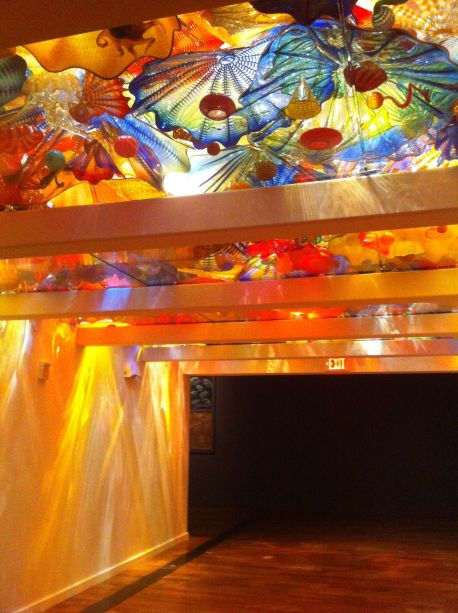
You walk under Persian Ceiling. It is lit from above, and this time you get the feeling as if you are walking through the water, in an aquarium of light.
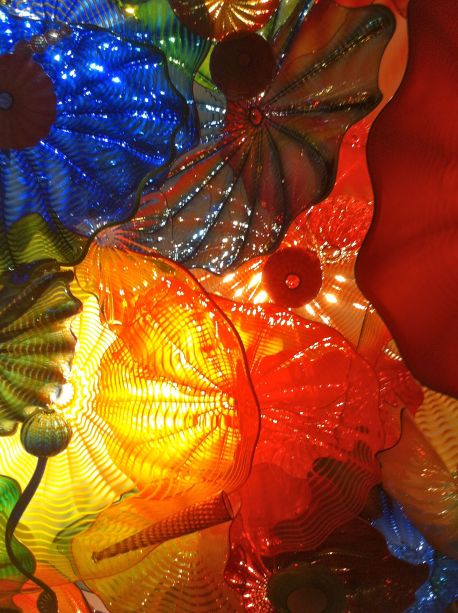
Persian Ceiling consists of over a thousand piece of blown glass
Chihuly layers pieces and nest smaller shapes into larger shapes in his Persian Ceiling. (Detail.)
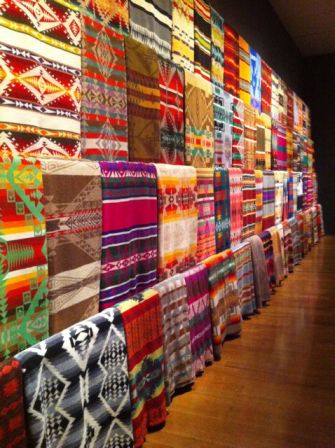
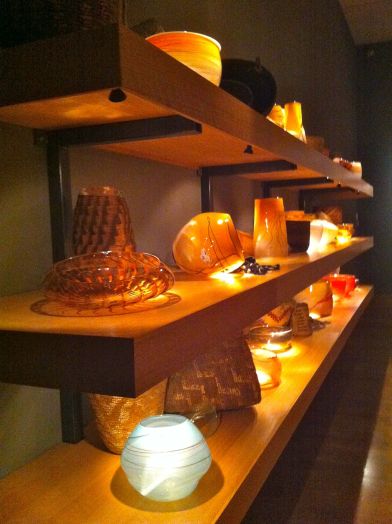
Chihuly, a native of Tacoma, Washington, drew inspiration from the “Slumped, sagging forms” [VMFA display card] of Indian baskets he saw on display at a museum for the “glass” baskets he displayed in his Northwest Room. He also drew from his extensive personal collection of Native American blankets.
Some of Chihuly’s blanket collection line the wall of the gallery.
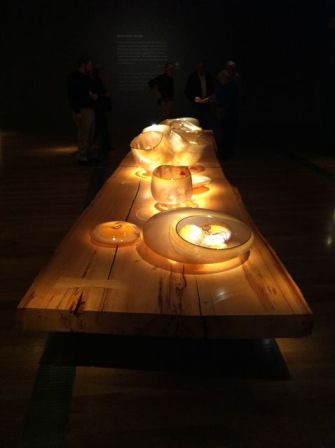
A long low table runs the length of the room.
Do you see the dovetail joining the split in the wood on the left? I loved how that echoed the patterns in the blankets.
And a wall of “baskets” — both the Chihuly glass versions and the traditional woven ones that acted as inspiration — line the other wall.
The glass in this room takes on the color of sand. We have definitely moved to the West.
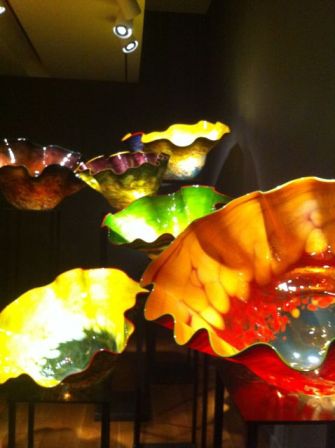
In Macchia Forrest the artist combines nine giant flower like bowls. Each bowl has thousands of colors.
Just one of the Macchia measures 27″ x 38″ x 30″
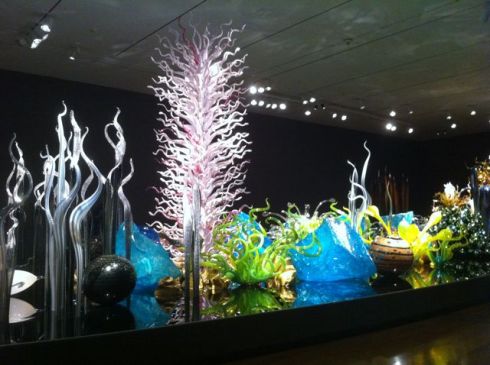
The central installment in the exhibit is a room size garden of glass called Laguna Torcello. [Think “room” as in the size-of -my-house “room”.]
It is monochromatic at either end but burst with exotic colors in the middle — an entire year’s worth of glass — winter, spring summer and fall.
A pink coral-esque structure soars to the ceiling, looking all the world like some Dr. Suessian underwater Christmas Tree.
“Welcome, Christmas! Fah who rahmus!” [The Whoville Christmas Song]
A “flower” of white at one end of the installation. [Detail.]
This room returns us to “water”. The over 1,500 pieces almost seem to sway in the waves.
Colorful middle portion of Laguna Torcello. [Detail.]
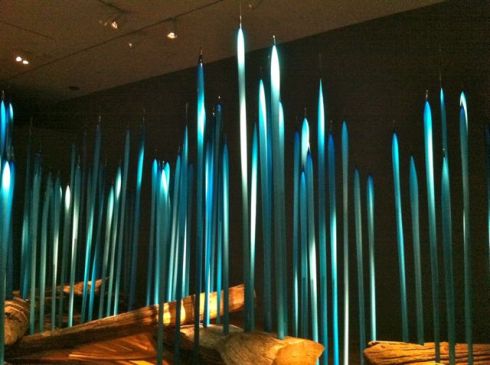
Chihuly began making Spears (known as Reeds on Logs) in Finland in 1995. The glass reeds are surprisingly strong. He uses salvaged red cedar from his home state for the logs.
Reeds On Logs
Chihuly Breathe Art Into Life is $20 for Adults/$16 for Seniors, students and groups of 10 or more. It is worth every penny.
[This is part four of my What To Do in Williamsburg Blog for part one go HERE. For part two go HERE. For part three go HERE. ]
Previous tips included:
Planning your trip in the Fall or Winter to avoid the heat and crowds.
Staying in a Colonial House.
Engaging with the locals.
Visit the Wren Building
Take the Rubbish, Treasures and Colonial Life Tour & the Behind the Scenes Tour
Visit the De Witt Wallace and Abby Aldrich Rockefeller Folk Art Museums
Tour the Governor’s Palace
Tour the Thomas Everard House.
Visit Bassett Hall.
Get spooky with it.
Today we’ll touch on some odds and ends in Williamsburg and travel down the road to the current capital of Virginia, Richmond.
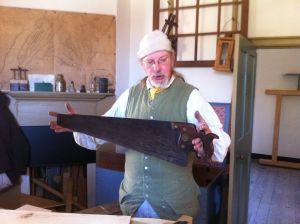
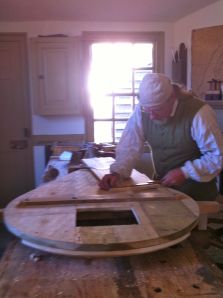
11. Stop in to see the craftsmen making things with wood. Bill likes woodworking so we spent time at the joiners near the Capitol on Frances Street…
Saw envy at the Joiners.
Where they do ordinary work, like making sashes for windows and bellows for the Gunsmith Shop….
Making 1 of three large wooden panels for the bellows.
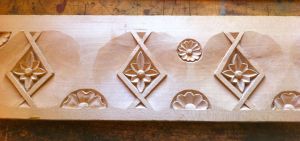
…and fancy work, like this decorative piece.
The craftsmen at the Joiners used a lot of fine carving skills to make this wooden ornamental panel.
We also went to the Cabinetmaker’s shop, which is on Nicholson Street, closer to the Palace Green.
Bill has a talk with one of the cabinet makers.
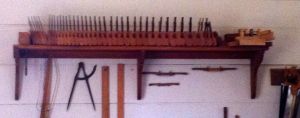
Both shops had beautiful sets of hollows and rounds for making moldings.
Hollow and round plane sets on the shelf.
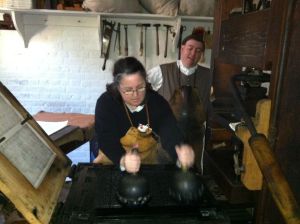
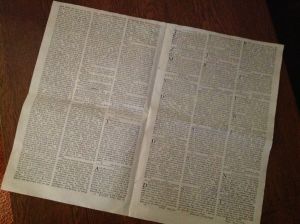
12.) Get your Ps and Qs in line at the Printers. Bill indulged my love of graphic design with a trip to the Printers. We had a nice long talk with printer and he was kind enough to let me have a go at the press.
First I inked the plate.
Added paper, cranked the carriage into place then PULLED the press down.
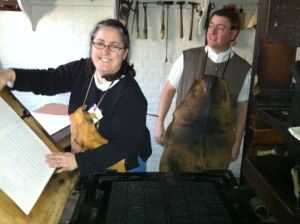
Cranked the carriage back out and lifted the paper tray and…
Taadaaa… my impression of a colonial paper. (Get it? IMPRESSION? It’s a letter-press. Never mind, it’s a printing joke.)
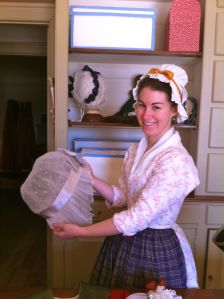
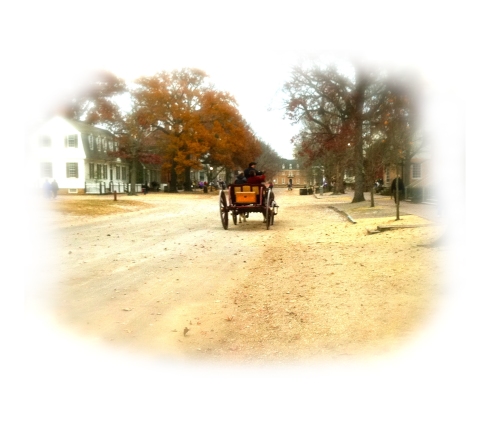
13.) Stroll along Duke of Gloucester Street. We especially enjoyed the Blacksmith, the Silversmith and the Milliner.
The Milliner shows off a hat that would have been popular around 1790. I like to think of it as a Mrs. Bennett or Mrs. Dashwood appropriate hat. (Yes that is Jane Austen reference.)
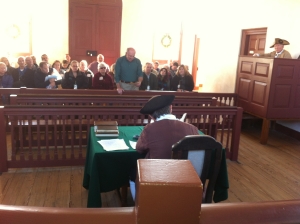
14.) Stand witness for the prosecution at the Courthouse. Learn about the 18th Century justice system first hand with the Order In The Court program (it runs several times a day and is free with your Williamsburg pass).
The Williamsburg Courthouse is one of the original buildings and was still in use when Goodwin and Rockefeller began to rebuild the town.
We saw several civil trials which required audience participation.
A Williamsburg visitor takes on the roll of a towns person who has failed to come to church — an offense which was against the law.
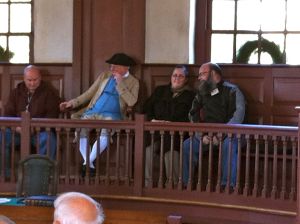
You MIGHT even get a chance to be on the judge’s bench (even if you’re a woman == as long as you go along with premise that you are a man for the purposes of historical accuracy.)
Yes, that’s judge Rita conferring with the bearded judge to the right on the fate of some poor soul. Don’t worry I was very easy. Every body else was a hangin’ mood, but not me.
15. EAT. There are four Colonial Taverns to choose from in the city, Christiana Campbell’s, Shield’s, King’s Arms, and Chownings. I liked King’s Arms the best because they have an amazing Peanut Soup. Dinner at any of the Taverns is by candle light and includes period entertainment, but be warned … it will be an expensive meal. You might choose to eat at one of the restaurants at Merchant’s Square (which is between Colonial Williamsburg and Williams and Mary. The bus that runs in a clockwise circle around the historic district has a stop at Merchants Square so you wont have to get in your car.) We liked the Cheese Shop on the square, and especially the Aroma Coffee Shop on Prince George Street. If you do decide to step into your horseless carriage just go out Richmond Road and you’ll find the usual suspect of chain eateries, an oddly prolific collection of pancake establishments and some rather nice restaurants of the non-chain variety (yes, there are still some of them out there.) We enjoyed sushi at Kyoto and American fare at Food for Thought (the best food I ate all week was the Food for Thought’s quinoa salad.)
Time to travel down the road and into the present, leaving 18th Century Williamsburg for 21st Century Richmond. Well, almost… there’s still a lot of history to explore on this trip.
Richmond is the capital of Virginia and during the American Civil War it was the Capital of the Confederacy. The city is ripe with monuments & museums to the South (and given the whole Slavery thing, that made me a mite itchy. But I do love my history, so…) While in the city you can visit the Museum and White House of the Confederacy, the Virginia Historical Society, Hollywood Cemetery or take a stroll down Monument Avenue.
We went to Tredegar Iron Works on the James River. You get two museums in one location here. One is run by the National Park Service and the other is part of the American Civil War Center. We went into the (free) Park Service museum and enjoyed the displays and movie on the third floor. The Map Room is a great way to orient yourself on Richmond’s role in the war.
Photograph of the Tredegar Iron Works, shortly after the Evacuation Fire of 1865; despite the original caption of the image, the works themselves survived largely unscathed. (Photo credit: Wikipedia)
The outdoor exhibits had seen better days, but this museum is a gem in the rough. I hope they get some funding and can restore all the exhibits to top-notch condition.
Next stop: Shopping. Carytown is Richmond’s “Mile of Style” and we enjoyed a mild weather stroll down the main drag of boutiques and unique shops. This quaint shopping district won Southern Living Magazine’s “Best Neighborhood to Shop In” nod by the magazine’s readers.
Flower Power Case at Anthill Antiques, Carytown, Richmond, VA (Photo credit: kayadams.com)
We ate at the Can Can Brasserie a beautifully restored building that made you feel like you’d stepped off the streets of Paris. I kept expecting to see Henri de Toulouse-Lautrec stroll by the table. The atmosphere was delightful, so was the food (I got half a Roast Chicken Salad and a half order of their Roasted Apple & Rutabaga Soup. ) And don’t forget to order a Eloise (their special version of a Shirley Temple.)
But our big find in Richmond, besides the wonderful company, was the Virginia Museum of Fine Arts… which I will talk about tomorrow.
[This is part three of my What To Do in Williamsburg Blog for part one go HERE. For part two go HERE. ]
Previous tips included:
Planning your trip in the Fall or Winter to avoid the heat and crowds.
Staying in a Colonial House.
Engaging with the locals.
Visit the Wren Building
Take the Rubbish, Treasures and Colonial Life Tour & the Behind the Scenes Tour
Visit the De Witt Wallace and Abby Aldrich Rockefeller Folk Art Museums
Today we’ll go inside some of Williamsburg’s beautiful houses and get a little spooky after dark.
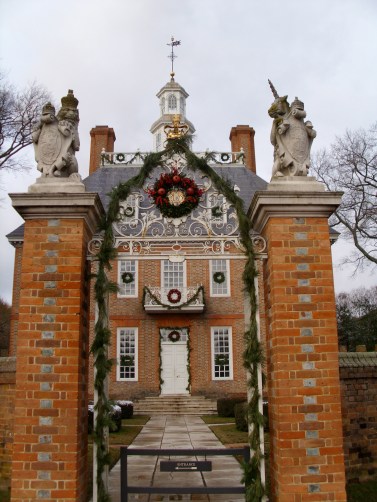
7. Tour the Governor’s Palace. It is the largest and finest residence in Williamsburg and it is meant to awe, inspire and intimidate all who see it. The moment you walk into the entrance hall lined with fire arms and crossed swords you know the power behind the man who lives here. It was home to seven colonial governors and two elected Virginia governors before Thomas Jefferson moved the Capital further west to Richmond in 1780.
Front gate leading to the Palace.
Tours, which require a separate ticket, will bring you through the public and private portions of the house.
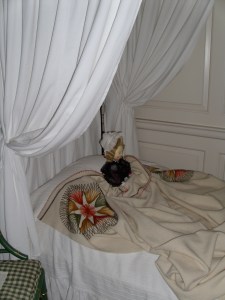
One of the beds in the Palace.
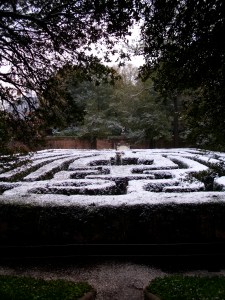
After your tour explore the vast gardens. Don’t miss the box wood maze. And be sure to climb the pyramid over the ice house. I found the gardens more enchanting than the building itself.
View of the box wood maze taken from the top of the pyramid. This was from our 2010 trip, and it had just snowed.
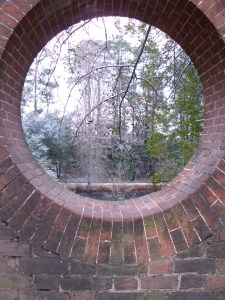
There were dozens of hidden treasures.
Window through the garden wall looking out to the canal.
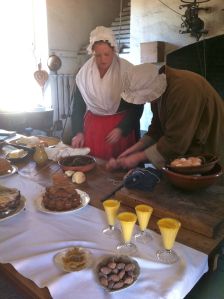
Even if you don’t take a formal Palace tour be sure to stop in to see the cellars and the kitchen. It will give you a fascinating glimpse on how they kept this huge home running. The cook, a man, was one of the highest paid and best regarded people in Williamsurg btw.
They made one big meal for the day. What kept was “left over” for breakfast.
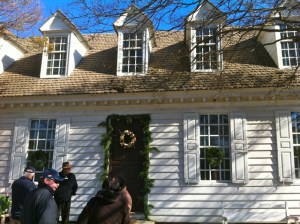
8. Tour the Thomas Everard House. On a prime piece of real estate on the Palace Green is the Thomas Everard House. Everard was an orphan when he arrived in Virginia as an apprentice to Matthew Kemp. Everard trained for seven years as a clerk. Soon after his apprenticeship was finished he was appointed clerk of Elizabeth City County court. Eventually he became the clerk of York county court for 36 years, Mayor of Williamsburg and held other prestigious post in the city. He purchased the house on the corner of Palace Green and expanded it.
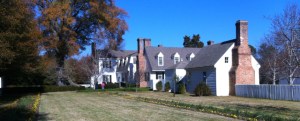
The front of the Everard House faces the Palace Green.
His wife died fairly young but his two daughters, Fanny and Patsy lived with him as they grew up.
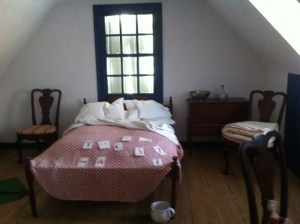
One of the girl’s bedroom.
Fanny married Rev. James Horrocks in 1765. He was the rector of Bruton Parish Church and president of Williams and Mary. He was a powerful man in the colony. When Rev. Horrocks died she returned to her father’s house. Sadly she died a year later. Her sister, Patsy lived, there until 1774 when she married.
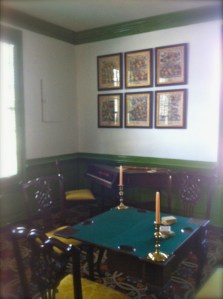
The house is in a “U” configuration. On the main floor the parlor and dining room face the front. The Parlor is a public room in the house. This multi use room can be set up for music, games or dancing.
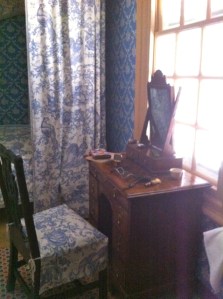
Thomas’ bedroom was accessible through the drawling room.
He had a quieter prospect of the yard and garden out his window. A back door allowed for special friends to enter his cozy retreat.
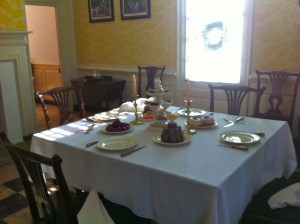
Like the Parlor, the Dinning Room also faces the Palace Green.
The door in the back of the dining room led to Thomas’ study. This room was also accessible through a rear door.
The Thomas Everard House is open 9-4 Tue, Wed & Friday.
9. Visit Bassett Hall. Williamsburg would not have been possible without the vision of one man and the generosity of another. The first man was Rev. W.A.R. Goodwin, The second was John D. Rockefeller, Jr.. Goodwin convinced Rockefeller to help him rebuild the Revolutionary City to its Colonial glory. Rockefeller and his wife Abby Aldrich Rockefeller.
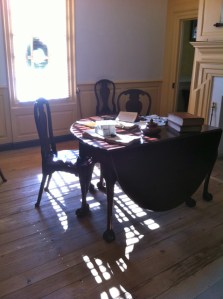
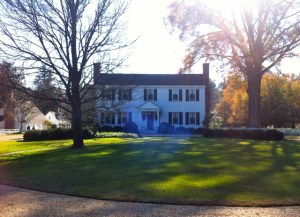
It was their retreat from the outside world. The Rockefellers visited there twice each year. The house and grounds have been restored not to the colonial era, but to the 1930s when the Rockefellers lived there.
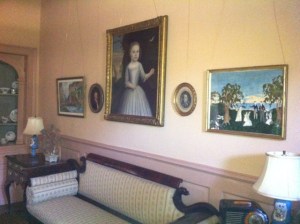
Abby filled the rooms with her folk art finds.
Folk art graces the walls at Bassett Hall.
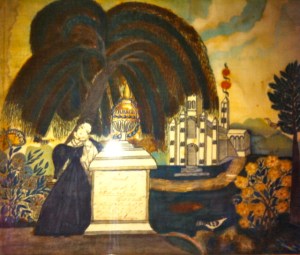
One of her special interest was “School Girl Art.” A sub set of her Folk Art collection the School Girl Art was literally done by girls who were away at school, usually finishing school in the 19 and 18th centuries.
A sample of School Girl Mourning Art. The artist was encouraged to memorialize some one close to them who had died.
The family entertained the locals — rich and poor– at their dinner table.
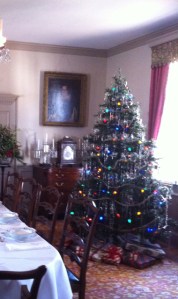
Dining Room decorated to Christmas
During the summer guest were often invited to tea in the Tea Room which was in a building overlooking the garden.
Looking back at the house from the garden.
Bassett Hall is open Wed-Sun 9-5. Don’t miss the informative movie at the beginning of the tour. You’ll learn a lot about the Rockefellers and the re-making of Williamsburg.
10. Get spooky with it. When you visit a 300 + year old city you expect a lot of history, and probably a few ghosts. So join in the fun and take a Ghost tour. We did the Tavern Ghost tour and it was fun (if not very scary.) Better still participate in the Cry Witch Program at the Capitol.
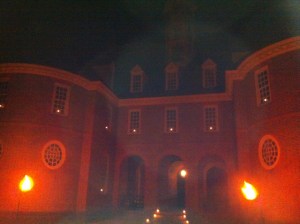
The Capitol Building at night before the Cry Witch program.
You’ll witness the trial of Grace Sherwood with first person interpreters bringing the transcript and court room drama to life. We don’t know what the actual verdict was, those documents have been lost. So the audience in the courtroom gets to weigh the evidence and decide Grace’s fate.
Tomorrow we finish up with Williamsburg and move up the road to Richmond.
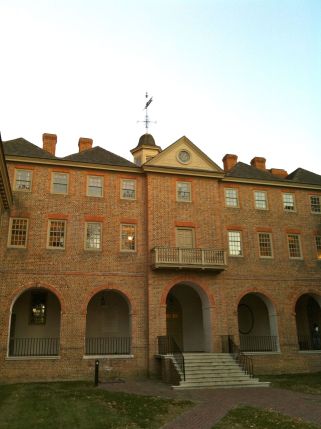
The first State House of Virginia was in Jamestown. But it burned down. Then it burned again. And again. And a fourth time. The governor and the citizens of Jamestown thought they’d better look for a better location for their capital. They chose Williamsburg (then known as the Middle Plantation) because the town already had a market, a church — Burton Parish, and a school — William and Mary. The architectural gem of William and Mary is the Wren Building. It sits at the opposite end of Duke of Gloucester Street from the Capitol and it is definitely worth a visit.
English: The front of the Wren Building at the College of William & Mary in Williamsburg, Virginia, USA. (Photo credit: Wikipedia)
The building began construction in 1695 and was completed in 1699. It is the oldest restored building in Williamsburg. It has suffered three major fires (in 1705, 1859 and 1862) and been rebuilt each time. Between 1928 and 1931 it was restored to its Colonial appearance. Every student at William and Mary has at least one class in the historic Wren Building during their time at the college. The college counts three US presidents among its alumni; Thomas Jefferson, James Monroe and John Tyler. Their portraits hang in the Great Hall.
Free tours of the building are available M-F 1-5 when school is in session. Hint: As you climb the steps to the front door look for a patch of darker red brick to your left. You’ll see the initials of some of the school’s earliest residents carved in the bricks.
Wren Building from the William and Mary Campus side. (Photo credit: Bill.)
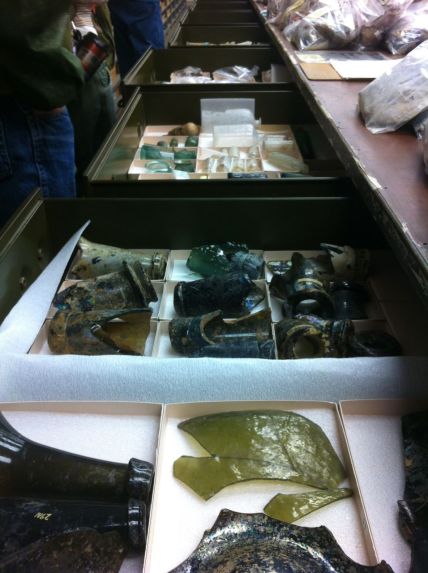
5.) Take the Rubbish, Treasures and Colonial Life Tour. Rev. W.A.R. Goodwin, the pastor at Bruton Church convinced John D. Rockefeller Jr. to join him in a dream of restoring the sleepy little 1920’s country seat back to the glorious colonial capital it had once been. That took a lot of money, a lot of research and a lot of digging. There is no better way to learn about how that transformation took place than on the 90 minute Rubbish, Treasures and Colonial Life tour. Meet members of the staff, learn about how archaeological methods have changed over the years, and see the treasures that await their turn to be cataloged. Tickets are FREE with your Williamsburg Admission Pass, but you must make a reservation prior to the tour.
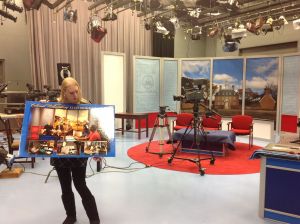
6.) Another great free tour is the Behind the Scenes tour. This tour takes place at the Bruton Heights School and focuses on preservation techniques (as opposed how the objects are found, put together and cataloged.) You’ll see the studio where educational videos, Emmy Award winning broadcasts and blogs are made…
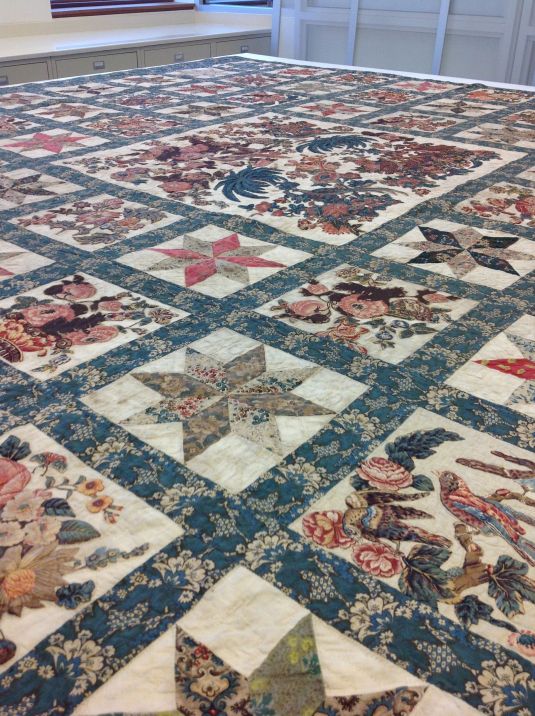
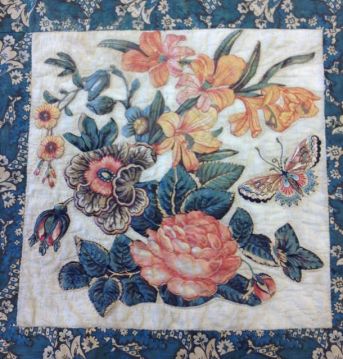
…then go to one of the restoration labs to see work being done on an 18th century item. We visited the Textile Lab where they were restoring some quilts for an upcoming show at the De Witt Wallace Museum.
Over sized quilt being restored at the Textile Lab
Detail of quilt
6.) Go to the De Witt Wallace Decorative Arts Museum and the Abby Aldrich Rockefeller Folk Art Museum. With a substantial permanent exhibit and wonderful traveling exhibits we have never been disappointed by a stop at the twin museums that are accessible through the recreated Public Hospital on Frances Street.
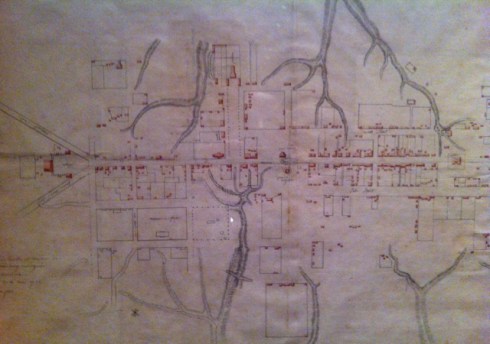
The Frenchman’s Map was on display as part of a temporary exhibit on maps and map making. Drawn when the French moved into the city after during the Siege of Yorktown, It is the Rosetta stone for Archeologist trying to restore Williamsburg. The Bodleian Plate, another key to what the Colonial Capital looked like, is also on display.
This is a terrific way to spend a rainy (or cold) afternoon. And if you are traveling with youngsters the Children’s room in the Abby Aldrich Museum is delightful.
Looking up to the past.
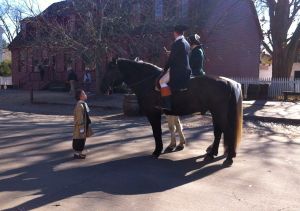
A young visitor finds both human and equine re-enactors equally fascinating and friendly on Duke of Gloucester street.
Related articles
To read my article on Williamsburg: A Winter Escape in 2011’s Mason-Dixon ARRIVE Magazine click HERE and scroll down == it is the third article on the page.
“A hit for me is if I enjoy the movie, if I personally enjoy the movie.”
-Ridley Scott
Cover of Alien (The Director’s Cut)
Ridley Scott was born on this day in South Shields, Tyme & Wear, England in 1937. He is 75 years old.
An army brat, Scott moved often as a child. He lived in Northern England, Wales, & Germany. He went to the Royal College of Art. Upon graduation he worked as a trainee set designer. Later he started Ridley Scott Associates with his brother Tony.
His first feature was The Duelists,but it was his second film, ALIEN, that made his name in film. He followed Alien with BLADE RUNNER. Next he named a big budget commercial for Apple Macintosh in 1984. 1991 brought THELMA AND LOUISE with Susan Sarandon and Geena Davis. GLADIATOR won 5 Academy Awards. He followed that with BLACK HAWK DOWN.
Other titles by Scott include:
A Good Year
American Gangster
Body of Lies
Robin Hood
G.I. Jane
In June of 2012 Scott released Prometheus, an Alien semi-prequel.
“I always knew I shouldn’t have said that.”
— Jon Stewart
Host Jon Stewart in the studio of The Daily Show in 2004 (Photo credit: Wikipedia)
Jonathan Stuart Leibowitz was born on this day in New York City, New York, USA in 1962. He is 50 years old today.
He grew up in Lawrenceville, New Jersey where he went to Lawrence High School. He went to William and Mary College in Williamsburg, Virginia where he majored in Chemistry before changing to Psychology. He graduated in 1984.
He worked in a number of jobs after graduation from contract administrator to bartender to puppeteer. He began stand up in 1987, adapting stage name Jon Stewart. He wrote for Caroline’s Comedy Houron TV then co-hosted the Short Attention Span Theatreon Comedy Central. MTV’s Jon Stewart Showfollowed.
When Craig Killborn left The Daily Show Stewart took his place behind the big desk. He has won 16 Emmy Awards for his work on The Daily Show.
“He looked like something that had gotten loose from Macy’s Thanksgiving Day Parade.”
–Harpo Marx
Adolph Marx was born on this day in New York City, New York, USA in 1888. Today is the 124th anniversary of his birth.
The second of five brothers in the Marx family, Adolph didn’t make it past second grade in school. He was small for his age and he was picked on by the bigger boys because he was Jewish. Two boys literally threw him out of the (first floor) classroom window on several occasions before he gave up and left school. He joined his brother Chico in doing odd jobs to help the family.
His uncle Al Schoenberg (stage name Al Shean) was in a Vaudeville act. His older brother Chico played piano, and his younger bother Julius (Groucho) was a boy soprano. Adolph joined Julius and Milton (Gummo) to form “the Three Nightingales” in 1910. Lou Levy joined them to make the group “The Four Nightingales.” When their mother, Minnie, and Aunt Hannah joined the act they changed the name to “The Six Mascots.”
The five Marx brothers with their parents in New York City, 1915. From left to right; Groucho, Gummo, Minnie (mother), Zeppo, Frenchy (father), Chico, and Harpo. (Photo credit: Wikipedia)
In 1911 he changed his name to Arthur because he didn’t like the sound of Adolph. He adopted the stage name of Harpo when his mother sent him a harp. He didn’t know how to tune it or play it. He didn’t even know how to hold it until he found an image of an angel holding a harp at the 5&10 store. He tuned it the best he could and taught himself to play.
At that point Harpo’s two-fold schtick — he “couldn’t talk” so he blew his horn or whistled to communicate; and he played the harp — was in place. (He could, in fact, talk. And he did so — a lot — off stage/scene. His “speaking career” stopped after he received a bad review for a largely ad-libbed performance in the play Home Again.)
A critic in the local newspaper described the show by saying, in part, “Adolph Marx performed beautiful pantomime which was ruined whenever he spoke.” Harpo then decided he could do a better job of stealing focus by not speaking. [The Marx Brothers; Harpo Marx from an article in Theatre Arts Monthly, October 1939]
The four Marx Brothers stowing away on an ocean vessel by hiding in barrels in this promotional still for Monkey Business. Left to right: Harpo, Zeppo, Chico, Groucho. (Photo credit: Wikipedia)
From the Vaudeville stage the Marx Brothers moved on to Hollywood. They made the short, Humor Risk, in 1921. (The film has since been lost.) Harpo was then in Too Many Kissesas the character “The Village Peter Pan.” He actually has a line in this movie, but, as it’s a silent film, you don’t actually hear him speak it. His brothers did not appear in the film.
In 1929 the brothers put out The Cocoanuts.The film was based on their Broadway play of the same name. In it…
the Marx Brothers run a hotel, auction off some land, thwart a jewel robbery, and generally act like themselves. [IMDB]
They shot during the day and performed in the stage show of Animal Crackers at night. It was an exhausting schedule and the Brothers were not happy with the result. They were “so appalled … that they offered to buy the negative from Paramount so that they could burn it.” [Ibid]
Marx Brothers, head-and-shoulders portrait, facing front. Top to bottom: Chico, Harpo, Groucho and Zeppo. (Photo credit: Wikipedia)
The Brothers made Animal Crackers,Horse Feathers , Duck Soup, A Night at the Opera, A Day at the Races, Room Service, At the Circus, Go West, The Big Store, A Night in Casablanca, and Love Happy in quick succession.
Starting in 1952 Harpo started doing guest spots on Television, most notably on the I Love Lucy Show.
His last film was The Story of Mankindin 1957. He played Sir Isaac Newton.
Off screen Harpo, the elementary school drop out, rubbed shoulders with some pretty high level literary types. In the 1920’s he held his own at the Algonquin Round Table with writers such as George S. Kaufman and Dorothy Parker. In 1928 he spent the summer on the French Riviera with George Bernard Shaw.
He attributes his welcome hanging out with the fast literary crowd at the Algonquin Round Table in New York in the 1920s to his ability to listen — in fact, to being the one real listener in that set. [Robert Wilfred Franson’s review of Harpo Speaks]
In 1933 Harpo did a 6-week goodwill mission in the Soviet Union. He was the “first American to perform in the Soviet Union after the United States government officially recognized it.” [Harpo’s Place] According to his autobiography, Harpo Speaks, the trip was part performance and part spy caper. He smuggled papers out of the USSR by taping them to his leg.
Marx died while having open-heart surgery on September 28, 1964.
Here’s a clip of Harpo actually speaking (and honking):
“It is from numberless diverse acts of courage and belief that human history is shaped. Each time a man stands up for an ideal, or acts to improve the lot of others, or strikes out against injustice, he sends forth a tiny ripple of hope.”
“People say I am ruthless. I am not ruthless. And if I find the man who is calling me ruthless, I shall destroy him.”
“I believe that, as long as there is plenty, poverty is evil.”
“Ultimately, America’s answer to the intolerant man is diversity, the very diversity which our heritage of religious freedom has inspired.”
—Robert F. Kennedy
Robert F. Kennedy, Cabinet Room, White House, Washington, DC. (Photo credit: Wikipedia)
Robert Francis Kennedy was born on this day in Brookline, Massachusetts in 1925. Today is the 87th anniversary of his birth.
He was the seventh of nine Kennedy children, the third son. The family split their time between New York and their summer home in Hyannis Port, Massachusetts. Bobby attended public schools until 6th grade. He went to a series of private schools including a Benedictine boarding school for boys and Milton Academy.
Shortly before he turned 18 he enlisted in the US Naval Reserve. He participated in the V-12 Navy College Training Program at Harvard and Bates College from 1944 to 1946 and served on the USS Joseph P. Kennedy, Jr, a destroyer named after his brother, on it’s shakedown cruise in the Caribbean. He was honorably discharged later that year. He then went on to the University of Virginia Law School.
English: Kennedy brothers; left to right John, Robert, Ted. Česky: Bratři Kennedyové – vlevo John F., uprostřed Robert F. (Photo credit: Wikipedia)
In 1952 he managed John F. Kennedy’s run for U.S. Senate. His brother won the Senate seat and Robert Kennedy served
briefly on the staff of the Senate Subcommittee on Investigations, chaired by Senator Joseph McCarthy. Disturbed by McCarthy’s controversial tactics, Kennedy resigned from the staff after six months. He later returned to the Senate Subcommittee on Investigations as chief counsel for the Democratic minority, in which capacity he wrote a report condemning McCarthy’s investigation of alleged Communists in the Army. [John F. Kennedy Presidential Library & Museum]
Next he tackled corruption in trade unions as Chief Counsel for the Senate Rackets Committee. His book The Enemy Within details the corruption he confronted with the Teamsters and other unions.
In 1956 he was an aide to Democratic presidential nominee Adlai Stevenson. Stevenson lost, but the experience was good training. Bobby took the reigns again for his brother’s bid for the presidency against Richard Nixon in 1960. When John Kennedy won he made Bobby the Attorney General.
He fought organized crime and “became increasingly committed to helping African-Americans win the right to vote.” [Ibid] In a 1961 speech in Georgia he said:
“We will not stand by or be aloof. We will move. I happen to believe that the 1954 [Supreme Court school desegregation] decision was right. But my belief does not matter. It is the law. Some of you may believe the decision was wrong. That does not matter. It is the law.” [Ibid]
He worked with the administration to create the Civil Rights Act of 1964.
Attorney General Robert F. Kennedy speaking to a crowd of African Americans and whites through a megaphone outside the Justice Department; sign for Congress of Racial Equality is prominently displayed. (Photo credit: Wikipedia)
He was also instrumental in foreign affairs including the Berlin Crisis of 1961 and the Cuban Missile Crisis of 1962.
John F. Kennedy was assassinated in Dealey Plaza, Dallas, Texas on November 22, 1963. Robert Kennedy was devastated by the death of his brother and friend. He even felt guilt — had his aggressive pursuit against organized crime and obsession to “get” Castro some how brought this about? [I won’t even attempt to resolve the myriad of conspiracy theories here. Suffice it to say Bobby was not the same man after the death of his brother.]
He resigned from his post as Attorney General nine months after the assassination and began a run for U.S. Senate. He won the seat.
He climbed Mount Kennedy, a mountain that was named for his brother and the highest peak in Canada that had not be summited, in 1965.
In 1966 he went to South Africa to speak out against the Apartheid government. He dared to ask “Supposed God is black? What if we go to Heaven and we, all our lives, have treated the Negro as an inferior, and God is there, and we look up and He is not white? What then is our response?”
As Senator he also spoke out against the Vietnam War, continued to work for Civil Rights and the War on Poverty.
He sought to remedy the problems of poverty through legislation to encourage private industry to locate in poverty-stricken areas, thus creating jobs for the unemployed, and stressed the importance of work over welfare. [John F. Kennedy Presidential Library & Museum]
On March 16, 1968 he declared his bid for the Presidency. His platform was based on racial and economic justice, he was also anti-war
…he challenged the complacent in American society and sought to bridge the great divides in American life – between the races, between the poor and the affluent, between young and old, between order and dissent. His 1968 campaign brought hope to an American people troubled by discontent and violence at home and war in Vietnam.[Ibid]
When Martin Luther King, Jr. was assassinated in April of 1968 Kennedy found out about it minutes before he was to give a speech in downtown Indianapolis. He could have gotten back in his limo and let some one else make the announcement to a crowd that was certain to be upset by the news, but he stepped in front of the inner city crowd and gave an impromptu speech calling for reconciliation between the races.
Many other American cities burned after King was killed. But there was no fire in Indianapolis, which heard the words of Robert Kennedy… a well-organized black community kept its calm. It’s hard to overlook the image of one single man, standing on a flatbed truck, who never looked down at the paper in his hand — only at the faces in the crowd. [NPR.org]
Kennedy also fell victim to an assassin’s bullet. He was fatally shot at the Ambassador Hotel in Los Angeles, California on June 5, 1968. He had just won California’s Democratic Primary.
The Robert F. Kennedy Memorial (Photo credit: Bernt Rostad)
[One of my earliest real memories is watching the train that carried Robert Kennedy’s body to its Arlington National Cemetery. My parents had taken us all on a picnic at the the ball field near the train tracks. We weren’t the only family there, there were lots of kids playing and other families on blankets eating cold chicken and potato salad. Then a train rolled through and all the adults stood up and faced the tracks. We kids didn’t need to be hushed. My mother was silently crying. I took her hand and asked her what was going on. As the flag festooned final car passed she whispered “A great American is on that train.” And then it was over. We packed up the picnics. No one was hungry or wanted to play any more.]
[Do you have a Bobby Kennedy story? Share it with us please.]

![Moreno in 2009. [Image courtesy NOVA Southeastern University.]](https://ritalovestowrite.com/wp-content/uploads/2012/12/rita_moreno.jpg?w=490)
!["Welcome, Christmas! Fah who rahmus!" [The Whoville Christmas Song]](https://ritalovestowrite.com/wp-content/uploads/2012/12/pink-tree.jpg?w=335&h=448)
![A flower of white at one end of the installation. [Detail.]](https://ritalovestowrite.com/wp-content/uploads/2012/12/laguna-torcella-detail-1.jpg?w=490&h=365)
![Colorful middle portion of Laguna Torcello. [Detail.]](https://ritalovestowrite.com/wp-content/uploads/2012/12/laguna-detail-2.jpg?w=490)








 ritaLOVEStoWRITE