Category Archives: United States

Thought of the Day 7.29.12 Ken Burns

“Good history is a question of survival. Without any past, we will deprive ourselves of the defining impression of our being.”

–Ken Burns
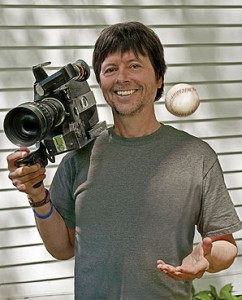
His family, including his brother Ric Burns, who is also a documentary film maker, traveled often through out Europe and the North East US. They settled in Ann Arbor.  Burns enjoyed reading, especially history. For his 17th birthday he got an 8mm movie camera and made his first documentary (it was about a factory in Ann Arbor.)  He attended Hampshire College in Amherst, MA. He Graduated in 1975 and co-founded Florentine Films in 1976 with Roger Sherman, Buddy Squires and Larry Hott.

Burns’ work as a director, writer, producer, cinematographer, and film music director began in earnest in 1977  when he started work on a documentary based on the book The Great Bridge by David McCullough.  The result, Brooklyn Bridge (1981) brought Burns an Academy Award nomination. He followed that success with 23 (and counting) award winning documentaries most of which saw their debut on PBS.

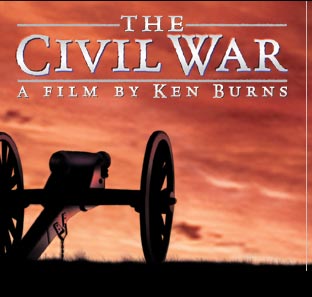
His break out series was the 11 hour  The Civil War which first ran in 1990. Burns used over 16,000 photographs  and archival images. He had first person narratives (mostly letters) read by different actors, giving each historic figure their on personality in the film. He had live interviews with noted historians. And the finishing touch was the music — a mix of Civil War era tunes and the haunting theme song, Jay Unger’s Ashokan Farewell.  The Civil War won two Emmy Awards, two Grammy Awards, a Peabody Award,  a Producers Guild of America Award, a People’s Choice Award and a slew of other accolades.
 

Films by Ken Burns:

  • The Shakers: Hands to Work, Hearts to God
  • The Statue of Liberty (which also received an Oscar nomination)
  • Huey Long
  • The Congress
  • Thomas Hart Benton
  • The Civil War
  • Empire of the Air: The Men Who Made Radio
  • Baseball
  • The West
  • Thomas Jefferson
  • Lewis & Clark: the Journey of the Corps of Discovery
  • Frank Lloyd Wright
  • Not for Ourselves Alone: Elizabeth Cady Stanton and Susan B. Anthony
  • Jazz
  • Mark Twain
  • Horatio’s Drive: America’s First Road Trip
  • Unforgivable Blackness: The Rise and Fall of Jack Johnson
  • The War
  • The National Parks: America’s Best Idea
  • The 10th Inning
  • Prohibition
  • The Dust Bowl

Films in production include:

  • The Central Park Five
  • The Roosevelts
  • Jackie Robinson
  • Vietnam
  • Country Music
  • Ernest Hemingway

The Baltimore Sun’s Media Critic, David Zurawik, has called Burns “… not only the greatest documentarian of the day, but also the most influential filmmaker period. ”


Thought of the Day 7.22.12

“Give me your tired, your poor,
Your huddled masses yearning to breathe free,
The wretched refuse of your teeming shore.
Send these, the homeless, tempest-tost to me,
I lift my lamp beside the golden door!”

Emma Lazarus

Engraving

Engraving (Photo credit: Wikipedia)

Emma Lazarus was born in New York City in 1849. Today is the 163 anniversary of her birth.

She was the middle of seven children born to Moses and Ester Lazarus. The family lived very comfortably in the Union Square neighborhood of the city. They had ties to some of the earliest Jewish American families and were part of the Jewish upper class. She received a classical education and excelled in German and French, she loved to write and translate poems.

As antisemitism began to rise in Europe and America, Lazarus became more and more involved in the fight against it. As the Russian Pogroms caused large numbers of Jews to immigrate to the US she became more outspoken on refugee issues.

She wrote “The New Colossus”  for an auction to help pay for the pedestal for the Statue of Liberty. (France had donated the statue, the US had to come up with the money for the pedestal.) The sonnet perfectly exemplified the Mother of Exiles in the the New York Harbor. The poem was engraved into the Statue of Liberty’s base after Lazarus’ death.


She was an accomplished writer, publishing books of poetry, a novel, a play, and several translations for the American market. She sought out Emerson as her mentor, and the two shared a long friendship.

"I lift my lamp. . .

“I lift my lamp. . . (Photo credit: ckaiserca)


Thought of the Day 7.21.12

“Life is like a movie-since there aren’t any commercial breaks, you have to get up and go to the bathroom in the middle of it.”

–Garry Trudeau

English: Garry Trudeau. I took this photo on N...

English: Garry Trudeau. November 9, 1999 at Tufts University  (Photo credit: Wikipedia)

Garry Trudeau was born in New York City on this day in 1948. He is 64 years old.

He grew up near Saranac Lake in upstate New York. He went to Yale where he earned a BA and MFA in Graphic Design in 1973. (YEAH Graphic Design.) He drew a comic strip, Bull Tales,  for Yale Daily News. He later became the editor and chief of the school newspaper.

His most famous work Doonesbury was syndicated in 1970. Today over 1400 outlets, both in print and online carry the strip. In 1975 Doonesbury won a Pulitzer, the first comic strip to do so.

The first Doonesbury cartoon, from October 26,...

The first Doonesbury cartoon, from October 26, 1970. (Photo credit: Wikipedia)

The Doonesbury was made into a short film that was nominated for an Oscar, an animated TV special and a Broadway musical (Trudeau wrote the book and lyrics, Elizabeth Swados composed the music). Rap Master Ronnie brought Trudeau and Swados together again, this time in 1984 to satirize the Reagan White House years. The show was filmed and broadcast on Cinemax in 1988. That same year Trudeau worked with Robert Altman to satirize the election campaign with Tanner ’88 for HBO. Tanner ’88 won an Emmy Award.

Illustration from The Sandbox blog on Slate.com

He  established The Sandbox, a …

forum for service members currently deployed to Iraq and Afghanistan (and serving elsewhere in the GWOT), returned vets, spouses and caregivers. …The unclassified details of deployment — the everyday, the extraordinary, the wonderful, the messed-up, the absurd.

In 2005 B.D. one of his main characters in Doonesbury was seriously injured in the Battle for Fallujah the  Pentagon invited Trudeau to Walter Reed Medical Center to visit the troops. Trudeau accepted and has been working with the wounded warriors since.  His book “The Long Road Home: One Step at a Time” chronicles  B.D.’s slow convalescence.

Trudeau lives with his wife Jane Pauley in New York City.

Interested in more Garry Trudeau quotes? Try BrainyQuote or Thinkexist.com. Those sites, along with my trusty Bartlett’s Famous Quotes, are my go-to sources for “THOUGHT” fodder.


Thought of the Day 7.12.12

“There is no remedy for love but to love more.”

–Henry David Thoreau

Henry David Thoreau was born Concord Massachuset 1817. This is the 195th anniversary of his birth. 

Thoreau was an abolitionist, a naturalist,  a lecturer, a historian, a teacher, a surveyor, a pencil maker  and a writer.  He was inspired by his friend Emerson.. 

Thoreau made most of his money through surveying. He wrote that surveying “seems a noble employment  which brings you within hearing of [the birds].” He also helped to make Thoreau & Co., his family’s pencil making company one of the best in the America when he  developed a way of mixing clay with graphite to make a superior, “smudge-free” pencil. 

Thoreau loved nature. He would take long walks in the woods and he collected specimens of herbs, leaves and flowers, storing along the way. He stored them in his hat until he got home.,  then he or his sister Sophia carefully press them. He carried a notched stick that acted as both walking stick and a measuring stick. He also brought along a copy of Alexander Wilson’s bird anthology to identify the birds in the trees.  In 1845 he built his own cabin near  Walden Pond, on property owned by Emerson,  and lived for two years. His goal was to “live deliberately, to front only the essential facts of life, and see if I could not learn what I had to teach.”   He wrote about his time there in A week on the Concord and Merrimack Rivers (a memorial to his late brother) and, after seven full drafts,  Walden.

His work as an abolitionist  included “Slavery in Massachusetts, and a trio of essays about John Brown. 

English: Portrait drawing of Henry David Thoreau

English: Portrait drawing of Henry David Thoreau (Photo credit: Wikipedia)


Thought of the Day 7.11.12

“If your actions inspire others to dream more, learn more, do more and become more, you are a leader.”

–John Quincy Adams

English: John Quincy Adams

English: John Quincy Adams (Photo credit: Wikipedia)

John Quincy Adams was born in Braintree, Massachusetts in 1767. Today is the 245th anniversary of his birth.

Eldest son of John and Abigail Adams, John Quincy grew up a child of the Revolution. His father was THE voice calling for  Independence from Britain in the Continental  Congress.  When he was 8 years old he watched the Battle of Bunker Hill from his parent’s farm.

After the War he travelled with his father to Europe, acting as his secretary. He attended Harvard and became a lawyer and at 26 was appointed Minister to the Netherlands. He became a US Senator in 1802 and when his term was up he was appointed as Minister to Russia by President Madison.  His international service to the US included the negotiation of numerous treaties including the Treaty of Ghent (that ended the War of 1812.) While Secretary of State under President Monroe he nailed down America’s border with Canada as far as the Pacific Ocean and was instrumental in forming the Monroe Doctrine and acquiring Florida from Spain.

The Presidential election in 1824 was decided in the House of Representatives. Since no candidate had garner a majority of the electoral votes  in the popular count it  was a three-way run off between JQ Adams, Andrew Jackson and Henry Clay. Clay’s platform was similar to Adams’ so he ceded his support to Quincy. Adams in turn named Clay as Secretary of State. Jackson, left out in the cold, raised angry cries of “corrupt bargaining” and began an aggressive campaign to gain the White House in 1828.

As President, Quincy started the first system of interstate roads and canals (breaking ground for the C&O Canal in 1828), he worked to modernize the US economy and paid off much of the National Debt,  encouraged the arts and sciences with a national university, scientific expeditions and an observatory. But he was thwarted on many of his initiatives by an uncooperative Congress.

In 1828 he was defeated in his bid for a second term after a bitter and messy campaign against Jackson and returned to his beloved Massachusetts only to be unexpectedly elected to the US House of Representative in 1830. He is the only  man to have served first as President and then in the House of Representatives, but his 17 years in the House were far more successful than his 4 years in the White House. Ever a stalwart proponent of civil liberties, Adams now became a leading voice against Slavery. He fought against the “gag rule”   — a resolution that automatically tabled any petition having to do with Slavery without review — by attempting to use parliamentary procedures to circumvent the rule. Eventually enough Congressmen from the North came down on the side of  antislavery and freedom of expression, and Adam’s argument gained favor. In 1844, after 8 years of fighting against it, the House rescinded the “Gag Rule” on a motion made by John Quincy Adams.

In 1840 Adams, “Old Man Eloquent,”  argued successfully for the defendants in the  Amistad case in front of the Supreme Court.

JQ Adams suffered a stroke while on the floor of the House of Representatives. He was taken to the Speaker’s Chambers and died four days later.

John Quincy Adams portrait. "John Quincy ...

John Quincy Adams portrait. “John Quincy Adams”. Metropolitan Museum of Art . . Retrieved September 4, 2009 . (Photo credit: Wikipedia)


Hey Brother, can you spare 5 CENTS?

I’ve been thinking about the National Debt.

And I’ve been thinking about how much money is going to be spent by the candidates in both parties to get IN this Election this year.

President Obama and Governor Romney are both projected to spend at least a Billion dollars in their run for President. And billions more will be spent by those seeking office in Congress and on a state level.

We may never know how much the Super Packs spend to support the candidates and issues that they favor.

I propose that anyone running for public office (and any super pack) give 5 CENTS of every dollar they spend in advertising, polling, telemarketing, research, lawn signs… what ever… 5 cents out of ever dollar that they spend to get to the White House (or Congress or the Governor’s House) to pay down the NATIONAL DEBT.

I don’t think it should be a tax. I think it should be a good will offering.  They could declare it when the report how much they’ve received in donations… then cut a check to the IRS.

Its simple. If you’d like to represent me (and the other citizens of the United States), then I think you should put your money where your mouth is by giving a measly 5 cents per buck  you spend getting into office to help pay off the National Debt.

Do that…and you can proudly proclaim it during your next stump speech or at your next debate. Your really ARE doing something to pay down the Debt!

Do that… and you can use my nifty little logo on your advertising and stuff.

I know that even 5% of all the money spent on this election will not solve the Debt crisis, but at least it will put 5% of ALL THAT MONEY to some good use.


Feel free to repost to you favorite candidate’s site. Come on…lets get THIS party started.


Thought of the Day 7.8.12

“He had delusions of adequacy.”

Walter Kerr

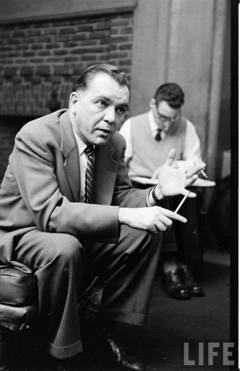
Walter Kerr was born today in Evanston, Illinois  in 1913. He would have been 99.

Kerr was a mid 20th Century New  York theatre critic, director and author. His sharp, witty reviews could make or break a Broadway show and he won a Pulitzer Prize for Criticism. Kerr also put his money where his mouth is– producing work for the stage as a writer and director. With his wife Jean Kerr he wrote Goldilocks, which won the 1958 Tony Award. Kerr directed the production. He also directed Touch and Go andKing of Hearts.

His books include How Not to Write a Play, Criticism and Censorship, The Theatre in Spite of Itself, and Thirty Plays Hath November.

In 1990 Broadway gave Kerr the ultimate honor. It named a theater after him. The old Ritz Theatre at 218 West 48th Street was renovated and reopened the Water Kerr Theatre. It opened to August Wilson’s The Piano Lesson and has since house six Tony Award Winning Plays.

Marquee of the Walter Kerr Theatre, advertisin...

Marquee of the Walter Kerr Theatre, advertising Christine Ebersole in Grey Gardens 218 West 48th Street, Manhattan, New York (Photo credit: Wikipedia)


Thought of the Day 7.6.12

“I have not yet begun to fight”

John Paul Jones

John Paul was born in Arbigland Scotland in 1747. Today is the 265 anniversary of his birth.

At 13 he started his seaman’s apprenticeship. After a brief stint on Slave Ships — which he quit calling it an “abominable trade” — and time as a Master Supercargo (the officer in charge of buying and selling the cargo of a ship), Paul became a captain at 21.  He worked the trans Atlantic routes to the Caribbean and Virginia and amassed a small fortune in the merchant marine business by 1773, but his hot temper got him into trouble more than once. And when he killed a mutineer in the West Indies he had to flee to Virginia. It was then that he changed his name to John Paul Jones.

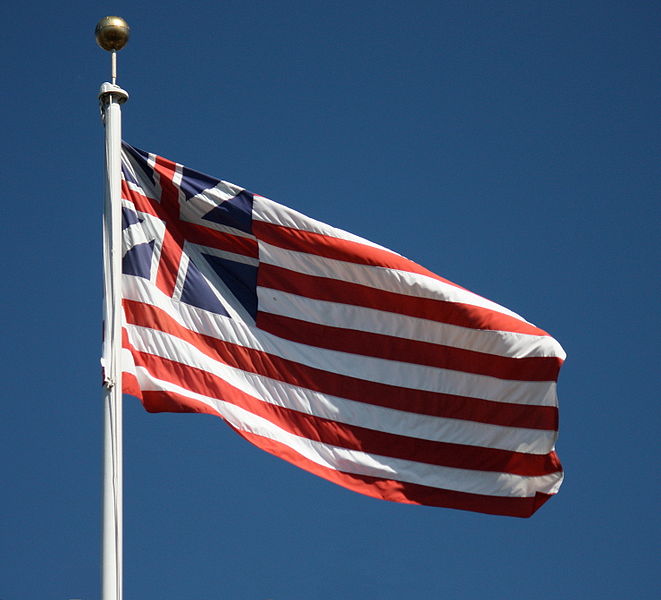
War with England was brewing and John Paul Jones offered his services on the sea. With the endorsement of Richard Henry Lee, Jones was commissioned as a First Lieutenant into the vast Continental Navy (they only had six vessels) on December 7th, 1775. As his ship, the Alfred set sail from the Delaware River on its maiden cruise he hosted the Grand Union Flag, (the first national flag of the United States,) it was the first time a US ensign was flown over a naval vessel. He next took command of the sloop Providence. He captured 16 prizes along the coast of Nova Scotia. Although he argued with Naval authorities, his reputation grew, he was given command of the USS Ranger and set sail for France. There he befriended American diplomats in Paris John Adams, Arthur Lee, and especially Benjamin Franklin (he named one of his boat the Bonhomme Richard in honor of Franklin’s Poor Richard’s Almanac.)  When the Bonhomme Richard was in dire straights in the Battle of Flamborough Head with the frigate Serapis he was offered the chance to surrender. Jones, of course answered that he had not yet begun to fight. He lost the Richard, but went on to capture the larger frigate.  Jones later earned the moniker  “Father of the American Navy.”

After the American Revolutionary War  Thomas Jefferson (who was then the American Ambassador to France) recommended him for service in Catherine II’s  Russian Navy. John Paul Jones then became Kontradmiral check Pavel Ivanovich Jones and served with Potemkin in the Black Sea campaign.

John Paul Jones, line drawing

John Paul Jones, line drawing (Photo credit: Wikipedia)

This media file is in the public domain in the United States. This applies to U.S. works where the copyright has expired, often because its first publication occurred prior to January 1, 1923.

A replica of the Grand Union Flag, the first flag of the United States of America.
(This image has been released into public domain by its author, Makaristos, and is courtesy Wikipedia.)


Public domain I, the copyright holder of this work, release this work into the public domain. This applies worldwide.
In some countries this may not be legally possible; if so:
I grant anyone the right to use this work for any purpose, without any conditions, unless such conditions are required by law.

Today’s Thought 7.4.12

“…We hold these Truths to be self-evident, that all Men are created equal, that they are endowed by their CREATOR with certain unalienable Rights, that among these are Life, Liberty and the Pursuit of Happiness…”

–The Declaration of Independence

Independence Hall, Philadelphia, PA

The Declaration of Independence  was adopted by the Second Continental Congress on this date in 1776. It is 236 years old.

The document was written by Thomas Jefferson with help from the “Committee of Five” (Jefferson, John AdamsBenjamin Franklin, Robert Livingston, and Roger Sherman). It announced that the thirteen American colonies had severed ties from the British Empire.

The interior of Independence Hall. This is the room where the Second Continental Congress signed the Declaration of Independence on July 4, 1776.

For the full text of the Declaration of Independence go HERE.  Links to the full text of the Constitution and the Bill of Rights can also be found on that page.