Category Archives: Today’s Birthday

Thought of the Day 7.13.12

“All bad precedents begin as justifiable measures”

–Julius Caesar

Gaius Julius Caesar was born in Rome on this day in 100 BC.

He was a soldier, statesman and writer. After impressive victories on the battlefield Caesar turned to politics. He entered into a power sharing governorship, the First Triumvirate with Marcus Licinius Crassus and Gnaeus Pompeius Magnus (Pompey). Caesar proposed social reforms including the distribution of land to the poor (always popular with masses, but not so popular with the ruling class).

He went back to the provinces and looked toward unconquered territory to grow Rome’s (and his own) coffers. He conquered Gaul building a bridge to cross the Rhine and  invaded Britain. All the while his popularity with the people grew.

With the death of Crassus the Triumvirate was in trouble. Pompey was appointed sole consul. Caesar was told to disband his army  and return to Rome, but if he entered the city with out the immunity of a magistrate he could be prosecuted by his political enemies. Pompey accused him of insubordination and treason.  And when Caesar and his 13th Legion crossed the Rubicon the die was cast. Civil war ensued, and Caesar emerged the victor. He was appointed Dictator but after being elected to a second consulship he resigned as dictator.

Pompey had fled to  Egypt and Caesar went in pursuit. There he met the beautiful co-regent Cleopatra. The two became romantically involved, but, according to Roman law, could not get married. However their relationship continued for over a decade.

Caesar was assassinated on the floor of the Roman Senate by his political enemies on the Ides of March in 44 Ad.


Bust of Marcus Licinius Crassus located in the...

Bust of Marcus Licinius Crassus located in the Louvre, Paris (Photo credit: Wikipedia)


Thought of the Day 7.12.12

“There is no remedy for love but to love more.”

–Henry David Thoreau

Henry David Thoreau was born Concord Massachuset 1817. This is the 195th anniversary of his birth. 

Thoreau was an abolitionist, a naturalist,  a lecturer, a historian, a teacher, a surveyor, a pencil maker  and a writer.  He was inspired by his friend Emerson.. 

Thoreau made most of his money through surveying. He wrote that surveying “seems a noble employment  which brings you within hearing of [the birds].” He also helped to make Thoreau & Co., his family’s pencil making company one of the best in the America when he  developed a way of mixing clay with graphite to make a superior, “smudge-free” pencil. 

Thoreau loved nature. He would take long walks in the woods and he collected specimens of herbs, leaves and flowers, storing along the way. He stored them in his hat until he got home.,  then he or his sister Sophia carefully press them. He carried a notched stick that acted as both walking stick and a measuring stick. He also brought along a copy of Alexander Wilson’s bird anthology to identify the birds in the trees.  In 1845 he built his own cabin near  Walden Pond, on property owned by Emerson,  and lived for two years. His goal was to “live deliberately, to front only the essential facts of life, and see if I could not learn what I had to teach.”   He wrote about his time there in A week on the Concord and Merrimack Rivers (a memorial to his late brother) and, after seven full drafts,  Walden.

His work as an abolitionist  included “Slavery in Massachusetts, and a trio of essays about John Brown. 

English: Portrait drawing of Henry David Thoreau

English: Portrait drawing of Henry David Thoreau (Photo credit: Wikipedia)


Thought of the Day 7.11.12

“If your actions inspire others to dream more, learn more, do more and become more, you are a leader.”

–John Quincy Adams

English: John Quincy Adams

English: John Quincy Adams (Photo credit: Wikipedia)

John Quincy Adams was born in Braintree, Massachusetts in 1767. Today is the 245th anniversary of his birth.

Eldest son of John and Abigail Adams, John Quincy grew up a child of the Revolution. His father was THE voice calling for  Independence from Britain in the Continental  Congress.  When he was 8 years old he watched the Battle of Bunker Hill from his parent’s farm.

After the War he travelled with his father to Europe, acting as his secretary. He attended Harvard and became a lawyer and at 26 was appointed Minister to the Netherlands. He became a US Senator in 1802 and when his term was up he was appointed as Minister to Russia by President Madison.  His international service to the US included the negotiation of numerous treaties including the Treaty of Ghent (that ended the War of 1812.) While Secretary of State under President Monroe he nailed down America’s border with Canada as far as the Pacific Ocean and was instrumental in forming the Monroe Doctrine and acquiring Florida from Spain.

The Presidential election in 1824 was decided in the House of Representatives. Since no candidate had garner a majority of the electoral votes  in the popular count it  was a three-way run off between JQ Adams, Andrew Jackson and Henry Clay. Clay’s platform was similar to Adams’ so he ceded his support to Quincy. Adams in turn named Clay as Secretary of State. Jackson, left out in the cold, raised angry cries of “corrupt bargaining” and began an aggressive campaign to gain the White House in 1828.

As President, Quincy started the first system of interstate roads and canals (breaking ground for the C&O Canal in 1828), he worked to modernize the US economy and paid off much of the National Debt,  encouraged the arts and sciences with a national university, scientific expeditions and an observatory. But he was thwarted on many of his initiatives by an uncooperative Congress.

In 1828 he was defeated in his bid for a second term after a bitter and messy campaign against Jackson and returned to his beloved Massachusetts only to be unexpectedly elected to the US House of Representative in 1830. He is the only  man to have served first as President and then in the House of Representatives, but his 17 years in the House were far more successful than his 4 years in the White House. Ever a stalwart proponent of civil liberties, Adams now became a leading voice against Slavery. He fought against the “gag rule”   — a resolution that automatically tabled any petition having to do with Slavery without review — by attempting to use parliamentary procedures to circumvent the rule. Eventually enough Congressmen from the North came down on the side of  antislavery and freedom of expression, and Adam’s argument gained favor. In 1844, after 8 years of fighting against it, the House rescinded the “Gag Rule” on a motion made by John Quincy Adams.

In 1840 Adams, “Old Man Eloquent,”  argued successfully for the defendants in the  Amistad case in front of the Supreme Court.

JQ Adams suffered a stroke while on the floor of the House of Representatives. He was taken to the Speaker’s Chambers and died four days later.

John Quincy Adams portrait. "John Quincy ...

John Quincy Adams portrait. “John Quincy Adams”. Metropolitan Museum of Art . . Retrieved September 4, 2009 . (Photo credit: Wikipedia)


Thought of the Day 7.10.12


“The real voyage of discovery consists not in seeking new landscapes but in having new eyes.”

Marcel Proust

Valentin Louis Georges Eugène Marcel Proust  was born in  Auteuil, France  1871.Today is the 141st anniversary of this birth.

[I’m writing today — real stuff that I might get paid for one day — and don’t have time to do the usual research / write up for my Thought of the Day birthday boy or girl. Instead I’ll let Proust speak for himself. Here’s a questionnaire he filled out at a social event when he was 20 years old. Looks like something that would be on Facebook, doesn’t it? Hmmmm I wonder how we’d answer some of these questions…]


Türkçe: en:wiki'den

Türkçe: en:wiki’den (Photo credit: Wikipedia)


  • Your most marked characteristic?
      A craving to be loved, or, to be more precise, to be caressed and spoiled rather than to be admired
  • The quality you most like in a man?
      Feminine charm
  • The quality you most like in a woman?
      A man’s virtues, and frankness in friendship
  • What do you most value in your friends?
      Tenderness – provided they possess a physical charm which makes their tenderness worth having
  • What is your principle defect?
      Lack of understanding; weakness of will
  • What is your favorite occupation?
      Loving
  • What is your dream of happiness?
      Not, I fear, a very elevated one. I really haven’t the courage to say what it is, and if I did I should probably destroy it by the mere fact of putting it into words.
  • What to your mind would be the greatest of misfortunes?
      Never to have known my mother or my grandmother
  • What would you like to be?
      Myself – as those whom I admire would like me to be
  • In what country would you like to live?
    One where certain things that I want would be realized – and where feelings of tenderness would always be reciprocated
  • What is your favorite color?
      Beauty lies not in colors but in thier harmony
  • What is your favorite flower?
      Hers – but apart from that, all
  • What is your favorite bird?
      The swallow
  • Who are your favorite prose writers?
      At the moment, Anatole France and Pierre Loti
  • Who are your favoite poets?
      Baudelaire and Alfred de Vigny
  • Who is your favorite hero of fiction?
      Hamlet
  • Who are your favorite heroines of fiction?
      Phedre (crossed out) Berenice
  • Who are your favorite composers?
      Beethoven, Wagner, Shuhmann
  • Who are your favorite painters?
      Leonardo da Vinci, Rembrandt
  • Who are your heroes in real life?
      Monsieur Darlu, Monsieur Boutroux (professors)
  • Who are your favorite heroines of history?
      Cleopatra
  • What are your favorite names?
      I only have one at a time
  • What is it you most dislike?
      My own worst qualities
  • What historical figures do you most despise?
      I am not sufficiently educated to say
  • What event in military history do you most admire?
      My own enlistment as a volunteer!
  • What reform do you most admire?
      (no response)
  • What natural gift would you most like to possess?
      Will power and irresistible charm
  • How would you like to die?
      A better man than I am, and much beloved
  • What is your present state of mind?
      Annoyance at having to think about myself in order to answer these questions
  • To what faults do you feel most indulgent?
      Those that I understand
  • What is your motto?
        I prefer not to say, for fear it might bring me bad luck.

For more on the Proust questionnaire and to see one he took when he was a child click here.


Thought of the Day 7.9.12

“If it wasn’t hard, everyone would do it. It’s the hard that makes it great.”

Tom Hanks

Tom Hanks was born in Concord, California, in 1956. He is 56 years old.

Hanks is an actor, director and producer. He started his acting career in the sitcom Bosom Buddies in the early 1980s. His first movie hit was SPLASH. Next came BIG in which he  seemed to both lampoon and perfect his man/child image with sweetness and charm. He left both qualities home when he played the gruff manager of an all-woman baseball team in A League of Their Own in 1992 and we learned that “there is NO crying in baseball.” He took on the role of leading rom.com. man in Sleepless in Seattle in 1993.

Hanks has since proved that he can easily handle both tough, serious roles as well as comedies with layered performances in Philadelphia, Forrest Gump, Apollo 13, That Thing You Do, Saving Private Ryan, You’ve Got Mail, Cast Away,  The Road to Perdition, The Terminal, Charlie Wilson’s War,  The Da Vinci Code, Angels and Demons, and Extremely Loud and Incredibly Close.

He has lent his voice to several animated characters, most notably Woody from the Toy Story franchise.

He expanded on two of his most popular films (Apollo 13 and Saving Private Ryan) by co-producing and directing  HBO miniseries with similar content. From Earth to the Moon followed the Apollo missions from Sputnik to Apollo 17.  Band of Brothers retold the story of “Easy” Company’s WWII European campaign. He later Executive Produced The Pacific which followed three Marines in the fight against Japan in that War.

Tom Hanks

Tom Hanks (Photo credit: Alan Light)


Thought of the Day 7.8.12

“He had delusions of adequacy.”

Walter Kerr

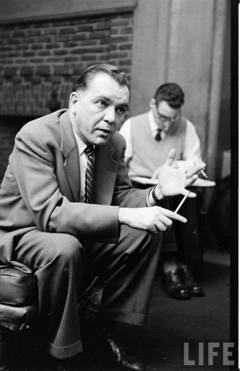
Walter Kerr was born today in Evanston, Illinois  in 1913. He would have been 99.

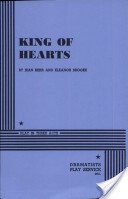
Kerr was a mid 20th Century New  York theatre critic, director and author. His sharp, witty reviews could make or break a Broadway show and he won a Pulitzer Prize for Criticism. Kerr also put his money where his mouth is– producing work for the stage as a writer and director. With his wife Jean Kerr he wrote Goldilocks, which won the 1958 Tony Award. Kerr directed the production. He also directed Touch and Go andKing of Hearts.

His books include How Not to Write a Play, Criticism and Censorship, The Theatre in Spite of Itself, and Thirty Plays Hath November.

In 1990 Broadway gave Kerr the ultimate honor. It named a theater after him. The old Ritz Theatre at 218 West 48th Street was renovated and reopened the Water Kerr Theatre. It opened to August Wilson’s The Piano Lesson and has since house six Tony Award Winning Plays.

Marquee of the Walter Kerr Theatre, advertisin...

Marquee of the Walter Kerr Theatre, advertising Christine Ebersole in Grey Gardens 218 West 48th Street, Manhattan, New York (Photo credit: Wikipedia)


Thought of the Day 7.7.12

“I like Beethoven, especially the poems.”

Ringo Starr

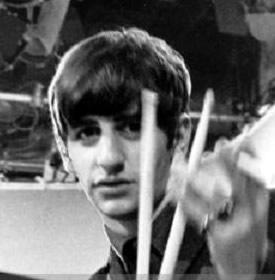
Richard Starkey was born today in Liverpool, England  in 1940. He is 72 years old.

For those of you who may not have turned on a radio in the last 50 years… Richard  Starkey is better known by his alias Ringo Starr. Starr was the drummer for the 1960’s rock and roll band the Beatles. Ringo met the nascent band in Hamburg, Germany. He was later asked to replace Pete Best as the Beatles drummer, and, with the exit of bass player Stu Sutcliffe, the Fab Four were born.

The Beatles released  their first 45 –“Love Me Do/P.S. I Love You”– in 1962 to moderate success, followed by “Please Please Me” which launched the group to the top of the English Charts. Beatlemania was born.

Although Ringo took a back seat to the juggernaut composing team of Lennon and McCartney and sang only a fraction for the Liverpudlian mop tops he was wildly popular. His easy going manner and self deprecating humor made him a fan favorite that lasted long after the band broke up.  Ringo wrote and sang one of the groups most popular songs, “With a Little Help from My Friends.”

He also starred in film and  television. Including his role as Mr. Conductor in the beloved children’s program Thomas the Tank Engine.


Thought of the Day 7.6.12

“I have not yet begun to fight”

John Paul Jones

John Paul was born in Arbigland Scotland in 1747. Today is the 265 anniversary of his birth.

At 13 he started his seaman’s apprenticeship. After a brief stint on Slave Ships — which he quit calling it an “abominable trade” — and time as a Master Supercargo (the officer in charge of buying and selling the cargo of a ship), Paul became a captain at 21.  He worked the trans Atlantic routes to the Caribbean and Virginia and amassed a small fortune in the merchant marine business by 1773, but his hot temper got him into trouble more than once. And when he killed a mutineer in the West Indies he had to flee to Virginia. It was then that he changed his name to John Paul Jones.

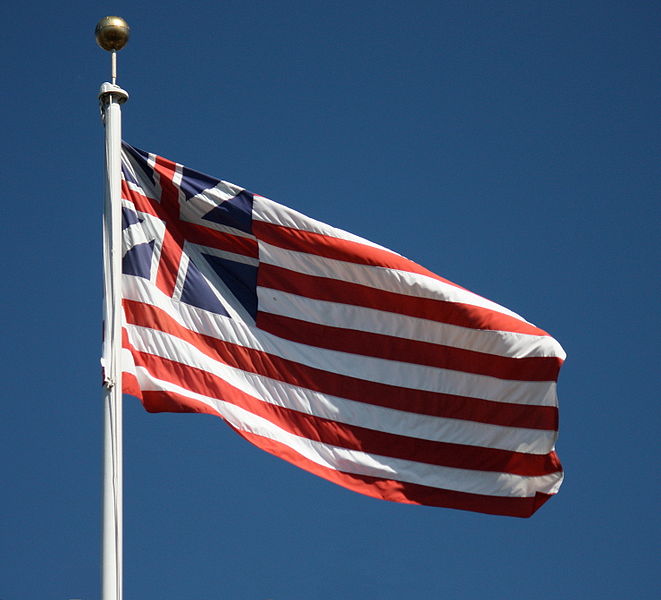
War with England was brewing and John Paul Jones offered his services on the sea. With the endorsement of Richard Henry Lee, Jones was commissioned as a First Lieutenant into the vast Continental Navy (they only had six vessels) on December 7th, 1775. As his ship, the Alfred set sail from the Delaware River on its maiden cruise he hosted the Grand Union Flag, (the first national flag of the United States,) it was the first time a US ensign was flown over a naval vessel. He next took command of the sloop Providence. He captured 16 prizes along the coast of Nova Scotia. Although he argued with Naval authorities, his reputation grew, he was given command of the USS Ranger and set sail for France. There he befriended American diplomats in Paris John Adams, Arthur Lee, and especially Benjamin Franklin (he named one of his boat the Bonhomme Richard in honor of Franklin’s Poor Richard’s Almanac.)  When the Bonhomme Richard was in dire straights in the Battle of Flamborough Head with the frigate Serapis he was offered the chance to surrender. Jones, of course answered that he had not yet begun to fight. He lost the Richard, but went on to capture the larger frigate.  Jones later earned the moniker  “Father of the American Navy.”

After the American Revolutionary War  Thomas Jefferson (who was then the American Ambassador to France) recommended him for service in Catherine II’s  Russian Navy. John Paul Jones then became Kontradmiral check Pavel Ivanovich Jones and served with Potemkin in the Black Sea campaign.

John Paul Jones, line drawing

John Paul Jones, line drawing (Photo credit: Wikipedia)

This media file is in the public domain in the United States. This applies to U.S. works where the copyright has expired, often because its first publication occurred prior to January 1, 1923.

A replica of the Grand Union Flag, the first flag of the United States of America.
(This image has been released into public domain by its author, Makaristos, and is courtesy Wikipedia.)


Public domain I, the copyright holder of this work, release this work into the public domain. This applies worldwide.
In some countries this may not be legally possible; if so:
I grant anyone the right to use this work for any purpose, without any conditions, unless such conditions are required by law.

Thought of the Day 7.5.12

“If I shoot at the sun I may hit a star”

— P.T. Barnum

Phineas Taylor Barnum was born in Bethel, Connecticut in 1810. He would be 202 years old today.

According to the Ringling Bros. and Barnum & Bailey website P.T. Barnum presented “the public of the 19th century shameless hucksterism, peerless spectacle and everything in between.”  The consummate promoter, Barnum began by presenting acts in New York. Here’s a few of the live acts and curiosities the “Master Showman” brought to the public: Joice Heth — a blind, nearly paralyzed slave woman, whom he claimed was the 161 year old Nurse to George Washington;  Charles Stratton, aka General Tom Thumb– “The Smallest Person that Ever Walked Alone;” and the embalmed remains of the “Feejee Mermaid.” In 1850 he presented a more refined act when he brought “The Swedish Nightingale” Jenny Lind to the American Stage.

In 1870 Barnum took his show on the road with P.T. Barnum’s Grand Traveling Museum, Menagerie, Caravan and Circus. The Circus made $400,000 its first year and quickly became known as the “The Greatest Show on Earth”  Barnum also started America’s first aquarium.

Barnum lectured as a temperance speaker, served two terms in the Connecticut legislature and was mayor of Bridgeport.

Image courtesy of the Ringling Bros. and Barnum & Baily Circus website